"Countess Markievicz chaired the founding meeting of Fianna Fáil and was a Fianna Fáil TD..."
- Micheál Martin, Fianna Fáil.
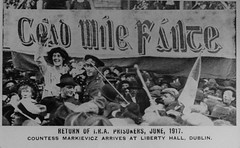
'Return of IRA prisoners, June 1917 : Countess Markievicz arrives at Liberty Hall, Dublin.'
Constance Georgina Gore-Booth was born in Buckingham Gate, London (the first of five children), on the 4th of February 1868, in what was then considered to be a 'high class' family - her father, Henry (the 'Fifth Baronet of Sligo') was a landowner and businessman, and her mother, Georgina (who died in January 1927, the same year as her daughter, Constance) , had her own connections to British 'high society', as she was the granddaughter of the 'Earl of Scarborough'.
Constance was raised on the family estate at Lissadell, in Sligo and, at 19 years of age, was 'presented' to Britain's 'Queen' Victoria , as was the custom in those days within her social group.
It was when she was in Paris to further her education (at the Julian School) in the late 1890's that she met a Polish 'Count', Casimir Dunin-Markievicz - he was already married at the time, but his wife died in 1899, and he and Constance got married in 1900.
They had one child together, Maeve Allys (who was raised by her grandmother, as her own mother, Constance, was heavily involved in politics) , who was born in Lissadell in 1901 and, two years later, the family moved to Dublin (prompting George Russell [AE/Æ/Aeon, his 'pen name'] to comment "...the Gore-Booth girl who married the Polish Count with the unspellable name is going to settle near Dublin...we might get the materials for revolt..")
Her interest in social issues brought her into contact with Irish republicans and others who were agitating for change in society and, to her credit, she remained steadfast to her republican beliefs -
"The old idea that a woman can only serve her nation through her home is gone.
Now is the time, on you the responsibility rests.
It may be as a leader, it may be as a humble follower, perhaps in a political party, perhaps in a party of your own, but it is there.
So many of you, the young women of Ireland, are distinguishing yourselves every day and coming more and more to the front ; we [older people] look to you with great hopes and a great confidence that in your gradual emancipation you are bringing fresh ideas, fresh energies.
Women, from having until very recently stood so far removed from all politics, should be able to formulate a much clearer and more incisive view of the political situation than men - you will go out into the world and get elected on to as many public bodies as possible..."
- Constance Markievicz, in a speech she gave to the Irish Women's Franchise League in 1915.
She was one of only two female officers that bore arms during the 1916 Rising, for which she was sentenced to death, a sentence later commuted to life imprisonment, but was released in June 1917.
In 1918 she was the first woman to be elected to the English 'House of Commons', but she never took her seat - instead, with other elected republicans, she helped to establish the First Dáil and served as 'Labour Minister' in that proud institution.
She opposed the Treaty of Surrender and played an active part in the struggle against the British-imposed 'parliament' that followed.
However, she joined de Valera and others and assisted with the formation of the 'Fianna Fáil' party, which was founded on the 23rd of March, 1926 and, the following year, she was elected as a Fianna Fáil candidate to the then-new Leinster House Free State parliament - but never took her seat, this time due to illness.
The poor woman suffered from peritonitis, and the treatment she received for same was administered too late : she died, at 59 years of age, as a member of Fianna Fáil - for which she will be forever tarnished, in our opinion - in a Dublin hospital at 1.25am on the 15th of July, 1927.


On the 4th February, 1919, newspapers in Ireland and England (and further afield) all led on their front pages with the same story - a prison escape by Irish republican rebels which had taken place the previous day.
In September 1919, the British declared Dáil Éireann to be an "illegal assembly" and it was forced to go 'underground' but, 'underground' or not, it still functioned.
Michael Collins and Harry Boland made plans to rescue de Valera from Lincoln Jail (pictured) in England and, on the 3rd February 1919 -
'..here is what actually happened at Lincoln Jail.
As de Valera regularly served Mass in the church jail, it was an easy matter for him to pocket a few candles.
He melted these down and took an impression of the Chaplain's master key. As there were double locks on every door, the master key was a must.
There were two ordinary keys made that didn't work : De Valera made the first impression and had it smuggled out of prison and sent to Gerard Boland in Dublin, who sent back the key in a Christmas cake but it didn't turn the lock.
A second impression was made which was sent to Manchester where craftsmen cut what they thought was a true replica but it, too, was a fiasco.
At that juncture Peter De Loughry told dev to have a blank key sent into the prison with a file, saying: "I'll cut it myself".
The blank key and the file arrived this time in a birthday cake and Peter, who was an expert locksmith, easily cut a perfect replica.
Outside waiting at the last gate to freedom were Michael Collins and Harry Boland and, as Collins spied Dev, Milroy and McGarry coming towards the door, he inserted another key, which he believed would open the last door to freedom.
He attempted to turn the lock, giving the key a powerful twist, but It broke in the lock. Collins was raging - "I've broken the key in the lock ; what are we going to do now?"
Dev muttered something while inserting the key Peter De Loughry had cut for him. It knocked out the broken part and with one turn the lock clicked open.
The five men shook hands and disappeared into the night. Peter De Loughry did not escape with the others as he had but a few weeks left to serve out his sentence...'
Rumours persist to this day that Westminster allowed de Valera to escape as they were aware that he would soon turn his back on republicanism and accept Westminster-imposed Free State structures, which he did in 1926, to the degree that he executed former comrades to help safeguard the British presence in Ireland.
Damn those weak locks in Lincoln Jail and damn those that followed de Valera through a 'constitutional door' and into Leinster House.

On the same day that those newspapers were - SHOCK! HORROR! - reporting on the audacity of rebel prisoners escaping, British politicians were meeting up in their so-called 'House of Commons'.
From Ireland, the 26 Unionist MPs and the 7 Nationalist MPs were in attendance, but none of the 73 Sinn Féin MPs turned up - they had their own Irish parliament in their own country to attend.
A British MP, a Mr Horatio Bottomley (! -pictured), took offence to the absence of the Irish rebels and proposed that a statutory instrument - 'the Call of the House' - be employed to compel them to attend.
That instrument had not been used in Westminster for 83 years as those employed (!) on the Grand Benches valued their free time during 'working hours' and Mr Bottomley's boss, a Mr Bonar Law, exhaled deeply and loudly at the very notion (!) and declared -
"The Government does not propose to take any action in the matter."
All members then went back to sleep.
Except, probably, Mr Bottomley...
==========================
GAS LADS...

The massive finds of oil and gas on our western seaboard could ensure Ireland's financial security for generations.
Wealth approximating that of the Arab countries is within our grasp, but the Irish government seems content to sell off our birthright for a handful of votes and a few dollars.
In a special 'Magill' report, Sandra Mara investigates just what we are giving away, and why.
From 'Magill' magazine, March 2002.
Some of those most directly affected in the West, meanwhile, told 'Magill Magazine that "..this is an opportunity for an incoming government to re-write our history - to return the family silver - by amending the terms and conditions of this most unusual, and seemingly inequitable, deal."
They say that, for them, this will be a major election issue.
They told 'Magill' -
"Only those politicians guaranteeing a reassessment of the deal and a restoration of an interest in our natural resources will get our vote."
('1169 Comment' - Ireland sits on an Atlantic margin geologically similar to Norway's North Sea yet, while Norway built a $1.5 trillion sovereign wealth fund from oil and gas, Leinster House politicians, led [by the nose] by a Mr Leo Varadkar, banned offshore exploration in 2019 and remains between 75% to 80% import-dependent (from England) for gas.
If developed, under proper political leadership, this whole country - North, South, East and West - could be energy self-sufficient, slash household bills, fund the entire HSA budget from royalties and still have hundreds of billions left for future generations, just like Norway, which is not only self-sufficient in its gas supply, but is also one of the world's net exporters of natural gas, producing at least 27 times more natural gas than it consumes.
Instead, we pay Arabs while leaving Irish hydrocarbons literally untapped in the ground...)
(END OF 'GAS LADS' : NEXT - 'The Great Oil And Gas Robbery', from 2005.)
ON THIS DATE (4TH FEBRUARY) 105 YEARS AGO : LAST DAY ON EARTH FOR AN UNWITTING FEMME FATALE.

Kitty O'Shea (pictured), was born as Katherine (/Katharine) Wood in 1846, on the 30th January ; she matured into an unwitting femme fatale, and is said to be practically solely responsible for 'the most notorious scandal of the late Victorian Age' - the downfall of Charles Stewart Parnell and the split which followed in the 'Home Rule Movement'.
'Kitty' was a name she would have hated, as it was slang for a woman of loose morals.
In fact, she only loved two men in her life and married both of them, though the marriage to Charles Stewart Parnell was to prove tragically short-lived as he died in her arms after a few brief months of happiness.
She was born Katharine Wood in 1845, and was known as Kate to her family. Her father was a baronet, a member of the British aristocracy and her brother a Field Marshall, although their grandfather had started life as an apprentice and was a self-made man.
The Woods were closely linked with the Gladstone family and Katharine often acted as a go-between with William Gladstone when Parnell was trying to persuade the British government to grant Ireland independence. She had married William O'Shea at the age of twenty-one, not long after the death of her father, and the marriage had produced a son and two daughters.
Mr O'Shea neglected his wife and pursued his own pleasures while she was often left to bring up the children alone, while also looking after her elderly aunt. She played the part of a dutiful wife, however, and hosted dinner parties to help her husband's career.
Mr Parnell, an important figure in Irish politics, was always invited, always accepted and yet never showed up.
Annoyed and perplexed by these apparent snubs she went to confront him in person at his office in Westminster in July 1880, and the effect was immediate ;
"This man is wonderful and different," she was to write later.
CS Parnell was a bachelor who had once loved and been rejected, and never took an interest in women again until he met Katharine. It was a suicidal love as she was married to a fellow Irish MP and was a respectable wife and mother.
The power of the attraction between the two, however, was impossible to resist and before long they were living together in her home in Eltham in the suburbs of London.
They had an illicit 'honeymoon' in Brighton and Katharine was to bear three children to Parnell while still married to O'Shea, the first of whom died soon after being born. It is even thought that she bore Parnell a son who could take his name after they finally married, although this child was stillborn.

Mr O'Shea (pictured) knew of the relationship but turned a blind eye to it. Then the Aunt died and left Katharine a large inheritance and he decided to divorce his wife and shame Parnell publicly.
The ensuing scandal ruined Parnell's career and his health.
His traditional supporters in Catholic Ireland turned away from him when they learned he had been living with a married woman even though he and his beloved Katharine became man and wife after they married at Steyning register office in Sussex, the county where they made their home.
In an attempt to revive his flagging fortunes, Parnell went to Ireland and spoke at a public meeting in County Galway. He was caught in a thunderstorm and developed a chill from which he never recovered. Seriously ill, he returned to be with Katharine and died soon afterwards. They had been married for only four months.
It is estimated that half a million people lined the streets of Dublin to pay their respects to Parnell as his coffin was taken to Glasnevin cemetery to be buried near Daniel O'Connell.
Later Eamon de Valera and Michael Collins were also laid to rest nearby.
On the granite stone above his grave lies just one word – 'Parnell', enough to identify Ireland’s flawed hero whose dream of a free and united country at peace with Britain was destroyed by his love for a married woman.

And what happened to Kitty, as the world now knew her?
It was all too much for her and she lived out her days quietly in Sussex.
She never married or fell in love again but looked after her children and died at the age of seventy-five.
When she was buried, only her immediate family came to the funeral and on her grave monument were the names of both her husbands with that of Parnell, the great love of her life, above that of O'Shea who gave her the name she is known by.
There is no sign of 'Kitty', however.
By the gravestone is a plaque placed by the Parnell Society with Parnell's promise to her:
"I will give my life to Ireland, but to you I give my love..."
Katharine Wood died on the 5th February 1921, at 75 years of age, in Littlehampton in Sussex, England, and is buried there.
RIP Katharine Wood.


On the 4th February, 1920, an armed IRA ASU met up in Kevin Street, in Dublin, and made their way to the DMP ('police) Barracks on the street.
On arrival, they noticed a small entry point to the sleeping quarters was unattended and open, and they lobbed a bomb into the room.
It exploded, causing extensive damage, but no casualties.
THE IRA ASU returned safely to base.

"People in the inner circles of unionism were opposed to the inclusion of Donegal, Cavan and Monaghan in a Northern Ireland (sic) assembly because that would provide such an access of strength to the Roman Catholic party, that the supremacy of the Unionists could be seriously threatened.
There is a real danger that on certain questions the Unionist Labour Party in Ulster (sic) might vote with the Roman Catholics..."
- A Mr Walter Long (pictured), in a report he delivered to the British Cabinet on the 4th February, 1920.
Mr Long was well got with the then 'powers-that-be' in Westminster - he was an ex-'Chief Secretary for Ireland' (appointed by 'Lord' Arthur James Balfour, the '1st Earl of Balfour') and was closely connected to unionists in Ireland.
On the 24th February (1920), the British Cabinet held a meeting at which they took Mr Long's 'advice'(warning) on board and they announced, internally, that they would be agreeable to grant the Irish unionists 'a Northern Ireland (sic) of six counties'.
Very generous of them, to be sure...

At the same time as Mr Long was 'advising' the British Cabinet in Westminister, about 350 miles (550km) away in another country, Ireland, the Thornton brothers were out in Galway, having a few pints.
One of them, Pat, was an ex-member of 'The Connaught Rangers Regiment' (aka 'The Devil's Own' - Mr Thornton fought with them in 'World War One') of the British Army but had been 'invalided out' of that grouping in November 1915.
He was known to be a bit of a mouthy character, who enjoyed pushing his weight around and, drunk or sober, would let it be known that he didn't favour the rebel Movement in Galway or Ireland.
But he was well-in with the 453 Crown Force members that were then stationed in Galway town, the 352 stationed in Ballinasloe, the 135 in Oranmore and with the smaller detachments in Gort (57) and Tuam (46).
However, other people, too, had made his acquaintance.
As the Thornton brothers left the pub on that night (4th February 1920) they were surrounded by a group of armed men who took Mr Pat Thornton to one side.
They beat him until he fell to the ground and then shot him dead.
The RIC later stated that "...he was unpopular in the area, had a bullying disposition, and he and his brothers were opposed to Sinn Féin.."
The group of armed men were never apprehended.
==========================
ON THIS DATE (4TH FEBRUARY) 130 YEARS AGO : DEATH OF 'SPERANZA OF THE NATION' ANNOUNCED.

"No voice that was raised in the cause of the poor and oppressed, none that denounced political wrong-doing in Ireland, was more eagerly listened to than that of the graceful and accomplished woman known in literature as 'Speranza' and in society as Lady Wilde..." - Martin MacDermott.
Lady Jane Wilde ('Speranza of The Nation' aka 'John Fanshaw Ellis') née Jane Francesca Elgee, mother of Oscar Wilde, died in London from bronchitis on the 3rd February 1896.
At the time, Oscar was incarcerated in Wandsworth Prison, serving a two year hard labour sentence for 'gross indecency' – homosexuality.
Despite her dying wish, she was not allowed to see him.
Lady Jane Wilde was famous in her own right as a writer and poet : she was an ardent nationalist in addition to being a staunch feminist. Her most famous poem is probably 'The Famine Year' -
The Famine Year (The Stricken Land).
Weary men, what reap ye?—Golden corn for the stranger.
What sow ye?— human corpses that wait for the avenger.
Fainting forms, hunger–stricken, what see you in the offing?
Stately ships to bear our food away, amid the stranger’s scoffing.
There’s a proud array of soldiers — what do they round your door?
They guard our masters’ granaries from the thin hands of the poor.
Pale mothers, wherefore weeping — would to God that we were dead;
Our children swoon before us, and we cannot give them bread.
Little children, tears are strange upon your infant faces,
God meant you but to smile within your mother’s soft embraces.
Oh! we know not what is smiling, and we know not what is dying;
We’re hungry, very hungry, and we cannot stop our crying.
And some of us grow cold and white — we know not what it means;
But, as they lie beside us, we tremble in our dreams.
There’s a gaunt crowd on the highway — are ye come to pray to man,
With hollow eyes that cannot weep, and for words your faces wan?
No; the blood is dead within our veins — we care not now for life;
Let us die hid in the ditches, far from children and from wife;
We cannot stay and listen to their raving, famished cries —
Bread! Bread! Bread! and none to still their agonies.
We left our infants playing with their dead mother’s hand:
We left our maidens maddened by the fever’s scorching brand:
Better, maiden, thou were strangled in thy own dark–twisted tresses —
Better, infant, thou wer't smothered in thy mother’s first caresses.
We are fainting in our misery, but God will hear our groan:
Yet, if fellow–men desert us, will He hearken from His Throne?
Accursed are we in our own land, yet toil we still and toil;
But the stranger reaps our harvest— the alien owns our soil.
O Christ! how have we sinned, that on our native plains
We perish houseless, naked, starved, with branded brow, like Cain’s?
Dying, dying wearily, with a torture sure and slow —
Dying, as a dog would die, by the wayside as we go.
One by one they’re falling round us, their pale faces to the sky;
We’ve no strength left to dig them graves — there let them lie.
The wild bird, if he’s stricken, is mourned by the others,
But we — we die in a Christian land — we die amid our brothers,
In the land which God has given, like a wild beast in his cave,
Without a tear, a prayer, a shroud, a coffin or a grave.
Ha! but think ye the contortions on each livid face ye see,
Will not be read on judgement–day by eyes of Deity?
We are wretches, famished, scorned, human tools to build your pride,
But God will take vengeance for the souls for whom Christ died.
Now is your hour of pleasure — bask ye in the world’s caresses;
But our whitening bones against ye will rise as witnesses,
From the cabins and the ditches, in their charred, uncoffin’d masses,
For the Angel of the Trumpet will know them as he passes.
A ghastly, spectral army, before the great God we’ll stand,
And arraign ye as our murderers, the spoilers of our land.
Folklore has it that, as she lay dying in her home (146 Oakley Street, Chelsea), on the 3rd February 1896, aware that her request to visit her son, Oscar, had been refused, her 'fetch' (apparition) appeared before Oscar in his cell.
Oscar was physically unable to arrange the details for his mother's funeral and that onerous task fell to his brother, William ('Willie') Charles Kingsbury Wilde who, unfortunately, was penniless.
Oscar managed to scrap together the bare amount to pay for the funeral service (which was held on the 5th February at Kensal Green Cemetery in London) but the family could not afford a headstone and so Jane Wilde was buried 'anonymously in common ground'.
The 'Oscar Wilde Society' later erected a Celtic Cross monument in her memory in the cemetery in the late 1990's.
As Oscar himself might have observed -
"Anyone who lives within their means suffers from a lack of imagination."

THE MONTH UNSPUN...
The stories that hit the headlines.
From Magill magazine, August 2002.
One major question needs to be answered -
Will people named in the report who acted illegally be pursued?
"Yes!", is the answer to that question if Enda Kenny is to be believed - he said in 'The Irish Times' that both the government and Opposition spoke in "one voice" on this issue and that possible prosecutions would be investigated "with vigour".
Vigour, though, may not be enough, and the reality is that very little else can be expected now that the Ansbacher report has been published.
Still, it will make good kindling for those winter fires...
(MORE LATER.)


One of 'The Big Houses' in County Meath, in Ireland, was a 100-roomed Palladian House, 'the ancestral seat of the Viscounts Langford and the Barons Langford...' - a mansion, known as 'Summerhill House' (pictured).
The British were known to 'commandeer' houses of that nature and repurpose them as 'Area HQ's', and the IRA were known to stop them from doing so.
On the night of the 4th February, 1921, the IRA took over the mansion and all lands attached, distributed the lands and farms of the estate equally between the estate workers and their families and set fire to the property.
The buildings were almost completely destroyed but stood, as ruins, until they were totally demolished in 1970.

On the 2nd February, 1921, two Crossley Tender lorries carrying 17 British Army Auxiliaries were driving between the towns of Granard and Ballinalee, in County Longford.
As those Crown Forces were passing through the village of Clonfin(/Cloonfin), they drove into an ambush position which had been established by Volunteer Seán MacEoin (a republican-gamekeeper-turned-Free State-poacher) and 20 of his rebel fighters in the IRA Longford Flying Column.
The rebels exploded a landmine under the lead lorry which wounded all the Auxiliaries in that lorry and killed the driver, and then opened fire on the second lorry.
The disoriented enemy troops, who were low on ammunition as they weren't expecting a gunfight on their travel, tried to fight back but the advantage was with the IRA and the Auxiliaries surrendered.
Eight of the foreign Auxie gunmen were wounded, and two more of their number died at the scene - a Mr Francis Craven ('ADRIC Service Number 1305', who had been wounded in the leg, and was killed by a bullet in the neck as he was bandaging his leg) and a Mr John Houghton ('ADRIC Service Number 1375').
Two of the wounded Auxie gunmen - a Mr George Bush ('ADRIC Service Number 1073') and a Mr Harold Clayton (pictured, above, 'ADRIC Service Number 1514') died from their wounds on the 4th February(1921).
(More about the Clonfin Ambush can be read here.)

On the 25th January, 1921, a Mr Edward Carson (pictured), the leader of the 'Ulster(sic)Unionist Party (UUP)' and 'Member of Parliament' for the Belfast Duncairn district, received a formal invitation from Westminster to become the first 'Prime Minister of Northern Ireland' (sic).
Mr Carson refused the invitation and, on the 4th February (1921), he resigned his position as the leader of the UUP (and was replaced by 'Sir' James Craig).
In his resignation speech to his fellow unionists, Mr Carson stated that Catholics have nothing to fear from the Protestant majority (in the Six Counties) and urged his colleagues "to give the same rights to the religion of our neighbours...", which was an implied, unspoken acceptance that Catholics did (rightly) fear the Protestant majority and an acknowledgement that that majority denied religious rights to their neighbours.
However, the Brits still favoured him - in late May that year, Westminster appointed him as a 'Lord of Appeal in Ordinary' (!)and, in early June, he was 'Created a Life Peer', and took that 'title'.
Ah sure he would have been better off altogether if he had told them to feck off years before...!
(...few more paragraphs about Mr Carson down below..)

After an attempt by armed men to lift him off the street, a man from Youghal, in County Cork - a Mr Alfred Kidney (a 31-year-old unemployed cabinetmaker), an ex-British Army soldier who maintained his contacts within that foreign army - was wary for his safety, especially when he was out and about.
And, as he was out and about on the 4th February 1921 on North Main Street in the town of Youghal, he was shot twice and "quickly succumbed" to his wounds.
His father received £750 (about €55,000 in todays money) in a compensation payment from Westminster...

On the same day that Mr Kidney met his maker, a few short miles away a rebel Volunteer, Lieutenant Patrick Crowley Junior (26, pictured) unfortunately met his -
"Volunteer Patrick Crowley remained at this time in our district (Maryborough/Timoleague, County Cork).
He was awaiting an appendix operation, and a bed was prepared by us for him - he had his meals in our house after being told there was no raiding parties expected.
Unfortunately, the place was surrounded this morning (4th February 1921) by military in single formation which closed in on the suspected houses.
When word came, Paddy and my brother ran by a fence for cover, only to run into Major Percival himself. They retraced their steps, Percival following and firing.
My sister and I ran after the two boys, hoping to save them from the firing, as we felt sure he would not fire on us. Then my sister caught Percival by the legs, he was on a gate, and held him fast, even though he beat her knuckles with a gun.
When he could not release himself, he pointed the gun at our brother and said he would shoot him dead if she did not let him go. We had hoped by this time that Paddy had got well away.
He was followed by Percival and was found stretched dead about a quarter of a mile from our home by a Cumann na mBan girl that was crossing to let us know of the raid.
My sister and I, with a few others, brought the body back to our house before the military had time to collect it. They came along with a local RIC man to identify the body but did not interfere again.
He was waked and buried from our house in Clogagh and was given full military honours, and Volunteer Charlie Hurley spoke at the grave after his burial..."
- Volunteer Mary Walsh of the Kilbrittain Cumann na mBan organisation.
"His death was a bitter blow to us all. From 1917 he had been a most active Volunteer and an outstanding leader..."
- Volunteer Liam Deasy, Commanding Officer of the Cork No. 3 Brigade (also known as the West Cork Brigade) of the Irish Republican Army.
In early January, 1921, on raiding the Crowley family house in the village of Kilbrittain in County Cork, again, and finding that rebel Volunteer, Lieutenant Patrick Crowley Junior, was not there, the Crown Force raiding party burned the family home down.
On the 4th February, 1921, celebrating their kill, those same Crown Force elements (from the 'Essex Regiment') drove into Kilbrittain Village and demolished the Crowley family shop.
Volunteer Lieutenant Patrick Crowley Junior is buried in Clogagh Cemetery in Timoleague, Carbery East, in County Cork.
RIP Volunteer Patrick Crowley.

On that same day, a few short miles away from where rebel Volunteer Lieutenant Patrick Crowley Junior was shot dead by Mr Percival, eight out of the ten Volunteers captured by the British at the Dripsey ambush site (on the 28th January 1921) were brought before a British Army court martial in Victoria Barracks in Cork City.
The other two rebel soldiers - Volunteer Jim Barrett and Volunteer Denis Murphy - were too badly wounded to be moved at that time : Volunteer Barrett had had one of his legs amputated but the operation went wrong and the poor rebel soldier died, and Volunteer Murphy, on recovering somewhat, was told on the 9th March that, on full recovery, he will be executed but that sentence was later commuted to 25 years imprisonment.
However ; the eight Volunteers - Patrick O'Mahony, Timothy McCarthy, Thomas O'Brien, Jeremiah O'Callaghan, Daniel O'Callaghan, John Lyons, Eugene Langtry and Denis Sheehan - with charged with 'levying war against His Majesty', a charge which carried the death penalty.
The 28th February was set as the date of execution.
It was during an IRA investigation after the failed ambush that it came to light that a local 'Lady of the Manor', a Mrs Mary Maria Georgina Lindsay, had informed to the Crown Forces about the up-coming ambush - Mrs MMG Lindsay had instructed her chauffeur, a Mr James Clarke, to drive her to the enemy forces with the information.
So the IRA paid Mrs MMG Lindsay and her staff a visit and took the woman and her driver away as hostages and, on the 26th February (1921), two letters were delivered to the 'General Officer Commanding' of the British Army 6th Division in Ireland, a Lieutenant General 'Sir' Edward Peter Strickland, KCB, KBE, CMG, DSO ETC ETC.
One of those letters was from the IRA, and stated.. "...if the five of our men taken at Dripsey were executed as scheduled on Monday morning 28th February 1921 by the military, the IRA would execute Mrs Lindsay and her chauffeur James Clarke, who have been convicted of spying and are under sentence of death.."
The second letter was from the Lady herself to Mr Strickland -
"I have just heard that some of the prisoners taken at Dripsey are to be executed. I write to beg that you will use your influence to prevent this taking place. My life will be forfeited for theirs, as they believe I am the direct cause of their capture.
I implore you to spare these men for my sake..."
No mention of the chauffeur.
Mr Strickland contacted his fellow KCB, KBE, CMG, DSO ETC ETC, a certain 'Sir' Cecil Frederick Nevil Macready, and the two of them discussed the quandary they had got themselves into.
The two of them agreed that the executions of the IRA Volunteers should go ahead, on the 28th, and it did.
Mrs Mary Maria Georgina Lindsay and her chauffeur, Mr James Clarke, were executed by the IRA on the 14th March, 1921, at Flagmount, in the Réileán (Rylane) district of Cork.
The Intelligence Officer of the Cork Number 1 Brigade IRA issued the following statement -
"In Mrs Lindsay's case, the death sentence passed by the IRA followed a flagrant and deliberate action against the Army, that of conveying information to the occupation forces in regard to the Dripsey ambush.
Even after sentence had been passed, an official letter from the Cork Number 1 Brigade to Major General Sir E. P. Strickland indicated that the sentence would not be carried out if the prisoners taken at Dripsey were treated as prisoners of war.
The communication was ignored and Mrs Lindsay was shot."
RIP to those brave IRA Volunteers.


As those eight rebels were appearing in that British 'court', about 85km (55 miles) up the road and westward across the country, the elderly proprietor of the Central Hotel (pictured) in Listowel, County Kerry, a Mr Jeremiah Galvin, was one of about 100 local men that had been forced, at gunpoint, by the Crown Forces, to clear blockages (pictured - trees, concrete blocks, old carts etc) from nearby roads, which had been placed there by the IRA, to draw the enemy forces out into the open.
As the men were being marched back to the town of Listowel after a days forced labour, Mr Galvin collapsed and died on the side of the road.
RIP Mr Jeremiah Galvin.

At the same time as that poor man died on a Kerry road, about 300 km (185 miles) up the road in Belfast, the first 'B Special' patrol (pictured) made its appearance on the streets - their colleagues in the 'A Special' grouping had been unleashed on the public in December, 1920.
And the Crown Forces were out in Dublin, too, on that same day - a Crossley Tender truck carrying British Army Auxiliary troops was driving down Eden Quay towards Liberty Hall when it came under attack from a rebel ASU comprising Volunteers from 'Section 1 Dublin Brigade IRA ASU', Volunteer Christopher Byrne from the 2nd Battalion and rebels from 'C Company' of the 4th Battalion, under the command of Volunteer Thomas Flood.
The Volunteers launched their attack but it didn't go as planned - IRA Section Commander Volunteer Thomas McGrath was shot through the leg during the engagement and three other rebels were wounded and captured.

On the 4th February, 1921, the 'County Kildare Farmers Union' was holding a local get-together in the Town Hall in the village of Naas, in County Kildare.
The British 'authorities' were wary of any organised body of Irish people because, inevitably, politics would be discussed, the seeds of rebellion could be sown or nurtured and contacts etc could be made.
So they sent in their soldiers and their 'police force', the RIC, carrying revolvers and rifles with fixed bayonets, and broke up the gathering.
Presumably contacts were made between the Farmers Union and the 'authorities' because, a few months later, another such Farmers Union get-together was held in the same venue but, this time, it was 'allowed' to proceed.
A resolution was raised, discussed and passed at that second meeting -
'That we, the farmers of North Kildare in the public meeting assembled, call upon the deputies representing this county in Dail Eireann to vote for the ratification of the Peace Treaty (sic).
We believed that the treaty contained all the essentials of national freedom, of economic development and lays the foundation of peace with honour, and that ratification is the only course open to Dail Eireann in the best interests of our nation.
We record our profound conviction that it is the bounden duty of the deputies indicated by the very designation of their office to faithfully and scrupulously interpret in their votes the will of the people by not only voting for, but using their influence to secure the ratification of the pact signed by the Irish Plenipotentiaries.'
Now THAT'S something the 'authorities' could approve of...
==========================
ON THIS DATE (4TH FEBRUARY) 206 YEARS AGO : FAMILY OF A 'UNITED IRISHMAN' FOUNDING FATHER GATHER FOR LAST MOMENTS.

"Nor one feeling of vengeance presume to defile
The cause, or the men, of the Emerald Isle..."
- the words of William Drennan (pictured), physician, poet, educationalist political radical and one of the founding fathers of the 'Society of United Irishmen', who was born on the 23rd May in 1754.
As well as his involvement with the 'United Irishmen', William Drennan will be forever associated with the descriptive term 'Emerald Isle' being used as a reference for Ireland, although he himself stated that that expression was first used in an anonymous 1795 song called 'Erin, to her own Tune'.
When he was 37 years of age, a group of socially-minded Protestants, Anglicans and Presbyterians held their first public meeting in Belfast and formed themselves as 'The Belfast Society of United Irishmen' (the organisation became a secret society three years later), electing Sam McTier as 'President', strengthing the link that William Drennan had forged with that revolutionary organisation - Sam McTier was married to Martha, who was a sister of William Drennan.
He was born on the 23rd May, 1754, at the manse of the First Presbyterian Church, Rosemary Street, Belfast, where his father was the minister.
A doctor by profession, he became one of the pioneers of inoculation against smallpox.
He became one of the founder members of the United Irishmen and, upon moving to Dublin in 1789, was appointed its Chairman.
After he was tried and acquitted of sedition in 1794, he withdrew from the movement and emigrated to Scotland but remained committed to his politics ; he married Sarah Swanwick in 1800, and they had four sons and a daughter.
'When Erin first rose from the dark-swelling flood,
God blessed the green island, he saw it was good.
The Emerald of Europe, it sparkled and shone,
in the ring of this world, the most precious stone.
In her sun, in her soil, in her station thrice blest,
With her back towards Britain, her face to the West,
Erin stands proudly insular, on her steep shore,
And strikes her high harp 'mid the ocean's deep roar...' (from here.)

The family were right to gather on the 4th : William Drennan died on the 5th (February 1820), at 66 years of age, and is buried in Clifton Street Graveyard, Belfast.
His coffin was carried by an equal number of Catholics and Protestants, and clergy from different denominations were in charge of the ceremony, as per his request.
RIP William Drennan.
DEATH IN THE MEDITERRANEAN...

Desmond Boomer, a Belfast engineer working in the Libyan oil-fields, disappeared seven years ago.
Officially, the plane on which he was a passenger crashed as a result of mechanical failure and pilot error.
But is that the real story?
Or were the Irishman and his fellow passengers unwitting victims of the shady war between Islamic fundamentalism and Mossad, Israel's intelligence network?
A special 'Magill' investigation by Don Mullan, author of 'Eyewitness Bloody Sunday'.
From 'Magill' magazine, January 2003.
On the 26th October, 1995, the leader of Islamic Jihad, Fathi Shqaqi, arrived in Malta, having disembarked from the Libya-Malta ferry 'Garnata'.
He was returning from a secret meeting with the Libyan leader, Muammar Gaddafi.
Shqaqi entered the island on a false passport to avoid detection.
It was his eleventh such trip since mid-December 1993 but, unknown to him, he was, on this occasion, being shadowed by members of the Israeli secret service, 'Mossad'.
According to 'Soldier of Fortune' magazine, Shqaqi signed his death warrant in January 1995 when he claimed responsibility for attacks in Israel...
(MORE LATER.)


The rebel Ladies worked long and hard that day and night, the 4th February 1922, re-checking the venue (the Round Room of Dublin's Mansion House), the seating arrangements, the stage etc - in final preparation for their 'Special Convention' to be held in that venue the following day.
The Treaty of Surrender was up for debate within the Cumann na mBan organisation and the delegates (about 500 Ladies) were confident that the majority of those voting would stand by their Irish republican beliefs and vote 'Yes' to reject that foul document.
And so it was - 419 voted to reject the Treaty, 63 to accept it - the first major militant Irish group to officially split over the Treaty.
The group of Treaty-supporting activists left Cumann na mBan and formed themselves into a new group, 'Cumann na Saoirse' and, a few years later, when the Fianna Fail party was founded, more Cumann na mBan members left the organisation to join Eamon de Valera in his new party.
Also, in the mid-1930's, yet another group from within Cumann na mBan left to form 'Mna na Poblachta' but the Cumann na mBan organisation itself stayed true to its republican principles in 1970 and again in 1986, when opportunists again left the then Republican Movement to seek their political (and financial) fortunes in constitutional political assemblies.

"As things developed in 1922, we could see that the Free State was toeing the line for Britain. Nearly all the girls stayed republican, but the men seemed to waver...we offer no apology to the rulers North or South of this partitioned land in asserting our rights as freeborn Irish women to repudiate that Treaty and the Imperial Parliament of partitioned Ulster. We fight for an Ireland where the exploitation of Irish workers by imported or native capitalists will be ruthlessly exterminated. (We will) put an end for all time to that state of chaos and social dis-order which is holding our people in unnatural bondage..." - Eithne Coyle, Cumann na mBan President.

On the 4th February, 1922, Irish and English newspapers published articles on the shooting dead the previous day of two RIC members.
A Mr William Gourlay (32), from Lanark in Scotland, and a Mr Frank Kershaw (23), from Lancashire in England, left Green's Pub in Lisdoonvarna, County Clare and were shot dead shortly afterwards.
Mr Gourlay had eight months 'service' with the RIC, and his drinking buddy, Mr Kershaw, had twelve.
==========================
ON THIS DATE (4TH FEBRUARY) 105 YEARS AGO : DUBLIN-BORN UVF LEADER RESIGNS HIS POLITICAL POSITION.

Edward Carson, born in Dublin in 1854, died in Kent, England, in 1935, age 81.
Mr Carson was born in Dublin in 1854,and was educated at Portarlington School, Trinity College, and King's Inns.
He died at 8am on the 22nd October 1935 on the Isle of Thanet in Kent, England.
His beloved empire had conveyed the title of 'Right Honourable The Lord Carson KC PC' on him, a prefix he was delighted to take with him to his grave.
He was virulently anti-(Irish) republican, and never hesitated to encourage others to despise those he considered to be of a 'lower class' -
"We must proclaim today clearly that, come what will and be the consequences what they may, we in Ulster will tolerate no Sinn Féin - no Sinn Féin organisation, no Sinn Féin methods.
But we tell you (the British Government) this : that if, having offered you our help, you are yourselves unable to protect us from the machinations of Sinn Féin, and you won't take our help ; well then, we tell you that we will take the matter into our own hands.
We will reorganise, as we feel bound to do in our own defence, throughout the province, the Ulster Volunteers.
And those are not mere words.
I hate words without action..."
- the 'not mere words' of then soon-to-be paramilitary leader Edward Carson ('Lord Carson of Duncairn') at an 'Orange' rally in Finaghy, Belfast, County Antrim.
Mr Carson was a staunch supporter of the Irish (pro-British) Unionists and, at 38 years young, was elected as a Unionist MP (to Westminster) for Dublin University and, again at that same age, was appointed (British) 'Solicitor General for Ireland'.
He served as the 'Solicitor General for England' from 1900 to 1905, and was also an Irish barrister, a judge and politician, and the leader Of 'The Irish Unionist Alliance' and 'Ulster Unionist Party'.

At 57 years of age (in 1911*) he was elected leader of the 'Ulster Unionist Council' (UUC) and helped to establish the 'Ulster Volunteer Force' (UVF), a pro-British militia (*he wrote to his friend James Craig, pictured, re his UUC leadership that he intended "...to satisfy himself that the people really mean to resist. I am not for a game of bluff and, unless men are prepared to make great sacrifices which they clearly understand, the talk of resistance is useless...") .
On the 3rd of September 1914, in an address he delivered in Belfast to the 'UUC', he stated -
"England's difficulty is not Ulster's opportunity. However we are treated, and however others act, let us act rightly.
We do not seek to purchase terms by selling our patriotism...." (A lesson there, without doubt, for all the gombeens that inhabit the Leinster House institution!)
From 1915 to 1916 he served as the British Attorney General, and was appointed as the 'First Lord of the Admiralty' in 1916 (until 1917) and was a member of Lloyd George's War Cabinet from 1917 to 1918.
Westminster thought so highly of him that they offered him an even bigger 'prize' - that of the 'Premiership' of the new Six County 'State' - but he refused, and retired from public life and resigned as *leader of the Ulster Unionist Party on the 4th February 1921, at 67 years of age (* he was replaced by a Mr James Craig) .
Mr Carson had held that position since 1910, when he was elected to lead the 'Irish Unionist Party' - he was then appointed a 'Lord of Appeal in Ordinary' ['law lord'], entering the 'House of Lords' on the 24th May that year.
In June 1935, at 81 years of age, Mr Carson contracted bronchial pneumonia but, even though he recovered some good health within weeks, a few months later his strength weakened again and he died on the 22nd of October, 1935.
ON THIS DATE (4TH FEBRUARY) 145 YEARS AGO : 'LAND LEAGUE' LEADER ANNOUNCED 'TO HAVE BEEN ARRESTED BY BRITISH FORCES'.

On the 21st October 1879 a meeting of concerned individuals was held in the Imperial Hotel in Castlebar, County Mayo, to discuss issues in relation to 'landlordism' and the manner in which that subject impacted on those who worked on small land holdings on which they paid 'rent', an issue which other groups, such as tenants' rights organisations and groups who, confined by a small membership, agitated on land issues in their own locality, had voiced concern about.
Those present agreed to announce themselves as the 'Irish National Land League' (which, at its peak, had 200,000 active members) and Charles Stewart Parnell (who, at 33 years of age, had been an elected member of parliament for the previous four years) was elected president of the new group and Andrew Kettle, Michael Davitt, and Thomas Brennan were appointed as honorary secretaries.
The leadership had 'form' in that each had made a name for themselves as campaigners on social issues of the day and were, as such, 'known' to the British authorities ; Michael Davitt, who was born into poverty in Straide, Mayo, on the 25th of March, 1846 - at the time of the attempted genocide/ An Gorta Mór - was the second of five children, and was only four years of age when his family were evicted from their home over rent owed, and the dwelling was destroyed by the evicting militia.
His father, Martin, was left with no choice but to travel to England to look for a job.
Martin's wife, Sabina, and their five children, were given temporary accommodation by the local priest in Straide.
The family were eventually reunited, in England, where young Michael attended school for a few years.
His family were struggling, financially, so he obtained work, aged 9, as a labourer (he told his boss he was 13 years old and got the job - working from 6am to 6pm, with a ninty-minute break and a wage of 2s.6d a week) but within weeks he had secured a 'better' job, operating a spinning machine but, at only 11 years of age, his right arm got entangled in the machinery and had to be amputated.
There was no compensation offered, and no more work, either, for a one-armed machine operator, but he eventually managed to get a job helping the local postmaster.

He was sixteen years young at that time, and was curious about his Irish roots and wanted to know more - he learned all he could about Irish history and, at 19 years young, joined the Fenian movement in England.
Two years afterwards he became the organising secretary for northern England and Scotland for that organisation but, on the 18th July 1870 - in his early 20's - he was arrested in Paddington Station in London after the British had uncovered an IRB operation to import arms.
He was sentenced to 15 years imprisonment, on a 'hard labour' ticket, and served seven years in Dartmoor Prison in horrific conditions before being released in 1877, at the age of 31, on December 19th.
Almost immediately, he took on the position as a member of the Supreme Council of the IRB and returned to Ireland in January 1878, to a hero's welcome.
At the above-mentioned meeting in the Imperial Hotel in Castlebar he spoke about the need "..to bring out a reduction of rack-rents...to facilitate the obtaining of the ownership of the soil by the occupiers...the object of the League can be best attained by promoting organisation among the tenant-farmers; by defending those who may be threatened with eviction for refusing to pay unjust rents; by facilitating the working of the Bright clauses of the Irish Land Act during the winter; and by obtaining such reforms in the laws relating to land as will enable every tenant to become owner of his holding by paying a fair rent for a limited number of years..."
In January 1881, Westminster introduced a 'Land Act' ('Coercion/The Protection of Person and Property Act') which was the first of over a hundred such 'laws' that aimed to suppress the increasing discontent in Ireland with British 'landlordism' and it was under those 'laws' that, on the 3rd February, 1881, Michael Davitt was arrested for being too 'outspoken' in his speeches (he had then only recently addressed a crowd in Loughgall, County Armagh : "Landlords of Ireland are all of one religion. Their god is mammon and rack-rents and evictions their only morality while the toilers of the fields – whether Orangemen, Catholics, Presbyterians or Methodists – are the victims...").
While in prison, he was elected MP for Meath but was disqualified from taking his seat as he was 'an incarcerated felon'.
Michael Davitt died at 60 years of age in Elphis Hospital in Dublin on the 30th of May 1906, from blood poisoning - he had a tooth extracted and contracted septicaemia from the operation.
His body was taken to the Carmelite Friary in Clarendon Street, Dublin, then by train to Foxford in Mayo and he was buried in Straide Abbey, near where he was born.
RIP Michael Davitt.


On the 4th February, 1923, between 150 and 200 delegates attended a conference in Dublin organised by a grouping calling itself 'The Neutral IRA Members Association' ('NIRAMA'), which had been formed by ex-Volunteers Donal O’Hannigan, MJ Burke and Florrie O’Donoghue, among others.
The organisation (which claimed to have about 20,000 members) expressed opposition to the on-going Free State executions of IRA POW's and called on the Free State Army and the IRA to hold one month's ceasefire/truce, during which each entity should examine the possibility of disbanding itself and joining together to form one army, composed entirely of Volunteers who were in the pre-Truce IRA.
The 'NIRAMA' suggested that, during the month-long truce, peace proposals be exchanged between the FSA and the IRA, but both sides rejected that suggestion.
Volunteer Tomás Ó Deirig (Thomas Derrig, a republican-gamekeeper-turned-Free State-poacher), the then Adjutant General of the IRA, advised de Valera that accepting the 'NIRAMA' proposals would be tantamount to surrendering the Republic - de Valera agreed, and added that he didn't trust ex-Volunteer Florrie O’Donoghue.
In a meeting with two members of the Executive Council of 'The Neutral IRA' (Donal O'Hannigan and MJ Burke) to discuss their proposals, a Mr William Thomas Cosgrave, the 'President of the Executive Council of the Irish Free State' (ie the 'PM' - plus, he doubled-up as the 'FS Minister for Finance' on occasion) said that any such truce would place his administration at a tactical disadvantage as his opponents would gain if the peace talks failed or succeeded, due to the fact that he and his would have gone back on their pledge not to negotiate.
He also said that, in his opinion, the IRA leadership could control, at most, only 90 per cent of its forces and that the remainder could do a lot of damage.
"I am not going to hesitate..." he told the two 'NIRAMA' representatives, "..if we have to exterminate ten thousand republicans, the three million of our people is bigger than this ten thousand..."
'The Irish Times', which was then a newspaper rather than that which it is today, a Leinster House PR broadsheet published daily, quoted a Mr Kevin O'Higgins, the then 'Vice-President of the Executive Council of the Free State' (plus - he doubled-up as the 'FS Minister for Home Affairs') as describing the 'NIRAMA' as either 'moral cowards who knew that the anti-Treaty campaign was wrong and were afraid to say so or physical cowards who thought that it was right but were afraid to participate...'.
A plague on BOTH of their houses, in our opinion.
Finally - somewhat exasperated that their venture had failed, the 'NIRAMA' began to wind down their organisation and, by late March 1923, it effectively ceased to exist.
Worth a shot.
But then, so were the Staters...
==========================
Thanks for the visit, and for reading - appreciated!
Sharon and the team.
(We'll be back on Ash Wednesday, 18th February 2026.)


