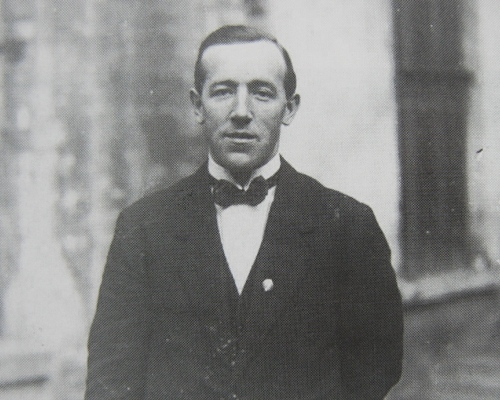
On the 7th January, 1920, the Commander-in-Chief of the British Army in Ireland, a 'General Sir' Mr Nevil Macready, and his GHQ Staff, issued an order to their Divisional Commanders to prepare lists of the commanders, officers and prominent members of the IRA in their areas.
So-called 'legal warrants' for the arrests of the rebels named on those lists would be drawn up and made available for collection by what was deemed by the British to be the 'competent military authority' in Ireland - the commanding officers of British Army Divisions and/or designated brigade commanders.
Rebels who were 'arrested' would be subject to 'Regulation 14b (of the) Defence of the Realm Act' ie interned and then deported to England unless evidence of a criminal offence was discovered, in which case they were to handed over to 'the civil power'(the RIC).
These 'arrests' were to be synchronised across British Army Divisions in Ireland on the night of the 23rd/morning of the 24th January(1920) and the 'competent military authority' carrying them out was 'authorised' to search individuals and buildings for arms, explosives and 'seditious literature' at any time of the day or night provided 'the greatest care and consideration was given to law-abiding citizens, women and children...'!
Oh well that's different then - "We're gonna storm your house and pull it apart but we'll do it with the greatest care and consideration..."

At the same time as Mr Macready and his Staff were issuing their 'raid gently' order, the 'General Officer Commanding Dublin District' of the British Army, a Mr 'Sir' Gerald Farrell Boyd (pictured) declared that the Dublin District was to be considered, jurisdictionally, to be a 'British Army Division'-area of operations rather than what it was up until then - a Brigade Area of the 5th Division of the BA.
Mr Boyd and his people were aware of the level of resistance offered by the Dublin rebels and were re-organising in the hope that they could get the better of it.

On the same date that Mr Boyd issued his 'regroup' instructions, his armed men (BA and RIC) raided the Sinn Féin Bank (pictured) in No. 6 Harcourt Street in Dublin, with the intention of closing it down and boarding-up the building.
The bank manager (and sole employee), a Mr David Kelly, approached the raiding party and demanded to see the 'warrant' - the 'closure order' - as he was entitled to know whether it was the RIC or the BA that had issued it ; this legal 'interference' stalled proceedings for perhaps 30 minutes but didn't prevent it, and the building was duly boarded up (...and the whole banking operation quickly resumed operations at No. 3 Harcourt Street!).
The raiding party got back in their trucks and drove up the road to No. 76 Harcourt Street, where Michael Collins sometimes operated from (the Dáil's 'Department of Finance', if you like!) but he wasn't in at the time - so they boarded-up that building as well!

On the same date that the British closed down the above two Irish institutions, a new one opened up.
Under the guidance and directorships of Robert Barton, Henry Gratten-Bellew, Erskine Childers, Edward Stephens and James MacNeill, 'The National Land Bank' held its first general meeting in Dublin, with a Mr Lionel Smith-Gordon responsible for the day-to-day running of the bank.
Within days they had acquired a premises to operate from - No. 68 Lower Leeson Street in Dublin City Centre (pictured) - and were aware that banking institutions that were not 'loyal to the Crown' were liable to be paid a visit by Crown agents, so they transferred their funds to about twenty co-operative banks, mainly in the north of England, for safe-keeping.
The existing Westminster-established 'Irish Land Commission' office/department was re-established/beefed-up by the Staters in 1923, to challenge the pro-Irish 'National Land Bank' and, within about three years, the latter found itself in a vulnerable position, financially.
The 'official banker' to the new Irish Free State administration, the so-called 'Bank of Ireland', saw its opportunity to move in for the kill and, in 1926, took over 'The National Land Bank'.
The 'Bank of Ireland' entity continued the operations of the 'Land Bank' for the short time it took them to announce the closures of most of its offices and the rebranding of them as 'The National City Bank Ltd' before fully merging them in to 'The Bank of Ireland Group' in 1969.
'The National Land Bank' started out as an institution to provide safeguards to working-class people and small farmers but, once the Staters got hold of it, it became yet another soulless place that would lend you money if you could prove that you didn't need it...
==========================
ON THIS DATE (7TH JANUARY) 104 YEARS AGO : ROUSING ANTI-TREATY SPEECH DELIVERED IN DÁIL ÉIREANN.

Henry James 'Harry' Boland (pictured, 27th April 1887 – 2nd August 1922).
"I rise to speak against this Treaty because, in my opinion, it denies a recognition of the Irish nation.
I object to it on the ground of principle, and my chief objection is because I am asked to surrender the title of Irishman and accept the title of West Briton.
I object because this Treaty denies the sovereignty of the Irish nation, and I stand by the principles I have always held — that the Irish people are by right a free people.
I object to this Treaty because it is the very negation of all that for which we have fought.
It is the first time in the history of our country that a body of representative Irishmen has ever suggested that the sovereignty of this nation should be signed away.
We secured a mandate from the Irish people because we put for the first time before the people of Ireland a definite issue ; we promised that if elected we would combat the will, and deny the right of England in this country, and after four years of hard work we have succeeded in bringing Ireland to the proud position she occupied on the fifth December last ('1169' Comment - on the 5th December [1922], Westminster enacted 'The Irish Free State Constitution Act', which gave 'legal sanction' to the new Constitution of the Irish Free State. That was sold by Michael Collins and his Stater comrades as "the freedom to achieve freedom...").
The fight was made primarily here in Ireland ; but I want to say that the fight that was made in Ireland was also reflected throughout the world and we — because we had a definite object — had the sympathy of liberty-loving people everywhere.
I have taken one oath to the Republic and I will keep it. If I voted for that document I would work the Treaty, and I would keep my solemn word and treat as a rebel any man who would rise out against it.
If I could in conscience vote for that Treaty I would do so, and if I did I would do all in my power to enforce that Treaty ; because, so sure as the honour of this nation is committed by its signature to this Treaty, so surely is Ireland dead.
We are asked to commit suicide and I cannot do it....."
(7th January, 1922, from here.)
It is generally considered that Harry Boland was the first man to be 'unofficially executed' by a Michael Collins-controlled Free State death squad on the evening of Sunday 30th July/early Monday morning 31st July 1922 and, following that shooting, in the Grand Hotel in Skerries, Dublin, the State gunmen issued this statement (on Monday 31st July 1922) -
"Early this morning a small party of troops entered the Grand Hotel to place Mr. H.Boland TD under arrest.
Mr. Boland had been actively engaged in the irregular campaign.
When accosted in his bedroom he made an unsuccessful attempt to seize a gun from one of the troops and then rushed out to the door.
After firing two shots at random and calling on Mr. Boland to halt, it was found necessary to fire a third shot to prevent an escape.
Mr. Boland was wounded and removed to hospital.
A man giving his name as John J. Murphy, with residence at 3 Castlewood Avenue, Ranelagh, Dublin, who was found with Mr. Boland, was taken prisoner.
Subsequently he was identified as Joseph Griffin* , an active irregular, belonging to Dublin."
(*'1169' Comment - Joe Griffin was an IRA operative within the Movement's Intelligence Department.)
One of the Free State troops present at the time stated afterwards - "Mr.Boland was wanted and we went to the hotel and two or three of us entered his room. He was in bed. We wakened him and he got up out of bed and partly dressed himself. He had no gun.
Suddenly he turned and rushed to tackle one of our fellows for his gun. A shot was fired over his head to desist but he continued to struggle and almost had the gun when a second shot was fired and Mr.Boland was wounded."
The bullet entered his right side near the ribs, passed through his body and came out through his left side causing very serious injuries.


Although unarmed at that moment, as admitted by his executioners, caught by surprise and outnumbered (a "small party" of Free State troops were in the room at the time) the Staters attempted to present the execution of Harry Boland as 'a killing in self-defence' ie 'he attempted to jump us and then tried to flee...'.
They had learned that script from their British colleagues.
Harry Boland died from his wounds on the 2nd August 1922, in St. Vincents Hospital, Dublin and, as he lay waiting for death, he told family members that the Stater who shot him had been imprisoned with him in Lewes Prison, in England, for Irish republican activity, but he refused to put a name to him.
The funeral expenses were taken care of by the Cumann na Poblachta organisation.
'Boland's mix of animal charm, gregariousness, wit and a dash of ruthlessness made him an influential and formidable character. Though not an intellectual in his manner he was a clear thinker, a forceful orator and a graceful writer....' (from here.)
Thankfully, there are those like him who continue to this day to work for the Movement.
RIP Volunteer Henry James 'Harry' Boland.
GAS LADS...

The massive finds of oil and gas on our western seaboard could ensure Ireland's financial security for generations.
Wealth approximating that of the Arab countries is within our grasp, but the Irish government seems content to sell off our birthright for a handful of votes and a few dollars.
In a special 'Magill' report, Sandra Mara investigates just what we are giving away, and why.
From 'Magill' magazine, March 2002.
The Corrib co-venturers estimate that on-going employment would be "..in the region of 50 to 65 people, most of whom would be likely to reside locally."
In an October 1998 report on the Corrib North region, international consultants 'Wood McKenzie' (independent oil and gas assessors within Natwest's Market Corporate and Investment Division) indicated that the find could yield between five and seven trillion cubic feet ('TCF') of gas.
Current estimates for the immediate Corrib area is around one 'TCF', with a monetary value of almost €3 billion and, if the area does yield seven 'TCF', then the find could be worth in excess of €21 billion, and this, with write-offs and tax breaks, a no-royalties deal and no State cut, means that 'Enterprise Energy Ireland' can make massive profits for its stated capital costs of €634 million, plus ancillary costs...
(MORE LATER.)
ON THIS DATE (7TH JANUARY) 103 YEARS AGO : LEINSTER HOUSE ANNOUNCES INTERNALLY THAT FIVE IRA MEN ARE TO BE EXECUTED.

In memory of Leo Dowling, Sylvester Heaney, Laurence Sheeky, Anthony O'Reilly and Terence Brady.
'Laurence Sheeky had a remarkable short life. He was just 22 when he was executed in 1923 during a turbulent time in Irish history...(he) was born 1901, the son of Patrick and Margaret Sheeky, in Braystown, Robinstown Co. Meath. He joined the (Free State) Army and in 1922 Private Sheeky was assigned to Baldonnel Aerodrome to guard aircraft.
Around this time the Leixlip Flying IRA Column was founded and its leader, Patrick Mullaney, a teacher from Balla, Co. Mayo, would often visit Baldonnel and became very friendly with the Free State soldiers, Laurence Sheeky amongst them.
On the 27th September 1922 the provisional (FS) government granted itself emergency powers, that any civilian charged with taking up arms against the State or even possessing arms could be tried in a military court and face the death penalty.
Still, such a sentence did not impact on Laurence's Republican feelings and he decided to join the Flying Column.
In December 1922, the Column came under attack after taking over Grangewilliam House in Leixlip and after a fierce gun battle, 20 IRA gunmen were captured, Sheeky and Sylvester Heaney from Dillonstown amongst them as well as Thomas McCann from Duleek Street, Drogheda, who had also been stationed at Baldonnel.
They were put on trial and the death sentence was handed down to Sheeky and Heaney, who was just 19 at the time.
Three others would also be put to death and (as confirmed, internally, on the 7th), on the 8th January 1923, the five were executed by firing squad.
Laurence Sheeky's family were never told about his execution and his parents learned of their son's death on their way to Ardee by a family friend who sympathised with them.
In 1938, Laurence Sheeky's body was brought home to Co Meath and he was buried in the new cemetery on the Boyne Road with full military honours...

After a skirmish on the border of County Kildare and County Meath, the Meath Anti-Treaty IRA column, consisting of 22 men under Paddy Mullally is captured. The Republicans attack a Free State supply column near Leixlip. One Republican and one Free State soldier are killed in the action and three Republicans are wounded. Five of the Anti-Treaty men, who had previously deserted from the National (FS) Army, are executed in Dublin on 8 January 1923 for "treachery".
Three Meath men were executed in 1923, Two, Laurence Sheeky from Braytown and Terence Brady from Wilkinstown, were executed in Portobello on 8th January 1923 and Thomas Murray from Kilcarn but originaly from Whitecross Co, Armagh was executed on 13th January 1923 in Dundalk Jail.
Laurence Sheeky and Terence Brady were executed with comrades Leo Dowling from Askinran Co, Kildare, Sylvester Heavey from Dillonstown Co, Louth and Anthony O`Reilly from Celbridge Co, Kildare. All five who deserted from the National army were arrested in Leixlip Co, Kildare on 1st December 1922 when an attack was carried out on an army (FS) supply lorry which had broken down in the townland of Collinstown on the Maynooth road.
In follow up searches carried out by the Free State army a number of confrontations occurred with insurgents resulting in over twenty insurgents being arrested.
During the battles three insurgents were wounded and a Free State soldier killed. Twenty one rifles, a Thompson sub-machine gun, six revolvers, a Lewis sub-machine gun, grenades and a substantial amount of ammunition were recovered.
The five - Sheeky, Brady, Dowling, Heavey and O'Reilly - were brought to Kilmainham Jail and Court Marshalled on 11th December 1922. The charges were as follows:
1) "TREACHERY ON THE 1ST DECEMBER 1922 IN THAT THEY AT LEIXLIP, CO, KILDARE ASSISTED CERTAIN ARMED PERSONS IN USING FORCE AGAINST THE NATIONAL ARMY"
2) "TREACHERY COMMUNICATING AND CONSERTING WITH ARMED PERSONS MENTIONED IN THE FIRST CHARGE, IN THE PLACE AND AT THE TIME MENTIONED"
All five were found guilty of both charges and sentenced to death. The men were executed on 8th January 1923 at Keogh barracks and were buried there, however, just a year later, the bodies were handed over to the families for burial in their own home towns...' (from here.)
In memory of those Irish republicans executed by colleagues who were led astray and turned against them.
ON THIS DATE (7TH JANUARY) 86 YEARS AGO : MEDIA REPORT THAT REPRESSIVE FREE STATE LAWS WERE TO BE UPDATED.

On the 7th January, 1940, media reports concentrated on the previous days announcement by the then Free State President, Douglas Hyde (pictured) : he had stated that it was his intention to convene his 'Council of State' (this was the first such meeting ever of said body) to discuss a bill he was asked to sign, concerning an amendment to the heavy-handed 'Offences Against the State Act 1939', which would have allowed the Leinster House administration to intern Irish-born citizens in a move said to be necessary in the Free State's fight against the IRA.
It should be noted that those who wanted that power fully intended to use it against men and women that they had fought side-by-side with only twenty years previously.
On the 8th January 1940 the 'Council' held a meeting in a Free State residence in Dublin's Phoenix Park (behind closed doors, minutes not made public) following which Hyde announced that he was going to refer the proposed amendment/legislation to the Free State 'Supreme Court', stating that he also intended to seek a judgement on the 'Offences Against the State (Amendment) Bill 1940' in its entirety.
The 'Supreme Court' replied that, in its opinion, 'it was within the power and the authority of the Oireachtas, consistent with the Constitution, to enact such legislation'.
Mr Hyde then signed the necessary paperwork, no doubt having convinced himself that he had done all in his power to prevent further injury to the republicans he would have associated with during his years as a member of the 'Society for the Preservation of the Irish Language', the 'Gaelic League' and the 'Gaelic Journal'.
But easing your conscience isn't the same as cleansing it.


The leadership of the East and West Waterford Brigades of the IRA (Volunteers Pax Whelan, Paddy Paul, George Lennon and Pat Keating) assembled their sixty fighters and told them that an ambush had been planned for the night of the 7th January (1921).
A small section of the rebels would attack the RIC barracks in Tramore, County Waterford, in the knowledge that those inside the barracks would call for assistance from their grouping based in Waterford City, who would send one or two lorries of armed men in response.
The lorry/lorries would drive through Pickardstown Cross on their way to Tramore Barracks, which is where the majority of the IRA Brigade were waiting for them.
But four lorry-loads of armed British soldiers were sent and, just as they approached the ambush position, one of the IRA Volunteers fired a shot prematurely, removing the element of a surprise attack and alerting the enemy forces.
A gun battle ensued but, being low on ammunition, the Volunteers had to stage a withdrawal, section by section.
Four rebel fighters were hit - Volunteers Michael McGrath, Thomas O'Brien, Michael Wyley and Nicholas Whittle - with Volunteers McGrath and O'Brien dying from their wounds.
Volunteers Wyley and Whittle were brought to a hospital in Waterford and were receiving treatment when other IRA men entered the ward to remove them and their bodyguards as the Crown Forces were on their way to 'arrest' them ; an RIC Sergeant, a Mr John Greene, who was friendly to the IRA and the Cause, had tipped the rebels off about the impending hospital raid.
The IRA party vacated the building before the BA/RIC raiders arrived.
In late June/early July 1921, an 'action audit' was carried out by the IRA on its structure in the Waterford area and, on the 6th July, the East and West Waterford Brigades were amalgamated, with Volunteer Pax Whelan as Officer Commanding and Volunteer Paddy Paul as Training Officer.
Incidentally, RIC Sergeant John Greene (50), from County Offaly, who spent 29 years in the RIC in Waterford and was a valuable asset for the rebels for all of those years, was found dead in a laneway in Waterford City in September 1921 (after the July 1921 ceasefire but before the Treaty of Surrender was signed).
His Crown Force 'colleagues' claimed it was "suicide"...
RIP Volunteer Michael McGrath and Volunteer Thomas O'Brien.
And RIP RIC Sergeant John Greene.

IRA Volunteer Seán MacEoin (pictured, at the time the Officer Commanding of the Longford Brigade, but later a 'republican-gamekeeper-turned-Free State poacher'), known as 'the Blacksmith of Ballinalee' (because that was how he earned his living) was on the Crown Force 'Most Wanted' list in 1921.
He was temporarily keeping a low profile in a cottage (owned by a M/s Anne Martin and her sister) in the townland of Cill Sruthla (Kilshruley) near Ballinalee in County Longford, when a knock came to the door.
An RIC 'District Inspector', a Mr Thomas James McGrath (30), a Limerick man, accompanied by his Black and Tan comrades, were at the outside of the cottage door, seeking to question the Martin sisters on their knowledge as to the whereabouts of Volunteer MacEoin.
The then rebel quickly opened the door and shot the RIC man in the head, killing him instantly, shot at a Tan, wounding him, and lobbed a grenade into the middle of the raiding party, wounding most of them, and escaping in the confusion.
'There is joy in the heart of old Ireland today,
because of a man who has well won his day,
for courage and daring - oh! - he is the boy.
A son of old Ireland, her pride and her joy,
when surrounded by foes sure he fought to the last, and never a thought for his own life he cast...'
At the same time as Volunteer MacEoin was getting himself out of trouble, 120km up the road (about 75 miles) in the townland of Carrickbrack, County Armagh, three pro-British USC members were walking into it.
An IRA ambush, that is : the three USC members were wounded, and the IRA ASU returned safely to base.
The following night, in revenge, one shop and a number of houses were burned to the ground in the townland "by men in uniform" and, four days later, "six masked men" forced entry into the home of a Mr John Doran, in the townland of Keggal, in Camlough, County Armagh and, at gunpoint, removed John and his brother, Michael, from the house.
Once outside, they shot John dead, but Michael escaped.
RIP Mr John Doran.

As the USC Crown Forces were walking into an ambush in Armagh, roughly 130 km (85 miles) down the road in Dublin, an IRA Volunteer was lifted off the street by a group of RIC members -
"We were completely surrounded by the murder gang.
We were taken to Wicklow Street and made stand against the wall.
After some twenty minutes the chief of the murder gang (RIC 'Head Constable' Eugene Igoe) with a squad of 7 or 8 men made me walk into Greek Street where I was again stopped and questioned.
When I refused to run I was pushed into the middle of the street and shot from a range of three or four yards.
I got 6 or 7 bullets ; stomach, hip and leg.
I was then taken and thrown into a truck, then taken to the Bridewell where, even though I was in very bad shape, I was subjected to brutal treatment.
I was kicked and beaten, and my teeth knocked out with the blows from the butts of revolvers.
In fact, it is impossible to describe the brutal treatment I was subjected to..."
-Volunteer Thomas 'Sweeney' Newell, January 1921.

Volunteer Newell (who had seen active service with the rebels in 1916 and was also active afterwards) had had 'contact' with Mr Igoe before and could easily identify him in a crowd, so the Dublin IRA requested the IRA leadership in Galway to send him across the country to them to assist in positively identifying the 'Head Constable', who was known to be in Dublin.
On the 7th January, 1921, he was waiting, as arranged, outside McBirney's department store on Aston Quay in Dublin City Centre to be met by a member of the IRA's Intelligence Department when he spotted Mr Igoe and about twenty other RIC members, all in plain clothes.
He followed the gang at a safe distance but, when he got to the corner of Grafton Street and Wicklow Street, they were waiting and pounced on him.
They gave him a few kicks and punches and marched him into Dame Street, told him to tell them why he was following them - he didn't - gave him another beating and took him across the River Liffey to Greek Street where they shot him four times.
The badly-injured Volunteer was then dragged/lifted to an RIC truck and driven to the near-by Bridewell Barracks where he was questioned and beaten again, but gave his interrogators no information.
Suspecting he was about to die on them without revealing his intentions, they rushed him to the 'King George V' hospital where he was operated on then, later, having recovered somewhat, they took him (in December [1921]) to the Mater Hospital, where he was operated on at least twice more.
Volunteer Thomas 'Sweeney' Newell was not fit enough to be released from hospital until September 1922 (among his other injuries, he had lost three inches [75mm] from his right leg) - twenty months after the RIC nearly killed him.
He returned to a hero's welcome in Galway and reported back to the IRA for Active Service but, because of his injuries, he was placed in the Intelligence Department rather than on military operations.
That brave rebel died on the 12th January, 1960, at 67 years of age ; a rebel until his last breath.
Mr Igoe, a Mayo man, died on a farm in County Antrim in 1969.
Probably a pig farm.
RIP Volunteer Thomas 'Sweeney' Newell, 1893-1960.
==========================

THE MONTH UNSPUN...
The stories that hit the headlines.
From Magill magazine, August 2002.
All 10,000 pages of the 'Ansbacher Report' were made available to anyone who cared to read them on the morning of 6th July 2002.
Some 190 Irish clients of the bank were named, with reports careful to point out that not all the individuals and companies involved had evaded tax.
According to the report, the 'Ansbacher (Cayman)' scheme involved breaking laws under the Companies Act, the Banking Act, the Income Tax Act and the Corporation Tax Act.
The report also stated that the Central Bank had sufficient powers to stop the scheme even before the introduction of the 1989 Central Bank Act, and had been aware of the tax evasion scheme since 1976...
(MORE LATER.)

"The Ulster Question hardly figured in the Dáil’s subsequent Treaty debates.
It is indeed astonishing that in a public debate which took some 338 pages to record, only nine of those pages are devoted to partition.
The private sessions are even less revealing, as fewer than five of 182 pages deal with Ulster..."
- Author Kevin Matthews.
On the 7th January, 1922, the Third Session of the Second Dáil was held in Dublin ; this was the debate on the 'Treaty of Surrender' at which a vote on that monstrosity would be held.
Volunteer Henry James 'Harry' Boland, not long back home from a tour of the United States, began proceedings with a strong pro-Irish, anti-Treaty speech (referenced elsewhere in this blog post) and Volunteer Cathal Brugha launched a fierce attack on Michael Collins, stating that he was "merely a subordinate in the Department of Defence" who held a very high opinion of himself.

Arthur Griffith (pictured) got the last word in with a long speech in which he claimed that the Treaty gave the Irish people the freedom to shape their destiny for the first time in centuries whereas, in reality, it eventually gave the politicians in Leinster House the imprimatur to sell what little freedom we had to Brussels and other corporate institutions in return for an aggregate GDP increase consisting of a huge and on-going poisoned influx of welfare-dependant 'asylum seekers/refugees/migrants/vagrants' into this 81.25% of a country - this morally-redundant State - that that accursed Treaty spawned.
However - on that date, the 7th January 1922 - those present at the Third Session of the Second Dáil voted to approve that Treaty by 64 votes to 57 ; 7 votes on the 7th - the 'Seventh Sin', Sloth, the last of the traditional 'Seven Deadly Sins' in Christian teaching (alongside Pride, Greed, Lust, Envy, Gluttony, and Wrath) representing spiritual laziness, apathy, a failure to do good, rather than just physical laziness, though it encompasses a lack of care and effort to live virtuously and fulfill spiritual duties.
How apt.

"If Ireland – or England – expects that a Golden Age is dawning I hope that they won’t be too roughly disillusioned.
It is huge gamble and we are groping in the dark..."
- a Mr Mark Sturgis (pictured), the Westminster-appointed 'Assistant Under-Secretary for Ireland' from 1920 to 1922.
There was nothing of a gamble about it, Mr Sturgis - it was "a grope in the dark" by a rapist...

The IRA split apart over that foul document, as the British knew they would.
The leadership of the republican-gamekeepers-turned-Free State poachers included Richard Mulcahy, Eoin O'Duffy, J J O'Connell, Gearóid O'Sullivan, Sean McMahon, Michael Collins, Diarmaid Hegarty, Emmet Dalton and Piaras Béaslai.
The Irish Republican leadership included Rory O'Connor, Liam Mellows, Sean Russell, Seamus O'Donovan, Cathal Brugha, Austin Stack and Oscar Traynor.

On the same date that the Treaty of Surrender was accepted by a 7-man majority, the RIC began its disbandment procedures and, by September that year (1922), it 'officially/formally' ceased to exist.
However, the mentality of its operatives and its objectives lived on in the 'two new police forces' which were then established - the 'Royal Ulster Constabulary (RUC)' in the Occupied Six Counties and the 'Civic Guard' in the Free State.
At least 1,500 ex-RIC men joined the 'new' RUC (forming over half of its initial strength) and about 200 more of them joined the 'Civic Guard'.
Basically, they simply switched uniform.
==========================
DEATH IN THE MEDITERRANEAN...

Desmond Boomer, a Belfast engineer working in the Libyan oil-fields, disappeared seven years ago.
Officially, the plane on which he was a passenger crashed as a result of mechanical failure and pilot error.
But is that the real story?
Or were the Irishman and his fellow passengers unwitting victims of the shady war between Islamic fundamentalism and Mossad, Israel's intelligence network?
A special 'Magill' investigation by Don Mullan, author of 'Eyewitness Bloody Sunday'.
From 'Magill' magazine, January 2003.
Of particular note was Dr Farrugia's criticism that the Board had failed to investigate allegations made by Captain Bartolo's family that "certain threats of physical harm" had been made against him in the days leading up to his disappearance.
Dr Farrugia said -
"These allegations raised the possibility of foul play aimed at the pilot in the days leading to his departure on the outbound flight from Malta to Djerba. If factually correct, they could have placed the whole incident on a totally different investigative plane."
The fact that Captain Carmelo Bartolo appeared to be in real danger in the days leading up to the disappearance of Piper 9H-ABU is, for members of the Boomer, Williams and Aquilina families, the most possible reason for their loved ones' disappearance - not a plane crash...
(MORE LATER.)
ON THIS DATE (7TH JANUARY) 39 YEARS AGO : NEWS BREAKS OF THE STATE CAPTURE OF AN IRA OTR.

On Easter Sunday morning, 1978, seven Donegal Provo recruits crossed the border to Derry City ; they had been chosen to form the Colour Party for the Easter Commemoration ceremony that afternoon, leading the Easter Parade through the Creggan and Bogside, where Dáithí Ó Conaill would deliver the oration.
After the event, the Colour Party members went into the Rossville Street flats, stripped off their paramilitary clothes and dark glasses and got into casual clothes.
The back road from Creggan to the border had been checked and cleared, they were assured.
Some of the seven men wanted to go for a few pints and then take the bus home but, under protest, they all piled into the one car and were driven off.
The joint British Army/RUC patrol which intercepted them minutes later already had photographs of all seven men taken from a helicopter during the Easter Parade. IRA membership would be easy to prove.

Two of the seven men detained were from Letterkenny in County Donegal ; Patrick McIntyre of Ard O'Donnell and his colleague, Jim Clarke (pictured).
Patrick McIntyre is the fifth of a family of nine, who did his 'Leaving Certificate' (school examination) in 1976 and, after taking a six months AnCo (State work-training) course, started working on a building site in Letterkenny. As a youth, Patrick was, as friends describe him, a 'withdrawn kind of a lad'.
His involvement with the IRA was to surprise the entire family, but he had been impressed by the 1916 plaque in Saint Eunan's College, by the sight of Derry refugees taking shelter in Letterkenny, of the (Free State) Army on stand-by near the border, by emotive speeches by politicians and by the 'Arms Trial'.
He mixed with Official Sinn Fein members in the early 1970's : they held meetings in a room over a pub in Letterkenny where local issues were discussed. But he always stayed clear of public displays and not a word was said at home.
However - the IRA Colour Party had now been detained by the British 'security forces' and, after 14 months on remand in the North, Patrick McIntyre came before a judge ; he was in deep trouble, as he had signed a statement admitting involvement in the attempted 'murder' of a UDR member ('Ulster[sic] Defence Regiment', a pro-British militia) near Castlederg in County Tyrone, in late 1977.
Volunteer McIntyre refused to recognise the court, was convicted and given a fifteen year jail sentence ; Jim Clarke was also jailed for the Castlederg attack - he got eighteen years.
The first part of their detention was spent in Crumlin Road Prison and the two men were then transferred to the Kesh at a time when the campaign for retention of political status was intensifying ; they took part in the Blanket Protest and were still there during the 1981 Hunger-Strike.
They were two of the 38 inmates who escaped from the prison in September 1983. Patrick McIntyre managed to stay loose for two days ; cameramen were alerted to film him and another escaper, Joe Corey, being recaptured near Castlewellan, County Down.

Re-captured within two days after the September 1983 jail-break, Patrick McIntyre (pictured) had to wait three years and three months to get a second chance ; with less than six months of his original sentence left, he was due three days 'rehabilitation parole' as Christmas 1986 approached.
The prison authorities opposed his release because the trial of the Maze escapers was pending, but McIntyre defeated their objections before the courts.
The Provisionals approved his absconding - they believed the recently introduced 'rehabilitation' gimmick was geared to cause divisions in their structures within the prisons. By December 20th, 1986, the RUC were looking for him but he was over the border, in Donegal, getting his hair tinted!
On the twisty main road between Killybegs and Kilcar, in West Donegal, there is a white flat-roofed dwelling in the townland of Cashlings ; some Gardai consider it 'a safe house'.
Raymond 'The Rooster' McLaughlin, a well-known IRA activist, was suspected of stopping off there not long before he drowned, accidentally, in a pool, in County Clare, in 1985.
Shortly after eight o'clock on the morning of 6th January 1987, Aiden Murray and other armed Free State detectives raided the house.
They roused a young man from his sleep - he was wearing pants only and, when asked his name, he hesitated before telling them he was 'Colm McGuire'.
He requested to see a doctor and solicitor and refused to answer any further questions.
Detective Aiden Murray promptly arrested 'McGuire' on suspicion of being a member of the IRA.
The Gardai were back at base in Ballyshannon with their prisoner soon after nine o' clock ; they still had no official identity for him and, in accordance with his wishes, a local solicitor, John Murray, was sent for ; he arrived and, after consulting with the man in the cell, he told gardai during a casual conversation that the prisoner was Patrick McIntyre of Ard O'Donnell, Letterkenny.
The gardai say that minutes afterwards they received information which possibly linked McIntyre to a robbery in Ballyshannon before Christmas and that they began questioning him about this crime.
By mid-morning the word was out in Donegaland, by the 7th, his 'arrest' was in the newspapers and on television : Paddy McIntyre had been collared and the prospect of extradition loomed.
By that afternoon, a Belfast solicitor, Pat Finucane, was contacting a colleague in Dublin.

The legal defence was prepared in the tiny rooms over a swop-shop along Ormond Quay, near the Four Courts, in Dublin, where solicitor Anne Rowland, a native of Ballina, County Mayo, set up her own firm.
Her penchant is for the cut and thrust of criminal cases and, on accepting the McIntyre brief, she immediately sought out barrister Patrick Gageby - they had worked together before ; Evelyn Glenholmes and Gerard Tuite (pictured) were among those they had represented.
Rowland and Gageby immediately agreed that their defence case would focus on the circumstances of McIntyre's arrest and detention and they were told that an extradition application would come before District Justice Liam McMenamin at Ballyshannon District Court.
Before leaving for County Donegal, Rowland put the state on notice that she would require in court the garda who performed the Section 30 arrest and the Garda Officer who signed the order extending Patrick McIntyre's detention for a second 24 hour period.
About one hundred Sinn Féin protestors had gathered outside the court as Patrick McIntyre was escorted from a prison vehicle and, in the melee, nobody noticed three plainclothes detectives sliding another man past - RUC member Robert Herron.
He was needed to identify Patrick McIntyre.
As he rose to speak, Sinn Féin members immediately headed for the exits but gardai told them the doors would have to be kept closed.
Then, his identity unknown to those outside, the RUC man was discreetly and safely brought past the crowds before the hearing ended.
Chief Superintendent Patrick Murphy was in the witness box - a stranger to the area, he had been transferred from Limerick to Letterkenny, in Donegal, on promotion, the previous October.
Murphy gave evidence of signing the Section 30 Extension Order for a second 24 hour period and State Solicitor Ciaran McLoughlin asked him nothing further.
District Justice McMenamin had no questions, and Defence Counsel Patrick Gageby kept quiet.
Chief Superintendent Patrick Murphy left the witness box ; defence counsel Patrick Gageby didn't even attempt to smile, but he did believe that 'the door had been left ajar'.
In an earlier case, Patrick Gageby and Anne Rowland had unsuccessfully appealed the three convictions of County Louth men in the Drumree Post Office murder trial - Garda Frank Hand had been killed in an armed robbery.
In the Court of Criminal Appeal, however, Gageby had spotted one sentence and quietly filed it away.
He now suggested that Chief Superintendent Murphy had not informed the court of his state of mind when signing the extension order - it had not been proven that the garda officer had the requisite mental element to justify the detention : State Solicitor Ciaran McLoughlin was quickly on his feet trying to answer the point, but District Justice McMenamin adjourned the hearing to consider this and other legal matters raised.
When the case came before District Justice McMenamin again in Donegal town, he again heard Defence Counsel Patrick Gageby question the validity of the Section 30 extension, but Judge McMenamin dismissed the arguments and granted the extradition order.
An appeal was immediately lodged in the High Court.

McIntyre's case was becoming something of a cause célèbre ; on March 10th (1987), when Leinster House met to elect a leader ('Taoiseach'), Independent Donegal Leinster House member, Neil Blaney (pictured), demanded that the extradition arrangements between Britain and Ireland "be repealed so that in the interim a young county man of mine, by name McIntyre, be not extradited."
But when the case came before Mr Justice Gannon in the High Court in May 1987, Defence Counsel Patrick Gageby had further 'ammunition' - as well as the ruling in the McShane, McPhilips, Eccles (Drumree) case which included this phrase in relation to the person issuing extension orders -"is bona fide suspected by him of being involved in the offence for which he was arrested."
Gageby had the additional support of a Supreme Court ruling of April 3rd (1987) which confirmed that a Chief Superintendent must give evidence of his suspicions when he is issuing an extension order ; it is not sufficient to confirm that he issues the order, he must say why.
Patrick McEntee SC had been added to the defence team - McIntyre's supporters were confident of victory.
On the afternoon of 7th May 1987, Patrick McIntyre was freed, courtesy of a legal loophole which has since been closed ; the Provisionals had a motorbike waiting outside the courtroom and he was driven off at high speed and was within seconds in city centre traffic. Garda had eighteen further warrants in relation to Patrick McIntyre ; his extradition was still being sought by the British, but he was then on the run.
OTR Patrick McIntyre net with a journalist in a nondescript suburban room.
His physical appearance has not altered since the Donegal court hearings - maybe he is a little less fidgety, but he speaks in a soft voice which frequently quivers. The sentiments are resolute. He was sleeping when the gardai came to the house in south Donegal, he says :
"I gave the surname of the people who own the house but they didn't believe me. They said I was Patrick McIntyre."
Yet the evidence given by gardai in court suggested that the prisoner was not positively identified until solicitor John Murray named him in Ballyshannon garda station, and It was also stated that the detectives went to Kilcar after a 'tip-off' that an armed man or men had been seen in the area.
It appears the gardai were not aware they would find Patrick McIntyre in the house, and it has not been possible to establish whether they knew him by sight ; they seem to have 'struck lucky' - and then got the procedure wrong.
As Patrick McIntyre says -
"The situation I'm in now prevents me from walking around in this country. I am not wanted for anything in this jurisdiction ; I am being sought for things related to the British administration. If the Birmingham Six were in the 26 Counties now, they could and would be extradited. If the British issue warrants for any person's extradition, the request will come before the Irish courts and the person opposing it must pay his own costs."
The free legal aid scheme does not apply to extradition cases and costs in the Patrick McIntyre case, expected to run into several thousand pounds, will be paid by Sinn Féin.
Asked about his family and his future, Patrick McIntyre stares at the floor -
"They let me out for three days to attend my mother's funeral in March. I was told the best I could expect was to go there escorted, in handcuffs, but I fought the case for compassionate bail in the High Court and won.
Then there was a rumour that the decision might be appealed by the state and I was thinking about that all the way during the journey from Dublin to Donegal. That was a shattering experience.
I tried to spend the three days with my family. There were thousands of people at the funeral and at the house. It was the first time that we had the family together for a long time, and we had photographs taken.
I met a lot of people that I grew up with.
Just before I left, my sister gave me a Saint Patrick's Day card that my mother had written, to me, in Saint Luke's Hospital..."
A knock comes to the door - it is time for him to go. What does he intend to do now?, I ask-
"Make it third time lucky. Or at least stay out longer than the past two times...", he replies.
THIS DATE, THE 7TH JANUARY, 155 YEARS AGO : EVE OF THE BIRTH OF A 40,000-STRONG PRO-BRITISH PARAMILITARY LEADER.

"..James Craig (pictured) was born in Belfast in 1871, son of a distiller. He was a millionaire by the age of 40 – much of his money coming from his adventures in stockbroking...he first distinguished himself in the (British) Army. Everybody had enjoyed the first Boer War so much that they decided to do it all over again and from 1899 Craig served as an officer in the 3rd Royal Irish Rifles. He was, at one point, imprisoned by the Boers and was finally forced home by dysentery in 1901..." (from here.)
Before the British partitioned Ireland in 1921, pogroms by loyalists in Belfast were carried out by the 'Ulster Volunteer Force' (UVF), a loyalist paramilitary outfit, with the British Army and the Royal Irish Constabulary (RIC) looking on, but not intervening.
The loyalist political leader, James Craig , who was concerned at the level of resistance to pro-British misrule, realised that the British hold on the island was slipping but was determined to protect his own patch, in the North-Eastern corner - he insisted that Westminster establish a 'Special Constabulary' to assist the British Army and the RIC and, at a meeting of the British Cabinet on 6th September, 1920, he got his wish ; a force of "well-disposed and loyal citizens" was to be established for operational purposes in the North-Eastern Counties only - the Six County area.
This new unit was to be known as the 'Ulster Special Constabulary' and was to be divided into three sub-units ; the A, B and C Specials.

The A-Specials were a full-time unit, and were based in RIC barracks, thus allowing more 'police officers' free to leave their desks and assist their colleagues in cracking skulls in Nationalist areas ; the B-Specials were a part-time but fully-armed unit, that were sent out on patrol duty, with or without the British Army or RIC and the C-Specials, a reserve unit for those eager to serve 'Queen and Country' on a 'call-us-if-you-need-us' basis (and it's those same paramilitary thugs that Leinster House sought to honour ; only a politically-immature and subservient 'Irish parliament' would wish to commemorate those who accepted arms and political direction from a foreign government, and used both, in an attempt to extinguish all things Irish).
James Craig also played a role in 'maintaining the empire' after Ireland had been partitioned ; in 1924, by then anointed as a 'Sir', James Craig was also enjoying power and position as the British-appointed 'Prime Minster' of the Stormont 'government' in the occupied Six Counties, was in a foul mood - his temper tantrums could be traced back to a certain clause in the then three-year-old 'Treaty of Surrender'.
The clause ('Article 12' of that treaty) which established a boundary commission re the imposed artificial border between 26 Irish counties and six other Irish counties, and which was agreed to by the British reluctantly (under protest, if you like).
The agreed terms of reference for that commission was '..to determine in accordance with the wishes of the inhabitants so far as may be compatible with economic and geographic conditions, the boundaries between Northern Ireland (sic) and the rest of Ireland..'
That body consisted of three members, one from each political administration - Dublin (represented by Free State 'Minister for Education', Eoin MacNeill), Stormont (the representative for which, Joseph R. Fisher, was put in place by the British, as 'Ulster' refused to put forward a representative, which should have brought that abomination to an end, there and then) and Westminster, and was 'Chaired' by Justice Richard Feetham, a South African Judge (and a good friend of the British 'Establishment') who also happened to be the British representative on the Commission ; in other words, the Staters meekly observed as the British picked two of the three representatives!

The British (in the guise of 'Sir' James Craig, one of their main players) were determined that the 'Boundary Commission' "..would deal only with minor rectifications of the boundary.." while Michael Collins claimed that the Free Staters would be offered "..almost half of Northern Ireland (sic) including the counties of Fermanagh and Tyrone, large parts of Antrim and Down, Derry City, Enniskillen and Newry...", to which the then British 'Colonial Secretary to Ireland', Winston Churchill, replied, stating that the possibility of the 'Boundary Commission' "..reducing Northern Ireland (sic) to its preponderatingly Orange (ie Unionist) areas (is) an extreme and absurd supposition, far beyond what those who signed the [1921] Treaty meant.."
Eoin MacNeill, the Free State representative on the commission, stated that the majority of the inhabitants of Tyrone and Fermanagh, and possibly Derry, South Down and South Armagh would prefer their areas to be incorporated into the Free State rather than remain as they were ie 'on the other side of the border', under British jurisdiction, but the other two (Westminster-appointed) members of the commission, Fisher and Chairperson Feetham, then disputed with MacNeill what the term 'in accordance with the wishes of the inhabitants' actually meant.
When MacNeill reported back to his Free State colleagues and voiced concern over the way the 'Boundary Commission' was doing its business, he was more-or-less told to just do his best - his colleagues were 'comfortable' by then ; they had status, careers and a bright (personal) future ahead of them.
The 1916 Rising had taken place eight years ago, the Treaty of Surrender had been signed three years ago and now the Stormont 'Prime Minister', 'Sir' James Craig, was threatening 'to cause more trouble' if the Boundary Commission recommended change.

The Staters thought it best just to be seen going through the motions, regardless of whether anything changed or not, especially when they considered the threat from the Stormont 'Minister for Education', 'Lord' Londonderry (pictured, on the left, posing with friends) -
"If by its findings any part of the territory transferred to us under the Act of 1920 is placed under the Free State, we may have to consider very carefully and very anxiously the measures which we shall have to adopt, as a government, for the purpose of assisting loyalists whom your commission may propose to transfer to the Free State but who may wish to remain with us, with Great Britain and the Empire."
Then, on the 7th October 1924, 'Sir' James Craig (the Stormont 'Prime Minister') took to the floor in Stormont and made a speech directed at Westminster - Craig knew his British 'friends' well enough to know that they would not hesitate to cross him : he stated in his speech that an "unfavourable" decision by the commission would see him resign as Stormont 'Prime Minister' and take charge of at least 40,000 armed men who were of similar mind with him, and that they would not rule out any steps necessary "to defend their territory".
Eoin MacNeill had his 'concerns' further added to when the 'Boundary Commission' stated that, in actual fact, the Free State should transfer some of its territory to the Six County 'State'!
He finally resigned in disgust on the 21st November 1925 (his absence thus further rendering that Commission 'unconstitutional') and, in a parting shot, the British claimed that, before he resigned, he had agreed that the Free State should cede some territory to the 'Northern Ireland State', a claim which may or may not have prompted him to also resign (on the 24th November 1925) from the Free State administration.
Within days (that is, on the 3rd December 1925), all those that were still involved with the 'Boundary Commission' farce agreed that the 'border', as fixed 5 years earlier in the '1920 Government of Ireland Act' and as stated in the 1921 'Treaty of Surrender', would so remain, and an agreement was signed to that effect by all concerned.
Those representatives also agreed that the 'findings' of that body should be kept hidden and, indeed, that paperwork was only published for the first time 44 years later, in 1969!
The Free Staters in Leinster House could (and should) have taken a legal case stating that the Boundary Commission was not properly constituted, as per the agreed 1921 Treaty, thereby highlighting, on an international stage, British duplicity - but that would have required 'balls', excuse the language, and the Free Staters, then, as now, have none.
'Sir' James Craig, 69 years of age, was in his house with his wife in Glencraig in County Down on the 24th November, 1940 (the same year that he tried to persuade Winston Churchill to invade the Free State!) when he dropped dead in his armchair.
His body was entombed on the grounds of Stormont Castle, along with all the other Irish ills that are located there.
LADIES DAY - PAY ATTENTION, LADS : IT'S NOT TOO LATE TO APOLOGISE AND PULL YER WEIGHT...!

Beannachtaí ar Lá Nollaig na mBan!
Yesterday, January 6th, was marked by Nollaig na mBan or 'Women's Little Christmas', in celebration of the Feast of the Epiphany in Ireland - Nollaig na mBan or 'Women's Little Christmas'.
On this day it is the tradition in Ireland for the women to get together and enjoy their own Christmas, while the men folk stay at home and handle all the chores.
It is also common for children to buy their mothers and grandmothers presents on this day, though this custom is gradually being overtaken by 'Mothers Day'.
"I sometimes think that God, in creating man, somewhat overestimated his ability..."
- Oscar Wilde.

Happy Nollaig na mBan to all our readers, especially the Ladies!
Thanks for the visit, and for reading - appreciated!
Sharon and the team.
(We'll be back on Wednesday, 21st January 2026 - near the end of the first month already...!)