IN HONOUR OF PETER ROGER CASEMENT BRADY.
On Saturday 6th June, 2015, the 2nd Annual Ruairí Ó Brádaigh Summer School will take place in the Abbey Hotel, Roscommon, from 9.30am to 5.30pm. This year the Summer School will be looking ahead to the centenary of the 1916 Rising.
Ruairí Ó Brádaigh worked throughout his life for economic, political and social justice both in Ireland and internationally and these themes will be reflected in the Summer School programme - current issues such as the campaign against water charges and the battle for the control of our natural resources, for example the Shell-to-Sea campaign, will be debated in terms of how these issues reflect in a modern context the ethos and thinking behind the 1916 Proclamation.
The Rising and the politics of commemoration : the relevance of the 1916 Proclamation and what it has to say to the Ireland of today. The 1916 Rising and Ireland's place in the global struggle against imperialism will all feed into what promises to be a day of lively debate and discussion and a book launch ('Selected Writings and Speeches Volume 1: 1970 -1986, Ruairí Ó Brádaigh', edited by Dieter Reinisch) will be held in the hotel straight after the Summer School at 6pm on the Saturday. On Sunday, 7th June, a commemoration will be held, which will form up beside the entrance to the Abbey Hotel at 11.45am and proceed to the grave of Ruairí Ó Brádaigh at St Coman’s Cemetery where the oration will be given by John Joe McCusker, Fermanagh. All genuine republicans welcome!
"TO BREAK THE CONNECTION WITH ENGLAND..."
ANNUAL WOLFE TONE COMMEMORATION : Sunday,
June 14th, 2015, Sallins, Co. Kildare.
"From my earliest youth I have regarded the connection between Great Britain and Ireland as the curse of the Irish nation, and felt convinced that, while it lasted, this country could never be free nor happy. My mind has been confirmed in this opinion by the experience of every succeeding year, and the conclusions which I have drawn from every fact before my eyes. In consequence, I was determined to employ all the powers which my individual efforts could move, in order to separate the two countries. That Ireland was not able of herself to throw off the yoke, I knew ; I therefore sought for aid wherever it was to be found. In honourable poverty I rejected offers which, to a man in my circumstances, might be considered highly advantageous. I remained faithful to what I thought the cause of my country, and sought in the French Republic an ally to rescue three millions of my countrymen". - Theobald Wolfe Tone.
A lecture delivered to Dublin republicans by Joe Egan in November 1989 (who was a member of the RSF Education Department at the time) still makes for interesting reading today for Irish republicans. The subject covered is the death of Wolfe Tone : "Theobald Wolfe Tone was born on June 20, 1763 - the exact time and date of his death are unknown. Wolfe Tone was sentenced to death on November 10th, 1798 ; on November 11th he was informed by his gaolers that he would be publicly hanged on the following day, Monday, at one o'clock. It is generally accepted that Wolfe Tone died on November 19, 1798 ; in fact, he could have been murdered at any time during the previous week, and there is no doubt, and none of us should be in any doubt, of his murder by British Crown agents. It is time now, once and for all, to bury the lie that Wolfe Tone took his own life. These false stories were put out at the time not just to cover up the murder but also as black propaganda to denigrate Tone and the Cause he cherished with all his being. The proof of their successes in trying to destroy Wolfe Tone's character is still evident today nearly 200 years later.
Yes, the British establishment was expert at that time at covering up their crimes, even more successful than they are today. Many historians to this day trot out the same British lies, as if they were gospel, that Tone committed suicide ; they quote all sorts of stories to 'back-up' their claims. They use the most abominable argument that especially as Wolfe Tone was of the Protestant faith it would not be repugnant for him to take his own life : I say here and now that this was and is the most objectionable of arguments. It was against everything Tone dedicated and gave his life for, namely, to substitute the common name of Irishman for the religious denominations.
To spread the lie and imply that somehow being a Protestant made it acceptable to commit suicide is to be against all Wolfe Tone stood for. The argument is still going on with new books being written about Tone and praised and published by the present establishment who are as much against what Tone stood for as were the British establishment of the time.
Why do the establishment, British and Irish, make such a case for Wolfe Tone's suicide? Because to face the truth might make people today see the light and not just follow Tone's teachings but practice them. It is often quoted also that Tone's son accepted his father's suicide ; even if this were true it is of no consequence as what he thought one way or the other has no bearing on the facts. How did Tone's son know how long his father lay dying? There was no way he could know, no more than anyone else - at no time were any visitors allowed into see Wolfe Tone. His father tried every possible move through the courts to get his son free. His lawyer applied for and was immediately granted a writ of Habeas Corpus by Chief Justice Lord Kilwarden. Major Sandy, in charge of the barracks, was recognised generally as being a man with scant regard for justice or truth. It has been stated as proof of Tone's suicide that a man of Sandy's calibre and his hirelings wouldn't do such a botched murder that would take eight days for the victim to die.
How do we know how long Wolfe Tone took to die? It could very well have been eight minutes, not eight days. The only evidence ever produced to support the suicide verdict is an account from a French royalist, a Doctor Lentaigne, of whom little is known. This same doctor was by his being a royalist first, and working for the British Army, doubly opposed to all Wolfe Tone would stand for. How anyone with the remotest feeling for justice or truth could accept the word of such a man under the circumstances at the time is an insult to ordinary intelligence. But then as the old cliche says - "where ignorance is bliss it's folly to be wise." The secrets of a state prison at that period in history are seldom penetrated and even today would be virtually impossible. Abundant proof is available even today if a thorough search was to take place but we who wish to know the truth have only to know the man : he had dedicated himself to his principles and had seen his friends and compatriots, including his brother, hanged, and he would not let them or his country down by taking his own life.
Without knowing the man, even reading his last letters is enough to disprove the abominable lie that he committed suicide. Did he not write to his wife - "My mind is as tranquil this moment as at any period in my life." One only has to read his last speech from the dock at his trial to see and understand the character of the man. Just to quote a few lines is enough to convince any fair mind of the impossibility of Wolfe Tone committing suicide ; only the avowed enemies of truth and justice could dare say otherwise - "Mr. President and gentlemen of the Court Martial : I mean not to give you the trouble of bringing judicial proof to convict me legally to having acted in hostility to the government of his Britannic Majesty in Ireland. I admit the fact from my earliest youth, I have regarded the connection between Ireland and Great Britain as the curse of the Irish nation and felt convinced that, whilst it lasted, this country could never be free nor happy."
Regarding the French, Wolfe Tone said - "Attached to no party in the French Republic, without interest, without money, without intrigue, the openness and integrity of my views raised me to a high and confidential rank in its armies ; under the flag of the French Republic I originally engaged with a view to save and liberate my own country. For that purpose, I have encountered the chances of war, amongst strangers. For that purpose, I have repeatedly braved the terrors of the ocean, covered as I knew it to be, with the triumphant fleets of that power, which it was my glory and my duty to oppose. I have sacrificed all my views in life ; I have courted poverty, I have left a beloved wife, unprotected children I adored, fatherless. After such sacrifices, in a cause which I have always conscientiously considered as the cause of justice and freedom - it is no great effort, at this day, to add the sacrifice of my life. To the eternal disgrace of those who gave the order, I was brought hither in irons, like a felon...."
During his last speech from the dock, Wolfe Tone stated - "I mention this for the sake of others, for me I am indifferent to it. I am aware of the fate which awaits me, and scorn equally the tone of complaint and that of supplication. Whatever be the sentence of this court, I am prepared for it. Its members will surely discharge their duty ; I shall take care not to be wanting in mine." Tone's use of the word 'eternal' and 'his duty' are obvious references to God and posterity and he would have been fully aware and very careful about their use. Any study of the man and any understanding of him as a person to those who wish to see the truth can only draw the one conclusion. To quote just a line or two from his last letters to his wife : "...be assured I will die as I have lived, and that you will have no cause to blush for me. Adieu, dearest love, keep your courage as I have kept mine. My mind is as tranquil this moment as at any period of my life."
Are these the words of a man contemplating suicide? No! Wolfe Tone knew that suicide would have damned his reputation irreparably and consequently the cause he dedicated his life to. There is only one conclusion to be drawn knowing the man - murder by a person or persons unknown."
This brave man will be commemorated in Bodenstown Churchyard on Sunday, 14th June 2015, in what will be a fitting tribute by his republican comrades.
THE PRICE OF PEACE......
Last month, 28 women who protested peacefully in the Phoenix Park, Dublin, against US President Ronald Reagan's visit to Ireland received £1000 each arising from their action for wrongful arrest. Gene Kerrigan recalls the weekend when another State determined Irish security requirements and details the garda action which could cost tens of thousands of pounds. From 'Magill' magazine, May 1987.
Some of the prisoners had visitors, others didn't, but the gardaí would allow only one prisoner at a time receive a visitor. Elaine Bradley's husband and two children were standing outside, as they weren't allowed in. A garda asked one of the kids - "Is your mammy in there? Poor little fella...", and he gave the child ten pence. For a while afterwards, the child associated garda uniforms with nice people who give you money.
Some of the women remember being hysterical and banging on the metal doors ; upstairs, a woman called Sophie had been calling for what seemed a couple of hours for her medication - she was taking anti-biotics and the medication had been taken away. She became distraught and eventually the gardaí took her out into the corridor. She began having a seizure. The women in the cells, looking out through peepholes the size of a 2p coin, shouted for Ludy Methorsg to be let out of her cell to help Sophie. Ludy had medical training. The women pleaded and screamed for 15 minutes, and they saw Sophie's back arch and her body drop. Some of them thought she was dead.
The gardaí first said "Ah, she's just hysterical..." , but they finally allowed Ludy out of her cell and she examined Sophie and said she needed hospital treatment. The gardaí wouldn't do anything on their own authority, so they sent for the station sergeant, who agreed to allow the prisoner be taken to hospital. Having received a valium injection at Blanchardstown Hospital, Sophie was returned to the Bridewell, 45 minutes later, around 10pm. She was pale and shivering, wrapped in a blanket, but still considered to be a danger to Ronald Reagan : she was locked up for the night. (MORE LATER).
THE IRA.THE NEW IRA IS YOUNGER, MORE RADICAL AND HAS SEEN LITTLE OF LIFE OTHER THAN VIOLENCE..... By Ed Moloney. From 'Magill' magazine, September 1980.
In 1974, Dáithí Ó Conaill praised the UWC loyalist strikers for showing "tremendous power and acting in a responsible way". On several occasions since he has described moves by loyalist paramilitary groups towards the idea of Northern independence as "encouraging". Although Federalism remains the official policy of Sinn Fein, it has now been rejected by the radical and Northern dominated IRA Army Council. One Army Council member explained why : "We are opposed to it because of the historic abuse of power by the loyalists in the North. Federalism wouldn't unite the Irish people, but perpetuate sectarian division". Ó Conaill's thinking as represented by his public statements between 1972 and 1975 led directly to the Feakle and post-Feakle talks, but is now light years away from the Northern radicals. Northern Provisionals are undeniably more sectarian than their Southern counterparts, not least of all because of the bloody carnage in Belfast and elsewhere in the North. Their view of Northern Protestants, influenced by left wing groups like the 'Peoples' Democracy', is that the Northern State is irreformable and so are most Northern Protestants.
The unease and leftward shift in republicanism allied to the change of attitude on Federalism has led inevitably to talk of there being two identifiable wings in the movement. One led by the spokesman for the radicals, Gerry Adams, and the other led by Ó Conaill. Twice last year the tensions between the two surfaced briefly. The first was in reaction to Gerry Adams' fiercely socialist oration at Bodenstown. The other was at a special weekend conference of 200 Sinn Féin leaders at Athlone last October (1979). By co-incidence, the Dublin-based 'Sunday World' newspaper published that same weekend an essentially accurate report claiming that Federalism was about to be abandoned and the Provos were about to 'lurch to the left'. The article also spoke about 'the waning influence' of Ruairí Ó Brádaigh and Dáithí Ó Conaill . (MORE LATER).
ON THIS DATE (3RD JUNE) 41 YEARS AGO.
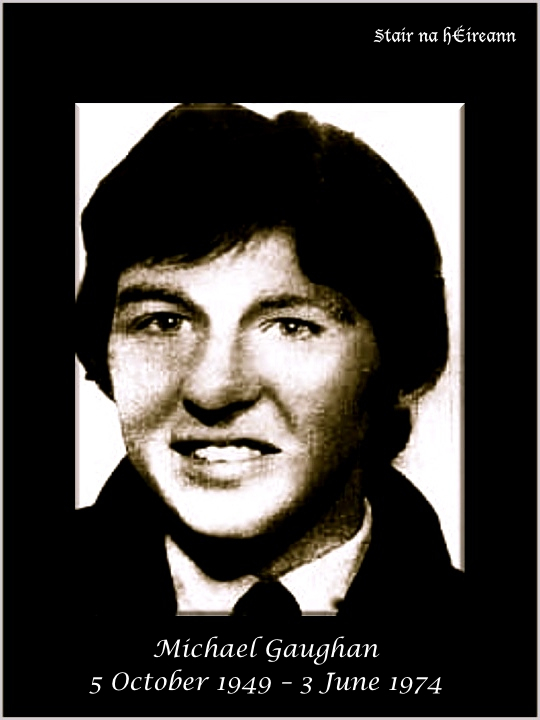
Michael Gaughan (pictured, left), the eleventh Irish republican to die on hunger strike. He was four months away from celebrating his 25th birthday.
Immortalised in song by Seamus Robinson , Michael Gaughan was an IRA activist in England and, in December 1971, he found himself in front of a British judge in the Old Bailey, where he was sentenced to seven years in Wormwood Scrubs for taking part in a (fund-raising) bank raid in north London. Two years later, he was transferred to Albany Prison on the Isle of Wight and demanded that he be treated as a political prisoner. This was refused and he was placed in solitary confinement before being moved to Parkhurst Prison, also on the Isle of Wight. On the 31st of March, 1974, Michael Gaughan joined an on-going hunger-strike protest and, after 23 days, he was force-fed : the tube that was forced down his throat punctured his lung, killing him, in Parkhurst Prison, on the 3rd of June, 1974. His body was removed from London and on Friday and Saturday, 7th and 8th June 1974, thousands of mourners lined the streets of Kilburn and marched behind his coffin, which was flanked by an IRA guard of honour, to a requiem mass held in the 'Church of the Sacred Heart of Jesus' in Kilburn.
On that Saturday, his body was transported to Dublin where, again, it was met by mourners and another IRA guard of honour who brought it to the Adam and Eve's Franciscan church on Merchant's Quay, where thousands filed past as it lay in state. The following day, his body was removed to Ballina, County Mayo. The funeral mass took place on the 9th June, at St. Muredach's Cathedral, Ballina, and the procession then led to Leigue Cemetery, Ballina. Gaughan was given a full republican burial and was laid to rest in the Republican plot. Mayo republican Jackie Clarke (Seán Ó Clérigh) presided at the last obsequies, and the oration at his graveside was given by Dáithí Ó Conaill, who stated that Gaughan "had been tortured in prison by the vampires of a discredited empire who were joined by decrepit politicians who were a disgrace to the name of Irishmen..." His coffin was draped in the same Tricolour that was used for Terence McSwiney's funeral 54 years earlier. He left a final message in which he stated - "I die proudly for my country and in the hope that my death will be sufficient to obtain the demands of my comrades. Let there be no bitterness on my behalf, but a determination to achieve the new Ireland for which I gladly die. My loyalty and confidence is to the IRA and let those of you who are left carry on the work and finish the fight." And today, 41 years after Michael Gaughan was buried, republicans are still working towards that same objective.
ON THIS DATE (3RD JUNE) 94 YEARS AGO : 'WARRIOR DAY' SHOOTING IN DUBLIN BY IRA.
This episode in republican history is definitely not as well known, or discussed as often as, other IRA actions from this period, and with good reason - the objective itself was sound, but the manner in which it was prosecuted was reckless, to put it mildly.
No doubt as part of its 'normalisation policy' of the time (1921) the British administration wanted to present Ireland to the rest of the so-called 'Commonwealth' (and further afield) as a colony where, apart from a few 'dissident troublemakers', its writ not only still ran but was welcomed by a majority of those in the country, same as Westminster attempts to depict the situation here today. And what better way to do so than to organise a cricket match in Dublin at which the British military would have an input, which is what they did on the 3rd of June, 1921.
The British military-linked 'Warrior's Day' ('...our crest is surmounted by the Imperial Crown that was worn by His Majesty King George V when the Council was established in 1921...the centre piece of the crest is a stylized rendering of the Princes' Gates depicting our loyalty to the Royal Family......many of our members served "King and Country....' from here) , established in 1921, was to be marked ('celebrated') in Dublin on the 3rd of June, 1921 - when the fighting between the IRA and the British military was at its most vicious - by the holding of a cricket match between the 'Gentlemen of Ireland' and the British military in the grounds of Trinity College. The IRA wasn't prepared to allow proceedings take place without incident and two men, Paddy O'Connor and Jim McGuiness, were instructed to stop the match - "....our instructions were that we were to go down to the vicinity of Trinity College and fire into the grounds.... Jimmy McGuinness and myself cycled down as the match was just starting. From a position behind the boundary wall of Trinity College at Lincoln Place, the two of us opened fire in the general direction of the players...." And this, from the same source - "At 5.30pm, just as the military band was leaving the field after the tea break, shots rang out from the railings on the Nassau Street side of the ground. The band and the Army players, who were fielding, threw themselves to the ground. Not knowing what was going on, the two batsmen looked on in stunned disbelief before they too were hauled to the ground by the soldiers. According to the Irish Times, two men had cycled up '..and carefully placed their machines against the kerbstone. They advanced towards the railings and, producing revolvers, fired them in the direction of the players. They then put their revolvers in their pockets, remounted their bicycles, and rode away....' "
Two female spectators were shot, one of whom, only 21 years of age, died as a result of her wound. It was, at best, a reckless attack on the British military which could and should have been carried out in a more organised (and therefore successful) manner although, having said that, it did expose the Westminster-attempted 'normalisation policy' as the folly it was then, and is now.
SPEAK OUT....
...AND BE DAMNED!
The man pictured above, using the loudhailer - Martin Reilly, a solid person that myself and many others have had the pleasure of protesting various issues with - has found himself being victimised due to the fact that he has made a stand, on subjects ranging from the double-water tax issue to injustices against Irish republicans. Martin is a gentleman, well educated, soft-spoken and strong in his convictions, and has now being singled out for standing up for what he believes in - his employer called him into an office and "..told me I was being suspended, when I asked why I was shocked with the answer I received....because of (my) involvement in tap tax protests....."(more here.)
This is by no means the first time that something like this has happened, and definitely won't be the last, but such sackings/suspensions are usually masked and/or cloaked with a veneer of 'legal respectability' ( ie 'outside contractors/customers folded and his/her position became untenable' etc) but, in this case, the employer seems to be of the opinion that they are within their rights to punish an employee because of the social issues that that employee protests against in his/her own time. I would hope that all readers of this piece will highlight this injustice on their own blog/site/Facebook page etc as it could be anyone of us next.
BREAK A LEG. SERIOUSLY.
If there was a 'Shameless Corner' section of this blog then the following would be assured a spot in the top three, at the very least - '...the new farcical play about the 1916 Easter Rising (in which) Padraig Pearse...the annoying little twerp..will be portrayed as a cross-dressing control freak with a fixation on his mother...Connolly is a gruff thug; Dev is a morose creep, Michael Collins is a wide-boy on the make....' (more here.)
The people behind this and, indeed, those that go to see it are, in my opinion, infected with a sense of self-loathing to the extent that they have no concern for their own dignity or that of others and are divested of all moral reference points. If they could get away with 'putting on a show' about the death of a family member, and felt that to do so would further their stage/screen 'career', I have no doubt that they would do it and would consider it sufficient reward for having done so if, as a result, they were invited on to a TV chat show to discuss how 'funny' they are. They are a sick breed for whom so much means so little.
Thanks for reading, Sharon.
IRELAND 1921 : 'OWN GOAL' BY THE IRA.
In 1921, in Ireland, a British attempt at 'normalising' its military and political presence in Ireland did not go unanswered by the IRA - but, in doing so, the IRA launched a reckless operation which resulted in two civilians being shot, one of whom died later. There were no British military casualties as a result of that operation, although media headlines were achieved. But mainly for the wrong reason....
(More on Wednesday, 3rd June 2015.)
YES! IN THE NAME OF 'EQUALITY'.
'...a secondary school in North Dublin held an LGBT week and pupils were forced to wear LGBT badges, write essays in favour of LGBT rights and do artwork in a similar vein....a 16-year-old girl who refused to wear one of the badges was told by her teacher that she was being "disrespectful" to LGBT people....another girl (aged 14) was asked to do an art project on an LGBT theme. When she objected, the teacher said she would have to leave her convictions outside the classroom...'(...from here.)
Hopefully, the above incident will be the exception rather than the rule although, having said that, I can almost picture a State in which a teenage boy and girl meet up behind the school bike shed for a clandestine kiss and to whisper their intention to go on a date that night, for fear that to do so in the school yard or on the street would cause 'offence' to fellow pupils and/or teachers (are separate schools the answer and, if so, why not separate shops,buses and whole housing estates etc?). Indeed, we should perhaps go the whole hog now - strike while the iron is hot and all that - and demand that all State citizens wear some item of clothing or badge etc identifying them as 'pro-equality' in relation to the 'gay marriage' issue, with failure to do so to be considered a probable offence under a new 'Public Order Act'. Those that object (especially the majority of voters from the Roscommon-South Leitrim constituency and some from Donegal South-West) will be moved to a 're-education' camp for their own good and that of society overall, and be 'encouraged' to stay there until they realise that a gay man can be a 'mother' and be described as such on a birth certificate!
And, speaking of 'equality', there has been no media uproar about the obvious lack of it regarding the age at which a citizen can be officially considered 'fit for office' in relation to the 'job' of State president (a position which, incidentally, I do not believe should exist at all) - ageism , apparently, is not as important and/or as 'sexy' an issue as 'gay marriage' and seemingly not as 'cool' to propagate on. And, as an Irish republican , it annoys me to witness careless people confuse the 26 county State with the country of 'Ireland' : Seth MacFarlane/@SethMacFarlane/Congratulations to Ireland for legalizing same-sex marriage on a national level! Come on U.S., let's catch up to the future. Richard Branson/
@richardbranson/Great to see the people of Ireland voting to live in a country where everybody is treated equally #MarRef #YesEquality(...and more here.) But perhaps it's only a rainbow that's blocking their vision.
The only answer which should be given in regards to the Office in question : this pic shows a ballot paper from the 'State presidential age' referendum, which was held here on Friday 22nd May 2015.And, finally - it seems that whereas 'gay marriage' is good and ageism is acceptable, being politically inept can be rewarding. It's at times like this that I wonder if we're doing ourselves more harm than even the British could do!
THE PRICE OF PEACE......
Last month, 28 women who protested peacefully in the Phoenix Park, Dublin, against US President Ronald Reagan's visit to Ireland received £1000 each arising from their action for wrongful arrest. Gene Kerrigan recalls the weekend when another State determined Irish security requirements and details the garda action which could cost tens of thousands of pounds. From 'Magill' magazine, May 1987.
"IS YOUR MAMMY THERE?"
The prisoners were told they could make a phone call, if it was practicable. It wasn't practicable, said the gardaí, so some prisoners prevailed on the gardaí to make phone calls for them, to relatives and friends, usually asking for dry clothes.
Outside the Bridewell, the women who had not been arrested gathered to give support to their friends inside, and a priest visited them and said Mass in a corridor, with the women in two rows, delighted to get out of the cells, some sobbing. In the cells emotions swung , above all the feeling of powerlessness, and rage at times - tears of anger, frustration, anxiety and fear. As always, there was singing. Paper plates were cut into quarter-moon shapes and used to decorate the cell, and plastic forks became brooms for paper witches.
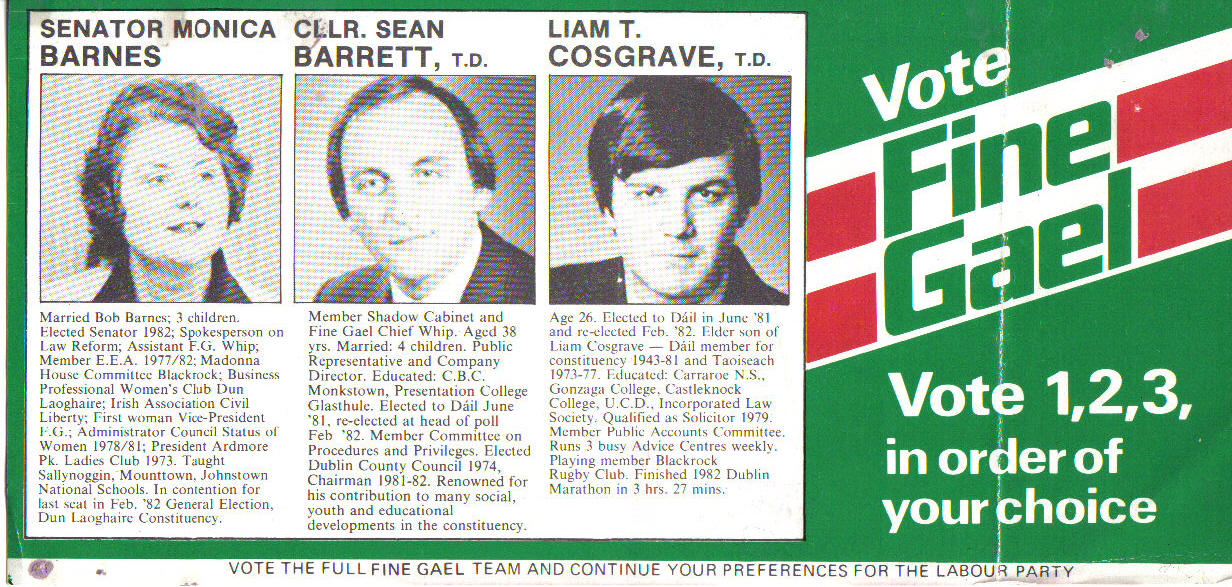
Monica Barnes, the Fine Gael representative, got a phone call and went to the Bridewell that evening. The gardaí first wanted the prisoners to select a spokeswoman to come out and meet the politician, but this search for ring leaders had been a feature of the garda activity in the Phoenix Park - so the women pointed out yet again that they were individuals and had no hierarchy. The gardaí went around the cells flushing the toilets before Barnes came in ; she went from cell to cell and visited all the women, and was appalled at the conditions. She found some women frightened, a high level of anxiety throughout, some worried about their families, not knowing what law they had broken, not knowing how long they could be held like this. (MORE LATER).
THE IRA.THE NEW IRA IS YOUNGER, MORE RADICAL AND HAS SEEN LITTLE OF LIFE OTHER THAN VIOLENCE..... By Ed Moloney. From 'Magill' magazine, September 1980.
But those two developments and, in particular, the Economic Resistance campaign, are at the root of conservative unease with the move leftwards. Not only is Economic Resistance uncomfortably reminiscent of the 'communist' Officials and their concept of a National Liberation Front, it also smacks of the same politics that led to the 1970 split over recognition of the two States in Ireland. For an Economic Resistance campaign to be really successful it clearly needs to get into the businesses of making demands on the State, both North and South of the Border. Building campaigns around the demand for jobs or better housing will lead, say the traditionalists, to a de facto recognition of Leinster House and whatever Humphrey Atkins can devise in the North to replace Stormont.
So far an uneasy compromise has been reached, which allows for agitation in the South but only glorified social work in the North. The most significant change in Eire Nua has come in the present differing attitudes of the IRA Army Council and Sinn Fein to the core of the 1972 document. That is Federalism, or the creation of strong Provisional government in Ireland when the British withdraw. Underlying Federalism was an implicit hope that it would mollify Northern Protestants and persuade them that however unrealistic the chances of re-unification, the Provisionals didn't really bear Protestants there any ill will. The Provos were even prepared to give them a large measure of self-government, should the distant dream of re-unification be realised.
The Provisional most closely identified with Federalism, is of course, Dáithí Ó Conaill. As Director of Publicity of the IRA between 1972 and 1975, Ó Conaill spoke more often of the need to build a 'United Ulster' than a 'United Ireland'. He even banned the latter phrase from Provisional vocabulary for a while. (MORE LATER).
ON THIS DATE (27TH MAY) 95 YEARS AGO : IRA OPERATIONS BEGIN TO ATTACK BRITISH FORCES IN THEIR BARRACKS IN LIMERICK.
The building, left, which was used at the time as a barracks for a British 'police force'.
In 1867, the Fenians attacked a British military outpost at Kilmallock in County Limerick, but were repelled ; fifty-three years after that event, the Fenians (IRA) decided to burn the outpost (then an RIC barracks) to the ground. The building was a two-storey, solid masonry structure with steel shuttering and was set back from the road ; it housed an RIC garrison of one sergeant and seventeen constables, all armed, and was known to be a 'tough' building. But it had one possible weakness - its roof.
A house to the right-hand side of the barracks, which was owned by the Carroll family, was taller than the barracks, and had a 'skylight' in its attic. Clery's Hotel and a bank practically faced the barracks, as did a shop, owned by the O'Herlihy family. If, during the attack, RIC reinforcements from other areas were to attempt to rescue their colleagues they would find the routes into the town barricaded by armed IRA units. Sixty IRA Volunteers were organised for the operation ; at least half of them, plus some local men, went out on the night of 27th May 1920 and blocked a number of roads leading to Kilmallock. IRA leader Tom Malone ('Sean Forde') and his unit took over Carrolls house, Tim Crowley and his Volunteer group took control of Cleary's Hotel, D. O'Hannigan was in charge of a unit of IRA men which occupied the bank and J. McCarthy and an IRA unit moved in to O'Herlihy's shop for the night. Michael Brennan, an IRA leader from East Clare, was also in the shop.
A few Volunteers were positioned near outhouses at the rear of the barracks. Just after midnight, IRA leader Tom Malone and his men took it in turns to lob heavy objects out of the skylight of the Carrolls' house, the objective being to break a hole through the roof of the barracks, into which prepared petrol-bombs could be thrown. When Malone's first object hit the roof, the IRA units positioned around the barracks opened fire on the front and rear of the building ; within minutes, the RIC men trapped in the building were shooting back. While this gun-fight was going on, Malone and his men succeeded in breaching the roof - dozens of parafin and petrol bombs were thrown through the hole, followed by a flaming torch and a grenade : the building was now on fire.
By 2am (approximately two hours after the attack began) the upper storey of the barracks was about to collapse on top of the ground-floor section, where the RIC men were now confined : the IRA stopped the attack and advised the RIC to throw out their weapons and then come out themselves. The RIC refused the offer.
However , all was not as it seemed to the attackers ; the RIC men had been retreating to the outbuildings at the back of the barracks , braving the sniper-fire from the IRA Volunteers rather than face the onslaught coming through the front of the building. By about 7am, with the barracks now a smouldering ruin, it was obvious that a fresh plan and re-deployment of the Volunteers would be necessary if the RIC were to be removed from the various outhouses they were now in, and the order was given for the IRA to withdraw ; one Volunteer, Liam Scully, was dead, and the RIC Sergeant and one of his constables were dead - six more RIC men were seriously wounded.
The Kilmallock attack, on 28th May, 1920 - in the middle of the Tan War - was one of the most prolonged and fiercest battles of that period. The actual battle itself began on the 27th of May, 1920, 95 years ago on this date.
ON THIS DATE (27TH MAY) 217 YEARS AGO : BATTLE OF OULART HILL, WEXFORD.
On the 27th of May, 1798 (Whit Sunday) , a few hundred well armed British Kingsborough militiamen and yeomanry from the North Cork Militia were sent to Oulart (Abhallghort/Orchard), in Wexford, to quell 'native unease' and, as expected, they plundered and caused havoc on their journey to 'put manners' on those Irish men and women who had assembled, approximately one-thousand strong, in Oulart, under the leadership of Fr.John Murphy, General Myles Byrne, from Ballylusk, and General Edward Roche of Garlough, Castlebridge.
A description of the battle can be read here, but suffice to quote one paragraph from that link : '...the (British) militiamen were soon completely overrun, and must have seen their fate written in the pent-up hatred on the rebels' faces. They turned and fled for their lives, spilling down the slopes from where they had come just a few minutes before. Some ran for miles before being overtaken, impaled and gutted. They begged for mercy in both Gaelic and English. They blessed themselves and shouted out prayers, since many of their number were themselves Catholic, but received absolutely no pity from the rebels. To the insurgents, the men begging for their lives were the same ones who had so recently burned out and murdered their neighbours and friends. The merciless pikemen offered no quarter, and the detested North Cork Militia disappeared forever on the bloody slopes of Oulart Hill....'
One of the above-mentioned leaders, Myles Byrne (who lived long enough to serve as an officer in Napoleon's 'Irish Legion') was born in Monaseed in Wexford, on March 20th, 1780. He was only a boy when he witnessed the attacks by the yeoman militia and other mercenaries which England let loose in Wexford in 1798. But he took his place in the United Irishmen and fought through the Wexford campaign, joined Michael Dwyer afterwards in Wicklow, later came to Dublin and was a comrade and friend of Robert Emmet in the continuation of '98 which failed so sadly in 1803. He was sent by Emmet (then on the run) to France to seek assistance from Thomas Addis Emmet and the other exiled United Irishmen. He went with no hesitation, in the hope that he would return in the ranks of a conquering army and, for over 30 years, he followed the flag of France across the battlefields of Europe, whilst seeking out information from all sources on the situation in Ireland. After his retirement in 1835, when all hope of striking a blow for his own country had failed, he settled in Paris and continued to write, off and on, for twenty years, right up to the day of his death in 1862.
His widow published his memoirs in three volumes and the story was published in serial form in the 'Shamrock' newspaper of Dublin, in 1869, and reprinted in the 'Irish Weekly Independent' in 1898. In his memoirs, he was critical of the "gentlemany nature" of the rebel approach, believing them to have been "too willing to negotiate and to accept (British) government protections and non-existent government good faith".
Whilst in Paris, his home was a 'safe house' for all who had ever served Ireland and one of the most welcome visitors to his home was that fine old soldier John Mitchel, who described Myles Byrne as "..a tall figure, the splendid ruin of a soldier d'elite , bearing himself still erect under the weight of eighty winters. The grey eye is keen and proud, the thin face bronzed and worn by war and weather, and the whole bearing gives the idea not of decrepitude, but of a certain dashing gallantry. He has marched over half of Europe, and stood full often at the head of his regiment on the rough edges of battle in Spain, in Germany, in Greece and other, earlier memories, cloud at times his clear grey eyes; and through and beyond the battle smoke and thunder of all Napoleon's fields, he has a vision of the pikemen at New Ross, and hears the fierce 'hurrah' on Oulart Hill..."
Myles Byrne died in France on Friday 24th January 1862, aged 82, and was buried in Montmarte Cemetery ('The Hill Of Martyrs'), Paris, in a grave marked with a Celtic Cross (since replaced with a different headstone) , inscribed with the words 'Sincerement Attache A L'Irlande : Son Pays Natal, IL A Fidelement Servi La France, Sa Patrie Adoptive.' The words on the new headstone read - 'Here lies Myles Byrne, Lieutenant Colonel in the service of France. Officer of the legion of Honour. Knight of St Louis, born at Monaseed in the county Wexford in Ireland, 20th March 1780. Died at Paris, the 24th January 1862, his long life was distinguished by the constant integrity and loyalty of his character and by his high-minded principles. Sincerely attached to Ireland, his native land, he gave faithful service to France, the country of his adoption.' He done more for Ireland on that one day, 217 years ago on this date, then some will do in a lifetime.
Thanks for reading, Sharon.
SIX OF THE BEST!
Going back to at least the early 1970's, the Republican Movement and supportive and affiliated organisations have come together each year to choose a handful of individuals who are deemed suitable emissaries to represent all that Irish Republicanism stands for and that which it seeks to obtain. Having decided on the best honorees possible , a dinner, dance and reunion is held to properly convey the Movement's appreciation to those people. And that pleasurable task has been undertaken this year, too.
On Saturday May 23rd 2015 , six Irish Republicans will be honoured at a CABHAIR function to be held for them in a Dublin hotel, at which a presentation will be made to each of them. Those six notable stalwarts of Irish Republicanism are : Tommy Morris, Westmeath, (Leinster); Margaret Dobbin, Antrim, (Ulster); Brendan Madden, Galway, (Connacht); Donal and Tom Malone, Tipperary, (Munster) and John Kelly, Pennsylvania, (USA). This blog extends warmest 'Congrats!' to those Honorees, and we hope all concerned have a great night, as they deserve it. Well done to ye all - Ni Seoinini Sinn Go Leir!
THE PRICE OF PEACE......
Last month, 28 women who protested peacefully in the Phoenix Park, Dublin, against US President Ronald Reagan's visit to Ireland received £1000 each arising from their action for wrongful arrest. Gene Kerrigan recalls the weekend when another State determined Irish security requirements and details the garda action which could cost tens of thousands of pounds. From 'Magill' magazine, May 1987.
The women do not on the whole have complaints about the personal behaviour of the gardai in the station : while there may have been roughness (Mary Duffy was dragged downstairs by her ankles) and individual brusqueness, some of the women considered that the gardai were embarrassed by their duties. Among any group of 33 women the chances are that several will be menstruating, and several of the women in the Bridewell were having their periods. They asked for sanitary towels and were told that the Bridewell provides "only basics".
"You know what it's like to bleed in your knickers?" , went an appeal to a ban garda, and it worked - she got three of her own tampax and brought them to the cells, but they weren't enough. It wasn't until Ruth-Anne FitzGerald, the barrister, found out what was happening and went to a local shop and came back with bags full of sanitary towels that the women were provided with what the Bridewell authorities do not consider 'basics'. One woman, a student, was distraught - she had exams to sit the next day and didn't know if she would be free by then. Mary Duffy, a thalidomide victim, was eventually put in a cell with some other women ; she had been wearing a coat belonging to someone else when she was searched and the gardai had taken away a nail scissors found in a pocket. Very clever, she mused, they must be afraid I'll cut my wrists!
In one cell there was a shortage of matches, so one cigarette was kept going at all times. Ventilation was lously - there was a small square of thick glass high up on the wall, another square of thick glass over the door and one 60-watt bulb burning outside. You got milk and sugar in your tea whether or not you liked it, and mashed potatoes and ham. Some of the women were vegetarians. (MORE LATER).
THE IRA.THE NEW IRA IS YOUNGER, MORE RADICAL AND HAS SEEN LITTLE OF LIFE OTHER THAN VIOLENCE..... By Ed Moloney. From 'Magill' magazine, September 1980.
Those are the traditional, conservative forces within the Provos ranged against the Northern radicals. Although there have been symbolic victories for them, notably the fusion, or takeover as some see it, of 'Republican News' with the Dublin based 'An Phoblacht', the real political debate has centred on the Provos 1972 policy document, 'Eire Nua!'
That document is identified in most people's minds with two traditional leaders, Sinn Fein President Ruairí Ó Brádaigh and Vice President Dáithí Ó Conaill . At Sinn Fein's last Ard Fheis held in January 1980, but actually 1979's Ard Fheis, that document was changed for the first time since the new policy document which was adopted, 'Eire Nua - the social, economic and political dimension', was more a change in emphasis than substance. The language was more socialist than the 1972 document but some controversial clauses especially relating to the right to land ownership, merely changed or deleted by Sinn Fein's ruling body, the Ard Comhairle.
But what that document did do was to set in motion a series of moves which the radicals hope will turn the Provisionals leftwards. A women's committee was set up to devise a policy document to be debated at the next Ard Fheis. The policy which it has devised reflects the difficulties the radicals are having converting their more conservative and catholic sisters. Women who have had abortions are not condemned but the system that forced them to is. Moral issues like contraception and divorce should, the committee decided, be left to individuals.
Similarly, an Economic Resistance campaign was re-emphasised in the new document and a committee headed by Post Office Engineering trade unionist, Paddy Bolger, also set up to devise a policy for the next Ard Fheis.The economic resistance campaign foresees the involvement of Sinn Fein in trade union struggles like the P A YE marches and opposition to the National (sic) Wage Agreement and to push republican issues at grass roots union level. It also intends to encourage housing, unemployment and social agitation by the republican movement. Those two developments reflect a political change in Republican thinking that is part and parcel of the IRA's long war scenario. If the IRA must stay around to fight that war, say the radicals, then Sinn Féin must have something other than the initially intoxicating, but in the long term irrelevant, slogan of 'Brits Out!' (MORE LATER).
ON THIS DATE (20TH MAY) 95 YEARS AGO : BRITISH MILITARY BOYCOTTED IN IRELAND.
"The Irish railwaymen, on their own initiative, without waiting for direction from any authority, decided not to participate in the transport of British munitions of war..." - the words of Tom Johnson, the then leader of the 'Irish Labour Party'. On this date (20th May) in 1920, Dublin dockers and railway workers began a boycott against the British 'war effort' and refused to work in a situation which would bring them into contact with British troops or British munitions in Ireland (an initiative which lasted until the end of that year - the British government 'imported' scab drivers and threatened to withhold funding from the railway companies here, which forced an end to the action), resulting in those occupation forces having to travel by road - not easily done, as the IRA dug trenches and/or destroyed same with explosives on a regular basis, so as to inhibit enemy movement.
The workers were already refusing to export foodstuffs to England, as those foods were needed here. Dublin IRA man Larry Nugent stated re that period - "The food situation in the city [Dublin] was still bad. Essential foodstuffs were very scarce and prices were prohibitive. Still the exports to England were increasing. Then on April 17th the dockers at the North Wall refused to load foodstuffs for England. This action relieved the scarcity in Dublin. The food position in Ireland during the years 1917, 1918, 1919, 1920 and most of 1921 was really bad. Butter, eggs, bacon, sugar and other foods were almost unobtainable. At the same time great quantities were being shipped to Britain under the British food control orders..." (...similar to this legislation).
That, of course, was a period in our history when the trade union leadership had not yet been purchased by the employers/business interests/political administration and genuinely seen its role as fighting for improved conditions for workers as opposed to now, when that same leadership works hand-in-glove with employers/business interests/political administration in using workers to advance their own personal and political careers. They are, in effect, the equivalent of the 1920's 'scab train drivers' and deserve to be treated with equal contempt.
VOTE 'YES' THIS TIME....OR THE NEXT TIME..?
By all accounts, the 'Yes' vote will triumph on Friday 22nd May 2015, in the 'Gay Marriage' referendum which will be held in this State on that date. Practically every media outlet here (which, by the way, have to be either licensed by the State and/or are controlled by State-orientated business people) has entered the fray on the 'Yes' side, some more blatantly so than others. But we have been here before, in 'Yes-is-the-winning-number' territory, only to witness a 'silent majority' spoil everything for the political forecasters and, no doubt, if such an 'upset' occurs in this State on May 22nd, we will most likely be given a second opportunity to 'correct' ourselves!
I have already outlined my position on this issue and nothing I have read or heard in the past few weeks has given me reason to think twice, never mind to consider actually changing my mind. Indeed, such is the haste here by the 'Vote Yes' leadership to show how 'liberal and with-the-times' they are that they almost (accidentally?) succeeded in outlawing marriage between a man and a woman! I'm going to follow my own advice in the polling booth and vote 'No' to gay marriage (because I believe gender matters, especially where children are concerned) and will then purposely spoil my 'presidential age' vote by writing 'Abolish the Office' on it. And why wouldn't I - not being a 'with-it' liberal, that is....
BREEDERS OF HUMAN LIVESTOCK TO VISIT IRELAND.
"Products of centuries of intermarrying between families, the questionable art of breeding human livestock has been cultivated to its extreme by different royal houses of (mostly) German descent festering over the European continent for many a century. As a result, this unholy, age-old cesspool of interbreeding gave birth to the most malicious type of human imaginable: the Saxe-Coburg-Gotha chieftain....." (...from here.)
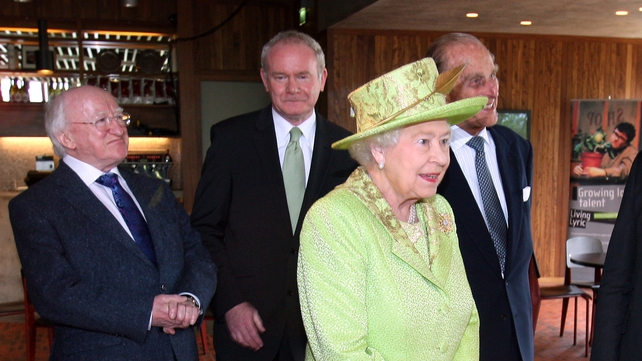
Representatives of the above-mentioned human livestock breeding experiment are due to visit this country for four days this month and, while Irish republicans oppose the visit, Free Staters and nationalists are almost wetting themselves with excitement and the media outlets here are delighted to use the opportunity to show how 'cosmopolitan' they are ; indeed, one of those media conglomerates has, in keeping with its confused outlook, described Ireland as consisting of two countries ('Their Royal Highnesses will also visit Northern Ireland (sic) in the same period. The four-day visit to both countries will take place from 19th to 22nd May 2015......'[from here]) and, indeed, this visit has shown that 'confusion' also exists in those that used to know better : the ex-republican political party, Provisional Sinn Féin, has stated that it will be represented at various 'royal' events during the four-day circus now that "...the conflict is over." Indeed, Gerry Adams and Martin McGuinness have had a private meeting with their 'prince', after Martin's friend insisted that Gerry be allowed sit-in with Martin and the 'prince'! Incidentally - and this is AN 1169 EXCLUSIVE!! - we can now reveal that part of that private meeting was in connection with the fact that 'Prince' Charles was about to have his secret Irish republican cover blown...
Gerry (and Martin) are expected to apologise to the British for all the trouble that the Irish caused to London over the last eight centuries.....
The Republican Movement, on the other hand, remains firm and clear on where it stands in relation to those parasites, has not changed its position and is not likely to change its position until after the British military and political presence has been withdrawn and Westminster has ended its jurisdictional control in relation to any part of this country : "We've made it clear that representatives of the British state are not welcome in Ireland and that statement continues..." (...from here).
Others may fawn over that British taxpayer-funded family, but those of us with self-respect will always reject them and those like them.
The guns sound out in salute, the bells ring out in the air,
The royal Duchess of Cambridge has given birth to an heir!
Prince William and Kate are overjoyed and blissfully happy
They have their longed-for offspring – in a clean white nappy!
Welcome to the world baby boy, as at your mother’s breast you feed
You’ve been born into wealth and privilege, and will never encounter need.
Third in line to the British throne, weighing 8 pounds and 6 ounces,
Delivered July 22 at 4.24 pm, the breathless Press announces.
"The birth of a Prince, our future monarch!" the tabloid headlines scream
While in blissful ignorance you close your eyes and dream.
You have nothing to disturb you, your future has been planned
You're one of the House of Windsor, the rulers of the land.
One day of 16 countries you’ll become Head of State,Including Australia and Canada and Britain the Great.
The Head of the Commonwealth, of the Church, Governor Supreme.
But that’s all in the future, the pomp, honour and esteem.
Right now you’re just a baby, you know nothing of the world,
Only your mother’s closeness as at her breast you lie curled.
You have yet to learn of money and the power of the rich
For you life'll be a bowl of cherries, for others it’s a bitch.
Although from a family neither aristocratic nor royal,
Your mummy too has never known hardship or toil.
Of upper middle class background, free from pecuniary cares
Her parents, ex flight staff Mike and Carole, are multi-millionaires.
You’ll get to see them often, but all of that’s to come.
And you’ll get to know Aunt Pippa, famous for her bum.
Not to mention Kate’s Uncle Gary and his Maison de Bang Bang.
(Maybe parties there in future with your elite little gang?)
Mum passes you to Prince William, who holds you gently in his hands
– Your Daddy who’s worth 40 million in investments, inheritance and lands.
As well as a Prince, he’s a Baron, Earl and Duke,
He pats you on your back as you have a quiet puke.
Yeah, forget the Middletons. The Windsors is the family that counts
For bringing in money and power in large amounts.
You’ve only been out of the womb a few hours since
And already you’ve been made of Cambridge the Prince!
You’ve already beat your Uncle Harry in line to the throne,
Just three deaths to come before it’s your own.
But playboy Harry need shed no tear,
He already makes 25 million a year.
Before your daddy, there’ll be funny Grandad Charlie as King
Crowned in Westminster Abbey with all that pomp and bling.
He's been destined to be monarch from the moment of his birth.
And if daddy’s makes 40 million – what’s grandaddy worth?
With a property of 300 million pounds, he’s certainly a man of means,
But as he says: "So much I do is done behind the scenes."
It’s rumored he’s the head of a rich organization called Foundation X,
Funded by banks, market manipulation and government lending excess.
He's also said to have had an influence on many a government minister
With his secret 'black spider memos' giving advice in writing sinister.
On a different matter, another dark secret as yet to unravel
Is Prince Charles’ close friendship with paedo rapist Jimmy Saville.
By the way, that’s not your real grandma, the blonde woman by his side
Her name’s Camilla, Duchess of Cornwall, and she’s his second bride.
Your real grandma was Princess Diana, killed in a car crash in France.
Some say that the accident was planned and not just matter of chance.
But, ah! Here’s your great grandma! Her Highness Elizabeth, the ruler
She’s worth 44 billion. Could anything be cooler?
She's the pinnacle of the Constitution,
Her face on every banknote – a living institution!
Judges, police and armed forces pledge allegiance to the Crown.
She’s the apex of aristocracy, of wealth and renown.
She has say when to begin and end wars
And one day my boy this power will be yours!
But what of the people you’re eventually to rule?
You should know about them to not look a fool.
Your birth is an important moment in the life of our nation
What about the people, and what’s their situation?
Well, while your pampered royal family sit cozy on their butts
The people of Britain suffer vicious drastic cuts
Benefits stopped, services scrapped, a state of dire recession
While the fawning Press focus adoring eyes on the third in line to succession.
Thousands sleep homeless on the street
Children don’t have enough to eat
Prices rise, wages go down
A smile is rarer than a frown.
Things are so bad for many that they’re almost unendurable
And yet don’t forget that they’re far from incurable.
All of this misery and want could be easily erased
With just half the money the Royals have saved.
Against this unfairness there’s only one solution
The people must unite and have a revolution.
So, New Born Royal Baby, I pray your first words be –
Loud and clear now, let me hear – "ABOLISH THE MONARCHY!"
(from here.)
Thanks for reading, Sharon.
THE PRICE OF PEACE......
Last month, 28 women who protested peacefully in the Phoenix Park, Dublin, against US President Ronald Reagan's visit to Ireland received £1000 each arising from their action for wrongful arrest. Gene Kerrigan recalls the weekend when another State determined Irish security requirements and details the garda action which could cost tens of thousands of pounds. From 'Magill' magazine, May 1987.
The first priority was to obtain bail for the prisoners and, on such a trivial charge, bail was a certainty. But the gardaí refused to grant station bail , a procedure in which they have discretion to allow people charged with lesser offences post their own bail at the station. Extraordinarily, they said they would grant bail to just one of the 33 women in the Bridewell, Mary Duffy, a thalidomide victim who has no arms, but her conditions in the jail were no worse than anyone else's. Indeed, she is a strong woman who has learned to do with her feet most of what others do with their hands, and she lives an independent life.
She had no doubt that the garda decision was made because they were embarrassed to be locking up someone without arms. She refused to accept station bail. Heather Celmalis, the lawyer, asked when the prisoners would be brought before a judge or a peace commissioner, but the gardaí told her that they had no information about that. It was at about this time that Ronald Reagan left Ballyporeen and flew to Aras an Uachtarain in the Phoenix Park.
There were four solicitors working for the women at various times : Isabel ni Chuireain, Mairead Quigley, Breda Allen and Heather Celmalis, and they set about gathering statements from the prisoners for use in preparing a request for Habeas Corpus . A couple of the women in the Bridewell had been locked up briefly before, after a peace demonstration in front of the Soviet Embassy, but most of them had no experience of this kind of thing and emotions ran high - you were either high as a kite or in the depths of depression, you laughed or you cried. The cells were filthy, with about five or six women in each one, which were meant for two, or three prisoners at most. The toilets were blocked in some of the cells and could only be flushed from outside, so they were left unflushed. All the women were wearing clothes that had been soaked through in the rain. (MORE LATER).
THE IRA.THE NEW IRA IS YOUNGER, MORE RADICAL AND HAS SEEN LITTLE OF LIFE OTHER THAN VIOLENCE..... By Ed Moloney. From 'Magill' magazine, September 1980.
The bulk of Provisional supporters, especially in the rural, border areas, are traditional Republicans. Small farmers or country town merchants ; what one Belfast radical calls 'Fianna Failers with guns'. Their support, which is reflected in the vote for the 30 or so Sinn Fein councillors, is vital for the war effort. They provide the training camps, the dumps and safe houses. Many of them stayed with the Provisionals precisely because they thought the Officials were too leftist or Marxist. Much the same can be said for the older veterans of the movement ; the men of the 'forties', and 'fifties', many of whom sit on the IRA Executive, the body that acts as the repository of Republican faith and which in 'war time', appoints the Army Council.
One such man, a Northerner in fact, who has spent 13 years in prison or internment camps, summed it up like this : "I don't like this word 'socialism'. I wish they could find another word for it". Others like Billy McKee, a former Chief of Staff and Belfast Brigade Commander, have dropped out altogether. When he last came to Belfast in May 1979 to speak to a welcome home rally for released blanket-man Ciaran Nugent, he was reportedly horrified at the number of foreign left wing posters and pamphlets in the offices of Republican News, the voice of the Northern left.
Another group whose dollars at least are vital to the Provos are the Irish-Americans and, notably, Irish Northern Aid, headed by veteran Republican and devout Catholic, Michael Flannery. Even in the early days, the Irish-Americans were a standing joke with Belfast Provos. It was common then for visiting Republican speakers from Ireland to be taken by Flannery for a new outfit of sober suit, tie and shiny shoes, before being let loose on the Irish-American faithful. Speakers were instructed by Flannery never to refer to socialism and one such tourist can recall discovering unopened bundles of Republican News, lying dumped in dustbins outside Nor-Aid's Bronx headquarters. The Northerners were always too radical for the Irish-Americans. (MORE LATER).
ON THIS DATE (13TH MAY) 96 YEARS AGO : "I THOUGHT I WAS A DEAD MAN. I HAD TO HOLD MY HEAD UP WITH BOTH HANDS...."
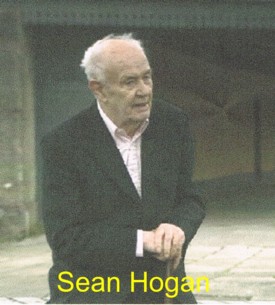
Seán Hogan (pictured, left), who was practically still in his teenage years when he was appointed as one of those in command of the 'Third Tipperary Brigade' of the IRA, a leadership group which became known by the British as 'The Big Four' - Dan Breen, Seán Treacy, Seamus Robinson and Seán Hogan.
Seán Hogan was born in Tipperary in 1901 and, at just 18 years of age, he took part in the Soloheadbeg ambush on the 21st of January in 1919, in which two Crown force personnel (James McDonnell and Patrick O'Connell) were killed as they drew their weapons. The British went all out to capture or execute those responsible and, on the 12th of May 1919, Seán Hogan was taken prisoner at a friends house, the Meagher's, at Annfield, in Tipperary, and taken to Thurles RIC barracks to be held overnight, and then transported to Cork. The following morning Seán Hogan was taken by a four-man armed British military escort to Knocklong train station and the five men got on board a train ; Hogan, who was handcuffed, was put sitting between RIC Sergeant Wallace and Constable Enright, both of whom were armed with revolvers, and Constables Ring and Reilly, carrying shotguns, sat opposite the three men.
Seán Hogan (right), thought to be about 20 years young when this photograph was taken.
An IRA unit, led by Seán Treacy, Dan Breen, Seamus Robinson and Eamonn O'Brien, and including Ned Foley, Seán Lynch, John Joe O'Brien, Ned O'Brien and Jim Scanlon (all from the East Limerick Brigade IRA) located the compartment where Seán Hogan was being held against his will and Seán Treacy and Eamonn O'Brien drew their revolvers and walked through the train to the compartment ; on entering same, they loudly instructed all present to put their hands up and called for Seán Hogan to make his way to them. RIC Constable Enright placed his revolver against Hogan's neck, using him as a shield, but was shot dead as he did so, as both Treacy and O'Brien had fired at him (Eamonn O'Brien was to say later that they would not have shot Enright had he not attempted to attack Hogan) and Hogan, still handcuffed, took that opportunity to land a two-handed punch to the face of Constable Ring, who was sitting opposite him. Seán Treacy and RIC Sergeant Wallace were trading punches, as were Eamonn O'Brien and Constable Reilly, when one of the IRA men managed to take Reilly's shotgun from him and smashed him over the head with it. He collapsed in a heap on the carriage floor. Constable Ring, meanwhile, found himself on the platform, having exited the carriage through a window, and withdrew from the area.

Of such a deed, no living man has ever heard before
From out a guarded carriage mid a panic stricken throng
Seán Hogan, he was rescued at the station of Knocklong
When a guard of four policemen had their prisoner minded well
As the fatal train sped o’er the rails, conveying him to his cell
The prisoner then could scarce foretell, of hearts both brave and strong
That were planning for his rescue at the station of Knocklong
The shades of eve were falling fast when the train at last drew in
It was halted for an hour or so by a few courageous men
They sprang into the carriage and it did not take them long
'Hands up or die' was the rebel cry at the station of Knocklong
King George’s pampered hirelings, they shrivelled up with fear
And thought of how they placed in cells, full many a Volunteer
Now face to face with armed men, to escape, how they did long
But two of them met with traitors deaths at the station of Knocklong
From Sologhead to Limerick, such deeds as these were never seen
And devil a tear was ever shed for Wallace of Roskeen
They did old England's dirty work and did that work too long
But the renegades were numbered up at the station of Knocklong
Now rise up Mother Erin and always be of cheer
You’ll never die while at your side there stand such Volunteers
From Dingle Bay to Garryowen, the cheers will echo long
Of the rescue of Seán Hogan at the station of Knocklong.(From here.)
YESTERDAY (12TH MAY) 99 YEARS AGO - NO PLACE AT THAT TABLE FOR THIS CHAIR.
If we had more time, we would give a brief history and/or mention of all those Irish men and women for whom this month carries special significance, but such is the level of destruction wrought on this country by the British over an on-going period of more than 840 years, and the huge number of Irish 'dissidents' that tried to right those wrongs, we are unable to do so but, nonetheless, we will try to do those brave people justice by posting a 'flavour' of just one of them (penned by John Horan, RSF, a blog colleague) - James Connolly, executed by the British on the 12th May 1916 - as all shared the same objective : to remove the British military and political presence from Ireland.
James Connolly was born on June 5th, 1868, at 107, the Cowgate, Edinburgh. His parents, John and Mary Connolly, had emigrated to Edinburgh from County Monaghan in the 1850s. His father worked as a manure carter, removing dung from the streets at night, and his mother was a domestic servant who suffered from chronic bronchitis and was to die young from that ailment.
Anti-Irish feeling at the time was so bad that Irish people were forced to live in the slums of the Cowgate and the Grassmarket which became known as 'Little Ireland'. Overcrowding, poverty, disease, drunkenness and unemployment were rife - the only jobs available was selling second-hand clothes and working as a porter or a carter.
James Connolly went to St Patricks School in the Cowgate, as did his two older brothers, Thomas and John. At ten years of age, James left school and got a job with Edinburgh's 'Evening News' newspaper, where he worked as a 'devil', cleaning inky rollers and fetching beer and food for the adult workers. His brother Thomas also worked with the same newspaper. In 1882, aged 14, James Connolly joined the British Army in which he was to remain for nearly seven years, all of it in Ireland, where he witnessed first hand the terrible treatment of the Irish people at the hands of the British. The mistreatment of the Irish by the British and the landlords led to Connolly forming an intense hatred of the British Army.
While serving in Ireland, he met his future wife, a Protestant named Lillie Reynolds. They were engaged in 1888 and the following year Connolly discharged himself from the British Army and went back to Scotland. In 1890, he and Lillie Reynolds were wed in Perth and, in the Spring of that year, James and Lillie moved to Edinburgh and lived at 22 West Port, and joined his father and brother working as labourers and then as a manure carter with Edinburgh Corporation, on a strictly temporary and casual basis.
He became active in socialist and trade union circles and became secretary of the 'Scottish Socialist Federation', almost by mistake. At the time his brother John was secretary; however, after John spoke at a rally in favour of the eight-hour day he was fired from his job with the corporation, so while he looked for work, James took over as secretary. During this time, Connolly became involved with the Independent Labour Party which Kerr Hardie formed in 1893.
Cobbler's Shop.
In late 1894, Connolly lost his job with the corporation. He opened a cobblers shop in February 1895 at number 73 Bucclevch Street, a business venture which was not successful. At the invitation of the Scottish socialist, John Leslie, he came to Dublin in May 1896 as paid organiser of the 'Dublin Socialist Society' for £1 a week. James and Lillie Connolly and their three daughters, Nora, Mona and Aideen set sail for Dublin in 1896, where he founded the Irish Socialist Republican Party in May of 1896. In 1898, Connolly had to return to Scotland on a lecture and fund-raising tour. Before he left Ireland, he had founded 'The Workers' Republic' newspaper, the first Irish socialist paper, from his house at number 54 Pimlico, where he lived with his wife and three daughters. Six other families, a total of 30 people, also lived in number 54 Pimlico, at the same time!
In 1902, he went on a five month lecture tour of the USA and, on returning to Dublin, he found the ISRP existed in name only. He returned to Edinburgh where he worked for the Scottish District of the Social Democratic federation. He then chaired the inaugural meeting of the Socialist Labour Party in 1903 but, when his party failed to make any headway, Connolly became disillusioned and in September 1903, he emigrated to the USA and did not return until July 1910. In the US, he founded the Irish Socialist Federation in New York, and another newspaper, 'The Harp'.
In 1910, he returned to Ireland and in June of the following year he became Belfast organiser for James Larkin's Irish Transport and General Workers Union. In 1913 he co-founded the Labour Party and in 1914 he organised, with James Larkin, opposition to the Employers Federation in the Great Lock-Out of workers that August. Larkin travelled to the USA for a lecture tour in late 1914 and James Connolly became the key figure in the Irish Labour movement.
Irish Citizen Army.
The previous year, 1913, had also seen Connolly co-found the Irish Citizen Army, at Liberty Hall, the headquarters of the ITGWU - this organisation, the ICA, was established to defend the rights of the working people. In October 1914, Connolly returned permanently to Dublin and revived the newspaper 'The Workers' Republic' that December following the suppression of his other newspaper, 'The Irish Worker'. In 'The Workers' Republic' newspaper, Connolly published articles on guerrilla warfare and continuously attacked the group known as The Irish Volunteers for their inactivity. This group refused to allow the Irish Citizen Army to have any in-put on its Provisional Committee and had no plans in motion for armed action.
The Irish Volunteers were by this time approximately 180,000 strong and were urged by their leadership to support England in the war against Germany. It should be noted that half of the Provisional Committee of the Irish Volunteers were John Redmond's people, who was the leader of the Irish Parliamentary Party. The Irish Volunteers split, with the majority siding with Redmond and becoming known as the National Volunteers - approximately 11,000 of the membership refused to join Redmond and his people.
However, in February 1915, 'The Workers' Republic' newspaper was suppressed by the Dublin Castle authorities. Even still, Connolly grew more militant. In January 1916, the Irish Republican Brotherhood had became alarmed by Connollys ICA manoeuvres in Dublin and at Connollys impatience at the apparent lack of preparations for a rising, and the IRB decided to take James Connolly into their confidence. During the following months, he took part in the preparation for a rising and was appointed Military Commander of the Republican Forces in Dublin, including his own Irish Citizen Army. He was in command of the Republican HQ at the GPO during Easter Week, and was severely wounded. He was arrested and court-martialed following the surrender. On May 9th, 1916, James Connolly was propped up in bed before a court-martial and sentenced to die by firing squad - he was at that time being held in the military hospital in Dublin Castle. In a leading article in the Irish Independent on May 10th William Martin Murphy, who had led the employers in the Great Lock-out of workers in 1913, urged the British Government to execute Connolly.
At dawn on May 12th 1916, James Connolly was taken by ambulance from Dublin Castle to Kilmainham Jail, carried on a stretcher into the prison yard, strapped into a chair in a corner of the yard and executed by firing-squad. Connolly's body, like that of the other 14 executed leaders, was taken to the British military cemetery adjoining Arbour Hill Prison and buried, without coffin, in a mass quicklime grave.
The fact that he was one of the seven signatories of the 1916 Proclamation bears evidence of his influence. As a post script, and on a personal level, I will quote James Connolly's words to the Irish Citizen Army on 16th April, 1916 ; "The odds are a thousand to one against us, but in the event of victory, hold onto your rifles, as those with whom we are fighting may stop before our goal is reached."
To those people whom Republican Sinn Féin would consider having "stopped before the goal is reached", I point out that the fact that James Connolly died on a chair should not be seen to infer that he wanted that chair placed at a table where a compromise would be the outcome.
James Connolly, 5th June 1868 - 12th May 1916. Executed by the British at 47 years of age.
"IT IS MY DUTY TO TELL YOU WHAT I BELIEVE SHOULD BE DONE..."
"Because I believe these things I will always stick to them, but I do not want to force any other person to believe as I do. Let everyone be honest with himself and do what he thinks right. It is my duty to tell you what I believe should be done..." - Commandant Neil 'Plunkett' O'Boyle, pictured, left.
Commandant O'Boyle was born on a small farm at Leac Eineach , near Burtonport in County Donegal, in 1898. He grew tall and thin, and was known to keep himself to himself as a teenager, but livened up as he grew older, and continually expressed an interest in the political affairs of the times he was witnessing and had a great interest in the Irish language. But he was not one for trying to impose his own beliefs , whether to do with politics , history , or the Irish language, and was known by now as a Sinn Féiner, but couldn't take his interest to the level he would have liked, as he was helping to look after his father, who was in poor health : the man died in 1917, and 'Plunkett', now 19 years of age, needed a secure job to assist the family - he got a position as a guard with the 'Londonderry (sic) and Lough Swilly Railway Company' but was forced to leave that job when he was 21 due to continued harassment from the RIC, a British 'police force' in Ireland, which knew of his Sinn Féin beliefs.
He left Ireland for Scotland and got a job as a miner in the 'New Mains' Colliery, where he joined the IRA's 2nd Battalion Scottish Brigade, B Company. His IRA work included procuring weapons for Army use in Ireland and ensuring that same received safe passage home. At 22 years of age, he was caught by the Scottish police whilst organising a shipment of arms and was sentenced to five years hard labour in Peterhead Prison and was known to have been singled-out for particularly rough treatment by the prison authorities, including long periods of solitary confinement.
The 'Treaty of Surrender' was signed in late 1921 and 'Plunkett' was one of many who qualified for early release under its terms and conditions (even though he was opposed to that Treaty) and, in 1922, at 24 years of age, he was released and he returned home to Donegal, but was arrested a few months later and placed in detention in Dungloe and then moved to Drumboe. Finally, he was put 'on hold' in Finner Camp until arrangements were made to move him to Dublin. From the moment he was first arrested he was determined to escape : he had intended to jump from the Free Staters lorry that was transporting him to Drumboe but another prisoner beat him to it. In Finner Camp he had started a tunnel but this was discovered, so he and others planned to seize the tug boat on which they were to be taken to meet the ship that was due to transport them to Dublin. When this didn't work, they then planned (unsuccessfully) to try and take control of the ship itself!
When 'Plunkett' and his comrades landed in Dublin, they were taken to Newbridge Barracks where they almost immediately began work on a tunnel, but this plan was soon improved on when one of the men got his hands on a Board of Works map which highlighted the sewerage system and the existing tunnel was then re-directed towards those pipes. They soon reached the buried pipes and in October that year (1922) approximately 160 IRA prisoners effected an escape through the sewerage system and came out the other end in the Kildare section of the River Liffey, from where Neil 'Plunkett' O'Boyle got to Dublin and was placed in command of the Dublin No. 2 Brigade IRA, 3rd Battalion, and was stationed in the Wicklow area : it was now November 1922 and, for the next six months, his IRA unit operated and lived rough in a mountainous area between Tallaght and Glenmalure.
The Ceasefire Order of April 1923 was adhered to by 'Plunkett' and his men but they stayed in hiding, as did many IRA units, until the general situation became clearer - but the Free State Army still hunted them and, indeed, his unit was attacked by the Staters on 8th May 1923. Michelle Boyle, a relative of 'Plunkett', put the following account on the record at the time : " Around 5am Rosie Kelly was out with (----) when she seen Free State soldiers in the vicinity. She told the volunteers. They went into the woods and hid behind a wall. As soon as Free State soldiers came looking, Plunkett and the column opened fire. The Free State soldiers sheltered behind Kelly’s house. It wasn’t long until another band of Free State soldiers came from Moin a' Bhealaigh and they shot into the woods. They hit their own men but none were hurt seriously. Some volunteers were in Free State soldier’s clothes and managed to escape quickly across the hills. The Column was all very tired and was glad to rest that night. At around this time Plunkett was after getting a shipment of arms from Belfast. That night in Kylebeg they had 2 Thompson guns and 7 rifles. The soldiers had Lewis guns and rifles and there were about 80 soldiers. Plunkett was a good leader, he was hot-headed but you couldn't frighten him. He had a sharp mind, knew what time to attack and what time to retreat. And when they were escaping, Wicklow men could guide him to safe houses and over the hills..."
In mid-May 1923, 'Plunkett' and his men were in a safe house in Knocknadruce, County Wicklow when, in the early hours of the morning, they were surrounded by Free State forces under the command of a Belfast man, Felix Mc Corley. IRA man Tom Heavey, who was in the house at the time, explained what transpired : "Plunkett wanted the mother and daughter to be let out of the house. The Staters wouldn't hear of that and threatened to bomb them out. That was a favourite trick, throwing grenades through the window. This put Plunkett in a spot as he couldn't let the women be injured. So he said, 'Let me come out'. Out he came with his hands up and walked slowly towards a stone stile at the right hand corner of the house. When he got there he spoke a few words with this Free State Officer named McCorley, a Belfast man perched on a stone ditch above him. Suddenly McCorley raised his revolver and shot Plunkett in the eye, the bullet passing through his upraised hands. For good measure he shot him again through the head. He just shot him. I saw it all. It was cold blooded murder. The others in the house were rounded up and taken away..." (more here.)
The 92nd anniversary of the State execution of Neil 'Plunkett' O'Boyle will be marked in Knocknadruce, County Wicklow, on Sunday 17th May 2015 at 3pm : those attending are asked to assemble in Hollywood at 2.30pm. All genuine republicans welcome!
BUS PRIVATISATION BAD, WATER PRIVATISATION NOT BAD.
The SIPTU trade union is rightly up in (verbal) arms over the threat by Dublin Bus and Bus Éireann to introduce privatisation into, for now, parts of their networks and have organised work stoppages (with more of same to come) in opposition to that move : 'Bus drivers across the country (sic) will engage in four days of strike action during May to defend the public transport service and decent jobs from the threat of privatisation. SIPTU drivers in Dublin Bus and Bus Éireann will conduct 24-hour work stoppages on Friday, 1st May, Saturday, 2nd May, Friday, 15th May and Saturday, 16th May. The decision to engage in strike action by over 1,500 drivers follows a refusal by the management of both companies to meet with workers to discuss their major concerns over plans to privatise 10% of bus routes during 2016. Announcing the major escalation of the SIPTU members campaign to defend the public transport system, SIPTU Construction and Utilities Division Organiser, Owen Reidy, said: "The privatisation plan being promoted by the 'National (sic) Transport Authority' is driven by ideological concerns rather than a focus on improving services. Privatisation of these routes will be a bad deal for the citizen and tax payer, the travelling public and indeed the workers who provide these services...." (from here.)
All good so far - a trade union expressing concern over the privatisation of a public utility, warning that it would be a bad move for the workers, the public and the quality of the service on offer, and recognising that to privatise a service (that, in this case, was built using taxpayers money) is not in the best interest of those that service purports to serve. So how come this same trade union is working hand-in-glove with those attempting to privatise a different public service/utility and, in a further deluded twist, actually supports and defends the scab employees of the soon-to-be new owners of that previously public-owned service?
The answer to that question is straight forward enough - that trade union organisation, like the State it supports and encourages, has no moral consistency and will run with the hare and hunt with the hound when it suits it to do so, and will do so shamelessly. The answer to the overall question of such corruption is here.
Thanks for reading, Sharon.