"OOPS! I MAY HAVE PUT MY FOOT IN IT..."
"I will not..break up my country..we cannot accept anything that threatens the integrity of our union..as I have already said, that is unacceptable...we will never agree to it..divides our country in two..it would mean breaking up our country.." (..from here, and loads of other sources!)
Oh the irony! It can't have been lost on her, can it? She must be aware of the moral ammunition she has handed to, among others, Irish Republicans who, unfortunately, know a thing or two about 'having their country broke up' and having their country divided by outside political (and military) forces. Where were her political advisers? Her scriptwriters? Where were her political minders? Was there ner a proofreader to hand to gently advise her that such comments would be thrown back at her a thousand times over by those of us in Ireland who know our history?
Or, more likely, having parlayed with the useless, self-serving political idiotic yes-men (and women) in Leinster House, did she and her advisers etc realise that the only issue that the latter group would take offence with is if their money and privileges were threatened? That would explain her hypocritical outburst, and would also explain the silence from Leinster House regarding same ; by their inaction in relation to her 'rule Britannia' rant, they were acknowledging that, through their own political subservience to those that established their political institutions in the first place, they had made themselves powerless to highlight the irony that a British politician was displaying in relation to this country and that was, once again, slapping them across the face. But being so sycophantic doesn't affect their money or their privilege so they carry-on, prepared to 'suffer' all types of hypocrisy in the name of 'democracy'!
''SINN FÉIN IS EVERYTHING ITS NAME IMPLIES - GOVERNMENT OF THE PEOPLE, BY THE PEOPLE, FOR THE PEOPLE....!'
From 'The United Irishman' newspaper, October 1954.
CHURCH OBJECTS TO U.S. COMICS.
For every student who is corrupted by 'The Decameron', thousands of young people are corrupted by American 'comics', says a commentator in the Church of England newspaper. "It is surely time, declares the writer, "that something was done to revise the legislation which deals with obscence publications".
"All right-minded people are agreed that the so-called 'comics' which come into this country from America are obscene, if the word has any meaning. We are glad to see that the Major of Blyth has drawn attention to the harm that such papers are doing to the young people who read them. It seems incredible that he should get no support from the Home Secretary or from the Director of Public Prosecutions, who ruled that there is insufficient ground for prosecution under present law."
That report was from 'The Irish Times', 20/8/1954. Oh! But DO let us be 'broad-minded' : We in Ireland mustn't 'interfere' with the free-flow of this 'culture' into the country.
(END of 'Church Objects to U.S. Comics' - NEXT, from the same source : 'Murder-For-Fun Gang See The Evidence'.)
YET ANOTHER DIZZY HEIGHT...
..FOR US TO FALL FROM!
'The Blog Awards Ireland 2018 - Finalist Announcement : The Blog Awards Ireland are delighted to announce the Finalists for the 2018 awards! These awards celebrate the outstanding achievements of the blogger community throughout the country over the past 12 months. This round the blogs were judged on their writing skills, the quality of their content, their interactions with the public and the overall feeling the judges got after reading the blogs. Were they enjoyable? Were they inspiring? Did they use their voice intelligently..?' (From here.)
And, despite what you, the reader, might think, the Blog Award Judges answered "YES! YES! YES!" to the above questions, and sent the following notification to us -
"Hi Sharon,
Congratulations!
We're over the moon to let you know that 1169 And Counting is a Finalist for the 2018 Blog Awards Ireland in the following category(ies) : Personal Blog > Current Affairs / Political.."
Yep, we've only gone and done it now - somehow, we've set the bar so high that we can be guaranteed not to hit our heads off it as we stumble aimlessly and unnoticed underneath it! Who in the name of James Street did we think we were kiddin' - look at the heavyweights that we're mixing it up with : An Sionnach Fionn, Ciaran Tierney, Disordered World, Jessica Thompson and TheChampsVoice (..not linking to those [OTHER!] finalists, as I don't want to encourage them!).
What were we thinking - that we could somehow persuade the Blog Award Judges to give us a sympathy vote and maybe give us an 'Also Ran' award, just by virtue of the fact that (once again..) their not gonna give us something better..?
Our pathetic pleading won't work - we've tried it before. Unashamedly. And we're now preparing our 'Thanks anyway..' speech, which I, personally, will deliver from the bottom of an empty flagon of cider to anyone who listens. Not that anyone will be listening, as you lot will be off celebrating with the winners but, in time, I'm sure we'll get over it...
NEWS, COMMENTS ETC.
From 'The United Irishman' newspaper, February 1955.
BACK TO WOLFE TONE...
The Irish 'modernists' find an outlet for their views in the columns of 'The Irish Times' ; that newspaper, by maintaining a comparatively high literary standard, attracts to its reading circle some of Ireland's finest thinkers.
It is therefore in a position to impose its views on some of the most influential minds in the nation, and for that reason it is potentially a great danger to the Republican Movement. I say "potentially" because in actual fact it does not constitute a danger at present.
The high literary standard of its contributors and their grand air of detached cynicism merely cloak their barren minds and specious arguments. Thus it is that 'The Irish Times' fools none but the fool... (MORE LATER).
COLUMBIA : NO IRISH NEED APPLY.
The arrest of the 'Colombia Three' on charges of training left-wing FARC guerrillas had implications for more than the North's peace process. Colombian paramilitaries suddenly had an excuse to target other Irish people in that country.
By Paul O'Brien. From 'Magill' magazine, July 2002.
Gearoid O Loingsigh spent five days walking a circuitous route through mountains in the Southern Bolivar region of Colombia to escape a right-wing paramilitary death squad. His work with Colombian human rights organisation 'Sembrar' had seen him arrive in the region some weeks earlier to meet with the local peasant and mining communities and their leaders.
These were the same peasants and miners who had converged in their thousands on the city of Barrancabermeja in 1998 to protest at an infamous paramilitary onslaught which took place there. The Sembrar-supported Mesa Regional entity represents these communities, and it was on Mesa's behalf that the Irishman travelled to the region ; part of his work would have involved the investigation and documentation of suspected human rights abuses. He couldn't foresee what lay ahead.
Along with colleagues, he arrived at a stretch of tarmac cut out of a mountain and functioning as an airstrip in the municipality of Santa Rosa del Sur. The airstrip lies next to a military base and as Gearoid O Loingsigh got off the plane the police approached him and requested his details - a standard procedure. Although he had already been questioned at the airport before boarding the flight to the region he gave his details again. It was then an army sergeant intervened, saying there were more questions to be answered. The trouble had started... (MORE LATER).
Thanks for reading, Sharon.
Wednesday, September 26, 2018
BRITISH IMPERIALIST CONDEMNS THOSE WHO "BREAK COUNTRIES"!
Wednesday, September 19, 2018
BURNED TO DEATH IN A TAR BARREL BY THE BRITISH.
ON THIS DATE (19TH SEPTEMBER) 215 YEARS AGO : ROBERT EMMET ON 'TRIAL'.
Robert Emmet was tried before a 'Special Commission' in Green Street Court House in Dublin on September 19th, 1803 - 215 years ago on this date.
The 'trial' lasted all day and by 9.30pm he was pronounced guilty ; asked for his reaction, he delivered a speech ("..when my country takes her place among the nations of the earth, then, and not till then, let my epitaph be written.." - full text here) which still inspires today. He closed by saying that he cared not for the opinion of the court but for the opinion of the future - "..when other times and other men can do justice to my character.."
He was publicly executed the next day, Tuesday, September 20th, 1803, outside St Catherine's Church in Dublin's Thomas Street. The final comment on the value of Robert Emmet's Rising must go to Séan Ó Brádaigh who states that to speak of Emmet in terms of failure alone is to do him a grave injustice. He and the men and women of 1798 and 1803 and, indeed, those that went before them, set a course for the Irish nation, with their appeal to Protestant, Catholic and Dissenter under the common name of 'Irishman', which profoundly affected Irish life for more than two centuries and which will, we trust, eventually bear abundant fruit - "The Society of United Irishmen to which he belonged was no myth. Nor is the Republican resistance to English rule in Ireland, before Emmet's Rising and since, a myth. The invasion, conquest and plantation of Ireland are no myths, nor is the suffering of the Irish people. We know of the laws against Catholics, we know of the landlord system and the evictions, the starvation of 1845-48 and the coffin ships. None of these are myths.." (more here.)
It should be noted that it was not only college-educated men and women like Robert Emmet (ie those who might be perceived as being 'upper class') who decided to challenge Westminster's interference in Irish affairs in 1803 : so-called 'working class' men and women also acknowledged the need for such resistance - Edward Kearney, carpenter, hanged, Thomas St / Owen Kirwin, tailor, hanged, Thomas St, September 1st 1803 / Maxwell Roche, roofer, hanged, Thomas St, September 2nd 1803 / Denis Lambert Redmond, coal facer, hanged, Coalquay (Woodquay) Dublin, / John Killeen, carpenter, hanged, Thomas St, September 10th 1803 / John McCann, shoemaker, hanged at his own doorstep, Thomas St, September 10th 1803 / Felix Rourke, farm labourer, hanged, Rathcoole, Dublin, September 10th 1803 / Thomas Keenan, carpenter, hanged, Thomas St, September 11th 1803 / John Hayes, carpenter, hanged, Thomas St, September 17th 1803 / Michael Kelly, carpenter, hanged, Thomas St, September 17th 1803 / James Byrne, baker, hanged, Townsend St, Dublin, September 17th 1803 / John Begg, tailor, hanged, Palmerstown, Dublin, September 17th 1803 / Nicholas Tyrrell, factory worker, hanged, Palmerstown, Dublin, September 17th 1803 / Henry Howley, carpenter, hanged, Kilmainham Jail, Dublin, September 20th 1803 / John McIntoch, carpenter, hanged, Patrick St, Dublin, October 3rd 1803 - there are dozens more we could list here, but suffice to say that 'class' alone was not then, nor is it now, a deciding factor in challenging British military and political interference in this country. 'Justice' is the deciding factor in that equation.
'The struggle is over, the boys are defeated
Old Ireland's surrounded with sadness and gloom
We were defeated and shamefully treated
And I, Robert Emmet, awaiting my doom
Hung, drawn and quartered,
sure that was my sentence
But soon I will show them no coward am I
My crime is the love of the land I was born in
A hero I lived and a hero I'll die'.
''SINN FÉIN IS EVERYTHING ITS NAME IMPLIES - GOVERNMENT OF THE PEOPLE, BY THE PEOPLE, FOR THE PEOPLE....!'
From 'The United Irishman' newspaper, October 1954.
AMERICA PROPPING UP THE EMPIRE....
We ask the American people, and particularly those of Irish origin, to examine where they are being led, to look beyond the statements of the politicans to the actions which follow them, to realise what their money and their armed forces are being used for.
How low have they fallen, that 'the land of the free and the home of the brave' should be used as a bully-boy to protect John Bull and his accursed 'empire'?
(END of 'America Propping Up The Empire' : next - 'Church Objects To U.S. Comics', from the same source.)
ON THIS DATE (19TH SEPTEMBER) 138 YEARS AGO - PARNELL AND BIDDING FOR AN 'EVICTED' PROPERTY.
'In September 1796, Ireland was pregnant with expectation. The United Irishmen and Defenders planned insurrection and a French invasion was imminent. On 19 September Dublin Castle announced plans to follow Britain’s lead and enlist civilian volunteers as a yeomanry force. In October commissions were issued to local gentlemen and magistrates empowering them to raise cavalry troops and infantry companies. Recruits took the ‘Yeomanry oath’, were officered by the local gentry but were paid, clothed, armed and controlled by government. Their remit was to free the regular army and militia from domestic peacekeeping and do garrison duty if invasion meant troops had to move to the coast. Service was part-time—usually two ‘exercise days’ per week—except during emergencies when they were called up on 'permanent duty'.
If the Irish Yeomanry are remembered at all it is usually for their notoriety in the bloody summer of 1798. The popular folk memory of every area which saw action supplies lurid stories from the burning of Father John Murphy’s corpse in a tar barrel at Tullow to the sabreing and mutilation of Betsy Gray after the battle of Ballynahinch....(from here.)
At a meeting in Ennis, County Clare, on the 19th September 1880 - 138 years ago on this date - Charles Stewart Parnell - whom the British described as "..combining in his person all the unlovable qualities of an Irish member with the absolute absence of their attractiveness...something really must be done about him...he is always at a white heat or rage and makes with savage earnestness fancifully ridiculous statements.." , who was looked at in a wary fashion by some of his own people as he was a Protestant 'Landlord' who 'owned' about 5,000 acres of land in County Wicklow and his parents were friends of and, indeed, in some cases, related to, the local Protestant 'gentry', stated - "Now what are you to do with a tenant who bids for a farm from which his neighbour has been evicted? Now I think I heard somebody say 'Shoot him!', but I wish to point out a very much better way, a more Christian and more charitable way...when a man takes a farm from which another had been evicted you must shun him on the roadside when you meet him, you must shun him in the streets of the town, you must shun him in the shop, you must shun him in the fairgreen and in the marketplace, and even in the place of worship, by leaving him alone, by putting him in a moral coventry, by isolating him from the rest of his country as if he were the leper of old, you must show your detestation of the crime he has committed..".
However, another man in the leadership of the 'Irish National Land League' which, at its peak, had 200,000 active members, John Blake Dillon (who was also a member of 'The Young Irelanders' War Council) will forever be more associated with introducing the word 'boycott' into the English language as it was Dillon who was the most active in organising such campaigns.
Also active was the then British Prime Minister, William Ewart Gladstone who, within months of Parnell's 'Boycott' statement, introduced and enforced a 'Crimes Act' ; that particular piece of British 'statute law' in Ireland was better known as the 'Coercion/Protection of Person and Property Act', which made it illegal to assemble in relation to certain issues and an offence to conspire against the payment of rents 'owed' which, ironically, was a piece of legislation condemned by the same catholic church which condemned the 'Irish National Land League'! That church did not approve of the Act because it introduced permanent legislation and did not have to be renewed on each political term.
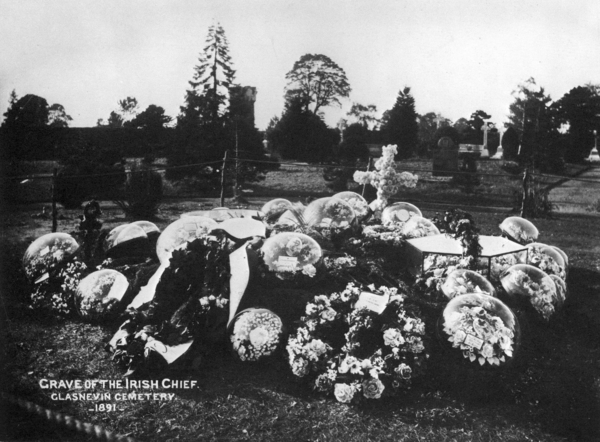
The 'uncrowned boycott king of Ireland', Charles Stewart Parnell, made what was to be his last public appearance at Creggs, County Galway, on the 27th September 1891, on a wet and cold winters day - he was in bad health, and the Creggs rally proved fatal : he returned to his wife's home in Brighton, England, after the rally and, on the 6th October 1891, he died there. He is buried in Glasnevin Cemetery in Dublin. 'The Irish Times' newspaper of the 12th October 1891 wrote of a '..spontaneous and irresistible wave that surged from all parts of Ireland to the grave at Glasnevin, whose wild waters would have swept away any barrier that either priests or politicians could have put up to stop it...the Catholic democracy of Ireland yesterday mustered in force to pay the last tribute of homage to a Protestant leader, in defiance not only of their priests, but of the vast majority of their elected Parliamentary representatives...'
Hopefully, sooner rather than later, we'll witness another 'surge that will sweep away the priests and politicians', who are still a blight in, and on, this country.
NEWS, COMMENTS ETC.
From 'The United Irishman' newspaper, February 1955.
BACK TO WOLFE TONE.
There have, I suppose, been 'modernists' and 'liberals' in every age and in every country ('1169' Comment - ...and in every political party, disguised and undisguised), but it seems to me that present-day Ireland has more than its quota. They are the cynical product of the self-seeking opportunism and downright dishonesty of Irish political life over the past 30 years, and their stock-in-trade is the smear and the jeer.
While they regard religious fervour* as sloppy sentiment and a sign of weakness they do not yet openly attack it in Ireland. They do, however, advocate an extreme liberalism whether it be in regard to pornographic literature or immoral and anti-social legislation.
Their most cynical jibes are, however, reserved for the man ('1169' Comment - or woman) who has in him (them) the true spirit of patriotism, for patriotism is out of fashion and regarded as mere parochialism - a relic of a more ignorant and barbaric age... (* - '1169' Comment : although this WAS taking place in the 1950's [and before and since then] it was not, unfortunately, exposed then as much as, thankfully, it is now.) (MORE LATER).
VIEW FROM THE HILLTOP CAFE...
A cafe at Drumcree and the insights it offers into the Orangemen who frequent it. Carl Whyte paid a visit. From 'Magill' magazine, July 2002.
In the paradigm of sectarianism that is the Orange Order, words like 'compromise' and 'agreement' are seldom uttered. The hospitality of those at the cafe in Drumcree is not reflected by the Order as a whole - despite two requests, no one from the Order's head office was available for interview.
Those at Drumcree were not the polished professionals that the Order would like to present - indeed, most had the look of fatherly figures that simply wanted to have a quiet cup of tea and a chat. But it would be a mistake to ignore them, or to dismiss out of hand their perceived grievances as being mere paranoia and nothing more.
It may appear that way but, as ever with the North, nothing is ever quite that simple. The heartbeat of the Order lies somewhere amidst the tables and chairs, the bread and bacon in that little cafe, demanding that their voice be heard. The tea and the trouble will continue to brew for some time yet.
(END of 'View From The Hilltop Cafe' ; NEXT - 'Columbia : No Irish Need Apply', from the same source.)
THE BIGGER (WE THINK) WE ARE....
..THE HARDER WE'LL FALL!
'The Blog Awards Ireland 2018 : Shortlist Announcement -
The Blog Awards Ireland, are delighted to announce the Shortlist for the 2018 Awards! These awards celebrate the outstanding achievements of the blogger community throughout the country over the past 12 months. After a gruelling round of judging, where each blog was judged on its readability, knowledge on their subject matter, navigation and design choices, the Blog Awards Ireland Judging Panel are proud to announce the Shortlist in both Business and Personal blogs in each category. These blogs will go through one more round of judging before the Finalists are announced!' (From here.) AND - we made it through to that 'Shortlist'! We are in the hands of the Blog Award Judges who, as part of their remit, will be reading this blog and will therefore no doubt read this post. We don't know who those judges are, so we can't bribe (!) them, nor can I offer them employment as our bag carriers on my next trip to New York with the girls (..all expenses paid, incidentally!) so I decided to write* this poem for them instead :
If you want a Blog Award bad enough
To go out and fight for it,
Work day and night for it,
Give up your time and your peace and your sleep for it,
If only desire of it
Makes you quite mad enough
Never to tire of it,
Makes you hold all other Awards tawdry and cheap,
If life seems all empty and useless without it
And all that you scheme and you dream is about it,
If gladly you'll sweat for it,
Fret for it,
Plan for it,
Lose all your terror of God or man for it,
If you'll simply go after that Award that you want
With all your capacity,
Strength, and sagacity,
Faith, hope, and confidence, stern pertinacity,
If neither cold, poverty, famished and gaunt,
Nor sickness nor pain
Of body and brain
Can turn you away from the Blog Award that you want,
If dogged and grim you besiege and beset it,
You'll get that Blog Award. You can bet on it!
(*..by which I mean 'borrowed and slightly edited it', from here!) We'll either soar to new heights or..it'll be a car-crash for us!
Thanks for reading, Sharon.
Robert Emmet was tried before a 'Special Commission' in Green Street Court House in Dublin on September 19th, 1803 - 215 years ago on this date.
The 'trial' lasted all day and by 9.30pm he was pronounced guilty ; asked for his reaction, he delivered a speech ("..when my country takes her place among the nations of the earth, then, and not till then, let my epitaph be written.." - full text here) which still inspires today. He closed by saying that he cared not for the opinion of the court but for the opinion of the future - "..when other times and other men can do justice to my character.."
He was publicly executed the next day, Tuesday, September 20th, 1803, outside St Catherine's Church in Dublin's Thomas Street. The final comment on the value of Robert Emmet's Rising must go to Séan Ó Brádaigh who states that to speak of Emmet in terms of failure alone is to do him a grave injustice. He and the men and women of 1798 and 1803 and, indeed, those that went before them, set a course for the Irish nation, with their appeal to Protestant, Catholic and Dissenter under the common name of 'Irishman', which profoundly affected Irish life for more than two centuries and which will, we trust, eventually bear abundant fruit - "The Society of United Irishmen to which he belonged was no myth. Nor is the Republican resistance to English rule in Ireland, before Emmet's Rising and since, a myth. The invasion, conquest and plantation of Ireland are no myths, nor is the suffering of the Irish people. We know of the laws against Catholics, we know of the landlord system and the evictions, the starvation of 1845-48 and the coffin ships. None of these are myths.." (more here.)
It should be noted that it was not only college-educated men and women like Robert Emmet (ie those who might be perceived as being 'upper class') who decided to challenge Westminster's interference in Irish affairs in 1803 : so-called 'working class' men and women also acknowledged the need for such resistance - Edward Kearney, carpenter, hanged, Thomas St / Owen Kirwin, tailor, hanged, Thomas St, September 1st 1803 / Maxwell Roche, roofer, hanged, Thomas St, September 2nd 1803 / Denis Lambert Redmond, coal facer, hanged, Coalquay (Woodquay) Dublin, / John Killeen, carpenter, hanged, Thomas St, September 10th 1803 / John McCann, shoemaker, hanged at his own doorstep, Thomas St, September 10th 1803 / Felix Rourke, farm labourer, hanged, Rathcoole, Dublin, September 10th 1803 / Thomas Keenan, carpenter, hanged, Thomas St, September 11th 1803 / John Hayes, carpenter, hanged, Thomas St, September 17th 1803 / Michael Kelly, carpenter, hanged, Thomas St, September 17th 1803 / James Byrne, baker, hanged, Townsend St, Dublin, September 17th 1803 / John Begg, tailor, hanged, Palmerstown, Dublin, September 17th 1803 / Nicholas Tyrrell, factory worker, hanged, Palmerstown, Dublin, September 17th 1803 / Henry Howley, carpenter, hanged, Kilmainham Jail, Dublin, September 20th 1803 / John McIntoch, carpenter, hanged, Patrick St, Dublin, October 3rd 1803 - there are dozens more we could list here, but suffice to say that 'class' alone was not then, nor is it now, a deciding factor in challenging British military and political interference in this country. 'Justice' is the deciding factor in that equation.
'The struggle is over, the boys are defeated
Old Ireland's surrounded with sadness and gloom
We were defeated and shamefully treated
And I, Robert Emmet, awaiting my doom
Hung, drawn and quartered,
sure that was my sentence
But soon I will show them no coward am I
My crime is the love of the land I was born in
A hero I lived and a hero I'll die'.
''SINN FÉIN IS EVERYTHING ITS NAME IMPLIES - GOVERNMENT OF THE PEOPLE, BY THE PEOPLE, FOR THE PEOPLE....!'
From 'The United Irishman' newspaper, October 1954.
AMERICA PROPPING UP THE EMPIRE....
We ask the American people, and particularly those of Irish origin, to examine where they are being led, to look beyond the statements of the politicans to the actions which follow them, to realise what their money and their armed forces are being used for.
How low have they fallen, that 'the land of the free and the home of the brave' should be used as a bully-boy to protect John Bull and his accursed 'empire'?
(END of 'America Propping Up The Empire' : next - 'Church Objects To U.S. Comics', from the same source.)
ON THIS DATE (19TH SEPTEMBER) 138 YEARS AGO - PARNELL AND BIDDING FOR AN 'EVICTED' PROPERTY.
'In September 1796, Ireland was pregnant with expectation. The United Irishmen and Defenders planned insurrection and a French invasion was imminent. On 19 September Dublin Castle announced plans to follow Britain’s lead and enlist civilian volunteers as a yeomanry force. In October commissions were issued to local gentlemen and magistrates empowering them to raise cavalry troops and infantry companies. Recruits took the ‘Yeomanry oath’, were officered by the local gentry but were paid, clothed, armed and controlled by government. Their remit was to free the regular army and militia from domestic peacekeeping and do garrison duty if invasion meant troops had to move to the coast. Service was part-time—usually two ‘exercise days’ per week—except during emergencies when they were called up on 'permanent duty'.
If the Irish Yeomanry are remembered at all it is usually for their notoriety in the bloody summer of 1798. The popular folk memory of every area which saw action supplies lurid stories from the burning of Father John Murphy’s corpse in a tar barrel at Tullow to the sabreing and mutilation of Betsy Gray after the battle of Ballynahinch....(from here.)
At a meeting in Ennis, County Clare, on the 19th September 1880 - 138 years ago on this date - Charles Stewart Parnell - whom the British described as "..combining in his person all the unlovable qualities of an Irish member with the absolute absence of their attractiveness...something really must be done about him...he is always at a white heat or rage and makes with savage earnestness fancifully ridiculous statements.." , who was looked at in a wary fashion by some of his own people as he was a Protestant 'Landlord' who 'owned' about 5,000 acres of land in County Wicklow and his parents were friends of and, indeed, in some cases, related to, the local Protestant 'gentry', stated - "Now what are you to do with a tenant who bids for a farm from which his neighbour has been evicted? Now I think I heard somebody say 'Shoot him!', but I wish to point out a very much better way, a more Christian and more charitable way...when a man takes a farm from which another had been evicted you must shun him on the roadside when you meet him, you must shun him in the streets of the town, you must shun him in the shop, you must shun him in the fairgreen and in the marketplace, and even in the place of worship, by leaving him alone, by putting him in a moral coventry, by isolating him from the rest of his country as if he were the leper of old, you must show your detestation of the crime he has committed..".
However, another man in the leadership of the 'Irish National Land League' which, at its peak, had 200,000 active members, John Blake Dillon (who was also a member of 'The Young Irelanders' War Council) will forever be more associated with introducing the word 'boycott' into the English language as it was Dillon who was the most active in organising such campaigns.
Also active was the then British Prime Minister, William Ewart Gladstone who, within months of Parnell's 'Boycott' statement, introduced and enforced a 'Crimes Act' ; that particular piece of British 'statute law' in Ireland was better known as the 'Coercion/Protection of Person and Property Act', which made it illegal to assemble in relation to certain issues and an offence to conspire against the payment of rents 'owed' which, ironically, was a piece of legislation condemned by the same catholic church which condemned the 'Irish National Land League'! That church did not approve of the Act because it introduced permanent legislation and did not have to be renewed on each political term.
The 'uncrowned boycott king of Ireland', Charles Stewart Parnell, made what was to be his last public appearance at Creggs, County Galway, on the 27th September 1891, on a wet and cold winters day - he was in bad health, and the Creggs rally proved fatal : he returned to his wife's home in Brighton, England, after the rally and, on the 6th October 1891, he died there. He is buried in Glasnevin Cemetery in Dublin. 'The Irish Times' newspaper of the 12th October 1891 wrote of a '..spontaneous and irresistible wave that surged from all parts of Ireland to the grave at Glasnevin, whose wild waters would have swept away any barrier that either priests or politicians could have put up to stop it...the Catholic democracy of Ireland yesterday mustered in force to pay the last tribute of homage to a Protestant leader, in defiance not only of their priests, but of the vast majority of their elected Parliamentary representatives...'
Hopefully, sooner rather than later, we'll witness another 'surge that will sweep away the priests and politicians', who are still a blight in, and on, this country.
NEWS, COMMENTS ETC.
From 'The United Irishman' newspaper, February 1955.
BACK TO WOLFE TONE.
There have, I suppose, been 'modernists' and 'liberals' in every age and in every country ('1169' Comment - ...and in every political party, disguised and undisguised), but it seems to me that present-day Ireland has more than its quota. They are the cynical product of the self-seeking opportunism and downright dishonesty of Irish political life over the past 30 years, and their stock-in-trade is the smear and the jeer.
While they regard religious fervour* as sloppy sentiment and a sign of weakness they do not yet openly attack it in Ireland. They do, however, advocate an extreme liberalism whether it be in regard to pornographic literature or immoral and anti-social legislation.
Their most cynical jibes are, however, reserved for the man ('1169' Comment - or woman) who has in him (them) the true spirit of patriotism, for patriotism is out of fashion and regarded as mere parochialism - a relic of a more ignorant and barbaric age... (* - '1169' Comment : although this WAS taking place in the 1950's [and before and since then] it was not, unfortunately, exposed then as much as, thankfully, it is now.) (MORE LATER).
VIEW FROM THE HILLTOP CAFE...
A cafe at Drumcree and the insights it offers into the Orangemen who frequent it. Carl Whyte paid a visit. From 'Magill' magazine, July 2002.
In the paradigm of sectarianism that is the Orange Order, words like 'compromise' and 'agreement' are seldom uttered. The hospitality of those at the cafe in Drumcree is not reflected by the Order as a whole - despite two requests, no one from the Order's head office was available for interview.
Those at Drumcree were not the polished professionals that the Order would like to present - indeed, most had the look of fatherly figures that simply wanted to have a quiet cup of tea and a chat. But it would be a mistake to ignore them, or to dismiss out of hand their perceived grievances as being mere paranoia and nothing more.
It may appear that way but, as ever with the North, nothing is ever quite that simple. The heartbeat of the Order lies somewhere amidst the tables and chairs, the bread and bacon in that little cafe, demanding that their voice be heard. The tea and the trouble will continue to brew for some time yet.
(END of 'View From The Hilltop Cafe' ; NEXT - 'Columbia : No Irish Need Apply', from the same source.)
THE BIGGER (WE THINK) WE ARE....
..THE HARDER WE'LL FALL!
'The Blog Awards Ireland 2018 : Shortlist Announcement -
The Blog Awards Ireland, are delighted to announce the Shortlist for the 2018 Awards! These awards celebrate the outstanding achievements of the blogger community throughout the country over the past 12 months. After a gruelling round of judging, where each blog was judged on its readability, knowledge on their subject matter, navigation and design choices, the Blog Awards Ireland Judging Panel are proud to announce the Shortlist in both Business and Personal blogs in each category. These blogs will go through one more round of judging before the Finalists are announced!' (From here.) AND - we made it through to that 'Shortlist'! We are in the hands of the Blog Award Judges who, as part of their remit, will be reading this blog and will therefore no doubt read this post. We don't know who those judges are, so we can't bribe (!) them, nor can I offer them employment as our bag carriers on my next trip to New York with the girls (..all expenses paid, incidentally!) so I decided to write* this poem for them instead :
If you want a Blog Award bad enough
To go out and fight for it,
Work day and night for it,
Give up your time and your peace and your sleep for it,
If only desire of it
Makes you quite mad enough
Never to tire of it,
Makes you hold all other Awards tawdry and cheap,
If life seems all empty and useless without it
And all that you scheme and you dream is about it,
If gladly you'll sweat for it,
Fret for it,
Plan for it,
Lose all your terror of God or man for it,
If you'll simply go after that Award that you want
With all your capacity,
Strength, and sagacity,
Faith, hope, and confidence, stern pertinacity,
If neither cold, poverty, famished and gaunt,
Nor sickness nor pain
Of body and brain
Can turn you away from the Blog Award that you want,
If dogged and grim you besiege and beset it,
You'll get that Blog Award. You can bet on it!
(*..by which I mean 'borrowed and slightly edited it', from here!) We'll either soar to new heights or..it'll be a car-crash for us!
Thanks for reading, Sharon.
Wednesday, September 05, 2018
NOT ALL PENSIONERS IN THIS STATE ARE STRUGGLING FINANCIALLY.
HAPPY BIRTHDAY, MGQ!
"There was one lesson that we learned when we were in government. And that was that the British will promise you the sun, moon and stars, and then at the last moment try and put in something, or change something. And it was like that in history, everything I'd learned in school was coming true. Every time the Irish and themselves (the British) made a deal, they would do something at the end to screw it up!" - Maire Geoghegan-Quinn (pictured), Fianna Fáil, in an interview in 'The Sunday Business Post', 12th May, 1996, page 26.Happy Birthday, Marie - 68 today, Wednesday 5th September 2018. And no mention, of course, in your above quote, of all the times since the foundation of this corrupt State that you and yours in Fianna Fáil have done "deals" with Westminster to assist in securing their continued military and political presence in this country. But then you are fond of doing 'deals' which you must hope will not be made public : '...(he) branded the commissioner (Maire Geoghegan-Quinn) "arrogant" for her initial refusal to even comment on the fact taxpayers provide her with two pensions, a ministerial one (€62,945) and a TD's one (€44,380), despite being paid €243,338 for being in the EU cabinet..' (from here). Those figures amount to €7306 a week, and that's not counting whatever 'expenses' she claims in her new 'job'.
Let me do what I wanna do, I can't decide 'em all
Just tell me where to put the money and I'll tell you who to call
Nobody can get no sleep, there's someone on everyone's toes
But when Quinn the politician gets here, everybody's gonna wanna doze..' (from here, slightly edited.)
And Marie is in good (!) company in regards to politicians pensions, lump sums and golden handshakes : 'The taxpayer paid out close to €20m last year in pensions, lump sums, and other retirement benefits to former politicians..the €19.67m bill was inflated by large golden handshakes for TDs and senators who retired or lost their seats in the last general election..thirteen politicians received more than €200,000 last year, their payments boosted by generous retirement lump sums available from the Oireachtas...the largest individual pensions are still being paid to former taoisigh Brian Cowen and Bertie Ahern - both received annual pensions of €134,500 last year, made up of their pensions from the Oireachtas and from the Department of Finance for their time as ministers and as taoiseach...' (from here). And these are the type of characters that want you to vote next month (October 2018) for either one of them or for one of their colleagues, in the Free State presidential election (€5000 a week salary). Do as we do - claim your ballot paper on the day and write 'NOTA' on it. Don't vote for them to have a lifestyle that we can't afford to pay for.
''SINN FÉIN IS EVERYTHING ITS NAME IMPLIES - GOVERNMENT OF THE PEOPLE, BY THE PEOPLE, FOR THE PEOPLE....!'
From 'The United Irishman' newspaper, October 1954.
AMERICA PROPPING UP THE EMPIRE....
A more sinister aspect of the Senator's 'misunderstanding' appeared on September 24th when it was announced that a U.S. naval task force, including an aircraft carrier and six destroyers, had arrived in Derry for intensified training. So this is the American idea of 'preservation of Irish freedom' ; to send forces to co-operate with and support the English invader.
We know they were there during the recent war, and they had no right then any more than now - but they could use the war as an excuse. Since then U.S. forces in the North have been gradually cleared out, but apparently this policy is to be reversed. It is time we had some blunt speaking about this.
We have heard great talk about the Communist puppet governments in East Germany, Austria, Hungary etc , propped up by the Red Army. The U.S. forces in Ireland are doing precisely the same job as the Red Army in those countries. The fact which must be faced is that you cannot preserve freedom by destroying it or helping another to destroy it... (MORE LATER.)
NEWS, COMMENTS ETC.
From 'The United Irishman' newspaper, February 1955.
'AN CUMANN CABHRAC...
Collection details - Athlone £19 12 shillings 0 pence, Monaghan £92 19 9, Nenagh and District £242 9 0, Ardfinnan £16 3 0, Laoighis (part) £225 0 0, Donegal £94 16 10, Strabane £50 0 0, Derry £82 0 0, Sligo £64 2 0.
MAYO - Westport, Castlebar £91 5 2, Meath £49 3 11, NCA collection £198 12 0, RA Committee New York £100 0 0, Tyrone Men's Social Benefit Patriotic Society Philladelphia £63 16 7, Benevolent IRA Association £100 0 0. (END of 'An Cumann Cabhrach' - next ; 'Back To Wolfe Tone', from the same source.)
VIEW FROM THE HILLTOP CAFE...
A cafe at Drumcree and the insights it offers into the Orangemen who frequent it. Carl Whyte paid a visit. From 'Magill' magazine, July 2002.
Throughout its history, the 'Orange Order' has enjoyed a powerful position within society. The problem of restrictions on parades is much wider than that at Drumcree ; parades are being re-routed throughout Northern Ireland (sic) and many such bans have led to various levels of civil disturbance. Michael Goodman of the Lower Ormeau Road Concerned Community, a residents group based in Belfast and opposed to parades on the nationalist Lower Ormeau Road, dismisses the view that Catholics ever watched Orange marches. He cites historical evidence which records civil disturbance as far back as 1920 in the Lower Ormeau Road.
He denies also that residents groups are a front for Sinn Féin, and claims that the main reason the residents in the Lower Ormeau decided to oppose the parades was after the death of five civilians shot by the UFF in a bookmaker's outlet on the Ormeau Road. Later that year, at an Orange parade, a female associate member danced outside that bookmaker shop shouting "five nil!, five nil!" , referring to the UFF murders.
Links between residents groups and Sinn Féin, however, are undeniable - Gerard Rice, spokesperson for the Lower Ormeau Road Concerned Community, served four years in prison for possession of explosives and membership of the IRA, although Michael Goodwin claimed he was unaware of that fact. When asked if he could see why some Orangemen would have a problem talking to a former IRA man, he simply replied that "the residents association is more than one person..." (MORE LATER).
ON THIS DAY NEXT WEEK (WEDNESDAY 12TH SEPTEMBER 2018).....
...we won't be posting our usual contribution, and probably won't be in a position to post anything at all until the following Wednesday ; this coming weekend (Saturday/Sunday 8th/9th September) is spoke for already with a 650-ticket raffle to be run for the Dublin Executive of RSF in a venue on the Dublin/Kildare border (work on which begins on the Tuesday before the actual raffle) and the 'autopsy' into same which will take place on Monday evening, 10th, in Dublin, meaning that we will not have the time to post here. But we'll be back, as stated above, on Wednesday 19th September 2018, providing nothing else catches our fancy between now and then - so we hope you can hold on until the 19th..!
Thanks for reading, Sharon.
"There was one lesson that we learned when we were in government. And that was that the British will promise you the sun, moon and stars, and then at the last moment try and put in something, or change something. And it was like that in history, everything I'd learned in school was coming true. Every time the Irish and themselves (the British) made a deal, they would do something at the end to screw it up!" - Maire Geoghegan-Quinn (pictured), Fianna Fáil, in an interview in 'The Sunday Business Post', 12th May, 1996, page 26.Happy Birthday, Marie - 68 today, Wednesday 5th September 2018. And no mention, of course, in your above quote, of all the times since the foundation of this corrupt State that you and yours in Fianna Fáil have done "deals" with Westminster to assist in securing their continued military and political presence in this country. But then you are fond of doing 'deals' which you must hope will not be made public : '...(he) branded the commissioner (Maire Geoghegan-Quinn) "arrogant" for her initial refusal to even comment on the fact taxpayers provide her with two pensions, a ministerial one (€62,945) and a TD's one (€44,380), despite being paid €243,338 for being in the EU cabinet..' (from here). Those figures amount to €7306 a week, and that's not counting whatever 'expenses' she claims in her new 'job'.
Let me do what I wanna do, I can't decide 'em all
Just tell me where to put the money and I'll tell you who to call
Nobody can get no sleep, there's someone on everyone's toes
But when Quinn the politician gets here, everybody's gonna wanna doze..' (from here, slightly edited.)
And Marie is in good (!) company in regards to politicians pensions, lump sums and golden handshakes : 'The taxpayer paid out close to €20m last year in pensions, lump sums, and other retirement benefits to former politicians..the €19.67m bill was inflated by large golden handshakes for TDs and senators who retired or lost their seats in the last general election..thirteen politicians received more than €200,000 last year, their payments boosted by generous retirement lump sums available from the Oireachtas...the largest individual pensions are still being paid to former taoisigh Brian Cowen and Bertie Ahern - both received annual pensions of €134,500 last year, made up of their pensions from the Oireachtas and from the Department of Finance for their time as ministers and as taoiseach...' (from here). And these are the type of characters that want you to vote next month (October 2018) for either one of them or for one of their colleagues, in the Free State presidential election (€5000 a week salary). Do as we do - claim your ballot paper on the day and write 'NOTA' on it. Don't vote for them to have a lifestyle that we can't afford to pay for.
''SINN FÉIN IS EVERYTHING ITS NAME IMPLIES - GOVERNMENT OF THE PEOPLE, BY THE PEOPLE, FOR THE PEOPLE....!'
From 'The United Irishman' newspaper, October 1954.
AMERICA PROPPING UP THE EMPIRE....
A more sinister aspect of the Senator's 'misunderstanding' appeared on September 24th when it was announced that a U.S. naval task force, including an aircraft carrier and six destroyers, had arrived in Derry for intensified training. So this is the American idea of 'preservation of Irish freedom' ; to send forces to co-operate with and support the English invader.
We know they were there during the recent war, and they had no right then any more than now - but they could use the war as an excuse. Since then U.S. forces in the North have been gradually cleared out, but apparently this policy is to be reversed. It is time we had some blunt speaking about this.
We have heard great talk about the Communist puppet governments in East Germany, Austria, Hungary etc , propped up by the Red Army. The U.S. forces in Ireland are doing precisely the same job as the Red Army in those countries. The fact which must be faced is that you cannot preserve freedom by destroying it or helping another to destroy it... (MORE LATER.)
NEWS, COMMENTS ETC.
From 'The United Irishman' newspaper, February 1955.
'AN CUMANN CABHRAC...
Collection details - Athlone £19 12 shillings 0 pence, Monaghan £92 19 9, Nenagh and District £242 9 0, Ardfinnan £16 3 0, Laoighis (part) £225 0 0, Donegal £94 16 10, Strabane £50 0 0, Derry £82 0 0, Sligo £64 2 0.
MAYO - Westport, Castlebar £91 5 2, Meath £49 3 11, NCA collection £198 12 0, RA Committee New York £100 0 0, Tyrone Men's Social Benefit Patriotic Society Philladelphia £63 16 7, Benevolent IRA Association £100 0 0. (END of 'An Cumann Cabhrach' - next ; 'Back To Wolfe Tone', from the same source.)
VIEW FROM THE HILLTOP CAFE...
A cafe at Drumcree and the insights it offers into the Orangemen who frequent it. Carl Whyte paid a visit. From 'Magill' magazine, July 2002.
Throughout its history, the 'Orange Order' has enjoyed a powerful position within society. The problem of restrictions on parades is much wider than that at Drumcree ; parades are being re-routed throughout Northern Ireland (sic) and many such bans have led to various levels of civil disturbance. Michael Goodman of the Lower Ormeau Road Concerned Community, a residents group based in Belfast and opposed to parades on the nationalist Lower Ormeau Road, dismisses the view that Catholics ever watched Orange marches. He cites historical evidence which records civil disturbance as far back as 1920 in the Lower Ormeau Road.
He denies also that residents groups are a front for Sinn Féin, and claims that the main reason the residents in the Lower Ormeau decided to oppose the parades was after the death of five civilians shot by the UFF in a bookmaker's outlet on the Ormeau Road. Later that year, at an Orange parade, a female associate member danced outside that bookmaker shop shouting "five nil!, five nil!" , referring to the UFF murders.
Links between residents groups and Sinn Féin, however, are undeniable - Gerard Rice, spokesperson for the Lower Ormeau Road Concerned Community, served four years in prison for possession of explosives and membership of the IRA, although Michael Goodwin claimed he was unaware of that fact. When asked if he could see why some Orangemen would have a problem talking to a former IRA man, he simply replied that "the residents association is more than one person..." (MORE LATER).
ON THIS DAY NEXT WEEK (WEDNESDAY 12TH SEPTEMBER 2018).....
...we won't be posting our usual contribution, and probably won't be in a position to post anything at all until the following Wednesday ; this coming weekend (Saturday/Sunday 8th/9th September) is spoke for already with a 650-ticket raffle to be run for the Dublin Executive of RSF in a venue on the Dublin/Kildare border (work on which begins on the Tuesday before the actual raffle) and the 'autopsy' into same which will take place on Monday evening, 10th, in Dublin, meaning that we will not have the time to post here. But we'll be back, as stated above, on Wednesday 19th September 2018, providing nothing else catches our fancy between now and then - so we hope you can hold on until the 19th..!
Thanks for reading, Sharon.
Wednesday, August 29, 2018
IRELAND, 18TH CENTURY - ONLY 'ROYALTY' HAD A VOTE IN 'ELECTIONS'!
An Anti-Internment / POW information rally will be held before the All-Ireland Football Final on Sunday 2nd September next. Assemble outside Gills Bar beside Croke Park at 1.30pm. All Welcome!
"All men are born with equal rights, and in associating together to protect one another and share public burdens, justice demands that such associations should rest upon a basis which maintains equality instead of destroying it. We therefore declare that, unable longer to endure the curse of monarchical government, we aim at founding a republic, based on universal suffrage, which shall secure to all the intrinsic value of their labour" - Fenian Proclamation 1867.
ON THIS DATE (29TH AUGUST) 215 YEARS AGO : DEATH OF A 'UNITED IRISHMEN' FOUNDER.
'Samuel Neilson was a son of a Presbyterian clergyman, the Rev Alexander Neilson, who ministered the congregation in the Ballyroney (County Down) meeting house, close to the town of Rathfriland. Existing accounts suggest he was born in 1761, but the family Bible and church records state that September 1762 was the date of his birth...the young Neilson would follow his older brother, John, to Belfast, and he was apprenticed in the textile business that would make the brothers wealthy citizens of the town. As a Presbyterian, Neilson was - like his co-religionists in the growing commercial port - unable to vote for the town's two MPs in the Irish parliament, who were elected by a handful of people appointed by the borough's owner, the Marquess of Donegall.
The sense of injustice grew during the years that regular troops were withdrawn to serve in north America against the armies of George Washington. To fill the void, volunteer companies were raised across Ireland, and these soon engaged in political debate as the anticipated invasion by France, Britain's traditional enemy, failed to materialise...calls for a reform of the Irish parliament in Dublin struck a chord with the politically literate Presbyterians and a process of intense politicisation began...' (from here.)
On the 18th October 1791, a group of socially-minded Protestants, Anglicans and Presbyterians, including the then 30-year-old Samuel Neilson, held their first public meeting in Belfast and formed themselves as 'The Belfast Society of United Irishmen' (the organisation became a secret society three years later), electing Sam McTier as 'President' ; he was married to Martha, who was a sister of William Drennan.
The aims and objectives of the Society were revolutionary for the times that were in it, and brought the organisation to the attention of the less 'socially-minded' political (and military) members of the British ruling-class in Dublin, which was then (and, indeed, now!) England's political power-base in Ireland. The intention of those present at that meeting is best summed-up by this statement from the minutes (which would have been relayed, one way or another, to the Dublin Castle 'authorities') - "That the weight of English influence in the government of this country is so great, as to require a cordial union among all the people of Ireland, to maintain that balance which is essential to the preservation of our liberties and the extension of our commerce...the sole constitutional mode by which this influence can be opposed, is by a complete and radical reform of the representation of the people in Parliament...no reform is just which does not include every Irishman of every religious persuasion.."
The Belfast Society also adopted the Charter of 'The United Irishmen' as a whole, and in so doing they drew further attention on themselves from their political enemies, at home and abroad – 'In the present era of reform, when unjust governments are falling in every quarter of Europe, when religious persecution is compelled to abjure her tyranny over conscience, when the rights of men are ascertained in theory, and theory substantiated by practice, when antiquity can no longer defend absurd and oppressive forms, against the common sense and common interests of mankind, when all governments are acknowledged to originate from the people, and to be so far only obligatory, as they protect their rights and promote their welfare, we think it our duty, as Irishmen to come forward, and state what we feel to be our heavy grievance, and what we know to be its effectual remedy.'
'We have no national government, we are ruled by Englishmen, and the servants of Englishmen, whose object is the interest of another country, whose instrument is corruption, and whose strength is the weakness of Ireland ; and these men have the whole of the power and patronage of the country, as means to seduce and subdue the honesty of her representatives in the legislature. Such an extrinsic power, acting with uniform force, in a direction too frequently opposite to the true line of our obvious interest, can be resisted with effect solely by unanimity, decision, and spirit in the people, qualities which may be exerted most legally, constitutionally, efficaciously, by the great measure, essential to the prosperity and freedom of Ireland, an equal representation of all the people in parliament. Impressed with these sentiments...we do pledge ourselves to our country, and mutually to each other...impressed with these sentiments...we do pledge ourselves to our country, and mutually to each other..'
And, in 1791, with those words, the assembled Irishmen – Theobald Wolfe Tone, Thomas Russell, William Sinclair, Henry Joy McCracken, Samuel Neilson, Henry Haslett, Gilbert McIlveen, William and Robert Simms, Thomas McCabe, Thomas Pearce and Samuel McTier, among others, ensured the continuity of the on-going struggle against the British military and political presence in Ireland.
In 1796, when he was 35 years of age, Samuel Neilson was touted on to the Dublin 'authorities' by the informer William Bird (aka 'John Smith') and imprisoned in Kilmainham Jail in Dublin. He served 18 months and, although in bad health and financially ruined on his release in February 1798, he continued his work with the United Irishmen and, in May that same year, was imprisoned again by the British. He was held in Ireland for a few months and then transported to Fort George Prison in Scotland in 1799 and, in 1802, he was shipped out again, this time to Hamburg, in Germany, where he was left to his own devices. He managed to return to Ireland, unbeknown to the 'Crown', to settle his affairs as best he could. He then made his way, eventually, to New York, in America, where he became involved in journalism. He was now a weakened man, and that city was stricken with 'Yellow Fever', so he left New York proper and travelled to the 'countryside' - Dutchess County, in southeastern New York.
On the 29th August, 1803 - 215 years ago on this date - in a small town in Duchess County called Poughkeepsie, Samuel Neilson died, aged only 42, and was buried in that town's 'Rural Cemetery'. A 'Northern Star', and true 'Felon of our Land'.
By the groans that ascend from your forefathers' grave
For their country thus left to the brute and the slave,
Drive the demon of bigotry home to his den,
And where Britain made brutes now let Éirinn make men...
''SINN FÉIN IS EVERYTHING ITS NAME IMPLIES - GOVERNMENT OF THE PEOPLE, BY THE PEOPLE, FOR THE PEOPLE....!'
From 'The United Irishman' newspaper, October 1954.
AMERICA PROPPING UP THE EMPIRE.
Senator A. Wiley (Republican) Chairman of the U.S. Senate Foreign Relations Committee, visited Belfast on September 10th to discuss with the Stormont Government "questions of mutual concern".
During his visit he said : "I am hoping that neither partition nor other local issues in any country becomes so oversized that the people lose sight of the greater issues for the time being - the unity and preservation of their own freedom."
This statement shows such a misunderstanding of the Irish position that we feel it necessary to enlighten him. The task facing the Irish people is to attain their freedom and to secure the unity of their country. When these have been obtained then we will make plans to preserve them, but they must first of all be obtained.
They can only be obtained when we have persuaded, by argument or otherwise, the occupation forces of America's ally, England, to withdraw. When these forces have withdrawn then perhaps we may enter into discussions on world freedom. But, while they remain, no amount of platitudes or politicians' cliches will cloak the fact that we must get rid of the aggressor already within our gates before starting to consider possible aggression from other sources... (MORE LATER.)
ON THIS DATE (29TH AUGUST) 68 YEARS AGO : THE MAN RESPONSIBLE FOR THE 'SPRING TIDE' IS BORN.
And sure why wouldn't he play a game of golf on his birthday? Only a begrudger might say otherwise. And a begrudger might also say that the man could play golf everyday if he wanted to, considering he scored a 'hole-in-one' years ago with his pension(s) (and he's also still in a paid 'job'!) - whether he's collecting one or the other (or both!), it must make the arduous journey around the green easier to put up with.
But the 'Birthday Boy' apparently had a harder 'journey' on the hustlings a few decades ago, according to the 'IN DUBLIN' magazine 'Election Special', 1987 :
'Nobody noticed how Ruairi Quinn hi-jacked Dick Spring's itinerary that day. The plan that had been laid out for Dick in advance included a visit to Ruairi, but when everybody arrived Ruairi had an alternative sheet prepared which he gave to journalists. Other than to have a stand-up row about it, there was really no choice but to go along with the new plan, which included a fair amount of publicity for Ruairi himself, who may not be returned in this election. There was even talk that he might have found himself 'a job' in the event of being made redundant by the electorate.
It's hardly a month since Dick Spring sat at the cabinet table, but in the minds of the Labour Party ministers they have distanced themselves from those awful days. Nowadays, posters of Dick show the man with an open shirt - a 'Good Man Of The People' - : his moustache is trimmed, to give it a tamer if sharper look. On the posters at least, the working class hero has finally come home to roost. The day is dark and cold when the bus leaves Labour Party Headquarters ; Dick Spring steps out - 'People of Ireland, I love you..'. On the bus, the RTE cameras start to roll as the vehicle makes its way down Dorset Street. Passers-by look with amazement as they see James Connolly's successor (!) answering questions, facing into a camera, in a bus moving through the early morning traffic. Dick has own reservations about touring in buses, and what effect it has on people but, since the other parties do it, Labour would not seem to have a choice. It is a travelling circus.
Dick Spring provides as many photo opportunities as he can think of, to give him the chance to be seen to do as many different things as possible. Except he won't be doing anything at all ; he'll just be posing. His first stop of the day is at Guinness's Brewery in Dublin, where he poses with what looks like a suspended wheel in his hand : he has no idea what the function of this wheel is, but neither does anybody else. The newspaper people tell him where to walk, how to talk. The badge on his lapel says 'People Matter Most'. The really strange thing about all of this is that Dick Spring never once gets embarrassed about the carry on. Other people might want a break for a minute, but not Dick - he signs the visitors' book 'click-click-click-click-click' goes the cameras.
All of the above was very early in the day. Later, voters would tell Dick how fed-up with politics and politicians they really were. People have lost faith in Fine Gael, in Labour and the other parties that have been playing musical seats for the past seventy years. Dick is taken downstairs to see small engines that were used to transport Guinness in years gone by. He says they're "fantastic". It is then time to go on to Camden Street and tie-in with Ruairi Quinn, which is where the day got hi-jacked. Just before the Labour Party bus reached Camden Street, a road worker did a cut-throat sign towards Dick Spring, twice, but Dick never noticed. Later on in the day, a driver gave him a single digit sign, which Dick noticed, and responded to in kind. At Camden Street, Dick is told to wait until everyone is out of the bus before he steps onto the street, as this will provide really good shots of Dick getting off a bus. When Comrade Quinn and Comrade Spring meet each other there is great hugging and kissing, in the Russian fashion, as if the two had not met in years. The Labour Party Office in Camden Street is a dump and looks like a bad squat. There are large bare rooms, some of which are in the process of being painted. Ruairi and Dick head off down Camden Street, and a handler attempts to introduce Dick to the public. An old woman brushes past, saying - "No. I'm not interested in meeting him."
On Camden Street in Dublin, Dick Spring and Ruairi Quinn talk to the street traders - and are told that business is bad. This is the first real opportunity * they have had to talk to the traders since their last election four years ago and this fact is not lost on the women of Camden Street ('1169' Comment - *...rather it's the first time they have bothered, and even then only because it's election time again). It was on Ruairi Quinn's initiative that South African fruit was partially banned from Ireland, but it would appear that the level of Mr Quinn's understanding is beyond that of those who trade in the 'forbidden fruit'.
The message as to why the fruit should be banned did not get across. In response to a question, one women says - " We'll sell anything we can get a living out of." And that is the general mood on the street - apathy. People are tired of politicians, politics and promises, and many belong to the 'don't-vote-it-only-encourages-them' school of thought. This, despite the fact that many politicians are of the 'don't-vote-it-suits-us' school of thought. One street trader remarks that 'you won't see them until the next time', and her companion replies 'That's it'. One old man says that business is terrible and, just then, a baby is pushed past in a pram and someone asks Dick Spring if he will do the 'decent thing' and kiss the baby. "No," says Dick, "..we're not in that league. We kiss the mothers."
Then the issue of drug abuse is briefly raised. A young man tackles Dick Spring about the lack of funding for the Coolmine Drug Treatment Centre and the politician assures him that he will not find his Party wanting in that area . Ruairi Quinn had by now arranged for everybody to go to Grafton Street for another walkabout. There are people walking and talking on Grafton Street, minding their own business, when along comes Dick and shakes their hand and introduces himself and asks for the vote. It is clear that people recognise him but they are far too polite this early in the day to be rude. Ruairi and Dick go into a hairdressers : it's a great scam and will give rise to loads of photos . So Ruairi combs Dick's hair and Dick pats Ruairi on the head. Sometime a few years ago, Ruairi had his hair parted by Moses and it hasn't been the same since.
Phil Coulter is on the amp system singing 'The Town I Loved So Well' as the bus reaches Landsdowne Road ; there are thirty-five workers engaged in work close to the river Dodder, developing a park. Needless to say, this is another of Ruairi's ideas. Some of the lads ask Dick for tickets to see a rugby match, and Dick replies 'see your man over there' , pointing at Comrade Quinn. There's very little really that can't be 'fixed up' if there's a will, a way and an election. It's lunch time, so we all head for Kitty O'Shea's. Ruairi Quinn bought everyone lunch in Kitty O'Shea's pub. Dick Spring stated that there will be a second election within eighteen months. " Come on, we're wasting time. Let's go ," says Dick. It's back across the river and onto the Northside Shopping Centre, Charlie Haughey's political heartland . Fianna Fail are having a press conference at 3pm that same afternoon and there are very few photographers still with Dick and Ruairi. In any event, many had been under the impression that they would have to pay for their own lunch and this had the effect of diminishing the numbers somewhat.
Dick wanders in and out, into a shop here, a fast food joint there. Two customers, who appear to be engrossed in some sort of deal, are frozen with horror as they see Dick advance towards them with hand outstretched. One of them tells Dick that he should have run the full term of Office, whilst the other is "disgusted" by what the Labour Party has done but, before the argument can proceed , Dick is pulled away by a handler to sign an autograph. Whatever one may say about Dick Spring, he is not afraid to be challenged about his four years in government('1169' Comment -...providing he has a 'handler' present to pull him away to sign autographs). On water rates, Dick said he would 'change the system' : one woman said her mother was stopped a pension because she 'had a few pounds from England', while a second woman cannot get a medical card. Dick replied that he 'will see what we can do'. In reply to men out of work that he meets, he says that what is needed is a strong Labour Party but they seem unimpressed. One of them replied that he used vote Labour until Micko did the dirt on him. And so the travelling circus moves on.
The reception everywhere to Dick and Ruairi is similar : one man with a child refuses to stop and passes by. "He doesn't care, he's a Sinn Fein man", says someone else, pointing to the child. "Did you see the funny man going by?" he asks the child, "Did you see the man with the moustache...". All of those belonging to the Labour Party camp-circus ignore the man and the child.
Supermarkets! You look after the kids all day and then you go out shopping. Now it's getting on towards evening and you're tired. You're pushing the trolley along wishing you were at home. As you reach for that tin of beans, your hand is grabbed, and a Dick is there pumping it up and down, telling you who he is, introducing people to you, asking you for your vote. It rarely dawns on anybody that this man has been 'Deputy Prime Minister' for the last four years. You're so surprised you just stand there and say nothing. Stalking between the shelves of supermarkets looking for innocent voters to accost is pretty safe because of the element of surprise. Dick wonders if it is of any benefit at all. One woman says she won't be voting at all as she doesn't believe in politics. Another shopper says she wore a blueshirt and is not afraid to say so. A third woman tells Dick that she has been living in uninhabitable conditions for twelve years and, for Dick, this suddenly becomes a priority. Something will be done, he says. But not just now, alas, as it's time to move on to the hotel. Dick spots a building site across the road from the hotel.
You work on a building site. You might have had a few jars the night before and maybe you don't feel too well. You might be thinking about getting home for something to eat. But right now you are down a hole, digging it deeper. Suddenly you hear "How's it goin' lads?" You look up and there's Dick Spring looking down into the hole, smiling : he asks if the digging is going okay. That can be very un-nerving. Dick wanders off and starts to 'level' some concrete with a piece of timber, and lets it be known that he once worked on a building site. Nobody mentions that perhaps it might have been a good idea if he had stayed there. Dick gets a hard hat and a sledgehammer and poses for local photographers beside a bucket of concrete. 'Dick The Builder', photographed filling a bucket of concrete with a sledgehammer. Someone remarks that Dick was known as a very dirty player on the sportsfield and Dick doesn't deny this. Dirty play is now parading as virtue. "Still am. When I don't get my own way, I walk off the pitch", he says.
Later, on the way into a hotel, Dick notices that a poster of Dessie O'Malley has had eyeshadow and lipstick painted in. "Graffiti with taste," he remarks. The political-circus bus drives on : Malahide, then Swords. At a shopping centre, it's time to talk to the punters again. The reaction is not great for the party leader who claims to represent the working class. Indeed, one woman says she will only vote for him when he gets her husband back to work, another woman says only when he gets her husband back from his job in England, and a third woman says only when he gets her a grant for some building work that she's trying to get done. A nurse says she will vote for Barry Desmond as she admires him, even though she wouldn't agree with everything he has done. But by now the timetable is getting loused up and Dick is led away by his handlers.
When this travelling political circus reaches the town of Rush in North County Dublin, one man says that the Labour Party should have pulled out of government long ago ; he is about sixty years of age and sounds very bitter - "I voted Labour last time but never again. You let me down. You said Fianna Fail and Fine Gael were six of one and half dozen of the other and then ye go in with Fine Gael! Youse are all gangsters. Justin Keating fucked up your seat here and you'll never get it back. What about the PD's? What about the Provos..?" It goes on and on, but Dick Spring hasn't time to argue the toss. There are other places to visit. Like the nearest pub. In the pub, Dick gives a bit of a speech. It's for the benefit of the party workers in the area : "Vote one-two as often as you can between here and the next town. It's a good constituency. Let's not be beaten by fifty or sixty votes. Let's go out there and do it. Vote early and vote often!" Fightin' talk. In the town of Balbriggan, Dick tells people that he's going to build up a strong Labour Party and that this is "necessary". One woman says that she's promising nothing, but that she'll think about voting for Labour, to which Dick replies that he isn't promising anything either. Another woman has a problem with bus-fares for her kids going to school and one of the Labour Party people makes a note of it and promises that something will be done.
Dick is uneasy walking around shaking people's hands, as he's not sure where the next attack might come from. There is no urgency or vibrancy to his personal appearances in public, unlike say that of Charlie Haughey, but then Dick's demeanour may be due to the last four years in government with Fine Gael where there has been a war of attrition. The best Dick Spring can say of the last four years in government with Fine Gael is that his party curbed the worst excesses of the latter, but this fine distinction is lost on an electorate which has become cynical about the whole political process. The six workers who have travelled with Dick all day in the bus finally get introduced to their leader - they had been handing out leaflets and canvassing all day. Then it's time to go to the town of Navan, where Dick signs an autograph for a twelve-year-old boy and, while he is doing this, three other young lads see and recognise him as they are going up a stairs. They start to chant "Sinn Féin, Sinn Féin", but are ignored by Dick. Now it's nearly 8pm. Other speeches have to be delivered elsewhere. At times throughout the day, Dick ignored some people who weren't interested in what he had to say and one could not help but wonder if voters care at all whether or not they get to hear him, now or at any other time.'
Not to worry, Dick - you have a happy birthday, now, safe in the knowledge that all that carry-on is in the past and the 'Labour Party' couldn't possibly suffer like that again...!
NEWS, COMMENTS ETC.
From 'The United Irishman' newspaper, February 1955.
'AN CUMANN CABHRAC...
Collection details - Athenry and District £90 10 shillings 1penny, Galway City and District £163 1 4, North Galway £74 10 10, Tuam and District £160 0 0, East Galway £110 0 0, Roscommon £130 15 4, Kildare (balance) £46 0 0.
KERRY : Tralee £100 0 shillings 0 pence, Cahirciveen £132 10 0, Brandon £22 10 0, Ardee £24 0 0, Ballylongford £26 1 3, Ballydonoghue £9 5 0.
CORK : Cork City £165 0 shillings 0 pence, Skibbereen £120 3 6, Waterford City £140 0 0, Limerick £48 0 0, Lisnagarvey £25 13 0, Cavan £112 15 0, Drogheda £73 10 0, Carlingford £21 1 1, Dundalk (balance) £35 9 6.... (MORE LATER.)
BLOG AWARDS 2018 : OUR CLAIM TO (or attempt at...!) FAME! We're up against some rock hard competition here, so sit back and watch us get our arse kicked. Again...!
(...and if any of the 'Blog Award' judges are reading this, we'll also accept an 'Also Ran' plaque...!)
VIEW FROM THE HILLTOP CAFE...
A cafe at Drumcree and the insights it offers into the Orangemen who frequent it. Carl Whyte paid a visit. From 'Magill' magazine, July 2002.
"Protestants don't want Sinn Féin in government and that's that", says Victor, a local farmer. Nearly all present in the cafe (pictured) had been UUP voters, but all abandoned it because of David Trimble's stance on the 'Good Friday Agreement' (Stormont Treaty) and they now vote for the DUP, a party completely opposed to that Agreement. Perhaps the saddest comment of the night surrounds the murder of the Quinn children in Ballymoney in 1998. The entire six counties were paralysed with civil disturbance because permission had not been granted for the parade at Drumcree. In the early hours of the 12th of July, members of the local UVF launched a petrol-bomb attack on the house of Chrissy Quinn in the Carnany Estate - Richard, Mark and Jason Quinn all died in the ensuing inferno.
Former RUC Chief Constable Ronnie Flanagan said that the attack was sectarian and linked to the Drumcree protest and many Orangemen deserted the protest at Drumcree following that tragedy but, in subsequent days, the Orange Order denied that their protests had led to those murders. In the cafe at Drumcree, those present volunteered their explanation - "Drug related. The Orangemen were nothing to do with it."
The 'Loyal Orange Institution' was founded on the 21st September 1795 and is more commonly known as the 'Orange Order'. It was established after the infamous 'Battle of the Diamond', a sectarian battle that took place in fields near Portadown. It pledges to uphold civil and religious liberties and its condemnation of religious ideology 'is directed against church doctrine and not against individual adherents or members'. It has lodges as far away as Canada and Togo, but it is most concentrated in Northern Ireland (sic), with a few lodges in Ulster counties in the Republic (sic) as well as some in Scotland.
Among its past members are four Prime Ministers of Northern Ireland (sic - how can six counties out of a nine-county Irish province have a 'Prime Minister'?!)) as well as the current UUP leader, David Trimble. Orangemen are forbidden from attending services in any Catholic church and Mr. Trimble was censured by his local lodge for attending the funeral service of a Catholic child killed in the Omagh bombing... (MORE LATER).
LAST COMMENT (FOR THIS YEAR!) RE OUR NYC HOLIDAY....
'Hell's Kitchen. Hell Gate. Richard Hell. The signs (and wonders) are everywhere. Abandon all hope : New York City is a living hell of renegade capital, exploited labour, racial hatred, institutional misogyny, and bodega cats. You must say goodbye. Or is it a neoliberal paradise, imperfect yet lovable, where capital and culture and rats roam free?
In recent times, the battle lines for this Cold War have been drawn by dueling essay collections, like Goodbye to All That vs. Never Can Say Goodbye. (Thankfully John Freeman’s beautifully careworn Tales of Two Cities avoids the question altogether.) Both collections have their merits and faults, and yet I can't shake the notion that they're actually the same book. You are saying goodbye ; you can never say goodbye. If New York City is truly a Dantean Inferno — and I'm inclined to think it is — what makes any of us believe that we can ever truly leave? The entire point of hell is its inescapability, and New York is no different. You can leave it in body, sure ; I've left several times. But you'll come back. Or at least your mind will remain here, and you'll still be writing essays about that time you told it to fuck off...' (from here).
Like the author, my friends and I can't say 'Goodbye' to New York. But the only time we tell that city to 'f**k off' is when we're told we have to go home from there. Hopefully, next year, we'll apologise for doing so...
Thanks for reading, Sharon.
"All men are born with equal rights, and in associating together to protect one another and share public burdens, justice demands that such associations should rest upon a basis which maintains equality instead of destroying it. We therefore declare that, unable longer to endure the curse of monarchical government, we aim at founding a republic, based on universal suffrage, which shall secure to all the intrinsic value of their labour" - Fenian Proclamation 1867.
ON THIS DATE (29TH AUGUST) 215 YEARS AGO : DEATH OF A 'UNITED IRISHMEN' FOUNDER.
'Samuel Neilson was a son of a Presbyterian clergyman, the Rev Alexander Neilson, who ministered the congregation in the Ballyroney (County Down) meeting house, close to the town of Rathfriland. Existing accounts suggest he was born in 1761, but the family Bible and church records state that September 1762 was the date of his birth...the young Neilson would follow his older brother, John, to Belfast, and he was apprenticed in the textile business that would make the brothers wealthy citizens of the town. As a Presbyterian, Neilson was - like his co-religionists in the growing commercial port - unable to vote for the town's two MPs in the Irish parliament, who were elected by a handful of people appointed by the borough's owner, the Marquess of Donegall.
The sense of injustice grew during the years that regular troops were withdrawn to serve in north America against the armies of George Washington. To fill the void, volunteer companies were raised across Ireland, and these soon engaged in political debate as the anticipated invasion by France, Britain's traditional enemy, failed to materialise...calls for a reform of the Irish parliament in Dublin struck a chord with the politically literate Presbyterians and a process of intense politicisation began...' (from here.)
On the 18th October 1791, a group of socially-minded Protestants, Anglicans and Presbyterians, including the then 30-year-old Samuel Neilson, held their first public meeting in Belfast and formed themselves as 'The Belfast Society of United Irishmen' (the organisation became a secret society three years later), electing Sam McTier as 'President' ; he was married to Martha, who was a sister of William Drennan.
The aims and objectives of the Society were revolutionary for the times that were in it, and brought the organisation to the attention of the less 'socially-minded' political (and military) members of the British ruling-class in Dublin, which was then (and, indeed, now!) England's political power-base in Ireland. The intention of those present at that meeting is best summed-up by this statement from the minutes (which would have been relayed, one way or another, to the Dublin Castle 'authorities') - "That the weight of English influence in the government of this country is so great, as to require a cordial union among all the people of Ireland, to maintain that balance which is essential to the preservation of our liberties and the extension of our commerce...the sole constitutional mode by which this influence can be opposed, is by a complete and radical reform of the representation of the people in Parliament...no reform is just which does not include every Irishman of every religious persuasion.."
The Belfast Society also adopted the Charter of 'The United Irishmen' as a whole, and in so doing they drew further attention on themselves from their political enemies, at home and abroad – 'In the present era of reform, when unjust governments are falling in every quarter of Europe, when religious persecution is compelled to abjure her tyranny over conscience, when the rights of men are ascertained in theory, and theory substantiated by practice, when antiquity can no longer defend absurd and oppressive forms, against the common sense and common interests of mankind, when all governments are acknowledged to originate from the people, and to be so far only obligatory, as they protect their rights and promote their welfare, we think it our duty, as Irishmen to come forward, and state what we feel to be our heavy grievance, and what we know to be its effectual remedy.'
'We have no national government, we are ruled by Englishmen, and the servants of Englishmen, whose object is the interest of another country, whose instrument is corruption, and whose strength is the weakness of Ireland ; and these men have the whole of the power and patronage of the country, as means to seduce and subdue the honesty of her representatives in the legislature. Such an extrinsic power, acting with uniform force, in a direction too frequently opposite to the true line of our obvious interest, can be resisted with effect solely by unanimity, decision, and spirit in the people, qualities which may be exerted most legally, constitutionally, efficaciously, by the great measure, essential to the prosperity and freedom of Ireland, an equal representation of all the people in parliament. Impressed with these sentiments...we do pledge ourselves to our country, and mutually to each other...impressed with these sentiments...we do pledge ourselves to our country, and mutually to each other..'
And, in 1791, with those words, the assembled Irishmen – Theobald Wolfe Tone, Thomas Russell, William Sinclair, Henry Joy McCracken, Samuel Neilson, Henry Haslett, Gilbert McIlveen, William and Robert Simms, Thomas McCabe, Thomas Pearce and Samuel McTier, among others, ensured the continuity of the on-going struggle against the British military and political presence in Ireland.
In 1796, when he was 35 years of age, Samuel Neilson was touted on to the Dublin 'authorities' by the informer William Bird (aka 'John Smith') and imprisoned in Kilmainham Jail in Dublin. He served 18 months and, although in bad health and financially ruined on his release in February 1798, he continued his work with the United Irishmen and, in May that same year, was imprisoned again by the British. He was held in Ireland for a few months and then transported to Fort George Prison in Scotland in 1799 and, in 1802, he was shipped out again, this time to Hamburg, in Germany, where he was left to his own devices. He managed to return to Ireland, unbeknown to the 'Crown', to settle his affairs as best he could. He then made his way, eventually, to New York, in America, where he became involved in journalism. He was now a weakened man, and that city was stricken with 'Yellow Fever', so he left New York proper and travelled to the 'countryside' - Dutchess County, in southeastern New York.
On the 29th August, 1803 - 215 years ago on this date - in a small town in Duchess County called Poughkeepsie, Samuel Neilson died, aged only 42, and was buried in that town's 'Rural Cemetery'. A 'Northern Star', and true 'Felon of our Land'.
By the groans that ascend from your forefathers' grave
For their country thus left to the brute and the slave,
Drive the demon of bigotry home to his den,
And where Britain made brutes now let Éirinn make men...
''SINN FÉIN IS EVERYTHING ITS NAME IMPLIES - GOVERNMENT OF THE PEOPLE, BY THE PEOPLE, FOR THE PEOPLE....!'
From 'The United Irishman' newspaper, October 1954.
AMERICA PROPPING UP THE EMPIRE.
Senator A. Wiley (Republican) Chairman of the U.S. Senate Foreign Relations Committee, visited Belfast on September 10th to discuss with the Stormont Government "questions of mutual concern".
During his visit he said : "I am hoping that neither partition nor other local issues in any country becomes so oversized that the people lose sight of the greater issues for the time being - the unity and preservation of their own freedom."
This statement shows such a misunderstanding of the Irish position that we feel it necessary to enlighten him. The task facing the Irish people is to attain their freedom and to secure the unity of their country. When these have been obtained then we will make plans to preserve them, but they must first of all be obtained.
They can only be obtained when we have persuaded, by argument or otherwise, the occupation forces of America's ally, England, to withdraw. When these forces have withdrawn then perhaps we may enter into discussions on world freedom. But, while they remain, no amount of platitudes or politicians' cliches will cloak the fact that we must get rid of the aggressor already within our gates before starting to consider possible aggression from other sources... (MORE LATER.)
ON THIS DATE (29TH AUGUST) 68 YEARS AGO : THE MAN RESPONSIBLE FOR THE 'SPRING TIDE' IS BORN.
And sure why wouldn't he play a game of golf on his birthday? Only a begrudger might say otherwise. And a begrudger might also say that the man could play golf everyday if he wanted to, considering he scored a 'hole-in-one' years ago with his pension(s) (and he's also still in a paid 'job'!) - whether he's collecting one or the other (or both!), it must make the arduous journey around the green easier to put up with.
But the 'Birthday Boy' apparently had a harder 'journey' on the hustlings a few decades ago, according to the 'IN DUBLIN' magazine 'Election Special', 1987 :
'Nobody noticed how Ruairi Quinn hi-jacked Dick Spring's itinerary that day. The plan that had been laid out for Dick in advance included a visit to Ruairi, but when everybody arrived Ruairi had an alternative sheet prepared which he gave to journalists. Other than to have a stand-up row about it, there was really no choice but to go along with the new plan, which included a fair amount of publicity for Ruairi himself, who may not be returned in this election. There was even talk that he might have found himself 'a job' in the event of being made redundant by the electorate.
It's hardly a month since Dick Spring sat at the cabinet table, but in the minds of the Labour Party ministers they have distanced themselves from those awful days. Nowadays, posters of Dick show the man with an open shirt - a 'Good Man Of The People' - : his moustache is trimmed, to give it a tamer if sharper look. On the posters at least, the working class hero has finally come home to roost. The day is dark and cold when the bus leaves Labour Party Headquarters ; Dick Spring steps out - 'People of Ireland, I love you..'. On the bus, the RTE cameras start to roll as the vehicle makes its way down Dorset Street. Passers-by look with amazement as they see James Connolly's successor (!) answering questions, facing into a camera, in a bus moving through the early morning traffic. Dick has own reservations about touring in buses, and what effect it has on people but, since the other parties do it, Labour would not seem to have a choice. It is a travelling circus.
Dick Spring provides as many photo opportunities as he can think of, to give him the chance to be seen to do as many different things as possible. Except he won't be doing anything at all ; he'll just be posing. His first stop of the day is at Guinness's Brewery in Dublin, where he poses with what looks like a suspended wheel in his hand : he has no idea what the function of this wheel is, but neither does anybody else. The newspaper people tell him where to walk, how to talk. The badge on his lapel says 'People Matter Most'. The really strange thing about all of this is that Dick Spring never once gets embarrassed about the carry on. Other people might want a break for a minute, but not Dick - he signs the visitors' book 'click-click-click-click-click' goes the cameras.
All of the above was very early in the day. Later, voters would tell Dick how fed-up with politics and politicians they really were. People have lost faith in Fine Gael, in Labour and the other parties that have been playing musical seats for the past seventy years. Dick is taken downstairs to see small engines that were used to transport Guinness in years gone by. He says they're "fantastic". It is then time to go on to Camden Street and tie-in with Ruairi Quinn, which is where the day got hi-jacked. Just before the Labour Party bus reached Camden Street, a road worker did a cut-throat sign towards Dick Spring, twice, but Dick never noticed. Later on in the day, a driver gave him a single digit sign, which Dick noticed, and responded to in kind. At Camden Street, Dick is told to wait until everyone is out of the bus before he steps onto the street, as this will provide really good shots of Dick getting off a bus. When Comrade Quinn and Comrade Spring meet each other there is great hugging and kissing, in the Russian fashion, as if the two had not met in years. The Labour Party Office in Camden Street is a dump and looks like a bad squat. There are large bare rooms, some of which are in the process of being painted. Ruairi and Dick head off down Camden Street, and a handler attempts to introduce Dick to the public. An old woman brushes past, saying - "No. I'm not interested in meeting him."
On Camden Street in Dublin, Dick Spring and Ruairi Quinn talk to the street traders - and are told that business is bad. This is the first real opportunity * they have had to talk to the traders since their last election four years ago and this fact is not lost on the women of Camden Street ('1169' Comment - *...rather it's the first time they have bothered, and even then only because it's election time again). It was on Ruairi Quinn's initiative that South African fruit was partially banned from Ireland, but it would appear that the level of Mr Quinn's understanding is beyond that of those who trade in the 'forbidden fruit'.
The message as to why the fruit should be banned did not get across. In response to a question, one women says - " We'll sell anything we can get a living out of." And that is the general mood on the street - apathy. People are tired of politicians, politics and promises, and many belong to the 'don't-vote-it-only-encourages-them' school of thought. This, despite the fact that many politicians are of the 'don't-vote-it-suits-us' school of thought. One street trader remarks that 'you won't see them until the next time', and her companion replies 'That's it'. One old man says that business is terrible and, just then, a baby is pushed past in a pram and someone asks Dick Spring if he will do the 'decent thing' and kiss the baby. "No," says Dick, "..we're not in that league. We kiss the mothers."
Then the issue of drug abuse is briefly raised. A young man tackles Dick Spring about the lack of funding for the Coolmine Drug Treatment Centre and the politician assures him that he will not find his Party wanting in that area . Ruairi Quinn had by now arranged for everybody to go to Grafton Street for another walkabout. There are people walking and talking on Grafton Street, minding their own business, when along comes Dick and shakes their hand and introduces himself and asks for the vote. It is clear that people recognise him but they are far too polite this early in the day to be rude. Ruairi and Dick go into a hairdressers : it's a great scam and will give rise to loads of photos . So Ruairi combs Dick's hair and Dick pats Ruairi on the head. Sometime a few years ago, Ruairi had his hair parted by Moses and it hasn't been the same since.
Phil Coulter is on the amp system singing 'The Town I Loved So Well' as the bus reaches Landsdowne Road ; there are thirty-five workers engaged in work close to the river Dodder, developing a park. Needless to say, this is another of Ruairi's ideas. Some of the lads ask Dick for tickets to see a rugby match, and Dick replies 'see your man over there' , pointing at Comrade Quinn. There's very little really that can't be 'fixed up' if there's a will, a way and an election. It's lunch time, so we all head for Kitty O'Shea's. Ruairi Quinn bought everyone lunch in Kitty O'Shea's pub. Dick Spring stated that there will be a second election within eighteen months. " Come on, we're wasting time. Let's go ," says Dick. It's back across the river and onto the Northside Shopping Centre, Charlie Haughey's political heartland . Fianna Fail are having a press conference at 3pm that same afternoon and there are very few photographers still with Dick and Ruairi. In any event, many had been under the impression that they would have to pay for their own lunch and this had the effect of diminishing the numbers somewhat.
Dick wanders in and out, into a shop here, a fast food joint there. Two customers, who appear to be engrossed in some sort of deal, are frozen with horror as they see Dick advance towards them with hand outstretched. One of them tells Dick that he should have run the full term of Office, whilst the other is "disgusted" by what the Labour Party has done but, before the argument can proceed , Dick is pulled away by a handler to sign an autograph. Whatever one may say about Dick Spring, he is not afraid to be challenged about his four years in government('1169' Comment -...providing he has a 'handler' present to pull him away to sign autographs). On water rates, Dick said he would 'change the system' : one woman said her mother was stopped a pension because she 'had a few pounds from England', while a second woman cannot get a medical card. Dick replied that he 'will see what we can do'. In reply to men out of work that he meets, he says that what is needed is a strong Labour Party but they seem unimpressed. One of them replied that he used vote Labour until Micko did the dirt on him. And so the travelling circus moves on.
The reception everywhere to Dick and Ruairi is similar : one man with a child refuses to stop and passes by. "He doesn't care, he's a Sinn Fein man", says someone else, pointing to the child. "Did you see the funny man going by?" he asks the child, "Did you see the man with the moustache...". All of those belonging to the Labour Party camp-circus ignore the man and the child.
Supermarkets! You look after the kids all day and then you go out shopping. Now it's getting on towards evening and you're tired. You're pushing the trolley along wishing you were at home. As you reach for that tin of beans, your hand is grabbed, and a Dick is there pumping it up and down, telling you who he is, introducing people to you, asking you for your vote. It rarely dawns on anybody that this man has been 'Deputy Prime Minister' for the last four years. You're so surprised you just stand there and say nothing. Stalking between the shelves of supermarkets looking for innocent voters to accost is pretty safe because of the element of surprise. Dick wonders if it is of any benefit at all. One woman says she won't be voting at all as she doesn't believe in politics. Another shopper says she wore a blueshirt and is not afraid to say so. A third woman tells Dick that she has been living in uninhabitable conditions for twelve years and, for Dick, this suddenly becomes a priority. Something will be done, he says. But not just now, alas, as it's time to move on to the hotel. Dick spots a building site across the road from the hotel.
You work on a building site. You might have had a few jars the night before and maybe you don't feel too well. You might be thinking about getting home for something to eat. But right now you are down a hole, digging it deeper. Suddenly you hear "How's it goin' lads?" You look up and there's Dick Spring looking down into the hole, smiling : he asks if the digging is going okay. That can be very un-nerving. Dick wanders off and starts to 'level' some concrete with a piece of timber, and lets it be known that he once worked on a building site. Nobody mentions that perhaps it might have been a good idea if he had stayed there. Dick gets a hard hat and a sledgehammer and poses for local photographers beside a bucket of concrete. 'Dick The Builder', photographed filling a bucket of concrete with a sledgehammer. Someone remarks that Dick was known as a very dirty player on the sportsfield and Dick doesn't deny this. Dirty play is now parading as virtue. "Still am. When I don't get my own way, I walk off the pitch", he says.
Later, on the way into a hotel, Dick notices that a poster of Dessie O'Malley has had eyeshadow and lipstick painted in. "Graffiti with taste," he remarks. The political-circus bus drives on : Malahide, then Swords. At a shopping centre, it's time to talk to the punters again. The reaction is not great for the party leader who claims to represent the working class. Indeed, one woman says she will only vote for him when he gets her husband back to work, another woman says only when he gets her husband back from his job in England, and a third woman says only when he gets her a grant for some building work that she's trying to get done. A nurse says she will vote for Barry Desmond as she admires him, even though she wouldn't agree with everything he has done. But by now the timetable is getting loused up and Dick is led away by his handlers.
When this travelling political circus reaches the town of Rush in North County Dublin, one man says that the Labour Party should have pulled out of government long ago ; he is about sixty years of age and sounds very bitter - "I voted Labour last time but never again. You let me down. You said Fianna Fail and Fine Gael were six of one and half dozen of the other and then ye go in with Fine Gael! Youse are all gangsters. Justin Keating fucked up your seat here and you'll never get it back. What about the PD's? What about the Provos..?" It goes on and on, but Dick Spring hasn't time to argue the toss. There are other places to visit. Like the nearest pub. In the pub, Dick gives a bit of a speech. It's for the benefit of the party workers in the area : "Vote one-two as often as you can between here and the next town. It's a good constituency. Let's not be beaten by fifty or sixty votes. Let's go out there and do it. Vote early and vote often!" Fightin' talk. In the town of Balbriggan, Dick tells people that he's going to build up a strong Labour Party and that this is "necessary". One woman says that she's promising nothing, but that she'll think about voting for Labour, to which Dick replies that he isn't promising anything either. Another woman has a problem with bus-fares for her kids going to school and one of the Labour Party people makes a note of it and promises that something will be done.
Dick is uneasy walking around shaking people's hands, as he's not sure where the next attack might come from. There is no urgency or vibrancy to his personal appearances in public, unlike say that of Charlie Haughey, but then Dick's demeanour may be due to the last four years in government with Fine Gael where there has been a war of attrition. The best Dick Spring can say of the last four years in government with Fine Gael is that his party curbed the worst excesses of the latter, but this fine distinction is lost on an electorate which has become cynical about the whole political process. The six workers who have travelled with Dick all day in the bus finally get introduced to their leader - they had been handing out leaflets and canvassing all day. Then it's time to go to the town of Navan, where Dick signs an autograph for a twelve-year-old boy and, while he is doing this, three other young lads see and recognise him as they are going up a stairs. They start to chant "Sinn Féin, Sinn Féin", but are ignored by Dick. Now it's nearly 8pm. Other speeches have to be delivered elsewhere. At times throughout the day, Dick ignored some people who weren't interested in what he had to say and one could not help but wonder if voters care at all whether or not they get to hear him, now or at any other time.'
Not to worry, Dick - you have a happy birthday, now, safe in the knowledge that all that carry-on is in the past and the 'Labour Party' couldn't possibly suffer like that again...!
NEWS, COMMENTS ETC.
From 'The United Irishman' newspaper, February 1955.
'AN CUMANN CABHRAC...
Collection details - Athenry and District £90 10 shillings 1penny, Galway City and District £163 1 4, North Galway £74 10 10, Tuam and District £160 0 0, East Galway £110 0 0, Roscommon £130 15 4, Kildare (balance) £46 0 0.
KERRY : Tralee £100 0 shillings 0 pence, Cahirciveen £132 10 0, Brandon £22 10 0, Ardee £24 0 0, Ballylongford £26 1 3, Ballydonoghue £9 5 0.
CORK : Cork City £165 0 shillings 0 pence, Skibbereen £120 3 6, Waterford City £140 0 0, Limerick £48 0 0, Lisnagarvey £25 13 0, Cavan £112 15 0, Drogheda £73 10 0, Carlingford £21 1 1, Dundalk (balance) £35 9 6.... (MORE LATER.)
BLOG AWARDS 2018 : OUR CLAIM TO (or attempt at...!) FAME! We're up against some rock hard competition here, so sit back and watch us get our arse kicked. Again...!
(...and if any of the 'Blog Award' judges are reading this, we'll also accept an 'Also Ran' plaque...!)
VIEW FROM THE HILLTOP CAFE...
A cafe at Drumcree and the insights it offers into the Orangemen who frequent it. Carl Whyte paid a visit. From 'Magill' magazine, July 2002.
"Protestants don't want Sinn Féin in government and that's that", says Victor, a local farmer. Nearly all present in the cafe (pictured) had been UUP voters, but all abandoned it because of David Trimble's stance on the 'Good Friday Agreement' (Stormont Treaty) and they now vote for the DUP, a party completely opposed to that Agreement. Perhaps the saddest comment of the night surrounds the murder of the Quinn children in Ballymoney in 1998. The entire six counties were paralysed with civil disturbance because permission had not been granted for the parade at Drumcree. In the early hours of the 12th of July, members of the local UVF launched a petrol-bomb attack on the house of Chrissy Quinn in the Carnany Estate - Richard, Mark and Jason Quinn all died in the ensuing inferno.
Former RUC Chief Constable Ronnie Flanagan said that the attack was sectarian and linked to the Drumcree protest and many Orangemen deserted the protest at Drumcree following that tragedy but, in subsequent days, the Orange Order denied that their protests had led to those murders. In the cafe at Drumcree, those present volunteered their explanation - "Drug related. The Orangemen were nothing to do with it."
The 'Loyal Orange Institution' was founded on the 21st September 1795 and is more commonly known as the 'Orange Order'. It was established after the infamous 'Battle of the Diamond', a sectarian battle that took place in fields near Portadown. It pledges to uphold civil and religious liberties and its condemnation of religious ideology 'is directed against church doctrine and not against individual adherents or members'. It has lodges as far away as Canada and Togo, but it is most concentrated in Northern Ireland (sic), with a few lodges in Ulster counties in the Republic (sic) as well as some in Scotland.
Among its past members are four Prime Ministers of Northern Ireland (sic - how can six counties out of a nine-county Irish province have a 'Prime Minister'?!)) as well as the current UUP leader, David Trimble. Orangemen are forbidden from attending services in any Catholic church and Mr. Trimble was censured by his local lodge for attending the funeral service of a Catholic child killed in the Omagh bombing... (MORE LATER).
LAST COMMENT (FOR THIS YEAR!) RE OUR NYC HOLIDAY....
'Hell's Kitchen. Hell Gate. Richard Hell. The signs (and wonders) are everywhere. Abandon all hope : New York City is a living hell of renegade capital, exploited labour, racial hatred, institutional misogyny, and bodega cats. You must say goodbye. Or is it a neoliberal paradise, imperfect yet lovable, where capital and culture and rats roam free?
In recent times, the battle lines for this Cold War have been drawn by dueling essay collections, like Goodbye to All That vs. Never Can Say Goodbye. (Thankfully John Freeman’s beautifully careworn Tales of Two Cities avoids the question altogether.) Both collections have their merits and faults, and yet I can't shake the notion that they're actually the same book. You are saying goodbye ; you can never say goodbye. If New York City is truly a Dantean Inferno — and I'm inclined to think it is — what makes any of us believe that we can ever truly leave? The entire point of hell is its inescapability, and New York is no different. You can leave it in body, sure ; I've left several times. But you'll come back. Or at least your mind will remain here, and you'll still be writing essays about that time you told it to fuck off...' (from here).
Like the author, my friends and I can't say 'Goodbye' to New York. But the only time we tell that city to 'f**k off' is when we're told we have to go home from there. Hopefully, next year, we'll apologise for doing so...
Thanks for reading, Sharon.
Subscribe to:
Posts (Atom)