ON THIS DATE (5TH JULY) 83 YEARS AGO : THOMAS ÓG MacCURTAIN'S STATED LAST DAY ON EARTH...
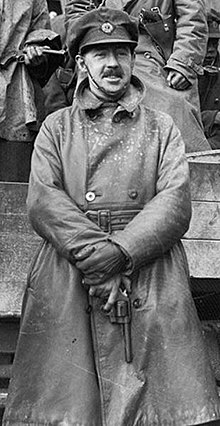
Tomás Óg MacCurtain, left, 33 years of age, pictured in Cork in 1948 (thanks to Brendan O'Neill for the pic!).
In Cork, in 1920, Irish republican Tomás MacCurtain was elected as 'Lord Mayor' of the city, just one of the many changes that resulted from the 15th January local council elections that were held in Ireland that year, in which Sinn Féin won control of 11 out of 12 cities and boroughs - the only municipal council in all Ireland left under Unionist control was in Belfast ; out of 206 councils elected on the island, 172 now had a
republican/nationalist majority.
The British had 'outlawed' Dáil Éireann (the 32-county body, not the pretend 'Irish parliament' in Kildare Street, in Dublin, which Free Staters claim, falsely, to be the same institution), which had directed all local council's in Ireland to break their connection with the (British) Dublin Castle system of local administration and, within months, most of the local councils in the country were reporting to the republican administration.
Incidentally, that All-Ireland (32 County) Dáil continued to function underground until 1938, when it delegated its executive powers to the Army Council of the IRA, in accordance with a resolution of the First Dáil in 1921. With the 1969 split, Tom Maguire, the last and faithful survivor of the All-Ireland Dáil, stated that the Provisional IRA was the successor of the 1938 body - similarly, following the 1986 split, he nominated the Continuity IRA as the legitimate IRA. Tom Maguire died in 1993 (on this date [5th July] incidentally - see our piece on the man, elsewhere in this post), aged one-hundred-and-one (101).
Anyway - back to Tomás Óg who, in the year that his father was elected as 'Lord Mayor' of Cork, was only five years of age. He developed an interest in all things Irish, encouraged as much by his mother, Eibhlís Breathnach (pictured), as well as his father and, as an adult, became every bit as active in Irish republicanism as was his father, and quickly became a trusted and leading republican, sitting on the Executive of the IRA.
This, plus his family history, marked him out to the Free State 'authorities' as 'a person of interest'.
On Wednesday, 3rd January 1940, in St. Patrick Street in Cork, Tomás Óg was jumped-on by a number of Free State Special Branch men, who had decided to 'arrest' him - he fought with them and, in the scuffle, a gunshot was fired. A Free State detective, from Union Square Barracks, by the name of Roche, who in particular had been harassing Tomás Óg for weeks, fell to the ground - he was fatally wounded and died the next day.
On the 13th June 1940, the Free State 'Special Criminal Court' sentenced Tomás Óg MacCurtain to death, to be carried out on the 5th July 1940 - 83 years ago on this date.
An application for 'Habeas Corpus' was lodged and the execution was postponed for a week, but the Free State Supreme Court then dismissed the appeal. The whole country was divided over the issue - some demanded that he be put to death immediately as a 'sign' from the Fianna Fail administration that they were serious about 'cracking-down' on their former comrades in the IRA, while others demanded that he be released.
Finally, on the 10th July 1940, the Free Staters issued a statement - "The President, acting on the advice of the government, has commuted the sentence of death on Tomás (Óg) MacCurtain to penal servitude for life."
It has since been alleged that a sister of Cathal Brugha's widow, who was then the Reverend Mother of an Armagh Convent, had requested that her 'boss', Cardinal MacRory, should 'speak to' Eamon de Valera about the case. This, if indeed it did happen, and the fact that Tomás Óg's father had actually shouldered a gun alongside many members of the then Fianna Fail administration (before they went Free State, obviously), saved his life.
Tomás MacCurtain (Senior) died in 1920, at only 36 years of age, and his son, Tomás Óg, died in 1994, at 79 years of age.
'NORTHERN IRELAND' FLAG ACT...'
From 'The United Irishman' newspaper, April 1955.
An amendment, tabled by the Belfast branch, seeks to replace the last paragraph by the words - 'This conference, upholding the principles of political democracy and especially the British people's conception of democratic government, acknowledges the right of the people of Northern Ireland (sic) to elect a government of their choice.
It is also of the opinion that the flaunting and parading of flags and emblems are the devices and tactics of reactionary bigots who seek to divert the attention of the workers from the real social issues and true causes of exploitation.'
The first paragraph of the amendment would be very sensible if the word 'Northern' was left out of it. As it stands it is ridiculous ; 'Northern Ireland', or rather the six north-east counties of Ireland, is not, never has been and never can be a political or economic entity...
(MORE LATER.)
ON THIS DATE (5TH JULY) 161 YEARS AGO : DEATH OF THE NATION'S SHAMROCK.
In Dublin, on the 8th October 1822, a child was born (out of wedlock - a 'mortaler' in those days!) to Mary Williams and a Tipperary Count, Nicholas D'Alton ; the child, Richard Dalton Williams (pictured), was reared at Grenanstown, Nenagh, County Tipperary and, at the age of ten, began his education at St. Stanislaus School, Tullabeg, in County Laois, and then at St. Patricks College, County Carlow, where he stayed until he was 21 years of age.
By the time he left that college he was fluent in three languages, and was studying medicine in St Vincent's Hospital in Stephens Green, in Dublin, preparing himself for a career as a doctor.
He combined both 'crafts' to produce a poem, which he called 'The Dying Girl' -
'From a Munster vale they brought her,
from the pure and balmy air ;
An Ormond peasant's daughter,
with blue eyes and golden hair.
They brought her to the city
and she faded slowly there -
consumption has no pity
for blue eyes and golden hair.' (From here.)
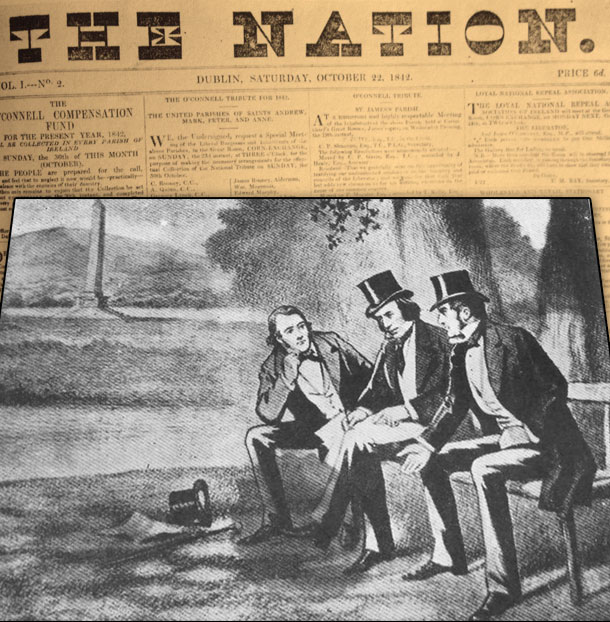
His first published poem was entitled 'The Munster War Song' and it appeared in 'The Nation' newspaper on the 7th January, 1843, under the pseudonym 'Shamrock' (at the time of its publication, he was actually in the process of moving from Carlow, to Dublin, to study medicine in St Vincents Hospital).
'The Nation' newspaper received a great response to Williams' poem, and 'Shamrock' became a regular contributor, with works such as 'Sisters of Charity' and 'The Haunted Man', which raised the profile and readership of the newspaper and of 'Shamrock' himself.
As well as the poems, 'The Nation' newspaper published a series of humorous articles from Richard Dalton Williams, entitled 'Misadventures of a Medical Student', and described the author, 'Shamrock' (in its July 1851 issue), in the following terms - "His intellect is robust and vigorous, his passion impetuous and noble, his perception of beauty most delicate and enthusiastic ; his sympathies take in the whole range of human affections, and his humour is irresistible. We think, indeed, that 'Shamrock' excels all his contemporaries in imagination and humour."
By now he was a member of the 'Young Ireland' Movement, and put his medical training to good use during 'The Great Hunger' of 1845-1849, by helping to ease the suffering of hundreds of cholera victims ; he was a hardened opponent of British misrule in Ireland and had joined the 'Irish Confederation' group, which was founded in January 1847 by William Smith O'Brien and other 'Young Irelanders' who had disagreed with Daniel O'Connell's 'Repeal Association'.
He was quickly elected to leadership level in the 'Confederation' and was the driving force behind a short-lived newspaper called 'The Irish Tribune', which he published with the assistance of 'Young Ireland' leader, Kevin Izod O'Doherty ; the first issue was published in June 1848, but only five issues of the weekly 'paper made it on to the streets before it was suppressed by the British in early July of that year. But
the British used 'The Irish Tribune' newspaper as a reason to arrest both men, and they were charged under the 'Treason-Felony Act' with "intent to depose the queen and levying war."
A famous barrister of the time, Samuel Ferguson, defended both men in a trial which lasted five months and caused great embarrassment to the British.
Eventually, in November 1848, Williams and O'Doherty were acquitted ; Williams went back to studying medicine, and qualified as a doctor, in Edinburgh, in July 1849.
In June 1851, he emigrated to America and, whilst in New Orleans, met and married an Irish woman, Elizabeth Connolly ; the couple moved to a town called Thibodeaux in Louisiana, where he wrote his last poem - 'Song of the Irish-American Regiments' -
'We have changed the battle-field,
but the cause abandoned never -
here a sharper sword to wield,
and wage the endless war for ever.
Yes! the war we wage with thee -
that of light with power infernal -
as it hath been still shall be,
unforgiving and eternal.' (From here.)
On the 5th July, 1862 - 161 years ago on this date - just shy of his fortieth birthday, Richard Dalton Williams, 'Shamrock of the Nation', died in America of consumption in Thibodeaux, Louisiana.
A patriot, a poet and a publisher, Dr Richard Dalton Williams is one of the hundreds, if not thousands, of almost unknown and/or practically forgotten Irish men and women that played their part in the on-going struggle to remove the British presence from Ireland. They deserve to be remembered somewhere : 'Now thou art a sink of evil — a serpent's nest — a tiger's den — an Iron-crowned and armed devil, having power to torture men.'
'LAW AND SOCIETY :
IS IT TIME TO ASK QUESTIONS OF THE LEGAL PROFESSION...?
Yet, in other more fundamental ways, certain members of the legal profession have questions to answer, but will almost certainly never be forced to do so by our current social consensus.
Certainly, there have been legal actions which have been far from edifying sights ; the cessation of the mini CTC signalling system inquiry, in particular, was not impressive to watch. There, we were treated to the unique claim that the constitutional rights of a dead person should stop a public inquiry!
Most citizens would like to see these types of inquiries move ahead, and positive results achieved. Yet that hasn't been the case with many.
The Lindsay Tribunal, for instance, has been so unimpressive that the Irish haemophiliacs are on the point of declaring no confidence in whatever findings it may issue. Given that the tribunal is not investigating the circumstances of 95 per cent of the infections, it is not difficult to understand why they are taking such a negative position.
Meanwhile, the Flood Tribunal is set fair to last for a decade and cost £100m.
Most are agreed that prosecutions or sentences for corruption are unlikely. With the possible exception of Michael Lowry, this is also likely to be the case with the Moriarty Tribunal. Even then, however, Michael Lowry is likely to be prosecuted under the Revenue Acts rather than as a direct result of any tribunal report...
(MORE LATER.)
1921 : BRITISH ARMY PATROL SURRENDER TO TOM MAGUIRE AND HIS MEN.
On March 7th 1921, the IRA's South Mayo Flying Column (pictured), under the command of Tom Maguire - who died 30 years ago on this date (5th July 1993) - surrounded a British army patrol at Kilfall between Ballinrobe and Castlebar forcing it to surrender and give up their arms. The patrol were then released unharmed. Tom Maguire’s personal account of the engagement is given in the book 'Survivors' by Uinsean MacEoin...
'On May 3rd of 1921, Tom Maguire led an ambush party on an RIC patrol in Tournakeady, Co. Mayo during which four RIC men were killed. Following the engagement, Maguire’s flying column made their escape to the Partry Mountains which lie to the west of Lough Mask. They were pursued by a large force of British soldiers and policemen who used an aeroplane to monitor the progress of the column.
A number of skirmishes ensued during which Tom Maguire was wounded and his adjutant killed. There is some dispute about the number of British casualties but fokelore has it that they were substantial. The column managed to escape with no further casualties...
Tom Maguire was elected to the Dáil elections of 1921, 1922 and 1923. He took the anti-treaty side in the Civil War and was a member of the anti-treaty IRA executive which commanded the anti-treaty army.
He was captured by the National Army (sic) and though he was told he was to be executed, his life was spared. However, his younger brother Seán, aged 17, was executed in Tuam on 11th April 1923 along with six others. These men are known today as the 'Tuam Martyrs'..'
In June 1923 General Maguire escaped from Athlone Barracks and was never re-captured.
Along with other surviving faithful members of the Second Dáil - the last All-Ireland parliament - he delegated Executive Authority to the Army Council of the IRA in 1938. In December 1969, he recognised the Provisional Army Council as the legitimate successor to the 1938 body -
"The majority of the delegates at the December 1969 IRA Convention, having passed the resolution referred to above, proceeded to elect an Executive which in turn appointed a new Army Council, committed to implement the resolution. That Convention had neither the right nor the authority to pass such a resolution.
Accordingly, I, as the sole surviving member of the Executive of Dáil Éireann and the sole surviving signatory of the 1938 Proclamation, hereby declare that the resolution is illegal and that the alleged Executive and Army Council are illegal, and have no right to claim the allegiance of either soldiers or citizens of the Irish Republic.
The delegates who opposed the resolution, together with delegates from units which were not represented at the Convention, met subsequently in Convention and repudiated the resolution. They re-affirmed their allegiance to the Irish Republic and elected a Provisional Executive which, in turn, appointed a Provisional Army Council.
I hereby further declare that the Provisional Executive and the Provisional Army Council are the lawful Executive and Army Council respectively of the IRA* and that the governmental authority delegated in the Proclamation of 1938 now resides in the Provisional Army Council and its lawful successors. I fully endorse their call for support from Irish people everywhere towards the realisation of the full freedom of Ireland.."
Dated the 31st day of December, 1969.
Signed : THOMAS MAGUIRE, (Tomas Mac Uidhir) Comdt. General."
NOTE - *Following the 1986 division, Comdt. General Thomas Maguire nominated the Continuity IRA as the legitimate IRA.
Tom Maguire is one of the many Irish republican men and women that the Republican Movement was, is and always will be guided by : when the majority of (P)IRA and (P)Sinn Féin decided to abandon abstentionism in the 1969/70 split, Ruairí Ó Brádaigh and Dáithí Ó Conaill sought and secured Maguire's recognition of the Provisional IRA as the legitimate successor to the 1938 Army Council.
Of the seven 1938 signatories, Tom Maguire was the only one still alive.
Likewise, in the aftermath of the 1986 split in the Republican Movement, Tom Maguire signed a statement in 1986 which was issued posthumously, in 1996 : he conferred this legitimacy on the Army Council of the Continuity IRA, who provided a firing party at Maguire's funeral in 1993 - he was 101 years of age when he died on the 5th July 1993 - 30 years ago, on this date.
Comdt. General Tom Maguire (28th March 1892 – 5th July 1993) remains an inspiration for Irish republicans to this day.
'WAITING TO FALL...'
If this year sees the end of the 'Age of Tribunals', it won't be a moment too soon.
By John Drennan.
From 'Magill' magazine, January 2003.
The outcome of the Moriarty Tribunal will be no different.
Like the Flood Tribunal, the good tribunal is legally 'sterile' - this means that even if it finds that Michael Lowry, for example, engaged in corrupt acts, it can impose no sanction other than the withholding of legal fees, and inflicting the kind of public embarrassment which will increase Lowry's majority in Tipperary by a thousand votes.
Of course, Mr Lowry could, in such an instance, be tried for corruption. But the present state of the law means that none of the evidence accumulated by the tribunal could be used. A Garda investigation would have to start from scratch.
You might think that this is a bit of a waste of six years and €20m!
We must be the only nation (sic) in the western world to choose something which is legally sterile as our 'main weapon' in the was against corruption. How easily we are pleased. For the moment our tribunals are safe, but their future prosperity is dangerously reliant upon the foundations of sand that a skim-doctor called Frank Dunlop is providing...
(MORE LATER.)
Thanks for the visit, and for reading,
Sharon and the team.
LEGAL FINDINGS STYMIED FOR FEAR OF UPSETTING A DEAD MAN...!
Within months of the British having 'outlawed' the 32-County Dáil Éireann, local councils in Ireland had decided to ignore the British directive and were reporting, and supporting, our own political administration in our own country. This, obviously, led to tensions...
We're in 'Marching Season' in the Occupied Six Counties and, in 1955, a British trade union tabled a motion regarding "..the flaunting and parading of flags and emblems", stating quite clearly that to do so in areas where the 'Orange Order' and other loyalist paramilitary groupings were operating was "the devices and tactics of reactionary bigots.."
This man, who committed a mortal sin before he was even born (!), involved himself in the struggle for Irish freedom and died, still a revolutionary force to be reckoned with, in the 1860's, but is not remembered as much or as often as he deserves to be...
So dodgy have been the State-instigated 'Tribunals of Inquiry' (into political/criminal occurrences in this Free State) that the 'Powers-That-Be' took it on themselves to severely limit one such 'Tribunal' least it breech the constitutional rights of a dead man...!
This Irish rebel, who took the fight to the British in Ireland in the 1920's, was over 100 years old when he died and left a political legacy behind him that still reverberates to this day...
We'll have the above and, I'm told, one other piece, ready for ya on Wednesday, 5th July 2023 so, like yerselves, I'm gonna have to wait until then to find out how exactly you can 'commit a mortal sin' before you are even born...?!
See ya on the 5th - thanks for the visit!
Sharon and the team.
ON THIS DATE (28TH JUNE) 101 YEARS AGO : FREE STATERS USE BORROWED WEAPONS FROM WESTMINSTER AGAINST THEIR OLD COMRADES.
"For a little while on the morning of the attack on IRA Headquarters, Four Courts, Dublin, 28th June 1922 (101 years ago, on this date), Liam Mellows and I shared vigil at one of the barricaded upper windows, and watched the city bestir itself, within our arc of vision, to the noise of rifle fire and light artillery fire. We thought our thoughts.
Two men, obviously workmen making their way along the quays to their jobs, started us speculating on what role the trade unions would have been guided into were James Connolly alive and the Republic under attack.
It was the first time I heard Mellows on the play of social forces in the crisis of the Treaty ; I was present at the Dáil Éireann session when he made his speech against the Treaty but, while what he said then impressed me greatly, it gave no indication of the pattern of ideas he uncovered now.
The Four Courts fell and its garrison became prisoners, and with it members of the IRA Executive - Rory O'Connor, Liam Mellows, Joe McKelvey and Peadar O' Donnell. In the angry mood of the thronged cells in Mountjoy Jail, the prisoners instinctively turned to Mellows as the one among us who must, somehow, be able to explain how the Republican Army could permit itself to be overrun by much weaker military forces and why certain men of courage, hitherto devoted to independence, should choose to enter on a road of struggle to overthrow the Republic and raise on its ruins a parliament which rested on the penal British Government of Ireland Act 1920.." (From 'There Will Be Another Day', by Peadar O'Donnell, first published in January 1963.)
'..on the 14th April 1922, Anti-Treaty forces under the command of Rory O'Connor occupied the Four Courts and several other buildings in Dublin city. A tense stand off between Pro and Anti-Treaty Forces commenced. Anti-Treaty forces hoped that their occupation of the courts would ignite a confrontation with British troops and thus unite the pro and anti Treaty forces. However, this hope never materialised.
Michael Collins and Arthur Griffith ('1169' comment - Both Free Staters, pro-Treaty - they were sold a pup, and they tried to sell it to others by subterfuge - in Griffith's own words "I have signed a Treaty of peace between Ireland and Great Britain. I believe that treaty will lay foundations of peace and friendship between the two Nations. What I have signed I shall stand by in the belief that the end of the conflict of centuries is at hand..") came under increasing pressure from London to assert the new governments authority in Dublin and remove those occupying the courts...on the 22nd June 1922, two men assassinated soldier and Unionist politician Sir Henry Wilson in London.
Though it was stated that the men were acting on their own initiative, it was suspected that they were acting on orders from Anti-Treaty forces. This action produced an ultimatum from the British government, that they would attack Anti–Treaty forces in the Four Courts unless the Free State government took action. Collins issued a final ultimatum to those occupying the courts. The three-armed parties involved had now reached a point of no return.
Civil War was now inevitable...on the 28th June 1922 (101 years ago, on this date) at 04.10 hours, the bombardment commenced. Shelling was to continue for a number of days..' (from here.)
Michael Collins (left) and his bodyguard, Emmet Dalton.
Emmet Dalton led the Free State attack on the Four Courts ; he was an Irish rebel-turned-Free Stater, who was born in America on March 4th 1898 and died in Dublin on March 4th 1978 - his 80th birthday, and also the bicentenary of the birth of the man he was named after - Robert Emmet.
Dalton sold out in favour of the 'Treaty of Surrender' in 1921 and made a (Free State) name for himself by attacking republican positions from the sea, actions that his British paymasters considered as having 'turned the tide' against the Irish republican resistance.
He was with Michael Collins on the 22nd of August 1922 when the latter was shot dead by republican forces in West Cork (Béal na mBláth) and is said to have propped up a dying Collins to place dressings on his wound. He resigned from the Free State Army shortly after Collins was killed, and was appointed as the clerk of the Free State Senate, but resigned from that, too, three years later, and opened a film production company, Ardmore Studios, near Bray, in Wicklow. He died, aged 80, on the 4th of March 1978, the same date and month that he had been born on, and was buried in Glasnevin Cemetery in Dublin.
He, Collins, Griffith and those others were wrong at the time when they propagandised that their 'treaty' offered "the end of the conflict of centuries" as they were experienced enough to realise that that wasn't the case.
They cursed the rest of us for their own ends.
'NORTHERN IRELAND' FLAG ACT.'
From 'The United Irishman' newspaper, April 1955.
It was reported in 'The Evening Mail' newspaper on the 14th March 1955 that -
'The annual conference of the 'Union of Shop, Distributive and Allied Workers Union', at their Easter Conference at Blackpool, will discuss the 'Northern Ireland (sic) Flag and Emblem (Display) Act 1954'.
A resolution from the Manchester Textile Branch calls on the government "to use its good offices with the Northern Ireland (sic) Government" to secure the repeal of the Act.
'Enactment such as this by a legislative body which is bolstered and subsidised by Britain is contrary to the British people's conception of democratic government, and violates every principle of freedom', says the proposal...'
(MORE LATER.)
ON THIS DATE (28TH JUNE) 225 YEARS AGO - 'UNITED IRISHMEN' LEADER EXECUTED BY THE BRITISH.
'Beauchamp Bagenal Harvey was captured within a few weeks by the British and was 'tried', convicted and hanged on the 28th June 1798 (225 years ago, on this date) at the bridge of Wexford. His body was then beheaded, the torso thrown into the River Slaney and his head displayed on a spike at the courthouse in Wexford town....' - from a piece we wrote here on the 31st May, 2017, as it was on that date (31st May) that the 'United Irishman' in question, Beauchamp Bagenal Harvey, '..was appointed by the approximate four-thousand strong rebel army in that area (Wexford) as their Commander-in-Chief..' (from here.)
We won't re-post the whole piece but, having said that, we couldn't let the date pass without referencing its relevance to the man, and drawing your attention to this article, from the 'Library Ireland' website :
'Beauchamp Bagenal Harvey (was) an estated gentleman of about £3,000 a year, in the County of Wexford, a barrister, and commander of the Wexford insurgents in 1798. He was born about 1762, educated at Trinity College, Dublin, studied at the Middle Temple, and was called to the Bar in 1782. Before the insurrection of 1798 he "was in tolerable practice as a barrister, and was extremely popular with all parties. He was high-spirited, kind-hearted, and good-tempered, fond of society, given to hospitality, and especially esteemed for his humane and charitable disposition towards the poor."
He resided at Bargy Castle, and when the insurgents took the field in May 1798, in the north of the county, Harvey, with his friends Colclough and FitzGerald, was immediately imprisoned in Wexford on suspicion.
After the defeat of the royalists at the Three Rocks, Wexford was evacuated by the small garrison that remained, and the prisoners were on 30th May released by the inhabitants, who implored Harvey to intercede with the insurgents for the safety of the town. This he did, and upon its being occupied by the insurgents he was appointed Commander-in-Chief...' (from here.)
Farewell to Bargy’s lofty towers, my father’s own estate
And farewell to its lovely bowers, my own ancestral seat
Farewell each friend and neighbour, that once I well knew there
My tenants now will miss the hand that fostered them with care.
Farewell to Cornelius Grogan, and to Kelly ever true
John Coakley and good Father Roche, receive my last adieu
And fare-thee-well bold Esmond Kyan, though proud oppression’s laws
Forbid us to lay down our lives, still we bless the holy cause.
Farewell my brave United men, who dearly with me fought
Though tyrant might has conquered right, full dearly was it bought
And when the sun of freedom shall again upon you shine
Oh, then let Bagenal Harvey’s name array your battle line.
Although perchance it may be my fate, in Wexford town to die
Oh, bear my body to the tomb wherin my fathers lie
And have the solemn service read, in Mayglass holy towers
And have twelve young maids from Bargyside, to scatter my grave with flowers.
So farewell to Bargy’s lofty towers, since from you I must part
A stranger now may call you his, which with sorrow fills my heart
But when at last fate shall decree that Ireland should be free
Then Bagenal Harvey’s rightful heirs shall be returned to thee.
Beauchamp Bagenal Harvey 1762 - 1798.
'LAW AND SOCIETY :
IS IT TIME TO ASK QUESTIONS OF THE LEGAL PROFESSION?
We have always been a society with a facility for the creation of myths. However, not even the most dewy-eyed devotee of the dreams of the Celtic Twilight could have invented the present status of the legal profession in Ireland.'
By John Drennan.
From 'Magill Magazine', November 2001.
The dominant viewpoint is that barristers are currently playing a crucial role in exorcising political corruption in Ireland, as dodgy politicians, bankers and others experience the modern-day equivalent of the religious missions of the 1950's.
Within the Dail (sic) politicians defer to them, whilst within the media no one seriously questions practitioners of the law because they are seen to be beyond reproof and rather powerful enemies. Whispers of discontent about the salaries of top barristers in cases funded by the taxpayer tend to be no more than just whispers - the kind of bugbear so beloved of taxi-drivers and lefty students.
Most other people simply accept the payment of fees of £1,500 per day* to each senior counsel as a necessary evil in a society where truth lies at the bottom of a tribunal...
(*'1169' comment - that figure [£1,500] was the standard in 2001 ; today [2023], senior counsel get a 'brief fee' of €1,716 and 'refresher fees' of €858 per day. The 'brief fee' for junior counsel and solicitors is now €1,144 and 'refresher fees' are €572 and €418 per day, respectively.)
(MORE LATER.)
ON THIS DATE (28TH JUNE) 101 YEARS AGO : FREE STATERS (WESTMINSTER PROXIES) DELIVER ULTIMATUM TO THE IRISH REPUBLICAN ARMY.
On the 26th June, 1922, Leo Henderson and a group of 'Irregulars/Dissidents' left the then republican-occupied Four Courts (which had been taken over on the 14th of April by anti-treaty forces) '..and arrived at Ferguson's garage on Dublin's Baggot Street, accusing them of doing business with Belfast ; this was, they said, in violation of the boycott the IRA had placed on the city due to violence against nationalists there. Leo Henderson, their leader, seized a number of cars at gunpoint, and was on the point of driving back to the anti-Treaty stronghold of the Four Courts when he was arrested by pro-Treaty/Free State troops. Henderson's comrades in the Four Courts in response arrested a pro-Treaty General, JJ O’Connell (pictured) and, within 24 hours, Free State artillery was battering at the walls of the Four Courts in central Dublin.
The first shots of the Irish Civil War were caused by a row over selling cars to Belfast...' (from here.)
Not altogether the full story, although the 'bones' of what actually happened are there.
Harry Ferguson's garage was a well-known Belfast automobile company, with a branch on Baggot Street, in Dublin. It was known to be unsympathetic to the 'Irregulars' and had blatantly ignored an overall directive from the IRA that for-profit business dealings with Belfast should cease until business bosses in that city took steps to ensure the safety of their nationalist workforce.
Leo Henderson and his men commandeered about 15 cars which had been sent, for sale, to Dublin from Belfast - the IRA's intention, as well as to be seen enforcing the 'Belfast Trade Boycott', was to use the vehicles, as part of the war effort, against the continuing British political and military presence in the Six Occupied Counties and in their campaign to overthrow the then-fledging Free State political administration.
Leo Henderson was captured by the Staters, with ex-IRA man Frank Thornton in command of them and, when the IRA leadership heard that Henderson had been 'arrested', they discussed abducting Collins himself or Richard Mulcahy in retaliation, but decided instead to seize Free State General Jeremiah Joseph (JJ) 'Ginger' O'Connell, who was Richard Mulcahy's Deputy Chief-of-Staff.
At 11.15pm on the night of Tuesday, 27th June, 1922, 'Ginger' was arrested in Dublin by the IRA after an evening out with his girlfriend - the couple had gone to the theatre and, after the girlfriend was dropped home, 'Ginger' went to McGilligan's Pub in Leeson Street for a few pints. As he left the pub, the IRA seized him and held him in the republican-occupied Four Courts ; Ernie O'Malley actually telephoned Free State General Eoin O'Duffy, who was in Portobello Barracks, and told him that 'Ginger' will be returned to the Staters in exchange for Leo Henderson.
The republicans knew that 'Ginger' was valued by Collins and his renegades - he was one of the few that eagerly conveyed the 'cancel-the-Rising'-order
from Eoin MacNeill in 1916 and both Collins and Mulcahy regarded him as a safe pair of hands.
Collins's political and military bosses in London were notified about 'JJ Ginger' being held in republican custody and made it clear to Collins that if he and his Free State colleagues didn't take steps to remove the republicans from the Four Courts, they would - the Staters had already decided to attack their former comrades in the Four Courts and had already accepted the offer from Westminster of equipment with which to carry-out the task ; British artillery, aircraft, armoured cars, machine guns, small arms and ammunition were by then in the possession of Collins and his team, who then used the 'JJ kidnap'-incident to press ahead with the assault.
At 3.40am, on Wednesday, 28th June 1922 - 101 years ago on this date - the republican forces inside the Four Courts were given an ultimatum from Collins - 'surrender before 4am and leave the building'.
The republicans ignored the threat and held their ground and, less than half-an-hour later - at about 4.30am - the Staters opened fire on the republicans with British-supplied 18-pounder guns and practically destroyed the building (pictured), an act which was described as "..a major national calamity..an assault on the collective memory of the nation..such actions are considered as war crimes..a cultural atrocity.."
The IRA held out for two days before leaving the building, but fought-on elsewhere in Dublin until early July, 1922, with Oscar Traynor (who later joined the Fianna Fáil party) in command.
'JJ Ginger' was rescued by his Stater colleagues on Friday, 30th June 1922 when they finally managed to enter the then shell of a building where the Four Courts once stood and, within months, he was demoted from a Lieutenant-General to a Major-General and then to a Colonel, a position he was to remain at.
He got married in 1922 and, between 1924 and 1944 (he died in the Richmond Hospital in Dublin from a heart attack on the 19th February of that year), he was shifted around like a pawn on a chess board : chief lecturer in the FS Army school of instruction, director of Number 2 (Intelligence) Bureau, OC equitation school, quartermaster-general and director of the military archives.
We wonder did he consider himself to be the man who, alongside Westminster and his Free State comrades, started a Civil War in Ireland...?
'WAITING TO FALL...'
If this year sees the end of the 'Age of Tribunals', it won't be a moment too soon.
By John Drennan.
From 'Magill' magazine, January 2003.
Ironically, it is at their moments of supposedly great triumph that the most serious flaw of the tribunals is unmasked.
The wonderful 'Flood Tribunal' report revealed that Tom Brennan knowingly misled the tribunal, John Finnegan had given false and misleading accounts, 'Rambo' Burke had received corrupt payments, James Stafford was a liar and so forth.
The list of those who hindered and obstructed the tribunal ran to six pages and consisted of 18 names.
But four months after the report, the tranquillity of those gentlemen's lives - one high-profile raid by the CAB on Ray Burke's house aside - is as undisturbed as the conscience of a tribunal barrister...
(MORE LATER.)
Thanks for the visit, and for reading,
Sharon and the team.
A question that was asked of ourselves by Irish republicans in the 1920's and is still being asked today...
In Manchester, England, in the 1950's, the issue of British military and political interference in Ireland was raised by a trade union at a meeting it held and they didn't hold back in doing so...
This 'well got' wealthy Irishman, a barrister who mixed in the 'right circles' and had esteemed connections, couldn't justify the injustices around him and decided to 'right' as many wrongs as he could. The British executed him...
Plus a few paragraphs on when the Staters 'officially' became political and military proxies for Westminster, some words on the legal profession in this State and a mention for some 'likely lads' from our recent past...!
All of the above, if not more, will be cominatya on Wednesday, 28th June 2023 ; give us a shout then, and see what we're on about!
Thanks for the visit, and for reading - see ye then!
Sharon and the team.
ON THIS DATE (21ST JUNE) 50 YEARS AGO : "FASCIST MURDER SQUAD" STRIKE AGAIN.
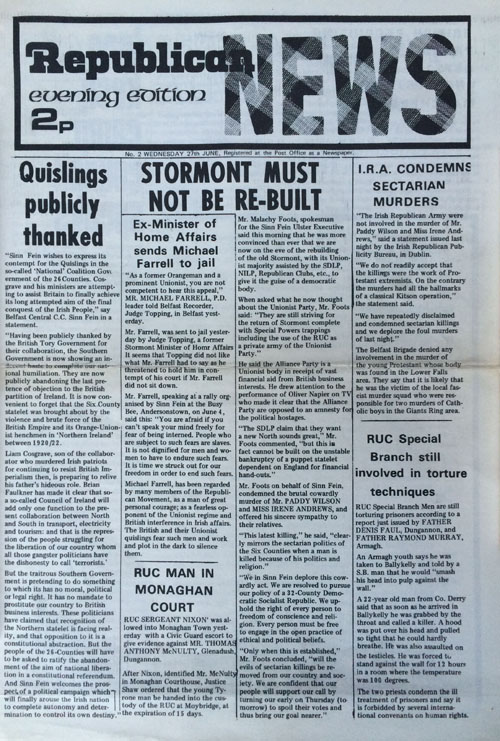
"The Belfast Brigade denied any involvement in the murder of the young protestant whose body was found in the Lower Falls area. They say that it is likely that he was the victim of the local fascist murder squad who were responsible for two murders of catholic boys in the Giants Ring area" - from the 'Republican News' newspaper, June 1973.
Of all the bombings, atrocities, tortures and killings that have unfortunately being visited and imposed on this country by Westminster due to their unwanted military and political presence here, the shooting dead of David Walker is one of the worst : this special needs sixteen-year-old boy was lifted off the street by the 'Official IRA', apparently as a 'dare', at about 8.30am on Thursday, 21st June 1973 - 50 years ago on this date - as he was working in his job.
He was found about three hours later on the Falls Road with gunshot wounds to his head and chest. He died a few minutes after he had been found.
'David Walker, 16-year-old Protestant civilian was found at O'Neill Street in the lower Falls area where he was shot and left by the Official IRA..(he) was described as being educationally subnormal and had a job in the Belvoir area of south Belfast near his home at Castlecoole Park...as (he) was working, the Official IRA abducted him and took him to the west of the city where they shot him. Joseph Cunningham, Senator Paddy Wilson, and Irene Andrews were later killed by the UDA/UFF in retaliation for young David's death.
The man jailed for David Walker's killing said in a statement that he thought David was a member of the UFF. He said he had been approached by a man in Leeson Street who asked him if he was "man enough to shoot a member of the UFF murder gang". The man said : "I said I would do it if there was proof that he was killing innocent Catholics. I asked for proof and he said Walker was involved in the murder of Danny Rouse".The judge said that David Walker's murder was "a horrible and unjustified murder.." ' (from here.)
It may well be fifty years since that barbarous act, but the political conditions for deeds like it are still in place - and it would still suit those in power in Westminster to have 'the wild Irish' killing themselves, allowing the British - the 'man in Leeson Street' - to continue to present themselves as being in Ireland 'to keep the warring factions apart'.
The only workable solution is that of a British political and military withdrawal from Ireland.
'RESURGENT ULSTER : NORTHERN SPEAKERS ADDRESS DUBLIN MEETING...'
From 'The United Irishman' newspaper, April 1955.
A large and enthusiastic audience accorded a warm welcome to a group of Ulster republicans who came to speak at a public meeting on Saturday, 19th of March (1955), in O'Connell Street in Dublin.
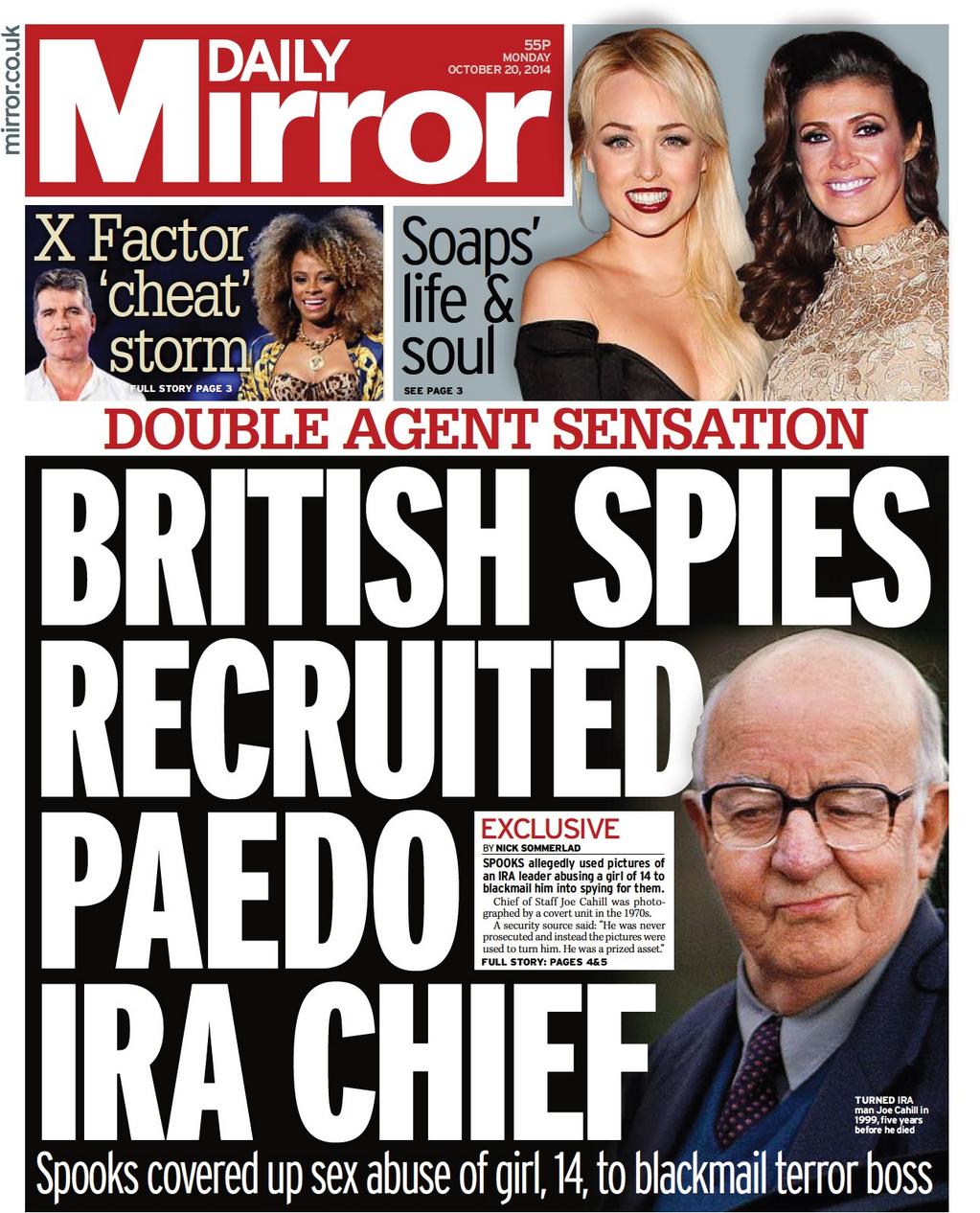
Joe Cahill, Belfast, speaking briefly, stated that he would sooner face the might of the Empire with a gun in his hand than address a public meeting.
He pointed to the futility of talk while an army of occupation was on our soil, and stated that moral force was not the answer to physical aggression. He said that the British Empire must be met on her own terms with a superior discipline and resolute determination. That way only lay victory.
Sean McKearney, Belfast, and James Rowantree, Newry, also spoke at the meeting.
Concluding, the Chairman (sic),Seoirse Dearle, traced the part played by Irish Protestants in the struggle for freedom from Tone, Emmet and Mitchel, down to the present day. It was Catholic England who first oppressed Ireland ; Ireland is the property of all Irishmen (sic) and freedom is our God-given right, but that freedom must be won.
Tone and Emmet had shown the way. Are the people of Ireland prepared to follow?
(END of 'Resurgent Ulster : Northern Speakers Address Dublin Meeting' ; NEXT - ' 'Northern Ireland' Flag Act', from the same source.)
'THOUGH THE HEAVENS MAY FALL...'
From 'Magill' Annual, 2002.
Dr Moira Woods (pictured).
Since it is clear that the families in question, including their now adult children, are anxious for the report to be published, and since the Medical Council has itself previously declared that it wishes all these matters to be as fully ventilated as possible, it is difficult to understand what possible basis there could be for declining now to publish the results of this investigation.
It would be a pity if the families were forced to return to the High Court to explore the potential of Mr Justice Barr's injunction concerning the paramountcy of doing justice.
(END of 'Though The Heavens May Fall' ; NEXT - 'Law And Society : Is It Time To Ask Questions Of The Legal Profession?', from the same source.)
ON THIS DATE (21ST JUNE) 146 YEARS AGO : 'THE DAY OF THE ROPE'.
'On 21st June 1877, in the anthracite-mining county of Schuylkill, Pennsylvania, ten Irish immigrant men alleged to have been members of an oath-bound secret sect of vigilantes called the 'Molly Maguires' were hanged in what came to be known as 'The Day of the Rope'. Twenty members of the group in all would be executed, following a kangaroo court that American historian John Elliot called "one of the most disgraceful episodes in the history of the bench and bar in the United States." Oppression, exploitation, racial and ethnic bigotry, strikes and union-busting are common enough themes in the American labour movement, but the story of the 'Molly Maguires' and the ruling class's attempts to destroy these Irish workers is so especially contemptible it has achieved legendary status....' (from here.)
On what became known as 'Black Thursday' (21st June, 1877), ten coal miners were hanged until dead in eastern Pennsylvania ; all ten had been born in Ireland but were forced to leave because of the attempted genocide ('An Gorta Mór') orchestrated by Westminster.
It was claimed that they, and others, were involved in 'organised retributions' against corrupt and unfair employers and other members of the establishment, and operated as such under the name 'Molly Maguires' (Molly Maguire had become famous in Ireland - or 'infamous', as the 'landlord' class described her - for refusing to bow down or bend the knee to them).
The workers had been arrested for their alleged part in several killings and, despite much doubt cast over the 'evidence' used against them, they were convicted and sentenced to death.
The court case was widely seen as employers drawing 'a line in the sand' in regards to what they considered to be 'uppity' workers looking for better wages and conditions, and an excuse for the establishment to vent its anti-labour and anti-Irish prejudice -
'The first trials began in January 1876. They involved 10 men accused of murder and were held in Mauch Chunk (an Indian name meaning 'Bear Mountain') and Pottsville. A vast army of media descended on the small towns where they wrote dispatches that were uniformly pro-prosecution.
The key witness for the prosecution was yet another Irishman, James McParlan. Back in the early 1870's, when Gowen had hired the Pinkerton Detective Agency to spy on his workers, McParlan had gone undercover to infiltrate 'the Mollies' and gather evidence. And gather he did — or at least he claimed he did, during the trials. On the stand he painted a vivid picture of 'Molly Maguire' secrecy, conspiracy and murder. With Irish catholics and miners excluded from the juries, the verdicts were a foregone conclusion.
The scene in Pottsville, Pennsylvania, on Thursday, 21st June 1877 - 146 years ago, on this date - as alleged members of the 'Molly Maguires' were taken to the scaffold.
All 10 were convicted and sentenced to hang.
No doubt seeking to send the most powerful message to the region's mining communities, authorities arranged to stage the executions on the same day — June 21st, 1877 – in two locations. Alexander Campbell, Michael Doyle, Edward Kelly, and John Donahue were hanged in Mauch Chuck (where the four men "all swung together"), while James Boyle, Hugh McGehan, James Carroll, James Roarity, Thomas Duffy, and Thomas Munley met a similar fate in Pottsville (where all six "swung two-by-two").
Although the hangings took place behind prison walls, they were nonetheless major spectacles that drew huge crowds and generated international news coverage..' (from here).
It was reported that there was "..screams and sobbing as husbands and fathers were bid goodbye.." and that "..James Boyle carried a blood-red rose and Hugh McGehan wore two roses in his lapel (as) James Carroll and James Roarity declared their innocence from the scaffold.."
Over the following two years, ten more alleged members of the 'Molly Maguires' were hanged, including Thomas P. Fisher (on the 28th March 1878) and James McDonnell and Charlie Sharp (on the 14th January 1879).
In 1979, the state of Pennsylvania pardoned one of the men, John 'Black Jack' Kehoe, after an investigation by its 'Board of Pardons' at the behest of one of his descendants (incidentally, Seán Connery played the part of John Kehoe in the film 'The Molly Maguires') and, on the 5th December 2005, the Pennsylvania State House of Representatives passed a resolution recognising the lack of due process for several of the men.
Make way for the Molly Maguires
They're drinkers, they're liars but they're men
Make way for the Molly Maguires
You'll never see the likes of them again.
Down the mines no sunlight shines
Those pits they're black as hell
In modest style they do their time
It's Paddy's prison cell
And they curse the day they've travelled far
Then drown their tears with a jar.
So make way for the Molly Maguires
They're drinkers, they're liars but they're men
Make way for the Molly Maguires
You'll never see the likes of them again.
Backs will break and muscles ache
Down there there's no time to dream
Of fields and farms, of womans arms
Just dig that bloody seam
Though they drain their bodies underground
Who'll dare to push them around.
So make way for the Molly Maguires
They're drinkers, they're liars but they're men
Make way for the Molly Maguires
You'll never see the likes of them again.
So make way for the Molly Maguires
They're drinkers, they're liars but they're men
Make way for the Molly Maguires
You'll never see the likes of them again.
'WAITING TO FALL...'
If this year sees the end of the 'Age of Tribunals', it won't be a moment too soon.
By John Drennan.
From 'Magill' magazine, January 2003.
The hopes and dreams of our tribunalistas that the Flood and Moriarty Tribunals would be the Trojan Horses which would facilitate the sack of Fianna Fail have been dashed.
Instead, if the present rate of 'progress' in the Flood Tribunal continues, they have provided Fianna Fail with the prospect of a cordon sanitaire that could last for 15 years.
The new popularity of tribunals was epitomised by the Morris Tribunal ; its creation - together with the cleverly designed terms of reference which have omitted PR Pat the Garda Commissioner, Michael McDowell and John O'Donoghue - has neutralised the political impact of the most serious Garda scandal in the history of the State.
From now on, any politician who attempts to raise the McBrearty affair will be greeted by the sight of Bertie Ahern highlighting the separation of powers and sighing - "I cannot comment on dat issue as it is a matter for de Tribunal".
Sweet...
(MORE LATER.)
Thanks for the visit, and for reading,
Sharon and the team.
ON THIS DATE (7TH JUNE) 102 YEARS AGO : TWO IRA MEN EXECUTED BY WESTMINSTER.
Patrick Maher (left), executed by the British on the 7th of June 1921 - 102 years ago on this date.
Ned Foley, executed by the British on the 7th of June 1921.
"Fight on, struggle on, for the honour, glory and freedom of dear old Ireland. Our hearts go out to all our dear old friends. Our souls go to God at 7 o'clock in the morning and our bodies, when Ireland is free, shall go to Galbally. Our blood shall not be shed in vain for Ireland, and we have a strong presentiment, going to our God, that Ireland will soon be free and we gladly give our lives that a smile may brighten the face of 'Dear Dark Rosaleen'. Farewell! Farewell! Farewell!" - the last words of Limerick (Ballylanders) IRA man Patrick Maher, 32 years of age, to his comrades.
Patrick Maher and his comrade Ned Foley were hanged in Mountjoy Jail in Dublin by Westminster on Tuesday 7th June 1921 - 102 years ago on this date - for their 'involvement' in the rescue of Tipperary IRA man Seán Hogan.
Patrick Maher, who worked as a clerk at Knocklong railway station and was about three miles from the scene of the rescue when it happened, was not involved in that operation. The two men were charged with the 'murder' of two RIC men (Peter Wallace and Michael Enright): - Patrick Maher strongly protested his innocence but, even though two juries failed to reach a verdict, he was convicted (by a military court martial) and sentenced to death.
He was one of 'The Forgotten Ten' IRA Volunteers (Kevin Barry, Patrick Moran, Frank Flood, Thomas Whelan, Thomas Traynor, Patrick Doyle, Thomas Bryan, Bernard Ryan, Edmond (Ned) Foley, and Patrick Maher) - Kevin Barry was executed in 1920 by the British and the other nine men were put to death in 1921.
All ten were buried in the grounds of Mountjoy Jail in Dublin, where six of them were placed in the same grave.
John Ellis, the British hangman hired to execute Maher and Foley, had 'proved his worth' to Westminster by previously carrying out other 'jobs' in Ireland for that institution - he and his assistant, Bill Willis, had listed in their bloody CV the names of Roger Casement and Kevin Barry (Ellis later killed himself in 1932, on his second attempt, but Willis lived for a further seven years).
The most poignant appeal for clemency was made by Edward Wallace, the father of RIC Sergeant Peter Wallace, who wrote to the Commander in Chief of British forces in Ireland, Sir Nevil Macready -
"The tragedy will pass heavily on me during the remaining years of my life, if any lives are sacrificed on account of my son's death. My son and daughter join with me in imploring you to be clement and merciful to those who have been tried in connection with the tragedy. May God forgive those who were really guilty. I do."
Thousands of people had gathered outside Mountjoy Jail in Dublin in protest against the executions, but to no avail (it should be noted that at the time, Munster and a small part of Leinster were under British 'martial law' and those executed there were shot as soldiers, but Dublin was under civilian law and that is why those executed in Mountjoy were hanged).
On Sunday, 14th October 2001, nine of those men were reinterred in Glasnevin Cemetery in Dublin by representatives of a 26-county state in an 'official' ceremony and, on Friday 19th October 2001 this state made the final arrangements to do the same for the tenth man, Patrick Maher, who was reburied in his home parish of Glenbrohane in Limerick (at the request of his family) on Saturday, 20th October 2001.
Both reinterments were carried out by a state which none of the ten men were fighting for - a 26-county free state - as the objective of the republican campaign - then (1920/1921) and now (2023)- was and is for a free Ireland, not a partially-free Ireland.
And, to add insult to injury, the then Free State 'minister for justice', John O'Donoghue, was the 'official figurehead' present, on both occasions, during which he delivered the graveside orations.
Irish republicans are looking forward to the day when those moral and political misappropriations can be corrected.
'RESURGENT ULSTER : NORTHERN SPEAKERS ADDRESS DUBLIN MEETING...'
From 'The United Irishman' newspaper, April 1955.
A large and enthusiastic audience accorded a warm welcome to a group of Ulster republicans who came to speak at a public meeting on Saturday, 19th of March (1955), in O'Connell Street in Dublin.
Frank McGlade deplored the insincerity of the party politicians in the 26 Counties who had made the long-suffering people of the North the scapegoat and pawn in their political game each time they sough election.
Referring to the activities of the 'B Specials', P McParland, from Bessbrook, in County Armagh, stated that apparently the death of Arthur Leonard was necessary, before many people of the 26 Counties were aware of their existence.
But the people of Ulster had been the subject of attack from this private army which was at the disposal of the Unionist clique for 30 years, and he deplored the deliberate attempts being made to relegate the struggle for freedom to a sectarian level.
Ireland had only one enemy - England, and the IRA had made this clear in the recent raids on British Army barracks and on British soldiers...
(MORE LATER.)
ON THIS DATE (7TH JUNE) TEN YEARS AGO : A PERSONAL REFLECTION.

 Ruairí Ó Brádaigh (far left, and his funeral service, above), pictured in 1954 : from this blog, June 2013 - 'Funeral arrangements : Reposing at Smyth's Funeral Home, Roscommon, on Friday 7th June 2013, from 5.30pm to 8.00pm, followed by Removal to the Sacred Heart Church. Requiem Mass on Saturday at 11.30am with Burial afterwards in St. Coman's Cemetery. Family Flowers only. House private Saturday morning. Donations, if desired, to CABHAIR (Irish Republican Prisoners’ Dependants Fund), 223 Parnell St, Dublin 1 and to the Roscommon-Mayo Hospice.'
'Born in Longford in 1932 to a republican family, Ruairí Ó Brádaigh studied at UCD where he gained a degree in commerce. During his time at UCD he became involved with Sinn Féin and joined the IRA, of which his father had also been a member. Although by profession a teacher, Ruairí spent most Of his time as a training Officer for the IRA and in 1954 was appointed to the Military Council Of the IRA, eventually being IRA Chief Of Staff until 1962.
He was elected as Sinn Féin TD in the Longford – Westmeath constituency in 1957. In 1970 Ruairí Ó Brádaigh led the walkout from the Sinn Féin Ard Fheis after the majority voted in favour of the abolition Of Sinn Féin's policy of abstention. He became President of Provisional Sinn Féin which he held until his resignation in 1983. In 1986, Ruairí Ó Brádaigh again led a walk out, this time from the Provisional Sinn Féin Ard Fheis, when they voted to drop the abstention policy. He and several supporters established Republican Sinn Féin..' (from here.)
"In the coming year we must present to the whole Irish people our framework of a federation of the four provinces of Ireland - in a post British withdrawal situation - with maximum devolution of power and decision-making to local level, with the complete separation of church and state and the building of a pluralist society and with neutrality and non-alignment in foreign affairs as the best hope for all the people of this island...this requires massive political and structural change on both sides of the border in order that all of us may escape from the political strait-jacket North and South designed for us in the Westminster parliament and imposed on us by the English ruling class to our detriment.
Such a solution remains our only hope of growing and developing naturally as a people and enjoying our cultural heritage. God speed the day...!" - Aitheasc an Uachtaráin Ruairí Ó Brádaigh don 85ú Ard-Fheis de Shinn Féin in Óstlann an Spa, Leamhcán, Co. Atha Cliath, 21ú agus 22ú Deireadh Fómhair, 1989 (Presidential Address of Ruairí Ó Brádaigh to the 85th Ard Fheis of Sinn Féin in the Spa Hotel, Lucan, County Dublin, 21st and 22nd October 1989).
And I still go looking for him at the Ard Fheis ; I miss him. But, thankfully, that which he stood for and represented is still here.
'THOUGH THE HEAVENS MAY FALL...'
From 'Magill' Annual, 2002.
Dr Moira Woods (pictured).
The parents are understandably concerned about these delays and might be forgiven for fearing the worst.
Mr Justice Barr, in his ruling of the 3rd April 1998, stated that no absolute mandatory prohibition exists on the publication of information concerning family proceedings on the basis of the in camera legislation.
He pointed out that established practice was that the court concerned had discretion to permit the dissemination of information where the judge "...believes that it is in the interests of justice so to do, due and proper consideration having been given to the interest of the person or persons intended to be protected by the conduct of the proceedings in camera."
The court, he said, was bound by the concept that "...the paramount consideration is to do justice.."
(MORE LATER.)
'WAITING TO FALL...'
If this year sees the end of the 'Age of Tribunals', it won't be a moment too soon.
By John Drennan.
From 'Magill' magazine, January 2003.
But when it comes to time we do have serious concerns - the length of tribunals means politics is set fair to remain in the dock for another decade.
Before our tribunalistas throw their caps into the air and indulge in another bout of huzzas, they would do well to stop and wonder if that's asking too much ; if the consequences will be corrosive rather than correctional.
After all, it can hardly be a matter of pride for the legal profession that tribunals have acted as the foster parents for the rise of Sinn Féin/IRA, whose representatives are being feather-bedded into seats by the belief that 'they're all at it' which is being fostered by our inquiries.
The very length of tribunals has diluted their impact in another critical way ; who can blame Bertie Ahern for his newborn enthusiasm for the things? The Lilliputians over in the Flood Tribunal took five years - and one election - to report on Rambo Burke's disgrace, whilst after five years - and one election - the Gullivers over in the Moriarty Tribunal still haven't reported on the frolics of some historical figure from the last century who went by the name of Charles J Haughey...
(MORE LATER.)
ON THIS DAY NEXT WEEK (WEDNESDAY 14TH JUNE 2023)...
..we'll be recovering from...
BODENSTOWN SUNDAY, JUNE 11th, 2023...ANNUAL WOLFE TONE COMMEMORATION : Sunday, June 11th, 2023, Sallins, County Kildare.
For information on the death of Wolfe Tone , scroll through this piece (article starts on March 9th on that page, just scroll down) which was published on this blog in 2005.
"From my earliest youth I have regarded the connection between Great Britain and Ireland as the curse of the Irish nation, and felt convinced that, while it lasted, this country could never be free nor happy.
My mind has been confirmed in this opinion by the experience of every succeeding year, and the conclusions which I have drawn from every fact before my eyes. In consequence, I was determined to employ all the powers which my individual efforts could move, in order to separate the two countries.
That Ireland was not able of herself to throw off the yoke, I knew ; I therefore sought for aid wherever it was to be found. In honourable poverty I rejected offers which, to a man in my circumstances, might be considered highly advantageous. I remained faithful to what I thought the cause of my country , and sought in the French Republic an ally to rescue three millions of my countrymen." -Theobald Wolfe Tone.
We won't be posting our usual (or any!) contribution on Wednesday 14th June, 2023, as we'll be putting out house back in order after the Bodenstown Commemoration, but we'll be back 'on air' here on the following Wednesday, 21st June 2023.
But if yer that bleedin' desperate for something to read, you can catch me between this and then on Twitter and Facebook as well!
Thanks for the visit, and for reading,
Sharon and the team.
Ruairí Ó Brádaigh (far left, and his funeral service, above), pictured in 1954 : from this blog, June 2013 - 'Funeral arrangements : Reposing at Smyth's Funeral Home, Roscommon, on Friday 7th June 2013, from 5.30pm to 8.00pm, followed by Removal to the Sacred Heart Church. Requiem Mass on Saturday at 11.30am with Burial afterwards in St. Coman's Cemetery. Family Flowers only. House private Saturday morning. Donations, if desired, to CABHAIR (Irish Republican Prisoners’ Dependants Fund), 223 Parnell St, Dublin 1 and to the Roscommon-Mayo Hospice.'
'Born in Longford in 1932 to a republican family, Ruairí Ó Brádaigh studied at UCD where he gained a degree in commerce. During his time at UCD he became involved with Sinn Féin and joined the IRA, of which his father had also been a member. Although by profession a teacher, Ruairí spent most Of his time as a training Officer for the IRA and in 1954 was appointed to the Military Council Of the IRA, eventually being IRA Chief Of Staff until 1962.
He was elected as Sinn Féin TD in the Longford – Westmeath constituency in 1957. In 1970 Ruairí Ó Brádaigh led the walkout from the Sinn Féin Ard Fheis after the majority voted in favour of the abolition Of Sinn Féin's policy of abstention. He became President of Provisional Sinn Féin which he held until his resignation in 1983. In 1986, Ruairí Ó Brádaigh again led a walk out, this time from the Provisional Sinn Féin Ard Fheis, when they voted to drop the abstention policy. He and several supporters established Republican Sinn Féin..' (from here.)
"In the coming year we must present to the whole Irish people our framework of a federation of the four provinces of Ireland - in a post British withdrawal situation - with maximum devolution of power and decision-making to local level, with the complete separation of church and state and the building of a pluralist society and with neutrality and non-alignment in foreign affairs as the best hope for all the people of this island...this requires massive political and structural change on both sides of the border in order that all of us may escape from the political strait-jacket North and South designed for us in the Westminster parliament and imposed on us by the English ruling class to our detriment.
Such a solution remains our only hope of growing and developing naturally as a people and enjoying our cultural heritage. God speed the day...!" - Aitheasc an Uachtaráin Ruairí Ó Brádaigh don 85ú Ard-Fheis de Shinn Féin in Óstlann an Spa, Leamhcán, Co. Atha Cliath, 21ú agus 22ú Deireadh Fómhair, 1989 (Presidential Address of Ruairí Ó Brádaigh to the 85th Ard Fheis of Sinn Féin in the Spa Hotel, Lucan, County Dublin, 21st and 22nd October 1989).
And I still go looking for him at the Ard Fheis ; I miss him. But, thankfully, that which he stood for and represented is still here.
'THOUGH THE HEAVENS MAY FALL...'
From 'Magill' Annual, 2002.
Dr Moira Woods (pictured).
The parents are understandably concerned about these delays and might be forgiven for fearing the worst.
Mr Justice Barr, in his ruling of the 3rd April 1998, stated that no absolute mandatory prohibition exists on the publication of information concerning family proceedings on the basis of the in camera legislation.
He pointed out that established practice was that the court concerned had discretion to permit the dissemination of information where the judge "...believes that it is in the interests of justice so to do, due and proper consideration having been given to the interest of the person or persons intended to be protected by the conduct of the proceedings in camera."
The court, he said, was bound by the concept that "...the paramount consideration is to do justice.."
(MORE LATER.)
'WAITING TO FALL...'
If this year sees the end of the 'Age of Tribunals', it won't be a moment too soon.
By John Drennan.
From 'Magill' magazine, January 2003.
But when it comes to time we do have serious concerns - the length of tribunals means politics is set fair to remain in the dock for another decade.
Before our tribunalistas throw their caps into the air and indulge in another bout of huzzas, they would do well to stop and wonder if that's asking too much ; if the consequences will be corrosive rather than correctional.
After all, it can hardly be a matter of pride for the legal profession that tribunals have acted as the foster parents for the rise of Sinn Féin/IRA, whose representatives are being feather-bedded into seats by the belief that 'they're all at it' which is being fostered by our inquiries.
The very length of tribunals has diluted their impact in another critical way ; who can blame Bertie Ahern for his newborn enthusiasm for the things? The Lilliputians over in the Flood Tribunal took five years - and one election - to report on Rambo Burke's disgrace, whilst after five years - and one election - the Gullivers over in the Moriarty Tribunal still haven't reported on the frolics of some historical figure from the last century who went by the name of Charles J Haughey...
(MORE LATER.)
ON THIS DAY NEXT WEEK (WEDNESDAY 14TH JUNE 2023)...
..we'll be recovering from...
BODENSTOWN SUNDAY, JUNE 11th, 2023...ANNUAL WOLFE TONE COMMEMORATION : Sunday, June 11th, 2023, Sallins, County Kildare.
For information on the death of Wolfe Tone , scroll through this piece (article starts on March 9th on that page, just scroll down) which was published on this blog in 2005.
"From my earliest youth I have regarded the connection between Great Britain and Ireland as the curse of the Irish nation, and felt convinced that, while it lasted, this country could never be free nor happy.
My mind has been confirmed in this opinion by the experience of every succeeding year, and the conclusions which I have drawn from every fact before my eyes. In consequence, I was determined to employ all the powers which my individual efforts could move, in order to separate the two countries.
That Ireland was not able of herself to throw off the yoke, I knew ; I therefore sought for aid wherever it was to be found. In honourable poverty I rejected offers which, to a man in my circumstances, might be considered highly advantageous. I remained faithful to what I thought the cause of my country , and sought in the French Republic an ally to rescue three millions of my countrymen." -Theobald Wolfe Tone.
We won't be posting our usual (or any!) contribution on Wednesday 14th June, 2023, as we'll be putting out house back in order after the Bodenstown Commemoration, but we'll be back 'on air' here on the following Wednesday, 21st June 2023.
But if yer that bleedin' desperate for something to read, you can catch me between this and then on Twitter and Facebook as well!
Thanks for the visit, and for reading,
Sharon and the team.