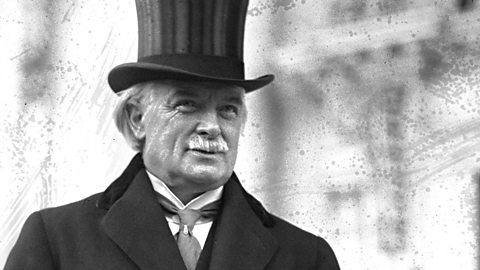
IRELAND, 1920 : THEY HAD 'TICKETS TO RIDE...'
On the 15th November 1920 - 103 years ago on this date - A British soldier in Ireland, a Lieutenant William Spalding Watts, who was attached to the '33rd Company Royal Engineers', was enjoying a train journey from Cork to Bere Island, in West Cork, an internment camp for Irish Republican POW's, which was built that year by the British.
Lieutenant Watts was travelling in the '1st Class' carriage and some of his comrades were in '3rd Class', as they were of the opinion that it would be safer for them to mingle with the public rather than to travel as a group in '1st Class'.
All of them wore their British Army uniforms and all were relaxed as the train pulled in to Waterfall Railway Station, about six miles outside Cork City, to pick up more passengers.
Lieutenant Watts, Lieutenant RR Goode, Captain Reedy, Captain Stewart Chambers and Captain Montague Green were sitting in their respective carriages oblivious to the fact that armed Volunteers from the 2nd Battalion, Cork No. 1 Brigade IRA, had boarded the train, and were making their way through the carriages.
Three of the Volunteers entered the '3rd Class' carriage and walked slowly through it, looking at each passenger as they went ; one of the IRA men, now with gun in hand, stopped at British Army Captain Chambers and said to his two comrades "That is one of them.." and, pointing at Captain Green, said "..and that is the other."
The two British Army soldiers were were then marched out of the train at gunpoint and were joined outside by Lieutenant Watts, who had been removed from his '1st Class' comfort by other Volunteers (...it was rumoured later that the IRA were looking for a British Army man named George Edward Green, who was involved in the torture of Tom Hales [".. his mouth was severely damaged and his hands crippled.."], not Montague Green. Incidentally, Tom Hales survived only to later join a Leinster House party).
Lieutenant Goode and Captain Reedy were left where they were.
Captain Stewart Chambers was responsible for the 'arrest' of Father O'Donnell (Chaplin to the Australian Forces) in October 1919 for 'seditious language' and the IRA wanted a word with him about that, and British Army Captains Chambers and Green had the previous week been witnesses to the shooting of two RIC members at Ballybrack, in Cork and, it seems, the IRA wanted to know what exactly they had seen.
Within days of their absence, posters and leaflets were displayed in areas of Cork and Kerry, signed as being from 'The Anti-Sinn Féin Society', demanding the release of the three British Army operatives within two days or else "...individuals and houses would be blown to the Devil. No mercy shown...(and) leading members of the IRA will be suitably dealt with. Ignore this at your peril. Vengeance may be slow, but it’s sure...not a tooth for a tooth, but 50 to 1.."
The posters and leaflets named thirteen villages in Cork and Kerry and listed certain houses in those villages that would be blown up and stated that the occupants of same would be killed, claiming that the 'Society' would not stop until "222 men were dead".
However, all three British Army Officers were shot dead. Their bodies were never recovered.
'RADIO ÉIREANN.'
From 'The United Irishman' newspaper, April 1955.
If ever blood is spilt among Irishmen* which, God forbid, there will be many whom history will judge harshly for their sin of omission, and among their number will be the men* (*sic) of Radio Éireann, the men* who could have enlightened but didn't, who could have spoken but elected for silence.
These, by a false toleration of error, have betrayed truth and, by an unvirtuous prudence, have suffered the continuance of ideological barriers. It is incredible, but it is also true.
Perhaps it is not yet too late to make amends ; all that is required is that at a certain fixed time, every day of the year, present political facts be related to their historical causes.
This should be done in an accurate and impartial manner, the aim being to educate both Orange and Green to know their past mistakes and the effects of these. The facts of history will show, also, that the chief architect of partition has never lived in Ireland.
(END of 'Radio Éireann' ; NEXT - 'American Notes', from the same source.)
IRELAND ON THE COUCH...
A Psychiatrist Writes.
'Magill' commissioned Professor Patricia Casey to compile an assessment of Irish society at what may emerge as the end of a period of unprecedented growth and change.
This is her report.
From 'Magill Magazine' Annual, 2002.
A few years ago, such reliance on therapists and pills would have been regarded by Irish people as among the worst kind of excesses typifying American society ; now we have abandoned any sense that it is mormal to feel negative emotions and that there are no simple, rapid solutions to the emotional vagaries of human existence.
It is in our voting pattern that we can most clearly see the fragmentation of our society - according to data produced by Professor Richard Sinnott of the Department of Politics at UCD, there has been a huge decline in turnout over the past nine years, especially among the under-25's ; from 47% in the 1992 Maastricht referendum to 21% in the recent Nice referendum, a decline that persisted even when circumstantial factors were taken into accoont.
Voter turnout increased with increasing age, but even in the Nice referendum only 52% of those in the 50-64 age group voted.
The lack of involvement of young people especially in the political process is worrying, since it suggests either a smugness that they have all their material wants and need nothing more, or alternatively that their lack of interest stems from a sense of helplessness in shaping their future.
Such disconnectedness, if proven to be the cause, is a breeding ground for dissent and anarchy...
(MORE LATER.)
BEIR BUA...
The Thread of the Irish Republican Movement from The United Irishmen through to today.
Republicanism in history and today.
Published by the James Connolly/Tommy O'Neill Cumann, Republican Sinn Féin, The Liberties, Dublin.
August 1998.
('1169' comment - 'Beir Bua' translates as 'Grasp Victory' in the English language.)
"One of the ancient indestructible things of the world...an idea which is older than any empire and will outlast every empire.." - Padraig Pearse was right.
Irish republicanism has outlasted the British Empire, thanks to determined people like Pearse. Ireland was Britain's first colonial possession to challenge its power this century and, since then, Britain has constantly retreated.
Britain is now only a shadow of the power it was in Pearse's time, still trying desperately to cling onto its first, and one of its last, colonies - Ireland.
In our time it has succeeded in strengthening and updating its grip on Ireland, in the form of a new Stormont Assembly in Ireland, but its overall power since Pearse's time has weakened, while republicanism - "one of the ancient indestructible things of the world" - has remained, pursuing Britain "like a sleuth-hound ; we lie in wait for her and come upon her like a thief in the night. And some day we will overwhelm her with the wrath of God".
Pearse followed in the tradition of Tone, Emmet and the Fenians. He accepted no compromise and knew that you could not claim to be heirs to Tone and the Fenians while disregarding their programme...
(MORE LATER.)
ON THIS DATE...
1922 :
On the 15th November 1922 - 101 years ago on this date - twenty-five IRA prisoners entered a tunnel they had dug inside Kilkenny Jail and escaped from the confines imposed on them by the Free Staters.
When the prison authorities discovered that the jailbreak had happenened they interviewed the remaining POW's who, to a man, knew nothing about it (!) and their 'privileges' were withdrawn as a result ie no cigarettes or other 'luxuries' were allowed in.
The newspapers heard about the escape so a press briefing was organised, at which the guv'nor reluctantly acknowledged that IRA prisoners had escaped but claimed that none of the missing prisoners were important IRA men!
None of the prisoners were recaptured.
(One of those who escaped, Jim Hayes, was shot dead by Free Staters three days after the escape [18th] near Silverfort, Fethard, in County Tipperary.)
============================
1922 :
On the 15th November, 1922, a 'legal writ', issued by a Free State court, was served on a Republican POW - a Mr Daithi O'Donnchadha (David O'Donoghue...who, a few short years later, joined the Staters).
Mr. O'Donnchadha had been sacked from his position in the Civil Service four years earlier because he refused to swear allegiance to the then new Free State regime which was attempting to organise itself and had, instead, placed his accountancy skills at the disposal of the fledgling Dáil Éireann (the 32-County institution).
He was employed as the 'Secretary to the Dáil Loan' Department and, as such, he had 'insider knowledge' as to how to access the funds in those accounts, and the Staters wanted that information and the cash.
The Free State 'writ' sought to compel him to transfer those details (and the money!) to the new 'trustees' who had been 'appointed' (!) by the Staters.
In around the end of that month (November 1922) a second 'writ' was served on a Mr Stephen O'Mara, another Republican POW - he, too, was being held captive in prison by the Staters as he was also a 'Loan Trustee' and, like Mr O'Donnchadha, had refused to aid the new State regime.
Mr Éamon de Valera was also a 'Loan Trustee' but, as he was then 'on the run', the Staters were unable to actually serve him with one of their 'legal writs' so they made it 'legal' to serve him with a 'writ', by placing an ad claiming that that ad was deemed to be 'notice of being served', in newspapers on the 4th December 1922!
Speaking later of his time as a finance-man-on-the-run, Mr O'Donnchadha recalled one occasion when he was nearly caught by Free State operatives -
"On the 11th November, 1919, as I was leaving 76 Harcourt Street, to go to the Sinn Féin Bank, I observed that there was a raid on the Sinn Féin Headquarters at No. 6.
I returned immediately with the news, and a warning that it might be advisable to be prepared in case No. 76 were raided. Mícheál Ó Coileáin was on the premises and I sent up word to him. After stowing away some money and accounts in the secret cache, I went into the street and mingled with the crowd outside No.6.
When the raid was over I followed the lorries down St. Stephen's Green South, until they were out of sight. Whilst the crowd was dispersing I went into University Church and stayed there a few minutes. Then, deciding to avoid No. 6, I was going back to 76 when I met Brian Ua hUigiun and Fionán Ó Loinsigh at the corner of the Green on their way to meet some other T.Ds.
We were just about to enter 76 when some military lorries came speeding towards us and pulled up there, so we passed on, saved by a matter of seconds. Leaving my two friends near Hatch Street, I came back on the other side of the street and joined the crowd which had gathered to look on at the raid..."
This corrupt, gombeen State remains 'loyal to the half-crown'!
============================
(sic - Ulster has nine counties, not six.)
1923 :
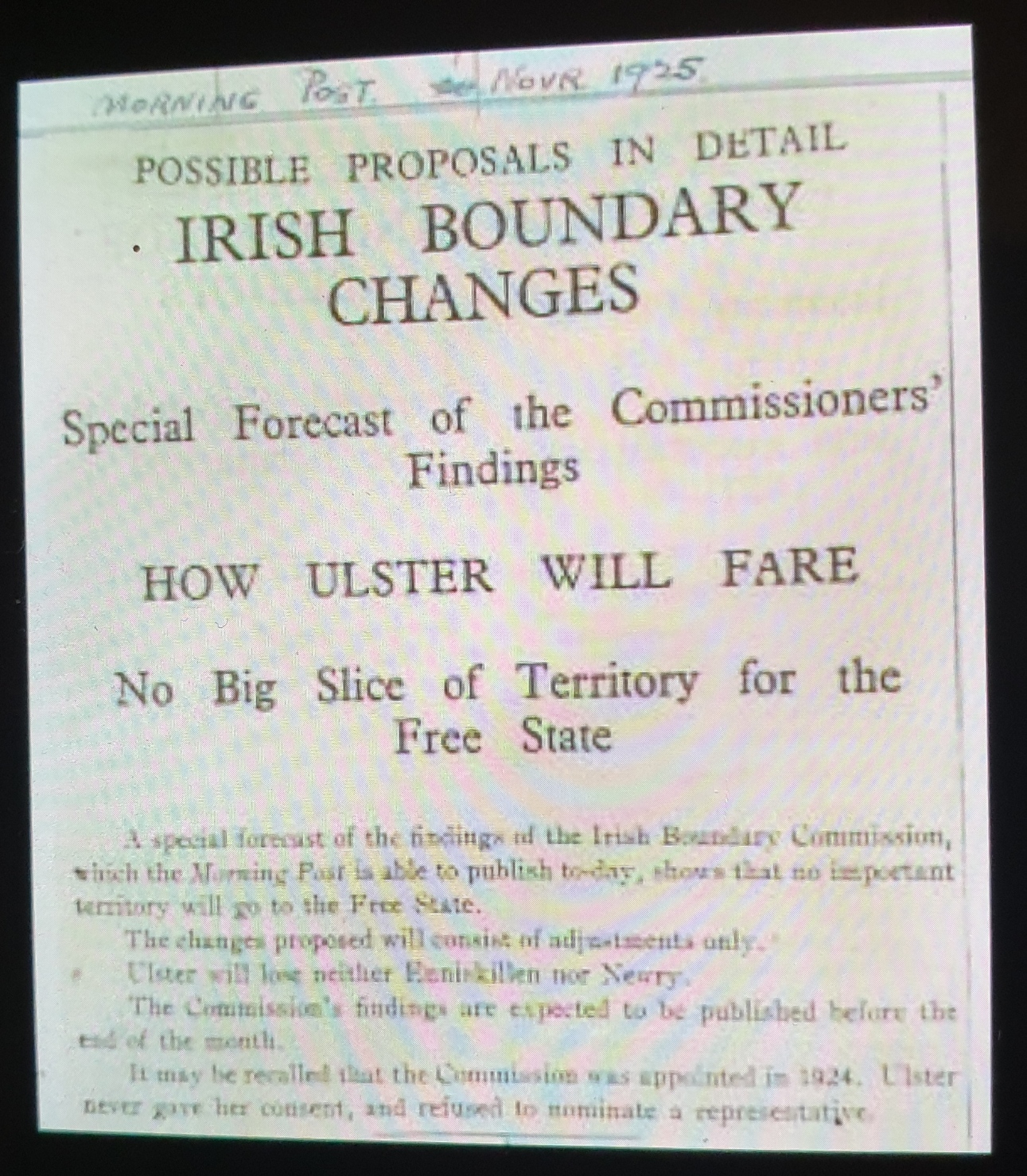
On the 15th November 1923 - 100 years ago on this date - Westminster held a 'Partition Meeting/Boundary Commission' discussion between themselves in London.
The attendance would have included their 'top people' in regards to 'Irish affairs' and it's safe to assume that Lionel Curtis, James Masterton-Smith, John Anderson, Mark Sturgis, Tomas Jones, G G Whiskard, Norman Loughnane and Stephen Tallents would have been present, as those people had all, in one way or another, 'directed Irish affairs' for Westminster over at least the previous three or four years.
A recommendation for 'progess' (consisting of about thirty pages!) was the outcome of their one-way chit-chat and it advised Westminster to change 'Article 12', stating that economic and geographic conditions should not now 'be read as a qualification to the wishes of the inhabitants'.
That meeting also advised Westminster that "...it is difficult to see an award (ie 'granting' extra land to Leinster House) which would not precipitate war between the North and South..", and suggested employing "..the large force of Specials equipped and armed by the British taxpayer (to) resist the findings of the Boundary Commission..."
Also included in their report was advice in regards to the actual composition of the Commission - that Westminster should have the final say on the Chairperson of that entity and that this should be done with a covernote stating that, in doing so, the British were proving just how serious they were in dealing with the issue - and, once the new appointment had been made, the new Chairperson would have to be allowed "...time to study the whole subject until he had fully grasped the issues at stake.."
An obvious delaying tactic and, considering that the 'Boundary Commission' was allowed to run until late 1925, it is obvious that its members from the Free State preferred the delaying tactic rather than having to report back home that the British had not only 'pulled a quick one' but weren't going to concede an inch of Irish territory.
The final (1925) report of that Commission was not made public until January 1968 ; it was suppressed (for 43 years) to aid the Stormont and Leinster House administrations to 'settle themselves' into their 'seats of power'.
And that whole saga remains to this day an open wound ; one of many caused by Westminster in Ireland.
============================
1973 :
IRA CAPTAIN MICHAEL McVERRY.
On the 15th November, 1973, IRA Captain Michael McVerry was killed during an attack on the 'Royal Ulster Constabulary' (RUC) barracks in Keady, County Armagh.
He was shot dead by British soldiers after placing a 100 lb bomb against the gable wall of the barracks during the IRA attack.
1st December 1949 – 15th November 1973.
RIP.
Thanks for the visit, and for reading!
Sharon and the team.
On Wednesday, 15th November 2023, we'll be putting up a five-piece post which - magically! - will turn into a seven-parter right in front of your lil' curious eyes...!
Among the pieces we'll be writing about are the following -
"Vengeance may be slow, but it’s sure...not a tooth for a tooth, but 50 to 1.." - a warning published by a pro-British armed gang in Ireland in the 1920's...
From 1955 - "There will be many whom history will judge harshly for their sin of omission..."
From 2002 - A few years ago, reliance on therapists and pills would have been regarded by Irish people as among the worst kind of excesses typifying American society ; now we have abandoned any sense that it is normal to feel negative emotions...
From 1998 - 'Irish republicanism has outlasted the British Empire, thanks to determined people like Pearse. Ireland was Britain's first colonial possession to challenge its power this century and, since then, Britain has constantly retreated...' (if so, it's due to the fact that the 'soup-takers' are doing the job for her.)
From 1922 - this man was involved in the financing of the Republican Movement but the Staters eventually got to him ; he spent a few years in State exile before, unfortunately, throwing his lot in with the same people that had exiled him...
Thanks for the visit, and for reading : hope to see ye back here on Wednesday, 15th November 2023!
Sharon and the team.
ON THIS DATE (8TH NOVEMBER) 28 YEARS AGO - DEATH OF A 'GUN-RUNNER'.
Neil T. Blaney (pictured), born 29th October 1922, died 8th November 1995 : 28 years ago on this date.
On November 10th 1966, when Sean Lemass resigned as Free State Taoiseach and leader of Fianna Fail, George Colley and Charles J.Haughey made known their desire for that position.
Neil Blaney entered on the nomination of another Fianna Fail Minister, Kevin Boland, but Haughey and Blaney withdrew when Sean Lemass nominated Jack Lynch. George Colley stayed in the contest and was defeated by 53 votes to 19 ; the Colley-Haughey power struggle began to develop, but all concerned (George Colley, Haughey, Boland, Neil Blaney and Jack Lynch) continued to cooperate with each other within the confines of the Fianna Fail 'TACA' group.
Neil Blaney was interested in the workings and objectives of the 'Civil Rights Association' in the Six Counties but let it be known that he didn't consider them to be hardline enough and tried to steer Fianna Fail away from having too much to do with them, a position which some seen as a challenge to Free State Taoiseach Jack Lynch, and more so with each speech Blaney made in which he verbally attacked a politician favoured by Lynch, Six County (British) 'Premier', Captain Terence O'Neill (who was also under attack by Ian Paisley).
Blaney actually advised nationalists in the Six Counties not to support 'Premier' O'Neill.
However, for the sake of party unity (a State-wide general election was due in June 1969), Neil Blaney softened his tone in public but tension remained high between him, George Colley and Haughey, although Jack Lynch tried to avoid taking sides.
Seamus Brady, a Fianna Fail 'spin doctor' and a linkman between Blaney and the media of that time, was a well-respected Fianna Fail activist in the Dublin North-East area and was friendly with Blaney, who maintained his contacts in the Six Counties even though the Fianna Fail party itself, officially, did not bother to keep in touch too much with the few remaining contacts it had in the North, a position it regretted finding itself in as the Six County area was in open turmoil.
Jack Lynch (pictured) made a speech on television in which he stated - "The Stormont Government is evidently no longer in control of the situation...the Government of Ireland (sic) has requested the British Government to apply to the United Nations for urgent dispatch of a peace-keeping force to the Six Counties...many injured do not wish to be treated in Six County hospitals, so Irish Army (sic) authorities have been instructed to establish field hospitals in Donegal and other points on the border.." and the State Minister for External Affairs, Patrick Hillery, flew to London (where he was told to mind his own business) before flying off to America and the UN, where he was to raise the Six County issue at the Security Council.
Leinster House decided that money would have to be provided to deal with 'distress' in the Six Counties and wanted any such funds spent in a way which would win friends and influence people for the Fianna Fail Government : £100,000 from State exchequer funds was agreed and a special sub-committee of the State Cabinet was appointed to deal with the whole Northern 'problem'; elected to that sub-comittee were Padraig Faulkner, Joe Brennan, Neil Blaney - their constituencies were on the border - and Charles J.Haughey, who was (FS) Minister for Finance and had strong Northern connections, his father having come South to join the Free State Army in the 1920's.
The objectives of that 'Northern sub-committee' were outlined by Charles Haughey at the 'Arms Trial'-
"We were given instructions that we should develop the maximum possible contacts with persons inside the Six Counties and try to inform ourselves as much as possible on events, political and other developments - within the Six County area."
This 'Northern Sub-Committee' made contact with the Belfast IRA, with Saor Éire elements through the Citizens Committee located in a house in Kildare Street in Dublin (now demolished) the use of which was made available by the New Ireland Assurance Company, and contact was also made with Cathal Goulding, the IRA Chief Of Staff, with the objective of using every possible contact to influence decision making in the Northern nationalist community.
Leinster House was not prepared to be 'compromised' by the decisions taken in either the Civil Rights Association or the IRA. Neil Blaney's friend, Seamus Brady, was appointed (on the 15th August 1969) by Haughey to the 'Propaganda Corps' attached to the State sub-committee and he was sent into the Six Counties and, later on that month, gave a report to Jack Lynch which concentrated on the strength of the IRA in the area.
Seamus Brady had produced a booklet entitled 'Terror in Northern Ireland' (sic) for the Central Citizens Defence Committee (CCDC) in Belfast - he had been chosen to infiltrate the CCDC and this publication launched him nicely into his work.
The full costs of producing the booklet were paid by the Leinster House-established 'Information Bureau', and a jointly-written booklet by Seamus Brady and local Civil Rights activist Aidan Corrigan was produced, entitled - 'Eye Witness in Northern Ireland' (sic) ; this too was financed by the 'Information Bureau' and was printed - 5,000 copies - at the Cityview Press in Dublin despite its imprint stating that it was 'Published and printed in the Province of Ulster'.
The booklet was launched at a press conference in Dublin's Jury's Hotel on October 5th, 1969 (the same month in which Neil Blaney, speaking at celebrations for his 21st year in Leinster House, said - "..the Fianna Fail party has never taken a decision to rule out the use of force if the circumstances in the Six Counties so demand .."), at an event organised by Brady who, along with Neil Blaney (the then State Minister for Agriculture) had had a meeting with an IRA staff officer, in Dublin (in Blaney's office in 'Government Buildings'!), the previous month (ie September 1969).
Neil Blaney's political career also encompassed ministerial sackings, the 'Arms Trial', an inquiry by the State 'Committee of Public Accounts' into exactly how a sum of money* (£100,000) was spent and power struggles in the Fianna Fail party, and we hope our few paragraphs, above, can give a flavour of Neil Blaney's involvement re the occupied six counties.
(*For instance - on the 14th November 1969, a bank account was opened [by a person operating on behalf of Charles J. Haughey, State Minister for Finance at that time] in a Baggot Street, Dublin, bank, in the name of 'Ann O'Brien', and the money in same was used mainly for the running and promotion of a newspaper called 'Voice of The North', which was based in an office in Monaghan and which pushed the views of Fianna Fail on 'the Northern Question').
The 'Gun Runner' died on the 8th of November, 1995, in his 74th year, 28 years ago on this date.
'FIRST THINGS FIRST...'
From 'The United Irishman' newspaper, April 1955.
For we are convinced that both Mr. de Valera and Mr. Costello are quite well aware that before the Irish people should even consider giving guarantees of this kind they must first get the British occupation forces out of our country.
That is the primary consideration.
To even suggest any kind of agreement or guarantee while those forces remain in Ireland is in effect a betrayal of our national rights and must be repudiated.
(END of 'First Things First' : NEXT - 'Radio Éireann', from the same source.)
ON THIS DATE (8TH NOVEMBER) 102 YEARS AGO : FINAL DRAFT PREPARED OF BRITISH GOVERNMENT'S 'SECRET CIRCULAR' RE EMPLOYING ARMED ANTI-IRISH MILITIA IN IRELAND.
In Ireland, in 1920, the British administration established a large paramilitary force of anti-Irish unionists and declared that that grouping should be known as the 'Special Constabulary', comprising approximately 40,000 members in total.
It was a three-tiered grouping : group 'A', numbering around 2,000 men, would be paid full time, armed and mobile, operating much as the hated RIC did, group 'B' would have about 20,000 armed members, part-time, uniformed but unpaid and group 'C' would consist of about 15,000 'reservists', to be called 'for duty' in times of "extreme emergency" only.
A sizeable number of those who joined the new 'Specials' were from the ranks of the 'Ulster Volunteer Force' (UVF), a pro-British paramilitary outfit which, even after its numbers had been so diminished, managed to retain a membership of approximately 20,000 (armed) men, with a British Colonel, Frederick Hugh Crawford (pictured), in charge of it.
The British government was interested in using Crawford's UVF to further secure its military and political position in Ireland - this was then only five years after the 1916 Rising and both sides in Ireland were aware that the fight was not yet over - and Westminster let it be known that it was in favour of 'utilising' those armed men as part of its military effort to 'secure Ireland for the Empire', a scenario which the RIC, in turn, 'let it be known' that it was in favour of.
On the 8th November 1921 - 102 years ago on this date - the Divisional Commissioner of the RIC in the Six Counties, a Colonel 'Sir' Charles Wickham, put the finishing touches to a 'secret' circular which he was sending to other RIC bosses in the Six Counties -
"Owing to the number of reports which have been received as to the growth of unauthorised loyalist defence forces, the (British) Government have under consideration the desirability of obtaining the services of the best elements of these organisations. They have decided that the scheme most likely to meet the situation would be to enroll all who volunteer and are considered suitable into Class 'C' (of the 'Special Constabulary') and to form them into regular military units.
There is no necessity to produce the maximum possible number of units ; what is required is to ensure that every unit recommended for formation can be constituted from a reliable section of the population."
Note how the supposed 'neutral' RIC described the UVF paramilitary organisation as a "loyalist defence force" and as "a reliable section of the population" - the British were then, and still are today, 'in charge' of those loyalist paramilitary organisations, and use them to carry-out 'jobs' which Westminster wants done, but not 'officially'. Also, about two weeks after 'Sir' Wickham wrote and dispatched his 'secret' circular, a copy of it found its way into the hands of Michael Collins who, on 23rd November 1921 - while attending Treaty negotiations with the British in London - produced it to the startled British team and told them it may very well signal the end of the 'negotiations'.
Westminster called-in its top man in the Six Counties, 'Sir' James Craig, the Stormont 'Prime Minister', and told him that the 'secret' circular would have to be withdrawn ; Craig then instructed his 'Minister for Home Affairs', a Mr. Richard Dawson Bates (a UVF man, pictured) to withdraw the circular.
However, by way of a 'two-fingered salute' to his political masters in Westminster, when he returned to Belfast, Craig increased the number of 'A Specials' by 700 men, and the 'B Specials' by 5,000 men - if they couldn't 'hire' "from a reliable section of the population" in one way, then they'd find another way to do it!
Incidentally, Colonel 'Sir' Charles Wickham had an interesting background - a British 'Establishment' man through and through,'Sir' Charles had an interesting background - he spent 23 years as the man in charge of the 'B' Specials, and was also head of the RUC for a period.
He was born in 1879, in England, and was educated at Harrow and Sandhurst, where he no doubt picked-up his 'stiff upper lip'. At 20 years young he joined the British Army and served in the Boer War and in the 'First World War'. Between the years 1918 and 1920 he served as a Lieutenant-Colonel with the British military 'mission' in the Russian Civil War, following which (at 41 years young) he was the 'Divisional Commissioner for Ulster' in the RIC, from 1920 to 1922.
It was at that time in his 'career' that he helped to establish the Ulster Special Constabulary.
At 43 years young he was appointed as the Inspector-General of the RUC, a position he held until 1945 when, at 66 years of age, his paymasters in Westminster formed the opinion that the 'johnnies' in the 'colonies' would benefit from a spot of 'Wickham-ism'. In 1945, British Lieutenant-Colonel 'Sir' Charles Wickham was 66 years of age ; but no rest for the wicked.
He was sent to Greece to serve as the 'Head of British Police and Prisons Mission', where he 'crossed swords' with the ELAS guerilla group. He remained in that position until 1952(when he was 73 years of age).
The man died in 1972, at the age of 93, and had a longer life than most of those he came into contact with.
IRELAND ON THE COUCH...
A Psychiatrist Writes.
'Magill' commissioned Professor Patricia Casey to compile an assessment of Irish society at what may emerge as the end of a period of unprecedented growth and change.
This is her report.
From 'Magill Magazine' Annual, 2002.
The priest as mentor has also been relegated due to a weakening of the influence of the Church.
In such a society, it is hardly surprising that those with problems are increasingly looking for help to counsellors but, even more worrying, is the fact that even those whose distress might be considered appropriate to the circumstances in which they find themselves are also attending counsellors ; moreover, they are also flocking to psychiatrists in huge numbers.
As personal development courses flourish and counsellors advertise in supermarkets, far from being considered an exercise in narcissism brought about by our affluence, it is regarded as a badge of honour to scrutinise one's past and explore one's feelings.
Not only are talking therapies available in abundance, but people are taking medication for nervous disorders in enormous amounts, costing the medical card system £52.66 million last year as compared to £19.1 million in 1995...
(MORE LATER.)
ON THIS DATE (8TH NOVEMBER) 232 YEARS AGO : DUBLIN REPUBLICANS PREPARE TO ESTABLISH A BRANCH OF THE 'UNITED IRISHMEN'.

NORTHERN ARMY OF AVENGERS.
Head Quarters.
The first year of Irish Liberty.
GENERAL, JN TANDY,
to his COUNTRYMEN.
UNITED IRISHMEN,
What do I hear? The British Government are dared to speak of concessions! Would you accept of them?
Can you think of entering into a treaty with a British Minister? A Minister too, who has left you at the mercy of an English soldiery, who has laid your cities waste, and massacred inhumanely your best Citizens . . . a Minister, the bane of society, and the scourge of mankind . . . behold, Irishmen . . . he holds in his hand the olive of peace; be aware, his other hand lies concealed armed with a poniard. NO, IRISHMEN, no . . . you shall not be the dupes of his base intrigues. Unable to subdue your courage, he attempts to seduce you, let his efforts be vain.
Horrid crimes have been perpetuated in your country. Your friends have fallen a sacrifice to their devotion for your cause. Their shadows are around you and call aloud for Vengeance.
It is your duty to avenge their death. It is your duty to strike on their blood-cemented thrones the murderers of your friends.
Listen to no proposals, IRISHMEN, wage a war of extermination against your oppressors, the war of Liberty against tyranny, and Liberty shall Triumph.
JN TANDY.'
It was on this date (8th November) in 1791 that James Napper Tandy put the final preparation into convening the inaugural meeting of the 'Dublin Society of United Irishmen'.
The meeting took place in the Eagle Tavern (now known as the 'Quaker [Friends] Meeting House', where the wall plaque, pictured above, is located) in Eustace Street in Dublin city centre.
The meeting was Chaired by Simon Butler (1757-1797, a barrister by profession, and brother of 'Lord' Mountgarret - family history here), with Tandy himself acting as Secretary, and the following resolutions were among those discussed and passed -
'That the weight of English influence in the government of this country is so great, as to require a cordial union among all the people of Ireland, to maintain that balance which is essential to the preservation of our liberties and the extension of our commerce...that the sole constitutional mode by which this influence can be opposed, is by a complete and radical reform of the representation of the people in Parliament... and that no reform is just which does not include every Irishman of every religious persuasion.'
The 'Dublin Society' held meetings on alternative Fridays, usually at the Music Hall in Fishamble Street in the city centre, with the objective of working to obtain social democratic reforms and independence from England and developed a strategy of spreading its ideals by means of leaflets, newspapers, ballads, 'catechisms' and travelling emissaries.
By 1797, the society as a whole had at least 100,000 members throughout Ireland whereas today, although smaller in number (!), the objective remains the same : 'independence from England'.
BEIR BUA...
The Thread of the Irish Republican Movement from The United Irishmen through to today.
Republicanism in history and today.
Published by the James Connolly/Tommy O'Neill Cumann, Republican Sinn Féin, The Liberties, Dublin.
August 1998.
('1169' comment - 'Beir Bua' translates as 'Grasp Victory' in the English language.)
The documents in this booklet are taken from periods of republican history in the 18th, 19th and 20th centuries.
Though these documents are from history, they cannot be safely locked away in an historical archive to be forgotten about. They are living history, all part of a story which has yet to be completed.
The story of Irish republicanism is of the struggle to 'break the connection with England, the never-failing source of all our political evils'.
Padraig Pearse drew upon the history of the United Irishmen and the Fenians to re-invigorate the Republican Movement and demonstrate its continuity with the struggle of previous generations. He honoured Ireland's dead by taking up the struggle again under the same banner that they stood under in their day. He consciously followed in their tradition... (MORE LATER.)
1919 :
In 1919 in Ireland, as Irish republican forces were defending themselves, their people and this country from imposed British political and military interference (an on-going struggle), the British paramilitary 'police force' in Ireland, the 'RIC', knew they were unable to 'contain the situation' and decided to regroup.
A 'Safety of Barracks' circular was distributed to all their 'section heads' in the country on the 8th November, decreeing that all such 'units' with less than six operatives should be closed immediately (...as they weren't able to 'defend themselves' successfully!) and the 'police men' effected by the policy change would be stationed in a different barracks, to ensure that they have more of their members present, should they be challenged by republicans.
That move led to the closure of smaller barracks - more than 430 of them - out of a total of 1,300 such 'police stations'. The IRA continued to defend themselves, their people and this country and also continued to 'close' hundreds more barracks in their own way...
===================
1920 :
On around the 8th November, 1920, an IRA Active Service Unit placed itself in an ambush position near Grange, in Limerick, waiting for two lorry loads of British soldiers who were due to pass that spot two days later (10th) ; Donnacha (Donnchadh) O'Hannigan (pictured, more info here) was in command of the rebels but the operation didn't go as intended -
"...we took up a position at the village of Grange on the Limerick-Brute road, expecting a convoy of enemy transport of which we had received
information that it was likely to pass that way.
After several hours waiting, the enemy approached, but in the opposite direction to that which we expected them. Unfortunately, a shot was fired prematurely and probably accidentally by one of our men, and this precipitated the fight, much to our disadvantage in the position we occupied.
The British were supported by an armoured car. I had a very poor knowledge of the district, and decided to withdraw.
We were hotly pursued by the enemy, but we returned their fire and retired in good order. We had one wounded (Volunteer Burke), but in the circumstances were unable to calculate the enemy casualties. I was subsequently informed that they had five wounded..."
After 'Truce and Treaty', Donnacha was neutral in the on-going conflict between the Republicans and the Free Staters.
===================
1920 :
A Flying Column attached to the Longford Brigade of the IRA, under the command of Sean MacEoin (who later joined the Free State Army) attacked an RIC post on the 8th November and reports suggest that three RIC members were killed, and one wounded.
===================
1920 :
On the 8th November (1920), a motorised RIC and Black and Tan gang stormed into the villags of Ardfert, in County Kerry, by two different routes.
They 'arrested' three men - Michael Brosnan (a Volunteer with the Castleisland Company IRA, 1st Battallion, Kerry No. 2 Brigade), John Cantillion and Maurice ('Mossy') McElligott - and placed them in their lorries, to be used as hostages in case they were to come under attack from the IRA. The two lorries then drove off, at speed, in the direction of the village of Rathoneen, where they carried out house raids.
After wrecking a few houses, they decided to drive back to Ardfert but, nearing their destination, they stopped and took their three hostages out of the lorries, and brought them into a field (which is now the Hazel Grove housing state). The 'police' and the Tans lined up and told the three hostages to make a run for it, but an RIC member whispered to Mossy McElligott that if he valued his life, he shouldn't move.
Michael Brosnan and John Cantillion ran for their lives, but only made it about fifty yards across the field before they were both shot dead. The pro-British 'peace keepers' then turned on Mossy and beat him until they thought he was dead. The RIC and their Tan colleagues then left the scene and went to the near-by pub, 'O' Sullivans' and demanded, and got, free drink from the owner.
Mossy McElligott lived to tell the tale.
===================
1921 :
During the 'Treaty of Surrender' negotiations (!) in the early 1920's, a British 'Civil Servant' named Thomas Jones, who had made it his business to be 'friendly' with Michael Collins and Arthur Griffith, approached both of those men, on the 8th November, 1921, and asked if he could speak to them about a possible solution that he, Mr Jones, had been thinking about.
Mr Jones asked both of them if they thought, perhaps, the formation of a small group, comprising members from the British and Irish sides, to discuss which areas of Ireland should be partitioned, would be a good idea...?
Michael Collins replied that he wouldn't be in favour of such a group because "it sacrificed unity entirely" (how right he has been, to date, regarding that issue - yet he went on to implement and enforce that same proposal!) but Arthur Griffith said he wasn't opposed to the idea, and Mr Jones told them that if anything should happen to his Prime Minister (David Lloyd George), then Mr Bonar Law could find himself in charge and he wouldn't be as favourable to the Irish in relation to the partition issue.
This put the wind up both men ('the devil you know' and all that) and so it was that the seed of a 'partition group' (the 'Boundary Commission') was planted but...it later transpired that David Lloyd George, the British PM, had instructed Mr Thomas Jones to approach the two Irish men in the manner he did, to innocently (!) propose the outcome that he, the PM, wanted ie 'I'm Thomas Jones, this is my idea, lads, just shootin' the breeze, but what do ye think...?'!
To add insult to injury, later that same day (8th November 1921) a Mr Lionel Curtis, the 'Secretary to the British Delegation', called a meeting of his own people and announced a 'breakthrough' - that of the soon-to-be-announced formation of a 'Boundary Commission'!
(We have mentioned (!) this con job before...)
===================
1922 :
On the 8th November, 1922, an IRA Unit, under the command of Bill Roe, attacked the Free Staters in Wellington Barracks (pictured), on the South Circular Road, in Dublin.
That barracks was a holding centre for IRA POW's and was also used by the Staters as the base for their 'Army Intelligence' unit.
IRA men were positioned on both sides of the near-by Grand Canal, armed with a Thompson submachine gun, revolvers and rifles ; one Free State soldier, Thomas Murphy, was killed in the gun battle, and another, James Finlay, was wounded and died later. Altogether, about twenty Staters were wounded, as were two civilians, and a third civilian, named Keane, was killed in the crossfire.
In a revenge attack, an IRA man, James Spain, was captured on Donore Avenue, in Dublin, by the Staters, and shot dead by a Free State soldier named Christy Clarke, following which Clarke and his comrades returned to Wellington Barracks and 'punished' the IRA prisoners they were holding there.
===================
1922 :
During an IRA attack on Free State Army forces on the 8th November 1922, in Milltown Village in County Kerry (pictured), a mother and her son were wounded in the crossfire. The son, Jeremiah McKenna, died four days later from his wounds.
Thanks for the visit, and for reading!
Sharon and the team.
"THE BANE OF SOCIETY AND THE SCOURGE OF MANKIND..."

By the end of the 18th Century, the Irish had at least 100,000 men and women that were prepared to put their lives on the line in their fight for freedom - their efforts re-kindled the flame for future generations...
Church officials and (other) therapies were availed of by a damaged people, but so too was medication for nervous disorders...
'Hiring' what they described as "reliable sections of the population" to 'police' the Irish was one of the methods that Westminster undertook to secure its 'place' in Ireland...
From 1955 - Sinn Féin replied that "to even suggest any kind of agreement or guarantee while those (British) forces remain in Ireland is in effect a betrayal of our national rights and must be repudiated..." : the same answer given by Irish Republicans to this day...
Who was the mysterious woman who, as the conflict in the Occupied Six Counties was raging on, opened a bank account in Dublin which was to be used to finance a propaganda war in relation to that military campaign...?
...and we'll have a few lil' snippets from 1919, 1920, 1921 and 1922 as well.
We'll be filling-in the above blanks, and adding a few paragraphs on to each one (obviously!) on Wednesday, 8th November 2023, in a six-part piece that we'll be posting then.
If we've whetted your appetite or even got ya curious, give us a shout then. You won't be disappointed but, if you are, give us your details and we'll send ya a few bob so as you can ring someone who cares...!
Thanks for poppin' in - hope to see ya on Wednesday, 8th November 2023.
Sharon and the team.
ON THIS DATE (1ST NOVEMBER) 103 YEARS AGO : THE EVE OF EXECUTION.
'On 28 June 1920, five men from C Company of the 1st Battalion at Wellington Barracks, Jalandhar, Punjab decided to protest against the effects of martial law in Ireland by refusing to soldier. They were soon joined in their protest by other Rangers (the protesters included at least one Englishman, John Miranda, from Liverpool) declaring they would not return to duty until British forces left Ireland.
Led by Private James Daly (whose brother William took part in the protest at Jalandhar), the protest spread to the Connaught Ranger company at Solon however the Connaught Ranger company at Jutogh hill-station remained loyal to the British crown. A party of men led by Daly made an attempt to recover their arms, storming the armory.
The loyal British guard successfully defended it, and two of Daly's party, Privates Patrick Smythe and Peter Sears, were killed in the firefight. Within days, both garrisons were occupied by loyal British troops; Daly and his followers surrendered and were taken prisoner. Eighty-eight mutineers were court martialed : nineteen men were sentenced to death (eighteen later had their sentences commuted to life imprisonment), 59 were sentenced to 15 years imprisonment, and ten were acquitted.
The 21-year-old Daly was shot by a firing squad in Dagshai Prison on 2 November 1920. He was the last member of the British Armed Forces to be executed for mutiny. Private Sears and Private Smyth were buried at Solan, while Daly and Miranda (who later died in prison) were buried at the Dagshai graveyard until 1970..' (from here.)
'On November 2nd, 1920, James Daly was killed by a British Army firing squad in India. He had been one of the leaders of the so-called 'India Mutiny', but had not been among its instigators. The mutiny began on May 28th, 1920, led by Joseph Hawes at Wellington barracks in Jullundar, India, when 350 Irish members of the famous Connaught Rangers regiment of the British Army laid down their arms and refused to keep soldiering as long as British troops remained in Ireland...as word of more and more British violence against the Irish people spread among the troops, they had begun to question the morality of wearing the uniforms of the same army that was terrorising families back home.
The mutiny soon spread to Ranger detachments in Solon and Jutogh. Daly was stationed at Solon and helped lead the action of the mutineers there. Two would die in Solon during a brief confrontation. Eventually, 61 Rangers were convicted by courts martial and 14 sentenced to death. All but one of those condemned men had their sentences reduced. James Daly of Tyrellspass, County Westmeath, was the only one shot.
The Connaught Rangers would not survive much longer than Daly ; in 1922 the regiment was disbanded after the signing of the Anglo-Irish treaty that created the Irish Free State. In 1970, James Daly's body was brought home and buried at Tyrellspass. Among those in the guard of honor at the reinterment ceremony were five of his fellow mutineers: Joseph Hawes, James Gorman, Eugene Egan, Patrick Hynes, and William Coote...' (from here.)
"The moral courage and sacrifice shown by James Daly and his comrades shines like a beacon light years after those momentous events in Jullander and Solon in India in June and July of 1920. The leadership shown by James Daly and Joe Hawes galvanised their comrades into striking a blow for the freedom of their own land. We also remember with pride the sacrifices of Peter Sears and Patrick Smythe who died at the hands of the British army during the mutiny and who are interred in Glasnevin cemetery.." - the then RSF President Des Dalton, 2010 : more here.
At that time, in Ireland, the Black and Tan War was at its height. Irishmen serving with the British Army in India mutinied in protest at the atrocities being committed in Ireland by the British. On June 27th, 1920, 350 Irishmen gave in their arms and refused to soldier for England. The mutiny was confined chiefly to members of 'B' and 'C' Companies, 1st Battalion, Connaught Ranger Regiment, stationed at Wellington Barracks, Jullunder, Punjab, India.
The men at Jullunder were led by Private Joseph Hawes and their protest was joined two days later by a detachment of 'C' Company at the hill-station in Solon, under Private James Daly (regimental number 35025), a member of the Irish Republican Brotherhood. On June 30th, 1920, following the deaths of Privates Patrick Smythe, Louth (regimental number10079) and Peter Sears, Mayo (regimental number 32781) in an attempt to capture the magazine at Solon, the mutiny ended.
Seventy-five of the mutineers were arrested and taken to Lucknow where they were held until September when they were moved to Dayshai Prison to stand trial.
While awaiting trial, the prisoners were subjected to such harsh treatment by the British that it resulted in the death of one of the men, Private John Miranda, a native of Liverpool.
At the subsequent general court-martial , fourteen of the prisoners were sentenced to death and the remainder to terms of imprisonment varying from ten to twenty years. In mid-October 1920, 13 of the fourteen death sentences were commuted to life imprisonment - the exception was Jim Daly, a native of Tyrellspass, County Westmeath.
After six months, the mutineers were transferred to Portland Convict Prison in England, where they suffered long periods of solitary confinement and ill-treatment during their fight for political status. They were later moved to Maidstone Prison and, on January 3rd, 1923, the remaining sixty mutineers were released and returned to Ireland.
In October 1970, the remains of Daly, Smythe and Sears were brought back to Ireland : Smythe, a native of Drogheda, Co. Louth and Sears, from Neale, Co. Mayo, were buried in the Republican Plot in Glasnevin Cemetery in Dublin.
James Daly, who was executed in Jullunder in India on November 2nd, 1920, as per orders issued by Major-General Sir G. de S. Barrow, K.C.B., K.C.M.G., of 'Northern Command of the British Army in India', was re-interred in his native Tyrellspass. These men and those like them are remembered and cherished by Irish republicans, as they should be.
The 1st November, 1920 - 103 years ago on this date - was James Daly's last full day on this Earth. Gone but never forgotten.
'FIRST THINGS FIRST...'
From 'The United Irishman' newspaper, April 1955.
Will Mr. Costello and Mr. de Valera tell us what is the use of talking against this attitude?
Will they not admit publicly, as they do in private, that it is essentially a question of force ; that England holds Irish territory by force and is determined to continue to do so no matter how strong the moral, legal or national argument brought against her?
Quite bluntly she says - "No matter what your case may be, here I am and here I'm going to stay!" But still the talk goes on.
During the recent war, Mr. de Valera stated - "Ireland will never allow her territory to become a base for any foreign power for an attack on England."
Mr. Costello has now repeated that statement and his renewal has been welcomed delightedly by 'The Yorkshire Post' newspaper ; it is high time that statement was critically examined.
Apologists for the politicians may look upon it as a wonderfully clever move to entice the English into making some 'concessions' but to republicans it is either of two things - a deliberate half truth or yet another surrender to the Free State...
(MORE LATER.)
ON THIS DATE (1ST NOVEMBER) 139 YEARS AGO : BIRTH OF WHAT MORPHED INTO A 'GRAB ALL ASSOCIATION'.
'On 1st November 1884 the Gaelic Athletic Association was founded at Miss Hayes' Commercial Hotel, Thurles, Co. Tipperary, by Michael Cusack (Clareman, teacher, sportsman and nationalist) and Maurice Davin (a Tipperary man who at the time was Ireland’s most famous athlete).
Other founding members present were John Wyse-Power, John McKay, J.K. Bracken, Joseph O'Ryan and Thomas St George McCarthy. Many of the seven men who attended the meeting were Fenians. Not present at the Thurles meeting was Patrick W. Nally, a keen athlete and leading IRB organiser who also played a prominent role in bringing about the birth of the GAA : he was the one who suggested the organisation to Cusack...' (from 'History Ireland' magazine.)
The objective of the new organisation was to to foster and promote native Irish pastimes, to open athletics to all social classes and to aid in the establishment of hurling and football clubs and, in order to encourage contact between towns and cities, it organised inter-county matches.
One of its founding members, Michael Cusack, was a pioneer of Irish language revival and a founder member of the Gaelic League, and was inspired by the ideal of restoring pride in the national games of hurling and football and - through them - instilling hope and determination among Irish manhood in their ability to control their country's destiny.
It had somewhat of a republican 'leaning' to it in its earlier years, through people like Michael Cusack and, for instance, James Nowlan who, in 1898, at 36 years of age, was elected as Alderman to Kilkenny Corporation and availed of the position to great effect in publicising the then fourteen-year's young 'Gaelic Athletic Association', but was less successful in persuading the Central Council of the GAA that it should begin preparations to commemorate the 100th anniversary of the 1798 Rising.
indeed, the GAA leadership refused to even appoint representatives to the 1798 Centenary Committee, but James Nowlan and a few other republican-minded GAA members insisted on playing their part in the celebrations.
At the GAA Congress held in September 1901, he was elected President (the sixth president of the GAA, a position he served in from 1901 to 1921) and attempted to steer the organisation towards a more republican path ; for instance, when the 'Irish Volunteers' was formed, Nowlan stated that it was a most suitable group for GAA members to join, even though other GAA leaders were not as enthusiastic about the group, or about republicanism in general.
And that 'mildly nationalist/small-'r' republican'-outlook has unfortunately prevailed in the overall leadership and membership of the GAA, so much so that, during the 1981 hunger-strikes.. '...the whole question of the role of the GAA in Nationalist affairs was raised, with it becoming blatantly clear that the courage was lacking from top GAA officials to come out openly, and support with direct action, motions passed at successive GAA congresses which backed the prisoners' demands.
The influence of Fianna Fáil and Fine Gael members, and the ever-present voice of the Garda Síochána in the GAA, was beginning to cause even more alarm among GAA Headquarters' staff ; the grassroots' support at Northern level was understandable as many clubs had at least one member in Long Kesh, but the gulf in understanding of many Southern GAA personnel was a reflection of how removed from the realities of the Northern situation they had become.
GAA Headquarters kept one careful eye on events in Long Kesh and the other on those middle-class conservatives who wanted the GAA to steer well clear of involvement in the H-Blocks crisis.
Statements from the GAA management committee referred to bringing "the whole sad situation to an end..in the interests of peace.." - hardly words calculated to cause Southern politicians to take seriously the degree of GAA concern over the prison situation..other statements talked of "humanitarian concern", while the increased pressure exerted by some GAA members in the South gave rise to terms such as "condemnation of violence and men of violence" being increasingly included in policy statements from the GAA management committee..' (from here.)
All in all - between the above and the 'Rule 21' issue, it's not surprising that republicans have learned not to depend on overall GAA structures as a support base and, indeed, to be extra vigilent in any dealings with the GAA as it is still 'influenced by Fianna Fáil, Fine Gael and the Garda Síochána..' (...and values profit over culture).
IRELAND ON THE COUCH...
A Psychiatrist Writes.
'Magill' commissioned Professor Patricia Casey to compile an assessment of Irish society at what may emerge as the end of a period of unprecedented growth and change.
This is her report.
From 'Magill Magazine' Annual, 2002.
However, there was also a degree of obfuscation, deliberate or otherwise, since there was a failure to publicise the fact that Ireland has one of the highest proportions of women in the workforce who have children under two years of age, at 42%, and most of these work full time.
Among women with children between 10 and 14, 22% were in full time work and 13% worked part time ; these figures suggest that women with young children are working for economic reasons as they grapple with enormous mortgages in the early years of their marriage.
The figures also suggest that, given their choice, a large proportion would choose not to work outside the home for a period. As women are being subtly forced into the workplace by the financial whip, stay-at-home parents have become the new pariahs.
In the past, many of the day-to-day problems of living were resolved within the family, or with the help of the local priest. However, as the family has become increasingly nuclear and over-extended by the demands placed upon it, the resources for supporting those with problems within the family have been curtailed... (MORE LATER.)
ON THIS DATE (1ST NOVEMBER) 103 YEARS AGO : IRISH 'LAD OF 18 SUMMERS' EXECUTED BY WESTMINSTER.
Kevin Barry (pictured) wearing the uniform of 'H' Company, 1st Battalion, Dublin Brigade of the IRA. He was 18 years of age when that photograph was taken, and that same age when he was put to death by Westminster.
He was executed on November 1st 1920 - 103 years ago on this date - in Mountjoy jail in Dublin by the British. He was the first Irish republican to be executed by the British since 1916, and was captured while on active service outside the entrance of Monk's bakery in Dublin. Although he was born in Dublin he spent much of his life at the family home in Tombeigh, Hackettstown, in Carlow.
Both sides of his family, the Barry's and the Dowling's, came from the area, and some of his ancestors had fought in 1798. His was a strong republican family. At the time of his death his eldest brother Mick was O/C of the volunteers in Tombeigh and his sister Sheila was in Cumann na mBan.
On Monday 20th September,1920, 18-year-old Kevin Barry had gone to Mass and received Holy Communion, then joined a party of IRA volunteers on Bolton Street in Dublin.
Their orders were to ambush a British army truck as it picked up a delivery of bread from Monk's Bakery at the junction of North King Street and Church Street and capture their weapons. The ambush was scheduled for 11am, which gave him enough time to take part in the operation and return to UCD in time for a medical examination he had at 2pm.
The gun he was using jammed during the operation (he had left his own weapon in Carlow and was using a borrowed one) and he was forced to seek shelter - he rolled under the British Army truck and continued trying to free the jammed gun.
His comrades left the scene as they were outnumbered and had lost the element of surprise, and Barry might very well have escaped capture in his hiding place had a local woman, a Mrs Garrett, who ran a coal and vegetable shop near the bakery, not shouted out to the driver of the British Army lorry that he shouldn't move it as the person under it (Kevin Barry) could get run over. Barry was captured and placed in the back of the military lorry along with three dead or mortally wounded British soldiers.
The woman who shouted the warning blamed herself, as did some of her neighbours, but Kevin's sister, Kathy, exonerated the woman from any blame for his capture -
"Incidentally, I should mention that some months after his execution we were most distressed to hear that this woman had been driven mad and was in an asylum as a result of the blame attached to her by her neighbours. There was nothing we could usefully do about it beyond explaining where we could that, in Kevin's own account of it to me on the day of his court martial, he was convinced that she cried out because she was afraid that the man under the lorry would be run over..."
On Halloween night, 1920 - the night before his execution - Kevin Barry was given a blue-leaded pencil and paper with which to write his last letter :
"Dear Boys, I had quite a crowd of visitors today and a crowd from the college prayed and sang outside the gates but perhaps you were there. Well boys, we have seen some good times, and I have always considered myself lucky to have such a crowd of pals. It's the only thing which makes it hard to go, the fact of leaving you chaps and other friends behind. Now I charge you thank anybody you know for me, who has had masses etc said. Everybody has been awfully decent and I can assure you I appreciate it. Also say just a few more prayers when I go over, and then you can rest. Your pal, Kevin."
As he was writing that last letter, Father Francis Browne SJ, a teacher at Belvedere College, cycled to the Vice Regal lodge in Dublin's Phoenix Park to plead for Barry's life, but to no avail : 18-year-old Kevin Barry was hanged in Mountjoy Jail in Dublin on the 1st November 1920, the first republican to be executed since the leaders of the Easter Rising of 1916.
'Just a lad of eighteen summers...'
BEIR BUA...
The Thread of the Irish Republican Movement from The United Irishmen through to today.
Republicanism in history and today.
Published by the James Connolly/Tommy O'Neill Cumann, Republican Sinn Féin, The Liberties, Dublin.
August 1998.
('1169' comment - 'Beir Bua' translates as 'Grasp Victory' in the English language.)
The booklet 'Beir Bua' has been written for just one such revolutionary and just one such revolutionary organisation - it is the first weapon of the grassroots Irish republican activist and it will help build the impregnable fortress that is our undiluted faith in a free, united, democratic, Gaelic, socialist and federalist Irish Republic.
It serves as a declaration of war on the Brits and their allies, it steels us for the hard road ahead and it guides us with the words of some of our greatest patriots on the one true path to freedom.
I heartily and gladly recommend it to all dedicated Irish republicans.
Máirtín Ó Catháin, Bogside, Derry, 1998... (MORE LATER.)
ON THIS DATE (1ST NOVEMBER) 103 YEARS AGO : A TERRIBLE UGLINESS IS BORN...
On the 1st November 1920 - 103 years ago on this date - a 'volunteer police force/Ulster Special Constabulary' scheme was officially announced by the British government, and recruitment for same began.
This 'new' grouping, which was to be formed mainly from the ranks of the existing 'Ulster Volunteer Force' (UVF), a pro-British militia, received full backing from the then British Prime Minister, David Lloyd George, as it would free up the RIC and other British military units for use elsewhere in Ireland, plus it was cheaper than having to raise a 'proper' (!) force, as this 'new' grouping was to be formatted in a manner that not all recruits would be paid : it would be established in three 'parts' and, at first, would only be set-up in the Belfast area of County Antrim and also in County Tyrone, but was soon extended to all six of the occupied counties.
The 'A Specials' would be a paid, full-time group, armed and equipped in an equal manner to the RIC, the 'B Specials' would be part-time and unpaid, except for a clothing allowance, and would only be armed if their local RIC commander deemed it necessary.
Their 'contract' stipulated that they would do only "..occasional duty, usually one evening per week exclusive of training drills, in an area convenient to members, day duties being required only in an emergency.." The 'C Specials' were to be a reserve group, to be called out on 'duty' only in case of an emergency. When this three-part outfit was 'fully staffed', it numbered about 5,000 'A', 18,000 'B' and 7,000 'C', and was an openly sectarian pro-British murder unit, which could count an estimated one in every five of the adult male Protestant population in Ireland as a member.
In 1925, Westminster thought it was time to 'modernise' its occupation of the part of Ireland it still claimed jurisdiction over - our six north-eastern counties (as remains the position today) and, in December that year, it offered the approximately 30,000 to 40,000-strong 'Special Constabulary' organisation a few bob to 'go away' (!) - £1,200,000 was put on the table, provided most of them agreed to disband (similar to what happened with the PIRA 73 years later - buying them out with a 'bank-load' of money).
'Sir' James Craig (pictured), up to then a great friend and supporter of the 'Specials', stated that they would have to go : on 10th December 1925, Craig told the 'A' and 'C' Specials that they were out of work and offered each man two months pay, adding that the 'B Specials' were to be maintained as they were. However, the 'A' and 'C' Specials were not happy with the 'disband now' order from Craig ; not enough money was offered, it was on the mouth of Christmas, and the unemployment rate was running at over 20% - so the 'A' and 'C' Specials held meetings between themselves and, on 14th December 1925, they mutinied!
'A' and 'C' members in Derry 'arrested' their own Officers, as they did in Ballycastle - two days later (ie on 16th December 1925) a demand from the 'A' and 'C' 'rebels' (!) was handed over to 'Sir' Richard Dawson Bates, the Stormont 'Minister for Home Affairs', a solicitor by trade, who was also Secretary of the 'Ulster Unionist Council', a position he had held since 1905.
The 'Special Rebels' were looking for more money ; they demanded a £200 tax-free 'bonus' for each member that was to be made redundant. Two days later (on the 18th December 1925) 'Sir' Bates replied to them that not only would they not be getting the £200 'bonus' but if they didn't back down immediately they would loose whatever few bob they were entitled to for being made redundant!
That message was delivered to the 'mutiniers' on 18th December 1925 ; on 19th December 1925 they all but apologised to Bates, released their hostages and signed on for the dole - the 'hard men' of the 'Specials' had been put in their place by a bigger thug than they were! By Christmas Day, 1925, the 'A' and 'C' Sections of the 'Ulster' (sic) Special Constabulary Association - the 'Specials' - were disbanded.
The 'B' Specials were indeed kept on as they were - it was only in 1969 that that gang of thugs 'disbanded' (actually, they changed uniform into that of the 'Ulster Defence Regiment' [UDR] and carried-on with their thuggery).
It was in September 1969 that the (British) 'Cameron Commission' described the 'B' Specials as "a partisan and paramilitary force", while the October 1969 'Hunt Report' recommended that the 'B' Specials be disbanded. We now suffer from the RUC/PSNI, (mostly) confined ('officially' anyway) to operating in the six occupied counties and wearing a more 'people-friendly' uniform.
But if a leopard could change its spots, it would still be, under its 'new skin', a leopard.
Thanks for the visit, and for reading!
Sharon and the team.







!['Quaker [Friends] Meeting House'](https://localstudies.files.wordpress.com/2013/01/eustace-street-dublin-meeting-house-erected-1694-rebuilt-c.jpg)