ON THIS DATE (22ND NOVEMBER) 100 YEARS AGO : DEATH OF AN IRA HUNGER-STRIKER.
Andrew Sullivan (aka Andy O'Sullivan, pictured), 5th Battalion, Cork 4th Brigade, was one of three IRA men to die on hunger-strike in 1923 - he was 41 years of age at the time (the other two men were Joe Witty, 19 years young, and Dennis Barry, 40 years of age ; Joe died on the 2nd September that year, and Dennis died on the 20th November).
'Captain Andrew Sullivan was born in Denbawn, County Cavan in 1882, the oldest of eight children born to Michael Sorahan and Mary Smith...he eventually became the agricultural inspector for the Mallow area, County Cork and held that position for many years.
During the War of Independence Sullivan was the Commanding Officer for Civil Administration in the North Cork area and later in the 1st Southern Cork division...a supporter of the anti-Treaty side during the Irish Civil War, he was arrested and interred on July 5, 1923. Between 1922 and 1923, hundreds of others in all parts of Ireland were arrested by the (*) British controlled Irish police force (*), without any charge, and were kept in the prisons and internment camps without trial...in the Autumn of 1923 the conditions in the prisons grew worse and the men and women were being treated as convicts rather than political prisoners. To protest their imprisonment and bring public attention to the cruelty they were receiving, the only 'tool' they felt they had at their disposal was a hunger strike...' (from here).
(*)- an accurate description, in our opinion, but the timeline would show that, 'officially', at least, the then existing 'police force' would be acting under instruction from the then 'new' Free State administration in Leinster House rather than 'officially' taking orders from Westminster.
However, as republicans know (and history has since attested to) that 'police force' was a proxy force for Westminster - as, indeed, was the Leinster House 'parliament' that established that 'police force' - so the description 'British controlled Irish police force' is, as we said, accurate.
Also, as regards the POW's being treated as convicts, one of the prisoners, Alfred McLoughlin, who was interned for a year without being told why, managed to get a letter published in 'The Irish Times' newspaper in which he wrote - "I slept on bare boards in the Curragh military prison for five nights..I was handcuffed night and day..I was threatened, with a gun, several times, that I would be shot..." -
"I am one of the Hare Park prisoners referred to. In spite of what General Mulcahy says, I slept on bare boards in the Curragh military prison for five nights – April 24-28. I got one blanket. I was handcuffed night and day (day behind, night in front). The handcuffs were not off for meals ; they were off one wrist for alleged dinner, excluding Thursday, April 26, when they were both off for dinner, but on that day I was hanging handcuffed by the wrists to a kit-rack about six inches from the floor, for four-and-a-half hours. I was threatened with a gun several times [that] I was to be shot..."
W.B. Yeats, 'Lord' Granard and Sir Bryan Mahon campaigned for proper treatment for the prisoners and, in April 1923, the 'International Committee of the Red Cross' carried out an 'investigation' into the conditions in the prisons, reporting (in keeping with those who had facilitated their visit ie the Staters) that "the prisoners were treated like prisoners of war". However, it later emerged that their report was flawed as not one prisoner was interviewed during their 'investigation'!
Anyway - in that particular year (1923), there were about 12,000 Irish republicans interned by the Free Staters and, as stated, above, those men and women "were being treated as convicts rather than political prisoners", and a decision was made, by both the POW's themselves and the leadership outside, to go on hunger strike and, on the 13th October 1923, Michael Kilroy (pictured, a respected republican, at the time) OC of the IRA POW's in Mountjoy Jail, announced that 300 republicans in that prison/internment camp (including ten men who had been elected to a 32-County Dáil Éireann) had voted to go on hunger strike (those 300 men were soon joined by 162 more of their comrades in that institution).
Within days, thousands more imprisoned republicans joined the protest - 70 in Cork Jail, 350 in Kilkenny Jail, 200 in Dundalk Jail, 711 in Gormanstown Prison Camp, 1,700 in Newbridge, 123 in 'Tintown', 3,390 in the Curragh Camp, 100 in Harepark Camp and 50 women in the North Dublin Union prison (good condensed background piece here about that period in our history).
While on hunger strike, Andrew wrote to his brother Michael on the 7th November, 1923 - the 25th day of the protest ; "Dearest Br. Miceal,
Thanks ever so much. I really can't find words to explain adequately my gratitude for your prompt response to my appeal for some cash. I have been very hard up for many things especially smokes and of course I would not ask anyone - besides, I could never bring myself to beg. I am much cheered by the news that Cork is now with us in the fight. I always expected that and should it be a fight to a finish I shall die happy in the thought that my bones will moulder in its confines.
I asked you for to arrange that I should be buried by my old chief's side in Fermoy. My heart is so set on the freedom (of my people) that my spare moments are always devoted to devising ways and means to expedite that Glorious Dawn.
With that object in view I have decided that if Mallow Republicans provide a Republican Plot in the new Cemetery near the Railway...I shall order my interment there instead of at Fermoy, as the latter place has enough in L. Lynch's and Fitz Gerald's graves to keep aflame the burning torch of Freedom.
Matter wants something in its midst to counter the awful shoneenism that permeates its walls and I came to the conclusion that if I can no longer alive take the same active part in the battle I may at least in my mouldering grave do still some little to help those who come after me with that object in view.
I ordered that nothing should be inscribed besides my name etc by way of epitaph. Over my remains but the simple motto of my late life work...when the Republic so estated functioning and duly recognised then, but not till then, let men dare to eulogise my name in cold press over my grave.
Then too will Lynch's and Emmet's blazon forth. This is rather gruesome but one so often thinks of the apparent inevitable in this struggle that it becomes quite secondary, thoughts of the spiritual world.
In the latter line I am quite at peace, prepared and content. There will be no swerving from the straight rugged path to the goal. I set the motto for the strike, 'Freedom or Death'. I am Prison Adjutant now and by long ways the strongest man on the strike even though judging by the looseness of my clothes I must have dropped at least 3 stone weight. There are 124 of us on strike now.
A large number were shifted to the various camps and many of the leaders were taken from here to Kilmainham. It is all alike to us, we carry on. Of course some weak ones have given in. About 60 out of the total here have gone off and taken food on a promise of release. Immediately they were strong enough in hospital they were thrown back into C wing just as they were before the strike and told they could not be released until a big batch was ready.
Fr. James McCabe came up when they heard of my being on Hunger Strike and with his friend went to G.H.L and found they have me held on suspicion only but have no evidence and would release me if I went off strike and signed the usual form. Of course Fr. James asked me to do this and I sent him out the definite reply "NEVER!" At the same time my profuse thanks for his trouble in my behalf. Well, I must close this long winded letter. Remember the change, Mallow instead of Fermoy, in case I do. Undying Love,
Your Aff Br. Andy."
Finally - from 'The Scotsman' newspaper, 26th November 1923 (page 10) - 'Death of Irish Hunger-Striker : At the inquest on Saturday on Andrew Sullivan, a hunger-striker, who after removal from Mountjoy Prison, Dublin, died on Friday afternoon in a military hospital, a doctor stated that Sullivan went on hunger-strike on October 14, and about a week ago he lost his sight. The jury found that death was due to pneumonia.' We mention that because the Friday in question would have been the 23rd November, 1923 and, on researching the inconsistency, we found the following :
'Many of the newspapers of the time reported Captain Andrew O'Sullivan died on November 22, 1923. That may have been the date he was removed from Mountjoy Prison and brought to St. Bricin's Military Hospital where he was pronounced dead on November 23, 1923...he died on 23 November 1923 at St. Bricin Military Hospital, Dublin City, County Dublin, Ireland, at age 41.5...the information on the death record was provided by Louis A. Burns, coroner for the City of Dublin. Inquest held 24 November 1923...(and) at the inquest on Saturday on Andrew Sullivan, a hunger-striker, who after removal from Mountjoy Prison, Dublin, died on Friday afternoon in a military hospital, a doctor stated that Sullivan went on hunger-strike on October 14, and about a week ago he lost his sight...' (from here).
However, the majority opinion is that the man died on the 22nd November 1923, and we, ourselves, believe that to be the correct date. IRA Captain Andy O' Sullivan, from Cork, died after 40 days on hunger-strike, on the 22nd November 1923, at 41 years of age, 100 years ago on this date.
'AMERICAN NOTES'
From 'The United Irishman' newspaper, April 1955.
Republican Aid Committee : Support for the dependents of the men (sic) in jail is growing steadily among the New York Irish.
The 'Irish Republican Prisoners Aids Fund' has been active here for more than 18 months but, since the sentencing of the eight young IRA men in connection with the Omagh raid, funds have rolled in much faster and steadier.
Also, attendance at affairs held to aid the prisoners has jumped enormously.
The Chairman (sic) of the 'Irish Republican Prisoners Aids Fund' of New York is Liam Cotter (pictured), a Kerry man, the Treasurer is Dr. Frank Monahan, from Cavan, and the Secretary is Chris McLoughlin, from Belfast.
New monthly dances and other social gatherings are held throughout New York, and other Irish clubs, organisations and county groupings have promised support. Some will hold functions, others will make cash contributions to the Central Committee in Dublin through the New York Committee...
(MORE LATER.)
IRELAND ON THE COUCH...
A Psychiatrist Writes.
'Magill' commissioned Professor Patricia Casey to compile an assessment of Irish society at what may emerge as the end of a period of unprecedented growth and change.
This is her report.
From 'Magill Magazine' Annual, 2002.
Whatever the explanation - indifference or scepticism - opting out of this fundamental right has significant consequences.
It is said that counselling is the new religion, replacing the priest, but information from several sources shows clearly that formal religion is not dead but is doing well, in spite of a number of significant problems.
The event of the year, the tour of the relics of Saint Therese, demonstrated the need that the Irish have for traditional forms of worship.
During the ten-week tour, over two million people filed past the casket and huge numbers went to confession again, with predictions that there would be a subsequent revitalisation of the sacrament.
That this could happen in post-Catholic Ireland, as one politician famously dubbed it, astounded us all. There has also been a reported increase in pilgrimages such as those to Lough Derg in recent years...
(MORE LATER.)
BEIR BUA...
The Thread of the Irish Republican Movement from The United Irishmen through to today.
Republicanism in history and today.
Published by the James Connolly/Tommy O'Neill Cumann, Republican Sinn Féin, The Liberties, Dublin.
August 1998.
('1169' comment - 'Beir Bua' translates as 'Grasp Victory' in the English language.)
Republican Sinn Féin, likewise, follows in the traditions of Tone, Emmet, the Fenians and Pearse.
We accept the programme of previous generations of republicans - 'Ireland Free'. No compromising 'interim settlement' is acceptable.
"The task we take up again is just Emmet's task of silent unattractive work, the routine of correspondence and committees and organising. We must face it as bravely and as quietly as he faced it, working on in patience as he worked on, hoping as he hoped, cherishing in our secret hearts the mighty hope that to us, though so unworthy, it may be given to bring to accomplishment the thing he left unaccomplished, but working on even when that hope dies within us..." - Padraig Pearse.
The Union Creed Of The United Irishmen :
"I believe in the Irish Union, in the supreme majesty of the people, in the equality of man* (sic), in the lawfulness of insurrection, and of resistance to oppression.
I believe in a revolution founded on the rights of man*, in the natural and imprescriptable right of all the Irish citizens to all the land. I believe the soil, or any part of it, cannot be transferred without the consent of the people, or their representatives, convened and authorised by the votes of every man* having arrived at the age of 21 years..."
(MORE LATER.)
1919 :
A pro-British newspaper in Dublin, 'The Irish Times', carried a report on the 22nd November, 1919, that a Mr Alan Bell had been appointed as a 'Resident Magistrate' by Mr John French, who was the '1st Earl of Ypres' and the British 'Lord Lieutenant of Ireland' (a position he resigned from on the 30th April 1921).
Mr Bell had come to the attention of the IRA before, as he had 'made a name' for himself as an RIC member who was particularly robust (!) in his treatment of Irish republicans.
He kept that demeanour about him in his new position, which gave him even more scope and opportunities to practice his 'robustness' (!) and, determined to further 'prove himself' to his new bosses, he organised the tracking-down and seizure of £71,000 belonging to the Movement.
Michael Collins, the then IRA Director of Intelligence, had instructed his men to observe Mr Bell's routine, and a plan to execute him was drawn-up ;
on March 26th, 1920, Collins ordered that the plan be acted on and, on that morning, Mr Bell was joined on the packed tram at Dalkey Station by three armed IRA men.
As the tram arrived at the corner of Simmonscourt Square at Merrion Road to take on and let-off passengers, another IRA man held it there ; the three IRA men on board rose from their seats and told Mr Bell to step off the tram with them - he refused and repeatedly called on the other passengers to help him.
Only one of the passengers on the packed tram attempted to help him, but he was quickly convinced to stay out of it. Mr Bell was then dragged off the tram by the three IRA men and, when they stepped onto the road, they were met by three other armed IRA men - the six Volunteers pushed Alan Bell across the road where he was shot three times in the head and died instantly. Mr Bell carried a pocket revolver for protection but never got the chance to use it.
The Dail Eireann National Loan recorded £357,000 in its account at the end of 1920, meaning that Dublin Castle had to continue to use its own money to pay its lackies in Ireland to do its bidding.
============================
1920 :
The Secretary of the Newbridge (County Kildare) branch of the ITGWU, Michael Smyth, was on his way to a Council meeting on the afternoon of Monday, 22nd November, 1920, when he was 'arrested' in Naas by the British 'police force' in Ireland, the RIC.
His republican leanings, which he had at the time - he was later to become a 'Senator' in the Free State administration - had previously brought him to the attention of the British junta in Ireland and he had been 'taken into custody' by the Black and Tans in early July that year and was badly beaten up by them, before being deposited in their barracks in Newbridge, Kildare, and held there for about a week.
He was then imprisoned in the Curragh and, later, Mountjoy Jail in Dublin.
Two men of his acquaintance, Thomas Patterson and Tom Harris, were also 'arrested' that same day, and imprisoned in the Curragh.
When he knew that Michael Smyth was in 'custody', the RIC 'County Inspector' for the Kildare area, a Mr Kerry Supple (whose house on the Sallins Road in Naas had been attacked by the IRA less that a year previously) assembled a raiding party and bustled their way into the Kildare County Council building and went to the room where the meeting was taking place.
They looted the office until they found the Minute Book, documents book and any correspondence to and from Dáil Éireann and removed those items from the premises. That material would have been delived by those 'Irishmen' to their British paymasters in Dublin.
============================
1920 :
'On the morning of 21 November 1920, Dublin IRA shooting teams simultaneously struck 14 separate premises housing 22 suspected British agents. The scale of the audacious operation was unprecedented, as scores of IRA gunmen shot dead 15 men (12 of whom were pre-targeted), many while still in their beds in fashionable areas of South Dublin...' (From here.)
(14 British intelligence officers were assassinated and, seeking revenge, their comrades drove into Croke Park, in Dublin, that afternoon, and opened
fire on the crowd, killing 14 civilians and wounding 65. 'The Freeman's Journal' newspaper described the Croke Park massacre as 'Amritzar Repeated in Dublin'.)
The following day, the 22nd November - 103 years ago on this date - the British administration in Ireland announced that they were extending their existing 'curfew' (martial law) to now operate from 10pm to 5am (instead of 12 Midnight to 5am), and they ordered their troops to arrest and intern "all known officers" of the IRA.
Within a few days, more than 500 men had been 'arrested' and imprisoned by the British, but the republican campaign continued.
(Incidentally, when British PM David Lloyd George was informed on the 22nd that his agents had been killed in Dublin and told of the manner by which they died, he is said to have turned to Patrick Moylett and callously commented "They got what they deserved. Beaten by counter-jumpers...")
============================
1920 :
"When we had been in position for some time, there was no sign of any activity, but suddenly someone dashed past the end of Mill Lane, at the same time firing a shot. We rushed onto the Main Street at the junction with Mill Lane and opened fire on two Black and Tans who were running up the street towards their barracks. The enemy party escaped, but when we returned to Mill Lane, we found that Paddy McCarthy had been shot dead by the single shot..." - IRA Volunteer William Reardon.
On the 22nd November 1920, IRA Volunteers from the Millstreet Battalion and the column of the Cork No. 2 Brigade IRA attacked British forces who had been terrorising the population of Millstreet, County Cork.
IRA Captain Patrick McCarthy, Newmarket Battalion, Cork No. 2 Brigade, was killed while taking part in that attack on the RIC/Tans, at Upper Mill Lane in Millstreet.
============================
1920 :
Edward (Edmund/Eddie) Carmody was born in Moyvane, in County Kerry and, at a young age, he moved to Ballylongford, on the North Coast of that county, and got work work on a farm.
When of an age to do so, he joined the IRA (8th Battalion [Ballylongford], Kerry No. 1 Brigade), served his time and worked his way into the position of Quarter Master and then settled into the rank of Lieutenant.
On the 22nd November, 1920, as he was on his way to inspect an arms dump outside Ballylongford, he was surrounded by a gang of Black and Tan members who shot at him. He sustained several wounds but continued to try and escape from them by lying low. It was said that the trail of blood in his wake gave his whereabouts away, and the Tans dragged him onto a road where they proceeded to kick and punch him, slammed their rifle butts into his bloody body, stood him up against a wall and fired more shots into him.
He was then stabbed with bayonets and shot in the face several times.
His lifeless body was then thrown onto a cart and he was paraded through Ballylongford by the Tans and left outside a turf shed inside the barracks yard, from where his father collected his remains the following day.
Another martyr for old Ireland, another murder for the Crown...
============================
1920 :
'WAR IRELAND – GERMANY - ENGLAND.
War is imminent between England and Germany. England's cowardly and degenerate population won't make soldiers. Not so the Germans. They are trained and ready.
What will England do? She will recruit Irishmen to fight Germany for her. She will then, when finished with them, fling them back to the workhouses of Ireland reeking with foul filthy diseases."
- a leaflet distributed in 1913 by Irish republicans and which was handed out by IRB member Art O'Donnell (pictured) in his village of Tullycrine, Kilrush, County Clare where, in 1890, he was born, one of fifteen children.
When the IRB split months later, Art remained true to his republican beliefs and assisted in re-organising the rebels in the townland of Kildysart, in County Clare, alongside
Sean McNamara, Martin Griffin and Frank McMahon, which they did, and those men armed themselves, trained and drilled, in preparation for 'England's difficulty...'
He was the 'Officer Commanding' of the West Clare Brigade IRA when he 'arrested' by the British in Ennis, County Clare, on the 22nd November, 1920, and detained in Ennis Barracks, before being taken to Limerick Prison and, from there, he was moved to Cork Jail.
He 'rested' in Cork Jail for a while before being put on a boat, with other IRA POW's, and they were delivered to Ballykinlar Camp, just outside Belfast but, thanks to his efforts, the rebel army in his district still functioned, under the command of Jack Coghlan and Commandant Willie Shannon.
He was released under the terms of the December 1921 'Treaty of Surrender'.
Art O'Donnell : the Quiet Idealist.
============================
1920 :
Éamonn Ó Modhráin (pictured, 'Prisoner A 3/56' in Mountjoy and 'Number 290' in Frongoch Internment Camp in Wales) had a passing interest in Irish history but expanded that interest, in the early 1900's, on hearing representatives of the 'Irish National League' ('Conradh na Gaeilge') speaking in his area, Kildare.
He involved himself in their cultural activities and was soon after to be elected as a 'Branch Secretary' for the organisation, and worked his way up to eventually being elected as its 'Chairperson'.
He maintained his interest in Irish culture, sport and language and also developed an interest in, and support for, Irish republicanism and, in 1914,
he joined the Athgarvan Company of the Irish Volunteers, which brought him further into the 'Person of Interest'-category of British forces.
He was 'arrested' by the British on the 22nd November 1920, as were hundreds of other republicans, in the aftermath of 'Bloody Sunday', was court-martialled and sentenced to sixteen months imprisonment in Mountjoy Jail, in Dublin, for "possession of seditious literature".
He was released under the terms of the 'Treaty of Surrender' in December, 1921.
============================
1920 :
John Jack 'Rover' McCann was born in Loughshinny, a small village between Skerries and Rush, in County Dublin, in 1886.
He joined the Movement at 28 years of age and was 30 when he took part in 'the Battle of Ashbourne' in April 1916 and, following the Easter Rising, he was captured by British forces and taken to Swords, County Dublin, and from there to Richmond Barracks, in Inchicore, Dublin, where his comrades were being held.
The republican POW's were then transported to Knutsford Jail in the county of Cheshire, in the North West of England, and from there to Frongoch internment camp in Merionethshire, Wales. The 'Rover' and his comrades were released in December 1916 in a 'Christmas Amnesty', and he returned home, still cherishing his republican beliefs.
In the early hours of the 22nd November, 1920, the Black and Tans called to his home, forced him into a nearby field and shot him dead.
RIP.
============================
1920 :
An RIC patrol was ambushed outside Ardara, in County Donegal, on the 22nd November 1920, resulting in the wounding of four RIC members, two of whom were seriously injured.
============================
1920 :
On the 22nd November, 1920, British Army Brigadier General Frank Percy Crozier arrived in Galway on foot of complaints lodged against 'D Company Auxiliaries' and he sacked the drunken Commander of that particular militia (on the 30th, a Lieutenant FHW Guard, formerly of the 'Royal Scots Regiment' and a former officer of the 'Gold Coast Volunteer Corps', took over the position).
While he was in Galway, he 'investigated' the murder of Father Griffin but it was only in May 1921 - after he had resigned his post - that he admitted that his men, the Auxies, were in fact responsible for the death of the priest.
His vehicle was involved in a serious crash on the 23rd, as he was travelling back to Dublin, having sacked the militia Commander, inquired (!) into the death of Father Griffin and inspecting 'G Company Auxiliaries' in Killaloe, in County Clare ; he ended up in the Curragh Hospital for about a month and was then transfered to a convalescent home in Dublin.
FP Crozier was born in 1879 in Warwick Camp, a British Army base in Bermuda and, at 33 years of age, he 'went home to the Mainland' and joined 'The British League for the Support of Ulster and the Union' and was put in charge of the UVF. He was an RIC member ('Service Number 72229') and worked his way through the paramilitary/militia system to the command position in the 'Auxiliary Division RIC'. He was a 'Company Man', in other words.
He was aware of the lawlessness that permeated the 'Auxies' (and, indeed, the whole British military and political system in Ireland) but, until it got so completely widespread, had weakly dismissed such debauchery as 'the workings of a malign influence, an inner crew, a shadowy group of officials, politicians and others..'
On one occasion, when his hand was forced and he had to summarily dismiss about two dozen serving men, a Lieutenant-General, a 'Sir' Henry Hugh Tudor ('KCB', 'CMG' etc) reinstated them 'pending a full inquiry' ; Mr Crozier let it be known that that was done out of fear that any of the dismissed men would talk to the press about their 'extracurricular' activities!
And the poor man was getting it tough at home, as well - in October, 1920, his wife called personally at the British War Office and stated that her husband had left her entirely destitute and that it would be necessary for her to go into the workhouse that night, and she wanted to know his whereabouts with a view to commencing civil proceedings...
No doubt caught between a rock and a hard place, he resigned from the 'British Defence Forces' in 1921, and resigned from this Earth on the 31st August 1937.
Here's hoping he eventually got some peace...!
============================
1920 :
On the 22nd November, 1920, sixteen-year-old Michael O'Reilly was crossing Capel Street, in Dublin City Centre, when he was shot dead.
It transpired that a British soldier, a Private Hampton, of the Wiltshire Regiment, had 'negligently discharged' his weapon, killing the youth in the process...
============================
1920 :
On the 22nd November, 1920, RIC members were travelling in a Crossley Tender truck through Dromoland, in the county of Clare, when the vehicle was involved in an accident.
The RIC driver, Edward Roper (25), from Hampshire, in England, who also wore the Black and Tan uniform when not attired as an RIC member, died, after his vehicle smashed into the gate leading into Dromoland Castle, and two of his comrades - Michael Fleming (31), from County Laois, also a Tan, and an ex-Sergeant Major in the British Army 'Irish Guards Regiment' and their comrade Patrick Driscoll (31), from Ballydehob, in Cork, who had joined the RIC nine years previously - died with him.
We have no idea how badly damaged the truck was.
============================
1921 :
On the 22nd November, 1921, responsibility for 'security, law and order and the administration of justice' (!) was transferred from Westminster to its spawn administration in Ireland, the Stormont regime in Belfast.
A few weeks before that, a new pro-British paramilitary group – the 'Ulster Imperial Guards' – had been formed, which was made up mainly of ex-British Army soldiers and ex-UVF gang members, and James Craig used their presence to pressure Dawson Bates into giving the 'Ulster Special Constabulary' more powers to crack down on Irish people.
Which he did.
============================
============================
118ú ARD FHEIS 2023.
We'll be extra busy on the last weekend in November 2023, as we have an 'appointment' in Dublin City Centre with our political comrades.
The 118th Ard Fheis of the Republican Movement is being held in a Dublin venue and myself and the two lads have each acquired a 'Visitors Pass' for the day, and we'll be doing some work for same in the days before the event, and in the days after it.
There are 53 motions to be discussed, ranging in topic from 'Political Policy', 'Prisoners' and 'Elections' to 'Organisation and Activities' and 'Publicity and Culture' and more, so it's gonna be a busy five or six days for us, but we're looking forward to meeting our comrades and colleagues, from home and abroad!
We won't be here on Wednesday 29th November 2023, but we will be back with our usual offerings on the following Wednesday, 6th December 2023. And I'll still be on 'X' and Facebook, 'cause yer not gettin' rid of me that easy...!
Thanks for the visit, and for reading ; we'll be back on Wednesday, 6th December 2023.
Sharon and the team.
18 FOR THE 22ND ON 1169...!
Well haven't we been busy bees!
We've put together 18 articles, covering the years 1919 to 2002, for the blog, for Wednesday, 22nd November 2023!
Included in the articles will be a letter which an Irish hunger-striker wrote to his family in the early 1920's, a British operative in Dublin who took the quickest way to his job but never arrived, what a British military raiding party were looking for when they looted the offices of a County Council building, the response of a British Prime Minister on being told of the executions of his team in Dublin, how an inspection of an arms dump went tragically wrong for an IRA man in 1920 and more than a dozen other stories from Irish history.
We'll be with ya on Wednesday, 22nd November 2023 - hope you'll be with us then!
Thanks for the visit, and for reading.
Sharon and the team.
IRELAND, 1920 : THEY HAD 'TICKETS TO RIDE...'
On the 15th November 1920 - 103 years ago on this date - A British soldier in Ireland, a Lieutenant William Spalding Watts, who was attached to the '33rd Company Royal Engineers', was enjoying a train journey from Cork to Bere Island, in West Cork, an internment camp for Irish Republican POW's, which was built that year by the British.
Lieutenant Watts was travelling in the '1st Class' carriage and some of his comrades were in '3rd Class', as they were of the opinion that it would be safer for them to mingle with the public rather than to travel as a group in '1st Class'.
All of them wore their British Army uniforms and all were relaxed as the train pulled in to Waterfall Railway Station, about six miles outside Cork City, to pick up more passengers.
Lieutenant Watts, Lieutenant RR Goode, Captain Reedy, Captain Stewart Chambers and Captain Montague Green were sitting in their respective carriages oblivious to the fact that armed Volunteers from the 2nd Battalion, Cork No. 1 Brigade IRA, had boarded the train, and were making their way through the carriages.
Three of the Volunteers entered the '3rd Class' carriage and walked slowly through it, looking at each passenger as they went ; one of the IRA men, now with gun in hand, stopped at British Army Captain Chambers and said to his two comrades "That is one of them.." and, pointing at Captain Green, said "..and that is the other."
The two British Army soldiers were were then marched out of the train at gunpoint and were joined outside by Lieutenant Watts, who had been removed from his '1st Class' comfort by other Volunteers (...it was rumoured later that the IRA were looking for a British Army man named George Edward Green, who was involved in the torture of Tom Hales [".. his mouth was severely damaged and his hands crippled.."], not Montague Green. Incidentally, Tom Hales survived only to later join a Leinster House party).
Lieutenant Goode and Captain Reedy were left where they were.
Captain Stewart Chambers was responsible for the 'arrest' of Father O'Donnell (Chaplin to the Australian Forces) in October 1919 for 'seditious language' and the IRA wanted a word with him about that, and British Army Captains Chambers and Green had the previous week been witnesses to the shooting of two RIC members at Ballybrack, in Cork and, it seems, the IRA wanted to know what exactly they had seen.
Within days of their absence, posters and leaflets were displayed in areas of Cork and Kerry, signed as being from 'The Anti-Sinn Féin Society', demanding the release of the three British Army operatives within two days or else "...individuals and houses would be blown to the Devil. No mercy shown...(and) leading members of the IRA will be suitably dealt with. Ignore this at your peril. Vengeance may be slow, but it’s sure...not a tooth for a tooth, but 50 to 1.."
The posters and leaflets named thirteen villages in Cork and Kerry and listed certain houses in those villages that would be blown up and stated that the occupants of same would be killed, claiming that the 'Society' would not stop until "222 men were dead".
However, all three British Army Officers were shot dead. Their bodies were never recovered.
'RADIO ÉIREANN.'
From 'The United Irishman' newspaper, April 1955.
If ever blood is spilt among Irishmen* which, God forbid, there will be many whom history will judge harshly for their sin of omission, and among their number will be the men* (*sic) of Radio Éireann, the men* who could have enlightened but didn't, who could have spoken but elected for silence.
These, by a false toleration of error, have betrayed truth and, by an unvirtuous prudence, have suffered the continuance of ideological barriers. It is incredible, but it is also true.
Perhaps it is not yet too late to make amends ; all that is required is that at a certain fixed time, every day of the year, present political facts be related to their historical causes.
This should be done in an accurate and impartial manner, the aim being to educate both Orange and Green to know their past mistakes and the effects of these. The facts of history will show, also, that the chief architect of partition has never lived in Ireland.
(END of 'Radio Éireann' ; NEXT - 'American Notes', from the same source.)
IRELAND ON THE COUCH...
A Psychiatrist Writes.
'Magill' commissioned Professor Patricia Casey to compile an assessment of Irish society at what may emerge as the end of a period of unprecedented growth and change.
This is her report.
From 'Magill Magazine' Annual, 2002.
A few years ago, such reliance on therapists and pills would have been regarded by Irish people as among the worst kind of excesses typifying American society ; now we have abandoned any sense that it is mormal to feel negative emotions and that there are no simple, rapid solutions to the emotional vagaries of human existence.
It is in our voting pattern that we can most clearly see the fragmentation of our society - according to data produced by Professor Richard Sinnott of the Department of Politics at UCD, there has been a huge decline in turnout over the past nine years, especially among the under-25's ; from 47% in the 1992 Maastricht referendum to 21% in the recent Nice referendum, a decline that persisted even when circumstantial factors were taken into accoont.
Voter turnout increased with increasing age, but even in the Nice referendum only 52% of those in the 50-64 age group voted.
The lack of involvement of young people especially in the political process is worrying, since it suggests either a smugness that they have all their material wants and need nothing more, or alternatively that their lack of interest stems from a sense of helplessness in shaping their future.
Such disconnectedness, if proven to be the cause, is a breeding ground for dissent and anarchy...
(MORE LATER.)
BEIR BUA...
The Thread of the Irish Republican Movement from The United Irishmen through to today.
Republicanism in history and today.
Published by the James Connolly/Tommy O'Neill Cumann, Republican Sinn Féin, The Liberties, Dublin.
August 1998.
('1169' comment - 'Beir Bua' translates as 'Grasp Victory' in the English language.)
"One of the ancient indestructible things of the world...an idea which is older than any empire and will outlast every empire.." - Padraig Pearse was right.
Irish republicanism has outlasted the British Empire, thanks to determined people like Pearse. Ireland was Britain's first colonial possession to challenge its power this century and, since then, Britain has constantly retreated.
Britain is now only a shadow of the power it was in Pearse's time, still trying desperately to cling onto its first, and one of its last, colonies - Ireland.
In our time it has succeeded in strengthening and updating its grip on Ireland, in the form of a new Stormont Assembly in Ireland, but its overall power since Pearse's time has weakened, while republicanism - "one of the ancient indestructible things of the world" - has remained, pursuing Britain "like a sleuth-hound ; we lie in wait for her and come upon her like a thief in the night. And some day we will overwhelm her with the wrath of God".
Pearse followed in the tradition of Tone, Emmet and the Fenians. He accepted no compromise and knew that you could not claim to be heirs to Tone and the Fenians while disregarding their programme...
(MORE LATER.)
ON THIS DATE...
1922 :
On the 15th November 1922 - 101 years ago on this date - twenty-five IRA prisoners entered a tunnel they had dug inside Kilkenny Jail and escaped from the confines imposed on them by the Free Staters.
When the prison authorities discovered that the jailbreak had happenened they interviewed the remaining POW's who, to a man, knew nothing about it (!) and their 'privileges' were withdrawn as a result ie no cigarettes or other 'luxuries' were allowed in.
The newspapers heard about the escape so a press briefing was organised, at which the guv'nor reluctantly acknowledged that IRA prisoners had escaped but claimed that none of the missing prisoners were important IRA men!
None of the prisoners were recaptured.
(One of those who escaped, Jim Hayes, was shot dead by Free Staters three days after the escape [18th] near Silverfort, Fethard, in County Tipperary.)
============================
1922 :
On the 15th November, 1922, a 'legal writ', issued by a Free State court, was served on a Republican POW - a Mr Daithi O'Donnchadha (David O'Donoghue...who, a few short years later, joined the Staters).
Mr. O'Donnchadha had been sacked from his position in the Civil Service four years earlier because he refused to swear allegiance to the then new Free State regime which was attempting to organise itself and had, instead, placed his accountancy skills at the disposal of the fledgling Dáil Éireann (the 32-County institution).
He was employed as the 'Secretary to the Dáil Loan' Department and, as such, he had 'insider knowledge' as to how to access the funds in those accounts, and the Staters wanted that information and the cash.
The Free State 'writ' sought to compel him to transfer those details (and the money!) to the new 'trustees' who had been 'appointed' (!) by the Staters.
In around the end of that month (November 1922) a second 'writ' was served on a Mr Stephen O'Mara, another Republican POW - he, too, was being held captive in prison by the Staters as he was also a 'Loan Trustee' and, like Mr O'Donnchadha, had refused to aid the new State regime.
Mr Éamon de Valera was also a 'Loan Trustee' but, as he was then 'on the run', the Staters were unable to actually serve him with one of their 'legal writs' so they made it 'legal' to serve him with a 'writ', by placing an ad claiming that that ad was deemed to be 'notice of being served', in newspapers on the 4th December 1922!
Speaking later of his time as a finance-man-on-the-run, Mr O'Donnchadha recalled one occasion when he was nearly caught by Free State operatives -
"On the 11th November, 1919, as I was leaving 76 Harcourt Street, to go to the Sinn Féin Bank, I observed that there was a raid on the Sinn Féin Headquarters at No. 6.
I returned immediately with the news, and a warning that it might be advisable to be prepared in case No. 76 were raided. Mícheál Ó Coileáin was on the premises and I sent up word to him. After stowing away some money and accounts in the secret cache, I went into the street and mingled with the crowd outside No.6.
When the raid was over I followed the lorries down St. Stephen's Green South, until they were out of sight. Whilst the crowd was dispersing I went into University Church and stayed there a few minutes. Then, deciding to avoid No. 6, I was going back to 76 when I met Brian Ua hUigiun and Fionán Ó Loinsigh at the corner of the Green on their way to meet some other T.Ds.
We were just about to enter 76 when some military lorries came speeding towards us and pulled up there, so we passed on, saved by a matter of seconds. Leaving my two friends near Hatch Street, I came back on the other side of the street and joined the crowd which had gathered to look on at the raid..."
This corrupt, gombeen State remains 'loyal to the half-crown'!
============================
(sic - Ulster has nine counties, not six.)
1923 :
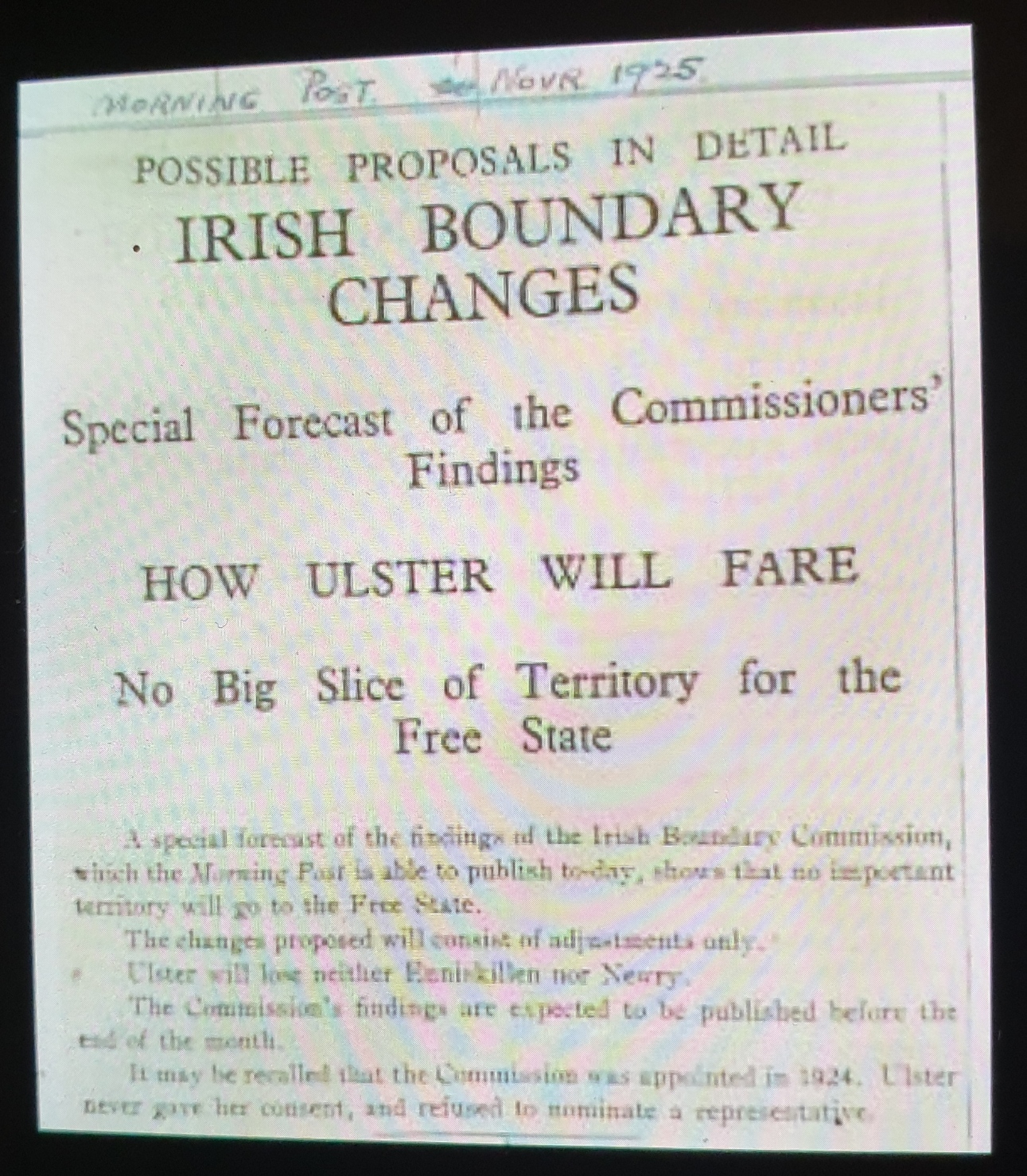
On the 15th November 1923 - 100 years ago on this date - Westminster held a 'Partition Meeting/Boundary Commission' discussion between themselves in London.
The attendance would have included their 'top people' in regards to 'Irish affairs' and it's safe to assume that Lionel Curtis, James Masterton-Smith, John Anderson, Mark Sturgis, Tomas Jones, G G Whiskard, Norman Loughnane and Stephen Tallents would have been present, as those people had all, in one way or another, 'directed Irish affairs' for Westminster over at least the previous three or four years.
A recommendation for 'progess' (consisting of about thirty pages!) was the outcome of their one-way chit-chat and it advised Westminster to change 'Article 12', stating that economic and geographic conditions should not now 'be read as a qualification to the wishes of the inhabitants'.
That meeting also advised Westminster that "...it is difficult to see an award (ie 'granting' extra land to Leinster House) which would not precipitate war between the North and South..", and suggested employing "..the large force of Specials equipped and armed by the British taxpayer (to) resist the findings of the Boundary Commission..."
Also included in their report was advice in regards to the actual composition of the Commission - that Westminster should have the final say on the Chairperson of that entity and that this should be done with a covernote stating that, in doing so, the British were proving just how serious they were in dealing with the issue - and, once the new appointment had been made, the new Chairperson would have to be allowed "...time to study the whole subject until he had fully grasped the issues at stake.."
An obvious delaying tactic and, considering that the 'Boundary Commission' was allowed to run until late 1925, it is obvious that its members from the Free State preferred the delaying tactic rather than having to report back home that the British had not only 'pulled a quick one' but weren't going to concede an inch of Irish territory.
The final (1925) report of that Commission was not made public until January 1968 ; it was suppressed (for 43 years) to aid the Stormont and Leinster House administrations to 'settle themselves' into their 'seats of power'.
And that whole saga remains to this day an open wound ; one of many caused by Westminster in Ireland.
============================
1973 :
IRA CAPTAIN MICHAEL McVERRY.
On the 15th November, 1973, IRA Captain Michael McVerry was killed during an attack on the 'Royal Ulster Constabulary' (RUC) barracks in Keady, County Armagh.
He was shot dead by British soldiers after placing a 100 lb bomb against the gable wall of the barracks during the IRA attack.
1st December 1949 – 15th November 1973.
RIP.
Thanks for the visit, and for reading!
Sharon and the team.
On Wednesday, 15th November 2023, we'll be putting up a five-piece post which - magically! - will turn into a seven-parter right in front of your lil' curious eyes...!
Among the pieces we'll be writing about are the following -
"Vengeance may be slow, but it’s sure...not a tooth for a tooth, but 50 to 1.." - a warning published by a pro-British armed gang in Ireland in the 1920's...
From 1955 - "There will be many whom history will judge harshly for their sin of omission..."
From 2002 - A few years ago, reliance on therapists and pills would have been regarded by Irish people as among the worst kind of excesses typifying American society ; now we have abandoned any sense that it is normal to feel negative emotions...
From 1998 - 'Irish republicanism has outlasted the British Empire, thanks to determined people like Pearse. Ireland was Britain's first colonial possession to challenge its power this century and, since then, Britain has constantly retreated...' (if so, it's due to the fact that the 'soup-takers' are doing the job for her.)
From 1922 - this man was involved in the financing of the Republican Movement but the Staters eventually got to him ; he spent a few years in State exile before, unfortunately, throwing his lot in with the same people that had exiled him...
Thanks for the visit, and for reading : hope to see ye back here on Wednesday, 15th November 2023!
Sharon and the team.
ON THIS DATE (8TH NOVEMBER) 28 YEARS AGO - DEATH OF A 'GUN-RUNNER'.
Neil T. Blaney (pictured), born 29th October 1922, died 8th November 1995 : 28 years ago on this date.
On November 10th 1966, when Sean Lemass resigned as Free State Taoiseach and leader of Fianna Fail, George Colley and Charles J.Haughey made known their desire for that position.
Neil Blaney entered on the nomination of another Fianna Fail Minister, Kevin Boland, but Haughey and Blaney withdrew when Sean Lemass nominated Jack Lynch. George Colley stayed in the contest and was defeated by 53 votes to 19 ; the Colley-Haughey power struggle began to develop, but all concerned (George Colley, Haughey, Boland, Neil Blaney and Jack Lynch) continued to cooperate with each other within the confines of the Fianna Fail 'TACA' group.
Neil Blaney was interested in the workings and objectives of the 'Civil Rights Association' in the Six Counties but let it be known that he didn't consider them to be hardline enough and tried to steer Fianna Fail away from having too much to do with them, a position which some seen as a challenge to Free State Taoiseach Jack Lynch, and more so with each speech Blaney made in which he verbally attacked a politician favoured by Lynch, Six County (British) 'Premier', Captain Terence O'Neill (who was also under attack by Ian Paisley).
Blaney actually advised nationalists in the Six Counties not to support 'Premier' O'Neill.
However, for the sake of party unity (a State-wide general election was due in June 1969), Neil Blaney softened his tone in public but tension remained high between him, George Colley and Haughey, although Jack Lynch tried to avoid taking sides.
Seamus Brady, a Fianna Fail 'spin doctor' and a linkman between Blaney and the media of that time, was a well-respected Fianna Fail activist in the Dublin North-East area and was friendly with Blaney, who maintained his contacts in the Six Counties even though the Fianna Fail party itself, officially, did not bother to keep in touch too much with the few remaining contacts it had in the North, a position it regretted finding itself in as the Six County area was in open turmoil.
Jack Lynch (pictured) made a speech on television in which he stated - "The Stormont Government is evidently no longer in control of the situation...the Government of Ireland (sic) has requested the British Government to apply to the United Nations for urgent dispatch of a peace-keeping force to the Six Counties...many injured do not wish to be treated in Six County hospitals, so Irish Army (sic) authorities have been instructed to establish field hospitals in Donegal and other points on the border.." and the State Minister for External Affairs, Patrick Hillery, flew to London (where he was told to mind his own business) before flying off to America and the UN, where he was to raise the Six County issue at the Security Council.
Leinster House decided that money would have to be provided to deal with 'distress' in the Six Counties and wanted any such funds spent in a way which would win friends and influence people for the Fianna Fail Government : £100,000 from State exchequer funds was agreed and a special sub-committee of the State Cabinet was appointed to deal with the whole Northern 'problem'; elected to that sub-comittee were Padraig Faulkner, Joe Brennan, Neil Blaney - their constituencies were on the border - and Charles J.Haughey, who was (FS) Minister for Finance and had strong Northern connections, his father having come South to join the Free State Army in the 1920's.
The objectives of that 'Northern sub-committee' were outlined by Charles Haughey at the 'Arms Trial'-
"We were given instructions that we should develop the maximum possible contacts with persons inside the Six Counties and try to inform ourselves as much as possible on events, political and other developments - within the Six County area."
This 'Northern Sub-Committee' made contact with the Belfast IRA, with Saor Éire elements through the Citizens Committee located in a house in Kildare Street in Dublin (now demolished) the use of which was made available by the New Ireland Assurance Company, and contact was also made with Cathal Goulding, the IRA Chief Of Staff, with the objective of using every possible contact to influence decision making in the Northern nationalist community.
Leinster House was not prepared to be 'compromised' by the decisions taken in either the Civil Rights Association or the IRA. Neil Blaney's friend, Seamus Brady, was appointed (on the 15th August 1969) by Haughey to the 'Propaganda Corps' attached to the State sub-committee and he was sent into the Six Counties and, later on that month, gave a report to Jack Lynch which concentrated on the strength of the IRA in the area.
Seamus Brady had produced a booklet entitled 'Terror in Northern Ireland' (sic) for the Central Citizens Defence Committee (CCDC) in Belfast - he had been chosen to infiltrate the CCDC and this publication launched him nicely into his work.
The full costs of producing the booklet were paid by the Leinster House-established 'Information Bureau', and a jointly-written booklet by Seamus Brady and local Civil Rights activist Aidan Corrigan was produced, entitled - 'Eye Witness in Northern Ireland' (sic) ; this too was financed by the 'Information Bureau' and was printed - 5,000 copies - at the Cityview Press in Dublin despite its imprint stating that it was 'Published and printed in the Province of Ulster'.
The booklet was launched at a press conference in Dublin's Jury's Hotel on October 5th, 1969 (the same month in which Neil Blaney, speaking at celebrations for his 21st year in Leinster House, said - "..the Fianna Fail party has never taken a decision to rule out the use of force if the circumstances in the Six Counties so demand .."), at an event organised by Brady who, along with Neil Blaney (the then State Minister for Agriculture) had had a meeting with an IRA staff officer, in Dublin (in Blaney's office in 'Government Buildings'!), the previous month (ie September 1969).
Neil Blaney's political career also encompassed ministerial sackings, the 'Arms Trial', an inquiry by the State 'Committee of Public Accounts' into exactly how a sum of money* (£100,000) was spent and power struggles in the Fianna Fail party, and we hope our few paragraphs, above, can give a flavour of Neil Blaney's involvement re the occupied six counties.
(*For instance - on the 14th November 1969, a bank account was opened [by a person operating on behalf of Charles J. Haughey, State Minister for Finance at that time] in a Baggot Street, Dublin, bank, in the name of 'Ann O'Brien', and the money in same was used mainly for the running and promotion of a newspaper called 'Voice of The North', which was based in an office in Monaghan and which pushed the views of Fianna Fail on 'the Northern Question').
The 'Gun Runner' died on the 8th of November, 1995, in his 74th year, 28 years ago on this date.
'FIRST THINGS FIRST...'
From 'The United Irishman' newspaper, April 1955.
For we are convinced that both Mr. de Valera and Mr. Costello are quite well aware that before the Irish people should even consider giving guarantees of this kind they must first get the British occupation forces out of our country.
That is the primary consideration.
To even suggest any kind of agreement or guarantee while those forces remain in Ireland is in effect a betrayal of our national rights and must be repudiated.
(END of 'First Things First' : NEXT - 'Radio Éireann', from the same source.)
ON THIS DATE (8TH NOVEMBER) 102 YEARS AGO : FINAL DRAFT PREPARED OF BRITISH GOVERNMENT'S 'SECRET CIRCULAR' RE EMPLOYING ARMED ANTI-IRISH MILITIA IN IRELAND.
In Ireland, in 1920, the British administration established a large paramilitary force of anti-Irish unionists and declared that that grouping should be known as the 'Special Constabulary', comprising approximately 40,000 members in total.
It was a three-tiered grouping : group 'A', numbering around 2,000 men, would be paid full time, armed and mobile, operating much as the hated RIC did, group 'B' would have about 20,000 armed members, part-time, uniformed but unpaid and group 'C' would consist of about 15,000 'reservists', to be called 'for duty' in times of "extreme emergency" only.
A sizeable number of those who joined the new 'Specials' were from the ranks of the 'Ulster Volunteer Force' (UVF), a pro-British paramilitary outfit which, even after its numbers had been so diminished, managed to retain a membership of approximately 20,000 (armed) men, with a British Colonel, Frederick Hugh Crawford (pictured), in charge of it.
The British government was interested in using Crawford's UVF to further secure its military and political position in Ireland - this was then only five years after the 1916 Rising and both sides in Ireland were aware that the fight was not yet over - and Westminster let it be known that it was in favour of 'utilising' those armed men as part of its military effort to 'secure Ireland for the Empire', a scenario which the RIC, in turn, 'let it be known' that it was in favour of.
On the 8th November 1921 - 102 years ago on this date - the Divisional Commissioner of the RIC in the Six Counties, a Colonel 'Sir' Charles Wickham, put the finishing touches to a 'secret' circular which he was sending to other RIC bosses in the Six Counties -
"Owing to the number of reports which have been received as to the growth of unauthorised loyalist defence forces, the (British) Government have under consideration the desirability of obtaining the services of the best elements of these organisations. They have decided that the scheme most likely to meet the situation would be to enroll all who volunteer and are considered suitable into Class 'C' (of the 'Special Constabulary') and to form them into regular military units.
There is no necessity to produce the maximum possible number of units ; what is required is to ensure that every unit recommended for formation can be constituted from a reliable section of the population."
Note how the supposed 'neutral' RIC described the UVF paramilitary organisation as a "loyalist defence force" and as "a reliable section of the population" - the British were then, and still are today, 'in charge' of those loyalist paramilitary organisations, and use them to carry-out 'jobs' which Westminster wants done, but not 'officially'. Also, about two weeks after 'Sir' Wickham wrote and dispatched his 'secret' circular, a copy of it found its way into the hands of Michael Collins who, on 23rd November 1921 - while attending Treaty negotiations with the British in London - produced it to the startled British team and told them it may very well signal the end of the 'negotiations'.
Westminster called-in its top man in the Six Counties, 'Sir' James Craig, the Stormont 'Prime Minister', and told him that the 'secret' circular would have to be withdrawn ; Craig then instructed his 'Minister for Home Affairs', a Mr. Richard Dawson Bates (a UVF man, pictured) to withdraw the circular.
However, by way of a 'two-fingered salute' to his political masters in Westminster, when he returned to Belfast, Craig increased the number of 'A Specials' by 700 men, and the 'B Specials' by 5,000 men - if they couldn't 'hire' "from a reliable section of the population" in one way, then they'd find another way to do it!
Incidentally, Colonel 'Sir' Charles Wickham had an interesting background - a British 'Establishment' man through and through,'Sir' Charles had an interesting background - he spent 23 years as the man in charge of the 'B' Specials, and was also head of the RUC for a period.
He was born in 1879, in England, and was educated at Harrow and Sandhurst, where he no doubt picked-up his 'stiff upper lip'. At 20 years young he joined the British Army and served in the Boer War and in the 'First World War'. Between the years 1918 and 1920 he served as a Lieutenant-Colonel with the British military 'mission' in the Russian Civil War, following which (at 41 years young) he was the 'Divisional Commissioner for Ulster' in the RIC, from 1920 to 1922.
It was at that time in his 'career' that he helped to establish the Ulster Special Constabulary.
At 43 years young he was appointed as the Inspector-General of the RUC, a position he held until 1945 when, at 66 years of age, his paymasters in Westminster formed the opinion that the 'johnnies' in the 'colonies' would benefit from a spot of 'Wickham-ism'. In 1945, British Lieutenant-Colonel 'Sir' Charles Wickham was 66 years of age ; but no rest for the wicked.
He was sent to Greece to serve as the 'Head of British Police and Prisons Mission', where he 'crossed swords' with the ELAS guerilla group. He remained in that position until 1952(when he was 73 years of age).
The man died in 1972, at the age of 93, and had a longer life than most of those he came into contact with.
IRELAND ON THE COUCH...
A Psychiatrist Writes.
'Magill' commissioned Professor Patricia Casey to compile an assessment of Irish society at what may emerge as the end of a period of unprecedented growth and change.
This is her report.
From 'Magill Magazine' Annual, 2002.
The priest as mentor has also been relegated due to a weakening of the influence of the Church.
In such a society, it is hardly surprising that those with problems are increasingly looking for help to counsellors but, even more worrying, is the fact that even those whose distress might be considered appropriate to the circumstances in which they find themselves are also attending counsellors ; moreover, they are also flocking to psychiatrists in huge numbers.
As personal development courses flourish and counsellors advertise in supermarkets, far from being considered an exercise in narcissism brought about by our affluence, it is regarded as a badge of honour to scrutinise one's past and explore one's feelings.
Not only are talking therapies available in abundance, but people are taking medication for nervous disorders in enormous amounts, costing the medical card system £52.66 million last year as compared to £19.1 million in 1995...
(MORE LATER.)
ON THIS DATE (8TH NOVEMBER) 232 YEARS AGO : DUBLIN REPUBLICANS PREPARE TO ESTABLISH A BRANCH OF THE 'UNITED IRISHMEN'.

NORTHERN ARMY OF AVENGERS.
Head Quarters.
The first year of Irish Liberty.
GENERAL, JN TANDY,
to his COUNTRYMEN.
UNITED IRISHMEN,
What do I hear? The British Government are dared to speak of concessions! Would you accept of them?
Can you think of entering into a treaty with a British Minister? A Minister too, who has left you at the mercy of an English soldiery, who has laid your cities waste, and massacred inhumanely your best Citizens . . . a Minister, the bane of society, and the scourge of mankind . . . behold, Irishmen . . . he holds in his hand the olive of peace; be aware, his other hand lies concealed armed with a poniard. NO, IRISHMEN, no . . . you shall not be the dupes of his base intrigues. Unable to subdue your courage, he attempts to seduce you, let his efforts be vain.
Horrid crimes have been perpetuated in your country. Your friends have fallen a sacrifice to their devotion for your cause. Their shadows are around you and call aloud for Vengeance.
It is your duty to avenge their death. It is your duty to strike on their blood-cemented thrones the murderers of your friends.
Listen to no proposals, IRISHMEN, wage a war of extermination against your oppressors, the war of Liberty against tyranny, and Liberty shall Triumph.
JN TANDY.'
It was on this date (8th November) in 1791 that James Napper Tandy put the final preparation into convening the inaugural meeting of the 'Dublin Society of United Irishmen'.
The meeting took place in the Eagle Tavern (now known as the 'Quaker [Friends] Meeting House', where the wall plaque, pictured above, is located) in Eustace Street in Dublin city centre.
The meeting was Chaired by Simon Butler (1757-1797, a barrister by profession, and brother of 'Lord' Mountgarret - family history here), with Tandy himself acting as Secretary, and the following resolutions were among those discussed and passed -
'That the weight of English influence in the government of this country is so great, as to require a cordial union among all the people of Ireland, to maintain that balance which is essential to the preservation of our liberties and the extension of our commerce...that the sole constitutional mode by which this influence can be opposed, is by a complete and radical reform of the representation of the people in Parliament... and that no reform is just which does not include every Irishman of every religious persuasion.'
The 'Dublin Society' held meetings on alternative Fridays, usually at the Music Hall in Fishamble Street in the city centre, with the objective of working to obtain social democratic reforms and independence from England and developed a strategy of spreading its ideals by means of leaflets, newspapers, ballads, 'catechisms' and travelling emissaries.
By 1797, the society as a whole had at least 100,000 members throughout Ireland whereas today, although smaller in number (!), the objective remains the same : 'independence from England'.
BEIR BUA...
The Thread of the Irish Republican Movement from The United Irishmen through to today.
Republicanism in history and today.
Published by the James Connolly/Tommy O'Neill Cumann, Republican Sinn Féin, The Liberties, Dublin.
August 1998.
('1169' comment - 'Beir Bua' translates as 'Grasp Victory' in the English language.)
The documents in this booklet are taken from periods of republican history in the 18th, 19th and 20th centuries.
Though these documents are from history, they cannot be safely locked away in an historical archive to be forgotten about. They are living history, all part of a story which has yet to be completed.
The story of Irish republicanism is of the struggle to 'break the connection with England, the never-failing source of all our political evils'.
Padraig Pearse drew upon the history of the United Irishmen and the Fenians to re-invigorate the Republican Movement and demonstrate its continuity with the struggle of previous generations. He honoured Ireland's dead by taking up the struggle again under the same banner that they stood under in their day. He consciously followed in their tradition... (MORE LATER.)
1919 :
In 1919 in Ireland, as Irish republican forces were defending themselves, their people and this country from imposed British political and military interference (an on-going struggle), the British paramilitary 'police force' in Ireland, the 'RIC', knew they were unable to 'contain the situation' and decided to regroup.
A 'Safety of Barracks' circular was distributed to all their 'section heads' in the country on the 8th November, decreeing that all such 'units' with less than six operatives should be closed immediately (...as they weren't able to 'defend themselves' successfully!) and the 'police men' effected by the policy change would be stationed in a different barracks, to ensure that they have more of their members present, should they be challenged by republicans.
That move led to the closure of smaller barracks - more than 430 of them - out of a total of 1,300 such 'police stations'. The IRA continued to defend themselves, their people and this country and also continued to 'close' hundreds more barracks in their own way...
===================
1920 :
On around the 8th November, 1920, an IRA Active Service Unit placed itself in an ambush position near Grange, in Limerick, waiting for two lorry loads of British soldiers who were due to pass that spot two days later (10th) ; Donnacha (Donnchadh) O'Hannigan (pictured, more info here) was in command of the rebels but the operation didn't go as intended -
"...we took up a position at the village of Grange on the Limerick-Brute road, expecting a convoy of enemy transport of which we had received
information that it was likely to pass that way.
After several hours waiting, the enemy approached, but in the opposite direction to that which we expected them. Unfortunately, a shot was fired prematurely and probably accidentally by one of our men, and this precipitated the fight, much to our disadvantage in the position we occupied.
The British were supported by an armoured car. I had a very poor knowledge of the district, and decided to withdraw.
We were hotly pursued by the enemy, but we returned their fire and retired in good order. We had one wounded (Volunteer Burke), but in the circumstances were unable to calculate the enemy casualties. I was subsequently informed that they had five wounded..."
After 'Truce and Treaty', Donnacha was neutral in the on-going conflict between the Republicans and the Free Staters.
===================
1920 :
A Flying Column attached to the Longford Brigade of the IRA, under the command of Sean MacEoin (who later joined the Free State Army) attacked an RIC post on the 8th November and reports suggest that three RIC members were killed, and one wounded.
===================
1920 :
On the 8th November (1920), a motorised RIC and Black and Tan gang stormed into the villags of Ardfert, in County Kerry, by two different routes.
They 'arrested' three men - Michael Brosnan (a Volunteer with the Castleisland Company IRA, 1st Battallion, Kerry No. 2 Brigade), John Cantillion and Maurice ('Mossy') McElligott - and placed them in their lorries, to be used as hostages in case they were to come under attack from the IRA. The two lorries then drove off, at speed, in the direction of the village of Rathoneen, where they carried out house raids.
After wrecking a few houses, they decided to drive back to Ardfert but, nearing their destination, they stopped and took their three hostages out of the lorries, and brought them into a field (which is now the Hazel Grove housing state). The 'police' and the Tans lined up and told the three hostages to make a run for it, but an RIC member whispered to Mossy McElligott that if he valued his life, he shouldn't move.
Michael Brosnan and John Cantillion ran for their lives, but only made it about fifty yards across the field before they were both shot dead. The pro-British 'peace keepers' then turned on Mossy and beat him until they thought he was dead. The RIC and their Tan colleagues then left the scene and went to the near-by pub, 'O' Sullivans' and demanded, and got, free drink from the owner.
Mossy McElligott lived to tell the tale.
===================
1921 :
During the 'Treaty of Surrender' negotiations (!) in the early 1920's, a British 'Civil Servant' named Thomas Jones, who had made it his business to be 'friendly' with Michael Collins and Arthur Griffith, approached both of those men, on the 8th November, 1921, and asked if he could speak to them about a possible solution that he, Mr Jones, had been thinking about.
Mr Jones asked both of them if they thought, perhaps, the formation of a small group, comprising members from the British and Irish sides, to discuss which areas of Ireland should be partitioned, would be a good idea...?
Michael Collins replied that he wouldn't be in favour of such a group because "it sacrificed unity entirely" (how right he has been, to date, regarding that issue - yet he went on to implement and enforce that same proposal!) but Arthur Griffith said he wasn't opposed to the idea, and Mr Jones told them that if anything should happen to his Prime Minister (David Lloyd George), then Mr Bonar Law could find himself in charge and he wouldn't be as favourable to the Irish in relation to the partition issue.
This put the wind up both men ('the devil you know' and all that) and so it was that the seed of a 'partition group' (the 'Boundary Commission') was planted but...it later transpired that David Lloyd George, the British PM, had instructed Mr Thomas Jones to approach the two Irish men in the manner he did, to innocently (!) propose the outcome that he, the PM, wanted ie 'I'm Thomas Jones, this is my idea, lads, just shootin' the breeze, but what do ye think...?'!
To add insult to injury, later that same day (8th November 1921) a Mr Lionel Curtis, the 'Secretary to the British Delegation', called a meeting of his own people and announced a 'breakthrough' - that of the soon-to-be-announced formation of a 'Boundary Commission'!
(We have mentioned (!) this con job before...)
===================
1922 :
On the 8th November, 1922, an IRA Unit, under the command of Bill Roe, attacked the Free Staters in Wellington Barracks (pictured), on the South Circular Road, in Dublin.
That barracks was a holding centre for IRA POW's and was also used by the Staters as the base for their 'Army Intelligence' unit.
IRA men were positioned on both sides of the near-by Grand Canal, armed with a Thompson submachine gun, revolvers and rifles ; one Free State soldier, Thomas Murphy, was killed in the gun battle, and another, James Finlay, was wounded and died later. Altogether, about twenty Staters were wounded, as were two civilians, and a third civilian, named Keane, was killed in the crossfire.
In a revenge attack, an IRA man, James Spain, was captured on Donore Avenue, in Dublin, by the Staters, and shot dead by a Free State soldier named Christy Clarke, following which Clarke and his comrades returned to Wellington Barracks and 'punished' the IRA prisoners they were holding there.
===================
1922 :
During an IRA attack on Free State Army forces on the 8th November 1922, in Milltown Village in County Kerry (pictured), a mother and her son were wounded in the crossfire. The son, Jeremiah McKenna, died four days later from his wounds.
Thanks for the visit, and for reading!
Sharon and the team.







!['Quaker [Friends] Meeting House'](https://localstudies.files.wordpress.com/2013/01/eustace-street-dublin-meeting-house-erected-1694-rebuilt-c.jpg)
