ON THIS DATE (17TH JANUARY) 52 YEARS AGO - POW DEEP DIVE...!
52 years ago on this date (17th January 1972), seven IRA prisoners escaped from an 'escape proof' British prison ship, which was anchored in Irish waters : the ship had three decks, the top one of which was sometimes used as an 'exercise yard' for a few hours each day by the republican POW's, with the other two 'converted' into living quarters.
Approximately 850 people were present on the ship at any one time, consisting of around 700 British military personnel and 150 prisoners, including Provisional and Official IRA members and some others that were not involved with either group.
James Emerson Bryson, Tommy Tolan, Thomas Kane, Tommy Gorman, Peter Rodgers, Martin Taylor and Sean Convery, a group of Irish republicans that became known as 'The Magnificent Seven' because of the nature of their escape from the Maidstone prison ship (pictured) on January 17th, 1972, were determined that their 'stay' on the ship would be a short one.
Of the 226 men detained following the introduction of internment in August 1971, 124 were initially held in Crumlin Road Jail while the remainder were held on the Maidstone, a prison ship moored at the coalwharf in Belfast docks. The prison ship, used as an emergency billet for British troops who arrived in 1969, was totally unsuitable as a prison - it was cramped, stuffy and overcrowded, with the 'lock-up' section located at the stern below the deck, which was used twice a day for exercise.
On January 16th, 1972 , fifty men were transferred from the ship to the new camp at Magilligan : this sudden move spurred on some of the internees who were planning to escape.
One of the group had spotted a seal slip through a gap in the barbed-wire draped around the ship and it was decided that if the seal could come in, then they could go out!
The men used black boot polish to camouflage themselves and smeared each other in butter, to keep out the cold. They had already cut through a bar in a porthole which they now slipped through, and clambered down the Maidstone's steel hawser and entered the water.
Several of them were badly cut by the barbed-wire, but they all managed to get through it. In single file, they swam the 400 yards through the ice-cold floodlit water to the shore : it took them twenty minutes, as some of the men could not swim and had to be helped by the others. On the bank, Volunteers of the Andersonstown Unit of the IRA's Belfast Brigade were waiting with four cars to transport the escapees to safety, but the escapees landed at the wrong spot, approximately 500 yards away.
The men realised their mistake and made their way to Queen's Road bus terminus where they commandeered a bus and drove across the city to the Markets area. During the journey, the bus was spotted by a British Army Land Rover which attempted to stop the vehicle ; however, the British soldiers backed-off when the bus entered the staunchly republican Markets district, which was then quickly surrounded by British reinforcements.
A search of the area was carried out by the British Army and RUC, but none of the escapees were found - the 'Magnificent Seven' were long gone to a different part of Belfast and, days later, gave a press conference in Dublin.
That 'deep dive' by Irish republican POW's took place on the 17th January 1972 - 52 years ago on this date.
'On April 4th, 1919, Michael Collins’s motion to Dáil Éireann to approve a £250,000 Dáil loan was approved.
Nothing was left to chance by the newly appointed minister of finance to ensure the success of the first Dáil loan and to fund the counter-state government that had been set up when the first Dáil met in January 1919.
Two million promotional leaflets and 500,000 copies of the prospectus were printed and distributed. More than 50,000 letters were sent to high-net-worth individuals. Full-page newspaper advertisements were budgeted, and €30,000 in today’s money was spent on a promotional film...' (From here.)
On the 17th January, 1920, Mr Collins and his Dáil Loan team, aware that interference by the British had effected the true potential of the 'Loan' to raise funds, issued a public circular announcing that the scheme had been extended until the 1st May 1920 and, on that same date (17th January 1920), the initiative was launched in America by Éamon de Valera, where about $5.5m was raised and just under £400,000 was raised in Ireland.
==========================
'SINN FÉIN NOTES...'
From 'The United Irishman' newspaper, April 1955.
CORK...
CUMANN BRIAN DIOLUN.
The activities of the Brian Dillon Cumann, Cork, augur well for the future of the organisation in the St Patrick's Parish area of the city.
The Cumann is also contemplating the formation of a Dramatic Group to promote amateur dramatics of a national and cultural background among its members and the organisation in general.
During the last few weeks the Cumann has had the pleasure to listen to two well-delivered lectures, one on John Mitchel, by Domhnall O Cathain, in which he dealt with the life of Mitchel and the part he played in the struggle for complete separation from England.
The other lecturer, Liam Early, gave a detailed and concise lecture on 'The Primary Objectives Of Sinn Féin', in which he traced the objectives of Sinn Féin since its inception up to the present day, and all members joined in the subsequent discussions.
Various and interesting motions have been forwarded to the next meeting of the Comhairle Ceanntair, covering a wide range of activities which include the forthcoming Local Government Elections, house-to-house collections, the Sinn Féin social and economic programme and the invitation of speakers from the Ard Comhairle to speak to the Cumann...
(MORE LATER.)
On the 17th January, 1921, the British Labour Party launched its campaign for 'Peace in Ireland' at a meeting in Manchester, which was just one such meeting in a series of about 500 overall, in various cities in England, Scotland and Wales.
One of the organisers, Arthur Greenwood, at the Manchester meeting, told the audience that "Manchester under German rule would be like Cork or Dublin under British rule today", but that level of support was absent from the higher level in British politics ; Llyod George jeered at the "Bolshevists and Sinn Féiners and faddists and cranks..." who were organising and attending those meetings.
However, within months of his jeer, Mr George himself was negotiating with those same "Bolshevists and Sinn Féiners and faddists and cranks..."!
==========================
During the on-going campaign against Westminster interference in Irish political affairs, the fort on Spike Island in County Cork was the largest British military run prison for republican prisoners and internees in the 'Martial Law' area.
During 1921‚ approximately 300 prisoners and 900 internees were imprisoned there and a headcount carried out by the British, on the 17th January, 1921, gave a figure of 1,478 internees altogether at that point in time.
==========================
On the 17th January, 1921, 25-year-old RIC member Robert Boyd ('Enlisted Number 708233'), from Banbridge, in County Down, was drinking a glass of stout in Margaret Moran's pub in Cappawhite, in County Tipperary.
The political atmosphere 'on the ground' was tense, as the death of Cork republican Terence James MacSwiney (Toirdhealbhach Mac Suibhne), a well-respected political and military activist, had occurred, at the hands of the British, on the 25th October 1920.
Four IRA Volunteers - P. English ('B' Company), J. Fitzpatrick ('C' Company) J. Ryan and O. Aherne (both from 'D' Company) entered the pub, approached the RIC man and shot him dead.
Mrs Moran's niece was hit in the leg by a ricochet.
Later that day, the RIC and their colleagues in the British Army burned down two business premises in Cappawhite.
Also on that same date (17th January 1921), an RIC car coming from the direction of Sixmilebridge was ambushed at Clonloun Cross, in County Clare.
==========================
British Army Private Alfred John Blitchford Williams (aged 18, 'Enlistment Number' 5373728) of the First Battalion, Oxfordshire and Buckinghamshire Light Infantry Regiment, based at Ballyvonare Military Camp, Buttevant, County Cork, died as the result of a self-inflicted gunshot wound to the abdomen, on the 17th January, 1921, while he was said to be "temporarily insane".
He is buried in St John's Churchyard at Buttevant.
He was born in 1903 in Cornwall, England, and died, with no family member present, in a foreign country, as a teenager, in 1921. Sad.
==========================
ON THIS DATE (17TH JANUARY) 193 YEARS AGO : 'SLAP-DOWN' SCRIPT FOR IRISH 'PET REBEL' APPROVED.
Daniel O'Connell ('The Liberator', pictured) never claimed to be an Irish republican despite involving himself in an issue which, then as now, required a republican solution in order to obtain a just resolution.
Although he campaigned on behalf of those who suffered as a result of injustices inflicted by Westminster, he made it clear that it was his desire that Ireland should remain as a unit governed by the British 'Monarchy' - saying, if you like - 'stay if you want, just treat us better'.
He had publicly and repeatedly vowed to work within 'the law' - British 'law'.
The only force to be used, he stated, was "moral force", but even this was too much of a demand for Westminster - 'Sir' Robert Peel (the then British Prime Minister) replied that to 'grant' O'Connell his way "would not merely mean the repeal of an Act of (British) Parliament, but dismemberment of a great Empire. Deprecating as I do all war but above all, civil war, yet there is no alternative which I do not think preferable to the dismemberment of Empire.." In other words - 'thus far, O'Connell, but no further'.
His subservience to British 'law' could have been used against him at any time and, in December 1830, that's what happened : he was one of a group of 'troublemakers' that were rounded-up for questioning in connection with meetings/assemblage of a type which had been forbidden by the British 'Lord Lieutenant of Ireland' - Westminster was 'jittery' regarding its political position in Ireland due, in the main, to four issues : corn (availability and price of), currency devaluations, the overall banking system and the 'catholic problem' ; this period in our history witnessed the beginning of 'an Cogadh na nDeachúna' - the 'Tithe War', and also heralded in catholic unrest in Belgium and Poland.
Westminster would not allow such actions to gather pace here, if it could help it, and so it was that, on the 17th January, 1831, the final 'Charge Sheet' against Mr O'Connell was presented to, and approved by, British 'legal eagles'.
The following day (18th January 1831), Daniel O'Connell was charged on 31 counts (14 of which were for 'violating the Suppression Act of 10 George IV 1829', to which O'Connell pleaded guilty) including 'conspiracy', and was arrested, fined 2,000 pounds and imprisoned for one year.
He served three months, mostly because the '1829 Acts' expired in April that year and those imprisoned under it were released by default. Westminster had 'boxed clever' - it had been seen to 'punish offenders' but not to the extent where the offender would become radicalised due to the severity of the punishment, a trick it performs to this day on those Irish people who consider themself to be 'radicals'!
In a report to Winston Churchill's 'Provisional Government of Ireland Committee' regarding the 'Ulster Special Constabulary', presented on the 17th January, 1922, it was recommended to stop funding the 'Specials' "at the earliest date that is legal or possible".
That advice wasn't given because Westminster was suddenly concerned that the vicious actions of their 'Special' forces in Ireland was bringing them into further disrepute, but rather because the 'buck' could now be passed.
On the 9th November, 1921, responsibility for 'security measures' (!) in the Occupied Six Counties had been transferred from Westminster to the puppet/Stormont regime in Belfast, and they were being told that it was now also their responsibility to finance their own 'security'!
'Mammy Bear' was hacking at the apron strings, and is still hacking at them...
==========================
On the 17th January, 1922, British Army General 'Sir' Cecil Frederick Nevil Macready (pictured), 1st Baronet, GCMG, KCB, PC ETC ETC (!) issued a 'Special Order of the Day' to all under his command -
"While I feel there is no desire on the part of the army to rake up past animosities or bitterness, you have been called upon to perform a duty in many respects repugnant to our traditions, and devoid of all the glamour of war, though in many ways entailing greater strain and greater individual danger...the Government having decided that the time has arrived to commence withdrawing troops from Ireland...you, officers and men, have accomplished the most difficult task that any soldier can be called upon to undertake and you have emerged with your discipline unshaken and your conduct in the eyes of all fair-minded men blameless.
When history is written you will find that by your pluck, vigilance and discipline, you have contributed no inconsiderable share towards what we hope may prove eventually to be the settled peace and prosperity of Ireland..."
The arrogance of the man, and of that which he represented ; his upper lip was so stiff that it evidently covered his eyes and his ears.
==========================
IRELAND ON THE COUCH...
A Psychiatrist Writes.
'Magill' commissioned Professor Patricia Casey to compile an assessment of Irish society at what may emerge as the end of a period of unprecedented growth and change.
This is her report.
From 'Magill Magazine' Annual, 2002.
Stating that life is sacred from conception until natural death will stimulate chants of "hypocrisy" or "misogyny", as it recently did in Dail Éireann (sic).
Comments by Cardinal Connell about the theological prowess of one of his Church of Ireland colleagues reported in a book led to exhaustive media coverage, and comments in the same book by a senator - an icon of liberal Ireland - that the Pope was "an instrument for evil" received scarcely a mention from our national broadcaster, nor from the 'paper of record' (The Irish Times), even though his view could be interpreted as insulting at best and possibly sectarian.
So in modern Ireland, certain issues are deemed out of bounds for public discussion by our politically correct elite, and those who attempt to raise them are branded, often, as fundamentalists...
(MORE LATER.)
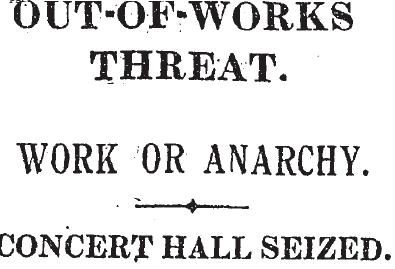
ON THIS DATE (17TH JANUARY) 102 YEARS AGO : DUBLIN UNEMPLOYED GROUP PREPARE TO OCCUPY LANDMARK BUILDING.
On the 17th January, 1922, the Dublin-based 'Council of Unemployed' held a meeting to finalise their protest to highlight their grievances and the lack of address by the 'authorities' to same :
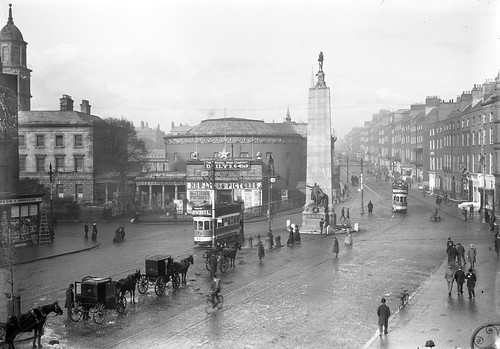
'On January 18th 1922, a group of unemployed Dublin workers seized the concert hall of the Rotunda. 'The Irish Times' of the following day noted that '..the unemployed in Dublin have seized the concert room at the Rotunda, and they declare that they will hold that part of the building until they are removed, as a protest against the apathy of the authorities...a 'garrison', divided into 'companies', each with its 'officers', has been formed, and from one of the windows the red flag flies..'
Liam O'Flaherty, as chairman of the 'Council of Unemployed', spoke to the paper about the refusal of the men to leave the premises, stating that no physical resistance would be put up against the police and that the protest was a peaceful one, yet they intended to stay where they were -"If we were taken to court, we would not recognise the court, because the Government that does not redress our grievances is not worth recognising.." O'Flaherty told the Times...' (more here.)
Rather than 'tackle' (occupy, in this case) symptoms of the disease (ie the Rotunda Hall and other 'Establishment' venues), the actual disease itself should be 'tackled', providing those doing so have no apparent embarrassing baggage.
ON THIS DATE (17TH JANUARY) 90 YEARS AGO : LAST FULL DAY ON EARTH FOR AN IRISH NATIONALIST LEADER.
In October of 1920, a Mr. John Robert Clynes of the British Labour Party voiced his concern, in Westminster, that the British Government were "..arming the Orangemen (to) police their Catholic neighbours..." in the Six County 'State', while Joe Devlin ('United Irish League' - UIL) [pictured] pointed out that 300 of the 'Special Constables' from the Lisburn area had already "resigned in protest" because their "fellow Constables" would not stop looting their (Catholic) neighbours!
Mr. Devlin stated - "The Protestants are to be armed. Their pogrom is to be made less difficult. Instead of paving stones and sticks they are to be given rifles."
Joe Devlin led a busy life - a barman and journalist at the start of his working life, he was elected as a 'Home Rule MP' (British Parliament) for North Kilkenny in 1902, at 31 years young, and held his seat until 1906, when he was elected again, this time for the West Belfast area.
He was that area's representative in Westminster until 1922 ; he acted as General Secretary for the 'United Irish League' (UIL)/Home Rule Party', from 1904 to 1920, and was also involved with the 'Ancient Order of Hibernians' when, at 34 years of age, he served as the 'National President' of that organisation, a position he held for 29 years (!), during which time he forged links between the 'AOH' and the 'United Irish League'.
He first took a seat in Stormont in 1921 (at 50 years of age, and stayed there until 1934) ; in 1928 he founded, and chaired, the 'National League of the North'. Incidentally, he was not related to Bernadette Devlin or Paddy Devlin.
The 'Irish News' newspaper wrote the following piece the day after Joe Devlin died -
"It is with feelings of the most profound sorrow that we record the death of Mr Joseph Devlin, MP...his own people, like many others, were driven from the country by the conditions of the times into the growing city of Belfast, and lived in humble circumstances in the West Division. A little household typical of thousands where life was a daily struggle to avert poverty, and where the youngest were expected to do their share, was the home of his early years...like the majority of the Catholic youth of Belfast at that period, he left school early to take his part in the battle of life...Speaking of him, Mr John Redmond M.P., said: "Mr Devlin's career has been a proud one for Ireland. It has been more than that – it has been a hopeful one for Ireland. Few public careers in the last century have been so rapid as the career of Mr Devlin. He today holds a foremost position in the public life of our country, and if I were asked to explain the reason, in my opinion, for the rapidity and success of his career, I would say that its success and rapidity have been due to the combination of several great qualities – superb debating power and dauntless courage, combined with a cautious mind and a cool judgement ; transparent honesty and enthusiasm combined with an absolutely untiring industry; perfect loyalty to his leader for the time being, to his comrades, and to his Party – combined, let me say, with a modest and lovable disposition...".
At the General Election of 1906 Mr Devlin was elected by a majority of 16...there was an indescribable outburst of enthusiasm when the figures were announced. Angered by the rout of the Tory, a mob of Unionists, who had been expecting the defeat of Mr Devlin and had come to the Courthouse on the Crumlin Road, where the votes were counted, with drums, bands and banners to celebrate the event, gave full expression in the usual manner to their chagrin.
As Mr Devlin MP was descending the steps of the Courthouse, surrounded by his friends, a police inspector advised him not to leave that way. Mr Devlin's response was characteristic. "I am not going to sneak out by the back way." He then proceeded down the steps in face of the mob, and one of the police, realising his undaunted courage, shouted for fair play for Mr Devlin. The West was truly awake that night ; it was Belfast's night of jubilation, in which old and young came out to expression to the joy they felt at the triumph of their fellow citizen – a man who later was destined to plead their cause all over the civilised world.
The historic division that night was ablaze with bonfires and illuminations, and the dawn had broken before the people retired to rest..."
Joe Devlin died young, at 63 years of age, on Thursday, the 18th January 1934 - 90 years ago tomorrow.
BEIR BUA...
The Thread of the Irish Republican Movement from The United Irishmen through to today.
Republicanism in history and today.
Published by the James Connolly/Tommy O'Neill Cumann, Republican Sinn Féin, The Liberties, Dublin.
August 1998.
('1169' comment - 'Beir Bua' translates as 'Grasp Victory' in the English language.)
'WHY WE WANT RECRUITS'.
(Padraic H. Pearse, May 1915.)
"We want recruits because we have undertaken a service which we believe to be of vital importance to our country, and because that service needs whatever there is of manly stuff in Ireland in order to do its effective rendering.
We want recruits because we have a standard to rally them to.
It is not a new standard raised for the first time by the men of a new generation. It is an old standard which has been borne by many generations of Irish men, which has gone into many battles, which has looked down upon much glory and upon much sorrow ; which has been a sign to be contradicted, but which shall yet shine as a star.
There is no other standard in the world so august as the standard we bear ; and it is the only standard which the men of Ireland may bear without abandoning their ancient allegiance. Individual Irishmen have sometimes fought under other standards : Ireland as a whole has never fought under any other.
We want recruits because we have a faith to give them and a hope with which to inspire them. They are a faith and a hope which have been handed down from generation to generation of Irish men and women unto this last..."
(MORE LATER.)
"it is merely a question of whether at some stage of the descent of Ireland into anarchy and chaos the British Government will step in. If Ireland is to be left to its own devices, it is an ugly sore and in the end may poison the whole body of the Empire..."
That quote is taken from a letter that its author, Charles Stewart Henry Vane-Tempest-Stewart, 7th Marquess of Londonderry (sic), KG, MVO, PC, PC ETC ETC (!) - 'Lord Londonderry' (pictured) - sent to Winston Churchill, on the 17th January, 1923.
If Westminster had only left Ireland "to its own devices", and not interfered here, politically and militarily as, indeed, it continues to do in six of our counties, we wouldn't be such "an ugly sore".
The so-called 'British Empire' claimed jurisdictional control over at least 56 countries, all of which it "poisoned" in one form or another.
Mr Charles Stewart Henry Vane-Tempest-Stewart died, at the age of 70, in 1949, in County Down, from a stroke. His body, like his mind and morality, was 'poisoned', you could say...
==========================
Thanks for the visit, and for reading.
Sharon and the team.
We won't be here next Wednesday [24th] or the following week, or the...!
Myself and the rest of the Girl Gang were Christmas-gifted an all-expenses paid holiday to Spain by our families [including a few bob spending money!] and we'll be heading over there within the next week, and staying until mid-February. The two lads said they'd keep the blog going but the three of us then decided that we'd all take a break and get back to business here, refreshed, sometime in February.
I'll still be on 'X' and Facebook, and sure I might even post a few pics of the five of us on the beach...!
So take care, y'all - off now to do some packing ; sun-cream oil, bikinis, sun hats, sunglasses...all the stuff you won't need, y'know...!
We're working on a 15-piece post for Wednesday, 17th January 2024 and, as we're only about halfway through it as I type, I won't delay ya (or meself!) too long.
Among the pieces we'll be covering is one particular inspiring occurrence from the 1970's about a deep dive (!) that Irish republican POW's entered into, so as not to seal (!) their fate...
From the 1950's - Cork republicans were up early (!) to study, hear and learn about these objectives...
From the 1830's in Ireland - an awkward bind for Westminster ; how do you appear to punish a well-known Irish political figure without actually 'properly' punishing him, and without being so severe in the punishment that you drive him to become a 'radical'...?
From 1922 - a group of men in Dublin put their plan in action to 'announce' themselves but perhaps showed their hand too much by announcing that no physical resistance would be offered if the 'authorities' objected...
In the early 1900's, this Irish politician was 'advised' by the pro-British 'police force' to vacate a particular building in Belfast by the back door, but refused the 'advice', which brought an unexpected response from the 'cops'...
There'll be at least another nine pieces from much the same time periods as above, all going on this blog on Wednesday, 17th January 2024.
Give us a shout on the 17th, if ya can - now, back to another century for me, to do a wee bit of investigating..!
Thanks for the visit, and for reading ; see ya Wednesday!
Sharon and the team.
ON THIS DATE (10TH JANUARY) 43 YEARS AGO - SERIOUSLY ILL FEMALE REPUBLICAN POW "RELEASED ON LICENCE".
In October 1980, protesting POW's in the H-Blocks of Long Kesh began a hunger strike for political status ; on the 1st December, 1980, they were joined by three republican women prisoners in Armagh Jail - Mairead Farrell, Mairead Nugent and Mary Doyle. These were the only three women weighing more than eight-and-a-half stone :
'One of the notable figures of the dirty protest, Pauline McLoughlin, was a 19-year-old from Derry when she was arrested and held on remand in Armagh before being sentenced in 1978 for complicity in the killing of a British soldier...as an initial member of the protest, Pauline lived in the unsanitary conditions from the first days and, because of a previously existing stomach condition, became increasingly ill as time went on.
After having lost all of her prison privileges as a member of the dirty protest, Pauline was suddenly unable to receive the packages of food which had kept her sustained and began to vomit continuously after every prison meal...between the poor food and the grotesque conditions she found herself living in, her weight quickly dropped from 9.5 stone to around 6 stone...on 18th March, a prison doctor cautioned that, should she not be given medical attention immediately, she would most likely die and she was subsequently declared unfit for punishment and sent to the hospital to recover (but) after an incomplete recovery, she was returned to Armagh where her condition worsened again, causing her to be sent back to the hospital; this was a pattern that would continue for multiple trips...
Upon hearing of Pauline’s condition, the public immediately began to protest the treatment of her poor health, which was blamed on her "voluntary" involvement in the dirty protest by prison officials and doctors. The activists group called the 'Women of Imperialism' issued a pamphlet advocating for Pauline's return to health and an improvement of prison conditions by juxtaposing a picture of a healthy Pauline, pre-arrest, with the following description of her condition : 'She landed in the hospital so dehydrated that eight bags of special fluid had to be drip fed into her to stop her heart [from] collapsing. Yet one week later Pauline was back in her cell in Armagh prison. Her condition was still undiagnosed and untreated. At the age of 23 her hair is grey, her teeth rotting and falling out (and) she has dizzy spells and blackouts if she tries to walk. Weighing just over 5 stone, she looks like the victim of a famine —too thin even to sit in one position for any length of time..'(from here).
In October 1980, the 'British Socialist Feminist Conference' (which was attended by 1,200 women) supported the demand for political status and pledged its aid to campaign for the release of Pauline McLoughlin from Armagh Jail.
The 'no wash' protest was halted as the hunger strikes began, putting Westminster under political pressure and, fearful of a Christmas bombing campaign, which hunger strike deaths could have sparked off, on December 18th, 1980, a 30-page document was released outlining proposals and assurances from the British Government that, step by step, the five demands - the right not to wear a prison uniform, the right not to do prison work, the right of free association with other prisoners and to organise educational and recreational pursuits, the right to one visit, one letter and one parcel per week and the full restoration of remission lost during the protest - would be met.
The hunger strike was called off and the fulfilment of promises was awaited. They were never fulfilled.
'Sentenced before 1976, McLaughlin qualified for special prisoner status, but was denied this. She originally joined the protest movement inside the Northern Irish prisons to gain this special status, but became ill and according to some sources, 'blackmailed by the prison doctor to end her action'..she suffered from stomach problems and was unable to digest food, which caused her to rapidly lose weight. Shuffled between prison hospital and Armagh, her condition was viewed as potentially fatal and there were calls by the anti-H-Block movement for her to be released on compassionate grounds. However the Thatcher government refused to do so, with Northern Ireland Secretary Humphrey Atkins claiming that her condition was "Not at present critical...while Miss McLaughlin's health does give cause for serious concern, it is considered in the light of all the advice available that there are insufficient grounds for taking the exceptional course of releasing her on licence from the indeterminate sentence and using the Royal Prerogative to remit the balance of the fixed terms.." (from here).
However, after a sustained campaign in Ireland and Britain, Pauline McLoughlin was released, on licence, on the 10th January, 1981 - 43 years ago on this date.
'SINN FÉIN NOTES...'
From 'The United Irishman' newspaper, April 1955.
CORK :
CUMANN BRIAN DIOLUN.
The activities of the Brian Dillon Cumann, Cork, augur well for the future of the organisation in the St Patrick's Parish area of the city.
Meetings are held weekly with full attendance of officers and members and, since its foundation last May, the Cumann has shown a remarkable increase in membership, having now over thirty active members.
The Cumann is publishing a booklet on 'The Life of Cathal Brugha' (mentioned here, page 59), and the objective of this publication is to raise funds to purchase a suitable premises for the Cumann in the Dillon's Cross area.
It is the aim of the committee to have the publication on sale before Easter, and to distribute it throughout the 32 Counties, England, Scotland and the USA, and they take this opportunity of appealing to all Cumann throughout the country to cooperate fully by selling as many copies as possible...
(MORE LATER.)
On the 10th January, 1919, the British 'Chief Secretary for Ireland', a Mr Edward Shortt (pictured) got his promotion to the position of British Home Secretary and was replaced by a Mr Ian Macpherson.
Mr Macpherson had very little time for Irish 'troublemakers' and, as such, felt at home and politically comfortable in the Cabinet in Westminster, which he shared with other anti-Irish luminaries like Lloyd George, Bonar Law, Walter Long and FE Smith, all of whom would have made their way on to one 'Irish Troublemakers' list or another...
Dublin-based Mr Walter Long was regarded by his superiors in Westminster as a particularly valuable 'asset' and was given the position of the 'First Lord of the Admiralty' ; apparently, the British Cabinet were of the opinion that Mr Long 'had his finger on the pulse' of Irish republicanism but in actual fact he 'deduced' his insider knowledge (!) from his close associations within the unionist/loyalist 'Big House' owners, and from friends of his wife, Dorothy (nee Boyle) : her father was the 'Ninth Earl of Cork'.
Still - Mr Long managed to trade that which he hadn't got for that which he desired, and was seen as 'successful' in some circles for being able to do so!
=================
IRELAND ON THE COUCH...
A Psychiatrist Writes.
'Magill' commissioned Professor Patricia Casey to compile an assessment of Irish society at what may emerge as the end of a period of unprecedented growth and change.
This is her report.
From 'Magill Magazine' Annual, 2002.
Modern Ireland has a number of icons and shibboleths that are untouchable.
So pointing out that we must mature and begin to examine the faults of the present, about which we can do something, rather than constantly focusing on the past over which we have no control, might lead to accusations of defending abuse.
Pointing out that marriage is better than single parenthood, that it may not be good for young people to drink alcohol, that the primary educators are parents and not the State or that, for women who wish it, staying at home with young children might be the ideal option etc is likely to provoke the vast right-wing conspiracy theorists into apoplexy.
Expressing the view that counselling does not cure all our ills or that pills cannot mend our lives will lead to charges of lack of compassion...
(MORE LATER.)
In early January, 1921, orders were issued from IRA HQ to all ASU's throughout the country to render their local infrastructure unusable to the enemy.
The 'Big House' had always been a target because those that lived in them were the 'gentry' who were, for the most part, predisposed towards the politics of Westminster rather than the Irish Republic, and those that were so either directly or indirectly assisted the invaders and, as such, must have known what to expect as a result.
Roads and bridges were now to be targeted as well, to hamper the movement of British forces : roads had trenches dug across them and bridges were destroyed.
Between the 9th and the 11th of January, 1921, in the Kildare area, for instance, bridges at Maynooth, Celbridge, Leixlip, Straffan, Kilcock, Allenwood and Rathangan were damaged by the local IRA and trenches were dug along the road from Rathangan to Edenderry and, in some districts, trees were felled across the road.
The British Army and other enemy forces then had to use secondary roads ('boreens') and small bridges which not only slowed them down but provided the rebels with cover from which to attack them.
=================
On the 10th January, 1921, eight Volunteers from the Dublin Brigade IRA ambushed the occupants of a British Army 'Touring Car' on Charlemont Bridge, in the Ranelagh area of Dublin.
At that time, most of the country was suffering under Westminster-imposed martial law, but Dublin had not yet been included in the 'lock down', so the 'dissidents' could still take to the streets to defend themselves.
The British Army vehicle was carrying two British Army officers and one of their wives when it came under sustained gunfire from the rebels and, although each round found its target and the vehicle was riddled with bullets, only one of the occupants was hit - and he walked away with slight wounds.
Incidentally, between that month (January 1921) and July that year, it was recorded that there was 1,000 casualties altogether, which included RIC members, British Army soldiers, IRA Volunteers and civilians.
=================
On the 10th January, 1921, in North Brunswick Street in Dublin City Centre, two British Army Auxiliaries were shot at and one of them fired his revolver in the general direction of where he believed the shots came from.
Two Dublin civilians were hit - a Mr James Farrell died from his wounds and a Mr Thomas Connolly, from Temple View, in Broadstone, was wounded but survived.
What was described at the time as "a semi-official" statement was issued which claimed, simply, that "Auxiliary police (sic) were fired upon and one of them replied with his revolver..".
=================
BEIR BUA...
The Thread of the Irish Republican Movement from The United Irishmen through to today.
Republicanism in history and today.
Published by the James Connolly/Tommy O'Neill Cumann, Republican Sinn Féin, The Liberties, Dublin.
August 1998.
('1169' comment - 'Beir Bua' translates as 'Grasp Victory' in the English language.)
'Fenian Proclamation 1867 :
Proclamation To The Irish People Of The World.
History bears testimony to the integrity of our sufferings, and we declare, in the face of our brethren, that we intend no war against the people of England.
Our war is against the aristocratic locusts, whether English or Irish, who have eaten the verdure of our fields, against the aristocratic leeches who drain alike our fields and theirs.
Republicans of the entire world, our cause is your cause. Our enemy is your enemy. Let your hearts be with us. As for you, workmen of England, it is not only your hearts we wish, but your arms.
Remember the starvation and degradation brought to your firesides by the oppression of labour. Remember the past, look well to the future, and avenge yourselves by giving liberty to your children in the coming struggle for human liberty.
Herewith we proclaim the Irish Republic.
THE PROVISIONAL GOVERNMENT.'
(MORE LATER.)
On the 10th January, 1922, at what was the Third Session of the Second Dáil – Day Fifteen – Mr Arthur Griffith was elected as the President of Dáil Éireann, and Mr Eoin MacNeill (he of the 'Countermanding Order' in 1916) moved a motion in what was still then the 32-County Dáil Éireann, seeking, in effect, recognition of the name 'Dáil Éireann' for the 26-County abomination (putting in place the groundwork for the Irish 'Free State', which was to be 'legally' formed on the 6th December 1922) to be based in Leinster House, Kildare Street, in Dublin, as per Westminster's instructions -
"That Dáil Eireann affirms that Ireland is a Sovereign Nation, deriving its sovereignty in all respects from the will of the people of Ireland ; that all the international relations of Ireland are governed on the part of Ireland by this sovereign status ; and that all facilities and accommodations accorded by Ireland to another state or country are subject to the right of the Irish Government to take care that the liberty and well-being of the people of Ireland are not endangered..."
Éamon de Valera, in reply, stated - "I regret this resolution has been brought forward. As Deputy MacNeill said he would withdraw it if it was controversial, I think, from one point of view, it should be withdrawn.
But the main idea can be served, perhaps, very much better by an amendment.
Our attitude is this : this resolution of the approval of the Treaty was simply a license to the Executive — the new Executive — that they might promote the setting up of a Provisional Government in accordance with the terms ; in other words, that we would not be actively hostile to the setting up of the Government, though we do not, and cannot, admit its right as the Government of this country until the Irish people have spoken..."
Mr de Valera and his supporters objected to Mr MacNeill's motion and to the probable promotion of Mr Griffith, as the latter was offering 'pledges to subvert the Republic on one hand and maintain it on the other' and, after further discussions, they walked out of the assembly.
As they were leaving, Mr Michael Collins shouted at them, declaring that they were "...deserters all, to the Irish nation in her hour of trial.." to which the Countess Markievicz shouted back that Mr Collins and his supporters were "...oath-breakers and cowards.." : Mr Collins called after them that they were all "...foreigners..americans..english.." which, in turn, drew a shouted response from the Countess that they were "Lloyd Georgeites".
It was after Mr de Valera, the Countess and their supporters had left, temporarily, that Mr Arthur Griffith was elected as the President of Dáil Éireann, Michael Collins as Minister for Finance, William Cosgrave as Minister for Local Government, Charles Gavin Duffy as Minister for Foreign Affairs, Kevin O'Higgins as Minister for Economic Affairs, Richard Mulcahy as Minister for Defence and EJ Duggan as Minister for Home Affairs.
The 'dissenters' then returned to the assembly and took their seats, in a tense atmosphere. For instance, when Robert Erskine Childers requested Arthur Griffith to clarify a point of policy, Mr Griffith shouted back that he "...would not reply to any damned Englishman in this Assembly.."
The split was enlarging.
The session ended, adjourned, until February 28th, 1922.
It should be noted that, in May 1926, Éamon de Valera and others (including the Countess Markievicz) decided to abandon Sinn Féin, and republicanism, and spawned the Leinster House 'Fianna Fáil' party.
=================
On the 10th January, 1922, some of the IRA leadership held a meeting to discuss the happenings in the Dáil.
Three GHQ members, six Divisional Commanders and the Officers Commanding of the two Dublin Brigades talked about what happened and were agreed that the IRA's allegiance to the Dáil was based on the (32-County) Republic being upheld and they that the decision of the Dáil to accept the Treaty means that, since the Dáil is no longer upholding the Republic, the IRA no longer owes it allegiance to that political institution.
The meeting was agreed that the IRA must return to being ruled and guided by its own (military) Executive, rather than any political body, and that a full meeting (Convention) of the IRA organisation must be held, and these instructions were put in writing, signed by Rory O'Connor, Liam Mellows, Sean Russell, James Donovan, Oscar Traynor, Liam Lynch and other IRA Commandants, and delivered to Richard (Risteárd) Mulcahy in Leinster House.
=================
The British Cabinet held one of its meetings, on the 10th January, 1922, to discuss establishing a 'Boundary Commission' in relation to how best (ie to suit themselves) to partition Ireland, as required in the 'Treaty of Surrender'.
And they talked, and talked, and...etc, as the actual Commission didn't hold its first 'official' meeting until late 1924 (...and was disbanded in late 1925)!
It was queried by those present if they should even recognise the body, or if they should just ignore it altogether but, as a then top British politician, Bonar Law (who was to become their Prime Minister in October that year) had received assurances that either their 'Lord' Clyde or 'Lord' Dunedin would be in an effective influential position on the Commission, and that their 'Sir' Edward Carson would be in charge of the entity, they agreed to be seen to co-operate with it.
Those at that meeting also agreed that "no immediate decision should be given" to the press or to the public. Or, indeed, to the Irish, as to do so would expose the hand of Jokers they were intending to play...
=================
On the 18th April, 1920, Volunteers from 'D' Company of the 4th Battalion, West Limerick Brigade IRA, Ballysteen, in County Limerick, raided the house of a local man, a Mr Peter Switzer, a farmer, who was known to have no time for the campaign to remove the British political and military presence from Ireland.
Mr Switzer got to one of his guns first and fired on the Volunteers, killing IRA Lieutenant Dan Neville.
The Officer Commanding of the West Limerick Brigade, Seán Finn, contacted IRA GHQ to notify them that they still intended to relieve Mr Switzer of his guns and to seek justice for the death of Lieutenant Neville but he was ordered by a superior Officer, Richard James Mulcahy (a republican-gamekeeper-turned-Free-State poacher) not to do so.
And there the matter rested.
Until, that is, September that year (1920) when, on his way to Mass, Mr Switzer was persuaded by the IRA to surrender two of his revolvers to them.
And there, once again, the matter rested. But it's a long road that has no turning...
Mr Switzer's encounters with the IRA had, it was believed locally, turned him from not only refusing to support the freedom struggle of his neighbours but to actually work against them in their struggle.
On the 10th January, 1922, as he was attending the funeral of one of his sisters in Castletown, in County Limerick, Mr Switzer was shot dead by the IRA.
Mr Richard James Mulcahy was not asked his opinion before or after the operation, as he had, by then, abandoned the freedom struggle himself and was wearing the military uniform of the Free State.
=================
John T. Prout (pictured) was born in 1880, in Dundrum, in County Tipperary, on the 25th October and, as a young man, emigrated to America, joined the army there and, at 36 years of age, took part in the 'First World War' as a soldier in the '69th Infantry Regiment', and soldiered for some months with the 'French Command'.
That was in 1916 and, naturally enough, the Rising back home in Ireland caught his attention.
He returned to Ireland at the end of 'WW1', joined the IRA and was put to work as a Training and Intelligence Officer for the Third Tipperary Brigade, based at Galtee Castle, in County Tipperary.
In 1922 he left Irish republicanism behind him and joined the Free State Army in the rank of 'Commandant General' in charge of the South-East of the new State, and was based in County Kilkenny, but there soon developed a sense of unease between him and some of his superiors in the Stater army ; a report from within his own ranks, in October 1922, stated - "Prout is too weak as well as too guilless to handle traiterous or semi-mutinous incompetents.."
On the 10th January, 1923, the West Waterford area of his command was stripped from him, but he had his supporters, too, and was promoted to the rank of 'Major General', a position he held when, in June 1924, he was 'demobilised' from the ranks of the FSA, an action which upset at least one of his supporters, General Richard Mulcahy, the Commander in Chief of the Stater Army -
"I think that is a very regrettable matter. Major-General Prout has been made the butt of an attack by a none too sober and none too industrious section here in the country and it is a most disconcerting matter that an officer of Major-General Prout's record and service during the last 18 months or two years finds himself now demobilised..."
Mr Prout returned to America and settled in New York. He died in 1969, at the age of 89, in Chesterfield, New Hampshire, and is buried in Brattleboro, Vermont, where Free Staters go to die...!
=================
From the 10th January to the 20th, in 1923, the IRA in the County Kerry area concentrated on making infrastructure unusable for Free Staters to use against them.
This had been an aspect of the IRA campaign since August 1922, when Liam Lynch had issued general orders to this effect -
"Owing to the use of railways by the Free State HQ for the conveyance of troops and war material and for the purposes of army communication, the destruction of the railways under Free State control is an essential part of our military policy.."
The bridge (pictured) just outside the small village of Currans, in County Kerry, for example, was 'dismantled' by the IRA in 1922 as it was of more use to the Staters than it was to the IRA, but Leinster House organised for it to be rebuilt.
Not long after it was reconstructed and the photo-ops with the local politicians had come to an end, the IRA paid the structure a visit and, again, deconstructed it...!
====================================
And that's it for our first proper post of 2024 - thanks for the visit, and for reading!
Sharon and the team.