Sweet 16!
...that's what we'll have ready for Wednesday, 9th October 2024, in our blog post : sixteen pieces, articles, instances, occurrences and/or other such stuff (!), all to do with our recent and not-so-recent historical and political past.
We'll have more info and detail on the following...
Westminster, late 1960's - an attempt to mislead world interest about 'an incident' in Ireland was only hours away from being made, and the British propagandists behind their oak desks were holding their last meeting before the 'big reveal'. They were somewhat nervous, but confident, as this wasn't their first such rodeo...
Westminster, 1900's - communication between high-ranking British Government politicians showed that they considered practically any offer to the Irish rebels to be 'a bridge too far' : "It would break-up our government..."
'Money, money, money' : a 20th Century 'cat and mouse game' between the British and their military and political agents in Ireland, England and further abroad and the military and political agents of the Irish 'dissidents' - but more than money was at stake, and both sides knew it...
..and thirteen other pieces (..well, fourteen, really, but in the last one we'll be mentioning a date in the near future!)
So do, please, give us a click on Wednesday, 9th October 2024. If yer not entirely happy with what ya find, let us know, won't ya?
And we'll block ya...!
Thanks for the visit, and for reading ; call again and be amazed (or blocked!) on the 9th!
Sharon and the team.
ON THIS DATE (25TH SEPTEMBER) 107 YEARS AGO : IRISH HUNGER-STRIKER MURDERED BY FORCE-FEEDING.
"You cannot put a rope around the neck of an idea...you cannot confine it in the strongest prison cell that your slaves could ever build.." - the words of Séan O'Casey, in relation to the murder of Thomas Ashe.
The funeral procession in Dublin, 30th September 1917 (pictured), for Thomas Ashe, an IRB leader who died on the 25th September that year - 107 years ago on this date - after being force fed by his British jailers.
He was the first Irish republican to die as a result of a hunger-strike and, between that year and 1981, twenty-one other Irish republicans died on hunger-strike.
The jury at the inquest into his death found..
"..that the deceased, Thomas Ashe, according to the medical evidence of Professor McWeeney, Sir Arthur Chance, and Sir Thomas Myles, died from heart failure and congestion of the lungs on the 25th September, 1917 and that his death was caused by the punishment of taking away from the cell bed, bedding and boots and allowing him to be on the cold floor for 50 hours, and then subjecting him to forcible feeding in his weak condition after hunger-striking for five or six days.."
Michael Collins organised the funeral and transformed it into a national demonstration against British misrule in Ireland ; armed 'Irish Republican Brotherhood' Volunteers in full uniform flanked the coffin, followed by 9,000 other IRB Volunteers, and approximately 30,000 people lined the streets.
A volley of shots was fired over Ashe's grave, following which Michael Collins stated - "Nothing more remains to be said. That volley which we have just heard is the only speech which it is proper to make over the grave of a dead Fenian."
The London-based 'Daily Express' newspaper perhaps summed it up best when it stated, re the funeral of Thomas Ashe, that what had happened had made '100,000 Sinn Féiners out of 100,000 constitutional nationalists.'
The level of support shown gave a boost to Irish republicans, and this was noted by the 'establishment' in Westminster - 'The Daily Mail' newspaper claimed that, a month earlier, Sinn Féin, despite its electoral successes, had been a waning force.
That newspaper said - '..It had no practical programme, for the programme of going further than anyone else cannot be so described. It was not making headway. But Sinn Féin today is pretty nearly another name for the vast bulk of youth in Ireland...'
Thomas Patrick Ashe’s activities and interests included cultural and physical force nationalism as well as trade unionism and socialism. He also commanded the 5th Battalion of the Dublin Brigade Volunteers who won the Battle of Ashbourne on the 29th of April 1916.
Born in Lispole, County Kerry on the 12th of January 1885, he was the seventh of ten siblings. He qualified as a teacher in 1905 at De La Salle College, Waterford and after teaching briefly in Kinnard, County Kerry, in 1906 he became principal of Corduff National School in Lusk, County Dublin.
Thomas Ashe was a fluent Irish speaker and a member of the Keating branch of the Gaelic League and was an accomplished sportsman and musician setting up the Roundtowers GAA Club as well as helping to establish the Lusk Pipe Band (pictured). He was also a talented singer and poet who was committed to Conradh na Gaeilge.
Politically, he was a member of the 'Irish Republican Brotherhood' (IRB) and established IRB circles in Dublin and Kerry, and eventually became President of the IRB Supreme Council in 1917. While he was actively and intellectually nationalist he was also inspired by contemporary socialism.
He rejected conservative Home Rule politicians and as part of that rejection he espoused the Labour policies of James Larkin.
Writing in a letter to his brother Gregory he said -
"We are all here on Larkin's side. He'll beat hell out of the snobbish, mean, seoinín employers yet, and more power to him".
He supported the unionisation of north Dublin farm labourers and his activities brought him into conflict with landowners such as Thomas Kettle in 1912 and, during the infamous lockout in 1913, he was a frequent visitor to Liberty Hall and become a friend of James Connolly.
Long prior to its publication in 1916, Thomas Ashe was a practitioner of Connolly’s dictum that "the cause of labour is the cause of Ireland, the cause of Ireland is the cause of labour".
In 1914 Ashe travelled to the United States where he raised a substantial sum of money for both the Gaelic League and the newly formed Irish Volunteers of which he was an early member.
Ashe founded the Volunteers in Lusk and established a firm foundation of practical and theoretical military training, and provided charismatic leadership first as Adjutant and then as O/C (Officer Commanding) the 5th Battalion of the Dublin Brigade. He inspired fierce loyalty and encouraged personal initiative in his junior officers and was therefore able to confidently delegate command to Charlie Weston, Joseph Lawless, Edward Rooney and others during the Rising.
Most significantly, he took advantage of the arrival of Richard Mulcahy at Finglas Glen on the Tuesday of the Rising and appointed him second in command. The two men knew one another through the IRB and Gaelic League and Ashe recognized Mulcahy’s tactical abilities. As a result Ashe allowed himself to be persuaded by Mulcahy not to withdraw following the unexpected arrival of the motorised force at the Rath crossroads.
At Ashbourne on the 28th of April Ashe also demonstrated great personal courage, first exposing himself to fire while calling on the RIC in the fortified barracks to surrender and then actively leading his Volunteers against the RIC during the Battle.
After the 1916 Rising he was court-martialled (on the 8th of May 1916) and was sentenced to death.
The sentence was commuted to penal servitude for life ; he was incarcerated in a variety of English prisons before being released in the June 1917 general amnesty, and immediately returned to Ireland and toured the country reorganising the IRB and inciting civil opposition to British rule.
In August 1917, after a speech in Ballinalee, County Longford, he was 'arrested' by the RIC and charged with "speeches calculated to cause disaffection" ; he was detained in the Curragh camp and later sentenced to a year's hard labour in Mountjoy Jail.
There he became O/C of the Volunteer prisoners, and demanded prisoner-of-war status and, as a result, he was punished by the Governor.
He went on hunger strike on the 20th September 1917 and five days later died as a result of force-feeding by the prison authorities. He was just 32 years old.
The death of Thomas Ashe resulted in POW status being conceded to the Volunteer prisoners two days later.
Thomas Ashe's funeral was the first public funeral after the Rising and provided a focal point for public disaffection with British rule. His body lay in state in Dublin City Hall before being escorted by armed Volunteers to Glasnevin Cemetery ; 30,000 people attended the burial where three volleys were fired over the grave (pictured) and the Last Post was sounded.
While imprisoned in Lewes Jail in 1916, Thomas Ashe had written his poem 'Let Me Carry Your Cross for Ireland, Lord' which later provided the inspiration for the Battle of Ashbourne memorial unveiled by Sean T. O'Kelly on Easter Sunday, 26th April 1959 at the Rath Cross in Ashbourne :
Let me carry your Cross for Ireland, Lord
The hour of her trial draws near,
And the pangs and the pains of the sacrifice
May be borne by comrades dear.
But, Lord, take me from the offering throng,
There are many far less prepared,
Through anxious and all as they are to die
That Ireland may be spared.
Let me carry your Cross for Ireland, Lord
My cares in this world are few,
and few are the tears will for me fall
When I go on my way to You.
Spare Oh! Spare to their loved ones dear
The brother and son and sire,
That the cause we love may never die
In the land of our Heart's desire!
Let me carry your Cross for Ireland, Lord!
Let me suffer the pain and shame
I bow my head to their rage and hate,
And I take on myself the blame.
Let them do with my body whate'er they will,
My spirit I offer to You,
That the faithful few who heard her call
May be spared to Roisin Dubh.
Let me carry your Cross for Ireland, Lord!
For Ireland weak with tears,
For the aged man of the clouded brow,
And the child of tender years;
For the empty homes of her golden plains,
For the hopes of her future, Too!
Let me carry your Cross for Ireland, Lord!
For the cause of Roisin Dubh.
"Unless legislation was previously enacted the Government of Ireland Act 1914 (pictured) would come into operation on the ratification of the last of the Peace Treaties, which is likely to be the Treaty of Peace with Turkey..."
- one of the issues raised at a meeting of the British Cabinet on the 25th September, 1919, and one which caused alarm to those British politicians, as the 1914 Act intended to provide 'Home Rule' (ie 'self-government within the United Kingdom') for Ireland, and did not envisage the partition of the country.
That 1914 Act had been first introduced in 1912 and was debated in the British Parliament for two years ; it was finally passed (under the 'Parliament Act 1911') and given 'Royal Assent' on the 18th September, 1914.
The partition of Ireland, rather than so-called 'Home Rule' for the whole 32 Counties of the country, suited the British and their loyalists in Ireland (ie a 'broken Ireland' would be easier to control, they reckoned) and a committee to facilitate that outcome was established, consisting of, among others, Walter Long (the 'Secretary of State for the Colonies'), FE Smith (the '1st Earl of Birkenhead'), Laming Worthington Evans, Herbert Albert Laurens Fisher ('OM PC FRS FBA...ETC..ETC..!) Gordon Ewart, Richard Horne, Auckland Geddes, James Ian MacPherson and Philip Kerr.
It should be noted that there were no 'pro-Irish' representatives on that committee, nor were any such people consulted. However, those 'loyal to the Crown' were invited to offer their opinion and their advice, and did so.
And so it was that Ireland was partitioned by the British, and remains so to this day.
==========================
On the 25th September, 1919, as British soldiers from the 'Yorkshire Regiment' were guarding, moving and taking stock of the explosives kept at the Castlecomer Collieries (coal mine) in County Kilkenny, an explosion killed three of them.
A Private Frank Lord, Private George Frederick Heppenstall and a Lance Corporal, Andrew Walsh, died from the wounds inflicted and at least two of their colleagues were badly injured.
It was an accidental explosion, apparently caused by 'expired munitions' which weren't...
The three British soldiers are buried at St Mary's Church in Ardra, Castlecomer, County Kilkenny.
==========================
WHY DOESN'T THE CENSUS ADDRESS ETHNICITY...?
By Niina Hepojoki.
From 'Magill' Magazine, March 2002.
It has been suggested that James Joyce was one of the first artists ever to imagine a world without foreigners.
In his essay 'Strangers in Their Own Country', Professor Declan Kiberd defines this Joycean world as... "..one possible once men and women begin to accept the foreigner in the self* and the necessarily fictive nature** of all nationalisms, which are open to endless negotiations."***
('1169' comment -* There is no "foreigner in the self" [except, perhaps, for those that are 'Woke'] as far as any indigenous people should be concerned ; we are what we are, and shouldn't seek to change our very DNA to suit anybody.
** - Nationalism is not of a "fictive nature" ; rather it is of a factual narrative and nature.
*** - "endless negotiations" ie 'those are my principles, and if you don't like them...well, I have others...' ; the very 'building blocks' of a 'Woke' structure!)
The importance of ethnicity as a question in the census is not merely in the data it provides for social research on issues such as racism.
This type of statistical information is also important in the assessment of particular conditions of certain ethnic groups, for instance in providing specific services for them.
A Dublin City Council document further emphasises this - according to its report titled 'A City of Possibilities', by the year 2005, 20% of Dublin's population will be made up of foreign nationals*.
If this proves to be the case, surely a solid statistical base is required so that the needs of a changing socety** can be addressed.
Far from being a socially divisive development, countries such as Britain have proven that an awareness of trends in statistical ethnicity contributes to a much more cosmopolitan national self-image***...
(* The figures are here - we find them frightening, with worse to come...)
(** Dublin and, indeed, the State and the country overall, is not as much "a changing society" as it is a society being changed - hundreds of thousands of foreigners have been people-trafficked here, politically, with a promise from Leinster House of "own accommodation after four months..", free medical plan, free food and utilities etc etc : Ireland, overall, is being (ab)used as a dumping ground for the unwanted of the world.)
(*** LOL! 'Contributing to a much more cosmopolitan national self-image' indeed!)
(MORE LATER.)
"A young man in the Milltown district of County Kerry was tarred and a young lady a short time earlier had her hair cut..."
- from a report in 'The Kerry People' newspaper, 25th September 1920.
'The most common act of physical violence carried out against women by the IRA was the cutting of hair, with 27 cases (23 per cent) found among
the sample.
Some public notices made it explicitly clear that women who interacted with the Crown Forces would have their hair cropped. In Mallow, County Cork, a notice posted on the chapel gate warned that 'Any girls speaking to the police from this day forward are liable to the penalty of hair cut'.
A Galway notice threatened that women found in company with the police would have '...their hair cut and their ears amputated..'
The cropping of hair offered a grimly visual reminder of transgression to the victim and an immediate warning to others. In Wicklow, young girls were warned against keeping company with Crown forces and any who disobeyed would 'have her hair cut off so that she will be held in contempt by all loyal citizens of the Irish Republic...' (From here.)
'Shame and Shearing...'
==========================
On the 25th September, 1920, in Westminster, 'Sir' Hamar Greenwood, the '1st Viscount Greenwood', opined to his friend, a Mr Andrew Bonar Law (the soon-to-be 'Unknown Prime Minster') that.. "...the tide has turned. The hostiles are getting frightened and the mass of Irishmen are losing faith in Sinn Féin as a winning side.."
Eight months later, an election was held in Ireland, North and South (East and West, too - 26 geographic constituencies were contested), and all of the 124 Sinn Féin candidates were elected!
An overview of the election can be read here.
==========================
On the 25th September, 1920, two RIC members - a Mr Michael Brogan and a Mr Brennan - were out and about in the village of Broadford, in County Clare, and popped in to a pub for a few pints.
On their way back to their barracks, two IRA men - Volunteer Michael Brennan and Volunteer James Hogan - ambushed them ; RIC member Mr Brennan ran away but Mr Brogan wasn't quick enough, and died from gunshot wounds.
Their 'Duty Status' was listed as 'On' at the time.
RIC member Michael Brogan (41, 'Service Number 61507') was from County Galway.
==========================
Two RIC members, a Mr Thomas Leonard and a Mr Thomas Carroll, were 'on duty' on the Falls Road in Belfast (pictured) on the 25th September, 1920, when they were approached by two armed IRA Volunteers.
The Volunteers wanted to disarm them, but the RIC members believed they could fight them off ; they couldn't, and both of them were shot.
RIC member Leonard died later that day from his wounds, his colleague survived.
Mr Leonard (35, 'Service Number 62331') was from Knockcroghery, in County Roscommon.
==========================
On the 25th September, 1920, at about 11pm, IRA Volunteers from the West Cavan and Longford Brigades quietly took over a house next door to the RIC Barracks in the village of Arva, in County Cavan.
They gained entrance to the roof of that house and, from there, got on to the roof of the RIC Barracks, and blocked the chimney - their reason for doing so was to prevent any one of the ten or so RIC members in the building from sending up a distress flare, and also to 'smoke them out'.
The IRA then opened fire on the barracks and lobbed grenades at the building and, after approximately 20 minutes, the RIC members inside surrendered.
At least 15 rifles and the same number of handguns, and ammunition for same, were removed from the barracks by the IRA that night.
The IRA were under the command of Volunteer Seán MacEoin (a republican-gamekeeper-turned-Free State-poacher) and, according to another Volunteer, Seamus Conway, Volunteer MacEoin was asked, after the RIC had given up the fight, by the RIC member in charge, to destroy the building 'so that my superiors would not see that we surrendered without a fight...'!
The request was granted...
==========================
ON THIS DATE (25TH SEPTEMBER) 41 YEARS AGO - IRA H-BLOCK PRISON ESCAPE.
THE LONG KESH ESCAPE - SUNDAY 25th SEPTEMBER 1983.
From 'IRIS' magazine, November 1983.
"We perceived the escape as a military operation from beginning to end. It could not have been achieved in any other way, and the ASU - as Volunteers in the Irish Republican Army - were under strict orders throughout from an Operations Officer whose judgement was crucial and whose every order had to be obeyed. Every Volunteer was under a tight brief.." - IRA statement.
It was this precision of planning, exclusively revealed in a detailed interview by key ASU personnel involved, that lay behind the almost incredible escape of 38 Republicans on Sunday 25th September 1983 from what is generally believed to be the most secure prison in Western Europe - the H-Blocks of Long Kesh.
At 2.15pm that day, three IRA Volunteers carrying concealed pistols fitted with silencers, which had been smuggled into the prison, moved into the 'Central Administration' area (the 'Circle') of H7-Block on the pretext of cleaning out a store. Fifteen minutes later they were joined by a fourth armed Volunteer ; control of the 'Circle', with its numerous alarm bells, was vital for the escape's success and had to be carried out simultaneously with the overpowering of prison Screws in the four wings of H7-Block.
Minutes later three other Volunteers - armed with pistols, hammers or chisels - took up key positions near Screws positioned by alarm buttons, on the pretext of carrying out orderly duties, while Brendan 'Bic' McFarlane (the H-Block Officer Commanding during the hunger-strike) was allowed through two locked grilles into the hall of the Block on cleaning duties - his job was to arrest the Screw there and, on a given signal - once everyone was in position - IRA Volunteers overpowered and arrested all the prison Screws in the Block, many of the Volunteers subsequently changing into their uniforms.
During the seizure of control one Screw - on duty in a locked control room - was shot twice in the head when he ignored orders to lie on the floor and instead made a lunge for the alarm.
Control of the Block was completed when 'Bic' McFarlane, accompanied by two IRA Volunteers dressed as Screws, arrested the Screw on duty in the front gate enclosure. It was now about 2.45pm.
Some time later the food lorry bringing evening meals to H7 (pictured) arrived ; 37 IRA Volunteers climbed into the back while another lay on the floor of the cab holding a gun on the Screw driving the lorry.
The lorry then drove through a series of 'security gates' in the Long Kesh complex manned by unsuspecting Screws and in full view of armed British sentry posts.
It eventually arrived at a 'tally hut' close to a back gate of the prison camp ; the plan was to arrest the Screws in the 'tally hut' and, leaving five Volunteers in control, drive the food lorry a further quarter mile to the front gate 'tally hut' which the escapees would then take control of, leaving two Volunteers there, before driving out in the food lorry to freedom.
Meanwhile, the five Volunteers in the first 'tally hut' would obtain a Screw's car from the adjoining car park, drive to the front gate where the two Volunteers in control there would clamber into the boot, and also make their escape.
That was the plan of escape ; unfortunately, it was not to be - it began to go wrong at the first 'tally-hut' due to there being larger numbers of Screws coming on duty than anticipated. While the escapees kept arresting more and more Screws, the situation got out of control and the alarm was raised.
At this point the escapees were forced to make a run for it on foot across fields, many of them successfully commandeering local cars. In the final melee several Screws were stabbed and one escapee, Harry Murray (pictured), was shot and wounded.
It was inevitable, given the eventual breakdown of the plan, that there would be some re-arrests, some within minutes and some within two days of the break-out. Nonetheless, the massive total of 19 Republican prisoners of war did successfully escape and eventually reach freedom - to the massive embarrassment of the British and the jubilation of Nationalists throughout the 32 Counties !
The 19 H-Block escapees that were then at liberty are - Kevin Barry Artt, (24) North Belfast ; Paul Brennan (30) Ballymurphy ; Seamus Campbell (26) Coalisland, County Tyrone ; James Clarke (27) Letterkenny, County Donegal ; Seamus Clarke (27) Ardoyne ; Gerard Fryer (24) Turf Lodge ; Dermot Finucane (22) Lenadoon ; Kieran Fleming (23) Derry ; Anthony Kelly (22) Derry ; Gerry Kelly (30) Belfast ; Anthony McAllister (25) Belfast ; Gerard McDonnell (32) Belfast ; Seamus McElwair (22) Scotstown, County Monaghan ; Brendan McFarane (31) Ardoyne ; Padraic McKearney (29) Moy, County Tyrone ; Dermot McNally (26) Lurgantarry, North Armagh ; Robert Russell (25) Ballymurphy ; Terence Kirby (27) Andersonstown and James Smith (38) Ardoyne.
Belfast areas, 25th September 1921 :
Eliza J Kelly was shot in her own home at about 8pm, in the Short Strand district, by an RIC man, and died of her injuries three hours later. Eliza was born in 1885 to John Dempsey and Elizabeth McLaughlin, and was married to William Kelly.
A Mr George Berry received fatal wounds when a bomb was thrown into his home on the Shore Rd. He died on October 10th. He was 38 years of age, and had fought with the British Army in the the Boer War and 'World War 1'.
Two young men, both aged 19 - James McMinn, from Reid's Place, and Alexander Harrison, from Frazer Street - were walking with a gang of loyalists towards the nationalist Short Strand area when a bomb was thrown at then, killing them and injuring about 20 other gang members.
==========================
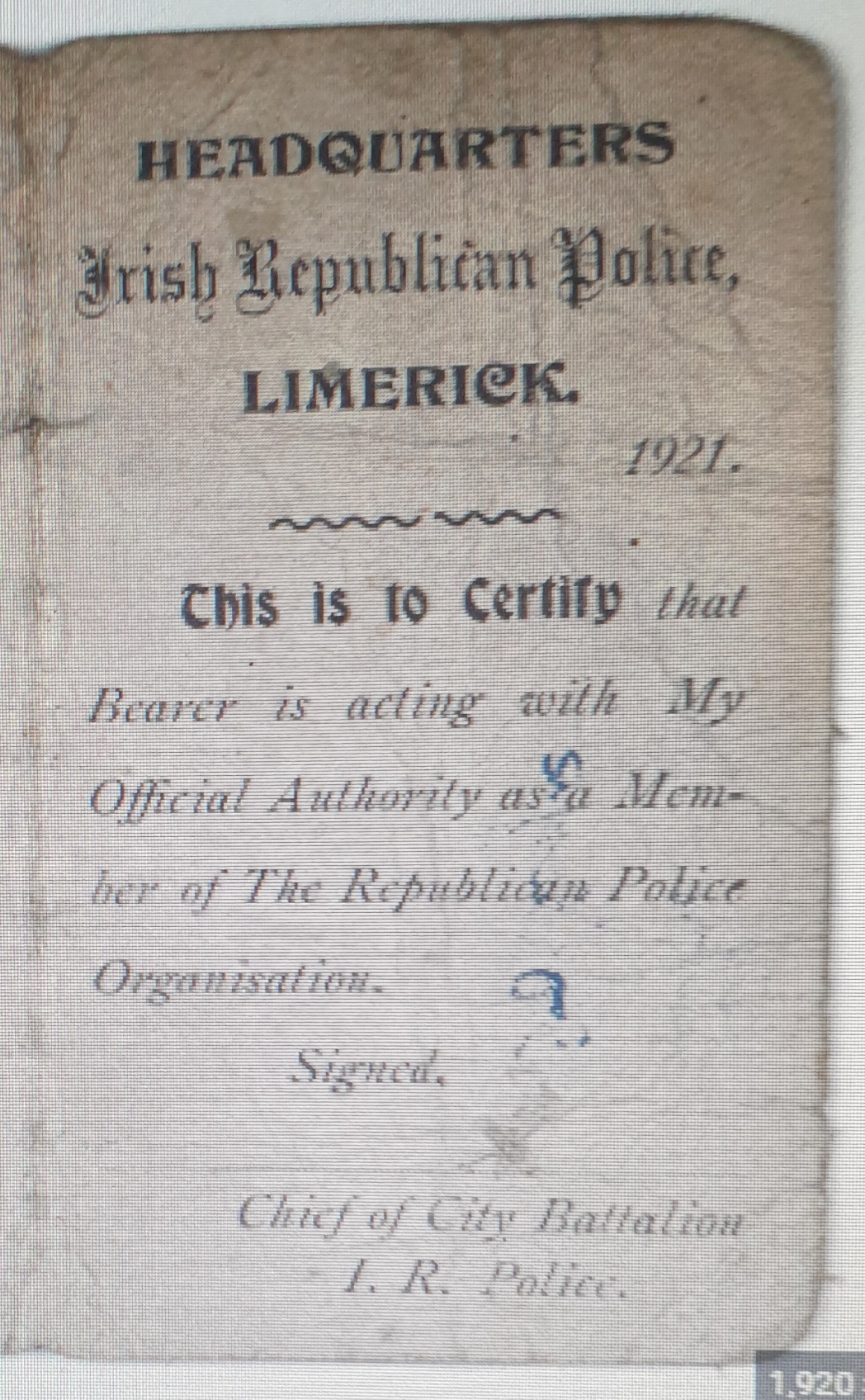
In the 1900's in Ireland, the 'Republican Police Force' were turned to (as opposed to the British 'police force', the RIC, who were more 'turned against'!) by citizens who felt they had been aggrieved and, despite not having the same resources at their disposal as the RIC had, the 'RPF' had gained a reputation as a fair and unbiased organisation.
So much so, indeed that, in Kilkenny, two former British Army Majors reported to the 'RPF' that their houses had been broken into and jewellery taken - the 'RPF' recovered and returned the stolen goods, then investigated a complaint from a 'Sir' Charles Denny Wheeler-Cuffe, that livestock had been removed by person(s) unknown from 'his' land : the animals were recovered and returned to Mr Wheeler-Cuffe.
Another case involved an organised gang of house burglars who were eventually apprehended and jailed in a deserted house for a set period of time by the 'RPF'.
But it wasn't all 'cops and robbers' (!) stuff ; the then-fledging police force (3 months 'old') was asked, in June 1920, by the owners and management of Gowran Park Races to marshall the grounds during race days and, by all accounts, were placed in the 'Winners Enclosure' each time for a job well done!
The offence of 'an attack on a girl' was usually punished, by court order, by the guilty party being tied to the gates of the church, by the 'RPF', in the area where the attack took place, and a notice of his crime tied beside him.
Anyway - on the 25th September, 1921, two men who stole from a pub in Bennettsbridge, County Kilkenny - a Mr William Hayes and a Mr John Renehan - were caught by the Republican Police Force and taken back to the village of Bennettsbridge where they were tied to the railings of the local church as people were arriving for Mass.
And they were barred from the pub as well...
On researching the incident, we came across a Mr William Hayes, a member of the British Army 'Irish Guards/Royal Irish Fusiliers' Regiment, who was based in MacDonagh Station in Kilkenny at that time, as was a Mr John Renehan, a member of the 'Royal Irish Regiment'.
Sure there's not enough railings in the whole of Ireland for them lads...
==========================
THE FORGOTTEN PEOPLE...
Emigration from Ireland to the United States continued throughout the 1990's, although the reasons were no longer so bluntly economic.
Now, in the wake of September 11th, the US authorities have been granted increased powers to investigate legal status, and Irish illegal emigrants are more vulnerable than ever before.
By Mairead Carey.
From 'Magill Annual', 2002.
Fr Tom Flynn of the 'Aisling Irish Centre' says -
"But for the fact that the economy in the US was so good in the last few years, we would have been experiencing very severe problems."
Rumours abounded about the plight of the undocumented in the aftermath of the attacks in New York.
There was talk that 30 young Irish illegals had been hired the day before to do a job in the World Trade Centre - they had, apparently, been given false union ID's, and were supposed to be on one of the top floors of the Twin Towers when the planes hit.
One report suggested that 26 Irish men working for a lighting company in Long Island were missing, and fears were aired that construction companies didn't have their workers insured and were consequently suppressing information.
Then there were the four undocumented Cavan men who appeared to have miraculously escaped from the Twin Towers ; the four, it was claimed, had been feared dead but were found alive, although seriously injured, in St Vincent's Hospital in New York, according to Caoimhghín Ó Caoláin, Sinn Féin.
The men's families were said to be relieved, but had requested anonymity : the Irish media went looking for the men, but no one could find them. To this day, Ó Caoláin stands over the story -
"I can only affirm the facts as they were given to me. The families made their own judgement and decided to maintain their anonymity, however uncomfortable it was for me," he says.
Even if those four men did not exist, there were others like them who did manage to escape...
(MORE LATER.)
On the 19th September, 1923, British 'Sir' Reginald Laurence Antrobus, the 'Senior Crown Agent for the Colonies', wrote to one of his political pals, a Mr Lionel George Curtis, an English public servant, writer, and political opinionist of the day, asking him what he made of the Irish situation.
On the 25th September (1923), Mr Curtis wrote back, stating that.. "...our friends' heads (ie the Free State administration) are, of course, pretty full at the moment.." (ie 'they are kept busy with the job we gave them - to destroy Irish republicanism') and he suggested that they wouldn't be so busy once they realised that their position in the world counted for little.. "...apart from their position in the British Commonwealth of Nations.."
Well, 'Har! Har!', Mr Curtis.
But now we have two powerbloc 'Commonwealths' that are sniggering at the indigenous Irish - one in Westminster, and one in Brussels.
The joke is on us.
==========================
BEIR BUA...
The Thread of the Irish Republican Movement from The United Irishmen through to today.
Republicanism in history and today.
Published by the James Connolly/Tommy O'Neill Cumann, Republican Sinn Féin, The Liberties, Dublin.
August 1998.
('1169' comment - 'Beir Bua' translates as 'Grasp Victory' in the English language.)
REPUBLICANS AND THE STATE :
The Republican view of where the legitimate right to govern Ireland lies, therefore, does not include the Six or 26 County States, and certainly not Britain.
Since the courts are one of the pillars of the State - the legislature and the president being the other two pillars in the 26 Counties and the legislature and the monarch for the British - Republicans do not recognise the authority of the courts.
The Republican Sinn Féin constitution forbids the organisation from making use of the courts of either partition assembly for civil actions and states -
"Recognition of these courts in the case of political charges is strictly forbidden, unless specifically sanctioned or ordered by the Republican Government."
Republican Sinn Féin does not recognise the right of the new Stormont, Leinster House or Westminster parliaments to govern any part of Ireland and would not therefore send their elected representatives to it.
This policy of not participating in these parliaments is called abstentionism, and has been the Sinn Féin policy since the formation of the organisation in 1905...
(Note - the RSF organisation has turned 'Woke' in the last few years and, while its stated political policy re our six occupied counties etc are sound, its social policies are much less so.)
(MORE LATER.)
Thanks for the visit, and for reading!
Sharon and the team.
(We won't be here next Wednesday, 2nd October 2024, as we have a BIG birthday party to help organise, and attend, and recover from... [I'm 21 then, and I'm not spending it with ye lot..!] ..but we'll be back 'On Air' on Wednesday, 9th October with, among other pieces, a few paragraphs about the final preparations put in place by Westminster before they unleashed a political white-washing on the world.
...and I'll be still chatting away on X/Twitter and Facebook as well!)
DUBLIN, EARLY 2000's - AN OFFICIAL REPORT AND A FRIGHTENING STATISTIC...
('16 FOR [4] 25'!)
'This funeral procession in Dublin, in the 1900's, which was organised by a republican-gamekeeper-turned-Free State-poacher, was witnessed by media from throughout the world and attended by tens of thousands of Irish men and women, some of whom were armed, some of whom were in the uniform of the rebels, and shots were fired in the graveyard.
Newspaper reports of the burial conveyed to the world the message that the Irish rebels were far from the 'spent force' that the British were insinuating...'
That's a few lines about one of the 16-part post pieces that we'll be writing about here on Wednesday, 25th September 2024 : and sure here's another two 'samplers' for ya -
'From the 1900's - this industrial storeroom in the South-East of Ireland was used by a business to warehouse the equipment it needed for day-to-day operations, including explosives. The British monitored it closely, as did the Irish rebels, but the local British Army regiment were uneasy that the munitions there could "fall into the wrong hands". So they sent some of their men in to remove any items which could be used against them, but that operation didn't go according to their plan...'
'Dublin, Ireland, early 2000's - an official report indicated that, within about a three-year time span, one-fifth of the population in the city would br foreign born, a statistic welcomed by at least one foreign journalist...'
So do please give us a shout on the 25th : we'll add a bit more text and a few pics to the above (...and a bit more detail, of course!), and throw in another thirteen bits and pieces to keep ya occupied!
Thanks for the visit, and for reading : see ya again on the 25th!
Sharon and the team.
ON THIS DATE (18TH SEPTEMBER) 173 YEARS AGO : DEATH OF AN IRISH HEROINE.
'Anne Devlin was born in County Wicklow around the end of the 1770s into a nationalist family. In 1800, Anne met Robert Emmet and moved into his house to assist him in his plans for an uprising in Dublin. On the evening of the 23rd July, 1803, the rising went ahead in Dublin, but despite taking the British authorities by surprise, the rebellion collapsed.
Anne and her eight year old sister were arrested. She was interrogated and tortured in order to get information about the whereabouts of Emmet. She refused to speak. On the 20th September 1803 Emmet was executed on Thomas Street, Dublin.
She was kept in solitary confinement in Kilmainham Gaol in squalid conditions and was subjected to brutal treatment, but consistently refused to cooperate despite the fact that her entire family were also being held. She was finally released in 1806. Anne Devlin died in September 1851 in the Liberties area of Dublin’s city centre ('1169' comment - she died from starvation on the 18th of that month ; 173 years ago on this date).
She was buried in a paupers plot in Glasnevin Cemetery, but following the efforts of a Doctor Richard Robert Madden, she was exhumed and reinterred with a headstone..' (From here.)
On the 2nd March 1914, Patrick Henry Pearse, 37 years of age, delivered the following address to a packed venue in the 'Academy of Music' in Brooklyn, New York :
"Wherever Emmet is commemorated let Anne Devlin not be forgotten.
Bryan Devlin had a dairy farm in Butterfield Lane ; his fields are still green there. Five sons of his fought in '98. Anne was his daughter, and she went to keep house for Emmet when he moved into Butterfield House.
You know how she kept vigil there on the night of the rising. When all was lost and Emmet came out in his hurried retreat through Rathfarnham to the mountains, her greeting was — according to tradition, it was spoken in Irish, and Emmet must have replied in Irish - "Musha, bad welcome to you! Is Ireland lost by you, cowards that you are, to lead the people to destruction and then to leave them ?"
"Don't blame me, Anne, the fault is not mine", said Emmet.
And she was sorry for the pain her words had inflicted, spoken in the pain of her own disappointment. She would have tended him like a mother could he have tarried there, but his path lay to Kilmashogue, and hers was to be a harder duty.
When Major Sirr (pictured) came out with his soldiery she was still keeping her vigil.
"Where is Emmet?", they demanded to know.
"I have nothing to tell you," she replied, and to all their questions she had but one answer : "I have nothing to say ; I have nothing to tell you."
They swung her up to a cart and half-hanged her several times ; after each half-hanging she was revived and questioned : still the same answer.
They pricked her breast with their bayonets until the blood spurted out in their faces. They dragged her to prison and tortured her for days. Not one word did they extract from that steadfast woman.
And when Emmet was sold, he was sold, not by a woman, but by a man — by the friend that he had trusted — by the counsel that, having sold him, was to go through the ghastly mockery of defending him at the bar.
The fathers and mothers of Ireland should often tell their children that story of Robert Emmet and that story of Anne Devlin.
To the Irish mothers who hear me I would say that when at night you kiss your children and in your hearts call down a benediction, you could wish for your boys no higher thing than that, should the need come they may be given the strength to make Emmet's sacrifice, and for your girls no greater gift from God than such fidelity as Anne Devlin's.."
Anne Devlin was an Irish republican famous for her involvement with the United Irishmen, and enduring terrible conditions, as well as torture, when imprisoned by British forces in Ireland.
She died, aged 71, on the 18th September, 1851 - 173 years ago on this date.
Original IRA 'Squad' members, pictured, above, in 1948 -
Seated : Vinnie Byrne, Piaras Béaslaí, Mick McDonnell, Frank Thornton, Jim Slattery.
Standing : Frank Bolster, Ben Byrne, Frank Saurin, Joe Guilfoyle, Pat McCrea, Barney McMahon, Charlie Dalton, Joe Leonard, Sean O Tuama, and Jimmy Shiels (Volunteers Tom Keogh and Tom Kilcoyne, among others, such as Dan Breen, Sean Tracey, John Joe Hogan, Seamus Robinson, Thomas Whelan and Patrick Moran, were seconded when required).
Although actually formed months earlier, 'The Squad' held its last 'unofficial' meeting on the 18th September, 1919 - the next day Michael Collins formally announced, 'inhouse', the establishment of the Unit.
In mid-July 1919, a selected number of IRA Volunteers arrived at 35 North Great George's Street in Dublin, where two prominent Volunteers, Dick McKee and Mick McDonnell, addressed the gathering -
"They picked out a number of us and took us to an inner room. Dick McKee addressed those of us who had been selected and asked us if we had any objection to shooting enemy agents. The greater number of Volunteers objected for one reason or another but I said I was prepared to obey orders. We were merely told that we were to be given special duties..."
- Volunteer Jim Slattery, describing what happened during a part of the meeting.
Other venues in Dublin used by the Squad include Number 3 Crow Street (off Dame Street), a builder's yard in Abbey Street ('George Moreland and Company') and a stable in North Great Charles Street.
Unfortunately, the majority of the Squad accepted the Treaty of Surrender in 1921/1922, and (ab)used their skills of assassination against their own.
==========================
WHY DOESN'T THE CENSUS ADDRESS ETHNICITY...?
By Niina Hepojoki.
From 'Magill' Magazine, March 2002.
It has been suggested that James Joyce was one of the first artists ever to imagine a world without foreigners.
In his essay 'Strangers in Their Own Country', Professor Declan Kiberd defines this Joycean world as... "..one possible once men and women begin to accept the foreigner in the self* and the necessarily fictive nature** of all nationalisms, which are open to endless negotiations."***
('1169' comment -* There is no "foreigner in the self" [except, perhaps, for those that are 'Woke'] as far as any indigenous people should be concerned ; we are what we are, and shouldn't seek to change our very DNA to suit anybody.
** - Nationalism is not of a "fictive nature" ; rather it is of a factual narrative and nature.
*** - "endless negotiations" ie 'those are my principles, and if you don't like them...well, I have others...' ; the very 'building blocks' of a 'Woke' structure!)
"There has been concern that the census and its results could be used as some kind of a whipping tool", said one source.
This year's census will, however, include a question on the Travelling Community, which was lobbied for by Pavee Point, the Travellers' rights group, as well as a question of nationality.
"We would have hoped to see an overall question on ethnicity in the form so we are not entirely happy with just a question on Travellers.
Our concern is that the Travelling Community as a result might feel isolated when identified as the only ethnic group in the census", says Brigid Quirke, health co-ordinator of the voluntary organisation (sic - it's a GONGO agency, funded by State taxpayers).
To overcome these worries, Pavee Point will be taking part in the information gathering with CSO, as "kind of consultants..."
(MORE LATER.)
In September, 1920, the East Clare Brigade of the IRA (pictured) took delivery of a number of bombs from the Dublin IRA, to be used in an attack on Scariff RIC Barracks, in East Clare, close to the shores of Lough Derg.
Volunteers who took part included Tomas Malone (alias Séan Forde), Michael Brennan, Alfie (Alphie) Rodgers, Michael 'Brud' McMahon and Martin Kildea, but the Dublin engineers let them down...
'From all surrounding parishes, on Saturday evening, September 18th, 1920, groups of armed young men moved closer to the town of Scariff.
Within the town, IRA Volunteers...central to the planned action, waited, impatiently...the republican leadership in East Clare had decided to move on the heavily fortified RIC barracks in Scariff...' (From here.)
==========================
A Mr Maurice P. Hankey (pictured), who was born on the 1st April, 1877, in Biarritz, in France, was educated at a private day school in Brighton and then Rugby School, and began his 'naval career' at 18 years of age as a probationary Second Lieutenant in the Royal Marine Artillery, from where he attended the 'Royal Naval College' in Greenwich, in London.
Mr Hankey rose through the political ranks and, in 1920, he was appointed as the 'Secretary to the British Cabinet' and was a trusted accomplice to a Mr David Lloyd George ('1st Earl Lloyd-George of Dwyfor'), the Prime Minister of the 'United Kingdom' (!).
Mr George, having been in a position of political authority during the 1916 Rising, had 'suffered the Irish' for the four years since then and was getting weary of it - he was beginning to entertain the idea that a military victory by Westminster in Ireland was not only not visible on the horizon but, indeed, might not be attainable at all without even greater losses to his political and military forces, which wouldn't be acceptable to his own people.
On the 18th September, 1920, Mr Hankey wrote that his bosses intention at that time... "..was to to pass the Irish Bill, establish a parliament in Ulster and, if Southern Ireland refuses to establish a parliament (ie the Leinster House assembly), withdraw from the interior, occupying the posts only.."
By "the posts" he meant the political and military structures that Westminster had established in the cities ie 'abandon the rural areas, concentrate our rule in the urban centres'.
That was in 1920 - within a year and a few months, anti-Irish elements had agreed between themselves to sacrifice six of our counties to British imperialism, and we are still paying for that folly today...
==========================
On the 18th September, 1920, a British Army Lance Corporal, a Mr Robert Clout ('Service Number 6908971'), who was attached to the 'Prince Consort's Own Rifle Brigade' of the '2nd Battalion Royal Sussex Regiment', was in a barracks in Finner Camp, Ballyshannon, County Donegal, when he was shot dead.
A Private Byrne was, basically, 'playing' with a rifle when it went off - the bullet hit Mr Clout in the throat, inflicting a wound that killed him.
The unfortunate soldier is buried in Chatham (Maidstone Road) Cemetery in his own country, England.
==========================
On the 18th September, 1920, IRA Volunteers entered a house in Gorey, County Wexford, where the Redmond family lived, and gave the man of the house a beating, then tarred him.
Mr Redmond had been advised to cease using his car to drive RIC members around the district, but he had ignored the advice.
The following night, another Wexford man, a Mr Patrick Cullen, was taken to a grave yard where a number of IRA Volunteers were waiting for him.
He was placed in front of a freshly-dug grave and told he was there because he had ignored advice to keep his distance from RIC members, and was then put on trial.
After the proceedings, the Volunteers again advised him to keep better company, and left the area. Mr Cullen later made his own way home.
==========================
On the 18th September, 1920, Field Marshal 'Sir' Henry Hughes Wilson (pictured), 1st Baronet, GCB, DSO ETC ETC (!) wrote to a 'Sir' Winston Leonard Spencer Churchill KG OM CH TD DL FRS RA ETC ETC (!), stating -
"I see no reason why, with patience and firmness, we may not wear the trouble down (in Ireland) in the course of a few years".
Within about a year, however, they had an army of Free State Irishmen in their back pocket, to "wear the trouble down" for them...
==========================
On the evening of the 8th September, 1920, a drunken, armed, Black and Tan driver, a man from Middlesex, in England - a Mr Edward Krumm, a 5'11"-tall bachelor, 26 years of age - and an equally drunk friend of his, a Mr Christopher Yorke, left their second or third pub and were making their way to Galway Railway Station to buy a copy of a newspaper, as they wanted the results of that days horse racing.
IRA Volunteers had been observing the pair of them, because a shipment of arms from Longford was due in that night on the train and, as well as that, the train station was a good vantage point for them to observe the movements of enemy troops, to collect despatches and to meet Volunteers from other areas - the IRA didn't want any unnecessary attention focused on the station, and Mr Krumm and his buddy, who had already made a nuisance of themselves in the town, were likely to continue to cause trouble.
And cause trouble they did - Mr Krumm, who believed himself to be "an ace shot", had his gun in his hand in the railway station and was causing a scene, so a few Volunteers moved in on him to disarm him and deal with him later, but he started shooting - Volunteer Séan Mulvoy (pictured) was badly wounded (and died later that evening from his wound), so another IRA man, Frank O'Dowd, shot the drunken Tan, who died at about 1am the following morning, and two other Volunteers -Tom Fahy and Michael Hynes - picked up his gun and left the area (Mr Krumm's mother received £2,100 compensation for his killing plus £100 for funeral costs).
The British Army held a 'Military Court of Inquiry' into the incident, at which a local woman, a M/s Eileen Baker, gave evidence, despite the IRA having advised people not to do so.
On the morning of the 18th September, 1920, a number of IRA Volunteers visited M/s Baker, held her down and cut off her hair, as a warning to herself and others to heed such advice in future.
That night, a number of RIC men and British Army soldiers 'arrested' five local women who they suspected were Cumann na mBan Volunteers and shaved their heads in retaliation.
Incidentally, the Galway IRA got the Longford guns that night - as the ruckus in the train station was taking place, the train had come to a halt just outside the station and the weapons were unloaded and taken safely away.
==========================
ON THIS DATE (18TH SEPTEMBER) 178 YEARS AGO - BIRTH OF A 'FENIAN UNIONIST'.
James Standish O'Grady (Anéislis Séamus Ó Grádaigh, pictured) was born on the 18th September, in Cork, in 1846 - 178 years ago on this date.
He was a 'mixed bag' of a person, having been born into the 'landlord class' but, at the same time, possessing enough cop-on to realise that if a political/financial/social system lacked the (minor) benefits to the less well-off of a 'trickle down' effect, then trouble was guaranteed.
He was of the opinion that he had more in common with the Irish 'aristocracy' than he had with his own 'class' in the fine halls and castles of Westminster and, witnessing the suffering in Ireland, apparently felt that England had somehow betrayed its standing and reputation (!) in the world because of the way the Irish were been treated.
'The Pictorial Times', a popular newspaper of the day, described the then attempted genocide of the Irish people in the following report, dated the 10th October, 1846 -
'Around them is plenty ; rickyards, in full contempt, stand under their snug thatch, calculating the chances of advancing prices ; or, the thrashed grain safely stored awaits only the opportunity of conveyance to be taken far away to feed strangers...but a strong arm interposes to hold the maddened infuriates away. Property laws supersede those of Nature.
Grain is of more value than blood. And if they attempt to take of the fatness of the land that belongs to their lords, death by musketry is a cheap government measure to provide for the wants of a starving and incensed people..'
Mr O'Grady realised that the unrest among the Irish could at least be lessened, if not smoothed-over completely, if only his own type on what he no doubt regarded as 'the main land' would be 'fair' towards those they were thieving from and, to that end, he wrote to those that had influence over those he called 'the landlords of Ireland' -
"I say that even still you are the best class in the country, and for the last two centuries have been ; but, see, the event proves that you were not good enough, had not virtue enough. Therefore you perish out of the land, while innumerable eyes are dry.
Christ save us all, you read nothing, know nothing.
This great modern, democratic world rolls on with its thunderings, lightnings and voices, enough to make the bones of your heroic fathers turn in their graves, and you know nothing about it, care nothing about it.
Of you, as a class, as a body of men, I can entertain not the least hope ; indeed, who can?
If you are quite satisfied to lose all that you have inherited, to be stripped naked, and in the slime to wrestle with dragons and gorillas hereafter for some morsel of official income which you will not get, then travel that way.
If you are satisfied to see all the worth, virtue, personal refinement, truth and honour which you know to be inherent in your own order wiped, as with a sponge, out of Ireland - maybe a bloody sponge - then travel that way.
If you wish to see anarchy and civil war, brutal despotisms alternating with bloody lawlessness, or, on the other side, a shabby, sordid Irish Republic, ruled by knavish, corrupt politicians and the ignoble rich, you will travel the way of égalité."
His plea for 'fair play' for the Irish fell on deaf ears, but he was right in regards to this State ('the republic') 'being ruled by knavish, corrupt politicians and the ignoble rich..', and that remains the case, but that would probably be little comfort to him as he lay on his deathbed in Shanklin, Isle of Wight, in England, in 1928 - he was 81 years of age when he went to his grave, leaving behind a reputation, among some, of being a 'Fenian Unionist'.
On the 12th September, 1921, Mr Éamon de Valera wrote to a Mr David Lloyd George in Westminster, London, in furtherance of a meeting between British and Irish political representatives.
On the 18th September, 1921, Mr George wrote back to Mr de Valera -
"My colleagues and I cannot meet them (the Irish delegates) as the representatives of a sovereign and independent State without disloyalty on our part to the (British) Throne and Empire. I therefore must repeat that unless the second paragraph* in your letter of the 12th is withdrawn conference between us is impossible..."
(*That paragraph sought an acknowledgment from Mr George that he and his people were meeting with 'representatives of a sovereign and independent State'.)
On the 19th September, 1921, Mr de Valera wrote back to the man, stating -
"We had no thought at any time of asking you to accept any conditions precedent to a Conference.
If you seek to impose preliminary conditions, which we must regard as involving a surrender of our whole position, they [the Conference] cannot meet..." and then asks Mr George to state whether his intent is to demand a surrender of the Irish or is it part or an invitation to a Conference "free on both sides...?"
Mr George replied saying that since he could not enter into a conference on the basis of the correspondence to date that they should start over again -
"We therefore send you herewith a fresh invitation to a Conference in London on October 11th (1921), where we can meet your delegates as spokesmen of the people whom you represent with a view to ascertaining how the association of Ireland with the community of nations known as the British Empire may best be reconciled with Irish national aspirations. Conference, not correspondence, is the most practical and hopeful way to an understanding..."
The next day, Mr de Valera accepted the offer on the basis that... "..our respective positions have been stated and understood..".
And so it was that the 'Treaty of Surrender' talks ('negotiations') officially began on the 11th October 1921, placing us in the position we still suffer today - with six of our thirty-two counties still under the jurisdictional control of Westminster.
==========================
...and, talking of losers - being the proud Dubs that we are! - we couldn't let this go without mention...
18th SEPTEMBER 1921 -
Kildare (1-4) lose to Dublin (3-3) in the Leinster Final replay in Croke Park.
Na, na, na, naa, naaaa...!
==========================
THE FORGOTTEN PEOPLE...
Emigration from Ireland to the United States continued throughout the 1990's, although the reasons were no longer so bluntly economic.
Now, in the wake of September 11th, the US authorities have been granted increased powers to investigate legal status, and Irish illegal emigrants are more vulnerable than ever before.
By Mairead Carey.
From 'Magill Annual', 2002.
No one knows how many Irish illegals are currently living in New York, let alone America.
Fr Tom Flynn of the 'Aisling Irish Centre' believes that in his own area of Manhattan - the Bronx and Yonkers - at least 5,000 illegal Irish immigrants have arrived in the last five years.
"Irish people seem to think that emigration had gone away, but we see a steady stream of Irish to New York, particularly from the North and from border counties.
As the economy got better at home, the divide between the rich and poor got greater. Those who didn't have a great education found themselves in jobs that weren't giving them enough money to keep them in the Celtic Tiger economy.
They were very low-paying jobs and they didn't feel they were going anywhere. They come here for different reasons", he says, "many come for the experience, many because they want to get away from home.
They leave Ireland because of personal problems, they think the problems will go away once they come to the US. We are seeing a lot of young Irish people bringing out a drug problem.
We have problems with ecstasy in particular - they are more likely to get in trouble and as a result are more vulnerable..."
(MORE LATER.)
"The peace of Belfast does not apparently meet with favour in some quarters, as, after a good period of welcome orderliness, some persons of the hooligan type have been doing their best to revive the awful deeds which disgraced the city several months ago..."
- 'The Belfast Telegraph' newspaper, 16th September 1922.
"Belfast is a bright spot in the midst of the darkness and gloom that hang over southern Ireland. Conditions in the Six Counties are as free from crime and bloodshed as are Kent and Lancashire..."
-'The Belfast Telegraph' newspaper, 18th September 1922.
Obviously, sometime between the 16th and the 18th, 'The Belfast Telegraph' owner had been instructed by Westminster to tone down the criticism.
Same thing happens today ; so-called 'journalists' and the equally so-called 'newspapers' they write for are subservient to the interests of whatever political power is in place at the time.
==========================
On the 18th September, 1922, a Mr William Thomas Cosgrave, the 'Chairman of the Provisional Government' in the Free State (from August 1922 to December 1922) introduced a bill to Leinster House enacting the 'Constitution of the Irish Free State' (pictured) and, the next day, that political assembly agreed to prepare a new electoral register for that State.
Nowadays...well, for the last twenty years, actually...that scenario is, and has been, operated in reverse, with the 'new voter base' acquired first...
==========================
On the 18th September, 1922 (listed elsewhere as having happened on the 20th), 18-years-young Margaret Collins was visiting her grandfather in Grangemore, Brannockstown, County Kildare, and was walking through a potato field.
The poor girl had either found herself in the middle of an IRA arms dump or had found something which piqued her curiosity ; the object she picked up to examine was actually a bomb - it exploded, killing her instantly.
Her father was a well-known republican activist in the area.
==========================
ON THIS DATE (18TH SEPTEMBER) 157 YEARS AGO : TWO IRISH FENIANS RELEASED FROM BRITISH PRISON VAN.
"These Irish are really shocking, abominable people. Not like any other civilised nation..."
- the words of Britain's 'Queen' Victoria, on hearing about the 'Manchester Outrage', as she called it.
Her comments were replied to by one of the 'uncivilised Irish' people she was speaking about :
"I will die proudly and triumphantly in defence of republican principles and the liberty of an oppressed and enslaved people..."
- the words of 18-years-young William Allen, from Bandon, County Cork.
The "outrage", as far as the British are concerned, anyway , began on the 11th September that year (1867) (...although, in reality, it began for us Irish in 1169) when, in the early hours of the morning of Wednesday, 11th September 1867, two men were arrested by police in Shudehill, Manchester, on suspicion that they were about to commit a robbery.
The two men were charged under the 'Vagrancy Act' and were detained in police custody, and it was then they were recognised, by fellow Irishmen in British police uniforms, as Colonel Thomas J.Kelly and Captain Timothy Deasy (both pictured), two known Fenians.
Their comrades in Manchester, which was the 'Bandit Country' of its day, vowed to free the two men and, on the 18th of September, 1867 - 157 years ago today - as a prison van carrying the two men (and a 12-years-young boy, plus three female prisoners) was travelling on the Manchester to Salford road, on its way to 'deposit the cargo' in Belle Vue Gaol on the Hyde Road in Gorton, Manchester, accompanied by a team of 12 horse-mounted policemen, it was attacked by about 50 Fenians.
Kelly and Deasy were handcuffed and locked in two separate compartments inside the van, guarded by a police sergeant, a Charles Brett, and, as such, were unable to assist their comrades outside.
The mounted police escort fled the scene on seeing the number of attackers but Brett was obviously unable to do so : the Fenian rescuers were unable to force open the van and advised Sergeant Brett that it would be for his own good to open the doors and let the prisoners go.
Mr Brett refused the offer, and was looking through the keyhole to further assess his situation when one of the rescuers decided to shoot the lock apart - the bullet went through the keyhole and hit Brett in the head, killing him instantly.
One of the female prisoners had the good sense to take the keys from his pocket and hand them out through an air vent to those outside, and Kelly and Deasy were taken to safety.
Twenty-six men were later arrested and tried for playing a part in the rescue, and five of them were detained to stand trial, on 1st November 1867, for their alleged part in what the British called the "Manchester Outrage" : all five were actually sentenced to be hanged, but one was granted clemency and another was 'pardoned' as the evidence against him was found to be perjured.
The other three - William Allen, Michael O'Brien and Michael Larkin - the 'Manchester Martyrs' - were hanged in front of thousands of baying spectators on Saturday, 23rd November 1867, in Salford, Manchester, outside the New Bailey Jail.
In an address to the court, William Philip Allen (pictured), 18, stated -
"No man in this court regrets the death of Sergeant Brett more than I do, and I positively say, in the presence of the Almighty and ever-living God, that I am innocent ; aye, as innocent as any man in this court. I don't say this for the sake of mercy : I want no mercy — I'll have no mercy. I'll die, as many thousands have died, for the sake of their beloved land, and in defence of it."
"I will die proudly and triumphantly in defence of republican principles and the liberty of an oppressed and enslaved people.
Is it possible we are asked why sentence should not be passed upon us, on the evidence of prostitutes off the streets of Manchester, fellows out of work, convicted felons — aye, an Irishman sentenced to be hanged when an English dog would have got off. I say positively and defiantly, justice has not been done me since I was arrested.
If justice had been done me, I would not have been handcuffed at the preliminary investigation in Bridge Street ; and in this court justice has not been done me in any shape or form.
I was brought up here and all the prisoners by my side were allowed to wear overcoats, and I was told to take mine off. What is the principle of that? There was something in that principle, and I say positively that justice has not been done me.
As for the other prisoners, they can speak for themselves with regard to that matter. And now, with regard to the way I have been identified. I have to say that my clothes were kept for four hours by the policemen in Fairfield station and shown to parties to identify me as being one of the perpetrators of this outrage on Hyde Road.
Also in Albert station there was a handkerchief kept on my head the whole night, so that I could be identified the next morning in the corridor by the witnesses.
I was ordered to leave on the handkerchief for the purpose that the witnesses could more plainly see I was one of the parties who committed the outrage. As for myself, I feel the righteousness of my every act with regard to what I have done in defence of my country. I fear not. I am fearless — fearless of the punishment that can be inflicted on me ; and with that, my lords, I have done."
However, he then added the following -
"I beg to be excused. One remark more. I return Mr. Seymour and Mr. Jones my sincere and heartfelt thanks for their able eloquence and advocacy on my part in this affray. I wish also to return to Mr. Roberts the very same. My name, sir, might be wished to be known. It is not William O'Meara Allen. My name is William Philip Allen. I was born and reared in Bandon, in the County of Cork, and from that place I take my name ; and I am proud of my country, and proud of my parentage. My lords, I have done."
Michael Larkin (pictured), 32, lived in the Banagher region of County Offaly and was a tailor by trade.
He was not of good health and himself and his two comrades were captured as they carried him away from the scene of the rescue. He, too, addressed the court :
"I have only got a word or two to say concerning Sergeant Brett. As my friend here said, no one could regret the man's death as much as I do. With regard to the charge of pistols and revolvers, and my using them, I call my God as witness that I neither used pistols, revolvers, nor any instrument on that day that would deprive the life of a child, let alone a man.
Nor did I go there on purpose to take life away. Certainly, my lords, I do not want to deny that I did go to give aid and assistance to those two noble heroes that were confined in that van, Kelly and Deasy. I did go to do as much as lay in my power to extricate them out of their bondage ; but I did not go to take life, nor, my lord, did anyone else.
It is a misfortune there was life taken ; but if it was taken it was not done intentionally, and the man who has taken life we have not got him. I was at the scene of action, when there were over, I dare say, 150 people standing by there when I was. I am very sorry I have to say, my lord, but I thought I had some respectable people to come up as witnesses against me ; but I am sorry to say as my friend said — I will make no more remarks concerning that.
All I have to say, my lords and gentlemen, is that so far as my trial went, and the way it was conducted, I believe I have got a fair trial. What is decreed a man in the page of life he has to fulfil, either on the gallows, drowning, a fair death in bed, or on the battle-field. So I look to the mercy of God. May God forgive all who have sworn my life away. As I am a dying man, I forgive them from the bottom of my heart. God forgive them."
Michael O'Brien (pictured), 31, from Ballymacoda in Cork, was a lieutenant in the US Army and was better known in England by the name 'William Gould'.
He delivered the following speech to the court :
"I shall commence by saying that every witness who has sworn anything against me has sworn falsely. I have not had a stone in my possession since I was a boy. I had no pistol in my possession on the day when it is alleged this outrage was committed. You call it an outrage, I don't. I say further my name is Michael O'Brien.
I was born in the county of Cork and have the honour to be a fellow-parishioner of Peter O'Neal Crowley, who was fighting against the British troops at Mitchelstown last March, and who fell fighting against British tyranny in Ireland. I am a citizen of the United States of America, and if Charles Francis Adams had done his duty towards me, as he ought to do in this country, I should not be in this dock answering your questions now.
Mr. Adams did not come, though I wrote to him. He did not come to see if I could not find evidence to disprove the charge, which I positively could, if he had taken the trouble of sending or coming to see what I could do. I hope the American people will notice this part of the business."
He then read a passage from a paper he was holding -
"The right of man is freedom. The great God has endowed him with affections that he may use, not smother them, and a world that may be enjoyed. Once a man is satisfied he is doing right, and attempts to do anything with that conviction, he must be willing to face all the consequences. Ireland, with its beautiful scenery, its delightful climate, its rich and productive lands, is capable of supporting more than treble its population in ease and comfort.
Yet no man, except a paid official of the British Government, can say there is a shadow of liberty, that there is a spark of glad life amongst its plundered and persecuted inhabitants. It is to be hoped that its imbecile and tyrannical rulers will be for ever driven from her soil amidst the execrations of the world.
How beautifully the aristocrats of England moralise on the despotism of the rulers of Italy and Dahomey — in the case of Naples with what indignation did they speak of the ruin of families by the detention of its head or some loved member in a prison. Who has not heard their condemnations of the tyranny that would compel honourable and good men to spend their useful lives in hopeless banishment?"
"They cannot find words to express their horror of the cruelties of the King of Dahomey because he sacrificed 2,000 human beings yearly, but why don't those persons who pretend such virtuous indignation at the misgovernment of other countries look at home, and see that greater crimes than those they charge against other governments are not committed by themselves or by their sanction?
Let them look at London, and see the thousands that want bread there, while those aristocrats are rioting in luxuries and crimes. Look to Ireland ; see the hundreds of thousands of its people in misery and want. See the virtuous, beautiful and industrious women who only a few years ago — aye, and yet — are obliged to look at their children dying for want of food.
Look at what is called the majesty of the law on one side, and the long deep misery of a noble people on the other. Which are the young men of Ireland to respect — the law that murders or banishes their people or the means to resist relentless tyranny, and ending their miseries for ever under a home government? I need not answer that question here.
I trust the Irish people will answer it to their satisfaction soon.
I am not astonished at my conviction. The Government of this country have the power of convicting any person. They appoint the judge ; they choose the jury ; and by means of what they call patronage (which is the means of corruption) they have the power of making the laws to suit their purposes. I am confident that my blood will rise a hundredfold against the tyrants who think proper to commit such an outrage.
In the first place, I say I was identified improperly by having chains on my hands and feet at the time of identification, and thus the witnesses who have sworn to my throwing stones and firing a pistol have sworn to what is false, for I was, as those ladies said, at the jail gates.
I thank my counsel for their able defence, and also Mr. Roberts, for his attention to my case."
All three men shouted the words "God Save Ireland!" at different times during the 'trial', perhaps realising that, then, as now, the British were going to get their 'pound of flesh' one way or the other.
The three men were hanged by the British on the 23rd November, 1867, but are still remembered and commemorated today by Irish republicans ; they gave their lives that their comrades may live again.
BEIR BUA...
The Thread of the Irish Republican Movement from The United Irishmen through to today.
Republicanism in history and today.
Published by the James Connolly/Tommy O'Neill Cumann, Republican Sinn Féin, The Liberties, Dublin.
August 1998.
('1169' comment - 'Beir Bua' translates as 'Grasp Victory' in the English language.)
REPUBLICANS AND THE STATE :
In a statement on July 25th, 1987, Thomas Maguire wrote -
"The faithful members of that Executive, in accordance with the IRA Constitution, filled the vacancies in the Executive and that Executive continues as the lawful Executive of the Irish Republican Army.
The Continuity Executive has appointed an Army Council of the IRA.
I quote the following extract from my statement of 31st December 1969 :
'In December, 1938, the surviving faithful members of the latest 32 County Republican Parliament, the Second Dáil elected in 1921, delegated their executive powers of government to the Army Council of the IRA.
This Proclamation of 1938 was signed by SS Ó'Ceallaigh ('Sceilg'), Ceann Comhairle, Mary MacSwiney, Count Plunkett, Cathal Ó Murchú, Brian O'Higgins, Professor Stockley and myself, Tomás Maguire.'
I hearby declare that the Continuity Executive and the Continuity Army Council are the lawful Executive and Army Council respectively of the Irish Republican Army, and that the governmental authority, delegated in the Proclamation of 1938, now resides in the Continuity Army Council, and its lawful successors."
Dated the 25th day of July 1987.
Signed : Thomas Maguire,
Tomás Maguidhir,
Comdt. General.
(MORE LATER.)
Thanks for the visit, and for reading!
Sharon and the team.