Emily Lawless, pictured, (aka 'Emily Lytton'), the writer and poet, was born on the 17th of June, 1845, in Ardclough, County Kildare and was educated privately.
War battered dogs are we
Fighters in every clime;
Fillers of trench and of grave,
Mockers bemocked by time.
War dogs hungry and grey,
Gnawing a naked bone,
Fighters in every clime -
Every cause but our own.
- Emily Lawless, 1902 ; "With the Wild Geese".
She was born into a politically mixed background, the eldest daughter and one of eight children ('Sir' Horace Plunkett was her cousin) .
Her father was 'Titled' by Westminster (he was a 'Baron') even though his father (Emily's grandfather) was a member of the 'United Irishmen'.
Her brother, Edward, seems to have taken his direction from his father rather than his grandfather - he held and voiced strong unionist opinions, wouldn't have a Catholic about the place and was in a leadership position within the (anti-Irish) so-called 'Property Defence Association'.
Perhaps this 'in-house' political confusion (mixed between stauch unionism and unionism with sympathies for Irish nationalism/republicanism, coupled with the 'whisperings of shame' that Emily was a lesbian and was having an affair with one of the 'titled' Spencer women) was the reason why her father and two of his daughters committed suicide.
She considered herself to be a Unionist although, unlike her brother, she appreciated and acknowledged Irish culture (...or, in her own words - "I am not anti-Gaelic at all, as long as it is only Gaelic enthuse and does not include politics...") and, despite being 'entitled' to call herself 'The Honourable Emily Lawless', it was a 'title' she only used occasionally.
She spent a lot of her younger days in Galway, with her mother's family, but it is thought that family tragedies drove her to live in England, where she died, on the 19th of October 1913, at the age of 68, having become addicted to heroin.
She is buried in Surrey.
She wrote a full range of books, from fiction to history to poetry, and is best remembered for her 'Wild Geese' works, although some of her writings were criticised by journalists for its 'grossly exaggerated violence, its embarrassing dialect and staid characters...'.
'The Nation' newspaper stated that 'she looked down on peasantry from the pinnacle of her three-generation nobility...' and none other than William Butler Yeats declared that she had "an imperfect sympathy with the Celtic nature..." and that she favoured "theory invented by political journalists and forensic historians."
But she had a great talent :
After Aughrim
She said, "They gave me of their best,
They lived, they gave their lives for me ;
I tossed them to the howling waste
And flung them to the foaming sea."
She said, "I never gave them aught,
Not mine the power, if mine the will ;
I let them starve, I let them bleed,
they bled and starved, and loved me still."
She said, "Ten times they fought for me,
Ten times they strove with might and main,
Ten times I saw them beaten down,
Ten times they rose, and fought again."
She said, "I stayed alone at home,
A dreary woman, grey and cold ;
I never asked them how they fared,
Yet still they loved me as of old."
She said, "I never called them sons,
I almost ceased to breathe their name,
then caught it echoing down the wind
blown backwards, from the lips of fame."
She said, "Not mine, not mine that fame ;
Far over sea, far over land,
cast forth like rubbish from my shores
they won it yonder, sword in hand."
She said, "God knows they owe me nought,
I tossed them to the foaming sea,
I tossed them to the howling waste,
Yet still their love comes home to me."
Emily Lawless, 1845-1913.


From the 17th to the 19th June, 1919, the fifth session of the First Dáil took place in Fleming's Hotel, 31–32 Gardiner Place in Dublin (just off Mountjoy Square).
A large number of issues were discussed and decisions made, including on consular affairs, national arbitration courts and the Dáil Loan.
A 'Commission of Inquiry' into the resources and industries of Ireland was established and a committee was established to look into the issue of land redistribution.
A Mr Arthur Joseph Griffith (a republican-gamekeeper-turned-Free State poacher) told the assembly that Mr de Valera had, "by and with the advice of the Ministry, gone on a mission abroad" (he was in America) and that he (Mr Griffith) was in charge of the proceedings, as the 'Acting President', to which two members - Seán McEntee and Joseph MacDonagh - objected (rightly so, in our opinion), on the grounds that only one Ministry (/Office) of the Dáil (the 'Presidents Ministry') had been consulted about the departure, and not the assembly itself.
Objection noted, and the business of the assembly continued : a Mr Desmond Fitzgerald was confirmed as the Dáil's 'Director of Publicity', Messrs Kevin O'Shiel and Conor Maguire were elected to oversee the establishment and running of a land arbitration court (although it was agreed that "each constituency was left free to pursue its own course in carrying the decree [of the court] into operation...", noting that Brian O’Higgins, TD for West Clare, had already set up a system of local courts in his constituency) and a Mr Eamon Bulfin had been appointed as the Irish representative in Argentina.

Mr Griffith (pictured) was questioned as to whether Dáil representatives in Paris had in fact entered into a joint-action agreement with Egyptian, Indian and South African nationalists, and he replied that there was no actual alliance between India, Egypt and Ireland, but rather they were working in co-operation with each other (...when is an 'alliance' not an 'alliance'?!).
A land bank committee, chaired by a Mr Robert Barton (TD for Wicklow West and the Director of Agriculture) was established to look into how land could be provided to the agricultural population which currently could not access land and, because land agitation was increasing through out the country, the Sinn Féin administration wanted the political agenda to stay focused on resistance to British rule and did not want to be distracted by another land war which could break the cross-class alliance within Sinn Féin.
A 'Commission of Inquiry' into the resources and industries of Ireland was set up, with a Mr Darrell Figgis as its Secretary, reporting to a Mr John O'Neill as the Chairman (a Mr Maurice Moore replaced Mr O'Neill in that position in September 1920).

The Dáil approved the issue of the Loan prospectus and appointed three trustees for the National Loan - Eamon de Valera, James O'Meara and Dr Michael Fogarty (the RC Bishop of Killaloe), with a Mr Daithi O'Donoghue appointed as their Secretary (it has been said that Mr O'Donoghue was the 'main mover and shaker' in keeping this initiative alive).
The terms of the Loan were delineated – the size of the bond was increased to £500,000 with half to be raised in Ireland and half in the United States, and it was listed as becoming the first charge on the Revenue of the Irish Republic after the English had evacuated Ireland.
It was this aspect in particular - the Dáil Loan - which Westminster was adamant to close down : they engaged in strenuous attempts to suppress it with a mass of prosecutions and the suppression of a large number of newspapers who carried advertisements for it, including many provincial newspapers.
Some of those newspapers were 'allowed' to reopen after a few days, 'having learned their lesson', but some of them were 'permanently banned' by the British, but the Dáil survived those attempts to destroy it, only to be betrayed in June 1922 by 'Collins Crew', aided by the British.
Historically and psychologically, this whole on-going event highlights how devastating unmasking traitorous insiders can be compared to open conflict and, indeed, that lesson is being learned again today, 2026 (and has been since the mid-1990's), as traitorous political insiders in this State and Country betray the indigenous Irish people as they infest us with 'asylum seekers/refugees/migrants/vagrants' from any country in the world with their 'best-boy-in-the-class'-people-trafficing industry for financial profit and a new voter base.
Only a complete political and military purge can save Ireland now, in our opinion...
==========================
THE GREAT OIL AND GAS ROBBERY...
From 'Magill' Magazine, October 2005.
"I spent an hour with Micheál Ó Seighin (pictured), one of the Rossport Five.
Micheál received us very graciously in the small visiting box. He is a small, quietly-spoken man in his late 60s.
"Tá sibhse ag dhéanamh obair go hiontach. Congratulations. Bhí an scéal Dé Luan go han, han mhaith. Ceim mhór", he said..."

Micheál Ó Seighin.

Michael McDowell.

Pat Rabbitte.
Micheál Ó Seighin said -
"That's why the Shell to Sea campaign can work ; Shell have the technical know-how and technological resources to process all the gas and oil out at sea where its no danger to anyone, and that's what they should have done from the beginning."
At this point the prison officers told us that we had five minutes left on our visit.
I asked Micheál had he any statement he wanted to make, and wrote down what he said along with my notes of our conversation. The main points are as follows -
"We have no choice. All normal people protect themselves, their families and their communities.
We are being kept here by Shell. They are the only ones who can lift the injunction, and we cannot agree not to protect our families and our communities. We cannot agree to anything which will make us less than citizens.
We want to thank everyone who supports us."
At that point the heavy door swung open and the prison warders arrived to take Michaél back to his cell.
They treated him respectfully and, as the door clanged closed behind him, I watched him going down the prison corridor flanked by two large escorts.
I was deeply impressed by Micheál's demeanor and his commitment to this cause...
(The third [ie last] pic above shows a Mr Patrick Rabbitte, ex-State Labour Party leader and ex-'State Minister for Communications, Energy and Natural Resources' ; Mr Rabbittee retired as State Labour Party leader in 2007, and from political life altogether in 2016, on a combined pension package worth over €2 million to him!)
(MORE LATER.)


In June, 1920, a Lieutenant Colonel, a Mr Gerald Bryce Ferguson Smyth, 34, (pictured), was sent from London to Ireland, to deal with "the troublesome Irish", as he had been seconded by his political bosses as the new 'RIC Divisional Commander for Munster'.
He rallied his somewhat demoralised 'police force' in Listowel Barracks, in County Kerry, and delivered a 'tally-ho!' speech to the poor devils -
"Sinn Fein has had all the sport up to the present and we are going to have the sport now. I am promised as many troops from England as I require, thousands are coming daily. I am getting 7,000 police* from England.
Police and military will patrol the country at least five nights a week. They are not to confine themselves to the main roads but take across the country, lie in ambush, and when civilians are seen approaching shout "Hands up!".
Should the order not be immediately obeyed, shoot, and shoot with effect. If persons approaching carry their hands in their pockets and are in any way suspicious looking, shoot them down.
You may make mistakes occasionally and innocent persons may be shot, but that cannot be helped and you are bound to get the right persons sometimes.
The more you shoot the better I will like you ; and I assure you that no policeman will get into trouble for shooting any man and I will guarantee that your names will not be given at the inquest..." (*Black And Tans)
Mr Smyth had been sent here to 'shake up' the manner in which the RIC were attempting to get the better of the IRA and, as part of his 'new broom' approach (his 'Order Number 5', issued on the 17th June 1920), he stated -
"A police man (sic) is perfectly justified in shooting any man who he had good reason to believe is carrying arms and does not immediately throw up his arms when ordered. Every proper precaution for protection will be given to police at inquests so that no information will be given to Sinn Féin as to the identity of individuals.."

Mr Smyth's 'shoot on sight, with impunity' instructions came to the attention of Volunteer Sean O'Hegarty (pictured), the Acting Officer Commanding of the Cork Number 1 Brigade of the IRA, and a Unit was formed to have a chat with Mr Smyth, the main players of which were Volunteers Sean Culhane, John O'Connell, Sean O'Donoghue, Daniel ('Sandow') O'Donovan and Cornelius O'Sullivan.
Mr Smyth's fondness for being wined and dined in the 'Country Club' (known as the 'Conservative Club') on the South Mall, in Cork City, was noted.
A friendly waiter in that Club, a Mr Ned Fitzgerald, was contacted, and a plan was put in place.
On Saturday, 17th July, 1920, as Mr Smyth and his friends were having a bite to eat and drink and chinwagging in the club, IRA Volunteer Daniel ('Sandow') O'Donovan walked up to him, shot him dead and wounded a Mr George Craig, an RIC 'County Inspector'.
Unsubstantiated legend has it that, as he approached Mr Smyth, Volunteer O'Donovan all but introduced himself, and said - "Your orders were to shoot on sight. You are in sight now, so make ready..."
A case of 'ready or not, here it comes...'
==========================

As Mr Smyth was issuing his 'Order Number 5' in Munster, about 270 miles (430 km) up the road in the county of Tyrone in Ulster, two RIC members - Messrs Denis A. Leonard and Thomas Hargaden - were putting their plan in action : to raid and burn down the RIC barracks in the town of Innisrush, in Cookstown, County Tyrone!
The two RIC men were supporters of the Republican Movement and the republican Cause, as were two of their RIC colleagues, Messrs Bernard Conway and John O'Boyle, and the four of them had approached the IRA with their 'attack and burn' plan.
However, on the 17th, Mr Conway (one of his brothers, Andrew, was an IRA leader in North Sligo) and Mr O'Boyle were sent to other districts, but the attack went ahead anyway.
In the early hours of the 17th, RIC member Leonard came down the stairs in the barracks and unlocked the back door, as arranged ; the IRA entered the barracks and tied RIC member Hargaden to a chair, as arranged, and gathered up the arms and other munitions that were kept on the ground floor, then went upstairs to where the 'Head Constable' and other RIC members were sleeping, with the intention of removing whatever military equipment they kept there.
All the upstairs doors were locked and the noise of men on the landing woke the 'Head Constable' who realised what was going on and fired a number of shots through his bedroom door, one of which hit Volunteer Patrick Loughran, from Dungannon, County Tyrone, who died later from the wound.
The gunshots and shouting woke the other RIC members and a gunfight ensued ; the Volunteers, carrying their wounded comrade, fought their way out and returned to base.
RIC member Leonard was dismissed from the RIC soon after ('carelessness for not securing the barracks during his watch'?)and, within about three months, the other three RIC members resigned and moved on.
But ex-RIC 'Constable' Bernard Conway didn't move too far away - he stayed with the IRA, and persuaded an RIC pal of his in Fermanagh, a Mr Hugh O'Donnell, to help him and Volunteers from the 4th Battalion of the Fermanagh Brigade of the IRA to raid the RIC barracks in the village of Tempo, in Fermanagh, on the 25th of October that same year (1920).

That raid was authorised by Volunteer Frank Carney, the Commanding Officer of the Fermanagh Brigade of the IRA.
An RIC street patrol was captured, detained and held outside the barracks by a section of the IRA (who numbered altogether between 15 and 25 fighters) and the rebels entered the building by a back door which had been left opened for them.
However, pro-British elements in the village (the UVF, pictured) were alerted to the raid, armed themselves and made their way to the barracks to help their 'police force'.
A gunfight ensued, the IRA were outnumbered and had to fight their way out of the village (carrying their recently acquired seven rifles, five or six revolvers, and a quantity of ammunition), street-by-street and, in the crossfire, an RIC member, a Mr Samuel Wilfred Lucas, was shot, and died from his wound later in hospital.
RIP Volunteer Patrick Loughran.
==========================

Elsewhere in the county of Fermanagh on that same day in June, 1920 (17th), armed IRA Volunteers attached to the West Cavan Brigade met up that night as arranged and crossed into the neighbouring county of Fermanagh.
Their objective was to destroy a symbol of British civil infrastructure in Ireland - Derrylin Courthouse.
These attacks on 'civil property' (courthouses, vacated buildings etc) were part of a nationwide IRA strategy to systematically destroy assets, rendering districts completely 'unpoliced' and ungovernable and, in this operation on that particular target, were aiming to destroy registries, RIC records and compensation claims etc.
The rebels moved into position late in the evening of the 17th and over the following couple of hours breached security, poured accelerant inside most of the building and set it alight ; the upper floor and its contents were burned, the lower floor survived major damage, as intended : the Volunteers deliberately avoided fully destroying the ground floor because it housed a chemist's shop and a residence, and a massive fire risked immense destruction and loss of innocent lives in the adjoining buildings.
All Volunteers returned safely to base.
Take that, your 'Honour'...
==========================
Conflicting results from different sources with this incident, but we'll list it anyway -
An RIC member, a Mr Patrick McKenna ('Service Number 62477'), drowned in the River Deel in Askeaton, County Limerick, on the 17th June, 1920.
His death was determined to be an accidental drowning rather than an act of war or an IRA ambush, which might help explain why his details are not recorded by all our sources.
From what little we could gather about Mr McKenna, he was born on the 2nd of July, 1896 (some sources say 1886) in the townland of An Luachair ('Lougher'), Annascaul, in the County of Kerry.
Not only did Mr McKenna fall in the river, but he fell in with a bad crowd...
==========================
On the same day that Mr McKenna was about to meet his fate, the Irish Republican Police (IRP) force were transporting prisoners (two men were under arrest for agrarian offenses and were being taken to a Sinn Féin court) about 165 miles (265 km) up the road in the town of Dromore, in the county of Tyrone.
The IRP officers were fired on by an RIC patrol who then demanded that the two prisoners be handed over to them, which the IRP officers refused to do.
The RIC fired again, and the IRP fired back - the gunfight resulted in the death of one IRP officer, Volunteer Peter McCani (frequently recorded in historical documents as 'Peter McCanny') and the wounding of at least two other IRP officers.
Outnumbered, outgunned and caught by surprise, the IRP withdrew from the scene.

Incidentally, the Irish Republican Police (IRP), which enforced decrees and maintained law and order across Ireland, was established in 1920 under the authority of Dáil Éireann (not to be confused with the Leinster House institution) to replace the British-controlled RIC, which was collapsing due to mass resignations and the IRA campaign against foreigners with ill intent in Ireland ; the foreigners are here again, albeit in a different form ; see pic, above.
RIP Volunteer Peter McCani (...and hoping for a speedy recovery to Mr Stephen Ogilvie, the 8th June 2026 victim of a foreign vagrant in Ireland).
==========================

On the same day that the RIC were breaking the law, trying to rob two prisoners, about 60 miles (95 km) down the road, in the town of Granard, in the county of Longford, an RIC 'Sergeant', a Mr John Campion (41), was in the RIC barracks when a shot was fired and he fell to the floor.
Seconds before he hit the floor, he had dropped his revolver on it, discharging a shot, which hit and killed him.
==========================

Due to his own carelessness, Mr Campion never did get to read the 17th June edition of 'The Irish Bulletin' republican newspaper, and so missed the article about the RIC raiding several grocery stores about 23 miles (35km) up the road from the floor he was lying on, in Mohill, County Leitrim, filling their trollies and baskets up with foodstuffs, estimating the cost of their 'weekly shop' and leaving the money on the counter for the shopkeeper.
None of the shops in that village, and other villages, would serve them ; a 'Boycott-The-Brits'-campaign was underway, and the RIC had no butter for their bread, which they hadn't got either.
When news of that and other RIC DIY-shopping expeditions reached a Mr Michael Collins (who was, at that time, still fighting against the British) he was reportedly pleased to hear that the boycott was hurting them.
Ironic, then, that, within 18 months, Mr Collins would be buttering their bread for them...
==========================
On the same day and date that the RIC in Leitrim were counting their pennies in shops they weren't welcome in, a British Navy 'Destroyer Class' warship, accompanied by a minesweeper, arrived at Rosses Point in County Sligo and put ashore about 60 marines who took up duty guarding an area that they, too, weren't welcome in.
Sure the poor divils probably had to survive on whatever fish they caught...
==========================

THE MONTH UNSPUN...
The stories that hit the headlines.
From Magill magazine, August 2002.
'Operation Hyphen'.
Gardai moved against a paper backlog of 2,610 outstanding deportation orders by making dawn raids on 100 addresses around the city.
More than 200 officers arrested ten people with deportation orders issued against them, and a further 36 people who are here illegally.
Some of those arrested will be deported as soon as possible, whereas others may be eligible to apply for asylum.
Four of the ten people arrested over outstanding deportation orders have children born in the State* who have resident status and, as children cannot be separated from parents living here illegally, under UN rules, so the parents will not be deported in the immediate future...
(*'1169' comment - then don't separate the anchor-baby children from their parents - deport them all together. Problem solved!)
(MORE LATER.)


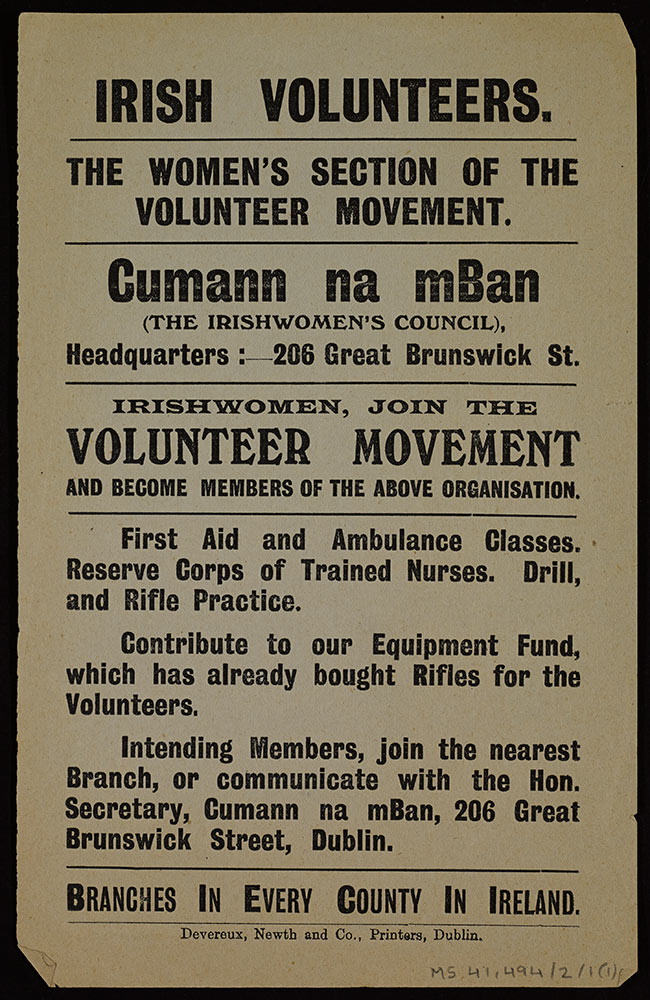
On Friday, the 17th June, 1921, the IRA General Military Headquarters issued official notification that the annual procession to the grave of Wolfe Tone in Bodenstown would take place on that coming Sunday, the 19th.
This republican directive was 'in direct violation' of the Westminster/Dublin Castle imposition of a martial law-type decree (issued under the so-called 'Restoration of Order in Ireland Act' [ROIA]) which 'allowed' British 'authorities' (!) to bypass standard civil liberties, implement curfews, and use military courts-martial to try civilians without 'formally declaring' a state of martial law.
Early on Sunday morning, the 19th (at about 3am) hundreds of (armed) British soldiers were mobilised and stationed on all the roads leading to Bodenstown Graveyard, on the look-out for any signs of groups of men and women forming-up for a procession to the graveyard.
However, the 'venue' in question being a graveyard, 'normal business' took place ie family and relatives etc continued to visit their loved ones and, as the day wore on, no group procession materialised - the Brits took it as 'a win' for them.
Until, that is, they checked the graveyard before heading off to interfere somewhere else, and discovered that Irish republicans had, indeed, assembled - in the graveyard! - and laid a wreath on the grave of Wolfe Tone!
It transpired that a small group of Cumann na mBan Volunteers had breached the 'security cordon' - as planned beforehand by the Republican Movement - assembled in the graveyard, and laid a wreath.
'Just not cricket', as the Brits would say...!
==========================

In 1921, while 'officially' operating as a 'police man' in Dundalk, County Louth, RIC member Mr William Campbell (22), from Dumbarton, in Scotland, apparently sought 'more action' and also worked (!) as an aid to the Black and Tans ; Mr Campbell was only about six months 'in the service of his King in Ireland' and was seemingly anxious to 'prove himself'.
The North Louth Battalion of the IRA noted his activities and listed the fact that, most nights, he left the Bridge Street Barracks, on a bicycle, between 10pm and 11pm (perhaps to meet a woman, an informer, or just looking for republican activity to report on to his Black and Tan buddies?) and a squad was assembled to end his (forever) rambles.
At least five IRA fighters, including Volunteers William Craven, Thomas Morgan, Thomas Richardson, Thomas Darcy and Thomas Faulkner, were instructed to put a 'plan of engagement' in place, and act on it.
At about 10.30pm on the night of the 17th June (1921), as Mr Campbell (wearing his RIC uniform, and armed with his .45 Webley revolver) was cycling along the Newry Road after leaving his barracks, at least three shots were fired at him, and his bicycle went one way and he went another - downwards.
One bullet hit his bicycle, the other two hit him, bringing his outings to an end.
'The Dundalk Democrat' newspaper reported that "..his holster was lying open and his revolver was gone. The body was lifted into the (British Army) tender and conveyed to the morgue at the Louth Infirmary..."
Incidentally, Mr Campbell was actually in breach of his own groupings regulations by travelling unaccompanied and being outside the town boundary ; but he wouldn't be breaking the rules again.

Within hours, however, a few Black and Tans and RIC members were in Dundalk, looking for targets to hit in revenge.
At about 2am on the 18th (June 1921), that armed gang forced entry into 'The Windmill Bar' (on Barracks Street/junction of Quay Stret and Seatown, in Dundalk), a small pub owned and operated by the Watters family - Patrick Watters (18) was an active member of the IRA and his two brothers, John and Bernard, were republican supporters, but not active, militarily.
The three sons were upstairs in bed, their two sisters were asleep in another room, and their mother was asleep in a third bedroom.
The British raiding party were met by the half-asleep Watters family and, during the shouting match and the scuffles, Bernard managed to escape.
The raiders marched Patrick and John outside, the three women were shouting at the Brits and trying to force the release of the two boys, who were barefooted and clad only in shirts and trousers.
The brothers were marched in single file down the road and the Tans/RIC fired at both of them wounding each one ; Patrick was picked up off the ground, stood up against a wall and shot dead, in view of his wounded brother, John, and his mother and two sisters.
The three Watters women were in hysterics, trying to revive Patrick and remove John from the 'custody' of the British killer gang, but the raiding party brushed them out of the way and pushed John to carry on walking down the road.
They marched about twenty yards further on and then shot John Watters dead.
An 'inquiry' was held shortly afterwards (in what was then the 'Old Louth Hospital') at which Mrs Watters and her two daughters spoke about having witnessed Crown Force members taking Patrick and John from their beds and murdering them on the street.
The 'inquiry' concluded that the brothers had been shot "by persons unknown..."
RIP Patrick and John Watters.
==========================

On the 16th June, 1921, an IRA ASU made its way in the evening to a 'Big House', Castletown Motte (/Mount, pictured, aka Dealgan and/or Cú Chulainn's Castle) located on the western outskirts of Dundalk, County Louth, in the townland of Castletown.
Their objective was to destroy the structure, as part of a coordinated 'scorched-earth campaign', to prevent the building being used by enemy forces.
The rebels burned it down hours later (and, on the 18th, another 'Big House' in Dundalk, Ravensdale Park [/'Ravensdale Castle'], was burned to the ground along with Ravensdale Court House).
Making the country uninhabitable for thuggish foreigners : a solid idea...
==========================

In 1915, at 37 years of age, an Offaly man, a Mr Patrick O'Connell, from the townland of Cloncon, in Tullamore, took a notion on the 6th of July in that year to join 'The Royal Irish Regiment' ('Service Number 8909') of the British Army.
And two years later, the 'RIR' took a notion to inform him that he had been "discharged for reason of sickness".
So Mr O'Connell went back to his small family holding in the townland of Cloncon, in Tullamore, in County Offaly, and tried again to make a living for himself from the land.
As with all such British Army 'returnees', the IRA monitored him from a distance to ensure he wasn't 'planted' there by the enemy to gather information against the Republican Movement.
We couldn't find any details of what, if anything, the Movement apparently discovered about his activities but, on the 17th June (1921), as Mr O'Connell was cutting turf (practically 'illegal' now in Ireland) he was approached in the (turf)bog by IRA Volunteers from the Kilbeggan Company, Offaly Brigade, IRA (Commanding Officer Volunteer Sean McGuinness) and taken away for questioning.
On the 19th June his blindfolded body was found near the townland of Killenmore (often spelled 'Killeenmore') in the civil parish of Geashill, in Offaly, with a handwritten note attached to his coat -
'Convicted Spy – Spies and Informers beware of IRA.'
==========================
As Mr O'Connell was cutting his last sleán of turf, about 30 miles (45 km) across the country and down a bit, in the county of Kildare, an RIC member, a Mr George Jones ('Service Number 57697') was having a bath.
He drowned in it.
==========================
Also in Kildare, as Mr Jones was trying to wash the blood off himself, a number of armed men were forcing their way into the home of the Dunne family in the townland of Gráinseach Huigín (Grangehiggin) in Rathernan Civil Parish, in Barony, County Kildare.
They were after Mr Philip Dunne, in apparent connection with a dispute over land.
The Dunne family tried to defend him but were overpowered and, in the scuffles, Mrs Dunne was wounded and her son, Philip - the target - was shot dead.
Three days previous to that operation, those armed men had called to the house looking for Philip Dunne, but he escaped their attention on that occasion.
==========================

On the same day that Mr Philip Dunne was shot dead, about 105 miles (165 km) across the country and down a bit, in the county of Clare, an IRA ASU attached to the 1st Battalion of the Mid-Clare Brigade had opened fire on an RIC Crossley Tender truck at Craighalough (near Newmarket-on-Fergus in that county).
However, during the gunfight, a second RIC Crossley Tender truck arrived on site and the rebels had to shoot their way out.
One of the rebels - Volunteer Thomas Healy (pictured) - took ill afterwards and died.
Volunteer Healy was a native of Duagh, a small village reasonably close to the town of Abbeydorney, in County Kerry, and was a member of the Mid Clare Active Service Unit before joining the East Clare Column ; and, before his involvement with the rebels, had actually worked against them as a member of the RIC, resigning from that grouping in August 1920!
Medics stated that his death, from exhaustion and heart failure, was attributed to his active service with the IRA, and he was taken back home to Duagh, in County Kerry, by the IRA, and buried with full Military Honours.

RIP Volunteer Thomas Healy.
==========================
DEATH IN THE MEDITERRANEAN...

Desmond Boomer, a Belfast engineer working in the Libyan oil-fields, disappeared seven years ago.
Officially, the plane on which he was a passenger crashed as a result of mechanical failure and pilot error.
But is that the real story?
Or were the Irishman and his fellow passengers unwitting victims of the shady war between Islamic fundamentalism and Mossad, Israel's intelligence network?
A special 'Magill' investigation by Don Mullan, author of 'Eyewitness Bloody Sunday'.
From 'Magill' magazine, January 2003.
Shqaqi's wife, Fatiyah, wept over his flag-draped coffin and proclaimed -
"This is your promised day, my comrade. This is the day of your trip to paradise."
In the Iranian capital of Tehran, the 'Coordinating Council for Islamic Propagation' held a special ceremony "to proclaim consolidation with the Palestinian nation and express hatred towards the Zionist regime and its crimes."
'The Tehran Times' newspaper (1st November 1995) reported a similar ceremony, held at the mosque of the University of Tehran, on behalf of the 'Supreme Leader of the Islamic Revolution', which branded "the Zionist regime as the major sponsor of state terrorism", and the 'Islamic Jihad Movement' in Palestine accused Mossad of Shqaqi's assassination...
(MORE LATER.)

In May 1922, 'The Men's Committee' was a disgruntled faction of recruits within the newly established Free State 'Civic Guard' (the precursor to AGS/An Garda Síochána, the present Free State 'police force').
On the 15th May, 1922, during an address by the 'Civic Guard' Commissioner, a Mr Michael Staines, at the Kildare training depot, over 1,000 recruits suddenly broke ranks, mutinied, and raided the armoury. 'The Men’s Committee' was at the heart of this disruption, as was its president, a Mr Thomas Daly.
On the 17th June, 1922, Mr Daly and others met with IRA representatives, including Volunteer Ernie O'Malley, outside Kildare Town and made their way to the Staters Army Barracks in Kildare, where Mr Daly used a password and gained entry for the group into the building.
They tied up the guards on duty and commandeered the armoury's weapons and ammunition - 167 rifles and 243 revolvers, as well as an amount of ammunition for those weapons - and the IRA Volunteers and Mr Daly and some of the other 'Committee' members then travelled to Dublin and joined with the rebels in the Four Courts.
On the 28th June (1922) the Stater Army, supported politically and militarily by the British, attacked the republicans in the Four Courts and, on the 30th June, the rebels surrendered, having lost that battle.
But the campaign - the struggle - for a new Ireland, free of the Stater mentality and free, also, of the British military and political presence - has not been surrendered...
==========================
On the 16th June, 1922, Volunteer Frank Aiken and about fifty other armed rebels took up an ambush position near the village of Druim an Tighe (Dromintee), County Armagh, in wait for a fourteen-man armed patrol from the 'Ulster Special Constabulary'.
On the 17th, the enemy 'police men' walked into the sights of the rebels, and fire was opened up on them.
One 'Special Constable', a Mr Thomas Russell, was shot dead and at least one of his colleagues, a Mr George Hughes, was listed as 'wounded'.
The IRA Volunteers returned safely to base.
Incidentally, for that ambush, some of the Volunteers were stationed in McGuill's Public House, and not only for the vantage point it gave them -
Three days before that ambush (ie on the 14th), just after midnight, eight members of the 'USC' (from the Forkhill Military Barracks) forced entry into McGuill's Pub wanting 'to have a word' with the owner, a Mr James McGuill.
He wasn't there, lucky for him, but the 'Specials' searched the premises, causing destruction as they went from room to room.
Unfortunately, his heavily pregnant wife, Unah, her mother, two small children, a female barworker/housekeeper and a (female) family friend were present.
The invaders proceeded to wreck the pub, helping themselves to as much drink as they wanted, robbing the cash from the till, and then turned their savage intentions to the women on the premises.
Mrs McGuill was beaten up by the thugs, who left her with, among other injuries, a fractured skull, and then three of them raped the poor woman.
The barworker/housekeeper was beaten up by them next, and then she, too, was raped.
The family friend ran upstairs and threw herself from a bedroom window.
Word about the 14th June sexual atrocities and sexual violence travelled fast in Irish republican circles and, on the 17th June, a party of about 20-30 armed IRA volunteers from the Ravensdale Training Camp in County Louth crossed the then new British-imposed border into South Armagh and carried out coordinated attacks on a unionist/loyalist farming community in the Altnaveigh and Lisdrumliska areas, just outside Newry, leaving six people dead, four others wounded, and about twelve houses burned or bombed.
In our opinion, the IRA should have continued to concentrate their attacks that day on British military and paramilitary targets, not on ordinary unionists/loyalists.
==========================
As the Volunteers were leaving the Training Camp on the 17th, about 180 miles (290 km) down the road in the townland of An Mhoingeach Thoir (Meggagh East) in Carran (/Carron), in the county of Clare, six other Volunteers forced entry into the home of the Kilmartin family, who had connections with the newly-formed Free State 'Civic Guards'.
They were looking for a Mr Stephen Kilmartin, who was there with his wife, Margaret ; there was a scuffle, during which about six shots were fired, one of which hit Mrs Kilmartin, and the poor woman died from the wound.
==========================

On that same Saturday, the 17th, about 100 miles (160 km) up the road in the townland of An Leathbhaile ('Lavally'), in the Ballymote area of the county of Sligo, armed rebel Volunteers entered the home of the Brehany family.
They were looking for James Brehany, an ex-RIC member, but were confronted and challenged by his brother, John, who argued with them.
In the verbal and physical melee that followed, Mr John Brehany was wounded ; as his brother, James, wasn't in the house, the Volunteers reported back to base.
The wounded man died from his injury hours later.
==========================

Over the 17th and 18th of that same month (June 1922), about 130 miles (210 km) across the country and up a bit in the Belfast area, at least eight businesses were hit during economic attacks by the IRA.
Volunteers Joseph Doran, Joseph McGlade, and John Donegan were captured on the morning of the 18th by the Crown Forces and 'arrested' in Harry Ferguson's Garage on Chichester Street (at about 4.45am) but, because they had no weapons, matches, or incendiary materials on them, they were only prosecuted 'for a curfew violation' offence.
The three men were ordered by the 'court' to pay a standard fine and post a £20 bond as a legal surety to 'keep the peace' for the following twelve months (!) but refused to do so.
However, outside supporters paid the fines 'and successfully posted the peace bonds' but, on the 5th of July, the Stormont 'Home Affairs Minister', a Mr Dawson Bates, circumvented their release by signing executive internment orders against the three men!
Instead of being set free, they were indefinitely detained under the 'Civil Authorities (Special Powers) Act', taken from Crumlin Road Jail to the infamous prison ship 'SS Argenta', which was anchored in Belfast Lough but was later moved to Larne Harbour.
Those three Volunteers - internees - were released in late 1924 when the 'SS Argenta' prison ship was officially decommissioned and the internment policy from that specific period was wound down.
Meanwhile, Irish republicans continue to seek the 'winding down' of the British writ over any part of Ireland.
==========================
ON THIS DATE (17TH JUNE) 52 YEARS AGO : IRA BOMB WESTMINSTER.

On Monday, 17th June 1974, the then IRA decided to make it's presence felt, once again, in 'the Belly of the Beast' - a 20lb device exploded at the British Parliament, causing widespread damage and injuring 11 people.
Six months before that attack, the IRA had exploded two bombs in London - one at Madame Tussauds and one at a boat show which was taking place at Earls Court Exhibition Centre and, one month after the 17th June attack, two bombs also exploded in London - British government buildings in Balham, South London, were damaged in the first explosion that day and the Tower of London was the target for the second bomb.
This is a BBC report of the 17th June 1974 IRA attack -
'A bomb has exploded at the Houses of Parliament, causing extensive damage and injuring 11 people.
The IRA said it planted the 20lb (9.1 kg) device which exploded at about 0828 BST in a corner of Westminster Hall.
The explosion is suspected to have fractured a gas main and a fierce fire spread quickly through the centuries-old hall in one of Britain's most closely-guarded buildings.
Scotland Yard detectives have said they fear this attack could herald the start of a new summer offensive by the dissident Irish group on government buildings.
No one expected in those days the House of Commons would be a target - security was extremely casual.'
Former Labour MP Tam Dalyell ('Sir Thomas Dalyell of the Binns, 11th Baronet'!) gave this account -
"A man with an Irish accent telephoned the Press Association with a warning only six minutes before the explosion. Police said a recognised IRA codeword was given. Although officers were not able to completely clear the palace before the bomb went off, most of the injured were only slightly hurt" and Edward Short, the Leader of the British 'Commons', announced that a review of security procedures would begin immediately, but he said the attack would not disrupt parliamentary business or intimidate MPs.
Liberal Chief Whip David Steel was in the building when the device detonated and told the BBC the damage looked considerable -
"I looked through Westminster Hall and the whole hall was filled with dust. A few minutes later it was possible to see flames shooting up through the windows..."
Today, the group that carried out that attack are only a short step away from again entering that bastion of British misrule but, this time, to assist their new objective of administering the British writ in Ireland.
Shame on them.
Thanks for the visit, and for reading - much appreciated!
Sharon and the team.
We'll be back with more bits and pieces on Wednesday, 1st July 2026 when, be the looks of things, we'll have four million hits to brag about ; GRMA!