ON THIS DATE (6TH DECEMBER) 102 YEARS AGO : A TERRIBLE CATASTROPHE IS BORN.
One of the leaflets (pictured) distributed by Irish republicans in late 1921 to counteract anti-republican propaganda that the 'Treaty (of Surrender)' was "a stepping stone" to that which they had fought for - indeed, one of those who accepted that Treaty, ex-republican Arthur Griffith, declared, in a press release immediately after signing same - "I have signed a Treaty of peace between Ireland and Great Britain. I believe that treaty will lay foundations of peace and friendship between the two Nations. What I have signed I shall stand by in the belief that the end of the conflict of centuries is at hand."
Yet historian Nicholas Mansergh noted that, at practically the same time as Griffith had penned the above, the British were talking between themselves of "...concessions (from the Irish) wrung by devices..some of which can be described at best as devious..every word used and every nuance was so important..."
On Monday 5th December 1921 - the day before the Treaty of Surrender was signed - the then British Prime Minister, Lloyd George, announced to the Irish side in the negotiations that he had written two letters, one of which would now be sent to his people in Ireland ; one letter told of a peaceful outcome to the negotiations, the other told of a breakdown in the negotiations - Lloyd George stated that if he sent the latter one "it is war, and war within three days. Which letter am I to send?"
(Years later, the Minutes of a British Cabinet meeting at which the 'Treaty' was discussed were released, and they showed that the majority of British politicians at the meeting "generally agree" that "the rough treatment to which the Irish extremists had been subjected during the past twelve months... had brought home to the (IRA) men in the field the need for some equitable compromise..." [UK National Archives, CAB 23/27/17]. Those people were also of the opinion "that a Boundary Commission would possibly give Ulster [sic] more than she would lose..")
That 'war letter' meeting took place on the afternoon of Monday 5th December 1921 ; at around 7pm that same evening, the Irish team left the Downing Street meeting to discuss the matter between themselves and returned to Downing Street later that night.
At ten minutes past two on the morning of Tuesday 6th December 1921 - 102 years ago on this date - Michael Collins and his team accepted 'dominion status' and an Oath which gave allegiance to the Irish Free State and fidelity to the British Crown - the Treaty was signed (and it should be noted that Collins and his team did not consult the [32-County] Dáil, the institution on whose behalf they were acting, before they signed it. Also, Mr Collins took the time to write to Kitty Kiernan saying that he did not get to bed until five o'clock that morning. He added - "I don’t know how things will go now but with God's help we have brought peace to this land of ours – a peace which will end this old strife of ours forever." He was wrong about it bringing peace, but was soon to catch up on his sleep. Also, when Mr Arthur Griffith got back to Dublin after his meetings in London, one of his first acts was to organise various meetings with 'representatives of the Southern unionists' [ie anti-republican elements in the country] to guarantee that "their interests would be safeguarded" in his new Free State!) :
On the 16th December (1921), the British so-called 'House of Commons' (by a vote of 401 for and 58 against) and its 'House of Lords' (166 for, 47 against) ascribed 'legitimacy' to the new State and, on the 7th January 1922, the political institution in Leinster House voted to accept it, leading to a walk-out by then-principled members who, in effect, were refusing to assist in the setting-up of a British-sponsored 'parliament' in the newly-created Irish Free State.
Mr Éamon de Valera was reportedly very annoyed when he heard that the 'Treaty' had been signed without his final consent but, later that same day, he dressed-up in his academic robes and, in his capacity as 'Chancellor of the National University of Ireland', he chaired an event to mark the anniversary of the death of Dante Alighieri in 1321. Mr de Valera was later to fully enforce the structure and operation of that same 'Treaty'. Mr Alighieri was known to have penned some verses on 'hypocrisy'...
But, at an IRA convention on the 26th March (1922), at which 52 out of the 73 IRA Brigades were present - despite said gathering having been forbidden by the Leinster House institution (!) - the 'Treaty' was rejected and a statement issued deriding Leinster House for having betrayed the Irish republican ideal.
Within six months, a Civil War was raging in Ireland, between the British-supported Free Staters and Irish republicans who did not accept the 'Treaty' and that vicious fight continued until the 24th May 1923 when the IRA were ordered by their leadership to "..dump arms (as) further sacrifice on your part would now be in vain and the continuance of the struggle in arms unwise in the national interest...military victory must be allowed to rest for the moment with those who have destroyed the Republic.." , but, 'unofficially', Free Staters continued to exact revenge on republicans for some time afterwards and, indeed, are still doing so today, albeit in a different manner.
On the 11th July 1924, the Treaty was registered at the 'League of Nations' by the Free State authorities which, in our opinion, would have been the ideal occasion for a legal challenge to it, based on the fact that, when Michael Collins and his supporters were attempting to 'sell' it to their own side, they made a big deal of the 'Boundary Commission' clause and in particular the part of it which stated that the 'border' could be adjusted "in accordance with the wishes of the inhabitants", which is precisely why Westminster 'took' only six of the nine Ulster counties - a built-in 'majority'.
Also, the British actually took it on themselves to amend the 1921 Treaty of Surrender to allow themselves (ie Westminster) to unilaterally appoint a representative to speak on behalf of the Stormont 'Parliament'.
That Boundary Commission clause ('Article 12') was not properly adhered to by the signatories of the 1921 Treaty thereby, legally, negating the Treaty itself but deep pockets would be required to take such an action.
And the only grouping in this State in a position to mount a challenge like that is the same (Free State) grouping which benefited then and continues to benefit today from that Clause and that which spawned it. For now they do, anyway...
(Incidentally, decades after the 'Treaty of Surrender' had been signed, the diary kept by a prominent British Army officer and politician, a 'Sir' Henry Wilson, was opened [after his death] and, in it, he had opined about that 'Treaty'- "The Agreement [sic] is complete surrender...a farcical oath of allegiance...withdrawal of our troops...a Rebel Army! The British Empire is doomed..."
If only it truly was, Mr Wilson. If only...)
'AMERICAN NOTES...'
From 'The United Irishman' newspaper, April 1955.
The New York GAA have given the use of Gaelic Park for a field day in aid of the 'Prisoners Dependents Fund' on March 27th.
The president of the New York GAA, John Kerry O'Donnell, and the other officers of the New York Council, have given of their time to help plan the event, and preparations are also now nearing completion for the biggest Easter Commemoration that New York has had for years, and the 'Clan na Gael-IRA Veterans of America Inc' will direct the proceedings.
An active committee representative of many organisations in overseeing arrangements for the function to be held at the Pythian Temple, West 70th Street, New York, on Easter Sunday night : Barney Rooney is the General Chairman (sic)...
(MORE LATER.)
ON THIS DATE (6TH DECEMBER) 98 YEARS AGO : A 'CON' ARTIST IS BORN!
Con Houlihan, pictured, a sports writer who sometimes strayed into other subjects, was born on this date - 6th December - in 1925, 98 years ago on this date.
One of those 'other subjects' that Mr Houlihan occasionally visited was politics (he was a Fine Gael supporter, it seems) which prompted us to post a piece on this blog a few years ago in connection with a highly coloured article (!) that the man wrote after he happened to share street-space with Ruairí Ó Brádaigh -
'Not so much (or at all, even) 'speaking ill of the dead' in this piece as highlighting the straws an 'artist' will clutch at when they attempt to stray onto another 'canvass'. And Mr. Houlihan was indeed an 'artist' when it came to discussing and dressing-up/colouring in matters of the field and had wonderful turns of phrase which he employed with great timing.
But he done himself no favours when he attempted to 'stray' on to the well-trodden anti-republican 'canvass', where he was not as sure-footed as he was 'on the field' - indeed, the only way he could sustain an 'away trip' of that nature was to use a straw man argument in the hope that those as unfamiliar with that particular 'turf' as he was would consider him to be as good a 'pol corr' as he was a sports writer.
The first fault with Mr. Houlihan's effort in this piece is that a radio station would not be played through the same loudspeakers on the same stage at the same time as an Irish republican was addressing an Irish republican gathering. It just wouldn't happen, simple as and, whilst some might dismiss this example as 'nit picking', it is from such 'little acorns' that mighty deceptions spring from.
It was a 'straw man' introduction that the author invented in order to 'colour' the gathering as "inflamed with hatred..indoctrinated by bigots in pubs and cafes or by mob orators..", before bringing in the standard 'Nazi' comparison.
All standard fare for any 'straw man' author - invent a 'connection' then rage against it. Mr. Houlihan got his answer days later from that particular "bigot (of a) mob orator" but the damage had been done : through deliberate misrepresentation, one anti-republican had 'confirmed' to others of that ilk just how right they were to despise Irish republicans and republicanism in general and, job done, Con parked his 'straw weapon' (in the back of the net, no doubt) to be (ab)used another day. Which he did, by the way - and often - but I'll not go into that here , as I have no desire to 'speak ill of the dead'..' (from here.)
Mr. Houlihan died on the 4th August, 2012, at 86 years of age. He was a fantastic sports writer, so I'm told (regular readers will know that I'm not big into sports or those that write about it etc) but I knew Ruairí, and I know how republicans carry themselves at rallies and protest marches etc and considered it fitting, and necessary, to repeat the above piece on the 'Con Almighty's' birthday.
IRELAND ON THE COUCH...
A Psychiatrist Writes.
'Magill' commissioned Professor Patricia Casey to compile an assessment of Irish society at what may emerge as the end of a period of unprecedented growth and change.
This is her report.
From 'Magill Magazine' Annual, 2002.
Further evidence for the ongoing role that Catholicism has in people's lives came from the study by Greally and Ward, published in late 2000, which surveyed 1,010 people in the Irish Republic (sic) as part of a larger, longitudinal European study.
The results are fascinating, not least because many of them are counter-intuitive and challenge the much-vaunted belief that the churches are empty and that our '20-somethings' have no interest in religion.
According to the results, Ireland is still the most religious country in Europe and there has been little change in weekly mass attendance during the 1990's, with the decline to the present level of 63 per cent occurring before the crop of clerical sexual scandals came to public attention.
The attitudes to the priests working in parishes at the coalface remain very positive, and the cohort now in their 20's have higher regard for these priests than any other age group, even when compared with their grandmothers born in the 1930's.
However, the institutional Church has suffered a serious decline in confidence since the last survey in 1991, with just 28 per cent having a great deal of confidence in the institutional Church...
(MORE LATER.)
6TH DECEMBER...
1919 :
IRA Volunteer Edward Malone, of Dunbrin, Athy, in County Kildare (a nephew of well-known cleric Reverend JJ Malone), was back in a British prison (Ship Street Barracks), having been in 'court' the previous day (5th December).
He had been charged with possession of 10 detonators, a document "likely to cause disaffection", a document "likely to prejudice discipline within the RIC" (!) and possession of a Winchester Rifle.
Volunteer Malone refused to recognise the 'court' but was sentenced anyway - to two years imprisonment with hard labour (but one year was remitted later).
==========
1919 :
John Charles Byrne (pictured) , aka 'Jack Jameson/Keith Prowse', a former British Army soldier who had been recruited into 'British Intelligence' by a Mr Basil Thomson of the London Metropolitan Police, arrived in Dublin on the 6th December, 1919, posing as a socialist theatre worker/musical instrument salesman, and let it be known that he could be helpful to the Irish republican Cause.
He was eventually put in contact with Michael Collins, who contacted one of his agents in London (Art O'Brien), who had supplied Mr Byrne with a cover note of introduction to Collins. The two men discussed the new 'benefactor', who had met with Collins twice and left an uneasy feeling behind him, on both occasions, with Collins and Squad members.
Mr Byrne was given false information by the IRA and, when that information was acted on by British operatives, the jig was up for the 'benefactor' : his body was found in Drumcondra, in Dublin, on the 7th March 1920.
'British Intelligence' later described him as "..the best Secret Service man we had...".
==========
1920 :
On the 6th December, 1920 (listed as 'October 1920' by some sources) as a Republican Court was in session in the village of Craggaknock, near Kilkee, in County Clare, armed and semi-uniformed men burst in to the building and stopped the proceedings.
The Black and Tans had arrived.
They were looking for one person in particular - an IRA man named William Shanahan (pictured) - they knew he had been there, but was no where to be found now.
But they wanted blood, so they opened-up on the unarmed civilians in the room, killing a local man, a Mr Thomas Curtin.
A local doctor stated that "the bullet had caused a wound about three to four and a half inches long. It had ripped up the skull, the coverings of the brain and the brain itself. The wound was about one inch wide. An ordinary rifle bullet was used, at about 500 yards range..."
==========
1920 :
On Monday, 6th December 1920, as Dublin Corporation was holding its monthly meeting in 'City Hall' in Dublin, British Auxiliaries stormed the venue, led by a Captain William King, and 'arrested' six elected political representatives - Michael Staines, Thomas Lawlor, Joseph Clarke, James V. Lawless, James Brennan and Michael Lynch.
Their intention was to disrupt Irish political life in Ireland, as they were aware that not all politicians supported 'the Crown'. They then "requisitioned" (under DORA 'legislation') the 'City Hall' building and another political institution, 'Municipal Buildings', for use by the British political and military forces.
==========
1920 :
On the 6th December, 1920, having been instructed by his betters (!) in Westminster to do so, British Army Lieutenant-General 'Sir' Henry Hugh Tudor ('KCB, CMG etc!') issued a notice to the British 'police force' in Ireland, the RIC, to, basically, 'calm down'.
That grouping, the RIC, had 'unofficially' been given carte blanche by Westminster to run riots in Ireland and terrorise the population, in order to 'restore and maintain law and order'. Britain's version of 'law and order', that is - the order was effective, for a few days, and then ignored. Westminster, too, ignored the fact that it had issued the order in the first place.
==========
1922 :
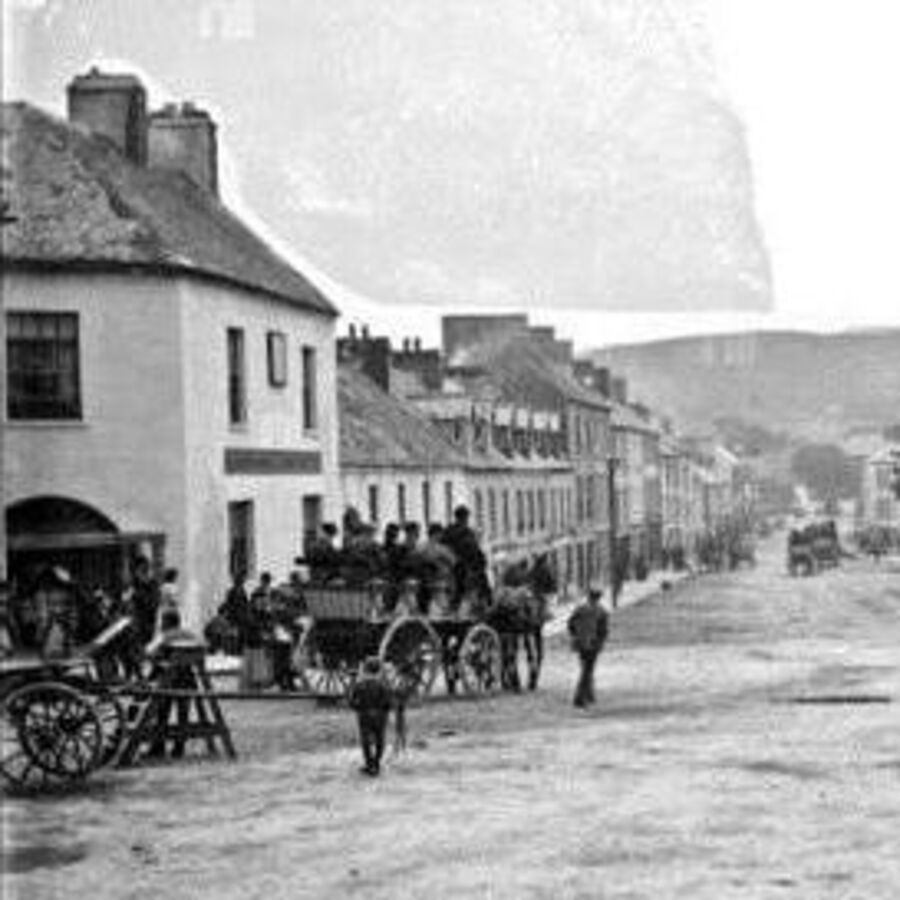
On the 6th December, 1922, Free State forces finally took over the town of Kenmare (pictured), in County Kerry.
The town had been held by the rebels (IRA) since September, 1922, and the Staters had tried, twice, to take it from them, but failed on both occasions. But, on the 6th December that year, the Leinster House Free State administration sent in three military columns of their armed forces to 'secure' the town, which they did, this time, and 'arrested' fourteen rebels in the process.
==========
1925 :
In order to 'legitimise the new Irish State in Northern Ireland' (sic) in the political eyes of the world, Westminster and its offspring in Leinster House needed to present the 'Stormont Government' (sic) in the Occupied Six Counties as 'an agreed positve advancement'.
So those three anti-republican, pro-British political institutions came up with a 'Tripartite Agreement' which all three would get on board with and sign off on.
In a speech in Dublin, Mr Éamon de Valera (playing the rebel) loudly objected, calling the 'Agreement' a "mediated crime" and described those in Leinster House as "Free Staters who had sold our countrymen for the meanest of all considerations – a money consideration..".
However, within two years, Mr de Valera and his followers had accepted political office in the Free State 'parliament' and Establishment...!
==========
BEIR BUA...
The Thread of the Irish Republican Movement from The United Irishmen through to today.
Republicanism in history and today.
Published by the James Connolly/Tommy O'Neill Cumann, Republican Sinn Féin, The Liberties, Dublin.
August 1998.
('1169' comment - 'Beir Bua' translates as 'Grasp Victory' in the English language.)
Republican Sinn Féin, likewise, follows in the traditions of Tone, Emmet, the Fenians and Pearse.
We accept the programme of previous generations of republicans - 'Ireland Free'. No compromising 'interim settlement' is acceptable.
"The task we take up again is just Emmet's task of silent unattractive work, the routine of correspondence and committees and organising. We must face it as bravely and as quietly as he faced it, working on in patience as he worked on, hoping as he hoped, cherishing in our secret hearts the mighty hope that to us, though so unworthy, it may be given to bring to accomplishment the thing he left unaccomplished, but working on even when that hope dies within us..." - Padraig Pearse.
The Union Creed Of The United Irishmen :
"I believe the land, or any part of it, cannot become the property of any man, but by purchase, or as rewards for forwarding and preserving the public liberty.
I believe our present connection with England must be speedily dissolved.
I believe that old age, pregnant women and labour should be honoured.
I believe that treason is the crime of betraying the people.
I believe religious distinctions are only protected by tyrants.
I believe applying the lands of the church to relieve old age, to give education and protection to infancy, will be more acceptable to a united people, than maintaining lazy hypocrites and ravenous tithe-gatherers.
In this faith I mean to live, or bravely die..."
(MORE LATER.)
Thanks for the visit, and for reading.
Sharon and the team.
Showing posts with label Barney Rooney. Show all posts
Wednesday, December 06, 2023
FROM 1922 - "A REBEL ARMY! THE BRITISH EMPIRE IS DOOMED..."
Labels:
Arthur Griffith,
Barney Rooney,
Con Houlihan,
John Kerry O'Donnell,
Lloyd George,
Michael Collins,
Nicholas Mansergh,
Pythian Temple West 70th Street New York,
Ruairí Ó Brádaigh.
Wednesday, May 06, 2020
AN IRISH INVINCIBLE WHO DEDICATED 52 YEARS OF HIS LIFE TO THE CAUSE.
'SAOIRSE IRISH FREEDOM' NEWSPAPER MAY 2020 FREE DOWNLOAD...
'Saoirse – Irish Freedom is the voice of the Irish Republican Movement. The monthly newspaper of Republican Sinn Féin, it takes its name from Irish Freedom – Saoirse, a Fenian paper which first appeared in November 1910 and continued as a monthly publication until December 1914 when it was suppressed by the British authorities. Among the contributors to that paper were Bulmer Hobson, PS Hegerty, Terence McSwiney, Pádraig Pearse, Ernest Blythe, Piaras Beaslaí, Pat Devlin, Fred Cogley, JW Good and Roger Casement. Irish Republicans have always attempted to produce a newspaper, as a means of speaking to the people. As revolutionaries we have had to rely on our own resources to counter-act the status quo message promoted by the Establishment media...' (from here.)
The May 2020 issue of this Irish republican newspaper can be downloaded, for free, here ; but you will be asked for a small few bob next month, for the June 2020 issue - the newspaper, and the organisation which produces it, are (obviously!) not State-funded and your custom would be greatly appreciated. Thank You - GRMA!
ON THIS DATE 138 YEARS AGO : 'THE INVINCIBLES' STRIKE A BLOW IN DUBLIN'S PHOENIX PARK.
6th May, 1882 (138 years ago on this date) - the scene of the executions in the Phoenix Park, Dublin, pictured, of two top British officials, 'Lord' Frederick Cavendish, and his under secretary, Thomas Henry Burke, by members of 'The Invincibles'.
The killings were condemned by both the Irish establishment and the churches ; indeed, Charles Stewart Parnell publicly condemned the killings, but he was implicated in same by letters published in 'The Times' newspaper, allegedly written by him. The letters expressed sympathies with the killers and suggested his public condemnation of them had been insincere. Parnell denied he had written the letters and they were subsequently proven to be forgeries, penned by Richard Pigott, a journalist who had a long-standing grudge against Parnell. After he had cleared his name, Parnell received a standing ovation from his fellow MPs on his first return to the House of Commons, a 'Welcome Back', if you like, for one of their own.
However - months went by and no arrests were made. Then, in one day, twenty-six men (all members of 'The Invincibles') were arrested and charged with the 'Phoenix Park murders'. The men soon realised that this was no 'desperate face-saving' expedition by the British ; one of the top members of the organisation, James Carey, had turned informer and his brother, Peter, also told the British all he knew about the group.
The other jarvey (cab-driver), Michael Kavanagh, also agreed to inform on the 'Invincibles'. Between May and December 1883, fourteen 'Invincibles' passed through Green Street Courthouse - five of them were hanged - some of them not 'properly' so - they were then decapitated and their remains were 'gifted' to be used for 'medical science' purposes. One of those spared the death penalty but who was sentenced to life imprisonment instead was James 'Skin-the-Goat' Fitzharris, who was arrested on the evidence given by the other driver, Michael Kavanagh.
When he was first arrested, the British offered Fitzharris (pictured) a deal if he, too, would turn informer, but he refused. His 'trial' actually ended with him being acquitted by the jury but the judge then halted proceedings and ordered that he be re-arrested ; he was then charged with being an 'accomplice' in the deed, found guilty, and sentenced to life. During both of his 'trials', 'Skin-the-Goat' made a mockery of the proceedings and refused to recognise the so-called 'authority' of the British to carry-out such functions in Ireland. James 'Skin-the-Goat' Fitzharris was fifty years of age when he began his life sentence - he was sixty-five when he got out of (Portlaoise) Prison, and things had changed ; his comrades were either dead or had moved away and, to the eternal shame of the Republican Movement, it turned its back on the man.
He had no job and no-where to live, he knew no-one and no-one wanted to know him. His choice now was to live on the street or sign himself into the workhouse - he chose the latter, and survived for the next twelve years as a pauper, between the gutter and the workhouse. He died in 1910 (on 7th September) aged seventy-seven. He was jobless, homeless and friendless when he died, alone, in the South Dublin Union Workhouse in James Street, Dublin.
James 'Skin-the-Goat' Fitzharris was twenty-five years young when he joined the Movement in 1858 and stayed true to his republican principles for fifty-two years, until he died. He had a hard life, in hard times, but he came through it and never recanted his actions or his beliefs. And, to his credit, he was working for a noble cause, unlike the two British agents/officials he encountered in the Phoenix Park in Dublin, on the 6th May, 1882, 138 years ago on this date, and unlike the informers and the politicians he encountered along the way.
'SINN FÉIN POST-ELECTION STATEMENT.'
From 'The United Irishman' newspaper, June, 1955.
"Sinn Féin entered the contest of these elections with the definite purpose of raising the issue of foreign occupation of Irish territory above the rut of party politics and of uniting the people in the demand that the British occupation forces must leave Ireland.
The issue is plain and simple and in placing it before the people of Ireland, and of the public at large, Sinn Féin entertains no feelings of animosity against any Irishman because of class, creed or individual outlook. This was plainly demonstrated by the manner in which Sinn Féin conducted the election campaign.
The verdict of the polls is most gratifying, and amply justifies the Sinn Féin approach to the ending of British occupation, and the evils that stem from Britain's unwarranted interference in affairs that are the sole concern of the Irish people. Sinn Féin made it amply clear both before and during the campaign that its intention of pursuing its policy would remain unaffected by the election results..." (MORE LATER.)
FIT TO PRACTISE...?
As social work in Ireland reaches a landmark, Phil MacGiolla Bháin argues that the profession is flawed beyond salvation.
From 'Magill' magazine, July 2002.
We need another set of rules and structures for people charged with protecting children and assisting families. It would help, of course, if these could see the children and parents they come into contact with as human beings rather than as objectified by an abstract ideology.
When occasionally eyebrows are raised concerning the involvement of social workers in the life of a family, the explanation for failure or error is either the individual failings of a social worker and/or an organisational failing of health boards snowed under with work.
It would be a crass mistake to believe that Moira Woods was some off-the-wall maverick who got it terribly wrong. In the wake of the report of the Medical Council's 'Fitness to Practise Committee', there was much blather about structures being different now - multi-disciplinary, working-peer reviews etc - but what hasn't changed since the time of Moira Woods is the worldview of the vast majority of those 'practising' child protection. If anything, this has got worse... (MORE LATER.)
'1169' comment : we have mentioned this instance of elder abuse in our area (Clondalkin, Dublin) before on the blog ; the two sisters and their families lost in their criminal endeavours and had all financial access to their parents savings taken from them, but the decent neighbours and friends etc won't forgive them for what they done and the resulting animosity is still fresh to this day, which is not at all surprising. The 'Fit To Practise' article has reminded us of a particular episode which happened within days of the two women having had their access to their parents bank account and credit union account taken from them by their brother ('Uncle S'), who was in the process of putting a stop to his parents savings and pensions being 'appropriated' by those two sisters and their families.
Besides the physical fights that ensued (two such confrontations that us locals know about, each one started by the sisters or one of their family members) - one in a local pub at a 60th birthday party and the other when the husband of one of the sisters attempted to hold 'Uncle S' hostage in his deceased parents bungalow - the two sisters, in one attempt to wrest back financial control, actually reported their brother to Social Services in Cherry Orchard, in Ballyfermot, for 'financial elder abuse of his mother'!
The Social Service man and the Office he represented, acting solely on the 'word' of the two sisters, tried to 'legally' browbeat and threaten the poor man into handing all financial access back to his two sisters but 'Uncle S' vigorously defended both himself and the action he had been forced to take because of the morally-corrupt deeds of his two sisters and their families and repeatedly offered to show that Social Services Office the proof of the thievery that had taken place and called their bluff by suggesting that they take a legal case against him, during which the two sisters would be named and shamed, in public, and the shortfallings in how the Social Services 'industry' in this State operates would be highlighted by him, with that particular Office practitioner being named and a legal case taken against him. 'Uncle S' stood his ground and that State 'service' backed down, apologised, and offered to drop the whole issue, to which 'Uncle S' replied that he wanted them to take a case against his two sisters for 'financial elder abuse' and that Office said they would get back to him about that. They never did, and the reason is obvious - because their own incompetence would have been exposed in any such court case so they decided to do nothing!
Definitely 'not fit for practise', as presently constituted, but they can be successfully challenged and defeated, and they should be ; they are too powerful in this State and believe themselves to be beyond reproach.
'FR. LIAM PILKINGTON DEPARTS FOR IRELAND...'
From 'The United Irishman' newspaper, November 1954.
Other speakers dwelt on the contribution made by Fr. Liam Pilkington (pictured) one of the top leaders of the Anglo-Irish war, to the defeat of the Black and Tan terror and the upholding of the Republic in the days following the acceptance of the Treaty.
Dr. Andrew Cooney, former Chief of Staff of the IRA, said Fr. Pilkington was probably the only senior officer surviving who had not deviated by as much as one inch from the principles of Irish republicanism, or the position he had taken in the dark days of 1922. Liam Cotter (pictured), Chairman of the 'Republican Prisoners Aid Committee', said the economic side of the struggle for Irish freedom had always been stressed by the leaders of the Republican Movement from Wolfe Tone on down.
Michael McGinn of Philadelphia spoke of a recent visit to Ireland and how the people there felt regarding Irish republicanism. Others who spoke briefly included Paddy O'Mahoney, Diarmuid Corkery, Eamon Deady, who are going to Ireland on a visit, and John Kerry O'Donnell.
Barney Rooney summed up and thanked the gathering for coming there to honour a great leader. He, himself, had served under him in the old days. Joe Stynes was the Committee Chairman. (END of 'Fr. Liam Pilkington Departs For Ireland'. NEXT - 'Eithne Nic Sibhne', from the same source.)
Thanks for reading - Sharon and the '1169' team. Stay safe, and 'play' safe. Or at least don't be as reckless as the old you!
'Saoirse – Irish Freedom is the voice of the Irish Republican Movement. The monthly newspaper of Republican Sinn Féin, it takes its name from Irish Freedom – Saoirse, a Fenian paper which first appeared in November 1910 and continued as a monthly publication until December 1914 when it was suppressed by the British authorities. Among the contributors to that paper were Bulmer Hobson, PS Hegerty, Terence McSwiney, Pádraig Pearse, Ernest Blythe, Piaras Beaslaí, Pat Devlin, Fred Cogley, JW Good and Roger Casement. Irish Republicans have always attempted to produce a newspaper, as a means of speaking to the people. As revolutionaries we have had to rely on our own resources to counter-act the status quo message promoted by the Establishment media...' (from here.)
The May 2020 issue of this Irish republican newspaper can be downloaded, for free, here ; but you will be asked for a small few bob next month, for the June 2020 issue - the newspaper, and the organisation which produces it, are (obviously!) not State-funded and your custom would be greatly appreciated. Thank You - GRMA!
ON THIS DATE 138 YEARS AGO : 'THE INVINCIBLES' STRIKE A BLOW IN DUBLIN'S PHOENIX PARK.
6th May, 1882 (138 years ago on this date) - the scene of the executions in the Phoenix Park, Dublin, pictured, of two top British officials, 'Lord' Frederick Cavendish, and his under secretary, Thomas Henry Burke, by members of 'The Invincibles'.
The killings were condemned by both the Irish establishment and the churches ; indeed, Charles Stewart Parnell publicly condemned the killings, but he was implicated in same by letters published in 'The Times' newspaper, allegedly written by him. The letters expressed sympathies with the killers and suggested his public condemnation of them had been insincere. Parnell denied he had written the letters and they were subsequently proven to be forgeries, penned by Richard Pigott, a journalist who had a long-standing grudge against Parnell. After he had cleared his name, Parnell received a standing ovation from his fellow MPs on his first return to the House of Commons, a 'Welcome Back', if you like, for one of their own.
However - months went by and no arrests were made. Then, in one day, twenty-six men (all members of 'The Invincibles') were arrested and charged with the 'Phoenix Park murders'. The men soon realised that this was no 'desperate face-saving' expedition by the British ; one of the top members of the organisation, James Carey, had turned informer and his brother, Peter, also told the British all he knew about the group.
The other jarvey (cab-driver), Michael Kavanagh, also agreed to inform on the 'Invincibles'. Between May and December 1883, fourteen 'Invincibles' passed through Green Street Courthouse - five of them were hanged - some of them not 'properly' so - they were then decapitated and their remains were 'gifted' to be used for 'medical science' purposes. One of those spared the death penalty but who was sentenced to life imprisonment instead was James 'Skin-the-Goat' Fitzharris, who was arrested on the evidence given by the other driver, Michael Kavanagh.
When he was first arrested, the British offered Fitzharris (pictured) a deal if he, too, would turn informer, but he refused. His 'trial' actually ended with him being acquitted by the jury but the judge then halted proceedings and ordered that he be re-arrested ; he was then charged with being an 'accomplice' in the deed, found guilty, and sentenced to life. During both of his 'trials', 'Skin-the-Goat' made a mockery of the proceedings and refused to recognise the so-called 'authority' of the British to carry-out such functions in Ireland. James 'Skin-the-Goat' Fitzharris was fifty years of age when he began his life sentence - he was sixty-five when he got out of (Portlaoise) Prison, and things had changed ; his comrades were either dead or had moved away and, to the eternal shame of the Republican Movement, it turned its back on the man.
He had no job and no-where to live, he knew no-one and no-one wanted to know him. His choice now was to live on the street or sign himself into the workhouse - he chose the latter, and survived for the next twelve years as a pauper, between the gutter and the workhouse. He died in 1910 (on 7th September) aged seventy-seven. He was jobless, homeless and friendless when he died, alone, in the South Dublin Union Workhouse in James Street, Dublin.
James 'Skin-the-Goat' Fitzharris was twenty-five years young when he joined the Movement in 1858 and stayed true to his republican principles for fifty-two years, until he died. He had a hard life, in hard times, but he came through it and never recanted his actions or his beliefs. And, to his credit, he was working for a noble cause, unlike the two British agents/officials he encountered in the Phoenix Park in Dublin, on the 6th May, 1882, 138 years ago on this date, and unlike the informers and the politicians he encountered along the way.
'SINN FÉIN POST-ELECTION STATEMENT.'
From 'The United Irishman' newspaper, June, 1955.
"Sinn Féin entered the contest of these elections with the definite purpose of raising the issue of foreign occupation of Irish territory above the rut of party politics and of uniting the people in the demand that the British occupation forces must leave Ireland.
The issue is plain and simple and in placing it before the people of Ireland, and of the public at large, Sinn Féin entertains no feelings of animosity against any Irishman because of class, creed or individual outlook. This was plainly demonstrated by the manner in which Sinn Féin conducted the election campaign.
The verdict of the polls is most gratifying, and amply justifies the Sinn Féin approach to the ending of British occupation, and the evils that stem from Britain's unwarranted interference in affairs that are the sole concern of the Irish people. Sinn Féin made it amply clear both before and during the campaign that its intention of pursuing its policy would remain unaffected by the election results..." (MORE LATER.)
FIT TO PRACTISE...?
As social work in Ireland reaches a landmark, Phil MacGiolla Bháin argues that the profession is flawed beyond salvation.
From 'Magill' magazine, July 2002.
We need another set of rules and structures for people charged with protecting children and assisting families. It would help, of course, if these could see the children and parents they come into contact with as human beings rather than as objectified by an abstract ideology.
When occasionally eyebrows are raised concerning the involvement of social workers in the life of a family, the explanation for failure or error is either the individual failings of a social worker and/or an organisational failing of health boards snowed under with work.
It would be a crass mistake to believe that Moira Woods was some off-the-wall maverick who got it terribly wrong. In the wake of the report of the Medical Council's 'Fitness to Practise Committee', there was much blather about structures being different now - multi-disciplinary, working-peer reviews etc - but what hasn't changed since the time of Moira Woods is the worldview of the vast majority of those 'practising' child protection. If anything, this has got worse... (MORE LATER.)
'1169' comment : we have mentioned this instance of elder abuse in our area (Clondalkin, Dublin) before on the blog ; the two sisters and their families lost in their criminal endeavours and had all financial access to their parents savings taken from them, but the decent neighbours and friends etc won't forgive them for what they done and the resulting animosity is still fresh to this day, which is not at all surprising. The 'Fit To Practise' article has reminded us of a particular episode which happened within days of the two women having had their access to their parents bank account and credit union account taken from them by their brother ('Uncle S'), who was in the process of putting a stop to his parents savings and pensions being 'appropriated' by those two sisters and their families.
Besides the physical fights that ensued (two such confrontations that us locals know about, each one started by the sisters or one of their family members) - one in a local pub at a 60th birthday party and the other when the husband of one of the sisters attempted to hold 'Uncle S' hostage in his deceased parents bungalow - the two sisters, in one attempt to wrest back financial control, actually reported their brother to Social Services in Cherry Orchard, in Ballyfermot, for 'financial elder abuse of his mother'!
The Social Service man and the Office he represented, acting solely on the 'word' of the two sisters, tried to 'legally' browbeat and threaten the poor man into handing all financial access back to his two sisters but 'Uncle S' vigorously defended both himself and the action he had been forced to take because of the morally-corrupt deeds of his two sisters and their families and repeatedly offered to show that Social Services Office the proof of the thievery that had taken place and called their bluff by suggesting that they take a legal case against him, during which the two sisters would be named and shamed, in public, and the shortfallings in how the Social Services 'industry' in this State operates would be highlighted by him, with that particular Office practitioner being named and a legal case taken against him. 'Uncle S' stood his ground and that State 'service' backed down, apologised, and offered to drop the whole issue, to which 'Uncle S' replied that he wanted them to take a case against his two sisters for 'financial elder abuse' and that Office said they would get back to him about that. They never did, and the reason is obvious - because their own incompetence would have been exposed in any such court case so they decided to do nothing!
Definitely 'not fit for practise', as presently constituted, but they can be successfully challenged and defeated, and they should be ; they are too powerful in this State and believe themselves to be beyond reproach.
'FR. LIAM PILKINGTON DEPARTS FOR IRELAND...'
From 'The United Irishman' newspaper, November 1954.
Other speakers dwelt on the contribution made by Fr. Liam Pilkington (pictured) one of the top leaders of the Anglo-Irish war, to the defeat of the Black and Tan terror and the upholding of the Republic in the days following the acceptance of the Treaty.
Dr. Andrew Cooney, former Chief of Staff of the IRA, said Fr. Pilkington was probably the only senior officer surviving who had not deviated by as much as one inch from the principles of Irish republicanism, or the position he had taken in the dark days of 1922. Liam Cotter (pictured), Chairman of the 'Republican Prisoners Aid Committee', said the economic side of the struggle for Irish freedom had always been stressed by the leaders of the Republican Movement from Wolfe Tone on down.
Michael McGinn of Philadelphia spoke of a recent visit to Ireland and how the people there felt regarding Irish republicanism. Others who spoke briefly included Paddy O'Mahoney, Diarmuid Corkery, Eamon Deady, who are going to Ireland on a visit, and John Kerry O'Donnell.
Barney Rooney summed up and thanked the gathering for coming there to honour a great leader. He, himself, had served under him in the old days. Joe Stynes was the Committee Chairman. (END of 'Fr. Liam Pilkington Departs For Ireland'. NEXT - 'Eithne Nic Sibhne', from the same source.)
Thanks for reading - Sharon and the '1169' team. Stay safe, and 'play' safe. Or at least don't be as reckless as the old you!
Labels:
Barney Rooney,
Diarmuid Corkery,
Dr. Andrew Cooney,
Eamon Deady,
Joe Stynes.,
John Kerry O'Donnell,
Liam Cotter,
Michael McGinn Philadelphia,
Moira Woods,
Paddy O'Mahoney,
Wolfe Tone
Subscribe to:
Posts (Atom)


