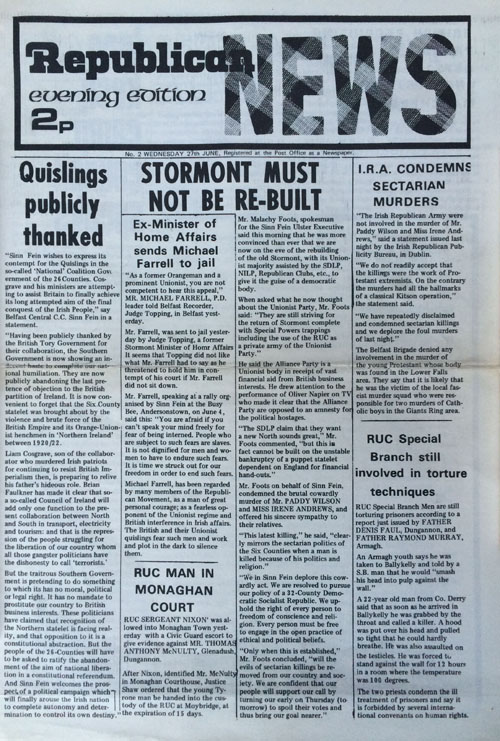
ON THIS DATE (21ST JUNE) 50 YEARS AGO : "FASCIST MURDER SQUAD" STRIKE AGAIN.
"The Belfast Brigade denied any involvement in the murder of the young protestant whose body was found in the Lower Falls area. They say that it is likely that he was the victim of the local fascist murder squad who were responsible for two murders of catholic boys in the Giants Ring area" - from the 'Republican News' newspaper, June 1973.
Of all the bombings, atrocities, tortures and killings that have unfortunately being visited and imposed on this country by Westminster due to their unwanted military and political presence here, the shooting dead of David Walker is one of the worst : this special needs sixteen-year-old boy was lifted off the street by the 'Official IRA', apparently as a 'dare', at about 8.30am on Thursday, 21st June 1973 - 50 years ago on this date - as he was working in his job.
He was found about three hours later on the Falls Road with gunshot wounds to his head and chest. He died a few minutes after he had been found.
'David Walker, 16-year-old Protestant civilian was found at O'Neill Street in the lower Falls area where he was shot and left by the Official IRA..(he) was described as being educationally subnormal and had a job in the Belvoir area of south Belfast near his home at Castlecoole Park...as (he) was working, the Official IRA abducted him and took him to the west of the city where they shot him. Joseph Cunningham, Senator Paddy Wilson, and Irene Andrews were later killed by the UDA/UFF in retaliation for young David's death.
The man jailed for David Walker's killing said in a statement that he thought David was a member of the UFF. He said he had been approached by a man in Leeson Street who asked him if he was "man enough to shoot a member of the UFF murder gang". The man said : "I said I would do it if there was proof that he was killing innocent Catholics. I asked for proof and he said Walker was involved in the murder of Danny Rouse".The judge said that David Walker's murder was "a horrible and unjustified murder.." ' (from here.)
It may well be fifty years since that barbarous act, but the political conditions for deeds like it are still in place - and it would still suit those in power in Westminster to have 'the wild Irish' killing themselves, allowing the British - the 'man in Leeson Street' - to continue to present themselves as being in Ireland 'to keep the warring factions apart'.
The only workable solution is that of a British political and military withdrawal from Ireland.
'RESURGENT ULSTER : NORTHERN SPEAKERS ADDRESS DUBLIN MEETING...'
From 'The United Irishman' newspaper, April 1955.
A large and enthusiastic audience accorded a warm welcome to a group of Ulster republicans who came to speak at a public meeting on Saturday, 19th of March (1955), in O'Connell Street in Dublin.
Joe Cahill, Belfast, speaking briefly, stated that he would sooner face the might of the Empire with a gun in his hand than address a public meeting.
He pointed to the futility of talk while an army of occupation was on our soil, and stated that moral force was not the answer to physical aggression. He said that the British Empire must be met on her own terms with a superior discipline and resolute determination. That way only lay victory.
Sean McKearney, Belfast, and James Rowantree, Newry, also spoke at the meeting.
Concluding, the Chairman (sic),Seoirse Dearle, traced the part played by Irish Protestants in the struggle for freedom from Tone, Emmet and Mitchel, down to the present day. It was Catholic England who first oppressed Ireland ; Ireland is the property of all Irishmen (sic) and freedom is our God-given right, but that freedom must be won.
Tone and Emmet had shown the way. Are the people of Ireland prepared to follow?
(END of 'Resurgent Ulster : Northern Speakers Address Dublin Meeting' ; NEXT - ' 'Northern Ireland' Flag Act', from the same source.)
'THOUGH THE HEAVENS MAY FALL...'
From 'Magill' Annual, 2002.
Dr Moira Woods (pictured).
Since it is clear that the families in question, including their now adult children, are anxious for the report to be published, and since the Medical Council has itself previously declared that it wishes all these matters to be as fully ventilated as possible, it is difficult to understand what possible basis there could be for declining now to publish the results of this investigation.
It would be a pity if the families were forced to return to the High Court to explore the potential of Mr Justice Barr's injunction concerning the paramountcy of doing justice.
(END of 'Though The Heavens May Fall' ; NEXT - 'Law And Society : Is It Time To Ask Questions Of The Legal Profession?', from the same source.)
ON THIS DATE (21ST JUNE) 146 YEARS AGO : 'THE DAY OF THE ROPE'.
'On 21st June 1877, in the anthracite-mining county of Schuylkill, Pennsylvania, ten Irish immigrant men alleged to have been members of an oath-bound secret sect of vigilantes called the 'Molly Maguires' were hanged in what came to be known as 'The Day of the Rope'. Twenty members of the group in all would be executed, following a kangaroo court that American historian John Elliot called "one of the most disgraceful episodes in the history of the bench and bar in the United States." Oppression, exploitation, racial and ethnic bigotry, strikes and union-busting are common enough themes in the American labour movement, but the story of the 'Molly Maguires' and the ruling class's attempts to destroy these Irish workers is so especially contemptible it has achieved legendary status....' (from here.)
On what became known as 'Black Thursday' (21st June, 1877), ten coal miners were hanged until dead in eastern Pennsylvania ; all ten had been born in Ireland but were forced to leave because of the attempted genocide ('An Gorta Mór') orchestrated by Westminster.
It was claimed that they, and others, were involved in 'organised retributions' against corrupt and unfair employers and other members of the establishment, and operated as such under the name 'Molly Maguires' (Molly Maguire had become famous in Ireland - or 'infamous', as the 'landlord' class described her - for refusing to bow down or bend the knee to them).
The workers had been arrested for their alleged part in several killings and, despite much doubt cast over the 'evidence' used against them, they were convicted and sentenced to death.
The court case was widely seen as employers drawing 'a line in the sand' in regards to what they considered to be 'uppity' workers looking for better wages and conditions, and an excuse for the establishment to vent its anti-labour and anti-Irish prejudice -
'The first trials began in January 1876. They involved 10 men accused of murder and were held in Mauch Chunk (an Indian name meaning 'Bear Mountain') and Pottsville. A vast army of media descended on the small towns where they wrote dispatches that were uniformly pro-prosecution.
The key witness for the prosecution was yet another Irishman, James McParlan. Back in the early 1870's, when Gowen had hired the Pinkerton Detective Agency to spy on his workers, McParlan had gone undercover to infiltrate 'the Mollies' and gather evidence. And gather he did — or at least he claimed he did, during the trials. On the stand he painted a vivid picture of 'Molly Maguire' secrecy, conspiracy and murder. With Irish catholics and miners excluded from the juries, the verdicts were a foregone conclusion.
The scene in Pottsville, Pennsylvania, on Thursday, 21st June 1877 - 146 years ago, on this date - as alleged members of the 'Molly Maguires' were taken to the scaffold.
All 10 were convicted and sentenced to hang.
No doubt seeking to send the most powerful message to the region's mining communities, authorities arranged to stage the executions on the same day — June 21st, 1877 – in two locations. Alexander Campbell, Michael Doyle, Edward Kelly, and John Donahue were hanged in Mauch Chuck (where the four men "all swung together"), while James Boyle, Hugh McGehan, James Carroll, James Roarity, Thomas Duffy, and Thomas Munley met a similar fate in Pottsville (where all six "swung two-by-two").
Although the hangings took place behind prison walls, they were nonetheless major spectacles that drew huge crowds and generated international news coverage..' (from here).
It was reported that there was "..screams and sobbing as husbands and fathers were bid goodbye.." and that "..James Boyle carried a blood-red rose and Hugh McGehan wore two roses in his lapel (as) James Carroll and James Roarity declared their innocence from the scaffold.."
Over the following two years, ten more alleged members of the 'Molly Maguires' were hanged, including Thomas P. Fisher (on the 28th March 1878) and James McDonnell and Charlie Sharp (on the 14th January 1879).
In 1979, the state of Pennsylvania pardoned one of the men, John 'Black Jack' Kehoe, after an investigation by its 'Board of Pardons' at the behest of one of his descendants (incidentally, Seán Connery played the part of John Kehoe in the film 'The Molly Maguires') and, on the 5th December 2005, the Pennsylvania State House of Representatives passed a resolution recognising the lack of due process for several of the men.
Make way for the Molly Maguires
They're drinkers, they're liars but they're men
Make way for the Molly Maguires
You'll never see the likes of them again.
Down the mines no sunlight shines
Those pits they're black as hell
In modest style they do their time
It's Paddy's prison cell
And they curse the day they've travelled far
Then drown their tears with a jar.
So make way for the Molly Maguires
They're drinkers, they're liars but they're men
Make way for the Molly Maguires
You'll never see the likes of them again.
Backs will break and muscles ache
Down there there's no time to dream
Of fields and farms, of womans arms
Just dig that bloody seam
Though they drain their bodies underground
Who'll dare to push them around.
So make way for the Molly Maguires
They're drinkers, they're liars but they're men
Make way for the Molly Maguires
You'll never see the likes of them again.
So make way for the Molly Maguires
They're drinkers, they're liars but they're men
Make way for the Molly Maguires
You'll never see the likes of them again.
'WAITING TO FALL...'
If this year sees the end of the 'Age of Tribunals', it won't be a moment too soon.
By John Drennan.
From 'Magill' magazine, January 2003.
The hopes and dreams of our tribunalistas that the Flood and Moriarty Tribunals would be the Trojan Horses which would facilitate the sack of Fianna Fail have been dashed.
Instead, if the present rate of 'progress' in the Flood Tribunal continues, they have provided Fianna Fail with the prospect of a cordon sanitaire that could last for 15 years.
The new popularity of tribunals was epitomised by the Morris Tribunal ; its creation - together with the cleverly designed terms of reference which have omitted PR Pat the Garda Commissioner, Michael McDowell and John O'Donoghue - has neutralised the political impact of the most serious Garda scandal in the history of the State.
From now on, any politician who attempts to raise the McBrearty affair will be greeted by the sight of Bertie Ahern highlighting the separation of powers and sighing - "I cannot comment on dat issue as it is a matter for de Tribunal".
Sweet...
(MORE LATER.)
Thanks for the visit, and for reading,
Sharon and the team.
ONE-THIRD PLAYGROUND, ONE-THIRD RIC MEMORIAL, ONE-THIRD BROWN-ENVELOPED APARTMENT BLOCK FOR A BUILDER BUDDY?
Another Moore Street fiasco in the making?
A Fine Gael political representative is currently flying a kite to gauge reaction/opposition to a proposal to build a playground for children on a 1798 graveyard.
The 'Croppies Acre' in Dublin, a memorial to the 'Croppy Boys' of the 1798 rebellion and believed to be where the men and women of '98 were buried after being executed by the British is, unfortunately, being stared at, financially and for votes, by the Blueshirts.
This is probably why the political 'powers-that-be' allowed this sacred spot to fall into disrepair in the first place ie '..anything would be better than the drug den it has become..' but those of us who see and appreciate more than a profit margin can hopefully nip this disgraceful proposal in the bud - please sign the petition against this folly and ask your friends, colleagues, workmates etc to do the same. We are up against political careerists who know the price of everything and the value of nothing. Let's try and educate them.
ON THIS DATE (13TH MAY) 101 YEARS AGO : "I THOUGHT I WAS A DEAD MAN. I HAD TO HOLD MY HEAD UP WITH BOTH HANDS...."
Seán Hogan (pictured, left), who was practically still in his teenage years when he was appointed as one of those in command of the 'Third Tipperary Brigade' of the IRA, a leadership group which became known by the British as 'The Big Four' - Dan Breen, Seán Treacy, Seamus Robinson and Seán Hogan.
Seán Hogan was born in Tipperary in 1901 and, at just 18 years of age, he took part in the Soloheadbeg ambush on the 21st of January in 1919, in which two Crown force personnel (James McDonnell and Patrick O'Connell) were killed as they drew their weapons. The British went all out to capture or execute those responsible and, on the 12th of May 1919, Seán Hogan was taken prisoner at a friends house, the Meagher's, at Annfield, in Tipperary, and taken to Thurles RIC barracks to be held overnight, and then transported to Cork. The following morning - the 13th May, 1919, 101 years ago on this date - Seán Hogan was taken by a four-man armed British military escort to Knocklong train station and the five men got on board a train ; Hogan, who was handcuffed, was put sitting between RIC Sergeant Wallace and Constable Enright, both of whom were armed with revolvers, and Constables Ring and Reilly, carrying shotguns, sat opposite the three men.
Seán Hogan (right), thought to be about 20 years young when this photograph was taken.
An IRA unit, led by Seán Treacy, Dan Breen, Seamus Robinson and Eamonn O'Brien, and including Ned Foley, Seán Lynch, John Joe O'Brien, Ned O'Brien and Jim Scanlon (all from the East Limerick Brigade IRA) located the compartment where Seán Hogan was being held against his will and Seán Treacy and Eamonn O'Brien drew their revolvers and walked through the train to the compartment ; on entering same, they loudly instructed all present to put their hands up and called for Seán Hogan to make his way to them. RIC Constable Enright placed his revolver against Hogan's neck, using him as a shield, but was shot dead as he did so, as both Treacy and O'Brien had fired at him (Eamonn O'Brien was to say later that they would not have shot Enright had he not attempted to attack Hogan) and Hogan, still handcuffed, took that opportunity to land a two-handed punch to the face of Constable Ring, who was sitting opposite him. Seán Treacy and RIC Sergeant Wallace were trading punches, as were Eamonn O'Brien and Constable Reilly, when one of the IRA men managed to take Reilly's shotgun from him and smashed him over the head with it. He collapsed in a heap on the carriage floor. Constable Ring, meanwhile, found himself on the platform, having exited the carriage through a window, and withdrew from the area.

Of such a deed, no living man has ever heard before
From out a guarded carriage mid a panic stricken throng
Seán Hogan, he was rescued at the station of Knocklong
When a guard of four policemen had their prisoner minded well
As the fatal train sped o’er the rails, conveying him to his cell
The prisoner then could scarce foretell, of hearts both brave and strong
That were planning for his rescue at the station of Knocklong
The shades of eve were falling fast when the train at last drew in
It was halted for an hour or so by a few courageous men
They sprang into the carriage and it did not take them long
'Hands up or die' was the rebel cry at the station of Knocklong
King George’s pampered hirelings, they shrivelled up with fear
And thought of how they placed in cells, full many a Volunteer
Now face to face with armed men, to escape, how they did long
But two of them met with traitors deaths at the station of Knocklong
From Sologhead to Limerick, such deeds as these were never seen
And devil a tear was ever shed for Wallace of Roskeen
They did old England's dirty work and did that work too long
But the renegades were numbered up at the station of Knocklong
Now rise up Mother Erin and always be of cheer
You’ll never die while at your side there stand such Volunteers
From Dingle Bay to Garryowen, the cheers will echo long
Of the rescue of Seán Hogan at the station of Knocklong.(From here.)
'SINN FÉIN POST-ELECTION STATEMENT...'
From 'The United Irishman' newspaper, June, 1955.
"The results, gratifying as they are, must strengthen the determination of our people to continue the effort to establish and maintain the sovereign independence of the Irish nation.
In this spirit, Sinn Féin will pursue the course it has set itself and, in pursuing that course, we seek no quarrel with Irishmen and any quarrel that may eventuate will certainly not be the responsibility of the Sinn Féin organisation. We wish to thank very sincerely all those people, whoever they may be, who helped the Six-County election campaign in any way. We could not have hoped for anything like the success it has achieved without their fine support ;
Who fears to rally to Sinn Féin,
or nationhood deny,
heed not what hostile Press proclaims,
with "splinter party!" cries.
For duty to your country calls
to you, from shore to shore,
that freedom for all Ireland be
for Sinn Féin to restore.
Who fears to march on with Sinn Féin,
upholding Ireland's right,
as did the men of '98,
united side by side.
They gave their all for country's cause,
against the common foe -
in tribute to their memory
united, stand once more! (by Micheal O h-Aonghusa.)
(END of 'Sinn Féin Post-Election Statement' ; NEXT - 'American Items Of Interest', from the same source.)
ON THIS DATE (13TH MAY) 168 YEARS AGO : 'LADIES LAND LEAGUE' FOUNDER BORN.
Anna Catherine Parnell, pictured, was born 'Catherine Maria Anna Mercer Parnell' on the 13th May, 1852 - 168 years ago, on this date - at Avondale House in Rathdrum, County Wicklow. She was the tenth of eleven children of John Henry Parnell, a landlord, and Delia Tudor Stewart Parnell, an Irish-American woman (the daughter of Admiral Charles Stewart of the US Navy).
Anna and one of her sisters, Fanny, worked with their brother, Charles (Stewart Parnell) in agitating for better conditions for tenants and, on the 31st January in 1881, the two sisters officially launched a 'Ladies Land League' which, at its full strength, consisted of about five hundred branches and didn't always see eye-to-eye with its 'parent' organisation, the 'Irish National Land League'.
In its short existence, it provided assistance to about 3,000 people who had been evicted from their rented land holdings to assist and/or take over land agitation issues, as it seemed certain that the 'parent' body was going to be outlawed by the British and, sure enough, the British Prime Minister, William Ewart Gladstone, introduced and enforced a 'Crimes Act' that same year, 1881 (better known as the 'Coercion/Protection of Person and Property Act') which made it illegal to assemble in relation to certain issues and an offence to conspire against the payment of rents 'owed' which, ironically, was a piece of legislation condemned by the same catholic church which condemned the 'Irish National Land League' because that Act introduced permanent legislation and did not have to be renewed on each political term.
And that same church also condemned the 'Ladies Land League' to the extent that Archbishop McCabe of Dublin instructed priests loyal to him "..not to tolerate in your societies (diocese) the woman who so far disavows her birthright of modesty as to parade herself before the public gaze in a character so unworthy of a Child of Mary..." - the best that can be said about that is that that church's 'consistency' hasn't changed much over the years, and that it wasn't only a religious institution which made an issue out of women being politicised - 'In the year in which the Ladies' Land League was formed, Ireland was first mentioned in the 15 January 1881 issue of the 'Englishwoman's Review'. Tellingly, this was a report headed 'Women Landowners in Ireland' (and) there was also a small report of a 'Catholic Charitable Association' being formed 'by a number of Irish ladies for aiding the families
of poor or evicted tenants'.
The addition of the phrase "It is distinctly understood that the society shall take no part whatever in political agitation.." reveals the disapproval felt by the journal for those engaged in that agitation *. The formation of the Ladies' Land League was then noted : 'In anticipation of Government action against local branches of the Irish National Land League, arrangements are being made for the establishment of a Ladies' Land League throughout Ireland. Such a movement has already been organised in America, where Mrs Parnell, the mother of the Member for Cork, is the President, and Miss Fanny Parnell and Mr John Stewart, the sister and brother of Mr Parnell, MP, are acting as organisers. The Irish movement will be led by the wives of the local leaders of the existing league, and will devote themselves to the collection of funds...' ** (from here).
* / ** - That periodical was assembled and edited by, and for, middle-class women of the day (late 19th/early 20th century) and, while it did cover and promote economic independence for women, occupation outside of the home for women, the need for better educational facilities for women to enable and encourage women to seek employment in 'the male professions' ie politics and medicine, it was truly of its day in that it was felt to be a bridge-too-far to call for women to take to the streets for the right to be more than 'just' fund-raisers. In short, the authors were, in effect, confining themselves to be further confined.
In October 1881, Westminster proscribed the 'Irish National Land League' and imprisoned its leadership, but the gap was ably filled by the 'Ladies Land League' until it was acrimoniously dissolved on the 10th August 1882, 19 months after it was formed. Anna's brother, Charles, died in 1891 and, somewhat disillusioned with the political society that she lived in, she moved to the south of England and went by the name 'Cerisa Palmer'. On the 20th September in 1911, when she was living in Ilfracombe in Devon, England, at 59 years of age, she went for her usual daily swim but got into difficulties. Her plight was noticed from the shore but she was dead by the time help arrived. She was buried quietly in the churchyard of Holy Trinity Church in Ilfracombe, in the presence of just a handful of strangers.
FIT TO PRACTISE...?
As social work in Ireland reaches a landmark, Phil MacGiolla Bháin argues that the profession is flawed beyond salvation. From 'Magill' magazine, July 2002.
The current child protection system is largely premised on the 'fact' that children are, ordinarily, at risk from the nearest available male, usually the father. The fact - yes, fact - that children are now and always have been statistically more at risk from the mother is ignored.
If social work were a profession like law, medicine or teaching, then there would be a thriving private practice. Social work's professional services are only in demand from the State and from organisations that carry out operations on behalf of the State. The idea of a private individual soliciting the services of a social worker to provide a service to them is, quite frankly, bizarre, disordered and mad.
It was stated in 'The Irish Social Worker' last year (Vol.19, No. 2-3) that the health board-run child protection system was falling to pieces ; social workers are apparently voting with their feet and leaving in droves. This is excellent news. The system cannot be patched and covered up - it must be put permanently and verifiably beyond use. The structure is unsound and it cannot be repaired or renovated. It must be knocked down and a new one built from the ground up. (END of 'Fit To Practise?' NEXT - 'Kicking Against The Pricks', from the same source.)
'EITHNE NIC SUIBHNE'.
From 'The United Irishman' newspaper, November 1954.
The Republican Movement has lost a very good friend and a constant enthusiastic worker in the death of Miss Annie McSwiney (Eithne Nic Suibhne, pictured). In particular, this newspaper has lost a real helper, regular contributor, one of our very first subscribers and a constant critic whose criticism was always constructive, vigorous always, sometimes almost sharp, but inspired with the desire to help us, to guide us, the better to serve the Cause she loved so well.
In some accounts published in the press after her death the impression is conveyed that she had ceased to take any active part in political or national affairs for many years. That this impression is false can be easily shown, but no better proof is required than to quote from a letter written by her on the 14th October, the day before she died, to the Secretary of this newspaper and received here at the same time as the news of her death was being announced.
The main purpose of the letter was to acknowledge receipt of copies, sending of annual subscriptions for friends and giving names of others who would take the newspaper, and some instances of her active help and co-operation. The letter continues - "I was wishing I could contact you (by phone) and ask if you would get some striking demonstration (organised) to show these 13 nations of the (World) Ploughing Organisation that their insolence (in insisting that the two puppet States in Ireland be treated as separate countries)...all these people come to our land and one after another they insult us and no one ever says a word. No wonder the insults are on the increase..." (MORE LATER.)
Thanks for reading - Sharon and the '1169' team. Stay safe, and 'play' safe. Or at least don't be as reckless as the old you. Or, if you must be, don't get caught!