Three different dates listed by our six sources for this shooting in 1919 - 15th April, 25th April and 29th April, and an unlikely scenario.
A British Navy vessel had docked near the village of An Rinn (Ring Village) in the county of Waterford (possibly docked in Helvick Harbour/Helvick Head) and some of the crew members left the ship to have a look around the village.
They ended up in a local pub ('Draper's') in which a few Irish republicans from the area were having a pint and a chat.
The situation in the pub got a bit tense, and voices were raised - and this is the unlikely scenario bit : one of the republicans, a man named Michael Walsh (22,an IRA Volunteer, by some accounts) is said to have left the pub to go for assistance - from the RIC!
As he was walking up to the door of the nearby Ballinagoul RIC barracks a single gunshot was fired at him, through the door of the building.
The bullet struck him in his throat, he fell, the noise of the gunshot drew people to where he was and he was rushed to hospital (probably Dungarvan Workhouse Hospital, later renamed 'St Joseph's', now known as 'Dungarvan Community Hospital') where the medics opened him up from his back and extracted the bullet.
He appeared to be recovering from the wound, but didn't : he died on either the 11th May or the 15th May - both dates stated by different sources.
His funeral took place at Ring, County Waterford, where a large crowd from all parts of the county turned out in attendance, including some members of the Volunteer movement dressed in uniform. The roadsides en route to the village of Ballinagoul were lined with Sinn Féin flags, and music was provided by the Waterford Sinn Féin Brass Band who had travelled from Dungarvan for the occasion.
As the funeral procession made its way from Mr Walsh's home to the church, a distance of about a mile, the band alternatively struck up 'Wrap the Green Flag Round Me', 'A Nation Once Again' and 'The Soldiers Song'.
The unlikely scenario we mentioned is that any IRA Volunteer would purposely and actively seek out the RIC (a pro-British grouping) for its assistance in defusing a tense situation where other (pro-)British forces (Navy, in this instance) are 'getting loud' with Irish republicans...?!
Anyway - the RIC man who fired the shot that struck and killed Michael Walsh was a Mr Michael McCarthy ('Service Number 66105') who, after the shooting, was put in for a transfer out of Waterford by his RIC bosses, citing reasons of personal safety ; they wanted to place him in an RIC Barracks in County Antrim (Templepatrick/Dunmurry), about 350km (220 miles) away, where he supposedly wouldn't be known : he objected to the proposed transfer, probably having fooled himself that, in Waterford, he knew who to be wary of and who to look out for, but his objection was rejected.
He resigned from the RIC on the 2nd June, 1920, with "no bad mark on his service record" - the magistrate involved in the Waterford shooting case had decided that "there was no case to answer...", referencing the RIC man's claim that Michael Walsh "had rushed towards the barracks shouting, 'Give up your arms, you will have to fight now...' "
RIP Michael Walsh.
==========================
On the same date that a pro-British militia gunman fired that shot in Waterford, another of that ilk fired a shot about 290 km (185 miles) away, up the road in Hollywood, in County Down.
That bullet, 'accidently' fired by a 'Somerset Light Infantry' comrade of British Army Private Charles Bernard Kirk ('Service Number 44458'), hit Mr Kirk who died from the wound.
The man was buried in his own country, in New Basford Cemetery, Nottingham, England.
==========================
In December, 1918, the 'Irish Parliamentary Party' ('IPP') was practically wiped-out at the polls by the then Sinn Féin organisation, which led to some verbal and physical jostling between members and supporters of both.
They emerged from that election campaign as a diminished, non-governing 'opposition' half-party, even more ineffectual than they had been before it.
On the 29th April (1919), 'The Waterford Standard' newspaper carried a report that a recent street brawl in Waterford City had resulted in the death of an 'IPP' member, a Mr William Grant.
We couldn't find any more information about that incident or about Mr Grant.
==========================
ON THIS DATE (29TH APRIL) 110 YEARS AGO : REPUBLICAN 'SURRENDER ORDER' AND FR. ALOYSIUS.
On Saturday, 29th April, 1916 - 110 years ago on this date - Pádraig Pearse issued the 'Surrender Order' on behalf of the Irish republican forces who were taken part in the (Easter) Rising in Ireland against the forces of the Crown -
"In order to prevent the further slaughter of Dublin citizens, and in the hope of saving the lives of our followers now surrounded and hopelessly outnumbered, the members of the Provisional Government present at Headquarters have agreed to an unconditional surrender, and the Commandants of the various districts in the City and Country will order their commands to lay down arms.
P. H. PEARSE.
29th April, 3.45 p.m., 1916."
Approximately 64 rebels, 132 crown force members and 230 civilians had been killed. About 2,500 people had been wounded, and the centre of Dublin was devastated by the British shelling.
Sometimes overlooked and/or deliberately played-down is the role that the Capuchin Friars took on during the 1916 Rising, including that of their input regarding the 'Surrender Order' -
'..the Capuchin Friars were heavily involved with the surrender - after the initial surrender had taken place between General Lowe, Patrick Pearse with Nurse Elizabeth O'Farrell as the 'runner' (and) in all the discussion between the British Forces and the Irish Military Army. They ably assisted Nurse Elizabeth O’Farrell [Cumann na mBan] with the task of delivering the surrender order to the other leaders all around the outskirts of Dublin in their strategic positions i.e Eamonn Ceant, Thomas MacDonagh , Dev Valera et.al.
Of course General Lowe, not wanting to take any chances that these surrender orders would not be safely delivered...ordered two of his officers to accompany them. They then went to Dublin Castle to deliver the surrender message..' (from here.)
'While many clerics have supported the armed struggle of the IRA since 1916, the Capuchin Friars have been particularly noted for their republicanism. One such Capuchin was Fr Aloysius Roche, the son of an Irish father and English mother, born in Scotland in 1886. He studied for the priesthood and, following his ordination, he was transferred to Dublin where he was attached to the Capuchin Order in Church Street.
During Easter Week 1916, Fr Aloysius along with Frs Albert, Augustine and Dominic brought spiritual aid to the Volunteers in the numerous garrisons and outposts throughout Dublin. Following Pádraig Pearse’s surrender on Saturday, 29 April 1916, Fr Aloysius spent the next day carrying the surrender order to the main garrisons on the south side of the city. In the early hours of the morning of 3rd May, Fr Aloysius administered the last sacraments to Pearse, MacDonagh and Thomas Clarke, the first three leaders of the Rising to be executed.
On 7th May, he met John Dillon, a leading member of the Irish Parliamentary Party, who agreed to do all in his power to persuade the British government to stop the executions. And it was largely due to his efforts that Dillon, five days later, during a debate on the rising in the House of Commons, launched a blistering attack on the British government’s handling of the situation in Ireland.
Earlier that day, Fr Aloysius accompanied James Connolly by ambulance from Dublin Castle to Kilmainham Gaol for execution and stood behind the firing squad as they fired the final volley. During the Tan and Civil Wars he was an enthusiastic and practical supporter of the national struggle and continued his republican allegiance throughout the following decades...' (from here).
Incidentally, the 'Fr Dominic' mentioned, above, was Fr Dominic O'Connor (Order of Friars Minor Capuchin, pictured, being led away by Free Staters from 'the battle of the Four Courts', in 1922) - it is recorded that the then 'President of the Executive Council of the Irish Free State' [aka 'Taoiseach'], Mr WT Cosgrave, did not agree with the political outlook voiced by the Capuchins and he wrote to the Archbishop, Edward J Byrne, to voice his objections and, in one such letter, actually accused Fr Dominic of "treasonous acts"!
Fr Dominic was, at the time, the chaplain to the local IRA Cork Brigade, and is on record for a reply he gave to the church hierarchy in relation to their anti-republican/pro-British sermons :
"Kidnapping, ambushing, and killing obviously would be grave sins or violation of Canon Law.
And if these acts were being performed by the Irish Volunteers as private persons, they would fall under excommunication.
But they are doing them with the authority of the Republic of Ireland.
Hence the acts performed by the Volunteers are not only not sinful, but are good and meritorious...therefore the excommunication does not affect us. There is no need to worry about it.
There is no necessity for telling a priest in confession that you went to Mass on Sunday, so there is no necessity to tell him one is in the IRA, or that one took part in an ambush or killing etc".
In another letter of complaint that he sent, Mr Cosgrave referred to a different priest, a Fr John Costello, and complained to the Archbishop that that priest had made it his business to approach Free State troops, in 1922, and called on them to lay down their arms ; when they declined to do so, he would call them "murdering green Black and Tans"!
As 'Lord Cosgrave' probably said, in private -
"It rings in my ears as kind of what miserable drones and traitors have I nourished and brought up in my household, who let their lord and president be treated with such shameful contempt by a low-born cleric?
Will no one rid me of this meddlesome priest?" (!)
Sometimes one has to be 'meddlesome' in order to be honourable...
THE GREAT OIL AND GAS ROBBERY...
From 'Magill' Magazine, October 2005.
"I spent an hour with Micheál Ó Seighin (pictured), one of the Rossport Five.
Micheál received us very graciously in the small visiting box. He is a small, quietly-spoken man in his late 60s.
"Tá sibhse ag dhéanamh obair go hiontach. Congratulations. Bhí an scéal Dé Luan go han, han mhaith. Ceim mhór", he said..."
Micheál Ó Seighin.
Michael McDowell.
Pat Rabbitte.
"Is this where you get your visits?"
"We get closed visits", he said. "There is a screen between us and our families. We have no physical contact on visits."
"Even the Brits don't do that", I said.
Micheál grinned at us.
"I knew nothing about prisons before coming here but the people who are in and out of jail hate Cloverhill. They say that it is worse than the Joy and the Midlands. I suppose it's to deal with the drugs problem. Drugs are creating havoc everywhere it seems. I never knew it was so bad until I came here.
I've met some young men here who are not going to last on the outside. They told me that. One of them, he's from Ballymun, was telling me about the turf wars. 'Two things I'm sure of', he told me, 'I'll be back on drugs when I get out. And I'll be killed.'"
It was obvious that Micheál cared deeply about all this.
He had a book with him - 'Nature's Way', by Ian Stewart, and I told him that we had left some books in for him and the other men.
"This book is about chaos", he said ; "A butterfly can flap its wings in Tokyo and cause a storm halfway across the world..."
(The third [ie last] pic above shows a Mr Patrick Rabbitte, ex-State Labour Party leader and ex-'State Minister for Communications, Energy and Natural Resources' ; Mr Rabbittee retired as State Labour Party leader in 2007, and from political life altogether in 2016, on a combined pension package worth over €2 million to him!)
(MORE LATER.)
ON THIS DATE (29TH APRIL) 427 YEARS AGO : DEVIL CHRISTENED ON EARTH.
"The term 'slavery' is rarely associated with the white race, although during the 1600's this was the most significant portion of the market.
More specifically, the Irish were targeted the most and the fact that the population of Ireland fell by 850,000 in the space of one decade highlights just how brutal things were...he (Oliver Cromwell, pictured) is one of the main reasons why the situation got to this point.
His fanatical anti-Catholic views meant that any action he took over the Irish was brutal to say the least and as well as utilising the conquest of Ireland for religious and political means, he was bidding to cleanse the country of Catholics.
In achieving this, selling the Irish off as slaves was one of his biggest weapons, but he also made sure life was as difficult as possible for those that did stay by burning off their crops, removing them from their land.." (from here.)
Pictured - some of Oliver Cromwell's Irish victims, sold as slaves and 'sex workers' to the highest bidder.
On the 29th April, 1599 - 427 years ago on this date - a baby boy, Oliver Cromwell, who had been born on the 25th April, was christened in Saint John the Baptist church in Huntingdon, England.
Decades later, when someone was trawling through the birth records for that period, they came across an unofficial addendum to that particular entry : it read -
"England's plague for five years..."
Cromwell should need no introduction to readers of this blog, but some readers may not be aware of the significance of a particular date - the 3rd September - in relation to the time he wreaked havoc on this Earth.
That creature died on that date in 1658, and it was also on that same date, in 1649, that he began his nine-day siege of Drogheda after which thousands of its inhabitants were butchered (..but they deserved it, according to the man himself - "This is a righteous judgement of God upon these barbarous wretches, who have imbrued their hands in so much innocent blood..").
The infamous 'Death March', which he forced on his enemy after the battle of Dunbar, took place on the 3rd September (in 1650) and, one year later on that same date - the 3rd September, in 1651 - he wallowed in more blood and guts, this time in his own country, at the battle of Worcester.
And, somewhere in between wrecking havoc and stealing and selling Irish children, he found the time (on the 27th September in 1649) to write to his political bosses in London :
'FOR THE HONOURABLE WILLIAM LENTHALL, ESQUIRE, SPEAKER OF THE PARLIAMENT OF ENGLAND :
Dublin, 27th September 1649.
Mr. Speaker - I had not received any account from Colonel Venables - whom I sent from Tredah to endeavour the reducing of Carlingford, and so to march Northward towards a conjunction with Sir Charles Coote - until the last night. After he came to Carlingford, having summoned the place, both the three Castles and the Fort commanding the Harbour were rendered to him. Wherein were about Forty Barrels of Powder, Seven Pieces of Cannon ; about a Thousand Muskets, and Five-hundred Pikes wanting twenty. In the entrance into the Harbour, Captain Fern, aboard your man-of-war, had some danger ; being much shot at from the Sea Fort, a bullet shooting through his main-mast. The Captain's entrance into that Harbour was a considerable adventure, and a good service ; as also was that of Captain Brandly, who, with Forty seamen, stormed a very strong Tenalia at Tredah, and helped to take it ; for which he deserves an owning by you.
Venables marched from Carlingford, with a party of Horse and Dragoons, to the Newry ; leaving the place, and it was yielded before his Foot came up to him. Some other informations I have received form him, which promise well towards your Northern Interest ; which, if well prosecuted, will, I trust God, render you a good account of those parts. I have sent those things to be presented to the Council of State for their consideration. I pray God, as these mercies flow in upon you, He will give you an heart to improve them to His glory alone ; because He alone is the author of them, and of all the goodness, patience and long-suffering extending towards you. Your army has marched ; and, I believe, this night lieth at Arklow, in the County of Wicklow, by the Sea-side, between thirty and forty miles from this place. I am this day, by God's blessing, going towards it.
I crave your pardon for this trouble; and rest, your most humble servant, OLIVER CROMWELL.
P.S. I desire the Supplies moved for may be hastened. I am verily persuaded, though the burden be great, yet it is for your service.
If the Garrisons we take swallow-up your men, how shall we be able to keep the field? Who knows but the Lord may pity England's sufferings, and make a short work of this?
It is in His hand to do it, and therein only your servants rejoice. I humbly present the condition of Captain George Jenkin's Widow. He died presently after Tredah Storm. His Widow is in great want.
The following Officers and Soldiers were slain at the storming of Tredah: Sir Arthur Ashton, Governor; Sir Edmund Varney, Lieutenant-Colonel to Ormond’s Regiment; Colonel Fleming, Lieutenant-Colonel Finglass, Major Fitzgerald, with eight Captains, eight Lieutenants, and eight Cornets, all of Horse; Colonels Warren, Wall, and Byrn, of Foot, with their Lieutenants, Majors, etc; the Lord Taaff’s Brother, an Augustine Friar; forty-four Captains, and all their Lieutenants, Ensigns, etc; 220 Reformadoes and Troopers; 2,500 Foot-soldiers, besides the Staff-Officers, Surgeons, etc.'
A butcher of even his own forces.
But he was appreciated in some circles...
On the 29th April, 1920, an estimated 3,000 people over-filled the Market Square in the village of Athy, in the county of Kildare.
They were there to say a loud and genuine 'Fáilte Abhaile!' ('Welcome Home!') to IRA Volunteer Eamon ('Edward/Ned') Malone, from the locality of Barrowhouse, Dunbrin, in that same county.
IRA Commandant Eamon Malone had been 'arrested' by the British in 1919 and held in Mountjoy Jail, in Dublin, where he went on hunger-strike before being released.
His uncle was Reverend James J. Malone, an author and a Catholic Priest based in Australia, and his cousin, Christiana, was a member of Cumann na mBan in the area.
Incidentally, Volunteer Eamon Malone formed a branch of 'The Irish Volunteers' in Athy in 1917, and had assisted in the formation, locally, in July 1914, of a branch of Cumann na mBan and, in August 1914, he had assisted in establishing the republican youth group Na Fianna Éireann in the area.
Volunteer Eamon 'Edward/Ned' Malone died from asthma-related illnesses at 45 years of age in 1939, in Sutton, County Dublin, and is buried in Barrowhouse Cemetery, in Kildare.
(The one 'downer' from the 'Welcome Home!' rally on the 29th was that a Mr Arthur James Kickham ['Art'] O'Connor delivered the 'Welcome Home' speech ; Mr O'Connor was a 'republican-gamekeeper-turned-Free State-poacher'.)
RIP Volunteer Eamon 'Edward/Ned' Malone.
==========================
On the 29th, as British soldiers and their spies were watching Market Square, Athy, for the homecoming ceremony, other British soldiers, hoping that there were no spies around, were undertaking a 'ceremony' of their own!
Some of the British troops from the 'Royal Horse Artillery' (pictured), who were billeted in Kildare town, met with some of the local IRA Volunteers, as arranged, and the deal was struck ; the rebels purchased 17 revolvers and 723 rounds of ammunition from the enemy troops, and both sides went back to their bases, all in good form!
It sounds unlikely, but it actually happened more than some readers might know about - arms sales from British soldiers to the IRA were a frequent and significant source of weaponry, particularly in Dublin and other garrison towns.
Disgruntled or sympathetic British soldiers, often looking to make extra money or to escape military life, sold their equipment regularly ; the Dublin Brigade IRA, for example, managed to purchase hundreds of rifles from a British Army Quartermaster at Wellington Barracks (Dublin) - in one known instance, two Irish-born British Army soldiers smuggled 4,000 rounds of .303 ammunition from the Athlone barracks and sold the packages to the IRA, with a few revolvers and rifles thrown-in to sweeten the deal, and BA troops stationed at Richmond Barracks (Dublin) were known to sell quantities of rifles to the rebels for £4 each!
In areas outside of Dublin, some British soldiers heading home on leave would sell their service rifles to local Volunteers because they "hated soldiering" and wanted extra money for their journey home and, in one instance that is known about (in 1922), a heavy-duty 'Hotchkiss Machine Gun' was sold to the IRA by British Army engineers who were converting a British naval vessel for civilian use.
Arms were not only sold but also frequently taken, traded, or seized by the IRA from RIC and British Army installations throughout the country and abroad - IRA agents/middlemen (like Owen Moore and Thomas Treacy) operated in London, securing revolvers and ammunition through local gunsmiths and underworld contacts and, in Scotland, the IRA cultivated links with German arms dealers and even broke into university chemistry departments to manufacture explosives.
Also, a steady supply was available from demobilised soldiers who, after 'WWI', kept their service weapons as souvenirs and were often willing to sell them on the black market for cash, and those weapons would be smuggled into Ireland hidden in legitimate cargo ; crates of rifles were smuggled through Liverpool and Southampton by sympathetic Irish dockers and crew members.
Once landed, small arms and ammunition would be carried by Cumann na mBan women, who used their status as civilians to transport such 'contraband' in personal luggage or, before being landed in Ireland, the weaponry would be loaded at sea onto fishing trawlers and yachts.
Indeed - many times throughout this on-going struggle, we have felt like we were all at sea, but we've always managed to reach the shore...
==========================
As that deal was being processed in Athy, County Kildare, about 75km (45 miles) up the road and over to the right (!), in the village of Rush, County Dublin, it was announced locally that an RIC member who had been shot by the IRA on the night of the 20th April was "still dangerously ill" in the Mater Hospital, in Dublin.
Mr John Brady (50, with about 25 years 'service in the force'), an RIC sergeant, was wounded in an attack on Rush RIC Barracks and died from his wounds on the 9th May.
He was born in Bray, County Wicklow, into a farming household, and is buried in Saint Brigid's Cemetery in Killoughter, County Cavan.
==========================
THE MONTH UNSPUN...
The stories that hit the headlines.
From Magill magazine, August 2002.
Expect some efforts to give convincing reassurance that standards will be reviewed but, if George Bush's efforts at same in the US recently are anything to go by, the average investor will remain hugely sceptical.
FAI TAKES SKY-DIVE :
Fresh from the controversial events surrounding Roy Keane's departure from Ireland's World Cup campaign, the FAI sold the rights to our home qualifying matches for the European Championships to SKY for €7.5m, believing the deal was too good to turn down.
RTE claimed that the FAI finished negotiations with the broadcaster unexpectedly and had no way of knowing what RTE's highest bid would be and, meanwhile, TV3 had obtained the rights to screen the matches one hour after they had finished.
The government initially claimed that there was nothing they could do about the sale, until it emerged that the EU's 'Television Without Frontiers' directive could still apply, and Ireland soccer matches, along with other notable sporting events such as the All-Ireland final, could be protected in the same way as Wimbledon and the FA Cup are in England ; in a final twist, Sky bid for Ireland's away matches also, but as yet have not obtained them...
(MORE LATER.)
On the 29th April, 1921, eleven RIC members (including a 'police sergeant' and a 'district inspector') were travelling in two Crossley Tender trucks and, near Castlelack National School (about five miles from the town of Bandon, County Cork) they came across a ten-foot-wide trench in the road, dug by IRA Volunteers to impede the movement of enemy forces.
The two top RIC members ordered the other nine men to get out of the trucks and fill the trench in - they disembarked, placed their rifles against a
fence and set to work.
One of them, a Mr John Edward Bunce (31, 'Service Number 79386'), a married man from the county of Kerry, was told to place himself on guard duty, and he headed towards a nearby piece of high ground.
Just as he did so a gunshot was fired, and Mr Bunce collapsed and slipped down from his vantage point.
One of his RIC buddies went over to him and found that he was bleeding from both legs, was in shock and in pain.
It transpired that one of the rifles which had been propped-up against the fence had fallen over and, on hitting the ground, had discharged one shot, which passed through Mr Bunce's legs.
As his pals tried to stop the bleeding, Mr Bunce shouted at them "What are my wife and kiddies going to do now..?" - he was still in shock, was hemorrhaging, and died from the wound.
The RIC record of the shooting stated that it was "..another case of ignorance in handling arms..the safety catch was off and no reason for it..."
('1169' comment - the 'Police Remembrance Trust' organisation gives a wrong date and incorrect location for the shooting ; as they might say themselves - "no reason for having done that, except carelessness...")
==========================
At the same time as Mr Bunce lay dying in a muddy field, one of his military bosses, 'Field Marshal' (!) Mr John French (pictured), was feeling hard done by about 250 km (155 miles) away up the road and over a bit on yer right (!), in Dublin.
In 1918, Mr French had been appointed by his friends in Westminster as the 'Lord Lieutenant of Ireland' (the 'Viceroy') but a new face and attitude was needed for the position in 1921 as a 'peace initiative' with Mr Michael Collins and his people was being discussed - Mr French, a reminder of the bad old days (!) had to go.
The man wasn't too happy about his enforced 'career move' but found himself between a rock and a hard place - he was being replaced as 'Lord Lieutenant' by a Mr Edmund Talbot ('1st Viscount FitzAlan of Derwent' - !), a friend of his, so he 'left office' a bit quieter than he otherwise might have!
And we're sure that his appointment a few months afterwards as the '1st Earl of Ypres', and the £50,000 'retirement grant' that was thrown in with the title, and his later appointment as 'Captain of Deal Castle' in Kent, in his own country had nothing a'tall to do with him accepting the move...!
==========================
On the 15th September, 1920, a Mr Sean O'Callaghan (28), an ex-British Army soldier ('Royal' Munster Fusiliers and the Worcestershire Regiment) was shot dead by the IRA in Cork City.
Mr O'Callaghan was employed by the British Army as a clerk in Victoria Barracks in Cork City and was arrested by two IRA men (Volunteer Patrick Collins and Volunteer Jeremiah Keating) from 'G Company', 2nd Battalion, Cork No. 1 Brigade IRA, and taken to the Farmer's Cross area of the city.
He was shot dead and his remains were never recovered ; he had discussed IRA business over a phone which had an IRA tap on it with a British Army Captain, a Mr Kelly, who was the 'Intelligence Officer' for the BA 6th Division and, during their discussion, a Mr Stephen O'Callaghan (no relation) was mentioned.
Mr Stephen O'Callaghan (29), also an ex-British Army soldier who had also 'served' with the 'Royal' Munster Fusiliers and the Worcestershire Regiment, was an out-of-work dock labourer who was trying to get by on a BA disability pension.
On the 29th April, 1921, he was shot dead in Cork by the IRA, who pinned a 'SPY'S BEWARE!' notice to his coat.
==========================
DEATH IN THE MEDITERRANEAN...
Desmond Boomer, a Belfast engineer working in the Libyan oil-fields, disappeared seven years ago.
Officially, the plane on which he was a passenger crashed as a result of mechanical failure and pilot error.
But is that the real story?
Or were the Irishman and his fellow passengers unwitting victims of the shady war between Islamic fundamentalism and Mossad, Israel's intelligence network?
A special 'Magill' investigation by Don Mullan, author of 'Eyewitness Bloody Sunday'.
From 'Magill' magazine, January 2003.
The front-page article, written by journalists Joe Mifsud and Felix Agius, claimed that the Shqaqi assassins may have left Malta on a Maltese private plane, flown by a Maltese pilot.
Alarmingly, the paper printed alongside this story a photograph of an aircraft which the bereaved families say was similar to one owned by Captain Bartolo.
'The Times Of Malta' newspaper, four days later, led with the headline - 'Shqaqi's Assassins May Have Left Malta On Private Plane' ; the article, penned by journalist Sharon Spiteri, stated that the Maltese police had received information from Interpol detailing how the assassins left the island.
That newspaper stated that no further details could be given, citing security reasons for this, but the article went on to state that "...other sources said the police were working on the theory that the men left the island on board a private plane hired from a local company and flown by a Maltese pilot.."
But, the following day, that newspaper carried a small front-page article saying that the Maltese police commissioner had refuted those assertions...
(MORE LATER.)
On the 29th April, 1922, 'The Roscommon Herald' newspaper reported on the burning of the Parke Masonic Hall in Carrick-on-Shannon, County Leitrim : the structure had been deconstructed (!) by the IRA ('the Irregulars') as per their intention to deny resources to British and pro-British forces.
Ballinamore, County Leitrim : The Masonic Hall in that town was noted as one of the first to be destroyed ; the IRA attacked it in the early hours of the 17th April 1920.
Dublin : On April 24–25th, 1922, the IRA seized the Freemason Hall on Molesworth Street, occupying it for 38 days.
Ballinasloe, County Galway : A Masonic Hall was attacked by "the Irregulars" in July 1922.
Wexford : The front of a building was partially burned by armed men on the 23rd November, 1922.
Mullingar, County Westmeath : Armed men raided a Masonic Hall, smashing windows and furniture, and poured petrol over the debris, but complete destruction was reportedly prevented by the intervention of a local priest.
Raphoe, County Donegal : the IRA commandeered and fortified the Masonic Hall on the 28th April, 1922, using it as a garrison.
Dundalk, County Louth : The Masonic Hall was raided, with books and property seized ; the members were given notice to leave the town and most of them fled to Belfast.
Freemasonry in Ireland during the 1920's was considered by the IRA to be a pro-British and imperialist-minded organisation ; they were not a formal military unit campaigning against the IRA, but they were associated with the British 'Establishment' and the Unionist movement, making them targets for republican attacks.
==========================
On the 29th April, 1922, 'The Clare Champion' newspaper reported that a 91-year-old man, a Mr James McGuane, Coolmeen, West Clare, had been taken from his bed and shot.
Mr McGuane died from his wound.
This was apparently the result of an agrarian dispute, and we could find no information regarding the who, what and why.
==========================
ON THIS DATE (29TH APRIL) 110 YEARS AGO - THOMAS PATRICK ASHE / BATTLE OF ASHBOURNE.
Thomas Patrick Ashe, pictured, was born in Lispole, in County Kerry, on the 12th of January, 1885, the seventh of ten siblings. He was active in Irish republicanism, trade unionism and cultural circles, and commanded the 5th Battalion of the Dublin Brigade which won the Battle of Ashbourne on the 29th of April 1916 (a battle which lasted for over five hours), 104 years ago on this date. He qualified as a teacher in 1905 at De La Salle College, Waterford and after teaching briefly in Kinnard, County Kerry, in 1906 he became principal of Corduff National School in Lusk, County Dublin.
He was a fluent Irish speaker and a member of the Keating branch of the Gaelic League and was an accomplished sportsman and musician setting up the Round Towers GAA Club as well as helping to establish the Lusk Pipe Band. He was also a talented singer and poet who was committed to Conradh na Gaeilge.
The funeral procession in Dublin, 30th September 1917 (pictured) for Thomas Ashe, an IRB leader who died on the 25th September that year, after being force fed by his British jailers - he was the first Irish republican to die as a result of a hunger-strike and, between that year and 1981, twenty-one other Irish republicans died on hunger-strike.
The jury at the inquest into his death found "..that the deceased, Thomas Ashe, according to the medical evidence of Professor McWeeney, Sir Arthur Chance, and Sir Thomas Myles, died from heart failure and congestion of the lungs on the 25th September, 1917 and that his death was caused by the punishment of taking away from the cell bed, bedding and boots and allowing him to be on the cold floor for 50 hours, and then subjecting him to forcible feeding in his weak condition after hunger-striking for five or six days.."
Michael Collins organised the funeral and transformed it into a national demonstration against British misrule in Ireland ; armed Irish Republican Brotherhood Volunteers in full uniform flanked the coffin, followed by 9,000 other IRB Volunteers and approximately 30,000 people lined the streets.
A volley of shots was fired over Ashe's grave, following which Michael Collins stated - "Nothing more remains to be said. That volley which we have just heard is the only speech which it is proper to make over the grave of a dead Fenian."
The London-based 'Daily Express' newspaper perhaps summed it up best when it stated, re the funeral of Thomas Ashe, that what had happened had made '100,000 Sinn Féiners out of 100,000 constitutional nationalists.'
The level of support shown gave a boost to Irish republicans, and this was noted by the 'establishment' in Westminster - 'The Daily Mail' newspaper claimed that, a month earlier, Sinn Féin, despite its electoral successes, had been a waning force.
That newspaper said -
'..It had no practical programme, for the programme of going further than anyone else cannot be so described. It was not making headway. But Sinn Féin today is pretty nearly another name for the vast bulk of youth in Ireland..'
Politically, he was a member of the Irish Republican Brotherhood (IRB) and established IRB circles in Dublin and Kerry and eventually became President of the Supreme Council in 1917. While he was actively and intellectually nationalist he was also inspired by contemporary socialism.
Ashe rejected conservative Home Rule politicians and as part of that rejection he espoused the Labour policies of James Larkin. Writing in a letter to his brother Gregory he said "We are all here on Larkin's side. He'll beat hell out of the snobbish, mean, seoinín employers yet, and more power to him".
He supported the unionisation of north Dublin farm labourers and his activities brought him into conflict with landowners such as Thomas Kettle in 1912. During the infamous lockout in 1913 he was a frequent visitor to Liberty Hall and become a friend of James Connolly. Long prior to its publication in 1916, Thomas Ashe was a practitioner of Connolly’s dictum that "the cause of labour is the cause of Ireland, the cause of Ireland is the cause of labour".
In 1914, he travelled to the United States where he raised a substantial sum of money for both the Gaelic League and the newly formed Irish Volunteers of which he was an early member.
Volunteer Ashe founded the Volunteers in Lusk and established a firm foundation of practical and theoretical military training, and provided charismatic leadership first as Adjutant and then as O/C (Officer Commanding) the 5th Battalion of the Dublin Brigade.
He inspired fierce loyalty and encouraged personal initiative in his junior officers and was therefore able to confidently delegate command to Charlie Weston, Joseph Lawless, Edward Rooney and others during the Rising and, most significantly, he took advantage of the arrival of Richard Mulcahy at Finglas Glen on the Tuesday of the Rising and appointed him second in command.
The two men knew one another through the IRB and Gaelic League and he recognised Mulcahy’s tactical abilities. As a result he allowed himself to be persuaded by Mulcahy not to withdraw following the unexpected arrival of the motorised force at the Rath crossroads.
At Ashbourne on the 28th of April, Volunteer Ashe also demonstrated great personal courage, during a battle which lasted over five hours, first exposing himself to fire while calling on the RIC in the fortified barracks to surrender and then actively leading his Volunteers against the RIC during the fight.
After the 1916 Rising he was court-martialled (on the 8th of May 1916) and was sentenced to death, but the sentence was commuted to penal servitude for life.
He was incarcerated in a variety of English prisons before being released in the June 1917 general amnesty and immediately returned to Ireland and toured the country reorganising the IRB and inciting civil opposition to British rule.
In August 1917, after a speech in Ballinalee, County Longford, he was arrested by the RIC and charged with "speeches calculated to cause disaffection" ; he was detained in the Curragh camp and later sentenced to a year's hard labour in Mountjoy Jail - he became O/C of the Volunteer prisoners, and demanded prisoner-of-war status and, as a result, he was punished by the Governor.
He went on hunger strike on the 20th September 1917 and five days later died as a result of force-feeding by the prison authorities. He was just 32 years old.
The death of Thomas Ashe resulted in POW status being conceded to the Volunteer prisoners two days later.
Thomas Ashe's funeral was the first public funeral after the Rising and provided a focal point for public disaffection with British rule. His body lay in state in Dublin City Hall before being escorted by armed Volunteers to Glasnevin Cemetery.
30,000 people attended the burial where three volleys were fired over the grave and the Last Post was sounded. While imprisoned in Lewes Jail in 1916, Thomas Ashe had written his poem 'Let Me Carry Your Cross for Ireland, Lord' which later provided the inspiration for the Battle of Ashbourne memorial unveiled by Sean T. O'Kelly on Easter Sunday, 26th April 1959 at the Rath Cross in Ashbourne :
Let me carry your Cross for Ireland, Lord, the hour of her trial draws near, and the pangs and the pains of the sacrifice, may be borne by comrades dear.
But, Lord, take me from the offering throng, there are many far less prepared, through anxious and all as they are to die, that Ireland may be spared.
Let me carry your Cross for Ireland, Lord, my cares in this world are few, and few are the tears will for me fall, when I go on my way to You.
Spare Oh! spare to their loved ones dear, the brother and son and sire, that the cause we love may never die, in the land of our heart's desire!
Let me carry your Cross for Ireland, Lord! Let me suffer the pain and shame, I bow my head to their rage and hate, and I take on myself the blame.
Let them do with my body whate'er they will, my spirit I offer to You, that the faithful few who heard her call, may be spared to Roisin Dubh.
Let me carry your Cross for Ireland, Lord! For Ireland weak with tears, for the aged man of the clouded brow, and the child of tender years.
For the empty homes of her golden plains, for the hopes of her future, too! Let me carry your Cross for Ireland, Lord! For the cause of Roisin Dubh. (from here.)
Thomas Patrick Ashe - born 12th January 1885, died, at 32 years of age, on the 25th September 1917.
On the 29th April, 1924, 'The Daily Herald' newspaper printed an article under the heading 'Ulster Boundary Crisis', in which it condemned the pro-partition, anti-Irish 'Ulster Clauses' of the 1921 Treaty of Surrender.
The newspaper was not favoured by the political leadership in Westminster as it was not a 'propaganda pusher' for the 'Establishment' and was not as anti-Irish republican as Mr Lloyd George and his 'learned colleagues' would have liked.
The 'Ulster Clauses' (Articles 11 to 15, mostly) established the political mechanisms for the Occupied Six Counties to opt out of the new Irish Free State, should the (pro-British) Stormont administration decide to do so which, of course, was why the British established Stormont in the first place!
The 'Opt-Out' options, referenced in Articles 11 and 12, allowed for a 'grace period' of one month for Stormont politicians to judge the Leinster House (Free State) set-up and decide, basically, whether the occupied area should join the Staters or express allegiance to Westminster (a foregone conclusion, obviously, otherwise the 'option' would not have been offered!).
In its objection, the newspaper referenced Article 12, which established a 'Boundary Commission' ; the newspaper editor knew that such a commission, and its objective, would perpetuate the conflict rather than resolve it.
'The Daily Herald' frequently highlighted how the 'Ulster Clauses' and, indeed, the British military and political presence in Ireland, led to violence in the Occupied Six Counties and elsewhere in Ireland, viewing it as a direct result of Lloyd George's divisive policy, designed by him and his for political expediency.
A mainstream media outlet that's not bought by the politicians is sorely missed...
==========================
Thanks for the visit, and for reading - appreciated!
Sharon and the team.
(We'll be back on Wednesday, 13th May 2026 - we're taking a 'lil more time off before then, 'cause me and himself are off soon for a few days in Waterford, so the 13th is an 'almost defo' date but...ah sure, ya know yerself...!)
Our information suggests that, on the 18th February, 1849, a 'Constabulary of Ireland' member, a Mr Henry Madden (31), "...accidentally sustained an injury in non-suspicious circumstances while on duty..".
Whatever happened him, he died from that injury the next day.
The poor man is all but forgotten now, and we have no more details about him or the 'accident' that killed him.
==========================
THE GREAT OIL AND GAS ROBBERY.
From 'Magill' Magazine, October 2005.
"I spent an hour with Micheál Ó Seighin (pictured), one of the Rossport Five.
Micheál received us very graciously in the small visiting box. He is a small, quietly-spoken man in his late 60s.
"Tá sibhse ag dhéanamh obair go hiontach. Congratulations. Bhí an scéal Dé Luan go han, han mhaith. Ceim mhór", he said..."
Micheál Ó Seighin.
Michael McDowell.
Pat Rabbitte.
Some time ago I contacted Cloverhill prison to arrange a visit with the five men imprisoned there at that time for breaching the injunction by Shell which denied them the right to protest against the huge gas pipeline being driven through their land in west Mayo.
The prison authorities were very cooperative.
It is normal practice for public representatives to visit prisoners, even in Northern Ireland (sic) where the British administration facilitates such visits.
But the Minister of Justice Michael McDowell (pictured, centre) takes a different view and on the eve of the visit I learned that I was barred from Cloverhill.
I immediately contacted the Department of Justice and spoke to the Secretary General who could offer me no explanation for this arbitrary decision...
(The third [ie last] pic above shows a Mr Patrick Rabbitte, ex-State Labour Party leader and ex-'State Minister for Communications, Energy and Natural Resources' ; Mr Rabbitte retired as State Labour Party leader in 2007, and from political life altogether in 2016, on a combined pension package worth over €2 million to him!)
(MORE LATER.)
"I can best describe the situation here (in Ireland) as something in the nature of an incipient Boer War.
Now what was the history of the Boer War?
At first we tried to capture their strongholds and engage them in pitched battles and afterwards we covered the country with a network of 'flying columns'.
But they remained unconquered until we wired them all up inside concentration camps.
This is really how we won the Boer War, and it is the only way we will settle this business here..."
- a British 'Sir', a Mr John Denton Pinkstone French (pictured), the '1st Earl of Ypres' and the British 'Chief of the Imperial General Staff' (1912–1914) and the 'Lord Lieutenant of Ireland (1918–1921), in a letter he wrote, on the 18th February 1920, to a colleague of his, a Mr James Ian Macpherson, who served as the 'British Chief Secretary for Ireland'.
Pot, kettle black with Mr Pinkstone French, the blighter (!) - for all his talk ("..pitched battles...flying columns..unconquered...wired them all up.."), his tenure of the 'British Expeditionary Force' (BEF) during 'World War I' was marked by failure ; his military orders led to high casualties and he was said by his own people to be "..temperamentally unsuited, often struggling with strategy..a fount of all that is slimy in our national life..a terribly pathetic figure, such a little while ago the hero of England and now goes out to nothing..." - he was forced to resign his commission in December 1915 and placed in Ireland where, it seems, it was considered that he would cause less damage.
Mr MacPherson got off lightly - in the British 'House of Commons', on the 3rd April, 1919, he admitted that when answering parliamentary questions..."all I can do is stand up and read a carefully prepared answer, prepared by somebody else, as best I can.."
Two chancers, by all accounts, using Ireland to grift their way to a British pension for life.
On the same date that one of those flim-flam polo-militarys was writing to the other, 'The Irish Times' newspaper (!) was doing some flim-flamming of its own.
In an Editorial on Westminster's so-called 'Better Government of Ireland Bill', the Editor wrote that the document "..had not a single friend in either hemisphere, outside Downing Street...".
'The Irish Times' was experiencing one of its recurring struggles with being disobedient which, again, it would follow with a plea for divine forgiveness to whatever 'Establishment' was in power on the day!
Four years before its "not a single friend" outburst (!), the same 'newspaper' had described the (1916) Rising as a "malignant growth" and a "criminal act", and called for an immediate, harsh military response by the British, calling for a severe "surgeon's knife" approach "to eliminate sedition" and, on the 10th May, 1916, defended the executions of the leaders, saying they knew the consequences.
That media outlet let it be known that it 'viewed the Rising as a threat to order'.
And today, 2026, it maintains its pro-Free State, West Brit attitude (founded in March, 1859, for a Protestant readership and supported 'the British Union' from day one), which it has extended to include the 'Woke' illness (pro-vagrant, queers, lesbians, he/she advocates and the other 'LGBTQIA+' (!) etc afflicted people and groups).
The sooner the better it won't have "a single friend" left itself.
==========================
DINNY LACEY, 1890 - 1923 ; IRA GUERRILLA FIGHTER .
In the small town of Attybrack, near Annacarty, in County Tipperary, a child born in the year 1890 was to know of no other way of life except that of with a gun in both hands.
At about twenty-three years young, Dinny Lacey joined the 'Irish Volunteers' and met, among others, Sean Treacy (six years later [ie 1919] that same man, Sean Treacy, was one of the two IRA leaders [the other being Dan Breen] that shot two RIC members dead in Soloheadbeg in County Tipperary - the IRA wanted the quantity of gelignite which the British 'policemen' were guarding. Sean Treacy was himself shot dead in Dublin's Talbot Street on the 15th October 1920, by a British intelligence officer named Price).
It was through Sean Treacy that Dinny Lacey was sworn in to The Irish Republican Brotherhood in 1914 and it was those two rebels, alongside Dan Breen,
that organised a much-feared fighting unit in Tipperary which sought-out the enemy ; Dinny Lacey, in particular, was known to be deeply angry that the 1916 Rising had not taken hold in the rest of the country as much as it had in Dublin.
He wanted confrontation with the British, and had no time for 'letting things lie'- he was in good company!
The Tipperary area was well-organised from an Irish Republican point-of-view ; the IRA were so strong in the area that they were able to set-up and run two small ammunition factories, one each in the villages of Knockharding and Shrough.
Dinny Lacey was appointed 'Officer Commanding' of the 3rd Tipperary Brigade No. 1 Flying Column, which controlled the South Munster area - it was Sean Treacy's position, but he had been shot dead by the British in Dublin.
Dinny Lacey and his 'Flying Column' IRA Unit were relentless in their pursuit of the British - he knew the countryside extremely well and had learned much from Sean Treacy : he hit and disappeared.
He was also known to be tough with his own men, did not suffer fools, but never asked anything of them which he was not willing to do himself.
When the 'Treaty of Surrender' was signed at Downing Street in London on the 6th December, 1921, Dinny Lacey and his men were living 'on the run' and only a handful of his Unit left, two or three of whom joined the Free State Army, with the same number of men just going home.
The majority of the IRA Flying Column stayed true, and carried on with the fight for the complete removal of the British military and political presence from Ireland and, as with their fight against the British, they didn't wait to be attacked - they took the fight to the Staters.
The 3rd Tipperary Brigade IRA, with Dinny Lacey in command, hit hard ; in the months following the December 1921 sell-out, Lacey's Unit raided the Free State Barracks in Clonmel, County Tipperary, and removed all the equipment (weapons , ammunition etc) that they wanted, with the result that they were now 'kitted-out' even better than before.
Dinny Lacey and his men controlled the North Munster area to such a degree that it was practically a 'no-go' zone for the Staters, and stayed that way for most of 1922.
Also, during that same year, the townlands around Carrick-on-Suir (outside Clonmel, County Tipperary) were controlled by Dinny Lacey's Unit until December(1922) when the Free State Army forced them out.
The Free State Administration in Dublin's Leinster House had had enough ; they sent a force of approximately one-thousand State troops into the area where Dinny Lacey and the 3rd Tipperary Brigade operated from, with orders to hunt them down.
The rebel Unit were tracked to the Glen of Aherlow area (near the village of Lisveranane, in Tipperary) and were eventually corraled in a house in Ballydavid (near Bansha, Tipperary) ; realising that their only way out was through the ranks of their enemy, they exited the house with all guns blazing.
Dinny Lacey and his men got as far as the boundary fence of the property when the man beside Volunteer Lacey was wounded ; stopping to help the injured man, Dinny Lacey was shot dead.
The date was the 18th February, 1923, he was thirty-three years of age, and had spent the final ten years of his life 'on-the-run'- 9 years hunted by the British and 1 year with the Free Staters on his tail.
He was an outstanding guerrilla leader, uncompromising in his demands - a full British military and political withdrawal from the island of Ireland.
"Why are the English there anyway,
as they kill with God on their side?
Blame it on the kids and the IRA,
as the bastards commit genocide..."
- John Lennon, 'The Luck of The Irish'.
RIP Volunteer Denis 'Dinny' Lacey, 31st May 1889 – 18th February 1923.
ON THIS DATE (18TH FEBRUARY) 105 YEARS AGO : IRISH REPUBLICAN VOLUNTEER POW 'TRANSFERRED FOR EXECUTION...'
"I DON'T WANT TO LET DOWN THE WITNESSES WHO GAVE EVIDENCE FOR ME...." -
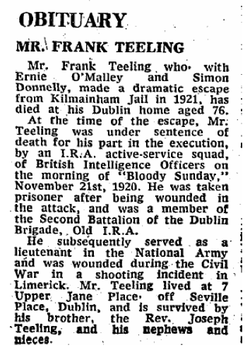
- the words of Volunteer Patrick Moran (pictured) , Adjutant of D Company Irish Volunteers, 2nd Battalion (Dublin), to his comrades Ernie O'Malley (who had passed himself off to the British as 'Bernard Stewart') and Frank Teeling as they were about to walk to freedom through a gate in Kilmainham Jail in Dublin, which they had forced open, on the 14th of February 1921.
Volunteer Moran believed he would be found innocent at his 'trial' and saw no reason why he should take the opportunity to escape.
He was a 'dangerous man', as far as Westminster was concerned, and had been imprisoned in Dublin Castle on the 7th of January 1921 and charged with the 'murder' of two British Army/paramilitary gang members, Ames and Bennett, after been mistakenly identified as having been involved in the shooting dead of both men - Lieutenant Peter Ashmun Ames and British Army Lieutenant George Bennett (both of whom were in command of 'The Cairo Gang') on the 21st of November 1920 at 38 Upper Mount Street in Dublin.
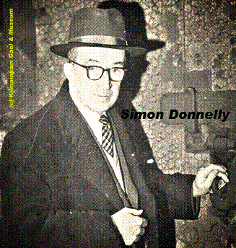
He stayed behind on the night of the prison break ,refusing to take part in same, having encouraged Simon Donnelly to go in his place, a decision which was was to cost Patrick Moran his life.
On the 15th of February 1921, he was put on 'trial' (during which sixteen people and an RIC man verified he was elsewhere!) but was, as expected, found 'guilty' and, three days later - on the 18th of February 1921, 105 years ago today - was transferred to Mountjoy Jail, Dublin.
On Wednesday, 9th of March 1921, Patrick Moran was sentenced to death and he was executed by hanging five days later, on Monday, the 14th of March.
He had defended the integrity of his country in Jacob's Factory Garrison during Easter week in 1916, where he served under Thomas MacDonagh, and had been imprisoned at Knutsford and Woorwood Scrubs in England, and in Frongoch Internment Camp in Wales.
He is one of 'The Forgotten Ten' in that he, and his nine comrades, were 'forgotten' by the State but have always been remembered by Irish republicans.
Finally, the planning and execution of the escape itself is worthy of a few paragraphs :
On the 11th February 1921, Frank Teeling and Ernie O'Malley were joined in Kilmainham Jail by Simon Donnelly, who was taken into their confidence and told of the up-coming plan of escape.
The peep-holes in the cell doors were three inches in diameter and, if one of the men could get his arm through it, it would be possible to open the door from the outside ; the plan then was to make their way to the yard, as the men had noticed that the door leading from the prison to the yard was usually left closed-over, but not locked, and then cross the yard to a large iron gate on the west side of the jail, cut the bolt on same and escape.
A 'Plan B' had been made in case the bolt cutter should fail - IRA Volunteers from 'F' Company, Fourth Battalion, Dublin Brigade, would take up positions outside the prison wall with a rope ladder and, awaiting an agreed signal, throw in the rope attached to the ladder, so that the prisoners could haul the ladder over to their side of the wall.
Oscar Traynor, (pictured) IRA Dublin Brigade O/C, had secured a bolt cutter and that, along with two revolvers, were packaged and smuggled into the prison by a friendly British soldier.
The prisoners were not sure that the bolt cutter would be up to the job but were determined to carry out the escape plan, as Frank Teeling was in line for execution ; on the night of February 13th, 1921, the three men made their way to the outer prison gate but, as the handles of the bolt cutter were incorrectly fitted, they were unable to cut the bolt.
They went to 'Plan B', and gave the signal for their comrades on the other side of the prison wall to throw in the rope attached to the ladder - the rope jammed on top of the wall and snapped when the men outside attempted to pull it back to them.
The three prisoners had no alternative but to return to their cells.
The following day, the British soldier who was in on the plan repaired/adjusted the handles on the bolt cutter and, that night, at 6.30pm, the three prisoners decided to make another escape attempt.
The three Irish republican prisoners again made their way down to the gate and, this time, the bolt cutter worked.
They used butter and grease, which they saved from their meals, to help ease the remaining portion of the corroded bolt out from its latch and two of the men got their revolvers at the ready as the third man pulled on the heavy door which creaked open sluggishly on its rusty hinges and the three men walked out!
Simon Donnelly had tried to persuade Patrick Moran to join them, but Volunteer Moran - who was not involved in shooting Ames or Bennett, and had what he considered the perfect alibi for that night - refused to leave the prison except by the front gate as a free man.
Patrick Moran paid with his life for relying on British justice : not the first innocent man to be put to death by the British, and not the last Irish person to be punished by them in revenge.
RIP Volunteer Patrick Moran.
ON THIS DATE (18TH FEBRUARY) 78 YEARS AGO....
"On my way to Knocksedan a little before mid-day I called at the Post Office in Lusk for stamps.
The postmistress, whom I knew very well, asked me to accompany her to her sitting room.
There she told me that she had just delivered a wire in code from Dublin Castle to the Lusk police sergeant, and she was familiar with the code from frequent messages.
This particular one to the police sergeant was to the effect that he was to make immediate arrangements for the arrest of Ashe and myself!
I mention this incident because I think that similar messages were sent to various Volunteer centres in the country, and because it tends to show that the Rising leaders were right in their view that there was to be a general swoop by Dublin Castle on that day.
The police attack was being directed by a District Inspector Smyth, an ex-Army officer and, at the other end (Southern or Cross Roads) a County Inspector Gray was directing operations.
Gray was severely wounded early in the fighting, leaving Smyth in sole command and, soon after Frank Lawless's arrival, an intermittent duel began between his and Smyth's squad.
Smyth was eventually mortally wounded by a shot from Lawless, leaving the police without a leader, with the result that they lost morale and, very soon after Smyth being knocked out, Lawless and his Volunteer squad came out on the roadway, firing intermittently, and moved at the double towards the motor cars.
On seeing them, some of the police peared from under cover of the cars with their hands up..."
- the above is taken from 'Document W.S.97' , a statement made on the 18th February 1948 by Dr. Richard Francis Hayes (pictured), a medical officer and Commandant of the 5th Battalion, Dublin Brigade of the Irish Volunteers, as part of a questionnaire into Volunteer activities in north county Dublin during Easter Week, 1916.
Volunteer Hayes and his men were active in Donabate, Swords, Garristown and Ashbourne and, following the Rising, he was sentenced to 20 years imprisonment but was released in June 1917, but was imprisoned again for republican activities between May 1918 and March 1919 and from November 1920 to July 1921.
However, he ruined his credentials by supporting the Treaty of Surrender and entered the Westminster-imposed Leinster House institution in 1922 and soon after joined the Free State 'Cumann na nGaedheal' party.
To his credit, he resigned from Leinster House in 1924 and turned his back completely on political life, perhaps because he realised that that which he fought for as a republican was not obtainable through the politics of the Free State and its 'parliament', Leinster House?
He died on the 16th of June, 1958, in his 80th year, and is buried in Deansgrange Cemetery, in Dublin.
ON THIS DATE (18TH FEBRUARY) 180 YEARS AGO : ATTEMPTED GENOCIDE RAISED IN THE BRITISH PARLIAMENT, REPORTED ON BY THE MEDIA.
On the 17th February, 1846, speaking in the British so-called 'House of Commons', Daniel O'Connell (pictured) raised, among other issues, the potato blight in Ireland, and the effect it was having on 'her majesty's subjects' on that island.
The 'servants of the people' in that political institution were only too aware of the suffering that the Irish were trying to live through, and Mr O'Connell was aware of that, but he was hoping that his comments would be carried in the newspapers and reach a wider audience, which they did on the 18th February (1846) and afterwards.
This is an extract of the speech he delivered -
"...It was certain that there was a fearful prospect of a most calamitous season before the people of Ireland. The extent of that calamity had been disputed, and there had been a time when there was a prospect of some portion of it being possibly averted..the calamity was pressing, was imminent – more pressing, more imminent, and more fearful than that House was aware of. In order to understand it, it was right that the House should be made aware of the state of Ireland before the calamity, had impended.
The last Population Returns of 1841 showed that, out of the whole rural population of Ireland, 46 per cent lived in a single room ; the entire human family and the pigs occupied the same apartment together. The next fact was, that of the civil population – that is, of the inhabitants of towns – 36 per cent lived in a single room, and that two or three families sometimes occupied the same room.
An account of all cattle, sheep, and swine, imported into Great Britain from Ireland, from the 10th day of October, 1845, to the 5th day of January, 1846 ; oxen, bulls, and cows, 32,883 ; calves, 583 ; sheep and lambs, 32,576 ; swine, 104,141..more than half the potato crop is unfit for human food, and the disease is progressing. More than half the labourers are unemployed, and are likely to continue so for the next three months, and during the months of July and August, as the farmers will not have money nor food to give them.
The agricultural labourers of Ireland suffer the greatest privations and hardships ; that they depend upon precarious and casual employment for subsistence ; that they are badly housed, badly fed, badly clothed, and badly paid for their labour ; that it would be impossible to describe adequately the sufferings and privations which the cottiers and labourers and their families in most parts of the country endure ; that in many districts their only food is the potato, their only beverage water ; that their cabins are seldom a protection against the weather ; that a bed or blanket is a rare luxury ; and that nearly in all, their pig and their manure heap constitute their only property ; that a large proportion of the entire population comes within the designation of agricultural labourers, and endure sufferings greater than the people of any other country in Europe have to sustain..." (from here.)
The finely-suited 'parliamentarians' in that institution were aware of the suffering endured by the Irish, as policies enacted and enforced by Westminster was responsible for the genocide being played-out in Ireland, but they didn't care, as they themselves were not only not affected by those conditions but actually benefited, financially, from same ; Irish land, free of impoverished 'tenants', was more valuable and easier to sell than if the same land was sold with 'troublesome tenants' on it.
That mindset is still prevalent in British 'High Society' to this day, but here's a newsflash for our snob British readers, for 'our own' gombeen snobs in Leinster House and for the 'asylum-seeking/refugee/migrant/vagrant'-pushing EU : we ain't goin' nowhere ; this is our country, not a dumping ground or a political and/or military base for your good selves.
Take your unwanted debris back to your own country, and leave us in peace!
THE MONTH UNSPUN...
The stories that hit the headlines.
From Magill magazine, August 2002.
Elan's accounts for 2002 were published on the 9th July, ending any hope that the drugs company may recover its past glories and causing severe embarrassment for the Irish-American investors who had defended it.
A company that had taken 33 years to build had fallen into despair in just six months.
The problems were essentially twofold - Elan's accounting practices made investing in the company look less risky than it actually was, and the Alzheimer's drug that the company was developing in the hope that it would be "the big one", failed clinical tests.
The "big one", therefore, never materialised, and Elan's complex system of shared investments could no longer bear the strain - one billion euro was knocked off the value of the 'National Pensions Reserve Fund' as a result of the chaos...
(MORE LATER.)
"The general condition of the county is unsatisfactory.
There were 18 outrages as compared with 27 committed during the previous month.
On 18/2/21 the Postmaster at Navan disappeared. He has not since been heard of and it is suspected that he has been the victim of foul play..."
- RIC report for Navan, County Meath, February 1921.
In the early hours of Friday morning, 18th February, 1921, a Protestant man, a Mr Thomas Hodgett (55, pictured), a Postmaster, was abducted from his home near Navan, in County Meath, by three armed men who claimed to be from the IRA.
He was taken away by the men, shot dead and his remains were thrown into the River Blackwater, but were not found until one month later.
The British claimed that his killing "was a Sinn Féin outrage against the minority religion...", but the IRA and local republicans denied all knowledge of the killing.
'The Irish Bulletin' newspaper investigated the shooting and stated that 'it was carried out by a County Inspector of the RIC and a notorious sergeant from Dublin Castle...'
Further words were exchanged between the IRA and the British, but no answers were forthcoming as to the 'who and why' of the shooting dead of Mr Hodgett.
Until 32 years later, that is...
"Three men were responsible for that murder. They were a policeman (sic) from Dublin Castle named Igoe, a civilian named Brady from Dublin, who was shot at the Bull Wall, Dublin a few weeks later, and RIC County Inspector Egan..."
- part of a letter written on the 13th January, 1953, by a Mr Gilbert, who lived beside the Hodgett family.
RIC Chief Constable Eugene Igoe, a Galway man, was in charge of a semi-'official' sub-unit of the RIC known as 'The Identification Company', whose function was to patrol the streets of Dublin searching for IRA men on the run who had come to the city for safety ; they were also known for occasionally shooting dead innocent civilians and leaving bogus IRA notes reading 'Death To Spies And Informers' on the corpses, making the murders appear to be the work of the IRA.
Mr (John Ellard) Brady was a 21-year-old man who was shot and killed by the IRA in Dublin in June 1921.
He was supplying information to the Crown Forces.
Mr Brady was sitting on a sea wall (near the Bull Wall area of Clontarf, Dublin) with two other men, a Mr Thomas Halpin (an ex-British Army soldier) and a man named Denver, when they were targeted by the IRA's 'F Company', 2nd Battalion.
Both Mr Brady and Mr Halpin were killed.
RIC 'County Inspector' (William) Egan had already been named, two years before Mr Gilbert named him, in a 'Bureau of Military History' (BMH 1951) statement as having played a part in the abduction and shooting dead of the Postmaster, Mr Thomas Hodgett.
The investigation in the 1950's indicated that the real cause for the murder of Mr Thomas Hodgett was that he, unfortunately and inadvertently, divulged information through an indiscretion, picked-up on by British operatives in Dublin Castle, which made the local RIC and British Army look incompetent in the eyes of their Headquarters and had signed his own death warrant in doing so.
RIP Mr Thomas Hodgett.
On the same day that poor Mr Hodgett was abducted by armed pro-British forces, their colleagues about 50km (30 miles) down the road, in Dublin, sealed-off Mountjoy Square and went house-to-house searching for rebels and military equipment, but left the area empty-handed.
"Sinn Féin Courts started to function, and one of the trials was the eviction of a British ex-soldier from one of my father's houses at 63 Blarney Street, Cork..."
- Volunteer PJ Murphy, Cork, recalling the details, years later, of an event which he was involved in :
"..after the trial, Walsh gave the names of the court and the local Volunteers to the RIC and was rewarded with money for this information.
His sister got the draft and went to cash it in the local shop, where it was reported to the local Volunteers, and Walsh was arrested by the IRA, sentenced to be deported, left the country and went to Wales.
After a few months he returned.
We made two attempts to arrest him, and on each occasion he got away from us ; on the first occasion by diving into a shop full of women and children, and the second time by throwing himself off a high wall.
On each occasion he went to the military barracks and brought the military to our homes.
While with the British in Cork Military Barracks, Walsh fell into bad health and they transferred him to the Cork workhouse (the Workshop Infirmary, Douglas Road). One night in February 1921 he was brought out on a stretcher to the backgate of the workhouse and shot dead by the IRA..."
A letter which was written and signed by a British Army Captain, a Mr Campbell Joseph O'Connor Kelly ('Sixth Division Intelligence Officer') came to light about one week after Mr Walsh had been executed (18th February 1921), in which Mr Kelly stated that the informer had been rescued in the past by his troops when they raided the Cork Mental Asylum where he was being detained by the IRA.
After they had rescued him, the British sent him to England to lie low, but he soon ended up in Ireland again.
It was an armed six-man Volunteer ASU (under the command of Volunteer Thomas Crofts, 2nd Battalion, Cork No. 1 Brigade), wearing disguises, that removed that informer from his hospital bed, carried him down the stairs from his ward, out the workhouse gate, onto the road, and shot him dead.
The Officer Commanding of the Cork IRA 2nd Battalion, Volunteer Michael Murphy, described Mr Walsh the informer as "a definite spy and a low type".
A card was pinned to the body -
'Caught at last. Spies and informers beware. IRA.'
On the same day that one informer was paying his dues, another one was earning his keep in that same county.
British Army soldiers 'came across' an arms dump owned by the Kilbrittain Company of the Cork No. 3 Brigade of the IRA and took the munitions into their custody.
The haul would have consisted of between 15 and 20 shotguns (many of which were collected voluntarily during the 1918 conscription scare), about 20 'Service Rifles' (probably Lee-Enfield brand), a small number of revolvers and other handguns, 'home-made' bombs and mines, gelignite, guncotton and hundreds of rounds of bullets for the guns on site.
The equipment would have been wrapped in canvas, oiled, and hidden in bunkers with corrugated steel roofs, typically located in field corners near safe houses to allow for quick access by IRA Flying Columns.
As those British looters were looting Irish freedom equipment, 'The Times Of London' newspaper carried a news article about the 'Oxford Union' having voted 219 to 129 in favour of condemning the British government's actions in Ireland.
Appreciated, lads and lassies, thanks - but any chance ye could have organised a whip-around for a few bob to replace some missing items...?
On the 18th February, 1921, newspapers in Ireland covered the 'arrest' on the previous day, by pro-British forces, of a member of the pro-British 'police force', the 'Dublin Metropolitan Police' (DMP).
A Mr Eamon 'Ned' Broy (pictured, a republican-gamekeeper-turned-Free State poacher) was a DMP officer, working as a spy for the rebels, who morphed into a Free Stater who worked to a British agenda for anti-republican Leinster House conformists ( confusing, isn't it!) and was 'arrested' by his own people on the 17th for "collaborating with the enemy".
Documents that he had typed for a Sinn Féin contact (a M/s Eileen McGrane [MacCarvill]) were found and his involvement with the rebels was discovered.
Mr Broy was charged with 'high treason' and imprisoned in Arbour Hill Prison, in Dublin, and was only released in August that year (1921).
He worked as a secretary/bodyguard for/to the Irish Treaty (of Surrender) negotiators and, after partition was forcibly accepted and implemented he joined the new Free State Air Corps with the rank of Commandant (later promoted to Colonel).
All of his personas died in January, 1972, at 85 years of age, in Rathgar, Dublin.
On the same date that those newspapers were writing about Mr Broy, about 50 miles (75 km) across the country and down a bit, in the RIC Barracks in the town of Monasterevin, in County Kildare, a 34-year-old RIC member, a Mr Thomas Bradshaw ('Service Number 63555', with 14 years 'service' in that grouping), from Newport, in County Tipperary - a troubled man - was ordered to prepare himself for 'patrol duties' in the morning.
He must have slept uneasily that night because the following morning (19th February 1921) he went into the stables attached to the RIC Barracks, removed his Webley MkVI revolver (serial number 391534) from its holster, placed the barrel in his mouth and pulled the trigger.
The gunshot was heard by three of his RIC colleagues, a Mr James May ('Service Number 72428'), a Mr Abraham Harvey ('Service Number 74540') and a Mr Patrick Ryan ('Service Number 57520'), who rushed to the stables and found Mr Bradshaw on the ground, with blood pouring from the back of his head, but still breathing, laboriously.
He died minutes later.
==========================
DEATH IN THE MEDITERRANEAN...
Desmond Boomer, a Belfast engineer working in the Libyan oil-fields, disappeared seven years ago.
Officially, the plane on which he was a passenger crashed as a result of mechanical failure and pilot error.
But is that the real story?
Or were the Irishman and his fellow passengers unwitting victims of the shady war between Islamic fundamentalism and Mossad, Israel's intelligence network?
A special 'Magill' investigation by Don Mullan, author of 'Eyewitness Bloody Sunday'.
From 'Magill' magazine, January 2003.
Journalists Neil Livingstone and David Halevy claim the mission to assassinate Shqaqi was codenamed 'Operation Caesarea' and, according to the two journalists, by September 1995 some 40 well-equipped Mossad agents were in Malta posing as "rich tourists together with their wives".
They monitored Shqaqi as he passed through Malta on his way to Libya.
On the day Shqaqi boarded the ferry, the Mossad base in Malta was promptly notified and, again according to the two journalists, a speedboat then carried the operation's commander and hit men to Malta from Sicily.
Shqaqi booked into 'The Diplomat Hotel' in Sliema and went out for some early afternoon shopping. Two Mossad agents on a dark blue Yamaha XT motorcycle approached him and called his name...
(MORE LATER.)
ON THIS DATE (18TH FEBRUARY) 130 YEARS AGO : JOHN REDMOND'S UNHEEDED PLEA IN WESTMINSTER FOR IRISH POLITICAL PRISONERS IS PUBLICISED.
On the 17th February 1896, John Redmond (pictured) secured speaking time in the Westminster Parliament to discuss the plight of Irish political prisoners held in prison by the British political administration.
Such was the dire conditions endured by our prisoners, two 'Irish Unionist' (Free Stater) members of that political administration - Mr Horace Plunkett and Mr W.E.H. Lecky - actually supported Mr Redmond in his attempt to secure some sort of justice for those POW's.
During his plea to 'The House', it was announced on the 18th that he had said..
"...many hon. Members seemed to think that because it was contended that these were political prisoners who ought to be released, the Irish Members were thereby claiming that political offences ought not to be punished.
Nothing could be more absurd.
What they said was that there was a distinction drawn by all the nations in the world between the treatment of political offences and offences which sprang from the ordinary criminal instincts of mankind, and in dealing with every other nation in the world except with Ireland, England had been the first to draw this distinction...
...all persons to-day would admit that John Mitchell (pictured) was a political offender, but Englishmen of his day did not admit it, and they passed a special Act of Parliament dealing with the subject of treason in order that he might be treated, not as a political offender, but as an ordinary criminal.
All men of all parties admitted that the Fenians were political offenders, but anyone who listened to the speech of the hon. Member for South Mayo (Mr. Davitt) the other night, who knew his history, and heard what he suffered in prison, would recognise that though he was a political offender he was not treated as such.
In this case the Government still maintained the fiction that these men were not political prisoners ; but when all these men had been released, and when another generation of Englishmen looked back on these transactions, they would, perhaps, be just as willing to admit that they were political prisoners as men of the present day were willing to admit that the hon. Member for South Mayo (Mr. Davitt) and John Mitchell were political prisoners of their day...
Michael Davitt....was it not a disgraceful thing for England and for the Imperial Parliament that every generation with relentless regularity had in face a question of amnesty? England's Government of Ireland involved this — that she was almost the only country in Europe which was never, by any chance, without some political prisoners in her gaols.
An amnesty movement had become part of recognised political life in Ireland ; he remembered that the first political meeting he ever attended was an amnesty meeting.
The first debate he ever heard in the House was when, some 20 years ago, he came to listen to his father making a speech in favour of the amnesty of the political prisoners of his day.
Irishmen had recently been blamed for telling the English people that in any foreign complications they had not the sympathy of the Nationalists of Ireland.
Irishmen would have been liars and hypocrites if they had said anything else..." (From here.)
Mr Redmond and company were 'put in their place', albeit eloquently, by the political Dandies they were sitting with, which wasn't the first time that such proceedings ended in that manner.
Indeed, Thatcher did much the same, although less eloquently.
The only solution is to ensure that there are no more Irish political prisoners been held for political ransom by Westminster and the best way to ensure that is by Westminster withdrawing, politically and militarily, from Ireland.
Until that happens, we will always, regrettably, have Irish men and women incarcerated for political actions against the Crown.
ON THIS DATE (18TH FEBRUARY) 82 YEARS AGO : LAST FULL DAY ON EARTH FOR A REBEL POACHER-TURNED-FREE STATE MILITARY GENERAL.
'JJ O'Connell (pictured) joined the Irish Volunteers in 1914, becoming Chief of Inspection in 1915, and travelled the country organising volunteer corps, as well as contributing to the Irish Volunteer's journal and delivering lectures on military tactics to both the Volunteers and Na Fianna Éireann.
He also delivered a series of lectures about the famous Irish battles to the Gaelic League in Dublin (but) was not a member of the Irish Republican Brotherhood as he believed that soldiers should not be a part of secret societies...
At the time the 1916 Easter Rising, O'Connell was operating in Dublin under instruction from Joseph Plunkett.
He was dispatched to Cork by Eoin MacNeill to try to prevent the Rising. Following the Rising, he was arrested and held in Frongoch internment camp from April to July 1916.
In 1918 he was again arrested and interned, spending time in Wandsworth Prison with Arthur Griffith for the alleged involvement in the fabricated German Plot.
During the Irish War of Independence, he was a member of the Irish Republican Army headquarters staff, as Assistant Director of Training and, after the killing of Dick McKee, as Director of Training. He coordinated, and was the principal lecturer, for a training course for military officers.
The course was run clandestinely in the premises of the Topographical Society on Gardiner Street in Dublin. A sympathetic doorkeeper allowed O'Connell's group in at night when the society was not present. Topics delivered by O'Connell included tactics, ordinance and engineering. In the IRA split after the Anglo-Irish Treaty was ratified, O'Connell took the pro-Treaty side...' (from here.)
On the 26th June, 1922, Leo Henderson and a group of 'Irregulars/Dissidents' left the then republican-occupied Four Courts, which had been taken over on the 14th of April by anti-treaty forces '..and arrived at Ferguson's Garage on Dublin's Baggot Street, accusing them of doing business with Belfast ; this was, they said, in violation of the boycott the IRA had placed on the city due to violence against nationalists there.
Leo Henderson, their leader, seized a number of cars at gunpoint, and was on the point of driving back to the anti-Treaty stronghold of the Four Courts when he was arrested by pro-Treaty/Free State troops.
Henderson's comrades in the Four Courts in response arrested a pro-Treaty General, JJ O’Connell and, within 24 hours, Free State artillery was battering at the walls of the Four Courts in central Dublin. The first shots of the Irish Civil War were caused by a row over selling cars to Belfast...' (from here.)
Not altogether the full story, although the 'bones' of what actually happened are there ; Harry Ferguson's garage (pictured) was a well-known Belfast automobile company, with a branch on Baggot Street, in Dublin.
It was known to be unsympathetic to the 'Irregulars' and had blatantly ignored an overall directive from the IRA that for-profit business dealings with Belfast should cease until business bosses in that city took steps to ensure the safety of their nationalist workforce.
Leo Henderson and his men commandeered about 15 cars which had been sent, for sale, to Dublin from Belfast - the IRA's intention, as well as to be seen enforcing the 'Belfast Trade Boycott', was to use the vehicles, as part of the war effort, against the continuing British political and military presence in the Six Occupied Counties and in their campaign to overthrow the then-fledging Free State political administration.
Leo Henderson was captured by the Staters, with ex-IRA man Frank Thornton in command of them and, when the IRA leadership heard that Henderson had been 'arrested', they discussed abducting Collins himself or Richard Mulcahy in retaliation, but decided instead to seize Free State General Jeremiah Joseph (JJ) 'Ginger' O'Connell, who was Richard Mulcahy's Deputy Chief-of-Staff.
At 11.15pm on the night of Tuesday, 27th June, 1922, 'Ginger' was arrested in Dublin by the IRA after an evening out with his girlfriend - the couple had gone to the theatre and, after the girlfriend was dropped home, 'Ginger' went to McGilligan's Pub in Leeson Street for a few pints and, as he left the pub, the IRA seized him and held him in the republican-occupied Four Courts.
Ernie O'Malley actually telephoned Free State General Eoin O'Duffy, who was in Portobello Barracks, and told him that 'Ginger' will be returned to the Staters in exchange for Leo Henderson.
The republicans knew that 'Ginger' was valued by Collins and his renegades - he was one of the few that eagerly conveyed the 'cancel-the-Rising'-order from Eoin MacNeill in 1916 and both Collins and Mulcahy regarded him as a safe pair of hands.
Collins's political and military bosses in London were notified about 'JJ Ginger' being held in republican custody and made it clear to Collins that if he and his Free State colleagues didn't take steps to remove the republicans from the Four Courts, they would - the Staters had already decided to attack their former comrades in the Four Courts and had already accepted the offer from Westminster of equipment with which to carry-out the task.
British artillery, aircraft, armoured cars, machine guns, small arms and ammunition were by then in the possession of Collins and his team, who then used the 'JJ kidnap'-incident as a further 'reason' to press ahead with the assault.
At 3.40am, on Wednesday, 28th June 1922, the republican forces inside the Four Courts were given an ultimatum by Collins and his men, acting in support of Westminster - 'surrender before 4am and leave the building'.
The republicans ignored the threat and held their ground and, less than half-an-hour later - at about 4.30am - the Staters opened fire on the republicans with British-supplied 18-pounder guns and practically destroyed the building (pictured), an act which was recently described as "..a major national calamity..an assault on the collective memory of the nation..such actions are considered as war crimes..a cultural atrocity.."
The IRA held out for two days before leaving the building, but fought-on elsewhere in Dublin until early July, 1922, with Oscar Traynor (who later joined the Fianna Fáil party) in command.
'JJ Ginger' was rescued by his Stater colleagues on Friday, 30th June 1922 when they finally managed to enter the then shell of a building where the Four Courts once stood and, within months, was demoted from a Lieutenant-General to a Major-General and then to a Colonel, a position he was to remain at.
He got married in 1922 and, between 1924 and 1944 (he died, aged 56, in the Richmond Hospital in Dublin from a heart attack on the 19th February of that year), he was shifted around like a pawn on a chess board : chief lecturer in the FS Army school of instruction, director of Number 2 (intelligence) bureau, OC equitation school, quartermaster-general and director of the military archives.
We wonder did he consider himself to be the man who helped give 'credence' to the Civil War...?
"We no longer recognise the authority of the present head of the army, and renew our allegiance to the existing Irish Republic..."
- part of a Proclamation issued on the 18th February 1922 to Michael Collins, Richard Mulcahy and other pro-Treaty leadership figures from the Officer Commanding of the Mid-Limerick Brigade IRA, Volunteer Liam Forde.
The split between Irish republicans and the Stater renegades was widening.
That Brigade was the first military unit of the IRA to formally break with the pro-Treaty Free State administration : it was a direct act of defiance against the Pro-Treaty leadership following the signing of the Treaty of Surrender in December 1921, which Irish republicans viewed (and still view) as a betrayal of the Republic.
Those repudiated by the republican forces included Michael Collins, Richard Mulcahy (the FS 'Minister of Defence') and Eoin O'Duffy (the 'Chief of Staff' of the Stater Army).
The IRA, rightly, no longer felt bound by the decisions of a political administration which now swore allegiance to the English Crown.
On the cusp of civil war...
In an unrelated/coincidental development in London, as Volunteer Forde and his fighters were making the lie of the land clear to the Staters, a British Army Field Marshall, a Mr Henry Wilson, stepped down as 'Chief of the Imperial General Staff' and, back in Ireland, at that same time, Ballylongford and Ballybunion RIC barracks in County Kerry were handed over to the IRA.
The then British Prime Minister, a Mr David Lloyd George, had his hands full on that 18th February - wondering whether his proxy Free State militia in Ireland could take on and defeat the Irish republican forces, who he could get to replace Mr Wilson (!), and what use would the IRA make of the two surrendered barracks?
As Mr George was juggling his 'what ifs' in London on the 18th, the uncertainties for an RIC member in Belfast had been removed.
The RIC 'Sergeant', a Mr Eugene Ahern (51), a Cork man, was due to be buried the next day in Emlaghfad Graveyard, which is located about one mile from the town of Ballymote, in County Sligo.
On the 15th of February, 1922, Mr Ahern and his patrol returned to Springfield Road Barracks in Belfast and were packing-up for the night ; the RIC member beside him was dismantling his machine-gun (he had removed the ammunition drum but never cleared the barrel) when the gun went off.
The bullet in the barrel caught Mr Ahern in his side, nearly blowing him off his feet ; he was rushed by his colleagues to the near-by 'Royal Victoria Hospital' but died within minutes of being admitted.
He was buried on the 19th.
In Sligo, as stated - not in his native Cork.
The day before Mr Ahern was buried, news broke of the death of a member of the Black and Tans in Limerick, a Scottish man, Mr Lauchlan McEdward (20, 'Service Number 81157').
Mr McEdward, described by some British sources as "a Scottish Temporary Cadet with the Royal Irish Constabulary (RIC)" and by others as "a Black and Tan during the Irish revolutionary period..." was said by those sources to have met his death "during an incident involving the accidental discharge of a gun that was being unloaded" and/or "fatally shot while out walking when attacked by several gunmen...".
The (deliberate, in our opinion) obfuscation would be done for a number of reasons - to mask the shame on him and his family for being associated with that gang of lowlife armed paramilitary thugs, to prevent an attack on those attending his funeral service by those opposed to the Black and Tans and/or in an attempt to confuse the enemy on the reliability and accuracy of their intelligence networks.
And in yet another 'accidental death', on the same date that Mr McEdward's killing was announced, an 'Ulster (sic) Special Constabulary' patrol was 'on checkpoint duty' at a location known locally as 'Spawell', between Enniskillen and Kinawley, in County Fermanagh, when a lorry failed to stop for them.
So they opened fire on it.
The lorry stopped abruptly at an impromptu angle and some of the USC checkpoint party approached it, cautiously, guns at the ready.
They opened the drivers door and discovered that the driver, now dead, was one of their own - 'Special Constable' James McInnes (25).
Ooops...
==========================
ON THIS DATE (18TH FEBRUARY) 103 YEARS AGO : IRA VOLUNTEER'S LAST NIGHT WITH HIS MOTHER.
On the 19th February, in 1923, IRA officer Thomas O'Sullivan, of Ballineanig, Kerry, was shot dead by a Free State Army officer near Dingle, in that same county.
The Stater who shot him was an ex-IRA man who had been expelled from the Republican Movement for misconduct and, as such, must have felt right at home with his new comrades.
This account of the death of Volunteer Thomas O'Sullivan is taken from Dorothy Macardle's book 'The Tragedies Of Kerry' -
' "I had twelve children, but I had none like him," Mrs. O'Sullivan says.
Tom was twenty-two years old when he was killed ; he was a teacher of Irish and a fisherman, and he was a Volunteer since the Black-and-Tan time ; he was Commandant of his Battalion when he died.
They (the Staters) came raiding for him in December, with their lorries, but his mother got him away. He was going fishing and had his hand on the kettle, going to make himself a cup of tea, when she ran in with the warning and he made out through the back door. She lifted a bucket and went up the road towards them thinking to hold them awhile in talk.
"Who's that man running?", the officer shouted to her, and she called back "I don't know at all.."
"You know well, you devil!" he answered, "'Tis your son, Tom," and he went down on his knee and fired. The bullet slit Tom's jersey, but Tom was not hurt. But the danger to him seemed more than she could bear.
"Wisha, give me your gun," she said to Tom that night, "and I'll carry it into town for you."
"No, mother," he answered, "that's what I'll never do. I didn't take my oath to break it," he said. "I know what's before me, and I'm satisfied to face that."
He used to come home sometimes, never to sleep, but maybe to change his clothes. He came in on the eighteenth of February (1923). His mother thought he looked troubled. "Have you any letter from Dan?" he asked her at once. Dan, his brother, was in jail. She gave him the letter and he read it under the lamp.
"Dan's all right," he said with relief in his voice, and gave her the letter again. Then he said, "Come down with me now."
She went with him down the bohereen.
It was getting dark and she could not well see his face. Suddenly he put his arms round her. "Goodbye, mother," he said.
"Why do you talk like that, Tom," she said, half-crying, "and you always so brave?"
"Ah, mother," he answered, "I'll be under locks from you soon." He took her hand then and they walked together a little further on.
He was going to sleep in a house across the fields, where he'd be safe, he said.
He started to go but came back to her again : "You're not ashamed of me, mother?" he asked her. It was in Irish, the speech of her heart, that she answered him.
In the dark of the night a man came to her door. It was Bob McCarthy, Tom's friend : she knew him well.
"'Tis pity to be disturbing you," he said, "but the Staters are in the fields below. Where's Tom?"
She told him and he ran out.
She was on her knees praying when she heard a shot fired. She started up and drew the bolt and ran out. She stood, crying out her prayers and blessings, against the gable of the house when she heard another shot and another again.
The man who was with Tom hiding in a hollow knows what happened then, but he is a prisoner, sentenced to fifteen years.
Only the little that he told to a fellow-prisoner, since released, is known -
"They were hiding and spoke to one another, not thinking the enemy were near, but they heard a voice call out suddenly : "That's O'Sullivan! I know his talk." They knew the man who spoke. He had been expelled from the Volunteers for misconduct and was a Free State Officer now. His kind were the most vindictive, always. Tom O'Sullivan must have known that this was death. The man saw him and fired, and Tom fell.
He was badly wounded and put his hands up as he lay on the ground.
"I surrender to you," he said. "Get a priest for me before you do any more." The man fired again and Tom moaned, "O Jesus and Mary come against me" and died.
Bob McCarthy evaded the enemy that night. He had another month to live. It was he who came to Mrs. O'Sullivan to tell her that her son was dead...'
That Free State officer, and other sleveen's of his type, still reside in, and operate from, Leinster House.
Parasites.
RIP Volunteer Thomas O'Sullivan.
Thanks for the visit, and for reading - appreciated!
Sharon and the team.
(We'll be back on Wednesday, 4th March 2026.)