Cahir Davitt, a Judge in the Dáil Courts in 1921 and later the first Attorney General of the Free State, recalled sitting as a judge in the District Court in Rathmines around this time where the other two judges were Erskine Childers and James Dwyer (neither judge was to survive the Civil War)...Dwyer also become involved in the military struggle for Irish independence and served as the Intelligence Officer (I/O) for G Company, 4th Battalion, Dublin Brigade IRA, during the War of Independence. He was arrested and imprisoned by the British for a time in 1920.
He worked with Michael Collins on policy material, rather than military operations (and) was a member of the Second Dáil, which sat on August 16, 1921 (until 8th June 1922)...the controversial Anglo-Irish Treaty (was) signed on 6th December 1921 (and) Dwyer was a strong Pro-Treaty member.
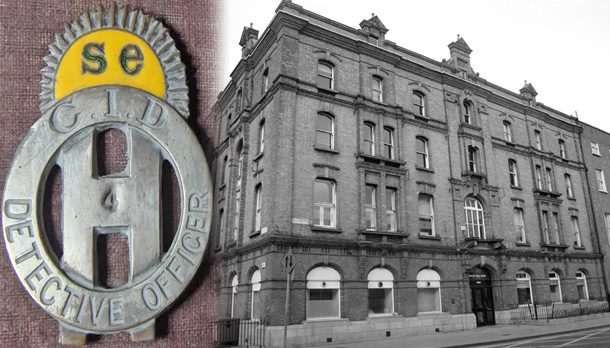
Oriel House, a prominent building in the centre of Dublin located on the corner of Fenian Street and Westland Row, was the headquarters of the Free State Intelligence Department which comprised of three sections - the Criminal Investigations Department (CID), the Protective Corps and the Citizen's Defence Force....though there is no record of Dwyer having an official position in the CDF*, it is clear that he was strongly associated with it in the minds of republicans...
On the evening of Wednesday 20th December 1922 (101 years ago on this date), as the day's trading drew to a close (in his shop) Marie was upstairs in their accommodation while her husband, Seamus (37), served customers and spoke with friends in the shop below...it was only five days before Christmas, no doubt trade was brisk and Dwyer was looking forward to the Christmas break.
It was also the day after seven republican prisoners had been executed in Kildare following their capture carrying arms, one of the largest single executions during the Civil War...standing less than a yard away from his victim, (the IRA man) reached into the inside breast pocket of his overcoat and whipped out the revolver, pointed it directly at Dwyer's chest and fired two shots into him from point blank range.
Dwyer was hit in the heart and died instantly, falling behind the counter...his death was noted in the records of Blackrock College by Fr John Ryan CSSp, College historian and archivist: 'Shot 1922..political assassination – connected with his attitude re killing of Rory O'Connor?' (From here.)
*To declare that Seamus Dwyer "had no official position in the CDF" is questionable - "Dwyer was also the head of a shadowy organisation called the Citizens Defence Force which operated out of Oriel House alongside the infamous CID and it is likely that this is the reason why he was killed, probably as a reprisal for the executions which the Free State had started shortly beforehand..." (from here), and then there's this, which also counters that declaration -
'The CDF was was set up to protect private property. One of it's first leaders, Seamus Dwyer, was shot dead in his own shop. Leadership of this body passed on to Harrison*, a former British Army officer. There were 101 members in this body, mostly former BA men, probably recruited from the British Legion. It was a very secretive organisation and used numbers instead of names when writing reports and communicating. Three of it's members were killed during it's existence. It was the first body to be abolished after the ending of the civil war...' (from here / *Captain Henry Harrison, O.B.E., M.C. secretary of the 'Irish Dominion League').
Seamus Dwyer, killed in his own business premises, is reported to have been in overall charge of the CDF but Leinster House records show although considered for the post he did not take it up. The man was obviously predisposed towards the objectives of the CDF and that was apparently recognised by the then State 'authorities'.
A local (Clondalkin, Dublin) connection re the above-mentioned execution of Seamus Dwyer -

He was a member of the Fourth Battalion, Dublin Brigade, IRA.
Robert Bonfield was born in Youghalarra, Nenagh, County Tipperary in 1903 (he was only 20 years of age when he was kidnapped and killed by the Staters) and was a member of the Fourth Battalion, Dublin Brigade, IRA.
He was educated by the Christian Brothers at Synge Street, Dublin and, at the age of 17, entered University College, Dublin, to study dentistry.
He joined the IRA through contacts in that College. A number of weeks before his death (29th March 1923) he was arrested at his home by the Staters, but he escaped from their custody (in Portobello Barracks) and went on the run, and remained a free man until his recapture and subsequent 'disappearance'.
He was visiting the Seven Churches on Holy Thursday and it would appear was accompanied by another man when he was picked up (visiting the Seven Churches was a custom in Dublin during that period, when its citizens would visit all seven churches during Holy Week).
After being captured he was dragged towards the Baggot Street corner of Stephen's Green, near the Shelbourne Hotel, and in the direction of both Oriel House and the new CID Headquarters which was just a few hundred yards away on Merrion Square. He was assaulted on several occasions by his escort in full public view and this was the last time he was seen alive.
His body was discovered the following day, Good Friday, by a shepherd at Clondalkin, Dublin - the previous day (Thursday, 29th of March 1923, between 6.30pm and 7pm), a young girl named Bella Brown, who lived near the Red Cow in Clondalkin, heard six shots as she was bringing milk to a neighbour's house.
The following day, Friday 30th March 1923, the body of Robert Bonfield was discovered in a field close by - he had been shot several times in the head.
According to testimony given by several witnesses at the inquest there is no doubt that Commandant Bonfield was arrested by members of (Free State) President Cosgrave's personal body guard and later murdered, either by them, or their associate detectives operating out of Oriel House. He was discovered lying on his side at the bottom of a ditch at Dowling's Farm, Newlands Cross - he had been shot a number of times.
He was aged 20 years. His remains were refused admission to his local Parish church in Ranelagh and he was buried in the family plot, St. Paul's section, Glasnevin Cemetery :
'Bonfield was arrested on 07th March 1923 by a Lieut. Bolger after his house at 103 Moyne Road, Ranelagh was raided and a veritable arsenal (including a Lewis Gun and three revolvers) were seized.
He was taken to Portobello Barracks from where he subsequently escaped a couple of nights later. He went to the house of schoolmates of his, Brendan and Kevin Mangan, at Albany Terrace, Ranelagh and had a wash and some food before going on the run. A 'servant girl' who had helped give him the meal probably reported him to the authorities.
The following night the Mangan's house was raided by "a group of men in plain clothes accompanied by a man in the uniform of an Army Lieutenant" who were looking for Bonfield. Brendan Mangan was taken to the back garden and interrogated. His parents attempted to intervene and when his mother asked why he was not arrested and charged in the 'proper way', the chilling reply was "We are out to execute, not make arrests".
Mangan's excuses were believed and the group left, which was rather lucky as Bonfield had hidden arms under the floor of the Mangans henhouse and Brendan was aware of this. The Mangans kept the guns hidden for many years and later when the family moved house Brendan transferred the guns to the hen house at their new address.
It was only years later when there was an amnesty that his brother Kevin handed in the guns. On the 29th of March 1923, about 2 weeks later, Bonfield was lifted by Cosgraves bodyguard which included Joe McGrath, John O'Reilly (who was either a Colonel, a Commandant or a Superintendent) and an unnamed guard. Two of these men took Commandant Robert 'Bobbie' Bonfield to Clondalkin and shot him...' (from here.)

However, in her book 'Four roads to Dublin : the history of Rathmines, Ranelagh and Leeson Street', Deirdre Kelly came across sources who suggested that the then State 'authorities' believed that a different IRA man had executed Seamus Dwyer - '(IRA man) Frank Lawlor was aware that CID agents were looking for him. He was tracked down to a friends house in Ranelagh and taken from there by the CID. His body was recovered at Milltown Golf Club.
Nothing was heard of Lawlor until the 1st of January 1923 when his body was found on Orwell Road...if Frank Lawlor was killed (he was killed by Staters on the 29th December 1922) in revenge for Dwyers death, it appears..that they got the wrong man, as according to IRA officer Séan Dowling it was another man, Bobby Bonfield who shot Dwyer, for which Bonfield was himself assassinated by pro-Treaty forces in March 1923..', and yet another IRA man, Thomas O'Leary, had his name linked by Staters to the Dwyer execution ; both IRA men were shot dead by Leinster House operatives, either because of the whispered 'Dwyer link' or simply due to the fact that they continued to be Irish republicans, unlike those that shot them.
Seamus Dwyer, a member of the Free State political establishment - whether or not he was a member/supporter or leader of the anti-republican CDF organisation, he was a gamekeeper-turned-poacher - was shot dead by the IRA on this date - 20th December - 101 years ago.
'SINN FÉIN NOTES.'
From 'The United Irishman' newspaper, April 1955.

GALWAY :
Sinn Féin went in strength to the Galway v Clare game at Ballinasloe on Sunday, 20th March last.
Cumann members from Galway City, Ballygar, Ballyforan, from Dublin and County Clare were very well received by the Gaels.
Every available copy of 'The United Irishman' was sold and a good collection made for the 'Northern Election Fund'.
All our members were greatly impressed by the reception they received, and it has been decided to hold public meetings in Tuam and Ballinasloe to explain Sinn Féin policy to the County Galway people ; the Tuam meeting will be held on Saturday, 16th April, at 8pm, and the Ballinasloe meeting will be held on Sunday, 17th April, at 12.30pm...
(MORE LATER.)


On the 20th December, 1919, an RIC 'Detective Inspector', a Mr William Charles Forbes Redmond (pictured), arrived in Dublin to take over as the boss of the 'G Division' of the 'Dublin Metropolitan Police' ('G Division' was a plainclothes ['Special Branch'] divisional office of the 'Dublin Metropolitan Police' which concentrated on 'detective police work'. Divisions 'A' to 'F' of the DMP were uniformed sections which patrolled particular districts of Dublin).
Mr Redmond had been head of the RIC's 'Detective Division' in Belfast ( and was later to be appointed 'Assistant Commissioner of the DMP' on January 5th 1920, which would bring him further into the spotlight...).
Mr Redmond didn't travel on his own, as he was accompanied by a few of his equally 'old guard' colleagues who were to operate as his new 'office staff'. The group 'roughed it' for a while in 'The Standard Hotel' in Harcourt Street in Dublin while they were waiting for 'secure accommodation' to be prepared for them in Dublin Castle.
At his first meeting with 'G Division' operatives, Mr Redmond told them that they had one month "to get (Michael) Collins" or else he would order them to resign, and also told them that he was bringing in some more of his old RIC colleagues from Belfast which, apparently (and understandably!) didn't go down too well with the existing operatives.
On Wednesday, 21st January 1920, he left his Dublin Castle Headquarters and was walking down Harcourt Street when he was shot dead by the IRA. Had he lived, he would have known that 'his men' never did catch Michael Collins, who was himself later to be shot dead by the IRA...
========================================

On the 20th December, 1919, Mr Arthur Griffith (pictured) hopefully woke up, after a sleepness night, wondering about - maybe even regretting? - what he done the previous day.
For it was on the 19th December that he had proposed the following motion in the (32 County) Dáil Éireann -
"That Dáil Éireann approve the Treaty between Great Britain and Ireland signed in London on December 6th, 1921."
...and it's all been down hill since then.
========================================

On the 20th December, 1919, Peadar Clancy (pictured) and other IRA Volunteers finalised their plan to pay a 'visit' to the offices of the pro-British 'Irish Independent' newspaper (!) offices in Dublin to convey to the management and staff of that enterprise that they objected to them having described IRA Volunteer Martin Savage as "a would-be assassin".
The IRA Unit called to the premises the next day and the machinery on site was put out of action.
Message delivered.
========================================
IRELAND ON THE COUCH...

A Psychiatrist Writes.
'Magill' commissioned Professor Patricia Casey to compile an assessment of Irish society at what may emerge as the end of a period of unprecedented growth and change.
This is her report.
From 'Magill Magazine' Annual, 2002.
For all of our self-indulgence, we are still a very generous nation, giving hugely both spiritually and emotionally when the time requires this.
Witness the collections a few Sundays ago for famine relief in Afghanistan, or the outpouring of grief at the day of mourning on the 14th September for the victims of the bombing in America. Attend any funeral and the people carry the coffins of the dead and comfort the bereaved in very practical ways.
We have had a recent diet of stories of terrible sexual and physical abuse from the 1950's and 1960's, resulting in books, court cases and a commission of inquiry.
The perpetrators, ie the Church and the State, have been rightly vilified. However, the constant preoccupation with the past is also unhealthy, since it distracts us from examining the problems in our midst.
Sexual abuse still occurs today and may possibly be more common than in the past, since the circumstances that promote it are rampant. The 1950's were imperfect, but so too is the new millennium and we should not be smug...
(MORE LATER.)

On the 20th December, 1920, the IRA ambushed an RIC/British Army patrol at Nine Mile House, County Kilkenny -
"(It was on) Monday the 20th December, 1920, at a point about 300 yards from the village of Nine Mile House. There was an excellent ambush position there, where the road from Kilkenny to Clonmel turns sharply to the right and then, about 40 or 50 yards further on, turns sharply to the left before entering the village of Nine Mile House.
The road from Mullinahone to Nine Mile House joins the main road at the latter sharp bend. There was ample cover along the steep slopes on the left-hand side of the road and a perfect view of the countryside.
Armed with a miscellaneous collection of weapons, shot guns, rifles and revolvers, over eighty men assembled at the ambush position at about 7 a.m. on the morning of the 20th. I had a service rifle which Father Delahunty had brought from Dublin and given to me some time before his arrest. Ammunition was our biggest worry, as a check-up revealed that there was scarcely ten rounds per man.

Pat Egan, Captain of the Mullinahone Company, was selected to take charge. He was assisted by Eamon Alyward and Jimmy Leahy and, by 8 a.m., final instructions had been issued and all men had taken up their positions. I was placed in charge of a party of fourteen or fifteen men from the Kilmanaghand/Ballycloven Companies on the left flank of the position.
As a precaution to prevent information reaching the (British) military in Callan, road blocks were not erected.
The day wore on with no sign of any lorries of British forces but about 2 p.m. we saw a cycle patrol of fourteen British troops and two men coming along the Mullinahone road. They dismounted from their bicycles and slowly pushed them up the steep incline towards the main road. It looked as if they were going to be sitting ducks when they entered the ambush position.
Unfortunately, at that stage, one of our men fired an accidental shot. The two R.I.C. men who were at the rear of the patrol turned and cycled back towards Mullinahone. The soldiers discarded their bicycles and ran back down the road. We opened rifle fire on them at 300 yards range but without effect.
The soldiers left the road, got cover in a hog and from there had an exchange of fire with us at a range which I gave as 1,000yards. One soldier was wounded in this latter exchange. The engagement was broken off almost immediately afterwards, our only booty being the soldiers' bicycles.
On being dismissed, the men separated to go to their own areas. With about thirty men I retreated cross-country to Garryricken and Trenchmore and afterwards crossed the Kilkenny-Clonmel road at a point about two miles from Callan. There was no sign of British forces on the road when I reconnoitred it but they arrived on cycles from Callan within minutes of our crossing.
We had not gone more than 200 yards from the road when two of our men, Paddy Ryan and a chap named Maher, who was cycling from Nine Mile House on two of the captured bicycles, came into conflict with the military. Shots were exchanged in which Ryan shot one of the soldiers, a Private Squib, through the head.

Leaving their bicycles on the roadside, Ryan and Maher crossed the fence and, under fire from the (British) military, made good their escape. It was dark at that time and we, assuming that the fire was directed at us, took cover for some time. It was only later that we got the details.
British forces were by that time concentrating into the area and firing was going on all over the countryside. It was particularly heavy in the Mullinahone direction but that, as I again learned later, was due to indiscriminate firing by British troops who had run amok.
Another party of British forces arrived from the Callan direction and, mistaking the troops who had pursued Ryan and Maher for I.R.A. men, opened fire on them. The mistake was mutual and the fire was returned with the result that a Constable Walsh of the R.I.C. was shot dead.
As I have said, it was dark when all this was going on and we had no idea at the time of what exactly was happening but I would say that the confusion amongst the British forces was a big factor in enabling us to reach our homes safely.
That night and on the following day Auxiliaries, Black and Tans, and (British) troops concentrated into the area around Nine Mile House. There were widespread raids and searches. They terrorised the inhabitants of the village, burned stacks of hay at farmhouses and wrecked O'Sullivan's licensed premises..."
The words of Edward Halley, Ballywater, Callan, in County Kilkenny, Vice Commander of the 7th Battalion IRA, Kilkenny Brigade.
========================================

On the 20th December, 1920, British soldiers and RIC members, numbering about 100 men, with the help of their 'Royal Navy', landed on Inishmore Island (pictured, the largest of the Aran Islands) to 'arrest suspects' and search for weapons.
They 'arrested' eleven men, ten of whom they said were IRA Volunteers, and shot one man dead, a Mr Laurence McDonagh who, it was reported at the time, was an Irish speaker who didn't understand the English language.
The British soldier who shot him said later that he had 'ordered' Mr McDonagh (in English) to stay where he was standing and, when Mr McDonagh kept moving ("...trying to escape.."), he shot him dead.
========================================

On the 20th December, 1920, two IRA men - Captain James Lobby and Volunteer William Delaney - were 'arrested' by British Auxiliaries in Dulla, in County Tipperary, and taken towards the town of Cashel, in that county.
But they never made it - as the British Army convoy was passing near Kilfeacle Cemetery, according to the British Army report, 'the two prisoners tried to escape custody' and were shot dead.
The following night, British forces burst into a local house and removed Laurence Lobby (James’s brother) and shot him dead.
========================================

On the 20th December, 1920, two armed and masked men entered McDonnell's Bar in Ballyroan, County Laois, and demanded the money from the till.
Patrick McDonnell and his son-in-law, James Whelan, tackle the two thieves but Patrick was wounded, and James was shot dead.
Two British Army Auxiliaries - JH Cockburn and John Reive, both of whom were were stationed in Abbeyleix Barracks - were found guilty of the attack, 'escaped from custody' but were caught again.
On the 18th of June, 1921, they were sentenced to death for murder by a general court martial but their sentences were commuted to penal servitude for life.
Paperwork and media interest over, they were released on the 8th May, 1922.
========================================

In December, 1920, the South Wexford Brigade of the IRA planned to destroy the RIC Barracks in Carrig-On-Bannow, Danescastle, in County Wexford, described locally as being 'strongly fortified and regarded as impregnable'.
A local man, James Walsh, ran a pub and a shop from the same premises (see pic) and, as well as making a few bob from the British 'police', he also rented out rooms above the premises to them.
A Mr Tom Traynor, who was employed as the Wexford County Engineer, was also an IRA Volunteer, and he had calculated the amount of explosives required for the job.
Another IRA Volunteer, Francis Carthy, later described the IRA plan -
"...to place a large quantity of gelignite in the public house against the inner wall of the barracks. The charge was calculated to be sufficient to destroy the barracks and its contents completely.."
On the 20th December (1920), the leader of the IRA Unit, Volunteer David Sears, entered the shop to buy some cigarettes, recce it and see who was there etc, and report back to the eleven Volunteers waiting near-by to carry out the operation, but Mr Walsh became suspicious of him, words were exchanged and it came to a fist fight.
The 'boxing match' spilled on to the street outside and then two shots were fired, hitting James Walsh, who died minutes afterwards. The RIC in the Barracks were now alerted and fired a few shots at the IRA men who, having lost the element of surprise, withdrew from the area.
========================================
BEIR BUA...

Republicanism in history and today.
Published by the James Connolly/Tommy O'Neill Cumann, Republican Sinn Féin, The Liberties, Dublin.
August 1998.
('1169' comment - 'Beir Bua' translates as 'Grasp Victory' in the English language.)
'Fenian Proclamation 1867 :
Proclamation To The Irish People Of The World.
Today, having no honourable alternative left, we again appeal to force as our last resource.
We accept the conditions of appeal, manfully deeming it better to die in the struggle for freedom than to continue an existence of utter serfdom.
All men (sic) are born with equal rights, and in associating to protect one another and share public burdens, justice demands that such associations should rest upon a basis which maintains equality instead of destroying it.
We therefore declare that, unable longer to endure the curse of Monarchical Government, we aim at founding a Republic based on universal suffrage, which shall secure to all the intrinsic value of their labour.
The soil of Ireland, at present in the possession of an oligarchy, belongs to us, the Irish people, and to us it must be restored. We declare, also, in favour of absolute liberty of conscience, and complete separation of Church and State. We appeal to the Highest Tribunal for evidence of the justness of our cause...'
(MORE LATER.)


The 20th December, in 1921, was the sixth day of the third session of the Second Dáil (the 32-County political institution, not to be confused with the entity which exists now in Kildare Street, in Dublin.)
The debates on the 'Treaty of Surrender' resumed, and those present went into a 'Private Session' in the afternoon to discuss the military situation which existed in the country at that time.
Most of the IRA Officers present say that a return to pre-'Truce' military conditions was not possible and Seán T. O'Kelly (a republican-gamekeeper-turned-Free State-poacher) stated - "The two great principles for which so many have died - no partition and no subjugation of Ireland to any foreign power – have gone in this Treaty and some good men are thinking of voting for it..."
Shortly afterwards, Mr O'Kelly voluntarily "subjugated" himself to the rule of the Free State...
========================================

On the 20th December, 1922, a Mr Patrick Fitzgerald, a Free State Army member, was shot dead at the corner of Granby Road and Dorset Street, in Dublin, by 'persons unknown' and, on that same day, while 'fumbling in the greasy till' in his shop in Number 5 Rathmines Terrace, in Dublin, a Mr Seamus Dwyer, a pro-'Treaty' politician and a personal friend of the late Michael Collins, was shot dead - see our 'Opening Post', above, for further details.
========================================

On the 20th December, 1922, the Belfast to Dublin train was boarded by IRA Volunteers at Castlebellingham, in County Louth, and the passengers were ordered to disembark, which they did.
The train was shunted into a siding, derailed, and the carriages were burnt.
On the same day, a commercial goods train was making its way north when it was stopped. The driver and other workers onboard were ordered off and the train was set, driverless, down the track where it crashed into a stationary passenger train.
========================================

In early April, 1922, William Blennerhassett, a (Protestant) farmer, was evicted, along with his wife and seven children, from their farm at Culleneghy, Beaufort, near Killarney, in County Kerry, by a group of armed and masked men.
A local man, John Murphy, had had his family members evicted from that farm, by the British, in the 1880's, and tensions were understandably high in the area because of that and other Westminster-encouraged intrusions into Irish matters.
The following day, however, the local IRA Battalion Officer Commanding reinstated the Blennerhassett family on the farm, which wasn't an acceptable outcome to many of the locals, so some of them decided to take a legal case regarding the proper ownership of the farm.
In mid-June, 1922, the High Court in Dublin ruled in favour of the Blennerhassett family in their land dispute with John Murphy and his supporters.
On the 20th December, 1922, the farmhouse was burnt down.
========================================
 UP THE REPUBLIC - OUR DAY WILL COME !
NOLLAIG SHONA DAR LEITHEOIRI!
Ar eagle an dearmaid...
Ba bhrea an rud e siocháin bhuan bunaithe ar an gceart a bheith againn in Éireann. Is i an bronntanas is fearr a d'fheadfaimis a thabhairt duinn fein agus dar gclann.
Coinniodh an ceart agus an tsiocháin uainn le breis agus ocht gcead bliain , de bharr ionradh , forghabhail agus miriaradh na Sasanach. Socrú ar bith a dheantar in ainm mhuintir na hÉireann agus a ghlacann le riail Shasana agus a dhaingnionn an chriochdheighilt , ni thig leis an ceart na an tsiocháin bhuann a bhunu.
Ni dheanfaidh se ach la na siochána buaine a chur ar an mhear fhada agus an bhunfhadb a thabhairt do ghluin eile . Tharla se seo cheana nuair a siniodh Conradh 1921 agus cuireadh siar ar mhuintir na hÉireann e in ainm na siochána. Is mór ag Sinn Féin Poblachtach Éire a bheith saor agus daonlathach, an cuspoir ceanna a bhi i gceist ag Wolfe Tone agus ag na Poblachtaigh uile anuas go dti 1916 agus an la ata inniu ann.
Rinne a lan fear agus ban croga iobairti mora, thug a mbeatha fiu, ar son na cuise uaisle seo.
CEART. SAOIRSE. DAONLATHAS.
A PEACEFUL CHRISTMAS TO OUR READERS !
Least we forget...
A just and permanent peace in Ireland is most desirable. It is the greatest gift we could give to ourselves and our children.
We have been denied justice and peace for more than eight centuries, because of English invasion, occupation and misrule of our country. Any arrangement which, in the name of the Irish people, accepts English rule and copperfastens the Border, will not bring justice and lasting peace. It will only postpone the day of permanent peace, handing over the basic problem to another generation.
This happened before when the Treaty of 1921 was signed and was forced on the Irish people in the name of peace. Republican Sinn Féin cherishes the objective of a free, democratic Ireland, as envisaged by Wolfe Tone and all Republicans down to 1916 and our own day. Many brave men and women sacrificed a lot, even their lives, for this noble Cause.
JUSTICE. FREEDOM. DEMOCRACY.
From the '1169' Crew, December 2023. PLEASE NOTE : we are on a short break now from normal posting, although we will return to 'normal' early in the New Year.
Yeah - that's all we can say for now - "early" 'cause, between the family, our political colleagues, the Girl Gang, our neighbours and other friends, we've got about a dozen Christmas parties to get to and literally dozens more house calls to make!
I'll still be having me say on Twitter and Facebook, as ya can't keep a Dublin young wan from spaking her mind!
Go raibh maith agat, and we hope a good 2024 will come to your door!
Nollaig shona dhaoibh is go méadaí Dia bhúr stór san Athbhliain!
Sharon and the Crew ; signing off for 2023.