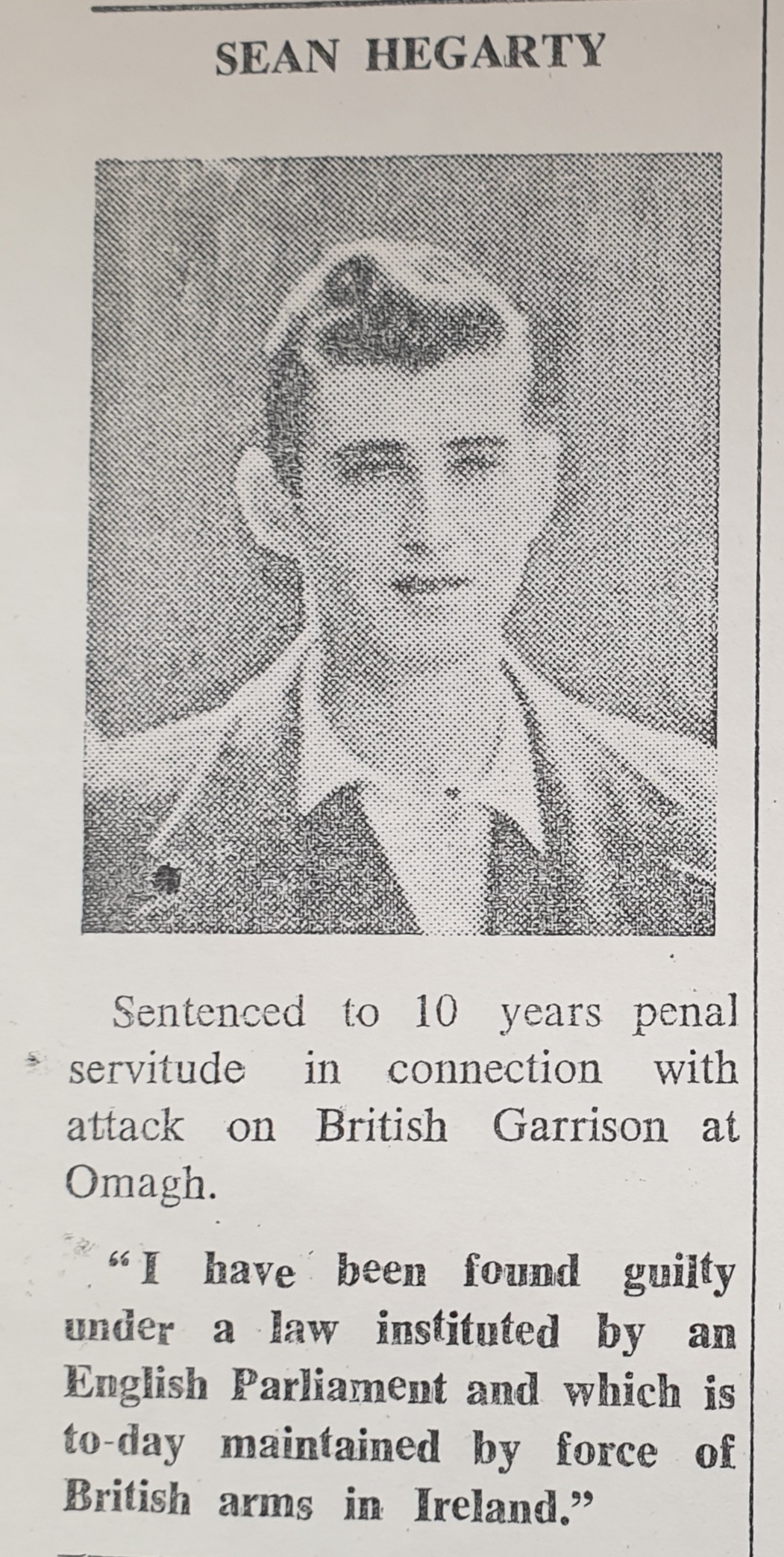
'Francis Sheehy-Skeffington did not enter his wife Hanna's details on the 1911 Census form at their home...as the suffragettes had a campaign of non-cooperation with the 1911 Census.
Francis recorded four people in the house : himself (aged 32), his one year old son (Owen) and two female servants, Philomena Morrissey (aged 23) and Mary Butler (aged 21).
The enumerator, James Crozier, attempted to circumvent the boycott by recording Hanna’s details, but almost all of the information was incorrect.
He entered her name as Emily, (but her correct name was Johanna), had the wrong age of 28 (her real age was 33), he recorded their marriage as 3 years in length (but they had been married for 8 years) and recorded her place of birth as Dublin (she was born in Kanturk, Co. Cork).
He was correct in recording that they had had one child and that this child was alive (Owen Lancelot) ; the enumerators, who were from the police force, had extensive powers to make enquiries locally about those who refused to fill out the form.
Johanna Mary Sheehy (pictured, in 1912, on her release from Mountjoy Prison in Dublin), known as Hanna, was born in Kanturk, County Cork, in May 1877. She belonged to a prosperous farming and milling family. Her father, David Sheehy (1844-1932), was a member of the IRB and later an MP, and had been imprisoned no less than six times for revolutionary activities. Hanna was a highly influential figure during the suffragette movement and was also active in the realms of socialism and Irish independence.
She married Francis Skeffington in 1903. They joined their names together on marriage, a symbol of the equality in their relationship. Both were founder members of the Irish Women’s Franchise League in 1908 which fought for women’s suffrage. They had one child, Owen Lancelot, in 1909. She was fired from her teaching post in 1912 following her arrest for breaking windows during a militant suffragette protest.
In 1912 she and her husband founded the 'Irish Citizen' newspaper. She was active in the labour movement assisting in the soup kitchen at Liberty Hall in 1913.
Like her husband, Hanna was a pacifist. She attended a meeting in Wexford organised by John Redmond for conscription to the British Army. Huge crowds attended as conscription was so popular and trains had been organised from Waterford and Kilkenny. Redmond was about to address the audience when a very heavily veiled Hanna stood up on a box asking people to repudiate Redmond and his recruiting. She was torn down from the box by the crowd and her clothes almost ripped from her.
She was very badly mistreated by the crowd and if it were not for the intervention of the police and some members of the public she would have been thrown into Wexford Bay ;
"A much battered and torn and, I am sure, very much bruised, Mrs Skeffington was rescued".
During the Rising Hanna did not join the rebels but she brought food and messages to the various outposts. Her elderly uncle, a priest named Eugene Sheehy, a well-known Land League and IRB member, was at the GPO as a confessor to the rebels. She was in the confidence of some of the leadership as they selected her to act as a member of a civil provisional government to come into effect if the Rising was prolonged (she was to be one of five members of the Provisional government to be set up once the rebellion was victorious).
She considered the Rising as the first point in Irish History where the struggle for women’s citizenship and national freedom converged. Her husband Francis, who was not involved in the Rising, was arrested while trying to prevent looting. He was detained by Captain Bowen-Colthurst and shot without a trial. She refused £10,000 in compensation and instead looked for a court martial for her husband’s killer.

After the Rising she worked tirelessly to convince the American public to support the Irish cause and conducted a series of lectures there to raise funds. She went to America with Margaret Skinnider and Nora Connolly but the US authorities did not want her there as she was "talking too much" and so she returned to Ireland.
In 1917 she was appointed to the executive of Sinn Féin, rising to become the Director of Organisation. In the War of Independence she served as a judge in the Republican law courts in Dublin and during the Civil War she helped to set up the Women’s Prisoners’ Defence League. In the 1930’s Hanna was assistant editor of An Phoblacht. She died in April 1946 and is buried beside her husband Francis in Glasnevin...' (from here.)
The inscription on the Sheehy Skeffington headstone reads -
'Sacred to the memory of Mrs. Rose Skeffington, born Magorrian in Ballykinlar, Co. Down. Died at Ranelagh, Dublin 16th April 1909. And Francis Sheehy Skeffington her son / murdered in Portobello Barracks April 26th, 1916 and his wife Hanna Sheehy Skeffington, Feminist, Republican, Socialist. Born May 1878 / Died April 1946 And their son Owen Lancelot Sheehy Skeffington, born May 19th 1909, died June 7th, 1970 who, like them, sought truth / taught reason and knew compassion.'
That headstone dates Hanna's death as 'May 1878', and other sources cite her date of birth as '24th May'. But, either way, in our opinion, the Lady deserves a write-up and also deserves to be remembered more than she is.


On the 27th May, 1919, a Mr Walter Hume Long (pictured, the '1st Viscount Long'!) wrote to his friend, a Mr David Lloyd George (the 'Prime Minister of the United Kingdom') offering his opinion that it was not yet the time for declaring the Sinn Féin organisation to be an 'illegal' body.
Mr Long was aware that if Sinn Féin were 'outlawed' the RIC, the pro-British 'police force' in Ireland, would come under ever more pressure and he knew they wouldn't be able 'to hold the line'.
So he suggested holding off until the RIC were 'overhauled' first, telling Mr George that the chief RIC officers were either incompetent or worn out, suggesting that the then RIC 'Inspector General', a Mr 'Sir' Joseph Aloysius Byrne (who was appointed in 1916) had lost his nerve and should be replaced.
Mr Byrne had initiated a policy of compulsory retirement of RIC members whom he considered "unfit for service", which didn't go down well in political or military circles in Westminster as it was precisely the "unfit for service" (ie 'the loose cannon')-types that they wanted to 'police' Ireland!
Mr Long opined that a Mr Thomas James Smith (Belfast City Commissioner since 1909), a hardline RIC supporter in Belfast, would be spot-on for the position, I say, what...!!
This issue was discussed between the politicians for a few months and, on the 10th November (1919), the British 'Lord Lieutenant of Ireland', Field Marshal John Denton Pinkstone French ('1st Earl of Ypres, KP, GCB, OM, GCVO, KCMG, PC...' ETC ETC!) wrote to Mr 'Sir' Joseph Aloysius Byrne ordering him to take one month's leave "to rest himself" (Mr French could not actually sack the man, as that would require input from the British Treasury and there was no guarantee that Treasury management would agree with the move).
Mr Byrne assured all and sundry that he was grand (!) and sure he took the few weeks off anyway but, when he returned to work in early December, he found that "desks containing his private papers had been sealed" and Mr Smith was sitting behind his desk, the locks on which had been changed, as had Mr Byrne's career trajectory!
Flexing his new muscles on the 6th July, 1920, the then 'Inspector General of the RIC', Mr 'Sir' Smith, issued a decree to the media and to his troops -
"No authorised persons will be allowed to arrogate to themselves the duties of the police. Any such gathering of Volunteers will be an illegal assembly, the local police should take steps to disperse it and arrest the leaders. Military aid may be invoked where necessary..."
Needless to say, the IRA ignored his 'warning' and continued to militarily defend themselves and their country.
His failed decree might have had some bearing on the fact that, within five months of him having issued it, he retired from his position with that paramilitary 'police force', on two-thirds of his salary.
Indeed, between the 1st May 1920 and the 31st July 1920, more than 500 members of that grouping also resigned/retired.
They were no doubt just as demoralised as Mr Smith was.
Incidentally, the official file on Mr 'Sir' Thomas James Smith is in the British 'National Archives' in Kew, London and, when the man retired, his file was sealed for 26 years...
==========================
THE GREAT OIL AND GAS ROBBERY...
From 'Magill' Magazine, October 2005.
"I spent an hour with Micheál Ó Seighin (pictured), one of the Rossport Five.
Micheál received us very graciously in the small visiting box. He is a small, quietly-spoken man in his late 60s.
"Tá sibhse ag dhéanamh obair go hiontach. Congratulations. Bhí an scéal Dé Luan go han, han mhaith. Ceim mhór", he said..."

Micheál Ó Seighin.

Michael McDowell.

Pat Rabbitte.
Micheál said all of this in a quiet understated way and every so often he would chuckle as he responded to our questions.
For example, when I asked him what was the pipeline like he said - "Shell told us it was a very thick pipeline. We told them that the pipeline might be very thick but we're not."
I had heard that heavy metal deposits were being dumped back into the sea. He is obviously a man who thinks and ponders on all these matters and in response to my questions he gave detailed answers.
"Yes", he said, "Originally they wanted to dump it in Broadhaven Bay which is a special area of conservation under the EU and it is also internationally important because it supports important populations of birds, among them Brent Geese.
That stretch of coast used to have the best sea angling in western Europe - seven different types of whale and dolphin breed in the bay.
Carrowmore Lake is the supplier of water for this region and is protected as a 'Natura 2000' site on the UN list of protected conservation areas, and it will be badly damaged. Shell were told all of this and so was the Government."
Our discussion turned to the bog through which the pipe is being laid which, in some parts, is 30 feet deep, and below that is the dóib ('1169' comment - dóib [pronounced doh-ib] is an Irish word referring to sticky mud - 'daub' - or plaster-clay and, in the context of Irish bogs, it refers specifically to a type of heavy, viscous mud or clay found deep within the soil). Dóib causes the bog to move.
Micheál told us of a neighbour's experience when he built a septic tank ; the dóib lifted the tank, and another neighbour had a similar experience with the foundations for a hayshed.
According to local people, sections of the pipe are sinking in the bog...
(The third [ie last] pic above shows a Mr Patrick Rabbitte, ex-State Labour Party leader and ex-'State Minister for Communications, Energy and Natural Resources' ; Mr Rabbittee retired as State Labour Party leader in 2007, and from political life altogether in 2016, on a combined pension package worth over €2 million to him!)
(MORE LATER.)
ON THIS DATE (27TH MAY) 158 YEARS AGO : "FENIAN HANGED IN PUBLIC" ANNOUNCEMENT IN ENGLAND.

'The last man to be publicly executed in England has had a plaque erected in his memory at a mass grave in London. Michael Barrett came from a small farm in Drumnagreshial, Fermanagh, and was 27 when he was publicly hanged in front of Newgate Jail in London in May 1868...(he) was a member of the Fenians and had been found guilty of blowing up the wall of Clerkenwell House of Detention in London in 1867...(his) guilt was never clearly established and the evidence given by witnesses at the trial was questionable...' (from here.)
Michael Barrett's body was left hanging for about one hour, in full public view, outside Newgate Prison, and his body was then removed by prison staff and he was put in a grave within the prison walls : he remained there for 34 years before the British were shamed into placing his remains into a box and burying him in the City of London Cemetery in Ilford, East London.
At the time they executed him, their 'queen', Victoria, expressed her disappointment that 'only one person was caught' for the deed and suggested that, in any future such incident, the police should simply lynch, on-the-spot, any Irish suspects rather then give too much publicity to the Irish fightback.
An unsurprising comment, really, from the 'Famine (sic) queen' who, to put it mildly, 'had no real compassion for the Irish people in any way'.
'It was on a bright may morning, in the year of 68,
They led young Michael Barrett to the scaffold at Newgate,
He was indeed a Fenian but they blamed him in the wrong,
They had to have a scapegoat and Michael was the one.
He came from north Fermanagh near the county Donegal,
And he had lived through the hunger, Michael seen it all,
He went away to Glasgow like so many from this land,
There he joined up with the Fenian’s to help to free Ireland...' (from here.)
RIP Michael Barrett, Bold Fenian Man ; 1841 - 26th May 1868.
ON THIS DATE (27TH MAY) 228 YEARS AGO : BATTLE OF OULART HILL, WEXFORD.
On the 27th of May, 1798 (Whit Sunday) , a few hundred well armed British Kingsborough militiamen and yeomanry from the North Cork Militia were sent to Oulart (Abhallghort/Orchard), in Wexford, to quell 'native unease' and, as expected, they plundered and caused havoc on their journey to 'put manners' on those Irish men and women who had assembled, approximately one-thousand strong, in Oulart, under the leadership of Fr.John Murphy, General Myles Byrne, from Ballylusk, and General Edward Roche of Garlough, Castlebridge.
A description of the battle can be read here, but suffice to quote one paragraph from that link :
'...the (British) militiamen were soon completely overrun, and must have seen their fate written in the pent-up hatred on the rebels' faces. They turned and fled for their lives, spilling down the slopes from where they had come just a few minutes before.
Some ran for miles before being overtaken, impaled and gutted.
They begged for mercy in both Gaelic and English. They blessed themselves and shouted out prayers, since many of their number were themselves Catholic, but received absolutely no pity from the rebels.
To the insurgents, the men begging for their lives were the same ones who had so recently burned out and murdered their neighbours and friends. The merciless pikemen offered no quarter, and the detested North Cork Militia disappeared forever on the bloody slopes of Oulart Hill....'
One of the above-mentioned leaders, Myles Byrne (who lived long enough to serve as an officer in Napoleon's 'Irish Legion') was born in Monaseed in Wexford, on March 20th, 1780, and was only a boy when he witnessed the attacks by the yeoman militia and other mercenaries which England let loose in Wexford in 1798.
But he took his place in the United Irishmen and fought through the Wexford campaign, joined Michael Dwyer afterwards in Wicklow, later came to Dublin and was a comrade and friend of Robert Emmet in the continuation of '98 which failed so sadly in 1803.
He was sent by Emmet (then on the run) to France to seek assistance from Thomas Addis Emmet and the other exiled United Irishmen and went with no hesitation, in the hope that he would return in the ranks of a conquering army and, for over 30 years, he followed the flag of France across the battlefields of Europe, whilst seeking out information from all sources on the situation in Ireland.
After his retirement in 1835, when all hope of striking a blow for his own country had failed, he settled in Paris and continued to write, off and on, for twenty years, right up to the day of his death in 1862.
His widow published his memoirs in three volumes and the story was published in serial form in the 'Shamrock' newspaper of Dublin, in 1869, and reprinted in the 'Irish Weekly Independent' in 1898.
In his memoirs, he was critical of the "gentlemany nature" of the rebel approach, believing them to have been "too willing to negotiate and to accept (British) government protections and non-existent government good faith".
Whilst in Paris, his home was a 'safe house' for all who had ever served Ireland and one of the most welcome visitors to his home was that fine old soldier John Mitchel, who described Myles Byrne as "..a tall figure, the splendid ruin of a soldier d'elite , bearing himself still erect under the weight of eighty winters. The grey eye is keen and proud, the thin face bronzed and worn by war and weather, and the whole bearing gives the idea not of decrepitude, but of a certain dashing gallantry.
He has marched over half of Europe, and stood full often at the head of his regiment on the rough edges of battle in Spain, in Germany, in Greece and other, earlier memories, cloud at times his clear grey eyes ; and through and beyond the battle smoke and thunder of all Napoleon's fields, he has a vision of the pikemen at New Ross, and hears the fierce 'hurrah' on Oulart Hill..."

Myles Byrne died in France on Friday 24th January 1862, aged 82, and was buried in Montmarte Cemetery ('The Hill Of Martyrs'), Paris, in a grave marked with a Celtic Cross (since replaced with a different headstone) , inscribed with the words -
'Sincerement Attache A L'Irlande : Son Pays Natal, IL A Fidelement Servi La France, Sa Patrie Adoptive.'
The words on the new headstone read -
'Here lies Myles Byrne, Lieutenant Colonel in the service of France.
Officer of the legion of Honour.
Knight of St Louis, born at Monaseed in the county Wexford in Ireland, 20th March 1780. Died at Paris, the 24th January 1862, his long life was distinguished by the constant integrity and loyalty of his character and by his high-minded principles.
Sincerely attached to Ireland, his native land, he gave faithful service to France, the country of his adoption.'
Myles Byrne done more for Ireland on that one day, 228 years ago on this date, then some will do in a lifetime.
RIP General Myles Byrne.


27th-28th May, 1920 : "In 1867, the Fenians attacked a British military outpost at Kilmallock in County Limerick, but were repelled ; fifty-three years after that event, the Fenians (IRA) decided to burn the outpost (then an RIC barracks) to the ground..."
60+ armed republican Volunteers from East Clare, Cork, Tipperary and West Limerick, including Volunteers Tim Crowley, Jack McCarthy, Michael Brennan (Officer Commanding East Clare Brigade), Donnacha O'Hannigan, Jeremiah O'Mahoney, Sean Finn (Officer Commanding West Limerick Brigade), Garrett McAuliffe, Patrick Clancy, Larry McNamee, Edmond Tobin, P Hannigan, Tadgh Crowley, Denis Lacey, D P McCarthy, Connie Mackey, J Lynch and J O'Brien.
Volunteer Thomás Malone (aka 'Seán Forde', pictured, above) and Volunteer Seán Wall (pictured, below) played prominent parts in the operation - there were about 30 armed foreign 'police men' in a well-fortified barracks, roads into and out of the area were blocked by the armed rebels, neighbouring buildings were availed of in the fight, and there were casualties...

..we have penned a few paragraphs about this military operation elsewhere in this blog post ; two for the price of one, yer gettin'...!
==========================

On the 11th November, 1919, British forces raided a Dáil Éireann office in Dublin (76 Harcourt Street) and, among other items robbed by them - and damage caused - was at least one box containing Dáil Éireann-headed notepaper.
Over the following weeks and months 'orders' were issued on Dáil Éireann notepaper to various Dáil Éireann departments leading to missed meetings, misinformation, people being named in the wrong etc and some more serious issues.
On the 18th May, 1920, Arthur Griffith (Acting President and Minister for Home Affairs, Dáil Éireann) again contacted a Lieutenant-Colonel Mr 'Sir' Walter Edgeworth-Johnstone (KBE, CB etc!), the 'Chief Commissioner' of the then British 'police' in Ireland, the DMP, demanding the return of all the Dáil Éireann headed paper his grouping took during the Harcourt Street intrusion.
On the 27th May (1920), Mr 'Sir' Johnstone wrote back to Mr Griffith declaring "that no notepaper or any writing paper was removed from 76 Harcourt Street or taken possession of by police or by the military...", which prompted Mr Griffith to issue another public statement confirming that official notepaper was indeed among the items removed from Harcourt Street by British forces during the November 1919 raid.
Mr Griffith again referenced the fact that 'The Irish Bulletin' had previously released photographs of British Army documents which were written on the stolen notepaper and a statement from a neutral typefounder/typecaster/die-sinking expert saying that the typeface on those documents was an exact match for the typeface on death notices written on Dáil Éireann notepaper which had been sent to Dáil Éireann members.
The republican newspaper also published a copy of a British Army intelligence report from a British Army Captain, a Mr Frederick Harper-Shove, to one of his 'intelligence department' buddies, a British Army Major, Jocelyn Lee 'Hoppy' Hardy -
"Dear Hardy,
Have been given a free hand to carry on, and everyone has been charming.
Re our little stunt, I see no prospects until I have things on a firmer basis, but still hope and believe there are possibilities..."
The "little stunt" was probably a reference to the 'false flag' orders/instructions he and his people were placing in Irish republican circles, in the hope that it would lead to IRA members executing their own people in the belief that they had been 'turned'.
When not trying to stitch good people up, Mr Harper-Shove was apparently stitching himself up - his military 'Medal Index Card' contains complaints from his superior officers that he was fond of wearing medals to which he was not entitled and, in his dealings with the 'Herbal Medicine' (!) industry, Mr Harper-Shove was known as a Lieutenant-Colonel, a rank he was never entitled to!
Mr Frederick Harper-Shove was attached to the 'BA General Staff, Intelligence', and was better known in BA circles as a 'spy instructor' - he mostly operated from the 'spy school' in Hounslow, in West London, in a premises known as 'Cavalry Barracks/Silent Section'.
Despite his many enemies, he managed to stitch-up (!) a long life for himself - he died in 1974 in his own country, at 88 years of age, in Gateshead, in Tyne and Wear, North East England.
That much, at least, is true about the man...
==========================
As Mr 'Sir' Johnstone was writing his 'don't-know-nothin'-letter to Mr Griffith, a British Army Private, a Mr Joseph Clarkson (19, 'Service Number 51979'), attached to 'The King's Own Royal Lancaster Regiment', was on guard duty outside the British 'Chief Secretary's Lodge' in the Phoenix Park in Dublin when a gunshot was discharged.
Mr Clarkson fell to the ground, dead.
The poor young man had been "accidently shot dead by a fellow British Army soldier..."
He is buried in Ince-in-Makerfield Cemetery on the Warrington Road in Lower Ince, in Wigan, Greater Manchester, in his own country.
==========================

THE MONTH UNSPUN...
The stories that hit the headlines.
From Magill magazine, August 2002.
For its part, the government claimed that it had tried to draw up a list of protected sporting events in the past, but the moves had been blocked by the FAI, the IRFU and the GAA.
But there was more to government utterances on the matter than met the eye.
The government is now in the process of drawing up a list of protected sports events, and it is not likely that any of the above-mentioned organsations will risk public outrage by trying to interfere.
The GAA has already said it had "no objection", according to 'The Irish Times', to the inclusion of the senior All-Ireland finals on the list.
The proposed list is not due to be finalised until mid-September, with Sky's coverage beginning with Ireland V Switzerland in October and, if that game is live on Sky but not on RTE, expect things to get messy.
('1169' comment - next 'Unspun' piece : deportation orders...)
(MORE LATER.)


On the 4th May, 1921, the '5th Division' of the British Army began an eight-day 'round-up drive' in the Mullingar, Tullamore and Longford areas of Ireland and "captured a number of wanted men" (...their own claim was that the 'drive' began on the 4th and resulted in the capture of 35 'terrorists').
On the 27th May, they geared-up in armoured columns and cavalry and, this time, used their colleagues in the RIC as 'point and spotters' (ie 'expendable') and headed off on another 'round-up drive', and intended to stay out until mid-June.
They had five counties in mind, and left from their base in the Curragh, County Kildare, for Offaly, Westmeath, Longford, Cavan and Monaghan (and paid a 'visit' to County Leitrim as well).
They captured a few more rebels but afterwards admitted... "..as in the first operation the results were disproportionate to the exertions of men and horses, owing to the difficulty of identification.."
However, their efforts didn't put the IRA out of business - Irish men and women carried-on and had no "difficulty of identification" when it came to knowing who had placed themselves as the enemies of Irish freedom...
==========================

On the same date that the second wave of 'armoured cars and tanks and guns' were leaving their Curragh base on the hunt for Irish rebels, 'The Cork Constitution' newspaper reported that four houses belonging to anti-republican/pro-unionist families in Cork City had been attacked and burnt down.
Historian Dr John Borgonovo later opined that these burnings were a counter-reprisal by the IRA for the burning of four local homes by the British Army after the ambush on an RIC patrol in Blackpool, County Cork, on May 14th, in which three RIC members were killed.
Incidentally, in 1921, the IRA targeted over 40 country estates, or 'Big Houses', across County Cork.
These burnings were primarily retaliation for the destruction of republican homes by Crown forces, or were strategic military operations to prevent British forces from using the properties as a barracks.
==========================

As that newspaper was reporting on trouble in Cork, about 260 miles up the road (420km approximately) in Belfast, an internal IRA GHQ memo was received by the leadership of the 3rd Northern Division.
The memo expressed concern in relation to the alleged lack of discipline on the part of 'IRA juniors' (ie street-level Volunteers) in Belfast.
The Belfast Brigade operated under the command structure of the 3rd Northern Division of the IRA and, due to its geographic isolation from Dublin (no mobile phones or email in those days!) and the intense sectarian violence in that northern city - it was engulfed in severe communal violence as well as guerrilla warfare - the Volunteers sometimes had to act with local pressures in mind, rather than on official IRA GHQ policy.
Understandable, in our opinion ; the British military and political presence caused additional problems in that part of our country, due to anti-republican/pro-unionist elements pressuring Westminster to go ahead with their plan to partition that part of Ireland.
==========================

Volunteer Patrick Boland, the Captain of the Crossard Company (pictured), East Mayo Brigade, IRA, was from Cluain Gamhnach (Cloongawnagh/Cloongownagh) near Toureen, in County Mayo.
On the 27th May (1921) he was 'arrested' by the British Army (2nd Battalion, Argyll and Sutherland Highlanders) near his home and, they claimed, attempted to escape and was shot dead by them.
Reports at the time stated that... "..his body was reportedly severely mutilated...(it is) believed he was tortured by Lieutenant Anderson of the Argyll and Southern Highlanders, stationed in Claremorris..".
The name 'Lieutenant Anderson' is said to be a pseudonym used by a British agent who knew that if he owned-up to his many deeds, using his real name, his last such deed would indeed be his last such deed...
RIP Volunteer Captain Patrick Boland.
==========================
As Volunteer Captain Patrick Boland was being 'arrested', about 90 miles (140km) up the road in Donegal, RIC member James Doherty (24, 'Service Number 74307') was "accidentally shot dead by a fellow RIC man...".
We couldn't find any more information on the circumstances involved or on Mr Doherty himself.
==========================
DEATH IN THE MEDITERRANEAN...

Desmond Boomer, a Belfast engineer working in the Libyan oil-fields, disappeared seven years ago.
Officially, the plane on which he was a passenger crashed as a result of mechanical failure and pilot error.
But is that the real story?
Or were the Irishman and his fellow passengers unwitting victims of the shady war between Islamic fundamentalism and Mossad, Israel's intelligence network?
A special 'Magill' investigation by Don Mullan, author of 'Eyewitness Bloody Sunday'.
From 'Magill' magazine, January 2003.
On the 31st October, 1995, crowds gathered outside the Maltese Embassy in the Libyan capital, Tripoli, protesting about Shqaqi's assassination.
On the 1st November, 'The Times' newspaper in Malta reported on its front page that the crowds "warned Valletta of unspecified retaliation if it did not arrest the killers of Islamic Jihad chief Fathi Shqaqi..."
Reuters reported that "crowds demonstrated in Tripoli's streets and outside the Maltese Embassy, carrying portraits of Libyan leader Muammar Gaddafi and shouting their anger and denunciation of this abominable crime.."
The Libyan news agency JANA went fuirther - it reported that the crowd outside the embassy "read out a message to the Maltese urging them to arrest Shqaqi's killers or bear responsibility for the consequences of the killing on Libyan-Maltese ties. The Maltese authorities and the ruling party there bear full responsibility if they do not arrest the terrorists and bear the responsibility for its results on all aspects of Arab-Maltese cooperation."
Arab reaction to Shqaqi's murder was not confined to Libya.
The crowd at his funeral in Palestine, where he was declared a martyr, was estimated at a quarter of a million...
(MORE LATER.)
ON THIS DATE (27TH MAY) 106 YEARS AGO : IRA OPERATIONS BEGIN TO ATTACK BRITISH FORCES IN THEIR BARRACKS IN LIMERICK.

The building, above, which was used at the time as a barracks for a British 'police force' in Ireland.
In 1867, the Fenians attacked a British military outpost at Kilmallock in County Limerick, but were repelled ; fifty-three years after that event, the Fenians (IRA, with Volunteers Thomas Malone amd Sean Wall in command) decided to burn the outpost (then an RIC barracks) to the ground.
This was officially an East Limerick IRA operation but Volunteers from East Clare, Cork, Tipperary and West Limerick took part in the attack, among whom were Volunteers Tim Crowley, Jack McCarthy, Michael Brennan (O/C East Clare Brigade), Donnacha O'Hannigan, Jeremiah O'Mahoney, Sean Finn (O/C West Limerick Brigade), Garrett McAuliffe, Patrick Clancy, Larry McNamee, Edmond Tobin, P Hannigan, Tadgh Crowley, Denis Lacey, D P McCarthy, Connie Mackey, J Lynch and J O'Brien.
The building was a two-storey, solid masonry structure with steel shuttering and was set back from the road ; it housed an RIC garrison of two sergeants, Messrs. Thomas Kane and Tobias O'Sullivan, and between seventeen and twenty-eight 'constables', all armed, and was known to be a 'tough' building.
But it had one possible weakness - its roof.
A house to the right-hand side of the barracks, which was owned by the Carroll family, was taller than the barracks, and had a 'skylight' in its attic. Clery's Hotel and a bank practically faced the barracks, as did a shop, owned by the O'Herlihy family. If, during the attack, RIC reinforcements from other areas were to attempt to rescue their colleagues they would find the routes into the town barricaded by armed IRA units.
Sixty IRA Volunteers were organised for the operation ; at least half of them, plus some local men, went out on the night of 27th May (1920) and blocked a number of roads leading to Kilmallock.
IRA leader Tom Malone ('Sean Forde') and his unit took over Carrolls house, Tim Crowley and his Volunteer group took control of Cleary's Hotel, D. O'Hannigan was in charge of a unit of IRA men which occupied the bank and J. McCarthy and an IRA unit moved in to O'Herlihy's shop for the night. Michael Brennan, an IRA leader from East Clare, was also in the shop.
A few Volunteers were positioned near outhouses at the rear of the barracks.
Just after midnight, IRA leader Tom Malone and his men took it in turns to lob heavy objects out of the skylight of the Carrolls' house, the objective being to break a hole through the roof of the barracks, into which prepared petrol-bombs could be thrown ; when Volunteer Malone's first object hit the roof, the IRA units positioned around the barracks opened fire on the front and rear of the building and, within minutes, the RIC men trapped in the building were shooting back.
While this gun-fight was going on, Malone and his men succeeded in breaching the roof - dozens of parafin and petrol bombs were thrown through the hole, followed by a flaming torch and a grenade : the building was now on fire.
By 2am (approximately two hours after the attack began) the upper storey of the barracks was about to collapse on top of the ground-floor section, where the RIC men were now confined : the IRA stopped the attack and advised the RIC to throw out their weapons and then come out themselves. The RIC refused the offer.
However, all was not as it seemed to the attackers ; the RIC men had been retreating to the outbuildings at the back of the barracks, braving the sniper-fire from the IRA Volunteers rather than face the onslaught coming through the front of the building.
By about 7am, with the barracks now a smouldering ruin, it was obvious that a fresh plan and re-deployment of the Volunteers would be necessary if the RIC were to be removed from the various outhouses they were now in, and the order was given for the IRA to withdraw ; one Volunteer, Liam Scully, from Glencar, County Kerry, was dead (and is buried in Reilig na Tríonóide [the Old Church] Graveyard [Templeglantine Cemetery], in the townland of Templeglantine West in County Limerick) and an RIC Sergeant, a Mr Thomas Kane, and one of his 'constables', a Mr Joseph Morton, were dead - six more RIC men were seriously wounded, two of whom were named as a Mr Arthur Hooey and a Mr Barry.
The Kilmallock attack, on 28th May, 1920 - in the middle of the Tan War - was one of the most prolonged and fiercest battles of that period. The actual battle itself began on the 27th of May, 1920, 106 years ago on this date.
Incidentally, local folklore has it that the rebels in 1920 were repeated name for name and, in many cases, in blood relationship, with the rebel attackers on that barracks during the Fenian Rising on March 6th 1867.
RIP Volunteer Liam Scully.


In late May, 1922, a Mr David Lloyd George (pictured), the 'Prime Minister of the United Kingdom', was 'conducting Empire business' in Genoa, Italy, when he was contacted by his office and reminded that he was due to meet on the 27th with a political delegation from the Free State in Ireland.
'That's a damned nuisance...', says he to himself, '..sure isn't the whole partition of Ireland issue settled...?!'
Anyway - he made it back to Westminster on the 20th and, on the 26th, he examined the 'Treaty document' (written by, among others, Messrs Hugh Kennedy, James Douglas and Professor Alfred O'Rahilly) which the Staters had delivered to himself and his administration.
And it wasn't to their liking.
At the meeting on the 27th (May, 1922), he didn't hold back - he told the Staters that the new Free State constitution was a republican one (!) with a "thin veneer" ('spoonful of sugar', if you like!) and a complete evasion of the Treaty, and declared that the Irish would be sent a list of British objections to their draft constitution by May 29th.
Also, a Mr Churchill referenced 'Article 17' of the Treaty (of Surrender) [which obliged the Staters to sign a declaration of adherence to the Treaty] and told 'Collins Crew' that if Article 17 did not apply then "the process of the transfer of function does not go forward anymore".
It later transpired that Mr Churchill had already made contingency plans, which were approved by "a subcommittee of the 'Committee for Imperial Defence'...", no less (!) chaired by Mr Churchill, to occupy the waterline of lakes and rivers running from Dundalk to Letterkenny "to defend the North against invasion [by the Staters]" (sic- how do you invade your own country?!).
Other (cringe-inducing) meetings were held on the 29th and the 30th May (1922) and also on the 1st June (it transpired after his 1st June meeting with the Staters that Mr Churchill had also held a meeting with British military chiefs to draw up a plan for the full military reconquest of Ireland!), in which the Brits put the Staters in their place and, on the 2nd June, Mr Arthur Griffith, speaking for the Stater delegation, wrote to Mr David Lloyd George saying, in effect - "OK, boss - you win. We'll sign whatever ya want, just let us have part-control over 26 of our own 32 counties, a titled office job, decent salary and pension and the job's done.."
And Stater politicians in that same Leinster House institution are still selling us out today, 2026, but this time it's to the EU/UN/WEF, who have sent hundreds of thousands of their foot-soldiers here already - the 'asylum seekers/refugees/migrants/vagrants' that gather at practically every street corner in almost every village, town and city in this God-forsaken corrupt State...
==========================

On the 27th May, possibly in the hope of putting pressure on the British at the meeting in Westminster that same day, the Staters back home in Dublin issued a 'Proclamation from the Provisional Government' stating that an election would be held in the new 'Free State' on the 16th June.
Nomination forms for that election referred to elections to the 'Provisional Parliament pursuant to the Free State (Agreement) Act' (and not for the Third Dáil) and, later that same day (27th May 1922), a 'Lord Viscount of Derwent', a Mr Edmund Bernard FitzAlan-Howard (pictured, the British-imposed 'Lord Lieutenant of Ireland' ie the representative of the British Crown in Ireland, a position often referred to as the 'Viceroy of Ireland') declared that "the Parliament of Southern Ireland was dissolved and I hereby call a Parliament to be known as and styled the Provisional Parliament..."
Mr FitzAlan-Howard was a lucky man - he died of natural causes on the 18th May, 1947, at the age of 91, at Cumberland Lodge in Windsor, Berkshire, in his own country, England, and is buried at the Arundel Roman Catholic Cemetery at Arundel Castle.
One of his ancestors, 'the 2nd/9th Earl of Arundel' who bore the same name, was not as lucky - he was beheaded for high treason on the 17th November, 1326.
'High Treason' is heredity, it seems...
==========================
On the same day that the Staters issued their 'Proclamation from the Provisional Government' in Dublin, about 105 miles (165km) up the road in Belfast, three people were shot - a Mr William Smyth (21) was shot dead in the Short Strand, a Mr Robert Rainey (50) was shot when he went to the aid of a man injured in disturbances in the Cullingtree Road area and a five-years-young child, Georgina Campbell, was shot by a sniper allegedly operating from St Matthew's Church.
Those poor people might not have known it at the time, but they had been abandoned to their fate that same day by the Staters in Westminster.
==========================
Between the dates May 27th and June 10th, 1922, the build-up to and actual clash between the 'Ulster Special Constabulary', the British Army, the Free State army and the IRA - 'The Battle Of Pettigo' - took place along the Donegal/Fermanagh Border.
It was the last occasion that the Free Staters and the IRA fought side-by-side against British and pro-British forces.
The British military occupied Pettigo, a small village and townland on the border of County Donegal and County Fermanagh, until January 1923, when it was handed over to Free State troops and stayed in Belleek until August 1924, when the RUC and the 'Specials' took over the security (!) of the village -
'Pettigo, that little dismembered village, half in County Fermanagh, half in County Donegal, half free and half unfree, recalls to thousands of us very vivid memories of our Pilgrimage to Saint Patrick's Purgatory, Lough Derg.
...the stand made by less than one hundred IRA Volunteers against overwhelming numbers of British forces and lasting over a week, began on Saturday, May 27th 1922.
On that day a hundred Specials crossed Lough Erne in a pleasure steamer named 'The Lady of the Lake', towing a number of small boats, and landed above Belleek.
They (the pro-British 'Special Constabulary') marched to Magheramenagh Castle, the residence of the late Reverend L. O'Kierans, the Parish Priest of Pettigo, and ordered him to leave immediately, which he did.
A party of thirty IRA Volunteers advanced down the railway line towards Magheramenagh Castle but on their way there they were intercepted by a patrol of Specials who engaged them and then retreated to Magherameena Castle, pursued by the IRA Volunteers.
The Specials then abandoned the Castle for good, retreated to their boats on the Lough and withdrew in them to the Buck Island in Lough Erne, where they were reinforced by another hundred Specials with medical attendants who treated their wounded.
The Volunteers had suffered but a few minor injuries...' (...more here.)
==========================

As 'The Battle Of Pettigo' was kicking off, about 122 miles (195 km) down the road in Dublin, a smaller battle was taking place.
A British Army 'Lance Corporal', a Mr George Albert Emery ('Service Number M/25319'), from London, England, attached to the 'Royal' Army Service Corps Motor Transport Division in Dublin, was in the College Green area of the city with an army buddie of his, a 'Private' Dean, standing beside their sidecar-mounted motorbike.
At about 12.40pm on that day (27th May 1922) two men approached them and ordered them to move away from the motorbike ; a verbal/physical scuffle ensued and five gunshots were fired.
Both of the BA soldiers were seen to stagger ; Mr Emery fell to the ground, got back up, moved unsteadily towards nearby Church Lane and managed to set foot on Saint Andrew Street where he fell down again - dead.
Mr Emery had been shot three times - once in the neck and once in each lung.
Mr Dean survived the day.
The two other men left the scene.
==========================
Around the same time as College Green in Dublin was thrown into a panic, about 103 miles (166km) across the country and up the road a bit an 'ex'-RIC 'Sergeant', a Mr James Greer, was taken out of his house in Cootehall (near the town of Boyle) in County Roscommon and shot dead.
Mr Greer's son, Thomas, who lived just down the road from his father and was an 'ex'-member of the ADRIC* anti-republican semi-paramilitary grouping was also paid a visit that same day.
He was removed from his house and shot dead as well.
The Greers name had surfaced during an IRA investigation into the killing of Fr Michael Griffin, as had the name of another ADRIC member, a Mr Nichols, and 'Lord Haw-Haw' (a Mr William Joyce).
(*The ADRIC's were known as 'Pound-a-Day' men by the rebels, as that's how little they sold their 'service' for.)
RIP Fr Michael Griffin.
==========================
ON THIS DATE (27TH MAY) 71 YEARS AGO - ELECTION VICTORY ANNOUNCED FOR SINN FÉIN IN THE O6C.

'SINN FÉIN VICTORY.
Two Prisoner Candidates Elected To Thirty-Two County Parliament!
Northern republicans on road to freedom : Thursday, May 26th 1955, is a landmark in Irish history.
A new chapter has been opened.
The total vote cast for Sinn Féin candidates, great though it was, is of secondary importance to the new spirit of co-operation and voluntary service to Ireland that has spread throughout the country.
We are proud of the response made by the republicans in the North to Ireland's call for freedom and unity ; after years of betrayal and confusion - in spite of enemy tactics to disrupt and 'friendly' efforts to discourage - the republicans of the North have proved that the courage and idealism of the O'Neills and the O'Donnells lives on.
The election is a phase in the Sinn Féin campaign to organise all Irishmen into one united people to end forever British occupation and influence in Ireland, to restore to the Irish people their fundamental right to govern themselves and to develop the resources of Ireland for the happiness and prosperity of the Irish people.
It is now the task and duty of all Irishmen (sic) to rally to the support of Northern republicans in their demand for a 32-County Parliament.
Sinn Féin has the plans, you have the power - join Sinn Féin and unite the Nation!'
(From 'The United Irishman' newspaper, June, 1955 ; please note that the Sinn Féin organisation referenced in the above piece has no connection, except verbally [according to the PSF grouping] to the Stormont and Leinster House political party which is a political service provider for both the Free State and British administrations in this country.)
Thanks for the visit, and for reading - much appreciated!
Sharon and the team.
(We'll be back here on the blog on Wednesday, 17th June, 2026, and 'lil auld me will be on 'X' and Facebook between now and then, if yer missin' me all that much!
Myself and one of my teams in the company I work for, and with, have been requested to travel to our Galway office to reorganise/tweak the internal structures, and the company have booked us in to a [5 Star 'sleek urban retreat', if ya wouldn't mind!] hotel so I won't be in Dublin for at least ten days, never mind being in a position to work on the blog.
Only hope I don't come back with a culchie accent. Or an African one...)