THE O'RAHILLY : NATIONLESS AND NOW HOMELESS.
Joseph O'Rahilly ('The O'Rahilly') was born in Ballylongford, in County Kerry, on the 22nd April, 1875. He had a busy, well-travelled and interesting life and took part in the 1916 Easter Rising in Ireland, during which he was killed in the fighting.
"Friday April, 29 1916. The General Post Office in Dublin, occupied on the Monday as the headquarters of republican insurrection, was burning fiercely. The insurgents inside had decided they had to make their escape across Henry Street to the network of small houses and shops on Moore Street.
A small party of twenty armed men dashed across the open street to establish a toehold there and to clear out a British barricade. At their head was a distinguished looking gentleman in green uniform, complete with Victorian moustache and sword.
The charging party was hit by volleys of British bullets from the barricades on both sides. Four Volunteers were killed outright. Their leader, the moustached gentleman, fell wounded in the face. He managed to drag himself out of the line of fire to Sackville Lane, where he lay, bleeding, grievously injured. His name was Michael O'Rahilly..." (from here.)
More information re 'The O'Rahilly' himself - 'His interest in Irish history led him slowly and inexorably towards nationalism. The first indication of nationalism is in a letters controversy in 1899 in the European edition of the New York Herald, following celebrations of Queen Victoria's 80th birthday. Rahilly criticised the celebrations, pointing out the miseries her reign had inflicted on Ireland. Some of his criticism was censored by the paper as too offensive..' - can be read here, and his family history can be read here, including a local [Clondalkin] connection : 'Aodogán and Marion (O'Rahilly) lived Moreen, Clondalkin, Co.Dublin (junction of Belgard Rd and Naas Rd, opposite Newlands golf course, townland of Mooreenaruggan). They spelt house "Moreen", but it is now spelt "Mooreen". The house was built 1936. Aodogán listed as living there by [Thom's, 1938].
The house website says: "In 1932, in America" [Aodogán and Marion] "purchased plans for use in building their new home, Mooreen House. The design was already famous and had been awarded the title House of the Year, and a full-scale replica was constructed in Macy's New York Department Store..."'. But read it quickly, in case it, too, vanishes -
'Dublin City Council is investigating the circumstances surrounding the demolition of the former home of a 1916 Rising leader in Ballsbridge this morning (Tuesday, 29th September 2020). The property at 40 Herbert Park, which once belonged to The O’Rahilly, was bulldozed by a company developing the site at around 6.30am this morning. The site and two adjoining addresses at 36 and 38 Herbert Park are set to be developed into 105 apartments and the extension of an aparthotel by Derryroe Limited, a company owned by the Kennedy and McSharry families...' (from here.)
Another State-inspired atrocity against our history, in the vein of, and for the same motive (€€€) as Hume Street, Wood Quay and Archers Garage. A corrupt State desecrating a part of its own history which it is ashamed of. Shame on the political system and those that operate same for paying lip-service to our historic past while counting the contents of their brown envelopes at the same time.
'SING of The O'Rahilly,
Do not deny his right;
Sing a "The" before his name;
Allow that he, despite
All those learned historians,
Established it for good;
He wrote out that word himself,
He christened himself with blood.
How goes the weather?
Sing of The O'Rahilly
That had such little sense
He told Pearse and Connolly
He'd gone to great expense
Keeping all the Kerry men
Out of that crazy fight;
That he might be there himself
Had travelled half the night.
How goes the weather?
"Am I such a craven that
I should not get the word
But for what some travelling man
Had heard I had not heard?"
Then on Pearse and Connolly
He fixed a bitter look:
"Because I helped to wind the clock
I come to hear it strike."
How goes the weather?
What remains to sing about
But of the death he met
Stretched under a doorway
Somewhere off Henry Street;
They that found him found upon
The door above his head
"Here died The O'Rahilly.
R.I.P." writ in blood.
How goes the weather? (By William Butler Yeats.)
ON THIS DATE (30TH SEPTEMBER) 26 YEARS AGO : DEATH OF AN IRISH REPUBLICAN LEGEND.
Michael Flannery (pictured) - born in North Tipperary in 1902, died in New York on the 30th September 1994, age 92. He joined the Irish Volunteers in 1916 (as did his brother, Peter) and often recounted how, as a teenage POW in a British prison in Ireland that year, he stood on a bucket at the window in his cell and watched the storm clouds gather over Dublin as the men of the Rising were executed.
He had three brothers and three sisters but spent his youth separated from them and the rest of his family - he was constantly 'on the run' from the British and, still only in his early teens, was known as a skilled guerrilla fighter, having learned to kill enemy forces "...without regret and without bitterness. I felt anger but not bitterness towards them. I hated their actions but always said 'God have mercy on your soul' as they died." One of those who served with him, Jack Moloney, described him as "..cool as a cucumber under fire. He had brains to burn, and he never got angry. You couldn't shake him."
He stayed through to the Republic and fought for the Anti-Treaty side but, on the 11th November 1922, he was captured in Tipperary by Free State soldiers and spent nearly a year and a half in Mountjoy Prison (C Wing) during which time he witnessed the execution of IRA men like Dick Barrett, Joe McKelvey, Liam Mellowes and Rory O'Connor. His internment was interspersed with periods of solitary confinement and culminated in a 28 day hunger strike during which he was transferred to the Curragh prison camp in Kildare (Tintown camp #3, prisoner #886).
He was eventually released on the 1st May 1924 and went to America in 1927 on behalf of the Republican Movement, sailing from Cobh in Cork and arriving in New York on the 14th February of that year. His job and intention was to help to organise, firstly, those in New York who, like himself, had remained true to Irish republicanism. He married Margaret Mary Egan ((known as 'Pearl') in Rockville Center, New York in 1928, and settled in Jackson Heights in that city, earning a wage as an insurance actuarial. Tipperary-born Margaret was a research chemist, educated at University College Dublin and University of Geneva. The couple had no children, but helped to raise and educate fourteen of their nephews and nieces both in Ireland and America.
As part of his work for the Movement, he formed the 'Congress for Irish Freedom', and then the New York-based 'Irish Northern Aid Committee' ('Noraid') . In 1982, Michael Flannery and four other Noraid officials (Thomas Falvey, Daniel Gormley, George Harrison and Patrick Mullin) were charged in New York of gunrunning to the I.R.A. but were subsequently acquitted. The trial of the 'Brooklyn Five' ran from 23rd September to 5th November, during which the defence reportedly asserted that the men were acting at the behest of the Central Intelligence Agency. He died in New York on the 30th September 1994 - 26 years ago on this date - and is buried in Mount Saint Mary's Cemetery in Flushing, New York with his wife Margaret, who died on the 12th November 1991.
The 'National Irish Freedom Committee' ('Cumann Na Saoirse Náisiúnta') , which he co-founded in 1987, hold an annual testimonial awards dinner in Astoria, New York, every spring at which the 'Michael Flannery Spirit of Freedom Award' and the 'Pearl Flannery Humanities Award' are presented.
Finally, I couldn't mention Michael without also commending those who, already referenced, above, worked alongside him in supporting the Cause of Irish republicanism - Pat Mullin, George Harrison, Tom Falvey and Danny Gormley. Legends all!
'ULSTER LETTER...'
From 'The United Irishman' newspaper, June, 1955.
You Protestants of Ulster attack republicanism because you say it is allied to Catholicism and a victory for republicanism would result in religious discrimination against you. But are you aware that the Catholics assail the cause of republicanism because they allege it is dominated by sinister Protestant influences and, mind you, the Catholics can point to the fact that Wolfe Tone, Robert Emmet, Thomas Davis, John Mitchell and a host of other republican leaders down through the years were Protestants?
Political opponents, Catholics and Protestants alike, criticise republicans because they uphold the right and maintain the tradition of fighting for freedom. Irish republicans are not segregated into particular religious denominations but rather are united under the one banner of freedom - freedom in all its thousand spheres. The freedom of Irishmen (sic) to govern their own nation. The freedom of the workers from the whims and dictates of their employers. The freedom of families and individuals from the worry and care now burthening them as a result of the multi-social evils which infest this generation.
The freedom of individuals to follow the guidance of their own consciences ; everyone will naturally retain and pursue their own religious faith in a republican Ireland but religious bigotry and antagonism provoked by the vested interests of rich property owners and corrupt party politicians shall be as it is at present, something alien to the teaching and practice of Irish republicanism... (MORE LATER.)
ON THIS DATE (30TH SEPTEMBER) 27 YEARS AGO : EX-REPUBLICANS TRIP THEMSELVES UP (ONCE AGAIN!).
Gerry Adams ( aka 'Crown Steward and Bailiff of the Manor of Northstead'), pictured, looking at his "national responsibility".
"Since the partition of Ireland, successive Dublin governments have run away from the Northern problem and thus have been part of the problem. Now it must become part of the solution. Dublin must assume its national responsibility" - from the Provisional Sinn Féin newspaper 'AP/RN', 30th September 1993, page 6, 'editorial column'. The Leinster House administration ('Dublin government') claims jurisdiction over the 26-county State only ; since when has it had a "national responsibility"?
That Kildare Street political administration was established, by the British, almost 100 years ago specifically to assume 'responsibility' for the Free State, not for the country ie 'national responsibility' was never its remit. But when you lie down with political dogs you get up with their political fleas.
'IS IT TIME TO ASK QUESTIONS OF THE LEGAL PROFESSION?'
By John Drennan. From 'The Magill Annual', 2002.
We have always been a society with a facility for the creation of myths. However, not even the most dewy-eyed devotee of the dreams of the Celtic Twilight could have invented the present status of the legal profession in Ireland. The dominant viewpoint is that barristers are currently playing a crucial role in exorcising political corruption in Ireland, as dodgy politicians, bankers and others experience the modern-day equivalent of the religious missions of the 1950's.
Within the Dail (sic) politicians defer to them, whilst within the media no one seriously questions practitioners of the law because they are seen to be beyond reproof and rather powerful enemies. Whispers of discontent about the salaries of top barristers in cases funded by the taxpayer tend to be no more than just whispers - the kind of bugbear so beloved of taxi drivers and lefty students. Most other people simply accept the payment of fees of £1,500 per day to each senior counsel as a necessary evil in a society where truth lies at the bottom of a tribunal.
Yet in other, more fundamental ways, certain members of the legal profession have questions to answer, but will almost certainly never be forced to do so by our current social consensus. Certainly, there have been legal actions which have been far from edifying sights. The cessation of the mini CTC signalling system inquiry, in particular, was not impressive to watch. There, we were treated to the unique claim that the constitutional rights of a dead person should stop a public inquiry. Most citizens would like to see these types of inquiries move ahead - and positive results achieved. Yet this hasn't been the case with many... (MORE LATER.)
ON THIS DATE (30TH SEPTEMBER) 78 YEARS AGO : FREE STATE RAIDING PARTY STORM WEDDING RECEPTION.
Ireland, 1942 : IRA Volunteers Paddy Dermody (who was the then Commanding Officer of the IRA's Eastern Command) and Harry White were both on the run from the Free Staters and, on the 30th September, 1942 - 78 years ago on this date - decided to 'take a day off' and attend a wedding reception in a house near Mount Nugent in Cavan : Paddy's sister, Jane, was getting married that day to Michael Tuite, a small farmer (their union produced eleven children - nine sons and two daughters). The house reception was in full swing when an armed Free State raiding party burst in, acting on information from two of their own type who had been observing proceedings and had seen the two IRA men enter the house.
A gun battle said to be reminiscent to that of any such encounter during the 1920's ensued and one of the musician's, a man named Finnegan, was shot in the leg. A Free State Detective, a Mr. M.J. Walsh, was in the house and moved past a window when one of his colleagues outside mistakingly fired at him, a wound from which he died later, in hospital. At the same time, Paddy Dermody was killed instantly by a bullet in the back, just as he and Harry White were about to try and escape through a different window.
Harry White was on his own now, in a house which was surrounded by armed Staters, some of whom were coming in. He dived through a window into the night and shot his way through an armed cordon : hit twice in the leg, he collapsed in a clump of whins half-a-mile from the house. For two cold October nights he lay wounded under the stars as Free State soldiers scoured the area for him. A sympathetic soldier found him, fed him, got him to shelter and finally escorted him by bicycle to Dublin - he was back on active service for the IRA.
Later on that same month (October, 1942) as part of what the Free Staters called 'an ongoing investigation into major criminal activity', a detective Garda Mordaunt was one of a number of armed Free Staters who went to house number 14 on Holly Park in Donnycarney, Dublin, to arrest a group of wanted men. Just prior to the arrival of the Gardai the men escaped from the house and during the course of a search for them detective Garda Mordaunt became separated from his colleagues. It was a short time later that he was missed, and on a search being made for him, his body was discovered in the garden of a house in an adjoining street - he had been fatally wounded by a firearm and Harry White was one of those considered to be responsible.
It was October 1946 before Harry White was finally captured on a lonely mountain farm on the Derry side of the Sperrins. Four days later, he was 'released' from Crumlin Road Jail, bundled into an RUC car and driven to a bridge on the Armagh-Monaghan road : a Garda car stopped on the other side and he was bundled across the border without the slightest pretence of judicial process. Six weeks later, at the 'Special Criminal Court' in Dublin, he was sentenced to death. Sean McBride was his defence counsel and, under cross-examination, a detective admitted he and his companions had fired on three men in a passageway near the house.
Of thirty to forty bullets fired in the lane, only two were ever produced - neither of those was the bullet that killed State detective Mordaunt. Instead, a pathologist claimed that the hole in Mordaunt's skull was too small to have been made by a shot from any of the Gardai's .45 revolvers, despite the fact there was evidence some had weapons of smaller calibre. Evidence was produced that Garda fire had hit targets well away from the lane. The State Appeal Court reduced Harry White's conviction to 'manslaughter', on the basis that the Gardai had not identified themselves as such before opening fire...(...more on this event can be read here.)
ON THIS DATE (30TH SEPTEMBER) 41 YEARS AGO : SELECTIVE CONDEMNATION FROM ROME.
On the 30th September, 1979, Pope John Paul II, the spiritual head of the Catholic Church, became the first Pope to visit Ireland.
Those half-hoping that such an influential person might use the occasion to highlight the many injustices inflicted by Westminster on the Irish were to be disappointed : instead, we got the opposite - a pro-establishment, pro-Westminster/Free State and anti-Republican rant, during which, in an address to the Irish nation, the man said - "On my knees I beg you to turn away from the paths of violence and return to the ways of peace..."
No mention of the British military and political presence in Ireland ; no reference to the continuing claim of British jurisdiction over six Irish counties ; not a word about "the paths of violence" which lead to and from Number 10 Downing Street and that other British institution, Leinster House. Condemnation, only, for those attempting to resist foreign occupation. However , we salute those who wear a similar collar and are not afraid to speak the truth - "Sometimes, I'm jealous of the Palestinians. They have one enemy, the Israelis. The Israelis are stealing Palestinian land and the Palestinians are resisting it and so they fight..."
If that particular institution had more people like that active within it, it might not be in the troubled position it's in today.
ON THIS DATE (30TH SEPTEMBER) 103 YEARS AGO : LET ME CARRY YOUR CROSS FOR IRELAND....
The funeral procession in Dublin, 30th September 1917 (pictured) - 103 years ago on this date - for Thomas Ashe, an IRB leader who died on the 25th September that year, after being force fed by his British jailers - he was the first Irish republican to die as a result of a hunger-strike and, between that year and 1981, twenty-one other Irish republicans died on hunger-strike.
The jury at the inquest into his death found "..that the deceased, Thomas Ashe, according to the medical evidence of Professor McWeeney, Sir Arthur Chance, and Sir Thomas Myles, died from heart failure and congestion of the lungs on the 25th September, 1917 and that his death was caused by the punishment of taking away from the cell bed, bedding and boots and allowing him to be on the cold floor for 50 hours, and then subjecting him to forcible feeding in his weak condition after hunger-striking for five or six days.."
Michael Collins organised the funeral and transformed it into a national demonstration against British misrule in Ireland ; armed Irish Republican Brotherhood Volunteers in full uniform flanked the coffin, followed by 9,000 other IRB Volunteers and approximately 30,000 people lined the streets. A volley of shots was fired over Ashe's grave, following which Michael Collins stated - "Nothing more remains to be said. That volley which we have just heard is the only speech which it is proper to make over the grave of a dead Fenian ."
The London-based 'Daily Express' newspaper perhaps summed it up best when it stated, re the funeral of Thomas Ashe, that what had happened had made '100,000 Sinn Féiners out of 100,000 constitutional nationalists.' The level of support shown gave a boost to Irish republicans, and this was noted by the 'establishment' in Westminster - 'The Daily Mail' newspaper claimed that, a month earlier, Sinn Féin, despite its electoral successes, had been a waning force. That newspaper said - '..It had no practical programme, for the programme of going further than anyone else cannot be so described. It was not making headway. But Sinn Féin today is pretty nearly another name for the vast bulk of youth in Ireland...'
Thomas Patrick Ashe’s activities and interests included cultural and physical force nationalism as well as trade unionism and socialism. He also commanded the 5th Battalion of the Dublin Brigade who won the Battle of Ashbourne on the 29th of April 1916. Born in Lispole, County Kerry on the 12th of January 1885, he was the seventh of ten siblings. He qualified as a teacher in 1905 at De La Salle College, Waterford and after teaching briefly in Kinnard, County Kerry, in 1906 he became principal of Corduff National School in Lusk, County Dublin. Thomas Ashe was a fluent Irish speaker and a member of the Keating branch of the Gaelic League and was an accomplished sportsman and musician setting up the Roundtowers GAA Club as well as helping to establish the Lusk Pipe Band. He was also a talented singer and poet who was committed to Conradh na Gaeilge.
Politically, he was a member of the Irish Republican Brotherhood (IRB) and established IRB circles in Dublin and Kerry and eventually became President of the Supreme Council in 1917. While he was actively and intellectually nationalist he was also inspired by contemporary socialism. Ashe rejected conservative Home Rule politicians and as part of that rejection he espoused the Labour policies of James Larkin. Writing in a letter to his brother Gregory he said "We are all here on Larkin's side. He'll beat hell out of the snobbish, mean, seoinín employers yet, and more power to him".
Ashe supported the unionisation of north Dublin farm labourers and his activities brought him into conflict with landowners such as Thomas Kettle in 1912. During the infamous lockout in 1913 he was a frequent visitor to Liberty Hall and become a friend of James Connolly. Long prior to its publication in 1916, Thomas Ashe was a practitioner of Connolly’s dictum that "the cause of labour is the cause of Ireland, the cause of Ireland is the cause of labour". In 1914 Ashe travelled to the United States where he raised a substantial sum of money for both the Gaelic League and the newly formed Irish Volunteers of which he was an early member.
Ashe founded the Volunteers in Lusk and established a firm foundation of practical and theoretical military training. He provided charismatic leadership first as Adjutant and then as O/C (Officer Commanding) the 5th Battalion of the Dublin Brigade. He inspired fierce loyalty and encouraged personal initiative in his junior officers and was therefore able to confidently delegate command to Charlie Weston, Joseph Lawless, Edward Rooney and others during the Rising. Most significantly, he took advantage of the arrival of Richard Mulcahy at Finglas Glen on the Tuesday of the Rising and appointed him second in command. The two men knew one another through the IRB and Gaelic League and Ashe recognized Mulcahy’s tactical abilities. As a result Ashe allowed himself to be persuaded by Mulcahy not to withdraw following the unexpected arrival of the motorised force at the Rath crossroads. At Ashbourne on the 28th of April Ashe also demonstrated great personal courage, first exposing himself to fire while calling on the RIC in the fortified barracks to surrender and then actively leading his Volunteers against the RIC during the Battle.
After the 1916 Rising he was court-martialed (on the 8th of May 1916) and was sentenced to death. The sentence was commuted to penal servitude for life. He was incarcerated in a variety of English prisons before being released in the June 1917 general amnesty. He immediately returned to Ireland and toured the country reorganising the IRB and inciting civil opposition to British rule. In August 1917, after a speech in Ballinalee, County Longford, he was arrested by the RIC and charged with "speeches calculated to cause disaffection". He was detained in the Curragh camp and later sentenced to a year's hard labour in Mountjoy Jail. There he became O/C of the Volunteer prisoners, and demanded prisoner-of-war status. As a result he was punished by the Governor. He went on hunger strike on the 20th September 1917 and five days later died as a result of force-feeding by the prison authorities. He was just 32 years old. The death of Thomas Ashe resulted in POW status being conceded to the Volunteer prisoners two days later.
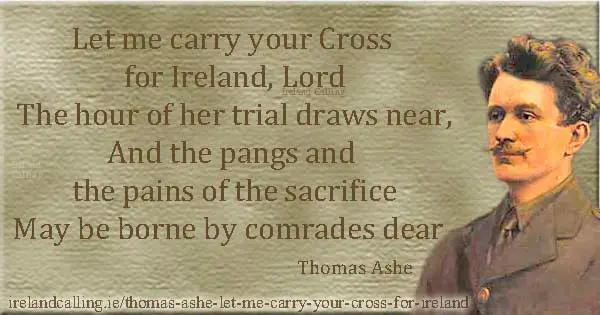
Thomas Ashe's funeral was the first public funeral after the Rising and provided a focal point for public disaffection with British rule. His body lay in state in Dublin City Hall before being escorted by armed Volunteers to Glasnevin Cemetery. 30,000 people attended the burial where three volleys were fired over the grave and the Last Post was sounded. While imprisoned in Lewes Jail in 1916, Thomas Ashe had written his poem 'Let Me Carry Your Cross for Ireland, Lord' which later provided the inspiration for the Battle of Ashbourne memorial unveiled by Sean T. O'Kelly on Easter Sunday, 26th April 1959 at the Rath Cross in Ashbourne :
Let me carry your Cross for Ireland, Lord
The hour of her trial draws near,
And the pangs and the pains of the sacrifice
May be borne by comrades dear.
But, Lord, take me from the offering throng,
There are many far less prepared,
Through anxious and all as they are to die
That Ireland may be spared.
Let me carry your Cross for Ireland, Lord
My cares in this world are few,
and few are the tears will for me fall
When I go on my way to You.
Spare Oh! Spare to their loved ones dear
The brother and son and sire,
That the cause we love may never die
In the land of our Heart's desire!
Let me carry your Cross for Ireland, Lord!
Let me suffer the pain and shame
I bow my head to their rage and hate,
And I take on myself the blame.
Let them do with my body whate'er they will,
My spirit I offer to You,
That the faithful few who heard her call
May be spared to Roisin Dubh.
Let me carry your Cross for Ireland, Lord!
For Ireland weak with tears,
For the aged man of the clouded brow,
And the child of tender years;
For the empty homes of her golden plains,
For the hopes of her future, Too!
Let me carry your Cross for Ireland, Lord!
for the cause of Roisin Dubh.
(from here.)
'THE REPUBLICAN POSITION ; STATEMENT ISSUED BY ÓGLAIGH NA H-ÉIREANN AND SINN FÉIN...'
From 'The United Irishman' newspaper, November 1954.
"A Chara,
The following statement has been released for publication. Please publish it in full or not at all...
The creation and maintenance of political splinter parties is a complete negation of a sincere and genuine purpose aimed at unified efforts to free Ireland.
Except for those who desire leadership in the limelight of party politics, their existence is quite unnecessary. In so far as they purport to cater for those who profess allegiance to republican principals, there is no need for them. Within the scope of the Republican Movement ample provision is made for all who desire to serve the cause dedicated to the achievement of Ireland's full freedom and the welfare of all her people.
There maintenance serves only to confuse and distract the nationally-minded among our people, to retard progress towards unified action and to serve, substantially and directly, the purpose and interests of those who deny Ireland's just claim to freedom, and who oppose her liberation from foreign agression. To accord them recognition would not promote or advance the effort towards unified action since their very existence is the acme of disruptive tactics..." (MORE LATER.)
Thanks for reading - Sharon and the '1169' team. Stay stayin' safe, and 'playing' safe!
ON THIS DATE (23RD SEPTEMBER) 209 YEARS AGO : BIRTH OF A REBEL'S BRIDE.
Lucy Caroline O'Brien (nee Gabbett) (pictured) was born on the 23rd of September, 1811 - 209 years ago on this date - in Limerick, to Joseph Gabbett and Lucy Maunsell. At 21 years young she married William Smith O'Brien, who was then 29 years of age, and they had seven children (five boys and two girls).
Most of the information that we could find in relation to Lucy was based on her marriage to William Smith O'Brien, a man we had mentioned before in regards to his endeavours in fighting against the British military and political presence in Ireland.
But there was another side to him as well, which would have added to the pressures on his poor wife : "..admittedly, he had earlier entertained so passionate an affection for a young woman in London that he had got her pregnant. Because she was not considered suitable for marriage to the son of a substantial Anglo-Irish landowner, the girl was bought off with an annuity of £50 a year by his older brother and their father...by the time he became one of the leaders of Young Ireland, in the middle of the 19th century, William Smith O’Brien was married to Lucy and had fathered several children.." (from here.)
He was held in captivity in Van Diemen's Land for five years and this 'garden seat incident' with a young girl was recorded, in writing, by his British captors who, it must be borne in mind, had (and still have) 'form' in inventing 'private lives' for those they wish to belittle. However, it does seem that Lucy's husband might have been prone to putting his own hand out to be slapped -
"Mary Ann Wilton bore, in 1830, a son William by him. The boy was baptised in fashionable St Margaret’s, Westminster, London, on 6 January 1832. The child’s sister, Mary Wilton O’Brien, born 1831, was baptised at the same ceremony. Note that Wilton, her mother’s family name, was given as her Christian name. The birth certificate records Mary Ann Wilton as their mother and William Smith O’Brien as their father. Nine months later, the latter married Lucy Caroline Gabbett..." (from here.)
Lucy Caroline O'Brien died on the 13th June, 1861, in Limerick, Ireland, only 41 years of age, and he himself passed away three years later, in his 61st year, in Bangor, Wales, and is buried in Rathronan Churchyard in Limerick. The inscription on the family mausoleum reads - 'Lucy Caroline O'Brien, Born 1811, Died 18 June 1861 ; William Smith O'Brien, Born 17 October 1803, Died 18 June 1861 and Here Lies Edward William, Eldest Son of William Smith O'Brien, A Just Man, Lover of His People. Born 24 Jan 1837, Died 21 Jan 1909.'
'William Smith O’Brien married Lucy Caroline Gabbett, daughter of Mayor William Gabbett, in 1832. She was born in 1811 and died on the 13 June 1861.(from here.)
Trying to make ends meet and raise seven children is a full-time job in itself. Attempting to do that and have to worry about an absent husband gives an indication of the strength of the woman.
'ULSTER LETTER'.
From 'The United Irishman' newspaper, June, 1955.
With the advent of each successive generation of party politicians it becomes ever more important for republicans to set out clearly the principles of their Movement. The fundamental principle of republicanism is 'Freedom' and Wolfe Tone, the founder of Irish republicanism, has spoken clearly on its objective - "To break the connection with England."
Ireland is denied her freedom by England and by England's minions, hence it is that today Irish republicans reiterate the words of their founder - "break the connection with England." Wolfe Tone found it necessary 150 years ago to clarify the issues at stake in Ireland in his day, so also do we find it incumbent upon us to remove any doubts as to what are the issues at stake in our day.
This clarification is necessary in Ulster, which is predominantly Protestant, and in the other three Provinces, which are predominantly Catholic ; this letter is for Ulstermen. It has always been an extraordinary feature of the Irish Republican Movement that it was and is attacked with equal harshness by Protestants and Catholics, or rather by politicians of both religious denominations. Unfortunately the people, following the example of their various party political leaders, criticise the Republican Movement and, in doing so, they put forward criticisms which of themselves are contradictory... (MORE LATER.)
ON THIS DATE (23RD SEPTEMBER) 44 YEARS AGO : "A THUNDERING DISGRACE".
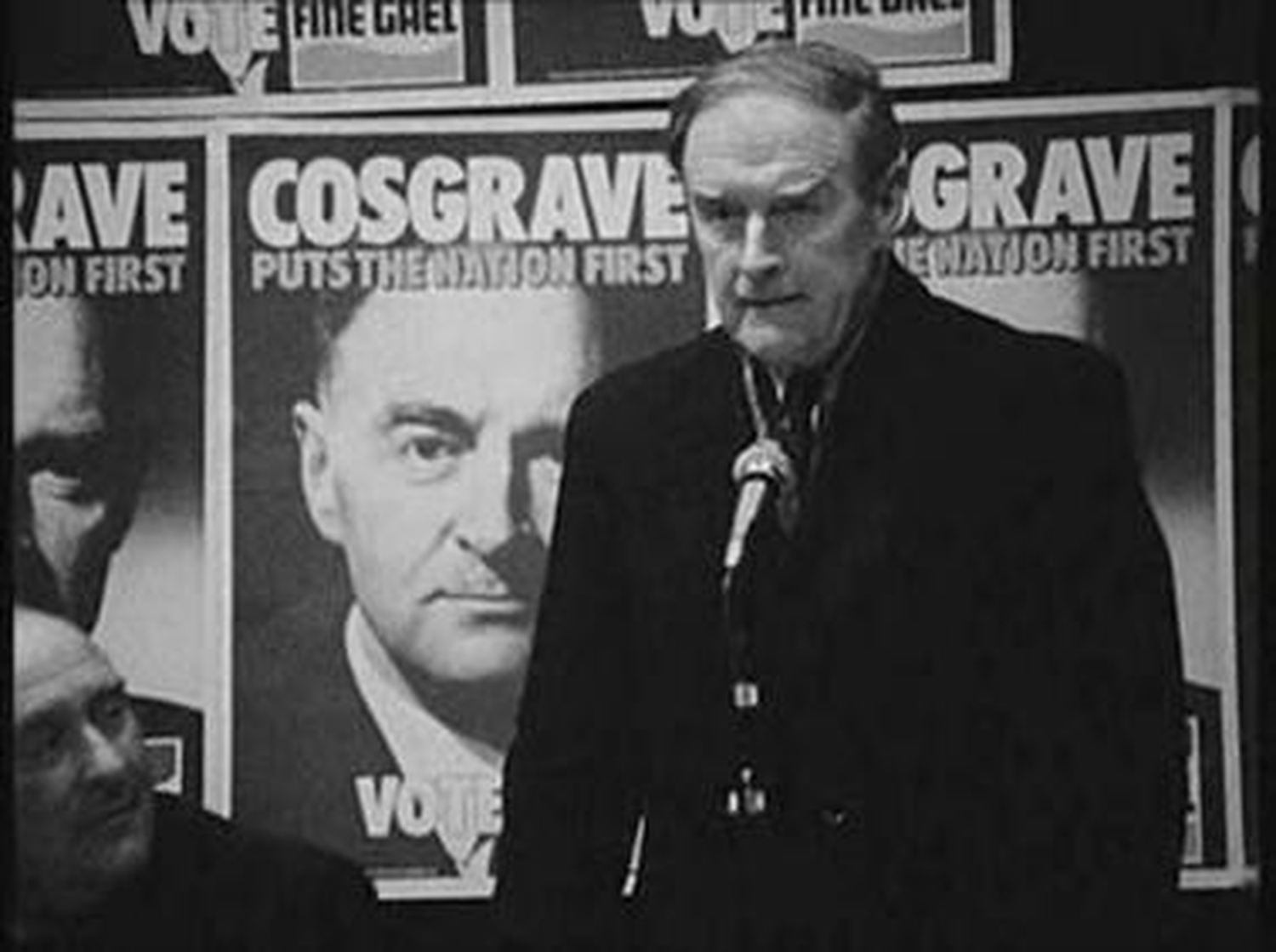
Ireland, 1970's : turmoil in the country, due to the then-as-now unwanted political and military interference here by Westminster. The Leinster House administration was headed-up at the time by Fine Gael's Liam Cosgrave (pictured), and among the many harsh laws introduced, enforced and 'improved on' by the Blueshirts was a censorship act, 'Section 31'.
The then Free State President was a Fianna Fail man, Cearbhall Ó Dálaigh , said to be a compromise candidate by the powers-that-be at the time, as he fitted the requirements dictated by the 'establishment' (ie 'a safe pair of hands') - he was previously the Free State Attorney General and Chief Justice of the FS Supreme Court, and was given the Office, unopposed, in 1974, following the death of Erskine Hamilton Childers.
But it was that legal training which raised a red flag with him in relation to a piece of legislation which the Blueshirt Leinster House administration wanted him to 'rubber stamp' - the 'Emergency Powers Act', and the fact that Ó Dálaigh and Cosgrave didn't agree with each other, socially or politically, came into play : Ó Dálaigh refused to simply 'sign off' on the 'EPA' without first testing its constitutionally.
On the 23rd of September, 1976 - 44 years ago on this date - Ó Dálaigh (pictured) spent four hours consulting with a bunch of posh suits known as the Free State 'Council of State' on whether or not it would be best practice to refer the legislation to the Free State Supreme Court to test its constitutionality before he could declare it to be 'the law' and it was decided that that would be the best thing to do, a decision which annoyed the Blueshirt administration.
Just over three weeks later (ie on the 15th October 1976) the FS Supreme Court declared that the 'EPA' was a legitimate piece of legislation and it was only then that Ó Dálaigh deemed it necessary to sign-off on it, which he did, reluctantly (or so it was alluded at the time) but that 'victory' wasn't enough for Cosgrave and his people - they considered themselves to have been disrespected by the actions of Ó Dálaigh and, three days later (ie on the 18th October 1976) , they could contain themselves no longer : it was on that date that the Free State Minister of Defence, Paddy Donegan, was opening a new Free State army barracks in Mullingar, County Westmeath (having, seemingly, forgot that Ó Dálaigh was the Commander-In-Chief of said army!) that he made a remark (he was concussed at the time, he later claimed!) which was to haunt him for the rest of his life.
He 'kicked himself up the transom' , if you like, which wouldn't have caused as much damage as firing a shotgun over dwellings in which people lived - more about that 'eccentric' (!) Free State politician can be read here...
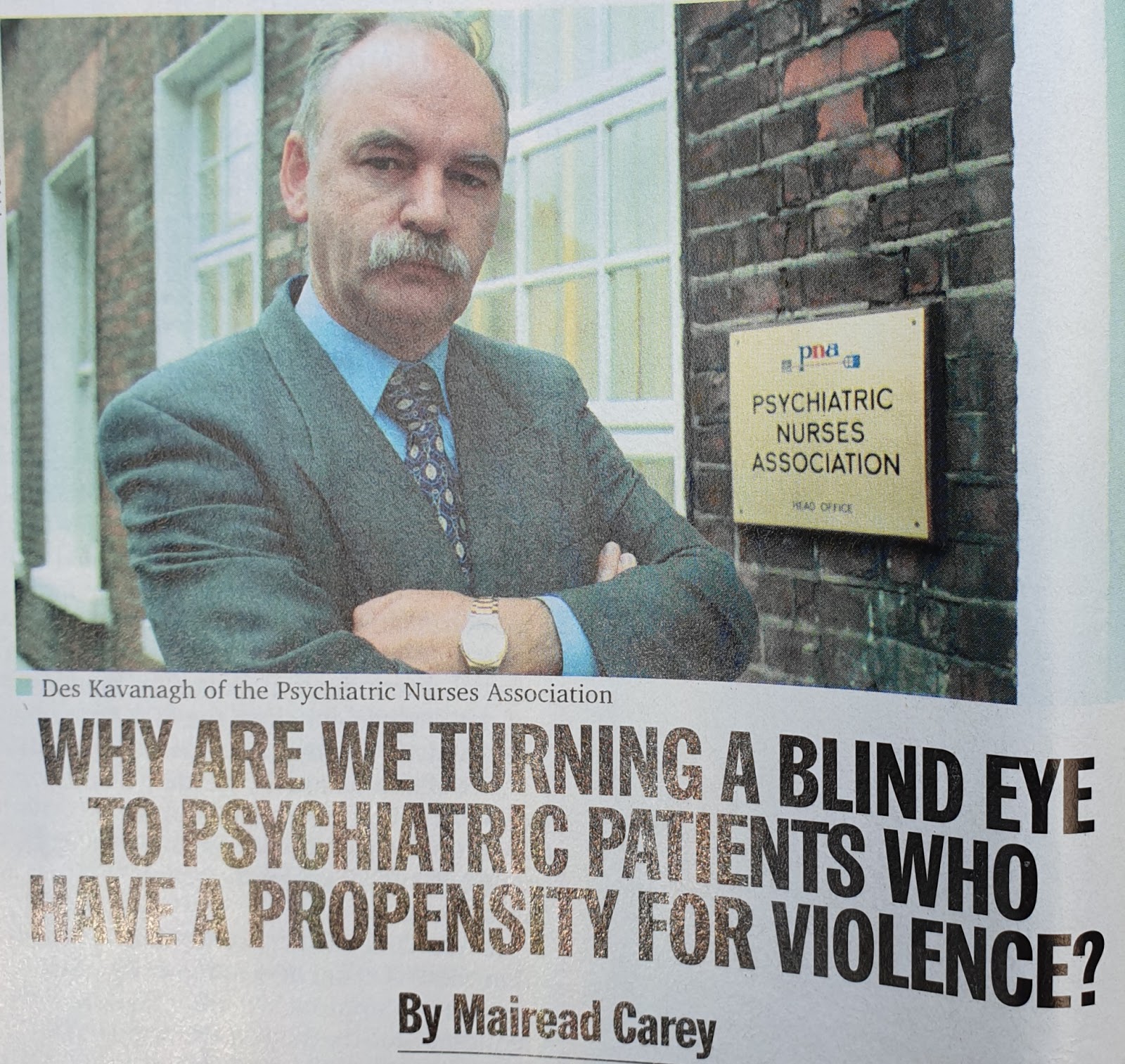
'WHY ARE WE TURNING A BLIND EYE TO PSYCHIATRIC PATIENTS WHO HAVE A PROPENSITY FOR VIOLENCE...?'
By Mairead Carey. From 'The Magill Annual', 2002.
Meanwhile, patients with acute psychiatric problems and violent tendencies are being betrayed by a system which doggedly and deliberately fails to recognise their needs. Psychiatric care in Ireland is stumbling from crisis to crisis.
Unless this unglamorous aspect of healthcare is given a significantly higher status when the government meets to attribute the 'new and improved' health budget, we can confidently expect another tragedy of the magnitude of the Riney case. Or perhaps even worse.
(END of 'Why Are We Turning A Blind Eye To Psychiatric Patients Who Have A Propensity For Violence?' ; NEXT - 'Is It Time To Ask Questions Of The Legal Profession?', from the same source.)
ON THIS DATE (23RD SEPTEMBER) 100 YEARS AGO : MURDER OF A SINN FÉIN COUNCILLOR.
'At 1.15 am Captain Geoffrey Thomas Baggallay, a one-legged courts-martial officer, had phoned Dublin Castle telling of John Lynch’s presence at the Exchange Hotel. A group of 12 British soldiers entered the Exchange Hotel, wearing military caps and long black Burberry coats. They held the hotel porter, William Barrett, at gunpoint. After consulting the register they went to the bedroom of John Lynch (pictured). It was number 6 on the third floor, where John Lynch had been staying since 12 Sept.
They shot him and the soldiers left ; the British soldiers claimed Lynch had fired a shot at them when they attempted to arrest him. The military reported a death at the hotel at 2.15 am. The RIC arrived after the military reported the death to them. The coroners verdict was that Lynch was shot by a soldier in self-defence. No evidence was given by any soldiers at the inquiry.
The IRA believed that the actual murder was carried out by Henry James Angliss and Charles Ratsch Peel working undercover. The group of khaki-clad men who shot Lynch numbered about 12, and the IRA certainly believed that Angliss and Peel were among them from the inside information that they received from “Lt G” at Dublin castle. Lt G is believed to be Lily Mernin who worked as a typist at army headquarters. Michael Collins believed that many of the British officers that were later killed on ‘Bloody Sunday’ shot John Lynch in the Exchange Hotel. Lynch was the local Sinn Féin organiser of a loan and was in Dublin to hand over £23,000 in subscriptions to Collins. Altogether £370,163 was raised in the loan effort in Ireland by September 1920 when it closed down.
It is not possible to know who the 12 men on the raiding party were who shot Lynch, however, apparently Lt. Angliss, under the influence of drink, divulged his participation in the shooting to a girl who passed this information on to an IIS (the republican intelligence department) informant. Peel escaped death on ‘Bloody Sunday’ by barracading himself in his room. George Osbert Smyth (on attachment to avenge his brother (Gerald’s death, shot by the IRA after a speech he gave in Listowel, Co Kerry) is understood to have been part of the raiding party, from information given to his family on a visit home. Osbert Smyth was shot dead in October 1920 while trying to arrest IRA suspects Dan Breen and Sean Treacy at a house in Drumcondra...' (from here.)
Like Liam Lynch, John Lynch had made his preference known in relation to how to deal with the unwanted British presence in Ireland - he was for a military solution ie to 'fight fire with fire'. This was known to the enemy in Westminster, so much so that they instructed their 'Cairo Gang' mercenaries to concentrate on admired soldiers like (Liam) Lynch and, in their rush to do so, the Sinn Féin councillor, John Lynch, was shot dead by 'Cairo' member Lieutenant Angliss (aka 'McMahon'- he had been recalled from spy work in Russia for the 'Cairo Gang' job in Dublin).
The British assassin is said to have believed that John Lynch was Liam Lynch, or related to him, but expressed no remorse when his mistake was pointed out to him. The Ciaro man was playing billiard's in Dublin after he killed John Lynch when the IRA shot him, but he was only wounded. He wanted revenge - and his position in the 'Cairo Gang' gave him that opportunity, or so he thought. But, in November, 1920, he was in lodgings at 22 Lower Mount Street in Dublin when two of the 'Twelve Apostles' entered his room. He reached for his revolver but was shot dead before he could get to it.
Sinn Féin County Councillor John Aloysius Lynch of Kilmallock, County Limerick was murdered at the Exchange Hotel in Dublin by a British agent on September 23rd, 1920 - 100 years ago on this date. The British mercenary who murdered him has been named over the years as a Captain John Fitzgerald (a native of Cappawhite, County Tipperary, who was later assassinated by the IRA), and Henry James Angliss and Charles Ratsch Peel were also named as the murderer. Whatever the case, justice was served afterwards.
'THE REPUBLICAN POSITION ; STATEMENT ISSUED BY ÓGLAIGH NA H-ÉIREANN AND SINN FÉIN...'
From 'The United Irishman' newspaper, November 1954.
"A Chara,
The following statement has been released for publication. Please publish it in full or not at all...
This official reiteration is now released for publication on behalf of Óglaigh na h-Éireann and on behalf of Sinn Féin. Its release at this juncture is considered necessary for the reasons stated above, and because of a recent approach made to ascertain if some kind of compromise agreement or understanding could be reached between the Republican Movement and Fianna Uladh, the most recent splinter party to enter the arena of party politics ('1169' Comment - "We in Fianna Uladh recognise the Constitution of the Republic of Ireland under which this State operates and we are prepared to work within its framework to extend its operation to the whole of Ireland..." - from here.).
The Republican Movement accepts and endorses the axiom that, to complete the task of freeing Ireland, the greatest possible measure of unity amongst our people is essential. Achievement of such measure of unity as a means to an end is a main aim of, and a principal plank in, the platform of the Movement. Republicans go further by fostering and endorsing the fundamental principle that the basis upon which unity rests is of greater national importance than mere achievement of a facade of unity behind which the politicians would manoeuvre for tactical positions in a game of political party stunting.
No useful purpose would be served through alignment of the Republican Movement with political splinter parties, whose national outlook is coloured by party interests and whose national endeavour is circumscribed by the personal ambitions of party leaders. Such alignment would at once bring the Republican Movement within the ambit of party politics, deprive it of any claim to national status, and reduce it to a level of yet another political party..."
(MORE LATER.)
Thanks for reading - Sharon and the '1169' team.
WHISTLEBLOWERS.
' 'Monday, 21st September 2020, 9.35pm - RTÉ Investigates Whistleblowers: 'Fighting to be Heard' ;
Barry O'Kelly reports on the importance of whistleblowers to society and the price they often pay for speaking out..'
...and there is a 'price' for speaking out, but it's a price worth paying.
We have mentioned this local act of in-house vandalism (to put it mildly) a few times already on the blog and are availing of the above-mentioned RTE programme to do so again, in the hope that it may offer warning signs to look out for if you or yours find yourself in such an unfortunate position. It's in connection with a family here in the Clondalkin, Dublin, area who are splintered beyond repair because of the unbelievable actions of two family members and their families, due to their own greediness.
The elderly husband and wife, both deceased now, God Bless them, were a truly beautiful couple and were well known in the Clondalkin area, for their friendly, chatty, helpful nature, and were much loved and respected by all who had the pleasure to know them. The greed that was publicly displayed by two of their daughters, and their families, knocked everyone here in the area for six and, even now - nine years after the Gentleman passed away and three years after his Lady wife was re-united with him beyond the stars - tensions between the 'evil' and the decent side of the families involved are still raw, and all because of the little money, and their bungalow, that the couple actually had left when they passed.
About €73,000 - the couple's life savings - was spent by the two daughters on themselves over a four-year period, €3,500 was taken from the couple's Credit Union (and spent in Boston, on a holiday, by one of the daughters and her family), household bills were left unpaid etc etc ; it was harrowing to hear about it and to witness, in public, the very real anger of the wrongdoers when they realised they had been caught and then copped-on to the fact that there would be no going back to the 'old', money-no-object ways, for them. Their anger exploded on the streets and in the pubs of the area, blood and drink was spilt, the cops were involved and legal offices were brought into play. But the decent side of the family won out in the end, 100%, over the nasty side of that same family, but they had to fight for their victory, legally and physically, although morally they had already won.
If you're reading this, and you have an elderly parent or parents, and you have siblings, please remember that it won't always be strangers from outside the family that pose the potential threat.
"...after my Nana died (in February 2017) it transpired that my two robbing Aunties and one of their daughters, 'EM' had, in 2014, taken my poor Nana to a solicitor where she was instructed to sign and date some legal papers, which she did 'cause she "didn't want to make a fuss". Those legal papers turned out to be a Will, which Nana didn't know anything about and was never given a copy of for herself (neither was either of my Uncles, who knew nothing about it at the time) and in that Will one of my Aunties, 'M', had named herself as the sole executor of my Nana's property, including the bungalow that Nana and my Grandad lived in. My two Uncles had always been named as joint executors in the Will(s) that my Nana and Grandad had made up to that point.
But that so-called 2014 Will troubled my Nana to the extent that she asked my Uncle 'S' to take her to a different solicitor, which he did, and she made a proper Will, in which the two robbing Aunties were left less than anyone else and my two Uncles were again named as joint executors. All this only became known after my Nana died and my two Aunties (and their families) are very very sore about it and that robbing side of the family actually started a fist fight with one of my two Uncles at a 60th birthday party that they all happened to be at. The robbers lost that fight, just as they had lost out in their plan to take over my Nana's and Grandad's bungalow and property and, on another occasion, an attempt was made to physically prevent one of my Uncles from leaving his late Dad and Mam's house, and that resulted in another punch-up, which the thieving side of the family also lost...."
This is the blog in question ; it's a heart-breaking read, but it may just save other blogs like it having to be written in the future.
Thanks for reading, Sharon. We'll be back here on Wednesday, 23rd September 2020.
'UNQUIET GRAVES' DOCUMENTARY, RTE ONE TV, WEDNESDAY 16TH SEPTEMBER 2020, 9.35PM...
..IF IT'S NOT 'POSTPONED' AGAIN.
'The story of the Glenanne Gang details how members of the RUC and UDR were centrally involved in the murder of over 120 innocent civilians. Now known as the Glenanne Gang, the group of killers rampaged through Counties Tyrone and Armagh and across into the Irish Republic in a campaign that lasted from July 1972 to the end of 1978...' (from here.)
'The Glenanne gang was based at a farm in Glenanne, County Armagh, in the 1970s. Its members are suspected of involvement in about 90 attacks during the Troubles, including the 1974 Dublin and Monaghan bombings, which killed 33 people, and the 1975 Miami Showband Massacre targeting one of Ireland's best known showbands...' (from here.)
Collusion between pro-British elements in Ireland and the forces of Westminster - political and/or military collusion, that is - has always been a part of the British occupation of Ireland, going back over 800 years ; we have, unfortunately, never had a decade in all that time when some political or military tout didn't make his/her presence felt, and the same is true today, except those operatives are more 'in-your-face' than they were in the past.
Since this State was spawned almost 100 years ago, those in political and military power have been pro-partition and have enforced that writ from a Westminster-imposed institution in Kildare Street in Dublin. They continue to benefit, financially, from being 'big fish in a small pond' and have no desire to change that position by having to work for a living in the changed political landscape that re-unification will bring, and if maintaining their position entails supporting overt and covert political and military manoeuvres by Westminster, anywhere in Ireland, then so be it. Anyway - if it is broadcast as stated, it will be worth watching : RTE One television, tonight (Wednesday 16th September 2020), 9.35pm. It will hopefully be 90 minutes well spent!
ON THIS DATE (16TH SEPTEMBER) 175 YEARS AGO : DEATH OF AN IRISH REVOLUTIONARY, POET AND POLITICAL THEORIST.
'Davis, Thomas Osborne (pictured), poet and politician, was born at Mallow (Cork), 14th October 1814. From his very earliest years he was noted for his passionate love of Ireland. In 1835 he graduated with distinction at the University of Dublin, mathematics and modern history being his favourite studies. In the debates of the College Historical Society he was distinguished more for talents and learning than for eloquence. Although called to the Bar in his twenty-fourth year he afterwards evinced little taste for following up the profession of the law. He travelled on the Continent, and collected a good library...
In 1840 he contributed a series of articles on the state of Europe to the Dublin Morning Register — contending that a crisis was approaching in which Ireland would be able to obtain her legislative independence. He became an active member of the Repeal Association, where his ability and the sincerity of his character soon obtained for him an effective and influential position. At times he did not shrink from opposing O'Connell, for whom he had the greatest veneration.
In 1842, with a few other persons desirous of strengthening the spirit of nationality in Ireland, he started the Nation newspaper...' (from here.)
Thomas Osbourne Davis was a revolutionary Irish writer and was one of the leaders of the 'Young Ireland' movement. He was well educated, having studied in Trinity College, from which institution he received an Arts Degree and, at 24 years young, he was 'called to the Irish Bar'.
In 1842, Thomas Davis and two of his colleagues, Charles Gavan Duffy and John Blake Dillon, were walking together in the Phoenix Park in Dublin discussing, among other issues, no doubt, the 'Hughes/Armagh Assizes' case, an infamous case of its day, and the manner in which it was being reported on. The three politically like-minded men made a decision there and then to start their own (weekly) newspaper which would present the news in a manner which would not be slanted towards the Westminster point-of-view. 'The Nation' newspaper was born that day.
The first copies of the newspaper were printed from a premises in Trinity Street in Dublin but later moved to a more suitable location in D'Olier Street, before finding a permanent home in Middle Abbey Street, Dublin. It was well received by Irish society, at home and abroad. In 1900, it merged with 'The Irish Weekly Independent' - 'There has never been published in this, or any other country, a journal, which was imbued with higher ideals of nationality, which attracted such a brilliant band of writers in prose and verse, which inspired such widespread enthusiasm, or which exercised a greater influence over all classes of its readers, which after a time included every section of the community.
'The Nation' preached a nobler and more self-sacrificing Gospel of Nationality than Irishmen and women had been accustomed to hear for many years. It sought, not only to disinfect the political life of the country, but to raise the whole standard of national self-respect based on the inalienable right of people to guard their own destinies ; to inculcate a sentiment of pride in Ireland and everything Irish - in our history, legends, language and literature ; in our music and in our art ; in our magnificent contributions to the culture and civilisation of other countries ; in our sacred ruins scattered throughout the land and in lonely islands off our coasts, silently preaching silent sermons on Irish sanctity, learning and foreign rapacity ; in our heroic struggle for freedom throughout the ages ; in the brilliant achievements of our soldiers on the continent of Europe and in America, where they helped the oppressed colonists to achieve their independence – and it strove to regenerate the motherland intellectually, spiritually, socially and nationally...' (from here.)
On the 16th September, 1845 - 175 years ago on this date - Thomas Osborne Davis, at only 30 years of age, died in Dublin from scarlet fever. He is buried in Mount Jerome Cemetery, in Dublin.
'EDUCATION...'
From 'The United Irishman' newspaper, June, 1955.
Principles, Methods and Subjects...
11. Elements of philosophy.
12. Theoretical and practical elements of art, science and music. Non-formal as well as formal study, with special attention to the creative faculty.
13. Development of manual work and craftmanship. Exclusion of competition and sense of time.
14. Elements of money.
As we have stated, the above is but an indication of some methods and subjects which could be adopted. To develop any such work, it will be necessary to obtain the co-operation of any member, or reader, who can assist in any way. We would therefore be glad to hear from those interested with a view to having a meeting in the near future.
(END of 'Education'. NEXT - 'Ulster Letter', from the same source.)
ON THIS DATE (16TH SEPTEMBER) 100 YEARS AGO : 'OH WHAT A TANGLED WEB WE WEAVE..'
'16th September 1920 : British double agent John Henry Gooding aka F. Digby Hardy (pictured) offers to betray his superior, Basil Thomson, to the IRA. It is unknown if the offer was genuine or part of a trap for Michael Collins ; exposed by Irish press as an ex-convict, forger and bigamist, 'Gooding' admits his past and scores a propaganda victory for the IRA; he is allowed to flee Ireland unharmed and dies of natural causes in 1930...'
'John Henry Gooding, alias Frank Digby Hardy was an English naval writer, journalist, soldier, career criminal and would-be spy during the Irish War of Independence. Born in Devonport, Plymouth to a middle-class family, he was educated in London before gaining notoriety in his native Devon as a bigamist and a cheque forger. Imprisoned numerous times throughout his life, he was enlisted by British intelligence to capture Irish Republican Army leader Michael Collins in 1920...his enlistment into the British intelligence services came at a time when membership of the organisation was low and a recruitment drive had been initiated by its leadership for the purposes of action in Ireland during the Irish War of Independence...'
'A convicted forger serving a 5 year sentence in a London prison, one F. Digby Hardy, offered his services as a spy. Hardy was to travel to Ireland and establish contact with the IIS (the Irish Republican Intelligence agency). Hardy's letter, however, had been intercepted and transmitted to IIS Headquarters, where Irish operatives began to amass a dossier of incriminating information concerning Hardy's past. Collins actually got a copy of the letter Gooding wrote offering his services.
Collins permitted Hardy to make contact with the IIS, and shortly there after arranged what Hardy had been led to believe was a conference with IIS officers. Those present were in fact American and British journalists anticipating the scoop that Hardy was shortly to provide. During this meeting the leaders of the IIS confronted Hardy with his criminal past, and his mission to penetrate the IIS. When Hardy learned the true identity and purpose of his host, he made a full confession, hoping thereby to obtain leniency from his inquisitors. Because of Hardy's cooperation, the IIS spared his life and gave him until the next morning to be out of Ireland. The story made international news headlines, and the BIS suffered a humiliating reversal before world opinion...'
The paragraphs above were taken from various sources as, indeed, was the subject matter - a hired mercenary, spawned, like all mercenaries, from a half-successful coupling between a couple, one of whom - or both - lacked the moral fibre to do it right.
Your manifest perfections never cease
To drive the day-long terrors out of mind
They are the lights the darkness hides behind
Allowing satisfaction its increase
Beyond the petty boundaries designed
To keep us well aware the world's unkind
And still your eyes proclaim a reign of peace... (from here.)
John Henry Gooding, alias Frank Digby Hardy, infected this world from the 5th April, 1868, until the 28th October 1930. He was 52 years of age when he died. From natural causes. He did good to make it that far.
'WHY ARE WE TURNING A BLIND EYE TO PSYCHIATRIC PATIENTS WHO HAVE A PROPENSITY FOR VIOLENCE...?'
By Mairead Carey. From 'The Magill Annual', 2002.
The West-Dublin area covers a population of over 350,000. As such, it is supposed to have 175 acute beds available to psychiatric patients. It has 50.
The promised 'step-down units' - which were to be built when they closed the acute admission unit at St. Loman's in Palmerstown - never materialised. The general admission unit at St. Loman's services the largest catchment area in the country. In one 22-bed unit in the last six months alone, there have been eight assaults on staff and six on patients, one of them leading to very serious injuries. Five psychiatric nurses have retired prematurely because of injuries suffered at work in the last five years, three more are in the process of retiring and another four are on long-term sick leave.
The nurses at St. Loman's were in industrial dispute in 1993, 1995 and 1997, and have returned to the Labour Relations Commission twice in the past month. The issues are the same as they were in the early 1990's - a shortage of staff and a dangerous shortage of facilities. The incidence of attacks on nurses is growing, and there is no compensation for them when serious attacks take place... (MORE LATER.)
ON THIS DATE (16TH SEPTEMBER) 95 YEARS AGO - BIRTH OF "A VERY SHALLOW PERSON".
Charles James Haughey was born in Castlebar, County Mayo, on the 16th September 1925 (95 years ago on this date) and died on the 13th June, 2006 ; he was 'Taoiseach' of the Free State on three occasions. His father was in the IRA
but then fought against his old colleagues, as a member of the Free State Army.
"He hid in plain sight. Was it a failure of journalism (not to investigate that fully)? He refused point blank to explain where his wealth came from...his wealth was vastly beyond anything he could accrue from a salary...he represented everything that people were refusing to speak about until then : sex, money and power. There was an oppressive relationship about all of those topics. He had all three of those, and a lifestyle way beyond the meagre existence of the 1960's..something happened. He became crooked and began behaving in an unethical and corrupt way..." (from here.)
However, despite his own taxpayer-funded luxury lifestyle, he had no hesitation in attempting to convince the State taxpayers whom he used to sustain himself that they were 'living beyond their means' - "As a community we are living away beyond our means. I don't mean that everyone in the community is living too well, clearly many are not and have barely enough to get by, but taking us all together we have been living at a rate which is simply not justified by the amount of goods and services we are producing..." (from here.)
'Evidence emerged yesterday that substantial cheques made out to Fianna Fail and sent to party Headquarters in Upper Mount Street, Dublin, ended up in the party leader's account which Mr Charles Haughey ran from his office in Leinster House. It also emerged that Mr Haughey was able to make withdrawals from this account for reasons that had nothing to do with politics. In February 1991, when he was Taoiseach, a cheque for £8,332 was written on the account and used to buy a draft in French francs. The draft was used to pay Chevret, Paris, an expensive shirtmaker used by Mr Haughey. In September of that same year a further £7,500 was used for the same purpose...' (from here.) He liked socialising with poets and painters, although not all of the latter profession got on with him (!) and Irish republicans certainly didn't -
'Taoiseach Charles Haughey speaks out strongly against the H Block activists who attempt to disrupt his election campaign : RTÉ News reports on the Taoiseach Charles Haughey, leader of the Fianna Fáil party, as he campaigns throughout the country (sic) in advance on the 1981 general election. In the border counties of Donegal, Monaghan and Cavan , supporters of the hunger strikers in the H Block prison attempt to disrupt the campaign...the National H-Blocks Committees had announced that they would harass the Taoiseach during all public appearances during the election campaign because, they claimed, he had not done enough to end the hunger strike in the Maze Prison...' (from here.)
'Maintain the Border, Haughey - you're Maggie's little boy ;
You bolster up what Irishmen still suffer to destroy.
Our constitution claims its right, but you in breach bear stain -
You expend the people's millions, the Border to maintain..'
He was the driving force behind the founding of the politically-motivated 'Special Criminal Court' (staffed at that time by personnel from the Free State Army, as opposed to just Free State sympathisers, as it is today) and developed a reputation for organising party nights within the State for what became known as 'the men in mohair suits', a breed of Free State 'politician' which one of Haughey's pals, Martin Mansergh, described as "..not holding much store by political correctness and (who) did not retire early to bed..". Another of his political pals, George Colley, equated Haughey with "low standards in high places".
He had what is known as 'a whiff of sulphur' off him and used that 'wink wink' codology to make a name and a political career for himself, just as other Leinster House reps did before him, and are still doing to this day.
'THE REPUBLICAN POSITION ; STATEMENT ISSUED BY ÓGLAIGH NA H-ÉIREANN AND SINN FÉIN.'
From 'The United Irishman' newspaper, November 1954.
'A Chara,
The following statement has been released for publication. Please publish it in full or not at all.
On a number of occasions within recent years, individuals acting on their own behalf or on behalf of some organised group, have made approaches to the Republican Movement. It is assumed that the motives prompting such individuals contain some measure of sincerity and that there is present, in some degree, genuine concern for the welfare of the national interest which the Republican Movement exists to serve.
Invariably, such approaches have had one thing in common ; the purpose was to ascertain how far members of the Republican Movement are prepared to compromise on issues having a fundamental bearing on Ireland's struggle for full freedom, in order to reach some measure of unified effort between republicans and one or other of the political parties in which the individuals concerned have an interest.
To the individuals making the approaches and irrespective of what interests they serve, or what motives prompt their approach, the reasons have been fully explained why the Republican Movement rejects compromise agreements or understandings which, if entered into, could only lead to a facade of unity lacking any element of intrinsic value. Lest those reasons may have been imperfectly understood or that there might be deliberate misrepresentation of the republican attitude, it is considered advisable to reiterate, officially and publicly, the reasons already given...' (MORE LATER.)
Thanks for reading - Sharon and the '1169' team.