A 'NEUTRAL' GROUP WANTS TO "TIP THE (GAY MARRIAGE) VOTE THE RIGHT WAY"!
Like political activists everywhere, I know the wisdom of 'keeping your friends close and your enemies closer', by which I mean it makes more sense to subscribe to a newsletter etc from your opposition rather than one from your own side. That's a practice I have long adhered to and it has paid dividends in the past and I've no doubt it will do so in the future. And, to a certain extent, it has done so now.
I have already announced my intention to vote 'No' in the up-coming 'Gay Marriage' State referendum and, as is my wont on occasions like this, I had already subscribed to the mailing lists of 'Vote Yes' campaigners and those I considered to be such (...and most of whom certainly view 'No' voters as less than human) , one of which is the 'Uplift' grouping, one of the "...newest multi-issue campaign organisations...a community of people who share progressive values, and believe in people powered action. UPLIFT is completely independent and believes that all decision makers should be held accountable..." This grouping claims to be "...completely independent and not aligned to any political or corporate interests.." , states that it "...does not represent any single issue or group in society.." (from here - see 'How is Uplift different from other civil society organisations?') , says that it "...will welcome and encourage progressive policy and will criticise bad policy.." (from here - see 'Our relationship with political parties and politicians?') , meaning that, as far as this 'independent' group are concerned, a 'Yes for gay marriage' vote would be "progressive" but a 'No' vote would be "bad", although, at the time of writing, they give the impression, on their website, that they are 'neutral' on this issue, as a search result brings up a 'no results found' page.
A group email they sent out on May 1st last (entitled 'Are you sure you're registered to vote?') also, in my opinion, brings their 'independence' into question :
"The Marriage Equality Referendum vote is far from certain. There has been a shift in support away from those saying they will vote Yes, towards those saying that they are unsure how they will vote. But we can help tip the vote the right way. The first really important thing we need to do is make sure we’re all registered to vote. Every year the Register of Electors is updated and over the past few weeks there have been lots of reports of people being surprised to find they are no longer registered. Are you and your friends registered to vote? Have you checked?
There is still time to check, but we need to be quick! You have until next Tuesday 5th May to be included in the Supplementary Register. Follow this link to find out if you are registered or not:
https://www.checktheregister.ie/
Although support for a Yes vote is still strong, this shift is not good news. So, your vote is precious. It’s your right as a citizen and it will really, really count in the Marriage Equality Referendum.
There are nearly 10,000 of us in the Uplift community. If we all made sure that we, and our loved ones are registered by next Tuesday, we could actually be the difference in securing a Yes vote on May 22nd.
So many referendums have been won and lost on a handful of votes! Here is the link again to check if you’re registered to vote: https://www.checktheregister.ie/
Thanks for being involved,
Siobhán and the team."
This 'Uplift' group states that it is "...completely independent and not aligned to any political or corporate interests.." yet is concerned about "...a shift in support away from those saying they will vote Yes...but we can help tip the vote the right way...we could actually be the difference in securing a Yes vote on May 22nd..." That's being "completely independent" , Irish style!
Incidentally, 'Uplift' states that they have "...received support from the Community Foundation of Ireland, Global Green Grants Foundation (and) Atlantic Philanthropies...." : the first and last-mentioned of those organisations are, amongst other activities, 'supporters of gay rights' whilst the middle group ('GGGF') has apparently not yet updated its books in relation to all of the groups it seemingly supports. And talking about 'updating books', it is apparent that there is at least one book that 'Update' would want to update (!) itself on - the dictionary.
Finally, their understanding of geography is on a par with their understanding of what being "completely independent (yet wanting to tip the vote the right way)" means - in their 'faq' section, under the heading 'How do I become a member of Uplift?', they declare themselves to be "...a community of people taking coordinated action for progressive change in Ireland...membership is open to anyone living on the island of Ireland and Irish people living abroad. Until there is an established membership base in Northern Ireland (sic) , Uplift does not initially plan to pro-actively campaign on this part of the island....". So it seems that that "part of the island (ie our six north-eastern counties)" is not part of "...the island of Ireland.." ? Not a very 'uplifting' point of view from such a "progressive" group!
THE PRICE OF PEACE......
Last month, 28 women who protested peacefully in the Phoenix Park, Dublin, against US President Ronald Reagan's visit to Ireland received £1000 each arising from their action for wrongful arrest. Gene Kerrigan recalls the weekend when another State determined Irish security requirements and details the garda action which could cost tens of thousands of pounds. From 'Magill' magazine, May 1987.
CONTRARY TO SECTION 7 (5).
Heather Celmalis, the solicitor, tried to find out from the gardaí the reason for the arrest of her clients - the gardaí confirmed that all the women had been arrested but couldn't and wouldn't give any further information. The mysterious 'edict' from the Garda Commissioner could not be shown or quoted, so Celmalis left the garda station to consult with barrister Ruth-Anne FitzGerald about getting a decree of habeas corpus and when she returned to the garda station at about 1pm she was told that her clients were now being formally charged.
The women were taken out of the cells and had the charge read to them : it said that on being ordered by the gardaí "in accordance with the provisions of Section 9 (3) of the Phoenix Park Act (1925) to leave the Phoenix Park you did fail to leave the said park. Contrary to Section 7 (5) Phoenix Park Act 1925". That particular Section of that Act says that anyone failing to leave the park when ordered to do so by a garda, if that person has breached any other section of the Act or any bye-law, has committed an offence. The section of the Act breached by the women, according to the charge, was Section 9 (3), which says that anyone breaching a regulation made by the Garda Commissioner is guilty of an offence and liable to a fine of £5.
But neither the women or their lawyers knew what regulation of the Commissioner's they had allegedly broken : 'Section 9 of the Phoenix Park Act' empowers the Commissioner to make regulations "for the routes to be observed by motor cars, carriages, carts, and other vehicles, and by horses and persons in the Park either generally or on special occasions, and may also give directions to the members of the Garda Síochána for the preserving of order in the Park, the observance of regulations made by the said Commissioner under this section, and the observance of bye-laws". The precise legalities could wait until later. (MORE LATER).
THE IRA.THE NEW IRA IS YOUNGER, MORE RADICAL AND HAS SEEN LITTLE OF LIFE OTHER THAN VIOLENCE..... By Ed Moloney. From 'Magill' magazine, September 1980.
THE MOVE TO THE LEFT.
"The most successful radicalisation of the Republican Movement since the Republican Congress, and it didn't cause a split" - that's how Sinn Féin Vice President, Gerry Adams, the man most identified with that radicalisation, now describes the recent political changes in Sinn Féin. The move to the left hasn't, it's true, caused a split in the Provisionals, but it has come very close to it. There is undoubtedly a division within the Provo ranks ; the organisation can be said now to be roughly divided between North and South, old and young, traditional and revolutionary, but essentially between right and left.
The impetus for the move leftwards has come from a small group of Northern and especially Belfast radicals, whose influence far outweighs their strength. One Belfast leftist puts their numbers at no more than 30 or 40, but it is almost entirely because the present 7 man IRA army Council is like-minded, and are the men responsible for the military re-vitalisation of the IRA, that the leftists have exerted as much influence. Realistically, the Provisionals have yet to move much further to the left before the radicals can say that they have successfully turned it into a socialist organisation.
More so than most political organisations, the Provisionals consist of a delicate balance of differing interest groups - move them one way and the balance is upset. Most political organisations can withstand those sort of stresses and strains, but less so an organisation that is also fighting a 'war of national liberation'. The leftists have been able to tip the balance so far and only a little at a time. (MORE LATER).
ON THIS DATE (6TH MAY) 133 YEARS AGO : PHOENIX PARK EXECUTIONS.
6th May, 1882 - the scene of the executions in the Phoenix Park, Dublin, of two top British officials, 'Lord' Frederick Cavendish, and his under secretary, Thomas Henry Burke.
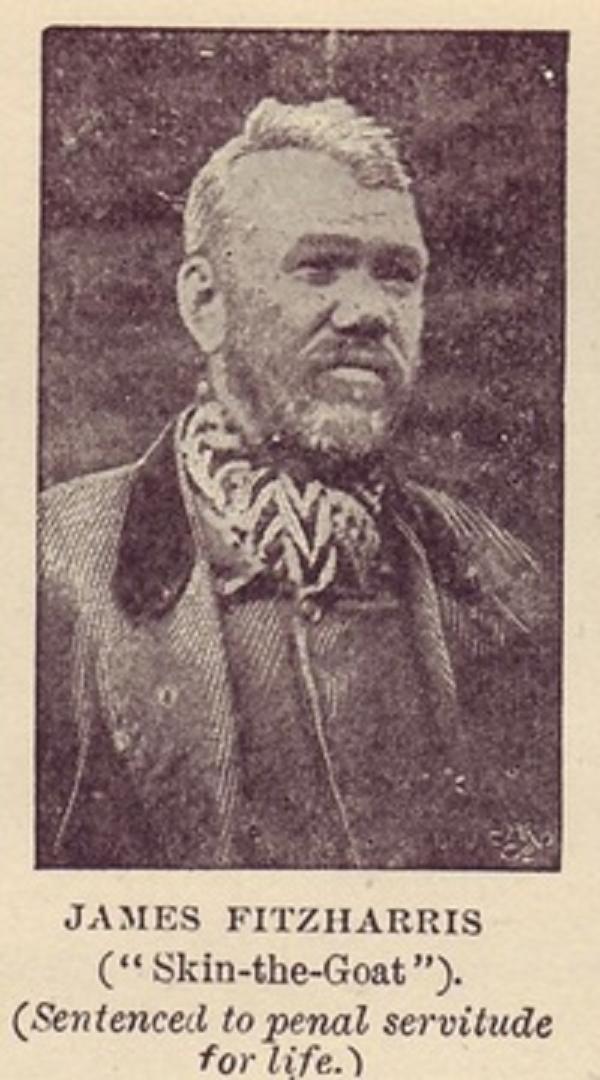
On the 6th May, 1882, the 'Invincibles' held a meeting in Mulbeths Public House, 12 Lower Bridge Street, Dublin, to discuss the arrival of the new British Chief Secretary, 'Lord' Frederick Cavendish. The route that Cavendish was to travel on his way to the Vice-Regal Lodge in the Phoenix Park was known to those at the meeting, all of whom were armed with knives - pistol-shots would only alert British patrols in the area - and two carriages were organised ; one driven by James 'Skin-the-Goat' Fitzharris and the other by Invincible member Michael Kavanagh. James Carey led the men out of Mulbeths Bar and into the two carriages, which then headed for the Phoenix Park. The new British Chief Secretary, 'Lord' Frederick Cavendish and his 'Permanent Undersecretary' Thomas Henry Burke, were waylaid by the Invincibles in Dublin's Phoenix Park and assassinated.
The killings were condemned by both the Irish establishment and the churches, but months went by and no arrests were made. Then, in one day, twenty-six men (all members of the 'Invincibles') were arrested and charged with the 'Phoenix Park murders'. The men soon realised that this was no 'desperate face-saving' expedition by the British ; one of the top members of the 'Invincibles', James Carey, had turned informer and his brother, Peter, also told the British all he knew about the group. The other jarvey (cab-driver) Michael Kavanagh, also agreed to inform on the 'Invincibles'. Between May and December 1883, fourteen 'Invincibles' passed through Green Street Courthouse - eight received life sentences and six were put to death. One of those sentenced to life was James 'Skin-the-Goat' Fitzharris, who was arrested on the evidence given by the other driver, Michael Kavanagh.
When he was first arrested, the British offered Fitzharris a deal if he, too, would turn informer, but he refused. His 'trial' actually ended with him being acquitted by the jury but the judge then halted proceedings and ordered that he be re-arrested ; he was then charged with being an 'accomplice' in the deed, found guilty, and sentenced to life. During both of his 'trials', 'Skin-the-Goat' made a mockery of the proceedings and refused to recognise the so-called 'authority' of the British to carry-out such functions in Ireland. James 'Skin-the-Goat' Fitzharris was fifty years of age when he began his life sentence - he was sixty-five when he got out of (Portlaoise) Prison, and things had changed ; his comrades were either dead or had moved away and, to the eternal shame of the Republican Movement, it turned its back on the man.
He had no job and no-where to live, he knew no-one and no-one wanted to know him. His choice now was to live on the street or sign himself into the workhouse - he chose the latter, and survived for the next twelve years as a pauper - between the gutter and the workhouse. He died in 1910 (on 7th September) aged seventy-seven. He was jobless, homeless and friendless when he died, alone, in the South Dublin Union Workhouse in James Street, Dublin. James 'Skin-the-Goat' Fitzharris was twenty-five years young when he joined the Movement in 1858 and stayed true to his Republican principles for fifty-two years, until he died. He had a hard life, in hard times, but he came through it and never recanted his actions or his beliefs. And, to his credit, he was working for a noble cause, unlike the two British agents/officials he encountered in the Phoenix Park in Dublin, 133 years ago on this date.
SIPTU AND THE SCABS!
We have posted before about the fact that the trade union organisation, SIPTU, has allowed anti-worker scab employees from the 'Irish Water' company to join its ranks and, for a weekly fee, is attempting to secure/improve better working conditions for those workers - "Meanwhile, the trade union SIPTU , the leadership of which is linked to and supports the State Labour Party (which fully endorses the double tax on water) has issued what could at best (ie being generous to them) only be described as a watery/fence-sitting statement in relation to this double tax in which, amongst other sickening half-way-house utterances, they suggest that other ways be found to "implement the water charges" and practically ask people to cooperate with the scabs that are attempting to build the infrastructure (meters, pipe work etc) via which this double tax will be enforced, which is not surprising, as those scab workers are apparently represented by SIPTU in their dealings with 'IW' management re their terms and conditions..." (from here) .
Now, as you can see from the above-pictured SIPTU letter (enlarged version here, transcript below) , dated 30th April 2015, the employer ('Irish Water') that hired those scab workers for that scab job is turning on them and treating them as all scabs should be treated - with contempt :
'30th April 2015
Update to SIPTU Water Service members
Dear Colleagues,
Further to yesterdays LRC conciliation hearing regarding the IW leak detection and fixing programme, it appears at this stage that IW will settle for nothing less than the wholesale introduction of contractors operating across the country (sic) to carry out what is regarded as core work of our members.
Such a development would represent a major breach of our agreements, as well as a calculated step towards the privatisation of the provision of water services in this country (sic) , despite all of the assurances given to the contrary.
On foot of this serious and developing situation, preparations will now commence to conduct a series of consultative meetings with members to appraise them of the situation.
Members should also be advised that in the event that there is any unilateral attempt to introduce contractors to carry out work normally done by our members, then we will proceed to ballot our members for industrial/strike action.
In this regard, all members should now be advised of the developing situation.
Yours Sincerely,
Brendan O' Brien,
Sector Organiser.'
This is one strike that I would like to see happen, just so that I could pass the picket, repeatedly, and with pleasure, even if I had to go out of my way to do so, as those people are basically scabbing a living off the backs of workers and the unemployed. SIPTU should wash its hands of those scabs and then issue a general apology for having had anything to do with them in the first place.
Thanks for reading, Sharon.
OUTED!
A 'Gay Marriage' referendum is being held in this State on Friday, May 22nd 2015 and, as expected in any such 'contest' - either here or in any other State and/or country - not all the 'players' are as they would seem to be, at first glance. On Wednesday, 6th May next, we will be commenting on this blog about one such grouping which describes itself as completely independent and not representing any particular issue or any other organisation but which, in a 'Vote Yes' email sent to a select few, has, to the fullest extent, destroyed any pretence it had in claiming to be 'independent of any particular issue'. I could be lighthearted here and say that the script for the above-mentioned 'Outed' post has been cleared for publication by our legal reps but I won't ! Suffice to say that such referendum manoeuvrings are par for the course and will not surprise any observer of any political scene, but that does not mean that they should happen without comment.
Check back with us here on Wednesday, 6th May 2015, and read why it is that the 'issue-free' organisation in question is not in any position to claim 'I am what I am'.....!
Thanks for reading, Sharon.
HUNGER-STRIKERS RALLY, GPO DUBLIN 2-5-15 : FEW WORDS AND PICS.
On Saturday 2nd May 2015, at the GPO in Dublin, RSF held a rally to commemorate the 22 Irish republican hunger-strikers that died for their political beliefs between 1917 and 1981. The event was Chaired by Josephine Hayden (pictured, left) and a representative from Na Fianna Éireann and the RSF International Bureau also addressed the gathering.
'Republican Rally' - GPO, Dublin, 2nd May 2015.
Alan Byrne, NFE, speaking at the Rally in Dublin, 2-5-15 : he gave a history of the Sands family and outlined how and why Bobby Sands was 'arrested' by the British and the conditions he endured in prison.
Republican Sinn Féin International Relations Bureau spokesperson Dieter Blumenfeld at the GPO, Dublin, 2-5-15, who highlighted the conditions experienced today by Irish republican prisoners incarcerated by the British and Free State regimes.
The organisers had intended to hold the commemoration on the traffic isle facing the GPO but the non-stop torrential rain which, at times - in between very heavy showers, that is - was almost of a biblical nature, forced their hand into 'setting up shop' as best they could under the canopy of the GPO. The small stage unit, the speakers lectern and the heavy-duty outdoor electrical PA system had to be 'returned to base' as it was deemed unsafe to use same in that weather.
Despite the bad weather and the fact that the streets were practically empty (due to a bus strike) the organisers managed to distribute 1,000 leaflets (in 'packs' of various sizes) during their two-hour rally.
Placards showing all twenty-two hunger-strikers were carried by some, while others carried placards with individual photographs of some of the hunger-strikers.
One of the '22 Men' placards on view at the republican rally.
Two of the 'individual' placards carried on the day.
A young lad proudly displaying a placard of Raymond McCreesh, one of the 22 men.
Alan Byrne, Na Fianna Éireann, at the GPO rally.
The weather was bad, the crowds were sparse, but the atmosphere at the rally was solid and the reason for the event was genuine and properly reflected in the manner in which it was done. Those that made it their business to attend are to be congratulated as are the organisers. A full report and more pics will be carried in the May 2015 issue of 'Saoirse', which goes to print on Wednesday 13th of that month.
Thanks for reading, Sharon.
"THEY WILL NOT CRIMINALISE US...
...ROB US OF OUR TRUE IDENTITY, STEAL OUR INDIVIDUALISM, DEPOLITICISE US, CHURN US OUT AS SYSTEMISED INSTITUTIONALISED, DECENT LAW-ABIDING ROBOTS. NEVER WILL THEY LABEL OUR LIBERATION STRUGGLE AS CRIMINAL." The above will be confirmed in Dublin city centre on Saturday 2nd May 2015 at 2pm in O'Connell Street. Hope to see you there!
THE PRICE OF PEACE......
Last month, 28 women who protested peacefully in the Phoenix Park, Dublin, against US President Ronald Reagan's visit to Ireland received £1000 each arising from their action for wrongful arrest. Gene Kerrigan recalls the weekend when another State determined Irish security requirements and details the garda action which could cost tens of thousands of pounds. From 'Magill' magazine, May 1987.
Mary Duffy, Elaine Bradley and Anne Barr were preparing to gather up belongings. There were about eight cars parked in the vicinity belonging to friends, husbands and relations of the arrested women and the men were helping with the packing. The three women were told by gardaí that under 'Section 9 of the Phoenix Park Act' the garda commissioner had signed an edict which made it illegal for "people like you" to be within a mile of the US Ambassador's residence.
The gardaí now said that walking, camping, sitting or loitering in that part of the Phoenix Park was illegal, and the women remarked that there were a number of joggers running past : was it illegal to jog? Why didn't the gardaí annoy those people? The gardaí said that jogging was not illegal, and the women then began to jog. And they were arrested as they jogged, with the gardaí jogging along behind them. This time the women refused to walk to the vans and had to be carried. It was these three women - Mary Duffy, Elaine Bradley and Anne Barr - that solicitor Heather Celmalis saw being taken into the Bridewell - one of them , Mary Duffy, was being dragged by the ankles.
The gardaí apparently had some trouble trying to lift Mary Duffy, as she is a thalidomide victim and has no arms. There were now 33 women detained in the Bridewell, and one in Cabra. Mary Duffy was put in a cell alone, and the other women were upset by her isolation and complained about it. Mary herself wasn't too upset, she was glad of the rest, and sang a few songs, pleased to find that the empty cell gave a terrific echo. She didn't know then that she was going to be in the Bridewell for over thirty hours. (MORE LATER).
THE IRA.THE NEW IRA IS YOUNGER, MORE RADICAL AND HAS SEEN LITTLE OF LIFE OTHER THAN VIOLENCE..... By Ed Moloney. From 'Magill' magazine, September 1980.
But it is Charlie Haughey's tough police and legal moves against IRA operations in the Border counties which has done more to impair the IRA in the last year than the RUC and British Army combined in the last three. Cross border co-operation between the Garda and the RUC at Regional Commander and ground level combined with meticulous Task Force searches of Border farms, have seriously disrupted IRA logistics and produced a number of significant arms and explosives dumps. Those tactics are described by one IRA leader as 'devastating' and things could get worse for the Provos if Haughey's attempt to activate the dormant 'Criminal Law Jurisdiction Bill' for cross-border offences succeeds.
At the same time there are indications that the IRA could be conserving its resources for the 'long war' ; to hit when and where it hurts. "We could bomb all around us for three months and cause millions of commercial damage, but we'd lose 40 or 50 men and maybe kill 9 or 10 civilians in the process. What would be the point of that?", asks one Northern IRA leader.
Despite temporary or long term setbacks, the IRA remains essentially a product of an abnormal society in the North, what Tim Pat Coogan calls a 'faecal society'. The IRA is not the problem in the North, it is only a reflection of the problem. And as long as the problem remains unsolved, the IRA and its bloody campaign will persist. In that context, it's worth quoting General Glover's conclusion to his 1978 assessment of the IRA: "The Provisional's campaign of violence is likely to continue, while the British remain in Northern Ireland (sic) ". (MORE LATER).
ON THIS DATE (29TH APRIL) 99 YEARS AGO : "IN ORDER TO PREVENT THE FURTHER SLAUGHTER OF DUBLIN CIVILIANS...
...and in the hope of saving the lives of our followers now surrounded and hopelessly outnumbered, the members of the Provisional Government present at headquarters have agreed to an unconditional surrender, and the commandants of the various districts in the City and county will order their commands to lay down arms..."
The above document, signed by Patrick Pearse, James Connolly and Thomas MacDonagh , signalled the end of six days of fighting between approximately 20,000 British troops (including, in their ranks, Irish men) and a volunteer rebel force of about 1,500 Irish men and women (and other nationalities) . At about 3.45pm on Saturday, 29th April 1916, the Rising was brought to an end - Pádraig Pearse surrendered to British Brigadier-General Lowe, James Connolly surrendered on behalf of the 'Irish Citizens Army' and Ned Daly surrendered to British Major De Courcy Wheeler ; it is not mentioned as often as it should be, but before the surrender of Ned Daly and his forces, all of whom fought bravely in the North King Street area of Dublin, the British Officer who was in command of that particular engagement, Lieutenant Colonel Henry Taylor of the South Staffordshire Regiment, had lost 11 of his men with a further 28 having being wounded. Following the surrender of Daly and the Dublin 1st Battalion, Taylor - who was to claim later that he was acting under orders from his superior, Brigadier-General William Henry Muir Lowe - ordered his men, who were enraged over having lost so many of their number, to 'flush out' any remaining enemy forces. Taylor's troops began breaking into local houses and, before their bloodlust was satisfied, they shot and/or bayoneted 15 boys and men to death, all of whom were 'rebel fighters', according to the British.
Approximately 590 people died during the six days of the 1916 Rising, of which 374 were civilians (including 38 children, aged 16 or younger) , 116 British soldiers, 77 Irish rebel soldiers and 23 members of the British 'police force' which operated in Ireland at that time. The objective has not yet being obtained, as not one of those rebel fighters took up arms to 'achieve' a so-called 'Free State' : the aim then, as now, is to secure a Free Ireland.
NOT A POUND'S WORTH - NO 'CRIME' COMMITTED.
British Labour Party MP, Stephen Pound [right, in pic] might very well consider himself to be 'in touch' with his Westminster-sponsored 'Irish brief', but in this instance he has stumbled across an historical scenario in which no 'crime' was committed.
Despite the fact that he should have known better if, that is, his cv is anything to judge by - 'Shadow Minister for Northern Ireland' and former member of the 'Northern Ireland (sic) Affairs Select Committee', and the fact that he has listed 'Ireland' as one of his "main political interests" - British Labour Party MP Stephen Pound apparently sees nothing wrong in inferring that the 1916 Rising was 'a crime against the British Empire'. How else to explain his announced intention to seek a "Royal Pardon" for those executed by the British military for their part in same, considering that such a 'Pardon' is '...an official order given by a king or queen to stop the punishment of a person accused of a crime..' ?
In a statement in relation to Pound's propaganda, the 'National Graves Association' said - 'British Labour Party M.P Steve Pound has announced his intention to ask the next British Government to consider recommending a "Royal Pardon" for the executed leaders of the 1916 Easter Rising.
While I am sure that Mr. Pound is well intentioned his proposal present problems on a number of levels. The whole point of the Easter Rising was that Irish Republican Forces rejected the jurisdiction of the British Crown in Ireland.
That’s precisely what they were fighting against and what they died for. Any “Royal Pardon” now would therefore be both meaningless and an insult to the memory of the executed leaders. Secondly, those who reject the Sovereign objectives (i.e. an Independent Ireland) of the Easter Rising may think that the executed leaders have something to be pardoned for. The rest of us most certainly do not. The British Offence that the executed Men were convicted of was "Waging War against his majesty the King". For Ireland to accept this British Offence as a crime in Ireland would be to criminalise all those who fought for Irish Freedom throughout the centuries.
Should Britain now wish to apologise to Ireland for executing such a noble body of people as the 1916 leaders, well and good. But, a "Royal Pardon" would be just a modern British Government adding insult to the injury of a previous one.
Is Mise
Sean Whelan, Chairman
National Graves Association
P.O Box 7105
Dublin 2
A solid reply, which needs no explanation to anyone who genuinely understands what Stephen Pound and his colleagues would consider to be 'the Irish question'. Also, the 'NGA' graciously omitted any reference to Mr. Pound's past indiscretions , even though they did 'shoot from the hip', so to speak (...as opposed to speaking from "a well filled hipflask..."). I presume Stephen would understand my highlighting the above - in for a penny, in for a Pound and all that....
SIX-FOOT BILL BURNED IN THE BATH!
On Saturday 25th April 2015, members and supporters of Republican Sinn Féin in Clondalkin, Dublin, took part in a double-water-tax protest outside the County Council offices in Clondalkin Village. The protest assembled at that location at 7.30pm and, after a few words from members of the 'Clondalkin Meter Watch' organisation (after which an RSF member addressed the gathering), a crowd of about one-hundred people marched through the village and then re-assembled outside the council offices. Bill's from the 'Irish Water' group were then burned on site, as were representations of same and other such paperwork from that group, following which the crowd re-assembled and marched through the village again.
Dozens of these RSF leaflet packs were distributed at this protest, and were very well received.
The six-foot 'bill' on display on the doors of the County Council Offices, Clondalkin, Dublin.
Paperwork from the 'Irish Water' group being properly dealt with at the 25th April Clondalkin protest!
All those who attended this protest are to be congratulated for doing so, and all present confirmed (loudly!) that they will be taking part in the double-water-tax protest in Dublin city centre on 'Mayday', Friday 1st May 2015 : those attending are requested to assemble at the Garden of Remembrance from where the protest will be leaving at 6.30pm. And I'll be there, too, with other RSF supporters and members, hoping to 'burn bill' again!
ABOLISH THE 'OFFER', AND THE 'OFFICE'.
On Friday, 22nd May 2015, those of us in this State who are entitled to vote will be asked to do so in relation to two issues : the introduction of same-sex marriage and lowering the age of those who wish to run as a candidate for the position as Free State president.
I intend to vote 'No' on the same-sex marriage State referendum because, in a nutshell, it's a bridge too far for me, morally, and I won't pretend to be neutral or a 'Yes' voter and/or supporter in an attempt to try and present myself as what some would see as being 'progressive' on the issue, as it's not a subject matter which I want to see 'progressed' in that particular direction. This society is fast losing and/or has lost its value system and its sense of honour, decency, respect and responsibility, replacing same with a carefree 'if-it's-good-enough-for-the-British/Europeans/Americans-then-it's-the-path-to-follow' type of attitude which will, in time, culturally destroy any remnants of 'neighbourliness' that have not already been destroyed. I have no religious or financial reasons which would encourage me to vote 'No', just a moral reason, and that's all I need. A 'Yes' vote would, I believe, add to the already-rampant societal apathy that allows a laissez faire attitude to thrive.
The second issue to be decided is to do with lowering the age of those who wish to contest for the position as Free State president - as it stands now, a candidate for that (unnecessary) 'job' must be 35 years of age or older and the question posed is should that be lowered to allow those over 21 years of age to run for the position. I will be purposely spoiling my vote on the day by writing a message (!)on the ballot paper as I don't believe such a position is necessary regardless of the age of the person who fills that role. And I would hope that all Irish republicans would do the same.
THE LOTTERY : WHERE A PICTURE IS WORTH $4,997,000.00 CENTS!
Like all other internet users, I receive spam emails on a fairly regular basis and have filters set-up to stop it from getting into my 'Inbox' but, even so - such is the sheer volume of them - a few get through now and again. Between my 'Trash' and 'Inbox' collection this past week alone I have been contacted regarding my electric usage (statement/bill included!), have received notification from the 'British Tobacco Mega Jackpot United Kingdom' re a small fortune that they are holding for me, been told that the World Bank/IMF wishes to reimburse me, that the Office of the President, Rue De Bureau Presidentielle of the FBI wish to compensate me to the tune of US$650,000.00 which, thankfully, is a sum of money which I will have , apparently, just in time to pay for the international drivers license and the university diplomas that I owe for. And, on top of that win, I also won a fortune in the 'Afro Asian Sweepstake Lottery'....
Anyway, after sorting through the above chaff, I discovered a sliver of wheat, from my new friend Fabian, from Lagos (the formatting is his, not mine!) -
UNITED BANK FOR AFRICA NIGERIA
HEAD OFFICE ADDRESS UBA HOUSE
57 MARINA P.O. BOX 2406 LAGOS
NIGERIA
PHONE: +234 8189850958
Hello,
Am FABIAN CHUKWUthe new, director cash processing unit, united bank for Africa [UBA the only bank appointed by the O.AU. Members lead by President John Kuffor.
Because of the frauds going on in West Africa countries where some innocent beneficiaries were asked to pay in advance before receiving their money owed to them. The above Africa union held meeting in Nigeria and resolve to pay all beneficiaries in cash through means of diplomatic courier service.
We receive your files from international monetary fund (I.M.F.) as one of the beneficiaries.
Take note; three thousand united state dollars (us$3,000) have been mapped out for all expenses in taxes and other documents that matters. Therefore,
I want you to bear it in mind that your total fund will be no more five million
($5,000.000,00) but four million and nine hundred and ninety seven thousand united state dollars ($4,997,000.00).
If anybody tells you that he is paying you in bank draft or telegraphic money transfer both western union and money gram, do not listen to him or her because due to this frauds no international bank honors our remittance instruction any more that is why we settled to pay in cash through courier
We also received a security report that you paid the fraudsters who have been deceiving you, telling you that they are going to send this money to you. Dear as a senior banker, controlling this cash payment now, I advise you not to waste your money by paying any body in advance again, and if you just follow my instruction, you will receive your money in three days time.
Your fund will now be packaged in box and take to the diplomatic courier service for immediate shipment, I will also send the picture of the box by attachment to you to see how the money is packed, and I will send you more mails to give you more information for you to know the genuineness of this transaction.
Therefore, do forward your home address and direct phone number to me for quick delivery because time is not in our side. All the documents will be sent to you if I am assured that you have stopped sending money to those fraudsters.
Am waiting to hear from you with the required information of yours.
FABIAN CHUKWU
Director cash processing unit
united bank for Africa. (U. B.A).Email: fabianchukwu@aol.com
I'm thinking that the above must be genuine, as Fabian knows that I have already been contacted by the IMF in regards to a reimbursement they owe me and he couldn't possibly know that unless he really is the 'director of the cash processing unit' of a large financial organisation. So I'm going to send him all my details, ask him to marry me and hope that I can move in with him to look after his sick dog and/or aged parents.
'Cause that's how stupid I am.
Thanks for reading, Sharon.
THE PRICE OF PEACE......
Last month, 28 women who protested peacefully in the Phoenix Park, Dublin, against US President Ronald Reagan's visit to Ireland received £1000 each arising from their action for wrongful arrest. Gene Kerrigan recalls the weekend when another State determined Irish security requirements and details the garda action which could cost tens of thousands of pounds. From 'Magill' magazine, May 1987.
The women were now lifted and carried to the police vans and thrown inside ; at one van the gardaí made jeering remarks about locking up the women and throwing away the key, but similar remarks had been made the previous night and they weren't very convincing. A young garda got into the back of another van - he was holding a piece of paper and said to the women " Right now, you've been arrested for disobedience of the Commissioner's edict. Just so that you know..." : he fiddled with the piece of paper, obviously embarrassed, and left the van.
They were taken to the Bridewell garda barracks , but they didn't know where they were, and were carried from the vans and dumped inside. Jane Morgan was dumped in a corridor, then lifted up and dumped on a desk. A man asked her name and address and she told him, but for some reason she thought he was a reporter. He asked her date of birth and her height but she asked who he was and was told he was a detective sergeant. He was filling in a form and he asked loudly who the arresting officer was. A garda stepped forward and said he was, but Jane Morgan had never seen him before.
The women were processed and put in cells, some downstairs, some upstairs, about five to a cell. There were 30 women in custody in the Bridewell, with Petra Breathnach (a member of the 'Release Nicky Kelly' campaign) still being held at Cabra Garda Barracks. But the arrests were not over yet : within a few minutes of the arrests, a woman was knocking at the window of solicitor Heather Celmalis's home in Halston Street, not far from the Bridewell, to tell her that her clients had been arrested. Word spread quickly - someone heard about the arrests on a taxi radio. Heather Celmalis arrived at the Bridewell in time to see three more women being dragged into the garda barracks - Mary Duffy, Elaine Bradley and Anne Barr had left the Phoenix Park sometime during the night to change into dry clothes, and they returned to the park early that morning. Mary Duffy arrived back before the mass arrests and saw the women being carried away - her two friends arrived later. (MORE LATER).
THE IRA.THE NEW IRA IS YOUNGER, MORE RADICAL AND HAS SEEN LITTLE OF LIFE OTHER THAN VIOLENCE..... By Ed Moloney. From 'Magill' magazine, September 1980.
In 1978, there was a rise to 15 bombings and 5 shootings and again the same the following year. This year, so far, is following that pattern - 6 bombings and 3 ambushes. Between 1977 and 1980 so far, the IRA in those three areas killed 173 people of the 230 total killed by the IRA in the North. That included businessmen, civilians, British soldiers, RUC men, UDR men, ex-UDR men and prison warders. Belfast IRA cells, incidentally, were responsible for the highest number of businessmen killed, 6 out of 7; the highest number of civilians killed, 30 out of 49 and the most prisoner warders, 11 out of 15. South Armagh clearly concentrates on the British Army; its IRA units killed 36 of the 68 soldiers killed by the IRA during those years.
The other five areas of IRA activity are quiescent by comparison. Derry and South Derry are virtually at peace and South Down, Fermanagh and North Armagh very quiet. However, the statistics do not tell all the story. There have been more security force deaths and less civilian deaths from IRA activity than for a long time. Furthermore, as the criminal damage payments bear testimony, the reduced level of bombings has not reduced the damage caused. As well the contrasting numbers of deaths of Provisionals compared to those in the British 'security forces' show, the IRA is losing less men for every death they inflict on the 'security forces' than ever before in this campaign. In terms of 'security forces' ' kills against the IRA the picture is even bleaker for the British. In 1979 and 1980 premature explosions, not British Army or RUC bullets, killed 4 of the 6 dead IRA men. All the figures available point to more effective activity by the IRA.
While 1978 and 1979 were 'good' years for the IRA, 1980 so far has been a bad one. Increased British undercover operations have hampered the organisation. IRA leaders admit that 5 out of 6 operations are now aborted because of surveillance and in addition frequent arrests and 7 day detention orders of 'middle management' leaders have disrupted co-ordination and communication. One Northern IRA activist was told by the British Army officer who arrested him that orders were just that - 'disrupt them'. The IRA as a result has spent most of this year killing 'soft' targets like off-duty UDR men but the campaign against prison warders has been halted to await the outcome of the H Block negotiations. (MORE LATER).
ON THIS DATE (22ND APRIL) 99 YEARS AGO :"VOLUNTEERS COMPLETELY DECEIVED.....
...ALL ORDERS FOR TOMORROW SUNDAY ARE ENTIRELY CANCELLED." - the infamous 'Countermand Order' issued by Eoin MacNeill on Easter Saturday (22nd April) 1916. He wrote several copies of that Order on his own personal headed notepaper ('Woodbrook, Rathfarnham, County Dublin') and instructed men under his command to distribute them throughout the country, resulting in the Rising being delayed by 24 hours : from the intended starting date of Easter Sunday to Easter Monday, 24th April 1916. An extended version of the 'Countermand Order' was issued to the newspapers of the day and published on Easter Sunday in same.
MacNeill, born in Glenarm, County Antrim on the 15th May 1867, was one of the founders of both the 'Gaelic League' in 1893 ('for the preservation of the Irish language, literature, and traditional culture...', which had at least 100,000 members in 900 branches throughout the island) and the 'Irish Volunteers' (in 1913). He was appointed 'Chief of Staff' of the latter group which, within months of its formation, had a membership of about 170,000, the vast majority of whom left in September 1914 to support John Redmond. Even though he played no part in the 1916 Rising (other than trying to undermine it) the British took action against him - he was court-martialed and sentenced to penal servitude for life, but was released under amnesty in June 1917. MacNeill later supported the 1921 'Treaty of Surrender' and was rewarded with a place at the Free State cabinet table as the 'Minister for Education', and was known for the vicious manner in which he sought to punish his ex-comrades.
He represented the State on the 'Boundary Commission' (Article 12 of the 1921 Treaty of Surrender, although the British were extremely reluctant to have anything to do with, or input into, any such commission) , the agreed terms of reference for which were as follows - 'To determine in accordance with the wishes of the inhabitants so far as may be compatible with economic and geographic conditions, the boundaries between Northern Ireland (sic) and the rest of Ireland .......' and which consisted of three members, one from each political administration - Dublin, Stormont (...the representative for which, Joseph R. Fisher [center, this pic], was put in place by Westminster!) and Westminster, to be 'Chaired' by Justice Richard Feetham, a South African Judge (and a good friend of the British 'Establishment'). The British (in the guise of 'Sir' James Craig) were determined that the 'Boundary Commission' "...would deal only with minor rectifications of the boundary.." while Michael Collins claimed that the Free Staters would be offered "...almost half of Northern Ireland (sic) including the counties of Fermanagh and Tyrone, large parts of Antrim and Down, Derry City, Enniskillen and Newry...", to which the then British 'Colonial Secretary to Ireland', Winston Churchill, replied, stating that the possibility of the 'Boundary Commission' ".. reducing Northern Ireland (sic) to its preponderatingly Orange (ie Unionist) areas (is) an extreme and absurd supposition , far beyond what those who signed the [1921] Treaty meant..."
Eoin MacNeill stated that the majority of the inhabitants of Tyrone and Fermanagh, and possibly Derry, South Down and South Armagh would prefer their areas to be incorporated into the Free State rather than remain as they were ie 'on the other side of the border', under British jurisdiction, but the two other (Westminster-appointed) members of the Boundary Commission, Fisher and Chairperson Feetham then disputed with MacNeill what the term " in accordance with the wishes of the inhabitants..." actually meant. When MacNeill reported back to his Free State colleagues and voiced concern over the way the 'Boundary Commission' was doing its business,he was more-or-less told to just do his best - his colleagues were 'comfortable' by now ; they had status, careers and a bright (personal) future ahead of them. The 1916 Rising had taken place eight years ago, the Treaty of Surrender had been signed three years ago and now the Stormont 'Prime Minister', 'Sir' James Craig , was threatening 'to cause more trouble' if the Boundary Commission recommended change. The Staters thought it best just to be seen going through the motions, regardless of whether anything changed or not, especially when they considered the threat from the Stormont 'Minister for Education', 'Lord' Londonderry - "If by its findings any part of the territory transferred to us under the Act of 1920 is placed under the Free State, we may have to consider very carefully and very anxiously the measures which we shall have to adopt, as a government, for the purpose of assisting loyalists whom your Commission may propose to transfer to the Free State but who may wish to remain with us, with Great Britain and the Empire."
MacNeill had his 'concerns' further added to when the 'Boundary Commission' stated that, in actual fact, the Free State should transfer some of its territory to the Six County 'State'! He resigned in disgust on the 21st November 1925 and, in a parting shot, the British claimed that, before he resigned, he had agreed that the Free State should cede some territory to the 'Northern Ireland State', a claim which may or may not have prompted him to also resign (on the 24th November) from the Free State administration. Within days (that is, on the 3rd December 1925) , all those that were still involved with the 'Boundary Commission' farce agreed that the 'border', as fixed 5 years earlier in the '1920 Government of Ireland Act' and as stated in the 1921 'Treaty of Surrender', would so remain, and an agreement was signed to that effect by all concerned. Those representatives also agreed that the 'findings' of that body should be kept hidden and, indeed, that paperwork was only published for the first time 44 years later, in 1969!
Eoin MacNeill died of abdominal cancer on the 15th October 1945 in his house, 63 Upper Leeson Street in Dublin, and is buried in Kilbarrack Cemetery. Incidentally, his grandson, Michael McDowell, is just as anti-republican and, like MacNeill's historical record, is not a connection to boast about!
ON THIS DATE (22ND APRIL) 43 YEARS AGO : CHILD (11) SHOT DEAD BY BRITISH SOLDIER.
11-years-young Francis (Frank) Rowntree, shot in the head with a rubber bullet on the 22nd April 1972 at point blank range by a British soldier.
Maura Groves, daughter of Emma, who was in her own house in Tullymore Gardens in Andersontown, Belfast, in 1971, when she was blinded by a rubber bullet fired into her house by a British soldier.
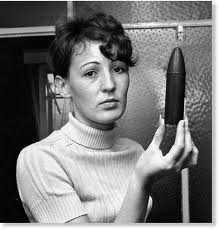
Francis Rowntree, 11, was playing with a friend beside the Divis Flats in Belfast in April 1972 when the two boys were approached by armed members of a British Army foot patrol, members of the Royal Anglian Regiment. Even though it was what's known as a 'non-riot situation', Francis was shot in the head from a distance of between five and seven yards by 'Soldier B' who, it seems, was 'testing' a 'modification' he had made to that projectile - he had hollowed it out and placed a battery inside it. Francis was the first person to die from the use of these rounds, which were used by British 'security forces' in the Six Counties between 1970 and 1975, and were replaced by the equally lethal plastic bullet. An 'inquest' was held, during which a British Army representative admitted he did not know at what distance it was permissible to fire a rubber bullet gun or at which part of the body it should be aimed! A media report from three years ago stated that new evidence in regards to the murder of Francis Rowntree had been found -
An inquest has been ordered to be reopened after new evidence was uncovered about the death of the first child killed by a rubber bullet in the north of Ireland. Seventeen people have died in the north of Ireland at the hands of rubber or plastic bullets, including seven children, and hundreds injured. The weapons continue to be used by the Crown Forces as a form of crowd control during 'public order' situations.
Schoolboy Francis Rowntree, known to his family as Frank, died in 1972 after being struck in the head with rubber baton round that it is believed had been 'modified' in order to make it more deadly. The 11-year-old from Lower Clonard Street in west Belfast sustained catastrophic head injuries after being hit as he played with a friend close to Divis Flats in April 1972. At the original inquest held in October 1972 the soldier who fired the fatal shot from the Royal Anglian Regiment, known only as 'Soldier B' was not called to give evidence and instead a statement taken by military police was produced at the hearing.
A witness has now came forward to say that within minutes of the shooting, the soldiers involved appeared to be searching the scene for the fatal round which was believed to have been hollowed out and a battery placed in side the rubber casing. 'Soldier B' claimed the bullet ricocheted off a lamppost. However, a recent forensic re-examination of the fatal injuries by state pathologist Professor Jack Crane undermines this account and suggests that the child was shot directly at close range. A Historical Enquiries Team report into the shooting confirmed that he was an "innocent bystander who posed no threat whatsoever to the soldier".
In a letter to the family, Six-County Attorney General John Larkin said that having considered all new evidence, "I have concluded that it is advisable that a fresh inquest be held into the death of Francis Rowntree and I so direct".
Frank’s brother Jim said the family were relieved to hear that a fresh inquest would now be held : "Frank was just an innocent child and yet the (British) army tried to blacken his name saying he was involved in a riot," Mr Rowntree said. "My parents were told by a consultant in the Royal that his head had been crushed like an eggshell. An apology would go a long way to healing the hurt. My Mum is 86 and so it's important for her that we have this inquest now."
The family’s solicitor, Padraig O Muirigh, said the decision by Mr Larkin was a "significant step forward for the family’s quest for truth".
"In 1970 an agreement was reached between the British army and the chief constable of the RUC, whereby the interviewing of soldiers involved in the death of Francis Rowntree was carried out by the Royal Military Police," Mr O Muirigh said. "There was nothing approaching a proper police investigation* into the incident." (from here and, in relation to that last sentence*, that claim can be explained by the fact that 'there is nothing approaching a proper police' force in the British-occupied Six Counties ). Had the British not interfered in Ireland, Frank Rowntree would be in his mid-50's today and thousands of other people, too, could have had the opportunity to live a normal life. And the worse part is that, in this, the 21st century, they are still here....
ONE SHOULD LOCK UP ONE'S OFFSPRING....
It seem's that the 'John Bruton's' in our midst are ready, willing and able to make a show of themselves again, in the presence of those they aspire to be - 'royalty' - '...Clarence House has confirmed that Britain's Prince Charlies and Camilla The Duchess of Cornwall will visit Ireland next month....the event will take in visits to both the Republic and the North (and) comes 20 years after the heir to the British throne first came to the Republic in May 1995...it is reported that he and his wife are to spend some time in the west of the country (but) their itinerary is still a work in progress - but there is speculation that it could include a visit to Mullaghmore, where Charles' great-uncle Lord Louis Mountbatten was killed in an IRA bombing in 1979...the (Free State) Foreign Affairs Minister Charlie Flanagan (wearing his colours in this pic) has welcomed the Royal visit, saying: "Following the reciprocal State Visits of recent years, this visit to Ireland will represent a further expression of the warm and friendly relations which now exist between us.
We look forward to their arrival next month, and to a visit programme which reflects the quality of these relations," he added....' (from here).
These "...quality..friendly relations.." have been 'expressed' before in our history, not least when 'Queen' Victoria of England (who was of German descent - she was born in 1819, at the Kensington Palace, to Princess Victoria of Saxe-Coburg-Saalfeld and Prince Edward Augustus, Duke of Kent) decided to grace us with her presence - "In the very midst of all this havoc, in August, 1849, her Majesty's Ministers thought the coast was clear for a Royal Visit. The Queen had long wished, it was said, to visit her people of Ireland; and the great army of persons, who, in Ireland, are paid to be loyal, were expected to get up the appearance of rejoicing......one Mr O'Reilly, indeed, of South Great George's Street, hoisted on the top of his house a large black banner, displaying the crownless Harp; and draped his windows with black curtains, showing the words Famine and Pestilence: but the police burst into his house, viciously tore down the flag and the curtains, and rudely thrust the proprietor into gaol. 'The Freemans Journal' newspaper says that on passing through Parkgate Street, Mr James Nugent, one of the Guardians of the North Union, approached the royal carriage, which was moving rather slowly, and, addressing the Queen, said: 'Mighty Monarch, pardon Smith O'Brien.' Before, however, he had time to get an answer, or even to see how her Majesty received the application, Lord Clarendon rode up and put him aside....." (from here) .
Then, as now, protests against the visit of English 'royalty' to Ireland will be held and, like Mr James Nugent (above), Republican Sinn Féin will be hoping to 'have a word in her ear....'. This blog will be only too happy to publicise such protests , so watch this space....
Thanks for reading, Sharon.
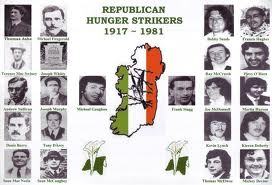
BOBBY SANDS COMMEMORATION : IRELAND'S TWENTY-TWO REPUBLICAN HUNGER-STRIKERS TO BE COMMEMORATED IN DUBLIN ON SATURDAY 2ND MAY 2015.
Between the years 1917 and 1981 , twenty-two Irish men died on hunger-strike in our on-going fight for Irish freedom :
Thomas Ashe, Kerry, 5 days, 25th September 1917(force fed by tube , died as a result).
Terence McSwiney, Cork, 74 days, 25th October 1920.
Michael Fitzgerald, Cork, 67 days, 17th October 1920.
Joseph Murphy, Cork, 76 days, 25th October 1920.
Joe Witty, Wexford, 2nd September 1923.
Dennis Barry, Cork, 34 days, 20th November 1923.
Andy O Sullivan, Cork, 40 days, 22nd November 1923.
Tony Darcy, Galway, 52 days, 16th April 1940.
Jack 'Sean' McNeela, Mayo, 55 days, 19th April 1940.
Sean McCaughey, Tyrone,22 days, 11th May 1946 (hunger and thirst strike).
Michael Gaughan, Mayo, 64 days, 3rd June 1974.
Frank Stagg, Mayo, 62 days, 12th February 1976.
Bobby Sands, Belfast, 66 days, 5th May 1981.
Frank Hughes, Bellaghy (Derry), 59 days, 12th May 1981.
Raymond McCreesh, South Armagh, 61 days, 21st May 1981.
Patsy O Hara, Derry, 61 days, 21st May 1981.
Joe McDonnell, Belfast, 61 days, 8th July 1981.
Martin Hurson, Tyrone, 46 days, 13th July 1981.
Kevin Lynch, Dungiven (Derry), 71 days, 1st August 1981.
Kieran Doherty, Belfast, 73 days, 2nd August 1981.
Tom McIlwee, Bellaghy (Derry), 62 days, 8th August 1981.
Micky Devine, Derry, 60 days, 20th August 1981.
The sectarian realities of ghetto life materialised early in Bobby's life when at the age of ten his family were forced to move home owing to loyalist intimidation even as early as 1962. Bobby recalled his mother speaking of the troubled times which occurred during her childhood; "Although I never really understood what internment was or who the 'Specials' were, I grew to regard them as symbols of evil..." , Bobby was later to say. Of this time Bobby himself later wrote: "I was only a working-class boy from a nationalist ghetto, but it is repression that creates the revolutionary spirit of freedom. I shall not settle until I achieve liberation of my country, until Ireland becomes a sovereign, independent socialist republic..." The fight for the same Cause that Bobby Sands died for in 1981 is on-going today, as six Irish counties remain under the jurisdictional control of Westminster, which enforces that control with military occupation. A commemoration will be held in Dublin in honour of Bobby Sands, the thirteenth republican to die on hunger-strike since 1917: those attending this commemoration are asked to assemble at 2pm on Saturday May 2nd, 2015, on the traffic isle facing the GPO in O'Connell Street, Dublin.
THE PRICE OF PEACE......
Last month, 28 women who protested peacefully in the Phoenix Park, Dublin, against US President Ronald Reagan's visit to Ireland received £1000 each arising from their action for wrongful arrest. Gene Kerrigan recalls the weekend when another State determined Irish security requirements and details the garda action which could cost tens of thousands of pounds. From 'Magill' magazine, May 1987.
At around 5am the number of women dwindled further, to about 40. They were waking up, moving to shelter under the trees, trying to keep themselves warm and amused. They staged a 'Miss Phoenix Park' contest, which was won by a woman wearing a black plastic rubbish sack and two odd wellies. They also played leap-frog and staged a sack race using survival bags.
The garda vans were assembled beside the US Ambassador's residence. It was now about 7am. The women began to walk in a circle as the garda vans moved in on them across the grass. More than one woman mentioned that it was like a movie scene as about eight garda vans and at least 100 gardaí surrounded them, van doors opening and gardaí spilling out of them. The circle broke and the women began walking towards the gardaí , but about ten of the women stood aside from all of this. As far as everyone knew this was just another eviction and it had been agreed beforehand that some of the women would stand aside and look after the belongings left under the trees.
As the gardaí and the women came closer the women broke into groups of about five, holding hands or linking arms, and singing. There was a garda in a light blue uniform saying something or trying to say something but he couldn't be clearly heard above the singing. A garda grabbed a woman and she slumped to the ground and lay there. There was no resistance to being arrested, just non-cooperation, bodies becoming deadweight. (MORE LATER).
THE IRA.THE NEW IRA IS YOUNGER, MORE RADICAL AND HAS SEEN LITTLE OF LIFE OTHER THAN VIOLENCE..... By Ed Moloney. From 'Magill' magazine, September 1980.
While the IRA has, thanks to that sort of ingenuity and the re-organisation, made a considerable comeback since 1977, the organisation and its campaign of death and destruction has at the same time been limited effectively to three of its eight operational areas : Belfast, South Armagh and East Tyrone. Even so the level of activity in those areas has also declined.
In Belfast for instance there were 109 bombing attacks and 51 ambushes and gun attacks on the RUC, British Army or other British security force personnel during 1977. In 1978, that had declined to 101 bombings and 29 shootings and, in 1979, to only 39 bombing attacks and 20 gun attacks. This year seems to be keeping in line with that, at 13 bombings and II gun attacks.
In East Tyrone it has been much the same story- 22 bombing attacks in 1977 and 9 gun attacks. In 1978 there was a rise to 36 bombings and a fall to 7 gun attacks and in 1979 there was a drop to 18 bombings but a rise to 13 shootings, aimed at the British security forces. South Armagh IRA units on the other hand display all the characteristics of classic guerrilla fighters. Very few incidents occur in South Armagh, compared to areas like Belfast, but those that are carried out have been devastatingly effective. In 1977 there were only 5 bombings and 7 shootings directed at the security forces, a low level of activity that was caused by increased SAS activity in the area. (MORE LATER).
ON THIS DATE (15TH APRIL) 167 YEARS AGO : PRESENTATION OF NEW IRISH FLAG.
'Does the world even have heroes like Ireland's Thomas Francis Meagher anymore? After fighting for Irish independence ("I know of no country that has won its independence by accident") ,then condemned to death, pardoned and exiled, Thomas Francis Meagher escaped to America,where he became a leader of the Irish community and commanded the Irish Brigade during the Civil War. General Meagher’s men fought valiantly at some of the most famous battles of the Civil War,including Antietam, Fredericksburg and Chancellorsville. After the war, Meagher served as Acting Governor of the Montana Territory. In 1867, Meagher disappeared on the Missouri River ;his body was never found...' (from the poster, pictured, left, sourced here.)
The defining day of the The Battle of Antietam/Battle of Sharpsburg was September 17th, 1862, which was the bloodiest day of not only the American Civil War but the bloodiest single day in all of American history. The battle took place between the town of Sharpsburg in Maryland and Antietam Creek, and it ended General Robert E. Lee's first invasion of a northern state, and was the first major battle in the American Civil War to take place on Union soil. The combined tally of dead, wounded, and missing stands at 22,717 soldiers of which the Irish Brigade, under the command of Brigadier General Thomas Francis Meagher, who recruited soldiers from among Irish immigrants for the Union side, lost over 60% of its men in an area that came to be known as 'Bloody Lane'. We have previously mentioned Meagher's involvement in the Irish struggle on this blog (here and here , for instance) but, before he left these shores for America, he unveiled an Irish flag (which he had based on the French Tricolour) in his native city, Waterford, on the 7th March 1848, outside the Wolfe Tone Confederate Club.
On this date (15th April) in 1848 - 167 years ago - on Abbey Street, in Dublin, he presented the flag to Irish citizens on behalf of himself and the 'Young Ireland' movement, with the following words : "I trust that the old country will not refuse this symbol of a new life from one of her youngest children. I need not explain its meaning. The quick and passionate intellect of the generation now springing into arms will catch it at a glance. The white in the centre signifies a lasting truce between the 'orange' and the 'green' and I trust that beneath its folds, the hands of the Irish Protestant and the Irish Catholic may be clasped in generous and heroic brotherhood..."
He was arrested by the British for his part in the 1848 Rising ,accused of 'high treason' and sentenced to death ('...to be hanged, drawn and disemboweled..') but, while he was awaiting execution in Richmond Jail, this was changed by 'Royal Command' to transportation for life and in July 1849, at only 26 years of age, he was transported from Dun Laoghaire on the S.S. Swift to Tasmania. Before he was deported, he spoke about the country and the flag he was leaving behind - "Daniel O'Connell preached a cause that we are bound to see out. He used to say 'I may not see what I have labored ,I am an old ,my arm is withered, no epitaph of victory may mark my ,but I see a young generation with redder blood in their veins, and they will do the work.' Therefore it is that I ambition to decorate these hills with the flag of my country...."
In Tasmania he was considered, and rightly so, to be a political prisoner (a 'Ticket of Leave' inmate) which meant he could build his own 'cell' on a designated piece of land that he could farm provided he donated an agreed number of hours each week for State use. In early 1852, Thomas Francis Meagher escaped and made his way to New Haven, in Connecticut, in America, and travelled from there to a hero's welcome in New York. This fine orator, newspaper writer, lawyer, revolutionary, Irish POW, soldier in the American civil war and acting Governor of Montana died on the 1st of July, 1867, at 44 years of age. Asked about his 'crimes', he replied - "Judged by the law of England, I know this 'crime' entails upon me the penalty of death ; but the history of Ireland explains that 'crime' and justifies it." And the reasons for such 'crimimal acts' still exist to this day.
ON THIS DATE (15TH APRIL) 175 YEARS AGO : 'LOYAL' (BUT 'PRO-IRISH'!) ASSOCIATION FOUNDED.
On April 15th, 1840, Daniel O'Connell launched the 'Loyal National Repeal Association' (as it called itself from 1841 onwards - at its inception it was simply known as 'The Repeal Association' : O'Connell was back-tracking with the name-change, all but apologising to the British for asking them to 'tweak' the system a little more in favour of the Irish) but he made it clear that it was his desire that Ireland should remain under the British 'Monarchy' saying, if you like - '...stay if you want , just treat us better.' The only force to be used, he stated , was "moral force" ; but even this was too much of a demand for Westminster - 'Sir' Robert Peel (the British PM) replied that to 'grant' O'Connell his way "...would not merely mean the repeal of an Act of (British) Parliament, but dismemberment of a great Empire. Deprecating as I do all war but above all, civil war, yet there is no alternative which I do not think preferable to the dismemberment of Empire...."
A group within the 'Loyal National Repeal Association' supported Daniel O'Connell in his endeavours but were not convinced that "moral force" alone would win the day ; they were the 'Young Irelanders', and they viewed their leader "...with a mixture of affection and impatience..." In 1842, 'The Young Irelanders' established a newspaper called 'The Nation', in which they supported the objectives of the 'Repeal' Movement. The newspaper, under the control of 26 years-young Charles Gavan Duffy, supported Daniel O'Connell in his quest to publicise the 'Repeal' Movement, and helped to organise and promote outdoor meetings (known as 'Monster Meetings') at which the objectives of the 'Repeal' Movement could be advanced. The year 1843 was promoted as 'The Year of Repeal', and Daniel O'Connell took his message to the people ; in Mullingar, County Westmeath, for instance, he addressed a crowd of approximately 150,000 people. The British 'authorities' were watching these developments with interest and, while no doubt regarding the 'Loyal' Daniel O'Connell as no more than a 'rebel pet', were presumably more worried by the fact that the huge crowds he drew would be susceptible to the less 'loyal' message coming from 'The Young Irelanders'. After the Mullingar 'Monster Meeting ' , which was viewed as a tremendous success by the organisers, 'The Nation' newspaper helped to publicise another such meeting - this time in Mallow, County Cork : 400,000 people turned up - the British were uneasy.
A third 'Monster Meeting' was held in Lismore, County Waterford - again, a crowd estimated at 400,000 people attended. At each meeting, the 'Young Irelanders' were recruiting, having made their position clear in the pages of their newspaper, 'The Nation', in leaflets, and by word of mouth - ie 'we get back whatever we can by O'Connell's methods, but will not confine ourselves to those methods alone...' The British were perplexed at what to do regarding the 'Monster Meetings' - were they a 'safety valve' at which the 'agitators/rebels' could let off steam in a more-or-less harmless fashion, or were they a possible recruiting exercise at which the more militant element could 'plot and plan'? However, after the 15th August 1843 'Monster Meeting' in Tara, County Meath, the British decided to take action. The 'Young Irelanders' newspaper, 'The Nation', put the figure for those in attendance at the Hill of Tara 'Monster Meeting' at three-quarters of a million people "...without fear of exaggeration.." ; Daniel O'Connell himself claimed it was at least one-and-a-half million people, while another newspaper of the day ('The Times'?) reported - "The whole district was covered with men. The population within a days march began to arrive on foot shortly after daybreak and continued to arrive, on all sides and by every available approach, 'till noon. It was impossible from any one point to see the entire meeting. The number is supposed to have reached between 500,000 and 700,000 persons...." . Other reports stated that O'Connell's marshals were on horseback, that the crowds arrived on foot and in carriages, banners were present, as were bands and groups in "historic fancy dress". Indeed, archaeologists have found human bones on the site, some of which are said to be 4000 years old, and traces of wooden platforms, bits of clay pipes and, of course (!), whiskey bottles, dating back to the mid-19th century. On that day in Irish history, Daniel O'Connell addressed a sea of people -
"We are at Tara of the Kings - the spot from which emanated the social power, the legal authority, the right to dominion over the furthest extremes of the land....the strength and majority of the National Movement was never exhibited so imposingly as at this great meeting. The numbers exceed any that ever before congregated in Ireland in peace or war. It is a sight not grand alone but appalling - not exciting merely pride, but fear. Step by step, we are approaching the great goal of Repeal of the Union, but it is at length with the strides of a giant..." Again, it must be stressed that Daniel O'Connell would use only "moral force" to achieve what he termed 'repeal of the Union' and, even then, favoured the island of Ireland remaining as a unit governed by the British 'Monarchy' - a 'new' coat of varnish on rotten timber. O'Connell could 'talk the talk' but the British were fearful that he was encouraging others to 'walk the walk'.
The 'Monster Meetings' were a great success - despite all the "misfortunes" (as the British would have it) that the Irish people were suffering in their daily lives ; the desire, the demand, for a British withdrawal had not gone away. And, as stated here a few paragraphs back, after the Tara 'Monster Meeting' (15th August 1843) the British decided it just wasn't cricket : enough was enough. A 'Monster Meeting' planned for Clontarf, in Dublin, which was to take place on Sunday, 8th October, 1843, was banned by the British authorities on Saturday, 7th October 1843 - the day before the event was due to take place ; Daniel O'Connell and others in the leadership of 'The Loyal National Repeal Association' quickly lodged a complaint. Daniel O'Connell protested at the banning, as did his colleagues in the leadership of the 'Association' - they were later to be arrested by the British and sentenced to a year in prison for 'conspiracy', but this judgement was then reversed in the 'British House of Lords'. When, on that Saturday, the 7th of October 1843, O'Connell noticed that posters were being put-up in Dublin by the British 'authorities' stating that the following days meeting had been banned, he backed down ; in this scribblers opinion he should have 'stuck to his guns' and ignored the British 'writ' - he should have went ahead with the Clontarf 'Monster Meeting' therby 'putting it up' to the British but..."moral force only" won the day ; O'Connell issued his own poster that same day (ie Saturday 7th October 1843) as well as spreading the word through the 'grapevine' that the meeting was cancelled. That poster makes for interesting reading -
NOTICE
WHEREAS there has appeared, under the Signatures of "E.B. SUGDEN, C DONOUGHMORE, ELIOT F BLACKBURN, E. BLAKENEY, FRED SHAW, T.B.C. SMITH, a paper being, or purporting to be, a PROCLAMATION, drawn up in very loose and inaccurate terms, and manifestly misrepresenting known facts ; the objects of which appear to be, to prevent the PUBLIC MEETING, intended to be held TO-MORROW, the 8th instant, at CLONTARF, TO PETITION PARLIAMENT for the REPEAL of the baleful and destructive measure of the LEGISLATIVE UNION.
AND WHEREAS, such Proclamation has not appeared until LATE IN THE AFTERNOON OF THIS SATURDAY, THE 7th, so that it is utterly impossible that the knowledge of its existence could be communicated in the usual Official Channels, or by the Post, in time to have its contents known to the Persons intending to meet at CLONTARF, for the purpose of Petitioning , as aforesaid, whereby ill-disposed Persons may have an opportunity, under cover of said Proclamation, to provoke Breaches of the Peace, or to commit Violence on Persons intending to proceed peaceably and legally to the said Meeting . WE, therefore, the COMMITTEE of the LOYAL NATIONAL REPEAL ASSOCIATION, do most earnestly request and entreat, that all well-disposed persons will, IMMEDIATELY on receiving this intimation, repair to their own dwellings, and not place themselves in peril of any collision, or of receiving any ill-treatment whatsoever. And we do further inform all such persons, that without yielding in any thing to the unfounded allegations in said alleged Proclamation, we deem it prudent and wise, and above all things humane, to declare that said MEETING IS ABANDONED, AND IS NOT TO BE HELD.
SIGNED BY ORDER,
DANIEL O'CONNELL,
CHAIRMAN OF THE COMMITTEE. T. M. RAY, Secretary.
SATURDAY, 7th OCTOBER, 1843. 3 O 'CLOCK P.M.
RESOLVED - That the above Cautionary Notice be immediately transmitted by Express to the Very Reverend and Reverend Gentlemen who signed the Requisition for the CLONTARF MEETING, and to all adjacent Districts, SO AS TO PREVENT the influx of Persons coming to the intended Meeting.
GOD SAVE THE QUEEN.
Browne,Printer, 36 Nassau Street.
The British had put pressure on their 'rebel pet', O'Connell, to enforce their ban, and had ordered a number of gunboats and land-based artillery pieces to train their weapons on the Clontarf area. Daniel O'Connell was aware that thousands of people would already be on their way to the Clontarf meeting (some having left their homes on the Friday, or earlier, for the walk to Dublin) so he sent his marshals out from Dublin on horseback, urging the crowds to return home : it was that or challenge Westminster, but that wasn't an option, as far as he was concerned.
O'Connell and his 'Loyal Association' had painted themselves into a corner ; they fell into a trap of their own making. He had publicly and repeatedly vowed to work "within the law" (ie British 'law') which could have at any time been used, as it eventually was, to ban his agitation and he had vehemently ruled out the use of force in any circumstances in challenging the British. One of the results of the decision by Daniel O'Connell to cancel the Clontarf 'Monster Meeting' was that the public lost faith in him and in the 'Loyal National Repeal Association' ; when he realised that he had lost that support, he expressed the view that "repeal of the Union" could not be won. The 'Young Irelanders' denounced him and the manner in which he had directed the 'Repeal' campaign, and stated that his leadership had failed to address the threat "of the decay of Irish culture, language and custom" under British influence. One of the many who left O'Connell's side to lead the 'Young Ireland' Movement, John Mitchel, the son of a Northern Presbyterian Minister, called on the Irish people to strike back against the British - "England! All England, operating through her government : through all her organised and effectual public opinion, press, platform, parliament has done, is doing, and means to do grievous wrongs to Ireland. She must be punished - that punishment will , as I believe, come upon her by and through Ireland ; and so Ireland will be avenged..."
The 'Loyal National Repeal Association' managed to limp along for a further four years but when O'Connell died in 1847 it fell into disarray and dissolved itself in 1848 proving, not for the first time in our history, that 'moral force' alone , when dealing with a tyrant, will not win the day.
LUFTWAFFE MEMORIAL IN LONDON AND NAZI MEMORIAL IN ISRAEL.
It would be ridiculous if either of the above were to be seriously proposed, and would be viewed as proof of the proposers mental and moral illness, and rightly so. There are many monuments etc throughout the world that locals and/or tourists might object to on grounds of character, setting, function etc and , with 'one man's terrorist being another man's freedom fighter', perhaps the best rule of thumb is to apply common sense to any such proposed memorial/monument ie don't do as our headline would suggest.
But common sense by the political establishment in this corrupt State has never been a strong point as they are so enamoured by foreign 'dignitaries' that whatever self-respect they may have had quickly evaporates in their rush to share center-stage with their hero (here and here, for example). And so it continues - 'The relatives of some of the British soldiers who fought and died during the Easter Rising in 1916 have called for a permanent memorial to their dead to be erected in Dublin...' - a ridiculous proposal, of course, but one which the weak-willed political establishment here would gladly take on board, to show how politically 'mature' they are and, if proceeded with, could also test their mettle with a brush and shovel.
EVERYBODY NEEDS GOOD NEIGHBOURS!
I live in Clondalkin, Dublin, and I want to take this opportunity to introduce you to two of my near-neighbours, who just happen to live next door to each other in Clondalkin (well, practically - house number 55 keeps them apart!) : Pat and Brian.
This is Pat (Rabbitte) (pictured, left) , photographed for an interview he done with the local 'Clondalkin Echo' newspaper in April 2011 (for the truth about this State's oil and gas fields, click here) . He was State Minister for Energy and Natural Resources at the time. Pat believes that the State broadcaster, RTE, is deliberately attempting to portray the double-taxation entity that is 'Irish Water' in a bad light - 'In a speech in the private members debate on Irish Water, he said that if he did not know better, he would conclude that the "lopsided" coverage of the water issue derives from a decision of the RTÉ Board to strangle Irish Water at birth...' This from the man who once boasted that he had "led the successful campaign against the water charges..." Pat lives in number 56 Monastery Drive, in Clondalkin.
This is Pat's (near-)neighbour, Brian (McKeown), who was appointed to the Board of 'Irish Water' in November 2013. Brian used to work for Dublin County Council and then moved to Dublin City Council, both jobs in which he would have met a lot of politicians. He retired from the former in 2011, which no doubt allowed him more time for family and friends. And neighbours. He lives in number 54 Monastery Drive, in Clondalkin.
I hope both men like their new neighbours, even if they might not pay twice for the one service and, speaking of which, those of us who refuse to pay twice for a water service will be meeting-up this Saturday, the 18th of April 2015, at 2pm, at the Garden of Remembrance in Parnell Square in Dublin city centre and we'll be marching down O'Connell Street to get to Leinster House, where we will hold a 'Bin the Bill' protest, at which bills from 'Irish Water' will be disposed of in wheelie bins. I'll be there, but I doubt if Pat or Brian will be!
Thanks for reading, Sharon.