REMINDER - SATURDAY, 15TH AUGUST 2015.
"We are the most cosmopolitan race in the whole universe; but Irishmen should have a country; they have a right to the country of their birth. By the use and aid of one steel – the pen – our committee have taken possession of that right, and as their title one day may be disputed, I trust they will be able and willing to prove it by the aid of another steel – the sword." - the words of Jeremiah O'Donovan Rossa : on Saturday, 15th August 2015, Republican Sinn Féin will hold a wreath-laying ceremony at 11am in Glasnevin Cemetery, Dublin, at the grave of O'donovan Rossa (those attending are asked to assemble at the cemetery gates) following which a seminar will be held, in Wynn's Hotel, Abbey Street, Dublin, from 1pm to 4.30pm. All genuine republicans welcome!
"WE SUPPORT THE USE OF ARMED STRUGGLE IN THE SIX COUNTIES..." - MARTIN McGUINNESS.
The following piece was published in the 'Socialist Republic!' newspaper in September 1986 and records some of the words of Martin McGuinness from a speech he delivered in Bodenstown on Sunday 22nd June of that year. That publication was 'the newspaper of the Scottish Communist Republican Party (SCRP)' , both of which are now apparently defunct as separate entities as, indeed, is McGuinness himself, in relation to Irish republicanism. Less than six months after he delivered the following speech, Martin McGuinness assisted other nationalists in splitting the Republican Movement.
Quote from Martin McGuinness, Sunday 22nd June, 1986, Bodenstown: "Despite the multi-million dollar hype of the (Hillsborough) Agreement, despite disinformation, despite the rewriting of Irish history by West Britons and British propaganda, more and more people are beginning to realise that internal tinkering with the six-county statelet solves nothing.."(...which is exactly what McGuinness and his nationalist colleagues are doing now - "internal tinkering with the six-county statelet.")
IRELAND : "ONLY A SOCIALIST REPUBLIC CAN END DECADES OF WAR, INJUSTICE AND POVERTY" - Sinn Féin.
"In the past week we have witnessed the twenty-six-county administration in the ridiculous position of having to exert diplomatic pressure on Libya at the British government's behest. The bold Peter Barry is now a mouthpiece both in Ireland and abroad of British interests." In contrast to imperialism's anti-people and hateful plans for Ireland, Martin McGuinness outlined Sinn Féin's aim of a 32-county socialist republic - "More and more people are beginning to realise that internal tinkering with the six-county statelet solves nothing," he pointed out, "Only the achievement of a socialist republic, as advocated by Sinn Féin, can end decades of war, injustice and poverty in Ireland. We are a socialist republican movement, a movement that supports the use of armed struggle in the six-counties of Ireland."
"In the whole of Western Europe there is not a revolutionary or a socialist organisation that enjoys as much popular support as we do. We must be conscious of that fact and attempt to build on it. Our position is perfectly simple - the Irish are a subject people who have the right to be free and have the absolute right to oppose in arms the occupying forces of Britain in the six counties."
"We are out to establish a society in which no-one is oppressed or exploited, where women are freed from their traditional oppressions, where the young people have nope and where freedom, justice and power rests with the people of Ireland." (MORE LATER).
THE PRICE OF PEACE......
Last month, 28 women who protested peacefully in the Phoenix Park, Dublin, against US President Ronald Reagan's visit to Ireland received £1000 each arising from their action for wrongful arrest. Gene Kerrigan recalls the weekend when another State determined Irish security requirements and details the garda action which could cost tens of thousands of pounds. From 'Magill' magazine, May 1987.
Section 9 of the Phoenix Park Act, already quoted above, is quite clear - the Garda Commissioner may make regulations "for the routes" to be observed by people and vehicles. He may also direct gardai to preserve order under existing law. The regulations the Commissioner is empowered to make were clearly intended to be ones which would regulate the procession of people or vehicles but, in the event, immense powers were brought into force to arrest and hold a small group of people who were deemed an embarrassment to the government. An obscure clause in an Act designed to regulate the mundane governance of a public park was certainly stretched to its limit.
At the end of March 1987, one of the women, Jane Morgan, settled a civil suit against the State and the gardai, out of court : she and 27 others had taken the cases, all of which were settled. Jane Morgan was given £1,000 damages and £900 special damages and the others will get £1,000. All of them will get their costs, and the final cost to the taxpayer for this affair will run into tens of thousands of pounds, but the cost to 'the flagship and flashfire of the future' is incalculable.
[END of 'The Price Of Peace'.] (Next : 'Prose And Cons' , from Portlaoise Prison, 1999.)
"WE HAVE WORN DOWN THEIR WILL....."
Ed Moloney speaks to a leading member of the Provisionals who has been authorised to speak on behalf of the (P)IRA Army Council. From 'Magill' magazine, September 1980.
Ed Moloney : What are the present state of relations between the IRA and the Palestine Liberation Organisation?
IRA : Well unfortunately, the PLO are in a bad situation. They have found it necessary to adopt certain policies. Some would say in order to ingratiate themselves with the EEC Governments for recognition. We do not question or judge them because we know the position of their people is very bad. They're denied their homeland and live in deplorable refugee camps. They're also subjected to frequent Israeli attacks and from Haddad, on Southern Lebanon. We sympathise with them, but we cannot dictate their relationships with other people. That's just unfortunate. There are only solidarity links between the IRA and the PFLP, but the Brits have used that to try to embarrass us, as they did with the Marxist smear, with those links. The IRA is a national liberation organisation.
Ed Moloney : Do the negotiations over the H Blocks between Cardinal O Fiaich and Humphrey Atkins involve the republican movement?
IRA : No. But these negotiations are causing a lot of anxiety, although by the time this interview appears in print there might be some conclusion to those negotiations. It is for the men in the H Blocks and their comrades in Armagh to decide. It's not even up to us to decide. They are the sole negotiating body. They are undoubtedly political prisoners. In February and March this year we privately decided to suspend attacks on prison warders, but the beatings meted out by them to the prisoners continued. It wasn't until June this year after prisoners had been continually beaten, after there was no progress in Cardinal 0 Fiaich's 'initiative', that we decided to resume attacks. Since June, there has only been one IRA attack on the warders but we have said it is open season on them again. We want the H Blocks settled, we don't want to see warders killed and the H Blocks are of no propaganda purpose to use. Our people in the jails are suffering real deprivations and we want that resolved.
[END of 'We Have Worn Down Their Will'.] (Next : 'Stunning Silence' , by Eamonn McCann , from 'Magill' magazine , June 1989.).
ON THIS DATE (12TH AUGUST) 46 YEARS AGO : POLITICAL RIOT IN DERRY.
The 'Battle of the Bogside' (pictured, left) , Derry, 12th, 13th and 14th of August 1969 : a reaction to British interference in Irish affairs.
The 'Battle of the Bogside' has had so many thousands of words printed about it over the last 46 years that it is unlikely that we can give any fresh insights into it nor do we feel it necessary to even attempt to do that - regardless of the position that this incident is viewed from, it is beyond doubt that it helped to further expose the lie from Westminster that its 'police force', the RUC/PSNI, and its army, were only in that part of Ireland to 'keep the peace between two warring religious factions'. The Free State administration declared that it "...could not stand by and watch innocent people injured and perhaps worse.." and they didn't - they dressed the wounds of the injured (!) but backed off when it came to intervening to prevent any more injuries and, indeed, have themselves inflicted injuries on those of us who continue to oppose the British military and political presence in Ireland. But we have broad shoulders, as had those whose footsteps we follow, and we will persist.
Tuesday 12 August 1969 : As the annual Apprentice Boys parade passed close to the Bogside area of Derry serious rioting erupted. The Royal Ulster Constabulary (RUC), using armoured cars and water cannons, entered the Bogside, in an attempt to end the rioting. The RUC were closely followed and supported by a loyalist crowd. The residents of the Bogside forced the police and the loyalists back out of the area. The RUC used CS gas to again enter the Bogside area. [This period of conflict between the RUC and Bogside (and Creggan) residents was to become known as the 'Battle of the Bogside' and lasted for two days.]....serious rioting spread across Northern Ireland from Derry to other Catholic areas stretching the Royal Ulster Constabulary (RUC). The rioting deteriorated into sectarian conflict between Catholics and Protestants and many people, the majority being Catholics, were forced from their homes....Jack Lynch, then Taoiseach (Irish Prime Minister), made a television address in which he announced that 'field hospitals' would be set up in border areas. He went on to say that: "... the present situation is the inevitable outcome of the policies pursued for decades by successive Stormont governments. It is clear also that the Irish government can no longer stand by and see innocent people injured and perhaps worse...."
After two days of continuous battle, and with the Royal Ulster Constabulary (RUC) exhausted, the Stormont government asked the British government for permission to allow British troops to be deployed on the streets of Northern Ireland. Late in the afternoon troops entered the centre of Derry. John Gallagher, a Catholic civilian, was shot dead by the Ulster Special Constabulary ('B-Specials') during street disturbances on the Cathedral Road in Armagh. [John Gallagher was recorded, by the Royal Ulster Constabulary (RUC), as the first 'official' victim of 'the Troubles'.] In Belfast vicious sectarian riots erupted and continued the following day. In Divis Street the RUC fired a number of shots, from a heavy Browning machine-gun mounted on an armoured car, into the Divis Flats and Towers. One of the shots killed a young Catholic boy while he lay in bed... (from here.)
The Irish republican position is the same now as it was then - as long as Westminster maintains a political and military presence in any part of Ireland then 'Bogside-type- Battles' are inevitable.
ON THIS DATE (12TH AUGUST) 93 YEARS AGO : DEATH OF ARTHUR GRIFFITH.
Arthur Griffith (pictured, left) was born at 61 Upper Dominick Street, Dublin, in 1871 (31st March) into a family of Welsh descent - his father was Arthur Charles (a printer) and his mother's name was Mary (nee Whelan). He left school before he was thirteen years of age but mastered the art of autodidacticism and was theoretician by nature, in that whereas he did envisage a single political parliament for all Ireland, in Ireland, he was against 'mixing' social issues with the fight for national freedom, opining that economic issues could not be improved until a British political and military withdrawal had been secured.
At 26 years of age he travelled to South Africa (mostly for reasons of climate - he was recovering at the time from TB) and worked there for two years - one of his jobs was as an editor of the 'Middelburg Courant' newspaper, during his tenure of which the paper folded, not least because Griffith couldn't see eye-to-eye with it's pro-British readership!
He was an unlikely Irish Republican and took no part in the 1916 Rising (because, according to his wife, Maud, - "he was against all that...") but was still imprisoned over same, and was released in 1917. He became a Sinn Féin MP in 1918, and was Acting President of the Dail Government of 1919-20 while Eamon de Valera was in America.
Griffith led the Irish delegates as chief negotiator in the Treaty talks of late 1921 and became President of the Dail and was perhaps better known in his day as, if not an actual capitalist, then an aspiring one! He was a follower of Deak, the Hungarian author, and was of the opinion that Irish members of the British Parliament should withdraw from that institution, as he was opposed to the British legislating for internal Irish affairs but was known to personally favour a dual monarchy system (ie as with Hungary and Austria) which would leave the British monarch as 'King of Ireland and England', but with separate parliaments in both countries, and was concerned with the authority/powers that any Irish Parliament could win for itself from the British Government - indeed, he wrote a series of articles in 1904 for the 'United Irishman' newspaper entitled 'The resurrection of Hungary: a parallel for Ireland', in which he discussed that very subject.
However, that is not to say that the Arthur Griffith-linked Sinn Féin organisation, which was founded on November 28th, 1905 (compromised of an amalgamation of Cumann na nGaedheal, the National Council [which was founded in the main to organise protests at the visit of the British King, Edward VII, and included in its ranks Edward Martyn, Séamus McManus and Maud Gonne] and the Dungannon Clubs, a largely IRB-dominated republican campaign group) was, in its first years, not republican in character but rather sought a limited form of Home Rule on the dual monarchist model ; Brian O'Higgins, a founding member of Sinn Féin, who took part in the 1916 Rising and was a member of the First and Second Dáil and who remained a steadfast republican up to his death in 1962, had this to say in his Wolfe Tone Annual of 1949: "It is often sought to be shown that the organisation set up in 1905 was not republican in form or spirit, that it only became so in 1917; but this is an erroneous idea, and is not borne out by the truths of history. Anyone who goes to the trouble of reading its brief constitution will see that its object was 'the re-establishment of the independence of Ireland.' The Constitution of Sinn Féin in 1905, and certainly the spirit of it, was at least as clearly separatist as was the constitution of Sinn Féin in and after 1917, no matter what private opinion regarding the British Crown may have been held by Arthur Griffith."
On the 3rd December 1921, in a heated all-day debate in the Mansion House in Dublin, the then Irish republican delegation was once again at odds regarding the treaty which Westminster sought to impose on Ireland : the Irish Minister for Defence, Cathal Brugha, just managed to stop short of describing two of his then colleagues, Michael Collins and Arthur Griffith, as traitors ("...the British government selected its men..") whilst de Valera declared he himself might have been flexible on either one of the descriptive terms 'Irish unity/unconditional independence' but did not believe that compromise should be accepted on both ("...you got neither this nor that..") and, indeed, such was the falling out that three of them -Barton, Childers and Duffy- travelled to London that night from the North Wall and the other three -Collins, Griffith and Duggan- left for London via Dun Laoghaire ('Kingstown', as it was known then) and, at that same meeting, Griffith is recorded as having declared in favour of the 'offer' : 'Mr. Griffith in favour of Treaty...he did not like the document but did not think it dishonourable...' (from here) and, three days later (ie on the 6th December 1921), he issued the following press release (pictured, left) -
-"I have signed a Treaty of peace between Ireland and Great Britain. I believe that treaty will lay foundations of peace and friendship between the two Nations. What I have signed I shall stand by in the belief that the end of the conflict of centuries is at hand".(Counting chickens on a long hand there, Arthur!)
Michael Collins and Arthur Griffith (both pro-Treaty) pressurised their colleague, Richard Barton (the Irish Minister for Economic Affairs) to accept the Treaty of Surrender, telling him that if he did not sign then he would be responsible for "Irish homes (being) laid waste and the youth of Ireland (being) butchered" and, at about 11pm on Monday, 5th December 1921, Barton signed the document. Ten days later (ie on the 15th December) he had this to say in relation to that eventful day - "I want first of all to say we were eight and a half hours on that Monday in conference with the English representatives and the strain of an eight and a half hours conference and the struggle of it is a pretty severe one. One, when I am asked a question like that, "Was it or was it not?", I cannot give you an answer. But as regards particular aspects of that question, which I cannot take on oath, I can only give you my impression. It is in my notes that the answer is given, and it is there because it was my impression of that conference. It did appear to me that Mr. Lloyd George spoke to me and I had an impression that he actually mentioned my name; but I could not swear on oath that he mentioned my name, or actually addressed me when he spoke. It appeared to me that he spoke to me. What he did say was that the signature and the recommendation of every member of the delegation was necessary, or war would follow immediately and that the responsibility for that war must rest directly upon those who refused to sign the Treaty..."
In a speech he delivered in the then Dáil Éireann (the 32-county institution) on the 19th December 1921, Arthur Griffith called for support for the Treaty of Surrender : "...we have made a bargain....I signed the Treaty, not as an ideal thing, but fully believing what I believe now, as a Treaty honourable to Ireland, and safe-guarding the interests of Ireland. Now by that Treaty I am going to stand, and every man with a scrap of honour who signed it will do the same...I hold that it is good enough...we went there to see how to reconcile the two positions, and I hold we have done it...it is the first Treaty signed between the representatives of the Irish Government and the representatives of the English Government since 1172, signed on an equal footing...it is the first Treaty that admits the equality of Ireland...it is a Treaty of equality, and because of that, I am standing by it...we have brought back to Ireland her full rights and powers of fiscal control...we are told that it is a Treaty not to be accepted; that it is a poor thing, and that the Irish people ought to go back and fight for something more, and that something more is what I describe as a quibble of words...I ask the Dáil to pass this resolution...let us stand as free partners equal with England and make after 700 years the greatest revolution that has ever been made in the history of the world, in the history of Europe - a revolution which sees the two countries standing, not apart as enemies, but standing together as equals. I ask you, therefore, to pass this resolution" (from here) .
The prolonged strain of the campaign took its toll on the man and, at 51 years of age (in 1922) , Arthur Griffith died from a brain hemorrhage. He was mentally exhausted and bore a heavy load in that he had witnessed the start of the political and military fight against his Treaty. He tried to take a break by resting in a nursing home but could not settle in and returned to his political job (administering the affairs of the Free State) and, on the 12th August 1922, he collapsed and, despite the best efforts of three doctors, he died. He was buried in Glasnevin Cemetery, Dublin, four days later. But the opposition to the Treaty he supported lives on.
ON THIS DATE (12TH AUGUST) 145 YEARS AGO : 'UNPREDICTABLE' BRITISH GENERAL BORN.
British General Sir Hubert de la Poer Gough, GCB, GCMG, KCVO (!) (pictured, left) was born in Gurteen, Co Waterford, on August 12th 1870, to General Sir Charles Gough and his wife, Harriet Anastatia de la Poer (who was the daughter of Edmund de la Poer MP). He was destined for a military life and trained for same at Sandhurst Military Academy, before joining the 16th ('Queen's') Lancers, with which he served in the Tirah Expedition in India, to suppress an uprising, and also fought in the Boer War. He served his Empire in Ireland as commander of the 3rd cavalry brigade in the Curragh (in his memoirs, he described himself as "an Englishman but Irish by blood and upbringing") and was the main architect behind the 'Curragh Mutiny' in 1914, as he was completely opposed to any notion of 'Home Rule' been imposed on his political brethren in the north-east of Ireland.
Yet, in spite of his political sympathies for pro-British unionists in Ireland, he couldn't let that support override his sense of injustice about the manner in which the Irish population in general was being abused by his own grouping and its political chiefs : in 1921 he stated that "Law and order (in Ireland) have given place to a bloody and brutal anarchy in which the armed agents of the Crown violate every law in aimless and vindictive and insolent savagery. England has departed further from her own standards and further from the standards even of any nation in the world, not excepting the Turk and Zulu, than has ever been known in history before..." , feelings which, no doubt, led to his decision the following year (1922) to retire from the British Army (even though he resurfaced in 1937 to accept a 'Knight Grand Cross of the Bath' award from the British establishment!)
And, finally, that British General wasn't the only one of his ilk to voice concern about the atrocious treatment inflicted on the Irish by Westminster, politically and militarily - other examples can be read here.
ON THIS DATE (12TH AUGUST) 146 YEARS AGO : THE KING OF THE U.S.A. ISSUES AN EDICT.....!
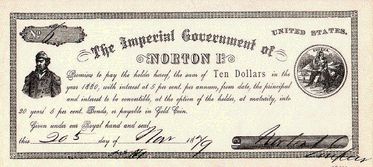
"At the pre-emptory request of a large majority of the citizens of these United States, I Joshua Norton, formerly of Algoa Bay, Cape of Good Hope, and now for the last nine years and ten months past of San Fransisco, California, declare and proclaim myself the Emperor of these United States.... ...and with those words a new 'royal family' came into being, although it took the man - Joshua Abraham Norton - ten years after his 'anointment' to abolish some of the 'opposition', which he did (!) on August 12th, 1869, by declaring - "Being desirous of allaying the dissension's of party strife now existing within our realm, (I) do hereby dissolve and abolish the Democratic and Republican parties, and also do hereby degree the disfranchisement and imprisonment, for not more than ten, nor less than five years, to all persons leading to any violation of this our imperial decree...."
JAN was his own man, with his own currency!
Anyone of that 'character' is bound to have left a few choice words in his/her wake and the Emperor is no exception - "We, Norton I, do hereby decree that the offices of President, Vice President, and Speaker of the House of Representatives are, from and after this date, abolished......now, therefore, the Directors of the company are hereby ordered to see that precautions are taken to make travel on said railroad perfectly safe by using a screw with at least twenty-four inches diameter.....it is my desire that, in case Maximillian will surrender, he be sent here a prisoner of war, but that in the event of his continuing the war, or refusing to surrender, then he be shot.....we do hereby command the Leaders of the Hebrew, Catholic and Protestant Churches to sanctify and have us crowned Emperor of the United States and Protector of Mexico.....we further decree that the Senate of the United States elect a prominent Democrat as their presiding officer, to act as President until the next election, and to reconstruct the Cabinet according to our wishes hereafter to be declared...."
This English-born 'royal' proclaimed himself as '(his) Imperial Majesty Emperor Norton I, Emperor of the United States of America and Protector of Mexico' on the 17th of September 1859 and has been variously described as being both (and between!) eccentric and barking mad. Nevertheless, when he died in 1880, at 61 years of age, about 30,000 people turned out for his funeral and the cortege was two miles long! More about Jan the Man can be had here. And it is hereby declared a violation should you not click on that link!
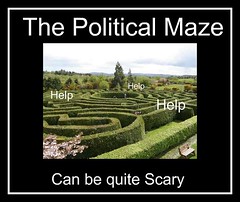
PLUSH GREEN CARPETS INSTEAD OF CONCRETE JUNGLE... (..although I much prefer the latter!)
New York doesn't (scare me, that is),although I love when it tries to! Galway didn't (nor will it) but sometimes, one or other of my three daughters do! Especially so when one of them won't be accompanying me and her two sisters to Galway next week, for a holiday - which is why there won't be any posts here next Wednesday, 19th August 2015 : myself and the other New York fanatics (see above link) had considered going on our usual adventure to New York, and had received an offer (again!) of free accommodation and transport (hi Joel!) but, even so, in order to have the same spending power as we had on previous trips we would have each needed about an extra one thousand euro because of the lousy exchange rate [one euro buys only one dollar and nine cents, at the time of writing :-( ] so we took an almost (!) group decision not to go, but consoled ourselves in the knowledge that that decision should mean that we will be able to afford to go for a full month next year. Anyway , for now, Galway for a break, New York (2016!) for a holiday! I'll be back here on Wednesday, 26th August next, if I'm not out searching for that third daughter of mine...!
Thanks for reading, Sharon.
HEARD THE ONE ABOUT..
...Obama, Trump, Bush and Clinton having been outlawed by an edict issued by a politician at the very top of the American political 'food chain'? Or how British Army conduct towards the Irish was condemned by a serving British Army General? Or the ex-Irish republican who claimed that the 1921 Treaty allowed us to present ourselves as free partners equal with Britain and who described that Treaty as being in itself the best ever revolution in the history of the whole world? Check back here with us tomorrow, Wednesday 12th August 2015...
Thanks for reading, Sharon.
"WE SUPPORT THE USE OF ARMED STRUGGLE IN THE SIX COUNTIES..." - MARTIN McGUINNESS.
The following piece was published in the 'Socialist Republic!' newspaper in September 1986 and records some of the words of Martin McGuinness from a speech he delivered in Bodenstown on Sunday 22nd June of that year. That publication was 'the newspaper of the Scottish Communist Republican Party (SCRP)' , both of which are now apparently defunct as separate entities as, indeed, is McGuinness himself, in relation to Irish republicanism. Less than six months after he delivered the following speech, Martin McGuinness assisted other nationalists in splitting the Republican Movement.
Quote from Martin McGuinness, Sunday 22nd June, 1986, Bodenstown: "Despite the multi-million dollar hype of the (Hillsborough) Agreement, despite disinformation, despite the rewriting of Irish history by West Britons and British propaganda, more and more people are beginning to realise that internal tinkering with the six-county statelet solves nothing.."(...which is exactly what McGuinness and his nationalist colleagues are doing now - "internal tinkering with the six-county statelet.")
IRELAND : "ONLY A SOCIALIST REPUBLIC CAN END DECADES OF WAR, INJUSTICE AND POVERTY" - Sinn Féin. In an important speech at the annual Bodenstown commemoration of the founder of Irish Republicanism Theobald Wolfe Tone, Sinn Féin's Martin McGuinness made a scathing attack on British and U.S. imperialism. "Our movement symbolises freedom and that, of course, is unacceptable to the imperialist war-mongers", he said. Britain and America are the two major powers who oppose freedom in Ireland, oppose sanctions in South Africa and oppose self-determination in Latin America and the Middle East. Their influence, their military hardware and their vast wealth is used to suppress freedom throughout the world." Condemning the Irish quislings who have sold out to imperialism, Martin McGuinness said "Fitzgerald and the SDLP are so dependent upon US dollars that they cannot find it in themselves to condemn America's blatant acts of international aggression. While Reagan, aided and abetted by Thatcher, engaged in the mass slaughter of Libyan children, the twenty-six-county coalition was one of the few states that did not criticise this adventurism." Interestingly, Ireland has ben dragged into the global paranoia of America and Britain and, in exchange for Thatcher's F-111 support for Reagan, the US administration is now seeking to link extradition of Irish republicans to the Senate's financial aid to Ireland. Should it succeed, the Irish establishment will fully support the three-way extradition of republicans, just as it increasingly attempts to undermine Irish neutrality and shift Ireland towards NATO." (MORE LATER).
O' DONOVAN ROSSA , BY BRIAN Na BANBAN (From 'The United Irishman' newspaper, January 1958).

honour and love to the name,
there is nought in it mean or ignoble
it speaks not of serfdom or shame.
It tells of a life lived for Ireland,
of a heart fond and fearless and true,
of a spirit untamed and defiant,
that the foeman could never subdue.
They chained him, they starved him, they scourged him,
they tried every devil-spent plan:
to blacken the heart of the hero,
to shatter the mind of the man.
They made him an exile, an outlaw,
they slandered him living and dead;
but his love or his hate never wavered,
'till the spirit God gave him had fled.
His crime was that Ireland, his Mother,
had called him to dare and to dree,
that one day her bonds might be riven,
that one day her limbs might be free.
From the chains of the English enslaver,
and proudly he answered her call,
nor cared what the future might bring him,
so Ireland were freed from her thrall.
Bear him back to that Mother who loves him,
bear him back to the land he loved well,
go forth 'mong the children of Ireland,
the tale of his triumph to tell.
In their hearts plant the seeds of his story,
in their minds light the dream of his soul,
and point them the road that he travelled,
the rough road to Liberty's goal.
Diarmuid O Donnabháin Rossa,
glory to God for his life,
for the glorious memory he leaves us,
to strengthen our hearts in the strife.
Till the cause that he lived for has triumphed,
'till the darkness of thraldom has fled,
and Ireland, unfettered, shall honour,
the names of her patriot dead!
On Saturday, 15th August 2015, Republican Sinn Féin will hold a wreath-laying ceremony at 11am in Glasnevin Cemetery, Dublin, at the grave of O'Donovan Rossa (those attending are asked to assemble at the cemetery gates) following which a seminar will be held, in Wynn's Hotel, Abbey Street, Dublin, from 1pm to 4.30pm. All genuine republicans welcome!
THE PRICE OF PEACE......
Last month, 28 women who protested peacefully in the Phoenix Park, Dublin, against US President Ronald Reagan's visit to Ireland received £1000 each arising from their action for wrongful arrest. Gene Kerrigan recalls the weekend when another State determined Irish security requirements and details the garda action which could cost tens of thousands of pounds. From 'Magill' magazine, May 1987.
Eight months later, in February 1985, the women and their lawyers got their first sight of the 'edict' which jailed them until Ronald Reagan had left the country :
I, Laurence Wren, in pursuance of the powers invested in me as Commissioner of the Garda Siochana, by Section 9 of the Phoenix Park Act, 1925, hereby prohibit, within a radius of one mile of the residence known as Deerfield, Phoenix Park Dublin, over the period commencing at 6.52pm on the 1st June 1984, and terminating at 3.00pm on the 4th June 1984, such period being a special occasion, the following :
(a) The erection of tents, temporary dwellings or shelters.
(b) The congregation of persons pursuing a common objective which in the opinion of members of the Garda Siochana may result in public disorder.
(c) The presence of persons acting in such a manner which, in the opinion of members of the Garda Siochana, may cause public anxiety.
(d) The presence of persons carrying placards, symbols or signs which in the opinion of members of the Garda Siochana may result in a breach of the peace.
(e) The presence of persons who, in the opinion of the Assistant Commissioner, Garda Siochana, or any of his assistants, are likely to interfere with the free movement of the President of the United States of America through the area.
Signed L. Wren.
Dated this 1st day of June 1984. (MORE LATER).
"WE HAVE WORN DOWN THEIR WILL....."
Ed Moloney speaks to a leading member of the Provisionals who has been authorised to speak on behalf of the (P)IRA Army Council. From 'Magill' magazine, September 1980.
Ed Moloney : Do you intend to resume the bombing campaign in England?
IRA : We're often asked this question and the standard reply whether we are bombing England at the time or not or planning to bomb England, is no comment.
Ed Moloney : After the assassination of Lord Mountbatten, the IRA threatened to kill more prominent personalities. Does that threat still exist?
IRA : Yes. As I've explained the importance of these people, like British ambassadors abroad, is that they put out false propaganda. They are part of the British military machine. It would be stupid and morally wrong for us to attack an ordinary British person, but for us to attack a pillar of the British establishment, like Mountbatten, or Quintin Hogg, or for us to attack the likes of Roy Mason, who we will never forget for what he did to the Irish people, gains us more attention and political effect. Yes we do intend to carry out more of those attacks. (MORE LATER).
ON THIS DATE (5TH AUGUST) 32 YEARS AGO - 22 ALLEGED IRA MEMBERS JAILED FOR A TOTAL OF 4,000 YEARS.
Christopher Black (left), one of the many so-called 'supergrasses' that inflicted heavy damage on the then republican movement, which he had joined in 1975.
On the 5th of August, 1983, 22 alleged members of the IRA were jailed for a total of more than 4,000 cumulative years on the testimony of Belfast IRA man Christopher Black, who had been arrested and subsequently 'turned' , in the notorious Castlereagh torture centre in East Belfast, by the British in November 1981 ; four of those were given life sentences with 18 others receiving shorter prison terms - one man alone, Kevin Malgrew, faced the most charges (84) and was sentenced to jail terms totalling 963 years. The political 'fine-tuning' of the British 'justice' system in the Occupied Six Counties had already been done and allowed for alleged informers - 'Supergrasses' - to testify in court in return for, amongst other benefits, immunity for themselves, even if they implicated themselves 'in activities of a serious nature'. Christopher Black received such assurances and gave information that lead to the arrests of 38 alleged combatants, 22 of whom were then sentenced to a total of 4,000 years in prison. Eighteen of those convictions were overturned on appeal on the 17th of July 1986. The 'Supergrass' scheme was employed by the British to arrest about 600 alleged paramilitaries but the fact that those informers were each paid between £50,000 and £100,000 and were themselves 'imprisoned' in safe houses with, in the main, no contact with or from family members and/or friends induced a form of 'Stockholm Syndrome' in Black and those of his ilk to the point that they would allow their captors - the British State and its representatives - to practically 'school' them in the nature of the 'evidence' that was required. More about that informer can be read here, but it's hard to believe that, if Christopher Black (or other [P]IRA informers) were active today they would be ordered by their own leadership to 'step forward' and voluntarily divulge whatever information they had on republican activity to the British, as per instructions from Martin McGuinness. A definite case of the above-mentioned 'Stockholm Syndrome' but, in the case of McGuinness, he actually welcomes the opportunity to work on behalf of Westminster!
ON THIS DATE (5TH AUGUST) 46 YEARS AGO : UVF ATTACK ANOTHER ANTI-REPUBLICAN ORGANISATION.
The main RTE studios, 'Montrose', Donnybrook, Dublin (left), pictured after the UVF bombed same on the 5th August 1969, 46 years ago on this date. No one was killed and no structural damage was done to the building and, afterwards (and to date), both organisations - RTE and the UVF - continued to propagate an anti-republican agenda.
RTE reported on the attack against it with the following statement but, despite rumours, never mentioned the probability that British State collusion (so-called 'rogue elements'!) could very well have played a part in the operation :
'The explosion occurred at exactly 1.30am and could be heard over a wide area of Dublin city. It is believed that the explosion may have been caused by a time bomb placed at the rear wall of the studio building. There was no structural damage to the building but there was damage to the large structural plate glass panels which are a feature of the building. No staff were injured by the explosion. At this stage Gardaí are investigating what happened but so far there have been no arrests. It was later discovered that the bomb had been planted by the Ulster Volunteer Force (UVF).'
Ironic to think that, as per our caption, above, one anti-republican grouping could turn so violently on another. But credit where it's due ; RTE, to date - despite that 1969 misunderstanding - remains as wedded as ever to the same anti-republican agenda that it freely operated at that time. At least they're consistent in that once bought, they stay bought, no matter what!
ON THIS DATE (5TH AUGUST) 127 YEARS AGO : 'LITTLE PHIL' MEETS HIS MAKER.
"The only good Indian is a dead one" - 'Supreme Commander' of the U.S. Army, Major Philip Henry Sheridan (pictured, left) who, despite being only five feet and five inches tall, made a 'big' (and bad) impression on the native American population.
He was born in Albany, New York, on the 6th of March 1831, the son of Irish immigrants from Cavan who had to leave Ireland because of 'An Gorta Mor' . He 'made his name' by his evil treatment of the native American population, and was responsible for the slaughter of the Lakota Indians at Wounded Knee in 1890, where one-hundred victims, under Chief Big Foot, were massacred by the U. S. 7th Cavalry ; about half of the dead were women and children.
The slain body of Chief Big Foot (his Lakota name was Si Tanka, 'Spotted Elk'), propped up in the snow at Wounded Knee. The Wounded Knee massacre was the last of the Indian uprisings, and prompted Sheridan to state that "The only good Indian I ever saw was dead." He knew he was in the wrong in what he was doing, as he said so himself : in 1878, he made a report to his Army superiors in which he stated - "We took away their country and their means of support, broke up their mode of living, their habits of life, introduced disease and decay among them, and it was for this and against this they made war. Could anyone expect less?"
He wouldn't argue against the fact that he and other armed 'Bluecoats' were 'occupiers/invaders' in a land where they were not welcome yet he had no hesitation in planning the 'best practical' methods of removing the natives from their lands and, indeed, with that objective in mind, he once stated that he had "...never once taken a command into battle and had the slightest desire to come out alive unless I won...." He died on this date (5th August), at 57 years of age, in 1888, in Bristol County in Massachusetts - one battle he didn't win.
TWO FAKES MAKE A FRAUD.
Martin McGuinness and Hillary Clinton - elsewhere in this post ('Socialist Republic' piece, above) you can read Martin's opinion* on U.S. imperialism and, with that in mind, Hillary's opinion* on American and world politics should likewise only be consumed if there's enough salt left in the cellar (*designed, at any given time, to please the particular audience that is being addressed : both of them are divested of moral reference points when it comes to forging and/or enhancing their political careers).
Ronald Kessler, a broadcaster, author and journalist who has written about 20 books on the American 'spook' industry (Secret Service, CIA, FBI etc) has recently spilled the beans on the Clintons , Bill and Hillary. He claims that cigar-chomping Bill is not lonely in Hillary's absence - "He has a blonde, busty mistress, and she's been code named 'Energizer' by agents. This is unofficially, but that is what they call her...she comes in to the Chappaqua [NY] home whenever Hillary leaves. The (security) details coordinate to make sure they don’t cross paths. She, unlike Hillary, is very nice to the (security) agents....(who) say that (Bill and Hillary are in a..) business relationship. It's not a marriage at all. It's a total fake, like everything else about Hillary. It's just a big show and a scam. Hillary Clinton pretends to be this champion of the little people — she's gonna help the middle class, she's compassionate. But the reality behind the scenes is she treats her agents and others less powerful than she is with contempt. In fact she's so abusive to her agents that being assigned to her detail is considered a form of punishment..."
Mr. Kessler has a record for getting the 'inside story' and should not be dismissed as some sort of a trashy-tabloid-type of journalist. And Hillary, too, has a 'track record', politically speaking and, as a professional politician herself, will not be surprised - as stated ie depending on the audience to be played to - that another political snake-oil salesperson, Martin McGuinness, would, in the same breath that he gives her a welcome kiss on the cheek, be as equally sleveen and as quick to condemn her and those like her as 'U.S. imperialists'. He probably kissed this person, too, before denouncing him that same night at some PSF fund-raising function or other!
'1169' SCOOP! EXCLUSIVE! ENDA KENNY'S "NEW PROCLAMATION" - SNEAK PREVIEW....!
"...what we want to do out of the series of commemorative events is right across the country, engage our people – young and not so young – both in their reflections on the Proclamation [and] on the drafting of a new proclamation...a whole series of issues in the Irish language, in culture, in music, in literature..." - Enda Kenny, from here.
...and full marks to the man : we all know he's good to his word and that we can be confident in the knowledge that he is the Free State 'Ronseal' political leader that we can trust and, true to form, he hasn't let us down in regards to his "new proclamation" promise - as per our headline, we have secured a sneak preview of Enda's new 'bible'-
- and, to show your appreciation for his heroic and patriotic efforts, you can leave a message for the man here, on what surely must be his home page....
Thanks for reading, Sharon.
FOR WEDNESDAY 5TH AUGUST 2015....
Stormont minister declares that he supports the use of armed struggle in the Six Counties, as he attempts to honour a man who fought against, not for , the continuance of British rule in Ireland. Also, we mention the members of an Irish organisation that were jailed by the British for a period of more than 4,000 years. Plus, we refer to an event in Dublin when one anti-republican organisation bombed another anti-republican organisation in a quiet, up-market Dublin suburb and we reflect on what happened to a Cavan-connected army man who couldn't placate the natives, unlike the two political fakes we name who placated each other, and some of the natives, to perpetuate each others fraud. And, finally, we publish the words (and a pic) of the "new Proclamation' as envisaged by a well-placed Blueshirt...
Check back with us here on Wednesday, 5th August 2015!
Thanks for reading, Sharon.
IRELAND'S YOUNG WARRIORS.
'Glaine 'nar gcroi – Purity in our hearts. Neart 'nar ngeaga – Strength in our arms. Beart do reir ar mbriathar – Truth on our lips : Na Fianna Éireann, 1909 to date.
On the evening of Friday October 6th 1922, a young Dublin lady, Jennie O'Toole - a member of Cumann na mBan - was pasting republican leaflets on lamp posts on the Clonliffe Road in Drumcondra, Dublin and, when she got near the Distillery Road junction, she was shouted at repeatedly and verbally abused by a local man when he saw the nature of the material involved. That loudmouth was, according to information distributed in Irish republican circles at the time, Free State Army Captain Pat Moynihan, who lived on that same road. Moynihan, an Irish republican 'poacher-turned-gamekeeper', could very well have been watching that street as two of his nieces were expected home on that route from a date to a theatre which they had been on with two anti-republican State operatives, Nicholas Tobin and Charlie Dalton, who both worked for the Free State Army Intelligence Section at Wellington Barracks. When Charlie Dalton was the same age as one of the NFE youths mentioned in this piece - Joseph Rogers (16) - he was recruited by Michael Collins and joined the squad that Collins was then assembling : this IRA unit was permanently housed in Abbey St, Dublin, in a 'front' premises in which a 'legitimate' business operated from - 'George Moreland, Cabinet Maker'- and squad members were paid £4 10s a week to carry out assassinations on a full-time basis. Shortly after his 17th birthday, as a member of that Squad, Charlie Dalton took part in the executions of British Army Major C M Dowling and British Army Captain Leonard Price in their bedrooms in Baggot Street.
The distressed young lady, Jennie, encountered three young lads, members of Na Fianna Éireann, who offered to take over the work : Edwin Hughes (17), who lived at 107 Clonliffe Road, Drumcomdra, Brendan Holohan (17), 49 St.Patrick’s Road, Drumcondra and Joseph Rogers (16), 2 Upper St.Patrick’s Road, Drumcondra. It appears to be the case that Free State Captain Moynihan met Nick Tobin and Charlie Dalton and told them that republicans were in the area, pasting leaflets, and that Tobin and Dalton contacted a near-by Free State Army barracks for a search party and arranged to meet them in the area. Dalton could very well have known who he was hunting, as young Brendan Holohan and Joseph Rogers were near-neighbours of his and the nature of his job would have dictated that he familarise himself with local Republican activists.
The three young boys were still pasting leaflets on poles on that route which took them in the vicinity of Free State Captain Pat Moynihan's house when, shortly after 10.30pm on that Friday night, a Free State Army truck screeched to a halt beside them and they were violently thrown in to the back of it and taken to Wellington Barracks, where they were interrogated and released. Their Free State captors included Charlie Dalton and Nick Tobin. The next day - Saturday 7th October 1922 - the three young lads were lifted again by the Free Staters and soon found themselves standing in waste ground just off the Naas Road in an area known then as 'The Quarries', in Clondalkin, Dublin (near to the Naas Road/Monastery Road junction) : each of them was riddled with bullets and had a coup de grâce delivered to 'finish the job' - a shot to the head. The youngest of the three lads, 16-years-old Joseph Rogers, was the son of well know Dublin Bookmaker Mr. Thomas Rodgers and had served two years of his apprenticeship as a mechanical engineer. The remains of Edwin Hughes (17) was identified by his older brother, Gerald, 17-year-old Brendan Holohan's body was identified by his father Michael and Joseph Rogers (16) was identified by his older brother, Michael.
At the inquest, Dr Frederick Ryan, who performed the post mortem, described the wounds that killed them ; "Joseph Rogers' overcoat was saturated with blood. He had 16 wounds altogether. There was an entrance wound in the back of the skull, about an inch and a half from the ear. There was no exit wound. It was possible for a man to inflict this wound while both were standing. There was no singeing. In the left upper jaw there was an entrance wound, but no corresponding exit wound. There were superficial wounds on the left side of the body corresponding to the nipple, on the left side of the abdomen, a punctured wound on the left side of the nose, an entrance and exit wound at the base of the left index finger, superficial wounds on the left arm, an entrance and exit wound in the middle of the left thigh, a large contused wound on the left shin bone, and an incised wound on the left knee, probably caused after death. Regarding Brendan Holohan there was a bullet hole through the peak of his cap, but no mark on his head. The coat was torn on the right elbow, and there was a wound through the flesh of the arm, corresponding with the perforation in the sleeve. There were two entrance wounds, four inches from each other, in the right chest...(but no exit wounds). They were clean cut, such as might be made by an instrument of the same diameter as a pencil. The clothing was perforated at the place corresponding with these wounds. There was a wound over the right shoulder blade, which was an old one. There was an entrance wound in the lower portion of the abdomen, and a bullet lodged in the surface over the left hip bone and the shin. There was a wound in the back of the skull in the occipital protuberance, which took a downward direction into the neck and severed the spinal cord. This was sufficient to cause death immediately. If a man was standing on top of a ditch he could have been shot in the head, otherwise he must have been lying down."
In the case of Edwin Hughes (17), he said "The first wound, on the right-hand side corresponding to the second rib, took a horizontal direction and pierced the great vessels of the heart. There was no exit wound to it. There was no singeing. Another bullet pierced the overcoat on the right side, but there was no mark on the inner coat or vest. There were wounds in the abdomen and on the left thigh. On the right knee and right arm there were superficial wounds, such as might be caused by grazing bullets. The clothes were cut as if by barbed wire. The abdomen wound might possibly be caused by a prod of some instrument, but that was not probable."
But this crime did not go unnoticed - Dermot MacGiolla Phadraig, a Na Fianna Éireann training officer, was passing by the area at the time on Saturday 7th October 1922 and witnessed the executions and a Charles Byrne, an undercover man for the IRA in Oriel House, was also passing by and actually spoke to one of the Free State gunmen, Charlie Dalton and, in November 1922, an inquest was held at which the prosecution demanded that a verdict of murder be brought against Charlie Dalton but, apparently, the jury were 'reminded' by the State that they were living in 'exceptional times' and, following that and possibly other 'reminders', the jury declined to entertain the prosecution. In an effort to suggest that 'justice will be done', Dalton was then 'arrested' by his colleagues in the CID but was never charged with an offence related to the 'Quarrie Killings'. Incidentally, Nick Tobin, one of the Free State 'Quarrie Gunmen', was in charge of a Free State raiding party later on that same month (October 1922) when they went to kill more Republicans who, they were told, were operating an IRA bomb-making factory from house number 8 in Gardiner Place, in Dublin city centre: Nick never made it back to his Free State base that day, having been shot dead by 'accident' by his own colleagues.
The Na Fianna Éireann organisation is still active to this day and, as in 1922, continues to support the republican position : Na Fianna Éireann (literally 'Warriors of Ireland') has had several subtitles in its history ; Irish National Youth Movement, Irish Republican Youth Movement, Irish Republican Scouts etc but its central ethos has never changed. It has always had the object of educating the youth of Ireland in national ideas and re-establishing the independence of the nation. The goal of the organisation on its foundation in 1909 was "...to re-establish the independence of Ireland by means of training the youth of Ireland to fight Ireland’s fight when they are older and the day comes...". Members are trained in scouting skills and parade drill and receive education regarding republicanism and Irish history and heritage. In short, the NFÉ organisation instills a sense of pride, worth and value into those who join - worthy character traits which they carry with them into adulthood.
A video crew from the international 'Vice News' organisation, which has offices throughout Europe and America and "provides an unvarnished look at some of the most important events of our time (and) highlight under-reported stories from around the globe..." was in Dublin over the last few months and recently produced a twenty-minute video on the Na Fianna, which can be viewed here. Finally, if you would like to contribute, financially, to Na Fianna Éireann you can do so care of 223 Parnell Street, Dublin 1. Go raibh maith agat!
THE PRICE OF PEACE......
Last month, 28 women who protested peacefully in the Phoenix Park, Dublin, against US President Ronald Reagan's visit to Ireland received £1000 each arising from their action for wrongful arrest. Gene Kerrigan recalls the weekend when another State determined Irish security requirements and details the garda action which could cost tens of thousands of pounds. From 'Magill' magazine, May 1987.
Monica Barnes tried to raise the issue of conditions in the Bridewell but was told by the Ceann Comhairle she could not - the Minister for Justice, Michael Noonan, was supposed to reply to the deputies, and he announced that he had read in the newspapers that the women might take legal action. Although the matter was not sub judice , he said, it might become so in the future so it would be "highly undesirable" for him to comment : "I am speaking in the shadow of a legal action".
Noonan would only offer the excuse that since the women were arrested on a Sunday and that the following day was a public holiday "the usual morning sitting of the court did not take place" : the District Court sits every day of the year except Sundays, Good Friday and Christmas Day, and there is always a court sitting on public holidays, from 10.30am, but neither the Chief Clerk's office nor the office of the President of the District Court have a record of whether the court sat that morning, but did say it would have been highly unusual if it did not.
On Sunday night, June 3rd, however, the gardai at the Bridewell were able to tell the 'Irish Times' newspaper that the women would be brought before the court on Monday afternoon. (MORE LATER).
"WE HAVE WORN DOWN THEIR WILL....."
Ed Moloney speaks to a leading member of the Provisionals who has been authorised to speak on behalf of the (P)IRA Army Council. From 'Magill' magazine, September 1980.
Ed Moloney : What is the present attitude of the Army Council to 'Éire Nua' and federalism?
IRA : The position of the IRA on federalism is that for a long time we promoted it as the best way of solving the problem by marrying the Unionist tradition to the Irish tradition in a transitional situation. However, within these last number of years and especially since the loyalists started to promote 6 county independence which they had anyway for 50 years we began to examine federalism again and the dangers involved. It wouldn't break the back of loyalism in Ireland and get rid of the bar to solving the national question and opening the possibilities of establishing a democratic socialist republic. What we now advocate is a single national government, but with much decentralisation as possible. On the question of Éire Nua, we totally support the way Sinn Fein is progressing and the way it has handled these problems because certain people do cherish certain ideas and even though there are only minor differences between us, on the majority of points we are agreed.
Ed Moloney :Why did the IRA kill Sir Richard Sykes, the British ambassador to The Hague?
IRA :We have carried out bombings and shootings in Germany over the last two years as well. Last Spring, we executed Sir Richard Sykes. He was involved in intelligence gathering against our organisation, but he was also a leading propagandist in the same way as Peter Jay was in America. Sykes was also the man who conducted the investigation into our attack on the British ambassador to Dublin, Ewart Biggs. Sykes was a very important person. What that and other attacks have shown is the IRA's capability to operate abroad and against the enemy, not the host country, and gained our struggle attention there. (MORE LATER).
ON THIS DATE (29TH JULY) 132 YEARS AGO : INFORMER SHOT DEAD.
James Carey (left), a member of 'The Invincibles' who turned informer on his comrades. And paid the price for doing so...
In November 1881, a group was formed in Dublin with the objective of "removing all the principal tyrants from the country" ; they called themselves 'The Irish National Invincibles' and, within a few months, they were to make world headlines. The group consisted mainly of former Fenians and decided to announce their presence in a dramatic fashion - on May 6th, 1882, they assassinated two of Britains top officials in Ireland : Chief Secretary Lord Frederick Cavendish and Under Secretary Thomas F. Burke in the Phoenix Park in Dublin, just yards from the Viceroy Lodge. The British offered a reward of £1000 for information leading to the arrest of those responsible and put their top man in Dublin, Superintendent John Mallon of the 'G Division' of the Dublin Metropolitan Police, on the case. He arrested dozens of 'suspects' and repeatedly questioned those who were known to be in the Phoenix Park that night , but to no avail.
Then, in November 1882, six months after the British lost their men, Superintendent John Mallon arrested a member of the Invincibles, Robert Farrell, and Mallon told him that they knew the identity of those that had carried-out the assassinations and advised Farrell to save himself - this was the same line that those previously arrested had been told but, unfortunately, Robert Farrell fell for it ; within weeks, twenty-six men were arrested. The 'G' man, John Mallon, needed additional witnesses and evidence to build a substantial case against the men and reverted to form - three of the twenty-six men ( Michael Kavanagh , James Carey and his brother, Peter) turned informers. In April 1883, in Green Street Courthouse in Dublin, Judge O'Brien began to hear 'evidence' against thirteen of the men. Five of the men - Joe Brady, Dan Curley , Michael Fagan , Thomas Caffrey and Tim Kelly - received the death sentence and the other eight men were sentenced to long periods of imprisonment (nineteen year-old Tim Kelly faced three 'trials' before eventually being convicted, the jury at the previous 'trials' having failed to agree on a verdict) . Joe Brady, Michael Fagan, Thomas Caffrey, Dan Curley and young Tim Kelly were hanged in Kilmainham Gaol in Dublin between May 14th and June 4th, 1883. One of the informers, James Carey, was shot dead on board the 'Melrose Castle' off Cape Town, South Africa, on his way to Natal to 'begin a new life' with his wife and children, on July 29th, 1883 - 132 years ago on this date - by Donegal-man Patrick O Donnell, who was caught and escorted back to Ireland , where he was executed on December 17th, 1883.
Carey knew he was being hunted by his old comrades and couldn't afford to let his guard down. A member of 'The Invincibles', Patrick O'Donnell, was on the same ship and, on Sunday 29th July 1883, words were exchanged between the two. Carey reportedly drew his revolver but O'Donnell already had his in hand and fired a shot at Carey, hitting him in the neck. Carey turned to flee and O'Donnell fired again, hitting the informer in the back, and fired again for good measure. Carey died and O'Donnell was arrested on board the ship, then held in British custody. His 'trial' (all two hours of it) was held at the 'Old Bailey' in London on the 30th November 1883, in front of Judge George Denman, a Liberal politician known to be in favour of public executions. Pat O'Donnell was found guilty of 'wilful murder', despite having the best defence team that money could buy - his supporters had raised and spent about fifty-five thousand dollars on legal representation for him, but then, as now, the British wanted their 'pound of flesh'. And they got it on the 17th December 1883 when they executed Patrick O'Donnell.
My name is Pat O’Donnell I was born in Donegal
I am you know a deadly foe to traitors one and all
For the shooting of James Carey I was tried and guilty found
And now upon the scaffold high my life I must lay down.
I sailed on board the ship Melrose in August ’83
James Carey was on board the ship but still unknown to me
When I found out he was James Carey we had angry words and blows
The villain swore my life to take on board the ship Melrose.
I stood a while in self defence to fight before I’d die
My loaded pistol I pulled out at Carey I let fly
I gave to him a second one which pierced him through the heart
I let him have a third volley before he did depart.
Then Mrs Carey came running up to the cabin where he lay
O’Donnell you shot my husband Mrs Carey she did say
O’Donnell you shot my husband Mrs Carey loud did cry
I only stood in self defence kind madame answered I.
The captain had me handcuffed and in strong irons bound
He gave me up as prisoner when we landed in Capetown
They turned me back to London my trial for to stand
And the prosecutors for the crown were Carey’s wife and son.
To all the evidence they swore I said it was a lie
The jury found me guilty and the judge he did reply
You’ll never more see Erin’s shore O’Donnell you must die
On the 17th of December upon the scaffold high.
If I had been a free man could live another year
All traitors and informers I would make them shake with fear
Saint Patrick drove the serpents from the our holy sainted land
I’d make them run before me like the hare before the hound.
Farewell to dark old Donegal the place where I was born
And likewise to the United States which ne’er was known for scorn
And twice farewell to old Gráinne Mhaol with her fields and valleys green
For never more around Erin’s shore Pat O’Donnell will be seen.
ON THIS DATE (29TH JULY) 167 YEARS AGO - 'YOUNG IRELANDERS' UPRISING.
The British dismissed the rebels as "a farce" and sneered at the attempt to challenge their hold on Ireland. But while they sneered, the Irish were learning from the failure...
Ireland, 1848 - the third successive year of the potato blight ; man-made 'famine' had put approximately one-and-a-half million men, women and children in early graves, and forced about another two million Irish people to emigrate (of whom thousands died in passage to America and Canada) . However : the incident that this article is about - the Uprising of July 29th, 1848 - had its roots two years earlier, in July 1846. Daniel O'Connell's 'Loyal National Repeal Association' was simmering with discontent - not all in the leadership, or membership, agreed with O'Connell that "Irish independence was not worth the spilling of one drop of human blood .....". Then, as now, the British were not shy about who's blood they spilled in their 'conquests' and in holding on to the 'spoils' of same and, also, then as now, not all Irish men and women were against 'fighting fire with fire'.
Even when Irish violence was to be employed in self-defence, Daniel O'Connell's 'Loyal National Repeal Association' was against it ; this led to tension within that organisation, and a 'split' developed - those that left included William Smith O'Brien (a Member of the British Parliament, Harrow-educated, with an accent to match!) , Thomas Francis Meagher and John Mitchel - a new group was established ; 'The Young Irelanders', and they outlined their position in their newspaper,'The United Irishman' - a call for immediate armed revolt against the British. Westminster was alarmed ; the 'Paris Revolution', which had taken place that February (1848) must have helped to put the final 'wind' up Westminster, as they moved quickly - John Mitchel was accused of writing "wild and menacing words" and was arrested by the British. In April 1848, the 'Treason Felony Act' had been introduced, followed by the suspension of 'Habeas Corpus' on July 25th that same year. William Smith O'Brien recognised that the British were 'battening down the hatches' - with John Mitchel in a British prison, he was in command ; he called for an immediate rising against the British. A 'War Council' was appointed (as was a 'Provisional Government of Ireland') comprising William Smith O'Brien, Thomas Francis Meagher and John Blake Dillon ; the latter was to come to the fore in the late 1870's when, as a member of the 'Irish National Land League' (which was formed in 1879 to protect the Irish 'tenantry' against the abuses of British 'landlords') he led a campaign against a British 'landlord' who was buying-up lands from which Irish 'peasants' had been evicted. As a result, a new word was to enter the English language ; 'boycott'. At a meeting in July 1848 at Ballinkeale, County Wexford, it was agreed that a 'Provisional Government of Ireland' would be established, to operate from Kilkenny. The Young Irelanders 'War Council' sent its people out to all districts in the South of Ireland to organise any local resistance groups and to make a reconnaissance of enemy strength and movement. But the timing was wrong - the blight that became known as 'The Great Famine' (sic) was on the land ; the potato disease first hit, that time, in 1845 and, by 1846, every county on the island had been struck by it, with three-quarters of the potato crop destroyed. Typhus fever, diarrhoea, cholera and dysentery followed. It was in this atmosphere that the Irish rebels were attempting to organise a military challenge against British mis-rule in Ireland. But the RIC - 'the eyes and ears of Westminster' - had their informers at work against the 'Young Irelanders'. Westminster was made aware that armed men and women were gathering in Ballingarry, County Tipperary, and that William Smith O'Brien, James Stephens and Terence Bellew McManus were in that town, organising the insurgents. A patrol of forty-six RIC men, from Callan in County Kilkenny, were the first to arrive in Ballingarry on that day, the 29th July, 1848 (167 years ago,on this date) knowing that more British Crown re-inforcements were on the way. However, on seeing a rebellious crowd of about one-hundred people, armed with firearms and/or pikes, the RIC decided to retreat until their re-inforcements arrived ; but the Irish rebels had seen them and, as the RIC mob quickly headed out of the town, they were followed closely by the insurgents. The British 'policemen' headed east out of Ballingarry and took refuge in a two-storey grey-stone farmhouse on the top of a small hill (the house now boasts a plaque above its door, inscribed 'Remember 1848', and is known locally as 'The War House') . At that time, a British 'warrant' had been issued for the arrest of William Smith O'Brien and, in all probability, the RIC detatchment from Callan, Kilkenny, were out to prove to their British paymasters that they were a trust-worthy bunch of loyal serfs, and decided that, by putting down a rebel rising and 'arresting' a wanted man, they could prove their worth to the Crown. But they were out-numbered by the rebels by about two-to-one, so they fled - but couldn't escape their pursuers. They forced their way into a house owned by the Widow McCormick, who was not at home at the time. But her five children were. An RIC Inspector, followed by about forty-five of his men, ran into the house shouting "British Grenadiers! British Grenadiers!" They then proceeded to thrash the dwelling, ignoring the cries of the children, and used what little furniture there was, and the debris they created, to block the doors and windows. On being told that there were five children in the siege house, rebel leader William Smith O'Brien offered the RIC hostage-takers the opportunity to surrender, making it clear that they would only lose their weapons, not their lives. But the offer was rejected. The RIC contingent inside the house realised that the rebels would not attack as long as the McCormick children remained in the house and they also knew that their RIC colleagues were on the way - so they 'got brave', refusing to release the child hostages or surrender. Trapped in a house, surrounded by their enemy, yet safe from attack. They cleared window-space in the house and readied their rifles and fired a volley at the rebels, killing two and wounding about a dozen. The McCormick children were by now hysterical, the rebels were in disarray as they couldn't attack but were under fire, and were about to be surrounded themselves : British Crown re-inforcements had arrived. They had to flee, and headed for the countryside. William Smith O'Brien, Terence Bellew MacManus and Thomas Francis Meagher were captured within days and sentenced to death by the British, but the sentences were later commuted (in June, 1849) to transportation for life to Tasmania. Other leaders of the failed 1848 Rising - John O'Mahony, James Stephens and John Blake Dillon - escaped capture and left the country. John O'Mahony went to America and was one of the founders in that country of the American Fenian Brotherhood (or 'Clann na Gael', referred to in Ireland as 'The Organisation' or the 'IRB') , while James Stephens made it safely to Paris, France and, that being the time of Louis Napoleon, made contact with several 'secret societies' which existed in France at that time. Incidentally, eight years later (ie in 1856) , James Stephens was to go on a 3,000-mile 'tour' of Ireland, mostly on foot, organising opposition to British mis-rule in Ireland. On Saint Patricks Day in 1858 (17th March), James Stephens was one of those who took an Oath, in Dublin, "...in the presence of God, to renounce all allegiance to the Queen of England, and to take arms and fight at a moments warning to make Ireland an independent Democratic Republic, and to yield implicit obedience to the Commanders and Superiors of this Secret Society." That 'Secret Society' was the Irish Republican Brotherhood. James Stephens had learned of a better way in which to organise a secret society - his 'stay' in France had been spent studying the structures of anti-government organisations there, and the IRB (Ireland) and the Fenian Brotherhood (America) were established to consist of 'closed circles', in which one member was allowed to know only one other member of any other 'circle', and all 'business' was to be conducted in public venues ie bars, restaurants, sporting events etc instead of holding same, as had been done, in a room in an hotel or in a members house. The new system worked - only months after its inception (ie towards the end of 1858) a young man named Jeremiah O'Donovan Rossa, who worked for the Irish Republican Brotherhood, was caught in Cork with three or four other men, whom the RIC alleged were acting suspicious ; it was actually a 'swearing-in' ceremony which the RIC had discovered but, due to their lack of information (their informers knew nothing about it) the RIC let the men go, believing, as they were told by O'Donovan Rossa, that the group were discussing the possible establishment of a political grouping, to be called ' The Phoenix Society'!
However - the failed 'Young Ireland' rising of 1848, which began on July 29th that year, was dismissed by the British as 'a farce' but it was what came from the attempted rising that was to prove the British wrong in their description ; Westminster derisively described that attempted rising as "the battle of the Widow MacCormicks cabbage garden", but the fact that armed British military personnel practically kidnapped five Irish children that day, and held them hostage to save their own skins, was not talked about. The British would prefer that each Irish rising, each rebellion, should be dismissed as 'a farce', as the actions of an unrepresentative few 'malcontents'. That is, after all, how the 'Empire' was built and maintained ; and, for our part, this 'weblog' has no hesitation at all in cheering on those 'malcontents'!
POLITICIANS STRUGGLING TO MAKE ENDS MEET (or 'more of this...'!).
Catherine Byrne (linked, above) didn't lick it off a stone, as we say here. The following information was recently collated by the 'RTE Investigations Unit' and was published in various outlets, including 'The Clondalkin Echo' (16th July 2015, P24).
Between March 2011 and December 2014 (inclusive) , if his two political pensions and two political lump sums had been paid weekly, Bertie Ahern would have pocketed €3947 a week, each week, for the 184 weeks mentioned above. But he didn't take his 'State entitlements' in that manner - in 2011 he was given a 'termination lump sum' of €16,404 and then a second amount of €159,873, on top of his weekly ministerial pension of €1690 which was paid to him on top of his Leinster House pension of €1110 a week! He obviously has a big biscuit tin.
If Brian Cowen had taken his 'political financial entitlements' for that same 184-week period on a weekly basis, he would have pocketed €3947 a week as well, every week but, like Ahern, he took two lump sums up front as well as pocketing the proceeds of two State political pensions each week. If he hasn't got a bank account to hold his fortune in, no doubt someone else is to blame!
If Mary Harney had taken her political retirement 'entitlements' on a weekly basis over the same 184-week period, she would have received €3518 each week but, like Bertie and Brian, she didn't, but she still managed to collect a total of €647,406 over that period. And I bet not one of the three of them spared a thought for the less well-off among us like, for instance, Fianna Fáil's Michael Woods : his 'entitlements' over the same period would have seen him collect €3440 a week had he not been given that €632,967 in a different manner.
I also have the figures relating to political payouts collected by Dermot Ahern, Mary O'Rourke, Rory O'Hanlon and John O'Donoghue, but I haven't got enough zero's left on my keyboard to write them here. But the money involved was well worth collecting, even though those collecting it were not, and are not - in my opinion - worth the money.
THE CRIMES OF BRITAIN.