PROSE AND CONS.
By prisoners from E1 Landing, Portlaoise Prison, 1999.
ACKNOWLEDGMENTS :
Grateful thanks to the following for their help, support, assistance and encouragement, and all those who helped with the typing and word processing over the past few months. Many thanks to Cian Sharkhin, the editor of the book, Mr Bill Donoghue, Governor, Portlaoise, Mr Seán Wynne, supervising teacher, the education unit in Portlaoise Prison and the education staff, especially Zack, Helena and Jane. Education officers Bill Carroll and Dave McDonald, Rita Kelly, writer, print unit, Arbour Hill.
First Print : November 1999, reprinted March 2000, illustrations by D O'Hare, Zack and Natasha. Photograph selection : Eamonn Kelly and Harry Melia.
BIRD MAN... by John Doran
The months passed, and the crow paired up with another pretty crow. After a number of years the rooftop was covered with crows, and Kevin would mix the bread and butter in a bucket and feed them every morning. He always took good care of the crows if anything happened to them and he always cleaned up after them and washed the benches after they were fed. This passed the morning for him.
A prisoner, Gitboy, was transferred from Mountjoy Prison : he was a very violent man, who was always in trouble. He was well known throughout all the prisons, and all the prisoners would never trust him, if they had a fight with him, as he had a reputation for attacking people from behind. His face was covered with scars. Gitboy was a big man with grey hair, some prisoners feared him. He moved 'next door' to Kevin, and things were quiet for a few days. But one morning Gitboy told kevin "I'm going to kill all the crows". Kevin asked him why he would do that, and Gitboy replied "I don't like crows, they wake me up too early in the mornings." Kevin told him that would be a bad thing to do, as the crows are harmless.
Gitboy tried to headbutt Kevin, but Kevin was like lightning : he got out of Gitboy's way and quickly gave him a left and a right to the jaw, and Gitboy went down. Kevin could have finished him off but he didn't. Gitboy got to his feet and Kevin done the 'Ali shuffle' and gave him a few more head punches. Gitboy fell to the floor and busted his head open. He was out for the count... (MORE LATER.)
IS PEACE SAFE WITH ANDREWS....?
Where politics once stagnated, events in Northern Ireland now chase each other helter-skelter. As 'Magill' went to press, a new joint government document turned recent perceptions head over heels. Fionnuala O'Connor charts the doubts behind the instant reactions. From 'Magill' magazine, February 1998.
But no matter how often violence blocks the path, if Northern Ireland (sic) is ever to find stability the present peace process, or something very like it*, still seems the most likely route to the necessary compromises. Which is the framework worked out two years ago by the two governments. Sinn Féin never openly welcomed that document **. It is a measure of how they have come to terms internally with compromise that they now profess such concern at the possibility that Dublin has backed away from it.
This is how a republican definition of that compromise goes in private: "The framework document turns out to be the minimum republicans*** could sell. The minimum. And only because it implies a dynamic towards an open-ended settlement, in the assurance of demographic change, sectarianism shrinking here so we can end up in a decent place—which, you know, isn't that hard to stick. With further possibilities."
An upbeat note. The downside is the grim possibility that, even if a stable compromise is ever reached by "the central ground of the Ulster Unionists, SDLP, Alliance and Sinn Féin" - a surprising recent description by John Major - violence by groups outside any new consensus, like the LVF and INLA, may still not come to an end.
(* The "something very like it" will have to include a very definite date of withdrawal from Ireland by Westminster otherwise it, too - like the 1998 effort - will fail. // ** "never openly welcomed" ? Not 'openly' so , perhaps (but internally their leadership were letting it be known that they supported it), in February 1998, when that article was published but, within weeks, the Provisional Sinn Féin organisation and its affiliates, were publicly supporting it. // *** For "republicans" read 'nationalists' - republicans had already rejected that 'treaty'.)
(END of 'Is Peace Safe With Andrews?' NEXT - 'Irish Political Prisoners In England', from 'Iris' magazine, July/August 1982.)
1916 - WHAT DID IT MEAN FOR IRISH WOMEN....?
By Ursula Barry..
What is there for women in Ireland to commemorate in 1916? Did the 1916 Proclamation and the subsequent 'Democratic Programme of the First Dáil' contain radical or revolutionary statements on the position of women in Irish society that were later betrayed or sold out in the process of establishing the Free State? From 'Iris' magazine, Easter 1991.
A time when socialism, feminism and republicanism were on the agenda, were subject to debate, when ideas were explored and revolution was in the air, when women were organised and militant and powerful enough to ensure that those early documents which attempted to characterise the incipient republic asserted a radical image of a society in which the equality of women and the rights of workers and small farmers would be a founding principle.
Key individuals, like Constance Markievicz, James Connolly and Hanna Sheehy-Skeffington, were central to this process but the debate around the kind of social and economic system which was to be built in an independent Ireland was weak and thin on the ground. It is hardly surprising, in that context, that it was so marginalised and that feminist and workers' organisations were subjugated in the early decades of the Free State.
It should also be said that the conservative and essentially anti-women ideology that shaped the contours of the Free State and the Six-County State have always been part of Irish nationalism. Radical popular republicanism and right-wing reactionary thinking have existed side by side inside the Republican Movement throughout its history. (MORE LATER.)
I DON'T GET PAID TWICE FOR THE SAME JOB, AND I DON'T PAY TWICE FOR THE SAME UTILITY!
An RSF protester at one of the many protests held in this State against the forced imposition of a double-tax on the supply of household water.
It hasn't gone away, you know. Although it has eased off considerably, due to the impending State 'general election' which, apparently, is due to be held here sometime in the next six weeks and the politicians don't want the electorate being reminded that one of the ways in which they attempted to screw them more than once - the water tax - is still an on-going issue which has only been 'parked' (postponed) until after they get as many voters as possible to vote for them (myself and other sensible citizens will be voting 'NOTA' so as not to encourage those political parasites).
Anyway : a protest march against this double-tax will be held on Saturday 23rd January 2016, in Dublin and in about 30 other venues throughout the State. In a statement, the Right2Water campaign said:
"As the Government parties gear up for a General Election, they need to be told loud and clear that public opposition to water charges remains unabated – and will be reflected in the ballot box come polling day. Not only are water charges being used to give tax breaks to the richest in society and corporations but this Government have now opened the door to the privatisation of our human 'Right2Water'. We are the only EU country with zero water poverty because we already pay for our water through progressive general taxation based on need, not means. We are determined it will stay that way. On January 23rd (2016), people around the country (sic) will have an opportunity to remind their local politicians that water will be the number one issue in this election campaign."
Details of these protests are as follows : Carlow/Kilkenny - Liberty Tree, Carlow Town - 2:00pm | Cavan - Argos Car Park, Cavan Town - 1:30pm | Clare* - Limerick City Hall - 2:00pm | Cork - Grand Parade - 2:00pm | Donegal - Mr. Chippie, Letterkenny - 2:00pm | Dublin - Local - St. Peter's Church, Phibsboro, D7 - 1:00pm | Dublin City Centre Event - Connolly Station and Christchurch - 2:00pm | Dun Laoghaire - People's Park - 11:00am | Galway - Eyre Square - 2:00pm | Kerry - McKenna's Corner, Listowel - 12 Noon | Kerry - Greyhound Track, Tralee - 2:00pm | Kildare - Kildare Co. Council HQ, Naas - 2:00pm | Limerick - Limerick City Hall - 2:00pm | Longford/Westmeath - Battery Road, Longford Town - 2:00pm | Louth - Fairgreen, Dundalk - 2:00pm | Mayo - Castlebar - 1:00pm | Meath - Enfield - 12:00am | Meath - Navan - 2:00pm | Meath - Oldcastle - 4:00pm | Meath East - Arkle Monument, Ashbourne - 2:00pm | Sligo/Leitrim - GPO, Sligo - 2:00pm | Tipperary - Sarsfield Street, Clonmel - 2:00pm | Waterford - The Glen, Waterford - 2:00pm | Wexford - Community School Car Park, Gorey - 2:00pm | Wicklow - Wicklow Co. Council HQ, Wicklow Town - 2:00pm.
As I mentioned above, it may be all quiet now re this issue but, after the election, those elected will once again attempt to enforce this unjust double-tax on the fools that will have voted for them and also on the rest of us that wouldn't pass them the time of day, never mind actually vote for them. It's up to all of us to not only ignore them at the polls (by voting 'NOTA') but by making sure they don't ignore us - a strong and noisy demo on Saturday 23rd January 2016 will help ensure that we don't go unnoticed, as will this :"To coincide with the local marches that will be taking place across the country (sic), 'Tallaght Says No', 'We Won’t Pay' and 'Jobstown Not Guilty' will be working with other local groups to organise the next march in Dublin South West. Now wait for it - here is the icing on the cake! We are lucky enough to have one of the parties who have hammered us over the last few years in our neck of the woods. Fine Gael are holding their Ard Fheis in Citywest Hotel (on Friday/Saturday 22nd/23rd January 2016) , sitting right at the last stop on the Red Luas line. How is that for fortunate!
So come on - let's get together and start the New Year reminding them that we will not forgive or forget – we wont take anymore of their austerity measures! We won’t be paying their water charges! Let them know that we won't take the criminalisation of Jobstown and the attack on the right to protest lying down! Let’s make this the best one yet! Assemble (on Saturday 23rd) at 1pm at Citywest Shopping Centre and we will march up to Citywest Hotel to let them know that we have had enough!" (From here.)
A selection of the leaflets which RSF members will be distributing at one or other or both (!) protests this coming Saturday, 23rd January 2016.I know that RSF in that area have 'split their numbers' and have organised for most of their members to attend the water tax protest in Dublin city centre but have requested some local activists to attend the Citywest protest instead, and I presume other interested organisations will have done the same. Either way - whether you attend a 'big' or 'small' protest, no matter how 'big' or 'small' that protest is, it's important that you get there to show your support. We're not the 'criminals' - they are!
ON THIS DATE (20TH JANUARY) 43 YEARS AGO : SACKVILLE PLACE IN DUBLIN BOMBED BY LOYALISTS. FOR THE SECOND TIME IN SEVEN WEEKS.A photograph from the scene of the loyalist bombing in Dublin on Saturday 20th January 1973 - 43 years ago on this date - in which one man died (29-year-old Scottish born Thomas Douglas, a bus conductor) and 13 people were injured.
'On Saturday 20 January 1973, seven weeks after the December 1972 bombings, a further bomb exploded in Dublin city centre killing one man...unbelievably, the location was once again Sackville Place and the bombers were now beginning to thumb their noses at the security forces...by choosing to bomb the same location twice within seven weeks...the bombing was never claimed by the organisation which carried it out, but no one was in any doubt that loyalists were involved...the bomb, which contained 20 pounds of explosives, was planted in a red Vauxhall Viva car, registration number EOI 1129, which was hijacked in Agnes Street off the Shankill Road in Belfast that morning...'
(from here, and details on the author can be read here.)
Regardless of how active their campaign is in Dublin (or elsewhere in Ireland) or whether they claim responsibility for their actions or not, the fact remains that as long as Westminster continues to maintain a political and military presence in Ireland the loyalists can be 'activated' anytime the British administration feels it would be advantageous to do so. The loyalists and other pro-British elements can only be neutralised when Westminster stops interfering in this country.
ON THIS DATE (20TH JANUARY) 93 YEARS AGO : 11 IRA PRISONERS PULLED FROM THEIR CELLS AND EXECUTED BY FREE STATERS.
On this date - 20th January - in 1923, Free State forces removed 11 of the IRA prisoners ('Irregulars') they were holding and executed each one of them. Sixteen months previous to executing those men, Leinster House politicians had signalled their intent to do so in order to secure their own positions in the new Free State, declaring that those IRA men were fighting against what they described as 'a legitimate Irish authority..' About one year before that awful day, those Free State executioners would have fought on the same side, in the fight against Westminster, as those they executed on that Saturday, 20th January 1923.
Five Anti-Treaty I.R.A. men were executed by firing squad, at about 8am that day, in Custume Barracks, Athlone, County Westmeath : Thomas Hughes, from Bogginfin, Athlone, who was Lieutenant Commandant, 'Officer Commanding Munitions', Western Division I.R.A. He had served as Captain with the 3rd Engineers Dublin Brigade and was also 'Officer Commanding Munitions' in Athlone. Michael Walsh, born in Derrymore, County Galway. He was Vice-Commandant, 2nd Battalion No. 1 Brigade, Western Division. Herbert Collins, a native of Kickeen, Headford, County Galway, who was captured at Currahan and charged with being in possession of arms and ammunition. Stephen Joyce, a native of Derrymore, Caherlistrane, County Galway and Martin Burke, a native of Caherlistrane, County Galway - he was Officer Commanding, Active Service Unit Number 3 Brigade, Western Division.
Four of the IRA men ('Irregulars/Anti-Treaty Army') - Michael Brosnan of Rathenny, Tralee, County Kerry, John Clifford of Mountlake Caherciveen, County Kerry, James Daly from Knock, Killarney, County Kerry and James Hanlon of Causeway, Tralee, County Kerry - were executed at Ballymullen Barracks, Tralee, Kerry : they were 'found guilty' of being in possession of arms and ammunition under the 'Emergency Powers Act' but local opinion was that the four men were put to death because of on-going attacks on the railway system in the Kerry area.
Two I.R.A. men were executed at Limerick Jail : Commandant Cornelius 'Con' McMahon, Limerick, and fellow Limerick man Volunteer Patrick Hennessy. Both men were charged with the destruction of Ardsollus railway station in County Clare on the 14th of January 1923 and were 'found guilty' of same and of being in possession of guns and ammunition. Patrick Hennessy was secretary of Clare County Gaelic Athletic Association and a member of the county team. Con McMahon had served a term in prison in Limerick Jail in 1920.
Also, for the record, between 17th November 1922 and 2nd May 1923, seventy-seven Irish republican prisoners were removed from their prison cells and shot dead by order of the Free State administration. In this post we name those 77 men and list where each man was executed and the date of same. We do so in the hope that these men will not be forgotten :
1922-
James Fisher, Dublin, November 17th.
Peter Cassidy, Dublin, November 17th.
Richard Twohig, Dublin , November 17th.
John Gaffney, Dublin, November 17th.
Erskine Childers, Dublin, November 24th.
Joseph Spooner, Dublin, November 30th.
Patrick Farrelly, Dublin, November 30th.
John Murphy, Dublin, November 30th.
Rory O Connor, Dublin, December 8th.
Liam Mellows, Dublin, December 8th.
Joseph McKelvey, Dublin, December 8th.
Richard Barrett, Dublin, December 8th.
Stephen White, Dublin, December 19th.
Joseph Johnston, Dublin, December 19th.
Patrick Mangan, Dublin, December 19th.
Patrick Nolan, Dublin, December 19th.
Brian Moore, Dublin, December 19th.
James O'Connor, Dublin, December 19th.
Patrick Bagnel, Dublin, December 19th.
John Phelan, Kilkenny, December 29th.
John Murphy, Kilkenny, December 29th.
1923-
Leo Dowling, Dublin, January 8th.
Sylvester Heaney, Dublin, January 8th.
Laurence Sheeky, Dublin, January 8th.
Anthony O'Reilly, Dublin, January 8th.
Terence Brady, Dublin, January 8th.
Thomas McKeown, Louth, January 13th.
John McNulty, Louth, January 13th.
Thomas Murray, Louth, January 13th.
Frederick Burke, Tipperary, January 15th.
Patrick Russell, Tipperary, January 15th.
Martin O'Shea, Tipperary, January 15th.
Patrick McNamara, Tipperary, January 15th.
James Lillis, Carlow, January 15th.
James Daly, Kerry, January 20th.
John Clifford, Kerry, January 20th.
Michael Brosnan, Kerry, January 20th.
James Hanlon, Kerry, January 20th.
Cornelius McMahon, Limerick, January 20th.
Patrick Hennesy, Limerick, January 20th.
Thomas Hughes, Westmeath, January 20th.
Michael Walsh, Westmeath, January 20th.
Herbert Collins, Westmeath, January 20th.
Stephen Joyce, Westmeath, January 20th.
Martin Bourke, Westmeath, January 20th.
James Melia, Louth, January 22nd.
Thomas Lennon, Louth, January 22nd.
Joseph Ferguson, Louth, January 22nd.
Michael Fitzgerald, Waterford, January 25th.
Patrick O'Reilly, Offaly, January 26th.
Patrick Cunningham, Offaly, January 26th.
Willie Conroy, Offaly, January 26th.
Colum Kelly, Offaly, January 26th.
Patrick Geraghty, Laoise, January 27th.
Joseph Byrne, Laoise, January 27th.
Thomas Gibson, Laoise, February 26th.
James O'Rourke, Dublin, March 13th.
William Healy, Cork, March 13th.
James Parle, Wexford, March 13th.
Patrick Hogan, Wexford, March 13th.
John Creane, Wexford, March 13th.
Séan Larkin, Donegal, March 14th.
Tim O'Sullivan, Donegal, March 14th.
Daniel Enright, Donegal, March 14th.
Charles Daly, Donegal, March 14th.
James O'Malley, Galway, April 11th.
Francis Cunnane, Galway, April 11th.
Michael Monaghan, Galway, April 11th.
John Newell, Galway, April 11th.
John McGuire, Galway, April 11th.
Martin Moylan, Galway, April 11th.
Richard Hatheway, Kerry, April 25th.
James McEnery, Kerry, April 25th.
Edward Greaney, Kerry, April 25th.
Patrick Mahoney, Clare, April 26th.
Christopher Quinn, Clare, May 02nd.
William Shaughnessy, Clare, May 02nd.
Those 77 men did not take up arms in the belief that they were fighting for the establishment of a morally corrupt so-called 'half-way-house' institution, nor did they do so to assist the British in the 'governance' of one of their 'part' colonies : that which those men and many other men and women fought for remains to be achieved : 'Unfinished Business', if you like. You can help present-day Irish republicans to achieve that aim...
ON THIS DATE (20TH JANUARY) 95 YEARS AGO : CLARE IRA AMBUSH BRITISH FORCES.
On the 20th January 1921 - 95 years ago on this date - over thirty men of the East Clare Brigade of the IRA ambushed an RIC patrol at Glenwood near Sixmilebridge, County Clare, killing six of their number. The well organised rebels suffered zero casualties and captured a significant amount of guns and ammunition. Numerous houses in the general area were burned by the RIC that evening in reprisal for the attack :
'In mid January 1921, orders were sent to all six battalions of the East Clare Brigade asking all available I.R.A. Volunteers to assemble at Parker’s house, Castlelake on the morning of the 20th of January. The officers of the Brigade had decided to attempt to ambush the regular R.I.C. patrol travelling from Sixmilebridge to Broadford.
On the appointed day, thirty seven I.R.A Volunteers reported for duty. Half of them carried rifles while the remainder were armed with shotguns and revolvers. A number of the republicans who had arrived unarmed,
volunteered as scouts. Volunteer Joseph Clancy of Kilkishen, a local and a former soldier in the British Army, suggested a suitable location for the attack at the rear entrance to Glenwood House. Michael Brennan accepted his advice and divided up the men into different sections and explained the plan of attack. At Glenwood the republican scouts were posted along the road a short distance in both directions from the I.R.A.'s new position. The thirty or so remaining I.R.A. Volunteers were divided into three sections under the command of Michael Brennan, his brother Austin Brennan of Meelick and Tom McGrath of O'Callaghan’s Mills. The men in Michael Brennan’s section
were all armed with rifles and positioned along a high stone wall just north of the gate to Glenwood house. The stone wall would give them a good cover from enemy fire and a direct line of fire for about fifty or sixty yards.
Michael Brennan himself was armed with a revolver and stood a few yards behind the men in his group positioned along this wall. Joseph Clancy was hidden behind a large holly bush on top of the wall keeping watch along the road as the other Volunteers remained hidden. Austin Brennan's group of Volunteers equipped with rifles and shotguns, was placed fifty yards further north behind another stone wall. The remaining men under Tom Mc Grath's command were located along the edge of a field a hundred yards to the south of the gate armed with revolvers. The ambushers were to hold their fire, until riflemen under Michael Brennan’s command attacked the lorry...at about 4pm, a motorised patrol of ten armed Royal Irish Constabulary (RIC) and Black and Tan members, travelling from Sixmilebridge to Broadford, approached the back gate of Glenwood house.
Waiting for them, concealed behind the walls of the Glenwood estate, was a group of approximately 37 armed IRA volunteers from the East Clare Brigade of the IRA, led by Michael Brennan of Meelick. As the British patrol passed by the gates, a fusillade of gunshot, fired by the waiting group, struck them. Six RIC and Black and Tans were killed, two were injured and two escaped unhurt. One IRA volunteer was injured. The ambush party withdrew in good order through the forest and mountains to the East of Glenwood, towards Oatfield. The surviving members of the British patrol made their way back to Sixmilebridge.
The local people, on hearing of the news of the ambush, braced themselves for the inevitable retribution which would follow. In an orgy of violence on that evening and in the following days, Black and Tans and Auxiliaries burned houses, destroyed property and terrorised and assaulted local people...' (from here.)
The destructive and vindictive nature of the British forces that remain in Ireland are felt today by republicans in the Occupied Six Counties and, even though those forces wear a different uniform to that displayed by the Black and Tans and the Auxiliaries, their methods and their objective is the same. And the resolve of Irish republicans, too, is the same.
ON THIS DATE (20TH JANUARY) 114 YEARS AGO : "TURN INFORMER OR WE'LL KILL YOU...".
On this date - 20th January - in 1902, a baby boy was born in Dublin who was to capture world support and sympathy while still in his teens : the child's name was Kevin Barry (pictured, left), and he was born into a strong Irish republican family which could trace members of its clan as having been active in 1798 with Wolfe Tone. Kevin Barry, 18 years young, was executed on the 1st November 1920 in Mountjoy Jail, Dublin, and was the first Irish republican to be executed by the British since 1916. At the time of his death his eldest brother Mick was OC of the Volunteers in Tombeigh and his sister, Sheila, was in Cumann na mBan. He was captured while on active service outside the entrance of Monk's bakery in Dublin. Although, as stated, born in Dublin, he spent much of his life at the family home in Tombeigh, Hackettstown, Carlow, and both sides of his family - the Barry's and the Dowling's - came from the Carlow area, and some of his ancestors had fought in 1798. He attended national school in Rathvilly, Carlow, for a few years, before going to Belvedere College in Dublin where he was a medical student.
Kevin Barry's body was not returned to his family for burial ; he was interred within the prison confines of Mountjoy Jail and was the first of what was to become know as 'the Forgotten Ten'. Because Munster and a small part of Leinster was under martial law those executed there were shot as soldiers but, as Dublin was under civilian law, those executed in Mountjoy were hanged. In his 'Sworn Statement' ('written testimony'), Kevin Barry wrote -
"I, Kevin Barry, of 58, South Circular Road, in the County of Dublin, Medical Student, aged 18 years and upwards solemnly and sincerely declare as follows: On the 20th of September, 1920, I was arrested in Upper Church Street by a Sergeant of the 2nd Duke of Wellington's Regiment and was brought under escort to the North Dublin Union, now occupied by military. I was brought into the guard room and searched. I was then moved to the defaulter's room by an escort with a Sergeant-Major, who all belonged to 1st Lancashire Fusiliers. I was then handcuffed. About 15 minutes after I was put into the defaulter's room, two Commissioned Officers of the 1st Lancashire Fusiliers came in. They were accompanied by 3 Sergeants of the same unit. A military policeman who had been in the room since I entered it remained.
One of the officers asked me my name, which I gave. He then asked me for the names of my companions in the raid. I refused to give them. He tried to persuade me to give the names and I persisted in refusing. He then sent a Sergeant for a bayonet. When it was brought in the Sergeant was ordered by this officer to point the bayonet at my stomach. The same questions as to the names and addresses of my companions were repeated with the same results. The Sergeant was then ordered to turn my face to the wall and point the bayonet to my back. The Sergeant then said he would run the bayonet into me if I did not tell. The bayonet was then removed and I was turned round again. This officer then said that if I still persisted in this attitude he would turn me out to the men in the barrack square and he supposed I knew what that meant with the men in their present temper. I said nothing. He ordered the Sergeants to put me face down on the floor and twist my arm. I was pushed down onto the floor after my handcuffs were removed. When I lay on the floor one of the Sergeants knelt on the small of my back, the other two placed one foot each on my back and left shoulder and the man who knelt on me twisted my right arm, holding it by the wrist with one hand while he held my hair with the other to pull back my head. The arm was twisted from the elbow joint. This continued to the best of my knowledge for 5 minutes. It was very painful.
The first officer was standing near my feet and the officer who accompanied him was still present. During the twisting of my arm the first officer continued to question me for the names and addresses of my companions and the names of my Company Commander or any other (IRA) officer I knew. As I still refused to answer these questions I was let up and handcuffed. A civilian came in and he repeated the same questions with the same results. He informed me that if I gave all the information I knew, I could get off. I was then left in the company of the military policeman. The two officers, three sergeants and civilian all left together. I could certainly identify the officer who directed the proceedings and put the questions. I am not sure of the others except the Sergeant with the bayonet.
My arm was medically treated by an officer of the Royal Army Medical Corps attached to the North Dublin Union the following morning and by the prison hospital orderly afterwards for 4 or 5 days. I was visited by the Court Martial Officer last night and he read the confirmation of sentence of death by hanging to be executed on Monday next and I make this solemn declaration conscientiously believing same to be true and by virtue of the Statutory Declarations Act, 1835. Declared and subscribed before me at Mountjoy Prison in the County of the City of Dublin, 28th October, 1920.
(Signed) MYLES KEOGH, a justice of the peace for said County.
KEVIN GERARD BARRY."
Canon John Waters, the prison chaplain, wrote to Kevin Barry's mother with a description of his final moments : "His courage was superhuman and rested I am sure, on his simple goodness and innocence of conscience. You are the mother, my dear Mrs Barry, of one of the bravest and best boys I have ever known, he went to the scaffold with the most perfect bravery, without the slightest faltering, 'til the very last moment of his life..." Incidentally, while speaking to Mrs Barry, Canon Waters opined that young Kevin "...does not seem to realise he is going to die in the morning.." to which she asked what was meant by that comment : the priest replied that Kevin "...is so gay* and light-hearted all the time (but) if he fully realised it he would be overwhelmed.." - Mrs Barry took offence at those words and replied "Canon Waters, I know you are not a Republican. But is it impossible for you to understand that my son is actually proud to die for the Republic?" The wise Canon didn't argue back.
It was on this date - 20th January - 114 years ago, that Kevin Barry was born. (*'Gay' - 'happy', not as it apparently would be interpreted today.)
ON THIS DATE (20TH) NEXT MONTH (FEBRUARY 2016)...
...Hanlon's Pub in Phibsboro, Dublin, is the place to be, as Sonia, Chris and Jay - 'Erin Go Bragh' - rip the roof off the gaff (vocally, only!) between 8pm and late : it's a fiver a head to get past the bouncers and you'd be advised to keep another fiver handy for raffle tickets, as I've seen some of the prizes and if you are lucky enough to win one of them you'll probably sell it for a multiple of that, if you're of a mind to do that, before you leave the place! (...but business before pleasure : a seminar, entitled 'Who Fears To Speak Of Easter Week?', will be held on the above-mentioned date [Saturday 20th February 2016] from 12 noon to 5pm, in Wynn's Hotel, Lower Abbey Street, Dublin. No cover charge, all welcome!)
Thanks for reading, Sharon.
MISDIRECTING THOSE WHO SEEM TO FIND COMFORT IN BEING MIS-DIRECTED...
Comforting to know that this wee blog continues to be read far and wide. Since our earlier post tonight re 'a split in Dublin Mid-West RSF..' our text machine has run out of ticker tape(!), the incoming emails have burned out the hard drive and the sim card in our mobile phone has gone on strike! Friends, supporters, comrades and colleagues from all four provinces here in Ireland, from Scotland, America and Australia (so far, and it's early yet!) have contacted us, directly and indirectly, to inquire as to the nature of the 'split' but, in fairness, most of those in Dublin who contacted us, and a good few of those from the Leinster area, read between the lines and knew where we were coming from as they, too, are aware of the necessity for RSF to 'cover' the two important protests (Dublin city centre and Dublin Mid-West area) that are being held, miles apart, at the same time and on the same day - Saturday 23rd January next - in connection with the unjust double water tax issue. And any group, including RSF members in Dublin Mid-West (as good and all as they are!) would not, obviously, be able to be in two places at the one time unless...they split their numbers to ensure that both events could be covered!
And there you have it : that's the reason for the 'split', and the above-mentioned areas are where each 'faction' will be. Until after each protest, that is, when they'll be meeting back up in Dublin Mid-West for the customary few pints! Conspiracy theorists and plain old-fashioned ne'er-do-wells among you MUST check back tomorrow night for even more mystery and suspense!
See you then, Sharon.
A MURDEROUS DAY FOR REPUBLICAN IRELAND...

A STORY OF TORTURE BEFORE EXECUTION...
This IRA man was captured in Dublin by the British after an IRA operation and was brought to a British barracks and handcuffed. A British Army officer demanded information from him but the IRA prisoner refused to say anything. The British Army officer threatened to hand him over to the squaddies unless he got the information he was looking for. The IRA man didn't reply. The British soldiers in the room then pushed him on to the floor and removed his handcuffs ; one of them knelt on his back and two others placed one foot each on his back and his left shoulder. His right arm was grabbed and twisted from the wrist and his head was forced back by the hair. His arm was then twisted from the elbow joint, and all during this torture he was shouted at for the information his British captors were looking for. But still he refused to cooperate. A bayonet was pressed against his stomach...
MORE ON WEDNESDAY 20TH JANUARY 2016.
PROSE AND CONS.
By prisoners from E1 Landing, Portlaoise Prison, 1999.
ACKNOWLEDGMENTS :
Grateful thanks to the following for their help, support, assistance and encouragement, and all those who helped with the typing and word processing over the past few months. Many thanks to Cian Sharkhin, the editor of the book, Mr Bill Donoghue, Governor, Portlaoise, Mr Seán Wynne, supervising teacher, the education unit in Portlaoise Prison and the education staff, especially Zack, Helena and Jane. Education officers Bill Carroll and Dave McDonald, Rita Kelly, writer, print unit, Arbour Hill.
First Print : November 1999, reprinted March 2000, illustrations by D O'Hare, Zack and Natasha. Photograph selection : Eamonn Kelly and Harry Melia.
BIRD MAN, by John Doran
Kevin was five foot ten, an athletic young man in his late twenties, black hair and good looking. He was a middleweight ex-boxer who fought for Ireland, a hard working man who got mixed up with the wrong crowd, eventually ending up in prison. He was a very quiet man who kept to himself.
One cold winter's morning, as the icicles hung from the wire fencing, Kevin walked on the snow-covered prison yard and noticed a young grey crow under the bench. It was shaking like a leaf. Kevin bent down and picked it up, and brought it back to his cell and put it into an old shoe box, which he placed on the heating pipe. After a few hours, the crow started to flap its wings. Kevin fed it some bread and butter mashed up and, after a few more days, it moved around the cell. Then one day the door was left open and the crow followed him down the landing , unknown to Kevin. It followed him right down to the hot plate. All the inmates and screws had a good laugh looking at this.
After a few more days, the weather improved and Kevin decided to bring the crow out to the yard and let it loose. He put the crow into the palm of his hand and raised his arm up in the air. The crow flew and circled the prison yard a few times and landed beside Kevin, as all the inmates in the yard cheered. As he walked in from the yard, the crow followed him. Kevin called him 'Greybird'.... (MORE LATER.)
IS PEACE SAFE WITH ANDREWS....?
Where politics once stagnated, events in Northern Ireland now chase each other helter-skelter. As 'Magill' went to press, a new joint government document turned recent perceptions head over heels. Fionnuala O'Connor charts the doubts behind the instant reactions. From 'Magill' magazine, February 1998.
The LVF victims were catholic civilians, two of them teenagers, a girl shot in bed beside her protestant boyfriend, a boy whose burned body was hidden among animal carcases. Yet some imagine that the LVF began to kill only when Billy Wright was shot, and that the two larger loyalist groups held blamelessly in 1997 to their ceasefires. Republicans and others in the wider nationalist community resent that impression - the sense that loyalist violence against catholics is invisible and unnoticed translates into more pressure on the IRA, already digesting political problems.
Whatever the polished (P) Sinn Féin spin, this comes down to macho pride ; other paramilitaries are putting it up to them. Their community says 'do something'. "If republicans are extremely clever, they won't do anything," says the ex-prisoner, "the big danger for them is if catholics continue to be killed and the INLA kills some major loyalist paramilitary figure. There would be a sort of residual respect for the INLA then which would hurt the IRA. I don't think it's likely - the INLA are far more likely to end up killing ordinary protestants. Why did they target Jim Guiney? Because he was a quarter of a mile out of Twinbrook. But there's still the myth - August 1969 , IRA means I Ran Away, and that's what this whole last two generations has been predicated on."
Perhaps, with hindsight, this was exactly when we should have expected the crunch to come, even down to the INLA—which no informed quarter believes was anything but characteristic reflex violence on their part.
Both governments began to insist before the Christmas talks break that the first month of the new year must see the start of real negotiation. Ministers pointed towards mid-February or March. "That's when we'll need to have the gist of it agreed," one said privately, "or we'll never make the May deadline." A period of six weeks' intensive negotiation, in other words, a crash-course towards compromise. Persistent rumour has it that the UDA in the Maze gave Mo Mowlam a deadline to achieve an outline of an acceptable settlement - six weeks again. And republicans do not deny the security-force claim that the IRA is to review the cease-fire in March. According to IRA rules, it is said, no review is needed to end a cease-fire, only to prolong it. Deadlines multiplying, muscles flexing. (MORE LATER.)
1916 - WHAT DID IT MEAN FOR IRISH WOMEN....?
By Ursula Barry..
What is there for women in Ireland to commemorate in 1916? Did the 1916 Proclamation and the subsequent 'Democratic Programme of the First Dáil' contain radical or revolutionary statements on the position of women in Irish society that were later betrayed or sold out in the process of establishing the Free State? From 'Iris' magazine, Easter 1991.
For example, the right to import contraceptives for personal use, women's right of access to jury service and to co-determine the education of their children were all established under the Constitution, but there is little doubt that the defeat* of radical republicanism and the subsequent partitioning of the island stripped the new state of its radical democratic potential. Partition has given us two weak and fragile states which have secured their existence through political and social repression.
A formidable alliance of right-wing forces, both inside and outside the institutional churches, has resisted progressive democratic change in both parts of this island. In the North the selective application of British social legislation (for example abortion and homosexuality) finds its direct parallel in the socially repressive 26-County state where, for example, married women were banned from public and private service employment and restricted in industrial employment, where abortion and male homosexual practice still carry a possible life sentence, where contraception was only finally and partially legalised in 1980, where the state designs its marital breakdown legislation according to catholic church dictates and where 'ethical' committees in the health and education systems succeed in determining the content of sex education, the availability of sterilisation and the limits on infertility research.
So what does it mean for women to commemorate 1916? I think that for women the question is not so much the Rising or the content of the 1916 Proclamation but rather to reflect on a period of critical revolutionary thought and action on this island. (* '1169' comment - radical republicanism has not been 'defeated' ; rather it has suffered a temporary set-back, inflicted by the Free State constitutional parties that nest in Leinster House.) (MORE LATER.)
USURPERS HIRE MORE GOONS TO PROTECT THEIR ILL-GOTTEN GAINS.
The funeral (pictured, left) of Irish republican Ruairí Ó Brádaigh, who died on Wednesday, 5th June 2013, being attacked by members of the Free State riot squad, an enforcement militia for the establishment.
'More than 100 extra gardaí have been drafted into the 'riot squad' to cope with 1916 centenary events. The serving officers, who come from all six Garda regions, were given specialised training to qualify for the Public Order Unit...the force has been beefed up amid fears that centenary commemorations could be hijacked by troublemakers...' (from here.)
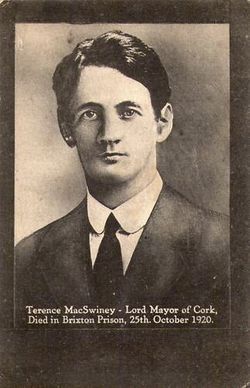
"..hijacked by troublemakers..." indeed : too late, for now, anyway, to worry about that, as it has already happened. The riot squad and their employers are the "troublemakers", the usurpers - representatives of those that Irish republicans challenged and fought against in one way or another in every generation since the 12th century. That fact won't change, no matter how many goons they hire in an attempt to legitimise themselves, and that's the message that will be delivered loud and clear to them from O'Connell Street in Dublin on Saturday 23rd April next and from other venues before and after that date. "It's not those who inflict the most, but those that endure the most, that shall prevail"(Terence MacSwiney).
ON THIS DATE (6TH JANUARY) 76 YEARS AGO : REPRESSIVE FREE STATE LAWS UPDATED.
On the 6th January 1940 - 76 years ago on this date - the then Free State President, Douglas Hyde (pictured, left) stated that it was his intention to convene his 'Council of State' (this was the first such meeting ever of said body) to discuss a bill he was asked to sign, concerning an amendment to the heavy-handed 'Offences Against the State Act 1939', which would have allowed the Leinster House administration to intern Irish-born citizens in a move said to be necessary in the Free State's fight against the IRA. It should be noted that those who wanted that power fully intended to use it against men and women that they had fought side-by-side with only twenty years previously.
Two days later (ie on the 8th January 1940) the 'Council' held a meeting in a Free State residence in Dublin's Phoenix Park (behind closed doors, minutes not made public) following which Hyde announced that he was going to refer the proposed amendment/legislation to the Free State 'Supreme Court', stating that he also intended to seek a judgement on the 'Offences Against the State (Amendment) Bill 1940' in its entirety. The 'Supreme Court' replied that, in its opinion, it was within the power and the authority 'of the Oireachtas, consistent with the Constitution, to enact such legislation'. Hyde then signed the necessary paperwork, no doubt having convinced himself that he had done all in his power to prevent further injury to the republicans he would have associated with during his years as a member of the 'Society for the Preservation of the Irish Language', the 'Gaelic League' and the 'Gaelic Journal'. But easing your conscience isn't the same as cleansing it.
ON THIS DATE (6TH JANUARY) 29 YEARS AGO : IRA OTR CAPTURED BY FS SPECIAL BRANCH.
On Easter Sunday morning, 1978, seven Donegal Provo recruits crossed the border to Derry City ; they had been chosen to form the Colour Party for the Easter Commemoration ceremony that afternoon, leading the Easter Parade through the Creggan and Bogside where Dáithí Ó Conaill delivered the oration. After the event, the Colour Party members went into the Rossville Street flats, stripped off their paramilitary clothes and dark glasses and got into casual clothes. The back road from Creggan to the border had been checked and cleared, they were assured. Some of the seven men wanted to go for a few pints and then take the bus home but, under protest, they all piled into the one car and were driven off. The joint British Army/RUC patrol which intercepted them minutes later already had photographs of all seven men taken from a helicopter during the Easter Parade. IRA membership would be easy to prove.
Two of the seven men detained were from Letterkenny in County Donegal ; Patrick McIntyre of Ard O'Donnell and his colleague, Jim Clarke. Patrick McIntyre is the fifth of a family of nine, who did his 'Leaving Certificate' (school examination) in 1976 and, after taking a six months AnCo (state work-training) course, started working on a building site in Letterkenny. As a youth, Patrick was, as friends describe him, a 'withdrawn kind of a lad'. His involvement with the IRA was to surprise the entire family. But he had been impressed by the 1916 plaque in Saint Eunan's College, by the sight of Derry refugees taking shelter in Letterkenny, of the (Free State) Army on stand-by near the border, by emotive speeches by politicians and by the 'Arms Trial'. He mixed with Official Sinn Fein members in the early 1970's : they held meetings in a room over a pub in Letterkenny where local issues were discussed. But he always stayed clear of public displays and not a word was said at home.
However - the IRA Colour Party had now been detained by the British 'security forces' and, after 14 months on remand in the North, Patrick McIntyre came before a judge ; he was in deep trouble, as he had signed a statement admitting involvement in the attempted 'murder' of a UDR member ('Ulster[sic] Defence Regiment', a pro-British militia) near Castlederg in County Tyrone, in late 1977. McIntyre refused to recognise the court, was convicted and given a fifteen year jail sentence ; Jim Clarke was also jailed for the Castlederg attack - he got eighteen years. The first part of their detention was spent in Crumlin Road Prison and the two men were then transferred to the Kesh at a time when the campaign for retention of political status was intensifying ; they took part in the Blanket Protest and were still there during the 1981 Hunger-Strike. They were two of the 38 inmates who escaped from the prison in September 1983. Patrick McIntyre managed to stay loose for two days ; cameramen were alerted to film him and another escaper, Joe Corey, being recaptured near Castlewellan, County
Down.
Re-captured within two days after the September 1983 jail-break, Patrick McIntyre had to wait three years and three months to get a second chance ; with less than six months of his original sentence left, he was due three days 'rehabilitation parole' as Christmas 1986 approached. The prison authorities opposed his release because the trial of the Maze escapers was pending, but McIntyre defeated their objections before the courts. The Provisionals approved his absconding - they believed the recently introduced 'rehabilitation' gimmick was geared to cause divisions in their structures within the prisons. By December 20th, 1986, the RUC were looking for him but he was over the border, in Donegal, getting his hair tinted! On the twisty main road between Killybegs and Kilcar, in West Donegal, there is a white flat-roofed dwelling in the townland of Cashlings ; some Gardai consider it 'a safe house'. Raymond 'The Rooster' McLaughlin, a well-known IRA activist, was suspected of stopping off there not long before he drowned, accidentally, in a pool, in County Clare, in 1985. Shortly after eight o'clock on the morning of 6th January 1987 - 29 years ago on this date - Aiden Murray and other armed Free State detectives raided the house.
They roused a young man from his sleep - he was wearing pants only and, when asked his name, he hesitated before telling them he was 'Colm McGuire'. He requested to see a doctor and solicitor and refused to answer any further questions. Detective Aiden Murray promptly arrested 'McGuire' on suspicion of being a member of the IRA. The Gardai were back at base in Ballyshannon with their prisoner soon after nine o' clock ; they still had no official identity for him and, in accordance with his wishes, a local solicitor, John Murray, was sent for ; he
arrived and, after consulting with the man in the cell, he told gardai during a casual conversation that the prisoner was Patrick McIntyre of Ard O'Donnell, Letterkenny. The gardai say that minutes afterwards they received information which possibly linked McIntyre to a robbery in Ballyshannon before Christmas and that they began questioning him about this crime. By mid-morning the word was out in Donegal : Paddy McIntyre had been collared and the prospect of extradition loomed. By that afternoon, a Belfast solicitor, Pat Finucane, was contacting a colleague in Dublin.
The legal defence was prepared in the tiny rooms over a swop-shop along Ormond Quay, near the Four Courts, in Dublin, where solicitor Anne Rowland, a native of Ballina, County Mayo, set up her own firm five years ago. Her penchant is for the cut and thrust of criminal cases. On accepting the McIntyre brief, she immediately sought out barrister Patrick Gageby - they had worked together before ; Evelyn Glenhomes and Gerard Tuite were among those they had represented. Rowland and Gageby immediately agreed that their defence case would focus on the circumstances of McIntyre's arrest and detention. They were told that an extradition application would come before District Justice Liam McMenamin at Ballyshannon District Court on January 7th (1987). Before leaving for County Donegal, Rowland put the state on notice that she would require in court the garda who performed the Section 30 arrest and the Garda Officer who signed the order extending Patrick McIntyre's detention for a second 24 hour period.
About one hundred Sinn Féin protestors shouted abuse outside the court as Patrick McIntyre was escorted from a prison vehicle ; in the melee, nobody noticed three plainclothes detectives sliding another man past - RUC member Robert Herron. He was needed to identify Patrick McIntyre. As he rose to speak, Sinn Féin members immediately headed for the exits but gardai told them the doors would have to be kept closed. Then, his identity unknown to those outside, the RUC man was discreetly and safely brought past the crowds before the hearing ended. Chief Superintendent Patrick Murphy was in the witness box - a stranger to the area, he had been transferred from Limerick to Letterkenny, in Donegal, on promotion the previous October. Murphy gave evidence of signing the Section 30 Extension Order for a second 24 hour period. State Solicitor Ciaran McLoughlin asked him nothing further. District Justice McMenamin had no questions, and Defence Counsel Patrick Gageby kept quiet. Chief Superintendent Patrick Murphy left the witness box ; defence counsel Patrick Gageby didn't even attempt to smile ; but he did believe that 'the door had been left ajar'. Early last year Patrick Gageby and Anne Rowland had unsuccessfully appealed the three convictions of County Louth men in the Drumree Post Office murder trial - Garda Frank Hand had been killed in an armed robbery. In the Court of Criminal Appeal, however, Gageby had spotted one sentence and quietly filed it away. He now suggested that Chief Superintendent Murphy had not informed the court of his state of mind when signing the extension order ; it had not been proven that the garda officer had the requisite mental element to justify the detention. State Solicitor Ciaran McLoughlin was quickly on his feet trying to answer the point ; District Justice McMenamin adjourned the hearing to consider this and other legal matters raised.
When the case came before District Justice mcMenamin again in Donegal town on January 14th (1987), he again heard Defence Counsel Patrick Gageby question the validity of the Section 30 extension ; but Judge McMenamin dismissed the arguments and granted the extradition order. An appeal was immediately lodged in the High Court.
McIntyre's case was becoming something of a cause celebre ; on March 10th (1987), when Leinster House met to elect a Taoiseach, Independent Donegal Leinster House member, Neil Blaney, demanded that the extradition arrangements between Britain and Ireland "be repealed so that in the interim a young county man of mine, by name McIntyre, be not extradited." But when the case came before Mr Justice Gannon in the High Court in May 1987, Defence Counsel Patrick Gageby had further 'ammunition' - as well as the ruling in the McShane, McPhilips, Eccles (Drumree) case which included this phrase in relation to the person issuing extension orders -"is bona fide suspected by him of being involved in the offence for which he was arrested." Gageby had the additional support of a Supreme Court ruling of April 3rd (1987) which confirmed that a Chief Superintendent must give evidence of his suspicions when he is issuing an extension order ; it is not sufficient to confirm that he issues the order, he must say why. Patrick McEntee SC had been added to the defence team - McIntyre's supporters were confident of victory. On the afternoon of 7th May 1987, Patrick McIntyre was freed, courtesy of a legal loophole which has since been closed ; the Provisionals had a motorbike waiting outside the courtroom and he was driven off at high speed and was within seconds in city centre traffic. Garda had eighteen further warrants in relation to Patrick McIntyre ; his extradition was still being sought by the British, but he was then on the run.
OTR Patrick McIntyre net with a journalist in a nondescript suburban room. His physical appearance has not altered since the Donegal court hearings - maybe he is a little less fidgety, but he speaks in a soft voice which frequently quivers. The sentiments are resolute. He was sleeping when the gardai came to the house in south Donegal, he says : "I gave the surname of the people who own the house but they didn't believe me. They said I was Patrick McIntyre." Yet the evidence given by gardai in court suggested that the prisoner was not positively identified until solicitor John Murray named him in Ballyshannon garda station. It was also stated that the detectives went to Kilcar after a 'tip-off' that an armed man or men had been seen in the area. It appears the gardai were not aware they would find Patrick McIntyre in the house. It has not been possible to establish whether they knew him by sight ; they seem to have 'struck lucky' - and then got the procedure wrong. As Patrick McIntyre says - "The situation I'm in now prevents me from walking around in this country. I am not wanted for anything in this jurisdiction ; I am being sought for things related to the British administration. If the Birmingham Six were in the 26 Counties now, they could and would be extradited. If the British issue warrants for any person's extradition, the request will come before the Irish courts and the person opposing it must pay his own costs."
The free legal aid scheme does not apply to extradition cases ; costs in the Patrick McIntyre case, expected to run into several thousand pounds, will be paid by Sinn Féin. Asked about his family and his future, Patrick McIntyre stares at the floor - "They let me out for three days to attend my mother's funeral in March. I was told the best I could expect was to go there escorted, in handcuffs, but I fought the case for compassionate bail in the High Court and won. Then there was a rumour that the decision might be appealed by the state and I was thinking about that all the way during the journey from Dublin to Donegal. That was a shattering experience.
I tried to spend the three days with my family. There were thousands of people at the funeral and at the house. It was the first time that we had the family together for a long time, and we had photographs taken. I met a lot of people that I grew up with. Just before I left, my sister gave me a Saint Patrick's Day card that my mother had written, to me, in Saint Luke's Hospital..."
A knock comes to the door - it is time for him to go. What does he intend to do now?, I ask - "Make it third time lucky. Or at least stay out longer than the past two times...", he replies. (NOTE : this is an edited version of a piece we posted here in November 2004.)
LADIES DAY - PAY ATTENTION, LADS....!
Beannachtaí ar Lá Nollag na mBan! January 6th is marked by Nollaig na mBan or 'Women's Little Christmas' ; in celebration of the feast of the Epiphany in Ireland, January 6th is marked by Nollaig na mBan or 'Women's Little Christmas'. On this day it is the tradition in Ireland for the women to get together and enjoy their own Christmas, while the men folk stay at home and handle all the chores. It is also common for children to buy their mothers and grandmothers presents on this day, though this custom is gradually being overtaken by Mothers Day....
I sometimes think that God in creating man somewhat overestimated his ability.(Oscar Wilde)
Happy Nollaig na mBan to all our readers, especially the Ladies!
ON THIS DAY NEXT WEEK (WEDNESDAY 13TH JANUARY 2016).....
...we won't be posting our usual contribution, and probably won't be in a position to post anything at all ; this coming weekend (Saturday/Sunday 9th/10th January 2016) is spoke for already with a 650-ticket raffle to be run for the Dublin Executive of Sinn Féin Poblachtach in a venue on the Dublin/Kildare border (work on which begins on the Tuesday before the actual raffle) and the 'autopsy' into same which will take place on Monday evening, 11th, in RSF Head Office on Parnell Street in Dublin, meaning that we will not have the time to post here. But we'll be back, as stated above, on Wednesday 20th January 2016. See ye then!
Thanks for reading, Sharon.
IRA COLOUR PARTY 'ARRESTED' BY BRITISH 'SECURITY FORCES'.
1978, Easter Sunday morning : seven IRA recruits crossed the border from Donegal to Derry City ; they were to form the Colour Party for the Easter Commemoration that afternoon, leading the parade through the Creggan and Bogside where Dáithí Ó Conaill delivered the oration. After the event, the Colour Party members went into the Rossville Street flats, stripped off their paramilitary clothes and dark glasses and got into casual clothes. The back road from Creggan to the border had been checked and cleared, they were assured. Some of the seven men wanted to go for a few pints and then take the bus home but, under protest, they all piled into the one car and were driven off. The joint British Army/RUC patrol which intercepted them minutes later already had photographs of all seven men taken from a helicopter during the Easter Parade. IRA membership would be easy to prove....
MORE ON WEDNESDAY 6TH JANUARY 2016.
Thanks for visiting, Sharon.
DÁITHÍ Ó CONAILL COMMEMORATION , FRIDAY 1ST JANUARY 2016, GLASNEVIN, DUBLIN.

On January 1st 1957, he was second-in-command of the Pearse Column during the attack on Brookeborough RUC barracks which resulted in the deaths of two of his comrades, Fearghal Ó hAnluáin and Seán Sabhat. Four others were wounded including the column commander. At 18 years of age Dáithí took command and led a successful withdrawal back across the border – evading 400 RUC, B-Specials, two helicopters and the British army – where they were forced to retire. He was then imprisoned in Mountjoy and the Curragh Concentration camp from where he escaped with his friend and comrade Ruairí Ó Brádaigh in September 1958. He returned to active service and for a period was Director of Operations. He was critically wounded in an ambush by the RUC and B-Specials in Arboe, Co Tyrone on the shores of Lough Neagh in November 1959. He made his escape but was forced to seek help because of loss of blood and his weakened condition. He was captured by Crown Forces and was sentenced to eight years which he served in Belfast’s Crumlin Road Jail. Following his release in 1963 he reported back to active service.
In 1969/70 he again made his talents available to the Republican Movement. Ruairí Ó Brádaigh said of him he possessed the 'ablest mind in the Republican Movement for over 20 years'. The sheer breadth of his ability and intellect was evidenced by his service to the All-Ireland Republic both militarily and politically. He had a central role in framing ÉIRE NUA and remained a tireless advocate of it right up to his death in 1991. Dáithí Ó Conaill never equivocated on what was the cause of the war in Ireland or what was required to deliver a just and lasting peace for all of the Irish people. Speaking in Belfast at Easter 1973 he said: 'Today, the central issue in the war is one of conflict between Ireland’s right to freedom and England’s determination to keep us in subjection. All other issues are subordinate to this basic point. There can be no compromise on the fundamental issue as to who should rule Ireland: the
British Parliament or the Irish people. We have had 800 years of British ineptitude in ruling Ireland; we have never known rule by the Irish, of the Irish, for the Irish. Until we do, we shall never enjoy peace and stability in our land.' " (From here.)
The commemoration will be held, as stated, on New Year's Day in Glasnevin Cemetery in Dublin. Those attending are asked to assemble at the main gates at 12.45pm. Go raibh maith agat.
PROSE AND CONS.
By prisoners from E1 Landing, Portlaoise Prison, 1999.
ACKNOWLEDGMENTS :
Grateful thanks to the following for their help, support, assistance and encouragement, and all those who helped with the typing and word processing over the past few months. Many thanks to Cian Sharkhin, the editor of the book, Mr Bill Donoghue, Governor, Portlaoise, Mr Seán Wynne, supervising teacher, the education unit in Portlaoise Prison and the education staff, especially Zack, Helena and Jane. Education officers Bill Carroll and Dave McDonald, Rita Kelly, writer, print unit, Arbour Hill.
First Print : November 1999, reprinted March 2000, illustrations by D O'Hare, Zack and Natasha. Photograph selection : Eamonn Kelly and Harry Melia.
SUICIDE.
The cell measured
ten by six by twelve
A dull light shone on
grey concrete floor
and artic walls
that stenched of stain and blood
mice scuttled in the dark
gloomy corners
The spy hole on the heavy steel door
opened and closed.
A two-by-two cast iron frame
surrounded the thirty-five
dirty perspex panes
A prisoner's naked body
hung limp
from a white sheet.
The shit ran down his legs.
John Doran.
(Next : 'Bird Man', by John Doran. )
IS PEACE SAFE WITH ANDREWS....?
Where politics once stagnated, events in Northern Ireland now chase each other helter-skelter. As 'Magill' went to press, a new joint government document turned recent perceptions head over heels. Fionnuala O'Connor charts the doubts behind the instant reactions. From 'Magill' magazine, February 1998.
"I'm sure the loyalists would love to know what it would take," says an ex-IRA prisoner. "I'm sure they're wondering 'if we went into a youth club or a community centre or a bookies or a pub (and opened fire), would that draw the IRA in ?' I don't know what the threshold is." He was speaking before a loyalist gang placed themselves on the roadside in the heart of republican west Belfast, flagged down a taxi driver, and shot him dead.
By one of those thought processes that southerners rarely understand, the INLA is not blamed in republican districts for triggering this terror by killing Billy Wright - "No," the ex-prisoner says, "because the catholic mood was up before that. They'd say 'what about Seán Brown in Bellaghy ('1169' comment - Seán Brown was "not a real victim", according to an 'Ulster Unionist' political leader!) , what had that got to do with Billy Wright? That was the LVF, whoever the hell they really are, trying to wreck the thing."
The much-reported RUC estimate that Billy Wright was responsible for up to 30 catholic deaths over a 15-year period certainly colours opinions about his killing. Loyalist violence before the recent spate, continuing through the IRA's cease-fire and scarcely commented upon, is more to the point - republicans killed five people in 1997 (two RUC men and a British soldier killed before the cease-fire, and an RUC man and Billy Wright, by the INLA) whereas loyalists of various kinds killed 15 people - the UDA two, the UVF two, the LVF four, with disputed circumstances in several other deaths. Some killings were apparently the results of internal loyalist feuds. (MORE LATER.)
1916 - WHAT DID IT MEAN FOR IRISH WOMEN....?
By Ursula Barry..
What is there for women in Ireland to commemorate in 1916? Did the 1916 Proclamation and the subsequent 'Democratic Programme of the First Dáil' contain radical or revolutionary statements on the position of women in Irish society that were later betrayed or sold out in the process of establishing the Free State? From 'Iris' magazine, Easter 1991.
The more radical republican ideology which emphasises diversity and co-existence based on a concept of common humanity was completely marginalised during this period in which the State took on increasingly the role of a single moral authority and the nature of that moral authority was such that the rights, needs and creativity of women were buried under a rigid system based on the deliberate preservation of the economic and political system for men and the fear of sexuality , especially female sexuality.
The 1937 Constitution, perhaps more than any other document, reflects the contradiction between the revolutionary period of 1880-1920 and the reactionary thinking of the 1920-1950 period. As the constitution of the 26 Counties it echoes some of the elements of the 1916 Proclamation and the Democratic Programme of the First Dáil but it also, and in some ways ever more so, reflects the time in which it was produced.
While the equality of all citizens before the law is enshrined within it, it also makes reference to different capacities of citizens based on sex. In addition it asserts directly and unambiguously that women have only one role in Irish society - that of mother and homemaker - reinforced by a prohibition on divorce legislation. Interestingly, those aspects of the Constitution which have their roots in the more radical definitions of the Republic are precisely those which have been used in a number of constitutional cases to assert democratic rights. (MORE LATER.)
ON THIS DATE (30TH DECEMBER) 44 YEARS AGO : IRA VETERAN KILLED IN EXPLOSION IN DUBLIN.
The funeral of IRA operative Jack ('John') McCabe, who died in an explosion on the 30th December 1971 - 44 years ago on this date. He was buried in Killann Graveyard, East Cavan, on the 1st January 1972 and the then PIRA chief of staff, Seán MacStiofain, delivered the graveside oration. Details re his death and funeral can be read here.
Jack McCabe, who was born in 1916, joined the IRA in Cavan in the 1930's, when he would have been in his late teens/early 20's, and rose to the position of Quartermaster General in that organisation. He operated for a while in England in the late 1930's, where he served the Cause as officer commanding in the Manchester area (he worked alongside a then 17-years-young Jackie Griffith) where he was captured while on active service and sentenced to 20 years penal servitude. He was released from Parkhurst Prison in 1948, at 32 years of age, and returned to Ireland to continue his work for the Movement.
In 1954, after an IRA raid in Omagh for enemy equipment, he was captured and imprisoned in Crumlin Road Jail and, when released in the early 1960's, he immediately reported back for duty and worked tirelessly for the IRA until his untimely death in 1971 - he was instrumental, along with Myles Shevlin (and others) in the defence of Bombay Street and, as Quartermaster General, he was part of the IRA team which first met with a Libyan delegation to discuss the issue of arms.
He was one of the main explosives experts for the IRA and that was how he was to meet a gruesome death - he was mixing explosives in the garage of his house on the Swords Road, in Dublin, when a spark from the shovel he was using set the mixture off. His eyes were blown out of his head and his testicles were blown off but, before he died (on 30th December 1971, 44 years ago on this date) he managed to devise a safe method of mixing explosives to ensure that the same mistake would not be made again. Even on his death-bed, and in great agony, Jack McCabe's thoughts were with those he knew would follow in his footsteps. Incidentally, his death inadvertently assisted the IRA in refining the use of a weapon still employed to this day.
AND FINALLY - THIS IS OUR LAST POST FOR 2015 :
Here's to the crazy ones.
The misfits.
The rebels.
The troublemakers.
The round pegs in the square holes.
The ones who see things differently.
They're not fond of rules.
And they have no respect for the status quo.
You can praise them, disagree with them, quote them,
disbelieve them, glorify or vilify them.
About the only thing you can't do is ignore them.
Because they change things.
They invent. They imagine. They heal.
They explore. They create. They inspire.
They push the human race forward.
Maybe they have to be crazy.
How else can you stare at an empty canvas and see a work of art?
Or sit in silence and hear a song that's never been written?
Or gaze at a red planet and see a laboratory on wheels?
We make tools for these kinds of people.
While some see them as the crazy ones,we see genius.
Because the people who are crazy enough to think
they can change the world, are the ones who do...(From here.)
Athbhliain faoi Mhaise Duit and Happy New Year to all our readers : thanks for reading, Sharon.