TRADE UNIONS AND THE OCCUPIED SIX COUNTIES.
As active Irish republicans and trade union members, we often wonder why we maintain our membership of the latter ; the trade union leadership in this country, North and South, have repeatedly, over the decades, shown an eagerness to agree (and, indeed, make) compromises with all three parliaments (Leinster House, Stormont and their parent, Westminster) in relation to the continuing, unwanted, British military and political presence in this country. Those compromises conflict with our republican position regarding the Occupied Six Counties and have left us, and many others, extremely wary of any pronouncements on that subject by the trade union leadership.
Which is why we'll later more than likely regret helping to publicise an initiative by the 'Communication Workers Union' in relation to the Six Counties : 'We, the undersigned, are calling on trade unionists across Ireland to begin engaging in the debate for Irish unity. Profound social and constitutional changes have taken place across this island in recent years and the debate about future arrangements has already begun.
As trade unionists working on both sides of the border, we believe it is critically important that the interests of workers and working families are put at the heart of this debate. If there is to be a United Ireland, it must be a New Ireland that puts workers rights, economic rights, gender rights, as well as universal human rights front and centre in a new all Ireland constitution...' (from here.)
And this - 'This initiative has secured the support of a broad range of trade unionists with many differing political views. We are all united in recognizing that the partition of Ireland has been disastrous for workers’ rights and progressive politics in this country...in the north, average wages are lower than anywhere else in Ireland or the UK. Furthermore, trade unions are still hamstrung by the Tories’ draconian anti-union laws, while in the south, more than a century after the 1913 Lockout, workers are still denied the basic right to collective bargaining. Our aim is to put forward a vision of what a fairer and more socially just Ireland would look like in the event of reunification. We want to see a new Ireland with a new constitution that promotes workers’ rights, economic equality and social justice...' (from here.)
The CWU's 'main man' behind the above campaign is a Provisional Sinn Féin activist and will more than likely point the 'tu4ui' efforts towards the same political cul-de-sac that PSF and other constitutional Leinster House political parties have willingly entered in order to allow themselves to claim that they are trying to address the issue when, in reality, their objective is to provide a fig leaf to Leinster House, Stormont and Westminster, behind which those institutions can attempt to conceal the on-going political claim of jurisdiction from Westminster over six Irish counties - much easier to pretend that the continuing British military and political presence never happened in the first place and/or was never as bad as republicans made it out to be and/or has now been 'solved'.
Time will tell where the above campaign goes but, for our part, we still support the position as outlined in the Irish republican magazine, 'Iris', in 1982 - 'The role of the trade union movement in Ireland in relation to the continued imperialist occupation of the North and to the foreign multi-national domination of the Irish economy - both north and south - remains an area of confusion for many people...we examine the economic policy of the 'Irish Congress of Trade Unions' (ICTU) and the general failure of the official Labour movement to advance the cause of the Irish working class, except in terms of extremely limited gains...the balance between militancy and cynicism is one that pervades all layers of the trade union rank-and-file in Ireland. The militancy is just what could be expected from members of a national trade union organisation (ICTU) which represents 65% of insured workers in both parts of the country, and which has a history dating to 1894 (whereas) the cynicism of course derives from bitter experience of betrayal from the Congress leadership...acting to prevent disruption of its spineless conservatism...'
At best, this campaign will bring the Six County issue to the attention of those who might not have given it a second thought in the past and hopefully encourage them to want to know more. At worst, it will distract people from working towards a proper solution.
'BRITISH FORCES MUST GO, DEMANDS SINN FÉIN PRESIDENT...'
From 'The United Irishman' newspaper, December 1954.
Tomas O' Dubghaill's speech to the Sinn Féin Ard Fheis, 7th November 1954 (...continued).
QUICKENING OF THE NATIONAL SPIRIT -
"But probably the most significant factor which has developed during the past year has been the quickening of the national spirit, the renewed interest taken by the general public in the national movement, the realisation that there is a problem confronting our nation, a problem which requires a solution now, and not in the dim future - a problem which needs the active help of every man and woman, old and young, to solve it in the only way which will probably serve the national interest.
If there is one thing more than any other which distinguishes today from the time of the last Ard Fheis, it is the sense of awareness which is now abroad in the land, awareness that we have a country, that that country is not free and that we must do something about it NOW!
Let us examine the steps by which that welcome change has been brought about - and I may say in the beginning that we of Sinn Féin have played our part in bringing it about. Addressing you last year, I said that the political objective of Sinn Féin is the restoration of the All-Ireland Republic with full and unfettered control over all 32 counties, and I pointed out that there were two main obstacles to be overcome : first, the claim of the British Government to hold portion of our country and to enforce that claim by occupation forces, aided by a government of anti-Irish elements in the country and, secondly, the attitude of the political groups in the South, many of whose members gave service in the republican cause in the old days but who now have a vested interest in maintaining the status quo..." (MORE LATER).
'TRAITORS TO THE CROWN...'
From 'The United Irishman' newspaper, January 1955.
The anti-republican 'judge' speaks before passing sentences on the eight young republican men who stood in the dock -
"It would be easy to say that you are of the criminal class or that your expressions of devoutness are hypocrisy but I don't find it easy to say that, and therein lies the real tragedy exemplified by your appearance in the dock." And then he began to impose the sentences -
Eamon Boyce, Dublin, 12 years,
Seán O' Callaghan, Cork, 10 years,
Liam Mulcahy, Cork, 10 years,
Seán O' Hegarty, Cork, 10 years,
Philip Clarke, Dublin, 10 years,
Thomas Mitchell, Dublin, 10 years,
John McCabe, Dublin, 10 years,
Patrick J Kearney, Dublin, 10 years.
Befitting the soldier, each man, on hearing his sentence, came smartly to attention. John McCabe, giving final testimony to his republican faith, shouted on leaving the dock - "Long live the Republic!" There was no fear shown, no regret. They had done their duty to Ireland and her people and now they expected the Irish people to do their duty, not to them, but to the Cause for which they have gone to live in the felon's cell...
(MORE LATER).
'A NEW THEORY OF RELATIVITY', by Pat Rabbitte.
From 'Magill' magazine, February 1998.
It must also be said that the report reverses the usual pattern of such reports, being stronger on recommendations for change than they are on analysis. However, in this case the analysis is important - fair enough if successive governments are entirely to blame for deficiencies identified and that no blame attaches to the garda culture. The question is glanced over as if it would somehow undermine the security of the State to discuss it.
However, if the apportioning of responsibility is not in fact entirely one-sided, is it healthy that an otherwise highly credible landmark report evades frank discussion of the issue? The 'safe pair of hands' approach sanctioned by the previous government also characterises the approach of the present government. The group charged with overseeing implementation of the report comprises the usual heavyweights, except that on this occasion Mr Tim Dalton and Mr Pat Byrne will be accompanied by two distinguished former departmental secretaries, Mr Kevin Bonnar and Mr Declan Brennan and senior counsel, Mr Eamon Leahy, as well as ICTU nominee Joan Carmichael.
Not even the formidable Ms Carmichael could cause a row in that company. Indeed, not even Shakespeare could complete with the drafting skills of a committee comprising three Irish departmental secretaries! (END of 'A NEW THEORY OF RELATIVITY'. NEXT - 'When An Irish Citizen is Not a Citizen', from 2002.)
Thanks for reading, Sharon.
Wednesday, February 27, 2019
CYNICISM DERIVING FROM BETRAYAL.
Wednesday, February 20, 2019
ONE PRO-BRITISH KILLER GANG IN IRELAND "HAD MORE VICTIMS THAN THE YORKSHIRE RIPPER, MORE THAN THE MOOR MURDERERS.."
ON THIS DATE (20TH FEBRUARY) 40 YEARS AGO : PRO-BRITISH 'BUTCHER' LOYALIST GANG SENTENCED TO LIFE IMPRISONMENT IN IRELAND.
'A group of 11 Loyalists known as the 'Shankill butchers' were sentenced (Tuesday 20 February 1979) to life imprisonment for 112 offences including 19 murders. The 11 men were given 42 life sentences and received 2,000 years imprisonment, in total, in the form of concurrent sentences..the Shankill Butchers had begun killing Catholics in July 1972 and were not arrested until May 1977. The Loyalist gang operated out of a number of Ulster Volunteer Force (UVF) drinking dens in the Shankill Road area of Belfast. The gang was initially led by Lenny Murphy but it continued to operate following his imprisonment in 1976. The Shankill Butchers got their name because not only did they kill Catholics but they first abducted many of their victims, tortured them, mutilated them with butcher knives and axes, and then finally killed them...' (from here).
The following is an edited version of a piece we published here 15 years ago in relation to the above-mentioned gang of loyalist murderers ; it's from a book by Martin Dillon, which was reviewed by Niall O'Flynn in 'The Evening Press' newspaper in August, 1989 -
In each country they occupied, the British have had their supporters - some of the natives wanted 'in' with the new establishment, in the hope that their new masters would leave them, if not in charge, then at least in a 'managerial' position ; others recognised an opportunity to 'settle old scores', or what they perceived to be 'old scores'. Between 1972 and 1977, the 'Shankill Butchers' killed more people than any other mass murderers in Irish or British criminal history. That is the stark fact - more victims than the Yorkshire Ripper, more than the Moors Murderers. Selecting the targets at random from Belfast's Catholic ghettos, the Butchers dragged dozens of innocent victims to their homes, to their drinking holes and 'romper rooms', sometimes just to darkened alleys, there to torture, humiliate, and finally, to kill them, slaughtering them with butchers' knives. But now (ie 1989), ten years after the jailing of the Butchers' inner circle, a new investigation has unearthed more than a dozen other murders committed by the gang and never before linked to them.
A CATALOGUE OF HORROR -
*Thomas Madden : suspended by a rope from a wooden beam, a nine-inch double-bladed knife was used on his body as a sculptor would chip away at a piece of stone. In all, there were 147 stab wounds on his body, and a pathologist's report indicates that it was the work of one man, working clinically. A woman heard him screaming "Kill me, kill me..."
*Francis Crossan : beaten with fists, feet and a wheel brace, Lennie Murphy (pictured,one of the 'Butchers') killed him by hacking at his throat with a knife, almost severing his head from his body.
*Sisters Frances Donnelly and Marie McGrattan and teenagers Gerard Grogan and Thomas Osborne : all shot in cold blood in a robbery on a drink wholesalers. Murphy himself killed three of them, the two boys after hearing they were Catholics, and Marie McGrattan as she knelt on the floor.
*Student and songwriter Stephen McCann : dragged from his girlfriend, tortured at knifepoint, shot, and finally all but decapitated.
*Protestant Alexander Maxwell : killed for gatecrashing a party celebrating Lennie Murphy's release from prison. He was beaten and kicked. To kill him, Murphy drove a car over, and back over, the hapless victim.
A murderer at the age of 20, the use of a knife was to become the trademark of Hugh Leonard Thompson Murphy, the leader of The Shankill Butchers. A flamboyant womaniser, only five-foot-six tall, Lennie Murphy began his bullyboy 'career' early. Ironically nicknamed 'Murphy the Mick' by his primary-school classmates on account of his Catholic-sounding surname, he was a belligerent child who, by the age of ten, was threatening other children and relieving them of their pocket-money at knifepoint. He ran rackets even at school - threatening other pupils, stealing their meal tickets and selling them to other boys at a reduced rate. He first came to the notice of the RUC at 12 years of age, when he was convicted of shopbreaking and larceny.
As a teenager, Lennie Murphy began to keep company with men in the Shankill district while, at local discos, it was he who decided who got in and who was turned away. In one early incident, a man who bumped against him at a bar, spilling his drink, was later badly beaten by his gang. Murphy joined the junior wing of the Ulster Volunteer Force (UVF) in 1969 and was in the midst of the violence when Protestant mobs invaded Catholic streets that summer, when hundreds of homes were burned. Says Martin Dillon, author of a new investigation of the gang's activities - "He often talked overtly while drinking in the 'Bayardo Bar' of his hatred for all Catholics because they were 'scum and animals. He was beginning to develop into what one UVF man later called a 'Super Prod', which was shorthand for saying that Murphy was more anti-Catholic, anti-Nationalist and anti-Republican than even the most bitter man on the Shankill Road. Lennie Murphy was prepared to shoot anyone ; man, woman or child. Or a blind man. As long as he could reasonably establish the religion of the victim."
Victim after victim was killed in the same brutal way - hacked through the throat with a butcher's knife. So callous were Murphy's men, so brutalised, that, while their victims waited, it was not unknown for gang members to stop for a cup of tea or to watch football on TV. Belfast is so much a city divided that, tragically, sectarian gangs are able to identify the religion of intended victims simply by the streets on which they are walking or working. Even on public routes, people travel towards either Protestant or Catholic housing estates. "Hundreds of people" , estimates Martin Dillon, had their fate sealed by this ghettoisation - and this was the basis on which The Shankill Butchers operated and selected their victims.
The 'Murphy Gang', in its heyday, included Robert 'Basher' Bates (pictured) and 'Big Sam' McAllister, who joined 'Ulster Volunteer Force' (a pro-British murdergang) at Murphy's bidding. Later, they were joined by William Moore, a taxi driver, who had learned to use a butcher's knife in a previous job. Meeting in The Brown Bear pub, the 'Brown Bear Gang' soon numbered close to two dozen men, mostly in their 20's - but one as young as 14 - and some who were not known to the RUC (a pro-British 'Police force') until such time as the Butcher gang were caught. Officially, 'Brown Bear Gang' members were used by the UVF to carry out executions, bombings, assassinations and punishment beatings, to deal with troublemakers within the pro-British paramilitary ranks. 'Punishments' then might mean kneecappings, beatings with baseball bats, the use of a power drill on the kneecaps or 'breeze-blocking', where concrete blocks were dropped on to the hands, or heads, of 'offenders'. "It is an incredible fact that, within the subculture of the paramilitary world, punishments of varying degrees were applicable according to the gravity of the offence. When it came to their respective terror campaigns, no such gradations applied to the atrocities committed" , writes Martin Dillon.
Despite warnings from their 'Ulster Volunteer Force' superiors that only armed republicans were to be considered as the enemy, the bulk of the Butchers' victims, in fact, were innocent civilians, picked up at random, easy pickings - 'If you can't get an IRA man, get a Taig'. Lennie Murphy was 'blooded' first on July 21, 1972, when, with other members of Loyalist paramilitary organisations, he was involved in the torture and killing of a 34-year-old Catholic, Francis Arthurs, who was picked-up by a Loyalist gang after leaving a Catholic area and taken to the Lawnbrook Social Club, a Loyalist club off the Shankill Road. Francis Arthurs was beaten severely by a large group of drinkers, stabbed repeatedly by Murphy, interrogated, tortured and shot. That night, those present have said, Murphy was seen to demonstrate that he could cause the victim the most pain by hitting him harder than anyone else. Joe Bennett, who later became one of the major UVF 'supergrasses', said that Lennie Murphy stood out as the most barbarous gang member present.
Martin Dillon, the Author of this book, confirms Lennie Murphy's pleasure in these sadistic practices : "There is plenty of evidence to suggest that Lennie Murphy committed the crimes firstly for pleasure and secondly for information. Many studies have indicated that sadists need aggression and I believe that in Northern Ireland (sic) the conflict provides the trigger for this aggression. It also allows misfits to find social acceptance by expressing the prejudice which is not endemic but socially acceptable. It has enabled many people who cannot escape prejudice to find a security within it and to accept its manifestations as a badge of patriotism."
The RUC, though they knew not the perpetrators of the Shankill killings ('1169' Comment - those slaughtered by the gang were Catholics ; all members of that religion were suspected by the RUC to be either active IRA members or supporters of same - the 'Butcher Gang' was, 'unofficially', doing the work of the Six-County State. The RUC were therefore not too concerned) recognised from a very early stage that they were dealing, not with 'ordinary terrorists', but with psychopaths. "We're looking for somebody more brutal than the average terrorist and we'd better get to him," RUC Detective Inspector Jimmy Nesbitt told his men as the first victims of the serial killers were found, "It represents for me a new degree of cruelty. We have seen victims who have been killed with concrete blocks, stabbed, shot or beaten to death, but the sight of this stirs something inside me which makes me feel cold," Nesbitt said. Speaking later, another RUC man recalled : "I knew I was witnessing something different, a more personal type of killing."
Such prolific activity brought Lennie Murphy high on the RUC's 'most wanted' list, and he was imprisoned briefly in the early 1970's, for minor offences, and again in 1976, though he continued to direct 'Brown Bear' operations from his Maze Prison jail cell. William Moore (pictured), the taxi-driving member of 'The Butchers', took up where Lennie Murphy had left off. Murphy had prepared well for his terrorist 'career', attending many of the murder trials of the early 1970's, at Belfast's Crumlin Road Courthouse. He learned about the law, the nature of witness and forensic evidence, and when such evidence was ruled admissible or inadmissible, and why. Attending IRA trials, he was able to identify IRA supporters in the public gallery who could later be targeted for assassination - by watching forensic evidence being produced in different court cases, Lennie Murphy learned how to remove lead residue from his hands and clothing, where it accumulates when a gun is fired in close proximity to a person. He discovered how to ruin an identification parade, and he learned never to give an alibi in case the RUC could break it - answering RUC questions by stating simply that they would have to prove any allegations they wished to make.
Murphy, McAllister, Moore and Bates, in fact, were so well versed in the law that they repeatedly refused, even while confessing, to avoid making admissions of premeditated killing - suggesting that only the beating, not the death, of the victim, was intended, and that alcohol had played a large part in their actions. An excerpt from a confession by one of the Shankill Butchers, 'Big Sam' McAllister (pictured), illustrates how the gang had used their knowledge of the law - "I was out in a car with another fellow who I don't wish to say...we were looking for a Taig (a Catholic) for a kicking. There was a hatchet in the car and I took it with me and got out of the car. As this man walked by me on his own, I hit him over the head with the wooden part of the hatchet. I hit him about twice. It was only meant to give him a digging. He was not meant to be killed. I think drink was the biggest cause of this.." In fact, neither of the gang members were drunk on this occasion, and the ill-fated 'taig', 49-year-old Cornelius Neeson, died from a fractured skull, a broken leg and multiple lacerations to the head, face, shoulder and hand. The pathologist concluded that all the blows were delivered with considerable severity from the hatchet, and from fists and feet.
It was only, finally, in 1977, that 'the Butchers' made a fatal 'mistake' - they left a victim alive. 20-year-old Gerard McLaverty, dumped in an alleyway after being beaten and tortured with a knife, identified key gang members, including 'Big Sam' McAllister. The RUC searched McAllister's home and found a butcher's knife sticking out of the floorboards beside the bed, another knife under the bed, plus two butchers knives and a sharpening steel in the kitchen. The knives ranged in size from six to ten inches, and the sharpener showed signs of heavy use. The breakthrough had been made - most of the gang broke down under RUC questioning, some "crying like babies". Sentencing eleven gang members, including William Moore, 'Big Sam' McAllister and Robert 'Basher' Bates, for their parts in nineteen murders, Mr. Justice Turlough O'Donnell talked of this "catalogue of horror", and told William Moore - "You pleaded guilty to eleven murders carried out in a manner so cruel and revolting as to be beyond the comprehension of any normal human being. I see no reason whatever why you should ever be released. The facts speak for themselves and will remain forever a lasting monument to blind sectarian bigotry".
In all, 'the Shankill Butchers' were given 2,000 years imprisonment, to run in concurrent sentences. British legal history was made with the 42 life sentences handed down, the largest number ever given out in one sitting. Some gang members, however, will be due for release in the coming decade (ie -the 1990's). One is already out and, of course, many of those involved in the murders were never brought to justice and are still walking the streets of Northern Ireland (sic). At least 17 people who were implicated in some of the killings were never brought before the courts, mostly due to insufficient evidence against them. Lenny Murphy, who walked out of prison in July 1982, three years after the jailing of his gang, had killed again within 24 hours. He met his own death at the hands of a republican assassination squad, as he parked behind his girlfriends house one evening that Autumn (1982). Enemies within the Loyalist camp, it is thought, may have helped to set him up.
After Lennie Murphy's execution by the then IRA, 'The Belfast Telegraph' newspaper carried 87 death notices, including ones from William Moore, Robert 'Basher' Bates and other gang members in the Maze Prison. His Aunt Agnes penned the following tribute to Murphy : 'Nothing could be more beautiful than the memories we have of you. To us, you were very special and God must have thought so too'. His mother told reporters : "My Lennie would not have hurt a fly.."
The UVF afforded Murphy a paramilitary funeral, with a guard of honour wearing UVF uniforms and balaclavas, and a volley of three shots was fired over his coffin as it was brought out of his house, as a piper played 'Abide With Me'. He was buried in Carnmoney Cemetery and on his tombstone the following words were inscribed : 'Here Lies a Soldier'. The tombstone was smashed in 1989.
'BRITISH FORCES MUST GO, DEMANDS SINN FÉIN PRESIDENT'.
From 'The United Irishman' newspaper, December 1954.
The continued presence of the British occupation forces is an act of war against the Irish nation. Their presence is an insult and a constant challenge to the Irish people. Thank God we still have young men willing and able to take up that challenge and to answer it in the only way England has ever understood, said President Tomas O Dubghaill, when he addressed the Ard Fheis of Sinn Féin in Dublin on the 7th November.
Delegates from all over the nation pledged their support to the policy and programme of Sinn Féin and reported magnificent progress from every area and there was an atmosphere of confidence and hope in the future. Republican actions on the military front have been supported by more widespread Sinn Féin activity and the decision to contest all twelve seats in the forthcoming Westminster elections in the Six Counties has given all members an immediate task which demands considerable work. The Presidential address was enthusiastically received and references to recent IRA actions were greeted with prolonged applause -
"A Chairde ; you will have learned from the reports of the General Secretaries and the General Treasurers that the organisation has made very substantial progress during the past twelve months and the number of Cumainn has increased, the funds at our disposal have increased and the work done by the organisation generally has greatly increased. Indeed, I may say that today Sinn Féin is an organisation which has a very definite place in the political life of our country. Much as they may dislike it, we can no longer be ignored or treated lightly by the professional politicians, North or South..." (MORE LATER.)
ON THIS DATE (20TH FEBRUARY) 98 YEARS AGO : 12 IRA VOLUNTEERS SHOT DEAD, TWO MORE EXECUTED LATER.
12 IRA Volunteers died at the Clonmult massacre site, Cork, on the 20th February 1921 - 98 years ago on this date - and two more were executed later. Six of the Volunteers in this picture were shot dead on that day.
'On the 20th of February 1921, our noble Midleton heroes were murdered in Clonmult,
for the fighting of there countries cause, to free her they did go,
but by the informers of our land, in there graves they are lying low.
It was on a Sunday morning this district the enemy did invade, to search for Irish rebels through many a hill and vale,
surrounded were those boys at last when rifle fire began, and Desmond said ‘Your courage lads we have them nearly done”.
From top of roof and window those lads went on to fight, 'till the burning of the cottage and no escape in sight,
but still they kept on fighting and the sad news reached old Midleton - "the column was done".
The bravest boys in Ireland this house they did command, brave Desmond brothers stood there true rebels to the last,
and many another mothers son whose hearts with grief were sore, to think that they should be betrayed and their hearts blood they let flow,
Hegarty you were a brave man and so was Higgins too, like the rest of the east Cork Martyrs ye were straight firm and true,
not forgetting Paddy O’ Sullivan and more as we all know, who were executed in Cork prison and their bodies then let low.' (from here.)
On the 20th February 1921, IRA Captain James P. Aherne and Volunteer James Glavin, two members of an IRA 'Flying Squad' that was based in Cork, watched as one of their number headed off on a short stroll from the cottage they were in to a near-by stream to collect water for the IRA Squad : a poacher, an ex-British Army man, was on the far side of the stream laying traps for rabbits when he spotted the man, whom he knew to be an IRA member, and watched as the IRA man filled as many buckets as he could carry and observed as the Volunteer headed to the near-by cottage. The poacher reported the sighting to the local RIC (pictured) and they, in turn, called in a Black and Tan murder gang. The cottage was soon surrounded by these armed pro-British thugs. Twelve IRA Volunteers were killed and another two were executed later :
Captain James Aherne from Cobh County Cork was killed while jumping a fence 200 yards from the house.
Volunteer Jeremiah Aherne, from Midleton, County Cork ,was killed in action.
Volunteer Liam Aherne, from Midleton, County Cork, killed in action.
Volunteer Donal Dennehy, from Midleton, County Cork, killed in action.
Volunteer David Desmond, from Midleton, County Cork, killed in action.
Volunteer Michael Desmond, from Midleton, County Cork, was killed while attempting to fight his way back into the house.
Volunteer James Glavin, from Cobh, County Cork, was killed during the fighting.
Volunteer Michael Hallahan, from Midleton, County Cork, killed in action.
Volunteer Richard Hegarty, from Garryvoe, County Cork, killed in front of the house when attempting to go for aid.
Volunteer John Joe Joyce, from Midleton, County Cork, killed while attempting to re-gain entry to the farm house.
Volunteer Maurice Moore, from Cobh, County Cork, was captured during the Ambush,and was later executed at Cork Military Barracks on April 28th 1921.
Volunteer Joseph Morrissey, from Athlone, County Westmeath, killed during the fighting.
Volunteer Christopher O'Sullivan, from Midleton, County Cork, killed during the fighting.
Volunteer Paddy O'Sullivan, from Cobh, County Cork, was captured and was later executed at Cork Military Barracks, on April 28th 1921.
The Clonmult Memorial, at the site of the ambush.
The graves of the Clonmult dead, Midleton Cemetery, Cork.
'TRAITORS TO THE CROWN...'
From 'The United Irishman' newspaper, January 1955.
And the voice of another John Mitchel is heard with the same defiant spirit that rang through the Dublin courthouse over 100 years ago : "I pray that our comrades in the Irish Republican Army will have the strength and courage to carry on until such times as the last British soldier is driven from the shores of Ireland. Long live the Republic!"
One by one they express such sentiments or approval of what a comrade has said. Twenty-one year-old Corkman, Seán O Callaghan (1169 comment - not the tout), claims it is a great privilege and honour to have been chosen for such work : "It is a great load off my shoulders", he says, "to know that my place in the ranks of the Irish Republican Army, in which a vacancy will be caused by my imprisonment - it is a great pleasure to know that that vacancy will be filled ten-fold by more Irishmen in the very near future."
The scarlet-dressed, white-wigged figure speaks before passing sentences on the men - and one feels a note of reluctance threading his words on the task before him, not because of his love of those courageous patriots or sympathy for the cause which they represent - but mainly because he realises the far-reaching implications and propaganda effects it will have on England's continued occupation by force of arms on part of our nation - showing up the hypocrisy and hollowness of her freedom pronouncements and the rights of nations to their independence... (MORE LATER).
WHAT IS IT WITH THE SIMON'S?
Simon Harris (pictured), the 'frightened little boy', is so obviously out of his depth that when an overspend (of taxpayers money) of this magnitude lands on top of him, it doesn't actually hit him because he's standing in such a large hole/crater of his own making. The people pointing out to him that he is in a precarious position are ignored as he washes his hands of responsibility, claiming that such gross incompetence is not a scandal at all, and attempts to distract public attention by complaining that those that he and his fellow administrators in Leinster House have inflicted serious financial and health-care pain on should have the cheek to express that pain in front of his house. Suck it up, Simon - sure you'll still get your pension and a well-paid position in a political side office somewhere, so what do you care...
Then there's this Simon. Coveney, that is. He was on the RTE radio programme 'Morning Ireland' yesterday (Tuesday 19th February 2019) to discuss the 'Brexit' shambles when, in an answer to a question about 'our relationship with Britain', he replied - "We share an island together". Seriously! That's how he and his type view the continuing political and military occupation by Westminster of the six north-eastern counties of this country. A 'shared experience'. Understandable, I suppose, when your party's 'hero' is Michael Collins, who accepted weapons and manpower from Westminster to obtain and then secure the partition of Ireland. So as we could all "share the island", much as you would with an intruder in your house. And that flag, Simon - looks like it's growing out of your head, where it was planted at the beginning of your political 'career'.
'A NEW THEORY OF RELATIVITY', by Pat Rabbitte.
From 'Magill' magazine, February 1998.
A man from Mars reading the 'Report Of The Steering Group On The Efficiency And Effectiveness Of The Garda Síochana' would never divine the background that gave rise to the study. Could this be due to the fact that the steering group was peopled entirely by eminent persons under the watchful eyes of the secretary of the (State) Department of Justice and the garda commissioner? An interesting dimension of experience might have been contributed by a typical 'ordinary' citizen.
As it is, the report's analysis is entirely in the context of the 'increasingly demanding environment' in which gardaí must function and on the need "to take an integrated appraisal across the entire criminal-justice system, given the interrelated nature of the service being provided".
Which no doubt is all very well, but there is little evidence of the influence of the typical consumer of "policing practice". There are the inevitable tables comparing Ireland (favourably) with a number of countries "in terms of percentage of crime detected" per 1,000 of the population. And there is the key concession that "the reality that a fair and efficient service is being delivered is lost if the public, as customers, do not perceive the service as efficient and helpful." The report goes on to recommend a 'Quality Service Initiative' whereby "the community know specifically what they can expect from the Garda Síochana" and that "this needs to be articulated in the public arena by setting and agreeing service standards which should then be published..." (MORE LATER).
Thanks for reading, Sharon.
'A group of 11 Loyalists known as the 'Shankill butchers' were sentenced (Tuesday 20 February 1979) to life imprisonment for 112 offences including 19 murders. The 11 men were given 42 life sentences and received 2,000 years imprisonment, in total, in the form of concurrent sentences..the Shankill Butchers had begun killing Catholics in July 1972 and were not arrested until May 1977. The Loyalist gang operated out of a number of Ulster Volunteer Force (UVF) drinking dens in the Shankill Road area of Belfast. The gang was initially led by Lenny Murphy but it continued to operate following his imprisonment in 1976. The Shankill Butchers got their name because not only did they kill Catholics but they first abducted many of their victims, tortured them, mutilated them with butcher knives and axes, and then finally killed them...' (from here).
The following is an edited version of a piece we published here 15 years ago in relation to the above-mentioned gang of loyalist murderers ; it's from a book by Martin Dillon, which was reviewed by Niall O'Flynn in 'The Evening Press' newspaper in August, 1989 -
In each country they occupied, the British have had their supporters - some of the natives wanted 'in' with the new establishment, in the hope that their new masters would leave them, if not in charge, then at least in a 'managerial' position ; others recognised an opportunity to 'settle old scores', or what they perceived to be 'old scores'. Between 1972 and 1977, the 'Shankill Butchers' killed more people than any other mass murderers in Irish or British criminal history. That is the stark fact - more victims than the Yorkshire Ripper, more than the Moors Murderers. Selecting the targets at random from Belfast's Catholic ghettos, the Butchers dragged dozens of innocent victims to their homes, to their drinking holes and 'romper rooms', sometimes just to darkened alleys, there to torture, humiliate, and finally, to kill them, slaughtering them with butchers' knives. But now (ie 1989), ten years after the jailing of the Butchers' inner circle, a new investigation has unearthed more than a dozen other murders committed by the gang and never before linked to them.
A CATALOGUE OF HORROR -
*Thomas Madden : suspended by a rope from a wooden beam, a nine-inch double-bladed knife was used on his body as a sculptor would chip away at a piece of stone. In all, there were 147 stab wounds on his body, and a pathologist's report indicates that it was the work of one man, working clinically. A woman heard him screaming "Kill me, kill me..."
*Francis Crossan : beaten with fists, feet and a wheel brace, Lennie Murphy (pictured,one of the 'Butchers') killed him by hacking at his throat with a knife, almost severing his head from his body.
*Sisters Frances Donnelly and Marie McGrattan and teenagers Gerard Grogan and Thomas Osborne : all shot in cold blood in a robbery on a drink wholesalers. Murphy himself killed three of them, the two boys after hearing they were Catholics, and Marie McGrattan as she knelt on the floor.
*Student and songwriter Stephen McCann : dragged from his girlfriend, tortured at knifepoint, shot, and finally all but decapitated.
*Protestant Alexander Maxwell : killed for gatecrashing a party celebrating Lennie Murphy's release from prison. He was beaten and kicked. To kill him, Murphy drove a car over, and back over, the hapless victim.
A murderer at the age of 20, the use of a knife was to become the trademark of Hugh Leonard Thompson Murphy, the leader of The Shankill Butchers. A flamboyant womaniser, only five-foot-six tall, Lennie Murphy began his bullyboy 'career' early. Ironically nicknamed 'Murphy the Mick' by his primary-school classmates on account of his Catholic-sounding surname, he was a belligerent child who, by the age of ten, was threatening other children and relieving them of their pocket-money at knifepoint. He ran rackets even at school - threatening other pupils, stealing their meal tickets and selling them to other boys at a reduced rate. He first came to the notice of the RUC at 12 years of age, when he was convicted of shopbreaking and larceny.
As a teenager, Lennie Murphy began to keep company with men in the Shankill district while, at local discos, it was he who decided who got in and who was turned away. In one early incident, a man who bumped against him at a bar, spilling his drink, was later badly beaten by his gang. Murphy joined the junior wing of the Ulster Volunteer Force (UVF) in 1969 and was in the midst of the violence when Protestant mobs invaded Catholic streets that summer, when hundreds of homes were burned. Says Martin Dillon, author of a new investigation of the gang's activities - "He often talked overtly while drinking in the 'Bayardo Bar' of his hatred for all Catholics because they were 'scum and animals. He was beginning to develop into what one UVF man later called a 'Super Prod', which was shorthand for saying that Murphy was more anti-Catholic, anti-Nationalist and anti-Republican than even the most bitter man on the Shankill Road. Lennie Murphy was prepared to shoot anyone ; man, woman or child. Or a blind man. As long as he could reasonably establish the religion of the victim."
Victim after victim was killed in the same brutal way - hacked through the throat with a butcher's knife. So callous were Murphy's men, so brutalised, that, while their victims waited, it was not unknown for gang members to stop for a cup of tea or to watch football on TV. Belfast is so much a city divided that, tragically, sectarian gangs are able to identify the religion of intended victims simply by the streets on which they are walking or working. Even on public routes, people travel towards either Protestant or Catholic housing estates. "Hundreds of people" , estimates Martin Dillon, had their fate sealed by this ghettoisation - and this was the basis on which The Shankill Butchers operated and selected their victims.
The 'Murphy Gang', in its heyday, included Robert 'Basher' Bates (pictured) and 'Big Sam' McAllister, who joined 'Ulster Volunteer Force' (a pro-British murdergang) at Murphy's bidding. Later, they were joined by William Moore, a taxi driver, who had learned to use a butcher's knife in a previous job. Meeting in The Brown Bear pub, the 'Brown Bear Gang' soon numbered close to two dozen men, mostly in their 20's - but one as young as 14 - and some who were not known to the RUC (a pro-British 'Police force') until such time as the Butcher gang were caught. Officially, 'Brown Bear Gang' members were used by the UVF to carry out executions, bombings, assassinations and punishment beatings, to deal with troublemakers within the pro-British paramilitary ranks. 'Punishments' then might mean kneecappings, beatings with baseball bats, the use of a power drill on the kneecaps or 'breeze-blocking', where concrete blocks were dropped on to the hands, or heads, of 'offenders'. "It is an incredible fact that, within the subculture of the paramilitary world, punishments of varying degrees were applicable according to the gravity of the offence. When it came to their respective terror campaigns, no such gradations applied to the atrocities committed" , writes Martin Dillon.
Despite warnings from their 'Ulster Volunteer Force' superiors that only armed republicans were to be considered as the enemy, the bulk of the Butchers' victims, in fact, were innocent civilians, picked up at random, easy pickings - 'If you can't get an IRA man, get a Taig'. Lennie Murphy was 'blooded' first on July 21, 1972, when, with other members of Loyalist paramilitary organisations, he was involved in the torture and killing of a 34-year-old Catholic, Francis Arthurs, who was picked-up by a Loyalist gang after leaving a Catholic area and taken to the Lawnbrook Social Club, a Loyalist club off the Shankill Road. Francis Arthurs was beaten severely by a large group of drinkers, stabbed repeatedly by Murphy, interrogated, tortured and shot. That night, those present have said, Murphy was seen to demonstrate that he could cause the victim the most pain by hitting him harder than anyone else. Joe Bennett, who later became one of the major UVF 'supergrasses', said that Lennie Murphy stood out as the most barbarous gang member present.
Martin Dillon, the Author of this book, confirms Lennie Murphy's pleasure in these sadistic practices : "There is plenty of evidence to suggest that Lennie Murphy committed the crimes firstly for pleasure and secondly for information. Many studies have indicated that sadists need aggression and I believe that in Northern Ireland (sic) the conflict provides the trigger for this aggression. It also allows misfits to find social acceptance by expressing the prejudice which is not endemic but socially acceptable. It has enabled many people who cannot escape prejudice to find a security within it and to accept its manifestations as a badge of patriotism."
The RUC, though they knew not the perpetrators of the Shankill killings ('1169' Comment - those slaughtered by the gang were Catholics ; all members of that religion were suspected by the RUC to be either active IRA members or supporters of same - the 'Butcher Gang' was, 'unofficially', doing the work of the Six-County State. The RUC were therefore not too concerned) recognised from a very early stage that they were dealing, not with 'ordinary terrorists', but with psychopaths. "We're looking for somebody more brutal than the average terrorist and we'd better get to him," RUC Detective Inspector Jimmy Nesbitt told his men as the first victims of the serial killers were found, "It represents for me a new degree of cruelty. We have seen victims who have been killed with concrete blocks, stabbed, shot or beaten to death, but the sight of this stirs something inside me which makes me feel cold," Nesbitt said. Speaking later, another RUC man recalled : "I knew I was witnessing something different, a more personal type of killing."
Such prolific activity brought Lennie Murphy high on the RUC's 'most wanted' list, and he was imprisoned briefly in the early 1970's, for minor offences, and again in 1976, though he continued to direct 'Brown Bear' operations from his Maze Prison jail cell. William Moore (pictured), the taxi-driving member of 'The Butchers', took up where Lennie Murphy had left off. Murphy had prepared well for his terrorist 'career', attending many of the murder trials of the early 1970's, at Belfast's Crumlin Road Courthouse. He learned about the law, the nature of witness and forensic evidence, and when such evidence was ruled admissible or inadmissible, and why. Attending IRA trials, he was able to identify IRA supporters in the public gallery who could later be targeted for assassination - by watching forensic evidence being produced in different court cases, Lennie Murphy learned how to remove lead residue from his hands and clothing, where it accumulates when a gun is fired in close proximity to a person. He discovered how to ruin an identification parade, and he learned never to give an alibi in case the RUC could break it - answering RUC questions by stating simply that they would have to prove any allegations they wished to make.
Murphy, McAllister, Moore and Bates, in fact, were so well versed in the law that they repeatedly refused, even while confessing, to avoid making admissions of premeditated killing - suggesting that only the beating, not the death, of the victim, was intended, and that alcohol had played a large part in their actions. An excerpt from a confession by one of the Shankill Butchers, 'Big Sam' McAllister (pictured), illustrates how the gang had used their knowledge of the law - "I was out in a car with another fellow who I don't wish to say...we were looking for a Taig (a Catholic) for a kicking. There was a hatchet in the car and I took it with me and got out of the car. As this man walked by me on his own, I hit him over the head with the wooden part of the hatchet. I hit him about twice. It was only meant to give him a digging. He was not meant to be killed. I think drink was the biggest cause of this.." In fact, neither of the gang members were drunk on this occasion, and the ill-fated 'taig', 49-year-old Cornelius Neeson, died from a fractured skull, a broken leg and multiple lacerations to the head, face, shoulder and hand. The pathologist concluded that all the blows were delivered with considerable severity from the hatchet, and from fists and feet.
It was only, finally, in 1977, that 'the Butchers' made a fatal 'mistake' - they left a victim alive. 20-year-old Gerard McLaverty, dumped in an alleyway after being beaten and tortured with a knife, identified key gang members, including 'Big Sam' McAllister. The RUC searched McAllister's home and found a butcher's knife sticking out of the floorboards beside the bed, another knife under the bed, plus two butchers knives and a sharpening steel in the kitchen. The knives ranged in size from six to ten inches, and the sharpener showed signs of heavy use. The breakthrough had been made - most of the gang broke down under RUC questioning, some "crying like babies". Sentencing eleven gang members, including William Moore, 'Big Sam' McAllister and Robert 'Basher' Bates, for their parts in nineteen murders, Mr. Justice Turlough O'Donnell talked of this "catalogue of horror", and told William Moore - "You pleaded guilty to eleven murders carried out in a manner so cruel and revolting as to be beyond the comprehension of any normal human being. I see no reason whatever why you should ever be released. The facts speak for themselves and will remain forever a lasting monument to blind sectarian bigotry".
In all, 'the Shankill Butchers' were given 2,000 years imprisonment, to run in concurrent sentences. British legal history was made with the 42 life sentences handed down, the largest number ever given out in one sitting. Some gang members, however, will be due for release in the coming decade (ie -the 1990's). One is already out and, of course, many of those involved in the murders were never brought to justice and are still walking the streets of Northern Ireland (sic). At least 17 people who were implicated in some of the killings were never brought before the courts, mostly due to insufficient evidence against them. Lenny Murphy, who walked out of prison in July 1982, three years after the jailing of his gang, had killed again within 24 hours. He met his own death at the hands of a republican assassination squad, as he parked behind his girlfriends house one evening that Autumn (1982). Enemies within the Loyalist camp, it is thought, may have helped to set him up.
After Lennie Murphy's execution by the then IRA, 'The Belfast Telegraph' newspaper carried 87 death notices, including ones from William Moore, Robert 'Basher' Bates and other gang members in the Maze Prison. His Aunt Agnes penned the following tribute to Murphy : 'Nothing could be more beautiful than the memories we have of you. To us, you were very special and God must have thought so too'. His mother told reporters : "My Lennie would not have hurt a fly.."
The UVF afforded Murphy a paramilitary funeral, with a guard of honour wearing UVF uniforms and balaclavas, and a volley of three shots was fired over his coffin as it was brought out of his house, as a piper played 'Abide With Me'. He was buried in Carnmoney Cemetery and on his tombstone the following words were inscribed : 'Here Lies a Soldier'. The tombstone was smashed in 1989.
'BRITISH FORCES MUST GO, DEMANDS SINN FÉIN PRESIDENT'.
From 'The United Irishman' newspaper, December 1954.
The continued presence of the British occupation forces is an act of war against the Irish nation. Their presence is an insult and a constant challenge to the Irish people. Thank God we still have young men willing and able to take up that challenge and to answer it in the only way England has ever understood, said President Tomas O Dubghaill, when he addressed the Ard Fheis of Sinn Féin in Dublin on the 7th November.
Delegates from all over the nation pledged their support to the policy and programme of Sinn Féin and reported magnificent progress from every area and there was an atmosphere of confidence and hope in the future. Republican actions on the military front have been supported by more widespread Sinn Féin activity and the decision to contest all twelve seats in the forthcoming Westminster elections in the Six Counties has given all members an immediate task which demands considerable work. The Presidential address was enthusiastically received and references to recent IRA actions were greeted with prolonged applause -
"A Chairde ; you will have learned from the reports of the General Secretaries and the General Treasurers that the organisation has made very substantial progress during the past twelve months and the number of Cumainn has increased, the funds at our disposal have increased and the work done by the organisation generally has greatly increased. Indeed, I may say that today Sinn Féin is an organisation which has a very definite place in the political life of our country. Much as they may dislike it, we can no longer be ignored or treated lightly by the professional politicians, North or South..." (MORE LATER.)
ON THIS DATE (20TH FEBRUARY) 98 YEARS AGO : 12 IRA VOLUNTEERS SHOT DEAD, TWO MORE EXECUTED LATER.
12 IRA Volunteers died at the Clonmult massacre site, Cork, on the 20th February 1921 - 98 years ago on this date - and two more were executed later. Six of the Volunteers in this picture were shot dead on that day.
'On the 20th of February 1921, our noble Midleton heroes were murdered in Clonmult,
for the fighting of there countries cause, to free her they did go,
but by the informers of our land, in there graves they are lying low.
It was on a Sunday morning this district the enemy did invade, to search for Irish rebels through many a hill and vale,
surrounded were those boys at last when rifle fire began, and Desmond said ‘Your courage lads we have them nearly done”.
From top of roof and window those lads went on to fight, 'till the burning of the cottage and no escape in sight,
but still they kept on fighting and the sad news reached old Midleton - "the column was done".
The bravest boys in Ireland this house they did command, brave Desmond brothers stood there true rebels to the last,
and many another mothers son whose hearts with grief were sore, to think that they should be betrayed and their hearts blood they let flow,
Hegarty you were a brave man and so was Higgins too, like the rest of the east Cork Martyrs ye were straight firm and true,
not forgetting Paddy O’ Sullivan and more as we all know, who were executed in Cork prison and their bodies then let low.' (from here.)
On the 20th February 1921, IRA Captain James P. Aherne and Volunteer James Glavin, two members of an IRA 'Flying Squad' that was based in Cork, watched as one of their number headed off on a short stroll from the cottage they were in to a near-by stream to collect water for the IRA Squad : a poacher, an ex-British Army man, was on the far side of the stream laying traps for rabbits when he spotted the man, whom he knew to be an IRA member, and watched as the IRA man filled as many buckets as he could carry and observed as the Volunteer headed to the near-by cottage. The poacher reported the sighting to the local RIC (pictured) and they, in turn, called in a Black and Tan murder gang. The cottage was soon surrounded by these armed pro-British thugs. Twelve IRA Volunteers were killed and another two were executed later :
Captain James Aherne from Cobh County Cork was killed while jumping a fence 200 yards from the house.
Volunteer Jeremiah Aherne, from Midleton, County Cork ,was killed in action.
Volunteer Liam Aherne, from Midleton, County Cork, killed in action.
Volunteer Donal Dennehy, from Midleton, County Cork, killed in action.
Volunteer David Desmond, from Midleton, County Cork, killed in action.
Volunteer Michael Desmond, from Midleton, County Cork, was killed while attempting to fight his way back into the house.
Volunteer James Glavin, from Cobh, County Cork, was killed during the fighting.
Volunteer Michael Hallahan, from Midleton, County Cork, killed in action.
Volunteer Richard Hegarty, from Garryvoe, County Cork, killed in front of the house when attempting to go for aid.
Volunteer John Joe Joyce, from Midleton, County Cork, killed while attempting to re-gain entry to the farm house.
Volunteer Maurice Moore, from Cobh, County Cork, was captured during the Ambush,and was later executed at Cork Military Barracks on April 28th 1921.
Volunteer Joseph Morrissey, from Athlone, County Westmeath, killed during the fighting.
Volunteer Christopher O'Sullivan, from Midleton, County Cork, killed during the fighting.
Volunteer Paddy O'Sullivan, from Cobh, County Cork, was captured and was later executed at Cork Military Barracks, on April 28th 1921.
The Clonmult Memorial, at the site of the ambush.
The graves of the Clonmult dead, Midleton Cemetery, Cork.
'TRAITORS TO THE CROWN...'
From 'The United Irishman' newspaper, January 1955.
And the voice of another John Mitchel is heard with the same defiant spirit that rang through the Dublin courthouse over 100 years ago : "I pray that our comrades in the Irish Republican Army will have the strength and courage to carry on until such times as the last British soldier is driven from the shores of Ireland. Long live the Republic!"
One by one they express such sentiments or approval of what a comrade has said. Twenty-one year-old Corkman, Seán O Callaghan (1169 comment - not the tout), claims it is a great privilege and honour to have been chosen for such work : "It is a great load off my shoulders", he says, "to know that my place in the ranks of the Irish Republican Army, in which a vacancy will be caused by my imprisonment - it is a great pleasure to know that that vacancy will be filled ten-fold by more Irishmen in the very near future."
The scarlet-dressed, white-wigged figure speaks before passing sentences on the men - and one feels a note of reluctance threading his words on the task before him, not because of his love of those courageous patriots or sympathy for the cause which they represent - but mainly because he realises the far-reaching implications and propaganda effects it will have on England's continued occupation by force of arms on part of our nation - showing up the hypocrisy and hollowness of her freedom pronouncements and the rights of nations to their independence... (MORE LATER).
WHAT IS IT WITH THE SIMON'S?
Simon Harris (pictured), the 'frightened little boy', is so obviously out of his depth that when an overspend (of taxpayers money) of this magnitude lands on top of him, it doesn't actually hit him because he's standing in such a large hole/crater of his own making. The people pointing out to him that he is in a precarious position are ignored as he washes his hands of responsibility, claiming that such gross incompetence is not a scandal at all, and attempts to distract public attention by complaining that those that he and his fellow administrators in Leinster House have inflicted serious financial and health-care pain on should have the cheek to express that pain in front of his house. Suck it up, Simon - sure you'll still get your pension and a well-paid position in a political side office somewhere, so what do you care...
Then there's this Simon. Coveney, that is. He was on the RTE radio programme 'Morning Ireland' yesterday (Tuesday 19th February 2019) to discuss the 'Brexit' shambles when, in an answer to a question about 'our relationship with Britain', he replied - "We share an island together". Seriously! That's how he and his type view the continuing political and military occupation by Westminster of the six north-eastern counties of this country. A 'shared experience'. Understandable, I suppose, when your party's 'hero' is Michael Collins, who accepted weapons and manpower from Westminster to obtain and then secure the partition of Ireland. So as we could all "share the island", much as you would with an intruder in your house. And that flag, Simon - looks like it's growing out of your head, where it was planted at the beginning of your political 'career'.
'A NEW THEORY OF RELATIVITY', by Pat Rabbitte.
From 'Magill' magazine, February 1998.
A man from Mars reading the 'Report Of The Steering Group On The Efficiency And Effectiveness Of The Garda Síochana' would never divine the background that gave rise to the study. Could this be due to the fact that the steering group was peopled entirely by eminent persons under the watchful eyes of the secretary of the (State) Department of Justice and the garda commissioner? An interesting dimension of experience might have been contributed by a typical 'ordinary' citizen.
As it is, the report's analysis is entirely in the context of the 'increasingly demanding environment' in which gardaí must function and on the need "to take an integrated appraisal across the entire criminal-justice system, given the interrelated nature of the service being provided".
Which no doubt is all very well, but there is little evidence of the influence of the typical consumer of "policing practice". There are the inevitable tables comparing Ireland (favourably) with a number of countries "in terms of percentage of crime detected" per 1,000 of the population. And there is the key concession that "the reality that a fair and efficient service is being delivered is lost if the public, as customers, do not perceive the service as efficient and helpful." The report goes on to recommend a 'Quality Service Initiative' whereby "the community know specifically what they can expect from the Garda Síochana" and that "this needs to be articulated in the public arena by setting and agreeing service standards which should then be published..." (MORE LATER).
Thanks for reading, Sharon.
Tuesday, February 12, 2019
FREE STATERS ATTEMPT TO BURY REPUBLICANISM UNDER CONCRETE.
ON THIS DATE (12TH FEBRUARY) 43 YEARS AGO : DEATH OF AN IRISH REPUBLICAN WHO WAS 'BURIED' BY FREE STATERS UNDER SIX FEET OF CONCRETE.
'Exhumed in glory a November moon was drifting
And freedom's light aglow
When some IRA had gathered in a graveyard in Mayo.
Those brave Irish Freedom fighters
Who came together in the West
Had come to fill the promise to lay Frank Stagg at rest.'
'Frank Stagg was the seventh child in a family of thirteen children, born at Hollymount near Ballinrobe, Co Mayo, in 1942. Stagg was educated to primary level at Newbrooke Primary School and at CBS Ballinrobe to secondary level. After finishing his education, he worked as an assistant gamekeeper with his uncle prior to emigrating from Ireland to England in search of work. In England, Frank was employed as a bus conductor and later qualified as a bus driver. In 1970 he married Bridie Armstrong from Carnicon, Co Mayo. He joined Sinn Féin in Luton in 1972 and shortly afterwards joined the IRA. Frank remained in touch with home and spent his annual holidays in Hollymount up to the year of his arrest and imprisonment in 1973. In the words of his mother, "he never forgot he was Irish..." ' (From here.)
Frank Stagg had begun his fourth (and final) hunger strike in late 1975 - having been convicted under the notorious 'British Conspiracy Laws' - as it was the only 'weapon' he had at his disposal with which to impress on his British captors his desire to be repatriated to Ireland. He died, blind and weighing just four stone, in Wakefield Prison on 12th February 1976, after 62 days on hunger strike.
His remains were hijacked by suited, uniformed and armed members of the State, acting under orders from FS Taoiseach Liam Cosgrave and his 'Justice' Minister, Paddy Cooney - the airplane carrying his coffin was diverted from Dublin to Shannon and, when it landed, the Special Branch surrounded it and forcibly removed the coffin and buried it, supported by an armed escort, under six feet of concrete in Leigue Cemetery in Ballina, County Mayo, in a grave purchased by the Free Staters and which was located about 70 meters from the Republican Plot in that cemetery ; on that day - Saturday, 21st February, 1976 - the Requiem Mass was boycotted by almost all his relatives.
For the following six months, armed State operatives maintained a heavy presence in the graveyard to prevent Irish republicans from affording Frank Stagg a proper burial but they were not the only group keeping a watch on the grave : the IRA were aware of their presence and, after the Staters withdrew, the IRA made their move : on the night of the 5th of November, 1976, the IRA disinterred Frank Stagg's remains and reburied them with his comrade, Michael Gaughan.
When questioned in Leinster House about this sordid affair, its 'Director', Paddy Cooney, stated - "The persistent attempts by members of an unlawful organisation and their associates to exploit the situation that arose are well known and, indeed, notorious. Because of this and because also of certain obligations of confidentiality, I must decline to make any comment on the question of the choice of burial place.."The "question of the choice of burial place" was, thankfully, not one that was left to Cooney and his thugs to decide. Frank Stagg, aged 33, had three funerals and two burials. One funeral had no body and one burial was done in darkness. In his final message to his comrades in the Republican Movement he wrote : "We are the risen people, this time we must not be driven into the gutter. Even if this should mean dying for justice. The fight must go on. I want my memorial to be peace with justice." That objective has still to be obtained and those in Leinster House, Stormont and Westminster are still working against it, still pouring 'concrete' on Irish republicanism. Shame on them.
Thanks for reading , Sharon. Back with a full post on Wednesday, 20th February 2019.
'Exhumed in glory a November moon was drifting
And freedom's light aglow
When some IRA had gathered in a graveyard in Mayo.
Those brave Irish Freedom fighters
Who came together in the West
Had come to fill the promise to lay Frank Stagg at rest.'
'Frank Stagg was the seventh child in a family of thirteen children, born at Hollymount near Ballinrobe, Co Mayo, in 1942. Stagg was educated to primary level at Newbrooke Primary School and at CBS Ballinrobe to secondary level. After finishing his education, he worked as an assistant gamekeeper with his uncle prior to emigrating from Ireland to England in search of work. In England, Frank was employed as a bus conductor and later qualified as a bus driver. In 1970 he married Bridie Armstrong from Carnicon, Co Mayo. He joined Sinn Féin in Luton in 1972 and shortly afterwards joined the IRA. Frank remained in touch with home and spent his annual holidays in Hollymount up to the year of his arrest and imprisonment in 1973. In the words of his mother, "he never forgot he was Irish..." ' (From here.)
Frank Stagg had begun his fourth (and final) hunger strike in late 1975 - having been convicted under the notorious 'British Conspiracy Laws' - as it was the only 'weapon' he had at his disposal with which to impress on his British captors his desire to be repatriated to Ireland. He died, blind and weighing just four stone, in Wakefield Prison on 12th February 1976, after 62 days on hunger strike.
His remains were hijacked by suited, uniformed and armed members of the State, acting under orders from FS Taoiseach Liam Cosgrave and his 'Justice' Minister, Paddy Cooney - the airplane carrying his coffin was diverted from Dublin to Shannon and, when it landed, the Special Branch surrounded it and forcibly removed the coffin and buried it, supported by an armed escort, under six feet of concrete in Leigue Cemetery in Ballina, County Mayo, in a grave purchased by the Free Staters and which was located about 70 meters from the Republican Plot in that cemetery ; on that day - Saturday, 21st February, 1976 - the Requiem Mass was boycotted by almost all his relatives.
For the following six months, armed State operatives maintained a heavy presence in the graveyard to prevent Irish republicans from affording Frank Stagg a proper burial but they were not the only group keeping a watch on the grave : the IRA were aware of their presence and, after the Staters withdrew, the IRA made their move : on the night of the 5th of November, 1976, the IRA disinterred Frank Stagg's remains and reburied them with his comrade, Michael Gaughan.
When questioned in Leinster House about this sordid affair, its 'Director', Paddy Cooney, stated - "The persistent attempts by members of an unlawful organisation and their associates to exploit the situation that arose are well known and, indeed, notorious. Because of this and because also of certain obligations of confidentiality, I must decline to make any comment on the question of the choice of burial place.."The "question of the choice of burial place" was, thankfully, not one that was left to Cooney and his thugs to decide. Frank Stagg, aged 33, had three funerals and two burials. One funeral had no body and one burial was done in darkness. In his final message to his comrades in the Republican Movement he wrote : "We are the risen people, this time we must not be driven into the gutter. Even if this should mean dying for justice. The fight must go on. I want my memorial to be peace with justice." That objective has still to be obtained and those in Leinster House, Stormont and Westminster are still working against it, still pouring 'concrete' on Irish republicanism. Shame on them.
Thanks for reading , Sharon. Back with a full post on Wednesday, 20th February 2019.
Wednesday, February 06, 2019
DUBLIN BARRISTER FOR SALE TO BOTH SIDES AT THE SAME TIME.
ON THIS DATE (6TH FEBRUARY) 142 YEARS AGO : DEATH OF AN IRISH PATRIOT.
'Imposing Military and Civic Demonstration in New York. The Remains En Route to Ireland - The Irish people of New York paid the last tribute of respect to the memory of the late Colonel John O’Mahony (pictured) on Tuesday of last week in one of the most imposing funeral demonstration that has been witnessed in this city since the obsequies of Terence Bellew McManus ; and by the time this issue of our paper reaches some of its more remote readers, the body of the dead Fenian leader will be upon the soil of his native land, as the “Dakota” by which it is being conveyed, is remarkable for making rapid and successful voyages.
The body of Colonel O’Mahony laid in state at the armory of the 69th Regiment until the morning of the 13th inst., and was viewed there by thousands of our citizens, the throng at times being so great as to entirely block up all the approaches to the building. A guard composed of a full Company of the 69th and detachments from the “Irish Legion” and the “Irish Brigade” and other national military organizations, was constantly on duty while the body lay at the armory ; and from the number of floral decorations that were from time to time sent in by sympathizing admirers of the deceased, the room in which the body was placed might have been taken for some fragrant parterre, if the character of the emblems were not suggestive of the somber presence of death. There were floral harps, with broken strings; shattered columns, and memorial crosses; as well as other designs of a more figurative nature and endless variety.
The coffin was draped with the handsome Irish flag sent to the 69th Regiment by the people of Tipperary, until the morning of the funeral, when the regimental flag of the 99th Regiment, NYSM, was substituted for it, and remained on the coffin to the end of the ceremonies. At an early hour on Tuesday morning, the remains were taken from the officers’ room in the armory, and placed in a handsome plate glass hearse, through the transparent panels of which the casket was plainly visible, covered by the regimental flags, and with the military cap, sword and belt of the deceased resting on the lid. Escorted by the guard of honor, the body was conveyed to the church of St. Francis Xavier, West sixteenth st., where preparations for the celebration of the last solemn offices of religion had been made by the Jesuit Fathers. The coffin was placed on a black draped catafalque in front of the high altar, which, as well as the body of the church, was dressed in mourning. On either side were three tall candlesticks ; and the numerous floral decoration were placed about the catafalque or on the lid of the casket. The Casket itself was of solid oak, covered with black cloth, and ornamented with silver bar-handles and mouldings, having a silver plate on the lid, on which was the following inscription:
“Colonel John O’Mahoney. Died Feb. 6, 1877; Aged 61 years.”
About half past eight o’clock, the church doors were opened, and though arrangements had been made to admit the congregation by tickets, so great was the throng that in a few minutes the spacious edifice was packed in every portion, nave, aisles and galleries...' (...from here.)
But then, as now, all was not well between those who struggled against British imperialism in Ireland - James Stephens who, along with Joseph Denieffe and Thomas Clark Luby had established the 'Irish Republican Brotherhood' in Peter Lanigan's timber yard, Lombard Street, Dublin, on St. Patricks Day in 1858, did not agree with the way John O' Mahoney got things done, and famously described O'Mahoney and his supporters as "...Irish tinsel patriots (who make) speeches of bayonets, gala days and jolly nights, banners and sashes, bunkum and filibustering, responding in glowing language to glowing toasts on Irish National Independence over beakers of fizzling champagne.." However - in our opinion, both were good men who shared a common objective but differed in how to obtain it, and both deserve to be remembered for the time and effort they gave to the cause of Irish freedom.
'TREASON FELONY'.
From 'The United Irishman' newspaper, December 1954.
There was a dramatic turn in the trial of the eight men charged in connection with the Omagh action, at the Winter Assizes in Belfast on November 30th, when 'Lord Chief Justice' McDermott addressed the Grand Jury on a new charge against the men - 'treason felony'.
This latest charge is a throw-back to the old days and proves more conclusively than ever that the struggle against the British forces remains fundamentally the same old struggle. 'Treason' connotes rebellion by one owing allegiance and this latest charge seems a fitting rebuttal of the oft-boasted claim by Leinster House that 'this part of Ireland is free'.
The address of 'Lord' McDermott substantiates and upholds the stand which the Republican Movement has always maintained. He said - "The days have passed when war is necessarily a matter of large armies or uniforms...if the evidence satisfies you that there was intent to compel her Majesty to change her councils for example by removing or causing her to remove her troops from Northern Ireland (sic) you would be justified in finding that ingredient present. If you find evidence of intention to remove Northern Ireland (sic) from the United Kingdom and so deprive her Majesty of her right and title you would be justified in finding a true Bill."
'Lord' McDermott's words above definitely accept that the attack on Omagh Barracks was an act of war against the British forces - but the prisoners are not being treated as 'prisoners of war'! Why not? Apparently 'the Crown' wants it both ways. Yes - it's the same old enemy with the same old ways!
(END of 'Treason Felony'. Next, from the same source : 'British Forces Must Go, demands Sinn Féin President').
ON THIS DATE (6TH FEBRUARY) 119 YEARS AGO : IRISH "FIGHT-FOR-ENGLAND" NATIONALIST ELECTED 'LEADER OF THE PACK'.
John Redmond (pictured), the leader of the 'Irish Parliamentary Party', was born into a 'Big House'-type Catholic family on the 1st September in 1856 and, after a 'proper' education (in Clongowes College in Kildare and Trinity College in Dublin) he became a political 'player' in the British so-called 'House of Commons', where he supplemented his income as a clerk. He was only 25 years-of-age when he was first elected as an MP, having worked his way up the establishment ladder, and was elected as the leader of the 'Irish Party' on the 6th February, 1900 - 119 years ago on this date.
He was an Irish nationalist (small 'n') politician who, occasionally, campaigned for his followers (and anyone else that would listen to him) to join the British Army in its fight against Germany, and did so infamously, and unashamedly, in a public speech he delivered in Woodenbridge in County Wicklow on the 20th September in 1914, where he stated - "The interests of Ireland - of the whole of Ireland - are at stake in this war. This war is undertaken in the defence of the highest principles of religion and morality and right, and it would be a disgrace for ever to our country and a reproach to her manhood and a denial of the lessons of her history if young Ireland confined their efforts to remaining at home to defend the shores of Ireland from an unlikely invasion, and to shrinking from the duty of proving on the field of battle that gallantry and courage which has distinguished our race all through its history. I say to you, therefore, your duty is twofold. I am glad to see such magnificent material for soldiers around me, and I say to you : 'Go on drilling and make yourself efficient for the work, and then account yourselves as men, not only for Ireland itself, but wherever the fighting line extends, in defence of right, of freedom, and religion in this war..".
And, unfortunately, in the months that followed his 'call to arms', tens of thousands of Irishmen joined his 'Cause' and fought alongside imperialism to the extent that one of his modern-day political mirror-images (...who called for Irish people to join and support the British 'police force' in Ireland!) all but called Redmond a traitor for encouraging such folly. Other political leaders did not agree with John Redmond and, among them, was James Connolly, the Irish Trade Union leader, who was also in command of the Irish Citizen Army - he answered Redmond's call thus :
'Full steam ahead, John Redmond said,
that everything was well, chum ;
Home Rule will come when we are dead,
and buried out in Belgium'.
Also, some of John Redmond's own men disagreed with his pro-British 'call-to-arms' ; Eoin MacNeill, who was then in a leadership position within the 'Irish Volunteers', was of the opinion that the 'Irish Volunteers' should only use force against the British if* Westminster first moved against them ; a bit 'watery', definitely, but he was, however, against fighting with the British (*if having your country occupied by a foreign power cannot be considered a 'first move against us' then Mr MacNeill had a different understanding of the English language than we have!).
Just over a year after Mr Redmond had delivered his 'join imperialism'-speech in Woodenbridge, a British Army Major-General, 'Sir' Lovick Bransby Friend (..perhaps his parents never bonded with him?) the Commander-in-Chief of the British Army in Ireland, said that 1,100 recruits were needed from Ireland every week "to replace wastage" (!) of existing Irish soldiers. The comments were made at a private conference on recruiting in Ireland that was held under the presidency of the 'Lord' Lieutenant of Ireland, Lord Wimborne, at the Viceregal Lodge in Dublin's Phoenix Park, where it was also stated that approximately 81,000 Irishmen had 'heeded Redmond's call-to-arms'. The political mirror-image, mentioned above, had a point : if a call to assist the foe comes from 'the right quarters', it will - unfortunately - be heeded by those who should know better.
Anyway : the 'fight-for-England-for-Ireland' man died on the 6th March 1918, after a medical operation that month to remove an intestinal obstruction ; the operation appeared to progress well at first, but then he suffered heart failure and died a few hours later at a London nursing home. But his party lived on, albeit with a name change..!
'TRAITORS TO THE CROWN'.
From 'The United Irishman' newspaper, January 1955.
A crowded courtroom in Belfast town. Armed 'police' stand shoulder to shoulder on guard. The courthouse is packed with the forces of the invader and her satellites - British military officers and soldiers, CID, RUC, B Specials and loyal civilians. On the judges bench a white-wigged figure sits dressed in robes of scarlet, representing the 'law' and force of the invader.
Before him in the dock stand eight young Irish republicans, cheerful and carefree in their captivity. They stand arraigned on the charge of 'treason-felony' ; over a century ago the 'Treason-Felony Act' was enacted to make sure of the conviction of Newry's patriot Presbyterian, John Mitchel. In that pro-British, hostile atmosphere, the men in the dock affirm their allegiance to Ireland - her unity and independence and protest against the assertion that a citizen of Ireland could be guilty of treason against a foreign queen.
"Our war is not waged against Irishmen of any creed or class", states Eamon Boyce, "but against a foreign queen who has no right whatever to have forces on our soil."
And young Philip Clarke spoke as well - "We are Irishmen, our Fatherland is Ireland, and it is to the Fatherland we owe allegiance. It is against all reason, all justice, and every tenet of democracy that we should be convicted of treason against a foreign queen to whom we owe no allegiance..." (MORE LATER).
'INFORMING' ON A FUND-RAISING RAFFLE!
We won't be posting next Wednesday (13th February) as we'll be busy until at least next Monday/Tuesday (11th and 12th) putting the finishing touches to a Cabhair fund-raising raffle, which will be held in a hotel on the Dublin-Kildare border on Sunday, 10th February 2019.
One of our intended posts for the 13th was to do with a two-legged rat who caused serious damage to the Irish republican cause in the early 19th century and, as we won't be 'on air' then to give this despicable character a mention, we reckoned we should do it now.
'Leonard McNally, playwright, barrister, United Irishman and an Informer died on this day. He was born in Dublin in 1752, and became a barrister in England before returning home to practise at the Irish Bar. He was one of the original members of the Society of United Irishmen and came to and defended many of its members in the Courts. He turned informer in 1794 following the arrest of the French agent the Rev Jackson. The general opinion is that his nerve snapped under threats during interrogation but the exact circumstances that led to his decision to become a tout remain unclear.
His play Robin Hood (1784) was playing in Dublin on the night in 1798 when Lord Edward Fitzgerald was captured on foot of information he had provided. . During 1798 and in 1803 he found himself in the bizarre situation of taking money both from revolutionary defendants before the Courts and from Dublin Castle for providing them with information that would compromise his clients...some of his associates had their doubts, and indeed one ‘doubter’ sent him a snake in a parcel from America as a token of gratitude! However his dark secret remained hidden until his death in 1820. Ironically he was given a Patriots funeral. It was only when his family demanded from the British government that his pension of £300 per annum should be continued that his secret life as a traitor was exposed...' (from here.)
And exposed he was, but not before he had 'earned his keep' for the British administration in Dublin Castle - while being hunted by the British, Robert Emmet took refuge in the Harold's Cross area of Dublin, during which time he met with his mother and Sarah Curran but, on Thursday August 25th, 1803, he was finally located and 'arrested' by the British. It has been stated by others that a £1000 reward was paid by Dublin Castle to an informer, for supplying the information which led to his capture. Robert Emmet's bad luck did not stop on his arrest : he had the misfortune to be defended by one Leonard McNally who was trusted by the United Irishmen. However, after McNally's death in 1820 it transpired that he was a highly paid government agent and, in his role as an informer, that he had encouraged young men to join the rebels, betrayed them to Dublin Castle and would then collect fees from the United Irishmen to 'defend' those same rebels in court!
This tout is alleged to have died on the 13th February, 1820, but he is also listed as having died in June that year : 'Hereunder lyeth the body of William NALLY, of [illegible], in the county of Dublin, Gent. who departed this life October 7th, 1669." [Mr. D'Alton mentions him as William MALLY, of Roebuck. His descendant, Leonard Mac Nally, was here interred 8th June, 1820...' The confusion arises because his son, Leonard (Jnr), also a solicitor, died on the 13th February that year and was buried in Donnybrook on the 17th February. His father, Leonard Snr, actually sent a legal missive to 'Saunder's Newsletter', on the 6th March that year, looking for financial 'compensation' for the "severe injury caused by the circulation of my death"! Ever the snake in the grass -trying to make money out of the death of his own son.
Anyway - this parasite died, as stated, in June, 1820, and was buried in Donnybrook on the 8th of that month, and, in his memory, we post the following 'tribute' :
VULTURE.
A sheepman in the Mournes observed it first
Gorging on the entrails of a still-born
Lamb; next it was disturbed plucking the heart
From an aborted human foetus unborn
For better things elsewhere and on the third
Day poachers stoned it from the corpse of
an Informer they found gagged with a dragon's turd And testicles.
But it grew weary on
Such rich fare, scavenging the abattoirs
Of hate until, enormous, gross, and fat
With the viscera of the dove and rat,
Sated yet home-sick for the heat and flies,
It bore South again, smelling a sweeter war,
Where God died long ago of tribal lies. (From here.)
'A NEW THEORY OF RELATIVITY', by Pat Rabbitte.
From 'Magill' magazine, February 1998.
In the Christmas edition of 'Garda Review', the editorial records that "..despite our many detractors, the Garda Síochana can be justifiably proud that as a police force it is winning the battle against criminal elements in this country (sic) .." It would be interesting to know precisely who the 'detractors' in mind are. Certainly, it can't include politicians, because only a maverick breaks the unwritten rule that politicians don't criticise the gardaí. Yet there is not a single politician of any party representing an urban constituency who, over the past four or five years, has not been privately sharing stories of worrying criticism of policing in his or her own constituency.
This criticism usually falls into two categories - firstly, prior to 'Operation Dochas' being introduced in late autumn 1996, a policing vacuum was allowed to develop in areas most severely ravaged by the drugs epidemic. This vacuum was almost inevitably filled by elements untroubled by the dictates of natural justice. Besieged parents sickened with fear for their children's welfare couldn't afford to withhold support from the 'self-policing' of their communities. Secondly, residents' associations in middle-class areas experienced unprecedented criticism of policing effectiveness and garda responses.
How much of this criticism was the result of legislators not doing their job, low morale, for whatever reason, in garda ranks or outdated management techniques in the upper echelons of the garda, or a combination of all three, is difficult to say...
(MORE LATER).
Thanks for reading, Sharon.
'Imposing Military and Civic Demonstration in New York. The Remains En Route to Ireland - The Irish people of New York paid the last tribute of respect to the memory of the late Colonel John O’Mahony (pictured) on Tuesday of last week in one of the most imposing funeral demonstration that has been witnessed in this city since the obsequies of Terence Bellew McManus ; and by the time this issue of our paper reaches some of its more remote readers, the body of the dead Fenian leader will be upon the soil of his native land, as the “Dakota” by which it is being conveyed, is remarkable for making rapid and successful voyages.
The body of Colonel O’Mahony laid in state at the armory of the 69th Regiment until the morning of the 13th inst., and was viewed there by thousands of our citizens, the throng at times being so great as to entirely block up all the approaches to the building. A guard composed of a full Company of the 69th and detachments from the “Irish Legion” and the “Irish Brigade” and other national military organizations, was constantly on duty while the body lay at the armory ; and from the number of floral decorations that were from time to time sent in by sympathizing admirers of the deceased, the room in which the body was placed might have been taken for some fragrant parterre, if the character of the emblems were not suggestive of the somber presence of death. There were floral harps, with broken strings; shattered columns, and memorial crosses; as well as other designs of a more figurative nature and endless variety.
The coffin was draped with the handsome Irish flag sent to the 69th Regiment by the people of Tipperary, until the morning of the funeral, when the regimental flag of the 99th Regiment, NYSM, was substituted for it, and remained on the coffin to the end of the ceremonies. At an early hour on Tuesday morning, the remains were taken from the officers’ room in the armory, and placed in a handsome plate glass hearse, through the transparent panels of which the casket was plainly visible, covered by the regimental flags, and with the military cap, sword and belt of the deceased resting on the lid. Escorted by the guard of honor, the body was conveyed to the church of St. Francis Xavier, West sixteenth st., where preparations for the celebration of the last solemn offices of religion had been made by the Jesuit Fathers. The coffin was placed on a black draped catafalque in front of the high altar, which, as well as the body of the church, was dressed in mourning. On either side were three tall candlesticks ; and the numerous floral decoration were placed about the catafalque or on the lid of the casket. The Casket itself was of solid oak, covered with black cloth, and ornamented with silver bar-handles and mouldings, having a silver plate on the lid, on which was the following inscription:
“Colonel John O’Mahoney. Died Feb. 6, 1877; Aged 61 years.”
About half past eight o’clock, the church doors were opened, and though arrangements had been made to admit the congregation by tickets, so great was the throng that in a few minutes the spacious edifice was packed in every portion, nave, aisles and galleries...' (...from here.)
But then, as now, all was not well between those who struggled against British imperialism in Ireland - James Stephens who, along with Joseph Denieffe and Thomas Clark Luby had established the 'Irish Republican Brotherhood' in Peter Lanigan's timber yard, Lombard Street, Dublin, on St. Patricks Day in 1858, did not agree with the way John O' Mahoney got things done, and famously described O'Mahoney and his supporters as "...Irish tinsel patriots (who make) speeches of bayonets, gala days and jolly nights, banners and sashes, bunkum and filibustering, responding in glowing language to glowing toasts on Irish National Independence over beakers of fizzling champagne.." However - in our opinion, both were good men who shared a common objective but differed in how to obtain it, and both deserve to be remembered for the time and effort they gave to the cause of Irish freedom.
'TREASON FELONY'.
From 'The United Irishman' newspaper, December 1954.
There was a dramatic turn in the trial of the eight men charged in connection with the Omagh action, at the Winter Assizes in Belfast on November 30th, when 'Lord Chief Justice' McDermott addressed the Grand Jury on a new charge against the men - 'treason felony'.
This latest charge is a throw-back to the old days and proves more conclusively than ever that the struggle against the British forces remains fundamentally the same old struggle. 'Treason' connotes rebellion by one owing allegiance and this latest charge seems a fitting rebuttal of the oft-boasted claim by Leinster House that 'this part of Ireland is free'.
The address of 'Lord' McDermott substantiates and upholds the stand which the Republican Movement has always maintained. He said - "The days have passed when war is necessarily a matter of large armies or uniforms...if the evidence satisfies you that there was intent to compel her Majesty to change her councils for example by removing or causing her to remove her troops from Northern Ireland (sic) you would be justified in finding that ingredient present. If you find evidence of intention to remove Northern Ireland (sic) from the United Kingdom and so deprive her Majesty of her right and title you would be justified in finding a true Bill."
'Lord' McDermott's words above definitely accept that the attack on Omagh Barracks was an act of war against the British forces - but the prisoners are not being treated as 'prisoners of war'! Why not? Apparently 'the Crown' wants it both ways. Yes - it's the same old enemy with the same old ways!
(END of 'Treason Felony'. Next, from the same source : 'British Forces Must Go, demands Sinn Féin President').
ON THIS DATE (6TH FEBRUARY) 119 YEARS AGO : IRISH "FIGHT-FOR-ENGLAND" NATIONALIST ELECTED 'LEADER OF THE PACK'.
John Redmond (pictured), the leader of the 'Irish Parliamentary Party', was born into a 'Big House'-type Catholic family on the 1st September in 1856 and, after a 'proper' education (in Clongowes College in Kildare and Trinity College in Dublin) he became a political 'player' in the British so-called 'House of Commons', where he supplemented his income as a clerk. He was only 25 years-of-age when he was first elected as an MP, having worked his way up the establishment ladder, and was elected as the leader of the 'Irish Party' on the 6th February, 1900 - 119 years ago on this date.
He was an Irish nationalist (small 'n') politician who, occasionally, campaigned for his followers (and anyone else that would listen to him) to join the British Army in its fight against Germany, and did so infamously, and unashamedly, in a public speech he delivered in Woodenbridge in County Wicklow on the 20th September in 1914, where he stated - "The interests of Ireland - of the whole of Ireland - are at stake in this war. This war is undertaken in the defence of the highest principles of religion and morality and right, and it would be a disgrace for ever to our country and a reproach to her manhood and a denial of the lessons of her history if young Ireland confined their efforts to remaining at home to defend the shores of Ireland from an unlikely invasion, and to shrinking from the duty of proving on the field of battle that gallantry and courage which has distinguished our race all through its history. I say to you, therefore, your duty is twofold. I am glad to see such magnificent material for soldiers around me, and I say to you : 'Go on drilling and make yourself efficient for the work, and then account yourselves as men, not only for Ireland itself, but wherever the fighting line extends, in defence of right, of freedom, and religion in this war..".
And, unfortunately, in the months that followed his 'call to arms', tens of thousands of Irishmen joined his 'Cause' and fought alongside imperialism to the extent that one of his modern-day political mirror-images (...who called for Irish people to join and support the British 'police force' in Ireland!) all but called Redmond a traitor for encouraging such folly. Other political leaders did not agree with John Redmond and, among them, was James Connolly, the Irish Trade Union leader, who was also in command of the Irish Citizen Army - he answered Redmond's call thus :
'Full steam ahead, John Redmond said,
that everything was well, chum ;
Home Rule will come when we are dead,
and buried out in Belgium'.
Also, some of John Redmond's own men disagreed with his pro-British 'call-to-arms' ; Eoin MacNeill, who was then in a leadership position within the 'Irish Volunteers', was of the opinion that the 'Irish Volunteers' should only use force against the British if* Westminster first moved against them ; a bit 'watery', definitely, but he was, however, against fighting with the British (*if having your country occupied by a foreign power cannot be considered a 'first move against us' then Mr MacNeill had a different understanding of the English language than we have!).
Just over a year after Mr Redmond had delivered his 'join imperialism'-speech in Woodenbridge, a British Army Major-General, 'Sir' Lovick Bransby Friend (..perhaps his parents never bonded with him?) the Commander-in-Chief of the British Army in Ireland, said that 1,100 recruits were needed from Ireland every week "to replace wastage" (!) of existing Irish soldiers. The comments were made at a private conference on recruiting in Ireland that was held under the presidency of the 'Lord' Lieutenant of Ireland, Lord Wimborne, at the Viceregal Lodge in Dublin's Phoenix Park, where it was also stated that approximately 81,000 Irishmen had 'heeded Redmond's call-to-arms'. The political mirror-image, mentioned above, had a point : if a call to assist the foe comes from 'the right quarters', it will - unfortunately - be heeded by those who should know better.
Anyway : the 'fight-for-England-for-Ireland' man died on the 6th March 1918, after a medical operation that month to remove an intestinal obstruction ; the operation appeared to progress well at first, but then he suffered heart failure and died a few hours later at a London nursing home. But his party lived on, albeit with a name change..!
'TRAITORS TO THE CROWN'.
From 'The United Irishman' newspaper, January 1955.
A crowded courtroom in Belfast town. Armed 'police' stand shoulder to shoulder on guard. The courthouse is packed with the forces of the invader and her satellites - British military officers and soldiers, CID, RUC, B Specials and loyal civilians. On the judges bench a white-wigged figure sits dressed in robes of scarlet, representing the 'law' and force of the invader.
Before him in the dock stand eight young Irish republicans, cheerful and carefree in their captivity. They stand arraigned on the charge of 'treason-felony' ; over a century ago the 'Treason-Felony Act' was enacted to make sure of the conviction of Newry's patriot Presbyterian, John Mitchel. In that pro-British, hostile atmosphere, the men in the dock affirm their allegiance to Ireland - her unity and independence and protest against the assertion that a citizen of Ireland could be guilty of treason against a foreign queen.
"Our war is not waged against Irishmen of any creed or class", states Eamon Boyce, "but against a foreign queen who has no right whatever to have forces on our soil."
And young Philip Clarke spoke as well - "We are Irishmen, our Fatherland is Ireland, and it is to the Fatherland we owe allegiance. It is against all reason, all justice, and every tenet of democracy that we should be convicted of treason against a foreign queen to whom we owe no allegiance..." (MORE LATER).
'INFORMING' ON A FUND-RAISING RAFFLE!
We won't be posting next Wednesday (13th February) as we'll be busy until at least next Monday/Tuesday (11th and 12th) putting the finishing touches to a Cabhair fund-raising raffle, which will be held in a hotel on the Dublin-Kildare border on Sunday, 10th February 2019.
One of our intended posts for the 13th was to do with a two-legged rat who caused serious damage to the Irish republican cause in the early 19th century and, as we won't be 'on air' then to give this despicable character a mention, we reckoned we should do it now.
'Leonard McNally, playwright, barrister, United Irishman and an Informer died on this day. He was born in Dublin in 1752, and became a barrister in England before returning home to practise at the Irish Bar. He was one of the original members of the Society of United Irishmen and came to and defended many of its members in the Courts. He turned informer in 1794 following the arrest of the French agent the Rev Jackson. The general opinion is that his nerve snapped under threats during interrogation but the exact circumstances that led to his decision to become a tout remain unclear.
His play Robin Hood (1784) was playing in Dublin on the night in 1798 when Lord Edward Fitzgerald was captured on foot of information he had provided. . During 1798 and in 1803 he found himself in the bizarre situation of taking money both from revolutionary defendants before the Courts and from Dublin Castle for providing them with information that would compromise his clients...some of his associates had their doubts, and indeed one ‘doubter’ sent him a snake in a parcel from America as a token of gratitude! However his dark secret remained hidden until his death in 1820. Ironically he was given a Patriots funeral. It was only when his family demanded from the British government that his pension of £300 per annum should be continued that his secret life as a traitor was exposed...' (from here.)
And exposed he was, but not before he had 'earned his keep' for the British administration in Dublin Castle - while being hunted by the British, Robert Emmet took refuge in the Harold's Cross area of Dublin, during which time he met with his mother and Sarah Curran but, on Thursday August 25th, 1803, he was finally located and 'arrested' by the British. It has been stated by others that a £1000 reward was paid by Dublin Castle to an informer, for supplying the information which led to his capture. Robert Emmet's bad luck did not stop on his arrest : he had the misfortune to be defended by one Leonard McNally who was trusted by the United Irishmen. However, after McNally's death in 1820 it transpired that he was a highly paid government agent and, in his role as an informer, that he had encouraged young men to join the rebels, betrayed them to Dublin Castle and would then collect fees from the United Irishmen to 'defend' those same rebels in court!
This tout is alleged to have died on the 13th February, 1820, but he is also listed as having died in June that year : 'Hereunder lyeth the body of William NALLY, of [illegible], in the county of Dublin, Gent. who departed this life October 7th, 1669." [Mr. D'Alton mentions him as William MALLY, of Roebuck. His descendant, Leonard Mac Nally, was here interred 8th June, 1820...' The confusion arises because his son, Leonard (Jnr), also a solicitor, died on the 13th February that year and was buried in Donnybrook on the 17th February. His father, Leonard Snr, actually sent a legal missive to 'Saunder's Newsletter', on the 6th March that year, looking for financial 'compensation' for the "severe injury caused by the circulation of my death"! Ever the snake in the grass -trying to make money out of the death of his own son.
Anyway - this parasite died, as stated, in June, 1820, and was buried in Donnybrook on the 8th of that month, and, in his memory, we post the following 'tribute' :
VULTURE.
A sheepman in the Mournes observed it first
Gorging on the entrails of a still-born
Lamb; next it was disturbed plucking the heart
From an aborted human foetus unborn
For better things elsewhere and on the third
Day poachers stoned it from the corpse of
an Informer they found gagged with a dragon's turd And testicles.
But it grew weary on
Such rich fare, scavenging the abattoirs
Of hate until, enormous, gross, and fat
With the viscera of the dove and rat,
Sated yet home-sick for the heat and flies,
It bore South again, smelling a sweeter war,
Where God died long ago of tribal lies. (From here.)
'A NEW THEORY OF RELATIVITY', by Pat Rabbitte.
From 'Magill' magazine, February 1998.
In the Christmas edition of 'Garda Review', the editorial records that "..despite our many detractors, the Garda Síochana can be justifiably proud that as a police force it is winning the battle against criminal elements in this country (sic) .." It would be interesting to know precisely who the 'detractors' in mind are. Certainly, it can't include politicians, because only a maverick breaks the unwritten rule that politicians don't criticise the gardaí. Yet there is not a single politician of any party representing an urban constituency who, over the past four or five years, has not been privately sharing stories of worrying criticism of policing in his or her own constituency.
This criticism usually falls into two categories - firstly, prior to 'Operation Dochas' being introduced in late autumn 1996, a policing vacuum was allowed to develop in areas most severely ravaged by the drugs epidemic. This vacuum was almost inevitably filled by elements untroubled by the dictates of natural justice. Besieged parents sickened with fear for their children's welfare couldn't afford to withhold support from the 'self-policing' of their communities. Secondly, residents' associations in middle-class areas experienced unprecedented criticism of policing effectiveness and garda responses.
How much of this criticism was the result of legislators not doing their job, low morale, for whatever reason, in garda ranks or outdated management techniques in the upper echelons of the garda, or a combination of all three, is difficult to say...
(MORE LATER).
Thanks for reading, Sharon.
Wednesday, January 30, 2019
SINN FÉIN PRESIDENT SUPPORTS 1921 TREATY OF SURRENDER.
ON THIS DATE (30TH JANUARY) 138 YEARS AGO : EVE OF 'CONSTRUCTION' FOR MILITANT IRISH LADIES.
On the 30th January 1881 - 138 years ago on this date - Charles Stewart Parnell's sisters, Anna and Fanny, put the final touches to a new organisation which they officially launched the following day : they established a 'Ladies Land League' which, at its full strength, consisted of about five hundred branches and didn't always see eye-to-eye with its 'parent' organisation, the 'Irish National Land League'.
In its short existence, it provided assistance to about 3,000 people who had been evicted from their rented land holdings) to assist and/or take over land agitation issues, as it seemed certain that the 'parent' body was going to be outlawed by the British and, sure enough, the British Prime Minister, William Ewart Gladstone, introduced and enforced a 'Crimes Act' that same year, 1881 (better known as the 'Coercion/Protection of Person and Property Act') which made it illegal to assemble in relation to certain issues and an offence to conspire against the payment of rents 'owed' which, ironically, was a piece of legislation condemned by the same catholic church which condemned the 'Irish National Land League' because that Act introduced permanent legislation and did not have to be renewed on each political term.
And that same church also condemned the 'Ladies Land League' to the extent that Archbishop McCabe of Dublin instructed priests loyal to him "..not to tolerate in your societies (diocese) the woman who so far disavows her birthright of modesty as to parade herself before the public gaze in a character so unworthy of a Child of Mary..." - the best that can be said about that is that that church's 'consistency' hasn't changed much over the years, and that it wasn't only a religious institution which made an issue out of women being politicised - 'In the year in which the Ladies' Land League was formed, Ireland was first mentioned in the 15 January 1881 issue of the 'Englishwoman's Review'. Tellingly, this was a report headed 'Women Landowners in Ireland' (and) there was also a small report of a 'Catholic Charitable Association' being formed 'by a number of Irish ladies for aiding the families of poor or evicted tenants'.
The addition of the phrase "It is distinctly understood that the society shall take no part whatever in political agitation.." reveals the disapproval felt by the journal for those engaged in that agitation *. The formation of the Ladies' Land League was then noted : 'In anticipation of Government action against local branches of the Irish National Land League, arrangements are being made for the establishment of a Ladies' Land League throughout Ireland. Such a movement has already been organised in America, where Mrs Parnell, the mother of the Member for Cork, is the President, and Miss Fanny Parnell and Mr John Stewart, the sister and brother of Mr Parnell, MP, are acting as organisers. The Irish movement will be led by the wives of the local leaders of the existing league, and will devote themselves to the collection of funds...' ** (from here).
* / ** - That periodical was assembled and edited by, and for, middle-class women of the day (late 19th/early 20th century) and, while it did cover and promote economic independence for women, occupation outside of the home for women, the need for better educational facilities for women to enable and encourage women to seek employment in 'the male professions' ie politics and medicine, it was truly of its day in that it was felt to be a bridge-too-far to call for women to take to the streets for the right to be more than 'just' fund-raisers. In short, the authors were, in effect, confining themselves to be further confined.
In October 1881, Westminster proscribed the 'Irish National Land League' and imprisoned its leadership, but the gap was ably filled by the 'Ladies Land League' until it was acrimoniously dissolved on the 10th August 1882, 19 months after it was formed.
"WE ASK FOR NO MERCY AND WE WILL MAKE NO COMPROMISE" - TERENCE MacSWINEY.
An edited version of this speech was published in 'The United Irishman' newspaper in October 1954. This is the speech in full ; on the 13th March, 1920, Terence MacSwiney (pictured) was unanimously elected as the 'Lord Mayor of Cork' by that city's Corporation. He donated his salary for the position to an outside organisation and received no salary for the other position he held at that time - Brigadier of the No. 1 Brigade, Cork IRA.
"But it is conceivable that they, our enemies, could interrupt our course for a time ; then it becomes a question simply of trust in God and endurance. Those whose faith is strong will endure to the end and triumph. The shining hope of our time is that the great majority of our people are now strong in that faith. To you, gentlemen of the minority here, I would address a word. I ask you again to take courage and hope. To me it seems — and I don't say it to hurt you — that you have a lively faith in the power of the devil, and but little faith in God.
But God is over us and in His divine intervention we have perfect trust. Anyone surveying the events in Ireland for the past five years must see that it is approaching a miracle how our country has been preserved. God has permitted this to be, to try our spirits, to prove us worthy of a noble line, to prepare us for a great and noble destiny. You amongst us who have yet no vision of the future have been led astray by false prophets. The liberty for which we today strive is a sacred thing, inseparably entwined as body and soul with that spiritual liberty for which the saviour of men died, and which is the inspiration and foundation of all just government. Because it is sacred, and death for it is akin to the sacrifice on Calvary, following far off but constant to that divine example, in every generation our best and bravest have died.
Sometimes in our grief we cry out foolish and unthinking words : 'the sacrifice is too great'. But it is because they were our best and bravest that they had to die. No lesser sacrifice could save us. Because of it our struggle is holy, our battle is sanctified by their blood, and our victory is assured by their martyrdom. We, taking up the work they left incomplete, confident in God, offer in turn sacrifice from ourselves. It is not we who take innocent blood but we offer it, sustained by the example of our immortal dead and that divine example which inspires us all for the redemption of our country. Facing our enemies we must declare our attitude simply. We ask for no mercy, and we will make no compromise. But to the Divine Author of mercy we appeal for strength to sustain us, whatever the persecution, that we may bring our people victory in the end. The civilised world dare not continue to look on indifferent. But if the rulers of earth fail us we have yet sure succour in the Ruler of Heaven ; and though to some impatient hearts His judgements seem slow, they never fail, and when they fall they are overwhelming and final."
(END of 'We Ask For No Mercy And We Will Make No Compromise'. Next - 'Traitors To The Crown', from 'The United Irishman' newspaper, January 1955.)
BORN ON THIS DATE (30TH JANUARY) 174 YEARS AGO : HISTORY-MAKER KATHARINE WOOD.
Born in 1846, on the 30th January - 174 years ago today - Katharine Wood (pictured) matured into an unwitting femme fatale, said to be practically solely responsible for 'the most notorious scandal of the late Victorian Age' - the downfall of Charles Stewart Parnell and the split which followed in the 'Home Rule Movement' -
'Kitty' was a name she would have hated, as it was slang for a woman of loose morals. In fact, she only loved two men in her life and married both of them, though the marriage to Parnell was to prove tragically short-lived as he died in her arms after a few brief months of happiness. She was born Katharine Wood in 1845, and was known as Kate to her family. Her father was a baronet, a member of the British aristocracy and her brother a Field Marshall, although their grandfather had started life as an apprentice and was a self-made man.
The Woods were closely linked with the Gladstone family and Katharine often acted as a go-between with William Gladstone when Parnell was trying to persuade the British government to grant Ireland independence. She had married William O'Shea at the age of twenty-one, not long after the death of her father, and the marriage had produced a son and two daughters. O'Shea neglected his wife and pursued his own pleasures while she was often left to bring up the children alone, while also looking after her elderly aunt. She played the part of a dutiful wife, however, and hosted dinner parties to help her husband's career. Parnell, an important figure in Irish politics, was always invited, always accepted and yet never showed up.
Annoyed and perplexed by these apparent snubs she went to confront him in person at his office in Westminster in July 1880. The effect was immediate ; "This man is wonderful and different," she was to write later. Parnell was a bachelor who had once loved and been rejected, and never took an interest in women again until he met Katharine. It was a suicidal love as she was married to a fellow Irish MP and was a respectable wife and mother. The power of the attraction between the two, however, was impossible to resist and before long they were living together in her home in Eltham in the suburbs of London. They had an illicit 'honeymoon' in Brighton and Katharine was to bear three children to Parnell while still married to O'Shea, the first of whom died soon after being born. It is even thought that she bore Parnell a son who could take his name after they finally married, although this child was stillborn. O'Shea knew of the relationship but turned a blind eye to it. Then the Aunt died and left Katharine a large inheritance and he decided to divorce his wife and shame Parnell publicly. The ensuing scandal ruined Parnell's career and his health.
His traditional supporters in Catholic Ireland turned away from him when they learned he had been living with a married woman even though he and his beloved Katharine became man and wife after they married at Steyning register office in Sussex, the county where they made their home. In an attempt to revive his flagging fortunes, Parnell went to Ireland and spoke at a public meeting in County Galway. He was caught in a thunderstorm and developed a chill from which he never recovered. Seriously ill, he returned to be with Katharine and died soon afterwards. They had been married for only four months. It is estimated that half a million people lined the streets of Dublin to pay their respects to Parnell as his coffin was taken to Glasnevin cemetery to be buried near Daniel O'Connell. Later Eamon de Valera and Michael Collins were also laid to rest nearby. On the granite stone above his grave lies just one word – 'Parnell', enough to identify Ireland’s flawed hero whose dream of a free and united country at peace with Britain was destroyed by his love for a married woman.
And what happened to Kitty, as the world now knew her? It was all too much for her and she lived out her days quietly in Sussex. She never married or fell in love again but looked after her children and died at the age of seventy-five. When she was buried, only her immediate family came to the funeral and on her grave monument were the names of both her husbands with that of Parnell, the great love of her life, above that of O'Shea who gave her the name she is known by. There is no sign of 'Kitty', however. By the gravestone is a plaque placed by the Parnell Society with Parnell's promise to her: "I will give my life to Ireland, but to you I give my love..." (from here.)
Katharine Wood died on the 5th February 1921, at 75 years of age, in Littlehampton in Sussex, England, and is buried there.
'SAVINGS LAW SHOULD BE CHANGED' : a letter sent to 'The Irish Times' newspaper by a Dr. Lucey.
From 'The United Irishman' newspaper, February 1955.
"No other country in the world, as far as I am aware, hands over its savings in this way to a foreign country. Why should we keep on doing this? How can we employ our people at home, if we send their savings to be spent abroad?"
Dr Lucey added that local savings should as far as possible be spent locally, not abroad or even for general national (sic) purposes. Last year, the 'Cork Savings Bank' handed over £309,000 of Cork money to the (State) Minister of Finance. The 'Post Office Savings Bank' in Cork sent him most likely much more. Why was this money - Cork's money - not handed over to the Corporation in Cork for housing? Were the Corporation to get this money at the rate the Minister got it there would be a saving of 2% in the interest rates on housing loans, and the rent of a £1,500 house would be 12 shillings less in consequence.
(END of 'Savings Law Should Be Changed'. Next - 'Treason Felony', from 'The United Irishman' newspaper, December 1954.)
ON THIS DATE (30TH JANUARY) 160 YEARS AGO : A FUTURE SINN FÉIN PRESIDENT IS BORN.
'Edward Martyn, playwright, co-founder of Irish Literary Theatre, and Sinn Féin president, is born in Tulira, Co. Galway.
Martyn was descended from Richard Óge Martyn (c.1604 - 1648), a leading Irish Confederate, and Oliver Óge Martyn (c.1630 - c.1709), a Jacobite who fought in the Williamite War in Ireland. Yet by his lifetime, the family were unionists. Martyn's outlook began to change in the 1880's after studying Irish history, as well as living through the events of the Irish Land War. He came out as an Irish republican when he famously refused to allow "God Save The Queen" to be sung after a dinner party at Tullira. By this stage he was involved with the political work of Maude Gonne and Arthur Griffith, and was a vocal opponent of the visit of Queen Victoria to Ireland in 1897.
He also protested the visit by Edward VII in 1903, this time as chairman of the People's Protection Committee. He was the first president of Sinn Féin from 1905 to 1908 (the party only taking that name in the latter year) (but) in 1908 he resigned from the party and politics in general to concentrate on writing and his other activities. He became close friends with Griffith, Thomas MacDonagh, Joseph Mary Plunkett and Patrick Pearse, and deeply mourned their executions in the aftermath of the Easter Rising. A parish hall and church that he founded at Labane, near Tullira, were burned by the Black and Tans. He supported * the Anglo-Irish Treaty of 1921...' (from here.)
( * - indeed, a close friend of his, Isabella Augusta Persse ['Lady' Gregory] stated, after one of her visits to him [on the 14th January 1922] that he declared to her that "he is all for the Treaty..")
ON THIS DATE (30TH JANUARY) 47 YEARS AGO : BRITISH ARMY MASSACRE IN DERRY.
After a peaceful Civil Rights march on January 30th, 1972 - 47 years ago on this date - from Creggan to Free Derry Corner, units of the British army Parachute Regiment opened fire with automatic rifles and shot dead 13 unarmed civilians, injuring many more, one of whom died later. It was later revealed that some days prior to the massacre, the British soldiers involved had been briefed to "shoot to kill" at the march.
"This Sunday became known as 'Bloody Sunday' and bloody it was. It was quite unnecessary. It strikes me that the (British) army ran amok that day and shot without thinking of what they were doing. They were shooting innocent people. They may have been taking part in a parade which was banned, but that did not justify the troops coming in and firing live rounds indiscriminately. I would say without reservations that it was sheer unadulterated murder. It was murder, gentlemen" - the words of British Major Hubert O'Neill, Derry City Coroner, at the conclusion of the inquests on the 13 people killed by the British Army on that day.
The British Army are still in Ireland and Westminster continues to claim jurisdictional control over six Irish counties - the potential for another 'Bloody Sunday' still exists. That threat can only be removed when Westminster removes itself from Ireland, politically and militarily.
'A NEW THEORY OF RELATIVITY', by Pat Rabbitte.
From 'Magill' magazine, February 1998.
When it comes to comment on garda performance, I am a bit sceptical, but understanding, of most security correspondents. The fact is that the Garda Síochana have emerged from a difficult period in their impressive history - damage has been done by the bitter and prolonged internal dispute about who speaks for rank-and-file gardaí.
The image of Gardaí importing 'security' to protect themselves from other gardaí* has lodged in the public memory. At one stage it seemed to many people that the response of certain personnel in the 'Garda Representative Association' was overtly political, with a large 'P'. Happily, that dispute seems to be about to finally resolve itself.
The emergence as lead advocate for the new combined representative organisation of some of the common-sense spokesmen who fronted the breakaway federation would greatly help the process of restoring public confidence. The gardaí themselves are clearly sensitive to, if not bitter about, criticism of their own performances... ( *...or to assist them in evictions ordered by banks) (MORE LATER.)
Thanks for reading, Sharon.
On the 30th January 1881 - 138 years ago on this date - Charles Stewart Parnell's sisters, Anna and Fanny, put the final touches to a new organisation which they officially launched the following day : they established a 'Ladies Land League' which, at its full strength, consisted of about five hundred branches and didn't always see eye-to-eye with its 'parent' organisation, the 'Irish National Land League'.
In its short existence, it provided assistance to about 3,000 people who had been evicted from their rented land holdings) to assist and/or take over land agitation issues, as it seemed certain that the 'parent' body was going to be outlawed by the British and, sure enough, the British Prime Minister, William Ewart Gladstone, introduced and enforced a 'Crimes Act' that same year, 1881 (better known as the 'Coercion/Protection of Person and Property Act') which made it illegal to assemble in relation to certain issues and an offence to conspire against the payment of rents 'owed' which, ironically, was a piece of legislation condemned by the same catholic church which condemned the 'Irish National Land League' because that Act introduced permanent legislation and did not have to be renewed on each political term.
And that same church also condemned the 'Ladies Land League' to the extent that Archbishop McCabe of Dublin instructed priests loyal to him "..not to tolerate in your societies (diocese) the woman who so far disavows her birthright of modesty as to parade herself before the public gaze in a character so unworthy of a Child of Mary..." - the best that can be said about that is that that church's 'consistency' hasn't changed much over the years, and that it wasn't only a religious institution which made an issue out of women being politicised - 'In the year in which the Ladies' Land League was formed, Ireland was first mentioned in the 15 January 1881 issue of the 'Englishwoman's Review'. Tellingly, this was a report headed 'Women Landowners in Ireland' (and) there was also a small report of a 'Catholic Charitable Association' being formed 'by a number of Irish ladies for aiding the families of poor or evicted tenants'.
The addition of the phrase "It is distinctly understood that the society shall take no part whatever in political agitation.." reveals the disapproval felt by the journal for those engaged in that agitation *. The formation of the Ladies' Land League was then noted : 'In anticipation of Government action against local branches of the Irish National Land League, arrangements are being made for the establishment of a Ladies' Land League throughout Ireland. Such a movement has already been organised in America, where Mrs Parnell, the mother of the Member for Cork, is the President, and Miss Fanny Parnell and Mr John Stewart, the sister and brother of Mr Parnell, MP, are acting as organisers. The Irish movement will be led by the wives of the local leaders of the existing league, and will devote themselves to the collection of funds...' ** (from here).
* / ** - That periodical was assembled and edited by, and for, middle-class women of the day (late 19th/early 20th century) and, while it did cover and promote economic independence for women, occupation outside of the home for women, the need for better educational facilities for women to enable and encourage women to seek employment in 'the male professions' ie politics and medicine, it was truly of its day in that it was felt to be a bridge-too-far to call for women to take to the streets for the right to be more than 'just' fund-raisers. In short, the authors were, in effect, confining themselves to be further confined.
In October 1881, Westminster proscribed the 'Irish National Land League' and imprisoned its leadership, but the gap was ably filled by the 'Ladies Land League' until it was acrimoniously dissolved on the 10th August 1882, 19 months after it was formed.
"WE ASK FOR NO MERCY AND WE WILL MAKE NO COMPROMISE" - TERENCE MacSWINEY.
An edited version of this speech was published in 'The United Irishman' newspaper in October 1954. This is the speech in full ; on the 13th March, 1920, Terence MacSwiney (pictured) was unanimously elected as the 'Lord Mayor of Cork' by that city's Corporation. He donated his salary for the position to an outside organisation and received no salary for the other position he held at that time - Brigadier of the No. 1 Brigade, Cork IRA.
"But it is conceivable that they, our enemies, could interrupt our course for a time ; then it becomes a question simply of trust in God and endurance. Those whose faith is strong will endure to the end and triumph. The shining hope of our time is that the great majority of our people are now strong in that faith. To you, gentlemen of the minority here, I would address a word. I ask you again to take courage and hope. To me it seems — and I don't say it to hurt you — that you have a lively faith in the power of the devil, and but little faith in God.
But God is over us and in His divine intervention we have perfect trust. Anyone surveying the events in Ireland for the past five years must see that it is approaching a miracle how our country has been preserved. God has permitted this to be, to try our spirits, to prove us worthy of a noble line, to prepare us for a great and noble destiny. You amongst us who have yet no vision of the future have been led astray by false prophets. The liberty for which we today strive is a sacred thing, inseparably entwined as body and soul with that spiritual liberty for which the saviour of men died, and which is the inspiration and foundation of all just government. Because it is sacred, and death for it is akin to the sacrifice on Calvary, following far off but constant to that divine example, in every generation our best and bravest have died.
Sometimes in our grief we cry out foolish and unthinking words : 'the sacrifice is too great'. But it is because they were our best and bravest that they had to die. No lesser sacrifice could save us. Because of it our struggle is holy, our battle is sanctified by their blood, and our victory is assured by their martyrdom. We, taking up the work they left incomplete, confident in God, offer in turn sacrifice from ourselves. It is not we who take innocent blood but we offer it, sustained by the example of our immortal dead and that divine example which inspires us all for the redemption of our country. Facing our enemies we must declare our attitude simply. We ask for no mercy, and we will make no compromise. But to the Divine Author of mercy we appeal for strength to sustain us, whatever the persecution, that we may bring our people victory in the end. The civilised world dare not continue to look on indifferent. But if the rulers of earth fail us we have yet sure succour in the Ruler of Heaven ; and though to some impatient hearts His judgements seem slow, they never fail, and when they fall they are overwhelming and final."
(END of 'We Ask For No Mercy And We Will Make No Compromise'. Next - 'Traitors To The Crown', from 'The United Irishman' newspaper, January 1955.)
BORN ON THIS DATE (30TH JANUARY) 174 YEARS AGO : HISTORY-MAKER KATHARINE WOOD.
Born in 1846, on the 30th January - 174 years ago today - Katharine Wood (pictured) matured into an unwitting femme fatale, said to be practically solely responsible for 'the most notorious scandal of the late Victorian Age' - the downfall of Charles Stewart Parnell and the split which followed in the 'Home Rule Movement' -
'Kitty' was a name she would have hated, as it was slang for a woman of loose morals. In fact, she only loved two men in her life and married both of them, though the marriage to Parnell was to prove tragically short-lived as he died in her arms after a few brief months of happiness. She was born Katharine Wood in 1845, and was known as Kate to her family. Her father was a baronet, a member of the British aristocracy and her brother a Field Marshall, although their grandfather had started life as an apprentice and was a self-made man.
The Woods were closely linked with the Gladstone family and Katharine often acted as a go-between with William Gladstone when Parnell was trying to persuade the British government to grant Ireland independence. She had married William O'Shea at the age of twenty-one, not long after the death of her father, and the marriage had produced a son and two daughters. O'Shea neglected his wife and pursued his own pleasures while she was often left to bring up the children alone, while also looking after her elderly aunt. She played the part of a dutiful wife, however, and hosted dinner parties to help her husband's career. Parnell, an important figure in Irish politics, was always invited, always accepted and yet never showed up.
Annoyed and perplexed by these apparent snubs she went to confront him in person at his office in Westminster in July 1880. The effect was immediate ; "This man is wonderful and different," she was to write later. Parnell was a bachelor who had once loved and been rejected, and never took an interest in women again until he met Katharine. It was a suicidal love as she was married to a fellow Irish MP and was a respectable wife and mother. The power of the attraction between the two, however, was impossible to resist and before long they were living together in her home in Eltham in the suburbs of London. They had an illicit 'honeymoon' in Brighton and Katharine was to bear three children to Parnell while still married to O'Shea, the first of whom died soon after being born. It is even thought that she bore Parnell a son who could take his name after they finally married, although this child was stillborn. O'Shea knew of the relationship but turned a blind eye to it. Then the Aunt died and left Katharine a large inheritance and he decided to divorce his wife and shame Parnell publicly. The ensuing scandal ruined Parnell's career and his health.
His traditional supporters in Catholic Ireland turned away from him when they learned he had been living with a married woman even though he and his beloved Katharine became man and wife after they married at Steyning register office in Sussex, the county where they made their home. In an attempt to revive his flagging fortunes, Parnell went to Ireland and spoke at a public meeting in County Galway. He was caught in a thunderstorm and developed a chill from which he never recovered. Seriously ill, he returned to be with Katharine and died soon afterwards. They had been married for only four months. It is estimated that half a million people lined the streets of Dublin to pay their respects to Parnell as his coffin was taken to Glasnevin cemetery to be buried near Daniel O'Connell. Later Eamon de Valera and Michael Collins were also laid to rest nearby. On the granite stone above his grave lies just one word – 'Parnell', enough to identify Ireland’s flawed hero whose dream of a free and united country at peace with Britain was destroyed by his love for a married woman.
And what happened to Kitty, as the world now knew her? It was all too much for her and she lived out her days quietly in Sussex. She never married or fell in love again but looked after her children and died at the age of seventy-five. When she was buried, only her immediate family came to the funeral and on her grave monument were the names of both her husbands with that of Parnell, the great love of her life, above that of O'Shea who gave her the name she is known by. There is no sign of 'Kitty', however. By the gravestone is a plaque placed by the Parnell Society with Parnell's promise to her: "I will give my life to Ireland, but to you I give my love..." (from here.)
Katharine Wood died on the 5th February 1921, at 75 years of age, in Littlehampton in Sussex, England, and is buried there.
'SAVINGS LAW SHOULD BE CHANGED' : a letter sent to 'The Irish Times' newspaper by a Dr. Lucey.
From 'The United Irishman' newspaper, February 1955.
"No other country in the world, as far as I am aware, hands over its savings in this way to a foreign country. Why should we keep on doing this? How can we employ our people at home, if we send their savings to be spent abroad?"
Dr Lucey added that local savings should as far as possible be spent locally, not abroad or even for general national (sic) purposes. Last year, the 'Cork Savings Bank' handed over £309,000 of Cork money to the (State) Minister of Finance. The 'Post Office Savings Bank' in Cork sent him most likely much more. Why was this money - Cork's money - not handed over to the Corporation in Cork for housing? Were the Corporation to get this money at the rate the Minister got it there would be a saving of 2% in the interest rates on housing loans, and the rent of a £1,500 house would be 12 shillings less in consequence.
(END of 'Savings Law Should Be Changed'. Next - 'Treason Felony', from 'The United Irishman' newspaper, December 1954.)
ON THIS DATE (30TH JANUARY) 160 YEARS AGO : A FUTURE SINN FÉIN PRESIDENT IS BORN.
'Edward Martyn, playwright, co-founder of Irish Literary Theatre, and Sinn Féin president, is born in Tulira, Co. Galway.
Martyn was descended from Richard Óge Martyn (c.1604 - 1648), a leading Irish Confederate, and Oliver Óge Martyn (c.1630 - c.1709), a Jacobite who fought in the Williamite War in Ireland. Yet by his lifetime, the family were unionists. Martyn's outlook began to change in the 1880's after studying Irish history, as well as living through the events of the Irish Land War. He came out as an Irish republican when he famously refused to allow "God Save The Queen" to be sung after a dinner party at Tullira. By this stage he was involved with the political work of Maude Gonne and Arthur Griffith, and was a vocal opponent of the visit of Queen Victoria to Ireland in 1897.
He also protested the visit by Edward VII in 1903, this time as chairman of the People's Protection Committee. He was the first president of Sinn Féin from 1905 to 1908 (the party only taking that name in the latter year) (but) in 1908 he resigned from the party and politics in general to concentrate on writing and his other activities. He became close friends with Griffith, Thomas MacDonagh, Joseph Mary Plunkett and Patrick Pearse, and deeply mourned their executions in the aftermath of the Easter Rising. A parish hall and church that he founded at Labane, near Tullira, were burned by the Black and Tans. He supported * the Anglo-Irish Treaty of 1921...' (from here.)
( * - indeed, a close friend of his, Isabella Augusta Persse ['Lady' Gregory] stated, after one of her visits to him [on the 14th January 1922] that he declared to her that "he is all for the Treaty..")
ON THIS DATE (30TH JANUARY) 47 YEARS AGO : BRITISH ARMY MASSACRE IN DERRY.
After a peaceful Civil Rights march on January 30th, 1972 - 47 years ago on this date - from Creggan to Free Derry Corner, units of the British army Parachute Regiment opened fire with automatic rifles and shot dead 13 unarmed civilians, injuring many more, one of whom died later. It was later revealed that some days prior to the massacre, the British soldiers involved had been briefed to "shoot to kill" at the march.
"This Sunday became known as 'Bloody Sunday' and bloody it was. It was quite unnecessary. It strikes me that the (British) army ran amok that day and shot without thinking of what they were doing. They were shooting innocent people. They may have been taking part in a parade which was banned, but that did not justify the troops coming in and firing live rounds indiscriminately. I would say without reservations that it was sheer unadulterated murder. It was murder, gentlemen" - the words of British Major Hubert O'Neill, Derry City Coroner, at the conclusion of the inquests on the 13 people killed by the British Army on that day.
The British Army are still in Ireland and Westminster continues to claim jurisdictional control over six Irish counties - the potential for another 'Bloody Sunday' still exists. That threat can only be removed when Westminster removes itself from Ireland, politically and militarily.
'A NEW THEORY OF RELATIVITY', by Pat Rabbitte.
From 'Magill' magazine, February 1998.
When it comes to comment on garda performance, I am a bit sceptical, but understanding, of most security correspondents. The fact is that the Garda Síochana have emerged from a difficult period in their impressive history - damage has been done by the bitter and prolonged internal dispute about who speaks for rank-and-file gardaí.
The image of Gardaí importing 'security' to protect themselves from other gardaí* has lodged in the public memory. At one stage it seemed to many people that the response of certain personnel in the 'Garda Representative Association' was overtly political, with a large 'P'. Happily, that dispute seems to be about to finally resolve itself.
The emergence as lead advocate for the new combined representative organisation of some of the common-sense spokesmen who fronted the breakaway federation would greatly help the process of restoring public confidence. The gardaí themselves are clearly sensitive to, if not bitter about, criticism of their own performances... ( *...or to assist them in evictions ordered by banks) (MORE LATER.)
Thanks for reading, Sharon.
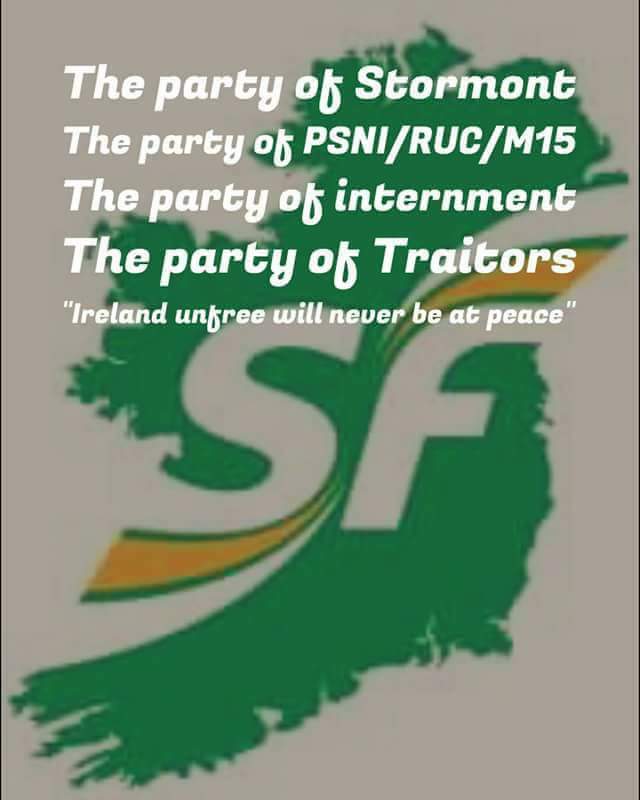
Subscribe to:
Posts (Atom)