ON THIS DATE (2ND SEPTEMBER) 97 YEARS AGO : FIFTH HUNGER-STRIKER IN SEVEN YEAR PERIOD DIES.
Pictured ; the grave of 19-years-young Irish republican Joe Whitty, who died on hunger-strike on the 2nd September 1923 - 97 years ago on this date - and was buried in Ballymore cemetery, Killinick, Co. Wexford.
Joseph Whitty came from Connolly Street in Wexford town. He was a volunteer in the IRA's South Wexford Brigade and was arrested and imprisoned in late 1922, after the counter-revolution had begun. Prior to his imprisonment, he was among the many Republicans in County Wexford to suffer at the hands of Britain's occupation forces and later at the hands of the Free State traitors.
In February 1923, members of Cumann na mBan had gone on hunger strike in protest against ongoing internment and successfully secured their release. By May the Civil War had officially ended, but thousands of republicans remained imprisoned, often in very poor conditions. This resulted in further hunger strikes during 1923. The Free State government had since passed a motion outlawing the release of prisoners on hunger strike, and this was to have dire consequences for Joseph Whitty and others. He died in Newbridge Internment Camp, on September 2nd, 1923, at the age of 19. He was the fifth Republican to die on hunger strike since 1917, and was laid to rest in Ballymore Cemetery, Killinick with full military honours.
'At a public meeting held in New Ross on Sunday July 22nd 1923, Miss Dorothy MacArdle read a letter from Newbridge prison camp. She did not think it had passed through the hands of the censor. The letter referred to the condition of 19 year old Óglach Joseph Whitty, William Street, Wexford. She asserted that he was not in the organisation at all and that he was being punished as revenge for the activities of his brothers. He signed the undertaking reluctantly on the advice of a friend but despite the boasting of the government that signing meant release, he was still in gaol and dying.
The first time his mother went to visit him the authorities refused to allow to do so. The second time when they allowed her to see her son he was unable to recognise her.
The meeting should demand that he be released before he died, said Miss MacArdle. Professor Caffery proposed a resolution demanding the immediate release of Joseph Whitty and the other prisoners in Ireland and Britain and suggested that a telegram should be sent to the pope. Miss Nellie O'Ryan seconded the resolution which was put to the meeting. All present signified assent by raising their right hands. Unfortunately, the free state government failed to release Joseph Whitty (pictured). On Thursday September 2nd, 1923, he died in the Newbridge military hospital. He had been arrested about a year earlier. Interment took place in Ballymore the following Sunday before a large crowd. When the remains were laid to rest his comrades fired three volleys over them and recited a decade of the rosary in Irish....' (from 'Boards.ie')
Joe Whitty is one of twenty-two Irish republicans to die on hunger-strike between 1917 and 1981, all of whom are remembered each year by the Republican Movement.
'EDUCATION...'
From 'The United Irishman' newspaper, June, 1955.
Principles, Methods and Subjects -
1. Most people think that some higher education, or years of study, are necessary to understand advanced subjects such as science, music, philosophy, art etc but, as a person at the age of reason, or thereabouts, can intelligently accept the greatest of all principles - God and the Holy Trinity - then an intelligent student should be able to understand all lesser principles when broadly explained. Thus, each and every subject may be quickly brought within the students grasp so that he (sic) may realise its significance as a universal value.
2. The purpose of education in relation to God, man, nature and country, so that the student clearly understands the reason for his (sic) actions and his (sic) work.
3. The development of human attributes ; the spiritual and intellectual in union with the individual and physical aspects of man. The development of feeling, thinking and willing.
4. The development of the individual creative faculty.
5. Approach to subjects by forming immediate associations and statement of Great Principles involved. Also, where possible, to go back on one's own furrow, so to speak. (MORE LATER.)
ON THIS DATE (2ND SEPTEMBER) 217 YEARS AGO : EXECUTED BY THE BRITISH FOR BEING "FOUND IN ARMS" IN DUBLIN.

Maxwell Roach, hanged in Thomas Street, Dublin, September 2.
Denis Lambert Redmond, hanged at Coal Quay (now Wood Quay), Dublin, September 8.
John Killeen, hanged in Thomas Street, Dublin, September 10.
John McCann, hanged in Thomas Street, Dublin, September 10.
Felix Rourke, hanged outside his own home, Rathcoole, September 10.
Thomas Keenan, hanged in Thomas Street, Dublin, September 11.
John Hayes, hanged in Thomas Street, Dublin, September 17.
Michael Kelly, hanged in Thomas Street, Dublin, September 17.
James Byrne, hanged in Thomas Street, Dublin, September 17.
John Begg, hanged in Thomas Street, Dublin, September 17.
Thomas Donnelly, hanged at Palmerstown, Dublin, September 17.
Nicholas Tyrrell, hanged at Palmerstown, Dublin, September 17.
Robert Emmet, hanged in Thomas Street, Dublin, September 20.
Henry Howley, hanged at Kilmainham Jail, Dublin, September 28.
John McIntosh, hanged in Patrick Street, Dublin, October 3.
Thomas Russell, hanged at Downpatrick, Co. Down, October 21.
James Corry, hanged at Downpatrick, Co. Down, October 22.
James Drake, hanged at Downpatrick, Co. Down, October 22.
Andrew Hunter, hanged at Carrickfergus, Co. Antrim, October 26.
David Porter, hanged at Carrickfergus, Co. Antrim, October 26.
Tradesmen were prominent in Robert Emmet's movement in Dublin. Edward Kearney, John Killeen, Thomas Keenan, John Hayes, Michael Kelly, Henry Howley and John McIntosh were carpenters; Owen Kirwan and John Begg were tailors; Thomas Donnelly and Nicholas Tyrrell were factory workers; Maxwell Roach was a slater; Denis Lambert Redmond was a coal factor; John McCann was a shoemaker; Felix Rourke was a farm labourer and James Byrne was a baker. (Source: Bold Robert Emmet (1778-1803) by Seán Ó Brádaigh.) [from here.]
it was not only college-educated men and women like Robert Emmet (ie those who might be perceived as being 'upper class') who decided to challenge Westminster's interference in Irish affairs in 1803 : so-called 'working class' men and women also acknowledged the need for such resistance. And the same can be said for today.
'WHY ARE WE TURNING A BLIND EYE TO PSYCHIATRIC PATIENTS WHO HAVE A PROPENSITY FOR VIOLENCE...?'
By Mairead Carey. From 'The Magill Annual', 2002.
The real tragedy is that Gerry Connell's situation is not unique ; hundreds of parents around the country face years of "absolute hell" from children with severe psychiatric problems and a tendency to violence. For many, there is simply nowhere to go for help.
As of now, if you live in Kildare, Wicklow, South or West Dublin, there are no secure beds available for violent psychiatric patients. St. Brendan's Hospital, which caters for patients who are a danger to themselves and others, is closed to admissions and, last month, the psychiatric unit 'Vergemount', in Clonskeagh, was forced to close for the weekend because a patient became violent and there was no place to put him.
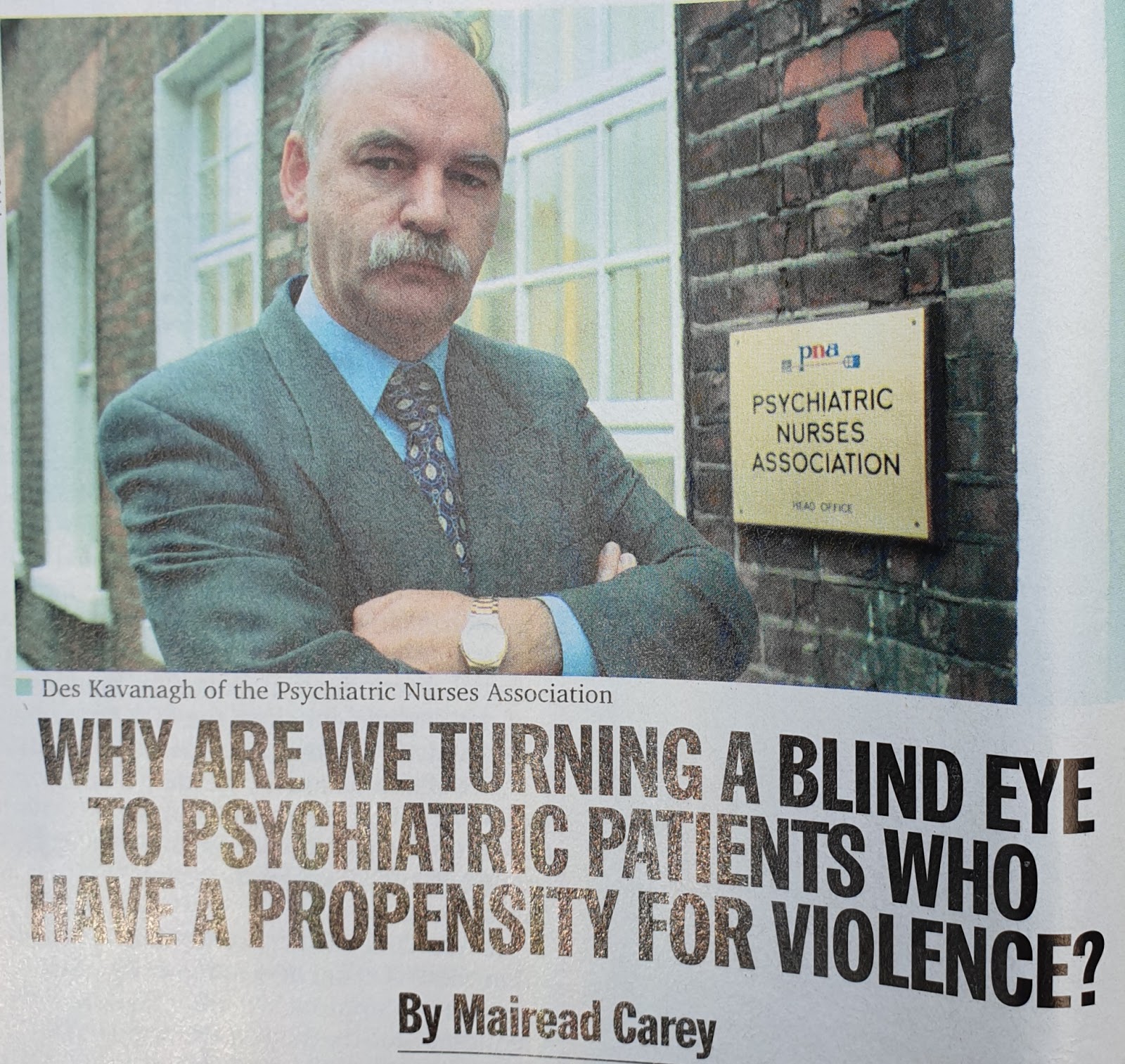
Some are familiar with the situation. The boardroom table of the 'Psychiatric Nurses Association' is covered with newspaper clippings highlighting the failures of the health system to deal with the violently disturbed : 'Schoolboy tortured and killed by psychiatric patient' is the headline on a piece about an 11-year-old from Strabane who was battered to death on the day 21-year-old Brian Doherty discharged himself from a psychiatric hospital... (MORE LATER.)
ON THIS DATE (2ND SEPTEMBER) 78 YEARS AGO : "IF FROM THE PATH YOU CHANCE TO STRAY...
Tom Williams, pictured (Tomás Mac Uilliam) ; born 12th May, 1923, murdered by Westminster - he was hanged in Crumlin Road Jail in Belfast on Wednesday 2nd September 1942 - 78 years ago on this date. The executioner was the 'official' English hangman, Thomas Pierrepoint, who was assisted by his nephew, Albert Pierrepoint.
..KEEP IN MEMORY OF THAT MORN, WHEN IRELAND'S CROSS WAS PROUDLY BORNE.."  "I met the bravest of the brave this morning..." Tom Williams, 12th May 1924 – 2nd September 1942."Williams was one of six IRA volunteers sentenced to death by hanging in 1942. A group of eight, including two women, had mounted a diversionary operation to take away attention from three republican parades held in Belfast to celebrate the 1916 Easter Rising. All such parades had been banned under the Stormont regime since the partition of Ireland and the introduction of the Civil Authorities (Special Powers) Act of 1922. A police (RUC) patrol managed to capture the group but not before an exchange of shots which resulted in the death of RUC constable Patrick Murphy. Although only 18 years old, Tom Williams was in charge of the unit and in a controversial statement to the police he assumed full responsibility for the shooting. Following a remarkable international reprieve campaign, the colonial Governor of Northern Ireland commuted five of the six death sentences to terms of penal servitude. But the British had decided that Tom Williams should hang..."(from here)'Time goes by as years roll onwards
But in my memory fresh I'll keep
Of a night in Belfast Prison
Unshamefully I saw men weep
For the time was fast approaching
A lad lay sentenced for to die
And on the second of September
He goes to meet his god on high
Now he's walking to the scaffold
Head erect he shows no fear
For on his proud and gallant shoulders
Ireland's cross he holds so dear
Now the cruel blow has fallen
For Ireland he has fought and died
And we the countrymen who bore him
Will love and honour him with pride
Brave Tom Williams we salute you
And we never will forget
Those who planned your cruel murder
We vow to make them all regret
So come all you Irish rebels
If from the path you chance to stray
Bear in memory of the morn, when Irelands cross was proudly borne
By a lad who lay within these prison walls.'
(From here) For Tom, and all the other brave men and women.
ON THIS DATE (2ND SEPTEMBER) 100 YEARS AGO : 'SPECIAL (LOYALIST) CONSTABULARY' FIRST MOOTED.
At a meeting in London on the 2nd September 1920 - 100 years ago on this date - the then 'Prime Minster' of Stormont, 'Sir' James Craig ("All I boast is that we are a Protestant Parliament and Protestant State...") demanded that a force of 'Special Constabulary' be established for 'Ulster' and, six days later - on the 8th September - Westminster agreed that a force of "loyal citizens" were needed, and insisted that the then pro-British paramilitary gang known as the 'Ulster Volunteer Force' should be made 'official' and employed as such. And, with a simple name change and the provision of a British uniform, a new State-sponsored paramilitary gang, the A,B and C Specials, was spawned.
The 'A' gang (about 3,500 of them in total) were full-time operatives who lived in the local RIC barracks and were used as re-inforcements for the RIC, and were armed and on a wage. Essentially, their presence allowed more 'police officers' free to leave their desks and assist their British colleagues in cracking nationalist skulls. The 'B' outfit (numbering 16,000 approximately) were armed but part-time and on 'expenses' only, and were usually to be found on street patrol and operating checkpoints and the 'C' grouping (about 1,000) were a reserve force with no specific duty as such but were 'on call' as an armed militia.
Nationalists knew the danger of such a move for them - the UVF/Specials were not by any means 'neutral' in the conflict. The then 'Daily News' newspaper stated, re the establishment of the 'Specials' - 'The official proposal to arm "well-disposed" citizens to "assist the authorities" in Belfast raised serious questions of the sanity of the government. It seems the most outrageous thing which they have ever done in Ireland. A citizen of Belfast who is "well-disposed" to the British government is, almost from the nature of the case, an Orangeman, or at any rate, a vehement anti-Sinn Feiner. These are the very same people who have been looting Catholic shops and driving thousands of Catholic women and children from their homes...' But all words of opposition, or even caution, were ignored.
The officer class in the 'Specials' were hired if they passed a civil service examination and were mostly upper and middle-class protestants with a moral connection to their 'mainland' (England) whereas the rank-and-file consisted of the thugs that once populated any anti-Irish paramilitary gang that would have them. The latter were not allowed 'serve' in their own county or that of a family member and were relocated on a fairly regular basis, living in the local barracks and single men were not allowed to leave same at night to socialise. 'Specials' who wanted to get married could only do so after they had been with the gang for seven years or more and even then only if their girlfriend was deemed 'suitable' by the officer class, a 'test' which included the nature of her job before and after the marriage. Any such 'Special' family were under orders not to take in lodgers, not to sell produce locally (ie eggs, vegetables etc) and the husband was not entitled to days off (no 'rest days' or annual holidays) and was not permitted to vote in elections!
After Westminster forcibly partitioned Ireland in 1921 the British wanted control over the new 'State' to be exercised by their own kind (as opposed to 'Paddies in British uniforms') and, in late 1925, they felt confident enough to declare that the 'Specials' should be wound-up and a kitty containing £1,200,000 was put on the table to secure their disbandment : their main man in that part of Ireland, 'Sir' James Craig - up to then a great friend and supporter of the Specials - was jobbed to pass on the bad news : on 10th December 1925, Craig told the 'A' and 'C' Specials that they were out of work (the 'B' gang were to be kept on) and offered each man two months pay. End of announcement - at least as far as Craig and Westminster were concerned, but the 'A' and 'C' Specials were not happy with the "disband" order and discontent in the ranks grew. The 'A' and 'C' Specials held meetings between themselves and, on 14th December 1925, they mutinied!
'A' and 'C' members in Derry 'arrested' their own Officers, as they did in Ballycastle - two days later (ie on 16th December 1925) a demand from the 'A' and 'C' 'rebels' was handed over to 'Sir' Richard Dawson Bates, the Stormont 'Minister for Home Affairs', a solicitor by trade, who was also Secretary of the 'Ulster Unionist Council', a position he had held since 1905. He was not impressed with their conduct. The 'A' and 'C' Specials were looking for more money ; they demanded a £200 tax-free 'bonus' for each member that was to be made redundant. Two days later (ie on 18th December 1925) 'Sir' Bates replied to the Special 'rebels' that not only would they not be getting the £200 'bonus' but if they didn't back down immediately they would loose whatever few bob they were entitled to for being made redundant and, on 19th December 1925, the 'rebels' all but apologised to Bates, released their hostages and signed on for the dole - the 'hard men' of the 'Specials' had been put in their place by a bigger thug than they were!
By Christmas Day, 1925, the 'A' and 'C' Sections of the 'Ulster (sic) Special Constabulary Association (the 'Specials') were disbanded. It was only in 1970 that the 'B' Special gang of thugs 'disbanded' (ie changed uniform into that of the 'Ulster Defence Regiment' (UDR) and carried-on with their mis-deeds). It was actually in September 1969 that the British 'Cameron Commission' described the 'B' Specials as "a partisan and paramilitary force..." while the October 1969 'Hunt Report' recommended that the 'B' Specials be disbanded.
Since then, the RUC, formed in 1922, have been amalgamated into the 'PSNI' but, even though the uniforms changed, the objective didn't - the preservation of British rule in Ireland.
'HE OBJECTS...'
From 'The United Irishman' newspaper, November 1954.
'The Irish Press' newspaper replies to the published 'Letter To the Editor' from John Lucy, Lieut. Col. OBE, The Royal Ulster Rifles, Roynane's Court, Rochestown, Cork.
'Irish Press, 20-10-1954.
One aspect of the Omagh raid which has excited considerable comment was the fact that the most badly wounded of the British soldiers was a man from Sligo, while some of the others were also Irishmen.
The above letter represents one view of the position this creates and we publish it with the idea of clarifying the republican position on the points raised. First of all, we agree wholeheartedly that "young lads from the Twenty-Six Counties first loyalty is to their own nation." This applies equally to the young lads from the Six Counties - there is only one Irish Nation - embracing 32 Counties, and the loyalty of man and woman from within the four shores of Ireland is due to that nation and to that nation alone.
The writer goes on to imply that transferring these young Irish lads in the British Army to posts outside Ireland would meet the situation. Maybe it would, from England's point of view. Their places here would be taken by Scotchmen or Welshmen or possibly Englishmen and the Empire would be protected as before. But what of the Irish point of view? As we said, the loyalty of every Irishman is due to Ireland and Ireland only...' (MORE LATER.)
Thanks for reading - Sharon and the '1169' team.
ON THIS DATE (26TH AUGUST) 107 YEARS AGO : A 146-DAY LOCKOUT BEGINS IN DUBLIN.
On the 26th August, 1913 - 107 years ago on this date - at about 9.40am, drivers and conductors on Dublin trams stepped-out of their vehicles and 'walked off the job' ; they, and other workers, were objecting to the poor working conditions they were forced to endure and their lack of rights to challenge those conditions, including an 'unofficial' workplace 'rule' that would practically ensure that if a worker joined a trade union he or she would be sacked.
The workers, who were fully supported by James Larkin, a revolutionary socialist who despised capitalism and supported the underprivileged, wanted better working conditions and the right to join a trade union without being penalised or sacked for doing so. The tram workers were not then unionised (either were Dublin Corporation employees, building workers or the staff that worked in Guinness' Brewery) but they had admired and supported Larkin and the then four-years-young, ten-thousand-membered ITGWU in the manner in which they had been fighting for improved conditions for the so-called 'unskilled workers' in Dublin, who were, mostly, members of the ITGWU : the workers and their trade union representatives were strongly agitating for a shorter working day (to work 8 hours a day rather than 12 or more hours a day), for better provision (if not actual jobs) for the many unemployed in the city, guaranteed pensions for workers who survived into their 60th year and a 'Labour Court', of sorts, where disagreements could be aired and settled in a neutral atmosphere.
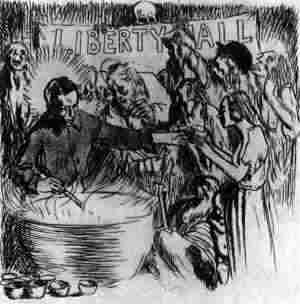
It should be remembered that the Catholic Church as an institution decided not to organise 'soup kitchens' etc or offer assistance of any kind which might be of benefit to children during the lockout, as those poor kids were the sons and daughters of the striking workers and that particular church supported the employers and branded Jim Larkin (pictured) as a 'political troublemaker'. Also worth remembering is the fact that anti-republican Arthur Guinness refused to close his premises or follow other such advice/demands from William Martin Murphy and, while he didn't actually join with Murphy and other employers in directly opposing the strikers, he organised for what was a large sum of money in those days - £500 - to be donated to a 'fighting fund' set-up by Murphy and other employers - '...(the Guinness company) had a policy against sympathetic strikes, and expected its workers – whose conditions were far better than the norm in Ireland – not to strike in sympathy ; six who did were dismissed. 400 of its staff were already ITGWU members, so it had a working relationship with the union. Larkin appealed to have the six reinstated, but without success..' (from here.)
The lockout ended after 146 days as the workers and their families were literally penniless and starving, even though their conditions, wages, hours worked, health and safety issues etc remained unchanged, and they were 'obliged' to sign a pledge that they would not join a trade union. However, if any good came out of it, it was that the strikers had at least laid claim to the principle of joining a trade union and had seen that, properly organised, they could defend themselves from attacks by the military and political establishment.
One of the better known connections between Irish republicanism and that period in our history was that Thomas Patrick Ashe (pictured), who was a member of the 'Irish Republican Brotherhood' (IRB) and who had established IRB circles in Dublin and Kerry and eventually became President of the IRB Supreme Council in 1917, espoused the Labour policies of James Larkin.
Writing in a letter to his brother Gregory he said "We are all here on Larkin's side. He'll beat hell out of the snobbish, mean, seoinín employers yet, and more power to him" . Ashe supported the unionisation of north Dublin farm labourers and his activities brought him into conflict with landowners such as Thomas Kettle in 1912. During the lockout, Thomas Ashe was a frequent visitor to Liberty Hall and become a friend of James Connolly. Long prior to its publication in 1916, Thomas Ashe was a practitioner of Connolly’s dictum that "the cause of labour is the cause of Ireland, the cause of Ireland is the cause of labour". Like Jim Larkin and James Connolly, Thomas Patrick Ashe was a supporter and organiser of 'the men (and women) of no property'.
'EDUCATION...'
From 'The United Irishman' newspaper, June, 1955.
It isn't either that we should preach political bias, but that our training in ideals, principles and native things should be so clear as to make the aims of our Movement also abundantly clear and attractive in reason.
As Sinn Féin caters for every aspect of national life, so our school will have to cater for every aspect of human character - spiritual, intellectual and physical. It does not matter how small the start is as it, itself, will provide its own momentum. Our education must be an education in wisdom for the purpose of leading a full life in harmony with God and nature, realising that we, individually, are created a necessary part of the great universal rhythm.
Our first aim should be to find the best methods by which this may be quickly and effectively achieved. We, one and all, must strive to remove the imprisonment of the spirit and shake off this inertia by action, particularly through fostering creative work, intellectually and manually. We give below a general statement of the principles which should motivate our teaching system, and also an indication of some of the methods and subjects which we consider necessary for the successful achievement of our aims... (MORE LATER.)
UPDATED DETAILS FOR THE 2020 BUNDORAN HUNGER STRIKE COMMEMORATION.
On Saturday 29th August 2020, the Bundoran/Ballyshannon H-Block Committee will be holding a rally in Bundoran, Donegal, to commemorate the 39th Anniversary of the 1981 Hunger Strike and in memory of the 22 Irish Republicans that have died on hunger strike between 1917 and 1981 ; please note that the location in Bundoran for this event has changed - it will now take place in the Republican Garden in that town. Wreaths will be laid for the Hunger Strikers and a new plaque will be unveiled in the Republican Garden.
The 2019 Bundoran Commemoration can be viewed here. Hope to see you all there on the 29th August this year!
'WHY ARE WE TURNING A BLIND EYE TO PSYCHIATRIC PATIENTS WHO HAVE A PROPENSITY FOR VIOLENCE?'
By Mairead Carey. From 'The Magill Annual', 2002.
Gerry Connell is spending the first days of his jail term behind the walls of Limerick Prison. The 54-year-old County Limerick man killed his son, Barry, at their home in the summer of 1999.
The incident was only one of a number of violent encounters over the past 14 years, a period which the family have described as being "absolute hell". The reason, they say, is that 25-year-old Barry suffered from acute manic psychosis and, as a result, he violently terrorised his own family. A jury in the Central Criminal Court found his father guilty of manslaughter - three years of his four-year sentence will be suspended.
A month before the shooting, Barry's father had signed him into a psychiatric unit, but he was back home within days. Sentencing Gerry Connell, Mr. Justice McKechnie said this was "an absolute tragedy for the Connell family" and he had "nothing but sympathy for those involved who were left to deal with it. There must be some other way to respond to a situation, even one as grim as the Connell family lived with and that Gerry Connell faced on this fateful evening.."
(MORE LATER.)
ON THIS DATE (26TH AUGUST) 51 YEARS AGO : B-SPECIALS RESIGNATIONS ANNOUNCED (OVER MONEY).
'On August 26, 1969 (51 years ago on this date), it emerged that a platoon of 21 B-Specials, at Dunmore, in Down, resigned...they arrived at their Ballynahinch headquarters during the weekend and handed over their arms and uniforms. No reason was given for the resignations..." (from here.)
The B-Specials were a part-time but fully-armed pro-British paramilitary outfit, that were sent out on patrol duty, with or without the British Army or RIC. Fifteen-thousand of them were unleashed on the public in February 1921 and those of them that were not ex-UVF men were said to have been unsuitable even for membership of that loyalist gun-gang!
Our history has shown how deranged that gun-gang were and how thrilled its members must have felt to be wearing an 'official' British military uniform, with a full weapons kit at their disposal, and plenty of 'taigs' to practice on, but it seems that money was their second motivation (their first being religious hatred) -
'A signed petition to have the 'B' Specials disarmed was taken up at all Mass in Newtownbutler and Lisnaskeagh on Sunday, 24/8/1969. On Monday night, 25th/26th August, 1969, about 500 troops moved into Omagh. There were about 500 troops already there. There is one Company of British 'Green Jacket' troops in Enniskillen, Co. Fermanagh. There are about 250 troops in all in Enniskillen. There is one Company of Green Jackett troops in Omagh and another one in Ballykelly. There is some ill feeling amongst the 'Green Jacket' troops in Enniskillen. Their pay is a fortnight overdue and this is the reason for the bad feelings...' (from here.)
They were 'loyal' to their religious bigotry and the Half-Crown.
'HE OBJECTS'.
From 'The United Irishman' newspaper, November 1954.
'Letter To the Editor, The Irish Press newspaper, 18th October 1954, from John Lucy, Lieut. Col. OBE, The Royal Ulster Rifles, Roynane's Court, Rochestown, Cork'. "Sir ; As an Irishman who fought in both great wars I take the strongest objection to the posting of Irish nationals to any British military station in this country. During the rebellion such men were moved to England. It is iniquitous that young lads from the Twenty-Six Counties whose first loyalty is to their own nation should be held in any degree as part of the British garrison of the Six Counties where they are liable to suffer at the hands of their blood brothers.
If the English Government wish to continue to support the partition of Ireland they should use English soldiery to further their strange political ambitions here. For no government outside Ireland has the slightest right to colour the definition of prior loyalty for any of our countrymen by word or deed or implication, as England does by posting our young men to North of the border.
It is a deadly sin to create a situation which gives occasion to the crime of fratricide. As I am particularly interested in the welfare of Irish soldiers in the British services I am sending a copy of this letter to the Under-Secretary of State, the War Office, who is responsible for postings.
Yours faithfully,
John Lucy,
Lieut. Col. OBE,
The Royal Ulster Rifles,
Roynane's Court,
Rochestown,
October 18, 1954. (MORE LATER ['The Irish Press' newspaper replies]...)
Thanks for reading - Sharon and the '1169' team. But, before we sign off, we need to bring to an end our Staycation Saga Story (!)...
Longest staycation EVER!!
We eventually collected our misplaced suitcase and our 'lost' family member, all in one fell swoop! Dunno what all the fuss was about - no need, really, for the cops, the custom people, the bailiffs, helicopters, the SWAT team etc to be rushin' around the gaff as they were ; sure it was all just a simple 'misunderstanding', to be sure.
After hours and hours of questioning, tea, 'soup' (!), toilet and smoke breaks, we had convinced the cops that there 'was nothing to see here' but the custom lads and lassies, the helicopter pilot and yer man that served us our 'soup' still, apparently, had their doubts. The bailiffs had started a fight with the SWAT fellas and were chasing each other around one of the runways when a phone call came through from the New York JFK Security Department, which had been contacted by one of the SWAT guys, before he was rushed to hospital.
The JFK/CIA/FBI/Homeland Security chaps, sobbing and shouting for some reason, pleaded with the Irish guys not to make a big issue of this thing, as to do so would make us reluctant to take any more staycations and would encourage us to go back to wreck havoc on New York for a holiday..!
Anyways ; they held us for another hour or so, keeping their distance, not quite sure what to say or do to us, when all of a sudden a big brown envelope with USA stamps on it was thrown into the room where we all were and the pilot, the soup man and the rest of them took it over to a corner, opened it, whispered to themselves, gave us back our belongings and opened a side door, telling us they were going for a cúpan tae and pleaded with us not to be there when they got back. And we weren't, which is why we're back here now!
So there ya have it ; more-or-less the usual type of holiday for us, whether home or abroad. And we're grounded for now, according to the suits from the Parole Board, so we'll see yis next week. Hopefully...!
ON THIS DATE (12TH AUGUST) 66 YEARS AGO ; SCOTLAND YARD MEN IN DUBLIN.
'Commander Len Burt, Special Branch Chief of Scotland Yard, and an Inspector Gale, also of Scotland Yard, visited Dublin on August 12th last where they met Chief Superintendent P. Carroll, head of the Special Branch, Dublin. The visit was described as "purely routine", whether that means there is a routine police inspection similar to the military inspection of General Woodall at the Curragh is not clear.
It is also said that the police in Northern Ireland (sic), in conjunction with Scotland Yard, had been taking extensive precautions against the possibility of hostile demonstrations on the occasion of the English Queen's visit to Belfast, and the visit of the Scotland Yard men may have been to gather information on the likelihood of protests organised from the 26 Counties.
It is interesting to note that Kevin McConnell, who was sentenced in Belfast for having copies of 'The United Irishman', was first arrested on Friday 13th August, taken to the barracks for questioning and then released. The following evening Special Branch men called to his home in Dublin and questioned his parents, at the request, as they admitted, of Belfast. About three hours later Kevin was again arrested in Belfast, and this time held for sentence.
Another interesting item is that since the Scotland Yard men's visit, the Dublin Special Branch have started a check-up on those men and women who had been deported from England during the Bombing Campaign in 1939-1940. A number of deportees have already been visited, questioned as to their own movements, whether they were going back to England, whether any of their comrades had already gone back, where they were and so on.
How's that for cooperation?' (From 'The United Irishman' newspaper, October 1954.)
'EDUCATION...'
From 'The United Irishman' newspaper, June, 1955.
It would cost comparatively few shillings to hire a room for a few evenings per week. The whole trouble, however, is the curriculum. It could easily take us a whole year, or more, to compose a curriculum because it must be chosen wisely and with great care.
Sinn Féiners know well the original work of Padraig Pearse in this field but, as time passes, he is being put into a special class of his own and is in danger of losing his humanity and, on account of this, one unconsciously gives tacit consent to the idea that only a Pearse could found such a school. Pearse, however, being a most human man, would be the last to desire this attitude, as the main principle of his system was to develop individuality and, consequently, individuality of effort.
Now, as Pearse's school was suitable for his generation, so we feel the type of school which we have in mind may be more suitable for our times and for the present generation... (MORE LATER.)
ON THIS DATE (12TH AUGUST) 100 YEARS AGO : 'ARRESTED' BY BRITISH FORCES FOR POSSESSION OF "SEDITIOUS ARTICLES AND DOCUMENTS".
Terence MacSwiney, pictured, with his wife Muriel and their daughter, Máire, photographed in 1919.
"If I die I know the fruit will exceed the cost a thousand fold. The thought of it makes me happy. I thank God for it. Ah, Cathal, the pain of Easter week is properly dead at last..." - Terence MacSwiney wrote these words in a letter to Cathal Brugha on September 30th, 1920, the 39th day of his hunger strike. The pain he refers to is that caused by his failure to partake in the 1916 Easter Rising. Contradictory orders from Dublin and the failure of the arms ship, the Aud, to land arms in Tralee left the Volunteers in Cork unprepared for insurrection...' (from here.)
In his book 'History of the Irish Working Class', Peter Beresford Ellis wrote : "On October 25th, 1920, Lord Mayor of Cork, Terence MacSwiney - poet, dramatist and scholar - died on the 74th day of a hunger-strike while in Brixton Prison, London. A young Vietnamese dishwasher in the Carlton Hotel in London broke down and cried when he heard the news - "A Nation which has such citizens will never surrender". His name was Nguyen Ai Quoc who, in 1941, adopted the name Ho Chi Minh and took the lessons of the Irish anti-imperialist fight to his own country..."
On the 12th August, 1920 - 100 years ago on this date - Terence MacSwiney was 'arrested' in Cork by the Crown Forces for possession of “seditious articles (a cipher key) and documents". He was born on the 28th March 1879, was the Commandant of the 1st Cork Brigade of the IRA and was elected as the Lord Mayor of Cork. He died after 74 days on hunger strike (a botched effort to force feed him hastened his death) in Brixton Prison, England, on the 25th October, 1920, and his body lay in Southwark Cathedral in London where tens of thousands of people paid their respects.
He summed-up the Irish feeling at that time (a feeling and determination which is still prominent to this day) - "The contest on our side is not one of rivalry or vengeance but of endurance. It is not those who can inflict the most but those who can suffer the most who will conquer. Those whose faith is strong will endure to the end in triumph."
And our faith is strong.
ON THIS DATE (12TH AUGUST) 150 YEARS AGO : 'DIVISIVE' BRITISH ARMY GENERAL BORN.
British Army General 'Sir' Hubert Gough (pictured) was a contentious figure (a man of "extreme opinions") in the (on-going) history of British imperialism ('a key figure in the Curragh Mutiny..') and, occasionally, caused confusion in the posh halls of Westminster.
He was born in London on the 12th August, 1870 (150 years ago on this date) and apparently found it hard to 'play cricket' with those around him, both politically and militarily - 'Historians are divided in opinion about Gough ; some label him a callous "butcher among generals", whereas others judge him to have been unusually considerate towards his soldiers...in his retirement, he stewarded the Fifth Army Comrades Association and led the Chelsea Home Guard in the second World War. It was in this capacity that, ironically, Gough attacked Northern Ireland’s (sic) unionist government in August 1941. He co-authored a letter to Churchill and Canadian prime minister William Mackenzie King, criticising Stormont for organising a local defence force, analogous to Britain’s home guard, but "recruited along politico-sectarian lines". Gough, and other retired Anglo-Irish officers, castigated Craigavon for his policies...' (from here.)
'On the morning of Friday 20 March (1914?), Arthur Paget (Commander-in-Chief, Ireland) addressed senior officers at his headquarters in Dublin. By Gough's account (in his memoirs 'Soldiering On'), he said that "active operations were to commence against Ulster," that officers who lived in Ulster would be permitted to "disappear" for the duration, but that other officers who refused to serve against Ulster would be dismissed rather than being permitted to resign, and that Gough – who had a family connection with Ulster but did not live there – could expect no mercy from his "old friend at the War Office..." (from here.)
In 1921, British General Sir Hubert Gough stated - "Law and order (in Ireland) have given place to a bloody and brutal anarchy in which the armed agents of the Crown violate every law in aimless and vindictive and insolent savagery. England has departed further from her own standards, and further from the standards even of any nation in the world, not excepting the Turk and Zulu, than has ever been known in history before..".
However - he stood-by those "Crown standards" and died, as he had lived ie a member of the British 'establishment', at 92 years of age, in London, in 1963. The damage in Ireland done by that man and his type lives on.
'FREEDOM OF INFORMATION OR FUMBLING OF INFORMATION...?'
By Paul O'Brien.
From 'The Magill Annual', 2002.
('1169' comment - Interesting article, considering the recent changes to this particular piece of State legislation.)
But, explaining the confusion over the 'Magill' request, the spokesman said - "Each body has their own decision-makers, and there's no obligation to take a common approach."
While they might later be reined in, as appeared to have happened with the 'Magill' request, the nature of the initial responses to that request would seem to indicate the departments not only take their own decisions but understand the Act differently. Is this really good enough when the importance of the Act is considered?
It must be said, in the departments' defence, that the FOI Act is still relatively new, and may take some time yet before the system is totally streamlined. And, no doubt, the vast majority of requests have been handed in the correct fashion. But there remains an issue at stake here.
The purpose of the FOI Act is explained by the Office of the Information Commissioner as follows - "An Act to enable members of the public to obtain access, to the greatest extent possible consistent with the public interest and the right to privacy, to information in the possession of public bodies and to enable persons to have personal information relating to them in the possession of such bodies corrected. Thus, the Act is designed to provide a right of access to information held by public bodies to the greatest extent possible."
Laudable indeed, but what's "the greatest extent possible" if the government departments interpret the Act as they see fit?
(END of 'Freedom Of Information Or Fumbling Of Information?' ; NEXT - 'Why are we Turning a blind eye to Psychiatric Patients who have a Propensity for Violence?', from the same source.)
ON THIS DATE (12TH AUGUST) 98 YEARS AGO : DEATH OF TREATY-SIGNING SINN FÉIN FOUNDER.
Arthur Griffith was born on the 31st March, 1872, at 61 Upper Dominick Street, Dublin, and matured into a somewhat contradictory political life - '..a printer by trade, he developed a passionate interest in Irish history and culture and became active in the Gaelic League. A gifted and influential journalist, he was made editor of several radical newspapers. He had been an admirer of Parnell but after 1891 he developed a growing contempt for the Irish Parliamentary Party and sought to map out an alternative strategy for Ireland.
He rejected the use of force.
Influenced by the experience of dissidents in Hungary, he argued in 1904 that Irish MPs should withdraw from Westminster and set up an assembly at home. It was his belief that the Irish electorate would support this policy and in time the British government would be compelled to support it too. Ireland would thus become a self-governing state and equal partner with Britain under the Crown. Drawing on the German economist Friedrich List, Griffith also suggested that Ireland could develop a balanced national economy, mainly through imposing high tariffs on British industrial imports. These two elements were central to the programme of the Sinn Féin party which he helped set up in 1905. It attracted little popular support but had disproportionate influence largely because of Griffith's propaganda skills..' (from here.)
There are two schools of thought in relation to the 'Sinn Féin Republican/Sinn Féin Home Rule Party'-issue in relation to the political organisation that Griffith founded in 1905. Contrary to the perception which has been advanced by some that Sinn Féin in its first years was not Republican in character but rather sought a limited form of Home Rule on the dual monarchist model, Brian O'Higgins, a founding member of Sinn Féin, who took part in the 1916 Rising, and was a member of the First and Second Dáil, remaining a steadfast Republican up to his death in 1962, had this to say in his Wolfe Tone Annual of 1949 : "It is often sought to be shown that the organisation set up in 1905 was not Republican in form or spirit, that it only became so in 1917 ; but this is an erroneous idea, and is not borne out by the truths of history. Anyone who goes to the trouble of reading its brief constitution will see that its object was 'the re-establishment of the independence of Ireland.' The Constitution of Sinn Féin in 1905, and certainly the spirit of it, was at least as clearly separatist as was the constitution of Sinn Féin in and after 1917, no matter what private opinion regarding the British Crown may have been held by Arthur Griffith."
Arthur Griffith was one of those who were in a pivotal position during the talks on the 'Treaty of Surrender' in 1921 which he accepted and signed, stating, in a press release immediately after dipping his pen in the blood - "I have signed a Treaty of peace between Ireland and Great Britain. I believe that treaty will lay foundations of peace and friendship between the two Nations. What I have signed I shall stand by in the belief that the end of the conflict of centuries is at hand." Yet historian Nicholas Mansergh noted that, at practically the same time as Griffith had penned the above, the British were talking between themselves of "..concessions (from the Irish) wrung by devices...some of which can be described at best as devious...every word used and every nuance was so important..."
The Treaty-signing Sinn Féin founder never did see "the end of the conflict of centuries" and was certainly never going to see it if he was depending on that Treaty to deliver it - for it was designed to make British misrule in Ireland easier for them to 'manage', rather than to bring to an end that misrule. Arthur Griffith died of a brain haemorrhage in Dublin on the 12th August, 1922, at only 51 years of age, and is buried in Glasnevin Cemetery in Dublin.
'THE SLAVE MIND'.
From 'The United Irishman' newspaper, November 1954.
The newly formed 'Waterford Cricket Club' invited the Duke of Edinburgh to become its honorary patron and president. The invitation was sent by Mr AJ Blyth, Organising Secretary to the Club.
Questioned about it, he said he did it in a burst of enthusiasm (loyality, we suppose). Even 'Duke' Philip realised what a blunder it was, and refused the 'honour'. It is an indication of the continued existence of active anti-Irish elements throughout the country. The well-organised 'RAF Association', the various British Army and Navy clubs, are all centres for British espionage and hostile fifth-column activity against the Irish nation. But they are not interfered with, certainly not by Leinster House.
(END of 'The Slave Mind'. NEXT - 'He Objects', from the same source.)
ON THIS DATE (12TH AUGUST) 29 YEARS AGO : JUDITH THERESA WARD WAS 'GRANTED A REVIEW' OF THE CASE AGAINST HER.
Judith Ward (pictured), an 'IRA activist', was arraigned on the 3rd October 1974 at Wakefield Crown Court, West Yorkshire, England, on an indictment containing 15 counts : Count 1 - causing an explosion likely to endanger life or property on the 10th September 1973, at Euston Station, Count 2 - a similar count relating to the explosion on the motorcoach on the M62 on the 4th February 1974, Counts 3-14 - twelve counts of murder relating to each of the persons killed in the explosion on the motorcoach and Count 15: causing an explosion as before on February 12, 1974, at the National Defence College at Latimer. She pleaded "not guilty" to all counts but, on the 4th November 1974, she was convicted on all counts, by a majority of 10 to two on Count 1 and unanimously on all the others.
She was sentenced to five years' imprisonment on Count 1, 20 years' imprisonment concurrently on Count 2, life imprisonment for the murder Counts 3-14 and to 10 years on Count 15, to be served consecutively to the 20 years on Count 2, making a determinate sentence of 30 years.
On the 12th August, 1991 - 29 years ago on this date - Judith Ward was 'granted a review' of the case against her ; it took eighteen years of campaigning to have her conviction quashed, which it was on the 11th May 1992. It transpired that she had changed her 'confession' several times and that the police and the prosecution selected various parts of each 'confession' to assemble a version which they felt comfortable with!
One of the main pieces of forensic evidence against her was the alleged presence of traces of nitroglycerine on her hands, in her caravan and in her bag. 'Thin Layer Chromatography' and the 'Griess Test' were used to establish the presence of nitroglycerine but later evidence showed that positive results using these methods could be obtained with materials innocently picked up from, for instance, shoe polish, and that several of the forensic scientists involved had either withheld evidence or exaggerated its importance.
Her book, 'Ambushed - My Story' makes for interesting reading and allows the reader to draw comparisons with the injustices suffered by the Maguire Seven, the Birmingham Six and the Guildford Four ; a total of 18 innocent people, including Judith Ward (13 men, 3 women and two children) who, between them, spent a total of 216 years in prison. Anne Maguire, a mother of 5 children, was menstruating heavily and denied all toiletries for a week and was beaten senseless. Carol Richardson, who didn't even know she was pregnant, miscarried in Brixton Prison days after her arrest.
Pat O'Neill, who had minutes before entered the Maguires house to arrange for a baby-sitter when the police arrived, was told by a cop to swear that he saw a big cardboard box on Maguires table or else he would be done, but he refused to lie - he served eleven years. On his release, he found his marriage was broken beyond repair and that his six children had left the family home.
How many more Irish children will have to 'leave the family home' before the British eventually give a date for their political and military withdrawal from Ireland, because the situation as it still exists here is that their very presence continues to be objected to by Irish republicans and continues to give rise to unrest. And, if our history is to be used as a yardstick, that will always be the case.
Thanks for reading - Sharon and the '1169' team. And here we go again ; we won't be here next Wednesday (19th August 2020) as we're still trying to deal with what this part of the world and its mother (!) are calling 'Staycationgate'. It seems we left a suitcase and at least one holiday-maker behind us, in our haste to depart from our posh holiday accommodation a few weeks ago...yes, I know it sounds careless, to put it mildly, but think 'Home Alone', only in reverse ; the '1169' team come from large families and...well, sometimes, after a certain number of days without sleep, a few flagons of cider, no phone signal or wi-fi and no change of clothes, you tend to forget your own name, never mind whatshisnames cousin or auntie or sister-in-law or whoever...anyway, long story short : we've been served legal paperwork by three sturdy bailiffs to call in person to 'collect our belongings'.
Apparently, all concerned are too afraid to actually open the suitcase, for some reason (!), and the cousin/auntie/sister-in-law/whoever has gone rabid and was 'speaking in tongues' and, we're told, 'reverted to something that must have existed in the Stone Age..'. Ah Jaysus, there's always somethin', isn't there..?!!
Anyway - we won't be here on the 19th, but should - all going well with the bailiffs, the medical people and the cops - be back on the blog on Wednesday, 26th August 2020. Unless we win the lotto in the meantime, thus enabling us to buy/build a Time Machine and go back to put a stop to this bleedin' nonsense. And ya can only imagine how far back we'll have to go and how long that would take us..!
ON THIS DATE (5TH AUGUST) 132 YEARS AGO : THE ONLY GOOD 'LITTLE PHIL' IS A DEAD ONE!
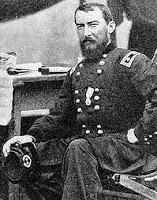
"The only good Indian is a dead one" - 'Supreme Commander' of the U.S. Army, Major Philip Henry Sheridan (pictured) who, despite being only five feet and five inches tall, made a 'big' (and bad) impression on the native American population.
He was born in Albany, New York, on the 6th of March 1831, the son of Irish immigrants from the parish of Killinkere in County Cavan who had to leave Ireland because of the attempted genocide of the Irish people by Westminster and its political and military agents. He 'made his name' by his evil treatment of the native American population, and was responsible for the slaughter of the Lakota Indians at Wounded Knee in 1890, where one-hundred victims, under Chief Big Foot, were massacred by the U. S. 7th Cavalry ; about half of the dead were women and children.
The slain body of Chief Big Foot (his Lakota name was Si Tanka, 'Spotted Elk'), propped up in the snow at Wounded Knee.
The Wounded Knee massacre was the last of the Indian uprisings, and prompted Sheridan to state that "The only good Indian I ever saw was dead." He knew he was in the wrong in what he was doing, as he said so himself : in 1878, he made a report to his Army superiors in which he stated - "We took away their country and their means of support, broke up their mode of living, their habits of life, introduced disease and decay among them, and it was for this and against this they made war. Could anyone expect less?"
He wouldn't argue against the fact that he and other armed 'Bluecoats' were 'occupiers/invaders' in a land where they were not welcome yet he had no hesitation in planning the 'best practical' methods of removing the natives from their lands and, indeed, with that objective in mind, he once stated that he had "...never once taken a command into battle and had the slightest desire to come out alive unless I won.."
He died, after suffering a series of massive heart attacks, on this date (5th August), at 57 years of age, in 1888, in Nonquitt, Bristol County, in Massachusetts - one battle he didn't win, and didn't deserve to win. The Irish and the Native Americans have a common enemy - imperialism. Phillip Sheridan was on the wrong side.
'EDUCATION.'
From 'The United Irishman' newspaper, June, 1955.
Recently, on looking through a short calendar of Irish Saints, we were amazed by the number who founded schools. And, of course, immediately ascribed it to the fact they were 'Saints'! It struck us then that if conditions were so primitive in those days it must not be really so hard to found a school at all, provided one knows exactly what is necessary remembering, too, that the best of schools are associated with sparse furnishings, and even hedges!
Sinn Féin has always been most aware of the crying need to change the educational system, but the job appears to be so great that few real attempts have been made. The main trouble is that we at once assume founding a large school is for the children or the very young alone but then, also, one asks how can a group of teachers give up their wages and live on thin air only, if finance is the main problem? When the 'Saints' founded their schools, did they found them for children or for the more mature? It is this question which provides a clue for Sinn Féin to make a start, and we propose to make the attempt now ; it is our idea to start with folk from adolescence upwards, not excluding ourselves, if necessary.
It must be emphasised that what we have in mind is not adult education classes of the usual school subjects on a higher level, but an education in the true values with respect to life... (MORE LATER.)
BUNDORAN HUNGER STRIKE COMMEMORATION, 2020.
On Saturday 29th August 2020, the Bundoran/Ballyshannon H-Block Committee will be holding a rally in Bundoran, Donegal, to commemorate the 39th Anniversary of the 1981 Hunger Strike and in memory of the 22 Irish Republicans that have died on hunger strike between 1917 and 1981 ; those participating have been asked to form-up at 2.30pm at the East End. All are welcome to attend!
UNSEEN SORROW. (By Bobby Sands)
Her tears fall in the darkness as the rain falls in the night,
Silvery tears like silvery rain, hidden out of sight,
The stars fall from her eyes like floating petals from the sky,
Is there no one in all this world who hears this woman cry?
A simple little floating dreamy thought has stirred this woman's heart,
The golden sleepy dream of yesterdays before they were apart,
What comfort can there be found for a petal so fair and slim
Alone in a forest dark of sorrow she weeps again for him?
Warm silver rolling tears blemish a once complexion fair,
That once shown in the fairest radiance midst a cloak of golden hair.
And the children whimper and cry for a father's care
and love they've never known,
Who sees their little tears of innocent years
as the winds of time are blown?
What sorrow will you know tonight when all the worlds asleep,
When through the darkness comes the wind
that cuts the heart so deep,
For there is no one there to dry your tears
or your childrens tears who cling around your frock,
When there has been another bloody slaughter
in the dungeons of H Block.
The 2019 Bundoran Commemoration can be viewed here. Hope to see you all there on the 29th August this year!
'FREEDOM OF INFORMATION OR FUMBLING OF INFORMATION...?'
By Paul O'Brien.
From 'The Magill Annual', 2002.
('1169' comment - Interesting article, considering the recent changes to this particular piece of State legislation.)
Honest mistakes, no doubt, but they stemmed from the fact that the various departments chose to interpret the FOI Act differently which, of course, has implications for how the Act is administered. Without a coherent understanding of the Act, who's to say that sensitive information won't be released again in the future, or that legitimate public information will be blocked?
A spokesperson for the FOI Central Policy Unit (based at the Department of Finance), which can issue shared advice to the departments through a system known as the 'Civil Service Users' Network', admitted that any FOI request is a matter for the individual department, and the officials within that department, to decide upon. But he stressed that there is an effort made to ensure constituency in approach when possible.
"Where a common request goes in, the 'Users' Network' would be used to exchange information to try and arrange a common approach", he said, "we do try to ensure consistency, and try to ensure openness." As part of that, the Central Policy Unit might get advice from the Attorney-General if deemed necessary, and then pass it on to the Network... (MORE LATER.)
'SINN FÉIN' and 'NATIONAL COLLECTION'.
From 'The United Irishman' newspaper, November 1954.
SINN FÉIN ; With the prospect of the Westminster election coming ever nearer and the constant rumours that it may take place before the end of this year or in the early part of next year, Sinn Féin has decided to select their candidates to contest the twelve seats in the Six County area.
It was decided that constituency conventions would be held before the 30th November next at which the candidates would be selected and, at a meeting of the Northern Election Committee, the dates for these conventions have been arranged ; the first being that for the 'Mid-Ulster' constituency, held on Sunday, 24th October, at which Tom Mitchell *, one of the men arrested in connection with the Omagh Raid, has been the unanimous choice as candidate.
* '1169' comment : Tom Mitchell, who was born on the 29th July, 1931, died on Wednesday, 22nd July 2020, in his 89th year ; the big news of that 1955 election was Sinn Fein’s two seats and its 23.6% of the vote. Sinn Fein’s two successful candidates in Mid-Ulster and Fermanagh & South Tyrone had been imprisoned for their part in the raid on Omagh. Philip Clarke and Thomas Mitchell were the successful Sinn Fein candidates for Fermanagh & South Tyrone and Mid Ulster respectively.
Both men stood for election to re-establish the All-Ireland Dáil and were elected, in 1955, on that basis, as T.D's but, as they were both "convicted prisoners", their election was overturned by Westminster and they were 'officially unseated'. Tom Mitchell contested for the seat in the second election and won again, with an increased vote, only to be unseated a second time, for the same 'reason'. Philip (Christopher) Clarke was released from prison in 1958 and died, at 62 years of age, in 1995.
Statement on the death of Thomas Mitchell from the Republican Movement -
"Sinn Féin Poblachtach regret to hear of the death of Tom Mitchell. Tom was a faithful Irish Republican. As a member of the Irish Republican Army he was imprisoned for his part in the raid on Omagh British Army barracks in 1954, he was elected as Sinn Féin TD for Mid-Ulster in 1955.
The British government used the archaic Westminster Forfeiture Act of 1870 to subvert the democratic vote of the people of Mid-Ulster. On 18 July 1955 a resolution of the British House of Commons, passed by 197 votes to 63, formally declared that Tom Mitchell was covered by this provision, vacated his seat, and ordered that a by-election be held. In the subsequent by-election Tom won with an increased majority.
Following this, unionist Charles Beattie, whom Tom defeated in both elections lodged an election petition stating that the votes of those who voted for Tom Mitchell were invalid. Tom was not allowed to attend the election court. The court overturned the result of the election and declared Beattie the winner in defiance of the democratically expressed wishes of the people of Mid-Ulster. The Westminster Forfeiture Act used to unseat Tom Mitchell in 1955 had also been used to unseat John Mitchell in 1875.
Tom later served as Ard Runaí of Sinn Fêin. He remained a faithful Irish Republican and regularly attended the Sinn Féin Poblachtach Ard Fheis. Deepest sympathy to his family.
Ar dheis Dé go raibh a anam." (From here.)
NATIONAL COLLECTION ; In South Armagh, some members of Sinn Féin had their names taken by the RUC for making the National Collection. One man, Frank McCann, has been served with a summons for collecting at Carrickcuppin Chapel ; the summons was signed by a 'Justice of the Peace' named King, a former 'B Special', who now carries on business as a traveller for a seed merchant in South Armagh and South Down.
(END of 'Sinn Féin' and 'National Collection' : NEXT - 'The Slave Mind', from the same source.)
Thanks for reading - Sharon and the '1169' team. Regarding our recent 'staycation' : can't say too much, as legal proceedings are still pending (!)...we got escorted by State militia in a six-vehicle convoy that stopped traffic, broke traffic lights, drove on footpaths in the wrong direction on one-way systems and, eventually, got thrown out of our still-moving armoured vehicle at a roundabout on a busy road. And that was only on our way there!
But, seriously, we 'vacated' (as posh people do!) our 'staycation' abode which was located in the sunny South-East (and very plush it was, too. Well...then, it was, but we soon fixed that..!) on fairly good terms (!) with the owners, their neighbours and the village who, for some reason, all lined the streets on the morning of our departure, waving something they held in their fists at us. Ah sure, we had the craic, and as soon as it's legal to publish our pics, we'll be doing that. Unanimously. On the 'Dark Web'...



 "I met the bravest of the brave this morning..."