GETTING READY...
..FOR A NINE-PARTER ON THE 18TH!
The British presence in Ireland gets its strength from the weakness of the Irish, by seducing, subduing and/or executing those they deem to be strong enough to stand up to them : a lesson from over 230 years ago...
19th Century Ireland - three political 'snakes-in-the-grass' held their venom until they had their victims where they wanted them - at the ballot box, deaf to the 'hiss'...
This 19th Century Irish alphabet became a battle-cry for the dispossessed and the down-trodden, and acted as a rallying point for those opposed to the many State agents who came hammering at their door...
In Ireland, family bonds and a powerful extended family network held the people together but the 'Establishment' viewed such attributes as a challenge to them and endeavoured to 'break the connection'. And they are still doing so...
From 1998 - a published Irish republican work that is not merely a manual for activism but a bible of endurance, which still stands as true today as it did then...
Westminster labeled Irish resistance as acts of murder, outrage and intimidation against the "law and order" of the land and then continued on arming murderers to cause outrage in Ireland with 'lawful' acts of intimidation against the population...
These ex-Irish rebels took the soup as they were counting their thirty pieces of profit and then sought to 'officially honour' the men and women that they had deserted in their rush to get to the soup cauldron and the banker...
In the 1920's in Ireland, this RIC man knew that his actions, and the command structures that he answered to, were in the wrong but, unlike his militia comrades who felt the same way, he just didn't determine to do 'less wrong' - he vowed to 'do right'. And he did...
...and a few words about our recent 'staycation'. But not too many, now, as any details we give may yet be used as evidence against us...!
Thanks for droppin' in, and for reading ; and, with a nine-parter comin' at ya on Wednesday, 18th October 2023, yer gonna have a quare bit of reading to do then. Give us a shout on the 18th...!
Sharon and the team.
Saturday, October 14, 2023
'TAKING THE SOUP' WITH THE MONEY-LENDERS...
Labels:
Irish history,
Irish politics.
Wednesday, September 27, 2023
A FREE STATE PRISON, A GRASS MAT AND A WIRE-CUTTERS...
ON THIS DATE (27TH SEPTEMBER) 65 YEARS AGO : TWO IRISH REPUBLICAN LEADERS ESCAPE FROM FREE STATE CUSTODY.
On Saturday, 27th September 1958, the Irish republican POW's in the Curragh Internment Camp in County Kildare (of which there were about 150) had put together two football teams and had organised a football match between both sides.
That activity was a distraction for the prisoners and, more importantly, for the Free State Army guards and the other prison staff members, but two of the POW's were not involved in that distraction - they were taking advantgage of it instead!
Dáithí Ó Conaill and Ruairí Ó Brádaigh were lying under a roughly-made grass 'mat' at a less-noticeable section of the metal fence that kept them interned and were using a wire cutters to remove a section of it, which they did, successfully freeing themselves from State custody.
The two men were not only republican comrades and activists, but were to become related through Dáithí's marriage, in 1964, to a fine Donegal Lady, Deirdre Caffrey, who was Ruairí's maternal first cousin (and Deirdre was also sister-in-law to another strong Irish republican, Kevin Mallon).
The successful escape attempt had been authorised by the leadership of the Movement (including Tomás Óg MacCurtain, O/C of the IRA Internees) and meant that Ruairí, who was at the time a Sinn Féin TD (while incarcerated he was elected as a Sinn Féin TD, on an abstentionist ticket, obviously, for Longford–Westmeath in the 1957 State general election), was the first such republican TD to be 'on the run' since the 1920's and, the following month (October 1958) he was appointed as Chief of Staff of the IRA by the leadership (a position he held until May 1959). That escape (27th September 1958 - 65 years ago on this date) was the second such escape from the Curragh Internment Camp (pictured) that year.
In May, three POW's had got out through a window in the Curragh Military Hospital where they had been patients. Two of them – one from Armagh, the other from Portarlington – were recaptured near Kilcullen in County Meath and the third man, from Dublin, evaded capture for ten days until he was found at house in Gormanstown, in County Meath and, in the first week in December (1958) fourteen Irish republican internees escaped from the internment camp.
That Free State prison was closed on the 11th March 1959, as the Staters in Leinster House were comfortable within themselves that they had consolidated their position in the State.
And they still believe that to be the case...
'KEOGHBOYS OF THE 1950's...'
From 'The United Irishman' newspaper, April 1955.
The policy of 'The Irish Tenant League' was to form a political party pledged to independent opposition in parliament and it was based on a 'Union of Creeds'.
'The Restoration of the Hierarchy Act' and 'The Ecclesiastical Titles Act' started a controversy that threatened 'the Union' ; in Ireland, an ultra-catholic party was formed - 'The Catholic Defence Association' (aka 'Irish Brigade'/Pope's Brass Band').
The chief figures were William Keogh, a lawyer from Athlone, and John Sadlier, a hawker from Tipperary (...more about those two shysters here).
Nominally 'Tenant Righters', those two men caused ill-feeling inside the party, because they were so ferociously catholic. In the Westminster General Election of September, 1852, forty 'Tenant Right' members were returned, including William Keogh, John Sadlier, his brother, nephew and two cousins.
All took a solemn pledge that they would stand together in independent opposition and oppose every ministry that refused to introduce a 'Tenant Right Bill' but, when Lord Aberdeen's ministry was formed, he refused to adopt such a Bill... (MORE LATER.)
ON THIS DATE (27TH SEPTEMBER) 101 YEARS AGO : MORE REPRESSIVE LEGISLATION IMPOSED.
Irish Free State soldiers, left, were given ever more of a free reign to impose the dictat of their paymasters in Leinster House in 1922, with the passing of the gloriously misnamed 'Public Safety Act'.
On the 9th June 1927 a general election was called in the Free State and Fianna Fail won 44 seats to Cosgrave's 47 : de Valera's policy was not to enter the Free State parliament until the Oath of Allegiance to the British monarch was removed but, in that same month, Kevin O' Higgins was assassinated and the Free State government passed a law which would force future Leinster House candidates to swear on their nomination that they would take the Oath of Allegiance.
In August 1927, de Valera led the Fianna Fail elected representatives, many of them with revolvers in their pockets, into Leinster House and signed the Oath of Allegiance document. A second general election was held in September 1927 and Fianna Fail increased its vote, winning 57 seats.
In short, Free Staters were once again in power in the Free State (!) but Irish republicans continued to fight back - on the 21st September 1927, six Free State soldiers were killed in a gun battle with the IRA near Ballina in Mayo and, on that same day, the Free State barracks in Drumshambo in Leitrim was attacked and taken by republicans, during which one Stater was killed.
On the 22nd September a FS soldier was killed and several others and three civilians injured in a gun and grenade attack by the IRA on enemy troops on Eden Quay in Dublin and, on the day that the 'Public Safety Act' was being voted on in Leinster House, several hundred IRA Volunteers attacked the town of Killorglin, in Kerry, and were only denied their victory, after 24 hours of fighting, when more Free State troops arrived in force, from Tralee.
The 'Public Safety Act' had been passed in the Free State assembly by 41 votes to 18 on this date, 27th September (1922), 101 years ago, allowing for the State to execute those captured bearing arms against it and permitting State agents 'to punish anyone aiding and abetting attacks on the National (sic) Forces', and/or anyone having possession of arms or explosives 'without the proper authority' or anyone 'disobeying an Army General Order'.
'Section 5' of the Act declared that "..every person who is a member of an unlawful association at any time after it has become by virtue of this Act an unlawful association shall be guilty of a misdemeanour and shall be liable on conviction thereof to suffer penal servitude for any term not less than three years and not exceeding five years or imprisonment with or without hard labour for any term not exceeding two years..." .
'Section 28' stated that "..any person found guilty by a special court of the offence under the Firearms Act, 1925 (No. 17 of 1925) of having possession of or using or carrying a firearm without holding a firearm certificate therefor, shall if the offence was committed while this Part of this Act is in force be liable to suffer death or penal servitude for life, or any term of years not less than three years, or to imprisonment with or without hard labour for any term not exceeding two years, and shall be sentenced by such court accordingly.."
That 'Act' represented politically and morally corrupt legislation and was enacted by the then, and now, politically and morally corrupt political assembly in Leinster House.
IRELAND ON THE COUCH...
A Psychiatrist Writes.
'Magill' commissioned Professor Patricia Casey to compile an assessment of Irish society at what may emerge as the end of a period of unprecedented growth and change.
This is her report.
From 'Magill Magazine' Annual, 2002.
The worst culprits are the new estates that have been built around developing industries or the trendy apartment blocks designed to improve our inner cities.
Many of the inhabitants are mobile young people who see these houses not as homes but as temporary receptacles. Add to this the emptiness that comes from the absence of people during the day as couples go out to work, and the lack of amenities such as shops, bars or post-offices, and they become bleak places indeed. In such an environment, it is possible to be sick for days and have no callers - or to die and lie decaying without being missed.
If our sense of community is under pressure, so too is the traditional family. This is showing itself not so much in the divorce courts yet as in other more nebulous ways.
A recently published international study on depression in the community (in which I was one of the investigators) showed that one of the significant factors associated with the high rate of this condition in urban Ireland is the absence of supports, whilst the very low rate in Spain was equally linked to the protective role that strong ties, especially to the family, can have in ameliorating our stress... (MORE LATER.)
ON THIS DATE (27TH SEPTEMBER) 374 YEARS AGO : A WAR CRIMINAL AND "THE REDUCING OF CARLINGFORD".
Pictured - some of Oliver Cromwell's Irish victims, sold as slaves and 'sex workers' to the highest bidder.
On the 29th April, 1599, a baby boy, Oliver Cromwell, who had been born on the 25th, was christened in Saint John the Baptish church in Huntingdon, England.
Decades later, when someone was trawling through the birth records for that period, they came across an unofficial addendum to that particular entry : it read - "England's plague for five years.." Cromwell should need no introduction to readers of this blog, but some readers may not be aware of the significance of a particular date in this month - the 3rd September - in that creature's life : on that date in 1649, Cromwell began his nine-day siege of Drogheda after which thousands of its inhabitants were butchered, the infamous 'Death March' he forced on his enemy after the battle of Dunbar on the 3rd September 1650 and, one year later on that same date - the 3rd September - he wallowed in more blood and guts, this time in his own country, at the battle of Worcester.
And, somewhere in between wrecking havoc and stealing and selling Irish children, he found the time - on the 27th September in 1649, 374 years ago on this date - to write to his political bosses in London :
'FOR THE HONOURABLE WILLIAM LENTHALL, ESQUIRE, SPEAKER OF THE PARLIAMENT OF ENGLAND :
Dublin, 27th September 1649.
Mr. Speaker - I had not received any account from Colonel Venables - whom I sent from Tredah to endeavour the reducing of Carlingford, and so to march Northward towards a conjunction with Sir Charles Coote - until the last night.
After he came to Carlingford, having summoned the place, both the three Castles and the Fort commanding the Harbour were rendered to him. Wherein were about Forty Barrels of Powder, Seven Pieces of Cannon ; about a Thousand Muskets, and Five-hundred Pikes wanting twenty. In the entrance into the Harbour, Captain Fern, aboard your man-of-war, had some danger ; being much shot at from the Sea Fort, a bullet shooting through his main-mast. The Captain's entrance into that Harbour was a considerable adventure, and a good service ; as also was that of Captain Brandly, who, with Forty seamen, stormed a very strong Tenalia at Treda, and helped to take it ; for which he deserves an owning by you.
Venables marched from Carlingford, with a party of Horse and Dragoons, to the Newry ; leaving the place, and it was yielded before his Foot came up to him. Some other informations I have received from him, which promise well towards your Northern Interest ; which, if well prosecuted, will, I trust God, render you a good account of those parts. I have sent those things to be presented to the Council of State for their consideration. I pray God, as these mercies flow in upon you, He will give you an heart to improve them to His glory alone ; because He alone is the author of them, and of all the goodness, patience and long-suffering extending towards you. Your army has marched ; and, I believe, this night lieth at Arklow, in the County of Wicklow, by the Sea-side, between thirty and forty miles from this place. I am this day, by God’s blessing, going towards it.
I crave your pardon for this trouble; and rest, your most humble servant, OLIVER CROMWELL.
P.S. I desire the Supplies moved for may be hastened. I am verily persuaded, though the burden be great, yet it is for your service. If the Garrisons we take swallow-up your men, how shall we be able to keep the field? Who knows but the Lord may pity England's sufferings, and make a short work of this? It is in His hand to do it, and therein only your servants rejoice. I humbly present the condition of Captain George Jenkin's Widow. He died presently after Tredah Storm. His Widow is in great want.
The following Officers and Soldiers were slain at the storming of Tredah: Sir Arthur Ashton, Governor; Sir Edmund Varney, Lieutenant-Colonel to Ormond’s Regiment; Colonel Fleming, Lieutenant-Colonel Finglass, Major Fitzgerald, with eight Captains, eight Lieutenants, and eight Cornets, all of Horse; Colonels Warren, Wall, and Byrn, of Foot, with their Lieutenants, Majors, etc; the Lord Taaff’s Brother, an Augustine Friar; forty-four Captains, and all their Lieutenants, Ensigns, etc; 220 Reformadoes and Troopers; 2,500 Foot-soldiers, besides the Staff-Officers, Surgeons, etc.'
This misfit had another meeting with his lucky date - 3rd September - in 1658, when he was collected from this Earth by his maker.
A pity he was spawned at all.
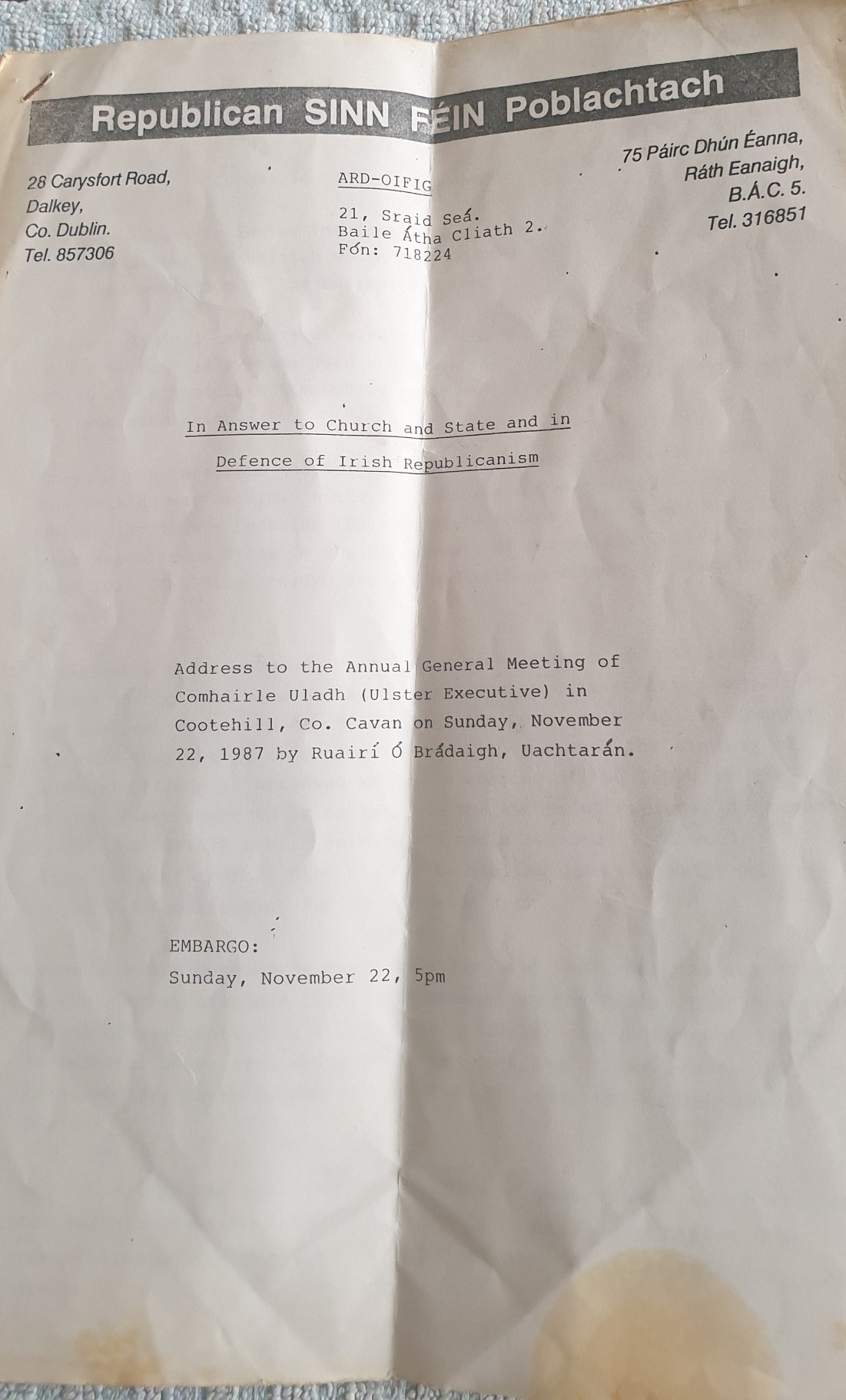
'IN ANSWER TO CHURCH AND STATE AND IN DEFENCE OF IRISH REPUBLICANISM...'
Address to the Annual General Meeting of Comhairle Uladh (Ulster Executive) in Cootehill, County Cavan, on Sunday, November 22nd, 1987, by Ruairí Ó Brádaigh, Uachtarán, Sinn Féin Poblachtach.
Comhaírle Uladh AGM, November 22nd, 1987.
But this country of ours can never be put to right until Britain withdraws her armed forces and administration from Ireland and recognises the right of the Irish people acting as a unit to determine their own future. Such is the recognised right of all peoples and the Irish have fought for it longer than most.
Irish republicanism has a high and honourable tradition. For close on two centuries it has called forth unstinting and unselfish service for the freedom of Ireland and the complete social, economic and cultural emancipation of the Irish people.
It still represents the only realistic alternative to the present colonial and neo-colonial morass which engulfs the Irish people.
It seeks to put the people, individually and collectively, in control of their own affairs in their own country. Republican Sinn Féin is confident that such an ideal will yet triumph.
(END of 'In Answer To Church And State And In Defence Of Irish Republicanism' : NEXT - 'Beir Bua', from 1998.)
Our families are taking a winter break in a few days time and heading off for a multi-trip 10-day-or-so 'staycation' ('staycaution', more like it..!) and meself and the Girl Gang are doing the same ; altogether, including the children and grandchildren and the '1169' team and the Girls, there'll be twenty-eight of us, in a large, colourful and noisey convoy and, I'm told, we'll bedecimatin......visiting (!) Waterford first, then heading to Galway, with a stop or two in between.
Scheduled stops, that is, but sure it's a long road that has no turnin', and we might happen across a little lay-by or two on the way!
Anyway. What has this got to do with you? Feck all, really, 'cepting for the fact that if the '1169' team are there (wherever "there" turns out to be!), we can't be here!
We don't expect to be back in Dublin (...most of them/us [that's my trans moment over..], hopefully!) until maybe between the tenth and twelfth of October, so we probably won't be in a position to post anything on the blog until at least Wednesday 18th October 2023.
I'll maybe still be a-rantin'-and-a-ravin' on Facebook and 'X', so ya could catch me there!
Thanks for the visit, and for reading : hope to see ye all on the 18th October 2023!
Sharon and the team.
On Saturday, 27th September 1958, the Irish republican POW's in the Curragh Internment Camp in County Kildare (of which there were about 150) had put together two football teams and had organised a football match between both sides.
That activity was a distraction for the prisoners and, more importantly, for the Free State Army guards and the other prison staff members, but two of the POW's were not involved in that distraction - they were taking advantgage of it instead!
Dáithí Ó Conaill and Ruairí Ó Brádaigh were lying under a roughly-made grass 'mat' at a less-noticeable section of the metal fence that kept them interned and were using a wire cutters to remove a section of it, which they did, successfully freeing themselves from State custody.
The two men were not only republican comrades and activists, but were to become related through Dáithí's marriage, in 1964, to a fine Donegal Lady, Deirdre Caffrey, who was Ruairí's maternal first cousin (and Deirdre was also sister-in-law to another strong Irish republican, Kevin Mallon).
The successful escape attempt had been authorised by the leadership of the Movement (including Tomás Óg MacCurtain, O/C of the IRA Internees) and meant that Ruairí, who was at the time a Sinn Féin TD (while incarcerated he was elected as a Sinn Féin TD, on an abstentionist ticket, obviously, for Longford–Westmeath in the 1957 State general election), was the first such republican TD to be 'on the run' since the 1920's and, the following month (October 1958) he was appointed as Chief of Staff of the IRA by the leadership (a position he held until May 1959). That escape (27th September 1958 - 65 years ago on this date) was the second such escape from the Curragh Internment Camp (pictured) that year.
In May, three POW's had got out through a window in the Curragh Military Hospital where they had been patients. Two of them – one from Armagh, the other from Portarlington – were recaptured near Kilcullen in County Meath and the third man, from Dublin, evaded capture for ten days until he was found at house in Gormanstown, in County Meath and, in the first week in December (1958) fourteen Irish republican internees escaped from the internment camp.
That Free State prison was closed on the 11th March 1959, as the Staters in Leinster House were comfortable within themselves that they had consolidated their position in the State.
And they still believe that to be the case...
'KEOGHBOYS OF THE 1950's...'
From 'The United Irishman' newspaper, April 1955.
The policy of 'The Irish Tenant League' was to form a political party pledged to independent opposition in parliament and it was based on a 'Union of Creeds'.
'The Restoration of the Hierarchy Act' and 'The Ecclesiastical Titles Act' started a controversy that threatened 'the Union' ; in Ireland, an ultra-catholic party was formed - 'The Catholic Defence Association' (aka 'Irish Brigade'/Pope's Brass Band').
The chief figures were William Keogh, a lawyer from Athlone, and John Sadlier, a hawker from Tipperary (...more about those two shysters here).
Nominally 'Tenant Righters', those two men caused ill-feeling inside the party, because they were so ferociously catholic. In the Westminster General Election of September, 1852, forty 'Tenant Right' members were returned, including William Keogh, John Sadlier, his brother, nephew and two cousins.
All took a solemn pledge that they would stand together in independent opposition and oppose every ministry that refused to introduce a 'Tenant Right Bill' but, when Lord Aberdeen's ministry was formed, he refused to adopt such a Bill... (MORE LATER.)
ON THIS DATE (27TH SEPTEMBER) 101 YEARS AGO : MORE REPRESSIVE LEGISLATION IMPOSED.
Irish Free State soldiers, left, were given ever more of a free reign to impose the dictat of their paymasters in Leinster House in 1922, with the passing of the gloriously misnamed 'Public Safety Act'.
On the 9th June 1927 a general election was called in the Free State and Fianna Fail won 44 seats to Cosgrave's 47 : de Valera's policy was not to enter the Free State parliament until the Oath of Allegiance to the British monarch was removed but, in that same month, Kevin O' Higgins was assassinated and the Free State government passed a law which would force future Leinster House candidates to swear on their nomination that they would take the Oath of Allegiance.
In August 1927, de Valera led the Fianna Fail elected representatives, many of them with revolvers in their pockets, into Leinster House and signed the Oath of Allegiance document. A second general election was held in September 1927 and Fianna Fail increased its vote, winning 57 seats.
In short, Free Staters were once again in power in the Free State (!) but Irish republicans continued to fight back - on the 21st September 1927, six Free State soldiers were killed in a gun battle with the IRA near Ballina in Mayo and, on that same day, the Free State barracks in Drumshambo in Leitrim was attacked and taken by republicans, during which one Stater was killed.
On the 22nd September a FS soldier was killed and several others and three civilians injured in a gun and grenade attack by the IRA on enemy troops on Eden Quay in Dublin and, on the day that the 'Public Safety Act' was being voted on in Leinster House, several hundred IRA Volunteers attacked the town of Killorglin, in Kerry, and were only denied their victory, after 24 hours of fighting, when more Free State troops arrived in force, from Tralee.
The 'Public Safety Act' had been passed in the Free State assembly by 41 votes to 18 on this date, 27th September (1922), 101 years ago, allowing for the State to execute those captured bearing arms against it and permitting State agents 'to punish anyone aiding and abetting attacks on the National (sic) Forces', and/or anyone having possession of arms or explosives 'without the proper authority' or anyone 'disobeying an Army General Order'.
'Section 5' of the Act declared that "..every person who is a member of an unlawful association at any time after it has become by virtue of this Act an unlawful association shall be guilty of a misdemeanour and shall be liable on conviction thereof to suffer penal servitude for any term not less than three years and not exceeding five years or imprisonment with or without hard labour for any term not exceeding two years..." .
'Section 28' stated that "..any person found guilty by a special court of the offence under the Firearms Act, 1925 (No. 17 of 1925) of having possession of or using or carrying a firearm without holding a firearm certificate therefor, shall if the offence was committed while this Part of this Act is in force be liable to suffer death or penal servitude for life, or any term of years not less than three years, or to imprisonment with or without hard labour for any term not exceeding two years, and shall be sentenced by such court accordingly.."
That 'Act' represented politically and morally corrupt legislation and was enacted by the then, and now, politically and morally corrupt political assembly in Leinster House.
IRELAND ON THE COUCH...
A Psychiatrist Writes.
'Magill' commissioned Professor Patricia Casey to compile an assessment of Irish society at what may emerge as the end of a period of unprecedented growth and change.
This is her report.
From 'Magill Magazine' Annual, 2002.
The worst culprits are the new estates that have been built around developing industries or the trendy apartment blocks designed to improve our inner cities.
Many of the inhabitants are mobile young people who see these houses not as homes but as temporary receptacles. Add to this the emptiness that comes from the absence of people during the day as couples go out to work, and the lack of amenities such as shops, bars or post-offices, and they become bleak places indeed. In such an environment, it is possible to be sick for days and have no callers - or to die and lie decaying without being missed.
If our sense of community is under pressure, so too is the traditional family. This is showing itself not so much in the divorce courts yet as in other more nebulous ways.
A recently published international study on depression in the community (in which I was one of the investigators) showed that one of the significant factors associated with the high rate of this condition in urban Ireland is the absence of supports, whilst the very low rate in Spain was equally linked to the protective role that strong ties, especially to the family, can have in ameliorating our stress... (MORE LATER.)
ON THIS DATE (27TH SEPTEMBER) 374 YEARS AGO : A WAR CRIMINAL AND "THE REDUCING OF CARLINGFORD".
Pictured - some of Oliver Cromwell's Irish victims, sold as slaves and 'sex workers' to the highest bidder.
On the 29th April, 1599, a baby boy, Oliver Cromwell, who had been born on the 25th, was christened in Saint John the Baptish church in Huntingdon, England.
Decades later, when someone was trawling through the birth records for that period, they came across an unofficial addendum to that particular entry : it read - "England's plague for five years.." Cromwell should need no introduction to readers of this blog, but some readers may not be aware of the significance of a particular date in this month - the 3rd September - in that creature's life : on that date in 1649, Cromwell began his nine-day siege of Drogheda after which thousands of its inhabitants were butchered, the infamous 'Death March' he forced on his enemy after the battle of Dunbar on the 3rd September 1650 and, one year later on that same date - the 3rd September - he wallowed in more blood and guts, this time in his own country, at the battle of Worcester.
And, somewhere in between wrecking havoc and stealing and selling Irish children, he found the time - on the 27th September in 1649, 374 years ago on this date - to write to his political bosses in London :
'FOR THE HONOURABLE WILLIAM LENTHALL, ESQUIRE, SPEAKER OF THE PARLIAMENT OF ENGLAND :
Dublin, 27th September 1649.
Mr. Speaker - I had not received any account from Colonel Venables - whom I sent from Tredah to endeavour the reducing of Carlingford, and so to march Northward towards a conjunction with Sir Charles Coote - until the last night.
After he came to Carlingford, having summoned the place, both the three Castles and the Fort commanding the Harbour were rendered to him. Wherein were about Forty Barrels of Powder, Seven Pieces of Cannon ; about a Thousand Muskets, and Five-hundred Pikes wanting twenty. In the entrance into the Harbour, Captain Fern, aboard your man-of-war, had some danger ; being much shot at from the Sea Fort, a bullet shooting through his main-mast. The Captain's entrance into that Harbour was a considerable adventure, and a good service ; as also was that of Captain Brandly, who, with Forty seamen, stormed a very strong Tenalia at Treda, and helped to take it ; for which he deserves an owning by you.
Venables marched from Carlingford, with a party of Horse and Dragoons, to the Newry ; leaving the place, and it was yielded before his Foot came up to him. Some other informations I have received from him, which promise well towards your Northern Interest ; which, if well prosecuted, will, I trust God, render you a good account of those parts. I have sent those things to be presented to the Council of State for their consideration. I pray God, as these mercies flow in upon you, He will give you an heart to improve them to His glory alone ; because He alone is the author of them, and of all the goodness, patience and long-suffering extending towards you. Your army has marched ; and, I believe, this night lieth at Arklow, in the County of Wicklow, by the Sea-side, between thirty and forty miles from this place. I am this day, by God’s blessing, going towards it.
I crave your pardon for this trouble; and rest, your most humble servant, OLIVER CROMWELL.
P.S. I desire the Supplies moved for may be hastened. I am verily persuaded, though the burden be great, yet it is for your service. If the Garrisons we take swallow-up your men, how shall we be able to keep the field? Who knows but the Lord may pity England's sufferings, and make a short work of this? It is in His hand to do it, and therein only your servants rejoice. I humbly present the condition of Captain George Jenkin's Widow. He died presently after Tredah Storm. His Widow is in great want.
The following Officers and Soldiers were slain at the storming of Tredah: Sir Arthur Ashton, Governor; Sir Edmund Varney, Lieutenant-Colonel to Ormond’s Regiment; Colonel Fleming, Lieutenant-Colonel Finglass, Major Fitzgerald, with eight Captains, eight Lieutenants, and eight Cornets, all of Horse; Colonels Warren, Wall, and Byrn, of Foot, with their Lieutenants, Majors, etc; the Lord Taaff’s Brother, an Augustine Friar; forty-four Captains, and all their Lieutenants, Ensigns, etc; 220 Reformadoes and Troopers; 2,500 Foot-soldiers, besides the Staff-Officers, Surgeons, etc.'
This misfit had another meeting with his lucky date - 3rd September - in 1658, when he was collected from this Earth by his maker.
A pity he was spawned at all.
'IN ANSWER TO CHURCH AND STATE AND IN DEFENCE OF IRISH REPUBLICANISM...'
Address to the Annual General Meeting of Comhairle Uladh (Ulster Executive) in Cootehill, County Cavan, on Sunday, November 22nd, 1987, by Ruairí Ó Brádaigh, Uachtarán, Sinn Féin Poblachtach.
Comhaírle Uladh AGM, November 22nd, 1987.
But this country of ours can never be put to right until Britain withdraws her armed forces and administration from Ireland and recognises the right of the Irish people acting as a unit to determine their own future. Such is the recognised right of all peoples and the Irish have fought for it longer than most.
Irish republicanism has a high and honourable tradition. For close on two centuries it has called forth unstinting and unselfish service for the freedom of Ireland and the complete social, economic and cultural emancipation of the Irish people.
It still represents the only realistic alternative to the present colonial and neo-colonial morass which engulfs the Irish people.
It seeks to put the people, individually and collectively, in control of their own affairs in their own country. Republican Sinn Féin is confident that such an ideal will yet triumph.
(END of 'In Answer To Church And State And In Defence Of Irish Republicanism' : NEXT - 'Beir Bua', from 1998.)
Our families are taking a winter break in a few days time and heading off for a multi-trip 10-day-or-so 'staycation' ('staycaution', more like it..!) and meself and the Girl Gang are doing the same ; altogether, including the children and grandchildren and the '1169' team and the Girls, there'll be twenty-eight of us, in a large, colourful and noisey convoy and, I'm told, we'll be
Scheduled stops, that is, but sure it's a long road that has no turnin', and we might happen across a little lay-by or two on the way!
Anyway. What has this got to do with you? Feck all, really, 'cepting for the fact that if the '1169' team are there (wherever "there" turns out to be!), we can't be here!
We don't expect to be back in Dublin (...most of them/us [that's my trans moment over..], hopefully!) until maybe between the tenth and twelfth of October, so we probably won't be in a position to post anything on the blog until at least Wednesday 18th October 2023.
I'll maybe still be a-rantin'-and-a-ravin' on Facebook and 'X', so ya could catch me there!
Thanks for the visit, and for reading : hope to see ye all on the 18th October 2023!
Sharon and the team.
Labels:
Arthur Ashton,
Captain Brandly,
Charles Coote,
Colonel Venables,
Edmund Varney.,
Tredah Storm,
William Lenthall
Sunday, September 24, 2023
FROM 1958 : THREE STRIKES, ALL OUT...!
The 'score' from this particular sporting occasion was 2 - 0, and it's an 'outing' that is still being talked about in Irish republican circles...!
In the mid-19th Century in Ireland, these two sniveling con-men managed to financially secure themselves, and their family members, at the expense of honest people who took them at their word...
Westminster demanded that an 'Oath of Allegiance' to their 'monarch' be agreed to by Irish republicans, who - rightly - wouldn't do so. But then a crack in the Movement developed, and those who were once dependable activists fell through it...
New families, but family support not to hand ; green-field sites, usually miles from any infrastructural support networks. Living beside strangers with the same concerns. Expensive 'pressure cookers'...
An English madman in Ireland, armed and supported by Westminster, left his mark in blood but someone marked his true presence in ink...
We'll be giving a bit more detail re the above snippets on Wednesday, 27th September 2023, so if you're over this side of the interweb on the 27th, do check in on us, won't ya...!
Thanks for the visit, and for reading : hope to see ye all on the 27th!
Sharon and the team.
Labels:
Irish history,
Irish politics.
Wednesday, September 20, 2023
"THE HYPOCRISY AND LAWLESSNESS OF THE SCRIBES AND PHARISEES..."
ON THIS DATE (20TH SEPTEMBER) 220 YEARS AGO : 'DARLING OF ERIN' BUTCHERED BY WESTMINSTER.
Robert Emmet was born on the 4th March, 1778, a son of Dr Robert Emmet and Elizabeth Mason. His father served as state physician to the vice-regal household but he was a social reformer who believed that in order to achieve the emancipation of the Irish people it was first necessary to break the link with England.
Robert Emmet (Jnr) was baptised on March 10th, 1778, in St Peter's Church of Ireland in Aungier Street, Dublin, and attended Oswald's School in Dropping Court, off Golden Lane, Dublin.
From there he went to Samuel Whytes School in Grafton Street, quite near his home, and later to the school of the Reverend Mr Lewis in Camden Street. He entered Trinity College, Dublin, in October 1793 when he was almost 16 years of age and practiced his oratorical skills in the historical and debating societies. One of his friends at TCD was the poet Thomas Moore.
There were four branches of the 'United Irishmen' in TCD and Robert Emmet was secretary of one of them but, after an inquisition, presided over by Lord Chancellor Fitzgibbon, Emmet became one of nineteen students who were expelled for United Irishmen activity.
Although not active in the 1798 Rising, Robert Emmet was well known to the British authorities and by April 1799, when 'Habeas Corpus' had been suspended, there was a warrant issued for his arrest, which he managed to evade. Early in 1801, accompanied by a Mr Malachy Delany of Cork, he travelled throughout Europe and made Paris his headquarters - it was there that he replaced Edward Lewis as the liaison officer between Irish and French republicans.
While in Paris, Emmet learned about rockets and weapons and studied a two-volume treatise by a Colonel Tempelhoff which can be examined in the Royal Irish Academy, with the marginal notes given the reader some insight into Emmet's thinking.
Following the signing of the 'Peace of Amiens' by France and England in March 1802, the United Irishmen that were being held as prisoners in Fort George were released and many such as Thomas Russell and Thomas Addis Emmet made there way to Paris. Emmet returned to Ireland in October 1802 and began to plan for a rising and, in March 1803, at a meeting in Corbet's Hotel, 105 Capel Street in Dublin, Emmet briefed his key organisers.
In April 1803 he rented an isolated house in Butterfield Lane in Rathfarnham as a new base of operations and Michael Dwyer, a 1798 veteran, suggested his young niece as a suitable candidate to play the role of the 'housekeeper'. Born in or around the year 1778, Ann Devlin soon became Robert Emmet's trusted helper and served him loyally in the months ahead.
Shortly afterwards he leased a premises at Marshalsea Lane, off Thomas Street, Dublin, and set up an arms depot there.
Arms depots were established in Dublin for the manufacture and storage of weapons for the incipient rising. Former soldiers mixed their practical skills with the scientific knowledge that Robert Emmet had acquired on the continent, and an innovative rocket device was produced. Elaborate plans were drawn up to take the city and in particular Dublin Castle : supporters from the surrounding counties of Kildare, Wicklow and even Wexford were pledged to assist.
Emmet bided his time waiting for an opportune moment when English troops would be withdrawn to serve in the renewed war in France, but his hand was forced when a premature explosion on the evening of July 16th, 1803, at the Patrick Street depot, caused the death of John Keenan. Though there was no obvious wide-scale search or arrest operation by the British following the explosion, the leadership of the movement decided to set Saturday July 23rd, 1803 as the date for the rising. Emmet hoped that success in Dublin would inspire other counties to follow suit.
Patrick M. Geoghegan, in a recent publication, says that "the plan for taking Dublin was breathtaking in its precision and audacity. It was nothing less that a blueprint for a dramatic coup d'état. Indeed, over a century later, Pearse and Clarke would also refer to the plan for their own rising.."
Emmet's plan depended on two factors - arms and men and, as Geoghegan states, when the time came, Robert Emmet had not enough of either - events went dramatically wrong for him. On the appointed day his plans began to unravel ; Michael Dwyer (pictured) and his promised 300 men did not get the word until Sunday July 24th and, the previous day, an excess of men had moved in to Dublin from Kildare and could not be concealed in the existing depots so they spread out around the city pubs and some started drinking.
Others, after inspecting the existing arsenal and finding many pikes but few muskets or blunderbusses, went home unimpressed.
Because he had alerted other countries and still had the element of surprise, Emmet decided not to postpone the rising thus, shortly after seven o'clock on Saturday July 23rd, 1803, Robert Emmet, in his green and gold uniform, stood in the Thomas Street, Dublin, depot and, to the assembled rebels, read out his proclamation, declaring that the Irish nation was about to assert itself in arms against foreign rule.
But again events conspired to thwart the rebels - coaches commissioned for the attack on Dublin Castle were lost and erroneous information supplied that encouraged pre-emptive strikes, meant that confusion reigned. Also, the novel rocket signals failed to detonate. Emmet's own forces, who were to have taken the Castle, dwindled away and, throughout the remainder of that evening, there were skirmishes at Thomas Street and the Coombe Barracks but he decided to terminate operations and leave the city.
For the English forces, which included Daniel O'Connell ("It is highly interesting to read that Daniel O'Connell, then a young barrister, enthusiastically joined a lawyer yeomen corps in 1803 to help in the pursuit of the rebels.." - from here), it was then merely a mopping-up operation : in the aftermath, the English arrested and tortured Anne Devlin, even offering her the enormous sum of £500 to betray Robert Emmet - she refused.
Emmet himself took refuge in the Harold's Cross area of Dublin, during which he met with his mother and Sarah Curran but, on Thursday August 25th, 1803, he was finally arrested.
It has been stated by others that a £1000 reward was paid by Dublin Castle to an informer, for supplying the information which led to his capture. Robert Emmet's misfortunes did not stop on his arrest : he was unlucky enough to be 'defended' by one Leonard McNally (pictured) who was trusted by the United Irishmen.
However, after McNally's death in 1820 it transpired that he was a highly paid government agent and, in his role as an informer, he had encouraged young men to join the rebels, betrayed them to Dublin Castle and would then collect fees from the United Irishmen to 'defend' those same rebels in court!
Emmet's 'trial' lasted 11 hours, and he stood for that entire duration, in front of a 'Special Commission' overseen by judge John Toler (better known as 'Hanging Lord Norbury') in Green Street Court House in Dublin on September 19th, 1803.
By about 9.30pm that night he was pronounced guilty and, asked for his reaction, he delivered a speech which still inspires today. He closed by saying that he cared not for the opinion of the court but for the opinion of the future - "..when other times and other men can do justice to my character...". Robert Emmet was publicly executed on Tuesday September 20th, 1803 - 220 years ago on this date - outside St Catherine's Church in Dublin's Thomas Street -
'The gallows on Thomas street was a temporary one which was built with planks and empty barrels and a cross beam on two poles about 12 feet tall. It was almost in the centre of the street...(his) final words on the gallows (were) "My friends, I die in peace and with sentiments of universal love and kindness towards all men"...the executioner began the hanging by dislodging a plank which was on a narrow ledge and Emmet convulsed on the end of the rope for over a half an hour when finally his body ceased to move...beheaded on a butchers block..if the reports of the blood squirting into the crowd when the procedure began are accurate, this would suggest that Robert Emmet was alive and merely unconscious at the time of his beheading...' (from here.)
His grave has yet to be located...
'KEOGHBOYS OF THE 1950's...'
From 'The United Irishman' newspaper, April 1955.
Having likened the 'Ancient Order of Hibernians' various spokesmen to the 'Pope's Brass Band', it will be, I think, no harm to consider the latter and the part they played in Irish history.
In 1850, representatives of catholic and protestant tenants held a national conference and formed 'The Irish Tenant League', the aim of which was to legalise tenant rights and extend it throughout Ireland. It was legal nowhere but existed in Ulster by force of custom.
Its leaders were Sharman Crawford, an Ulster landlord ; Charles Gavin Duffy, who had been a 'Young Irelander' ; Doctor James MacKnight, who edited 'The Banner of Ulster', a presbyterian newspaper, and Frederick Lucas, a convert from Quakerism and, at the time, the editor of the English catholic newspaper 'The Tablet', which was then published in Dublin.
'The League' was strongly supported by clergy, both catholic and presbyterian, and by numbers of professional men... (MORE LATER.)
ON THIS DATE (20TH SEPTEMBER) 109 YEARS AGO : IRISH LEADER CAMPAIGNS FOR RECRUITMENT TO BRITISH ARMY.
John Redmond (left), the leader of the 'Irish Parliamentary Party', was born into a 'Big House'-type Catholic family on the 1st September in 1856 and, after a 'proper' education (in Clongowes College in Kildare and Trinity College in Dublin) he became a political 'player' in the British so-called 'House of Commons', where he supplemented his income as a clerk.
He was only 25 years-of-age when he was first elected as an MP, having worked his way up the establishment ladder.
He was an Irish nationalist (small 'n') politician who, occasionally, campaigned for his followers (and anyone else that would listen to him) to join the British Army in its fight against Germany, and did so infamously, and unashamedly, in a public speech he delivered in Woodenbridge in County Wicklow on this date - 20th September - in 1914, where he stated -
"The interests of Ireland - of the whole of Ireland - are at stake in this war. This war is undertaken in the defence of the highest principles of religion and morality and right, and it would be a disgrace for ever to our country and a reproach to her manhood and a denial of the lessons of her history if young Ireland confined their efforts to remaining at home to defend the shores of Ireland from an unlikely invasion, and to shrinking from the duty of proving on the field of battle that gallantry and courage which has distinguished our race all through its history.
I say to you, therefore, your duty is twofold. I am glad to see such magnificent material for soldiers around me, and I say to you: 'Go on drilling and make yourself efficient for the work, and then account yourselves as men, not only for Ireland itself, but wherever the fighting line extends, in defence of right, of freedom, and religion in this war...' ".
And, unfortunately, in the months that followed his 'call to arms', tens of thousands of Irishmen joined his 'Cause' and fought alongside imperialism to the extent that one of his modern-day political mirror-images all but called Redmond a traitor for encouraging such folly.
Other political leaders did not agree with John Redmond and, among them, was James Connolly, the Irish Trade Union leader, who was also in command of the Irish Citizen Army - he answered Redmond's call thus :
'Full steam ahead, John Redmond said,
that everything was well, chum ;
Home Rule will come when we are dead,
and buried out in Belgium'.
Also, some of John Redmond's own men dis-agreed with his pro-British 'call-to-arms' ; Eoin MacNeill, who was then in a leadership position within the 'Irish Volunteers', was of the opinion that the 'Irish Volunteers' should only use force against the British if* Westminster first moved against them ; a bit 'watery', definitely, but he was, however, against fighting with the British (*if having your country occupied by a foreign power cannot be considered a 'first move against us' then Mr MacNeill had a different understanding of the English language than we have!).
Just over a year after Mr Redmond had delivered his 'join imperialism'-speech in Woodenbridge, a British Army Major-General, 'Sir' Lovick Bransby Friend (..perhaps his parents never bonded with him?) the Commander-in-Chief of the British Army in Ireland, said that 1,100 recruits were needed from Ireland every week "to replace wastage" (!) of existing Irish soldiers.
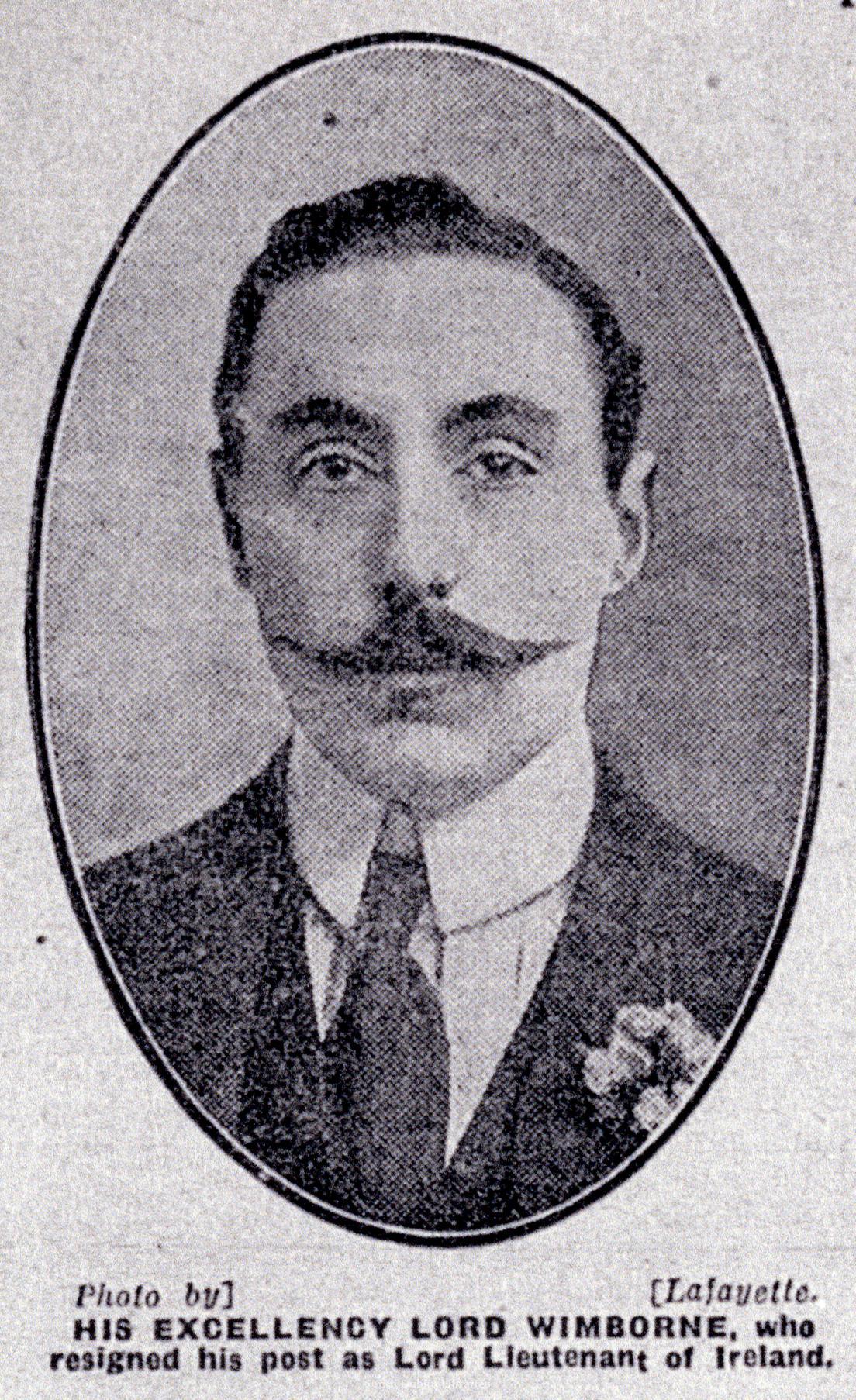
The comments were made at a private conference on recruiting in Ireland that was held under the presidency of the 'Lord' Lieutenant of Ireland, Lord Wimborne, at the Viceregal Lodge in Dublin's Phoenix Park, where it was also stated that approximately 81,000 Irishmen had 'heeded Redmond's call-to-arms'.
The political mirror-image, mentioned above, had a point...
IRELAND ON THE COUCH...
A Psychiatrist Writes.
'Magill' commissioned Professor Patricia Casey to compile an assessment of Irish society at what may emerge as the end of a period of unprecedented growth and change.
This is her report.
From 'Magill Magazine' Annual, 2002.
If we are apathetic about how our citizens behave, are we also apathetic about their troubles?
There is certainly anecdotal evidence that we are less neighbourly than in times past. If the British are renowned for their reserve, the Irish have an equal measure of extraversion and friendliness but, increasingly, neighbours have just a passing knowledge of each other and may hardly even know each other's names.
Conversations are limited to the few words of greeting in the lift or at the bus stop on the way to work. There is no sense of belonging, no sense that one is part of something larger than oneself, no sense of shared purpose. This fragmentation is as prominent in many of our modern middle-class estates as in areas of poverty and crime.
Of course, estates vary greatly and, as they age, the sense of belonging and of community increases... (MORE LATER.)
ON THIS DATE (20TH SEPTEMBER) 106 YEARS AGO : THE DEATH OF THE FIRST OF OUR TWENTY-TWO HUNGER-STRIKERS.
Thomas Ashe (pictured) was born in Lispole, County Kerry, on the 12th of January 1885 - he was the seventh of ten siblings. He qualified as a teacher in 1905 at De La Salle College, Waterford and after teaching briefly in Kinnard, County Kerry, in 1906 he became principal of Corduff National School in Lusk, County Dublin. He was a fluent Irish speaker and a member of the Keating branch of the Gaelic League and was an accomplished sportsman and musician setting up the Round Towers GAA Club as well as helping to establish the Lusk Pipe Band. He was also a talented singer and poet who was committed to Conradh na Gaeilge.
Politically, he was a member of the Irish Republican Brotherhood (IRB) and established IRB circles in Dublin and Kerry and eventually became President of the Supreme Council in 1917. While he was actively and intellectually nationalist he was also inspired by contemporary socialism.
Ashe rejected conservative Home Rule politicians and as part of that rejection he espoused the Labour policies of James Larkin. Writing in a letter to his brother Gregory he said - "We are all here on Larkin's side. He'll beat hell out of the snobbish, mean, seoinín employers yet, and more power to him".
Ashe supported the unionisation of north Dublin farm labourers and his activities brought him into conflict with landowners such as Thomas Kettle *. During the infamous lockout in 1913 he was a frequent visitor to Liberty Hall and become a friend of James Connolly. Long prior to its publication in 1916, Thomas Ashe was a practitioner of Connolly’s dictum that "the cause of labour is the cause of Ireland, the cause of Ireland is the cause of labour".
In 1914 Ashe travelled to the United States where he raised a substantial sum of money for both the Gaelic League and the newly formed Irish Volunteers of which he was an early member.
(*'Tom Kettle was a member of the National Volunteers, and in 1914 went to Belgium to buy arms for them. Whilst there, war broke out, and he became convinced of the justice of the Allied cause. He returned to Ireland, and made a series of recruiting speeches, which effectively alienated him from the Nationalist movement. Kettle then joined the Royal Dublin Fusiliers. After the Easter Rising and the murder of Francis Sheehy-Skeffington he asked to be sent to the Front, and was killed on the eve of the Battle of Ginchy, 9 September 1916. His body was never recovered...')
He founded the Volunteers in Lusk and established a firm foundation of practical and theoretical military training, and provided charismatic leadership first as Adjutant and then as O/C (Officer Commanding) the 5th Battalion of the Dublin Brigade, where he inspired fierce loyalty and encouraged personal initiative in his junior officers and was therefore able to confidently delegate command to Charlie Weston, Joseph Lawless, Edward Rooney and others during the Rising.
Most significantly, he took advantage of the arrival of Richard Mulcahy at Finglas Glen on the Tuesday of the Rising and appointed him second in command. The two men knew one another through the IRB and Gaelic League and Ashe recognized Mulcahy's tactical abilities. As a result Ashe allowed himself to be persuaded by Mulcahy not to withdraw following the unexpected arrival of a motorised force of British 'police' at the Rath crossroads, Ashbourne, on the 28th of April, 1916 - he demonstrated great personal courage, first exposing himself to fire while calling on the RIC in the fortified barracks to surrender and then actively leading his Volunteers against the RIC during the battle.
After the 1916 Rising he was court-martialed (on the 8th of May 1916) and was sentenced to death, which was commuted to penal servitude for life. He was incarcerated in a variety of English prisons before being released in the June 1917 general amnesty and immediately returned to Ireland and toured the country reorganising the IRB and inciting civil opposition to British rule.
In August 1917, after a speech in Ballinalee, County Longford, he was arrested by the RIC and charged with "speeches calculated to cause disaffection". He was detained in the Curragh Camp and later sentenced to a year's hard labour in Mountjoy Jail. There he became O/C of the Volunteer prisoners, and demanded prisoner-of-war status and, as a result, he was punished by the Governor.
He went on hunger strike on the 20th September 1917 - 106 years ago on this date - and five days later died as a result of force-feeding by the prison authorities. He was 32 years old. His death resulted in POW status being conceded to the Volunteer prisoners two days later.
His funeral was the first public funeral after the Rising and provided a focal point for public disaffection with British rule ; his body lay in state in Dublin City Hall before being escorted by armed Volunteers to Glasnevin Cemetery. 30,000 people attended the burial where three volleys were fired over the grave and the Last Post was sounded.
While imprisoned in Lewes Jail in 1916, he had written his poem 'Let Me Carry Your Cross for Ireland, Lord' which later provided the inspiration for the 'Battle of Ashbourne Memorial', which was unveiled by Sean T. O'Kelly on Easter Sunday, 26th April 1959, at the Rath Cross in Ashbourne :
Let me carry your Cross for Ireland, Lord
The hour of her trial draws near,
And the pangs and the pains of the sacrifice
May be borne by comrades dear.
But, Lord, take me from the offering throng,
There are many far less prepared,
Through anxious and all as they are to die
That Ireland may be spared.
Let me carry your Cross for Ireland, Lord
My cares in this world are few,
and few are the tears will for me fall
When I go on my way to You.
Spare Oh! Spare to their loved ones dear
The brother and son and sire,
That the cause we love may never die
In the land of our Heart's desire!
Let me carry your Cross for Ireland, Lord!
Let me suffer the pain and shame
I bow my head to their rage and hate,
And I take on myself the blame.
Let them do with my body what'er they will,
My spirit I offer to You,
That the faithful few who heard her call
May be spared to Roisin Dubh.
Let me carry your Cross for Ireland, Lord!
For Ireland weak with tears,
For the aged man of the clouded brow,
And the child of tender years;
For the empty homes of her golden plains,
For the hopes of her future, Too!
Let me carry your Cross for Ireland, Lord!
For the cause of Roisin Dubh.
The jury at the inquest into his death found that "Thomas Ashe, according to the medical evidence of Professor McWeeney, Sir Arthur Chance, and Sir Thomas Myles, died from heart failure and congestion of the lungs on the 25th September, 1917 and that his death was caused by the punishment of taking away from the cell bed, bedding and boots and allowing him to be on the cold floor for 50 hours, and then subjecting him to forcible feeding in his weak condition after hunger-striking for five or six days.."
Michael Collins organised the funeral and transformed it into a national demonstration against British misrule in Ireland ; armed Irish Republican Brotherhood Volunteers in full uniform flanked the coffin, followed by 9,000 other IRB Volunteers and approximately 30,000 people lined the streets. A volley of shots was fired over his grave, following which Michael Collins stated - "Nothing more remains to be said. That volley which we have just heard is the only speech which it is proper to make over the grave of a dead Fenian."
The London-based 'Daily Express' newspaper perhaps summed it up best when it stated that what had happened had made '100,000 Sinn Féiners out of 100,000 constitutional nationalists.'
The level of support shown gave a boost to Irish republicans, and this was noted by the 'establishment' in Westminster - 'The Daily Mail' newspaper claimed that, a month earlier, Sinn Féin, despite its electoral successes, had been a waning force, and opined 'it had no practical programme, for the programme of going further than anyone else cannot be so described. It was not making headway. But Sinn Féin today is pretty nearly another name for the vast bulk of youth in Ireland...'
Thomas Ashe, the first of twenty-two Irish republican fighters to die on hunger-strike, began his protest on this date, 20th September, 106 years ago.
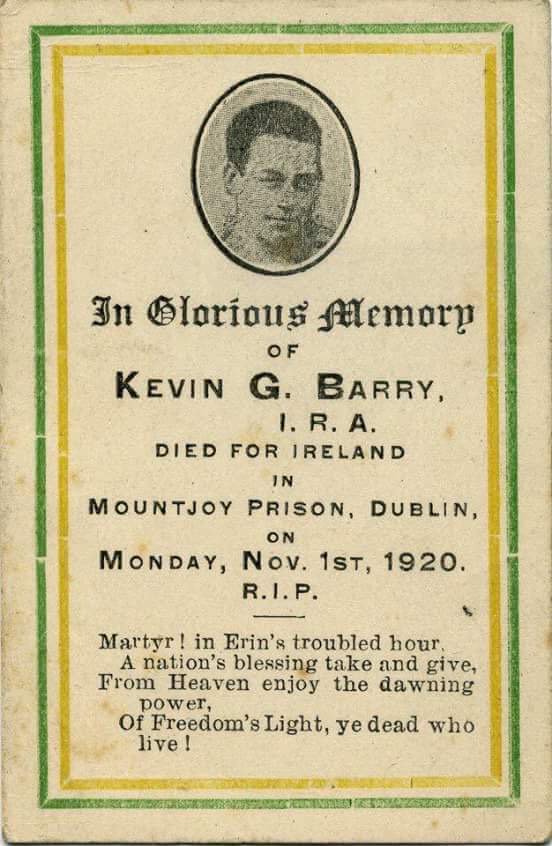
ON THIS DATE (20TH SEPTEMBER) 103 YEARS AGO : IRISH REBEL CAPTURED IN DUBLIN BY BRITISH SOLDIERS.
Pictured - the 'arrest' by British forces of Irish republican Kevin Barry, in Upper Church Street in Dublin, on Monday 20th September, 1920 - 103 years ago on this date.
On that morning, 18-year-old Kevin Barry had gone to Mass and received Holy Communion, then joined a party of IRA volunteers on Bolton Street in Dublin. Their orders were to ambush a British army truck as it picked up a delivery of bread from Monk's Bakery at the junction of North King Street and Church Street and capture their weapons.
The ambush was scheduled for 11am, which gave him enough time to take part in the operation and return to UCD in time for a medical examination he had at 2pm. The gun he was using jammed during the operation (he had left his own weapon in Carlow and was using a borrowed one) and he was forced to seek shelter - he rolled under the British Army truck and continued trying to free the jammed gun.
His comrades left the scene as they were outnumbered and had lost the element of surprise, and Barry might very well have escaped capture in his hiding place had a local woman, a Mrs Garrett, who ran a coal and vegetable shop near the bakery, not shouted out to the driver of the British Army lorry that he shouldn't move it as the person under it (Kevin Barry) could get run over.
Barry was captured and placed in the back of the military lorry along with three dead or mortally wounded British soldiers and the poor woman blamed herself, as did some of her neighbours.
Kevin's sister, Kathy (pictured), exonerated the woman from any blame for his capture -
"Incidentally, I should mention that some months after his execution we were most distressed to hear that this woman had been driven mad and was in an asylum as a result of the blame attached to her by her neighbours. There was nothing we could usefully do about it beyond explaining where we could that, in Kevin's own account of it to me on the day of his court martial, he was convinced that she cried out because she was afraid that the man under the lorry would be run over."
In an affidavit drawn up in Mountjoy Prison days before his execution, he wrote -
"I, Kevin Barry, of 58 South Circular Road, in the County of Dublin, Medical Student, aged 18 years and upwards solemnly and sincerely declare as follows: On the 20th of September 1920, I was arrested in Upper Church Street by a Sergeant of the 2nd Duke of Wellington's regiment and was brought under escort to the North Dublin Union now occupied by military. I was brought into the guard room and searched. I was then moved to the defaulter's room by an escort with a Sergeant-Major, who all belonged to 1st Lancashire Fusiliers. I was then hand-cuffed.
About 15 minutes after I was put into the defaulter’s room, two Commissioned Officers of the 1st Lancashire Fusiliers came in. They were accompanied by 3 Sergeants of the same unit. A military policeman who had been in the same room since I entered it remained. One of the officers asked me my name, which I gave. He then asked me for the names of my companions in the raid.
I refused to give them. He tried to persuade me to give the names and I persisted in refusing. He then sent a Sergeant for a bayonet. When it was brought in the Sergeant was ordered by this officer to point the bayonet at my stomach. The same questions as to the names and addresses of my companions were repeated with the same results. The Sergeant was then ordered to turn my face to the wall and point the bayonet to my back. The sergeant then said he would run the bayonet into me if I did not tell. The bayonet was then removed and I was turned round again.
This officer then said that if I still persisted in this attitude he would turn me out to the men in the barrack square and he supposed I knew what that meant with the men in their present temper. I said nothing. He ordered the Sergeants to put me face down on the floor and twist my arm. I was pushed down onto the floor after my handcuffs were removed. When I lay on the floor one of the Sergeants knelt on the small of my back, the other two placed one foot each on my back and left shoulder and the man who knelt on me twisted my right arm, holding it by the wrist with one hand while he held my hair with the other to pull back my head. The arm was twisted from the elbow joint. This continued to the best of my knowledge for 5 minutes. It was very painful. The first officer was standing near my feet and the officer who accompanied him was still present. During the twisting of my arm the first officer continued to question me for the names and addresses of my companions and the names of my Company Commander or any other officer I knew. As I still refused to answer these questions I was let up and handcuffed.
A civilian came in and he repeated the same questions with the same results. He informed me that if I gave all the information I knew I could get off. I was then left in the company of the military policeman. The two officers, three sergeants and civilian all left together. I could certainly identify the officer who directed the proceedings and put the questions. I am not sure of the others except the sergeant with the bayonet. My arm was medically treated by an officer of the Royal Army Medical Corps attached to the North Dublin Union the following morning and by the prison hospital orderly afterwards for 4 or 5 days. I was visited by the Court Martial Officer last night and he read the confirmation of sentence of death by hanging to be executed on Monday next and I make this solemn declaration conscientiously believing same to be true and by virtue of the Statutory Declarations Act, 1835.
Declared and subscribed before me at Mountjoy Prison in the County of the City of Dublin, 28 October, 1920 Signed Myles Keogh, A justice of the peace for said County.
Kevin Gerard Barry."
On Halloween night, 1920 - the night before his execution - Kevin Barry was given a blue-leaded pencil and paper with which to write his last letter :
"Dear Boys, I had quite a crowd of visitors today and a crowd from the college prayed and sang outside the gates but perhaps you were there. Well boys, we have seen some good times, and I have always considered myself lucky to have such a crowd of pals. It's the only thing which makes it hard to go, the fact of leaving you chaps and other friends behind. Now I charge you thank anybody you know for me, who has had masses etc said. Everybody has been awfully decent and I can assure you I appreciate it. Also say just a few more prayers when I go over, and then you can rest.
Your pal, Kevin."
As he was writing that last letter, Father Francis Browne SJ, a teacher at Belvedere College, cycled to the Vice Regal lodge in Dublin's Phoenix Park to plead for Barry's life, but to no avail.
18-year-old Kevin Barry was hanged in Mountjoy Jail in Dublin on the 1st November 1920, the first republican to be executed since the leaders of the Easter Rising of 1916.
Ar dheis Dé go raibh a anam.
'IN ANSWER TO CHURCH AND STATE AND IN DEFENCE OF IRISH REPUBLICANISM...'
Address to the Annual General Meeting of Comhairle Uladh (Ulster Executive) in Cootehill, County Cavan, on Sunday, November 22nd, 1987, by Ruairí Ó Brádaigh, Uachtarán, Sinn Féin Poblachtach.
Comhaírle Uladh AGM, November 22nd, 1987.
The hypocrisy and lawlessness of the scribes and pharisees are as prevalent and as scandalous today as they were 2,000 years ago.
All of this has not gone unnoticed by the nationalist people of the Six Counties who now feel that their lives count for little or nothing in the cynical power-play between London and Dublin.
The one consolation for them in recent years was the massive and spontaneous demonstration of support by the ordinary people of this island following the shooting dead by British paratroopers of 13 unarmed people in Derry on the 30th January 1972.
British colonial rule in Ireland is the root cause of all political turmoil here. It is still "the never-failing source of all our political evils." Loss of uninvolved civilian lives cannot be justified no matter who is responsible... (MORE LATER.)
Thanks for the visit, and for reading,
Sharon and the team.
Robert Emmet was born on the 4th March, 1778, a son of Dr Robert Emmet and Elizabeth Mason. His father served as state physician to the vice-regal household but he was a social reformer who believed that in order to achieve the emancipation of the Irish people it was first necessary to break the link with England.
Robert Emmet (Jnr) was baptised on March 10th, 1778, in St Peter's Church of Ireland in Aungier Street, Dublin, and attended Oswald's School in Dropping Court, off Golden Lane, Dublin.
From there he went to Samuel Whytes School in Grafton Street, quite near his home, and later to the school of the Reverend Mr Lewis in Camden Street. He entered Trinity College, Dublin, in October 1793 when he was almost 16 years of age and practiced his oratorical skills in the historical and debating societies. One of his friends at TCD was the poet Thomas Moore.
There were four branches of the 'United Irishmen' in TCD and Robert Emmet was secretary of one of them but, after an inquisition, presided over by Lord Chancellor Fitzgibbon, Emmet became one of nineteen students who were expelled for United Irishmen activity.
Although not active in the 1798 Rising, Robert Emmet was well known to the British authorities and by April 1799, when 'Habeas Corpus' had been suspended, there was a warrant issued for his arrest, which he managed to evade. Early in 1801, accompanied by a Mr Malachy Delany of Cork, he travelled throughout Europe and made Paris his headquarters - it was there that he replaced Edward Lewis as the liaison officer between Irish and French republicans.
While in Paris, Emmet learned about rockets and weapons and studied a two-volume treatise by a Colonel Tempelhoff which can be examined in the Royal Irish Academy, with the marginal notes given the reader some insight into Emmet's thinking.
Following the signing of the 'Peace of Amiens' by France and England in March 1802, the United Irishmen that were being held as prisoners in Fort George were released and many such as Thomas Russell and Thomas Addis Emmet made there way to Paris. Emmet returned to Ireland in October 1802 and began to plan for a rising and, in March 1803, at a meeting in Corbet's Hotel, 105 Capel Street in Dublin, Emmet briefed his key organisers.
In April 1803 he rented an isolated house in Butterfield Lane in Rathfarnham as a new base of operations and Michael Dwyer, a 1798 veteran, suggested his young niece as a suitable candidate to play the role of the 'housekeeper'. Born in or around the year 1778, Ann Devlin soon became Robert Emmet's trusted helper and served him loyally in the months ahead.
Shortly afterwards he leased a premises at Marshalsea Lane, off Thomas Street, Dublin, and set up an arms depot there.
Arms depots were established in Dublin for the manufacture and storage of weapons for the incipient rising. Former soldiers mixed their practical skills with the scientific knowledge that Robert Emmet had acquired on the continent, and an innovative rocket device was produced. Elaborate plans were drawn up to take the city and in particular Dublin Castle : supporters from the surrounding counties of Kildare, Wicklow and even Wexford were pledged to assist.
Emmet bided his time waiting for an opportune moment when English troops would be withdrawn to serve in the renewed war in France, but his hand was forced when a premature explosion on the evening of July 16th, 1803, at the Patrick Street depot, caused the death of John Keenan. Though there was no obvious wide-scale search or arrest operation by the British following the explosion, the leadership of the movement decided to set Saturday July 23rd, 1803 as the date for the rising. Emmet hoped that success in Dublin would inspire other counties to follow suit.
Patrick M. Geoghegan, in a recent publication, says that "the plan for taking Dublin was breathtaking in its precision and audacity. It was nothing less that a blueprint for a dramatic coup d'état. Indeed, over a century later, Pearse and Clarke would also refer to the plan for their own rising.."
Emmet's plan depended on two factors - arms and men and, as Geoghegan states, when the time came, Robert Emmet had not enough of either - events went dramatically wrong for him. On the appointed day his plans began to unravel ; Michael Dwyer (pictured) and his promised 300 men did not get the word until Sunday July 24th and, the previous day, an excess of men had moved in to Dublin from Kildare and could not be concealed in the existing depots so they spread out around the city pubs and some started drinking.
Others, after inspecting the existing arsenal and finding many pikes but few muskets or blunderbusses, went home unimpressed.
Because he had alerted other countries and still had the element of surprise, Emmet decided not to postpone the rising thus, shortly after seven o'clock on Saturday July 23rd, 1803, Robert Emmet, in his green and gold uniform, stood in the Thomas Street, Dublin, depot and, to the assembled rebels, read out his proclamation, declaring that the Irish nation was about to assert itself in arms against foreign rule.
But again events conspired to thwart the rebels - coaches commissioned for the attack on Dublin Castle were lost and erroneous information supplied that encouraged pre-emptive strikes, meant that confusion reigned. Also, the novel rocket signals failed to detonate. Emmet's own forces, who were to have taken the Castle, dwindled away and, throughout the remainder of that evening, there were skirmishes at Thomas Street and the Coombe Barracks but he decided to terminate operations and leave the city.
For the English forces, which included Daniel O'Connell ("It is highly interesting to read that Daniel O'Connell, then a young barrister, enthusiastically joined a lawyer yeomen corps in 1803 to help in the pursuit of the rebels.." - from here), it was then merely a mopping-up operation : in the aftermath, the English arrested and tortured Anne Devlin, even offering her the enormous sum of £500 to betray Robert Emmet - she refused.
Emmet himself took refuge in the Harold's Cross area of Dublin, during which he met with his mother and Sarah Curran but, on Thursday August 25th, 1803, he was finally arrested.
It has been stated by others that a £1000 reward was paid by Dublin Castle to an informer, for supplying the information which led to his capture. Robert Emmet's misfortunes did not stop on his arrest : he was unlucky enough to be 'defended' by one Leonard McNally (pictured) who was trusted by the United Irishmen.
However, after McNally's death in 1820 it transpired that he was a highly paid government agent and, in his role as an informer, he had encouraged young men to join the rebels, betrayed them to Dublin Castle and would then collect fees from the United Irishmen to 'defend' those same rebels in court!
Emmet's 'trial' lasted 11 hours, and he stood for that entire duration, in front of a 'Special Commission' overseen by judge John Toler (better known as 'Hanging Lord Norbury') in Green Street Court House in Dublin on September 19th, 1803.
By about 9.30pm that night he was pronounced guilty and, asked for his reaction, he delivered a speech which still inspires today. He closed by saying that he cared not for the opinion of the court but for the opinion of the future - "..when other times and other men can do justice to my character...". Robert Emmet was publicly executed on Tuesday September 20th, 1803 - 220 years ago on this date - outside St Catherine's Church in Dublin's Thomas Street -
'The gallows on Thomas street was a temporary one which was built with planks and empty barrels and a cross beam on two poles about 12 feet tall. It was almost in the centre of the street...(his) final words on the gallows (were) "My friends, I die in peace and with sentiments of universal love and kindness towards all men"...the executioner began the hanging by dislodging a plank which was on a narrow ledge and Emmet convulsed on the end of the rope for over a half an hour when finally his body ceased to move...beheaded on a butchers block..if the reports of the blood squirting into the crowd when the procedure began are accurate, this would suggest that Robert Emmet was alive and merely unconscious at the time of his beheading...' (from here.)
His grave has yet to be located...
'KEOGHBOYS OF THE 1950's...'
From 'The United Irishman' newspaper, April 1955.
Having likened the 'Ancient Order of Hibernians' various spokesmen to the 'Pope's Brass Band', it will be, I think, no harm to consider the latter and the part they played in Irish history.
In 1850, representatives of catholic and protestant tenants held a national conference and formed 'The Irish Tenant League', the aim of which was to legalise tenant rights and extend it throughout Ireland. It was legal nowhere but existed in Ulster by force of custom.
Its leaders were Sharman Crawford, an Ulster landlord ; Charles Gavin Duffy, who had been a 'Young Irelander' ; Doctor James MacKnight, who edited 'The Banner of Ulster', a presbyterian newspaper, and Frederick Lucas, a convert from Quakerism and, at the time, the editor of the English catholic newspaper 'The Tablet', which was then published in Dublin.
'The League' was strongly supported by clergy, both catholic and presbyterian, and by numbers of professional men... (MORE LATER.)
ON THIS DATE (20TH SEPTEMBER) 109 YEARS AGO : IRISH LEADER CAMPAIGNS FOR RECRUITMENT TO BRITISH ARMY.
John Redmond (left), the leader of the 'Irish Parliamentary Party', was born into a 'Big House'-type Catholic family on the 1st September in 1856 and, after a 'proper' education (in Clongowes College in Kildare and Trinity College in Dublin) he became a political 'player' in the British so-called 'House of Commons', where he supplemented his income as a clerk.
He was only 25 years-of-age when he was first elected as an MP, having worked his way up the establishment ladder.
He was an Irish nationalist (small 'n') politician who, occasionally, campaigned for his followers (and anyone else that would listen to him) to join the British Army in its fight against Germany, and did so infamously, and unashamedly, in a public speech he delivered in Woodenbridge in County Wicklow on this date - 20th September - in 1914, where he stated -
"The interests of Ireland - of the whole of Ireland - are at stake in this war. This war is undertaken in the defence of the highest principles of religion and morality and right, and it would be a disgrace for ever to our country and a reproach to her manhood and a denial of the lessons of her history if young Ireland confined their efforts to remaining at home to defend the shores of Ireland from an unlikely invasion, and to shrinking from the duty of proving on the field of battle that gallantry and courage which has distinguished our race all through its history.
I say to you, therefore, your duty is twofold. I am glad to see such magnificent material for soldiers around me, and I say to you: 'Go on drilling and make yourself efficient for the work, and then account yourselves as men, not only for Ireland itself, but wherever the fighting line extends, in defence of right, of freedom, and religion in this war...' ".
And, unfortunately, in the months that followed his 'call to arms', tens of thousands of Irishmen joined his 'Cause' and fought alongside imperialism to the extent that one of his modern-day political mirror-images all but called Redmond a traitor for encouraging such folly.
Other political leaders did not agree with John Redmond and, among them, was James Connolly, the Irish Trade Union leader, who was also in command of the Irish Citizen Army - he answered Redmond's call thus :
'Full steam ahead, John Redmond said,
that everything was well, chum ;
Home Rule will come when we are dead,
and buried out in Belgium'.
Also, some of John Redmond's own men dis-agreed with his pro-British 'call-to-arms' ; Eoin MacNeill, who was then in a leadership position within the 'Irish Volunteers', was of the opinion that the 'Irish Volunteers' should only use force against the British if* Westminster first moved against them ; a bit 'watery', definitely, but he was, however, against fighting with the British (*if having your country occupied by a foreign power cannot be considered a 'first move against us' then Mr MacNeill had a different understanding of the English language than we have!).
Just over a year after Mr Redmond had delivered his 'join imperialism'-speech in Woodenbridge, a British Army Major-General, 'Sir' Lovick Bransby Friend (..perhaps his parents never bonded with him?) the Commander-in-Chief of the British Army in Ireland, said that 1,100 recruits were needed from Ireland every week "to replace wastage" (!) of existing Irish soldiers.
The comments were made at a private conference on recruiting in Ireland that was held under the presidency of the 'Lord' Lieutenant of Ireland, Lord Wimborne, at the Viceregal Lodge in Dublin's Phoenix Park, where it was also stated that approximately 81,000 Irishmen had 'heeded Redmond's call-to-arms'.
The political mirror-image, mentioned above, had a point...
IRELAND ON THE COUCH...
A Psychiatrist Writes.
'Magill' commissioned Professor Patricia Casey to compile an assessment of Irish society at what may emerge as the end of a period of unprecedented growth and change.
This is her report.
From 'Magill Magazine' Annual, 2002.
If we are apathetic about how our citizens behave, are we also apathetic about their troubles?
There is certainly anecdotal evidence that we are less neighbourly than in times past. If the British are renowned for their reserve, the Irish have an equal measure of extraversion and friendliness but, increasingly, neighbours have just a passing knowledge of each other and may hardly even know each other's names.
Conversations are limited to the few words of greeting in the lift or at the bus stop on the way to work. There is no sense of belonging, no sense that one is part of something larger than oneself, no sense of shared purpose. This fragmentation is as prominent in many of our modern middle-class estates as in areas of poverty and crime.
Of course, estates vary greatly and, as they age, the sense of belonging and of community increases... (MORE LATER.)
ON THIS DATE (20TH SEPTEMBER) 106 YEARS AGO : THE DEATH OF THE FIRST OF OUR TWENTY-TWO HUNGER-STRIKERS.
Thomas Ashe (pictured) was born in Lispole, County Kerry, on the 12th of January 1885 - he was the seventh of ten siblings. He qualified as a teacher in 1905 at De La Salle College, Waterford and after teaching briefly in Kinnard, County Kerry, in 1906 he became principal of Corduff National School in Lusk, County Dublin. He was a fluent Irish speaker and a member of the Keating branch of the Gaelic League and was an accomplished sportsman and musician setting up the Round Towers GAA Club as well as helping to establish the Lusk Pipe Band. He was also a talented singer and poet who was committed to Conradh na Gaeilge.
Politically, he was a member of the Irish Republican Brotherhood (IRB) and established IRB circles in Dublin and Kerry and eventually became President of the Supreme Council in 1917. While he was actively and intellectually nationalist he was also inspired by contemporary socialism.
Ashe rejected conservative Home Rule politicians and as part of that rejection he espoused the Labour policies of James Larkin. Writing in a letter to his brother Gregory he said - "We are all here on Larkin's side. He'll beat hell out of the snobbish, mean, seoinín employers yet, and more power to him".
Ashe supported the unionisation of north Dublin farm labourers and his activities brought him into conflict with landowners such as Thomas Kettle *. During the infamous lockout in 1913 he was a frequent visitor to Liberty Hall and become a friend of James Connolly. Long prior to its publication in 1916, Thomas Ashe was a practitioner of Connolly’s dictum that "the cause of labour is the cause of Ireland, the cause of Ireland is the cause of labour".
In 1914 Ashe travelled to the United States where he raised a substantial sum of money for both the Gaelic League and the newly formed Irish Volunteers of which he was an early member.
(*'Tom Kettle was a member of the National Volunteers, and in 1914 went to Belgium to buy arms for them. Whilst there, war broke out, and he became convinced of the justice of the Allied cause. He returned to Ireland, and made a series of recruiting speeches, which effectively alienated him from the Nationalist movement. Kettle then joined the Royal Dublin Fusiliers. After the Easter Rising and the murder of Francis Sheehy-Skeffington he asked to be sent to the Front, and was killed on the eve of the Battle of Ginchy, 9 September 1916. His body was never recovered...')
He founded the Volunteers in Lusk and established a firm foundation of practical and theoretical military training, and provided charismatic leadership first as Adjutant and then as O/C (Officer Commanding) the 5th Battalion of the Dublin Brigade, where he inspired fierce loyalty and encouraged personal initiative in his junior officers and was therefore able to confidently delegate command to Charlie Weston, Joseph Lawless, Edward Rooney and others during the Rising.
Most significantly, he took advantage of the arrival of Richard Mulcahy at Finglas Glen on the Tuesday of the Rising and appointed him second in command. The two men knew one another through the IRB and Gaelic League and Ashe recognized Mulcahy's tactical abilities. As a result Ashe allowed himself to be persuaded by Mulcahy not to withdraw following the unexpected arrival of a motorised force of British 'police' at the Rath crossroads, Ashbourne, on the 28th of April, 1916 - he demonstrated great personal courage, first exposing himself to fire while calling on the RIC in the fortified barracks to surrender and then actively leading his Volunteers against the RIC during the battle.
After the 1916 Rising he was court-martialed (on the 8th of May 1916) and was sentenced to death, which was commuted to penal servitude for life. He was incarcerated in a variety of English prisons before being released in the June 1917 general amnesty and immediately returned to Ireland and toured the country reorganising the IRB and inciting civil opposition to British rule.
In August 1917, after a speech in Ballinalee, County Longford, he was arrested by the RIC and charged with "speeches calculated to cause disaffection". He was detained in the Curragh Camp and later sentenced to a year's hard labour in Mountjoy Jail. There he became O/C of the Volunteer prisoners, and demanded prisoner-of-war status and, as a result, he was punished by the Governor.
He went on hunger strike on the 20th September 1917 - 106 years ago on this date - and five days later died as a result of force-feeding by the prison authorities. He was 32 years old. His death resulted in POW status being conceded to the Volunteer prisoners two days later.
His funeral was the first public funeral after the Rising and provided a focal point for public disaffection with British rule ; his body lay in state in Dublin City Hall before being escorted by armed Volunteers to Glasnevin Cemetery. 30,000 people attended the burial where three volleys were fired over the grave and the Last Post was sounded.
While imprisoned in Lewes Jail in 1916, he had written his poem 'Let Me Carry Your Cross for Ireland, Lord' which later provided the inspiration for the 'Battle of Ashbourne Memorial', which was unveiled by Sean T. O'Kelly on Easter Sunday, 26th April 1959, at the Rath Cross in Ashbourne :
Let me carry your Cross for Ireland, Lord
The hour of her trial draws near,
And the pangs and the pains of the sacrifice
May be borne by comrades dear.
But, Lord, take me from the offering throng,
There are many far less prepared,
Through anxious and all as they are to die
That Ireland may be spared.
Let me carry your Cross for Ireland, Lord
My cares in this world are few,
and few are the tears will for me fall
When I go on my way to You.
Spare Oh! Spare to their loved ones dear
The brother and son and sire,
That the cause we love may never die
In the land of our Heart's desire!
Let me carry your Cross for Ireland, Lord!
Let me suffer the pain and shame
I bow my head to their rage and hate,
And I take on myself the blame.
Let them do with my body what'er they will,
My spirit I offer to You,
That the faithful few who heard her call
May be spared to Roisin Dubh.
Let me carry your Cross for Ireland, Lord!
For Ireland weak with tears,
For the aged man of the clouded brow,
And the child of tender years;
For the empty homes of her golden plains,
For the hopes of her future, Too!
Let me carry your Cross for Ireland, Lord!
For the cause of Roisin Dubh.
The jury at the inquest into his death found that "Thomas Ashe, according to the medical evidence of Professor McWeeney, Sir Arthur Chance, and Sir Thomas Myles, died from heart failure and congestion of the lungs on the 25th September, 1917 and that his death was caused by the punishment of taking away from the cell bed, bedding and boots and allowing him to be on the cold floor for 50 hours, and then subjecting him to forcible feeding in his weak condition after hunger-striking for five or six days.."
Michael Collins organised the funeral and transformed it into a national demonstration against British misrule in Ireland ; armed Irish Republican Brotherhood Volunteers in full uniform flanked the coffin, followed by 9,000 other IRB Volunteers and approximately 30,000 people lined the streets. A volley of shots was fired over his grave, following which Michael Collins stated - "Nothing more remains to be said. That volley which we have just heard is the only speech which it is proper to make over the grave of a dead Fenian."
The London-based 'Daily Express' newspaper perhaps summed it up best when it stated that what had happened had made '100,000 Sinn Féiners out of 100,000 constitutional nationalists.'
The level of support shown gave a boost to Irish republicans, and this was noted by the 'establishment' in Westminster - 'The Daily Mail' newspaper claimed that, a month earlier, Sinn Féin, despite its electoral successes, had been a waning force, and opined 'it had no practical programme, for the programme of going further than anyone else cannot be so described. It was not making headway. But Sinn Féin today is pretty nearly another name for the vast bulk of youth in Ireland...'
Thomas Ashe, the first of twenty-two Irish republican fighters to die on hunger-strike, began his protest on this date, 20th September, 106 years ago.
ON THIS DATE (20TH SEPTEMBER) 103 YEARS AGO : IRISH REBEL CAPTURED IN DUBLIN BY BRITISH SOLDIERS.
Pictured - the 'arrest' by British forces of Irish republican Kevin Barry, in Upper Church Street in Dublin, on Monday 20th September, 1920 - 103 years ago on this date.
On that morning, 18-year-old Kevin Barry had gone to Mass and received Holy Communion, then joined a party of IRA volunteers on Bolton Street in Dublin. Their orders were to ambush a British army truck as it picked up a delivery of bread from Monk's Bakery at the junction of North King Street and Church Street and capture their weapons.
The ambush was scheduled for 11am, which gave him enough time to take part in the operation and return to UCD in time for a medical examination he had at 2pm. The gun he was using jammed during the operation (he had left his own weapon in Carlow and was using a borrowed one) and he was forced to seek shelter - he rolled under the British Army truck and continued trying to free the jammed gun.
His comrades left the scene as they were outnumbered and had lost the element of surprise, and Barry might very well have escaped capture in his hiding place had a local woman, a Mrs Garrett, who ran a coal and vegetable shop near the bakery, not shouted out to the driver of the British Army lorry that he shouldn't move it as the person under it (Kevin Barry) could get run over.
Barry was captured and placed in the back of the military lorry along with three dead or mortally wounded British soldiers and the poor woman blamed herself, as did some of her neighbours.
Kevin's sister, Kathy (pictured), exonerated the woman from any blame for his capture -
"Incidentally, I should mention that some months after his execution we were most distressed to hear that this woman had been driven mad and was in an asylum as a result of the blame attached to her by her neighbours. There was nothing we could usefully do about it beyond explaining where we could that, in Kevin's own account of it to me on the day of his court martial, he was convinced that she cried out because she was afraid that the man under the lorry would be run over."
In an affidavit drawn up in Mountjoy Prison days before his execution, he wrote -
"I, Kevin Barry, of 58 South Circular Road, in the County of Dublin, Medical Student, aged 18 years and upwards solemnly and sincerely declare as follows: On the 20th of September 1920, I was arrested in Upper Church Street by a Sergeant of the 2nd Duke of Wellington's regiment and was brought under escort to the North Dublin Union now occupied by military. I was brought into the guard room and searched. I was then moved to the defaulter's room by an escort with a Sergeant-Major, who all belonged to 1st Lancashire Fusiliers. I was then hand-cuffed.
About 15 minutes after I was put into the defaulter’s room, two Commissioned Officers of the 1st Lancashire Fusiliers came in. They were accompanied by 3 Sergeants of the same unit. A military policeman who had been in the same room since I entered it remained. One of the officers asked me my name, which I gave. He then asked me for the names of my companions in the raid.
I refused to give them. He tried to persuade me to give the names and I persisted in refusing. He then sent a Sergeant for a bayonet. When it was brought in the Sergeant was ordered by this officer to point the bayonet at my stomach. The same questions as to the names and addresses of my companions were repeated with the same results. The Sergeant was then ordered to turn my face to the wall and point the bayonet to my back. The sergeant then said he would run the bayonet into me if I did not tell. The bayonet was then removed and I was turned round again.
This officer then said that if I still persisted in this attitude he would turn me out to the men in the barrack square and he supposed I knew what that meant with the men in their present temper. I said nothing. He ordered the Sergeants to put me face down on the floor and twist my arm. I was pushed down onto the floor after my handcuffs were removed. When I lay on the floor one of the Sergeants knelt on the small of my back, the other two placed one foot each on my back and left shoulder and the man who knelt on me twisted my right arm, holding it by the wrist with one hand while he held my hair with the other to pull back my head. The arm was twisted from the elbow joint. This continued to the best of my knowledge for 5 minutes. It was very painful. The first officer was standing near my feet and the officer who accompanied him was still present. During the twisting of my arm the first officer continued to question me for the names and addresses of my companions and the names of my Company Commander or any other officer I knew. As I still refused to answer these questions I was let up and handcuffed.
A civilian came in and he repeated the same questions with the same results. He informed me that if I gave all the information I knew I could get off. I was then left in the company of the military policeman. The two officers, three sergeants and civilian all left together. I could certainly identify the officer who directed the proceedings and put the questions. I am not sure of the others except the sergeant with the bayonet. My arm was medically treated by an officer of the Royal Army Medical Corps attached to the North Dublin Union the following morning and by the prison hospital orderly afterwards for 4 or 5 days. I was visited by the Court Martial Officer last night and he read the confirmation of sentence of death by hanging to be executed on Monday next and I make this solemn declaration conscientiously believing same to be true and by virtue of the Statutory Declarations Act, 1835.
Declared and subscribed before me at Mountjoy Prison in the County of the City of Dublin, 28 October, 1920 Signed Myles Keogh, A justice of the peace for said County.
Kevin Gerard Barry."
On Halloween night, 1920 - the night before his execution - Kevin Barry was given a blue-leaded pencil and paper with which to write his last letter :
"Dear Boys, I had quite a crowd of visitors today and a crowd from the college prayed and sang outside the gates but perhaps you were there. Well boys, we have seen some good times, and I have always considered myself lucky to have such a crowd of pals. It's the only thing which makes it hard to go, the fact of leaving you chaps and other friends behind. Now I charge you thank anybody you know for me, who has had masses etc said. Everybody has been awfully decent and I can assure you I appreciate it. Also say just a few more prayers when I go over, and then you can rest.
Your pal, Kevin."
As he was writing that last letter, Father Francis Browne SJ, a teacher at Belvedere College, cycled to the Vice Regal lodge in Dublin's Phoenix Park to plead for Barry's life, but to no avail.
18-year-old Kevin Barry was hanged in Mountjoy Jail in Dublin on the 1st November 1920, the first republican to be executed since the leaders of the Easter Rising of 1916.
Ar dheis Dé go raibh a anam.
'IN ANSWER TO CHURCH AND STATE AND IN DEFENCE OF IRISH REPUBLICANISM...'
Address to the Annual General Meeting of Comhairle Uladh (Ulster Executive) in Cootehill, County Cavan, on Sunday, November 22nd, 1987, by Ruairí Ó Brádaigh, Uachtarán, Sinn Féin Poblachtach.
Comhaírle Uladh AGM, November 22nd, 1987.
The hypocrisy and lawlessness of the scribes and pharisees are as prevalent and as scandalous today as they were 2,000 years ago.
All of this has not gone unnoticed by the nationalist people of the Six Counties who now feel that their lives count for little or nothing in the cynical power-play between London and Dublin.
The one consolation for them in recent years was the massive and spontaneous demonstration of support by the ordinary people of this island following the shooting dead by British paratroopers of 13 unarmed people in Derry on the 30th January 1972.
British colonial rule in Ireland is the root cause of all political turmoil here. It is still "the never-failing source of all our political evils." Loss of uninvolved civilian lives cannot be justified no matter who is responsible... (MORE LATER.)
Thanks for the visit, and for reading,
Sharon and the team.
Labels:
Daniel O'Connell,
Hanging Lord Norbury,
John Toler,
Leonard McNally,
Marshalsea Lane.,
Patrick M. Geoghegan,
Reverend Mr Lewis,
Sarah Curran
Sunday, September 17, 2023
IRELAND, LATE 1850's - CLERGY FORCED TO GET OFF THE FENCE...
1920 - A 'MISHAP' IN AN ENGLISH PRISON.
In the 1800's, scientific and weight/measure skills etc had been acquired from abroad and brought back to Ireland by this well-known Irish rebel, who had gathered like-minded individuals around him and put a plan together to 'introduce' those skills to the British political and military establishment in this country...
In the late 1850's in Ireland, such was the level of suffering witnessed by the various clergy in the country and by some in the business community that they supported an organisation which had not been 'granted legal status' by Westminster...
This Irish political leader had somehow convinced thousands of Irishmen that their best interests - politically, militarily and financially - lay in propping-up the very 'Empire' that was doing, worldwide, what it was also doing to them...
Ireland 2002 (and still true today, unfortunately) - we had then lost our once-famous empathy and, considering how society has hardened-up since then, it seems that we get our retaliation in first now...
From Lusk in County Dublin to Ashbourne in County Meath, this Irish military fighter gained such a reputation that, having captured him, the British took him to their own country and moved him from prison to prison in an attempt to break him - they couldn't, so a 'mishap' occurred...
Ireland, 1920 - this young Irishman had one 'job' (!) on in the morning and a second appointment made for early that afternoon - but the morning session didn't go as planned and he never made it to the second one. But he did make it into our history books...
A comparison made in the late 1980's between the 'Establishments', their paid-for spokespeople in the 'free press' and in society in general and how things were much the same 2,000 years ago...
We'll have a seven-parter ready (so I'm told!) for the blog for this Wednesday, 20th September 2023 ; so have some manners, won't ya, and don't leave us reading it all by ourselves!
I'll be Counting (*groan!*) on ya for the 20th...
Thanks for the visit, and for reading ; see yis then!
Sharon and the team.
In the 1800's, scientific and weight/measure skills etc had been acquired from abroad and brought back to Ireland by this well-known Irish rebel, who had gathered like-minded individuals around him and put a plan together to 'introduce' those skills to the British political and military establishment in this country...
In the late 1850's in Ireland, such was the level of suffering witnessed by the various clergy in the country and by some in the business community that they supported an organisation which had not been 'granted legal status' by Westminster...
This Irish political leader had somehow convinced thousands of Irishmen that their best interests - politically, militarily and financially - lay in propping-up the very 'Empire' that was doing, worldwide, what it was also doing to them...
Ireland 2002 (and still true today, unfortunately) - we had then lost our once-famous empathy and, considering how society has hardened-up since then, it seems that we get our retaliation in first now...
From Lusk in County Dublin to Ashbourne in County Meath, this Irish military fighter gained such a reputation that, having captured him, the British took him to their own country and moved him from prison to prison in an attempt to break him - they couldn't, so a 'mishap' occurred...
Ireland, 1920 - this young Irishman had one 'job' (!) on in the morning and a second appointment made for early that afternoon - but the morning session didn't go as planned and he never made it to the second one. But he did make it into our history books...
A comparison made in the late 1980's between the 'Establishments', their paid-for spokespeople in the 'free press' and in society in general and how things were much the same 2,000 years ago...
We'll have a seven-parter ready (so I'm told!) for the blog for this Wednesday, 20th September 2023 ; so have some manners, won't ya, and don't leave us reading it all by ourselves!
I'll be Counting (*groan!*) on ya for the 20th...
Thanks for the visit, and for reading ; see yis then!
Sharon and the team.
Wednesday, September 13, 2023
"BANE OF BLISS AND SOURCE OF WOE..."
ON THIS DATE (13TH SEPTEMBER) 87 YEARS AGO : TWENTY-FOUR YEAR OLD IRISH REPUBLICAN KILLS HIMSELF OVER MENTAL TORTURE BY FREE STATERS.
'In fond and loving memory of Seán Glynn, Captain Mid-Limerick Brigade IRA, 69 Pennywell Road, Limerick, who died in Arbour Hill Detention Barracks, Dublin, Sunday 13th Sep 1936, aged 24 years. Jesus Mercy Mary help..'
- inscription on the grave (pictured) of Seán Glynn, who was born into a strong republican family in 1911 and, on leaving school, began work as a labourer.
In 1930 he joined the IRA and was known to be a committed Volunteer. He rose through the ranks and soon became O/C of 'B' Company of the Mid-Limerick Brigade, a position previously held by his father, John Glynn, during the early 1920's.
In 1936, the Free State government had banned the Wolfe Tone Commemoration at Bodenstown and ordered contingents of its State police and troops to block all approaches to Bodenstown.
In Limerick, approximately 30 republicans, including Seán Glynn, commandeered a Limerick County Council lorry and headed for Bodenstown.
They were apprehended at Dunkerrin, County Offaly and subsequently sentenced to prison terms ranging from 6 to 18 months (Seán was sentenced to nine months imprisonment). The prisoners were committed to Arbour Hill Military Prison, where the Free State Army ran an exceptionally harsh regime, including a policy of strict silence (the screws actually wore rubber-soled shoes, to ensure that they could 'appear as if from nowhere' in an attempt to frighten the prisoners), which was brutally enforced.
The Fianna Fail administration had warned that Arbour Hill "was no longer (sic) going to be a holiday camp or hotel for republican prisoners".
Conditions in the prison were grim - Free State military guards kept the republican prisoners in solitary confinement and they were punished for trying to speak or otherwise communicate with each other ; the prison was said to be like a tomb, and the system was intended to drive men insane and in some cases succeeded.
Several men never recovered from their months of solitude even if they did manage to preserve their sanity. These were the conditions that drove Seán Glynn, serving nine months for IRA membership - who had been in perfect mental health prior to his arrest - first insane and then, on Sunday, September 13th 1936 - 87 years ago, on this date - to take his own life (another IRA prisoner, Christy Aherne, had attempted to kill himself a few months earlier, for the same reason).
A subsequent inquest and commission of inquiry into his death found that he had been driven insane by the 'silent-system' in Arbour Hill.
After his death, somewhat more humane (but by no means pleasant) conditions prevailed for the remaining prisoners.
Two days after his death, Seán Glynn was buried in the Republican Plot in Mount St Laurence's Cemetery in Limerick.
At 24 years of age, he was driven to take his own life on September 13th, 1936 - 87 years ago on this date - by a Fianna Fail administration : driven to suicide by concocted prison conditions, Arbour Hill Barracks, Dublin.
Rest In Peace.
'KEOGHBOYS OF THE 1950's...'
From 'The United Irishman' newspaper, April 1955.
Sinn Féin must indeed be this man's 'bane of bliss and source of woe', because he sacrificed his claim to even the slightest shred of common sense in an effort to discredit it -
"Of around 1,300,000 votes cast, only 2090 first preferences were in favour of the only party who advocated physical force. We, of the Hibernian Order, who have always condemned physical force, find it extremely gratifying that of a total of 1,300,000 votes cast at the last General Election, only 2090 disagree with us."
He did not state that out of the 147 seats Sinn Féin had only contested two constituencies in the Twenty-Six Counties with no machinery, no money and no propaganda from the press. The last brave statement is just amusing -
"The protestants and the catholics of Northern Ireland (sic) can, therefore, believe together that in a united Ireland the task of subduing a few hundred at the most who would refuse to accept the law of the land would indeed be a light one."
It was all ended by the singing of 'A Nation Once Again'.
God help us.
An Goban Saor.
(MORE LATER.)
FREEDOM OF THE PRESS...?
On the 13th September 1919 - 104 years ago on this date - 'The Dundalk Examiner' newspaper was closed down by British forces, who were operating under orders from their military superiors in Dublin Castle, and other so-called "subversive" newspaper were also visited by British military wrecking crews.
The newspapers targeted had, for the most part, published advertisements for the 'Dáil Loan' request from that 32-County entity and, in doing so, had marked themselves out as 'enemies of the (British) State'.
In the following weeks about 35 newspaper offices throughout the 32 Counties were attacked by the British, who physically prevented the printing of any material by taking the equipment and other machinery apart and removing the various components with them on leaving the premises.
The newspaper owners were later contacted by Dublin Castle operatives and told that they could have their equipment back and resume publication only if they gave signed personal guarantees that they "would not publish seditious literature" in future.
But at least seven newspapers were either never given the 'choice' or, if offered, refused it, and ceased publication.
Dáil Éireann (not the current institution on Kildare Street in Dublin) decided to increase its own advertising abilities to relace the lost outlets and produced three million leaflets/brochures explaining the benefits of the scheme and distributed same throughout the country, posted out more than 50,000 letters to what were described as "high-net-worth" individuals and (correctly, as it transpired) expanded the Dáil's 'Loan Department'.
The 'Dáil Loan' operation stayed active until mid-July 1920 and, when the final tally was done, it had raised over £370,000 (equivalent to between about five and seven million Euros today) and was oversubscribed by about 50%.
Westminster and its minions in Dublin Castle had cut off their nose to spite their face!
IRELAND ON THE COUCH...
A Psychiatrist Writes.
'Magill' commissioned Professor Patricia Casey to compile an assessment of Irish society at what may emerge as the end of a period of unprecedented growth and change.
This is her report.
From 'Magill Magazine' Annual, 2002.
Ireland has always been famous for its strong sense of community, in which everybody knew everybody else* ; a society in which our roads were like umbilical cords attaching us to our families who nurtured us through their influence even from a distance : a society in which social opprobrium was one of the principle determinants of behaviour.
It was also a society that produced 'the valley of the squinting windows' as a metaphor for our intrusiveness and suffocation.
This has changed significantly and there are few, if any, social sanctions remaining - only murder, rape and financial wrong-doings are the focus of any public disapproval.
Evidence from other countries points to the controlling influence of social disapproval in stemming antisocial behaviour. Against this background, it is hardly surprising that crime is increasing, that teenagers are running amok and that their loutish behaviour, seen especially after exams, is regarded as nothing more than spirited high jinks...
( * '1169' comment : not anymore, unfortunately : State borders are, to put it very mildly, porous, and have been left so, purposely, for years. There now exists many new 'communities', consisting of tens of thousands of economic migrants, mostly young males, who are here to take whatever free resources they can, regardless of how they acquire them. Indeed, the political administrations in other countries have recently advised their citizens not to holiday in this State, as it's too dangerous to do so. And it's just as dangerous for State citizens here, too.)
(MORE LATER.)
'IN ANSWER TO CHURCH AND STATE AND IN DEFENCE OF IRISH REPUBLICANISM...'
Address to the Annual General Meeting of Comhairle Uladh (Ulster Executive) in Cootehill, County Cavan, on Sunday, November 22nd, 1987, by Ruairí Ó Brádaigh, Uachtarán, Sinn Féin Poblachtach.
Comhaírle Uladh AGM, November 22nd, 1987.
The British Government, for its part, refused to declare illegal the loyalist organisation which claimed responsibility and soon afterwards capitulated to the loyalist demands in scrapping Sunningdale.
The British royal visitors to the bereaved and injured in Enniskillen ignored the family of Tommy MacAuley, killed in a loyalist sectarian assassination in Belfast. In point of fact between seven and eight hundred catholics have died in the Six Counties in the same manner in recent years.
The lessons of the reaction to the Enniskillen bombing is that there are two standards being operated with regard to the loss of human life in the present armed conflict in Ireland. On the one hand, such deaths are minimised and quickly forgotten and, on the other, such occasions are used politically to root British rule even deeper in Ireland and to collaborate with it in the most humiliating fashion...
(MORE LATER.)
AND, FINALLY...
...on the 13th September 1922, the IRA carried out three attacks on Free State troops in Dublin, at St Stephen's Green, Mountjoy Square and on O'Connell Bridge.
The 'Irregulars' were armed with rifles, handguns and grenades and, after the operations, one IRA man lay dead and another was injured, as were three Free State soldiers and three civilians. Also, a 'retired' RIC man, James O'Rourke, was killed during the battles.
On that same date, on Little George Street in Belfast, a young (Protestant) boy who worked as a messenger, John Walker, was shot dead by a lone gunman.
Thanks for the visit, and for reading,
Sharon and the team.
'In fond and loving memory of Seán Glynn, Captain Mid-Limerick Brigade IRA, 69 Pennywell Road, Limerick, who died in Arbour Hill Detention Barracks, Dublin, Sunday 13th Sep 1936, aged 24 years. Jesus Mercy Mary help..'
- inscription on the grave (pictured) of Seán Glynn, who was born into a strong republican family in 1911 and, on leaving school, began work as a labourer.
In 1930 he joined the IRA and was known to be a committed Volunteer. He rose through the ranks and soon became O/C of 'B' Company of the Mid-Limerick Brigade, a position previously held by his father, John Glynn, during the early 1920's.
In 1936, the Free State government had banned the Wolfe Tone Commemoration at Bodenstown and ordered contingents of its State police and troops to block all approaches to Bodenstown.
In Limerick, approximately 30 republicans, including Seán Glynn, commandeered a Limerick County Council lorry and headed for Bodenstown.
They were apprehended at Dunkerrin, County Offaly and subsequently sentenced to prison terms ranging from 6 to 18 months (Seán was sentenced to nine months imprisonment). The prisoners were committed to Arbour Hill Military Prison, where the Free State Army ran an exceptionally harsh regime, including a policy of strict silence (the screws actually wore rubber-soled shoes, to ensure that they could 'appear as if from nowhere' in an attempt to frighten the prisoners), which was brutally enforced.
The Fianna Fail administration had warned that Arbour Hill "was no longer (sic) going to be a holiday camp or hotel for republican prisoners".
Conditions in the prison were grim - Free State military guards kept the republican prisoners in solitary confinement and they were punished for trying to speak or otherwise communicate with each other ; the prison was said to be like a tomb, and the system was intended to drive men insane and in some cases succeeded.
Several men never recovered from their months of solitude even if they did manage to preserve their sanity. These were the conditions that drove Seán Glynn, serving nine months for IRA membership - who had been in perfect mental health prior to his arrest - first insane and then, on Sunday, September 13th 1936 - 87 years ago, on this date - to take his own life (another IRA prisoner, Christy Aherne, had attempted to kill himself a few months earlier, for the same reason).
A subsequent inquest and commission of inquiry into his death found that he had been driven insane by the 'silent-system' in Arbour Hill.
After his death, somewhat more humane (but by no means pleasant) conditions prevailed for the remaining prisoners.
Two days after his death, Seán Glynn was buried in the Republican Plot in Mount St Laurence's Cemetery in Limerick.
At 24 years of age, he was driven to take his own life on September 13th, 1936 - 87 years ago on this date - by a Fianna Fail administration : driven to suicide by concocted prison conditions, Arbour Hill Barracks, Dublin.
Rest In Peace.
'KEOGHBOYS OF THE 1950's...'
From 'The United Irishman' newspaper, April 1955.
Sinn Féin must indeed be this man's 'bane of bliss and source of woe', because he sacrificed his claim to even the slightest shred of common sense in an effort to discredit it -
"Of around 1,300,000 votes cast, only 2090 first preferences were in favour of the only party who advocated physical force. We, of the Hibernian Order, who have always condemned physical force, find it extremely gratifying that of a total of 1,300,000 votes cast at the last General Election, only 2090 disagree with us."
He did not state that out of the 147 seats Sinn Féin had only contested two constituencies in the Twenty-Six Counties with no machinery, no money and no propaganda from the press. The last brave statement is just amusing -
"The protestants and the catholics of Northern Ireland (sic) can, therefore, believe together that in a united Ireland the task of subduing a few hundred at the most who would refuse to accept the law of the land would indeed be a light one."
It was all ended by the singing of 'A Nation Once Again'.
God help us.
An Goban Saor.
(MORE LATER.)
FREEDOM OF THE PRESS...?
On the 13th September 1919 - 104 years ago on this date - 'The Dundalk Examiner' newspaper was closed down by British forces, who were operating under orders from their military superiors in Dublin Castle, and other so-called "subversive" newspaper were also visited by British military wrecking crews.
The newspapers targeted had, for the most part, published advertisements for the 'Dáil Loan' request from that 32-County entity and, in doing so, had marked themselves out as 'enemies of the (British) State'.
In the following weeks about 35 newspaper offices throughout the 32 Counties were attacked by the British, who physically prevented the printing of any material by taking the equipment and other machinery apart and removing the various components with them on leaving the premises.
The newspaper owners were later contacted by Dublin Castle operatives and told that they could have their equipment back and resume publication only if they gave signed personal guarantees that they "would not publish seditious literature" in future.
But at least seven newspapers were either never given the 'choice' or, if offered, refused it, and ceased publication.
Dáil Éireann (not the current institution on Kildare Street in Dublin) decided to increase its own advertising abilities to relace the lost outlets and produced three million leaflets/brochures explaining the benefits of the scheme and distributed same throughout the country, posted out more than 50,000 letters to what were described as "high-net-worth" individuals and (correctly, as it transpired) expanded the Dáil's 'Loan Department'.
The 'Dáil Loan' operation stayed active until mid-July 1920 and, when the final tally was done, it had raised over £370,000 (equivalent to between about five and seven million Euros today) and was oversubscribed by about 50%.
Westminster and its minions in Dublin Castle had cut off their nose to spite their face!
IRELAND ON THE COUCH...
A Psychiatrist Writes.
'Magill' commissioned Professor Patricia Casey to compile an assessment of Irish society at what may emerge as the end of a period of unprecedented growth and change.
This is her report.
From 'Magill Magazine' Annual, 2002.
Ireland has always been famous for its strong sense of community, in which everybody knew everybody else* ; a society in which our roads were like umbilical cords attaching us to our families who nurtured us through their influence even from a distance : a society in which social opprobrium was one of the principle determinants of behaviour.
It was also a society that produced 'the valley of the squinting windows' as a metaphor for our intrusiveness and suffocation.
This has changed significantly and there are few, if any, social sanctions remaining - only murder, rape and financial wrong-doings are the focus of any public disapproval.
Evidence from other countries points to the controlling influence of social disapproval in stemming antisocial behaviour. Against this background, it is hardly surprising that crime is increasing, that teenagers are running amok and that their loutish behaviour, seen especially after exams, is regarded as nothing more than spirited high jinks...
( * '1169' comment : not anymore, unfortunately : State borders are, to put it very mildly, porous, and have been left so, purposely, for years. There now exists many new 'communities', consisting of tens of thousands of economic migrants, mostly young males, who are here to take whatever free resources they can, regardless of how they acquire them. Indeed, the political administrations in other countries have recently advised their citizens not to holiday in this State, as it's too dangerous to do so. And it's just as dangerous for State citizens here, too.)
(MORE LATER.)
'IN ANSWER TO CHURCH AND STATE AND IN DEFENCE OF IRISH REPUBLICANISM...'
Address to the Annual General Meeting of Comhairle Uladh (Ulster Executive) in Cootehill, County Cavan, on Sunday, November 22nd, 1987, by Ruairí Ó Brádaigh, Uachtarán, Sinn Féin Poblachtach.
Comhaírle Uladh AGM, November 22nd, 1987.
The British Government, for its part, refused to declare illegal the loyalist organisation which claimed responsibility and soon afterwards capitulated to the loyalist demands in scrapping Sunningdale.
The British royal visitors to the bereaved and injured in Enniskillen ignored the family of Tommy MacAuley, killed in a loyalist sectarian assassination in Belfast. In point of fact between seven and eight hundred catholics have died in the Six Counties in the same manner in recent years.
The lessons of the reaction to the Enniskillen bombing is that there are two standards being operated with regard to the loss of human life in the present armed conflict in Ireland. On the one hand, such deaths are minimised and quickly forgotten and, on the other, such occasions are used politically to root British rule even deeper in Ireland and to collaborate with it in the most humiliating fashion...
(MORE LATER.)
AND, FINALLY...
...on the 13th September 1922, the IRA carried out three attacks on Free State troops in Dublin, at St Stephen's Green, Mountjoy Square and on O'Connell Bridge.
The 'Irregulars' were armed with rifles, handguns and grenades and, after the operations, one IRA man lay dead and another was injured, as were three Free State soldiers and three civilians. Also, a 'retired' RIC man, James O'Rourke, was killed during the battles.
On that same date, on Little George Street in Belfast, a young (Protestant) boy who worked as a messenger, John Walker, was shot dead by a lone gunman.
Thanks for the visit, and for reading,
Sharon and the team.
Labels:
An Goban Saor,
Christy Aherne,
Dunkerrin,
James O'Rourke,
John Glynn,
John Walker.,
Professor Patricia Casey,
Ruairí Ó Brádaigh,
Seán Glynn
Subscribe to:
Posts (Atom)