'But for now, let us give three cheers
And shout BRAVO!
For the unsung heroes of our streets,
who thanklessly brave the wind and rain,
to do an honest days work,
in a thankless task that must be done...'
(...but thanks, definitely [and apologies!], from us, to Bryan W!)
Ireland, 20th Century : the British political and military leaderships were wary of 'permitting' Irish work crews from established, organised entities to 'repair/prepare the land for them', so they put together their own teams but, not only did that not work out for them, it actually worked against them and, in the long run, worked in favour of the original work crews...
...and this particular 'work crew' here in '1169 Towers' are working on a 20-piece blog post for Wednesday, 5th February 2025, in which we'll be filling in (!) the missing parts of the above tale of (road)woe.
And we'll also be writing a few paragraphs about a man who was born in Ireland in the mid-18th Century and matured into a well-known and well-respected doctor, a man of medicine...and a political radical.
The British claimed he was seditious and a danger to society but, like all such Irish rebels, he was really a danger to their continuing 'misadventures' in Ireland. He laid low in another country for a while, but remained an Irish radical...
So...
..be a radical yerself and give us a look-see on Wednesday, 5th February 2025, for the above pieces and about 18 others.
And thanks for dropping in - it's appreciated!
Sharon and the team.
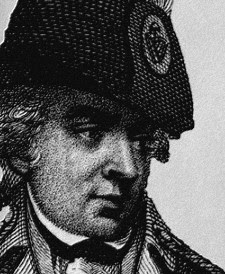
ON THIS DATE (29TH JANUARY) 231 YEARS AGO : UNSUNG HERO CHARGED WITH DISTRIBUTING "A SEDITIOUS PAPER".
Archibald Hamilton Rowan (pictured), a United Irishman, was 'tried' on a charge of distributing 'a seditious paper'.
On the 16th December, 1792, Rowan (and Napper Tandy, among others) were present at a political meeting/protest in Dublin at which pamphlets entitled 'Citizen Soldiers, To Arms!' were distributed (...but, incidentally, Rowan himself wasn't distributing them, nor was he the author of the pamphlet).
Rowan was brought to 'trial' (two years later) on the 29th January 1794 - 231 years ago, on this date - at the old Four Courts, near Christ Church, Dublin, for this 'offence' and was sentenced to a fine of £500, imprisoned for two years, and instructed to "find security for his good behaviour" (!)
'Little about Archibald Hamilton Rowan's beginning in life suggested that he would become a leading political revolutionary...conceived in Killyleagh Castle in Co Down, he was born in 1751 and grew up in England surrounded by wealth and privilege...he lived a charmed and adventurous life, travelling in Europe and America, and lived for a time in France.
He could be reckless at times, lost a lot of money at the gaming table, became involved in duels, and 'had scrapes with married women'.
He came under the influence of the celebrated radical John Jebb, who held that no man should suffer persecution for his religious and political opinions and that the people have a right to resist tyrannical forms of government.
Rowan married Sarah Dawson in France in 1781, and thereby gained the lifelong love of a steadfast comrade. On his return to Ireland in 1784, he fought an unforgiving ruling class in the pursuit of justice for the poor.
He championed the cause of Mary Neal, a child who was raped by the Earl of Carhampton, and denounced the military for the shooting dead of tradesmen in Dublin who were engaged in bull-baiting (...for which, in our opinion, the [British] military should have been commended, not condemned).
In 1794 Rowan landed on the French coast in the run-up to the naval slaughter that became known to history as the 'Glorious First of June'. Such was the tense disposition of the French forces at this time that he was immediately imprisoned as a suspected English spy.
From his cell window he watched many men with their hands pinioned carted to the guillotine. At the height of the Terror he was fortunate to escape the guillotine himself. Within days of his release his boots were stained with the blood of revolutionaries guillotined by their erstwhile comrades.
Rowan was a founder of the United Irish Society, and was imprisoned, this time in Newgate Prison, in the Cornmarket area of Christ Church, in Dublin.
When he was implicated in a plot initiated by the Committee of Public Safety in Paris to bring a French revolutionary army into Ireland, Rowan successfully escaped from the prison ('1169' comment - he paid a prison officer £100 to allow him out of prison to visit his wife and sign some paperwork in near-by Dominick Street and, on the 2nd May 1794, he escaped from custody by jumping out a back window of his house and then laid low for about three days in the Lusk area of Dublin).
Had he not escaped he would almost certainly have been hanged.
He sailed to Roscoff in a small fishing craft, enduring 11 years of hardship as a political exile in France, America and Germany. Fortunately for Rowan, his wife, Sarah, successfully secured his pardon, and he returned to Ireland in 1806.
Without Sarah's tenacity, Rowan would almost certainly never have set foot in Ireland again...' (from here.)
He maintained his quest to free Ireland and continued his fight for justice for the working class but lost heart somewhat when his wife died, in her seventieth year, in late February 1834 ; they were married for 53 years, and were a 'team'.
His sorrow was compounded in August that same year when his son, Gawin William, 51 years of age, died, and the poor man never recovered from the pain those deaths caused him.
He died, aged 83, on the 1st November that same year, and was buried in the churchyard of St Mary's Church, on the corner of Mary Street and Jervis Street, in Dublin :
"My dear children,
Whilst (in residence) at Wilminoton on the Delaware, in the United States of North America, not expecting to return to Europe, and unwilling to solicit my family to rejoin me there, I was anxious to leave you some memorial of a parent whom in all probability you would never know personally.
Under that impression I commenced the following details, uninteresting except to you, who have requested me to transcribe them, that each of you should have a copy.
It was not at that time, nor is it now my intention to vindicate the act which occasioned (my) then exiled situation ; though I felt a strong self-justification, in the consciousness that if I had erred, it had been in common with some of the most virtuous and patriotic characters then in Ireland..." (from here.)
RIP : one of our unsung heroes, without a doubt.
On the 29th January, 1920, with Volunteer leader James Mansfield (pictured, Officer Commanding of the 3rd Waterford Battalion IRA) in command, about 50 Volunteers of the West Waterford Brigade of the IRA attacked the enemy barracks (pictured) in the village of Ardmore, in County Waterford.
To secure the immediate area, the rebels monitored and/or blocked all access to Ardmore from the Youghal, Clashmore and Dungarvan directions.
The plan was to blow an entry point into the barracks from a gable wall, using explosives and land mines and, as a rebel unit were making their way to that wall, their comrades concentrated heavy fire and grenade-type projectiles at the doors and windows of the building, to allow the explosives unit to get to their target.
But, unknown to the Volunteers, the gable wall (and others) had been 'loop-holed' (certain wall blocks were removable from inside the building) and, from those vantage points, the RIC directed constant fire at the approaching IRA unit, preventing them from reaching the gable wall.
Firing from the IRA and those in the barracks lasted for about two hours but, as they were running out of ammunition, the IRA had to withdraw, suffering no casualties (the RIC reported that a number of their members were wounded during the attack).
Incidentally, Volunteer James Mansfield escaped the clutches of the Free Staters after the then new IRA chief of staff, Frank Aiken, declared a ceasefire on the 30th April, 1923 and, on the 24th May, ordered IRA Volunteers to dump their arms and return to their homes.
Volunteer Mansfield escaped to Canada.
==========================
GAS LADS...
The massive finds of oil and gas on our western seaboard could ensure Ireland's financial security for generations.
Wealth approximating that of the Arab countries is within our grasp, but the Irish government seems content to sell off our birthright for a handful of votes and a few dollars.
In a special 'Magill' report, Sandra Mara investigates just what we are giving away, and why.
From 'Magill' magazine, March 2002.
The problem stems from the fact that since the first offshore exploration licences were granted by the Irish government in the late 1960's, the balance of power has been with the oil companies.
Marathon Oil (USA) was granted a licence that effectively gave it control of the entire south coast of Ireland for the princely sum of £500 (€635).
Marathon went on to discover large quantities of natural gas in the Celtic Sea and, in the process, generated some work for Irish rig-workers, with ensuing economic and commercial spin-offs for the Cork region.
There should have been a lesson learned there but, as recently as 1992, long after the benefits of the North Sea finds had been realised, Ireland introduced an oil tax regime of 25 per cent - the lowest in the world ; Norway's oil tax is currently 78 per cent.
Ireland offered the oil companies a further benefit - all costs could be written off against this levy...
(MORE LATER.)
ON THIS DATE (29TH/30TH JANUARY) 144 YEARS AGO : EVE OF 'CONSTRUCTION' FOR MILITANT IRISH LADIES.
On the 29th and 30th of January 1881 - 144 years ago on this date - Charles Stewart Parnell's sisters, Anna and Fanny, put the final touches to a new organisation which they officially launched on the 31st : they established a 'Ladies Land League' which, at its full strength, consisted of about five hundred branches and didn't always see eye-to-eye with its 'parent' organisation, the 'Irish National Land League'.
In its short existence, it provided assistance to about 3,000 people who had been evicted from their rented land holdings and assisted and/or took over land agitation issues, as it seemed certain that the 'parent' body was going to be outlawed by the British and, sure enough, the British Prime Minister, William Ewart Gladstone, introduced and enforced a 'Crimes Act' that same year, 1881 (better known as the 'Coercion/Protection of Person and Property Act').
That piece of legislation declared it illegal to assemble in relation to certain issues and an offence to conspire against the payment of rents 'owed' which, ironically, was a piece of legislation condemned by the same catholic church which condemned the 'Irish National Land League' because that Act introduced permanent legislation and did not have to be renewed on each political term.
And that same church also condemned the 'Ladies Land League' to the extent that Archbishop McCabe of Dublin instructed priests loyal to him "..not to tolerate in your societies (diocese) the woman who so far disavows her birthright of modesty as to parade herself before the public gaze in a character so unworthy of a Child of Mary..." - the best that can be said about that is that that church's 'consistency' hasn't changed much over the years, and that it wasn't only a religious institution which made an issue out of women being politicised - 'In the year in which the Ladies' Land League was formed, Ireland was first mentioned in the 15 January 1881 issue of the 'Englishwoman's Review'. Tellingly, this was a report headed 'Women Landowners in Ireland' (and) there was also a small report of a 'Catholic Charitable Association' being formed 'by a number of Irish ladies for aiding the families of poor or evicted tenants'.
The addition of the phrase "It is distinctly understood that the society shall take no part whatever in political agitation.." reveals the disapproval felt by the journal for those engaged in that agitation *. The formation of the Ladies' Land League was then noted :
'In anticipation of Government action against local branches of the Irish National Land League, arrangements are being made for the establishment of a Ladies' Land League throughout Ireland.
Such a movement has already been organised in America, where Mrs Parnell, the mother of the Member for Cork, is the President, and Miss Fanny Parnell and Mr John Stewart, the sister and brother of Mr Parnell, MP, are acting as organisers.
The Irish movement will be led by the wives of the local leaders of the existing league, and will devote themselves to the collection of funds...' ** (from here).
* / ** - That periodical was assembled and edited by, and for, middle-class women of the day (late 19th/early 20th century) and, while it did cover and promote economic independence for women, occupation outside of the home for women, the need for better educational facilities for women to enable and encourage women to seek employment in 'the male professions' ie politics and medicine, it was truly of its day in that it was felt to be a bridge-too-far to call for women to take to the streets for the right to be more than 'just' fund-raisers.
In short, the authors were, in effect, confining themselves to be further confined.
In October 1881, Westminster proscribed the 'Irish National Land League' and imprisoned its leadership, but the gap was ably filled by the 'Ladies Land League' until it was acrimoniously dissolved on the 10th August 1882, 19 months after it was formed.
On the 29th January, 1921, 'The Longford Leader' newspaper carried a report on the killing of two young (Protestant) men - William Charters and William Elliott - from the Ballinalee area of County Longford.
Both men had been executed (on the 22nd January 1921) by the IRA.
Mr Charters was charged by the IRA of giving information to the RIC which led to the arrest of two republicans, and Mr Elliott, a lieutenant in the pro-British UVF grouping, was charged with working with, and identifying local people to, the Black and Tans and the British Army Auxiliaries.
They were the first civilians (and only Protestants) to be executed in that county by the IRA - altogether, five civilians were shot by the IRA as alleged spies in Longford, three of whom were Catholics.
It transpired that Mr Charters's uncle and father (Robert and William Charters Snr) had brought a land dispute to the republican courts for arbitration and, while the IRA Brigade engineer, Barney Kilbride, was surveying the disputed plot of land, William Charters ran down to the town of Ballinalee and informed the Black and Tans and RIC that a known IRA Volunteer, Barney Kilbride, was on his farm, accompanied by a Republican Court Adjudicator, a Mr James Victory.
Volunteer Kilbride and Court Adjudicator Victory were both 'arrested' by the Crown Forces as a result of the tip-off.
Mr Elliott, the UVF member, was observed more than once travelling the area with the Crown Forces.."...directing them and giving them
information, who was who, and identifying people.."
The IRA subsequently issued a proclamation guaranteeing protection.."..of both the life and property of all citizens, both Catholic and Protestant, who remained neutral.."
==========================
On the 29th January, 1921, the IRA let it be known that, in 'The Wicklow Hotel' in Wicklow Street, in Dublin, they had shot dead a Mr William Doran, on the previous day.
Mr Doran worked as a night porter in the hotel, a venue which Michael Collins and other (at the time) Irish republicans (among them was Tom Cullen, Gearóid O'Sullivan, Dermot O'Hegarty and Liam Tobin) met to discuss the business at hand.
One of Mr Collins' people in the hotel (Paddy O'Shea?) had previously observed Mr Doran chatting to the Deputy Chief of British Intelligence in Ireland, a Colonel Hill Dillon, and told Michael Collins that he was of the opinion that he was passing information to the British, and he was approached at least twice and told to stop or face the consequences.
But he ignored the advice.
Liam Tobin tasked IRA Squad Volunteers Joseph Dolan and Danny McDonnell to execute the spy Doran and, on the 28th January, 1921, Volunteers Dolan and McDonnell entered the hotel just as the spy was exiting a room - Volunteer Dolan shot him through the head and in the heart, and Volunteer McDonnell shot him in the stomach.
An 'Inspector' in the 'Dublin Metropolitan Police' (a British proxy grouping), a Mr Robert Forrest, later admitted that William Doran "had provided valuable information on burglaries..."
Incidentally, 'Mary's Bar and Hardware' now operates from where the hotel used to trade, the DMP are gone, too (...at least in name) and the British military and political presence has officially vacated Dublin and 25 other Irish counties, but continue to claim jurisdictional control over six of our counties.
==========================
"This was an ambush of military forces in lorries by Dublin Brigade I.R.A. personnel at Terenure, in the course of which several bombs were exploded in the lorries filled with British troops and numbers of them were killed and wounded. The date of this ambush is recorded as 29th January 1921.
Sometime that same evening a couple of the warder NCO's who were quartered in the military barracks across the road (now Collins Barracks) told us all the gory details of what they had seen and heard in the barracks when they went to their tea. One fellow had apparently been in barracks when the lorries returned after the ambush, and his description of the state of blood and gore of the lorries left little to the imagination.
When the news of the action reached the Castle, which I suppose it did within twenty minutes or so of the opening of the attack, every Auxiliary in Dublin as well as other forces, sped towards the area and spent the day and night terrorising the inhabitants of the locality in the effort to locate any of the IRA participants..."
- IRA Volunteer Joe Lawless (pictured, a republican-gamekeeper-turned-Free State poacher).
On the 29th January, 1921, about two dozen IRA Volunteers from 'E' and 'G' Companies of the 4th Battalion of the Dublin Brigade (which had around 930 Volunteers 'on its books' at the time), under the command of Volunteer Francis Xavier Coghlan (a republican-gamekeeper-turned-Free State poacher), took up three pre-arranged vantage points at Harold's Cross Road in Terenure, Dublin, at 7pm, waiting on two British Army lorries which were transporting soldiers from the 'Royal' Berkshire Regiment.
The IRA men were armed with hand guns and home made grenades.
As the two trucks arrived at a 'pinch point' on the road, IRA Volunteers lobbed grenades into and at the trucks and their comrades opened fire on the cabs and bodies of each truck ; disoriented British soldiers attempted to return fire, during which a civilian, a Mr John Doody (41), a milk delivery man, was shot dead (his mother, Anne, was later awarded £1,500 in compensation by Westminster ; two British Army Privates, a Mr W Preston and a Mr AF Goodchild, who were in one of the two trucks, were also awarded financial compensation).
The British Army's own record of the 'incident' stated that one officer and eight other-ranked soldiers were wounded.
Incidentally, one of the IRA Volunteers present, Christopher Stephen 'Todd' Andrews (a republican-gamekeeper-turned-Free State-poacher), was later to claim that, just before the attack, the British troops were singing 'I’m forever blowing bubbles' and a Volunteer named Kane shouted at them "we’ll give you fucking bubbles" as the ambush parties opened fire with their revolvers!
The IRA Units all escaped from the area via nearby Rathgar Avenue.
==========================
A Mr Charles Thomas Ingledew, a soldier in the British Army in Ireland, left that employment in November 1920 and joined the British 'ADRIC' grouping as a 'temporary constable'.
'Out of the frying pan...'
And then, in January 1921, he left that 'job', too.
Maybe it was his own (ex-) works party he was at (...most certainly a 'Farewell' gig..!) but, whether or not, on the 29th January, 1921, in the evening, he found himself in Hannan's Pub in Listowel, County Kerry, having a few pints with two RIC pals, a Mr Andrew McBride and a Mr Sheridan Gallagher.
The ex-soldier/RIC man removed his RIC service revolver from his pocket (which he should have handed-in when he left that 'job') and, showing it to his two drinking buddies, asked.. "..what would the head constable say if he could see me with this..?!"
And, with that, he shot himself in the head with it and died a few hours later.
It was definitely his round.
I'll get me coat...
==========================
THE FORGOTTEN PEOPLE...
Emigration from Ireland to the United States continued throughout the 1990's, although the reasons were no longer so bluntly economic.
Now, in the wake of September 11th, the US authorities have been granted increased powers to investigate legal status, and Irish illegal emigrants are more vulnerable than ever before.
By Mairead Carey.
From 'Magill Annual', 2002.
The plan was that they would be exposed to a 'multicultural' US which would ease sectarian tensions when they returned to Ireland to revitalise their own communities.
The Walsh scheme, according to Caoimhghin Ó Caoláin, was "...very imperfect. The uptake was very poor because it was choked with bureaucracy.
It wasn't for people already there, but for young people at home. I don't think the take-up came anywhere close to what was intended.
But people still continue to travel from the border counties as illegals, there hasn't been a peace dividend here. A lot of traditional employment is gone and the only sponge that can soak up the loss is America.
In recent weeks I have seen a lot of CNN and a lot of political players and commentators looking for more draconian measures to be applied to be applied to illegals, and that voice of reaction * against the undocumented knows no boundaries in terms of race and ethnicity.
People seem to forget the British woman whose husband died in the September 11th attacks. She was served notice to leave because her papers weren't in order. Her month's mind hadn't even been reached.
In a grand humanitarian gesture, the INS (the immigration department) said they would not pursue her case but, only that the woman had the ability to articulate her situation, and get the media on side, she would have been just another victim of the harsh and cold administration in relation to the immigrant community..."
(* "voice of reaction" as if that was a bad thing - 'voice of reason' would be the correct term.)
(MORE LATER.)
29TH JANUARY 1859 (166 YEARS AGO ON THIS DATE) : EVE OF THE BIRTH OF A FUTURE SINN FÉIN PRESIDENT.
Edward Martyn, playwright, co-founder of Irish Literary Theatre, and Sinn Féin president, was born in Tulira, County Galway, on the 30th January 1859.
'Martyn was descended from Richard Óge Martyn (c.1604 - 1648), a leading Irish Confederate, and Oliver Óge Martyn (c.1630 - c.1709), a Jacobite who fought in the Williamite War in Ireland. Yet by his lifetime, the family were unionists.
Martyn's outlook began to change in the 1880's after studying Irish history, as well as living through the events of the Irish Land War. He came out as an Irish republican when he famously refused to allow "God Save The Queen" to be sung after a dinner party at Tullira.
By this stage he was involved with the political work of Maude Gonne and Arthur Griffith, and was a vocal opponent of the visit of Queen Victoria to Ireland in 1897.
He also protested the visit by Edward VII in 1903, this time as chairman of the People's Protection Committee. He was the first president of Sinn Féin from 1905 to 1908 (the party only taking that name in the latter year) (but) in 1908 he resigned from the party and politics in general to concentrate on writing and his other activities.
He became close friends with Griffith, Thomas MacDonagh, Joseph Mary Plunkett and Patrick Pearse, and deeply mourned their executions in the aftermath of the Easter Rising. A parish hall and church that he founded at Labane, near Tullira, were burned by the Black and Tans. He supported * the Anglo-Irish Treaty of 1921...' (from here.)
(* - indeed, a close friend of his, Isabella Augusta Persse ['Lady' Gregory] stated, after one of her visits to him [on the 14th January 1922] that he declared to her that "he is all for the Treaty..")
Edward Martyn : 30th January 1859 – 5th December 1923.
29th January 1922 - last preparatory meeting in Dublin of those who were about to draft a constitution for their new 'Free State'. The meeting was Chaired by Michael Collins.
30th January 1922 - first meeting of the committee to draft that constitution.
31st January 1922 - the Free State Army was 'officially' established in Beggar's Bush Barracks in Dublin and began training troops to be dispatched
around the new 'Free State'.
29th January 2025 - Mr Collins has long since departed us, but that which he helped spawn - the Free State - lingers on like a bad smell...
==========================
ON THIS DATE (29TH JANUARY) 179 YEARS AGO : EVE OF THE BIRTH OF HISTORY-MAKER KATHARINE WOOD.
Born in 1846, on the 30th January - 179 years ago this month - Katharine Wood (pictured) matured into an unwitting femme fatale, said to be practically solely responsible for 'the most notorious scandal of the late Victorian Age' - the downfall of Charles Stewart Parnell and the split which followed in the 'Home Rule Movement' -
'Kitty' was a name she would have hated, as it was slang for a woman of loose morals. In fact, she only loved two men in her life and married both of them, though the marriage to Parnell was to prove tragically short-lived as he died in her arms after a few brief months of happiness.
She was born Katharine Wood in 1845, and was known as Kate to her family. Her father was a baronet, a member of the British aristocracy and her brother a Field Marshall, although their grandfather had started life as an apprentice and was a self-made man.
The Woods were closely linked with the Gladstone family and Katharine often acted as a go-between with William Gladstone when Parnell was trying to persuade the British government to grant Ireland independence.
She had married William O'Shea at the age of twenty-one, not long after the death of her father, and the marriage had produced a son and two daughters. O'Shea neglected his wife and pursued his own pleasures while she was often left to bring up the children alone, while also looking after her elderly aunt.
She played the part of a dutiful wife, however, and hosted dinner parties to help her husband's career. Parnell, an important figure in Irish politics, was always invited, always accepted and yet never showed up.
Annoyed and perplexed by these apparent snubs she went to confront him in person at his office in Westminster in July 1880.
The effect was immediate ; "This man is wonderful and different," she was to write later. Parnell was a bachelor who had once loved and been rejected, and never took an interest in women again until he met Katharine. It was a suicidal love as she was married to a fellow Irish MP and was a respectable wife and mother.
The power of the attraction between the two, however, was impossible to resist and before long they were living together in her home in Eltham in the suburbs of London. They had an illicit 'honeymoon' in Brighton and Katharine was to bear three children to Parnell while still married to O'Shea, the first of whom died soon after being born.
It is even thought that she bore Parnell a son who could take his name after they finally married, although this child was stillborn. O'Shea knew of the relationship but turned a blind eye to it. Then the Aunt died and left Katharine a large inheritance and he decided to divorce his wife and shame Parnell publicly. The ensuing scandal ruined Parnell's career and his health.
His traditional supporters in Catholic Ireland turned away from him when they learned he had been living with a married woman even though he and his beloved Katharine became man and wife after they married at Steyning register office in Sussex, the county where they made their home.
In an attempt to revive his flagging fortunes, Parnell went to Ireland and spoke at a public meeting in County Galway. He was caught in a thunderstorm and developed a chill from which he never recovered. Seriously ill, he returned to be with Katharine and died soon afterwards.
They had been married for only four months. It is estimated that half a million people lined the streets of Dublin to pay their respects to Parnell as his coffin was taken to Glasnevin cemetery to be buried near Daniel O'Connell.
Later Eamon de Valera and Michael Collins were also laid to rest nearby. On the granite stone above his grave lies just one word – 'Parnell', enough to identify Ireland’s flawed hero whose dream of a free and united country at peace with Britain was destroyed by his love for a married woman.
And what happened to Kitty, as the world now knew her? It was all too much for her and she lived out her days quietly in Sussex. She never married or fell in love again but looked after her children and died at the age of seventy-five.
When she was buried, only her immediate family came to the funeral and on her grave monument were the names of both her husbands with that of Parnell, the great love of her life, above that of O'Shea who gave her the name she is known by.
There is no sign of 'Kitty', however.
By the gravestone is a plaque placed by the Parnell Society with Parnell's promise to her :
"I will give my life to Ireland, but to you I give my love..."
Katharine Wood died on the 5th February 1921, at 75 years of age, in Littlehampton in Sussex, England, and is buried there.
RIP to that fine Lady.
POLITICAL LIFESTYLES IN IRELAND...
His lavish lifestyle was funded by wealthy admirers.
Time after time, his debts were taken care of by friendly businessmen.
In exchange for giving people access to government leaders, he cheerfully lined his own pockets.
From 'Magill' Magazine, January 2003.
Want some more, Garret? (That's a rhetorical question, by the way.)
How about this, from his tribute to the late Roy Jenkins, in 'The Irish Times' -
"A decade or so ago he asked me to help him launch, in Dublin, his book on Gladstone, of which he sent me a proof copy.
For the fun of it, I returned it to him with several hundred corrections - the need for most if not all of which his proof readers would of course have detected in any event..."
'For the fun of it'?
And they dared to call this man out of touch...
In Britain, of course, Garret would be 'Lord Fitzgerald' by now, along with 'Lord Haughey'. Doesn't sound quite right, does it...?
(MORE LATER.)
ON THIS DATE (29TH JANUARY) 53 YEARS AGO : PLANS FINALISED FOR BRITISH ARMY MASSACRE IN DERRY.
After a peaceful Civil Rights march on January 30th, 1972 - 53 years ago on this date - from Creggan to Free Derry Corner, units of the British army Parachute Regiment opened fire with automatic rifles and shot dead 13 unarmed civilians, injuring many more, one of whom died later.
It was later revealed that some days prior to the massacre, the British soldiers involved had been briefed to "shoot to kill" at the march.
"This Sunday became known as 'Bloody Sunday' and bloody it was. It was quite unnecessary. It strikes me that the (British) army ran amok that day and shot without thinking of what they were doing. They were shooting innocent people. They may have been taking part in a parade which was banned, but that did not justify the troops coming in and firing live rounds indiscriminately. I would say without reservations that it was sheer unadulterated murder. It was murder, gentlemen" - the words of British Major Hubert O'Neill, Derry City Coroner, at the conclusion of the inquests on the 13 people killed by the British Army on that day.
The British Army are still in Ireland and Westminster continues to claim jurisdictional control over six Irish counties - the potential for another 'Bloody Sunday' still exists. That threat can only be removed when Westminster removes itself from Ireland, politically and militarily.
On the 29th January, 1923, at about 9.30pm, seven armed IRA Volunteers entered the Palmerstown House mansion (pictured, then valued at £60,000)which the 'Lord Senator the Earl of Mayo and the Countess of Mayo' owned, which was situated about two miles from Naas on the Dublin road (the mansion was built as a memorial house to Richard, the '6th Earl of Mayo and Viceroy of India', in 1872).
'Lord and Lady Mayo' had just finished eating, and were being tended to by their two male and six female servants.
The ten people in the mansion were told by the IRA Volunteers that they were there to burn down the dwelling and were about to do so as an act of reprisal because the Staters were executing their comrades in prison.
They advised all present that they had between fifteen and thirty minutes to gather up their personal possessions and vacate the building, which they did - 'Lord' Mayo exited the mansion "carrying his best pictures and plates".
The building was then burned to the ground, and the Volunteers left the area.
==========================
On the 29th January, 1923, an armed Unit of IRA Volunteers were making their way along a lengthy tree-lined driveway towards a two-storey over-basement mansion, 'Milestown House', Castlebellingham, in Dundalk, County Louth (pictured, which extended to 1,096sq meters [11,800sq feet] in total) to have a chat with the resident, a British Army Major, a Mr Ronald Barrow.
On gaining entry to the abode (!), the Volunteers might have noticed the ornate cornicing and centre roses and the grand chimney pieces in the rooms, and would have been happy, I imagine, that they didn't have to search through its 22 acres of rolling parkland (on the banks of the River Glyde) to find the gaff.
The family and servants were ordered outside and the mansion was burned down.
==========================
Thanks for dropping in - appreciated.
Sharon and the team.
We got a good start on our Holy Communion preparation work last week, and managed to have a bit of craic with family members as well ; we secured a lovely venue (choice of three, 'cause we were early on the hunt!), food menu decided and agreed on, colour scheme (table dressings, flowers, coasters, placemats etc) music choice (and volume!) and new outfits to change into.
More so nowadays than when we first started with the prep works years ago for Holy Communions and Confirmations, it's like planning for a mini wedding-type event now - nothing left to chance, 'Plan B's' in place just in case...!
Anyway - we'll be up to our usual shenanigans on Wednesday, 29th January 2025, as we'll be posting a 16-part blog on various instances in Ireland, which took place between the 18th Century and the year 2002...
Dublin, Ireland - born in the mid-18th Century in Ireland, and buried in what was then a quite cemetery in the heart of Dublin City Centre in the early 19th Century, this military and political revolutionary is not remembered as fittingly as he should be...
Ireland, South-East of the country, early 1920's - this IRA Battalion Commander was on a 'Most Wanted' list circulated by Westminster and their lackies in Dublin Castle, but always avoided capture. When some of his comrades decided to support the British in partitioning Ireland, he knew that his 'safe houses' were no longer safe, as the search party would now consist of former comrades-in-arms. He knew he had to look abroad...
Today, 2025, State and local politicians are in the process of people- trafficking so-called 'asylum seekers/refugees/migrants' into the State for reasons of financial gain and 'pats on the back' from their new bosses in the EU etc but, as can be read in this 23-year-old article, the same politicians once sold a complete coast of this country for a few hundred Euros...
We Irish gals were once made of sterner stuff than we are now (although some of us still carry the old DNA!) and, in the late 19th Century in Ireland, some of the less-than-sterner-stuff Ladies attempted to put societal shackles on the Ladies who still carried that old DNA...
The four pieces above will be explained in full, and twelve other articles as well : so, if yer not booked up with mini-wedding-type events yourself, give us a shout here on Wednesday, 29th January 2025.
Or may God forgive ya your sins if'n ya don't...!
Thanks for dropping in - hope to see yis all on the 29th!
Sharon and the team.
On the 15th January, 1921, an IRA Volunteer, Seán Kavanagh, from Tralee, in County Kerry (a republican-gamekeeper-turned-Free State-poacher) was having a bite to eat in the 'Royal Exchange Hotel' in Dublin (having arrived there by train, from Newbridge in County Kildare) when he was accosted by a Black and Tan 'soldier' and two British Army Auxiliaries, all armed.
They had recognised him on the street, in the Kingsbridge area, and followed him at a distance, before closing in on him.
Seán worked for the Movement in the Intelligence Department, with Michael Collins and others, and knew that he was a wanted man ; he had been 'in hiding/on the run', and was billeted in various locations between Dublin and Kildare.
His work also included carrying messages from around Ireland and abroad which he would pass-on to Michael Collins himself, at an arranged time, in Vaughan's Hotel on Parnell Square West in Dublin, every Saturday and, when he was 'arrested' by the Crown Forces on the 15th, he had three such messages on him, which had been passed to him earlier that day in Sallins Train Station in County Kildare.
Seán was charged with... "..having in his possession a seditious document namely a report headed Óglaigh na hÉireann containing statements relating to road cutting and another relating to the affairs of the Irish Volunteers, an unlawful association..."
He was taken to Dublin Castle where he was interrogated ('questioned, hair pulled, body blows') for about two hours, but he gave them nothing. He was removed from the Castle and brought to Kilmainham Jail where he was 'processed', then taken to Mountjoy Jail (he was hand-cuffed to Rory O'Connor) where he was locked-up for one year.
His interrogators, Major William Lorraine 'Tiny' King, commanding officer of 'F Company' ADRIC (who was later to be charged by his own people for certain killings), and (the sadistic) Captain Jocelyn Lee 'Hoppy' Hardy misinterpreted one of the messages to read that Michael Collins would be attending 'The Royal Exchange Hotel' that night at 8pm for a meeting, so they 'tooled up' with armed soldiers and forced Seán Kavanagh to stand in the doorway of the hotel, setting a trap, they thought, for Michael Collins and whoever else might be with him.
However, 8pm came and went - but nothing happened.
The meeting was set for 8pm that evening, the 15th January 1921 - in Vaughan's Hotel, not in the 'Royal Exchange'!
But, early in 1922, IRA Volunteer Seán Kavanagh switched his allegiance from the Republic to the Free State and by August of that year he had been promoted to the rank of 'Commandant'.
He was given governorship of the Hare Park camp on the Curragh (a holding centre for prisoners waiting to be court-martialled) and, about two years later, he resigned from the Free State Army to begin a 'career' in the State Prison Service, commencing his future State service as the Deputy Governor of Mountjoy Jail then, eventually, as the Governor of that institution, a position he held for 28 years.
His duties in that job included the detention of many of his former comrades and overseeing the executions of some of them.
He died in 1984, at 87 years of age, and is buried in Deansgrange Cemetery, in Dublin.
We wonder if he ever thought back to that doorway...
GAS LADS.
The massive finds of oil and gas on our western seaboard could ensure Ireland's financial security for generations.
Wealth approximating that of the Arab countries is within our grasp, but the Irish government seems content to sell off our birthright for a handful of votes and a few dollars.
In a special 'Magill' report, Sandra Mara investigates just what we are giving away, and why.
From 'Magill' magazine, March 2002.
Ireland, by conservative estimates, contains thousands of oil and gas-bearing zones in her 65,000 square kilometres of water.
In recent years, the Marathon Oil company has discovered large quantities of natural gas in the Celtic Sea and, more recently, the indications are that the Corrib North gas fields off the shores of North Mayo look set to produce massively lucrative gas finds.
In the current economic climate, Ireland is expected to suffer a downturn in employment figures, with a corresponding drop in tax revenue and increased inflation.
The discovery of massive natural resources of gas within our territorial waters should be a Godsend - something that will ensure our fiscal security, creating jobs and revenue for the foreseeable future.
Such resources have been a guarantee of success for countries like Norway and those of the Middle East which, before the discovery of oil, were bereft of any real income-generating industries.
Now, like them, we have won the oil and gas lottery - only to find we've thrown away the winning ticket.
A loss of unimaginable proportions to Ireland for generations to come...
(MORE LATER.)
On the 15th January, 1920, elections to borough and urban district councils in Ireland were held using, for the first time, the 'Proportional Representation' voting system (which was mandated by the 'Local Government (Ireland) Act of 1919'), whereby seats are won based on the proportion of votes each candidate receives ; all votes cast (except for 'spoiled votes') contribute to the result and are effectively used to help elect (one of) the candidates.
The then Sinn Féin organisation, other nationalist candidates and The Labour Party, between them, obtained control of 172 out of 206 councils, and the number of Unionist councillors dropped from 52 to 29.
Nowadays, it's a case of "It is enough that the people know there was an election. The people who cast the votes decide nothing. The people who count the votes decide everything..."
==========================
BUTCHERS APRON ON A FORCED PARADE.
"...they gathered in the main street, in front of the Moy Hotel, a number of most respectable citizens and men who were whole-heartedly Sinn Féiners.
Pat and Michael Beirne, John Moylett, Martin Corcoran, Dominick Molloy and Michael Moylett.
After handcuffing them, the Auxiliaries tied the Tricolour to the last prisoner (John Moylett), trailing it in the mud of the streets and, with an itinerant musician marching in front, took them to the Market Cross where the prisoners were beaten and kicked to their knees in an effort to make them kiss a Union Jack placed on the roadway.
They refused and were kicked and beaten and ultimately allowed to go free..."
- the words of George Hewson, a local pharmacist in Ballina recalling, in 1957, the incident he witnessed in January 1921.
On the 15th January 1921, 'The Irish Independent' and 'The Freeman's Journal' newspapers reported that, on the 14th... '...Crown Forces arrested five prominent merchants and made them parade through the streets carrying the Union Jack with one trailing the Republican flag on the ground. Before they were released they had to kneel and kiss the Union flag while at the same time the Republican flag was burned...'
On the 17th January, 'The Irish Independent' carried a report from the Auxiliaries that the men were not arrested but "were merely asked to come to the Auxiliary headquarters, and that when desired to carry the Union Jacks through the town they did not object..."
This group of armed British thugs had only arrived in Ballina, County Mayo, on the 12th of January, and had taken over two hotels ('The Imperial' and 'The Moy') as their Headquarters, flying their Butchers Apron flag from both, and wanted to stamp their 'authority' on the town.
During their 'parade' through the town, the six Irishmen were repeatedly punched in the side with revolvers by the English thugs who walked beside them, while other armed Auxies accompanied them in two motor vehicles, one at the front and one at the back.
When the 'parade' reached a place known as Tyler's Cross, the six men were put on their knees and made to kiss the foreigner's flag as the Irish Tricolour was burned beside them and they were then, at gunpoint, told to sing 'God Save the King'.
They were then brought back to the Auxie 'Headquarters' and lectured on 'loyality' and, before they were released, were told that if there was any retaliation their businesses "would go up and you'll go down".
The local newspaper, 'The Western People', no doubt in fear for its staff and premises, did not report on the issue at the time, but one of its reporters, a Mr Tom Hennigan, gave the details to reporters in Dublin and, as stated above, two reports were published on the 15th January ('The Ballina Herald' reported on the matter on the 2nd February 1922, and 'The Western People' ran a story about it on the 4th February 1922.)
The English perpetrators were annoyed that their deed was headline news and claimed that the details were incorrect and there had been no element of coercion involved!
A year later (ie in January 1922), five of the men were awarded £100 and the sixth, Mr Michael Beirne, was awarded £200.
But nothing could have compensated them for the humiliation they suffered at the hands of the Crown.
On the 15th January, 1921, the British Army sealed off the Church Street/Capel Street area of Dublin City Centre and began a search of every premises in that location.
They seemingly 'arrested' some of the people who objected to them doing what they were doing, but no Volunteers were located and no weapons were found.
They packed-up and went back to base on the 17th.
==========================
On Friday, 31st December, 1920, the IRA planted an explosive device consisting of 30 pounds of gelignite and gun cotton, encased in a wooden box, against the door of the occupied RIC/Black and Tan barracks (pictured) in the town of Kilbrittain, in County Cork.
The plan was to storm the barracks after the front doors were blown off their hinges, but the device failed to explode and the operation was called off.
On the 15th January, 1921, the IRA returned (with Volunteer Jackie O'Neill in command) with another explosive device (weighing about a half-hundred weight/4 stone!) and tried again - seven Volunteers, carrying revolvers, were to enter first, closely followed by about a dozen Volunteers with rifles and fixed bayonets.
Volunteer Dinny Manning placed the device but it, too, failed to explode and, frustrated about the failure, Volunteer Manning is reported to have... "..stood out in the middle of the street and shouted to the Crown Forces inside 'If you hand me out a pencil and paper I'll write down my name for you..' "
Those inside the barracks (IRA Intelligence indicated that at least 12 armed men were in the building) started sending up Verey lights and throwing out small bombs to drive the IRA away.
Once again, the operation was called off and the IRA withdrew.
==========================
On the 15th January, 1921, Michael Collins replied to a letter he had received on the 13th from Éamon de Valera, in connection with the up-coming elections (due to be held in May) and the 'northern parliament' itself, Stormont.
Mr Collins opined that Sinn Féin would hopefully win at least a dozen seats, that the populations of counties Fermanagh, Tyrone and Derry would have more allegiance to Dublin rather than London and that town and rural county councils will continue to be worked on to declare their support for the (32-County) Dáil.
Sinn Féin only won six seats, for a variety of reasons - of the nineteen Sinn Féin candidates (excluding Queen’s University), eight were in prison or interned and seven were 'on the run', which meant that they were not visible on election platforms and were represented by proxy,
nationalist/republican voters were intimidated by loyalists, Sinn Féin organisers were arrested, republican literature was confiscated by anti-republican elements and there was a lack of nationalist/republican organisations in some parts of the electoral area.
Today, 104 years after those elections, Ireland remains partitioned and some so-called 'republican' elements are comfortable, politically and financially with, and because, of that...
==========================
On the 15th January, 1921, Gerald Oswald Pring (34), from Main Street, Midleton, in County Cork, and his brother and sister, were walking past a shop on the Western Road in Cork when two British Army Crossley Tender lorries drove past them.
When the lorries drove on about 100 yards away from them, a shot was fired and Mr Gerald Pring collapsed onto the footpath. He had been shot just below his left eye and died within minutes.
During an investigation, a British Army Officer stated that his men... "...might have had drink (on them) but were all perfectly sober, otherwise they would not be allowed out on patrol. Men on lorries sit with their fingers on the triggers, which is the only safe thing at present.
It was possible, but not probable, that a shot would go off accidentally..."
Bizarrely, Gerald's sister, Mary Ellen, in a claim for compensation, later stated that her dead brother "was an officer of the crown and was killed in the course of an attack on British Crown Forces by members of the IRA..." (?!).
==========================
THE FORGOTTEN PEOPLE...
Emigration from Ireland to the United States continued throughout the 1990's, although the reasons were no longer so bluntly economic.
Now, in the wake of September 11th, the US authorities have been granted increased powers to investigate legal status, and Irish illegal emigrants are more vulnerable than ever before.
By Mairead Carey.
From 'Magill Annual', 2002.
Bruce Morrison says -
"People have scruples. Even if they intend getting married, they don't want to do it for a green card.
My advice is that they should start paying more attention to these things because the horror stories are more likely to increase in this climate.
You are going to see the guy with the good job and the family having it all wrenched apart because he got a speeding ticket."
He is surprised that the Irish community has not been organised in recent years in campaigning for green cards for the undocumented.
"There has been no concerted effort by the Irish community to take advantage of other initiatives aimed at helping other countries.
They could have been extended to help the Irish, but there wasn't any organisation campaigning for it."
The last initiative was the 'Walsh Visas', which were aimed at helping young people in the North of Ireland and in the border counties train in the US for three years...
(MORE LATER.)
From the 14th to the 19th of January, 1922, ten IRA POW's were released from prison by the British and by their proxies in the Free State -
Volunteer Jack Mitchell, Caragh Road, Naas, was freed after fifteen months imprisonment in Gloucester Jail in England. He was greeted home by the 'Naas Workingmen's Band' and a large gathering which included a local company of Volunteers, Republican Police and Na Fianna Éireann, who played music, sang and danced as tar barrels blazed all around the area.
Volunteer Richard O'Brien (released from Mountjoy Jail in Dublin) and Volunteer Arthur Doran (Canterbury Prison, England) were lifted high by the Staff Officers and other Volunteers from the 3rd Battalion IRA, hundreds of members of the public and the local band.
Volunteers Michael Smyth, William Jones and Matthew Cardiff, from Athgarvan, in County Kildare, were welcomed home by family, friends and the local branch of the ITGWU trade union.
A huge 'Welcome Home!' party greeted Volunteers Fintan Brennan and Hugh E. McNally in Monasterevin, County Kildare, on their return home from Parkhurst Prison in England - bonfires were lit, tourchlights were lit from them and carried on the streets and the local fife and drum band played republican songs.
Volunteers Patrick Duffy (from Gurteenoona, Monasterevin, County Kildare) Michael Duffy (Kilgowan) and Michael Carpenter all had parties held in their honour.
==========================
On the 7th January, 1922, the 'Treaty of Surrender' was agreed to and accepted by 64 to 57 votes in Dáil Éireann (up to that point, a 32-County body) and on the 14th of that month a 'Provisional Government' (ie a Free State administration) was formed to administer the handover from British rule in the 26-County area to the Staters.
Therefore today, the 15th, is the 103rd anniversary of the first full day of business for that corrupt and ill-begotten institution.
Nothing to celebrate.
==========================
WESTMINSTER-ORGANISED PAEDOPHILE RING IN IRELAND.
On the 3rd April, 1980, three staff members of the Kincora Boys Home in Belfast were charged with acts of gross indecency.
Serious allegations were made that elements of the British security forces, civil servants and a number of loyalists had been involved in the abuse of young boys at the home.
One of those sentenced was William McGrath, the leader of a loyalist paramilitary group called Tara.
On the 15th January 1982 - 43 years ago on this date - the then 'Secretary of State for Northern Ireland (sic)', a Mr James Michael Leathes Prior, announced the setting up of a 'Committee of Inquiry' into the sexual abuse of children who lived in the Kincora institution.
John Dunlop McKeague (pictured), who had been a prominent Loyalist activist, and an 'activist' in other areas, too, was shot dead by the 'Irish National Liberation Army' (INLA) in his shop on the Albertbridge Road, Belfast, on the 29th January, 1982.
That he survived as long as he did is testament to his colleagues in the War Office in Westminster, who only 'threw him to the wolves' when they feared he was about to do the same to them.
'Loyalists have harboured within their ranks some of the most notorious deviants in Northern Ireland's (sic) history.
These include John McKeague, who led the Red Hand Commando terror group for a short time in the early Seventies. British military intelligence was aware of McKeague's taste for young boys and used it to blackmail him into becoming an informer...he was aware through his links with other loyalist paedophiles, particularly the Orangeman William McGrath, of the child abuse going on at Kincora's boys' home in east Belfast.
In 1982 McKeague was about to go public about the role of British intelligence in blackmailing paedophiles like McGrath, Kincora's housemaster, when he was shot dead by the INLA...when McGrath's regime of abuse became public, he was allowed to retire to the outskirts of loyalist east Belfast.
None of the loyalist paramilitary groups took any action against him...' (from here.)
'In a British intelligence document called 'Folio 4782/9/76 LB', McKeague was supposedly the mastermind of the Protestant Unionist plot to launch a coup d'état in Northern Ireland (sic).
A key aide of Paisley was being blackmailed over personal problems which caused him to be depressed causing his wife to have a nervous breakdown...using Paisley's aide there was active recruitment to a new loyalist paramilitary force among former members of the B Specials. Rather than being under DUP authority the group would be under the control of McKeague himself.
The DUP aide met with the UDA who were also to take part in the coup and the meeting was tape recorded secretly so to blackmail the DUP if they contemplated pulling out. At the time Paisley and the DUP were organizing a strike with other unionists and loyalists under the 'United Unionist Action Council' umbrella.
McKeague was good friends with William McGrath who was a fellow rapist and sex abuser of young boys at Kincora.
McGrath, a preacher who once accompanied Paisley to meet Chichester Clark in 1969 to form a 'People's Militia', was the founder of Tara, a bizarre group of British Israelites who recruited many young loyalists who believed in an Armageddon uprising by the Catholic population...' (from here.)
The Westminster 'establishment' and its political camp followers, including its 'royal family', in England and elsewhere, is overflowing with perverts and misfits who use insider knowledge against one another for political advantage ; in Ireland, and its other colonies, the British political 'top table' use such information to organise 'murder gangs' to carry-out politically-based killings.
John McKeague, an evil individual, was 'encouraged' in that manner and was protected by Westminster until he became too hot to handle.
His 'licence' was withdrawn on the 29th January, 1982...
"Patrick had a dugout in a bank on the commonage, covered with scraws, about 300 yards from his house. During his years on the run, whenever things got hot, Pat would go there and lie low for a while..." (from here.)
In December, 1922, four IRA Volunteers - Frederick Burke (from Borrisoleigh, County Tipperary), Martin O'Shea (from Carrinagreena, Borrisoleigh), Patrick Russell (from Summerhill, Borrisoleigh) and Patrick McNamara (from Nenagh, County Tipperary) - were 'arrested' by Free State forces for "illegal possession of arms" ('bearing arms against the State...')
On the 15th January, 1923, those four political prisoners were taken by the Staters into the grounds of Roscrea Castle in Tipperary and shot dead.
A fifth political prisoner, James Lillis (from Bagnalstown, in County Carlow) was executed that same day by the Free State Army : in total, in that month of January (1923), 34 Irish republican prisoners were executed by the Staters in towns throughout their new 'Free State' - Dundalk, Roscrea, Carlow, Birr, Portlaoise, Limerick, Tralee, Roscrea and Athlone.
Indeed, the then Leinster House 'Minister for Justice', a Mr Kevin Christopher O'Higgins, had issued instructions that such killings should be carried out in every county in the State in order "to maximise their impact".
The new Westminster-spawned State administration was "asserting its authority", and republicans asserted back...
RIP to those brave soldiers of the Republic.
==========================
On the 15th January, 1923, a Mr Lionel George Curtis (pictured), a military and political 'fixer-upper' for Westminster, wrote a letter to his colleague, a Mr George William Tallents (ex-Lord Mayor of Westminster) in which he praised the new Free State administration for... "..having crossed the rubicon. Definitely ranked themselves on the side of the constitutional governments by opening fire on their old comrades..."
We can picture the two of them, brandy and cigars in hand, going 'Har! Har!'.
Also, in a letter he wrote in September that year to a Mr Antrobus, another British political 'fixer-upper', Laughing Lionel wrote -
"Our friends heads (ie the Free State administration) are, of course, pretty full at the moment, but this would soon change once they realised that their position in the world counted for little apart from their position in the British Commonwealth of Nations..."
And they were right to sneer at the Staters, and they still are - right, and sneering, that is - but they are still Toffboy Brit bastards for doing so, and the Staters are wannabe-Toffboy Irish Gobshites for putting themselves in a position where the other Toffboys can sneer at them.
==========================
POLITICAL LIFESTYLES IN IRELAND...
His lavish lifestyle was funded by wealthy admirers.
Time after time, his debts were taken care of by friendly businessmen.
In exchange for giving people access to government leaders, he cheerfully lined his own pockets.
From 'Magill' Magazine, January 2003.
To which the only sensible answer is - what does he expect people to write about instead?
Since his election in June, after all, Enda Kenny has mainly busied himself with a series of media interviews, each more vacuous than the last.
The nadir was reached during the week after Christmas, when Enda Kenny dropped the following bombshells in the course of an exclusive chat with 'The Irish Independent' -
'Fine Gael will take up defined positions on the issues that matter. It will campaign on a whole range of issues.
It stands for a fairer Ireland where work opportunities exist. It is forward-looking and has a strong social conscience. If it sits down and does nothing it will face extinction...'
Well, they do say that every journey begins with a small step but, really, Enda, does it have to be this small...?
(MORE LATER.)
On the 15th January, 1986, a Mr Victor Foster (18), a building contractor and part-time member of 'B-Company', 6th Battalion, of the 'Ulster Defence Regiment', got into his Opel Kadett car outside his house in Gamble Park, Castlederg, County Tyrone, and drove off.
The car blew up, killing him instantly ; the IRA had fitted an under-car bomb to it.
Mr Foster was given a full UDR funeral, and was buried at Drumclamph Church of Ireland, at nearby Crewe Bridge.
Incidentally, British Army soldiers in Ireland referred to the UDR/UDA/RUC and other suchlike armed anti-republican gangs as 'native levies', a term for 'local troops' raised in, and for, suppression of "the Colonies".
'The enemy of my enemy is not necessarily my friend...'
==========================
A FOUR-DAY INQUIRY TO FIND THE OBVIOUS!
On the 15th January, 1916, 'The Down Recorder' newspaper carried the following report -
'RIC CONSTABLE EARLY RECEIVES AN UNFAVOURABLE RECORD.
There has just been promulgated the finding in a constabulary inquiry by District-Inspector Loch, president, and District-Inspector Sheridan, into disciplinary charges, numbering no fewer than 220, and affecting Sergeant Hamill, Kirkcubbin, and six constables.
The inquiry extended over four days.
Sergeant Hamill was found not guilty of the 78 charges preferred against him and, in turn, Constables Clarke, Leader, M’Cole, Morrison, and Mullarkey were exonerated.
Constable Early, who was found guilty of committing a minor assault upon Constable M’Cole, admitted 64 charges.
He received an unfavourable record...'
'An unfavourable record'.
That'll learn him...
But, seriously, there was no need at all for a four-day inquiry to see if the words "unfavourable record" should be attached to the RIC...
We won't be posting any content next Wednesday, 22nd January 2025, as we're heading off 'down the country' to family members to begin and help with the shopping spree for Communion outfits etc, book a hotel for the little Princesses (if we can find one without 'asylum seekers/refugees/migrants' in it) for a two-day stay for them and a four-day stay for us.
And yes - we could organise most of that on-line, but there's no craic in that and, besides, it's an outing with some of my brothers and sisters, an opportunity never to be missed!
We'll be back 'on air' on Wednesday, 29th January 2025 with, among other bits and pieces, a few paragraphs about so-called 'Hate Speech' legislation in Ireland in the 18th Century!
Thanks for dropping in - appreciated.
See yis on the 29th - GRMA!
Sharon and the team.