
Tony Darcy was sentenced to three months imprisonment for refusing to either account for his movements or give his name and address when arrested by Free Staters at an IRA meeting in Dublin.
The POW's went on hunger strike after Meath IRA man, Nick Doherty, was imprisoned on the criminal wing in Mountjoy Jail and a request to transfer him to join his political comrades in Arbour Hill Jail was refused by the Staters. One week into the protest, the prison authorities made a move to take the IRA Officer Commanding of the prisoners, Seán McNeela, for 'trial' before the 'Special Criminal Court' but he refused to go with them.
Barricades were built and D-Wing was secured as best as possible by the IRA prisoners and they were soon attacked by armed Special Branch men, backed-up by the Dublin Metropolitan Police. Amongst the casualties were McNeela and Darcy, both of whom were beaten unconscious and suffered wounds that were never allowed to heal.
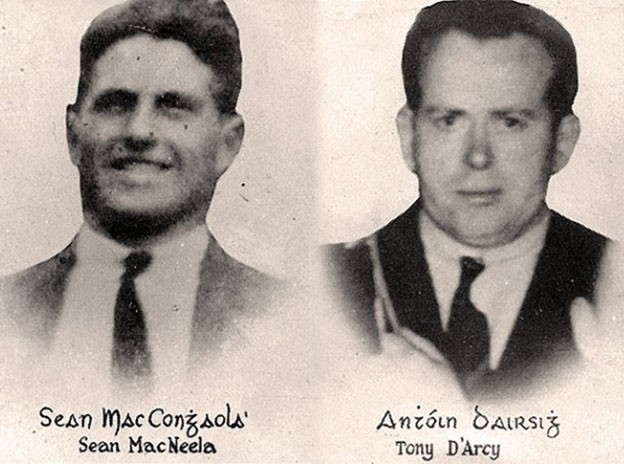
This account of that period, by Michael Traynor, was placed in the public domain by Carmel McNeela, widow of Paddy McNeela and sister-in-law of Seán McNeela : (Michael Traynor, Adjutant-General, IRA at the time of his arrest in February 1940, endured hunger strike with Seán McNeela, Tony Darcy, Tomás Mac Curtáin, Jack Plunkett and Tommy Grogan) :
"When Seán McNeela became CS (Chief of Staff) of the IRA in 1938 he immediately appointed Jack McNeela OC (Officer Commanding) Great Britain with the particular task of putting the organisation there on a war footing and amassing explosives and preparing for the forthcoming bombing campaign.
After a few months of tense activity Jack was arrested and sentenced to nine months imprisonment. He returned to Ireland in 1939 and was appointed Director of Publicity. Jack was very disappointed with this appointment. He said he knew nothing about publicity and would have preferred some task, no matter how humble, which would have kept him in contact with the rank and file Volunteers.
However, publicity had to be organised and Jack threw himself to the job with zeal and energy. After two months, out of nothing, Jack had his Publicity Department functioning perfectly. Writers were instructed and put to work, office staff organised, radio technicians got into harness.

Another big disappointment at this time for Jack was the instructions he received about the raid on the Magazine Fort. He nearly blew up when he was told that he could not take part in the operation, that HQ staff could not afford to lose more than the QMG and the AG if the operation failed.
He was a man of action and wanted to be with his comrades in time of danger. He repeatedly requested the AG for permission to take part in the operation but without success. But Jack was there, orders or no orders, and he did about ten men’s work in the taking of the fort and the loading of the ammunition.
He was a very pleased man that night, for he, like all the rest of the members of GHQ, knew that this ammunition was necessary to the success of the Army’s attack on the Border, which was planned to take place in the following spring.
He was arrested about three weeks later with members of the Radio Broadcast Staff and lodged in Mountjoy jail.
He was OC of the prisoners when I arrived in the middle of February 1940. Tomás Mac Curtáin was there, and Tony Darcy, who was a very great personal friend of Jack’s, so was Jack Plunkett and Tommy Grogan.
I was about a week in jail, life was comparatively quiet, great speculation was going on as to what would happen to the men arrested in connection with the raid on the Magazine Fort.
The crisis developed when Nicky Doherty, of Julianstown, County Meath, was sentenced to five years penal servitude. Instead of being transferred to Arbour Hill (where other republican prisoners had political status), Nicky was lodged in the criminal section of Mountjoy Jail.
Jack, being OC of the republican prisoners, interviewed the governor of the jail and requested that Nicky be transferred to Arbour Hill on the grounds that he was a political prisoner and that it was unjust and unchristian to attempt to degrade and classify as criminal a republican soldier. The request was ignored.
Jack and his prison council met to consider the situation : it was decided that a demand was necessary and with the demand for justice went the ultimatum that if he refused a number of prisoners (who were still untried) would go on hunger strike until the demand was accepted. A short time limit was set, but the demand was also ignored.
Jack, I remember well, was very insistent that the issue should be kept clear and simple. The hunger strike was a protest against the attempted degradation of republican soldiers. There was no other question or issue involved. A simple demand for justice and decency.
Seven men volunteered to go on hunger strike and when the time limit [February 25, 1940] of the ultimatum expired they refused to eat any food, although tempting parcels of food kept arriving every day from their relatives and friends. It was felt by the men on hunger strike that the struggle would be either a speedy victory or a long, long battle, with victory or death at the end.
It was victory and death for Jack McNeela and Tony Darcy.
Seven days after the commencement of the hunger strike Special Branch policemen came to take Jack to Collins Barracks for trial before the 'Special Criminal (or was it the Military) Court'. Jack refused to go with them. They told him they’d take him by force. They went away for reinforcements.
A hasty meeting of the Prisoners’ Council was held. They felt it was unjust to take Jack for trial while he was on hunger strike, and that everything possible should be done to prevent the hunger strikers from being separated. Barricades were hastily erected in the D-Wing of the jail. Beds, tables and mattresses were piled on top of each other ; all the food was collected and put into a common store and general preparations made to resist removal of Jack, their OC.

A large contingent of the DMP arrived together with the Special Branch at full strength. The DMP men charged the barricades with batons ; the Special Branch men kept to the rear and looked on while the DMP men were forced to retire by prisoners with legs of chairs. Several charges were made but without success. Some warders and a few policemen suffered minor injuries. The governor of the jail came down to the barricade and asked the prisoners to surrender. They greeted him with jeers and booing.
After some time the DMP men returned, armed with shovel shafts about six feet long, hoping with their superior weapons to subdue the prisoners. After several charges and some tough hand-to-hand fighting the policemen again retired. The most effective weapon possessed by the prisoners was a quantity of lime, liquefied by some Mayo men, and flung in the faces of the charging DMP men.
It was reminiscent off the Land League days and the evictions.
Finally the fire hydrants were brought into use and the force of the water from these hoses broke down everything before them. The barricade was toppled over and the prisoners, drenched to the skin, could not resist the powers of water at pressure ; they were forced to take cover in the cells. I got into a cell with Tony Darcy and Jack McNeela. We closed the door. After a few minutes the door was burst open and in rushed about five huge DMP men swinging their batons in all directions.
Tony, standing under the window facing the door, put up his hand but he was silenced by a blow of a baton across the face that felled him senseless. Jack was pummelled across the cell by blow after blow. Blood teemed from his face and head. These wounds on Jack and Tony never healed until they died.
It lasted only a few brief minutes, this orgy of sadistic vengeance, and then we were carried and flung into solitary confinement. Jack was taken away that evening and tried and sentenced by the Special Court. The next time I say Tony and Jack was in the sick bay in Arbour Hill. Jack Plunkett was also there with them. We exchanged experiences after the row in the 'Joy'.
Day followed day, I cannot remember any particular incident, except that regularly three times a day an orderly arrived with our food, which we of course refused to take. We were by now nursing our strength realising that this was a grim struggle, a struggle to the death. We jokingly made forecasts of who would be the first to die.
Jack was almost fanatic about speaking Gaelic. Most of our conversation while in the Hill was in Gaelic. Tony used to laugh at my funny accent. While he couldn’t speak Gaelic he understood perfectly well all that was said and sometimes threw in a remark to the conversation. When conversation was general, English was the medium. Jack Plunkett didn't know any Gaelic at all. We were in the best of spirits. Rumours filtered through to us, I don't know how, because we were very strictly isolated from the rest of the republican prisoners in the Hill. We heard that one of our comrades had broken the hunger strike at the Joy ; we didn't hear the name for a few days. The report was confirmed, we were inclined to be annoyed, but we agreed that it was better for the break to come early than late. It had no demoralising effect.
After Jack was arrested all the books he had bought (mostly Gaelic) were sent into the Joy. He intended to make good use of his spell of imprisonment. He kept requesting the Governor of the Hill to have them sent to him. After about three weeks a few tattered and water-sodden books were brought to him, all that remained of his little library, the others had been trampled and destroyed by the police in Mountjoy.
Jack was vexed. He hadn’t smoked, nor taken drink and every penny he had went to the purchase of these books that he loved.
We were, during all this time, as happy as men could be. In spite of imprisonment and all that it means we were not all despondent nor feeling like martyrs. Everyday, we reviewed our position ; what we had done, our present state of health, the prospect of success. The conclusion we came to was that de Valera, Boland and company had decided to gamble with us – to wear us out in the hope that we would break and therefore demoralise all our comrades and if we didn’t break, to give political treatment to all IRA prisoners when we were in the jaws of death.
The issue, as we saw it, was of vital importance to us, but of practically no consequence to the Fianna Fáil regime. We knew of course that de Valera and the Fianna Fáil party hated the IRA, because we were a reminder of their broken pledges to the people.

On the eve of St Patrick’s Day we were removed to St Bricin’s military hospital. A few days later Tomás Mac Curtáin and Tommy Grogan joined us. We were terribly disappointed with their report from the 'Joy' - the men who had been sentenced were accepting criminal status instead of refusing to work as they had been instructed to do ; that is another story, although it led directly to the death of Seán McCaughey six years later in Portlaoise jail.
We were in a small hospital ward. Three beds on each side, occupied by six hungry men and every day was a hungry day. Every evening each of us would give the description of the meal he would like most, or the meal he had enjoyed most. Salmon and boxty loomed large in Jack’s menu. About this time we began to count the days that we could possibly live. The doctors who examined us, sometimes three times a day, told us that we had used up all our reserves and were living on our nerves ; they tried to frighten us, assuring us that if we didn’t come off the hunger strike our health would be ruined. We all agreed among ourselves that the doctors were actuated by purely humane motives, although their advice if acted on by us would have been very satisfactory to their employers.
After 50 days on hunger strike we were unable to get out of bed, or rather the strain of getting up was too great an expenditure of energy, which we were determined to husband carefully.
We did not see any change on each other. The change came so imperceptibly day after day. Jack, lying in the next bed to me, seemed to be the same big robust man that I had known before we were arrested, yet, we each were failing away. The doctors and nurses were very kind. We were rubbed with spirit and olive oil to prevent bedsores ; all our joints and bony places were padded with cotton wool, for by now the rubbing of one finger against another was painful. None of us could read anymore, our sight had lost focus and concentration on material objects had become difficult.
We were face to face with death ; but no one flinched or if he did he prayed to God for strength and courage.
On the 54th night of the strike, about midnight, Tony cried out (we were all awake) : "Jack, I'm dying."
We all knew that it was so. Jack replied, "I’m coming, Tony".
I felt, and I’m sure Jack and the others felt also, that getting out of bed and walking across the room to Tony would mean death to Jack also. As well as I remember MacCurtáin, Plunkett, Grogan and myself appealed to Jack not to get out of bed. But Tony’s cry pierced Jack’s heart deeper than ours so he got up and staggered across the room to his friend and comrade.
Later that night Tony was taken out to a private ward. We never saw him again. He died the following night. A great and staunch and unflinching soldier and comrade ; oh that Ireland had twenty thousand as honourable and fearless as he.
The day following Tony's removal from the ward, Jack's uncle, Mick Kilroy, late Fianna Fáil TD, came to see Jack.
Alas, he didn’t come to give a kinsman's help, but attacked Jack for "daring to embarrass de Valera, the heaven-sent leader" by such action, and demanded that Jack give up his hunger strike at once. Jack’s temper rose and had he been capable of rising would have thrown him out. He ordered him out of the room, so did we all.
It was the first time in 56 days that we felt enraged at anything. The brutal treatment of the police after seven days’ hunger strike was trivial in comparison to this outrage. The next day Jack was taken out of the ward. We never saw him again.
A few hours after his removal we received a communication from the Chief of Staff IRA. The following is an extract :
"April 19, 1940.
To the men on hunger strike in St Bricin's Hospital :
The Army Council and the Nation impressed with the magnitude of your self-sacrifice wish to convey to you the desire that if at all consistent with your honour as soldiers of the Republic you would be spared to resume your great work in another form.
We are given to understand that the cause you went on strike has been won and that your jailers are now willing to concede treatment becoming soldiers of the Republic. In these circumstances if you are satisfied with the assurances given you – you will earn still more fully the gratitude of the people – relinquishing the weapon which has already caused so much suffering and has resulted in the death of a gallant comrade."
Jack had requested confirmation from HQ of the assurances given to us by Fr O'Hare, a Carmelite Father from Whitefriars Street, Dublin. Fr O’Hare had interviewed Mr Boland, the Minister for Justice in the Free State government and received his assurances that all republican prisoners would get political treatment.
Naturally we did not want to die, but we could not accept any verbal assurance so we felt that written confirmation by our Chief of Staff was necessary. When the confirmation arrived Jack was out in the private ward. I was acting OC. We were reluctant, the four of who remained, to come off the hunger strike, with Tony dead and Jack at death’s door.
Yet we had the instruction from HQ that our demands were satisfied. The doctors assured us that if the strike ended, Jack had a 50-50 chance of living, so I gave the order that ended the strike. I believe the doctors worked feverishly to save Jack’s life, but in vain.
Jack McNeela, our OC and comrades, died that night and joined the host of the elected who died that Ireland and all her sons and daughters would be free from the chains of British Imperialism and happy in the working out of their own destiny."
NOTES: Nicky Doherty was found in possession of a quantity of ammunition seized in the raid on the Magazine Fort. He remained an active Volunteer until his death at an early age in the mid-1950s.
Criminal section of Mountjoy : This was A-Wing.
The republicans on remand were housed in D-Wing - on sentence, they were usually sent to Arbour Hill.
Governor of the jail : Seán Kavanagh, a former republican prisoner himself during the Tan War.
DMP: Dublin Metropolitan Police, originally a separate force from the RIC. They were kept on after the Treaty and amalgamated with the Gardaí in 1925. They made a deal with the IRA in 1919 not to engage in 'military activities' and were removed from the list of legitimate targets.
'G Division', or Special Branch, were not excluded. In 1940 they supplied the Riot Squad for Mountjoy.
Tony Darcy, Headford, County Galway, died April 16th 1940. He was OC Western Command, IRA at the time of his arrest.
Seán McNeela, Ballycroy, County Mayo, died April 19th 1940.
From 1940 to 1947, sixteen republican prisoners were sent to Portlaoise Prison where they were denied political status. For all seven years they were naked, except for the prison blanket. For three years of this they were also in solitary confinement."

Finally - writing about the funerals of Tony Darcy and Seán McNeela, Brian Ó hÚiginn (pictured) stated -
"Hundreds of uniformed and plain-clothes police were sent into the two graveyards, while soldiers in full war-kit were posted behind walls and trees in surrounding fields, and armoured cars patrolled the roads...the lowest depths of vindictive pettiness was reached when mourners on their way to Seán MacNeela's funeral were stopped by armed police and their cars and persons searched...even when they reached the cemetery many were locked out - the gates were locked - and those attempting to enter were attacked..."
That was 1940, this was 2013 - the 'establishment' harasses those it fears, even in death, and wines and dines those it has purchased, even though they, too, are 'dead' : morally and spiritually.
RIP Volunteers Tony Darcy, Seán McNeela and Seán McCaughey.


The family of a British Army Gunner with the 'Royal Garrison Artillery', a Mr Philip Fay (45, 'Service Number 181305'), was notified on the 16th April, 1919, that he had killed himself the day before in what was then known as 'King George V Hospital' (later re-named as Ospidéal Míleata Naomh Bricin [St Bricin's Hospital], pictured), in Arbour Hill, Dublin.
Mr Fay is buried in Grangegorman Military Cemetery, Dublin.
==========================


On the 16th April, 1920, at least ten IRA Volunteers took up their positions at an ambush point they had established on Bridge Street, Dundalk, County Louth, near a Mr Walsh's gate, waiting for a three-man RIC patrol which was due to pass the Gate.
The IRA man in command was Volunteer Patrick Culhane.
When the three Crown Force members arrived on the scene, one of them - a Mr Joseph Bustard (who had 27 years of 'service to the crown') - noticed that Walsh's gate was only half closed, and went over to investigate.
With that, a fist-fight ensued, then guns were drawn, and Volunteer Thomas Mulholland (33, pictured), from Carrickrobin, Dundalk, County Louth, QM of 'C Company', North Louth Battalion, IRA, was shot dead.
At the inquest into the shooting, RIC member Bustard claimed that he used his revolver because he feared for his own life, but the jury brought in the finding that there was no justification for the shooting.
At Volunteer Mulholland's funeral (on the 18th April), the Crown Forces isolated Volunteer Patrick Culhane and beated him severly ; he was still suffering from that beating when they pounced on him again a few weeks later and compounded those injuries.
He died from his wounds on the 19th September 1920.
RIP Volunteers Thomas Mulholland and Volunteer Patrick Culhane.
==========================
GAS LADS...

The massive finds of oil and gas on our western seaboard could ensure Ireland's financial security for generations.
Wealth approximating that of the Arab countries is within our grasp, but the Irish government seems content to sell off our birthright for a handful of votes and a few dollars.
In a special 'Magill' report, Sandra Mara investigates just what we are giving away, and why.
From 'Magill' magazine, March 2002.
On the surface, it could only appear that poor amadán Ireland had been hung out to dry while the oil companies, it seems, reaped the rewards of an exceptional sweetheart deal.
Who could blame the oil companies?
They are, after all, in business.
But there remains bewilderment over Ray Burke's move - was it a lack of sophistication and knowledge of the oil industry norms, or a simple mistake?
Burke indicated that it was done to encourage the oil companies to come into Ireland in a time of little activity by oil companies internationally but, at the time of the original agreements secured by Keating and Spring, expert opinion took into account the long-term benefits that could accrue to Ireland and the agreements reflected that.
They were designed to protect Ireland's interests, but without any visible benefits in return, those interests were given away by Ray Burke's deal...
(MORE LATER.)

"I intend to die like a Welch Fusilier with a laugh and forgiveness.
I would like my death to lessen rather than increase the bitterness that exists between England and Ireland.
I have been treated with great kindness and, during my short captivity, have learned to regard the Sinn Feiners rather as mistaken idealists than as a 'murder gang'.
My cigarette case I leave to the mess. I shall die with it in my pocket..."
- farewell note from British Army Major Geoffrey Lee Compton-Smith (of the 'Royal' Welch Fusiliers), who was held as a hostage by the IRA and shot dead on the 30th April, 1921.
Mr Compton-Smith was travelling on a train through County Cork on the 16th April (1921) when IRA Volunteer Frank Busteed and his men captured him and held him in a safe house in Knockadoon, in County Cork.
The IRA leadership contacted the British Army 'Military Governor' in Ireland, a Major-General 'Sir' Peter Strickland (the 'Commander of the 6th Divisional Area' in Ireland) and offered an exchange of hostages ; Mr Compton-Smith would be handed back in exchange for the safe return of four IRA Volunteers who were being held by the British - Volunteers Maurice Moore and Patrick O'Sullivan, who had been taken prisoners at Clonmult, and Volunteers Thomas Mulcahy and Patrick Ronayne, taken prisoners after the Mourne Abbey ambush.
The British refused the offer and, on the 28th April, stood the four Volunteers up against a white-washed wall in the 'Military Detention Barracks' in Cork City and shot them dead.
In retaliation for the executions, on the 30th April Mr Compton-Smith was removed from the safe house, taken to the Donoughmore area in the county (Cork) and executed ; he was brought up into Barrahaurin Bog, to a place where his grave had already been dug, and he was given a final cigarette.
In his witness statement, Volunteer Maurice Brew wrote -
"When removed to the place of execution he placed his cigarette case in his breast pocket of his tunic.
He then lit a cigarette and said that when he dropped the cigarette it could be taken as a signal by the execution squad to open fire..."
Also in retaliation, RIC members and British Army soldiers were shot throughout the IRA's 1st and 2nd Division area resulting in the killing of a number of them and the wounding of others.
Mr Compton-Smith was buried in the bog but, in 1926, his remains were exhumed and reburied in the British military cemetery outside Fort Carlisle in County Cork.
RIP Volunteers Maurice Moore, Patrick O'Sullivan, Thomas Mulcahy and Patrick Ronayne.
On the same date that Mr Compton-Smith's train journey was interrupted, IRA Volunteers about 300km (180 miles) away - in County Mayo - carried out an operation uninterrupted.
On the night of the 15th/early morning of the 16th, an ambush point had been established and manned by armed Volunteers (attached to the North Mayo Brigade) in Bridge Street, in Ballina, County Mayo and, when the expected RIC patrol showed itself, it was ordered by the IRA to halt.
The RIC members tried to shoot their way out of the trap, and two of their number - a Mr Walter Davis and his colleague, a Mr Harold Moore - were severly wounded, as witnessed by their other colleagues before they legged it out of the area and back to the relative safety of a nearby enemy barracks.
In an attempt to put manners on the rebels, the Crown Forces went on a rampage through the town centre ; shop windows, places of business and private homes were smashed, and weapons were fired indiscriminately, leaving the commercial centre of the town in a sea of broken glass and bullet casings.
But the rebels carried on, in an unmannerly (!) fashion...
On the same date that those two RIC members were wounded in Mayo (16th April 1921), a British Army Captain (and former Auxie), a Mr Patrick O'Neill, was resting in his basement flat in 38 Heytesbury Street, in Dublin, when a knock came to his door.
Without opening the door, he asked who was there and a man replied that he was looking for Patrick O'Neill.
Mr O'Neill told him that Mr O'Neill wasn't in (!) but, as the stranger was ascending the steps to the footpath, he spotted Mr O'Neill at the window, looking out at him.
The stranger - an IRA Volunteer - pulled out his revolver and shot (the absent!) Mr O'Neill once, in the chest. The ex-Auxie fell to the ground, the Volunteer walked away.
Mr O'Neill died later, in hospital, from the wound.
While Mr O'Neill was (briefly) looking out of his window, a colleague of his about 200km (125 miles) away in Pallasgreen RIC Barracks in County Limerick, a Mr Harry G. Moscrop ('Service Number 79475', joined the RIC in January that year), a London man, was found to be in possession of jewellery and other valuable items which had been stolen during RIC house raids.
Mr Moscrop killed himself on that same date.
At about the same time as Mr Moscrop and others were examining his haul, the three Stone brothers in Killusty, Fethard, in County Tipperary, were closing the hall door behind them as they were leaving the house they were living in.
The IRA were waiting for them and opened fire.
One of the brothers, Robert, was killed ; apparently, the Stone family were in occupation of an evicted man's home, and had been living there for about two decades.
This was said to have been an agrarian action by republicans.
On that same date, about 80km (50 miles) away up the road, an off-duty (so-called) group of British Army soldiers and some of their RIC colleagues were in a favoured-by-them 'friendly' pub, Shaughnessy’s, in Market Street, in Ennis, County Clare, at about 10pm.
The pub owners had been advised a number of times that serving Crown Forces members would be a bad business model, but the advice was ignored.
About ten armed IRA Volunteers from the Mid-Clare Brigade, with Volunteer Paddy McMahon in command, knocked on the locked door and, when it was opened for them, entered the pub (with others remaining outside, keeping watch), located their quarry, opened fire on them and lobbed a hand grenade in their midst.
A British Army Sergeant, a Mr Sidney Rew/Rue ('Royal' Scots Regiment) was killed outright and an RIC member, a Mr Vanderburgh, was wounded, as was civilian M/s Mary Anne Danagher and the pub owner, a M/s Kate O'Shaughnessy.
The next day, Crown Force Units descended on Ennis and burned down a shop, a house and 'The Old Ground' Hotel (venues with known nationalist/republican sympathies).
The day after that, the IRA visited the home of a local loyalist family, the Mills, and burned it down to the ground.
On that same date (16th April 1921), on the far side of the country (about 280 km [170 miles] away), the Cheshire Regiment of the British Army were settling-in to their occupation of Avondale House, in Rathdrum, County Wicklow, when a gunshot sounded.
On investigation, they discovered that their Lance Corporal, a Mr Jack Williams, had taken his own life.
He is buried in Saint Saviours Churchyard Cemetery in Rathdrum, County Wicklow.
Incidentally, Mr Williams is one of 42 suicides in the British Army in Ireland during the period 1919-1922.
==========================
THE NUMBER'S UP...

How some famous gambling conspiracies came to light.
By Con Houlihan.
From 'Magill' Magazine Annual 2002.
'Gay Future' was appearing suspiciously often in doubles and trebles ; if the other bet horses didn't run, all those bets would be single bets.
A clerk alerted his superior who checked his list of runners for the day and found that 'Gay Future' was down to run at a course with no telephone to the outside.
Things began to add up.
The clerk rang the office in Lancaster, and a man was dispatched to Cartmel with enough cash to bring down 'Gay Future's' price - but the Bank Holiday traffic frustrated him.
However, the clerk in London was not to be out-done ; he rang Collins's stable, and the housekeeper answered the phone ;
"Billy has gone to the races. Tom and Polly are grazing in the paddock, I'm looking at them from the kitchen window..."
The game was up...
(MORE LATER.)


On the 16th April, 1922, a crowd estimated at between two and three thousand people assembled outside the then 'Hibernian Bank' building in Naas, County Kildare, to listen to a slew of Free Staters praising the newly-spawned Free State.
The toadies on the platform included Michael Collins, Joe McGrath, Kevin O'Higgins, Michael Joseph Staines, Christopher Michael Byrne and Gearóid O'Sullivan.
We weren't there ourselves (!) but we have it on good authority that a Mr Oliver Cromwell slithered in and out of the crowd doing a bucket collection for expenses.
The platform proxies argued that the 'Treaty of Surrender' loosened the ties (a noose) with Britain and offered a pathway to full independence and the re-unification of Ireland, but didn't dare refer to the facts that the Treaty, and the State it gave birth to, did not end the partition of Ireland, did not offer complete independence and kept Ireland within the British Empire with an oath of allegiance to the English 'King', in effect establishing the Irish Free State as a dominion within the British Empire.
And, in the true spirit of the Free Staters, Mr Cromwell did a runner with the collection...
==========================
POLITICAL LIFESTYLES IN IRELAND...

From 'Magill' Magazine, January 2003.
Should the blue-collar rocker Bruce Springsteen have the will to pursue it, warns the flame-haired prophet Una Power, real political power could well be his.
As a true-blue conservative, Wigmore proposes to immediately send a copy of this column to 1600 Pennsylvania Avenue so that the President can make the preparations for a pre-emptive strike against this real and present danger to world safety.
(END of 'Political Lifestyles In Ireland' ; NEXT - 'Death In The Mediterranean', from the same source.)


As the Free State was in the process of being 'officially' invented and its army formed, quite a number of Free State Army officers and soldiers held talks with the IRA leadership about joining the proper Irish Army and deserting the Westminster-proxied Free State militia.
They were instructed to stay where they were - within the enemy camp - and soldier for the Republic from inside 'the Belly of the Beast'.
One such operative, a Free State Army Captain, a Mr Edward Somers, FSA Officer Commanding at Callan, County Kilkenny, repeatedly gained entry to FSA barracks and arranged entry points for the IRA to safely cross the thresholds into the buildings and out again, with arms and ammunition and/or to destroy the barracks on their way out.
It was a dangerous occupation and, in April 1923, Volunteer Somers (South Kilkenny Brigade IRA) was 'on the run' with another Volunteer, Captain Theo English (1st Battalion, 3rd Tipperary Brigade).
On the 16th April (1923), the two rebels were sheltering in the ruins of Castleblake Castle near Rosegreen, in County Tipperary, when they were surrounded by Free State soldiers, (mis)led by a Captain Quinlan and a Lieutenant Patrick Kennedy.
Both men "were killed when trying to escape..." .
Incidentally, FSA Lieutenant Kennedy, from Rosegreen in Tipperary, before he gave up soldering for a just Cause, once fought alongside the 1st Battalion, 3rd Tipperary Brigade IRA...
RIP Volunteers Edward Somers and Theo English.
On the same date that the two rebels were shot dead, the Head 'Greasy Till' fumbler in Leinster House, a Mr William Thomas Cosgrave, was listening to another Leinster House member, a Mr Pat McCartan, pleading with him not to execute any more IRA POW's -
"We are now practically at the end of this hideous struggle and magnanimity will do more to heal the sores opened than any show of strength..."
Mr Cosgrave dismissed his pleas, rejected his argument, and doubled-down on his own 'kill-'em-all' position -
"The women republican prisoners are the mainstay of the trouble we have had.
I fear that it is not possible to consider these women as ordinary females..."
A "Wet Sack" of a man :
'And he is not so sure now if his mother was right,
when she praised the man who made a field his bride.
Watch him, watch him, that man on a hill whose spirit
is a wet sack flapping about the knees of time -
and he knows that his own heart is calling his mother a liar...'
('The Great Hunger'.)
==========================
Thanks for reading - always great to have yer company!
Sharon and the team.


