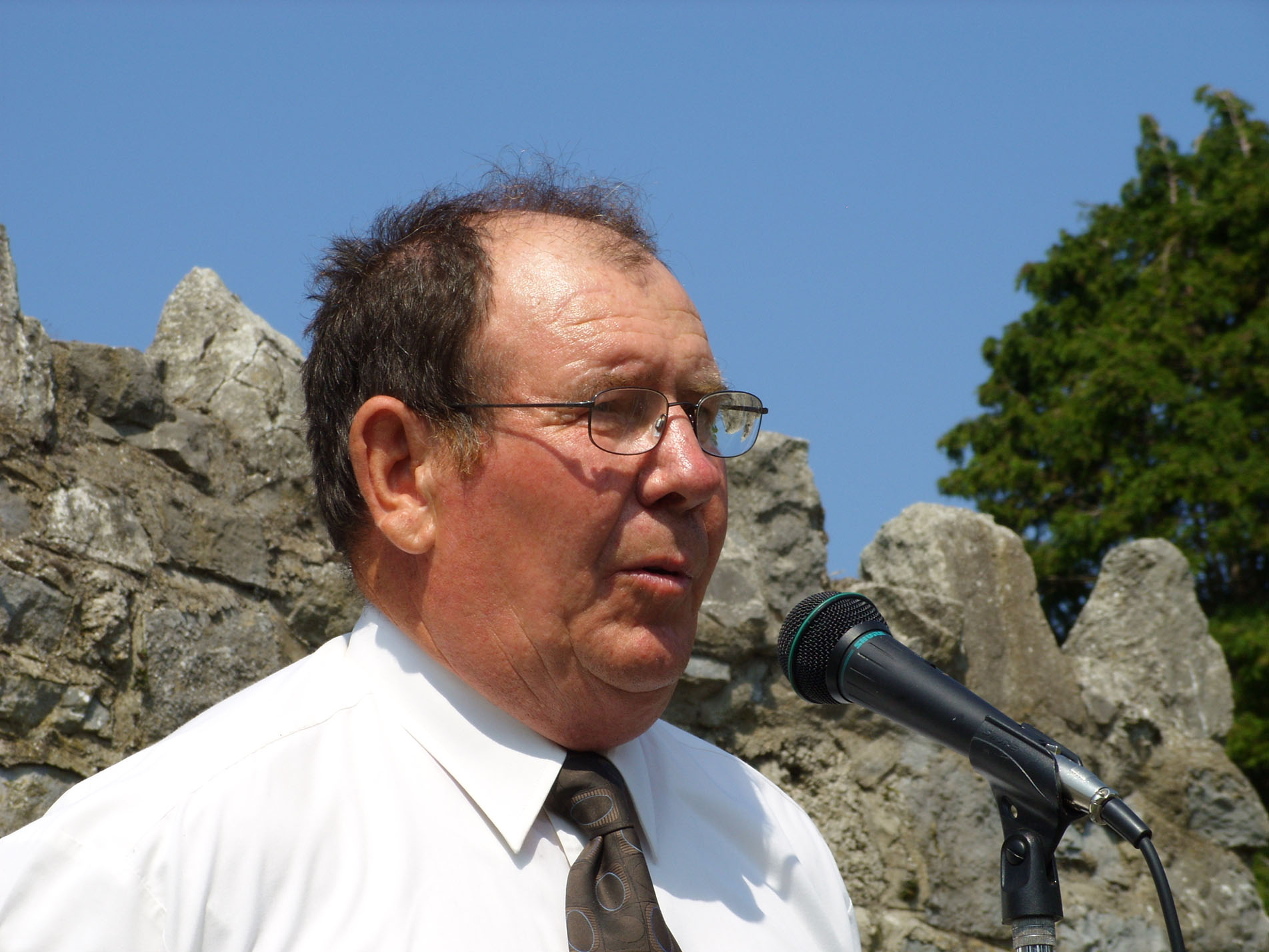
Christopher Black (pictured), one of the many so-called 'supergrasses' that inflicted heavy damage on the then republican movement, which he had joined in 1975.
On the 5th of August, 1983, 22 alleged members of the IRA were jailed for a total of more than 4,000 cumulative years on the testimony of Belfast IRA man Christopher Black, who had been 'arrested' and subsequently 'turned', in the notorious Castlereagh torture centre in East Belfast, by the British in November 1981.
Four of those 'arrested' were given life sentences with 18 others receiving shorter prison terms - one man alone, Kevin Malgrew, faced the most charges (84) and was sentenced to jail terms totalling 963 years.
The political 'fine-tuning' of the British 'justice' system in the Occupied Six Counties had already been done and allowed for alleged informers - 'supergrasses' - to testify in court in return for, amongst other benefits, immunity for themselves, even if they implicated themselves 'in activities of a serious nature'.
Christopher Black received such assurances and gave information that lead to the arrests of 38 alleged combatants, 22 of whom were then sentenced to a total of 4,000 years in prison.
Eighteen of those convictions were overturned on appeal on the 17th of July 1986.
The 'supergrass' scheme was employed by the British to arrest about 600 alleged paramilitaries but the fact that those informers were each paid between £50,000 and £100,000 and were themselves 'imprisoned' in safe houses with, in the main, no contact with or from family members and/or friends induced a form of 'Stockholm Syndrome' in Black and those of his ilk to the point that they would allow their captors - the British State and its representatives - to practically 'school' them in the nature of the 'evidence' that was required.
More about that informer can be read here, but it's hard to believe that, if Christopher Black (or other [P]IRA informers) were active today they would be ordered by their own leadership to 'step forward' and voluntarily divulge whatever information they had on republican activity to the British, as per instructions from Martin McGuinness.
A definite case of the above-mentioned 'Stockholm Syndrome' but, in the case of Mr McGuinness, he (and others) actually welcomed the opportunity to work on behalf of Westminster!


"We must lay the sure foundations of national health and industrial prosperity (first)..."
In 1919, the British involved themselves in political and military 'campaigns' in Afghanistan, Russia, Northwest Pakistan ('the Waziristan Campaign'), Egypt and, of course, Ireland.
They were 'stretched', politically, militarily and financially.
Their Prime Minister, a Mr Lloyd George, uttered the above sentence on the 5th August, 1919, at a cabinet meeting in Westminster, during which he warned his colleagues of the effect on public opinion of the continuing high military spending, stating that their first priority had to be their own people.
A Mr Winston Churchill, the British 'Secretary of War and Air' (!), stated that the (British) army could very well be reduced to about 320,000 members within the year, which prompted Mr Lloyd George to ask why the army needed to be so big (up from about 255,000 members in 1914/15).
Mr Churchill replied -
"Our responsibilities during the War had considerably increased, especially in regard to Ireland and the East..."
Your "responsibilities", Mr Churchill, should have been with English people and England, not Irish people and Ireland...
(Incidentally, an Irish historian, a Mr Keith Jeffery, was later to state that what he termed 'imperial overstretch' became a constant theme in British policy towards Ireland during the following few years - "In the hard light of the post-war world, and vividly illustrating the consequences of imperial overstretch, overseas vision had to be tempered with domestic economy..."
In other words, Westminster's ego was bigger than its pocketbook.)
==========================
ON THIS DATE (5TH AUGUST) 108 YEARS AGO : GAA FANS HARASSED BY BRITISH ARMY AND RIC.

'In July 1918 the British government declared the GAA a 'dangerous organisation' and Gaelic games were banned.
The British authorities informed the GAA that no hurling or football games would be allowed unless a permit was obtained from Dublin Castle.
On 20 July 1918, the GAA held a meeting in the Sackville Street rooms in response to the Dublin Castle edict. Those at the meeting unanimously agreed that no such permit should be applied for, under any conditions, and instead defiantly organised a series of matches throughout the country. After a short discussion, it was decided that no permits would be asked for under any conditions and provisional councils, county committees, leagues and clubs were to be notified accordingly, and also that no member was to participate in any competition if any permit had already been obtained.
It was further decided to arrange for Sunday, 4 August, at 3 pm, a series of matches throughout each county to be localised as much as possible. The GAA organised a game in every parish, and on 4 August 1918 around 1,500 hurling or football matches were held throughout the country on what became known as 'Gaelic Sunday'.
In Dublin, matches were played in Clondalkin (!), at Croke Park, Phoenix Park, Ringsend, Sandymount, Baldoyle, Fox and Geese, Crumlin, Balneary, Clonsilla, Terenure, Church Road and Bray. In all, there were 22 football and two hurley matches throughout each county to be localised as much as possible..' (from here.)
On the 5th August, dozens of reports of 'stop and search' harassments of GAA fans by the British military and their RIC colleagues were published in the newspapers, with some 'arrests' being made.
That was back when the GAA had balls to spare (excuse the language and the pun) and they actually knew where they stood as an organisation, in relation to the British military and political presence in this country.
Even before the 'Top Table' in the GAA agreed to campaign for dropping Rule 21 and roll out the welcome mat for armed British and pro-British terrorists in this country, a sea-change had taken place around that 'Top Table', prompted by 'political considerations'.
If such an edict was issued today by the British in relation to GAA clubs in the Occupied Six Counties, the Ulster GAA leadership's first reaction would more than likely be to seek financial compensation for 'loss of earnings', and the GAA 'Top Table' would be ok with that, provided it got a share of the spoils.
A ball-less own goal, if you like.
ON THIS DATE (5TH AUGUST) 148 YEARS AGO : BIRTH OF MARGARET MARY PEARSE ANNOUNCED.

On the 4th of August, 1878, James and Margaret Pearse (nee Brady), then living in number 27 Great Brunswick Street in Dublin, celebrated the birth of a daughter, Margaret Mary, pictured (a sister for their future son, Padraig).
As a child, Margaret went to school at the Holy Faith Convent in Glasnevin, Dublin, and liked the experience so much that she wanted to train as a teacher, which she did, even though she didn't think too much of the education system that existed in the country at the time.
And neither did her brothers, Padraig and William - so all three set about establishing their own school, in Cullenswood House, Rathmines, Dublin, in 1908.
In 1916, Padraig and William were executed by the British for their part in the Easter Rising that year, which left Margaret Mary in charge of the school, a position she maintained (with great assistance from a Mr Fergus De Búrca) until the early 1930's.
In the 1930s, the then relatively new 'Fianna Fáil' party was on the look-out for 'names' to help boost its political profile, and Margaret Mary was approached by two people she knew, a Doctor James McCann and her work colleague, Mr Fergus De Búrca, and it was suggested to her that she join the new party and contest a seat in a Leinster House election for it, in the then 'Dublin County' constituency.
She agreed, although one must wonder how and why she did so, as she must have known that Fianna Fáil's political policy, then and now, was counter to that which her brothers, and thousands of other political fighters, fought and died for.
In 1933, at 55 years of age, Margaret Mary, who was introduced as 'a spinster from St Enda's College', won a seat in Leinster House for Fianna Fáil but lost that position (on the seventh count) four years later but, as continues to happen now, that failed candidate was 'tucked away' in the Free State 'Senate' on the so-called 'Administrative Panel' for futher use by her Free State party.

Margaret Mary (pictured) stayed in that well-remunerated talking-shop until she died, at 90 years of age, in 1968, in Linden Convalescent Home in Dublin, on the 7th of November that year.
Sad to say that herself and, indeed, her mother, Margaret, 'lent themselves' to Fianna Fáil (and the Free State) as 'figureheads' ie the Fianna Fáil party and their State used the Pearse name as leverage when it was seeking votes and political legitimacy.
THE GREAT OIL AND GAS ROBBERY...
(Extra information, from various sources -)
Ireland sits on an Atlantic margin geologically similar to Norway’s North Sea yet, while Norway built a $1.5 trillion sovereign wealth fund from oil and gas, Ireland banned offshore exploration in 2019 and remains about 80 per cent import-dependent for gas.
Estimates (pre-ban) Barryroe up to 1.6 billion barrels oil equivalent and Dunquin, Druid, Drombeg gas prospects and Porcupine Basin alone could hold about 10 billion barrels.
If developed, this State could be energy self-sufficient, slash household bills, fund the entire HSE budget from royalties, and still have hundreds of billions left for future generations (or, indeed, to squander on foreign vagrants) just like Norway.
Instead we pay Arabs while leaving Irish hydrocarbons literally untapped in the ground which, in our opinion, is the result of 'brown-envelope planning'.
Time to reopen the Atlantic margin before the lights go out ; pre-existing State licences (which were agreed to before the ban) are still honoured and active, some of which run until 2034, but the area remains 'officially' closed to new entrants ; the 'planning' must not have been sufficient...
(END of 'THE GREAT OIL AND GAS ROBBERY' ; NEXT - 'Failing The Children', from 2002.)

On the 5th August, 1920, an IRA ASU in Gortahork (under the command of Volunteer Frank O'Donnell), in the county of Donegal, finalised their arrangements for an operation to take place the following day.
On the 6th, the Volunteers took up an ambush position near Gortahork and detained a three-man RIC patrol, who were reluctant to surrender but done so after one of their number was wounded.
This was an operation for munitions, and any military equipment carried by the RIC was taken from them and they were released.
The Gortahork IRA was a highly organised and efficient unit, and was attached to the 2nd Battalion, 1st Brigade of the 1st Northern Division of the rebel army.
==========================

THE MONTH UNSPUN...
The stories that hit the headlines.
From Magill magazine, August 2002.
The government announced that there would have to be major cuts in Exchequer spending, and first to go were the Sikorsky helicopters on order for the Defence Forces (sic). Over €12 million had already been put aside for their purchase in this year's defence budget and, following that, it was announced that 800 health jobs would not be filled this year, saving the Exchequer another €10 million.
One day later, the government increased the registration fees for third-level colleges from €396 to €670, an increase of just under 70 per cent, to the fury of college students.
Meanwhile, the maximum maintenance grant increased five per cent to €2,510 for the 2002-2003 academic year...
(MORE LATER.)


"A service was established in all (British) government departments in the area, General Post Office, telephone exchange, RIC headquarters and Victoria military barracks..."
- Volunteer Frank (Francis Joseph) Crummey (pictured, 47 years of age in 1921, a school teacher by profession), IRA Third Divisions Intelligence Officer.
"In a few short months we had practically completed a copy of every important file in the Military Headquarters..." - Volunteer David McGuinness, who worked alongside Volunteer Crummey.
On the 5th August, 1921 (some sources give the date as the 6th?), Volunteer Crummey's son, Francis Joseph (18), and another young Volunteer, Freddie Fox (19, from Lisburn, County Antrim), were armed and on IRA business on the Earlswood Road in Belfast (they were following up on a lead about an RIC member, a Mr Richard Harrison, who was part of John William Nixon's 'Murder Gang') when they were stopped on the street by an RIC patrol.
Shots were exchanged, one RIC member was hit in the leg and, in the confusion, the two Volunteers hurriedly left the scene but were pursued by the RIC members and, during the subsequent chase (or during an altercation with the wife of another RIC man who had intervened, according to some sources?), Volunteer Crummey's gun was discharged, the shot hit his comrade, Volunteer Fox, in the stomach, and both men were 'arrested'.
Volunteer Freddie Fox died in the 'Royal Hospital' in Belfast from the wound on the 15th August, 1921.
RIP Volunteer Freddie Fox.
==========================
Elsewhere in Belfast on that same day, a shop owner, a Mr Charles Green (42), was working in his premises in College Court when an armed men entered and shot him.
He died later from the wound.
==========================
DEATH IN THE MEDITERRANEAN...

Desmond Boomer, a Belfast engineer working in the Libyan oil-fields, disappeared seven years ago.
Officially, the plane on which he was a passenger crashed as a result of mechanical failure and pilot error.
But is that the real story?
Or were the Irishman and his fellow passengers unwitting victims of the shady war between Islamic fundamentalism and Mossad, Israel's intelligence network?
A special 'Magill' investigation by Don Mullan, author of 'Eyewitness Bloody Sunday'.
From 'Magill' magazine, January 2003.
Desmond Boomer's father said -
"However, given the immense pressure Malta found itself coping with, especially the very dangerous threats emanating from Islamic fundamentalists in Tripoli, we must question the source of these two well-placed reports.
Given the numerous imponderables in the crash theory, our ongoing suspicions are understandable."
One of those suspicions is the possibility that pilot Carmelo Bartolo may have been offered as a sacrificial lamb in order to appease the blood lust of members and supporters of Islamic Jihad who had vowed retaliation against Malta if the assassins of Shqaqi were not brought to justice...
(MORE LATER.)


On the 5th August, 1922, an 'off duty' (!) member of the 'Ulster Special Constabulary', a Mr Samuel Hayes (45), was having a few pints in the Britannic Bar on the Newtonards Road in Belfast, relaxing after a hard day throwing his weight around the neighbourhood.
There was a commotion on the street outside the pub and a man burst in to the bar and ran throught it, apparently looking for a back door.
Just then at least two armed men stormed into the pub and fired shots at the first man ; one of the bullets hit Mr Hayes and he died later from the wound.
==========================

As Mr Hayes was sipping from his last pint, the fight between the IRA and the Stater Army in and around the town of Kilmallock, in the south of the county of Limerick, was continuing.
The Leinster House militia (FSA) was about 2,000 strong and had the use of (borrowed-from-the-British) artillery, but what really worried the rebels was the fact that, days earlier (2nd and 3rd July 1922), the Staters had landed from sea in the towns of Fenit and Tarbert, in the county of Kerry.
The Kerry rebels who were fighting in Kilmallock in Limerick wanted to return to their own county to defend it against the Staters and their fellow rebels, from Cork, anticipating a sea borne invasion of Cork by the Staters, also wanted to return to their home county to defend it.
This left the town of Kilmallock practically undefended and the FSA took it on the 5th : they established a HQ in Hartnett's Hotel in the town of Castleisland and, from a basecamp in Tralee, they took the town of Farrenfore.
Bad cess to the Staters, then and now.
==========================

The Dublin Brigade IRA picked Saturday, the 5th August, 1922, for their operation against the FSA (and against the much-reduced British military and political presence still in the newly-spawned so-called 'Free State'), and mobilised about 250 Volunteers to take part in it (the Volunteers were mobilised across the mountains and outlying northern and western districts).
The well-drafted plan of action was to destroy/destabilise the infrastructure (main roads, canal access, railway bridges etc) which gave access to Dublin ie to 'cut off' and isolate the city from the rest of the country and halt the FSA offensives, from Dublin, into republican-held Munster.
IRA Units were in place in what were at the time rural outlying villages (ie Blanchardstown, Ashtown, Raheny, Malahide, Howth, Kilakee, Roundwood etc) with instructions to dismantle road and rail infrastructure, railway bridges, road crossings, stone bridges, to trench roads etc but they were not then aware that the Staters had captured documents outlining the plans of the IRA operation.
About 160 Volunteers were captured by the FSA, with between 90 and 100 eventually returning safely to base.
Mr John Dorney, the Irish historian, described that operation as "...an even greater disaster for the Dublin Brigade than the attack on the Customs House had been in 1921.."
Yes, indeed - the 'Cut-Off And Isolate' operation of the 5th August, 1922, was "a disaster", but the 1921 Customs House operation (despite an IRA-acknowledged heavy military cost) was a major propaganda/publicity success and a blow to the British civil administration in Ireland.
==========================
As the Free Staters were 'arresting' republicans in the Leinster area, an FSA soldier, a Mr Michael Purcell, was shot dead in Tralee in the Munster county of Kerry and, in that same Munster county, an FSA Captain, a Mr Brian Houlihan, and two of his comrades, were wounded in an IRA attack on a supply lorry which was on its way to the town of Castleisland when it was fired on at Knockeen Cross.
Mr Houlihan was shot in an arm and in both of his kidneys and was removed from the scene to hospital, where he died from his wounds on the 6th (some reports state that he died within minutes of been shot on the 5th).
==========================

"Outrages have been committed against retired policemen...(by those who)...talk and wrangle for days about their shadowy republic. I deplore this conduct.."
- the words of virulent anti-republican Cardinal Michael Logue (pictured), as quoted in 'The Clare Champion' newspaper on the 5th August 1922.
This priest, a staunch Free Stater and the Archbishop of Armagh and Primate of All Ireland, not only didn't believe in an 'All-Ireland', but used his position and standing within the community to repeatedly condemn those who did.
He aligned himself fully with the Staters and was loud and constant in his condemnation of those who were prepared to fight on for a 32-County Irish Republic.
Mr Logue died at 84 years of age on the 19th November, 1924, in the then - and now - still occupied Irish county of Armagh.
==========================

"No definite military problem exists outside the Southern Division (Cork/Kerry/Limerick/Waterford) area.
We should postpone parliament until we can clean this matter up definitely (that is, his military campaign against the IRA!).
If parliament did not meet until the 24th of August our military position would be very favourable..."
- a Mr Michael Collins, in a memo he sent on the 5th August 1922 to one of his political bosses, a Mr William Thomas Cosgrave.
Mr Collins was shot dead on the 22nd of that month by the IRA in an ambush at Béal na Bláth in the county of Cork, a "problem" area, apparently...
==========================

As Mr Collins was sending that memo, the long running strike by farm labourers (pictured) on farms and farmlands owned by the Keane, Devonshire, Villers-Stuart, Musgrave and Ussher families in the Blackwater Valley in the county of Waterford came to an end with a partial defeat for the strikers.
The landed gentry had, in May that year (1922), stated their intention to cut wages (in most cases, from 38 shillings to 30 shillings a week and an increased working week ie from 45 hours a week to 54 hours) and the labourers, supported by a trade union leadership which wasn't yet in bed with the bosses, objected, and talks were held but, in early August, the labourers and other farm workers had had enough, and downed tools.
That industrial action coincided with the Stater Army having moved in to Waterford in late July and, money following money, they 'unofficially' supported the gentry as, indeed, for shame, did the latest batch of recruits into the IRA once it was safe to join ie once the 'Truce' came into effect (the 'old hands' described those new 'gimme-a-medalers' as 'truceileers' - the sons of and/or linked to farmers and landowners, and it is estimated that, during the pause in the fighting, the IRA expanded from about 15,000 members to over 72,000 by November 1922).
The strike was over, rather than settled, but it blew-up again in 1923 and, this time, the Staters publicly came down heavy on the strikers...
==========================
ON THIS DATE (5TH AUGUST) 138 YEARS AGO : 'LITTLE PHIL' MEETS HIS MAKER.

"The only good Indian is a dead one" - 'Supreme Commander' of the US Army, Major Philip Henry Sheridan (pictured) who, despite being only five feet and five inches tall, made a 'big' (and bad) impression on the native American population.
He was born in Albany, New York, on the 6th of March 1831, the son of Irish immigrants from Cavan who had to leave Ireland because of the attempted genocide ('An Gorta Mor').
He 'made his name' by his evil treatment of the native American population, and was responsible for the slaughter of the Lakota Indians at Wounded Knee in 1890, where one-hundred victims, under Chief Big Foot, were massacred by the U. S. 7th Cavalry ; about half of the dead were women and children.

The slain body of Chief Big Foot (his Lakota name was Si Tanka, 'Spotted Elk'), propped up in the snow at Wounded Knee.
The Wounded Knee massacre was the last of the Indian uprisings, and prompted Sheridan to state that...
"...the only good Indian I ever saw was dead."
He knew he was in the wrong in what he was doing, as he said so himself : in 1878, he made a report to his Army superiors in which he stated -
"We took away their country and their means of support, broke up their mode of living, their habits of life, introduced disease and decay among them, and it was for this and against this they made war.
Could anyone expect less?"
He wouldn't argue against the fact that he and other armed 'Bluecoats' were 'occupiers/invaders' in a land where they were not welcome yet he had no hesitation in planning the 'best practical' methods of removing the natives from their lands and, indeed, with that objective in mind, he once stated that he had "...never once taken a command into battle and had the slightest desire to come out alive unless I won...."
He died on this date (5th August), at 57 years of age, in 1888, in Bristol County in Massachusetts - one battle he didn't win, and didn't deserve to win.
The Irish and the Native Americans have a common enemy - imperialism.
Mr Phillip Sheridan was on the wrong side.
(Incidentally, it was Mr Sheridan who personally reinstated Lieutenant Colonel George Armstrong Custer and gave him standing orders "to kill all the warriors, capture all the women and children, destroy all camps and material goods, and kill all the ponies..."
Shame on the man.)
ON THIS DATE (5TH AUGUST) 57 YEARS AGO : UVF ATTACK ANOTHER ANTI-REPUBLICAN ORGANISATION.

The main RTE studios, 'Montrose', Donnybrook, Dublin (pictured), after the UVF bombed same on the 5th August 1969, 57 years ago on this date.
No one was killed and no structural damage was done to the building and, afterwards (and to date), both organisations - RTE and the UVF - continued to propagate an anti-republican agenda.
RTE reported on the attack against it with the following statement but, despite rumours, never mentioned the probability that British State collusion (so-called 'rogue elements'!) could very well have played a part in the operation -
'The explosion occurred at exactly 1.30am and could be heard over a wide area of Dublin city.
It is believed that the explosion may have been caused by a time bomb placed at the rear wall of the studio building.
There was no structural damage to the building but there was damage to the large structural plate glass panels which are a feature of the building.
No staff were injured by the explosion. At this stage Gardaí are investigating what happened but so far there have been no arrests. It was later discovered that the bomb had been planted by the Ulster Volunteer Force (UVF).'
Ironic to think that, as per our caption, above, one anti-republican grouping could turn so violently on another. But credit where it's due ; RTE, to date - despite that 1969 misunderstanding - remains as wedded as ever to the same anti-republican agenda that it freely operated at that time.
At least they're consistent in that once bought, they stay bought, no matter what!


On the 5th August, 1924, the then British Prime Minister, a Mr James MacDonald Ramsay wrote to the wife of 'Lord' Londonderry (that particular 'lord' had been brought into this world with the name Charles Stewart Henry Vane-Tempest-Stewart!), a Mrs Edith Vane-Tempest-Stewart (! -'Marchioness of Londonderry', a so-called 'aristocrat', pictured) outlining his concerns about a Mr ('Justice') Richard Feetham, a British-born South African judge and Oxford graduate who, at that time, was the Chairman of the Boundary Commission in Ireland.
Phew! Are yis all still with us? Not much to go now, and no more bleedin' extra-barrel names...!

Anyway - didn't Mr Ramsey give it to Mrs Edith Vane-Tempest-Stewart, in writing, that he was of the view that it was a mistake for Mr Feetham to believe that the Boundary Commission could only make "minor changes to the border" (ie Mr Ramsey was apparently hoping, and he himself believed, that that Commission should expand/increase the occupied territory - one of the other three Ulster counties or perhaps one of the 'bordering' Free State counties!).
But sure didn't Mrs Edith Vane-Tempest-Stewart repeat Mr Ramsey's concerns in one or other of the 'aristocratic' circles she hung out in and word got back to Mr Ramsey that his doubts about Mr Feetham and the Commission were now practically public knowledge and he needed some damage limitation to take the bad look off it.
He and his people put it about in the social media circles of the day that he was simply repeating some of the "mere gossip" he himself had heard...!
A typical politician - evasive, cowardly and untrustworthy, not believing that he should accept accountability for his own words.
==========================
ON THIS DATE (5TH AUGUST) 107 YEARS AGO : DEATH OF TWO BRITISH 'POLICE OFFICERS' IN IRELAND ANNOUNCED.

'Derrymore is a townland approximately four miles from Ennistymon and the same distance from Inagh. As a result of agrarian trouble some years before the war, a man named Kildare had been murdered, and consequently the RIC (pictured) built a hut in the area.
A sergeant, a constable and a number of other police went into occupation to try to identify the murderer. Their attempts, however, were unsuccessful and because of this they lost the confidence of the local people.
Sergeant O’Riordan and Constable Murphy did their rounds of duty on bicycles and their movements were carefully watched by the local IRA members in the Lavareen Company area. It had been noted that the men got off their bicycles at the bottom of the hill near 'Curtin's Gate' and it was here the ambush party, which consisted of Martin Devitt, John Joe Neylon, Jackie and Micko McGuane and Mickey and Tom Kelleher, lay in wait.
After getting off their bicycles, as the party had hoped, the sergeant took the lead and his comrade followed at a distance of about one hundred yards. When the sergeant reached Curtin’s Gate he was rushed on and overpowered.
This had been the signal to attack the constable, whose rifle was slung over his shoulder in the usual way.
Because of his surprise the constable fell across the bicycle and his shoulder strap became entangled in the handlebars and had to be cut by the IRA in order to get the rifle.
The ambushing party then dispersed delighted with their success as this had been their first attempt to disarm RIC in the area. The two policemen departed, shocked and swearing vengeance but glad to have escaped with their lives. A house search was carried out and locals, including some of the men who took part, were questioned, but no information was given.
Following the success of this ambush another one was planned for August 4th of the same year.
However, this time the policemen put up a fight and both were shot dead.
This ambush occurred at a place called '81 Cross' which is about three and a half miles from Ennistymon and only three quarters of a mile from the hut in Derrymore. The policemen were returning from Ennistymon to the hut at about eleven fifteen p.m. when they were fired on from behind a ditch.
They were not wounded by the first volley of shots and the Sergeant drew his revolver and fired on a man he saw in the ditch. The shooting continued and Constable Michael Murphy was shot dead. Sergeant John O’Riordan was wounded and died shortly afterwards...' (from here.)
One of the IRA Volunteers was wounded in that operation, but he lived to tell the tale. One of the RIC men, Michael 'James' Murphy (badge number 69587) was only 20 years young when he died, having been shot through the heart. The other British 'policeman', John O' Riordan, who was 44 years of age at the time, died from his wounds.
But their colleagues in the British Army wanted revenge ; this is from the same source as above -
'...ten days later...a fifteen year old Sinn Féin Boy Scout was shot dead while reading a book by the fireside at his home in Glann, on August 14th, 1919.

At an inquest his father told of how the family had retired to bed on the night of the 14th at about 10.20 p.m. while Francis (pictured) remained in the kitchen reading a book. At about 12.30 a.m. he was awakened by the sound of shots and falling of mortar in his own room. Another shot was fired and then he saw a flash going through the partition.
As he went into the kitchen, he found his son lying in a pool of blood but he could see nobody about. After receiving evidence of some locals including Pete Connole, a night watchman for the West Clare Railway, the jury concluded that the murder was carried out by the (British) military as revenge for the shooting of the two policemen and passed the following verdict -
'Francis Murphy, of Glann, Ennistymon was unlawfully and wilfully murdered..by a bullet unlawfully and wilfully fired by members of the (British) military..which caused immediate death'.'
15-years-young Francis Murphy had played no part in the IRA ambush of the two paramilitary 'policemen' but the young lad was associated with the Republican Movement, so the IRA leadership sent one of its operatives, Michael Knightly, from Dublin, to County Clare, to investigate what had happened.
He went, as instructed, and handed his report in to Arthur Griffith -
"On returning to Dublin I went to Sinn Féin headquarters and informed Mr. Arthur Griffith that in no doubt young Murphy had been shot by crown forces. Mr. Griffith attached considerable importance to the matter and appeared to think that it would be a serious blow to British rule in Ireland if it could be proved that their forces had resorted to such measures.
He engaged Mr. Patrick Lynch, Kings Counsel, to attend the inquest on behalf of the Murphy family. I attended the inquest as a reporter and gave what assistance I could to elucidate the facts. A verdict of murder against British crown forces was returned..."
The verdict obviously didn't bring young Francis back to his family, but hopefully it gave them some small comfort.
Thanks for the visit, and for reading - really appreciated, sure yer helping us to get to 5 million hits, so why wouldn't we appreciate ya!
Sharon and the team.
We'll be back with a few more bits and pieces on Wednesday, 19th August 2026.
...but I'll still be givin' out on 'X' and 'Facebook' as well, if yer looking for me!