Officially, the 'safeguarding' of streets, marts and the local citizens seems to have been put on a regular footing in Ireland in 1786, in Dublin, when a body of men were assembled under the banner 'Dublin Police'.
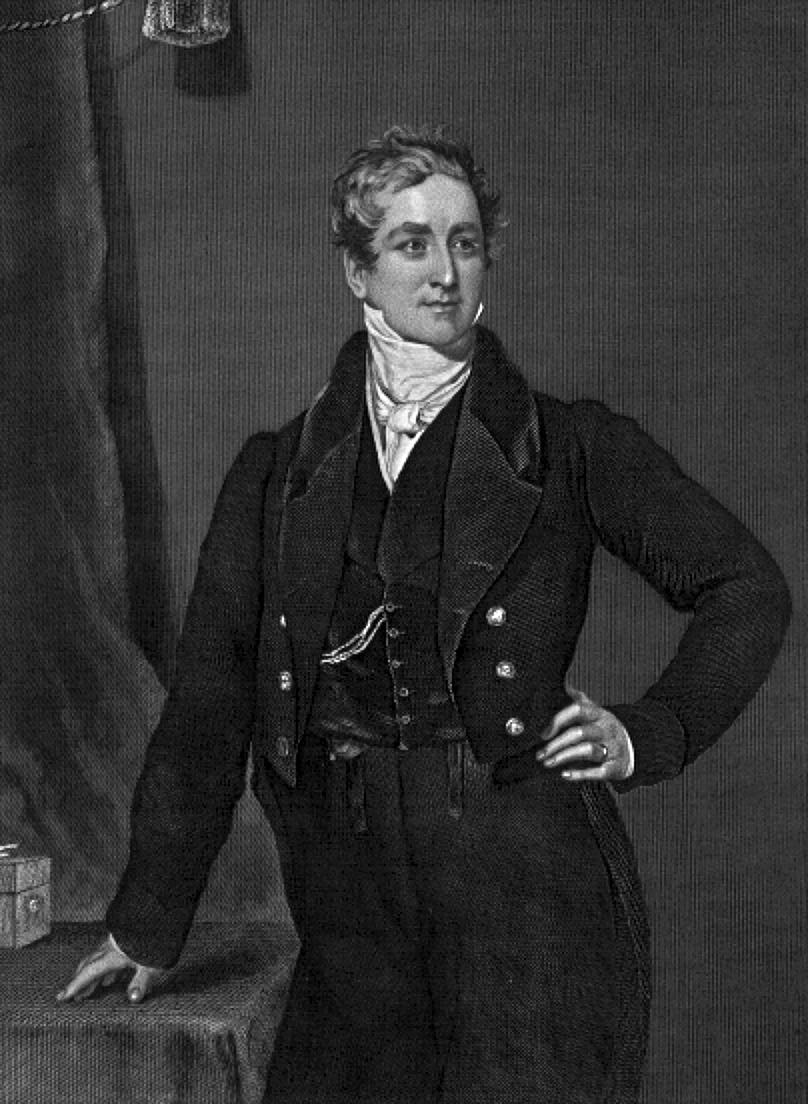
This grouping was replaced in 1814 by Westminster, when an Irish 'Peace Preservation Force' was announced by the then 'Chief Secretary for Ireland', a Mr Robert Peel, to be replaced six years later by a more organised body, the 'County Constabulary', which was organised on a regional basis and shared a common uniform.
Fourteen years later, the 'County Constabulary' was replaced by two organisations, the 'Irish Constabulary' and the 'Dublin Metropolitan Police' (DMP) : the former was re-named the 'Royal Irish Constabulary' (RIC) (which recorded 11,000 members in about 1,600 barracks in the year 1900) and was officially dissolved in 1922 (but not mentally or morally,as far as its members and supporters are concerned) and the latter, the 'DMP', merged with the 'Civic Guard' (renamed in 1923 as 'Garda Síochána na hÉireann') in 1925 and the amalgamated force was named 'An Garda Síochána' on 2nd April 1925, 100 years ago on this date :
'On and from the commencement of this Act the Dublin Metropolitan Police and the Gárda Síochána shall be amalgamated and form one force (which force is in this Act referred to as the amalgamated force), and it shall thenceforward be lawful for the Executive Council to train, equip, pay, and maintain such amalgamated force as a police force in Saorstát Eireann.
The amalgamated force shall be called and known as the Gárda Síochána.....'
As far as Irish republicans are concerned, there is little, if any, actual difference between the above-mentioned 'police forces' as they are all tainted either directly by a foreign government or by that foreign government's proxy in this country, north or south of Britain's imposed border.
In short, both the RUC/PSNI and An Gárda Síochána seek to preserve the political status quo and, as such, they are of no benefit to those of us who campaign and work, politically, for a just society in this country.
Robert Peel and his ilk would be proud of both groups.
From this...
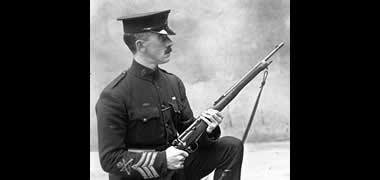
A member of the Dublin Metropolitan Police (DMP), a British creation in Ireland...
...to this -
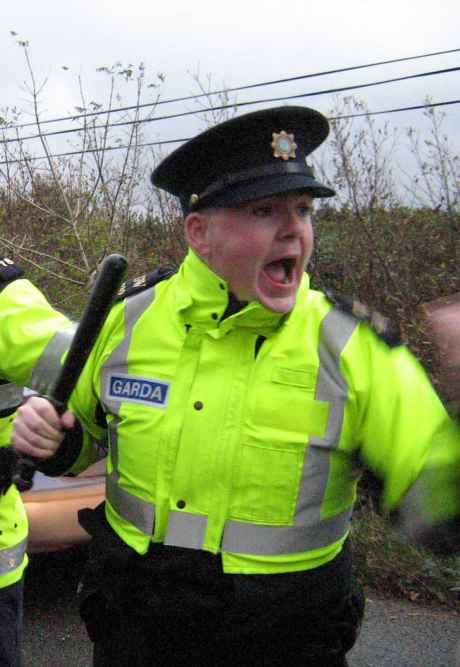
A member of the State 'Garda Síochána', a Free State creation in Ireland.
A history of the former (DMP) will show that between 1836 and 1925, approximately 13,000 men passed through its ranks, some of whom were 'awarded' the 'King's Police Medal' whilst others transferred to the DMP from the 'London Metropolitan Police'.
Other like-minded colleagues joined the gang, having developed a taste for it in the RIC.
This group changed uniforms again on the 3rd April in 1925, and again changed its name - to that of 'An Garda Síochána', but kept its by-now infamous attitude : to defend the State - whether British or the Westminster-permitted 'Free State' in Ireland - by the same methods.
And these are the same methods that pro-Irish, anti-migrant/foreign vagrant supporters have experienced from that State militia, whatever it may call itself.
Since their inception, the State 'Police Force' have attempted to present themselves as a 'neutral' body, dedicated to 'keeping peace' in society, regardless of the circumstances : the truth, as known by those of us who have 'dared' to challenge this unjust system, is much different - they see their position as one in which to preserve the status quo, whether same is dictated to them from the EU, Westminster or Leinster House.
They may not know it yet but one day (soon, hopefully!) they will have to change again, but this time it will be more than just a change of uniform...


On this date (2nd April) in 1919, the Second (32-County) Dáil Éireann (pictured) held a meeting to elect/confirm its departments and officers.
Éamon de Valera was elected Príomh-Aire (President), Arthur Griffith (Home Affairs), George Plunkett (Foreign Affairs), Eoin MacNeill (Industries), Cathal Brugha (Defence), Robert Barton* (Agriculture), Countess Markievicz (Labour), WT Cosgrave (Local Government) and Michael Collins, (Finance).
Seán T. O’Kelly was elected Ceann Comhairle.
Three non-cabinet appointments were also announced - Laurence Ginnell elected as Director of Propaganda, Robert Barton* as Director of Agriculture and Ernest Blythe as Director of Trade and Commerce.
The Dáil session was held over three days, and 52 TDs attended, which was the largest of any of the Dáil sessions which took place between 21st January 1919 and 10th May 1921.
Proper business was done, whereas the political institution in this State now, in Leinster House, is a farcical and expensive waste of space.
==========================
GAS LADS...

The massive finds of oil and gas on our western seaboard could ensure Ireland's financial security for generations.
Wealth approximating that of the Arab countries is within our grasp, but the Irish government seems content to sell off our birthright for a handful of votes and a few dollars.
In a special 'Magill' report, Sandra Mara investigates just what we are giving away, and why.
From 'Magill' magazine, March 2002.
Other experts within the industry allege that many claims of 'dry holes' drilled by the oil companies in the past were in fact positive finds, held over for a later day.
In contrast to standard operating procedures in the world, Ireland has no government officials based on oil rigs operating in Irish waters - instead, they visit the rigs from time to time, and by appointment only.
The State relies on the information supplied to it by the oil companies as to the viability of each site.
In the early day, the then State Energy Minister, Justin Keating, introduced oil and gas exploration taxation, which would protect Ireland's interests in the event of any commercially viable finds.
The tax then was levied at 50 per cent, and gave the State a right to an automatic 50 per cent shareholding in the find, together with royalties in the region of six to seven per cent...
(MORE LATER.)


On the 2nd April, 1920, the 'First Battalion' of the Manchester Regiment of the British Army (pictured) arrived in Ireland (Cork) and overstayed its welcome here by two years.
They were billeted in Fermoy and Kilworth, and were under the command of a Lt Col Gareth Evans and, as they were being transferred to this country, one of their political bosses, a Mr James Craig, was himself being shifted from his position as Parliamentary Secretary for Pensions in the British administration to that of Parliamentary Secretary at the Admiralty (where his new boss was a Mr Walter Long, the 'First Lord of the Admiralty').
All concerned probably had that sinking feeling...
==========================

An RIC man was shot dead in Carlow on the 25th March 1920, resulting in the local IRA leadership having to go 'on the run'.
Volunteer Edward Malone, from County Laois, the Commander of the Carlow Active Service Unit of the IRA (pictured, which, at the time, was fairly well armed - 11 rifles, 6 revolvers, about 50 shotguns and at least 1,000 rounds of ammunition for their weaponry) had already been 'arrested' by the British (on the 22nd November 1919) and was imprisoned in Mountjoy Jail in Dublin.
Volunteer Malone supported, and took part in, the IRA riot in the 'Joy which preceded a brief hunger-strike by the POW's, from late March to the 2nd April that year, even though he was isolated in the prison hospital from his men, and was handcuffed and monitored by prison warders.
They couldn't break the man.
==========================
THE NUMBER'S UP...

How some famous gambling conspiracies came to light.
By Con Houlihan.
From 'Magill' Magazine Annual 2002.
Some professionals are former bookmakers who have chosen a less hectic life, and the bookie knows all too well that the professional isn't above being part of a conspiracy.
You can bet, however, that no professional was involved in the most celebrated conspiracy of this generation - if some professionals had been involved, it might have succeeded.
As it was, the conspirators were woefully naive ; some of them were well known to me, and I wouldn't trust them to rob an orchard.
They were successful in their own professions but, as conspirators, they were non-runners.
The horse at the centre of the plot was a useful hurdler named 'Gay Future', and he was more useful than he seemed, but had been less than busy in his outings before the big day.
The chosen location was Cartmel, a modest racecourse in the Lake District in England, about 25 miles from the nearest big town, Lancaster, and the appointed time was a Bank Holiday ; on such occasions there are meetings at almost every course in Britain...
(MORE LATER.)


The 2nd April 1921 was a very eventful day in Ireland, politically and military :
Volunteers from the 6th Battalion of the Kerry No.2 Brigade of the IRA joined with their comrades from the Kerry No.1 Flying Column (about 30 armed Volunteers in all), under the leadership of Volunteers Tadhg Brosnan (Castlegregory) and Tom O’Connor (Milltown) and ambushed British soldiers at Glenbeigh Railway Station.
There were no casualties on either side, and - caught unawares - some of the British soldiers fled the scene, dumping their rifles behind them, as they knew the IRA would kill them for the weaponry.
However, the 'RIC County Inspector', putting a brave face on their sufferings, claimed that the British Army captured "a Lewis gun and five rifles.." from the rebels!
While that RIC man was inventing armaments, Volunteers from E Company, 4th Battalion, South Wexford Brigade of the IRA were on a fund-raising operation in Killagowan, Oulart, in County Wexford ; a Mr. Oriel Richard Lee (31), who worked for the British administration in Ireland as a petty sessions officer, was at home having been issuing dog licences all day, assisted by RIC member Mr Patrick Eger, of Oulart Barracks, who was in the house with him.
At about 9pm, a knock came to the halldoor and, when he opened it, he was faced by at least two armed Volunteers, Thomas Cullen and Thomas Cosgrave, who instructed him to put his hands up, that they were IRA men and intended to take the money for licences that he had in the house.
With that, RIC member Eger showed himself, armed, and shots were fired by both parties ; Mr Lee died the next day from his wounds.
An RIC member, a Mr Patrick Neary, was accidentally (!) shot and wounded by another RIC member on the 2nd April - he died from his wound on the 11th April in King George V Hospital whereas, in Cork, an ex-British Army soldier, a Mr Thomas Goulding, on being approached by armed IRA Volunteers, escaped with his life by jumping into the River Lee and swimming to the other side.
‘Notice is here by given that anyone who is found loitering or standing at corners will be liable to be shot at sight. The same applies to anyone who is seen on the street of Tullamore with his hands in his pockets or acting in any suspicious manner whatsoever or interfering with or belittling or attempting to beset any member of his Majesty’s forces. We are out to end assassination and murder, and by hell we’ll do it...'
- a British Army notice distrubuted in the Tullamore area of County Offaly in April 1921.
That notice was issued following an attack by the IRA on Tullamore RIC Barracks on the 1st April that year.
During that attack, IRA Volunteer Lieutenant Matthew Kane, from Ruddock's Lane in Tullamore, and his nephew, Volunteer John Conroy, were wounded (Volunteer Conroy was removed from the scene by the IRA Brigade Quartermaster, Volunteer Seamus Kelly) : Lieutenant Kane's body was found the following morning (2nd April) at Hophill, Tullamore and, to this day, it is not clear whether he died from his wounds or was found after the gunfight by the British Army and finished off.
In the early hours of the 2nd April, 1921, acting under instructions from IRA Volunteer Peadar O'Donnell, Officer Commanding of the 2nd Donegal Brigade, one group of IRA Volunteers attacked the RIC Barracks on Lecky Road in Derry (during which RIC member Michael Kenny was killed), a second group attacked the RIC Barracks on the Strand Road and a third group, split-up into pairs, was sent out to shoot any enemy forces they came across.
One pair of Volunteers came across an RIC member, a Mr John Higgins, on the Creggan Road and shot him dead, wounding four other RIC members but, unfortunately, two civilians were wounded in the crossfire.
The British Army were somewhat 'jumpy' during the shootings and a BA Private, a Mr James Wright (or Whyte), who was manning a post on Shipquay Street, was accidentally (!) shot dead by one of his colleagues.
On the 1st April, 1921, the owners of coal mines in England announced the slashing of miner's wages by up to a half, which was rejected by the miners who were then locked out of the mines by the owners.
In turn, this was to result in the British Government bringing its 'Emergency Powers Act' into play (enacted in 1920) and sending troops into the coalfields.
On the 2nd April, 1921, an industrial dispute by miners in England began, with the understanding that railway and other transport workers would also down tools but, by the 15th, no such support materialised, and the strikers were forced to call off the pickets and return to work on the 1st July.
But the fact that the system was being challenged by the workers upset the 'Establishment' and, fearful that the working class were organising for an uprising, British armed forces were brought home from Upper Silesia (Poland) because, according to Westminster... "..the risk at home from Sinn Feiners, Communists and other dangerous elements, was sufficiently great to necessitate their return.."
Also, armed troops from Malta and Egypt were ordered back home, the 'Reserve Forces' were mobilised and a special paramilitary ‘Defence Force’ was also raised (which eventually had about 80,000 men).
Westminster was reluctant to pull any troops out of Ireland but, such was their unease with the bravado showed by the workers, on the 8th and 9th of April (1921) they ordered four battalions of their troops to return home from Ireland.
Pity they didn't withdraw the lot of them...
"One night Jennie Kelly, Bob Hamill and myself were on IRA guard duty on a nearby road. A patrol of 'B Specials' came along.
Hugh Duffy (65, a 'postman' for the area) was an advanced guard for this patrol.
It was a fairly dark night and Duffy nearly got past where we were standing before we noticed him. We ordered him to halt and he immediately opened fire on us. We replied vigorously to his fire..."
- statement from an IRA Volunteer who was on guard duty that night.
Mr Hugh Duffy, from Rockberry in County Monaghan, an officially retired British Army soldier, used the cover of darkness to escape his fate that night, but long lay the fox.
On the 2nd April (1921), Mr Duffy's body was discovered at Moylemuck, Lisnalong near Ballybay in County Monaghan, with four bullet wounds in his head, one in his shoulder and one in his wrist.
A notice was pinned to the body -
'Spies and Informers Beware'.
On the same date that one of their spies was executed, a Mr Edward Talbot ('Lord' Fitzalan) was appointed by Westminster as the new 'Lord Lieutenant of Ireland', replacing a Mr John French, and the British Army burned down two houses in Macroom, in County Cork, belonging to IRA Officers Volunteer Daniel Corkery and a Volunteer named Kelleher.
On the 2nd April (1921), the home of a M/s Patrica Hoey, No.5 Mespil Road, Dublin, was raided by Crown Forces.
M/s Hoey told the raiding party that she was just on her way out to pay a visit to her sick mother and they let her go, and entered her house.
She took the route that Michael Collins, Tom Cullen and Alice Lyons were using to get to her house, met them, and warned them to get out of the area, which they did.
Located in her house was a room used by Mr Collins as part of his operations for the Department of Finance, and all the files etc were removed by the raiders -
"The raid was much worse than I thought. Practically the entire record is gone...", Collins said later.
As that raid was taking place in Dublin, a British Army Major General, a Mr Tudor, the 'Chief of Police', was inspecting the RIC garrison and 'D Company' of the Auxiliaries in Galway City.
Mr Tudor stated -
"In the determined stand that you have taken in lifting the terror of the reign of the gunman, I assure you that you have my fullest support...", he declared, and 'The Connacht Tribune' newspaper reported on his inspection thus -
'Having inspected the Auxiliaries, he spoke of the pleasure it gave him to hear from many sources of the excellent discipline of D Company. He congratulated them upon the gallantry shown by a small party of them when ambushed at Kilroe on January 18 last...'
The Kilroe Ambush did not result in the death of any Crown Force members but, in its aftermath, the RIC killed four unarmed civilians.
A Mr Carl Ackerman, a journalist with 'The Philadelphia Public Ledger' newspaper, was a close friend of a Mr Basil Thomson, of Scotland Yard in London, who ran a spy network against the IRA.
On the 2nd April, 1921, Mr Ackerman interviewed three of the rebel leadership in Dublin - Michael Collins, Arthur Griffith and Éamon de Valera.
He reported (and probably not only to his editor and readers) that Mr Collins had told him that.. "..it is only a question of time until we shall have Ireland cleared of Crown Forces..", and any talk of a compromise was dismissed.
Mr Ackerman wrote that Mr Arthur Griffith stated that Lloyd George should call a conference at which peace could be discussed, and he asked Mr de Valera if he would meet with Unionist leader Mr James Craig and de Valera replied that he would meet any Irishman because, once England had left Ireland, internal differences could be resolved amicably.
Whatever else he reported was for the ears of Scotland Yard only...
On the 2nd April, 1921, a British Army Crossley Tender truck in Rathfarnham was making its way to Rathmines, in Dublin, with IRA Volunteer Bernard Nolan in the back of it.
A BA 'spotter' on board thought he recognised another IRA man and he, too - a civilian named Christopher Reynolds - was pulled off the street and put in the back, beside Volunteer Nolan.
As they were driving through Rathmines, the truck stopped and both prisoners were shot and considered to be dead but, even though they appeared lifeless, and were seriously wounded, they were in fact both still alive.
The truck was driven to 'King' George V hospital and their 'bodies' were placed in the hospital guard room under British Army soldiers.
Both men knew if they moved or cried out in pain, they would be finished off, so both of them somehow managed to lie still and silent, until they heard the British Auxiliaries getting back in the truck ; then they moved and groaned loudly, but the Auxies heard them and made their way into the guard room to shoot them again, but were prevented from doing so by the British Army guards, who sent for a Fr Francis Farrington from Aughrim Street Church.
The civilian, Mr Christopher Reynolds, gave a statement to Fr Farrington in which he stated that he was shot in the back, in cold blood, by one of the Auxies, and he died from his wound shortly afterwards.
Volunteer Bernard Nolan survived to fight another day.
While that was going on in Dublin, the IRA in Galway was raiding a house in Kinvara, in that county, searching for a Mr Thomas Morris (57).
They found their man in his sisters house, from which he was removed and shot dead.
Mr Morris, an ex-British Army man and former RIC member, had given information to his old buddies in the Crown Forces which resulted in a raid on a house (a M/s Bridget Quinn's house, perhaps..?) where IRA Volunteers were billeted, leading to their capture.
A notice was pinned to his body, reading 'Spies Beware!'.
In late March, 1921, two anti-republican informers in Manchester, England - Gilmartin and Foy - told their paymasters that at least two IRA Volunteers would be in the Erskine Street Irish Club in Hulme, Manchester, on the 2nd April, taking part in a whist drive (community fundraiser).
The British police raided the event, and a Detective named Harding pulled his gun on IRA Volunteer Séan Morgan, who was pushed out of the way by Volunteer Séan Wickham.
Detective Harding aimed his gun at Volunteer Morgan and fired, killing him ; he then aimed at Volunteer Wickham, aiming for his head, but instead wounded him in his neck.
Three of Mr Harding's colleagues were also wounded in the gunfight.

'For conspicuous gallantry during the combined naval and military operations in the neighbourhood of Lindi, East Africa, on the 10th and 11th June 1917. Though wounded in two places in the legs, he showed exemplary conduct in continuing to stand by the engines (the engine-room artificer in charge having been killed) until ordered on deck for medical treatment...'
James Leach (pictured) was born at Great Island, Kilmokea, County Wexford on the 22nd December 1890 and, at 21 years of age, joined the British Navy ('Number K11874').
On the 19th December, 1917, he was awarded the 'Conspicuous Gallantry Medal' (see above citation) and, in 1920, he took up duty on HMS Rocket (an 'R Class' Destroyer) and was aboard the Fishguard boat, the SS Great Western, on the 2nd April, 1921, when 'he went overboard and drowned'.
His body was not found until the 24th of April, floating in the river at the junction of the Rivers Barrow and Suir, in Waterford.
The court of inquiry found that Mr Leach "..had accidentally fell overboard. No blame attaches to anyone. There is not sufficient evidence to enable the court to form an opinion as to how the deceased came to be in the water.."
His second child was born the day after his body had been found – his wife had not been told of his death until after the birth...
Sad.
==========================
POLITICAL LIFESTYLES IN IRELAND...

From 'Magill' Magazine, January 2003.
"Pigeons are wandering around the station coffee shop..." comes the breathless announcement from the party's community affairs spokesman, Seán O'Neill, clearly a man of exceptionally sensitive disposition,"...they fly into the premises from the adjacent rail station and at times they walk the floor rummaging for scraps of food.
We are now calling on the Mid-Western Health Board to launch an immediate health inspection to ensure that the pigeons do not pose a health hazard..."
It is an article of faith among Irish republicans, of course, that everyone has their part to play in the struggle, no matter how small.
But, you know, sometimes you can take these things too far.
(MORE LATER.)

The 2nd April, 1922, was the day after Mr Churchill and Mr Michael Collins had officially signed the 'Transfer of Powers' document, in which Westminster 'gave authority' to the new Free State regime in Leinster House to govern over this bastard State.
An 'April Fools' joke indeed...
And, on the 2nd April, over 500 pro-British USC members carried out a major sweep of the Cookstown, Greencastle and Draperstown area in County Tyrone ; they detained over 300 men but only four were considered to be members of the IRA. Did Mr Collins sign-up for that, too...
Meanwhile, Mr de Valera was in Dundalk (on the 2nd April) speaking against the 'Transfer of Powers' pact stating, among its other faults, that it placed northern nationalists in the position, by default, of having to recognise the Stormont Administration, and all that flowed from it, as 'legitimate'.
And, in Limerick, the 'Protestant Young Men's Association' premises on 97 O’Connell Street, in Limerick, was damaged by a bomb.
Three day earlier (on March 30th) it had been subjected to gunfire and on March 29th, the Association's pavilion at Farranshone was burned down.
IRA Volunteer Liam Forde, the Officer Commanding of the Mid-Limerick Brigade IRA, condemned the attacks.
==========================


'Dublin Evening Mail Wednesday April 4‐ 1923.
TWO SHOT DEAD.
Shocking Discoveries near Dublin.
MYSTERIOUS TRADGEDIES.
Men’s Bodies Found on Roadside.
The shooting of two young men, whose bullet riddled bodies were discovered on the outskirts of the city at midnight last night, is surrounded in mystery, pending the holding of the coroner’s inquest, which has been fixed for this evening.
The first body, that of a young man, aged about 25 years, was discovered about 11.30 near a farmhouseat Cabra Lane by a party of military who were patrolling the district in an armoured car.
PATROL’S DISCOVERY.
The military were proceeding along the road when they were stopped by an old woman who resides in the locality and who informed the officer in charge that a man had been shot near the Deaf and Dumb school, Cabra Road. The military immediately proceeded to the scene and discovered the body at the spot indicated.
The man was dressed in army breeches, but was wearing civilian boots and black leggings. Portion of the head was blown away and the features were almost unrecognisable.
THE SECOND BODY.
The second body was discovered in the same vicinity. At about midnight a D.M.P. man on duty at the back gate of the Vice regal lodge was informed by a man that a man had been shot on the Navan Road near Cabra Lane. The guard immediately turned out and found the body of a man, whose name is stated to be Joseph Kieran, of 40 Upper Mercer Street. Both bodies were removed to the Mater Hospital where an inquest will be held this evening.
THE VICTIMS.
Today the bodies were identified as Christopher Breslin (26), Mount Tallant Road, and Joseph Kieran (19), of 40 Upper Mercer Street.
Breslin’s body was found in a gateway opposite the Deaf and Dumb Institution. Kieran's body was found on the Navan Road, near Cabra Lane. Particulars gathered today go to show that the shootings were very similar to other dreadful tragedies that have occurred on the outskirts of the city on many occasions, during the past twelve months.
Kieran, who was employed as a messenger in Eastman’s George’s Street, was at his work yesterday, and returned home in the evening at the usual hour. He was last seen alive about 11 o’clock last night at Redmond’s Hill. He was then going towards his home.
MEN IN MOTOR.
A motor car containing a number of men drove up quite close to him. The occupants got out and surrounded him. They carried revolvers and they ordered him to get into the car. He did as he was ordered and the car was driven away.
TAKEN FROM HOME.
The tactics adopted in taking Breslin away were somewhat similar. About 11.40 pm last night a party of armed men called at Breslin’s house, having arrived in a motor car which stopped outside. They asked for Christopher Breslin. He was inside at the time, and when he was told he was wanted he went to the door, where the men were standing. He was told he was wanted and should go with them immediately.
One of them said he would be taken back tomorrow. He was then escorted to the motor car and taken away.
Breslin had been employed as a labourer in the Dublin Corporation. His brother Peader, was killed during the attack on the military policemen in Mountjoy Prison last Autumn.
IRA Volunteers Christy Breslin and Joseph Kieran were 'arrested' separately by Free Staters and killed by them at Cabra, in Dublin, on the 2nd April 1923.
RIP to both of those men.
==========================
Thanks for reading - appreciated.
Sharon and the team.