Wednesday, December 18, 2013

18TH DECEMBER , 43 YEARS AGO - LOYALIST DEATH SQUAD FORMED BY WESTMINSTER.

By Peadar O'Donnell ; first published in January 1963.

This catechism enjoyed a popularity few other catechisms have ever achieved - it was recited in public houses : 'Stories that live longest are told above the glass'. Shortly after we had grouped together in Galway, Father John Fahy's parish priest asked him to make an appeal to his parishioners on a Sunday for money to build a curate's house , and Father John began his address quietly - he was sorry to have to ask people for money and indeed he might not have agreed to do it only that it had been made clear to him that the people had money to spare. Some of them might think that if they had spare money they could put it to better use , and it could be , indeed, that he was not the comfort to them he should be, much as he would like to be a big help to them.

However, whatever his faults, he lived among them and he did the best he could , so if they had money to give away would it not be a better use to make of it to build a house for him than send it to Britain by way of land annuities.....the startled parish priest popped out of the sacristy door, but Father John had no eyes for him as he was too busy advising his people to make two halves of the land annuity, take one half of it with them into the village and buy the makings of a celebration and give the other half to him. The congregation, watching the parish priest in a dither, was in a mood to cheer by the time Father John finished his sermon.

The bailiff seized cattle and was foolish enough to put them in a pound in Galway city for public sale. Had he been responsive to a whisper from Father John, he could not have served the agitation better, for it took very little organising to ensure that when they were offered for sale no man bid on them. That night, members of the Galway committee released the cattle from the pound. From the very outset I was scared Father John might get himself personally involved in some clash that would bring down penalties on him to which other members of the committee would not be exposed and, at meetings with him present , I asked the others to see to it that he kept himself in the background at moments of stress. (MORE LATER).


THE ANATOMY OF AN AFTERNOON : THE STORY OF THE GIBRALTAR KILLINGS........

By Michael O'Higgins and John Waters. From 'Magill Magazine' , October 1988.

Commissioner Canepa arrived back in the Operations Room at about ten minutes past three and he was told that an arrest had been considered a short time before but had been abandoned when the three suspects moved southwards. He was told that this had led the occupants of the Operations Room to consider the possibility that, contrary to assessments up to that point, the Renault car did not contain a bomb, and that the three might be on a reconnaissance mission. In court six months later , Deputy Commissioner Columbo, who was in command at the time, said that when he saw the three move southwards he began to have doubts that the car contained a bomb.

Commissioner Canepa was requesting that more positive identifications of the three be made before he would agree to sign the document handing over control but then the three suspects were reported to be back in the assembly area. The occupants of the Operations Room were told that the three had "stared hard" at the car , and 'Officer H' would later tell the inquest that the three had "looked intently" at the car from the far side of the Main Street. They were looking around them, he said , talking and laughing, but he detected "the intent to look at the car". There were children about the square at the time, he said.

He said that Daniel McCann turned towards the other two and appeared to make a joke and, as they moved off , he claimed, there were smiles on their faces : "It was a chilling moment. I felt that these were evil people , people who were prepared to shed a lot of blood...." , said 'Officer H'. Around this time, according to the SAS testimony, control was again passed fleetingly to them, this time by Commissioner Canepa, but was withdrawn again when he asked for final confirmatory checks on the identities of the suspects. Mairead Farrell , Daniel McCann and Seán Savage , meanwhile, had left the assembly area and were moving north towards the border. The time at that point was 3.25pm. (MORE LATER).


'ON TRACK' BY BRITISH FORCES, TASERED AND HOSPITALISED : MONDAY 16TH DECEMBER 2013.

The tracking device which British forces attempted to retrieve , after an RSF member found it under the wheel arch of his vehicle.....

....and the owner of the vehicle, after those same British forces paid him a visit to retrieve the device.

This is one of the sides of the continuing British violence in Ireland that, although widespread in various forms, is not highlighted by the mainstream/establishment media which, since 1998 (for some of those media outlets) and for decades before that year/Treaty (for the majority of those outlets) have propagated the lie that the British are on a 'peace keeping' mission in Ireland and, indeed, were it not for a few hundred Irish republican 'dissidents' , would not be still in Ireland at all.

That the British military can behave in that fashion today , knowing full well that they are politically protected by Stormont and Westminster, is reminiscent of , among other British transgressions, their conduct on Bloody Sunday in 1972- 41 years ago, after which all concerned were told by Westminster that that was an 'attitude changing' event and that their army 'would be kept in check' in future dealings with civilians. The manner in which they punished the man in question shows that their attitude hasn't changed , and nor has the attitude of Irish republicans : we are still demanding a complete British military and political withdrawal from this country. They haven't got enough tasers or manpower to deal with us all in the manner they dealt with Eddie Breen.


GRAND THEFT....

....or just another 'misunderstanding'?

It was, in my opinion, always going to be so from the word go: the 'NAMA' institution was based on a false premise from the start , by which I mean that the stated reason for it being established was faulty so therefore any proposition/solution offered by it, again in my opinion, would be incorrect because, in short, it was 'starting' from the wrong place.

As far as I'm concerned , that institution was established by (political) business people to save reckless bankers, property developers and other business people from their own greed by making it 'legal' (under State law) to offer them a means to regain their wealth using taxpayers cash and, quite apart from the fact that almost one-fifth of the 'NAMA Corporation' is now in the hands of British businessmen, the 'business plan' behind the company is outrageous.

NAMA was established this month three years ago (2009) and, within a mere eighteen months, had begun to attract the type of attention it had hoped to avoid (indeed, it was only three months 'old' when it itself decided it was practically worth its weight in gold!) but , given its 'parentage' , that type of attention was inevitable. The can of worms was beginning to open further and more indications surfaced that some of those appointed to positions of authority within the company were as willing (and as able) as their 'parents' to ensure that, come what may, they themselves should be looked after by the taxpayer. And, like those in the political class that spawned this monster, they, too, will not suffer financially, regardless of the pain they inflict on the taxpayers. Because that's the way this State, and the system it enforces, works.


43 YEARS AGO TODAY (18TH DECEMBER 1970) : LOYALIST DEATH-SQUAD FORMED.

The 'Ulster Defence Regiment' , a pro-British loyalist paramilitary gang, was established by Westminster on 18th December 1970 and continued to uphold the British writ , as the UDR, until 1992, when they were amalgamated with the 'Royal Irish Rangers' to form the 'Royal Irish Regiment'.

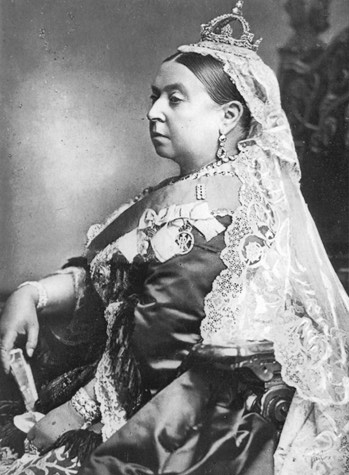
In every country it occupied (....and in every country it continues to either occupy or take an 'interest' in) Britain , like other imperialist forces, recruits a native 'workforce' which it uses to serve its interests : in the mid-to-late 19th Century in Ireland, for instance , Westminster decreed that the then Irish police force be re-named the 'Royal Irish Constabulary' , a move which the then British 'queen' , Victoria, was strongly in favour of , as a 'reward' to them in payment for the cruel manner in which they dealt with the Fenian rising : in the early 1920's , after Britain had partitioned Ireland, the paramilitary RIC groupings in the Six Counties were re-classified as the 'RUC' , 'U' for 'Ulster' ('1169...' comment : sic - Ulster has nine counties , not six) and a new pro-British death squad was also established - the 'USC' (or the 'B Specials' , as they were better known) , comprised of native loyalist/unionist supporters , sharing a common hatred of all things Irish.

British military forces show proper respect for their flag.

'The Specials' were left with more or less a free rein by Westminster to 'maintain (English) law and order' in that part of Ireland but they dirtied their own doorstep so often that Westminster , long embarrassed by having to clean up after them so often, produced a report which, basically (much to the disgust of the local 'powers-that-be') , called for their reign to be brought to an end but, by coincidence (!) , a new pro-British murder gang was formed : the UDR. This latest reincarnation of the RIC/RUC/USC/B Specials (which also 'traded' as the 'UVF') had, by 1992, ran out of doorsteps to dirty and, in that age-old British 'tradition' , was 're-launched/re-named' as the 'Royal Irish Regiment' (RIR), on 1st July 1992.

But regardless of what name or uniform Westminster dresses them up as (or in) they will remain what they have always been - mercenary boot-boys in military garb , whether in Ireland or abroad. And they will continue to meet the same response that their ilk so readily dish out to those that dare challenge the 'might of the British Empire'.


THE LAST WEEK IN DECEMBER 217 YEARS AGO IN IRELAND...

Bad weather prevented French troops from landing in Bantry Bay , Cork, Ireland in 1796.

Near the end of December in 1796, Wolfe Tone arrived in Bantry Bay , Cork, with French General Hoche and a fleet of thirty-five ships, carrying about 15,000 troops, but fog and other bad weather prevented them from landing. Some of the ships sank, and a despondent Wolfe Tone recorded the following in his journal at that time - "This damned fog continues without interruption. I asked General Cherin what we should do in case they did not rejoin us. He said that he supposed General Grouchy would take the command with the troops we had with us, which, on examination, we found to amount to about 6,500 men. The Captain has opened a packet containing instructions for his conduct in case of separation, which order him to cruise for five days off Mizen Head, and, at the end of that time, proceed to the mouth of the Shannon, where he is to remain three more, at the end of which time, if he does not see the fleet or receive further orders by a frigate, he is to make the best of his way back to Brest....".

On 21st December , this entry was recorded in his journal -
"There cannot be imagined a situation more provokingly tantalising than mine at this moment, within view, almost within reach of my native land, and uncertain whether I shall ever set foot in it. We were near enough to toss a biscuit ashore..." and this on the 26th : "We have now been six days in Bantry Bay, within 500 yards of the shore, without being able to effect a landing. All our hopes are now reduced to getting back safely to Brest...". The French armada was forced, by the weather, to return to France and an opportunity to change the history of this country and, likely enough, the on-going political conflict here, went with it.


49 YEARS AGO ON THIS DATE : CHE GUEVARA LANDS IN IRELAND.

Che Guevara being interviewed in Dublin Airport by RTE's Seán Egan : the result was first aired on RTE television on this date (18th December)in 1964. He was travelling to Algeria from New York when the plane he was on was redirected from Shannon to Dublin due to bad weather.

On the 14th June 1928, Celia de la Serna y Llosa, from Rosario in Argentina, gave birth to her fifth child,a boy, who her and her husband, Ernesto Guevara Lynch, named as Ernesto Rafael Guevara de la Serna , better known to the world as Che Guevara. Celia's mother was from Galway and moved to South America where she married into the Guevara family.

Having Irish roots , Guevara visited this country a number of times and it was during one such visit in the early 1960's , to Kilkeel , in British-occupied County Down, that Irish artist Jim Fitzpatrick encountered the man. The young artist , then a teenager and a student at Gormanstown College , was helping to pay his way through college by working part-time in the Marine Hotel pub in Kilkeel, where his mother was from. Jim happened to be on the premises on the same morning that Che Guevara and two of his colleagues walked in and ordered glasses of Irish whiskey. He recognised Guevara immediately and got chatting to him about his Irish roots, and was told by Guevara that he had an Irish grandmother and that her mother , his great-grandmother, a woman named Isabel, was from Galway and that he had other family connections with the Cork area. However , now, perhaps, more so than in the 1960's , 'money talks' and local politicians listen : to destroy a Jim Fitzpatrick work of art for such short-term gain is the very mindset that Che Guevara tried to overcome and, unfortunately, there are not enough Che Guevara types left in this world to do that.


UP THE REPUBLIC - OUR DAY WILL COME !
NOLLAIG SHONA DAR LEITHEOIRI ! Ar eagle an dearmaid .... Ba bhrea an rud e siocháin bhuan bunaithe ar an gceart a bheith againn in Éireann . Is i an bronntanas is fearr a d'fheadfaimis a thabhairt duinn fein agus dar gclann . Coinniodh an ceart agus an tsiocháin uainn le breis agus ocht gcead bliain , de bharr ionradh , forghabhail agus miriaradh na Sasanach. Socrú ar bith a dheantar in ainm mhuintir na hÉireann agus a ghlacann le riail Shasana agus a dhaingnionn an chriochdheighilt , ni thig leis an ceart na an tsiocháin bhuann a bhunu.

Ni dheanfaidh se ach la na siochána buaine a chur ar an mhear fhada agus an bhunfhadb a thabhairt do ghluin eile . Tharla se seo cheana nuair a siniodh Conradh 1921 agus cuireadh siar ar mhuintir na hÉireann e in ainm na siochána . Is mór ag Sinn Féin Poblachtach Éire a bheith saor agus daonlathach , an cuspoir ceanna a bhi i gceist ag Wolfe Tone agus ag na Poblachtaigh uile anuas go dti 1916 agus an la ata inniu ann.

Rinne a lan fear agus ban croga iobairti mora , thug a mbeatha fiu , ar son na cuise uaisle seo .
CEART . SAOIRSE. DAONLATHAS .

A PEACEFUL CHRISTMAS TO OUR READERS ! Least we forget .... A just and permanent peace in Ireland is most desirable . It is the greatest gift we could give to ourselves and our children . We have been denied justice and peace for more than eight centuries , because of English invasion , occupation and misrule of our country . Any arrangement which , in the name of the Irish people , accepts English rule and copperfastens the Border , will not bring justice and lasting peace . It will only postpone the day of permanent peace , handing over the basic problem to another generation.

This happened before when the Treaty of 1921 was signed and was forced on the Irish people in the name of peace . Republican Sinn Féin cherishes the objective of a free , democratic Ireland , as envisaged by Wolfe Tone and all Republicans down to 1916 and our own day . Many brave men and women sacrificed a lot , even their lives , for this noble Cause .
JUSTICE . FREEDOM . DEMOCRACY .

(From the '1169...' Crew , December 2013. PLEASE NOTE : we are on a short break from normal posting , although we will post details of how the CABHAIR swim went and possibly a few other posts. We will return to 'normal' early in the New Year. Go raibh maith agat, and thanks for reading! Sharon.)


Wednesday, December 11, 2013

MANDELA : CHAINS OF GOLD RATHER THAN IRON.

By Peadar O'Donnell ; first published in January 1963.

I was eager to light a fire on Paddy Hogan's doorstep and here certainly were the makings : if I had a campaign headquarters anywhere outside 'An Phoblacht' offices it was at Father John's home at Bullaun. Working with him was a happy, exciting business , and he nominally followed the Donegal pattern, but anytime he chose to push past me nobody around him would look back over their shoulder to see whether I was coming too! The Officer Commanding of the local IRA unit was a member of Father John's committee and he was a good, firm man , and I never had any anxiety that he would involve his local unit in any embarrassing way. They would act as neighbours would.

Father Fahy had a great gift for leadership , and even his occasional incoherence seemed to emphasize his leadership, as in the case of Big Jim. And he was a fine propagandist : he wrote a play of the land war of the 1880's, which was performed at Loughrea. His group wrote a catechism to which I gave my imprimatur, by publishing it in 'An Phoblacht' -

"How did England establish a claim to the land of Ireland? By robbery. What is rent? Rent is a tribute of slavery enforced by the arms of the robber-landlord. What is a landlord? A landlord is a descendant of a land robber. Who pays rents to landlords? Only slaves. What is a bailiff? A bailiff is a land robbers assistant. What should be done with a bailiff...with a landlord...?" (MORE LATER).


THE ANATOMY OF AN AFTERNOON : THE STORY OF THE GIBRALTAR KILLINGS........

By Michael O'Higgins and John Waters. From 'Magill Magazine' , October 1988.

Soldiers 'A' and 'B' had been in the vicinity of Main Street since about noon as well , and were both casually dressed and were armed with Browning 9mm pistols. 'A' had four magazines, each containing twelve rounds, one of which was on the weapon. The gun was on the rear of the waistband of his trousers and the magazines were in his pocket. Soldier 'B' had just two magazines with twelve rounds in each , and the men had a radio apiece; soldier 'A' s was set to the military network and soldier 'B' s was set to the surveillance network. Most of the information concerning developments was coming through on both networks and whatever wasn't they were keeping each other informed of.

Soldiers 'A' and 'B' had been in a small coffee shop close to the Governor's residence, about a hundred yards or so from the assembly area, when they had received information that two suspected members of the IRA ASU had entered the colony. They were instructed to go to the Governor's residence and meet up with a Gibraltar police officer , they did so and went with him to a confectioner's shop nearby where they received instructions to remain where they were.

They learned that the three suspected IRA members had met in the square where one of them had parked a car earlier in the day. Word came through about a possible arrest. In fact, both Soldiers 'A' and 'B' stated in court that they heard over the radio at this point that control had actually been passed by the police to the military , but was passed back again before they could be given instructions to move. In fact, Soldier 'E' , the immediate tactical commander of Soldiers 'A - F' would tell the inquest that control had actually been handed over to Soldier 'F' by Deputy Commissioner Columbo and that he, Soldier 'E' , had informed the soldiers of this on the military command radio net, though he had not given them orders about making the arrests. This was the time that Mr Columbo had hesitated about signing the document and the opportunity for the arrest had passed. (MORE LATER).


DECEMBER - PRISONERS MONTH.

Irish republican prisoners are especially remembered at this time of year by their comrades who still have their freedom.

Throughout the year , every year, Irish republicans remain conscious of their comrades that are incarcerated here in Ireland and abroad and various pickets , protests and fund-raisers are held for them and their families , to help ease their burden. This month , December, has always been the month in which an extra push is held to increase awareness and , hopefully , raise extra money, as it is an emotive time of year for all concerned and if financial burdens can be eased a little it is at least one obstacle that need be worried about less than usual.

Those that share our sympathies in this regard can attend a picket to be held this Saturday (14th December) in support of republican prisoners, at 2pm outside the GPO in O'Connell Street , Dublin, at which placards and banners will be provided, and/or attend the annual Cabhair Swim which , this year, is 37 years on the go! Your presence will be appreciated.


A STRONG BASE DOESN'T NECESSARILY EQUATE TO INNER STRENGTH.

A pedestal should be reserved for accepted works of art, which are themselves incapable of being adversely affected by human frailties.

As with all Irish republicans of my acquaintance , I am opposed to putting any man or woman on a pedestal , regardless of the oft-stated 'reasons' why that person deserves to be placed on same , and why they should be admired and paid homage to etc. This wouldn't just be an Irish republican 'thing' , I believe, but is perhaps more prevalent within those circles than elsewhere , and for good reason : for more than eight centuries , we as a people have witnessed more political and military 'stars' that shined bright whilst we were in their company - they dazzled us , if you like - yet, as they 'passed' , we were positioned better to see them and had more time to examine the path they trailed. And, indeed, the path they travelled and the 'baggage' they carried with them.

As I write this post, the fever pitch surrounding the death of Nelson Mandela is only now beginning to fade, as the establishment media move on , en masse, to cover the funeral of their 'icon'. That is the same media , owned either by the same people or those like them , especially so in mindset, that described Mandela (and his struggle) as 'terrorist orientated' (and worse) but changed their opinion when they realised that Mandela was 'pliable' and, as such, could be useful to them and to the business interests that owned not only the media but the country itself. They helped construct the path that he followed to his pedestal but take a look under same at the foundation : "The racial hierarchy of wealth developed since South Africa's colonisation remains mostly undisturbed, and the wealthy elite were virtually unaffected by the end of apartheid....the biggest scandal in South Africa today is the appropriation of tens of millions of dollars in taxpayer's money by President Jacob Zuma for the construction of his personal residence..." (from here) . Nelson Mandela was a distraction for those who wanted to be distracted into believing that 'if he can do it, we can, too'. The poor man ended his days with chains of gold rather than iron.


WHAT NEXT? CHARGE THE VICTIM FOR THE BULLETS?

New York cops - shoot first, blame the victim afterwards...

I'm a big fan of all that New York has to offer , as regular readers will know, and any interaction I had with the police in NYC was of a cordial nature , perhaps reflecting the fact that they would have been aware that I was Irish or, at the very least , 'just another lost/confused tourist' , in a massive city with a population of about 8 million people which , on a 'population density' scale, means approximately an unbelievable 27,550 people per square mile! Which explains why the transport system is constantly under pressure , as are water and electricity supplies etc and , to a certain extent, why the cops sometimes have short fuses. But there is a huge difference between the cops being 'a bit sharp' with those they 'serve' and this, which seems to suggest that the political establishment had decided in advance to 'close ranks' immediately in favour of the cops, to the extent that they are prepared to place the full fault regarding the shooting on the man that was shot ie physical and legal blame . And that's not 'serving the community'.


"ARE YA SURE , PET.....?" says she...

".....ABSOLUTELY , MRS K..." , says I... !

The poor Dear! What a lovely woman , even if she's not a Dub! Couldn't believe it , and it held up proceedings by about fifteen minutes when Freddie , the barman, pulled the first prize for us at the Cabhair raffle last Sunday (8th December 2013) : for it was indeed 'yer wan' that won it - Mrs Kavanagh , a Wexford woman , had the stub (number 462) and she cashed it in with us for €200 , bought us a round and hugged us for the next quarter of an hour! And what a stroke of luck for us , too - there must have been about two dozen people in her clan, all present and all of whom bought tickets from us and we were able to put them in touch with a few Cabhair colleagues in Wexford who will most definitely keep in contact with them re the next raffle , which both the 'K Clan' and the 'Cabhair Clan' were most eager to do!

And then the fun (and confusion!) really started : we got Mrs K to pull the second prize for us and out popped the ticket belonging to an auld Dub , Seánnie G , a lovely man, there with his family (and extended members!) - stub number 426 won the man €100 and a round of applause and when we got a wee break in the slagging match between the 'K Clan' and the auld Dub Clan , we managed to settle one of the Dubs down long enough to pull the third prize for us and Wendy F , from Lucan , in Dublin, who had bought her ticket from one of our regular sellers , Darren, won €40 on her ticket , 170, and Wendy then dipped her hand into the drum and found the winner of the fourth prize - Seánnie G , again , who pocketed €20 this time , with stub number 678, and wasn't at all shy about letting the Wexford people know about it!

Then Waterford got in on the act : Martin K , from Dungarvan, the owner of ticket 277 , won the fifth prize (€20) and we think he thanked us but the Wexford/Dublin 'clash' was still on-going and it was then we discovered that people from Dublin and Waterford get on with each other better than those from Waterford and Wexford do, and that Dublin people could sometimes be lukewarm (!) with Wexford people. Or something along those lines....! Anyway : inter-county rivalries or not, we had a raffle to run so we declared ourselves neutral and asked Freddie to pull another ticket from the drum for us - Kevin , a Dub, won that prize (€20) , the 6th , on stub 097, which he had bought from our own Pat M , from Ballyfermot , in Dublin , and Kev then picked our second-last prize , €20, which our bus driver, Anto , had sold to Paul Langan , a James Bond look-a-like , who won the prize with ticket 008 (!) and no , we didn't ask him where he was from....but he was asked to pull the last ticket for us , which he did , and Marie D (a Dub - yay!) won that €20 on ticket 392, which she had bought from one of our local sellers , Dan.

It was our last raffle for this year and all the team , and the local crew, were thanked by the Cabhair reps present and plates of sandwiches and a few drinks were brought out , courtesy of Cabhair, and more of same followed minutes later , courtesy of the hotel management and staff! And , within the hour, business had resumed and tickets and arrangements etc were distributed and made for the first Cabhair raffle in 2014. And auld Dubs and those from Dungarvan were told that they would be more than welcome!

Thanks for reading, Sharon.


Wednesday, December 04, 2013

COLLUSION : THE RUC AND LOYALIST DEATH SQUADS.

By Peadar O'Donnell ; first published in January 1963.

I remember - I can see clearly - the opening sentence in Father John Fahy's first letter to me : "To be sure , you are the one man in Ireland making a stand for the old Gael..." I did not, in fact, prefer the Gael before the Gall as an Irishman, but Father John's idea of the Gael corresponded with what I had in mind when I talked of the Ireland of the poor. Father John invited me to Galway , as he was curate at Bullaun, outside Loughrea.

I was greatly taken with the group of men he had gathered around him , among whom were Martin Fahy , Mick Silver , John Joe Kennedy and Michael Seery , and veterans of the land war were there, outstanding among them Tom Kenny and Pat Gannon. Eamonn Corbett, close friend of Liam Mellows, was there. This was Mellows' country, and it was interesting that just as the Donegal group was eager to take their stand on the 1919 resolution, their kind in Galway wanted, in a confused way , to advocate Mellows. It took us a few nights to sort out our viewpoints and get agreement that we would work together on the narrower platform of an agitation against land annuities.

The embers of the land war emitted sparks in Galway during the war of independence ; the Sinn Féin land officer who came to Galway to take note of what was to be done when the Republican Government was free to work its policy, was forced to abandon a few of his meetings and here and there ranch lands were used as commonage. There was no organised repudiation of land annuity but there were so many cases of individual default that they added up to a greater, if less compact , basis for agitation than in Donegal. (MORE LATER).


THE ANATOMY OF AN AFTERNOON : THE STORY OF THE GIBRALTAR KILLINGS........

By Michael O'Higgins and John Waters. From 'Magill Magazine' , October 1988.

Three of the Commissioner's 'indicators' were already in place - the car had been brought across the border and been parked in the square and the three IRA ASU members were together in one place on the Rock. He hesitated. He asked if the three had been positively identified and was told that the identifications were eighty per cent positive. He phoned the Commissioner at home for the second time, told him that the earlier suspicions had been hardened up and asked him to come in to the Operations Room. Deputy Commissioner Columbo was not required to proceed with signing the form , however. Before the identifications could further be firmed up the three IRA members moved southwards through Referendum Gates towards Alemeda Gardens, in the opposit direction to the border.

From about noon, Soldiers 'C' and 'D' had been in the area between Trafalgar Cemetery and the Queen's Hotel, just south of Main Street. Soldier 'C' was the more senior of the two , and he was wearing blue trousers, a black shirt and white shoes. He had a radio , linked into the military net, up the sleeve of his shirt, with a small earpiece and a mouthpiece attached to his collar , and was armed with a Browning 9mm pistol which he carried in the rear waistband of his trousers and for which he had two magazines , one attached to the weapon, with twelve rounds in each. Soldier 'D' was also casually dressed and had a similar weapon with three magazines of twelve rounds each. His radio was linked into the surveillance network.

They had heard that what were believed to be the three IRA members had entered Gibraltar , that a car had been parked in the square and that the three had met together at the assembly area. Then they were told over the radio that the three were headed in their direction and were asked to make a positive identification based on the photographs they had seen. From their position in Trafalgar Cemetery , Soldiers 'C' and 'D' made the identifications and reported over the radio. They were told to stay away from the three to avoid being seen and were instructed to make their way back down the town towards the airport. (MORE LATER).


WINIFRED CARNEY , BORN ON THIS DATE 126 YEARS AGO.

"The conditions of your toil are unnecessarily hard, that your low wages do not enable you to procure sufficiently nourishing food for yourselves or your children, and that as a result of your hard work, combined with low wages, you are the easy victims of disease, and that your children never get a decent chance in life, but are handicapped in the race of life before they are born..." - part of the speech which Winifred Carney and James Connolly prepared for his speech to millworkers in Belfast in late 1911. Connolly was the Belfast Organiser for the ITGWU at the time, and Carney was just a few weeks away from becoming the full-time Secretary of the then newly-formed 'Irish Textile Workers' Union'.

On the 4th of December 1887 , Alfred and Sarah Carney welcomed the birth of their sixth child, Winifred, into their existing family - three boys (Ernest, Louie and Alfred) and two girls , Maud and Mabel. The family were then living in Bangor , County Down but , not long after Winifred was born, the marriage broke down and Sarah moved with the children to Carlisle Circus in Belfast , where she started a small shop. Winifred found work as a teacher and developed a love for the Irish language , joining the Gaelic League to further her interest and, at 27 years of age, she joined (membership number 56077) the then newly-formed Cumann na mBan organisation and, indeed, was present in Wynn's Hotel in Dublin in April 1914 when that organisation was founded. Her duties included teaching first aid to the other members as well as training in the use of weapons, as she was known to be proficient in that particular field (a skill no doubt learned due to her activity with the 'Irish Citizens Army' , which she joined on its formation in 1913). This was two years before the (1916) Easter Rising and, due to her connection with James Connolly and her membership of various republican/nationalist organisations, Winifred Carney knew that an action against British interference in Ireland was being discussed and she was determined to play her part in any such blow against the 'empire' and said as much to Connolly, who by then had stationed himself in Dublin to assist the workers there in what became known as 'the great lock out'. Carney stayed in Belfast , collecting whatever money she could for the Dublin strikers and billeting as many families of the strikers as she could. Connolly kept her up to date on developments and , when the time came - April 1916 - he asked her to come to Dublin to help with the preparations for a rising against Westminster.

At first she was 'jobbed' in Liberty Hall , writing dispatches and mobilisation orders etc but, on the day the rising began - 24th April 1916 - as an Adjutant in the Irish Citizen Army, she carried both 'tools of her trade' into the GPO : a typewriter and a revolver. During the early stages of the week-long battle , she was the only female in the building and , towards the end of that particular battle (....but not the end of the fight itself!) she refused orders at the time to leave the premises , as did her two colleagues, Julia Grenan and Elizabeth O'Farrell. Altogether, there was a total of thirty-four women in the GPO at the time , members of the Irish Citizens Army and Cumann na mBan, thirty-one of whom followed orders and vacated the building, with the wounded. The female Volunteers were also tasked with carrying military instructions around the city during which trips they gathered intelligence on the strength and locations of the enemy and carried as much food and ammunition as they could safely deliver to their comrades. The Rising ended when Winifred Carney , Nurse Elizabeth O'Farrell and Julia Greenan , who were by now based in the Moore Street Headquarters as there was no safety or shelter to be had in the remains of the GPO, were instructed to deliver a surrender notice to British General Lowe , stating the following - "In order to prevent further slaughter of the civil population and in the hope of saving the lives of our followers, the members of the Provisional Government present at headquarters have decided on an unconditional surrender, and commandants or officers commanding districts will order their commands to lay down arms. P.H. Pearse, Dublin 30th April 1916."

Winifred Carney , Brigid Foley , Maire Perolz , Nell Ryan and Helena Moloney were the five female Volunteers that were deported to prisons and internment camps in England and Wales ,following the surrender, as were 1,836 male Volunteers , and approximately 80 other female Volunteers were taken, firstly, to Richmond Barracks and then to Kilmainham Jail and ,although most were released within a week, Winifred Carney , Helena Moloney and Nell Ryan were held captive in Aylesbury Prison in Buckinghamshire in England until the 24th December (1916). They had been offered early release if they signed an undertaking "not to engage in any act of a seditious character" but they had refused to do so. She maintained her republican principles in the years that followed , despite being targeted repeatedly by agents of the State and, despite many personal setbacks (most of which were related to her strong political beliefs) she never compromised her republicanism. When ill health forced her off the picket lines she continued to verbally challenge the State at every opportunity until even that became too much for her : she died at fifty-five years of age on the 21st November 1943 , just as opposed to Free Staters and partition as she had always been , and is buried in Milltown Cemetery in Belfast. More information on this remarkable woman can be read here.


COLLUSION? APPARENTLY SO.....


....and not only between the cops in this State and the political administration that pay them. It appears that at least one of the two dead RUC men that are in the news lately was himself aware of 'acts of collusion' , for which some headline-hungry politician or other will apologise. Snippet of said RUC collusion here : "20. I was friendly at that time with RUC Constable Billy McBride and I visited his home on one occasion at a time when Chief Inspector Harry Breen was present. We discussed McBride's connection to a group of Loyalists in Co. Down called Down Orange Welfare, which was headed by a retired Army officer, Lt. Col. Edward Brush. McBride told us he was a member of this group, which was almost entirely composed of members or ex-members of the (British) security forces. He produced a .38 revolver from a drawer in his living room and after I had examined it he replaced it in the drawer. He then went into another room and brought out two home made sub-machine guns, copies of the Sterling machine-gun. He explained that Down Orange Welfare was manufacturing Sterling sub-machine guns and that the two he had shown me were the prototypes and were of imperfect design. McBride added that the group were in the process of making an M1 carbine, an American rifle, and that the only remaining problem to be tackled was the ejector mechanism for spent bullets. He anticipated that this would not present any insuperable difficulty. In Chief Inspector Breen's presence he then offered me the two sub-machine guns because he knew about my connections to Loyalist paramilitaries. I accepted them and took them to Mitchell's farmhouse..."

Watch closely now as Mr. Shatter demands an apology from Westminster.....


"MY VALUE SYSTEM....."

As promised , Colm is looking after 'Number One'. Himself. Or he thinks he is, anyway , and he reckons that membership of Fianna Fáil is the best way to ensure his own political future.

For now he does, or so it seems : but anyone with such a misunderstanding of a 'system of values' would be equally at home in any of the establishment political parties in Leinster House , so next time Colm gets cold feet , he may decide to warm them on the back of Fine Gael or , indeed, even Provisional Sinn Féin. Interchangeable , the lot of them. And all equally as useless.


BUSY END-OF-WEEK AND WEEKEND FOR RSF AND CABHAIR.

Cabhair : their last raffle for 2013 will be held this coming Sunday, 8th December , and their first such event for 2014 has already been organised and will be held on Sunday 9th February. Way ahead of themselves, as usual...!

Myself and at least five other Cabhair supporters/members will be busy this coming Saturday (7th December), putting the finishing touches to the 650-ticket raffle that will be held the following day in the usual venue, a hotel on the Dublin-Kildare border. And as we settle-in to our work on that Saturday we will be conscious that friends of ours in Tralee , in County Kerry, will be relaxing a wee bit having already held a commemoration the day before, Friday 6th, for Charlie Kerins.

We will also be aware that at around the same time as we'll be finishing our lunch break on that Saturday , our colleagues in Tyrone will be beginning picket duty on Main Street , in Cappagh, to highlight the plight of Irish republican POW's and, as we'll be doing the last check on the raffle tickets etc on the actual day of the raffle (Sunday 8th) , our comrades in Wexford will be holding a commemoration for Liam Mellows in Castletown.

To hold so many events over, in this instance, a three-day period is a good indication that the Movement overall is in a healthy condition and, as it approaches a new year, there is no reason to believe that that will change. Except, hopefully , for the better!

Thanks for reading, Sharon.


Wednesday, November 27, 2013

NO COUNTRY FOR (C)OLD PEOPLE.

By Peadar O'Donnell ; first published in January 1963.

I had been going over in my own mind how to explain why Fianna Fáil could speak to the slogan 'CALL OFF THE BAILIFF' and at the same time refuse to endorse 'NO RENT'. The resolution on which Moore and I agreed called for the suspension of decrees enforcing land annuities until such time as there would be national agreement (sic) on the payments which Irish farmers must make to national (sic) housekeeping expenses.

If this money was neither morally nor legally due, why should farmers pay it and why should Fianna Fáil worry so long as the resolution contemplated the prospect that Irish farmers might be asked to make a direct payment later on? Who would argue that the land annuity, that was negotiated to compensate rack-renting landlords, was the charge that should be regarded as the farmers' proper payment towards national (sic) housekeeping expenses?

We now settled down to a friendly sparring match : I explained that I must keep the case of the people already exposed to seizures and arrests in mind in any slogan that we raised. Hugo Flynn was a surprise to me - he was quite impatient with what he called the niceties in the hesitations of some of the leaders , saying that the truth was that the city-minded men were scared of their lives of the countryside. If the countryside was going to break loose, good luck to it. By the time we reached Loughrea there could be no doubt that we would muster a full team of speakers on the platform the next day. But new troubles broke out as we stepped from the train - to understand them , the Galway story must be brought up to date and that is a story for Father John Fahy to tell..... (MORE LATER).


THE ANATOMY OF AN AFTERNOON : THE STORY OF THE GIBRALTAR KILLINGS........

By Michael O'Higgins and John Waters. From 'Magill Magazine' , October 1988.

The 'Operations Room' was a long rectangular room , with tables at each end, one of which was occupied by the apparatuses for three radio networks and their operators - these were for the police, surveillance and military. At the other end was a table for use by the Commissioner's advisory group which, the inquest was told, were features of all such operations where military aid had been requested by a civil power.

On this occasion the advisory group consisted of 'Soldiers E' , 'F' and 'G' , Deputy Commissioner Columbo , Detective Chief Inspector Ullger , Head of the Special Branch , 'Officer M' and other security people. In cross examination at the inquest , Commissioner Canepa said that the decision to form the advisory group had been a joint one between himself and certain senior military officers and intelligence.

Also in advance of the operation, as was also apparently customary, two documents had been prepared by the military to enable control of the operation be signed over to them should the need arise. The first was the 'handing over' document , which said - " I have considered the terrorist situation in Gibraltar and have been fully briefed on the military plan with firearms. I request that you proceed with military option which may include the use of lethal force for the preservation of life." This was to be signed by Commissioner Canepa or his appointed deputy whenever he decided it appropriate that the IRA ASU be apprehended.

The second document , the 'handing back' form, was to be signed by 'Soldier F' , the SAS commanding officer , when the arrests were completed. It read - " A military assault force completed the military option in respect of the terrorist ASU in Gibraltar and returns control to the civil power." Now , just before 3pm on Sunday March 6th 1988 , Deputy Commissioner Columbo , in command in the absence of the Commissioner, was presented with the first form by the SAS and asked to sign it.... (MORE LATER).


"HAND GRENADES WERE PUT IN THEIR MOUTHS AND THESE EXPLODED....."

Pat and Harry Loughnane , Galway - tortured to death in Ireland by British forces in 1920.

"I am of the opinion that hand grenades were put in their mouths and that these then exploded ....." - part of the comments made by the doctor who examined the remains of the Loughnane brothers.

The remains of Harry Loughnane.

Pat and Harry Loughnane were well-known and equally well-liked and respected in their neighbourhood of South-Galway. Pat (the eldest) , was an IRA man and Secretary of Sinn Féin in the area ; he was also active in GAA circles. His younger brother , Harry , played in goal for the local Beagh Hurling Club , and was in charge of the local cumann of Sinn Féin ; both brothers worked on the family farm in Shanaglish , County Galway , and were working in the corn fields on Friday , 26th November 1920 , when the Black and Tans surrounded them. The two brothers were thumped around a bit in the corn fields by the Black and Tans and then thrown into the back of the lorry belonging to the Tans - they were pushed off the lorry outside the Bridewell Barracks in Gort and put in a cell. People in near-by cells later reported hearing the brothers being battered by the Tans , who were well aware that the Loughnane brothers were active in the struggle for Irish Freedom.

After three or four hours of beating , the brothers were dragged out to the courtyard of Gort Bridewell and tied to each other ; the other end of the rope was then tied to the back of the truck , which drove off , heading for Drumharsna Castle , which was then the Headquarters of the Black and Tans in that area of Galway. Both Pat and Harry Loughnane were at that stage too weak to run behind the truck , and ended up being dragged on the ground behind it and, on arrival at Drumharsna Castle, the rope was untied from the truck and the two men were dragged into another cell and beaten again. At around 10.30 or 11pm that same night (Friday 26th November 1920) the Loughnane brothers were removed from the cell and put in the back of the truck ; they were pushed out of the back of same after travelling a few miles - the brothers would have been too dazed to realise it, but they were now in Moy O'Hynes Wood , and were being taken deep into the thicket of it by the Black and Tans.

Locals later reported hearing four shots and, the following day (Saturday , 27th November 1920) , rumour was rife in the neighbourhood that Pat and Harry Loughnane had been dragged into the Moy O'Hynes Wood and shot dead by the Black and Tans but that rumour also insisted that Harry Loughnane somehow survived the ordeal - and the Tans heard that same rumour. It was early on Sunday morning (28th November 1920) that the Brits again entered the Wood - they were observed loading something into the back of their lorry and driving off at speed towards the small town of Umbriste (near Ardrahan , on the Gort to Clarinbridge road) ; it later transpired that the Black and Tans burned the bodies of the Loughnane brothers when they arrived at Umbriste but even then they were not satisfied - so they dug a hole and threw the bodies in to it. However , because of the rocky terrain , the Tans were unable to fully cover their tracks and were convinced that the charred remains would be found ; they dug them up and carried them to a near-by pond , weighted them down , and threw them in - they then apparently poured a couple of gallons of dirty engine oil into the pond at that same spot.

That happened on Sunday , 28th November 1920 ; the following day (Monday 29th November) the Brits called to the Loughnane home and told the boys' mother that they were looking for her two sons - that they had escaped from custody and were "on the run". The Brits knew well enough where the two brothers were but , as well as deliberately giving false hope to the family , they were in the process of concocting an alibi for themselves. However , at this stage , the family and friends did not know any better and search-parties were organised to look for Pat and Harry.

In the middle of December that year (1920) , the remains were found. Before the brothers were given a proper funeral , a local doctor was asked to examine the remains and his report showed that both men had , at first , been sadistically battered ; the eldest of the brothers , Pat , had both wrists broken and both legs broken , while Harry had had two fingers removed by a saw , while still alive , and his right arm was only attached to the remains of the charred body by sinews. The doctor stated that the damage to the head , neck and upper-chest area of both men was caused , in his opinion , by "...hand grenades (which) were put in their mouths and that these then exploded ..." The remains of both men showed that the Black and Tans had attempted to 'write' on the men , using knives or bayonets - sets of initials were carved into both bodies.

There was a heavy presence of Black and Tans at the funerals of Pat and Harry Loughnane , but the IRA called their bluff just as the burial ceremony was coming to an end - six armed IRA Volunteers stood over the grave and a three-volley shot was given. The kidnap , torture , abuse and manner of death suffered by Pat and Harry Loughnane is the most horrific incident that this author has come across in researching articles for this blog. Even in times of war , the fate deliberately inflicted on the brothers was inhuman. At the risk of sounding like we are trying to score a cheap political point , we remind our readers that the military kin of the Black and Tans are still in this country. And they receive their instructions from the same political institution which gave the Tans their orders. Think of that , next time you hear talk of "dissident Republicans" in Ireland , and ask yourself how could you be but "dissident" to British rule in any part of Ireland ? And ask yourself when have true Irish Republicans ever been but "dissident"?

On Sunday 24th November last , the Republican Movement held a commemoration to mark the 93rd anniversary of that savage act , and a report on same can be viewed here.


PUT IT ON THE (TAXPAYERS) TAB....

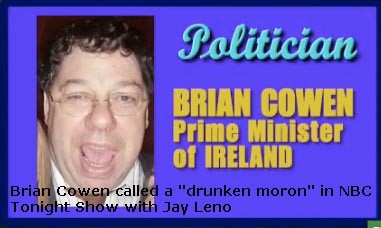
....not unheard of with such 'high-profile' political figures,but 'PM' Cowen was such a 'dizzy' man that he considered that title suited him better than his proper one - 'Free State Taoiseach'.

Gerry Adams is right , without a doubt , in regards to his 'drink in the workplace' comments , but the man is wasting his time : the 'drink culture' , whatever about it being ingrained in 'Irish culture' , definitely 'comes with the job' as far as those in Leinster House are concerned. And why wouldn't it ? Those 'professional' politicians have too much time and too much spare money on their hands , and even if they don't make a show of themselves by their (publicised) drunken behaviour, and even if they don't apparently spend what workers and the unemployed would consider a small fortune on alcohol (and/or other mind-altering substances), they are still in receipt of more money than they know what to do with.

And not only is the man who raised the issue '(financially)guilty as charged', but he could teach the rest of them a thing or two : in 2011, Gerry Adams was paid a wage of €1920 a week and also claimed weekly 'expenses' of €1013 and last year he was paid the same weekly wage (€1920) and, on top of that, collected weekly 'expenses' of €1198! Any chance , Gerry , that instead of complaining about how your political colleagues in Leinster House spend their money, you would query , instead, how come they can afford to spend it in that manner?


NO PLACE FOR (C)OLD PEOPLE.

On his knees : the economic war being waged on the citizens of this State by those in Leinster House is , literally, killing people.

Being faced with a choice of part-paying a bill , buying some food or putting the heat on for an extra hour (or at all) is something that those in Leinster House will never have to do and, in order to keep it that way, they need to maintain their lifestyles , which costs money - large amounts of it and on a regular basis. Which leads to them having to make a choice between relinquishing some of their luxury items in order that cash might flow back into the 'kitty' in the hope that some of it , at least, might trickle down , or deliberately making a decision that 'it's every man for themselves'. And they have , to a man (and a woman) , decided on the latter - at great cost to the citizens that they claim to 'govern' over. No matter to them how often this happens or who knows about it as they are inured to criticism at this stage of their political 'careers' and, indeed, the further up that slimey political pole they climb the less they care about such criticism (witness Pádraig Flynn in the above-linked video) . It's not 'new people' we need to replace the existing shower of mé féiners , but a new system to replace this failed political entity. And until that happens, the rest of us would be advised to wrap-up well...


LESS THAN A MONTH. AND COUNTING....!

37 Years underwater!

It began - properly structured and organised - in 1976 ,as a 'fundraiser with a difference' , combined with the need to gain extra publicity for a situation which was then - as now - making world headlines. Those that sat down together in early September 1976 to tighten-up the then 'hit-and-miss' affair were a dedicated team who fully understood that to fail in their business would not only bring derision on them and the issue they sought to highlight , but would give their enemy a publicity coup which they would exploit to the fullest extent . With that in mind , the team persevered - favours were called-in , guarantees were secured , provisions obtained and word dispatched to like-minded individuals in the area. At the appointed time on the agreed day - 12 Noon , Christmas Day 1976 - a soon-to-be 37-years-young event was 'born'. The CABHAIR Christmas Day Swim is , thankfully , still going strong and will be , as mentioned , 37-years-young on December 25th next!

Sponsored Swim * Christmas Day * 12 Noon * Grand Canal * 3rd Lock* Inchicore* Dublin*

ALL WELCOME!

(....and on this link you can read how firewood from the Inchicore Cabhair Swim can be used to get you into 'hot water' elsewhere..!)

Thanks for reading, Sharon.


Wednesday, November 20, 2013

1913 : 'IV' V 'ICA' AND 20TH NOVEMBER 1920 - THE DAY BEFORE THE STORM.....

By Peadar O'Donnell ; first published in January 1963.

I had no idea how a 'NO RENT!' poster came to be issued in Galway , but in face of this letter I must somehow get there. Just then a nurse asked me if I would speak with Colonel Moore on the phone and I said I would. I certainly would. I am always very glad to remember that for all my blazing anger I did not fly out at him : I had forgotten for the moment that he tried to reach me the day before . He asked me if I had seen the letter and I said I had. He said he was very unhappy about it and that he tried to reach me before signing it. He was afraid that all his good work with Fianna Fáil had been swept away and that the poster was most unfortunate. I agreed with him.

"I told them that," I said , "I knew you had nothing to do with it." I could chuckle now - Sinn Féin were not the only people who had their doubts of me. "Isn't it a wonder they wouldn't suspect some of the local Cumann na nGael flyboys for it , for after all this meeting is to be on Paddy Hogan's doorstep. He must have his own bright boys round him." Colonel Moore asked me if I think they did it, but I replied no , and laughed. He asked me what I intended to do and I told him I would be on my way to Loughrea by the afternoon train. Did I want him to come along , he asked , but I said that he had better stay back with the others so as to keep within speaking distance of Fianna Fáil , behind whom the radicals of the countryside were shut away from us.

It was easy enough to say to Moore that I would be on the next train to Loughrea , but I had to get out of hospital. Fortunately my clothes were at hand , so I wrote a note for Jo O'Donnell , and I phoned my wife. She understood that I just must go , and I promised to see a doctor that evening in Loughrea. I slumped into a corner of the carriage - my head was one raw ache. I awoke to find Colonel Moore with his hand on my shoulder. He told me that Frank Fahy and Hugo Flynn were also on the train and he was not at all sure they would speak at the meeting , but they came along in the hope that we might somehow find a way out of this muddle. (MORE LATER).


THE ANATOMY OF AN AFTERNOON : THE STORY OF THE GIBRALTAR KILLINGS........

By Michael O'Higgins and John Waters. From 'Magill Magazine' , October 1988.

Coming up to 2.50pm , Mairead Farrell and Daniel McCann were approaching the assembly area having walked from the border. They arrived via Line Wall Road and walked up the square towards the spot where the car was parked just off Main Street. Police Constable Viagas , watching from the Hambros Bank , heard on his radio that the two people had been postively identified and were walking at a casual pace. Daniel McCann glanced at the car in passing and almost immediately they were joined in the square by Seán Savage.

Police Commissioner Joseph Canepa , meanwhile, was on his lunch break : he had gone home at 12.30pm , twenty minutes before Seán Savage drove into the assembly area, and was still there at 2.30pm when he got a call from his deputy, Acting Deputy Commissioner Charles Columbo , to say that two members of the IRA ASU , Mairead Farrell and Daniel McCann , had just been tentatively identified entering at the frontier. Commissioner Canepa remained at home.

Back in the Operations Room , Acting Deputy Commissioner Columbo was in charge, despite the fact that this was his first real involvement in 'Operation Flavius'. Once the operation had got under way , Acting Deputy Columbo had taken over Commissioner Canepa's other duties to allow the Commissioner give the operation his full attention. Columbo had not attended the midnight briefing on the previous night, at which all personnel involved in the operation had attended, although he was a member of the Commissioner's advisory group. He did, however , receive a private briefing from Commissioner Canepa , filling him in on the details and objectives of the operation. Now , just as things were beginning to happen , he found himself in command. (MORE LATER).


IRELAND 1923 : IRISH HUNGER STRIKER DENIED A CHRISTIAN BURIAL.

IRA Commandant Denis Barry - died on hunger-strike on 20th November 1923.

90 years ago on this date (20th November) , at forty years of age, IRA Commandant Denis Barry , from Riverstick , in south County Cork, died on hunger-strike in Newbridge Internment Camp in Kildare after fasting for 34 days.

Denis Barry was 31 years of age when he joined the then seven-month old 'Irish Volunteers' (membership number '1426') and, when the time came to declare himself a 'dissident' or a 'Free Stater' (in 1921) , he bravely chose to stay on the Irish republican side. In late September/early October 1922 he was captured by the Staters and, on 6th October , was imprisoned in Newbridge , one of approximately 11,000 republican prisoners that were under armed guard in the State at that time. The only way these men and women could continue the fight for the Irish Republic was to use the hunger-strike weapon either to obtain freedom or, at least, to improve their prison conditions and, in October 1923 , an estimated 7,800 republican prisoners used that weapon. After 33 days on hunger strike , Denis Barry was brought by military ambulance to the Curragh Military Hospital in the afternoon of Monday 19th, where he died the next day (Tuesday 20th November 1923) at 2.45am , at forty years of age. The Catholic Church refused him a Christian burial so the Staters buried him in the Curragh but, three days later, after a legal battle, his remains were taken to Cork Sinn Féin Head Office (56 Grand Parade , Cork City) and he was then buried in the Republican Plot in St. Finbarr's Cemetery, in one of the biggest funeral services that ever took place in that city. That was 90 years ago this month, and Denis Barry , and his comrades - from whatever year - will always be remembered by the Republican Movement.


Serving British soldiers , former British soldiers, RIC members and ex-members, carpenters, plumbers, electricans, landlords (and landladies), servants , busdrivers and taximen , businessmen and women , postmen and housewives - and the IRA ; all the above, and others, combined their knowledge and skills to great effect on the morning of Sunday, 21st November , 1920 : it was on that morning , 93 years ago, that thirteen senior British intelligence officers were executed in Dublin ......

A list giving details of the British assassins executed by the IRA in Dublin on 21st November 1920.

The IRA Intelligence Department at that time was an extremely efficient machine, run by Michael Collins , and the British were well aware of that fact ; Sir Henry Wilson wanted it, and Collins, eliminated , and sanctioned the use , in Ireland, of 'The Cairo Gang' , a unit of British agents which specialised in political assassinations - they got their name , and their reputation, from 'hits' in the Middle East, carried out on the instruction of Wilson and others in Westminster.

'The Cairo Gang' lived quietly in boarding houses and hotels in Dublin , never drawing attention to themselves, and set about compiling a 'hit-list' of Irish Republicans for assassination ; the IRA , however, were one step ahead of them. A Sergeant Mannix of the Dublin Metropolitan Police Force, stationed at Donnybrook in Dublin, was an IRA agent, and obtained the names and addresses of all the 'Gang' members and passed the list on to his IRA contact, Frank Thornton. A situation then developed that 'The Cairo Gang' were monitoring the movements of the IRA members that they intended to assassinate while being monitored themselves by the IRA Intelligence Department. The Dublin Brigade of the IRA and the IRA Intelligence Department decided to work together on a plan to wipe out 'The Cairo Gang' , and a meeting was held at which Michael Collins , Dick McKee , Liam Tobin , Peadar Clancy , Tom Cullen , Frank Thornton and Oscar Traynor were present : the operation was to take place on Sunday morning, 21st November 1920 , as the then Leinster champions, Dublin and Tipperary, were to play in a GAA match, and large crowds would be in Dublin for the occasion, providing 'cover' for the IRA teams to escape in.

British Army Captain Leonard Price , a Major Dowling , a Captain Keenlyside and two British Army Colonels, Woodcock and Montgomery, were staying in premises at 28 Pembroke Street in Dublin when , at 9am on Sunday 21st November 1920, eight armed IRA Volunteers entered the building ; Price and Dowling were in a room by themselves sorting paperwork when the IRA entered the room and shot them dead - one of the Dublin Volunteers , Andrew Cooney , gathered up the sheets of paper and left the building . At the same time , British Captain Keenlyside and the two Colonel's found themselves confronted by some of the same IRA unit and a struggle ensued between Keenlyside's wife (no doubt present as part of what her husband probably considered a 'working holiday') and IRA Volunteer Mick O'Hanlon ; another IRA man , Mick Flanagan, pushed Mrs. Keenlyside out of the way and shot her husband dead....


British Lieutenant McLean , John Caldow (McLean's brother-in-law) and known informer T H Smith were staying at 119 Morehampton Road in Donnybrook, Dublin, on that Sunday morning when six armed IRA Volunteers entered the building ; McLean , Caldow and Smith were caught off-guard and escorted to the top of the building , where IRA men Vincent Byrne and Sean Doyle shot them. John Caldow survived that morning and , after receiving medical attention, fled to Scotland (where he had come to Ireland from in order to join the RIC).

British Captain Newbury and his wife were staying at 92 Lower Baggot Street and heard the front door being kicked in - he immediately blocked the door to his room and made a run for the window ; he was half-way out of the window when his door was forced open and Volunteers Bill Stapleton and Joe Leonard shot him dead. His body was left draped over the open window for hours , as the Black and Tans believed it to be booby-trapped. At 38 Upper Mount Street , a maid let a number of men in to the building and led them to two rooms ; British Captain George Bennett was in one of the rooms, and British Colonel Peter Aimes was in the other one. Both men were armed and resisted the Volunteers, resulting in a gun-battle which left the two 'Cairo' men dead.

More documentation on IRA members, compiled by the 'Cairo Gang', was found at 28 Earlsfort Terrace , where British Captain Fitzgerald was staying ; he was shot dead on that Sunday morning and the paperwork removed for examination by the IRA Intelligence Department. Two British Lieutenants , McMahon and Peel , had been brought in by the British from Russia, where they had been involved in gathering intelligence information - they were to do the same job , in Dublin, this time as members of the 'Cairo Gang'. They were staying at 22 Lower Mount Street. McMahon had a score to settle with the IRA : he had previously shot dead a Sinn Fein member , John Lynch, in the mistaken belief that Lynch was the Divisional Commandant of the 1st Southern Division of the IRA , Liam Lynch . The IRA later shot McMahon in a billiard hall , wounding him, and he wanted revenge. The two 'Cairo' men were in different rooms in number 22 Lower Mount Street when the IRA unit was let in ; they entered McMahon's room just as he had picked up his revolver and shot him dead. On hearing the gunfire , Peel locked his door and then blocked it with a piece of furniture - unable to get in , the Volunteers fired more than a dozen bullets through the door , but Peel survived that day.

Na Fianna Eireann (Irish Republican Scouts) were also on Lower Mount Street that Sunday morning , as 'lookouts' ; one of their members ran into number 22 to tell the eleven-person IRA unit that the British Auxiliaries were on the street - five members of the IRA unit left calmly by the front door , the other six men went to the back of the house, out the back-door and walked away up a laneway . These six men were challenged by a number of Auxiliaries and a gun battle ensued - IRA man Frank Teeling was wounded , and two of the Brits, Garnin and Morris, were killed . The wounded Volunteer, Teeling, was captured, but the rest of his unit made good their escape. British Captain Bagally , who had made his reputation by presenting 'evidence' in showtrials which led to the executions of the Irish Republicans on 'trial' , was staying in number 119 Baggot Street when, on that Sunday morning, 21st November 1920, three IRA Volunteers (including Sean Lemass, a future Fianna Fail Free State Taoiseach) entered his room and shot him dead . British Captains McCormack and Wilde were staying in the Gresham Hotel in Dublin's O'Connell Street when a number of men , claiming to be undercover British soldiers with a message to deliver to the two Captains, were shown by the hotel staff to the rooms they were looking for : as each man opened his door he was shot dead.

An IRA unit entered a guesthouse in Fitzwilliam Square to deal with a 'Cairo Gang' leader, British Major Callaghan ; he was booked in at the guesthouse but was not there at that particular moment - his colleague , however, a Captain Crawford, was present and was held at gunpoint by the Volunteers. Crawford was held at gunpoint by the Volunteers : however , it was decided that, as he was not the intended target his life would be spared if he left the country within twenty-four hours - Crawford threw some things in a case and left immediately. Another missed target was a Colonel Jennings , who was staying in the 'Eastwood Hotel' ; when the IRA unit broke in the door of his room,it was empty and there was no sign of him in the hotel - the Volunteers left the premises. A total of 13 British Secret Service executioners known as ' The Cairo Gang ' were themselves executed in Dublin on Sunday 21st November , 1920, by the IRA . The loss of those operatives , and the intelligence material they had accumulated, shook the British establishment to its roots , and highlighted on a global scale the extent of the British 'dirty-tricks' campaign in Ireland.

FOOTNOTE - IRA Volunteer Frank Teeling , who was wounded and captured in a laneway at the back of Lower Mount Street , was sentenced to death - however , he escaped with others from Kilmainham Jail / Days after the 'Cairo Gang' were wiped-out , it emerged that Major Callaghan and Colonel Jennings , who were both absent from their digs when the IRA called, had in fact stayed overnight in a local brothel! I can only presume that they were both with women./ On that Sunday ( 21st November, 1920) , a match took place between Dublin and Tipperary : the 'Black and Tans' came on to the pitch and opened fire on the players and the crowd - fourteen people were killed and sixty injured. The British later said they were fired on first....


IRISH VOLUNTEERS 1913-2013: 100th ANNIVERSARY SEMINAR.


On the 11th of November in 1913 in Dublin , in the then 68-year-old Wynn's Hotel on Lower Abbey Street , a group of Irishmen and women held a meeting to discuss the formation of an 'Irish National Volunteer Force'. Those present at that meeting , and/or at five other such meetings which were held immediately afterwards in the space of a two-week period, included Sean Fitzgibbon, John Gore, Michael J Judge, James Lenehan, Michael Lonergan, Peadar Macken, Seamus O'Connor, Colm O'Loughlin, Peter O'Reilly, Robert Page, George Walsh, Peadar White and Padraig O'Riain, amongst others (all of whom were well known in Irish nationalist circles ie Sinn Féin , Cumann na mBan , Na Fianna Éireann , the Gaelic League , the IRB , the Irish Citizen Army ,the Ancient Order of Hibernians, Irish Parliamentary Party and the United Irish League.)

Then, on the 25th November (1913), the inaugural enrolment meeting for the 'Irish Volunteers' was held at the Rotunda Rink in Dublin , overseen by a Provisional Committee consisting of thirty members , all of whom had been elected at the above-mentioned meetings. A week previous to the formation of the 'Irish Volunteers' , Jim Larkin and James Connolly had formed the 'Irish Citizen Army' , and both groups were in competition for members , the former on a 32-county basis whereas the latter was confined to the Leinster area , although attempts were made , through trade union structures, to recruit in Cork , Belfast , Derry , Sligo , Limerick , Kilkenny , Waterford , Dundalk , Galway and Wexford , but with no success. Also , those joining the 'Volunteers' were supplied with a uniform and other equipment while those joining the 'ICA' had to purchase same themselves.

Relations between the two organisations were not the best, as the 'Volunteers' allowed , for instance, employers to join and this at a time when employees and other trade unionists would most likely be 'ICA' members or supporters and, actually, when the 'Volunteers' were in conference for the first time (25th November 1913) 'ICA' members and supporters loudly made their presence felt and they also objected in print - their first leaflet stated that the 'Volunteers' were controlled by those who were opposed not only to trade unionism but also to workers rights re conditions etc.

Within a few months, however, the animosity had lessened to the extent that there was some official co-operation between both groups at the Wolfe Tone commemoration in June 1914 and again in October that year during the events held to commemorate Charles Stewart Parnell , but.......you will have to attend the seminar in Wynn's Hotel in Lower Abbey Street, Dublin, on Saturday 23rd November 2013 , between 11.30am and 4.30pm to hear the rest....!


MARTIN McGUINNESS TO (FURTHER) HONOUR BRITISH SOLDIERS.

Martin is obviously delighted with his new acquisition , and he has no objection to the payback required for same....

One of the shared British 'prime ministers' of the occupied Six Counties, Martin McGuinness, is due to pay homage at the graves of British soldiers on December 19th next in Messines , Belguim , in the company of other anti-republican elements. I'm told that the full story was published in the 'Irish News' newspaper on 15th November last, but as it's not freely accessible I won't be using it here - that article, McGuinness and the other two clowns mentioned in our first link are not worth the price. Won't be long now until McGuinness physically wears a poppy and/or sells them. He's good at selling things, is our wee Martin.....


'SUICIDAL' WITH A SUITCASE.....

....then, from the inside, he padlocks himself in and throws away the key..!

This British spy was obviously a cross between James Bond (he was shaken, but didn't stir...) and Harry Houdini or , indeed , even better than both of them : he obviously (!) placed himself into a suitcase , in a bath tub, closed the (external) zipper and put a padlock on it without leaving fingerprints or DNA anywhere! Previous to that particular incident , the USA held the record for 'Worst Case Of Suicide - Ever!' but the Brits weren't going to lose (to North) Face and couldn't just let it go.....

Thanks for reading , Sharon.


Monday, November 18, 2013

HIGGINS PRANCES AS CONNOLLY SPINS.

THE HIGGINS-SACHSEN-COBURG UND GOTHA (WINDSOR) ROADSHOW.....

"I really and truly just can't wait! I'm going to be standing THIS close to my Queen.....!"

Great news for Free State royalists and fans of 'Corrie' and 'Eastenders': our wee Micky and his entourage are due to meet the Sachsen-Coburg Und Gotha clan and their entourage in April next year and, who knows, the presidential Mickey may even get to sleep in the same bed as the leader of that German-blooded clan.

As a leading light in the State Labour Party , it might be expected that Mr. Higgins would have some affiliation with the working (and unemployed) class , and not just verbally - "I believe that the pernicious and self-interested individualism without restraint, inspired and promoted by Thatcherism, Reaganism, and by recent Irish Governments has led to a de-peopled system and has undermined the solidarity which is essential for our society. There is a need in Ireland for a radical inclusive society that regards citizenship as built on equality, as valuing solidarity and rooted in caring......" (from here) , and he went on to 'emphasis his political experience, his commitment to Irish culture and his involvement in human rights campaigns...', but that's as far as it goes - 'verbal commitment' only , as he beats a path to be seen with (foreign) 'royalty'. One small consolation, I suppose , is the fact that the meeting of these two con artists will take place about two weeks before Easter weekend that year , which should allow enough time for Mr. Higgins' hero , James Connolly , to stop spinning in his grave.....

See you Wednesday evening - thanks for reading, Sharon.