Wednesday, January 29, 2014

NOT BITTER, NOT OUT FOR REVENGE - BUT SEEKING JUSTICE.

By Peadar O'Donnell ; first published in January 1963.

While Father John and I were still running our curacy - I am not sure we were still at Clostoken - Lord Lascelles and his wife, Princess Mary, took a notion to visit Galway. Lascelles had a residence near Portumna and the local parish priest, Canon Joyce, got into the news a great deal, fussing around his distinguished visitors. I suppose it was simply because I was so much in Galway that I took notice of this little bit of harmless playacting in an editorial in 'An Phoblacht' , under the caption 'Princess Mary's Little Priest'. Canon Joyce was not pleased at all, and it didn't help things that somebody tried to set fire to Lascelles' residence. There was a great deal of respectable - and understandable - indignation.

My editorial got talked of, and I think it likely I got blamed for more than the editorial and that the blame extended to Father John, too. Some of our friends turned sour on us - we called at a house one day where the good woman , who had a son in one of the religious orders, did not make us at all welcome. We had arranged to meet somebody there, however, so we held on and in the end we sat down to a very begrudged cup of tea.

"Did you hear what Princess Mary did with the rosary beads that Canon Joyce gave her?" , Father John asked the woman of the house. "I did not", she snapped back , "Ah well," said Father John, "maybe it's just as well" , and Father John and I nibbled away at other topics. Our hostess suddenly turned to Father John and said "What did you say about the rosary beads?". "Ah that," he replied, "maybe I shouldn't talk about it. The poor things, they don't know any better....."

(MORE LATER).


THE ANATOMY OF AN AFTERNOON : THE STORY OF THE GIBRALTAR KILLINGS........

By Michael O'Higgins and John Waters. From 'Magill Magazine' , October 1988.

By this time, Mairead Farrell, Danny McCann and Seán Savage had passed through the bridge linking Line Wall Road to Smith Dorrien Avenue, still being followed at a discreet distance by Soldiers 'C' and 'D' and surveillance Officer 'H'. When the message came through that control had been handed over, the IRA trio had reached the junction of Winston Churchill and Smith Dorrien Avenues and, according to Officer 'H' , he passed on the word that the handing over document had been signed and he characterised the situation in court as control being passed to the military and police by him.

Other surveillance witnesses appeared to have the same impression of the situation, though this was clarified in cross examination by lawyers for the Crown and Soldiers 'A-G' when it was explained that their choice of words had arisen from the fact that there was to be an involvement by both police and military in the arrests.

Soldiers 'A' and 'B' emerged from King's Lines with surveillance Officer 'J' who indicated to them where the three IRA ASU members were standing, about fifty yards down the road to the right, opposite the junction of Winston Churchill and Smith Dorrien Avenues. The three had crossed the road at the traffic lights and were standing facing in the general direction of Soldiers 'A' and 'B' and were chatting and laughing. Soldiers 'A' and 'B' noticed Soldiers 'C' and 'D' on the far side of the road with a surveillance officer. 'A' and 'B' , having confirmed once again that they had control, moved in to apprehend the three..... (MORE LATER).


NOT SEEKING REVENGE , BUT JUSTICE.


THE DESTRUCTION OF IRISH TRADE: The early Irish were famous for their excellence in arts and crafts, especially for their wonderful work in metals, bronze, silver and gold. By the beginning of the 14th century trading ships were constantly sailing between Ireland and the leading ports of the Continent.

COMPETITION WITH ENGLAND: This commerce was a threat to English merchants who tried to discourage such trade. They brought pressure on their government, which passed a law in 1494 that prohibited the Irish from exporting any industrial product, unless it was shipped through an English port, with an English permit after paying English fees. However, England was not able to enforce the law. By 1548 British merchants were using armed vessels to attack and plunder trading ships travelling between Ireland and the Continent (unofficial piracy).

ENGLISH MEN, ENGLISH SHIPS, ENGLISH CREWS, ENGLISH PORTS AND IRISH GOODS : In 1571 Queen Elizabeth ordered that 'no cloth or stuff' made in Ireland could be exported, even to England, except by English men in Ireland. The act was amended in 1663 to prohibit the use of all foreign-going ships, except those that were built in England, mastered and three-fourths manned by English, and cleared from English ports. The return cargoes had to be unloaded in England. Ireland's shipbuilding industry was thus destroyed and her trade with the Continent wiped out.

TRADE WITH THE COLONIES : Ireland then began a lucrative trade with the Colonies. That was "cured" in 1670 by a new law which forbade Ireland to export to the colonies "anything except horses, servants, and victuals." England followed with a decree that no Colonial products could be landed in Ireland until they had first landed in England and paid all English rates and duties. Ireland was forbidden to engage in trade with the colonies and plantations of the New World if it involved sugar, tobacco, cotton, wool, rice, and numerous other items. The only item left for Ireland to import was rum. The English wanted to help English rum makers in the West Indies at the expense of Irish farmers and distillers.

IRISH WOOL TRADE CURTAILED, THEN DESTROYED : When the Irish were forbidden to export their sheep, they began a thriving trade in wool. In 1634 The Lord Lieutenant of Ireland, Lord Stafford, wrote to King Charles I: "All wisdom advises us to keep this (Irish) kingdom as much subordinate and dependent on England as possible; and, holding them from manufacture of wool (which unless otherwise directed, I shall by all means discourage), and then enforcing them to fetch their cloth from England, how can they depart from us without nakedness and beggary?" In 1660 even the export of wool from Ireland to England was forbidden. Other English laws prohibited all exports of Irish wool in any form. In 1673, Sir William Temple advised that the Irish would act wisely by giving up the manufacture of wool even for home use, because "it tended to interfere prejudicially with the English woolen trade." George II sent three warships and eight other armed vessels to cruise off the coast of Ireland to seize all vessels carrying woolens from Ireland.

LINEN TRADE REPRESSED : Irish linen manufacturing met with the same fate when the Irish were forbidden to export their product to all other countries except England. A thirty percent duty was levied in England, effectively prohibiting the trade. English manufacturers, on the other hand, were granted a bounty for all linen exports.

BEEF, PORK, BUTTER AND CHEESE : In 1665 Irish cattle were no longer welcome in England, so the Irish began killing them and exporting the meat. King Charles II declared that the importation of cattle, sheep, swine and beef from Ireland was henceforth a common nuisance, and forbidden. Pork and bacon were soon prohibited, followed by butter and cheese.

SILK AND TOBACCO : In the middle of the 18th century, Ireland began developing a silk weaving industry. Britain imposed a heavy duty on Irish silk, but British-manufactured silk was admitted to Ireland duty-free. Ireland attempted to develop her tobacco industry, but that too was prohibited.

FISH : In 1819 England withdrew the subsidy for Irish fisheries and increased the subsidies to British fishermen - with the result that Ireland's possession of one of the longest coastlines in Europe, still left it with one of the most miserable fisheries.

GLASS : Late in the 18th century the Irish became known for their manufacture of glass. George II forbade the Irish to export glass to any country whatsoever under penalty of forfeiting ship, cargo and ten shillings per pound weight.

THE RESULT : By 1839, a French visitor to Ireland, Gustave de Beaumont, wrote - "In all countries, more or less, paupers may be discovered; but an entire nation of paupers is what was never seen until it was shown in Ireland. To explain the social condition of such a country, it would be only necessary to recount its miseries and its sufferings; the history of the poor is the history of Ireland."

CONCLUSION : From the 15th through the 19th centuries, successive English monarchies and governments enacted laws designed to suppress and destroy Irish manufacturing and trade. These repressive Acts, coupled with the Penal Laws, reduced the Irish people to "nakedness and beggary" in a very direct and purposeful way. The destitute Irish then stood at the very brink of the bottomless pit. When the potato blight struck in 1845, it was but time for the final push..... (From here.)

We are no longer bitter to the point of distraction , nor do we seek 'revenge'. But we continue to demand justice.


LOOKING FOR CONTACT....

....or maybe he hadn't got the right email address?

A Woman's Email to Her Husband:

My Dear Husband,

I am sending you this letter via this BBS communications thing, so that you will be sure to read it. Please forgive the deception, but I thought you should know what has been going on at home since your computer entered our lives TWO YEARS AGO. The children are doing well. Tommy is seven now and is a bright, handsome boy. He has developed quite an interest in the arts. He drew a family portrait for a school project, all the figures were good, and the back of your head is very realistic. You should be very proud of him.

Little Jennifer turned three in September. She looks a lot like you did at that age. She is an attractive child and quite smart. She still remembers that you spent the whole afternoon with us on her birthday. What a grand day for Jenny, despite the fact that it was stormy and the electricity was out.

I am doing well. I went blonde about a year ago, and discovered that it really is more fun! George, I mean, Mr. Wilson the department head, has uh, taken an interest in my career and has become a good friend to us all.

I discovered that the household chores are much easier since I realised that you didn't mind being vacuumed but that feather dusting made you sneeze. The house is in good shape. I had the living room painted last spring; I'm sure you noticed it. I made sure that the painters cut holes in the drop sheet so you wouldn't be disturbed.

Well, my dear, I must be going. Uncle George, uh, Mr. Wilson, I mean, is taking us all on a ski trip and there is packing to do. I have hired a housekeeper to take care of things while we are away, she'll keep things in order, fill your coffee cup and bring your meals to your desk, just the way you like it. I hope you and the computer will have a lovely time while we are gone. Tommy, Jenny and I will think of you often. Try to remember us while your disks are booting.

Love,

Your Wife.


Sometimes we put too much time into our 'online lives' and sometimes the amount of time we spend doing computer work is unnecessary - if we are in the right frame of mind and have a decent internet connection and the proper equipment we can get the same amount of work done in maybe half the time. But even having the above is no use if we don't know where to send our work/enquiry/solution etc or if we send same to the wrong address, which brings me to the point of this unusual (for me, anyway!) post : RSF has recently updated some of its email addresses, and if you now need to contact RSF in Dublin (or the RSF Head Office , 223 Parnell Street in Dublin 1) you can do so via email at dublin@rsf.ie and you can contact the web admin for RSF at admin@rsf.ie ; RSF in Limerick City and County can be contacted at limerick@rsf.ie , Galway RSF at galway@rsf.ie , RSF in Monaghan can be contacted at monaghan@rsf.ie and if your looking for RSF in Cork City and County then email them at cork@rsf.ie , for Kildare RSF contact kildare@rsf.ie and for RSF in Mayo, mayo@rsf.ie.

If we get any more updates from RSF re contact details, we'll post them here. And if you want to contact the authors of this blog, you can do so at the 'Leave a comment' link (at the end of each post) on our 'Wordpress' site , here.


Thanks for reading, Sharon.


Sunday, January 26, 2014

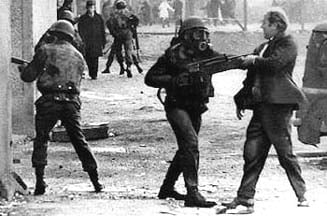
'OUR SOLDIERS LOOKED SPLENDID ON BLOODY SUNDAY....'

"TAKING ACTION AGAINST THOSE BLIGHTERS...."

A section of the RSF members and supporters that took part in the 'Bloody Sunday' picket in O'Connell Street, Dublin, on Saturday 25th January 2014.

For over two hours on Saturday 25th January 2014 (11.30am - 1.45pm) , in atrocious weather conditions, Irish republicans maintained a presence in O'Connell Street, Dublin, to mark the 42nd anniversary of 'Bloody Sunday' in Derry when, on the 30th January in 1972, 13 unarmed civilians were shot dead by the Parachute Regiment of the British Army.

RSF Head Office (223 Parnell Street, Dublin 1) had compiled a total of 260 'leaflet packs' comprising 1,000 items of printed material for distribution on the day and, to the credit of those distributing same, all were distributed during two hours, despite a less-than-usual 'populated' city centre, due to the weather conditions.

The picket alternated between the front of the GPO and the traffic isle in O'Connell Street, depending on the severity of the downpours!

The names of the 13 civilians who were massacred on the 30th January 1972 by the British Army were read out at the picket, and the details involved were highlighted ie - "Michael Kelly died from a single shot to his abdomen, probably fired by Soldier F. The bullet entered from the front and travelled backward and downward. He died within a few minutes of being shot. He was shot near the rubble barricade in front of Rossville Flats. Lord Widgery accepted that Kelly was not armed but concluded that he must have been standing close to someone who had discharged their weapon because of lead particles on Kelly's right cuff. This finding ignored the strong likelihood of contamination from soldiers who handled the bodies when they were taken to the morgue and this was true in the case of many of those killed..." and a letter, dated 1st February 1972, penned by British Army Brigadier F.P. Barclay, DSO, MCDL, Colonel, the Royal Norfolk Regiment, was read out at the picket : "Dear Wilford, As an ex-parachute Brigade Commander I write to say how proud it made one feel to see the way, on TV, which your lads went into action against those blighters last Sunday. They looked splendid and, as usual, bang on the ball. It seems to me and many others that prompt retaliatory action such as this is long overdue. It will have, I've little doubt, a most salutory effect. Should have happened long since! I sincerely trust you successfully weather those thoroughly unjustified but seemingly inevitable brickbats and recriminations emanating mostly from those who either have no sense of law and order, duty or perspective, or who are spineless. With best wishes to you and yours, Sincerely, Peter Barclay, Little Dunham Lodge, Kings Lynn, Norfolk."

The Republican Movement are to be congratulated for continually highlighting this (and other) British Army atrocities in Ireland and for reminding those willing to listen that as long as the British remain in Ireland, politically and/or militarily, the potential remains for such atrocities. Once again, well done to RSF for the good work they have done in relation to this and other issues. A full report will be published in the February 2014 issue of 'Saoirse', which goes to print on Wednesday 5th of that month.

Thanks for reading, Sharon.


Wednesday, January 22, 2014

SIPTU BOSS TO OBSERVE JIM LARKIN SPINNING IN HIS GRAVE.

By Peadar O'Donnell ; first published in January 1963.

I didn't think it wise to visit Father John in Galway Jail , but my wife went to see him and she consulted with Louis Ó' Dea, a solicitor, a good republican and a good neighbour. O' Dea went to see Father John and they went into a huddle together to find a formula that would open an escape for Father John without altering his plea. It seemed to me that the key lay in the attitude one took before the jury. I chose to ask the jury to keep out of it by finding me not guilty. Suppose Father John said to the jury that he didn't want to put them to the trouble of listening to a lot of balderdash ; that he didn't see any reason why he should deny that he rescued a poor woman's cows from the bailiff. Louis O' Dea and Father John evolved a polished formula and so when Father Fahy was asked how he pleaded, guilty or not guilty, he said to the jury he saw no reason why the judge should not proceed as if they had just found him guilty.

The judge interpreted this as a plea of guilty and sentenced Father Fahy to six weeks' imprisonment to date from the day of his arrest, so that he walked out of the court into a throng of friends. His bishop had Father John on the carpet, but to the great relief of us all he did not 'silence' him : his Lordship gave Father John written instructions that he must not discuss politics where two other people are present, and he sent him to Clostoken. There is a 'Clostoken' in nearly every diocese, a ragged curacy which is a sort of place of punishment for priests who 'stumble' : the people there know that unless the new priest is a fledgeling on his first appointment, then he is a poor man under a cloud of some kind.

They are civil to the first but they reach out warmly to the second. Father John and I took up residence at Clostoken, a thatched cottage. Our circumstances were changed. Alice, wonderful Alice, who fed relays of greedy and not too-thoughtful men who let her cook meals at all hours of the day or night at Bullaun, could not fit into our new house - anyway, we could not afford her. Father John and I are both untidy men in a house and so Clostoken soon took on some of the appearance of an unhappy home but the appearance belied it, for there never was a happier house in a setting of better neighbours, and the gatherings at night in that cottage are a great memory. I wrote a lot amid the confusion , as my mind seems to thrive on noise, and some of the noise went into 'An Phoblacht'. (MORE LATER).


THE ANATOMY OF AN AFTERNOON : THE STORY OF THE GIBRALTAR KILLINGS........

By Michael O'Higgins and John Waters. From 'Magill Magazine' , October 1988.

Back in the Operations Room, Commissioner Canepa had finally been persuaded to sign the handing over document and in court he said that he formed the view that they should arrest the three "on suspicion of conspiracy to murder" , now that all the four indicators were in place. The form was presented to him by military officers and he signed it, thereby passing control to Soldier 'E', the SAS tactical commander, who crossed the room and instructed the radio operator to issue orders to the men on the ground. It was 3.40pm.

Commissioner Canepa said in court that he did not actually hear the order being given and said that the radio operator had a headset and it was therefore not possible to hear messages being received or transmitted. Soldier 'F' in evidence appeared flatly to contradict this when he said that the radios were equipped with speakers which could be heard throughout the room. Other witnesses subsequently 'clarified' this apparent conflict by explaining that the device used to transmit messages was like the handset of a telephone - incoming messages could not be heard by anyone other than the operator but the procedure for transmitting and receiving messages was for the operator to state aloud the message received back as well as that transmitted, so that everyone within earshot could hear.

It was suggested that perhaps the reason the Commissioner did not hear the order going out was that he had other things on his mind. Canepa was able to say in court , however, that Mr Ullger, the Head of the Special Branch and Soldier 'E' had both left the Operations Room as soon as the order was given. He remained there with Soldier 'F' and said in court that he heard nothing further for over twenty minutes. Having signed the document he instructed Deputy Commissioner Columbo who was also present to phone Central Police Station to ensure that vehicles were available to take the suspects into custody.

Mr Columbo immediately phoned the station and instructed them to have a van and a car on standby. Back in the station, PC John Anthony Goodman radioed a patrol car in which Inspector Luis Revagliatte and three other officers were out on patrol. The time recorded for the call in the station was 3.42pm. (MORE LATER).


MARTIN COREY RELEASED : "NOT BEFORE TIME..."


Statement from POW Department, Republican Sinn Féin:

THE release of Martin Corey from Maghaberry jail in Co Antrim on January 14th, 2014 was "not before time", according to Josephine Hayden, a spokesperson for the POW Department, Republican Sinn Féin who welcomed his release in a statement on January 15th.

She said "The treatment meted out to Martin Corey for nearly four years was nothing short of barbaric and it was difficult to get the general public and the media interested in Martin Corey’s internment from the beginning. While, quite rightly, we saw/see criticism of the mistreatment of prisoners in other countries - on social media and in the press - the case of Martin Corey was ignored, with a few honourable exceptions, by people here at home. The various British secretaries of state hid behind a wall of silence and claimed that Martin Corey was ‘a threat to the public’. Their case was based on secret evidence/closed material and unspecified allegations. The role of the courts to ensure that 'not only must justice be done, but must be seen to be done' took such a back seat that it disappeared.

Not only was justice not done to Martin Corey, an injustice was done to him. Unspecified allegations are not allowed in courts of law, unless of course the allegations are made by states. We have seen the British Crown Forces and their collaborationists hide behind physical screens and screens of silence in many cases down the years, black-ops in good working order, still operational. For almost four years Martin sat in a jail cell not knowing why he was there – this is also the type of action that even the British condemn in other countries. Martin was held without any due process, he was never questioned from the time of his arrest about any specific incident(s) and his legal team have never been allowed to challenge any of the secret evidence that was bought before the Parole Commissioners – neither the legal team or the judge saw the secret evidence adjudicated on by a state appointed advocate. On his release the statement from the Northern Ireland (sic) Office said 'The Parole Commissioners have decided to release Martin Corey on a licence that is subject to conditions which are designed to manage the risk they assess him to pose.' On his release – after four years - we are still asking the question 'what risk'? "

She concluded: "Is it any wonder the Republicans have no confidence in and refuse to engage with what operates as the justice system in the Occupied Six Counties, when it sees a man who ran his own business for 20 years, just picked up and interned on the word of some anonymous MI5 individuals and held without charge or trial for almost four years. And who, according to media reports [BBC and UTV January 14/15, 2014], cannot even reside in his own home town. Martin should never have been interned in Maghaberry or any other jail. He should have been, and should be now, at home with his family and friends, working at his business and getting on with his life."

As alluded to in the above statement, the media, for the most part, censored itself in relation to this injustice, and maintained that censorship for almost four years. Shame on them.


SIPTU BOSS TO OBSERVE JIM LARKIN SPINNING IN HIS GRAVE.


We note that the trade union group, SIPTU, has organised a commemoration in Dublin to Jim Larkin to be held in early February next with the purpose of "reaffirming.....that trade unions serve their members and the wider community when they champion social and economic justice for all..." The oration will be given by SIPTU General President, Jack O'Connor.

We know the date, the venue and all other details in relation to the above event but, out of respect for Jim Larkin, we won't be mentioning them here nor will we promote or attend the event. SIPTU has more in common with the bosses than it has with the workers and the unemployed and, in our shared opinion, if Jim Larkin was alive today he would form another trade union in opposition to SIPTU and other trade unions like it. Mr. O'Connor should not add insult to injury by claiming any proper connection with Jim Larkin or that which he fought for.


SUNDAY , 26TH JULY , 1914 - ON THE DUBLIN QUAYS ; BRITISH SOLDIERS OPEN FIRE.

British Army 'KOSBIE' Regiment: same as any other terrorist unit in that murder gang.

On Saturday 22nd February next, in Dublin, a fund-raiser will be held to cover the cost of a memorial plaque in memory of those who were killed and injured in 1914 on Batchelors Walk, Dublin, by the 'Kings Own Scottish Borderers' (the 'KOSBIE' regiment) and any money left over will be donated to two good causes - details here.

In the early afternoon of Sunday , 26th July , 1914 , a consignment of over one-thousand rifles and ammunition for same was landed at Howth harbour , in Dublin , and unloaded by the newly-formed 'Irish Volunteers' , assisted by members of Na Fianna Éireann. On its way in to Dublin city , the Republican convoy was halted by a force of about fifty British RIC 'policemen' and over one-hundred British soldiers from the 'Kings Own Scottish Borderers' , known as the 'Kosbies'. A large crowd of civilians gathered to watch the confrontation ; the Assistant British RIC Commissioner , William Harrell , approached the republicans and demanded that their weapons be handed over. Two of the rebel leaders , Thomas MacDonagh and Darrell Figgis ,left the main body of armed republicans and marched over to Harrell and told him it was their understanding that he (Harrell) had no legal authority to issue such a demand.

While RIC Chief Harrell issued chapter and verse of how , and from whom , he derived his 'authority' , the two Irish republicans were quoting him chapter and verse of why it was that his 'authority' was not valid in Ireland ; Harrell's RIC colleagues were lined-up on the road about ten feet behind him and the British 'KOSBIES' were , in turn , lined-up behind the RIC men - both groups were concentrating on the verbal sparring-match between Harrell, MacDonagh and Figgis. But the group of Irish republicans , standing in military formation behind MacDonagh and Figgis , were concentrating on something else and, as the verbal disagreement continued , republicans at the very back of the gathering simply walked away in the opposite direction with their weapons under their coat! Other men in the republican contingent handed their weapons to known members of the public who , again , walked off with the equipment under their coats.

Meanwhile , after about half-an-hour of trying to get the better of MacDonagh and Figgis , RIC Chief Harrell gave up and ordered his men , and the British military , to move-in and seize the guns ; they got 19 of the 1000 rifles , the rest having been spirited away! The Brits were not amused , but the crowd that had gathered to watch the confrontation cheered , clapped and laughed at the RIC and the British KOSBIES , as the two forces formed-up for the march back into the city centre. Word of the incident had spread at this stage and a large number of the public decided to walk alongside the British forces , laughing and jeering at them . When the procession was about three miles from Dublin city centre , they were joined by about fifty more members of the 'Kings own Scottish Borderers' who fell in behind their colleagues. Likewise , dozens of men , women and children - out for a Sunday walk - had heard about the "disappearing rifles" and joined with their neighbours in walking beside the Brits , poking fun at them. It being a Sunday afternoon , families were out in force in the city and were lined-up along the Quays , having heard that the British military detachment was headed that way : people spilled-out from the old tram terminus on Bachelors Walk to join in the slagging.

The Brits were by now near breaking-point ; they were more accustomed to being feared or, at best , ignored , by the public , and were seething with rage now that they were being laughed at by them . An Officer in charge felt the same, and he ordered one line of his men (approximately twenty soldiers) to halt and turn to face the jeering crowd ; when the soldiers had done as commanded , he instructed them to "ready weapons" and fire on the crowd , if he so ordered. It is not clear whether the order to fire was given or not but , regardless , the Brits did open fire - the people on the footpaths - men , women and children - were easy targets. Forty-one people were hit : a man in his mid-forties died on the spot , as did a woman in her early fifties , and a teenage boy. Of the other thirty-eight people , one died later. Such was the outcry from Ireland and abroad , the British Government decided to hold a so-called 'Commission of Inquiry' into the shooting and, in August that year (1914), the Brits announced their conclusion and, as expected , the 'Commission of Inquiry' was nothing of the sort. In August that year (1914) the Brits announced the findings of same -it amounted to a mere 'slap-on-the-wrist' for those who pulled the triggers. The 'Commission' simply stated that the actions of their gunmen on that day , Sunday , 26th July , 1914, was " questionable and tainted with illegality " and scolded their soldiers for "a lack of control and discipline"!

The British Army soldiers responsible for the massacre (the 'Kings Own Scottish Borderers') within hours following the shootings , found themselves even more reviled by the Irish than they had been - their very presence on the street now guaranteed trouble. They were shipped out only days after the incident , to the Western Front. The Irish , meanwhile , had buried their dead : on 29th July , 1914 , literally thousands of Irish people followed the coffins of those shot dead three days earlier. Dublin city came to a standstill as thousands upon thousands of people filled the footpaths along the funeral route , from the Pro-Cathedral to Glasnevin Cemetery . An armed Company of Irish Volunteers , with weapons reversed , led the mourners to the gravesides.

The 'KOSBIES' shot forty-one members of the public , in Dublin , on 26th July 1914 ; the then British Prime Minister , H. H. Asquith, announced on 4th August 1914 that Britain had declared war on Germany and the 'KOSBIES' were shipped-out from Ireland on that same date (ie 4th August 1914) , and sent to the Western Front. There were already twenty-two thousand soldiers from all parts of Ireland serving in the British Army when the war began , attached to regiments such as the Connaught Rangers , the Munster Fusiliers and the Irish Guards. Thousands more Irishmen took John Redmonds advice and joined up as well. Redmond's crew were apparently led to believe that they would be kept together , as an 'Irish Brigade' , with their own special badges and emblems etc , but the British War Office would not allow that to happen.

While the British Administration claim jurisdiction over any part of Ireland , and maintain and enforce that jurisdictional claim with an armed presence , the incident outlined above can happen again. That British claim must be dropped and the armed thugs enforcing same must be re-called to their own country . Any other 'solution' only postpones a true and lasting peace.......

And don't forget -

.....another British massacre in Ireland will be marked this coming Saturday (25th January 2014):

Bloody Sunday , Derry, 30th January 1972.

A picket to mark the 42nd Anniversary of 'Bloody Sunday' will be held at the GPO in Dublin on Saturday 25th January 2014, at 12 Noon. All genuine republicans welcome!


ON THIS DATE 113 YEARS AGO....

...English 'Queen' Victoria died (22nd January 1901), aged 81, at Osborne House on the Isle of Wight : her legacy in Ireland included 1,225,000 deaths due to An Gorta Mór (the 'Great Hunger'/so-called 'famine') , 4,185,000 who were forced to emigrate and 3,668,000 who were evicted. And a newspaper editor was jailed for two years for pointing those facts out.
She was of German descent, born in 1819 at the Kensington Palace, to Princess Victoria of Saxe-Coburg-Saalfeld and Prince Edward Augustus, Duke of Kent. She is (and was) known as 'The Famine Queen' here in Ireland, but republicans would not agree with that nickname , and for the same reason that George Bernard Shaw (and many others) disagreed with it : "The Famine? No, the starvation. When a country is full o' food, and exporting it, there can be no famine. Me father was starved dead; and I was starved out to America in me mother's arms. English rule drove me and mine out of Ireland...." ('Man and Superman' , 1903.)

"HER PEOPLE IN IRELAND (WHO ARE)PAID TO BE LOYAL...."

"In the very midst of all this havoc, in August, 1849, her Majesty's Ministers thought the coast was clear for a Royal Visit. The Queen had long wished, it was said, to visit her people of Ireland; and the great army of persons, who, in Ireland, are paid to be loyal, were expected to get up the appearance of rejoicing......one Mr O'Reilly, indeed, of South Great George's Street, hoisted on the top of his house a large black banner, displaying the crownless Harp; and draped his windows with black curtains, showing the words Famine and Pestilence: but the police burst into his house, viciously tore down the flag and the curtains, and rudely thrust the proprietor into gaol...... 'The Freemans Journal' newspaper says, that on passing through Parkgate Street, Mr James Nugent, one of the Guardians of the North Union, approached the royal carriage, which was moving rather slowly, and, addressing the Queen, said: 'Mighty Monarch, pardon Smith O'Brien.' Before, however, he had time to get an answer, or even to see how her Majesty received the application, Lord Clarendon rode up and put him aside....." (from here.)

And, for shame, there are still those in Ireland today who are "paid to be loyal."


A FEW BOXES OF THIS -


- will be required for this. And even then it would only be a temporary 'solution' , as it's 'the nature of the beast' that needs to be tackled, not just the symptoms caused by that particular 'beast'. The greedy 'leader' in question in the above-linked article is guilty of nothing more than having looked up the greasy pole at those that appointed him and saying to himself 'ME, TOO!'. And he could be forgiven for looking around the room at his inquisitors and wondering why it seems to be acceptable for them to get rich at the taxpayers expense but not for him. And the poor man must surely be wondering where his political 'friends' are now that he could do with a 'dig out'. In the corrupt political and business worlds that exist in this bastard of a State , Paul Kiely and those like him would be considered 'sound men' and simply judged to be unfortunate in that they 'got caught'. But they won't be subjected to any serious jail time, if any at all, as that would set a dangerous precedent. 'Dangerous', that is, as far as the political and business leaders here are concerned. Because 'there but for the grace of God.....'


OH WHAT A TANGLED WEB WE WEAVE....

"....and, with a shake of his head from side-to-side, he said 'YES' , of course I will...!"

We occasionally (!) highlight on this blog the sheer hypocrisy of the 'Establishment' Leinster House-registered political parties vis-à-vis their 'do-as-I-say-not-as-I-do' attitude and political outlook in general but this example has got even us confused : two elected representatives , from the same ex-Irish republican party, apparently arguing, verbally (and, no, I'm not referencing this particular episode!) over which of them is a 'better republican' :

Councillor Colum Thompson throws a verbal grenade at Councillor Michael McIvor, not realising , apparently, that the same point could be made about him!

Both men are members of the same political party which sits in a British-established 'parliament' in this corrupt State, the same party which assists the British government, via Stormont, to implement its writ in six north-eastern counties of Ireland, yet they see fit to argue, publicly, over which of them is the better 'republican'!

"A tangled web..." , said the pot to the kettle.....

Thanks for reading, Sharon.


Wednesday, January 15, 2014

ONE MAN'S CORRUPTION IS ANOTHER MAN'S CRONYISM.

By Peadar O'Donnell ; first published in January 1963.

To make matters harder for himself, when he was brought before the court he refused to plead. He was held at Loughrea until late in the evening while ecclesiastics in authority over him and priests devoted to him stormed at him and pleaded with him - in refusing to recognise the court , it followed that he could not be remanded on bail. He left the State no option but to imprison him and was lodged that night in Galway Jail. I went on to Galway where I saw his sister, Agnes , and his brother, Joe , and they were anxious that having taken this stand Father John should be let follow his own course, the good, sturdy folk. "Father John is a man who always has to stand well with himself" , Joe told me.

Father John was not sent forward to the Central Criminal Court but remanded for trial before a jury in Galway , and we had little anxiety about the verdict. The worry was how to get him out of the difficulty that followed from his refusal to recognise the court - we were afraid he might be silenced if he persisted in it , but Father John himself had no worry. He spent in all about six weeks in Galway jail and he certainly made his presence felt in it , and his concern for people in trouble made him 'big brother' to all the prisoners. He was laughter in the grey of their misery , and everybody was courteous to him and he wandered around pretty much at will.

One day he spotted a newcomer, a tinker, one of the Wards from Ballinasloe. Father John knew the people of the roads and the people of the roads knew Father John well. He called the prisoners and the warders to halt as they marched past him, and with such sharp authority that he got almost a barrack-square response. All the ex-soldiers among them rapped the cobbles and , said the one among the prisoners who told the story to me, "any old farmer that had a foot in the air , froze it in the air." Father John addressed the tinker - "Macaward, Bard to the O'Donnells, it is an evil day for Ireland when I see thee thus. But be of good heart, Brother, for when we achieve our independent Republic , Peadar O'Donnell will restore to you your tribal lands in Tirconail and your great herds of kine, and you will have your flowing robes..." , and he went on to describe the brave world that awaited the tinker. When he paused for breath, Macaward spoke urgently : "For the love of God, Father John, slip me a chew of tobacco......" (MORE LATER).


THE ANATOMY OF AN AFTERNOON : THE STORY OF THE GIBRALTAR KILLINGS........

By Michael O'Higgins and John Waters. From 'Magill Magazine' , October 1988.

Soldiers 'C' and 'D' , having identified the three from Trafalgar Cemetery just before 3pm, had moved northwards back down Main Street, through the Landport Tunnel, down Winston Churchill Avenue and had reached the sundial roundabout , less than five minutes' walk from the airport when they heard on the radio that the three suspects had been seen moving back towards the assembly area where the car was parked. They were instructed to turn back and head up Smith Dorrien Avenue towards the Mobil petrol station on Line Wall Road , about mid-way between the airport and the assembly area.

The IRA threesome were being tailed along Line Wall Road by a number of surveillance officers, including Officer 'H' , who noted that after Seán Savage split from the others to go to the tourist office, he did not immediately rejoin them but walked some distance behind. Officer 'H' said in court that he recognised this as a counter-surveillance measure. Seán Savage had bought a newspaper and was using it to enable him to look discreetly around him. Officer 'H' adjudged all three to be "extremely alert and sensitive" and when Seán Savage again caught up with the others , they all relaxed somewhat. Officer 'H' , following the three from about thirty metres, met up with Soldiers 'C' and 'D' who had been waiting behind the Mobil petrol station. He identified the three to Soldiers 'C' and 'D' who began following also.

Soldiers 'A' and 'B' , meanwhile, had passed through Casemates Square and the Landport Tunnel where they had met up with Officer 'J' , one of two female surveillance officers who would give evidence to the inquest. They emerged from the tunnel together and passed through Kings Lines towards Corral Road which runs into Winston Churchill Avenue at the junction with Smith Dorrien Avenue. (MORE LATER).


BLOODY SUNDAY PICKET , DUBLIN , SATURDAY 25TH JANUARY 2014.

Republican Sinn Féin in Dublin will hold a picket on Saturday 25th January 2014 at 12 Noon at the GPO in O'Connell Street , Dublin, to mark the 42nd Anniversary of Ireland's Bloody Sunday.

After a peaceful Civil Rights march on January 30 , 1972 - from Creggan to Free Derry Corner - units of the British army Parachute Regiment opened fire with automatic rifles and shot dead 13 unarmed civilians , injuring many more . It was later revealed that some days prior to the massacre , the British soldiers involved had been briefed to "...shoot to kill.." at the march.

"This Sunday became known as 'Bloody Sunday' and bloody it was . It was quite unnecessary . It strikes me that the (British) army ran amok that day and shot without thinking of what they were doing . They were shooting innocent people . They may have been taking part in a parade which was banned , but that did not justify the troops coming in and firing live rounds indiscriminately . I would say without reservations that it was sheer unadulterated murder . It was murder , gentlemen.... " -the words of British Major Hubert O'Neill , Derry City Coroner, at the conclusion of the inquests on the 13 people killed by the British Army. On Saturday , January 25th 2014 , a picket to mark the 42th Anniversary of that massacre will be held at the GPO in Dublin , at 12 Noon and, on Sunday 2nd February next, a Bloody Sunday march will be held in Derry, and those attending are asked to assemble at the Creggan shops at 2.30pm.


ONE MAN'S CORRUPTION IS ANOTHER MAN'S CRONYISM.

The Establishment has two ways of 'passing the buck' - blame someone else (ie "the previous administration...") and the method pictured above.

Our 'RA Extortion' post last week was in reference to corruption and cronyism in political circles and just how perverse such occurrences are can be gauged by how quickly and often they filter down to what has always been the level below those particular political circles - that of the business word. One depends on the other : politicians need finance from big business to secure election and to maintain their political positions and , in turn, in order to stay 'big' (competitive), business needs political backing. Nothing new there, as we are all aware.

However, just how far and fast that cronyism seeps across from one part of the Establishment to another may occasionally be hinted at in the 'mainstream media' but, to a certain and usually lesser extent, that media outlet itself can and has been compromised by its connections, in one form or another, to those that operate further up that particular greasy pole - career politicians and the party they have aligned themselves with and the other side of that same coin, big business interests. But those of us that know where to look for it can find practically endless accounts of that corruption and cronyism (here and here, for example) and, obviously, if we can find it, the political and business classes can, too. But because of their own insatiable moral greed, they not only choose not to but they refuse to use their position in society to even properly highlight those injustices. As always, the 'Top Tier' will close ranks to protect their own interests and resources and so it will remain until the opportunity to do so is no longer an option for them. And this policy would do just that - it's an opportunity for us, and an opportunity-remover for them.


AN (UNUSUALLY) SUBDUED 'GAME' , BUT RSF ROMP HOME....!

Rugby crowd : more 'restrained'(!) than our usual clients!

We had the usual complement of workers at the monthly raffle on Sunday 12th January last , we were in the usual venue and we were looked after by the same staff as usual - but the 'punters/clients' were different and, to this 'non-sporter', that difference was notable. Remarkable, even, and I was assured before the raffle that the difference would be notable, but I really didn't believe it would be as extreme as it was.

The sporting fixture that day was a rugby match between an Irish (Leinster) team and a French side , Castres Olympique which, incidentally , the Irish team won , by seven points, I'm told. The monthly raffles always seem to coincide with a soccer fixture (by accident, not design) and maybe there was a soccer match that day but the hotel was jam-packed with rugby supporters , at least ninty per-cent of whom were Irish - but the atmosphere was not the same ; it was, as I said above, more 'restrained' than usual although, having said that, when Julie, one of the lounge girls, pulled the first prize for us , the winner - a Wicklow man , Niall Ó C (ticket 362) - metamorphosed, briefly, into a soccer supporter but restrained himself quickly after the initial shock of winning €200 but, in fairness, he did buy the raffle team a round of drinks which , briefly, in turn, shocked us! And we got him to pull the second prize , €100, with no problem and the winner , a lovely lady from Dublin , Eva G, who had bought ticket 225 from our Gavin, politely made her way to the raffle table , presented her ticket stub and, after it was verified, smiled and winked at us in delight.

Eva then pulled the third prize for us , and the winner - a young man from Tallaght, Dublin , Brian H (ticket 601) was thrilled to win €40 and told us repeatedly that he had never won anything in a raffle before , to which we replied , in broken French accents, that he should remember how good it feels as it may temper his feelings of rejection later on when the French win the game! That was nasty of us, and poor Brian walked back to his pals, looking over his shoulder at us , not altogether sure if we were serious or not!

Our fourth winner , Declan , from Mullingar in County Westmeath (ticket 355, €20) was a very happy little man , who wasn't all that interested in the rugby game but was brought out for the day by two of his rugby-mad sons whom he described as 'good lads but they have a fondness for odd-shaped balls....' and, with an introduction like that, we couldn't help but to ask him to sit with us and tell us more! And we jobbed him , in between the jibes, to pull prize number five (€20, ticket 310) which Wicklow-born Patricia B won, and claimed, seemingly glad to get away from her hubbie, who was roaring at the screen with most of the others and who hadn't noticed her absence which, she told us, means he won't notice that she's a few bob richer! Patricia pulled our sixth prize , €20, which was won on ticket number 241 by a young local lass, Caitlyn D , who had bought it from our Gavin earlier on that day and asked where he was so as she could buy him a drink. She was, we think, a bit disappointed when we told her that Gav was up at the bar with Eva G and she didn't know what to make of it when Declan offered to take her up on the offer! We told him to behave himself and stop trying to 'score'!

Prize number seven ,€20, the second-last prize for this raffle, was won with ticket 218 by D. Felton, who seemed to be genuinely amazed that he had won anything , thanked us , remarked on how well presented his prize envelope , and the raffle itself, was , opened it carefully in front of us (he wanted to keep the empty envelope as a keepsake!) , gave us a tenner and asked that we put him in for five tickets for the next raffle, which we were glad to do. He pulled out the last prize for us and by coincidence one of his friends, Willie L. who had also bought his ticket from one of our local sellers, Paul, won €20 on number 001. A near look-a-like for James Bond, we told him....!

But anyway - whatever the game , the team or the outcome , RSF won the day and took home the 'trophy' - but I hope the February raffle clashes with loads of soccer matches. The craic is better!

Thanks for reading, Sharon.


Wednesday, January 08, 2014

BEWARE THE 'RA' AND ITS SUPPORTERS......

WHAT'S ANOTHER YEAR : 2014 AND COUNTING.....


Welcome back to the blog for the first 'official' post of 2014 , even though we did post a piece on the Dáithí Ó Conaill Commemoration which was held on New Years Day. We intend to carry on in the same format and schedule etc with no major or minor tweaks planned , although we did discuss some changes to the blog , but decided against on the basis that 'if it ain't broke, don't fix it'! And considering we have over half-a-million hits (see stat counter, bottom of page) , we must be doing something right! Hope you all enjoyed the break , as we did and, like us, you're probably finding it hard to get back into the swing of things. We all of us need a holiday to help us get over the Christmas and New Year break.... ;-) !


By Peadar O'Donnell ; first published in January 1963.

There is an element of luck in life , and Father John's luck ran out : the bailiff seized three cows from a widow for arrears of land annuity , and Father John was among a group of men working at a graveyard wall when the bailiff went by, wheeling his bicycle and driving the cattle before him. No man among those at work on the wall was a member of the local committee , but at Father John's bidding they rushed on to the road to free the cattle , at which the bailiff promptly drew his revolver and fired in the air. He soon had the road to himself, except for Father John - here was something he just could not dodge. He sent the bailiff staggering into the ditch with a thrust of his shoulder and young Cooney, one of the road workers, sprinted back to give Father John a helping hand, and he took over the cattle.

The bailiff got on his bicycle and cycled off for help and, at Father John's bidding, Cooney turned the cattle in on the land of a man named Kane, an ex-soldier of the 1914-18 war in which he lost a leg. Kane rose to it, and when the guards came swarming down on the scene the cows were safely tucked away in his byre. I arrived at Fr. John's on the following evening and there was a good gathering of us : I shed my own anxiety in the gaiety of the others , as the bailiff would make no complaint - they were certain he would make no complaint , so we joked over what lay ahead for Father John Fahy. He would be jailed, of course, maybe transported. I would come down to Loughrea and make a speech to protest against people saying Willie Cosgrave was anti-clerical, that he was making war on the Church , that he had Father John Fahy in jail. I would say people must stop talking such nonsense , as Willie Cosgrave was a holy man.

If he put Father John Fahy in jail , it was only because he didn't like Father John's politics , and who knew but maybe Joe Stalin was a bit like Willie Cosgrave as he, too, had priests in jail and who knew but it was simply that he didn't like their politics! All great fun. I went into Clare next day or the day after and I was still in Clare when I learned of Father John Fahy's arrest..... (MORE LATER).


THE ANATOMY OF AN AFTERNOON : THE STORY OF THE GIBRALTAR KILLINGS........

By Michael O'Higgins and John Waters. From 'Magill Magazine' , October 1988.

Soldiers 'A' and 'B' were still in the confectioner's shop near the top of Main Street with their 'Joe' , the Gibraltar policeman in plain clothes. The three suspects passed by the shop and Soldier 'A' caught a fleeting glimpse of Mairead Farrell as she passed by the window. Under instructions, Soldiers 'A' and 'B' remained in the shop for a few minutes. Information was relayed over the radio that Seán Savage had separated from the others and had gone into the tourist office in the Piazza and shortly afterwards they heard that the three had met up again and were heading northwards along the Line Wall Road.

Soldiers 'A' and 'B' were instructed to move northwards also, but along Main Street, parallel to Line Road Wall , and they were told that Soldiers 'C' and 'D' were in place behind a garage further up Line Wall Road, waiting for the suspects to pass. It was around this time that, according to his own evidence to the inquest, Commissioner Canepa was given a written report to read which provided 100 per cent confirmation that the three suspects were in fact Mairead Farrell , Daniel McCann and Seán Savage.

He also instructed Soldier 'G' , the bomb expert who had been assigned to the operation, to go and examine the Renault which the three IRA members had left behind in the assembly area. Within minutes, Soldier 'G' returned to the Operations Room out of breath, and gesturing with his hands in a downward sweeping motion, as though shushing a noisy group of people. Soldier 'G' had been to look at the car which he discovered parked with its boot to the road in the second bay of the car park. Almost immediately he noticed that, although the car was relatively new, it had an aerial on the roof which appeared much older , as it was grimy and beginning to rust. He immediately returned to the Operations Room and reported to the Commissioner that in his opinion the Renault was a suspect car bomb. (MORE LATER).


WHAT'S THIS "OUR" BUSINESS , MR. McGUINNESS ?

Martin McGuinness receives part-payment from his employer.

Christmas ,Easter and summer holiday times are three of the 'old reliables' , as far as politicians are concerned, in that bad news statements and 'position papers' etc are best released then as people in general have other issues on their mind and by the time the voters cop-on to what has happened it's a 'done deal'. And so it must have been with a British Minister in Stormont , Martin 'Babe' McGuinness who, in a previous life, was a Provisional Sinn Féin and PIRA activist.

This particular instance, in which the 'Babe' again showed how grateful he is to the British for the upturn in his financial and social circle fortunes, happened after a gun attack , two days before Christmas Day, on one of the RUC/PSNI British 'police' barracks in Fermanagh , a not unusual occurrence in any occupied area and, indeed, an action which ex-PIRA activists here in Ireland would know more about than I do. Now ensconced firmly as part of the establishment, Mr McGuinness was asked for his reaction about that dastardly deed and, as expected , condemned it and went on to describe it as an attack "on our police service" ! This man and his followers/party members and supporters, would have you believe that he is still the same 'Irish republican' that he was in his younger , more active (!) days and he and they will tell you that he still has the same political objectives now as he had then. And perhaps he has - maybe he did put himself literally in the firing line (in his very early days, that is, before he was recruited by the British and placed in a position of 'political respectability' by them) in the mistaken belief that the campaign at that time was to secure better treatment from Westminster rather than that which republicans considered it to be - a campaign to secure a British military and political withdrawal from Ireland. But the 'Babe' McGuinness wouldn't want that now if, indeed , he ever did , as he depends on the British for his own political survival. And they know that, too.


THE 'RA' ON THE EXTORTION TRAIL : THEY HAVEN'T GONE AWAY , YOU KNOW....

They wear a different political suit now than they did before, but the 'morality' of the balaclava-type method of doing 'business' , is exactly the same with them now as it was before they 'jumped ship'.

Yes , it's true , and it has to be said : the 'RA' make their money from wheeling-and-dealing in the business world, from extorting money from anyone it can , when in a position to do so - employed , unemployed, rich or poor - in the guise of the 'taxes' and 'levies' it imposes on State benefits , wages and savings, and is directly and indirectly responsible for driving ordinary , innocent people to despair.

They are a law on to themselves, and have the backing of their own 'justice' system and various armed militia within their groups of supporters , who will enforce the writ of the 'RA' and , indeed - if the money is right - those armed gangs will do the same for the groups that the 'RA' claims to be opposed to , even though members of the 'RA' are known to have previous history with said groups. For in the murky world of the 'RA' , there are no permanent enemies or friends , no stable alliances , no guaranteed allegiances : it is a treacherous , 'words-are-cheap' and unprincipled mini-society , which operates quite openly in this State and, indeed, it has formed contacts with other 'RA'-like groups in Europe and beyond. And they all share the same objective : to mercilessly use any means necessary to enrich themselves.

Indeed, so embolded have the 'RA' become , and so sure of themselves , that they have organised an indoor public rally in Dublin , to be held this very month - January 2014 - at which the present leadership will attempt to show a 'kinder face' to its victims, and will promise to offer a 'new beginning' to those who, in one guise or another over the years, they have terrorised - financially , morally and physically - but only if those people give their unconditional support to the 'RA'. In the best tradition of these gangsters, it is an 'offer' that best not be refused , least they take whatever it is you still possess. However , whether you attend their rally or not, or pledge your allegiance to them or not, or try and stay neutral in the storm of their onslaught , one or other of the 'RA' family members or their close connections will get you one way or the other. Of that there is little doubt.

Details of the 'RA' Dublin rally can be had here , but be warned - whether you attend or not, pledge your support or not, oppose them or stay neutral - there is no escape from the 'RA' or from their 'family' connections. They have no reason to let you off their hook, even though they have already enriched themselves at your expense. They figure you have more to give..... [Postscript: apologises if you were led to believe that something other than the above would be posted here....;-) ]


TWO IRISH REPUBLICAN EVENTS WILL BE HELD THIS COMING SUNDAY , 12TH JANUARY 2014....

The Fearghal Ó hAnluain (Fergal O Hanlon) Monument in Monaghan.

This coming Sunday , 12th January 2014 , the Republican Movement will be holding two events - one in Monaghan , the other on the Dublin/Kildare border. At 2pm on that Sunday , republicans will assemble at the Cathedral in Monaghan and march from there to Latlurgan Cemetery , where a commemoration will be held for Fergal O Hanlon : incidentally , O Hanlon and the republican men and women of that era were regarded by nationalists and , indeed, former republicans at that time , as being irrelevant and unrepresentative of republicanism much the same as republicans today are regarded , by those in Leinster House and Stormont. But just as O Hanlon and the men and women of the 1950's took inspiration from those that went before them, so, too, do republicans today take inspiration from Fergal and his comrades.

A cousin-in-law of Feargal's , Maitiu O Cinneide, wrote a song about Fergal which was recorded (on 78 disc!) , by Deirdre O Cinneide (Deirdre Donnelly)- these are the lyrics :

Oh hark to the tale of young Fergal O'h-Annluan

Who died in Brookboro' to make Ireland free

For his heart he had pledged to the cause of his country

And he took to the hills like a bold rapparee


And he feared not to walk to the walls of the barracks

A volley of death poured from window to door

Alas for young Fergal, his life blood for freedom

Oh Brookboro' pavements profused to pour


When the smoke and the dim from the battle was over

And Fergal was borne by his comrades away

He asked them to fly from that place and take cover

But he died in the hands of the foe that day


God strike from your hands all your hierlings and traitors

The weopens that murdered our brave volunteer

God grant us our freedom, the dreams of O'hAnnluain

And lift from our valleys all sorrow and fear.

If you can get there , please do - 2pm , the Cathedral in Monaghan , Sunday 12th January 2014.

The second event is a 650-ticket raffle , the first of 2014, which will be held in a hotel on the Dublin/Kildare border , also at 2pm on that same Sunday, the proceeds of which will help boost the coffers of the Republican Movement in Dublin , which I will be attending. And I'm sure Fergal will forgive my absence.

Thanks for reading, Sharon.


Monday, January 06, 2014

THE 'RA' : EXTORTION OVER THE YEARS - DIFFERENT SUITS , SAME MORALITY, SAME OBJECTIVES : SELF ENRICHMENT.

EXCLUSIVE TO THIS BLOG : THE 'RA AND EXTORTION OVER THE YEARS , ITS 'TAXES' AND 'LEVIES' , ITS SO-CALLED 'ALLIES' AND 'ENEMIES' OVER THE YEARS , WHO HAVE AFFECTED IT IN ONE WAY OR ANOTHER, IN ONE OR OTHER OF ITS MANY GUISES : the article will be posted on this blog on Wednesday 8th January 2014 , come what may......

They wear a different political suit now than they did before, but the 'morality' of the balaclava-type method of doing 'business' , is exactly the same with them now as it was before they 'jumped ship'.

Extracts from the piece to be posted here on Wednesday 8th January 2014 : "...the 'RA' make their money from wheeling-and-dealing in the business world, from extorting money from anyone it can , when in a position to do so - employed , unemployed, rich or poor - in the guise of 'taxes' and 'levies' .....if the money is right - those armed gangs will do the same for the groups that the 'RA' claims to be opposed to , even though members of the 'RA' are known to have previous history with said groups.....to mercilessly use any means necessary to enrich themselves.... in the best tradition of these gangsters, it is an 'offer' that best not be refused , least they take whatever it is you still possess..... there is no escape from the 'RA' or from their 'family' connections...."

We expect some opposition from various quarters in relation to us posting this piece and , as such, a back-up of the piece has already been sent to two colleagues , one or other of whom will ensure publication here, should I be unable to do so myself. The 'RA' has powerful friends , but this piece deserves to be seen and it will be - on Wednesday 8th January 2014, on this blog.

Thanks for reading, Sharon.



Thursday, January 02, 2014

DÁITHÍ Ó CONAILL COMMEMORATION , NEW YEARS DAY 2014 , GLASNEVIN CEMETERY, DUBLIN.

CUMANN NA MBAN VETERAN DELIVERS MAIN ORATION.


As with our swim report, we'll just give a quick mention of the weather on the day which, again, as with the Cabhair Swim (or any outdoor event) , is a vital element : it started raining heavily in Dublin on the morning of New Years Day at about 8am , it eased off at around 12 noon , stopped altogether at about 12.30pm and , despite a dark and threatening sky, somehow managed to stay dry for the following two hours, which was more than enough time to allow us, in some comfort (dry but very cold!) , to hold our commemoration for Dáithi Ó Conaill.

Approximately fifty people (and five 'Special Branch/Political Police' members) observed proceedings as the RSF Colour Party and Na Fianna Éireann members formed-up just inside the gates of Glasnevin Cemetery and , having taken up positions behind the uniformed republicans, the parade marched the short distance to the Republican Plot. The commemoration was Chaired by Andy Connolly , who welcomed all to the commemoration , and outlined how he and Dáithí had practically "grown up together in the republican family" , and highlighted various events and issues that Dáithí was involved in during his 36 years in the Movement.

As per a request from the Ó Conaill family , a Decade of the Rosary was recited by Padraig Ennis , following which the Chairperson asked Seán Ó Sé to play a Lament for the Dead on the tin whistle. A wreath from the Republican Movement was laid in the republican plot by Matt Conway and the oration was delivered by life-long republican and Cumann na mBan veteran , Peig King , Dublin, who gave a detailed account of Dáithí's early years in the Movement and outlined the many instances when their paths crossed , in Dublin and Donegal and all points in between. A full report on this commemoration will be published in the January 2014 issue of 'Saoirse' , which goes to print on Wednesday 8th of this month. We post with this brief report a few pics taken at the commemoration, more of which can be viewed in 'Saoirse'.

Andy Connolly , Chairperson.

Peig King , giving the oration.

Andy and Peig.

Séan Ó Sé, playing the Lament for the Dead.

Paddy Ennis , saying a Decade of the Rosary.

Matt Conway , laying the wreath on behalf of the Republican Movement.

RSF Colour Party and NFÉ.

The National Anthem and the lowering of the flags, bringing proceedings to a close.

Finally , a reminder that the annual Seán Sabhat Commemoration will be held this coming Sunday , 5th January, in Mount St Lawrence Cemetery in Limerick ; those attending are asked to assemble at the Horse and Hound Pub in Mulgrave Street at 1pm, and all genuine republicans are welcome!

Thanks for reading, Sharon.


Tuesday, December 31, 2013

DÁITHÍ Ó CONAILL : 'THE ABLEST MIND IN THE REPUBLICAN MOVEMENT FOR OVER 20 YEARS'.

DÁITHÍ Ó CONAILL COMMEMORATION TO BE HELD ON NEW YEARS DAY 2014.


Dáithí came from a strong Cork Republican family. His uncle Michael O’Sullivan (17), along with five of his comrades, was bayoneted to death by British Crown forces in March 1921. He joined Sinn Féin at the age of 17 during the local elections in 1955. By the end of the following year he was on active service as a Volunteer in the Irish Republican Army , serving as an organiser under GHQ staff in Co Fermanagh.

On January 1, 1957 he was second-in-command of the Pearse Column during the attack on Brookeborough RUC barracks which resulted in the deaths of two of his comrades, Fearghal Ó hAnluáin and Seán Sabhat. Four others were wounded including the column commander. At 18 years of age Dáithí took command and led a successful withdrawal back across the border – evading 400 RUC, B-Specials, two helicopters and the British army – where they were forced to retire. He was then imprisoned in Mountjoy and the Curragh Concentration camp from where he escaped with his friend and comrade Ruairí Ó Brádaigh in September 1958.

He returned to active service and for a period was Director of Operations. He was critically wounded in an ambush by the RUC and B-Specials in Arboe, Co Tyrone on the shores of Lough Neagh in November 1959. He made his escape but was forced to seek help because of loss of blood and his weakened condition. He was captured by Crown Forces and was sentenced to eight years which he served in Belfast’s Crumlin Road Jail. Following his release in 1963 he reported back to active service.

In 1969/70 he again made his talents available to the Republican Movement. Ruairí Ó Brádaigh said of him he possessed the 'ablest mind in the Republican Movement for over 20 years'. The sheer breadth of his ability and intellect was evidenced by his service to the All-Ireland Republic both militarily and politically. He had a central role in framing ÉIRE NUA and remained a tireless advocate of it right up to his death in 1991.

Dáithí Ó Conaill never equivocated on what was the cause of the war in Ireland or what was required to deliver a just and lasting peace for all of the Irish people. Speaking in Belfast at Easter 1973 he said: 'Today, the central issue in the war is one of conflict between Ireland’s right to freedom and England’s determination to keep us in subjection. All other issues are subordinate to this basic point. There can be no compromise on the fundamental issue as to who should rule Ireland: the British Parliament or the Irish people. We have had 800 years of British ineptitude in ruling Ireland; we have never known rule by the Irish, of the Irish, for the Irish. Until we do, we shall never enjoy peace and stability in our land....
(From here.)

We will post a brief report on the commemoration, with a few pics , on this blog , before the weekend. But if you can make it to the commemoration itself , please do - all genuine republicans welcome!

Thanks for reading, Sharon.