BLIANTÚIL CUIMHNEACHÁIN WOLFE TONE...
..TÉIGH IN AITHNE AR 02.30, SALLINS, CONTAE CHILL DARA, DÉ DOMHNAIGH, 26th MEITHEAMH 2016. Annual Wolfe Tone Commemoration, assemble at 2.30pm, Sallins Village, Co Kildare, Sunday, June 26th, 2016. "We have come to the holiest place in Ireland: holier to us than the place where Patrick sleeps in Down. Patrick brought us life, but this man died for us. And though many before him and some since have died in testimony of the truth of Ireland's claim to nationhood, Wolfe Tone was the greatest of all that have died for Ireland whether in old time or in new. He was the greatest of Irish nationalists. I believe he was the greatest of Irish men. And if I am right in this I am right in saying that we stand in the holiest place in Ireland and that the holiest sod of a Nation's soil is the sod where the greatest of her dead lies buried..." - that is the first paragraph of the address delivered by Pádraig Pearse at Wolfe Tone's grave on June 12, 1913.
"From my earliest youth I have regarded the connection between Great Britain and Ireland as the curse of the Irish nation, and felt convinced that, while it lasted, this country could never be free nor happy. My mind has been confirmed in this opinion by the experience of every succeeding year, and the conclusions which I have drawn from every fact before my eyes. In consequence, I was determined to employ all the powers which my individual efforts could move, in order to separate the two countries. That Ireland was not able of herself to throw off the yoke, I knew ; I therefore sought for aid wherever it was to be found. In honourable poverty I rejected offers which, to a man in my circumstances, might be considered highly advantageous. I remained faithful to what I thought the cause of my country, and sought in the French Republic an ally to rescue three millions of my countrymen.." - Theobald Wolfe Tone. During his last speech from the dock, Wolfe Tone stated - "I mention this for the sake of others, for me I am indifferent to it. I am aware of the fate which awaits me, and scorn equally the tone of complaint and that of supplication. Whatever be the sentence of this court, I am prepared for it. Its members will surely discharge their duty ; I shall take care not to be wanting in mine..." and, finally, to quote just a line or two from his last letters to his wife : "..be assured I will die as I have lived, and that you will have no cause to blush for me. Adieu, dearest love, keep your courage as I have kept mine. My mind is as tranquil this moment as at any period of my life..."
One only has to read his last speech from the dock at his trial to see and understand the character of the man - just to quote a few lines is enough to convince any fair mind of the impossibility of Wolfe Tone committing any crime against the Cause he served : "Mr.President and gentlemen of the Court Martial : I mean not to give you the trouble of bringing judicial proof to convict me legally to having acted in hostility to the government of his Britannic Majesty in Ireland. I admit the fact from my earliest youth, I have regarded the connection between Ireland and Great Britain as the curse of the Irish nation and felt convinced that, whilst it lasted, this country could never be free nor happy..." and, regarding the French, Wolfe Tone said - "Attached to no party in the French Republic, without interest, without money, without intrigue, the openness and integrity of my views raised me to a high and confidential rank in its armies ; under the flag of the French Republic I originally engaged with a view to save and liberate my own country. For that purpose, I have encountered the chances of war, amongst strangers. For that purpose, I have repeatedly braved the terrors of the ocean, covered as I knew it to be, with the triumphant fleets of that power, which it was my glory and my duty to oppose. I have sacrificed all my views in life ; I have courted poverty, I have left a beloved wife, unprotected children I adored, fatherless. After such sacrifices, in a cause which I have always conscientiously considered as the cause of justice and freedom - it is no great effort, at this day, to add the sacrifice of my life. To the eternal disgrace of those who gave the order, I was brought hither in irons, like a felon.."
This proud Irish 'felon' will be commemorated by fellow republicans in Bodenstown Churchyard, Sallins, County Kildare, on Sunday June 26th 2016, at 2.30pm. All genuine republicans welcome!
PROSE AND CONS.
By prisoners from E1 Landing, Portlaoise Prison, 1999.
ACKNOWLEDGMENTS :
Grateful thanks to the following for their help, support, assistance and encouragement, and all those who helped with the typing and word processing over the past few months. Many thanks to Cian Sharkhin, the editor of the book, Mr Bill Donoghue, Governor, Portlaoise, Mr Seán Wynne, supervising teacher, the education unit in Portlaoise Prison and the education staff, especially Zack, Helena and Jane. Education officers Bill Carroll and Dave McDonald, Rita Kelly, writer, print unit, Arbour Hill.
First Print : November 1999, reprinted March 2000, illustrations by D O'Hare, Zack and Natasha. Photograph selection : Eamonn Kelly and Harry Melia.
THE BIG HOUSE. (By Rita Kelly.)
The moon rides high
in a clear sky above Portlaoise.
The sun is a huge burning orb
and spills red unto the windows of Portlaoise.
The Slieve Blooms lose their substance
and are miraged on the outer rim.
The town is burnished and bright
despite the incarceration.
The gantries swing high above this scene
and this condition.
In the fields the cattle graze and glow,
the people prosper having the sun and the moon
simultaneously
it waxes full.
The walls ride high and grey and hard,
hard as hell,
they hem in and overwhelm-
a place which feels itself strange and dangerous
a place of vaulted anger.
You can not hear the activity of the living
you can not hear life driving its articulated truck
you can not see the bright smile of the lads
heading into the snooker hall close to the Coliseum
or the women with the cranky little pomeranian.
You cannot smell that oil and salt sharpness
of the vinegar in its immediacy, as the young fellow
leaves the chipper, and rushes back to his thin wheeled tractor,
his hand diving into the fried-hot chips, bringing bits of pleasure to his mouth, watering...
knowing that he will spray more and more acres of corn
for hours, until bone-weary of a long day, the vistas
and the smell of the herbicide...
There is a grey in the faces of those you can see.
Incarcerated.
It is a grey which is reflected in the heaped, high up
texture of the local limestone, dug out of some
dank and dark hiding place to suppress the day.
We are tired and nervous for no apparent reason
and the air hangs heavy with the lives we have squandered
and the futures we have fucked up and funnelled into
this narrow place, this hole, this hell, this hindermost
position of all that is stagant. (The rest of 'The Big House' will be posted here next week.)
AIRBNB - 'ACQUIRING' NEW PROPERTY EVEN BEFORE THE LAND IS AVAILABLE.
'Airbnb is a trusted community marketplace for people to list, discover, and book unique accommodation around the world..' (from here) - and what could be more "unique" than a new-build house or apartment that has been built on land 'acquired' from those that were born and bred on it but were 'encouraged' to vacate it by a savage 'neighbour'?
'Airbnb' is listing properties for rent in Israeli settlements that violate international law and occupy Palestinian land illegally and, by listing these homes, the listings company is directly helping legitimise the occupation of stolen land, contributing to a key piece of the Israeli government's decades-long policies of occupation, discrimination and dispossession. The 'new-builds' on offer to holidaymakers are literally built on the rubble of stolen homes, orchards and fields, and have resulted in the displacement of communities and families. At least 48,000 Palestinian buildings have been demolished to build homes where only Jewish Israelis are allowed to live - and now dozens are listed on 'Airbnb'.
'Airbnb' is a private, unlimited company and its Irish office is located at the Watermarque Building, South Lotts Road in Ringsend, Dublin 4. Its company directors are Aisling Hassell, Dermot Patrick Clarke and Eoin Michael Hession : contact details for same are terms@airbnb.com and https://www.airbnb.ie/help/contact_us.
Palestinians are evicted from their homes, 'Airbnb' profits off stolen homes. 'Google' the company for other ways to contact them and/or use the above-mentioned contact details but, however you do it, please do do it. Register your disgust at that particular business practice and, hopefully, if enough of us do so, they will stop doing it. And maybe they'll even apologise to those most affected by it - the Palestinians.
EXPLOSIVE QUESTIONS....
'Magill' magazine has unearthed new information which raises a grim but important question : were explosives from within this Republic used in the Dublin and Monaghan bombings? It is a question which, bizarrely, also encompasses the controversial Dónal de Róiste case. By Don Mullan, author of the book 'The Dublin and Monaghan Bombings'.From 'Magill' magazine, February 2003.
THE CLONAGH AFFAIR.
A Detective Ted Jones of the Garda Ballistic Squad did manage, however, to deliver small quantities of debris from Parnell Street, the first of the four bomb targets, to Dr James Donovan, then at the State Laboratory, on the 20th and 23rd May 1974 and, in his analysis of the debris, Dr Donovan detected "...the presence of two blackened prills of ammonium nitrate.."
On the 24th March 1999 I interviewed Dr Donovan, who made the following statement which, in the light of Captain Walshe's revelations, may have a profound significance. He said - "I feel that the ovide prills of ammonium nitrate, blackened as they were, must have had some significance or else somebody would have come and talked to me. But when my own authorities did not do so, I find that strange."
When asked if the apparent disappearance of the forensics related to the Dublin and Monaghan bombings for 11 days may be linked to the fact that someone in authority may have known that the source of the explosives was actually within the State, Garrett Fitzgerald responded - "I see the possible relationship between the two events, which is news to me. I was always thinking in terms of the explosives being used in the North. I hadn't related it back down here." Fitzgerald agreed it was right that these matters should be raised and expressed satisfaction that ex-Commandant Walshe had met with Mr Justice Barron, the man in charge of the long-running 'Independent Commission of Inquiry' into the bombings.
"It is a thesis to be explored," Fitzgerald told 'Magill', "and it is right that these matters be thoroughly explored. There is no case for covering matters up." (MORE LATER.)
GROWING UP IN LONG KESH...
SIN SCÉAL EILE.
By Jim McCann (Jean's son). For Alex Crowe, RIP - "No Probablum". Glandore Publishing, 1999.
Biographical Note : Jim McCann is a community worker from the Upper Springfield area in West Belfast. Although born in the Short Strand, he was reared in the Loney area of the Falls Road. He comes from a large family (average weight about 22 stone!). He works with Tús Nua (a support group for republican ex-prisoners in the Upper Springfield), part of the Upper Springfield Development Trust. He is also a committee member of the 'Frank Cahill Resource Centre', one of the founders of 'Bunscoil an tSléibhe Dhuibh', the local Irish language primary school and Naiscoil Bharr A'Chluanaí, one of the local Irish language nursery schools.
His first publication last year by Glandore was 'And the Gates Flew Open : the Burning of Long Kesh'. He hopes to retire on the profits of his books. Fat chance!
"THANK YOU, BOYS, THANK YOU..." (PART TWO.)
A few months after Damien's release there had been a total physical change in the camp : Cage 17 along with a few inmates from old Cage 13 had become Cage 11. One of the inmates was one Timmy Johnson from the New Lodge Road - Lasher Beirne had been thinking about Timmy for about two months. In fact, Lasher had been thinking more about Timmy's impending release.
Just before Timmy's release the necessary gear to transform Lasher into Timmy had been secreted into Long Kesh and was placed in a secret dump. We don't know who dumped it because that was a secret,too! Timmy readied himself for his big day unaware that in smoke-filled cubicles in Cage 11 desperate men were making desperate decisions that could have desperate repercussions on Timmy's planned holiday a few days hence in Carnlough.
For those two months before his release Timmy thought that it was very good of Lasher to take such an interest in him. After all, Lasher had barely acknowledged Timmy's existence in the four or five months since the 'Fire of Long Kesh' had put them together in the same cage. They were inseparable. "That's what I like about Lasher," Timmy declared one day to 'another' friend, "Lasher's always there for me with a sympathetic ear. He's genuinely interested in everything about me..." If Timmy had taken a closer look he would have noticed that Lasher was starting to walk, talk and act like Timmy. On the day Timmy was getting released, Lasher was Timmy... (MORE LATER.)
ON THIS DATE (1ST JUNE) 94 YEARS AGO : BRITISH PARAMILITARY GROUP IN IRELAND RE-NAMED.
In every country it occupied (and in every country it continues to either occupy or take an 'interest' in) Britain, like other imperialist forces, recruits a native 'workforce' which it uses to serve its interests (!) : in the mid-to-late 19th century in Ireland, for instance, Westminster decreed that the then Irish police force be re-named the 'Royal Irish Constabulary', a move which the then British 'queen', Victoria, was strongly in favour of, as a 'reward' to them in payment for the cruel manner in which they dealt with the Fenian rising : on the 1st June 1922 - 94 years ago on this date - (after Britain had partitioned Ireland) the paramilitary RIC outfit in the Six Counties was re-classified as the 'RUC' ('U' for 'Ulster' : sic - Ulster has nine counties , not six) and Britain's reign of 'official' terror in that part of Ireland continued, albeit by a 'different' paramilitary gang.
For instance, in June of 1982, the 60th anniversary of the formation of the RUC was marked by a series of commemorative events ; articles filled newspapers, editorials and letters from loyal correspondents heaped praise and glory on that force, church services, some attended by well-known catholic clergy, prayed for its members, and local councils passed motions of support and congratulations in their 'honour'. In short, 'respectable unionist society' paid its tribute to its 'police force', formed in its image - and 60 years of brutality, torture, murder and lies were brushed aside as the unionist establishment congratulated itself for the continuing existence of a paramilitary force which had maintained and safe-guarded its rule over the turbulence of those years. There were of course no prayers for young Michael McCartan, gunned down in cold blood in July 1980 by a plainclothes RUC man while painting 'Up The Provos' on a gable wall near his south Belfast home. Nor, doubtless, did any clergyman pause a moment in memory of 9-year-old Danny Rooney, shot dead by RUC men in August 1969 in his Divis Flats home ; or in memory of 42-year-old Samuel Devenney, beaten to death in his own home by those same 'guardians of peace' in April 1969.
There were no newspaper editorials recalling the hideous murder of trade union activist Brian Maguire at the hands of his RUC interrogators in Castlereagh in 1978. Or the 'disappearance' of Jackie McMahon on January 18th, 1978, after his arrest by the RUC, and the finding of his drowned body in the River Lagan months later.
The columns of 'The Belfast Telegraph' establishment newspaper were empty of condemnations of the RUC killers of young Julie Livingstone in May 1981, and of those other nationalists murdered by the plastic bullet weapon which British rulers have equipped their RUC 'peace-keepers' with. And the local councils omitted to mention the torture centres such as Castlereagh and Gough barracks, or the Bennett Report, or the Amnesty International Report, or the European Court of Human Rights condemnation of torture techniques in 1971. The 'conveyor belt' from the nationalist ghettos to the H-Blocks and Armagh, in which the RUC play an integral role with their trade in torture , blackmail and perjury, was totally ignored.
The black history of the RUC is shrouded in a cloak of lies and false platitudes : although it was founded in June 1922, its roots, nonetheless, and its political nature, can be firmly traced back to the force which was established to maintain British rule in Ireland before partition. The 'Constabulary (Ireland) Act 1836', passed by the British government, created a constabulary of some 8,500 men but, by 1846, this was extended to 13,500 with, in addition, a large number of auxiliaries, specifically to protect the property of absentee landlords and to squeeze rent from impoverished peasants in the 'Great Hunger' period, or to seize the property they attempted to 'live' on. The 'Royal Irish Constabulary'(RIC) as it was known, effectively acted as the strong-arm of the landlords and the mill and factory owners, carrying out evictions against tenants who defaulted on 'rent' payments - if those who had been evicted decided to squat on the land (as they often did, because they had nowhere else to go) the RIC and/or the Auxiliaries would attack them again for doing so. If a 'street' or village attempted to defend their neighbour from eviction, the same State thugs would move-in to break-up what they considered the 'strike action'.
The Northern RIC was almost entirely composed of protestants : a British 'royal commission' reporting on the 1857 pogroms against Belfast catholics found that this overwhelmingly protestant para-military 'police' force had behaved in a sectarian fashion, and had actually led attacks on catholic homes and businesses - just as at Burntollet in January 1969, and in the lower Falls in August, when out-of-uniform and uniformed RUC men and 'B' Specials co-ordinated the attacks on catholics. That 'royal commission' recommended that 'a total change should be made in the mode of appointment and the management of the local police.". 112 years later, the Hunt Report commissioned by the British Government was still tinkering along the same lines of 'reform'. But just as in 1857, so in 1969 - nothing changed in the essential sectarianism of the 'police', and throughout the 19th century, attacks on nationalist homes and property continued unabated. On December 6th, 1921, the so-called 'Treaty' was initialed, soon to be ratified by the dominant Free State faction in the South of Ireland, and Ireland was partitioned. In the twenty-six counties the implementation of the new status was undertaken by Free State forces using British arms and equipment, and employing brutally repressive measures. In the Six Counties, the job of 'pacifying' nationalist opposition fell largely to the RUC.
A departmental committee established under the Stormont administration to enquire into the organisation of a force to replace the RIC, recommended (on March 31st 1922) that a 'new' force, the 'RUC', be set up comprising 3,000 men. Nominally, this force was to include one-third catholics in its number, but because of loyalist sectarianism and the force's political role in defending partition, it was from the outset an almost exclusively protestant and loyalist force.
The first priority of the newly-formed RUC was to eliminate the republican forces who still enjoyed popular support in the nationalist areas of the Occupied Six Counties. To achieve this, the 'Constabulary Act (Northern Ireland) 1922', incorporated the already established 'Special Constabulary' fully into the RUC. This 'Special Constabulary' had been set up in 1920 by the British administration to combat the increasingly effective IRA forces in the north-east of the island. The unionist leader, 'Lord' Edward Carson, had organised it, and it was composed almost entirely of former units of the Ulster Volunteer Force (UVF) from the gun-running era. Within a year of its formation the 'Specials' - 'A', 'B' and 'C' classes (although only the 'B' Specials lasted long) numbered more than 30,000 men, and at the end of 1921 the Stormont administration assumed control over them from the British government. By the end of 1922 when they were incorporated into the RUC, the 'Specials' numbered 50,000 well-armed men.
Both the 'Specials' and the RUC proceeded to wage a terror campaign against the nationalist people, indulging in widespread pogroms : reports of atrocities were common place between 1922 and 1925 and the 'Murder Gang' (a 1920's version of the 'Shankill Butchers') was composed of ex-British soldiers, UVF men and RUC/'B' Specials, and typical of their atrocities was the McMahon Murders on March 24th 1922, which was organised and carried-out by RUC Detectives and District Inspectors J.W. Nixon and Harrison, in which all the male members of the McMahon family and a man employed by them were killed. In another incident around this time, two elderly sisters were killed when 'B' Specials threw a hand-grenade into the bedroom of their Thompson Street home in east Belfast's isolated nationalist ghetto of Short Strand. Perhaps the most sadistic killings took place in Tyrone in 1924 - four IRA Volunteers were captured by a large platoon of 'B' Specials and shot on the spot. Their genitals were cut off and placed in their mouths and obscenities about the Pope were written on the road with blood from their entrails. At the inquest, the 'B' Specials' Commander defended their actions by stating that his men "..had seen action in Palestine..". No action was taken against the perpetrators.
In the intervening years, the RUC came to reinforce its position as the institutional guardian of Orange sectarian privilege in the Occupied Six Counties, periodically (as in 1932 during the 'Outdoor Relief' strikes) repressing nationalists by extreme brutal force. Its importance in that institutional repression can be gauged by the fact that the RUC, through its advice and intelligence reports, were instrumental in operating the internment of nationalist opponents of the state, not just in 1971 but in every decade since the foundation of the state in 1920. The late 1960's saw this repressive role emphasised again, as RUC thugs continued to 'keep the peace' with their batons.
The late 1960's saw this repressive role emphasised again, as RUC thugs batoned civil rights marchers to the ground, first on October 5th 1968 in Derry, in full view of the television cameras. Despite the outcry no investigation took place. When on August 14th 1969 the RUC finally admitted defeat, faced with the undaunted nationalist resistance of the Battle of the Bogside, and British troops entered Derry and then Belfast to safeguard the status quo, the 'B' Specials gave full vent to their anti-nationalist spleen, shooting dead a bystander in Armagh and Francis McCloskey in Dungiven, while in Belfast 'B' Specials and RUC men led loyalist mobs on attacks into nationalist streets.
When the first flames died down and the nationalists counted the cost in terms of human tragedy, the British summoned 'Lord' Hunt to prepare a report on the RUC - like subsequent reports it was essentially a whitewash.
August 1969 had revealed to the watching world that the RUC was a sectarian paramilitary force, and the British felt pressurised to act. Typically they summoned an academic, 'Lord' Hunt, to prepare a report which essentially would salvage the 'credibility' of the force : Hunt's report was issued on October 3rd 1969 and was announced as the 'reform' of the RUC. The 'reforms', however, were not real but apparent. The 'B' Specials were disbanded but were replaced by the 'Ulster (sic) Defence Regiment' (UDR), which were attached to the British Army rather than to the RUC. But 90% of all 'B' Specials in 1969 joined the UDR at its formation in 1970, meaning that 80% of the UDR was composed of former 'B' Specials.
Most of the few nationalists who joined the UDR, in an initial belief in the reality of the 'reform' (about 12% of the UDR in all) resigned when it soon became clear that the UDR was no more than a 'Special Constabulary' in khaki uniform. As a further concession to the 'pride' of the 'B' Specials, former members were allowed to keep their weapons! One other Hunt Report 'recommendation' was that the RUC be disarmed : this was implemented initially but, under loyalist pressure, the RUC soon resumed its traditional role as the armed paramilitary wing of loyalism. In fact, to suppress the militant nationalist population, the British administration actually strengthened the RUC in numbers and weaponry. In the history of nationalist and republican resistance to the Orange state, this better-armed, better-trained and numerically stronger RUC paramilitary force played a central and conscious role in the attempted repression of that struggle. Their 'contribution' in particular to the post-internment H-Block/Armagh 'conveyor belt', through the use of RUC-trained interrogators in Castlereagh and other torture centres across the North was a major factor in the torture, by physical or psychological methods, of the estimated 20,000 nationalists who have passed through these centres since the ending of political status in 1976. Over 80% of those subsequently convicted by non-jury Diplock courts were jailed solely on the basis of 'confessions' obtained while under interrogation in those centres.
The RUC's immunity from criticism in employing these methods is well illustrated by the Rafferty Case : James Joseph Rafferty, from Dungannon in County Tyrone, was arrested in November 1976 and held for three days in Omagh RUC Barracks where he was brutally beaten by RUC detectives from the 'Regional Crime Squad', which had only recently been established by the then RUC assistant chief constable Kenneth Newman, for just such purposes. Eventually, James Joseph Rafferty was released without charge and taken to hospital where he remained for several days. The evidence of the brutality used against him was clear-cut : he had multiple bruising, his scalp was covered with blood-red pin-pricks, and his backside was gashed. Doctors testified that these injuries could not have been self-inflicted. Nevertheless, after years of a stonewall conspiracy of RUC silence, which caused one member of the 'RUC Police Authority', Jack Hassard, to resign in disgusted frustration, James Joseph Rafferty's torturers were acquitted in 'court' and his claim for compensation was dismissed. As the ex-RUC 'Police Authority' member, Jack Hassard, said - "The bastards who beat up James Joseph Rafferty would stop at nothing, even killing..." And they didn't stop for Brian Maguire -
'In Castlereagh from day to day
The tortured know no rest,
And men don't sleep and men must weep
Until they have confessed,
Confessed to 'crime' for sentenced time
Though guilt they may not know,
But that is law, however raw,
So bear your cross of woe.' (Bobby Sands: 'The Crime of Castlereagh'.)
- On May 12th 1978 there were two funerals of particular relevance for the nationalist people : one was Jackie McMahon's, his body having been dragged from the River Lagan, the first time he had been seen since being taken into RUC custody four months earlier. The other was the funeral of 27-year-old Brian Maguire who, two days earlier on May 10th 1978, had been found hanging by a sheet from his cell ceiling, in Castlereagh Barracks. Brian Maguire was an electronics engineer at the Strathearn Audio factory in West Belfast, a branch secretary of his trade union , the AUEW(TASS), and a militant in the 'Trade Union Campaign Against Repression'. In November 1977 he had helped organise a march in West Belfast against repression, at which one of the speakers warned that unless Castlereagh were closed then somebody would be tortured to death. Brian Maguire was that somebody. His murder was, typically, 'offically' dismissed as suicide, physically an impossibility in the regime of constant supervision in Castlereagh . A key to what did actually happen to him, however, is given by the case of Phelim Hamill from West Belfast who was being held for questioning about the same matters as Brian Maguire. Phelim was 20 years of age when he was taken from his home on April 23rd 1978 : over the next two days he experienced the most severe physical and mental torture in Castlereagh, suffering ear damage, abdominal bruising and bruising to the kidneys and testicles. While being beaten by 'teams' of up to eight RUC men, he was made to stand against the wall spread-eagled for long periods. His RUC torturers also engaged in a specific type of mock strangulation which induced a drowning sensation : this is the last torture that is believed to have gone too far in Brian Maguire's case and led to his death.
In a statement taken before Brian Maguire's death, Phelim Hamill detailed this aspect of the torture : "My arms and legs were pinned down and a light-coloured towel was put over my head, obstructing my vision. The RUC tied the towel around my neck and choked me. While the towel was tied around my face a cup of water was poured down my throat and nose, giving me a drowning feeling." After surviving this terrifying experience, Phelim Hamill spent eleven months on remand before being released. Brian Maguire was not so lucky.
'Like withered leaf or side of beef
They hang you by the heels,
Then kidneys crunch with heavy punch
To tortured jiggling squeals.
Bones are bruised 'cos boots are used
To loosen up your tongue,
So men admit a little bit
When nothing they have done.' (Bobby Sands : 'The Crime of Castlereagh')
The RUC are* a bigoted and sectarian force, existing to perform the function they were set up to perform - the defence of the Orange state. The child-killers of 1969 are the torturers of Castlereagh and the plastic bullet assassins, and any number of years on the RUC are an unchanged and unchangeable paramilitary force. Their name spells repression and death to the nationalist community. That is why, for all the newspaper articles and editorials, and for all the middle-class prayers and council motions and, above all, for all the ambivalence and collaboration of the establishment towards them, there are not and never will be any birthday greetings to the RUC from the nationalist people. *On the 4th November 2001 , the RUC was renamed and rebranded as the 'PSNI' - another name change - but they remain the same : an armed wing of an unjust bastard 'State'.
(The above post is a re-edited version of an article we first published here in 2008.)
FOREIGN NATIONAL ASSAULTS IRISHMAN.
The foreign national, pictured left (with handgun), is known to have recently met-up with like-minded pro-British elements in Dublin and was caught in the act of assaulting an Irishman in a cemetery in Grangegorman, on the northside of Dublin.
The photograph in our link, above, clearly shows that the foreign national perpetrator , who is a guest in this part of Ireland, has meddled in the (political) affairs of this State despite his position being traditionally best served by staying out of domestic politics. He was not requested to attend that gathering in the cemetery to operate as 'security' but, by his own actions, he has now involved himself in Irish politics and has shown his support for the anti-republican elements who, like him, seek to silence the republican narrative in this State.
In our opinion, the man is not fit for purpose (or office) and should be recalled to his own country, where he can assault those he disagrees with to his hearts content ; we agree that he had no business in "...attacking an Irish Citizen who had every right to protest the fact that his relatives who died in the 1916 uprising were being remembered alongside those that did the butchering.." and we request our readers to support the 'phone-in-protest' that is taking place on Friday, 3rd June 2016 - details here. Bad enough that those of us who speak out against injustices are silenced by 'our own', without letting outsiders do the same to us. Make that call on Friday 3rd - let's 'get our man'.
KINCORA - BRITISH 'DIRTY TRICKS' TO BE EXPOSED?
'..it has long been claimed a high ranking paedophile ring preyed on vulnerable young boys in Kincora during the 1970s (and) it is further alleged the UK security services knew about the abuse but did nothing to stop it, instead using the information to blackmail and extract intelligence from the influential men, including senior politicians and establishment figures, who were the perpetrators..' (from here.)
The following piece was first published in 'FORTNIGHT' Magazine in May 1984, and was posted on this blog in 2005. It was apparently penned by a gay supporter of McGrath/TARA/Kincora Boys Home and we re-post it here to give you a taste of the 'spin' which some people attempted to put on that issue ; please read it with that in mind.
This is a link to the 'objectives' of the TARA loyalist paramilitary organisation with which William McGrath and Roy Garland were associated.
'Gay people have watched the growth of the Kincora industry with fascinated horror : a number of sordid and petty crimes perpetrated against teenage adults have been presented as atrocities on a par with Bloody Sunday, Bloody Friday and every other bloody day of the Ulster week. Prejudices long dormant in the intelligent public have been gentled back into life ; homosexual people are underhand, sexually voracious and unusually interested in young people as sex partners, whether those young people are willing or not. This is how the crazed notion that a boy brothel could exist in a city the size of Belfast got off the ground. It could be taken for granted that gay men in particular would find such a set-up congenial and that we would close ranks to protect the people who would try to organise such a venture. William McGrath is the central figure in the Kincora 'stew' - he had ideas which were lunatic enough to pass for fascist, he was also homosexual and subjected his charges to distressing and unwanted sexual attentions. This, it is implied, is the crux of the matter so far as McGrath is concerned. Such an attitude is nonsensical ; William McGrath and his fellow defendants spent whole lifetimes building up images of familial rectitude. They never once said anything about their homosexual orientation. It is worth questioning whether they were entirely homosexual at all. No hint of their being gay ever seeped out into the gay community, much less the general community.
William McGrath's 'paramilitary' organisation, 'TARA', appears to have consisted of a smallish number of 'chiefs' and no 'indians' at all ; even Roy Garland, once his deputy, admits that all its invitations to other Unionist 'chieftains' to 'pow-wow' were always refused. This fits in with the image of a psychologically dislocated dreamer. Such people are often attractive to young people. Unionists in the early 1970's appeared to be 'girt' (ie 'be' and 'mix with') with cruel foes - and successful ones. The Unionist leadership did not have an idea between them. William McGrath had lots of ideas - all utterly impracticable - and the ability to put them across. Young Ulster (sic) protestants who had not caved in to self-hatred probably momentarily enjoyed the thought that they were the Vanguard of the Chosen Race : McGrath was a British Israelite.
British Intelligence probably did know about McGrath and 'TARA' ; they probably also knew about his employment and they may have known that he was homosexual. So also did Ian Paisley, who told his informant, Valerie Shaw, that she should give thanks to God she "was not born a pervert". But it required journalists working for Ireland's leading quality newspaper to turn this into something sinister. We are asked to be outraged by the fact that Ian Paisley did not instantly assume that a homosexual must be sexually molesting his charges.
Sir George Terry, in his report into the affair, slates the press for their handling of it but does not mention the never-ending quality of the whole thing. For more than two years every single day every single medium regaled us with another Kincora fable - we very rarely got a fact. Public figures tumbled over themselves to prove that they were cleaner than clean. Meanwhile, the Social Services Department were in the grip of paranoia ; gay women and men went in fear of their livelihoods - some had their private lives insultingly closely scrutinised. A number were made to assent to humiliatingly intimate physical examination. Non-gay people were just as deeply affected as the suspicion was all-pervasive. Sir George Terry lays most of the blame for the actual events at the Kincora Home on the Eastern Health and Social Services Board, unjustly, one feels. This body could only be expected to work with the material to hand. This included that inherited from the Belfast Welfare Committee ; both bodies, like all such bodies, had to depend on the good will and the good faith of their employees.
'Welfare on the cheap' was what Belfast wanted - and that's what it got : in William McGrath's day you got a job in Welfare because you 'knew someone at City Hall', not because you were qualified for the job or even had an interest in the work. Sir George Terry is very lenient with the RUC ; he uses the excuse that in the mid-seventies the RUC were in the midst of a campaign of terror. However, they were not so busy that they could not resist arresting twenty gay people over a period of some months in 1976 and asking them questions about practically everything except Kincora. The 'Northern Ireland (sic) Gay Rights Association' will have no truck with a judicial inquiry, for a number of reasons - as there was no traffic in boys there is nothing to investigate . The consequences for gays would be dire - they would be driven out of any employment involving young people and they would be kept out of such employment for decades. This would lead to endless complications. Sexuality is not easily pinned down and codified ; instability would be endemic in teaching, welfare and many other fields. Gay people would be faced with repressing their sexuality or going through life lying and prevaricating at every turn. This would set up destabilising suspicions, and so on ad infinitum, until we had reached the pinnacle of Victorian rectitude, where nobody was honest about their sexuality.'
The main trust of this article was to attempt to dismiss all fears about Kincora, McGrath and others as 'nonsensical' and it was maintained throughout the piece that any investigation into said fears should be seen as an attack on the gay community as a whole. A truly sickening position to have held on that sordid episode in the history of this country and, even at this late stage, this issue needs to be properly resolved.
'VOTING WOULD BE SUCH A BLESSING...
..IF IT WEREN'T SO MUCH A GAME OF GUESSING..'
If you like what we do here in our wee corner of the internet, then please don't be shy - give us a vote! You will have to either log in or create an account before you can vote but we really would appreciate it if you did that for us. There is no charge, and it won't take up too much of your time - entries are open until the 26th June next and judging will start after that. Think about it, anyway - this could be your opportunity to see me on stage. Cleaning it, afterwards...!
Thanks for reading, Sharon.
PROSE AND CONS.
By prisoners from E1 Landing, Portlaoise Prison, 1999.
ACKNOWLEDGMENTS :
Grateful thanks to the following for their help, support, assistance and encouragement, and all those who helped with the typing and word processing over the past few months. Many thanks to Cian Sharkhin, the editor of the book, Mr Bill Donoghue, Governor, Portlaoise, Mr Seán Wynne, supervising teacher, the education unit in Portlaoise Prison and the education staff, especially Zack, Helena and Jane. Education officers Bill Carroll and Dave McDonald, Rita Kelly, writer, print unit, Arbour Hill.
First Print : November 1999, reprinted March 2000, illustrations by D O'Hare, Zack and Natasha. Photograph selection : Eamonn Kelly and Harry Melia.
CELTIC TIGER (Based on a song by the Dubliners).
By Eamonn Kelly.
Dublin is to Dubliners'
a dear old dirty town.
It's getting dearer every year
and hard to earn a pound.
Thugs and drugs and muggings
are the order of the day.
The headlines yell 'We have gone to Hell
It's time Crime didn't Pay'.
Mortgage a home in Dublin town
and watch the banks
take your pound.
The gangs and the police
fight nightly on Foley Street
bleeding their way through the news.
The new show on our screen,
will soon be seen
as 'Seán MacDermot Street Blues'.
And as for the Liffey
that stench throughout the city
it's thicker than treacle or chalk,
it will soon be so grim
that instead of a swim
we'll be holding the 'Liffey Walk'.
But Dublin you're my city
and I'm proud to call you mine.
EXPLOSIVE QUESTIONS....
'Magill' magazine has unearthed new information which raises a grim but important question : were explosives from within this Republic used in the Dublin and Monaghan bombings? It is a question which, bizarrely, also encompasses the controversial Dónal de Róiste case. By Don Mullan, author of the book 'The Dublin and Monaghan Bombings'.From 'Magill' magazine, February 2003.
THE CLONAGH AFFAIR.
When shown photographs taken by Captain Walshe detailing the lack of security around the Clonagh factory, Garrett FitzGerald had this to say - "It is inexplicable that this information was furnished and no action was taken. I don't understand it. It's totally out of kilter with anything I would have known about my colleagues. It's a problem. The allegation always was that Cosgrave and the cabinet went over the top with security (in relation to) the IRA, not that they were ever neglectful. So that's why it is surprising."
Patrick Walshe's suspicion that the 1974 Dublin and Monaghan bombings were related to the Clonagh scandal and that the aim was to teach the Republic a lesson also needs to be examined. The Garda handling of the forensics in the aftermath of the bombings is deeply disquieting. It is known that bomb debris related to the biggest unsolved mass murder case in the history of the Irish Republic disappeared for 11 days after the explosions before being delivered to a forensic laboratory outside Belfast, by which time all explosive traces had effectively disappeared.
In the course of my research for my book, 'The Dublin and Monaghan Bombings' (Wolfhound Press, 2000) , the Garda Commissioner failed to explain this anomaly and also failed to state whether the Republic's police could establish a chain of custody for the debris, especially for the 11 days it took to reach a forensic laboratory. (MORE LATER.)
GROWING UP IN LONG KESH...
SIN SCÉAL EILE.
By Jim McCann (Jean's son). For Alex Crowe, RIP - "No Probablum". Glandore Publishing, 1999.
Biographical Note : Jim McCann is a community worker from the Upper Springfield area in West Belfast. Although born in the Short Strand, he was reared in the Loney area of the Falls Road. He comes from a large family (average weight about 22 stone!). He works with Tús Nua (a support group for republican ex-prisoners in the Upper Springfield), part of the Upper Springfield Development Trust. He is also a committee member of the 'Frank Cahill Resource Centre', one of the founders of 'Bunscoil an tSléibhe Dhuibh', the local Irish language primary school and Naiscoil Bharr A'Chluanaí, one of the local Irish language nursery schools.
His first publication last year by Glandore was 'And the Gates Flew Open : the Burning of Long Kesh'. He hopes to retire on the profits of his books. Fat chance!
"THANK YOU, BOYS, THANK YOU..." (PART ONE.)
No-one was more impressed than Lasher Beirne, who declared - "I'm your man, let's do it!". Damien winced ; he knew that Lasher wasn't given to flights of fancy and when it came to trying to get out of the Kesh, Lasher had absolutely no sense of humour. Damien looked at Arder as if to say 'do you see what you've started now?' and Arder sniggered impishly. Cold-blooded impishly. "There are four hours to pull this thing together," urged Lasher but, as the OC saw the enthusiasm in Lasher's eyes, he told him he would have to talk to the cage Intelligence Officer. "There isn't enough time and we haven't got the stuff," the IO informed the OC, "we've no make up or wigs for disguises," he continued. Damien interjected - "It's a pity because it's a cracker plan, but we have to be realistic - without them disguises, ye know.." "I'll take the chance," said Lasher, "I've nothing to lose."
The OC pondered the logistics of transforming Lasher into Damien and, while Damien waited on the outcome of the OC's ponderings, he pondered himself about how to avert the heart attack he could feel starting way down in his boots. "No!" , said the OC, "It's a good idea for another time when we have the proper gear to do it right." Lasher was disappointed. Damien feigned disappointment, but only a wee bit. "Jesus, but that's a pity, Lasher," said Damien, "I was all for it, no problem." Nobody believed Damien but he couldn't care less. (MORE LATER.)
IN THIS MONTH 61 YEARS AGO : SINN FÉIN TD'S ELECTED IN THE SIX OCCUPIED COUNTIES.
In 1955, splits were occurring in the IRA as several small groups, impatient for action, launched their own attacks in the Occupied Six Counties. One such activist, Brendan O'Boyle, blew himself up with his own bomb in the summer of that year. Another, Liam Kelly, founded a breakaway group 'Saor Uladh' ('Free Ulster') and in November 1955, attacked a Royal Ulster Constabulary (RUC) barracks at Roslea in County Fermanagh. One RUC man was badly injured and a republican fighter was killed in the incident.
In the UK general election of 1955, Sinn Féin candidates were elected as TD's for the Mid-Ulster and Fermanagh and South Tyrone constituencies in the Occupied Six Counties, with a total of 152,310 votes. The following is the Election Manifesto that the then Sinn Féin organisation put to the people :
'SINN FÉIN ELECTION MANIFESTO WESTMINSTER ELECTIONS, 1955 :
In the election of 1918 the Irish people, by an overwhelming majority, repudiated the claims of England and her parliament to rule them and they established the Irish Republic which was proclaimed in arms in 1916. The Republican Government and State then established were later overthrown by England and the nation was partitioned into two statelets. The cardinal objective of the Irish people is the restoration of the Republic thus unlawfully subverted.
The resurgent confidence of Irish men and women in their own strength and ability to achieve the full freedom of their country and the right of its citizens to live in peace, prosperity and happiness has enabled Sinn Féin to contest all 12 seats in this election and give an opportunity to our people in the Six Counties to vote for Ireland, separate and free. Sinn Féin candidates are pledged to sit only in a republican parliament for all Ireland. Apart altogether from the futility of the procedure, sending representatives to an alien legislature is in effect attempting to give it semblance of authority to legislate for and govern the people of North-East Ulster. Sinn Féin candidates seek the votes of the electorate and the support of the Irish people as the representatives of the Republican Movement now on the onward march towards achievement of the National ideal - the enthronement of the Sovereign Irish Republic.
The winning of seats in these elections will not be regarded by Sinn Féin as an end in itself, nor will the results, whatever they be, effect in any way the determination of republicans to forge ahead towards their objective. Neither will the number of votes recorded for the republican candidates be looked upon as something in the nature of a plebiscite affecting in any way the right of Ireland to full and complete freedom. That right is inalienable and non-judicable and must never be put in issue through referendum of a section of population nor of the people of the country at large. Through the medium of the election machinery, Sinn Féin aims at providing an opportunity for the electorate, in all constituencies, and for the people of the country to renew their allegiance to Ireland, and by their support of the republican candidates demonstrate to England and to the world the right of an ancient and historic nation to its complete and absolute freedom and independence.
Sinn Féin has been charged with disruptionist tactics. The aim of Sinn Féin today as always is to secure unity of thought, purpose and deed in the achievement of separate nationhood. Bigotry, persecution and sectarianism have no place in the Sinn Féin programme. Republican policy has ever been to secure civil and religious freedom for the Irish nation and the individual citizens. Ireland and all its resources belongs to the Irish people. Sinn Féin will, with the consent of the Irish people, organise and develop the resources of the nation for the benefit of its citizens irrespective of class or creed. The continued occupation of Ireland by England makes such development impossible, since England has succeeded in making effective in Ireland the imperial dictum of 'Divide and Conquer' thereby impoverishing not only the Irish people but the material resources of the country as well. Sinn Féin appeals to all Irishmen to forget all past dissension's and to demonstrate by their support of the Sinn Féin candidates their opposition to English occupation and their determination to achieve national independence.
Published by Sinn Féin Northern Election Committee, Divis Street, Belfast and printed by the Cromac Printery, Belfast.'
The big news of that (1955) election was Sinn Féin's two seats and its 23.6% of the vote, won on a clearly stated political platform policy of abstentionism from any British-linked parliament. Sinn Féin's two successful candidates in Mid-Ulster and Fermanagh and South Tyrone, Philip Clarke and Thomas Mitchell, had been imprisoned for their part in the raid on Omagh but, as they were serving prison sentences at the time, they were deemed ineligible to serve in the House of Commons and their seats were awarded to the defeated unionist candidates!
ON THIS DATE (25TH MAY) 95 YEARS AGO : DUBLIN'S CUSTOM HOUSE BURNED.
'The Burning of the Custom House (pictured, left) in Dublin took place on 25th May 1921 (- 95 years ago on this date -), during the Irish War of Independence. The Custom House was the centre of local government in the British administration in Ireland. It was occupied and then burnt in an operation by the Irish Republican Army, involving over 100 volunteers...' (from here.)
In May 1921, the IRA decided to burn down the centre of British Administration in Ireland - the Custom House in Dublin. The Dublin Brigade of the IRA (consisting of approximately 120 Volunteers) moved in on the building during working hours. Positions were taken up around the Custom House by armed IRA Volunteers, while other members entered the building, carrying cans of petrol. The civil servants working in the offices were told to get out, which all did, except for one woman who, having being told to leave immediately (incidentally, she was given that instruction by one of the IRA men who had been active on 'Bloody Sunday', as the British called it, when Michael Collins hit out at British Intelligence operatives) replied - "You can't do that.." The IRA man showed the woman his revolver and the can of petrol he was carrying, and she is alleged to have said - "Can I get my hat and coat?" to which he replied "Lady, you'll be lucky if you get your life." She left the building immediately.
The IRA men were scattering the contents of filing-cabinets and other paper work etc onto the floor and pouring petrol on it and the furniture. As the flames caught hold, the alarm had already been sounded in near-by Dublin Castle - "Armed men at the Custom House!" A force of British troops and Auxiliaries hurriedly left Dublin Castle and joined their colleagues, who were coming under fire, around the Custom House.
The gun-fight claimed the lives of two IRA men and forced the surrender of the Dublin Brigade IRA (approximately 120 Volunteers) , as they were surrounded and out-numbered by enemy forces.
The British administration issued the following statement the day after the attack - 'Three tenders carrying Auxiliary cadets, accompanied by an armoured car, approached the Dublin Customs House, which was occupied by a large body of Sinn Féiners. The cadets dismounted from their tenders under heavy fire and surrounded the Customs House, which was seen to be on fire. Fire from the Auxiliaries and the machine-guns on the armoured car was poured into the windows of the Customs House, from which the rebels replied vigorously, and a series of desperate conflicts took place between Crown Forces and seven or eight parties of rebels, who rushed from different doors of the building and made dashes for liberty, firing as they ran. The first party to emerge from the building consisted of three men, one of whom was killed and two wounded.
By this time smoke and flame were pouring from the building, and the official staff, including many women, who had been held prisoners by the rebels, came flocking out with their hands above their heads and waving white handkerchiefs. While these defenceless people were leaving the building the rebels continued to fire from the windows. The staff were taken to a place of safety by some of the Auxiliaries. As the staff were leaving the building the rebels made their last sortie, and of this party, consisting of seven men, only one escaped, the rest being killed or wounded. Some of the Auxiliaries then stormed the blazing building, where many of the rebels surrendered. Some of them were found to be saturated with petrol which they had been pouring over the flames, and several of them were probably burnt to death before the Crown forces entered...at the conclusion of the fighting dead and wounded rebels lay about on all sides...four Auxiliaries were wounded, 7 civilians were killed, 11 wounded, and over 100 captured.'
That action took place 95 years ago on this date - 25th May.
ON THIS DATE (25TH MAY) 154 YEARS AGO : BAPTISED INTO A LIFETIME OF REPUBLICANISM.
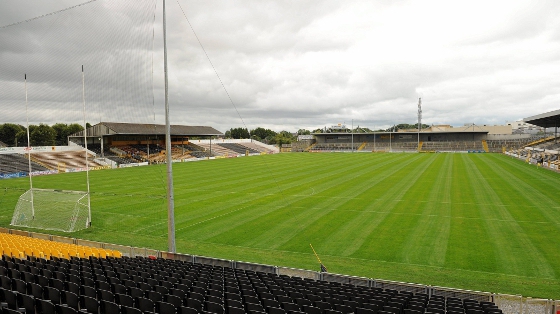
James Nowlan (pictured, left) was born in Kilkenny in 1862 into a republican household - his father, Patrick, was a trusted member of the IRB - and was baptised at Cowpasture in Monasterevin in County Kildare on the 25th May that year - 154 years ago on this date. He was 'trained' from early childhood into sporting and republican activities and,during his short life (he was only 62 years of age when he died) , he became the President of the GAA (from 1901 to 1921) and is the only person to have even been appointed 'Honorary Life President' of that organisation.
In 1898, at 36 years of age, he was elected as Alderman to Kilkenny Corporation and availed of the position to great effect in his endeavours to publicise the then fourteen-year's young 'Gaelic Athletic Association', but was less successful in persuading the Central Council of the GAA that it should begin preparations to commemorate the 100th anniversary of the 1798 Rising - indeed, the GAA leadership refused to even appoint representatives to the 1798 Centenary Committee, but James Nowlan and a few other GAA members insisted on playing their part in the celebrations. At the GAA Congress held in September 1901, he was elected President and attempted to steer the organisation towards a more Republican path ; for instance, when the 'Irish Volunteers' was formed, Nowlan stated that it was a most suitable group for GAA members to join, even though other GAA leaders were not as enthusiastic about the group.
He was arrested by the British in May 1916 following the Easter Rising, and imprisoned in Frongoch, in Wales ; in August that year he was released, and resumed his GAA and Sinn Féin activities. He was to the forefront in campaigning for a general amnesty for all political prisoners and also raised funds for the 'Irish National and Volunteer Dependent Fund'. During the 'Tan War' (1919-1921) he publicly voiced support for the IRA's armed struggle and was unmercilessly harassed by the British for doing so - the GAA itself as an institution and anyone associated with it were abused, verbally and physically, by the British establishment and its armed units in Ireland. James Nowlan retired as GAA President in March 1921, at the Congress that year, and was appointed 'Honorary Life President' of the association - the only person to be so honoured. He died on the 30th June, 1924, at only 62 years of age and, three years after his death, the Kilkenny GAA Stadium became known as 'Nowlan Park'. In our opinion, there is a lot more that today's GAA leadership could do to honour that man properly ; that leadership has to all intent and purpose aligned itself firmly with the establishment of the day and is wasting the potential it has to help achieve a British withdrawal from this country or even, indeed, to draw attention to that subject and the many issues that surround it. I would suggest that people of the calibre of James Nowlan would have little to do with them today except, perhaps, to try and avail of the organisation as a 'platform' from which to highlight issues of injustice.
'INKGATE' - PART TWO...
...Part One ('Aengus Ó Snodaigh, a Provisional Sinn Féin member of Leinster House...has been discovered to have been in receipt of over €55,000 worth of printer cartridges - 434 units in total at a cost of €130 per unit, an average of 3 cartridges a day ; more than enough, overall, to print more than 3 million letters - in the last two years : indeed, in one year, when his 'job' was not-unusually only 'open for business' for 96 days in a twelve month period, the bould Aengus took 219 printer cartridges (and) Aengus's leader in Leinster House, Crown Steward and Bailiff of the Manor of Northstead, Gerry Adams, is the second-highest user of ink cartridges in Leinster House...') can be read here.
It's not as if Gerry and Mary don't have enough on their desk (!) without Mary having to explain why, over a seven consecutive day period earlier this year, she contacted the stationary stores in Leinster House and ordered 100 black pens, 24 packets of A4 paper, 24 permanent markers, seven screen wipes, 20 packs of post-it notes, 10 boxes of paper clips, 40 notebooks, three staplers, five printer toners, 50 document wallets, 10 storage boxes, five dividers, four lever-arch files, three multi-punch pocket holders, 10 box files, two desk tidy stationary holders and six rolls of tape. Maybe herself, Gerry and Aengus are opening a market stall in Dubai and Jonathan was just going over there to suss things out...
And perhaps Joe Carey, Fine Gael Leinster House member (22 rolls of sellotape and two tape dispensers), Fianna Fail leader Micheál Martin (100 pens, 48 highlighters, 26 packets of Post-It notes, 34 packets of A4 paper, 20 packets of photocopy paper, four lots of Tipex, two storage boxes and six letter trays) and Stephen Donnelly, the leader of the Social Democrats (180 pens, 38 notebooks, nine packs of A4 paper and seven packets of paper clips) are in on the market stall, too!
'NICE TUNE, LADS AND LASSIES. ANY CHANCE YOU COULD PLAY FOR US...?'
Dublin, Easter Monday 2016 (28th March) : some members of an Irish republican flute band that was in the city to attend a republican commemoration decided to make a point and preformed a few bars of 'Take it down from the Mast' outside the Provisional Sinn Féin office in Parnell Square, to highlight the fact that those inside that office, and other Free State political party offices like it have, despite their verbal assurances to the contrary, abandoned Irish republicanism. Nothing complicated for republicans in regards to understanding the point that those band members were making, and why they were making that point. But, apparently, at least one member of that Parnell Square-based political party didn't understand the significance of the tune played...
..and actually attempted to contact the band to enquire if they would play at an upcoming Provisional Sinn Féin event!
Brass neck or a complete lack of knowledge about republicanism? And do ya think she'd be any better working on a market stall...?
Thanks for reading, Sharon.
1921 : THREE BRITISH ARMY TENDERS APPROACHED THE DUBLIN CUSTOMS HOUSE...
Dublin's tiger heard in Portlaoise...an 11-day 'gap' in a chain of custody...'transformers' in Long Kesh... "the right (to obtain the republican objective) is inalienable and non-judicable and must never be put in issue through referendum of a section of population nor of the people of the country at large..." - Sinn Féin, 1955....Ireland, 1921 - ''Three tenders carrying Auxiliary cadets, accompanied by an armoured car, approached the Dublin Customs House, which was occupied by a large body of Sinn Féiners...' ....this Alderman was arrested by the British in May 1916 following the Easter Rising, and imprisoned in Frongoch, in Wales...'Inkgate', Part Two, including rolls of sellotape, staples, pens, notepads etc...when 'take it down from the mast' is interpreted as support! Check back with us here on Wednesday, 25th May 2016..
Thanks for the visit, Sharon.
CABHAIR ANNUAL TESTIMONIAL DINNER AND REPUBLICAN REUNION 2016.
Going back to at least the early 1970's, the Republican Movement, and supportive and affiliated organisations, have come together each year to choose a handful of individuals who are deemed suitable emissaries to represent all that Irish republicanism stands for and that which it seeks to obtain. Having decided on the best honorees possible, a dinner, dance and reunion is held to properly convey the Movement's appreciation to those people. And that pleasurable task has been undertaken this year, too -
On Saturday May 21st 2016, six Irish republicans will be honoured at a function to be held for them in a Dublin hotel, at which a presentation will be made to each one of them. Those six notable stalwarts of Irish republicanism are : Seán and Sadie Collins (chosen by republicans in Leinster), Seoirse de Rís (George Rice, Munster), Frank Beattie (Connacht), Eddie McKeown (Ulster) and John Hunt (USA).
This blog extends warmest 'Congrats!' to those honorees ; well done to ye all - Ni seoinini sinn go leir!
A LOAD OF (ODD-SHAPED) BALLS, APPARENTLY...
This picture of Irish rugby player Ronan O'Gara 'snubbing' an English 'queen' went global in 2009 when the player in question was alleged to have deliberately refused to shake her* hand, and her* (*'Her'?!) followers and supporters here rallied to her defence- "...what Ronan O'Gara did to the Queen was loutish and a breach of international protocol...he went up to Belfast, freely and of his own accord, and very deliberately kept his hands in his pockets in her presence, in order to establish some political point which also means that he is a lout....Ronan O'Gara travelled North last week to insult - either intentionally or otherwise -- the Queen..." (from here.)
His 'own people' half-heartedly attempted to excuse his apparent 'snub', declaring that the picture in question 'did not tell the full story' - "The whole reception was both cordial and informal. In this environment, Ronan was obviously very relaxed.." (from here) while others supported his 'loutish behaviour' - "..a hero of Irish independence.." and "We're not British, we're not Saxon, we're not English, We're Irish! and proud we are to be..." (from here and here.)
And what has the man himself got to say? You'll be sorry you asked - "The situation in terms of the Queen was horrendous, I addressed this in the book but it hasn't really been put out there, people take out of it what they want...I was in the line to be introduced, my hands were a little bit sweaty, I put them into my pockets to clean them..." (from here). And, in an interview with Jarlath Regan, O'Gara stated - "I was in the line to be introduced. My hands were a little bit sweaty. I put them into my pockets to clean them. But the angle taken (ie the 'snub photo', above) - you couldn't have staged it. It was a complete non-event in the day. I was like any other player on the day, shaking her hand, being respectful...but that's all been lost and swept under the carpet, which astounded me..".
And then there's this - "The Ireland squad had been invited to an official congratulations ceremony with Her Majesty (whose "majesty"?)....it was optional for players to attend the reception but as a senior player I felt I should do so. This involved a flight from Cork and a train, so it was a big commitment. If I didn't like the Queen, or if I'd strong feelings about the monarchy, I wouldn’t have travelled to Belfast...I can still picture the moments before meeting her. I had sweaty palms. I like to think I present myself well, so I put them in my pockets to keep them dry...I was next in line to be introduced when an opportunistic photograph was taken a moment before I took my hands out of my pockets to greet her...the fallout was disturbing, and I’m glad to have an opportunity to explain what truly happened. It bothered me, and I wouldn't be bothered by much...you don't disrespect the Queen...I am not a republican...some people are so stupid for thinking it was a statement, that I was trying to insult the Queen... I wish I had taken my hands out of my pockets sooner.." (from here.)
...and here's what happened after he took his hands out of his pockets (from here) -
Not only did he 'shake hands with the Devil', but also chatted politely with her about her family - 'Indeed, O'Gara is reported to have chatted to the Queen about her grandson William, who he met on two previous Lions tours..' (from here) , an article which also mentioned how O'Gara was feeling '..just prior to shaking the hand and speaking with HRH..'. Also, O'Gara's rugby-playing pal, Brian O Driscoll, has spoke about how great it was "..to have the Sovereign of the north of Ireland to come over, the queen, and give us her time..." We (as in the Royal 'we'!) hope that both men make their pension from the game of rugby, as they are both obviously useless at pocket billiards...
PROSE AND CONS.
By prisoners from E1 Landing, Portlaoise Prison, 1999.
ACKNOWLEDGMENTS :
Grateful thanks to the following for their help, support, assistance and encouragement, and all those who helped with the typing and word processing over the past few months. Many thanks to Cian Sharkhin, the editor of the book, Mr Bill Donoghue, Governor, Portlaoise, Mr Seán Wynne, supervising teacher, the education unit in Portlaoise Prison and the education staff, especially Zack, Helena and Jane. Education officers Bill Carroll and Dave McDonald, Rita Kelly, writer, print unit, Arbour Hill.
First Print : November 1999, reprinted March 2000, illustrations by D O'Hare, Zack and Natasha. Photograph selection : Eamonn Kelly and Harry Melia.
THE WATERFALL.
A dozen drops
fall from your face.
Shaking the rain in a quiet place
shining clean,
a fresh new day
awakes up the world to
a fragrant bouquet.
Listen to the sound of a constant fall.
Skies give water for life to all
if you reach into the air
rain will come and kiss
your hair.
Dermot Griffin.
EXPLOSIVE QUESTIONS....
'Magill' magazine has unearthed new information which raises a grim but important question : were explosives from within this Republic used in the Dublin and Monaghan bombings? It is a question which, bizarrely, also encompasses the controversial Dónal de Róiste case. By Don Mullan, author of the book 'The Dublin and Monaghan Bombings'.From 'Magill' magazine, February 2003.
THE CLONAGH AFFAIR.
In an interview with 'Magill' magazine Garrett Fitzgerald said he personally had no knowledge of Captain Walshe's efforts to stem the flow of explosives to subversive elements. He was unaware that a fellow minister had been apprised of the situation in mid-April 1974 pertaining to the Clonagh factory and that the Taoiseach of the day, Liam Cosgrave, was personally aware of the situation at the factory by at least 9th September 1974.
He expressed surprise at learning that Colonel Cogan had felt the need to seek an urgent meeting with Cosgrave to discuss the deteriorating situation at the factory - "You would have thought," Garrett Fitzgerald said, "the government, having been informed, would have done something about it." While expressing the opinion that this was an interesting line of inquiry and should be pursued he did not, however, accept that the Irish government knew about the situation at Clonagh before the British Army.
He said - "They may or may not have reacted adequately to concerns about security but that doesn't mean that they knew or believed that explosives were actually leaking out. You wouldn't expect any government to allow that to happen if they thought that." (MORE LATER.)
GROWING UP IN LONG KESH...
SIN SCÉAL EILE.
By Jim McCann (Jean's son). For Alex Crowe, RIP - "No Probablum". Glandore Publishing, 1999.
Biographical Note : Jim McCann is a community worker from the Upper Springfield area in West Belfast. Although born in the Short Strand, he was reared in the Loney area of the Falls Road. He comes from a large family (average weight about 22 stone!). He works with Tús Nua (a support group for republican ex-prisoners in the Upper Springfield), part of the Upper Springfield Development Trust. He is also a committee member of the 'Frank Cahill Resource Centre', one of the founders of 'Bunscoil an tSléibhe Dhuibh', the local Irish language primary school and Naiscoil Bharr A'Chluanaí, one of the local Irish language nursery schools.
His first publication last year by Glandore was 'And the Gates Flew Open : the Burning of Long Kesh'. He hopes to retire on the profits of his books. Fat chance!
"THANK YOU, BOYS, THANK YOU..." (PART ONE.)
"Suppose I was to tell you that you were going to be placed under close arrest tonight, bound and gagged until after the screws do their head-count first thing in the morning...", he said, "..then tomorrow morning after hopefully the successful escape of Lasher Beirne, the screws were to find you trussed up in the toilets..?" Thereby guaranteeing no sleep for Damien that night.
And poor Damien sat up all night watching any movement in the hut - the slighest sneeze, snore or other bodily noise sent shivers running down his back. Next morning, bright and early, Damien woke Arder - "They didn't come for me. They must have changed their minds..." "What time is it?", asked Arder. "Ten minutes past six" , replied Damien. "Are you fucking simple or what?" screamed Arder, "You woke me up at this time of the morning for this?! It was a mix, for Christ sake. I was only joking..." Arder saw veins rising in Damien's neck he never knew existed. "Where's your sense of humour?" Arder shouted, "Take it easy , you're tired.." "Tired?" said Damien, "Of course I'm fucking tired..." shouted Damien, "..I'm up all night sweating blood, throwing up and terrified, waiting on getting tied up and you're telling me it's a joke, ye rotten bastard.."
Damien chased Arder down the hut and out into the cage, screaming all sorts of abuse at him, and Arder was able to stay out of his grasp until a number of the boys caught hold of Damien and managed to subdue him. "What in the name of Jesus is going on here?", asked the OC of the cage. When he was told the cause of the dawn chase through Cage 10, his face broke into a laugh. When he finally stopped laughing, he told Damien to cool down, then asked Arder to join him in the OC hut and to tell him the story again from the start, and not to leave anything out. Before long the story was all around the cage. Not surprisingly, the long-term POW's had very little sympathy for Damien's distress and lots of admiration for Arder's inspiration. Then Lasher Beirne got involved... (MORE LATER.)
1916 AND 'THE PAST'.
"..maybe we should all just forget the whole thing and treat Easter Week 2016 as so much drinking time, with perhaps a brief satirical parade outside the GPO on the Friday, which as it happens will be April Fool's Day.." (from here) and this - '1916 was a zero-sum game which we should forget..' (from here).
Who dares to say forget the past to men of Irish birth?
Who dares to say cease fighting, for our place upon this earth?
Let remembrance be our watchword, and our dead we'll never fail.
Let their graves be to us as milestones, on that blood-soaked one-way trail.
Remember how Eoghan Rua fought, Port Lester mill beside,
no man can say a coward fell when Hugh O'Donnell died.
Remember Ruth and Sarsfield and forget, whoever will,
that glorious stand at Limerick and at Kilmacadden Hill.
Think of the men of '98 who fought to hold at bay
the Butchers of an Empire and the wiles of Castlereagh :
how Emmett's gallant handful, in historic Dublin Town,
marched out to give the challenge to the forces of the crown.
And then for a time, 'twas silence. Was Ireland's struggle done?
"The answer's in the negative", thundered many a Fenian gun.
Then just as England thought she'd won and that we at last were meek,
crashed forth the glorious challenge of the men of Easter Week!
Think of how our solders fought the pick of many lands,
the scum of British prisons in Britannia's Black and Tans.
And then by men we trusted, this land of ours was sold,
They sold their friends to enemies, as Judas did of old.
And on their own, who still were true, they turned and shot them down,
seventy-seven in all were slaughtered by those hirelings of the Crown.
Think of County Kerry where they butchered our lads like swine,
think, O God, of Ballyseedy, where they tied them to a mine.
Remember fighting Wexford, where the blood was never cold,
on Boulavogue and Oulart Hill their fathers fought of old.
How Rory, Liam, Dick and Joe to glut the Imperial beast
were murdered, while in prison, on our Blessed Lady’s feast.
How his overworked revolver as he dashed from that hotel,
roared a rebel's last defiance as Cathal Brugha fell.
Think how the Staters fought for England, how they fought for British law,
and in Cosgrave's last coercion how they murdered Captain Vaugh.
Hear we not the voice of Connolly, the worker-soldier friend?
Our conquered soul asserts itself, and we shall rise again!
For Freedom, yes and not to starve, and not for rocks and clay,
but for the lives of the working class, we fight and die today.
And what, says Cathal Brugha, if the last man is on the ground,
If he is lying, weak and helpless, and his enemies ring him round?
If he's fired his final bullet, if he's fired his final shot,
And they say "Come into the Empire", he should answer, "I WILL NOT!"
Then back, back to that one-way trail-
"Ní Síocháin go Saoirse!" is the war cry of the Gael.
While our country stands beside us with the blood of martyrs set,
wayside crosses to remind us, "WHO DARES TO SAY FORGET?"
Remember, then, immortal Tone, to say "Forget!" is wrong,
work to break that vile connection that has lasted far too long.
That Emmett's tomb is uninscribed, until we our rights assert,
until Ireland takes her place among the nations of the earth.
Yes, indeed - 'forget the past', and pretend that hardly anyone, except those dismissed by the establishment here as 'a few hundred republican malcontents' or somesuch, noticed that political 'officialdom' in this corrupt State recently attempted to pay homage to the men and women of 1916 and highlighted the fact that those Free Staters are the direct inheritors of those who, within five years of that Easter Rising, fought against those same men and women, borrowing arms and munitions from the British to do so. That, no doubt, is something they would like everyone to 'forget'.
HAVING THE COURAGE OF YOUR OWN CONVICTIONS.
Put not your trust in Princes.
"There are many things about water charges that Fine Gael/Labour would prefer you didn’t know. At the top of the list is this : not one penny of the money they're demanding you pay will be used to run, or to upgrade, the water system. In fact, even if everyone paid their water bill, every penny of the money would be spent on the admin involved in issuing us with bills...water charges should be abolished...the meter rollout should be stopped..." (from here) - Stephen Donnelly, 'Social Democrats', who made his name campaigning against the notion of demanding that citizens should pay twice for their tap water. But then he got a taste of power -
"I paid, because my not paying was getting in the way of important discussion, about water and many other issues."
And then there's this Leinster House politician who, like Mr. Donnelly, above, enhanced his political 'man-of-the-people' reputation by voicing support for those opposed to the double-water tax : 'Independent TD Finian McGrath said the scale of the protest has sent out the clearest message yet to Government that water charges must be abolished...' (from here, more here) only to change his tune when a 'promotion' was offered.
It's understandable that some people would be disheartened by the carry-on of those two politicians, but not me - as I stated here three years ago "I am not relying on the courage of somebody else's 'conviction'..." and that remains the case today. And until enough people believe in themselves more so than in 'political princes', I will continue to be in the minority. But I will continue. Incidentally, on the 12th May last, this water company (of which I am not a customer of, as I never signed any contract or letter etc in connection with the 'service' it offers) sent me a 'bill' for €324.64 which it claims I owe them. As I have said before, I am lucky enough to have the money to pay that 'bill' if I wanted to but, as I have already paid for a water service through general taxation (and car tax, vat etc) I won't be paying it. Because, simply, I don't believe I owe them anything.
Thanks for reading, Sharon.
BALLS TO THIS GAME OF POCKET BILLIARDS...
Cabhair to celebrate the lives of these six Irish republicans...pocket billiards in the presence of their 'majesty'...those who 'honour' a struggle against injustice and in the same breath insist that you not fight for your place upon this earth...
Check back here on Wednesday, 18th May 2016.
Thanks! Sharon.
SIXTEEN DEAD MEN.
O but we talked at large before
The sixteen men were shot,
But who can talk of give and take,
What should be and what not
While those dead men are loitering there
To stir the boiling pot?
You say that we should still the land
Till Germany's overcome;
But who is there to argue that
Now Pearse is deaf and dumb?
And is their logic to outweigh
MacDonagh’s bony thumb?
How could you dream they'd listen
That have an ear alone
For those new comrades they have found,
Lord Edward and Wolfe Tone,
Or meddle with our give and take
That converse bone to bone?
(W. B. Yeats, from here.)
Black flag vigils in memory of the sixteen leadership figures executed in 1916 by the British have been organised by Republican Sinn Féin -
Tuesday May 3rd, 4pm. Assemble at the GPO, O'Connell Street, Dublin : Pádraig Mac Piarais, Tomás Ó Cléirigh, Tomás MacDonnchadha.
Wednesday May 4th, 4pm. Assemble at the GPO, O'Connell Street, Dublin : Éamonn Ó Dálaigh, Liam Mac Piarais, Mícheál Ó hAnnracháin, Seosamh Ó Pluingcéad.
Thursday, May 5th, 4pm. Assemble at the GPO, O'Connell Street, Dublin : Seán Mac Giolla Bhríde.
Sunday, May 8th, 4pm. Assemble at the GPO, O'Connell Street, Dublin : Éamonn Ceannt, Conchúir Ó Colbáird, Seán Mac Aodha, Mícheál Ó Mealláin.
Monday, May 9th, 4pm. Assemble at the GPO, O'Connell Street, Dublin : Tomás Ceannt.
Thursday May 12th, 4pm. Assemble at the GPO, O'Connell Street, Dublin : Seán MacDiarmada, Séamus Ó Conghaile.
Roger Casement was hanged at Pentonville Prison, England, on August 3rd 1916. A black flag vigil will be held on Wednesday 3rd August 2016, at the GPO, Dublin, from 4pm to 5.30pm.
All genuine republicans welcome!
PROSE AND CONS.
By prisoners from E1 Landing, Portlaoise Prison, 1999.
ACKNOWLEDGMENTS :
Grateful thanks to the following for their help, support, assistance and encouragement, and all those who helped with the typing and word processing over the past few months. Many thanks to Cian Sharkhin, the editor of the book, Mr Bill Donoghue, Governor, Portlaoise, Mr Seán Wynne, supervising teacher, the education unit in Portlaoise Prison and the education staff, especially Zack, Helena and Jane. Education officers Bill Carroll and Dave McDonald, Rita Kelly, writer, print unit, Arbour Hill.
First Print : November 1999, reprinted March 2000, illustrations by D O'Hare, Zack and Natasha. Photograph selection : Eamonn Kelly and Harry Melia.
EMPATHY.
In the silence of myself
the door slides slowly open
to the heart of all things
there I reach to the suffering of others
to care and share in my own woundness
there we give our trust
and gently flow together
into the warm streams
of empathy.
Silently we gather up the broken pieces
through the eyes of inner conflict
we give rise to meaning, to hope
we give expression with only words
though innocently chosen
steeped in love
we feel the hurt, the pain, with joy
though inside a tear does cry
for tears are words to those
in pain
and creation has made us
all the same.
Dermot Griffin.
EXPLOSIVE QUESTIONS....
'Magill' magazine has unearthed new information which raises a grim but important question : were explosives from within this Republic used in the Dublin and Monaghan bombings? It is a question which, bizarrely, also encompasses the controversial Dónal de Róiste case. By Don Mullan, author of the book 'The Dublin and Monaghan Bombings'.From 'Magill' magazine, February 2003.
THE CLONAGH AFFAIR.
Patrick Walshe's contemporaneous commentary to his military superiors concerning the Clonagh affair is revelatory - he expressed concern that three months had elapsed and his recommendations had not been implemented. He expressed deep dis-quiet that a facility existed from which explosive materials could be taken with minimal risk of detection and he also stated - "It is apparent that a double standard of custody and control of dangerous substances exists...over one year ago, quantities of sodium chlorate as small as two kilograms were withdrawn from hardware and chemist shops throughout the country (sic) . This substance was stored in military custody under high security conditions...the implementation of that procedure rings hollow when compared with the present situation evident at Clonagh."
Captain Patrick Walshe expressed concern that no consideration appeared to have been given to the serious responsibility of ensuring "...that these dangerous substances are prevented from getting into the hands of subversives.." and he recommended urgent action "without further delay" and expressed the opinion that the immediate closure of the plant and impounding of all materials in safe custody might be necessary until such time as management of the factory met some basic security commitments but became increasingly alarmed at the lack of response to his reporting.
Yet another report, dated 4th September 1974, concluded that '..until such time as ALL deficiencies are corrected..there can be no reasonable assurance that the source of bomb-making material in unauthorised hands has not come from the 'Irish Industrial Explosives Plant' at Clonagh.' In late October 1974 a Garda investigation into the theft of explosives at Clonagh was conducted and two Irish Army (sic) privates were convicted of stealing small quantities of substances from the factory.
Ex-Commandant Walshe told 'Magill' magazine that he fully co-operated with the investigation and furnished it with a full set of the reports but he is, however, critical of the Garda operation against the members of the (State) Army and believes it was an attempt to discredit the (State) Army when, in reality, people in more senior positions in the political administration should have been held accountable for the scandalous lack of security. Garrett Fitzgerald's recent revelation that the Clonagh factory was, indeed, a major source for the IRA's bombing campaign in the North has vindicated the young officer's concerns. (MORE LATER.)
GROWING UP IN LONG KESH...
SIN SCÉAL EILE.
By Jim McCann (Jean's son). For Alex Crowe, RIP - "No Probablum". Glandore Publishing, 1999.
Biographical Note : Jim McCann is a community worker from the Upper Springfield area in West Belfast. Although born in the Short Strand, he was reared in the Loney area of the Falls Road. He comes from a large family (average weight about 22 stone!). He works with Tús Nua (a support group for republican ex-prisoners in the Upper Springfield), part of the Upper Springfield Development Trust. He is also a committee member of the 'Frank Cahill Resource Centre', one of the founders of 'Bunscoil an tSléibhe Dhuibh', the local Irish language primary school and Naiscoil Bharr A'Chluanaí, one of the local Irish language nursery schools.
His first publication last year by Glandore was 'And the Gates Flew Open : the Burning of Long Kesh'. He hopes to retire on the profits of his books. Fat chance!
"THANK YOU, BOYS, THANK YOU..." (PART ONE.)
For the next twenty-four hours Damien tormented Arder about his impending release and Arder took to hiding under beds and in lockers to stay clear of the incessant banter. When it happened it was beautiful, even though it wasn't planned in any shape or form - it was just the product of the sleeping giant that was Arder's brain (it should be noted here that 'Arder' is just a pseudonym for the author) . Anyway - Arder's brain has been a secret too long : he was sitting playing cards when Damien came into the hut. Arder got in first - "Fair play to you," he said to Damien. "What are you on about?" asked Damien. Arder winked at him knowingly. "I understand, Damien, said Arder, "you can't say too much about it, but obviously I hope it comes off." "I haven't a clue what you're talking about," said Damien. "Say no more," answered Arder, "You kept that a secret, ye fly frigger..." Damien went out off the hut scratching his head but returned ten minutes later - "Listen, Arder, what did you hear?", he pleaded. "Stop messing about," said Arder, "I heard all about it from the I.O. [Intelligence Officer] of the cage." "Does it involve me?" asked Damien. "Maybe not, right enough," Arder retorted, "it's just about the escape tomorrow. I just heard that Lasher Beirne was taking the place of someone getting released tomorrow and I thought that it was you as you're the only one out tomorrow." "I am?" shrieked Damien. "Jesus! Sorry comrade, I thought you knew..." replied Arder.
Damien went white in colour - "This is insane," he said, "Lasher looks fuck all like me.." "But they have a wig and make-up," said Arder. Damien went out again looking for the I.O. and returned shortly afterwards - "That's a load of rubbish. I was talking to the I.O. and he told me someone was messing about." "Is that right?" said Arder, with a sly grin...
(MORE LATER.)
ON THIS DATE (4TH MAY) 16 YEARS AGO : "NAIL IT TO MY BACK" MAN DIES.
When he was only 16 years of age, Kieran Nugent was arrested by the British Army and spent five months on remand in Crumlin Road Prison. When he was eventually tried, the case against him was withdrawn and he was released. He became an active volunteer until his arrest and imprisonment, without trial, on 9th February 1975 and spent nine months in Cage 4 of Long Kesh prison camp until the 12th November 1975. He was imprisoned again after another arrest on 12 May 1976, and sentenced to three years imprisonment on the 14th September 1976 for hijacking a vehicle.
With the removal of Special Category Status, the (British) Labour Government began the process of 'criminalisation' in 1976. All prisoners convicted of 'offences' committed after March 1st, 1976, were denied political status and classified as 'criminals'! The prisoners were now expected to do prison work ; in Long Kesh, 'criminalisation' also meant that male prisoners had to wear prison uniform. In September 1976, Kieran Nugent refused to wear a prison uniform and began the 'Blanket Protest', and the women in Armagh refused to do prison work. The protesting prisoners in Armagh and Long Kesh had begun a struggle for the recognition of their political status which was to end in the deaths of the hunger strikers five years later (ie 1981). In May 1979, Billy McKee, a former IRA Chief of Staff and Belfast Brigade Commander, spoke at a welcome home rally for Kieran.
Some of those that once not only (apparently) championed the Cause he fought for but gave the impression they actually supported that Cause were partially exposed here and the British government itself, too, were later shown to have attempted to manipulate Kieran and his comrades for their own purposes -
'The proposal is to allow an ITN team (including cameras) to visit Maze tomorrow, to see both clean and dirty cells; and to interview Nugent (who) may refuse but if he does so we expect this to be to our advantage. It would be just as effective in propaganda terms from our point of view. Discussions are now taking place with the Governor...tomorrow morning, Thursday, Nugent will be bathed, and his hair trimmed, with a hospital officer in attendance. Minimum necessary force will be used to bath him, but if he shows a disposition to resist violently and there seems to be a risk of injury, the bathing will not be proceeded with...on the morning of Friday 11 May (1979) Nugent will have an early breakfast...he will then be given his own clothes...release is expected to take place at about 8.30 am...' (From here.)
On the 4th May 2000 - 16 years ago on this date - Kieran Nugent died from a heart attack and Irish republicanism lost another stalwart of our on-going fight for freedom.
ON THIS DATE (4TH MAY) 100 YEARS AGO : FOUR 1916 LEADERS EXECUTED BY THE BRITISH.
On Thursday, 4th May 1916 - 100 years ago on this date - in reprisal for the then recent attempted uprising against British rule in Ireland, the London administration removed four Irish republican prisoners from their cells and executed them :
JOSEPH PLUNKETT - born into a privileged background (his father was a papal count) he was one of the seven signatories of the 1916 Proclamation and one of the founders of the 'Irish Volunteer' organisation. He was executed in Kilmainham Gaol on the 4th May 1916. He was Director of Military Operations for the Rising, with overall responsibility for military strategy. Hours before his execution by the British, he married his sweetheart Grace Gifford in Kilmainham Gaol. Grace was born on the 4th March 1888, in Dublin, and attended art school there and in London and, in 1915, at the age of 27, she 'stepped out' with the then editor of 'The Irish Review' magazine, Joseph Plunkett. He was imprisoned in Kilmainham Jail in Dublin for his part in the 1916 Easter Rising and was condemned to death by firing squad : he asked Grace to marry him and, on the 3rd of May 1916, at 6pm, in Kilmainham Jail, Grace Gifford and Joseph Plunkett were married, with two prison officers as witnesses and fifteen British soldiers 'keeping guard' in the same cell. The couple were allowed ten minutes together, before Grace was removed from her husband. He was executed by the British hours later, on the 4th May, 1916. Grace Gifford Plunkett was at that time on the Executive of the then Sinn Féin organisation, and spoke out against the Treaty of Surrender.
EDWARD DALY - was born in Limerick in 1891 into a strongly nationalist family. His father (also named Edward) , a staunch Irish republican, died at only 41 years of age, five months before Edward (junior) was born, but his father's brother, John - who was imprisoned for twelve years for his republican activities during the 1867 rebellion against British rule - helped to raise the young child. Edward (junior) was Tom Clarke's brother in law and lived with him in Fairview, Dublin. He was a member of the IRB and the Irish Volunteers in which he held the rank of Commandant of the 1st Battalion. During Easter week he led his battalion in the Four Courts area which witnessed some of the most intense fighting of the week. After his arrest he was sentenced to death by the court-martial and executed at Kilmainham Gaol on 4 May 1916. As a youth, Edward (junior) was considered somewhat lazy and easily distracted, more concerned with his appearance and a 'party lifestyle' than he was with the day-to-day poverty and related injustices that surrounded him, but he developed a social conscience to the extent that, at only 25 years of age, he was asked to take command of the First Battalion of the Irish Volunteers, leading raids on the Bridewell and Linenhall British barracks and seizing control of the Four Courts, before which he addressed the men under his command - "Men of the First Battalion, I want you to listen to me for a few minutes, and no applause must follow my statement. Today at noon, an Irish Republic will be declared, and the Flag of the Republic hoisted. I look to every man to do his duty, with courage and discipline. The Irish Volunteers are now the Irish Republican Army. Communication with our other posts in the city may be precarious, and in less than an hour we may be in action.." . On the 4th of May, 1916, 25-years-young Commandant Edward Daly was executed by firing squad by the British in Kilmainham Jail in Dublin and was buried in near-by Arbour Hill Cemetery. He was the youngest commander of the rebels and the youngest 1916 leader to be executed by the British.
MICHAEL O'HANRAHAN - was born in New Ross, County Wexford, in 1877 and educated in Carlow. He was active in the Gaelic League from 1898, and that organisation would lead him to Dublin where he worked as a proof reader and journalist, and was the author of two novels, 'A Swordsman of the Brigade' and 'When the Norman Came'. He joined Sinn Féin shortly after its establishment by Arthur Griffith, and in 1913 joined the Irish Volunteers. He was Vice-Commandant of the 2nd Battalion of the Irish Volunteers under Thomas MacDonagh. During Easter week he was stationed at Jacob's Factory, was arrested by the British after the Rising and sentenced to death by court-martial. He was executed at Kilmainham Gaol on the 4th May 1916.
WILLIAM PEARSE - The younger brother of Patrick, William was born in Dublin in 1881 and trained as a sculptor under his father. He studied art in London and Paris, and his career was progressing well until he decided to go and work with his brother Patrick at St Enda's. He joined the Irish Volunteers in 1913, and during Easter Week he was alongside his brother in the General Post Office. He was sentenced to death by court-martial in the wake of the Rising, and was executed at Kilmainham Gaol on the 4th May 1916. Pearse railway station on Westland Row in Dublin was re-named in honour of the two brothers in 1966, and a black flag vigil was held today, Wednesday 4th May 2016, in memory of these four men - see 'SIXTEEN DEAD MEN', above.
ON THIS DAY NEXT WEEK (WEDNESDAY 11TH MAY 2016).....
...we won't be posting our usual contribution, and probably won't be in a position to post anything at all until the following Wednesday ; this coming weekend (Saturday/Sunday 7th/8th May 2016) is spoke for already with a 650-ticket raffle to be run for the Dublin Executive of Republican Sinn Féin in a venue on the Dublin/Kildare border (work on which begins on the Tuesday before the actual raffle) and the 'autopsy' into same which will take place on Monday evening, 9th, in Dublin, meaning that we will not have the time to post here. But we'll be back, as stated above, on the following Wednesday, 18th May 2016, so please check back with us then.
Thanks for reading, Sharon.
BRITISH GOVERNMENT MEMO RE IRA PRISONERS...
..marked 'Confidential' and released, internally, in the late 1970's, this memo confirms that a television camera crew can have permission to film inside Long Kesh prison to record the 'Dirty Protest' and to interview a named IRA prisoner, the result of which will be used by Westminster as "effective propaganda" against the struggle, but first that IRA prisoner will be cleaned up, by force, if need be...
Check back with us here on Wednesday, 4th May 2016.
Thanks for the visit, Sharon.