WE NEED A 'HARD BORDER' IN ORDER TO MAKE A 'HARD'* CHOICE.
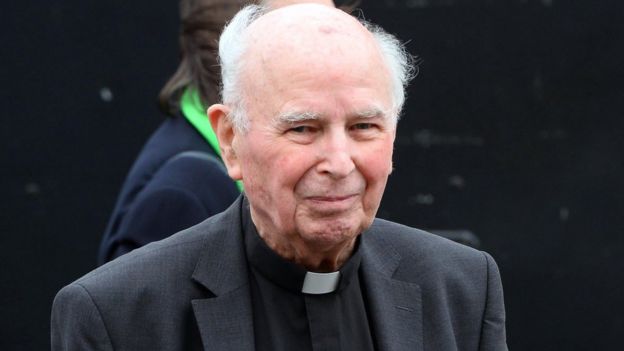
Free State 'Minister for Foreign Affairs', Charlie Flanagan (pictured, left) recently stated the following re the English 'Brexit' decision in a speech in which he called for 'no hard border' - "...the border isn't something that's going to be decided by the UK government..it's going to ultimately be decided by the 27 remaining EU states..."
The enforced and unwanted border in this country is an Irish matter and should not be placed under a 'foreign affairs' remit - by all means open the issue up to include suggestions from those outside Ireland but the border in question is first and foremost an issue which affects all Irish people, whether they live here or abroad and should, in the first instance, be dealt with by the Irish. If that border is visible (ie not 'out of sight, out of mind') then there will be more of an urgency to remove it, rather than to 'hide' it (ie a so-called 'soft' border).
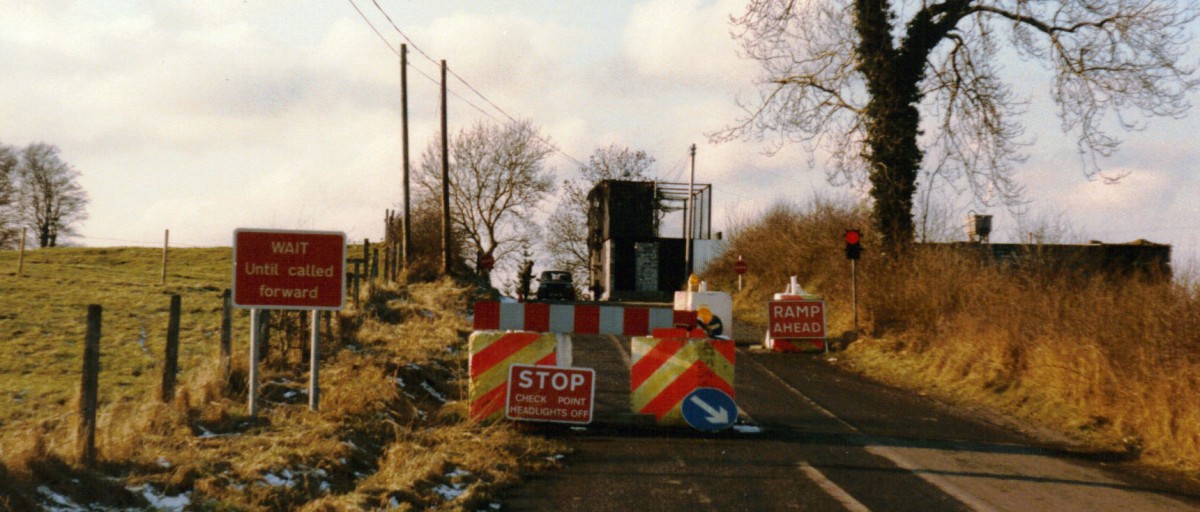
As we stated before re this issue -"..for what it's worth, this blog is firmly in the 'Brits Out' (ie vote 'Leave!') camp, for our own selfish (!) reason : we want the return of British Army checkpoints on their imposed 'border' in Ireland. We want to see a visible presence by the British military and customs and revenue 'suits' as they operate vehicle checks, passport checks and stoppages, and queries from armed British personnel directed at those travelling from one part of our nine-county Ulster into another part of same and at those travelling from the 26-county state into any of the six occupied counties, frustrated queues forming at every access/exit point etc - in short, we want visible reminders (for those that need same) that our country is still militarily and politically occupied and divided by Westminster..."
Frans Timmermans, vice president of the 'European Commission', recently stated re 'Brexit' - "The argument that won the Brexit campaign is the one that said take back control...which is another way of saying we want to control our destinies again. This is an existential issue for the whole of Europe not just for the UK because this sentiment is not limited to the United Kingdom..." We, too, want to 'control our own destiny' again but cannot do so as long as Westminster maintains a political and military presence in this country. In the context of 'Brexit' (or, actually, in any context of occupation) a 'hard border' is necessary to remind all concerned that the issue is not yet fixed, and we believe that that should be the position of any Irish republican or, indeed, of any concerned citizen who's country is militarily and/or politically occupied - a 'soft' border, under those circumstances, is a cop-out. Such a political obstruction needs to be on view and 'in-your-face' until it is removed, and should not be hidden (ie 'soft') because some deem it 'politically correct' to do so. (*...as some would call it.)
PROSE AND CONS.
By prisoners from E1 Landing, Portlaoise Prison, 1999.
ACKNOWLEDGMENTS :
Grateful thanks to the following for their help, support, assistance and encouragement, and all those who helped with the typing and word processing over the past few months. Many thanks to Cian Sharkhin, the editor of the book, Mr Bill Donoghue, Governor, Portlaoise, Mr Seán Wynne, supervising teacher, the education unit in Portlaoise Prison and the education staff, especially Zack, Helena and Jane. Education officers Bill Carroll and Dave McDonald, Rita Kelly, writer, print unit, Arbour Hill.
First Print : November 1999, reprinted March 2000, illustrations by D O'Hare, Zack and Natasha. Photograph selection : Eamonn Kelly and Harry Melia.
LONG JOURNEY HOME. (By David Lynch.)
Reaching out to touch the clouds
like a high rise building clawing toward the sky,
the bliss of ignorance
never knowing, or wondering why.
The beam of light piercing its barriers
releasing the beauty entombed by darkness.
Pleasure, pain, loss and gain
cast into oblivion,
the colourful vapour of its trail
like a boomerang in the rain.
Soaring now with perverse delight
not wondering of wrong or right,
filled with mystery and paradox
the freedom it feels.
Floating like driftwood upon the ocean
a migrating bird lands to rest upon it,
absorbing, yet remaining empty...
on its long journey home.
(Next - 'Nature Of The Cat', by David Lynch.)
IF IT AIN'T WHITE...
The Far Right has been resurgent across continental Europe for several years. But only in the last 12 months has Ireland seen an emergence of openly neo-Nazi cells. By Alan Walsh. From 'Magill' magazine, May 2002.
At first glance, Ireland would seem to be at the very other end of the political spectrum ; historically obsessed with its own national struggle against imperialism to the point where it did not develop a distinct left/right divide, even in the 1960's when the world bifurcated into the two political options.
Yet it is in this very political and economic isolationism that Ireland exhibited its most obvious tendencies towards doctrines of racial purity and national socialism. Analyses of Ireland's political standpoint in 'world war two' often assume that our reluctance to renounce neutrality was based on an aversion to siding with former (sic) colonial oppressors.
In fact, it could be argued that Hitler's vision of a racially pure, culturally cohesive agrarian nation may have been more attractive in theory to many within the Irish government (sic) than Britain's aristocratic imperialism. In such a nebulous ideological haze, it is perhaps unsurprising that we had already managed to foster our own strain of national socialism. Far from being immune in this country to extremist politics, the Blueshirt movement, arising from the 10,000-strong 'Army Comrades Association', was steered along regular fascist lines under Eoin O'Duffy. Back then, the main popular momentum was gained in response to fears of communism. (MORE LATER).
GROWING UP IN LONG KESH...
SIN SCÉAL EILE.
By Jim McCann (Jean's son). For Alex Crowe, RIP - "No Probablum". Glandore Publishing, 1999.
Biographical Note : Jim McCann is a community worker from the Upper Springfield area in West Belfast. Although born in the Short Strand, he was reared in the Loney area of the Falls Road. He comes from a large family (average weight about 22 stone!). He works with Tús Nua (a support group for republican ex-prisoners in the Upper Springfield), part of the Upper Springfield Development Trust. He is also a committee member of the 'Frank Cahill Resource Centre', one of the founders of 'Bunscoil an tSléibhe Dhuibh', the local Irish language primary school and Naiscoil Bharr A'Chluanaí, one of the local Irish language nursery schools.
His first publication last year by Glandore was 'And the Gates Flew Open : the Burning of Long Kesh'. He hopes to retire on the profits of his books. Fat chance!
CATCHING SEAGULLS. (In memory of Eddie Brophy, RIP.)
Cage 22 had an advantage over most of the other cages I was in during my stay Faoi Ghlas Ag Gall. The front right-hand corner of the cage was an easy place to catch seagulls (the aquatic variety) - not to be confused with the human variety ie a seagull is by nature a scavenger so anyone who ate more than their fair share in Long Kesh was called 'seagull'.
Bits of bread would be thrown into this corner and when the seagulls came we would run down and capture them. This was made easy by the way the German razor barbed-wire hung over the corner making it impossible for the seagulls to rise up in the air without a good run, by which time we would have caught two or three of them.
There were a number of ways to use seagulls to lighten the day : you could wait until you had about ten of them then when someone went into the toilet, throw the seagulls over the top of the toilet cubicle, or put them into someone's locker - this was considered cruel and so was only done about twice a day... (MORE LATER).
ON THIS DATE (5TH OCTOBER) 33 YEARS AGO : BRITISH DIPLOCK 'JUSTICE' FURTHER EXPOSED.
On this date - 5th October - in 1983, British 'Lord Chief Justice' Robert Lynd Erskine Lowry, during a 'trial' based on the 'word' of an IRA informer, had no choice but to dismiss part of the tout's so-called 'evidence', stating that he found same "..so unsatisfactory and inconsistent that I could not contemplate allowing myself, as a tribunal of fact, to say that guilt has been proved beyond a reasonable doubt..."
The background to the above is as follows : even by North of Ireland standards, where dramatic political developments have a tendency to follow one another with unnerving rapidity, October 1983 and the weeks that followed was an unusually active period in the psychological warfare between the British government and the republican struggle that continues to focus around the use of paid perjurers. It was a month which, at least in terms of propaganda, republicans won on points - but it also heavily underlined the British government's commitment to the perjurer strategy in the face of mounting opposition. The retractions by Robert Lean (Belfast) and Patrick McGurk [mentioned here] (Dungannon) of their incriminating statements against a total of 37 people accused of republican activities, by Lean on October 19th and by McGurk on October 24th, was a crushing embarrassment to the RUC. Robert Lean, in particular, had been portrayed in 'leaks' to a sensationalist media to be the IRA's No.2 in Belfast, and in a classic exercise in 'trial by media' the RUC claimed that his evidence had secured the imprisonment of the IRA's Chief of Staff and its Belfast Brigade Officer Commanding ; both of the individuals against whom these claims had been made were among those released two days after Lean's retraction.
Patrick McGurk's retraction a few days later was equally damaging to the image cultivated by the RUC around its use of perjurers. He had implicated nine Dungannon men as far back as February 1982, five of whom had been held on remand for twenty months - the longest remand period involved in any of the perjurer cases. On September 20th 1982 , the RUC, apparently doubtful that Patrick McGurk would go through with his 'evidence' if produced in court, instead invoked the obsolete 'Bill of Indictment' to by-pass the preliminary enquiry stage of the case against the nine accused. This meant that, until his return to Dungannon on Wednesday 26th October, Patrick McGurk had been held incommunicado, without access to family or friends, throughout the 20-month period. If, as seems to be the case, Patrick McGurk was unwilling to testify but was prevented by the RUC from retracting and prevented from contacting his family, it makes a nonsense of RUC assertions that - once having been given immunity from prosecution - their perjurers (or 'converted terrorists' in RUC jargon!) are 'free agents' voluntarily in protective custody. Not surprisingly, some of the defendants in the McGurk case are said to be considering suing the RUC for wrongful imprisonment.
The Robert Lean episode, too, has gone a long way to publicly undermining propaganda about 'converted terrorists' and 'free agents' : not only did Robert Lean feel so unfree that he felt it necessary to escape from 'protective custody' in Palace Barracks, Hollywood, County Down, by climbing out of a window and stealing the car of his RUC 'minder' but, on leaving a press conference in West Belfast the following afternoon, he was immediately arrested under Section 12 and held in Castlereagh for a further seven days! Apparently, the RUC seriously intended to charge him with a killing on 'new evidence' obtained from the perjurer, William Skelly (named here), who had originally implicated Robert Lean, in a revenge act for his retraction, but the RUC finally changed their minds. It is highly improbable that the (British) Crown Prosecutor could have persuaded even a Diplock Court that the informer William Skelly had forgotten this 'evidence' until after Robert Lean retracted, and then miraculously remembered it!
The inference that the RUC had been aware of 'evidence' linking Lean to a killing at the outset, but had suppressed it in order to do a 'deal' with him, and so imprison prominent republicans, would have been unavoidable . Most damaging of all from the RUC's viewpoint was Robert Lean's assertion that his 'deal' for immunity was to sign statements already prepared by the RUC incriminating specific individuals wanted 'out of the way' by them. Top of the list was Gerry Adams, but it seems the RUC were unable to charge him because Robert Lean refused to co-operate with a face-to-face confrontation.
On their release, two of those actually imprisoned on Lean's statements - Edward Carmichael and Ivor Bell (both men referenced here) - confirmed that they had also been offered immunity if they would incriminate Sinn Féin elected representatives, Adams, Danny Morrison and Martin Mcguinness. Additionally, Edward Carmichael had been offered £300,000 and Ivor Bell was told to "..name my own figure.." The RUC were not having a one-hundred per cent success rate with their informer/perjurer strategy, but they were not prepared to give up on it.
But if the RUC's optimism for the potential of their perjurer strategy has been tempered by a series of retractions in recent months - Walter McCrory (Derry), Charles Dillon (County Derry), Robert Lean and Patrick McGurk - and if they have been forced to the realisation that it will continue to be an imperfect strategy, with perjurers as much subject to the persuasion of the nationalist community's abhorrence of their actions as they are to RUC threats and inducements, nevertheless the third major event in this momentous month ensured the continued successful use of paid perjurers as a means of securing convictions. It was an event that marked a further and fundamental diminishing in the standard of evidence required in Diplock Courts for conviction : (British) Lord Chief Justice Lowry's sentencing of seven men on IRA charges, in Belfast Crown Court, on Wednesday 26th October, on the uncorroborated evidence of Kevin McGrady, was incredible even by Diplock 'standards'. Three weeks earlier, on October 5th 1983 - 33 years ago on this date - he had released two of the ten defendants and thrown out 13 of the original 45 charges (including charges of murder), saying that in respect of those he found Kevin McGrady's evidence "...so unsatisfactory and inconsistent that I could not contemplate allowing myself, as a tribunal of fact, to say that guilt has been proved beyond a reasonable doubt.."yet, in his final summation on the 25th of that month - despite acknowledging that McGrady's evidence had contained "..some glaring absurdities.." and was "..contradictory, bizarre and in some respects incredible.." - and, despite finding the remaining eight defendants innocent of a further 19 charges, Lowry nonetheless returned verdicts of guilty against seven of them on the remaining 13 charges!
In one case, the former Sinn Féin National Organiser, Jim Gibney (then 28 years of age), was sentenced to terms of 12 years and 5 years on two charges, even though he was cleared of no less than 20 other charges on Kevin MGrady's "bizarre" 'evidence'!
British 'Lord Chief Justice' Lowry rubbed salt into the wounds of incredulity by using his summation for the purposes of a policy statement on the use of perjurers, in which he formally signalled the willingness of the northern judiciary to accept uncorroborated evidence of an 'accomplice witness' as the sole basis for a conviction : arguing that the judiciary was, and remained, independent of the (Westminster) 'Northern Ireland' Office and was not in any form of collusion, Lowry stated - "The resort to supergrasses has been described by some people as a method of convicting suspected terrorists. But the expression 'method of conviction' is a complete misnomer, since it is likely to give the impression that the Executive and Judges are together implementing a trial process with the joint object of convicting and imprisoning suspects. It is for the Executive to prosecute a case if, on the available evidence, that seems to be the right course. But the function of the Judges, acting quite independently, has not altered ; it is simply to decide whether or not in any individual case the allegations of the prosecutor have been proved." Two days before Lowry made that statement, the British Attorney-General, Sir Michael Havers (forever tainted, and rightly so, by his involvement in the 'Guildford Four' case), had spoken about the "financial arrangements.." made with those informers. Havers, in a statement obviously timed to coincide with British Chief Justice Lowry's comments in the wake of the Robert Lean/Patrick McGurk affair, also defended the 'independence' of the judiciary - but added, in response to loyalist criticisms of the system, that in future all "financial arrangements (made with) accomplice witnesses" would be disclosed to defence counsels.
The utter worthlessness of this 'concession' lies of course in the fact that the RUC deny, and will continue to deny, that cash bribes - such as Edward Carmichael's offer from the British of £300,000 - are made to perjurers in the first place. Havers' 'sincerity' should be judged in the light of his flagrant dishonesty in saying that the practice surrounding the use of "accomplice witnesses" was identical in England, Scotland and Wales with its use in the North of Ireland!
The Lowry verdict in the McGrady trial was a crucial one for the future of the perjurer strategy ; although the principle of accepting uncorroborated perjurer evidence had earlier been accepted by the judiciary in the UVF Joe Bennett (referenced here) trial which ended on April 11th 1983 with convictions for 14 of the 16 accused, and in the Christopher Black trial in which Judge Basil Kelly convicted 35 of the 38 defendants on August 5th, both judges in these cases had gone to considerable lengths to emphasise the 'credibility' of informers Bennett and Black and the general consistency "in all important respects" of their testimony. While this was incredible enough, the fact that Lowry convicted on McGrady's 'evidence', which was substantially bizarre, contradictory and unsatisfactory, is an indication that the judiciary in the North of Ireland has fallen completely into line, contrary to Lowry's denial, with the political objective of securing convictions, and has cynically redefined even the previously low standards regarding acceptable evidence.
British judges in the North of Ireland were defending the use of informers to obtain convictions at the same time as that perjurer system had started to come under attack from a variety of directions, while among the nationalist community itself - buoyed by the retractions and less open than it initially was to demoralisation over the issue (since it has seen the IRA's continued ability to inflict losses on the British) - there have been the unmistakable signs of a 'fight back'.
The first clear example of this was the mass rally at Beechmount Avenue in West Belfast on September 11th, 1983, which announced the holding of an open conference in Dungannon on October 2nd 1983 to establish a broad-based committee on the non-exclusive lines of the National H-Block/Armagh Committee established during the hunger-strikes of 1981. Up until that point public protest action on the perjurer issue had mainly been confined to small and isolated groups, such as 'Relatives For Justice' and 'Campaign Against The Show Trials' (CAST), which although active had drawn support primarily from relatives of the victims - in much the same way as the 'Relatives Action Committee' had campaigned between 1976-79 on the H-Blocks. The Dungannon conference announced the setting up of a new 'umbrella' organisation, the 'Stop the Show Trials Campaign', calling for an end to the use of perjurers, an end to show trials and the release of all the sentenced and remanded victims of perjurers. It voted to mount a campaign of political opposition to the perjurer system, at the same time embracing those sections of the community whose opposition to the use of perjurers is based on humanitarian or civil liberties motives and who endorse the campaign's central demands.
It is inevitable that the campaign structure, and mobilisations, will focus heavily on the North, though it is envisaged that support groups will be established in the 26 Counties and abroad. However, not all Irish nationalists were opposed to the perjurer system - to date, the response on the perjurer issue from sections of the catholic establishment has been a muted one, explicable by their obvious ambivalence to a strategy which although seriously eroding the already blackened 'judicial process' is clearly seen to be aimed at undermining the political advance of republicanism - a shared objective, after all, with the catholic hierarchy and the SDLP.
In response to such a taunt by West Belfast MP Gerry Adams on September 11th 1983, SDLP spokesperson Seamus Mallon retorted that the use of perjurers was 'law bending' but the thrust of his attack was aimed not at the British but at Sinn Féin and republican resistance.
On September 28th 1983, however, the SDLP met the 'Relatives for Justice' group and condemned the use of perjurers - though they have maintained a low profile on the issue since then. And what of the Catholic church on the issue? They have maintained a low profile on that subject, with the exception of Dr. Edward Daly, Bishop of Derry, and a handful of priests, who have condemned the use of perjurers. Bishop Cahal Daly, previously so vocal on political issues, has adopted a studious silence. For his part, Dungannon priest Fr. Denis Faul, having failed to limit the opposition to perjurers to relatives (whose emotions, his experience during the hunger-strikes leads him to believe, can, at critical points, be exploited against republicans) has concentrated much of his efforts on vitriolic attacks on Sinn Féin - on one occasion going as far as to allege that Sinn Féin were 'using' the perjurer campaign to finance their involvement in the EEC elections!
Also ranged against the use of perjurers have been the SDLP-controlled Derry Council, the Belfast and District Trades Council and a number of British MP's and British and American legal figures. British Labour MP, Martin Flannery, has said that the use of perjurers is bringing "the whole of the British system of justice into disrepute. It is the kind of thing that Hitler and company engaged in.." The use of paid perjurers by Westminster was welcomed by some Unionists but condemned by others - sometimes both 'pro' and 'anti' camps were in the same political party.
While so far the real pressure exerted within the nationalist community on the perjurer system has been largely 'internal' (perjurers retracting in response to their families' efforts), since the Stormont administration will only feel pressurised by 'external' political pressure from nationalists when the campaign achieves its full impetus, there is undoubtedly strong concern among sections of the loyalist community too, which may eventually cause headaches for the British government. That concern stems, obviously enough, not from any opposition to the clinging of the northern judiciary to the coat-tails of Stormont, which after all is unionist policy, but from the increasingly heavy losses which perjurers are inflicting on loyalist paramilitary groups, and the spin-off effect which this undoubtedly has on loyalist political parties, particularly the DUP. Although the 'Official Unionist Party' has taken a strong line in support of paid perjurers under their 'law and order' spokesperson, Edgar Graham, individual members of the 'OUP' including John Carson, have identified themselves with a campaign of opposition. In April of this year (1983), DUP leader Ian Paisley condemned the use of perjurers as 'undermining the rule of law' and he specifically opposed the granting of immunity to perjurers. Immediately after the informer Robert Lean's 'evidence' began to lead to the arrest of several prominent republicans, the DUP appeared to modify its stance considerably when leading spokespersons Peter Robinson and Jim Allister - at a press conference on September 13th, from which, strangely, Ian Paisley was absent - supported the use of uncorroborated evidence and only opposed the granting of total immunity, implying that perjurers should instead be given heavily reduced sentences for their own admitted involvement.
Significantly, in a 'Panorama' programme screened on BBC 1 television on October 24th - after Robert Lean's retraction - Ian Paisley again appeared to resolutely oppose the use of perjurers : more than most politicians, he, arguably, has a great deal to lose from future loyalist perjurers bringing up parts of his past life! For loyalists, under greater pressure from the judiciary than for a long time, the use of paid perjurers must be causing a further crisis of identity and resulting in a heavy demoralisation. But for nationalists, existing under a constant regime of repression, the situation is clearer-cut and the option a simple one - resistance. With scores of nationalists and republicans still imprisoned on the 'word' of paid perjurers, there is certainly no room for complacency despite recent retractions and the ever-present hope of more, but there is now a will and an ability to mobilise on the issue in the nationalist community that was not fully there before. (This is an edited version of a piece we first posted here in 2005.)
ON THIS DATE (5TH OCTOBER) 9 YEARS AGO : FUNERAL MASS HELD FOR IRISH REPUBLICAN ICON.
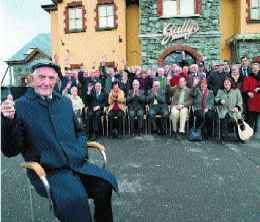
Dan Keating (pictured, left), from Ballygamboon, Castlemaine, County Kerry, celebrating his 105th birthday with members of Republican Sinn Féin at Gally's Bar and Restaurant, Tralee, County Kerry, on the 2nd January 2007.
DAN Keating was born in 1902 in the townland of Ballygamboon, Castlemaine, Co Kerry. In 1917, he went to work in Tralee at Jerry McSweeney's Grocery, Bar and Bakery. Jerry McSweeney's uncle, Richard Laide, was shot in the attack on Gortalea barracks which was the first barracks to be attacked in Ireland.
Dan joined the Fianna in Tralee in 1918 and about two years later he joined the Irish Republican Army. Others to join at that time were Gerry Moyles, Donnchadh Donoghue, Tommy Vale, John Riordan (Kerry All-Ireland footballer), Jerry O'Connor (better known as 'Uncy'), Matt Moroney and Paddy and Billy Griffin. Dan met a soldier who used to frequent the bar where he worked and during conversations procured a rifle from him, which was then handed over to Johnny O'Connor of the Farmers' Bridge unit. Dan was later to join this unit which included men of the calibre of Johnny Duggan, Johnny O'Connor, Timmy Galvin, Moss Galvin, Jack Corkery, Jim Ryle, Mick Hogan and Jamesy Whiston. This unit was very active from 1920 to 1924 and many of its members took part in the Headford ambush which claimed the lives of approximately 20 British soldiers. Volunteers Danny Allman and Jimmy Baily also lost their lives at Headford.
Dan took part in the ambush at Castlemaine in which eight RIC and Black-and-Tans were killed. Gerry Moyles was severely injured in this encounter. The last ambush in Kerry took place in Castleisland on the night before the Truce and Dan also participated in this. Four RIC members were killed in this action and Volunteers Jack Shanahan, Jack Prenderville, John McMahon and John Flynn also lost their lives. In 1922 Dan was transferred to a unit in Tralee which was commanded by Tommy Barton of Ballyroe when they occupied Ballymullen barracks for a period of three months, and also took part in the attack on Listowel barracks, now occupied by the Free Staters, in which one Free Stater was shot dead.
In Limerick, Dan, along with comrades from Kerry, fought the Free State troops over a period of ten days - republican Volunteers Patrick Foran, Charlie O'Hanlon and Tom McLoughlin lost their lives there, then Dan was sent to Tipperary to instruct Gerry Moyles to return to Kilmallock but on the way they were surrounded by Free Staters. After a battle at Two Mile Bridge, Dan and his comrades were taken prisoner and held in Thurles barracks for two days before being conveyed to Portlaoise jail where he was held for six months. This was to be the first of many times Dan was interned by the Free State. During this period in Portlaoise the jail was burned and Volunteer Paddy Hickey from Dublin was shot dead. Dan was then transferred to the Curragh Internment Camp and was held there until March 1923. A Free State soldier named Bergin from Nenagh, who became friendly with the republican prisoners and acted as a courier to republicans on the outside, was executed by the Staters.
Dan was charged with possession of a shotgun in 1930 and was issued a summons but did not attend court and was fined £1. In the true republican tradition he refused to pay and was sent to Limerick and held for one week. During a court case in Tralee involving Johnny O'Connor and Mick Kennedy, in which they refused to recognise the court, their supporters in the courthouse cheered loudly and when things died down the judge ordered Dan Keating to be brought up before him and gave him three months for contempt. Dan was jailed in Cork with Johnny O'Connor but after a hunger strike by Johnny both were released after three weeks. The next time Dan was interned was after O'Duffy's visit to Tralee; he was sentenced to six months in Arbour Hill. Dan was later captured in Carrigans in Clonmel by a policeman who had previously arrested him in Tralee and was taken first to Thurles and from there to the Curragh where he was held for three years and six months. In this period the camp was burned and Barney Casey from Longford was shot dead. Dan was also on active service in England during the early 1940s.
Dan returned to work in Dublin and operated as a barman in the Eagle House, James Street, the Cornet and the Kilmardenny public houses. His other great interest was Gaelic games, and indeed between football and hurling he has attended more than 140 All-Ireland senior finals including replays, which must be a record in itself. When Dan retired he returned to Kerry in 1978 and resided at Ballygamboon, Castlemaine. In 2004, Dan Keating replaced George Harrison of Mayo and New York as the fourth Patron of Sinn Féin Poblachtach since 1986, following in the footsteps of such illustrious republicans as Comdt-General Tom Maguire and Michael Flannery of Tipperary and New York. During his long, healthy and adventurous lifetime Dan has seen many splits and deviations from republican principles, but he remained loyal and true to the end.
Dan Keating, born on January 2nd 1902, died in Tralee on October 2nd, 2007 - 105 years of age - after a short illness. His funeral mass was held on this date - 5th October - 9 years ago, in Kiltallagh Church, Castlemaine, in Kerry. I measc Laochra na nGael go raibh sé.
ON THIS DATE (5TH OCTOBER) 8 YEARS AGO : FAIRY TALES IN FAIRYHOUSE!
This a piece we found in our archives from 2008 - and it's still as relevant today as it was then :
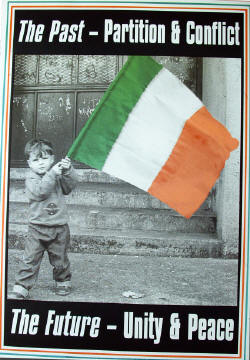
MICHAEL COLLINS LOOKS ON AS PARTITION AND CONFLICT ARE SAID BY 'THE REBELS' TO BE 'IN THE PAST..'
(Click here for better image of the so-called 'Past and Future' poster.)
One of our regular readers found himself with a few hours to spare on (Sunday) 5th October 2008 - eight years ago on this date - so himself and his Missus headed-out to the County of Meath to have a browse around Fairyhouse Market. Whilst browsing the hundreds of stalls and units etc he came across a stall operated by Provisional Sinn Féin at which he noticed, incredulously, that not only were they selling framed prints of Michael Collins but they had one such framed print located right beside a framed poster which declared that partition in Ireland and the political conflict it feeds are things of the past!
Our reader asked one of the PSF stall holders if they would agree that they were being a wee bit premature in saying that partition and conflict on this isle are in the past and proceeded to give a brief history lesson to the hapless rep and asked how they could possibly support the notion that partition and the conflict which arises from it can be said 'to be over' as this country is still partitioned by Westminster, which maintains an armed, and political, presence here? The garbled reply was as dense as the framed poster - "But things are a lot better...we're almost there....the leadership know what they're doing....things are looking up...."
Our man walked away, shaking his head in despair, and wondering how such people can be left in charge of a market stall, never mind how they can 'claim ownership' to the best way to resolve the not yet resolved issue of partition and the conflict that arises from it. Needless to say, our man wasn't buying it..!
ON THIS DAY NEXT WEEK (WEDNESDAY 12TH OCTOBER 2016)....
...we won't be posting our usual contribution, and probably won't be in a position to post anything at all until the following Wednesday, the 19th October ; this coming weekend (Saturday/Sunday 8th/9th October 2016) is spoke for already with a 650-ticket raffle to be run for the Cabhair group in a venue on the Dublin/Kildare border, work on which begins on the Tuesday before the actual raffle, and the 'autopsy' into same which will take place on Monday evening, 10th, in Dublin, meaning that we will not have the time to post here. But we'll be back, as stated above, on Wednesday 19th October 2016, when our offering will include, I'm told, a piece about when the British military in Ireland used a 'hamar' in an attempt to crack the IRA...
Thanks for reading, Sharon.
PROSE AND CONS.
By prisoners from E1 Landing, Portlaoise Prison, 1999.
ACKNOWLEDGMENTS :
Grateful thanks to the following for their help, support, assistance and encouragement, and all those who helped with the typing and word processing over the past few months. Many thanks to Cian Sharkhin, the editor of the book, Mr Bill Donoghue, Governor, Portlaoise, Mr Seán Wynne, supervising teacher, the education unit in Portlaoise Prison and the education staff, especially Zack, Helena and Jane. Education officers Bill Carroll and Dave McDonald, Rita Kelly, writer, print unit, Arbour Hill.
First Print : November 1999, reprinted March 2000, illustrations by D O'Hare, Zack and Natasha. Photograph selection : Eamonn Kelly and Harry Melia.
ETHAN. (By David Lynch.)
I see you in my dreams
the flower of my seed,
I reach to touch your face
to embrace your every need.
Possessing treasures of the universe
your soul the riches of life,
oblivious to cruel bindings
eyes shine bright as stars at night.
Reciting your poem to me
I feel oh so proud,
the story of the goblin
floating on a cloud.
I hear your laughter
I taste your tears,
surrounding your bed at night
I protect you from your fears.
Whispering I love you
I wonder do you hear?
you smile into my eyes
telling me - loud and clear.
(Next - 'Long Journey Home' , by David Lynch.)
IF IT AIN'T WHITE...
The Far Right has been resurgent across continental Europe for several years. But only in the last 12 months has Ireland seen an emergence of openly neo-Nazi cells. By Alan Walsh. From 'Magill' magazine, May 2002.
Immigration, crime and an abandonment of traditional values - the extreme right campaign on just those issues and, in economic circumstances such as those recently experienced in Ireland (ie an economic boom and then an economic slowdown) they garner success, like that that the 'British National Party' and France's 'Front National' group have enjoyed.
The roots of this re-emergence of the far right lie in the stark economic conditions of the 1970's and 80's. France, during the 1980's, witnessed mass unemployment, public service cutbacks and a crisis in the electorate which had become heavily disillusioned with the socialist Mitterand government. The 'Front National', formed in 1972, is now the strongest fascist movement in Europe, and got its breakthrough in a council election in a small town near Paris in 1983. Campaigning largely on an anti-immigrant platform, Jean Marie Le Pen, leader and founder of the FN, used this initial triumph as a base on which to build a series of electoral gains at local level, fielding 25,000 candidates in 1995. These in turn made a platform for an assault at national level, culminating in his most recent spectacular success in the presidential preliminaries.
In England, in a late 1970's climate of massive cutbacks in health, education and welfare spending, and with unemployment running at almost two million, the NF, a combination of many far-right parties including the 'British National Party', took a stance blaming the same immigrants who had been invited to the country to fill the labour shortage after the war. Statistics on racial attacks rocketed and 'NF' politics flourished at local election level to such a degree that it was necessary for the ruling Conservatives under Margaret Thatcher to speak of countries being "swamped by foreigners" back from the far right and cash in on their sentiment. The above, however, are all cultures with grand imperial histories.
(MORE LATER).
GROWING UP IN LONG KESH...
SIN SCÉAL EILE.
By Jim McCann (Jean's son). For Alex Crowe, RIP - "No Probablum". Glandore Publishing, 1999.
Biographical Note : Jim McCann is a community worker from the Upper Springfield area in West Belfast. Although born in the Short Strand, he was reared in the Loney area of the Falls Road. He comes from a large family (average weight about 22 stone!). He works with Tús Nua (a support group for republican ex-prisoners in the Upper Springfield), part of the Upper Springfield Development Trust. He is also a committee member of the 'Frank Cahill Resource Centre', one of the founders of 'Bunscoil an tSléibhe Dhuibh', the local Irish language primary school and Naiscoil Bharr A'Chluanaí, one of the local Irish language nursery schools.
His first publication last year by Glandore was 'And the Gates Flew Open : the Burning of Long Kesh'. He hopes to retire on the profits of his books. Fat chance!
CATCH 22 - IN CAGE 22. (In memory of Ned Maguire RIP)
Big Ned's face broke into a grin - "You're one crazy bastard, McCann," he said, laughing. I started to relax, nerve by nerve, but it took me three days to get my nerves back to where they were before Ned asked me for the leather. "Fair play to you, Ned, you can take a joke," I reminded him, just in case he forgot. "I'll get you back for that," he joked. I hope.
He stuck the two boots down his waistband, toes first, and pretended to draw against me and then he walked away, laughing. Fra came over to the wire to me and said "You've balls for burning." "Yeah", I said, remembering in that five seconds before Ned started to grin that I could feel all the major organs in my body make their way up my body, "they're up around my throat somewhere."
Some months later Ned was caught escaping and was moved to the 'Sentenced' end of the Camp into the same Cage as me. Strangely enough, the day he came into the Cage all the Dr. Marten boots mysteriously disappeared. Out of sight, out of Big Ned's mind!
(End of 'Catch 22 - in Cage 22'. Next : 'Catching Seagulls'.)
ON THIS DATE (28TH SEPTEMBER) 96 YEARS AGO : CORK IRA ATTACK BRITISH ARMY BASE.
Richard Willis, a carpenter, and his friend Jack Bolster, a painter, sometimes worked together on jobs ; it was on one such occasion that the two men got talking to a British soldier from the military barracks in Mallow, where Willis and Bolster were working ; the conversation ended with the soldier complaining that those in charge of the forty-five strong Mallow garrison were taking a chance by sending out a detachment of thirty Lancers each morning, to exercise their horses for a few hours. The soldier voiced his fear that the remaining fifteen or so soldiers in the barracks would be unable to prevent the IRA from taking munitions from the barracks should they attack, not realising that the two tradesmen he was talking to were themselves members of the IRA.
The seven IRA battalions in the Mallow and surrounding areas had recently formed, from within their ranks, a 'Flying Column', with Paddy Clancy in charge. Richard Willis and Jack Bolster contacted Clancy and told him of the conversation they had with the British soldier - they also had plans and sketches of the barracks, and mentioned that other men in their unit knew the lay-out of the surrounding district, having lived in the area since they were born. Clancy got in touch with Liam Lynch and Ernie O'Malley and a start was made on putting a plan together to raid the barracks for munitions. On Saturday morning, 28th September 1920 - 96 years ago on this date - Richard Willis and Jack Bolster went to the barracks to continue with the job they were doing there, this time accompanied by Paddy McCarthy, whom they introduced to the guards as a Board of Works foreman ; all three were admitted, and all three were armed.
At the same time, Liam Lynch and eighteen members of the 'Flying Column' were assembled in small groups in Barrack Street (where the military barracks was located) and six other armed Volunteers were already in control of Mallow Town Hall, a building which the RIC would have to pass should the alarm be raised and the RIC attempt to get to Barrack Street. The barrack gates opened as usual to allow the thirty or so Lancers out and, once they were out of sight, Liam Lynch walked up to the gate, with an envelope in his hand, and knocked until the guard opened up ; when the gate was opened enough to allow the guard to take the envelope, he was rushed by about twenty IRA Volunteers and held captive. The other twelve or so British soldiers were quickly rounded-up : a Sergeant Gibbs attempted to lock the door of the guardroom where the munitions were stored and was shot dead.
About thirty rifles, a couple of light machine-guns and dozens of boxes of ammunition were removed from the barracks and placed in waiting motor cars which drove off immediately ; the RIC knew nothing of the raid and were not seen that morning. As they were leaving the barracks, the IRA set fire to a load of straw, hoping to burn the place down, but the fire didn't catch - the stairs, floors and walls were all made from stone flaggings.
The next night, British troops from surrounding areas wrecked and burned Mallow Town Hall and the local creamery, and looted any shop they could get in to. They were to pay dearly for their presence over the following months, as their own weapons were turned on them by the IRA.
40TH ON THE 25th OF THE 12TH FOR THE 32!
The pic on the left is from the 34th successive Cabhair Swim, which took place at the 3rd Lock of the Grand Canal in Inchicore, Dublin, on the 25th December 2010. And, no, it's not been photoshopped...
...and yes, I know it's only September and it's not right or proper to mention the big day that falls on the 25th December every year which is why I won't yet actually be using that particular word (!) and will 'box clever' by just mentioning that, for the 40th successive year, a Christm... (ooops!) swim will be held at the above-mentioned outdoor venue at 12 noon. On the 25th December, that is. At the 3rd Lock in Inchicore, Dublin. We'll give it another plug between now and then, for all you slow learners... ;-)!
Thanks for reading, Sharon.
PROSE AND CONS.
By prisoners from E1 Landing, Portlaoise Prison, 1999.
ACKNOWLEDGMENTS :
Grateful thanks to the following for their help, support, assistance and encouragement, and all those who helped with the typing and word processing over the past few months. Many thanks to Cian Sharkhin, the editor of the book, Mr Bill Donoghue, Governor, Portlaoise, Mr Seán Wynne, supervising teacher, the education unit in Portlaoise Prison and the education staff, especially Zack, Helena and Jane. Education officers Bill Carroll and Dave McDonald, Rita Kelly, writer, print unit, Arbour Hill.
First Print : November 1999, reprinted March 2000, illustrations by D O'Hare, Zack and Natasha. Photograph selection : Eamonn Kelly and Harry Melia.
COSMIC GRACE. (By DAVID LYNCH.)
Diving into the bottomless lake
beginning to wonder will it awake.
Breath diminished, life at stake
desperately seeking that golden gate.
Lungs are empty, heart is still
never before such a thrill
body and mind two separate parts
one the beginning, the other the start.
Feeling like it's floating in space
confident now that it'll win the race,
floating along at a steady pace
high on the plateau of cosmic grace.
Returning to base it feels each follicle,
absorbing air, omitting molecule.
(Next - 'Ethan' , by David Lynch.)
IF IT AIN'T WHITE.
The Far Right has been resurgent across continental Europe for several years. But only in the last 12 months has Ireland seen an emergence of openly neo-Nazi cells. By Alan Walsh. From 'Magill' magazine, May 2002.
Far-right politics seem somehow an alien concept in Irish culture, despite being widespread throughout the rest of the continent. The last outright movement of this type here was the 'National Socialist Irish Workers Party' back in 1986 and, up until very recently, the Garda hadn't even been keeping statistics on racially motivated crime.
With many of our EU partners, however, the new far right is very familiar and, in some quarters already, even a tradition, often converging directly with the mainstream. The failure of social democrat and labour parties in Britain and across the continent to successfully present Europe as a culturally cosmopolitan utopia has seen a steep decline in membership and, in some cases - such as the 'Social Democrat Party' in Austria - removal from office.
Low turnouts in many elections, especially that in Austria, are indicative of an electorate, particularly the middle and lower middle class, entirely alienated from traditional politics. These are the precise circumstances used by certain groups to propose themselves as fighting against both corporate dominated globalisation and the handcuffed piecemeal measures of the parliamentary left. These groups, in order to avoid confronting the factual necessities of the market, select the easiest and most deceptively obvious factors on the ground, such as immigration, crime and an abandonment of traditional values as their scapegoats...
(MORE LATER).
GROWING UP IN LONG KESH...
SIN SCÉAL EILE.
By Jim McCann (Jean's son). For Alex Crowe, RIP - "No Probablum". Glandore Publishing, 1999.
Biographical Note : Jim McCann is a community worker from the Upper Springfield area in West Belfast. Although born in the Short Strand, he was reared in the Loney area of the Falls Road. He comes from a large family (average weight about 22 stone!). He works with Tús Nua (a support group for republican ex-prisoners in the Upper Springfield), part of the Upper Springfield Development Trust. He is also a committee member of the 'Frank Cahill Resource Centre', one of the founders of 'Bunscoil an tSléibhe Dhuibh', the local Irish language primary school and Naiscoil Bharr A'Chluanaí, one of the local Irish language nursery schools.
His first publication last year by Glandore was 'And the Gates Flew Open : the Burning of Long Kesh'. He hopes to retire on the profits of his books. Fat chance!
CATCH 22 - IN CAGE 22. (In memory of Ned Maguire RIP)
I was alone and in a Catch 22 situation ; was Big Ned having me on or not? This was the question. I had to take a chance : I shouted "What exactly is it that you are looking for?" and, as Ned told me again what he needed, I detected that look on his face that told me that he thought that he had got one over on me. "Where are you going to get the leather for two holsters?" , asked Tommy Barnes. "I have a plan", I answered with a wink, and I put that plan in motion after I had a cup of tea. Of course. I gathered the stuff about me to implement my plan, walked over to the wire and shouted over to Fra McCann in Cage 6 : "Fra, give Big Ned a shout for me but make sure you let everyone know that there's something afoot..."
I couldn't have spoken a truer word : Ned came out to the wire, and I could see dozens of Cage 6'ers behind his back, taking vantage points to find out what was happening. "Any joy, mate?", asked Big Ned. "It was touch and go, comrade, but I've came up trumps for you," I answered. "I managed to get two bits of old leather that should prove perfect for your needs. Stand back from the wire and catch this bag." As Ned made his way to the centre of the cage I launched the bag containing two busted Dr. Marten boots into Cage 6. As the boots were in mid-air I told Ned that it was the best of leather. At one time...
"What the fuck's this?", Ned screamed. "Two bits of leather", I replied. "Are you trying to make an eejit out of me?", asked Ned. "No way, comrade.What's the problem? You asked me for two old bits of leather for holsters and I thought that they would be perfect. I even got them for a left-handed or right-handed draw..." Big Ned looked at me as if I was simple and asked - "Are you simple?" "If they're no good I might be able to get my hands on a pair of Beatle Boots for you", I said. In for a penny, in for a pound. The entire Cage 6'ers and most of the Cage 22'ers held their breath awaiting Big Ned's response. My stomach was churning... (MORE LATER.)
STILL STRUGGLING WITH THE IRISH TIMELINE...
And I am. Shouldn't be, I know, but I feel like a fish out of water - uneasy, disorganised. But I'm getting there : for our post next week (Wednesday 28th September 2016) I'm told we'll have a piece about two FBI agents who were spying on an Irish republican in California but who were themselves being spied on by a college security officer...but, for now, here's two 'On This Date' pieces that we borrowed from elsewhere :
ON THIS DATE (21ST SEPTEMBER) 189 YEARS AGO : BIRTH OF AN RIC MAN WHO RESIGNED HIS POSITION IN OPPOSITION TO 'REPRESSIVE ACTIONS AGAINST THE IRISH'.
On the 21st September 1827 - 189 years ago on this date - Michael Corcoran (left), a brigadier general in the Federal Army during America's Civil War, was born in Carrowkeel, County Sligo. Corcoran served as a policeman in the Royal Irish Constabulary but resigned during the Great Hunger, no longer able to condone the repressive actions of that police force against the starving Irish. He emigrated to New York and found work in the city's employ while also joining the 69th New York State Militia as a private. He rose through the ranks to colonel commanding the regiment and won the hearts of the city's Irish population when he refused to parade the 69th for the visit of the Prince of Wales in 1860. The state intended to court-martial him for this but the start of the Civil War led officials to dismiss the charges, and Corcoran led the regiment to Washington. At the Battle of 1st Bull Run, Corcoran was wounded and captured and spent the next 13 months in various Confederate prisons before he was finally exchanged. His health would never recover from that time in Southern prison camps. Promoted to brigadier general on his return, he recruited a brigade of volunteers from Irish enclaves in New York state that became known as Corcoran's Legion. He led the legion and then a division during the Suffolk (Virginia) campaign in April 1863. While there he was involved with a regrettable incident. While riding with fellow Fenian leader John O'Mahoney, Corcoran shot and killed Lt. Col. Edgar Kimball of the 9th New York Infantry. Corcoran was ordered to face a court-martial in the case, but it was never convened. On December 22nd, 1863, Corcoran was riding with Brig. Gen. Thomas F. Meagher and others when he suddenly fell from his horse and died shortly afterwards. Many articles on Corcoran say he was killed when his horse fell on him, but recent research points toward a stroke as the most likely cause of death. On December 27th, he was interred at Calvary Cemetery in the borough of Queens, today within New York City. (From here, as is the 'Eamonn Ceannt' piece - also, more on Michael Corcoran here.)
ON THIS DATE (21ST SEPTEMBER) 135 YEARS AGO : 1916 SIGNATORY BORN.
On this date - 21st September - in 1881, revolutionary Éamonn Ceannt (left) was born in Glenamaddy, County Galway. He was educated at University College, Dublin, and worked on the clerical staff of Dublin city council. Éamonn joined the Gaelic League in 1900 and later taught classes in Irish. He was a pipe player, once playing the uileann pipes for the Pope in Rome. He was said to love the language, music and dance of his native country and to have an unshakeable commitment to Irish freedom. Ceannt joined Sinn Féin and the Irish Republican Brotherhood in 1908 and was also one of the founders of the Irish Volunteers in 1913, and was elected to its Provisional Committee. The day before the Easter Rising in 1916, Ceannt was one of the seven signatories to the Proclamation, in effect, signing their death warrants. During the Rising, he commanded the area of the South Dublin Union. The plan called for him to hold the area with 1,000 men; he had only 130, but his small command, especially Cathal Brugha, resisted the British until Patrick Pearse surrendered the entire rebel force. Like the other leaders of the Rising, Éamonn Ceannt faced the kangaroo court that condemned him with his head held high. On May 7th 1916, he wrote his wife a note, telling her "I shall die, like a man for Ireland's sake" and, On May 8th, he was put up against a wall in Kilmainham Jail and shot by the British.
THIS DATE - 21ST SEPTEMBER - AND BERTIE AHERN.
On this date 15 years ago (2001) the then State 'Taoiseach', Bertie Ahern (pictured, left) announced 'that Ireland (by which he meant the 26-County State) will put its airports, airspace, refuelling facilities and garda intelligence at the disposal of the US in the battle against terrorism' (and is on record for also claiming that "we" [the Leinster House administration and/or those that voted for them?] are "happy to facilitate" such American actions - see page 8, here) and, on the 21st September nine years ago (2007) he was exposed for his 'inconsistencies' (!) in relation to his testimony (under oath, not that that means anything to him and his ilk) at the Mahon Tribunal.
Or am I just another kebab plotting against him, in the hope of upsetting the apple tart...?
Thanks for reading, Sharon.
RALLY 'ROUND THE ROADWORKS...
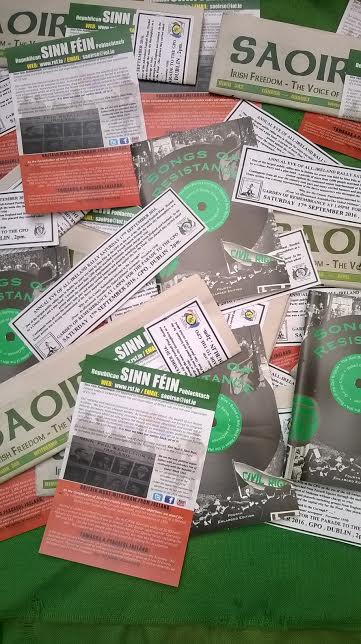
Due to the luas works on the island at the GPO, which is affecting traffic etc on O'Connell Street, it will not be possible to hold the annual Eve of All Ireland Rally, in its usual format, at the GPO this year ; instead, Republican Sinn Féin will hold an 'Éire Nua' picket from 12noon to 2pm under the portals of the GPO.
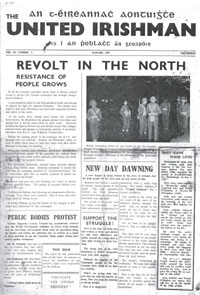
Alternative routes and compositions etc (for instance, to hold the whole event at the Garden of Remembrance, rather than to just assemble there) were discussed at length by the organising committee but, due to the nature of the problem and the shortage of time in which to suitably advertise any new arrangement, it was finally agreed that a republican presence - a picket, in this case - should be maintained at the GPO on the eve of the All-Ireland final. Such a presence has been visible at that location on the day before the final since at least 1958: "One of the largest public rallies seen in Dublin for years was held by Sinn Féin at the GPO on the eve of the All-Ireland Football Final. Headed by a Colour Party and a pipe band, a parade of more than 2,000 people marched from Parnell Square through the main city thoroughfare as a protest against the continued unjust imprisonment of Irishmen without charge or trial. Contingents from all over the country took part and many carried banners and placards including groups from England and Scotland. In the Ulster section was a strong representation of the Derry supporters who thronged the capital city for the Final. One placard they carried asked -'Why are Six-County nationalists interned in the Curragh?'....." (From 'An tÉireannach Aontaithe/The United Irishman' newspaper, November 1958.)
This change, unfortunately, also affects the ability to properly distribute the 'song book'-leaflet packs which will now be kept in storage for another occasion, although other material will be distributed, as best as possible, allowing for the constrained space we have been obliged to operate in and this new, temporary, format also denies the organisers the use of the small stage and lectern unit which has been a feature of the event since the 1980's. But we'll make the best of what we've got - see you at the GPO in Dublin on Saturday, 17th September 2016, between 12 noon and 2pm.
Thanks for reading, Sharon.
OUTPUT...
...100% over there*, but not firing on all cylinders here just yet!
But we're working on it, even as we find ourselves thrown in at the deep end! On Sunday next, 11th September 2016, RSF Dublin are holding a 650-ticket raffle in the usual sports pub on the Dublin/Kildare border and, as usual, we're helping to organise same and will be there on the day to assist in running it. And, for once, there are three sporting fixtures which we are hoping to watch - the Red Bulls are playing against DC United, the Jets are up against the CB's and the Yankees are gonna have their work cut out for them if they hope to teach the TB Rays a lesson! YAY RA RA! and all that...!
Then the following weekend (on Saturday 17th September) we have been asked to help out with a republican event in O'Connell Street in Dublin at which about fifty 124-page Irish republican songbooks (and other Irish republican printed material) will be distributed, free of charge - details here. We hope to post one of our usual offerings here on Wednesday 14th September next but, considering that the weekend coming (Sat/Sun 10th/11th) is spoke for, as is Monday evening, 12th (raffle autopsy in Dublin city centre!) and then it's straight into final preparations for the 17th September rally, we can't be 100% sure of our output! But do check back with us anyway and, in the meantime, have a nice day!
(*...but of course 'output' would have to be located there. Well, it is - and it is 100%!!)
Thanks for reading, Sharon.
TWO OF THE WORST THINGS ABOUT ANY HOLIDAY...
..are the preparations that have to be made before you go, in relation to the 'life' you're temporarily leaving and the 'life' you're temporarily entering, and the fact that you have to play 'catch-up' when you return. And more so, on both counts, when it's a five-week holiday you're taking, and even more so again when you're a mother who works outside the home as well as in it.
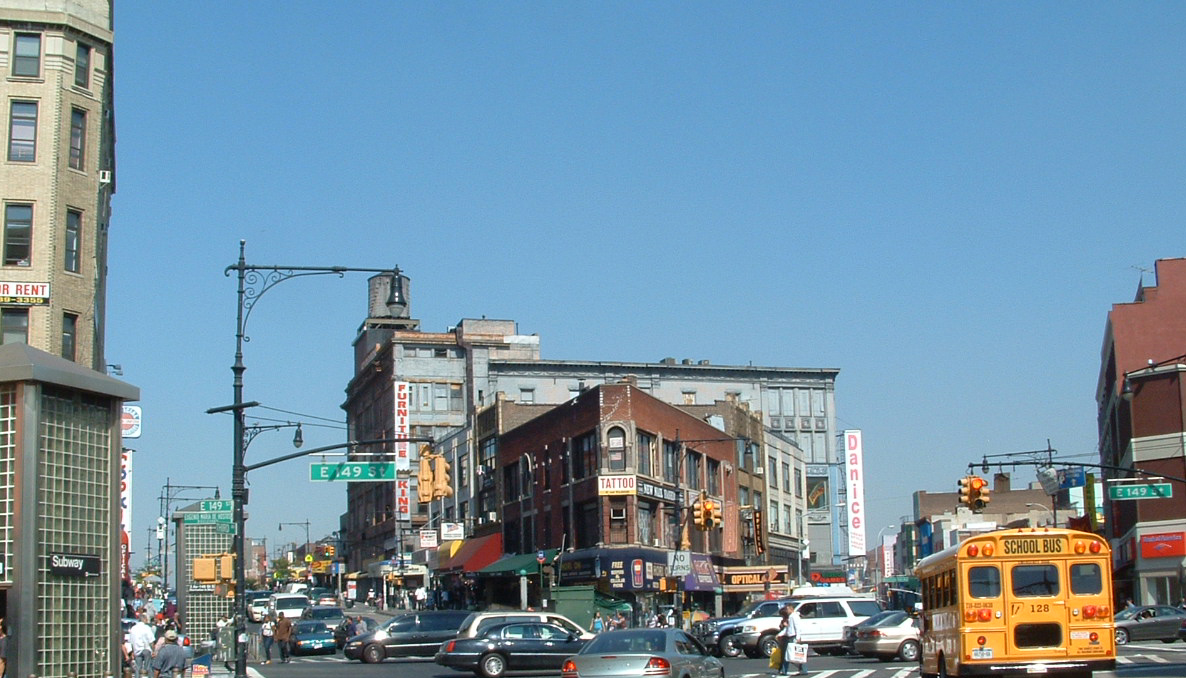
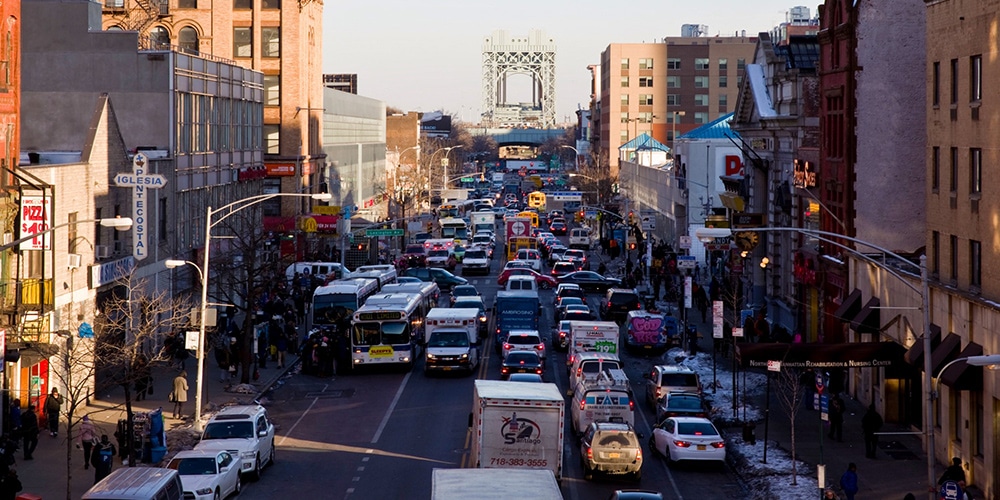
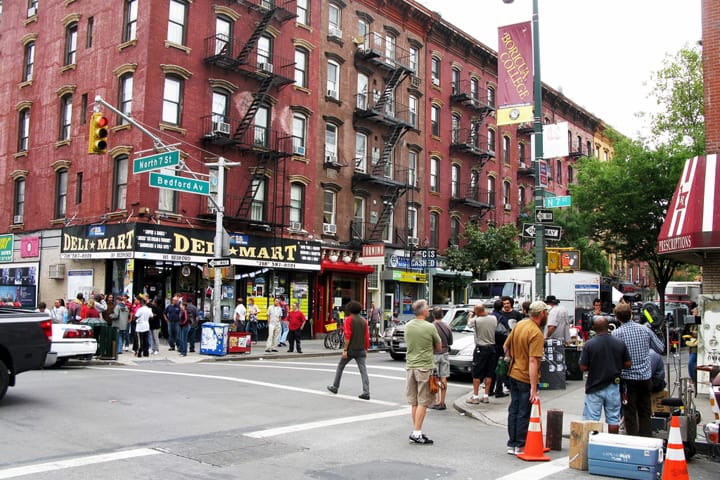
But the five of us planned and plotted every move within an inch of its life and then, naturally (!) cut corners and muddled through as we had to in order to secure our five-week break and now, having returned to the 'life' we temporarily left, we are having to once again cut corners and muddle through as best we can and accept the fact that we can no longer decide to people-watch in Central Park and/or watch the sun rise during a rooftop party in the Bronx and/or hangout for a few hours with friends in Marcus Park in Harlem and/or dance with the Devil (retired!) on the boardwalk at Coney Island and the hours spent with the chess players in Union Square Park and the dozens of other treats we afforded ourselves on a daily basis. And we're still rebelling against having to live within the confines of this 'life' even as we make ourselves do so, consoling ourselves at every juncture with the knowledge that we're not finished by a long shot with our New York adventures. Just temporarily so...
Anyway : back to blog business - before our holiday we discovered that we had been nominated in the 'best current affairs/political blog' category in the 2016 Littlewoods Ireland Blog Awards competition and, on our return from New York, discovered that we had somehow made it as far as the 'shortlist' for that category and, in the last few days, have noticed that this wee blog has managed to make it to the 'finals'! The competition will be held on Thursday 15th September 2016 in Dún Laoire, Dublin but, win or lose, we thank all those who voted for us and got us this far, as it's nice to know that our readers appreciate the political message that we promote here. And, if we lose, all those who voted against us will be introduced to our new friends from Coney Island...!
Thanks for reading ; we'll be back soon to our usual output but, for now, anyway, the five-hour time difference and the need to get back to our overall 'normal' day-to-day operations are battling with our objections and unwillingness to do so. And the latter feeling will get an award for the way it's winning...!
Slán go fóill anois, Sharon.
OH NEW YORK CITY, SO RUINED BY ITSELF...
..a wonderful piece of shit : rats carved out of bone, dodging the rattling subways and shaking themselves awake to scurry 'round confused people, who measure their tragedies against those of their neighbour. A city of immigrants in transition, enduring breakfast, lunch and dinner in a traffic jam, a people jam or a subway jam. And we can't fully let go of it. Beautiful chaos! (Apologises to Nicodemus Nicoludis.)
Five weeks isn't enough. As regular readers will know, this wasn't our first holiday in New York and it sure won't be our last. The five of us are breathless after it ; wrecked, shattered, exhausted, broke - unhinged, even, and not willing to settle back into our 'normal' routine. Indeed, not able to settle back into our normal routine, and not even prepared to try and do so. We never had an experience like it and we know we never will again. Every second of every minute of every hour of every day of those five weeks we were alive and in our element. It's the place where we are meant to be. That city suits us - the pace it moves at, the easy ability to blend in, the concrete atmosphere, the noise, the smells, the heat, the ignorance and arrogance of it, the callousness and cruelty we witnessed and, above all, the different ways which New Yorkers (and guests) coped and/or attempted to cope with those attributes : some fought back with kindness and generosity but others let it get to them and turned, temporarily, ignorant and arrogant. And maybe that's why they named it twice - despite 'all the scandal and the vice', the city and its people have a heart of gold.










#/media/File:Liamlynchira.jpg)