ON THIS DATE (30TH JANUARY) 138 YEARS AGO : EVE OF 'CONSTRUCTION' FOR MILITANT IRISH LADIES.
On the 30th January 1881 - 138 years ago on this date - Charles Stewart Parnell's sisters, Anna and Fanny, put the final touches to a new organisation which they officially launched the following day : they established a 'Ladies Land League' which, at its full strength, consisted of about five hundred branches and didn't always see eye-to-eye with its 'parent' organisation, the 'Irish National Land League'.
In its short existence, it provided assistance to about 3,000 people who had been evicted from their rented land holdings) to assist and/or take over land agitation issues, as it seemed certain that the 'parent' body was going to be outlawed by the British and, sure enough, the British Prime Minister, William Ewart Gladstone, introduced and enforced a 'Crimes Act' that same year, 1881 (better known as the 'Coercion/Protection of Person and Property Act') which made it illegal to assemble in relation to certain issues and an offence to conspire against the payment of rents 'owed' which, ironically, was a piece of legislation condemned by the same catholic church which condemned the 'Irish National Land League' because that Act introduced permanent legislation and did not have to be renewed on each political term.
And that same church also condemned the 'Ladies Land League' to the extent that Archbishop McCabe of Dublin instructed priests loyal to him "..not to tolerate in your societies (diocese) the woman who so far disavows her birthright of modesty as to parade herself before the public gaze in a character so unworthy of a Child of Mary..." - the best that can be said about that is that that church's 'consistency' hasn't changed much over the years, and that it wasn't only a religious institution which made an issue out of women being politicised - 'In the year in which the Ladies' Land League was formed, Ireland was first mentioned in the 15 January 1881 issue of the 'Englishwoman's Review'. Tellingly, this was a report headed 'Women Landowners in Ireland' (and) there was also a small report of a 'Catholic Charitable Association' being formed 'by a number of Irish ladies for aiding the families
of poor or evicted tenants'.
The addition of the phrase "It is distinctly understood that the society shall take no part whatever in political agitation.." reveals the disapproval felt by the journal for those engaged in that agitation *. The formation of the Ladies' Land League was then noted : 'In anticipation of Government action against local branches of the Irish National Land League, arrangements are being made for the establishment of a Ladies' Land League throughout Ireland. Such a movement has already been organised in America, where Mrs Parnell, the mother of the Member for Cork, is the President, and Miss Fanny Parnell and Mr John Stewart, the sister and brother of Mr Parnell, MP, are acting as organisers. The Irish movement will be led by the wives of the local leaders of the existing league, and will devote themselves to the collection of funds...' ** (from here).
* / ** - That periodical was assembled and edited by, and for, middle-class women of the day (late 19th/early 20th century) and, while it did cover and promote economic independence for women, occupation outside of the home for women, the need for better educational facilities for women to enable and encourage women to seek employment in 'the male professions' ie politics and medicine, it was truly of its day in that it was felt to be a bridge-too-far to call for women to take to the streets for the right to be more than 'just' fund-raisers. In short, the authors were, in effect, confining themselves to be further confined.
In October 1881, Westminster proscribed the 'Irish National Land League' and imprisoned its leadership, but the gap was ably filled by the 'Ladies Land League' until it was acrimoniously dissolved on the 10th August 1882, 19 months after it was formed.
"WE ASK FOR NO MERCY AND WE WILL MAKE NO COMPROMISE" - TERENCE MacSWINEY.
An edited version of this speech was published in 'The United Irishman' newspaper in October 1954. This is the speech in full ; on the 13th March, 1920, Terence MacSwiney (pictured) was unanimously elected as the 'Lord Mayor of Cork' by that city's Corporation. He donated his salary for the position to an outside organisation and received no salary for the other position he held at that time - Brigadier of the No. 1 Brigade, Cork IRA.
"But it is conceivable that they, our enemies, could interrupt our course for a time ; then it becomes a question simply of trust in God and endurance. Those whose faith is strong will endure to the end and triumph. The shining hope of our time is that the great majority of our people are now strong in that faith. To you, gentlemen of the minority here, I would address a word. I ask you again to take courage and hope. To me it seems — and I don't say it to hurt you — that you have a lively faith in the power of the devil, and but little faith in God.
But God is over us and in His divine intervention we have perfect trust. Anyone surveying the events in Ireland for the past five years must see that it is approaching a miracle how our country has been preserved. God has permitted this to be, to try our spirits, to prove us worthy of a noble line, to prepare us for a great and noble destiny. You amongst us who have yet no vision of the future have been led astray by false prophets. The liberty for which we today strive is a sacred thing, inseparably entwined as body and soul with that spiritual liberty for which the saviour of men died, and which is the inspiration and foundation of all just government. Because it is sacred, and death for it is akin to the sacrifice on Calvary, following far off but constant to that divine example, in every generation our best and bravest have died.
Sometimes in our grief we cry out foolish and unthinking words : 'the sacrifice is too great'. But it is because they were our best and bravest that they had to die. No lesser sacrifice could save us. Because of it our struggle is holy, our battle is sanctified by their blood, and our victory is assured by their martyrdom. We, taking up the work they left incomplete, confident in God, offer in turn sacrifice from ourselves. It is not we who take innocent blood but we offer it, sustained by the example of our immortal dead and that divine example which inspires us all for the redemption of our country. Facing our enemies we must declare our attitude simply. We ask for no mercy, and we will make no compromise. But to the Divine Author of mercy we appeal for strength to sustain us, whatever the persecution, that we may bring our people victory in the end. The civilised world dare not continue to look on indifferent. But if the rulers of earth fail us we have yet sure succour in the Ruler of Heaven ; and though to some impatient hearts His judgements seem slow, they never fail, and when they fall they are overwhelming and final."
(END of 'We Ask For No Mercy And We Will Make No Compromise'. Next - 'Traitors To The Crown', from 'The United Irishman' newspaper, January 1955.)
BORN ON THIS DATE (30TH JANUARY) 174 YEARS AGO : HISTORY-MAKER KATHARINE WOOD.
Born in 1846, on the 30th January - 174 years ago today - Katharine Wood (pictured) matured into an unwitting femme fatale, said to be practically solely responsible for 'the most notorious scandal of the late Victorian Age' - the downfall of Charles Stewart Parnell and the split which followed in the 'Home Rule Movement' -
'Kitty' was a name she would have hated, as it was slang for a woman of loose morals. In fact, she only loved two men in her life and married both of them, though the marriage to Parnell was to prove tragically short-lived as he died in her arms after a few brief months of happiness. She was born Katharine Wood in 1845, and was known as Kate to her family. Her father was a baronet, a member of the British aristocracy and her brother a Field Marshall, although their grandfather had started life as an apprentice and was a self-made man.
The Woods were closely linked with the Gladstone family and Katharine often acted as a go-between with William Gladstone when Parnell was trying to persuade the British government to grant Ireland independence. She had married William O'Shea at the age of twenty-one, not long after the death of her father, and the marriage had produced a son and two daughters. O'Shea neglected his wife and pursued his own pleasures while she was often left to bring up the children alone, while also looking after her elderly aunt. She played the part of a dutiful wife, however, and hosted dinner parties to help her husband's career. Parnell, an important figure in Irish politics, was always invited, always accepted and yet never showed up.
Annoyed and perplexed by these apparent snubs she went to confront him in person at his office in Westminster in July 1880. The effect was immediate ; "This man is wonderful and different," she was to write later. Parnell was a bachelor who had once loved and been rejected, and never took an interest in women again until he met Katharine. It was a suicidal love as she was married to a fellow Irish MP and was a respectable wife and mother. The power of the attraction between the two, however, was impossible to resist and before long they were living together in her home in Eltham in the suburbs of London. They had an illicit 'honeymoon' in Brighton and Katharine was to bear three children to Parnell while still married to O'Shea, the first of whom died soon after being born. It is even thought that she bore Parnell a son who could take his name after they finally married, although this child was stillborn. O'Shea knew of the relationship but turned a blind eye to it. Then the Aunt died and left Katharine a large inheritance and he decided to divorce his wife and shame Parnell publicly. The ensuing scandal ruined Parnell's career and his health.
His traditional supporters in Catholic Ireland turned away from him when they learned he had been living with a married woman even though he and his beloved Katharine became man and wife after they married at Steyning register office in Sussex, the county where they made their home. In an attempt to revive his flagging fortunes, Parnell went to Ireland and spoke at a public meeting in County Galway. He was caught in a thunderstorm and developed a chill from which he never recovered. Seriously ill, he returned to be with Katharine and died soon afterwards. They had been married for only four months. It is estimated that half a million people lined the streets of Dublin to pay their respects to Parnell as his coffin was taken to Glasnevin cemetery to be buried near Daniel O'Connell. Later Eamon de Valera and Michael Collins were also laid to rest nearby. On the granite stone above his grave lies just one word – 'Parnell', enough to identify Ireland’s flawed hero whose dream of a free and united country at peace with Britain was destroyed by his love for a married woman.
And what happened to Kitty, as the world now knew her? It was all too much for her and she lived out her days quietly in Sussex. She never married or fell in love again but looked after her children and died at the age of seventy-five. When she was buried, only her immediate family came to the funeral and on her grave monument were the names of both her husbands with that of Parnell, the great love of her life, above that of O'Shea who gave her the name she is known by. There is no sign of 'Kitty', however. By the gravestone is a plaque placed by the Parnell Society with Parnell's promise to her: "I will give my life to Ireland, but to you I give my love..." (from here.)
Katharine Wood died on the 5th February 1921, at 75 years of age, in Littlehampton in Sussex, England, and is buried there.
'SAVINGS LAW SHOULD BE CHANGED' : a letter sent to 'The Irish Times' newspaper by a Dr. Lucey.
From 'The United Irishman' newspaper, February 1955.
"No other country in the world, as far as I am aware, hands over its savings in this way to a foreign country. Why should we keep on doing this? How can we employ our people at home, if we send their savings to be spent abroad?"
Dr Lucey added that local savings should as far as possible be spent locally, not abroad or even for general national (sic) purposes. Last year, the 'Cork Savings Bank' handed over £309,000 of Cork money to the (State) Minister of Finance. The 'Post Office Savings Bank' in Cork sent him most likely much more. Why was this money - Cork's money - not handed over to the Corporation in Cork for housing? Were the Corporation to get this money at the rate the Minister got it there would be a saving of 2% in the interest rates on housing loans, and the rent of a £1,500 house would be 12 shillings less in consequence.
(END of 'Savings Law Should Be Changed'. Next - 'Treason Felony', from 'The United Irishman' newspaper, December 1954.)
ON THIS DATE (30TH JANUARY) 160 YEARS AGO : A FUTURE SINN FÉIN PRESIDENT IS BORN.
'Edward Martyn, playwright, co-founder of Irish Literary Theatre, and Sinn Féin president, is born in Tulira, Co. Galway.
Martyn was descended from Richard Óge Martyn (c.1604 - 1648), a leading Irish Confederate, and Oliver Óge Martyn (c.1630 - c.1709), a Jacobite who fought in the Williamite War in Ireland. Yet by his lifetime, the family were unionists. Martyn's outlook began to change in the 1880's after studying Irish history, as well as living through the events of the Irish Land War. He came out as an Irish republican when he famously refused to allow "God Save The Queen" to be sung after a dinner party at Tullira. By this stage he was involved with the political work of Maude Gonne and Arthur Griffith, and was a vocal opponent of the visit of Queen Victoria to Ireland in 1897.
He also protested the visit by Edward VII in 1903, this time as chairman of the People's Protection Committee. He was the first president of Sinn Féin from 1905 to 1908 (the party only taking that name in the latter year) (but) in 1908 he resigned from the party and politics in general to concentrate on writing and his other activities. He became close friends with Griffith, Thomas MacDonagh, Joseph Mary Plunkett and Patrick Pearse, and deeply mourned their executions in the aftermath of the Easter Rising. A parish hall and church that he founded at Labane, near Tullira, were burned by the Black and Tans. He supported * the Anglo-Irish Treaty of 1921...' (from here.)
( * - indeed, a close friend of his, Isabella Augusta Persse ['Lady' Gregory] stated, after one of her visits to him [on the 14th January 1922] that he declared to her that "he is all for the Treaty..")
ON THIS DATE (30TH JANUARY) 47 YEARS AGO : BRITISH ARMY MASSACRE IN DERRY.
After a peaceful Civil Rights march on January 30th, 1972 - 47 years ago on this date - from Creggan to Free Derry Corner, units of the British army Parachute Regiment opened fire with automatic rifles and shot dead 13 unarmed civilians, injuring many more, one of whom died later. It was later revealed that some days prior to the massacre, the British soldiers involved had been briefed to "shoot to kill" at the march.
"This Sunday became known as 'Bloody Sunday' and bloody it was. It was quite unnecessary. It strikes me that the (British) army ran amok that day and shot without thinking of what they were doing. They were shooting innocent people. They may have been taking part in a parade which was banned, but that did not justify the troops coming in and firing live rounds indiscriminately. I would say without reservations that it was sheer unadulterated murder. It was murder, gentlemen" - the words of British Major Hubert O'Neill, Derry City Coroner, at the conclusion of the inquests on the 13 people killed by the British Army on that day.
The British Army are still in Ireland and Westminster continues to claim jurisdictional control over six Irish counties - the potential for another 'Bloody Sunday' still exists. That threat can only be removed when Westminster removes itself from Ireland, politically and militarily.
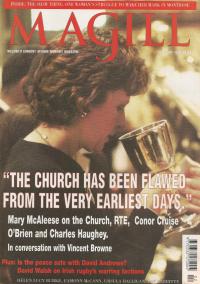
'A NEW THEORY OF RELATIVITY', by Pat Rabbitte.
From 'Magill' magazine, February 1998.
When it comes to comment on garda performance, I am a bit sceptical, but understanding, of most security correspondents. The fact is that the Garda Síochana have emerged from a difficult period in their impressive history - damage has been done by the bitter and prolonged internal dispute about who speaks for rank-and-file gardaí.
The image of Gardaí importing 'security' to protect themselves from other gardaí* has lodged in the public memory. At one stage it seemed to many people that the response of certain personnel in the 'Garda Representative Association' was overtly political, with a large 'P'. Happily, that dispute seems to be about to finally resolve itself.
The emergence as lead advocate for the new combined representative organisation of some of the common-sense spokesmen who fronted the breakaway federation would greatly help the process of restoring public confidence. The gardaí themselves are clearly sensitive to, if not bitter about, criticism of their own performances... ( *...or to assist them in evictions ordered by banks) (MORE LATER.)
Thanks for reading, Sharon.
Wednesday, January 30, 2019
SINN FÉIN PRESIDENT SUPPORTS 1921 TREATY OF SURRENDER.
Wednesday, January 23, 2019
THE ENGLISH 'GENTRY' IN IRELAND - "LIVED A LIFE OF CRUELTY, DECEPTION AND EXTREME VIOLENCE".
"WE ASK FOR NO MERCY AND WE WILL MAKE NO COMPROMISE" - TERENCE MacSWINEY.
An edited version of this speech was published in 'The United Irishman' newspaper in October 1954. This is the speech in full ; on the 13th March, 1920, Terence MacSwiney (pictured) was unanimously elected as the 'Lord Mayor of Cork' by that city's Corporation. He donated his salary for the position to an outside organisation and received no salary for the other position he held at that time - Brigadier of the No. 1 Brigade, Cork IRA.
"Gentlemen, you have paid tribute to him on all sides. It will be my duty and steady purpose to follow that line as faithfully as in my power, though no man in this Council could hope to discharge its functions with his ability and his perfect grasp of public business in all its details and as one harmonious whole.
I have thought it necessary to touch on this normal duty of ours, though — and it may seem strange to say it — I feel at the moment it is even a digression. For the menace of our enemies hangs over us, and the essential immediate purpose is to show the spirit that animates us, and how we face the future. Our spirit is but to be a more lively manifestation of the spirit in which we began the year — to work for the city in a new zeal, inspired by our initial act when we dedicated it and formally attested our allegiance, to bring by our administration of the city, glory to our allegiance, and by working for our city's advancement with constancy in all honourable ways, in her new dignity as one of the first cities in Ireland to work for and if need be to die for.
I would recall some words of mine on that day of our first meeting after the election of Lord Mayor. I realised that most of you in the minority here would be loyal to us, if doing so did not threaten your lives ; but that you lacked the spirit and the hope to join with us to complete the work of liberation so well begun. I allude to it here again, because I wish to point out again the secret of our strength and the assurance of our final victory. This contest of ours is not on our side a rivalry of vengeance, but one of endurance — it is not they who can inflict most but they who can suffer most will conquer — though we do not abrogate our function to demand and see that evil doers and murderers are punished for their crimes..." (MORE LATER).
BLOODY SUNDAY PICKET, SATURDAY, 26TH JANUARY 2019, GPO, DUBLIN, 12.45PM TO 1.45PM.
After a peaceful Civil Rights march on January 30th, 1972 - from Creggan to Free Derry Corner - units of the British army Parachute Regiment opened fire with automatic rifles and shot dead 13 unarmed civilians, injuring many more. It was later revealed that some days prior to the massacre, the British soldiers involved had been briefed to "..shoot to kill.." at the march.
"This Sunday became known as 'Bloody Sunday' and bloody it was. It was quite unnecessary. It strikes me that the (British) army ran amok that day and shot without thinking of what they were doing. They were shooting innocent people. They may have been taking part in a parade which was banned, but that did not justify the troops coming in and firing live rounds indiscriminately. I would say without reservations that it was sheer unadulterated murder. It was murder, gentlemen" - the words of British Major Hubert O'Neill, Derry City Coroner, at the conclusion of the inquests on the 13 people killed by the British Army on that day. On Saturday January 26th next, a picket to mark the anniversary of that massacre will be held at the GPO in Dublin, from 12.45pm to 1.45pm. All welcome!
ON THIS DATE (23RD JANUARY) 216 YEARS AGO - DEATH OF THE 'GUINNESS BLACK PROTESTANT PORTER' MAN!
'Arthur Guinness disapproved of the United Irishmen's Rebellion of 1798. Because of this, the new brew became known as 'Guinness's black Protestant porter'. Catholics and nationalists boycotted the drink for a time, but far from damaging his trade, Guinness used the opportunity to set up a lucrative export trade with England...' (from here.)
I don't drink the stuff meself (..much more refined than that, so I am..!) but that drink, and the family associated with it - Guinness - have an 'interesting' history. Henry Grattan (to whom the Guinness family were related, through marriage) and Arthur were both vocal critics of the then taxation system which imposed tariffs on, among other goods, beer and, while both men were 'sympathetic' towards the suffering of the Irish, both were prepared to accept and, indeed, campaigned for, less than complete Irish freedom from the British 'crown'. Arthur was not only against full independence for Ireland but was politically opposed to those who were to the extent that, in republican circles, he was considered to be an informer, collecting and passing information to 'crown' agents - the 'Union Star' newspaper described him as "..a brewer at James's Gate, an active spy. United Irishmen will be cautious of dealing with any publican who sells his drink..."
Arthur is on record for being 'directly opposed to any movement toward Irish independence (and wanting) Ireland to remain under English control', to which end one of his family members, 'Lord' Iveagh, donated £10,000 to the UVF arms fund in 1913. As employers, they were decent enough to most of their employees - 'While they maintained their reputation as good employers and philanthropists, their unionist politics left them out on a limb in independent Ireland (sic) , although they quickly adjusted to doing business with the new Free State. In many respects they were the ultimate business pragmatists: the union was important to them because so much of their stout was sold in Britain and the empire. When a trade war threatened in the 1930s they finally activated plans that had been drawn up when Home Rule looked likely before the first World War and moved their headquarters to England...' (from here.)
'In the run-up to the Easter Rising, members of the Irish Volunteers who worked in Guinness' were discouraged from openly parading. Frank Henderson, a captain in the Irish Volunteers who took part in the Howth Gun Running and the Easter Rising, said Guinness' staff were wary that they may be victimised in their workplace...the company took a hard line with anybody displaying any form of support for Irish republicanism or nationalism. Following the 1916 Rising, Guinness was one of a number of companies that dismissed its staff suspected of involvement in the rebellion or sympathetic to those who took part. During the fighting in 1916, trucks used by Guinness' were converted into improvised armoured fighting vehicles by the British Army and used against republican forces. One such Guinness truck used by the British was made by bolting four boilers onto the rear of a Guinness flatbed truck. These were believed to have been the first armoured cars used in Ireland. There are conflicting reports over whether these vehicles were commandeered by the British Army or donated to them by Guinness & Co...' (..more here.)
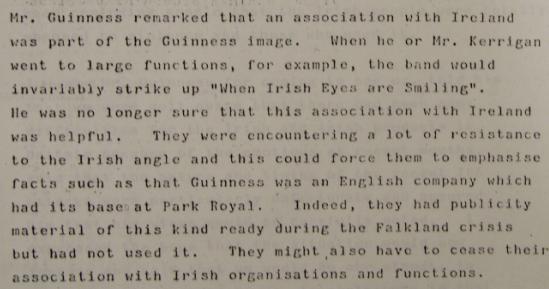
In the 1980's, one of the management team in the company, Edward Guinness, referenced the conflicts in the occupied six counties of Ireland and in the Malvinas and spoke about how he didn't agree with the attitude from Leinster House in regards to not (publicly) supporting Westminster in its 'endeavours' in those two areas of conflict (see text graphic, above), opining aloud that he was "..no longer sure the association with Ireland was helpful.." and stating that it may be opportune to "..emphasise facts such as that Guinness was an English company.."
It is indeed "an English company" ; in 1997, that company further integrated itself into its 'English (business) Empire' when it and the 'Grand Metropolitan' company merged to form 'Diageo'. Guinness could have been better to the Irish, just as the Irish were good for Guinness. But I'll stick to my cider, anyway, as I raise a pint to Arthur Guinness, who died on this date - 23rd January - in 1803.
Up ya Boy, ya - and here's to the Wild Rover...!
'SAVINGS LAW SHOULD BE CHANGED' : a letter sent to 'The Irish Times' newspaper by a Dr. Lucey.
From 'The United Irishman' newspaper, February 1955.
"I urge most strongly that the law governing savings be changed so that the local community may be allowed to benefit by the thrift of its own members" said the most Rev Dr Lucey, Bishop of Cork, when presiding at the annual meeting of the 'Cork Savings Bank' in Cork recently.
Dr Lucey said that the 'Cork Savings Bank' and the 'Post Office Savings Bank' were bound by law to deposit all their income with the Minister for Finance, and much of it was invested in British Government Securities in London. According to his latest report, of July 16th last year, no less than £27,000,000 of Irish savings was so invested. The rest, he said, was used at home, some being in our own State, and municipal loans.
"Dublin, incidentally, has £4,750,000 of it compared with a mere £240,000 to Cork, and the rest - roughly £30,000,000 - used as advances to the Exchequer etc. In a word, our savings are either exported to England, lent out by the State at, perhaps, 5%, to local authorities or used to finance State expenditure.." (MORE LATER).
'A NEW THEORY OF RELATIVITY', by Pat Rabbitte.
From 'Magill' magazine, February 1998.
There is a further reason why the men and women of the Garda Síochana ought to be properly paid - they ought not be driven out of necessity into double-jobbing. It is difficult to know how widespread the phenomenon is - there are no figures available - and it is hard to divine how much is due to gardaí being unable to raise their families on basic pay and how much is due to good old-fashioned greed. Some of it is quite harmless and nobody's business, but some of it seems to regard the day job as a distraction.
Where large-scale entrepreneurial talent is constrained in a garda uniform, should it not, as a matter of policy, be released into the private sector? What is the policy on the matter? For example, why should a garda moonlighting a couple of nights a week as a 'bouncer' be subjected to severe disciplinary action while another member of the force can, with impunity, devote himself to the business of his (sic) choice?
I turned eagerly to the recently published 'Report of the Steering Group on the Efficiency and Effectiveness of the Garda Síochana' for guidance on this and other questions. In other words - quis custodies custodiet? To my surprise , the question seems not to have been addressed. How is it possible to examine the 'efficiency and effectiveness of the Garda Síochana' and not address such a question? Or is it that the subject was discussed but no conclusions are reflected in the published report? No amount of 'Irish Times' reports or expansive pieces by 'security correspondents' on the 'comprehensive' nature of the report can reassure me on this point... (MORE LATER).
ON THIS DATE (23RD JANUARY) 64 YEARS AGO : JUST ANOTHER BRICK IN THE WALL...
"Only four per cent of the 450,000 pupils attending primary schools could get secondary education, while only eight per cent of secondary students could afford to go to a university.." - so said Dr Noel Browne, on the 23rd January 1955.
In February 1955, 'The United Irishman' newspaper quoted the above comment and (rightly) described it as "..a damning indictment of not merely Leinster House policy, but nineteen years of Fianna Fáil supremacy in that House..", and informed its readers that Dr Noel Browne was a Fianna Fáil Executive member who joined that party in 1953 but lost his Leinster House seat in the 1954 state election and was later expelled from that political party. Since then, however, not only have Fianna Fáil and their colleagues in Leinster House not fixed the education system in this State, but they have 'dumbed down' the health service to match it. Maybe in the hope/belief that if you leave school 'under-educated', you won't notice the shambles that the health service, and every other 'service' in this corrupt State, is in.
ON THIS DATE (OR THEREABOUTS!) 245 YEARS AGO : IF AT FIRST YOU DON'T SUCCEED...
'Our domestic news is first the death of Lord Sydney occasioned by a dose of Danish poison. His lordship to render himself agreeable to his lady upon their marriage stopped two issues he had in his thighs but found no ill effects until the 13th inst. when, after a night of great exercise by dancing, his temper and reason as appears since, was in some sort affected ; however, not so much as to make those about him immediately suspect it or the consequence. He complained of indisposition and sent for a physician. He republished his will leaving his estate to Capt. Cosby of the Navy and added a codicil leaving the jewels he bought for his wife (whom in his delirium he was jealous of) and the family china to his sister Lady Farnham, after which being disappointed in an attempt to shoot himself and one to poison himself, he took on (this date) the dose which was sufficiently strong to carry him off in a few hours..' - from a newspaper report of the time.
Dudley Cosby [pictured] ('Baron Sydney'), an MP for Carrick, was born in that part of Donegal in 1730 into a well-to-do family and, as expected, was groomed for, and accepted, a 'diplomatic' lifestyle - at 33 years of age he took a position in the 'Irish House of Commons' as a political representative and was, that same year, appointed by his political peers as a 'Minister Resident' to Denmark. He was elected to the Irish House of Commons as one of two representatives for Carrick in 1763 (a seat he held until 1768). That same year (1763) he was also appointed 'Minister Resident to Denmark', where he was to assist the aged 'Envoy Extraordinary', Walter Titley. He arrived in Copenhagen in February 1764, but returned to Britain already the following year. In 1768 he was elevated to the Peerage of Ireland as Lord Sydney, of Leix, Baron Stradbally and, like many English 'diplomats' in Ireland, he came from a 'troubled' family and was himself actually described as insane in diplomatic correspondence from the time!
At least one of his relatives, Francis, was known to be a thug who repeatedly murdered and abused the native Irish to enforce his writ and publicly robbed, cheated and blackmailed anyone who could improve his financial position - "...he was a law unto himself who terrorised and butchered the native Irish. He acted in his own best financial interests, and when he wasn't just plain killing people he was swindling, blackmailing and double-crossing them (and) proved himself a prolific slayer of the Irish in the battles around the Pale..he was given the previous Franciscan religious house in Stradbally by Queen Elizabeth I in 1562, as a reward for his enthusiastic suppression of the natives...his entry in the 'Royal Irish Academy’s Dictionary of Irish Biography' describes him as living a life of cruelty, deception and extreme violence...he set to work on his main local rival, the Laois Gaelic chief Ruairí Óg Ó Mórdha and they began their ill-fated relationship by running lucrative protection rackets together (but) they fell out when Cosby's brother-in-law executed two of Ó Mórdha's cousins.
In retaliation Ó Mórdha kidnapped Cosby's son, Alexander (and) a peace summit was called in Mullamast, in Co Kildare. But when 70 or so of Ó Mórdha's men turned up, Cosby's forces killed them, in an event that became known as the 'Massacre of Mullaghmast'. In 1580, Cosby was on a campaign against Irish rebel forces in Wicklow, an encounter that became known as the 'Battle of Glenmalure'. It is believed that Cosby was killed by his own men during the battle.." (From here.)
Anyway - the (other!) insane family member, Dudley, who was born in 1730, died at forty-four years of age in 1774 on, according to various sources, either the 22nd or 23rd January. And Francis probably had something to do with that as well..!
ON THIS DATE (23RD JANUARY) 121 YEARS AGO : 'DISSIDENT' GROUP FORMED.
'The United Irish League was launched in January 1898 (and) by early 1900 it had spread across most of Ireland, and was to have major implications for the future course of Irish nationalism. Its methods were partly a consequence of a cumulative experience from the past, focused particularly on its immediate predecessors, the Land League of 1879–82, the subsequent Irish National League, and the Plan of Campaign in the latter half of the 1880s. Its political and agrarian purposes were to an unusual degree clearly articulated, thereby enabling a more precise analysis of the way in which particular methods of protest were related to objectives..' (from here.)
'Its principal architect was William O'Brien, a member of Parnell's Parliamentary Party in the 1880's and of the anti-Parnellite majority faction after 1891. After withdrawing from his parliamentary seat in 1895, O'Brien worked locally in west Mayo in facilitating and influencing the development of a new agrarian agitation focused on the plight of evicted tenants, on hostility to "land grabbers," and against the graziers occupying land that would otherwise have been available for tillage farming. With the help of others, especially the Parnellite MP T. C. Harrington and the veteran founder of the Land League, Michael Davitt, O'Brien directed his energies toward "a great accumulation of national strength".
'The organization that resulted, the United Irish League, had three interconnected objectives. The first, and most incidental, of these was to capture an initiative on the celebrations of the centenary of the 1798 United Irishmen's rebellions, then at risk of passing to the advocates of physical force ('1169' comment - surely, as that 1798 rising was an action of 'physical force', those who supported that action could better 'lay claim' to it than those who were opposed to such an activity?) . The second objective was to infuse into national politics an enthusiasm that, "drawing an irresistible strength and reality from the conditions in the west," would make impossible continuation of dissension and factionalism between Parnellites and anti-Parnellites. And the third, most tangible and practical objective, was to secure from Parliament a measure enabling tenant farmers to acquire ownership of their land..' (from here.)
William O'Brien was born at Bank Place in Mallow, County Cork, in 1852 ; he died, aged 76, in 1928. He was an Irish nationalist, journalist, agrarian agitator, social revolutionary, politician, party leader, newspaper publisher, author and Member of Parliament (MP) in the 'House of Commons of the United Kingdom of Great Britain and Ireland', and was particularly associated with the campaigns for land reform in Ireland during the late 19th and early 20th centuries - more here. Due to policy disagreements and splits, the 'UIL' was mostly active in the Ulster area in its latter years and had disappeared altogether by the mid-1920's.
Thanks for reading, Sharon.
An edited version of this speech was published in 'The United Irishman' newspaper in October 1954. This is the speech in full ; on the 13th March, 1920, Terence MacSwiney (pictured) was unanimously elected as the 'Lord Mayor of Cork' by that city's Corporation. He donated his salary for the position to an outside organisation and received no salary for the other position he held at that time - Brigadier of the No. 1 Brigade, Cork IRA.
"Gentlemen, you have paid tribute to him on all sides. It will be my duty and steady purpose to follow that line as faithfully as in my power, though no man in this Council could hope to discharge its functions with his ability and his perfect grasp of public business in all its details and as one harmonious whole.
I have thought it necessary to touch on this normal duty of ours, though — and it may seem strange to say it — I feel at the moment it is even a digression. For the menace of our enemies hangs over us, and the essential immediate purpose is to show the spirit that animates us, and how we face the future. Our spirit is but to be a more lively manifestation of the spirit in which we began the year — to work for the city in a new zeal, inspired by our initial act when we dedicated it and formally attested our allegiance, to bring by our administration of the city, glory to our allegiance, and by working for our city's advancement with constancy in all honourable ways, in her new dignity as one of the first cities in Ireland to work for and if need be to die for.
I would recall some words of mine on that day of our first meeting after the election of Lord Mayor. I realised that most of you in the minority here would be loyal to us, if doing so did not threaten your lives ; but that you lacked the spirit and the hope to join with us to complete the work of liberation so well begun. I allude to it here again, because I wish to point out again the secret of our strength and the assurance of our final victory. This contest of ours is not on our side a rivalry of vengeance, but one of endurance — it is not they who can inflict most but they who can suffer most will conquer — though we do not abrogate our function to demand and see that evil doers and murderers are punished for their crimes..." (MORE LATER).
BLOODY SUNDAY PICKET, SATURDAY, 26TH JANUARY 2019, GPO, DUBLIN, 12.45PM TO 1.45PM.
After a peaceful Civil Rights march on January 30th, 1972 - from Creggan to Free Derry Corner - units of the British army Parachute Regiment opened fire with automatic rifles and shot dead 13 unarmed civilians, injuring many more. It was later revealed that some days prior to the massacre, the British soldiers involved had been briefed to "..shoot to kill.." at the march.
"This Sunday became known as 'Bloody Sunday' and bloody it was. It was quite unnecessary. It strikes me that the (British) army ran amok that day and shot without thinking of what they were doing. They were shooting innocent people. They may have been taking part in a parade which was banned, but that did not justify the troops coming in and firing live rounds indiscriminately. I would say without reservations that it was sheer unadulterated murder. It was murder, gentlemen" - the words of British Major Hubert O'Neill, Derry City Coroner, at the conclusion of the inquests on the 13 people killed by the British Army on that day. On Saturday January 26th next, a picket to mark the anniversary of that massacre will be held at the GPO in Dublin, from 12.45pm to 1.45pm. All welcome!
ON THIS DATE (23RD JANUARY) 216 YEARS AGO - DEATH OF THE 'GUINNESS BLACK PROTESTANT PORTER' MAN!
'Arthur Guinness disapproved of the United Irishmen's Rebellion of 1798. Because of this, the new brew became known as 'Guinness's black Protestant porter'. Catholics and nationalists boycotted the drink for a time, but far from damaging his trade, Guinness used the opportunity to set up a lucrative export trade with England...' (from here.)
I don't drink the stuff meself (..much more refined than that, so I am..!) but that drink, and the family associated with it - Guinness - have an 'interesting' history. Henry Grattan (to whom the Guinness family were related, through marriage) and Arthur were both vocal critics of the then taxation system which imposed tariffs on, among other goods, beer and, while both men were 'sympathetic' towards the suffering of the Irish, both were prepared to accept and, indeed, campaigned for, less than complete Irish freedom from the British 'crown'. Arthur was not only against full independence for Ireland but was politically opposed to those who were to the extent that, in republican circles, he was considered to be an informer, collecting and passing information to 'crown' agents - the 'Union Star' newspaper described him as "..a brewer at James's Gate, an active spy. United Irishmen will be cautious of dealing with any publican who sells his drink..."
Arthur is on record for being 'directly opposed to any movement toward Irish independence (and wanting) Ireland to remain under English control', to which end one of his family members, 'Lord' Iveagh, donated £10,000 to the UVF arms fund in 1913. As employers, they were decent enough to most of their employees - 'While they maintained their reputation as good employers and philanthropists, their unionist politics left them out on a limb in independent Ireland (sic) , although they quickly adjusted to doing business with the new Free State. In many respects they were the ultimate business pragmatists: the union was important to them because so much of their stout was sold in Britain and the empire. When a trade war threatened in the 1930s they finally activated plans that had been drawn up when Home Rule looked likely before the first World War and moved their headquarters to England...' (from here.)
'In the run-up to the Easter Rising, members of the Irish Volunteers who worked in Guinness' were discouraged from openly parading. Frank Henderson, a captain in the Irish Volunteers who took part in the Howth Gun Running and the Easter Rising, said Guinness' staff were wary that they may be victimised in their workplace...the company took a hard line with anybody displaying any form of support for Irish republicanism or nationalism. Following the 1916 Rising, Guinness was one of a number of companies that dismissed its staff suspected of involvement in the rebellion or sympathetic to those who took part. During the fighting in 1916, trucks used by Guinness' were converted into improvised armoured fighting vehicles by the British Army and used against republican forces. One such Guinness truck used by the British was made by bolting four boilers onto the rear of a Guinness flatbed truck. These were believed to have been the first armoured cars used in Ireland. There are conflicting reports over whether these vehicles were commandeered by the British Army or donated to them by Guinness & Co...' (..more here.)
In the 1980's, one of the management team in the company, Edward Guinness, referenced the conflicts in the occupied six counties of Ireland and in the Malvinas and spoke about how he didn't agree with the attitude from Leinster House in regards to not (publicly) supporting Westminster in its 'endeavours' in those two areas of conflict (see text graphic, above), opining aloud that he was "..no longer sure the association with Ireland was helpful.." and stating that it may be opportune to "..emphasise facts such as that Guinness was an English company.."
It is indeed "an English company" ; in 1997, that company further integrated itself into its 'English (business) Empire' when it and the 'Grand Metropolitan' company merged to form 'Diageo'. Guinness could have been better to the Irish, just as the Irish were good for Guinness. But I'll stick to my cider, anyway, as I raise a pint to Arthur Guinness, who died on this date - 23rd January - in 1803.
Up ya Boy, ya - and here's to the Wild Rover...!
'SAVINGS LAW SHOULD BE CHANGED' : a letter sent to 'The Irish Times' newspaper by a Dr. Lucey.
From 'The United Irishman' newspaper, February 1955.
"I urge most strongly that the law governing savings be changed so that the local community may be allowed to benefit by the thrift of its own members" said the most Rev Dr Lucey, Bishop of Cork, when presiding at the annual meeting of the 'Cork Savings Bank' in Cork recently.
Dr Lucey said that the 'Cork Savings Bank' and the 'Post Office Savings Bank' were bound by law to deposit all their income with the Minister for Finance, and much of it was invested in British Government Securities in London. According to his latest report, of July 16th last year, no less than £27,000,000 of Irish savings was so invested. The rest, he said, was used at home, some being in our own State, and municipal loans.
"Dublin, incidentally, has £4,750,000 of it compared with a mere £240,000 to Cork, and the rest - roughly £30,000,000 - used as advances to the Exchequer etc. In a word, our savings are either exported to England, lent out by the State at, perhaps, 5%, to local authorities or used to finance State expenditure.." (MORE LATER).
'A NEW THEORY OF RELATIVITY', by Pat Rabbitte.
From 'Magill' magazine, February 1998.
There is a further reason why the men and women of the Garda Síochana ought to be properly paid - they ought not be driven out of necessity into double-jobbing. It is difficult to know how widespread the phenomenon is - there are no figures available - and it is hard to divine how much is due to gardaí being unable to raise their families on basic pay and how much is due to good old-fashioned greed. Some of it is quite harmless and nobody's business, but some of it seems to regard the day job as a distraction.
Where large-scale entrepreneurial talent is constrained in a garda uniform, should it not, as a matter of policy, be released into the private sector? What is the policy on the matter? For example, why should a garda moonlighting a couple of nights a week as a 'bouncer' be subjected to severe disciplinary action while another member of the force can, with impunity, devote himself to the business of his (sic) choice?
I turned eagerly to the recently published 'Report of the Steering Group on the Efficiency and Effectiveness of the Garda Síochana' for guidance on this and other questions. In other words - quis custodies custodiet? To my surprise , the question seems not to have been addressed. How is it possible to examine the 'efficiency and effectiveness of the Garda Síochana' and not address such a question? Or is it that the subject was discussed but no conclusions are reflected in the published report? No amount of 'Irish Times' reports or expansive pieces by 'security correspondents' on the 'comprehensive' nature of the report can reassure me on this point... (MORE LATER).
ON THIS DATE (23RD JANUARY) 64 YEARS AGO : JUST ANOTHER BRICK IN THE WALL...
"Only four per cent of the 450,000 pupils attending primary schools could get secondary education, while only eight per cent of secondary students could afford to go to a university.." - so said Dr Noel Browne, on the 23rd January 1955.
In February 1955, 'The United Irishman' newspaper quoted the above comment and (rightly) described it as "..a damning indictment of not merely Leinster House policy, but nineteen years of Fianna Fáil supremacy in that House..", and informed its readers that Dr Noel Browne was a Fianna Fáil Executive member who joined that party in 1953 but lost his Leinster House seat in the 1954 state election and was later expelled from that political party. Since then, however, not only have Fianna Fáil and their colleagues in Leinster House not fixed the education system in this State, but they have 'dumbed down' the health service to match it. Maybe in the hope/belief that if you leave school 'under-educated', you won't notice the shambles that the health service, and every other 'service' in this corrupt State, is in.
ON THIS DATE (OR THEREABOUTS!) 245 YEARS AGO : IF AT FIRST YOU DON'T SUCCEED...
'Our domestic news is first the death of Lord Sydney occasioned by a dose of Danish poison. His lordship to render himself agreeable to his lady upon their marriage stopped two issues he had in his thighs but found no ill effects until the 13th inst. when, after a night of great exercise by dancing, his temper and reason as appears since, was in some sort affected ; however, not so much as to make those about him immediately suspect it or the consequence. He complained of indisposition and sent for a physician. He republished his will leaving his estate to Capt. Cosby of the Navy and added a codicil leaving the jewels he bought for his wife (whom in his delirium he was jealous of) and the family china to his sister Lady Farnham, after which being disappointed in an attempt to shoot himself and one to poison himself, he took on (this date) the dose which was sufficiently strong to carry him off in a few hours..' - from a newspaper report of the time.
Dudley Cosby [pictured] ('Baron Sydney'), an MP for Carrick, was born in that part of Donegal in 1730 into a well-to-do family and, as expected, was groomed for, and accepted, a 'diplomatic' lifestyle - at 33 years of age he took a position in the 'Irish House of Commons' as a political representative and was, that same year, appointed by his political peers as a 'Minister Resident' to Denmark. He was elected to the Irish House of Commons as one of two representatives for Carrick in 1763 (a seat he held until 1768). That same year (1763) he was also appointed 'Minister Resident to Denmark', where he was to assist the aged 'Envoy Extraordinary', Walter Titley. He arrived in Copenhagen in February 1764, but returned to Britain already the following year. In 1768 he was elevated to the Peerage of Ireland as Lord Sydney, of Leix, Baron Stradbally and, like many English 'diplomats' in Ireland, he came from a 'troubled' family and was himself actually described as insane in diplomatic correspondence from the time!
At least one of his relatives, Francis, was known to be a thug who repeatedly murdered and abused the native Irish to enforce his writ and publicly robbed, cheated and blackmailed anyone who could improve his financial position - "...he was a law unto himself who terrorised and butchered the native Irish. He acted in his own best financial interests, and when he wasn't just plain killing people he was swindling, blackmailing and double-crossing them (and) proved himself a prolific slayer of the Irish in the battles around the Pale..he was given the previous Franciscan religious house in Stradbally by Queen Elizabeth I in 1562, as a reward for his enthusiastic suppression of the natives...his entry in the 'Royal Irish Academy’s Dictionary of Irish Biography' describes him as living a life of cruelty, deception and extreme violence...he set to work on his main local rival, the Laois Gaelic chief Ruairí Óg Ó Mórdha and they began their ill-fated relationship by running lucrative protection rackets together (but) they fell out when Cosby's brother-in-law executed two of Ó Mórdha's cousins.
In retaliation Ó Mórdha kidnapped Cosby's son, Alexander (and) a peace summit was called in Mullamast, in Co Kildare. But when 70 or so of Ó Mórdha's men turned up, Cosby's forces killed them, in an event that became known as the 'Massacre of Mullaghmast'. In 1580, Cosby was on a campaign against Irish rebel forces in Wicklow, an encounter that became known as the 'Battle of Glenmalure'. It is believed that Cosby was killed by his own men during the battle.." (From here.)
Anyway - the (other!) insane family member, Dudley, who was born in 1730, died at forty-four years of age in 1774 on, according to various sources, either the 22nd or 23rd January. And Francis probably had something to do with that as well..!
ON THIS DATE (23RD JANUARY) 121 YEARS AGO : 'DISSIDENT' GROUP FORMED.
'The United Irish League was launched in January 1898 (and) by early 1900 it had spread across most of Ireland, and was to have major implications for the future course of Irish nationalism. Its methods were partly a consequence of a cumulative experience from the past, focused particularly on its immediate predecessors, the Land League of 1879–82, the subsequent Irish National League, and the Plan of Campaign in the latter half of the 1880s. Its political and agrarian purposes were to an unusual degree clearly articulated, thereby enabling a more precise analysis of the way in which particular methods of protest were related to objectives..' (from here.)
'Its principal architect was William O'Brien, a member of Parnell's Parliamentary Party in the 1880's and of the anti-Parnellite majority faction after 1891. After withdrawing from his parliamentary seat in 1895, O'Brien worked locally in west Mayo in facilitating and influencing the development of a new agrarian agitation focused on the plight of evicted tenants, on hostility to "land grabbers," and against the graziers occupying land that would otherwise have been available for tillage farming. With the help of others, especially the Parnellite MP T. C. Harrington and the veteran founder of the Land League, Michael Davitt, O'Brien directed his energies toward "a great accumulation of national strength".
'The organization that resulted, the United Irish League, had three interconnected objectives. The first, and most incidental, of these was to capture an initiative on the celebrations of the centenary of the 1798 United Irishmen's rebellions, then at risk of passing to the advocates of physical force ('1169' comment - surely, as that 1798 rising was an action of 'physical force', those who supported that action could better 'lay claim' to it than those who were opposed to such an activity?) . The second objective was to infuse into national politics an enthusiasm that, "drawing an irresistible strength and reality from the conditions in the west," would make impossible continuation of dissension and factionalism between Parnellites and anti-Parnellites. And the third, most tangible and practical objective, was to secure from Parliament a measure enabling tenant farmers to acquire ownership of their land..' (from here.)
William O'Brien was born at Bank Place in Mallow, County Cork, in 1852 ; he died, aged 76, in 1928. He was an Irish nationalist, journalist, agrarian agitator, social revolutionary, politician, party leader, newspaper publisher, author and Member of Parliament (MP) in the 'House of Commons of the United Kingdom of Great Britain and Ireland', and was particularly associated with the campaigns for land reform in Ireland during the late 19th and early 20th centuries - more here. Due to policy disagreements and splits, the 'UIL' was mostly active in the Ulster area in its latter years and had disappeared altogether by the mid-1920's.
Thanks for reading, Sharon.
Wednesday, January 09, 2019
FROM TORY UNIONISM TO 'HARD LINE REPUBLICAN' IN 1916.
ON THIS DATE (9TH JANUARY) 97 YEARS AGO : RESIGNATIONS OVER THE TREATY OF SURRENDER.
"In view of the vote that was taken here on Saturday and which I had definitely to oppose as one that was tending to subvert the Republic which I was elected to my present position to defend and maintain ; and as it appeared to me also to be a vote which would tend to subvert the independence of the country, I could no longer continue — as I was beaten in that - I could no longer continue in my present office feeling I did not have the confidence of the House. I therefore wish to place my resignation in the hands of the Assembly ; and I think it is not necessary to say any further words in doing so, but simply to resign my office and the responsibilities of it and the members of the Cabinet all go with my resignation" - Eamon de Valera (pictured) stepped down from that position on the 9th January 1922 because of the 'Treaty of Surrender', which had been accepted by Michael Collins and others (Arthur Griffith, Riobárd Bartún [Robert Barton], Eamonn S Ó Dugáin [Eamonn Duggan] and Seoirse Ghabháin Uí Dhubhthaigh [George Gavan Duffy] had also appended their names to that vile document) on the 6th December, 1921, in London - at ten minutes past two on that Tuesday morning (6th December 1921), those men accepted 'dominion status' and an oath which gave "allegiance" to the Irish Free State and "fidelity" to the British Crown - within six months a civil war was raging in Ireland, between the British-supported Free Staters and the Irish republicans who did not accept that 'Treaty'.
De Valera had already stated, on the 18th December 1921, that he was against that 'Treaty' - "We were elected by the Irish people and did the Irish people think that we were liars when we said that we meant to uphold the Republic. I am against this Treaty because it does not reconcile Irish national aspirations with association with the British Government. I am against this Treaty not because I am a man of war, but a man of peace. I am against this Treaty because it will not end the centuries of conflict between the two nations of Great Britain and Ireland. It gives away Irish independence ; it brings us into the British Empire.." ('1169' comment - yet the same man had no problem with working on behalf of that 'empire' in the years following that 'not acceptable' speech!)
He had offered to resign on the 6th January, 1922, but the offer was not accepted at the time - but, on the 9th, it was accepted by 60 votes to 58 votes, following which Arthur Griffith (another Free-Stater-in-waiting) stated - "Before another word is spoken I want to say : I want the Deputies here to know, and all Ireland to know, that this vote is not to be taken as against President de Valera. It is a vote to help the Treaty, and I want to say now that there is scarcely a man I have ever met in my life that I have more love and respect for than President de Valera. I am thoroughly sorry to see him placed in such a position. We want him with us."
Others objected to the 'deal', and among them were Austin Stack, who stated his intention to fight on "even if this rotten document be accepted", and Erskine Childers, who complained that the 'Treaty Ports' section of the document would prevent the Free State from pursuing an independent foreign policy. The seven women members of the Dáil opposed the Treaty on the grounds that lives had been lost in pursuit of an Irish Republic, which the document subverted. Many, such as Margaret Pearse, Mary MacSwiney and Kathleen Clarke had lost close relatives in the struggle for independence and stated that such an outcome was not what they and others had fought for. And, one week later (on the 16th January), Michael Collins and his Free State comrades were given the seat of British injustice in Ireland - Dublin Castle - from which to continue the campaign against Irish republicans from.
Máire Nic Shuibhne [pictured] (Mary MacSwiney) stated her objection to the 'Treaty' - "I claim my right, before matters go any further, to register my protest, because I look upon this act worse than I look upon the Act of Castlereagh. I, for one, will have neither hand, act, nor part in helping the Irish Free State to carry this nation of ours, this glorious nation that has been betrayed here to-night, into the British Empire — either with or without your hands up. I maintain here now that this is the grossest act of betrayal that Ireland ever endured. I know some of you have done it from good motives ; soldiers have done it to get a gun, God help them! Others, because they thought it best in some other way. I do not want to say a word that would prevent them from coming back to their Mother Republic, but I register my protest, and not one bit of help that we can give will we give them.
The speech we have heard sounded very beautiful — as the late Minister of Finance can do it ; he has played up to the gallery in this thing, but I tell you it may sound very beautiful but it will not do. Ireland stands on her Republican Government and that Republican Government cannot touch the pitch of the Free State without being fouled ; and here and now I call on all true Republicans ; we all want to protect the public safety, it is our side that will do its best to protect the public safety. We want no such terrible troubles in the country as faction fights. We can never descend to the faction fights of former days. We have established a Government, and we will have to protect it.
Therefore, let there be no misunderstanding, no soft talk, no ráiméis at this last moment of the betrayal of our country, no soft talk about union. You cannot unite a spiritual Irish Republic and a betrayal worse than Castlereagh's, because it was done for the Irish nation. You may talk about the will of the Irish people, as Arthur Griffith did ; you know it is not the will of the Irish people, it is the fear of the Irish people, as the Lord Mayor of Cork says. And tomorrow or another day when they come to their senses, they will talk of those who betrayed them today as they talk of Castlereagh. Make no doubt about it. This is a betrayal, a gross betrayal, and the fact is that it is only a small majority, and that majority is not united. Half of them look for a gun and the other half are looking for the fleshpots of the Empire. I tell you here there can be no union between the representatives of the Irish Republic and the so-called Free State."
And today, on the 9th January 2019 - 97 years after the Westminster and Free State-enforced partition of Ireland - Irish republicans remain adamant that there can be no political union between "the representatives of the Irish Republic and the so-called Free State".
"WE ASK FOR NO MERCY AND WE WILL MAKE NO COMPROMISE" - TERENCE MacSWINEY.
An edited version of this speech was published in 'The United Irishman' newspaper in October 1954. This is the speech in full ; on the 13th March, 1920, Terence MacSwiney (pictured) was unanimously elected as the 'Lord Mayor of Cork' by that city's Corporation. He donated his salary for the position to an outside organisation and received no salary for the other position he held at that time - Brigadier of the No. 1 Brigade, Cork IRA.
"I shall be as brief as possible. This is not an occasion for many words, least of all a conventional exchange of compliments and thanks. The circumstances of the vacancy in the office of Lord Mayor governed inevitably the filling of it. And I come here more as a soldier stepping into the breach, than as an administrator to fill the first post in the municipality. At a normal time it would be your duty to find for this post the councillor most practical and experienced in public affairs. But the time is not normal. We see in the manner in which our late Lord Mayor was murdered an attempt to terrify us all. Our first duty is to answer that threat in the only fitting manner by showing ourselves unterrified, cool and inflexible for the fulfillment of our chief purpose - the establishment of the independence and integrity of our country — the peace and the happiness of our country. To that end I am here.
I was more closely associated than any other here with our late murdered friend and colleague, both before and since the events of Easter Week, in prison and out of it, in a common work of love for Ireland, down to the hour of his death. For that reason I take his place. It is, I think, though I say it, the only fitting answer to those who struck him down. Following from that there is a further matter of importance only less great — it touches the efficient continuance of our civic administration. If this recent unbearable aggravation of our persecution by our enemies should cause us to suspend voluntarily the normal discharge of our duties, it would help them very materially in their campaign to overthrow our cause. I feel the question of the future conduct of our affairs is in all our minds. And I think I am voicing the general view when I say that the normal functions of our corporate body must proceed, as far as in our power lies, uninterrupted, with that efficiency and integrity of which our late civic head gave such brilliant promise.
I don't wish to sound a personal note, but this much may be permitted under the circumstances — I made myself active in the selection of our late colleague for the office of Lord Mayor. He did not seek the honour and would not accept it as such, but when put to him as a duty he stepped to his place like a soldier. Before his election we discussed it together in the intimate way we discussed everything touching our common work since Easter Week. We debated together what ought to be done and what could be done, keeping in mind, as in duty bound, not only the ideal line of action but the practical line at the moment as well. That line he followed with an ability and success all his own..."
(MORE LATER).
'A NEW THEORY OF RELATIVITY...', by Pat Rabbitte.
From 'Magill' magazine, February 1998.
Whoever is responsible, 'relativity' has certainly caught on in Ireland - some have done relatively well from it. Others not so well. There is no doubt it has been expensive for the Irish taxpayer (sic - he means 'State taxpayer'). Charlie McCreevy may prefer a chat with his caddy at the 'K Club', but there is no doubt that when it comes to 'relativity', the finance minister agrees with the Liberty Hall porter ; he warned in his budget-day speech that 'relativity is something up with which he will not put'. Well, the gardaí have news for Mr McCreevy - their 'relativity' claim is well advanced and coming down the tracks at a fierce pace. I support the gardaí.
It is important that members of the Garda Síochana are fairly remunerated for the impartial and effective discharge of their important duties. The manner in which they serve the citizenry to a considerable extent defines the character of our democracy. We are regularly reminded that for many gardaí their job is becoming increasingly dangerous and they are expected to risk life and limb so that the citizen can sleep safely in his or her bed.
Insofar as is reasonable - and it is not possible in absolute terms to reflect that nobility in pay terms - the gardaí in turn have a right to expect a fair day's pay for a fair day's work...
(MORE LATER).
We won't be posting here on the 16th January next as we'll only be just about coming out of the aftermath (!) of the monthly 650-ticket fund-raising raffle, which will be held on Sunday, 13th January, in a venue on the Dublin/Kildare border, but we couldn't let the 16th pass without mentioning a remarkable Irish republican woman who, to our shame, is practically forgotten about today. The following piece will hopefully encourage some of our readers to want to find out more about this dedicated Irish republican 'dissident' -
'DEATH OF PATRIOT IRISHWOMAN'.
From 'The United Irishman' newspaper, February 1955.
The death of Gobnait Ni Bruadar (Albina Broderick), pictured occurred on the 16th January last (1955), at her residence in Ballimeoona, Castlecove, in County Kerry. This splendid woman remained constant in her loyalty to Ireland and was actively associated with the Republican Movement until she died in the 93rd year of her life.
She was educated in England and spent most of her early life there, was 'presented at the Court' and knew only the 'society life' of a 'Lady' in England. Yet this did not prevent her from seeing the ills which existed in Ireland under the system of the absentee landlord nor the injustices being perpetrated by the English conquerors of the native Ireland she loved.
And for her, love was shown by deeds, not words - she gave up the easier way of living and took up one decidedly less attractive in the Republican Movement. She became a member of Cumann na mBan and remained in that organisation while she could continue to take an active part. In her last years, when too old to be actively militant, she still continued to help in every way she could, particularly in raising funds. The dependents of the republican prisoners were always a special care of hers. Her life was an inspiration to all who knew her and the Republican Movement has great reason to regret her death.
(END OF 'DEATH OF PATRIOT IRISHWOMAN' : next post [23rd January 2019], from the same source - 'SAVINGS LAW SHOULD BE CHANGED', a letter sent to the 'Irish Times' by a Dr. Lucey).
Also, regarding the 16th January date (...this post dictated by the in-house requirement for gender balance!) we want to give a brief mention to a perhaps lesser-known figure from Irish republican history, who was born on the 16th January 1822 - "From the time I came to what have been called the years of discretion, my entire thought has been devoted to Ireland. I believed the course I pursued was right ; others may take a different view. When the proceedings of this trial go forth to the world, the people will say that the cause of Ireland is not to be despaired of, that Ireland is not yet a lost country — that as long as there are men in any country prepared to expose themselves to every difficulty and danger in its service, prepared to brave captivity, even death itself if needs be, that country cannot be lost..." - Thomas Clarke Luby (pictured) was born in Dublin on this date (16th January) 197 years ago.
His mother was of a different religious persuasion from his father (a Tipperary-born Church of Ireland clergyman) and both parents were determined that their son, Thomas, should be 'successful' in life : he was educated at Trinity College, in Dublin, from where he graduated in 1840, then studied law at 'The Temple', in London. However, he became more interested in journalism than in practising law and, as a 'toff' with a solid social conscience, he joined the 'Repeal Association' but came to the opinion that that organisation was not prepared to go far enough in defending Irish society from the ravages inflicted on it by Westminster and joined a more radical organisation, the 'Young Irelanders' and was active in the 1848 Rising. When that rebellion was put down by the British, Luby and other 'dissidents' established a new revolutionary organisation, the 'Irish Democratic Association' ('IDA') and once again challenged British misrule in Ireland - but, once again, they failed in their endeavours.
Shortly after that failure, Luby went to France in the hope of improving his military tactics and then to Australia, where he stayed for about a year, before returning to Ireland. He made his living through journalism (mostly working for, and with, 'The Tribune' newspaper) and, in 1858, he helped establish the 'Irish Republican Brotherhood', known as the 'Fenians,' with the avowed and same purpose of that of his previous efforts - to overthrow British rule in Ireland and establish an Irish Republic. Such were the times he lived in - including the period in our history when the 'Irish National Invincibles' struck a blow for Irish freedom - and Thomas Clarke Luby supported and/or was involved in every such effort. He died in Jersey City, at 79 years of age, in 1901, from paralysis, on the 29th November, 1901, and is buried, with his wife, in Bay View Cemetery in that city, under a headstone which reads - 'Thomas Clarke Luby 1822–1901. He devoted his life to love of Ireland and quest of truth.'
His objective remains unfulfilled.
Thanks for reading ; we'll be back on Wednesday, 23rd January, 2019. Sharon.
"In view of the vote that was taken here on Saturday and which I had definitely to oppose as one that was tending to subvert the Republic which I was elected to my present position to defend and maintain ; and as it appeared to me also to be a vote which would tend to subvert the independence of the country, I could no longer continue — as I was beaten in that - I could no longer continue in my present office feeling I did not have the confidence of the House. I therefore wish to place my resignation in the hands of the Assembly ; and I think it is not necessary to say any further words in doing so, but simply to resign my office and the responsibilities of it and the members of the Cabinet all go with my resignation" - Eamon de Valera (pictured) stepped down from that position on the 9th January 1922 because of the 'Treaty of Surrender', which had been accepted by Michael Collins and others (Arthur Griffith, Riobárd Bartún [Robert Barton], Eamonn S Ó Dugáin [Eamonn Duggan] and Seoirse Ghabháin Uí Dhubhthaigh [George Gavan Duffy] had also appended their names to that vile document) on the 6th December, 1921, in London - at ten minutes past two on that Tuesday morning (6th December 1921), those men accepted 'dominion status' and an oath which gave "allegiance" to the Irish Free State and "fidelity" to the British Crown - within six months a civil war was raging in Ireland, between the British-supported Free Staters and the Irish republicans who did not accept that 'Treaty'.
De Valera had already stated, on the 18th December 1921, that he was against that 'Treaty' - "We were elected by the Irish people and did the Irish people think that we were liars when we said that we meant to uphold the Republic. I am against this Treaty because it does not reconcile Irish national aspirations with association with the British Government. I am against this Treaty not because I am a man of war, but a man of peace. I am against this Treaty because it will not end the centuries of conflict between the two nations of Great Britain and Ireland. It gives away Irish independence ; it brings us into the British Empire.." ('1169' comment - yet the same man had no problem with working on behalf of that 'empire' in the years following that 'not acceptable' speech!)
He had offered to resign on the 6th January, 1922, but the offer was not accepted at the time - but, on the 9th, it was accepted by 60 votes to 58 votes, following which Arthur Griffith (another Free-Stater-in-waiting) stated - "Before another word is spoken I want to say : I want the Deputies here to know, and all Ireland to know, that this vote is not to be taken as against President de Valera. It is a vote to help the Treaty, and I want to say now that there is scarcely a man I have ever met in my life that I have more love and respect for than President de Valera. I am thoroughly sorry to see him placed in such a position. We want him with us."
Others objected to the 'deal', and among them were Austin Stack, who stated his intention to fight on "even if this rotten document be accepted", and Erskine Childers, who complained that the 'Treaty Ports' section of the document would prevent the Free State from pursuing an independent foreign policy. The seven women members of the Dáil opposed the Treaty on the grounds that lives had been lost in pursuit of an Irish Republic, which the document subverted. Many, such as Margaret Pearse, Mary MacSwiney and Kathleen Clarke had lost close relatives in the struggle for independence and stated that such an outcome was not what they and others had fought for. And, one week later (on the 16th January), Michael Collins and his Free State comrades were given the seat of British injustice in Ireland - Dublin Castle - from which to continue the campaign against Irish republicans from.
Máire Nic Shuibhne [pictured] (Mary MacSwiney) stated her objection to the 'Treaty' - "I claim my right, before matters go any further, to register my protest, because I look upon this act worse than I look upon the Act of Castlereagh. I, for one, will have neither hand, act, nor part in helping the Irish Free State to carry this nation of ours, this glorious nation that has been betrayed here to-night, into the British Empire — either with or without your hands up. I maintain here now that this is the grossest act of betrayal that Ireland ever endured. I know some of you have done it from good motives ; soldiers have done it to get a gun, God help them! Others, because they thought it best in some other way. I do not want to say a word that would prevent them from coming back to their Mother Republic, but I register my protest, and not one bit of help that we can give will we give them.
The speech we have heard sounded very beautiful — as the late Minister of Finance can do it ; he has played up to the gallery in this thing, but I tell you it may sound very beautiful but it will not do. Ireland stands on her Republican Government and that Republican Government cannot touch the pitch of the Free State without being fouled ; and here and now I call on all true Republicans ; we all want to protect the public safety, it is our side that will do its best to protect the public safety. We want no such terrible troubles in the country as faction fights. We can never descend to the faction fights of former days. We have established a Government, and we will have to protect it.
Therefore, let there be no misunderstanding, no soft talk, no ráiméis at this last moment of the betrayal of our country, no soft talk about union. You cannot unite a spiritual Irish Republic and a betrayal worse than Castlereagh's, because it was done for the Irish nation. You may talk about the will of the Irish people, as Arthur Griffith did ; you know it is not the will of the Irish people, it is the fear of the Irish people, as the Lord Mayor of Cork says. And tomorrow or another day when they come to their senses, they will talk of those who betrayed them today as they talk of Castlereagh. Make no doubt about it. This is a betrayal, a gross betrayal, and the fact is that it is only a small majority, and that majority is not united. Half of them look for a gun and the other half are looking for the fleshpots of the Empire. I tell you here there can be no union between the representatives of the Irish Republic and the so-called Free State."
And today, on the 9th January 2019 - 97 years after the Westminster and Free State-enforced partition of Ireland - Irish republicans remain adamant that there can be no political union between "the representatives of the Irish Republic and the so-called Free State".
"WE ASK FOR NO MERCY AND WE WILL MAKE NO COMPROMISE" - TERENCE MacSWINEY.
An edited version of this speech was published in 'The United Irishman' newspaper in October 1954. This is the speech in full ; on the 13th March, 1920, Terence MacSwiney (pictured) was unanimously elected as the 'Lord Mayor of Cork' by that city's Corporation. He donated his salary for the position to an outside organisation and received no salary for the other position he held at that time - Brigadier of the No. 1 Brigade, Cork IRA.
"I shall be as brief as possible. This is not an occasion for many words, least of all a conventional exchange of compliments and thanks. The circumstances of the vacancy in the office of Lord Mayor governed inevitably the filling of it. And I come here more as a soldier stepping into the breach, than as an administrator to fill the first post in the municipality. At a normal time it would be your duty to find for this post the councillor most practical and experienced in public affairs. But the time is not normal. We see in the manner in which our late Lord Mayor was murdered an attempt to terrify us all. Our first duty is to answer that threat in the only fitting manner by showing ourselves unterrified, cool and inflexible for the fulfillment of our chief purpose - the establishment of the independence and integrity of our country — the peace and the happiness of our country. To that end I am here.
I was more closely associated than any other here with our late murdered friend and colleague, both before and since the events of Easter Week, in prison and out of it, in a common work of love for Ireland, down to the hour of his death. For that reason I take his place. It is, I think, though I say it, the only fitting answer to those who struck him down. Following from that there is a further matter of importance only less great — it touches the efficient continuance of our civic administration. If this recent unbearable aggravation of our persecution by our enemies should cause us to suspend voluntarily the normal discharge of our duties, it would help them very materially in their campaign to overthrow our cause. I feel the question of the future conduct of our affairs is in all our minds. And I think I am voicing the general view when I say that the normal functions of our corporate body must proceed, as far as in our power lies, uninterrupted, with that efficiency and integrity of which our late civic head gave such brilliant promise.
I don't wish to sound a personal note, but this much may be permitted under the circumstances — I made myself active in the selection of our late colleague for the office of Lord Mayor. He did not seek the honour and would not accept it as such, but when put to him as a duty he stepped to his place like a soldier. Before his election we discussed it together in the intimate way we discussed everything touching our common work since Easter Week. We debated together what ought to be done and what could be done, keeping in mind, as in duty bound, not only the ideal line of action but the practical line at the moment as well. That line he followed with an ability and success all his own..."
(MORE LATER).
'A NEW THEORY OF RELATIVITY...', by Pat Rabbitte.
From 'Magill' magazine, February 1998.
Whoever is responsible, 'relativity' has certainly caught on in Ireland - some have done relatively well from it. Others not so well. There is no doubt it has been expensive for the Irish taxpayer (sic - he means 'State taxpayer'). Charlie McCreevy may prefer a chat with his caddy at the 'K Club', but there is no doubt that when it comes to 'relativity', the finance minister agrees with the Liberty Hall porter ; he warned in his budget-day speech that 'relativity is something up with which he will not put'. Well, the gardaí have news for Mr McCreevy - their 'relativity' claim is well advanced and coming down the tracks at a fierce pace. I support the gardaí.
It is important that members of the Garda Síochana are fairly remunerated for the impartial and effective discharge of their important duties. The manner in which they serve the citizenry to a considerable extent defines the character of our democracy. We are regularly reminded that for many gardaí their job is becoming increasingly dangerous and they are expected to risk life and limb so that the citizen can sleep safely in his or her bed.
Insofar as is reasonable - and it is not possible in absolute terms to reflect that nobility in pay terms - the gardaí in turn have a right to expect a fair day's pay for a fair day's work...
(MORE LATER).
We won't be posting here on the 16th January next as we'll only be just about coming out of the aftermath (!) of the monthly 650-ticket fund-raising raffle, which will be held on Sunday, 13th January, in a venue on the Dublin/Kildare border, but we couldn't let the 16th pass without mentioning a remarkable Irish republican woman who, to our shame, is practically forgotten about today. The following piece will hopefully encourage some of our readers to want to find out more about this dedicated Irish republican 'dissident' -
'DEATH OF PATRIOT IRISHWOMAN'.
From 'The United Irishman' newspaper, February 1955.
The death of Gobnait Ni Bruadar (Albina Broderick), pictured occurred on the 16th January last (1955), at her residence in Ballimeoona, Castlecove, in County Kerry. This splendid woman remained constant in her loyalty to Ireland and was actively associated with the Republican Movement until she died in the 93rd year of her life.
She was educated in England and spent most of her early life there, was 'presented at the Court' and knew only the 'society life' of a 'Lady' in England. Yet this did not prevent her from seeing the ills which existed in Ireland under the system of the absentee landlord nor the injustices being perpetrated by the English conquerors of the native Ireland she loved.
And for her, love was shown by deeds, not words - she gave up the easier way of living and took up one decidedly less attractive in the Republican Movement. She became a member of Cumann na mBan and remained in that organisation while she could continue to take an active part. In her last years, when too old to be actively militant, she still continued to help in every way she could, particularly in raising funds. The dependents of the republican prisoners were always a special care of hers. Her life was an inspiration to all who knew her and the Republican Movement has great reason to regret her death.
(END OF 'DEATH OF PATRIOT IRISHWOMAN' : next post [23rd January 2019], from the same source - 'SAVINGS LAW SHOULD BE CHANGED', a letter sent to the 'Irish Times' by a Dr. Lucey).
Also, regarding the 16th January date (...this post dictated by the in-house requirement for gender balance!) we want to give a brief mention to a perhaps lesser-known figure from Irish republican history, who was born on the 16th January 1822 - "From the time I came to what have been called the years of discretion, my entire thought has been devoted to Ireland. I believed the course I pursued was right ; others may take a different view. When the proceedings of this trial go forth to the world, the people will say that the cause of Ireland is not to be despaired of, that Ireland is not yet a lost country — that as long as there are men in any country prepared to expose themselves to every difficulty and danger in its service, prepared to brave captivity, even death itself if needs be, that country cannot be lost..." - Thomas Clarke Luby (pictured) was born in Dublin on this date (16th January) 197 years ago.
His mother was of a different religious persuasion from his father (a Tipperary-born Church of Ireland clergyman) and both parents were determined that their son, Thomas, should be 'successful' in life : he was educated at Trinity College, in Dublin, from where he graduated in 1840, then studied law at 'The Temple', in London. However, he became more interested in journalism than in practising law and, as a 'toff' with a solid social conscience, he joined the 'Repeal Association' but came to the opinion that that organisation was not prepared to go far enough in defending Irish society from the ravages inflicted on it by Westminster and joined a more radical organisation, the 'Young Irelanders' and was active in the 1848 Rising. When that rebellion was put down by the British, Luby and other 'dissidents' established a new revolutionary organisation, the 'Irish Democratic Association' ('IDA') and once again challenged British misrule in Ireland - but, once again, they failed in their endeavours.
Shortly after that failure, Luby went to France in the hope of improving his military tactics and then to Australia, where he stayed for about a year, before returning to Ireland. He made his living through journalism (mostly working for, and with, 'The Tribune' newspaper) and, in 1858, he helped establish the 'Irish Republican Brotherhood', known as the 'Fenians,' with the avowed and same purpose of that of his previous efforts - to overthrow British rule in Ireland and establish an Irish Republic. Such were the times he lived in - including the period in our history when the 'Irish National Invincibles' struck a blow for Irish freedom - and Thomas Clarke Luby supported and/or was involved in every such effort. He died in Jersey City, at 79 years of age, in 1901, from paralysis, on the 29th November, 1901, and is buried, with his wife, in Bay View Cemetery in that city, under a headstone which reads - 'Thomas Clarke Luby 1822–1901. He devoted his life to love of Ireland and quest of truth.'
His objective remains unfulfilled.
Thanks for reading ; we'll be back on Wednesday, 23rd January, 2019. Sharon.
Wednesday, January 02, 2019
'THE GERMANS HAVE AS MUCH RIGHT TO IRELAND AS THE ENGLISH HAVE'.
ON THIS DATE (2ND JANUARY) 103 YEARS AGO : "FIGHT FOR IRELAND" SPEECH BY 1916 RISING LEADER.
"If the Germans landed in Ireland, taking it by force of arms, they would have just as much right to it as England...fight for Ireland and be buried in consecrated ground, not dying like those in France, to be thrown into a *bode.." - Tomás Ceannt, speaking at a public meeting in Ballynoe, County Cork, on the 2nd January 1916 - 103 years ago on this date (* borehole/hole in the ground).
Tomás Ceannt (Thomas Kent) was born on the 29th August, 1865, in Bawnard House, Castlelyons, in Cork, the fourth of seven sons and two daughters, for David and Mary Kent. The Kent family had a long tradition of fighting against social and political injustices : 'His family were squeezed off their land by the British Crown's incremental rate increases. Thomas Kent left for Boston in the United States, but returned to Ireland several years later, owing to illness. Himself and his three brothers became radicalised, and were often jailed for their political activities, chiefly their support for the Land League and their membership of the Irish Volunteers. When the Easter Rising kicked off in April 1916, Tomás Ceannt, then 50 years of age, and his brothers, obeyed Eoin MacNeill's countermanding order and stayed home, Kent having planned to head to Dublin to fight. In a swoop for known republican sympathisers, however, the RIC made a dawn raid on the Kent family home in Castlelyons.
The Ceannts resisted arrest and had a shoot-out with the RIC, which lasted four hours. The RIC's head constable was killed, his face blown off, before the Ceannts surrendered. When they arrested Tomás Ceannt..he was paraded through the town of Fermoy a bit like Jesus Christ. His hands were tied and he had no shoes — he wasn't allowed wear any boots. He was humiliated...his mother was 89 and she was cooling down the guns and supplying her sons with ammunition during the raid. (The RIC) humiliated her as well. She was too old to walk so they put her on a cart with her dying son, the youngest son, Richard. He suffered from his nerves, as they said in those days. He had mental issues...he was terrified when he was arrested and he ran away and was shot in the back. He was dying. He died about a day later from his wounds...' (from here).
Thomas and his brother, William, were charged by the British with 'armed rebellion' - the brother was acquitted, but Thomas was found guilty and sentenced to death. Another brother, David, was 'found guilty' of the same charge and received a death sentence, but this was commuted to five years penal servitude. On the 9th May 1916, Tomás Ceannt was put to death by firing squad and his body was placed in a hole in the ground of Cork Prison, where he lay for 99 years : in 2015, the Free State administration, still attempting to associate themselves with those who fought against British rule, shamefully re-buried that Irish republican in a televised display of pomp and ceremony and it and the 'establishment' it spawned practically crawled over themselves to be seen to be associated with such a man. After their taxpayer-funded meal and drinks, they reverted to condemning those who continue to fight for the freedom of this country. Disgusting behaviour from a disgusting political 'elite'.
'WE ASK FOR NO MERCY AND WE WILL MAKE NO COMPROMISE...' - edited highlights of a speech on the 13th March, 1920, by Terence MacSwiney. From 'The United Irishman' newspaper, October 1954.
"Those whose faith is strong will endure to the end and triumph. The liberty for which we today strive is a sacred thing - inseparably entwined as body with soul with that spiritual liberty for which the Savour of man died and which is the inspiration and foundation of all just governments. We, taking up the work left incomplete, confident in God, offer sacrifice from ourselves. We ask for no mercy and we will make no compromise."
(END of the 'United Irishman'-edited version of that speech : NEXT - that speech in full).
ON THIS DATE (2ND JANUARY) 117 YEARS AGO : BIRTH OF AN IRISH GUERRILLA FIGHTER.
"One branch of the family was very militant. At the time land-grabbing was rampant in Ireland. You had an agent in Milltown called Leslie, and Lord Mounteagle was the landlord. You could be doing well today and a couple days later they would raise the rent to something you couldn't meet and they would put another fellow into it and you got the road. That brought the Moonlighters and it must be said, the Moonlighters did a great job. In every generation you had [people willing to fight] . . . the Moonlighters, the United Irishmen, then onto Sinn Féin and the IRB. You could say they were the soul of Ireland at the time..
They were great, the local people at the time, they were the soul of Ireland. Without the local people, the Flying Columns couldn't exist. They'd [the police] get no response from the people. The people were opposed to them at the time, and it continued that way right up to the Truce..De Valera? I never liked him. He'd make a statement and it'd have about four different meanings.. I always thought there was something queer about him...when it came out that you were prepared to hand over a big part of your territory to the British, there was a revulsion against it. People expected a lot — when they found out they got nothing but partition, they got very annoyed..
(Michael) Collins did marvellous work in the war against the Tans — but when he went Free Stater then, actually he declared it one time that he was signing his own death warrant. He knew it was wrong, which made it worse. As it went along then he got very bitter..I went back to Kerry then and I worked in a bread van for a number of years, but I got various jobs through the years all along. I was arrested a number of times ; the finish was refusing to answer questions and I was jailed. I lost my job again — came out and was going all right again. There was a lot of turmoil, unemployment was rotten..we decided anyway to take him (O'Duffy) out of it, the IRA in Kerry. Six of us assembled in Ballyseedy. The train is over the road at Ballycarthy. I was up in the railway station and Christy Leen was in the roadside to give me the number of the car when it'd come. The reception party was Johnny O'Connor, John Duggan, my brother Tadhg and Josie Hassett — they were well armed, they had a Thompson machine-gun and two rifles, he wouldn't escape...
I had a number of men there (in England) — three or four active men. We kept ourselves small. And we laid bombs whenever we got the chance. You would have to say we were very successful for a long time. You would select places and one of the places we selected was the Grosvenor Hotel in Park Lane. The bomb was laid at the back of a flowerpot. The only thing was to try and cause as much confusion as we could. But as time went by, what we were doing was nothing. The war was on.." - Dan Keating, pictured, from here.
Dan Keating was born on the 2nd of January in 1902 - 117 years ago on this date - in the townland of Ballygamboon, Castlemaine, Co Kerry. In 1917, he went to work in Tralee at Jerry McSweeney's Grocery, Bar and Bakery. Jerry McSweeney's uncle, Richard Laide, was shot in the attack on Gortalea barracks which was the first barracks to be attacked in Ireland. Dan joined the Fianna in Tralee in 1918 and about two years later he joined the Irish Republican Army. Others to join at that time were Gerry Moyles, Donnchadh Donoghue, Tommy Vale, John Riordan (Kerry All-Ireland footballer), Jerry O'Connor (better known as "Uncy"), Matt Moroney and Paddy and Billy Griffin.
In the meantime, he met a soldier who used to frequent the bar where he worked and during conversations procured a rifle from him. This was then handed over to Johnny O'Connor of the Farmers' Bridge unit. Dan was later to join this unit which included men of the calibre of Johnny Duggan, Johnny O'Connor, Timmy Galvin, Moss Galvin, Jack Corkery, Jim Ryle, Mick Hogan and Jamesy Whiston. This unit was very active from 1920 to 1924 and many of its members took part in the Headford ambush which claimed the lives of approximately 20 British soldiers. Volunteers Danny Allman and Jimmy Baily also lost their lives at Headford. He took part in the ambush at Castlemaine in which eight RIC and Black-and-Tans were killed. Gerry Moyles was severely injured in this encounter. The last ambush in Kerry took place in Castleisland on the night before the Truce and Dan also participated in this. Four RIC members were killed in this action and Volunteers Jack Shanahan, Jack Prenderville, John McMahon and John Flynn also lost their lives.
Dan, pictured in 2002, when he was 100 years of age.
In 1922, he was transferred to a unit in Tralee which was commanded by Tommy Barton of Ballyroe when they occupied Ballymullen barracks for a period of three months. He took part in the attack on Listowel barracks, now occupied by the Free Staters, in which one Free Stater was shot dead. In Limerick, Dan, along with comrades from Kerry, fought the Free State troops over a period of ten days. Republican Volunteers Patrick Foran, Charlie O'Hanlon and Tom McLoughlin lost their lives there. Dan was then sent to Tipperary to instruct Gerry Moyles to return to Kilmallock but on the way they were surrounded by Free Staters. After a battle at Two Mile Bridge, Dan and his comrades were taken prisoner and held in Thurles barracks for two days before being conveyed to Portlaoise Jail where he was held for six months. This was to be the first of many times he was interned by the Free State. During this period in Portlaoise the jail was burned and Volunteer Paddy Hickey from Dublin was shot dead. Dan was then transferred to the Curragh Internment Camp and was held there until March 1923. A Free State soldier named Bergin from Nenagh, who became friendly with the republican prisoners and acted as a courier to republicans on the outside, was executed by the Staters.
Dan was charged with possession of a shotgun in 1930 and was issued a summons but did not attend court and was fined £1. In the true republican tradition he refused to pay and was sent to Limerick and held for one week. During a court case in Tralee involving Johnny O'Connor and Mick Kennedy, in which they refused to recognise the court, their supporters in the courthouse cheered loudly and when things died down the judge ordered Dan Keating to be brought up before him and gave him three months for contempt. He was jailed in Cork with Johnny O'Connor but after a hunger strike by Johnny both were released after three weeks.
The next time he was interned was after O'Duffy's visit to Tralee ; he was sentenced to six months in Arbour Hill Prison in Dublin. He was later captured in Carrigans in Clonmel by a policeman who had previously arrested him in Tralee and was taken first to Thurles and from there to the Curragh where he was held for three years and six months. In this period the camp was burned and Barney Casey from Longford was shot dead.
Ruairí Ó Brádaigh and Dan Keating, pictured in January 2007.
He was also on active service in England during the early 1940's, and returned to work in Dublin and operated as a barman in the Eagle House, James Street, the Cornet and the Kilmardenny public houses. His other great interest was Gaelic games, and indeed between football and hurling he has attended more than 140 All-Ireland senior finals including replays, which must be a record in itself. When he retired he returned to Kerry in 1978 and resided at Ballygamboon, Castlemaine and, in 2004, he replaced George Harrison of Mayo and New York as the fourth Patron of Sinn Féin Poblachtach since 1986, following in the footsteps of such illustrious republicans as Comdt-General Tom Maguire and Michael Flannery of Tipperary and New York. During his long, healthy and adventurous lifetime he had seen many splits and deviations from republican principles, but he remained loyal and true to the end. He died in Tralee on the 2nd of October 2007, at 105 years of age, after a short illness, and is buried in Kiltallagh Cemetery in Castlemaine, in Kerry, and his funeral oration was delivered by his comrade Ruairí Ó Brádaigh.
I measc Laochra na nGael go raibh sé .
'DERRY MEN FINED', 'GAA SUPPORT' AND 'MISTAKEN IDENTITY'.
From 'The United Irishman' newspaper, February 1955.
DERRY MEN FINED : Patrick Shields, Terence Doherty, John O' Doherty, Thomas Mellon and Seán Keenan, all of Derry, were charged at Derry Petty Sessions on January 31st last with collecting for the Republican Prisoners Dependents Fund without having a 'police permit'. None of the men appeared in court . They were fined £2 each.
GAA SUPPORT : Offaly County Board, GAA, adopted a resolution that each club contributes ten shillings to a fund in aid of the dependents of the men imprisoned as a result of the raid on Omagh Barracks.
MISTAKEN IDENTITY : In our January issue we commented on an article by a David Jack, which appeared in the 'Empire News' newspaper of the 26th December 1954. In the course of our comment we stated that Mr Jack was the coach to the Shelbourne Soccer Club. We are now in receipt of a letter from Mr David BN Jack, the Shelbourne manager coach, in which he states that he is not a contributor to the 'Empire News' and has therefore no connection with the article in question. We regret the error and wish to tender our apologises to Mr Jack for publishing it.
(END of 'Derry Men Fined', 'GAA Support' and 'Mistaken Identity' : NEXT - 'Death Of Patriot Irishwoman', from the same source.)
'A NEW THEORY OF RELATIVITY', by Pat Rabbitte.
From 'Magill' magazine, February 1998.
A porter I knew at Liberty Hall was renowned for the sheer breadth of his opinions on complex national and international issues, although he may have been a bit weak on portering as such. Where Noel Browne went wrong in his battle with the Catholic Church and the medical establishment, where the country (sic) went wrong on decimalisation and where the government went wrong on emigration were only some of his areas of expertise.
"Do you know what has this country ruined?", he challenged a couple of drinking cronies in the adjacent Liffey Bar on a cold January evening. His comrades hugged their hot whiskies, knowing they were going to be told anyway : "Relativity", he pronounced, looking up from his 'Evening Press'. "There was never any relativity in this country before the British unions..." And he went on to berate one 'British union' official in particular who, happily, is still with us.
I thought it an odd line from an ITGWU partisan, given the origins of Connolly and Larkin. As if reading my mind, he threw aside the latest coverage of industrial strife and triumphantly 'belled the cat' - "I tell a lie. He (naming the 'British union' official) is not responsible for relativity. I read one time that a foreigner called Einstein started relativity, but I still say yer man brought it to Ireland..." (MORE LATER).
HAPPY WEDNESDAY (AND 2019!) TO ALL OUR READERS!
Thanks to all our readers for continuing to check-in with us and we hope you keep doing so in 2019 - we do appreciate it, and like to think that we're doing a little something and maybe even making some progress in our endeavours to counter the manner in which the establishment media repeatedly misrepresent and/or ignore the Irish republican position. We haven't got the same resources at our disposal as the latter has but we'll continue to avail of the outlets we have - this blog, Twitter and Facebook - to promote what we believe in and hopefully reinforce that same belief in other Irish republicans and perhaps even convert some of those 'on the fence' to see issues as we do. A tall order, we know, but we're nothing if not persistent!
Thanks for reading, Sharon.
"If the Germans landed in Ireland, taking it by force of arms, they would have just as much right to it as England...fight for Ireland and be buried in consecrated ground, not dying like those in France, to be thrown into a *bode.." - Tomás Ceannt, speaking at a public meeting in Ballynoe, County Cork, on the 2nd January 1916 - 103 years ago on this date (* borehole/hole in the ground).
Tomás Ceannt (Thomas Kent) was born on the 29th August, 1865, in Bawnard House, Castlelyons, in Cork, the fourth of seven sons and two daughters, for David and Mary Kent. The Kent family had a long tradition of fighting against social and political injustices : 'His family were squeezed off their land by the British Crown's incremental rate increases. Thomas Kent left for Boston in the United States, but returned to Ireland several years later, owing to illness. Himself and his three brothers became radicalised, and were often jailed for their political activities, chiefly their support for the Land League and their membership of the Irish Volunteers. When the Easter Rising kicked off in April 1916, Tomás Ceannt, then 50 years of age, and his brothers, obeyed Eoin MacNeill's countermanding order and stayed home, Kent having planned to head to Dublin to fight. In a swoop for known republican sympathisers, however, the RIC made a dawn raid on the Kent family home in Castlelyons.
The Ceannts resisted arrest and had a shoot-out with the RIC, which lasted four hours. The RIC's head constable was killed, his face blown off, before the Ceannts surrendered. When they arrested Tomás Ceannt..he was paraded through the town of Fermoy a bit like Jesus Christ. His hands were tied and he had no shoes — he wasn't allowed wear any boots. He was humiliated...his mother was 89 and she was cooling down the guns and supplying her sons with ammunition during the raid. (The RIC) humiliated her as well. She was too old to walk so they put her on a cart with her dying son, the youngest son, Richard. He suffered from his nerves, as they said in those days. He had mental issues...he was terrified when he was arrested and he ran away and was shot in the back. He was dying. He died about a day later from his wounds...' (from here).
Thomas and his brother, William, were charged by the British with 'armed rebellion' - the brother was acquitted, but Thomas was found guilty and sentenced to death. Another brother, David, was 'found guilty' of the same charge and received a death sentence, but this was commuted to five years penal servitude. On the 9th May 1916, Tomás Ceannt was put to death by firing squad and his body was placed in a hole in the ground of Cork Prison, where he lay for 99 years : in 2015, the Free State administration, still attempting to associate themselves with those who fought against British rule, shamefully re-buried that Irish republican in a televised display of pomp and ceremony and it and the 'establishment' it spawned practically crawled over themselves to be seen to be associated with such a man. After their taxpayer-funded meal and drinks, they reverted to condemning those who continue to fight for the freedom of this country. Disgusting behaviour from a disgusting political 'elite'.
'WE ASK FOR NO MERCY AND WE WILL MAKE NO COMPROMISE...' - edited highlights of a speech on the 13th March, 1920, by Terence MacSwiney. From 'The United Irishman' newspaper, October 1954.
"Those whose faith is strong will endure to the end and triumph. The liberty for which we today strive is a sacred thing - inseparably entwined as body with soul with that spiritual liberty for which the Savour of man died and which is the inspiration and foundation of all just governments. We, taking up the work left incomplete, confident in God, offer sacrifice from ourselves. We ask for no mercy and we will make no compromise."
(END of the 'United Irishman'-edited version of that speech : NEXT - that speech in full).
ON THIS DATE (2ND JANUARY) 117 YEARS AGO : BIRTH OF AN IRISH GUERRILLA FIGHTER.
"One branch of the family was very militant. At the time land-grabbing was rampant in Ireland. You had an agent in Milltown called Leslie, and Lord Mounteagle was the landlord. You could be doing well today and a couple days later they would raise the rent to something you couldn't meet and they would put another fellow into it and you got the road. That brought the Moonlighters and it must be said, the Moonlighters did a great job. In every generation you had [people willing to fight] . . . the Moonlighters, the United Irishmen, then onto Sinn Féin and the IRB. You could say they were the soul of Ireland at the time..
They were great, the local people at the time, they were the soul of Ireland. Without the local people, the Flying Columns couldn't exist. They'd [the police] get no response from the people. The people were opposed to them at the time, and it continued that way right up to the Truce..De Valera? I never liked him. He'd make a statement and it'd have about four different meanings.. I always thought there was something queer about him...when it came out that you were prepared to hand over a big part of your territory to the British, there was a revulsion against it. People expected a lot — when they found out they got nothing but partition, they got very annoyed..
(Michael) Collins did marvellous work in the war against the Tans — but when he went Free Stater then, actually he declared it one time that he was signing his own death warrant. He knew it was wrong, which made it worse. As it went along then he got very bitter..I went back to Kerry then and I worked in a bread van for a number of years, but I got various jobs through the years all along. I was arrested a number of times ; the finish was refusing to answer questions and I was jailed. I lost my job again — came out and was going all right again. There was a lot of turmoil, unemployment was rotten..we decided anyway to take him (O'Duffy) out of it, the IRA in Kerry. Six of us assembled in Ballyseedy. The train is over the road at Ballycarthy. I was up in the railway station and Christy Leen was in the roadside to give me the number of the car when it'd come. The reception party was Johnny O'Connor, John Duggan, my brother Tadhg and Josie Hassett — they were well armed, they had a Thompson machine-gun and two rifles, he wouldn't escape...
I had a number of men there (in England) — three or four active men. We kept ourselves small. And we laid bombs whenever we got the chance. You would have to say we were very successful for a long time. You would select places and one of the places we selected was the Grosvenor Hotel in Park Lane. The bomb was laid at the back of a flowerpot. The only thing was to try and cause as much confusion as we could. But as time went by, what we were doing was nothing. The war was on.." - Dan Keating, pictured, from here.
Dan Keating was born on the 2nd of January in 1902 - 117 years ago on this date - in the townland of Ballygamboon, Castlemaine, Co Kerry. In 1917, he went to work in Tralee at Jerry McSweeney's Grocery, Bar and Bakery. Jerry McSweeney's uncle, Richard Laide, was shot in the attack on Gortalea barracks which was the first barracks to be attacked in Ireland. Dan joined the Fianna in Tralee in 1918 and about two years later he joined the Irish Republican Army. Others to join at that time were Gerry Moyles, Donnchadh Donoghue, Tommy Vale, John Riordan (Kerry All-Ireland footballer), Jerry O'Connor (better known as "Uncy"), Matt Moroney and Paddy and Billy Griffin.
In the meantime, he met a soldier who used to frequent the bar where he worked and during conversations procured a rifle from him. This was then handed over to Johnny O'Connor of the Farmers' Bridge unit. Dan was later to join this unit which included men of the calibre of Johnny Duggan, Johnny O'Connor, Timmy Galvin, Moss Galvin, Jack Corkery, Jim Ryle, Mick Hogan and Jamesy Whiston. This unit was very active from 1920 to 1924 and many of its members took part in the Headford ambush which claimed the lives of approximately 20 British soldiers. Volunteers Danny Allman and Jimmy Baily also lost their lives at Headford. He took part in the ambush at Castlemaine in which eight RIC and Black-and-Tans were killed. Gerry Moyles was severely injured in this encounter. The last ambush in Kerry took place in Castleisland on the night before the Truce and Dan also participated in this. Four RIC members were killed in this action and Volunteers Jack Shanahan, Jack Prenderville, John McMahon and John Flynn also lost their lives.
Dan, pictured in 2002, when he was 100 years of age.
In 1922, he was transferred to a unit in Tralee which was commanded by Tommy Barton of Ballyroe when they occupied Ballymullen barracks for a period of three months. He took part in the attack on Listowel barracks, now occupied by the Free Staters, in which one Free Stater was shot dead. In Limerick, Dan, along with comrades from Kerry, fought the Free State troops over a period of ten days. Republican Volunteers Patrick Foran, Charlie O'Hanlon and Tom McLoughlin lost their lives there. Dan was then sent to Tipperary to instruct Gerry Moyles to return to Kilmallock but on the way they were surrounded by Free Staters. After a battle at Two Mile Bridge, Dan and his comrades were taken prisoner and held in Thurles barracks for two days before being conveyed to Portlaoise Jail where he was held for six months. This was to be the first of many times he was interned by the Free State. During this period in Portlaoise the jail was burned and Volunteer Paddy Hickey from Dublin was shot dead. Dan was then transferred to the Curragh Internment Camp and was held there until March 1923. A Free State soldier named Bergin from Nenagh, who became friendly with the republican prisoners and acted as a courier to republicans on the outside, was executed by the Staters.
Dan was charged with possession of a shotgun in 1930 and was issued a summons but did not attend court and was fined £1. In the true republican tradition he refused to pay and was sent to Limerick and held for one week. During a court case in Tralee involving Johnny O'Connor and Mick Kennedy, in which they refused to recognise the court, their supporters in the courthouse cheered loudly and when things died down the judge ordered Dan Keating to be brought up before him and gave him three months for contempt. He was jailed in Cork with Johnny O'Connor but after a hunger strike by Johnny both were released after three weeks.
The next time he was interned was after O'Duffy's visit to Tralee ; he was sentenced to six months in Arbour Hill Prison in Dublin. He was later captured in Carrigans in Clonmel by a policeman who had previously arrested him in Tralee and was taken first to Thurles and from there to the Curragh where he was held for three years and six months. In this period the camp was burned and Barney Casey from Longford was shot dead.
Ruairí Ó Brádaigh and Dan Keating, pictured in January 2007.
He was also on active service in England during the early 1940's, and returned to work in Dublin and operated as a barman in the Eagle House, James Street, the Cornet and the Kilmardenny public houses. His other great interest was Gaelic games, and indeed between football and hurling he has attended more than 140 All-Ireland senior finals including replays, which must be a record in itself. When he retired he returned to Kerry in 1978 and resided at Ballygamboon, Castlemaine and, in 2004, he replaced George Harrison of Mayo and New York as the fourth Patron of Sinn Féin Poblachtach since 1986, following in the footsteps of such illustrious republicans as Comdt-General Tom Maguire and Michael Flannery of Tipperary and New York. During his long, healthy and adventurous lifetime he had seen many splits and deviations from republican principles, but he remained loyal and true to the end. He died in Tralee on the 2nd of October 2007, at 105 years of age, after a short illness, and is buried in Kiltallagh Cemetery in Castlemaine, in Kerry, and his funeral oration was delivered by his comrade Ruairí Ó Brádaigh.
I measc Laochra na nGael go raibh sé .
'DERRY MEN FINED', 'GAA SUPPORT' AND 'MISTAKEN IDENTITY'.
From 'The United Irishman' newspaper, February 1955.
DERRY MEN FINED : Patrick Shields, Terence Doherty, John O' Doherty, Thomas Mellon and Seán Keenan, all of Derry, were charged at Derry Petty Sessions on January 31st last with collecting for the Republican Prisoners Dependents Fund without having a 'police permit'. None of the men appeared in court . They were fined £2 each.
GAA SUPPORT : Offaly County Board, GAA, adopted a resolution that each club contributes ten shillings to a fund in aid of the dependents of the men imprisoned as a result of the raid on Omagh Barracks.
MISTAKEN IDENTITY : In our January issue we commented on an article by a David Jack, which appeared in the 'Empire News' newspaper of the 26th December 1954. In the course of our comment we stated that Mr Jack was the coach to the Shelbourne Soccer Club. We are now in receipt of a letter from Mr David BN Jack, the Shelbourne manager coach, in which he states that he is not a contributor to the 'Empire News' and has therefore no connection with the article in question. We regret the error and wish to tender our apologises to Mr Jack for publishing it.
(END of 'Derry Men Fined', 'GAA Support' and 'Mistaken Identity' : NEXT - 'Death Of Patriot Irishwoman', from the same source.)
'A NEW THEORY OF RELATIVITY', by Pat Rabbitte.
From 'Magill' magazine, February 1998.
A porter I knew at Liberty Hall was renowned for the sheer breadth of his opinions on complex national and international issues, although he may have been a bit weak on portering as such. Where Noel Browne went wrong in his battle with the Catholic Church and the medical establishment, where the country (sic) went wrong on decimalisation and where the government went wrong on emigration were only some of his areas of expertise.
"Do you know what has this country ruined?", he challenged a couple of drinking cronies in the adjacent Liffey Bar on a cold January evening. His comrades hugged their hot whiskies, knowing they were going to be told anyway : "Relativity", he pronounced, looking up from his 'Evening Press'. "There was never any relativity in this country before the British unions..." And he went on to berate one 'British union' official in particular who, happily, is still with us.
I thought it an odd line from an ITGWU partisan, given the origins of Connolly and Larkin. As if reading my mind, he threw aside the latest coverage of industrial strife and triumphantly 'belled the cat' - "I tell a lie. He (naming the 'British union' official) is not responsible for relativity. I read one time that a foreigner called Einstein started relativity, but I still say yer man brought it to Ireland..." (MORE LATER).
HAPPY WEDNESDAY (AND 2019!) TO ALL OUR READERS!
Thanks to all our readers for continuing to check-in with us and we hope you keep doing so in 2019 - we do appreciate it, and like to think that we're doing a little something and maybe even making some progress in our endeavours to counter the manner in which the establishment media repeatedly misrepresent and/or ignore the Irish republican position. We haven't got the same resources at our disposal as the latter has but we'll continue to avail of the outlets we have - this blog, Twitter and Facebook - to promote what we believe in and hopefully reinforce that same belief in other Irish republicans and perhaps even convert some of those 'on the fence' to see issues as we do. A tall order, we know, but we're nothing if not persistent!
Thanks for reading, Sharon.
Thursday, December 27, 2018
42 YEARS UNDERWATER : SWIMMING IN THE FOGGY DEW, 25TH DECEMBER 2018.
CABHAIR SWIM , 25TH DECEMBER 2018 - A SWIM IN THE FOGGY DEW : FEW WORDS AND PICS.
The Cabhair Swim site, 3rd Lock, Inchicore, Dublin, pictured at 9am on Christmas Day, 2018.
A swim in the foggy dew - not really, as it had cleared-up by about 10.30am, when we got there, but the Cabhair Crew, who arrived on site at about 8.30am to begin assembling all the paraphernalia that goes with an 'outdoor gig' of this size, told us that visibility was only about fifteen feet, due to the heavy fog, until about half ten, when it lifted - but they were delighted that it wasn't raining, like last year, when all of us on-lookers got as wet as the swimmers!
Anyway - enough with the weather report : by the time we got there, the Crew were putting the finishing touches to the event, passers-by, on foot and in cars etc, were stopping for a chat and a mince pie and a few sweets and/or a drink (and not only lemonade, God bless their constitution!) and the scene was starting to buzz.
A Cabhair donation tin and some of the 'goodies', which those present helped themselves to.
The Cabhair Swim heating system ; not 100% efficient but, according to the swimmers, better than nothin'!
And then the fun (!) began : the Crew had to forcibly stop all six swimmers from jumping in at the same time (yeah, right...) and straws were drawn...
..resulting in one brave man (the 'winner' of the shortest straw competition!) 'volunteering' to test the waters for his comrades!
'Short Straw' was then joined by two more swimmers..
..one of whom made a break for dry land..
..but took the scenic route back..
..to give one of the lads a hand out!
And, finally, with the help of a sharp instrument -
- the six swimmers were corralled around the fire to have their picture taken :
And then all six were escorted off the premises and the rest of us had a party. Couldn't let them stay, as they were dripping like mad yokes all over the beer, the cider and the 'goodies'. But they were allowed to keep the T-shirts, and told to behave themselves next year...!
Thanks to Cabhair for putting the event together - for the 42nd consecutive year - and a BIG 'GRMA' to the swimmers and their sponsors, and to the on-lookers ; couldn't have done it without ya!
Thanks for reading, Sharon.
The Cabhair Swim site, 3rd Lock, Inchicore, Dublin, pictured at 9am on Christmas Day, 2018.
A swim in the foggy dew - not really, as it had cleared-up by about 10.30am, when we got there, but the Cabhair Crew, who arrived on site at about 8.30am to begin assembling all the paraphernalia that goes with an 'outdoor gig' of this size, told us that visibility was only about fifteen feet, due to the heavy fog, until about half ten, when it lifted - but they were delighted that it wasn't raining, like last year, when all of us on-lookers got as wet as the swimmers!
Anyway - enough with the weather report : by the time we got there, the Crew were putting the finishing touches to the event, passers-by, on foot and in cars etc, were stopping for a chat and a mince pie and a few sweets and/or a drink (and not only lemonade, God bless their constitution!) and the scene was starting to buzz.
A Cabhair donation tin and some of the 'goodies', which those present helped themselves to.
The Cabhair Swim heating system ; not 100% efficient but, according to the swimmers, better than nothin'!
And then the fun (!) began : the Crew had to forcibly stop all six swimmers from jumping in at the same time (yeah, right...) and straws were drawn...
..resulting in one brave man (the 'winner' of the shortest straw competition!) 'volunteering' to test the waters for his comrades!
'Short Straw' was then joined by two more swimmers..
..one of whom made a break for dry land..
..but took the scenic route back..
..to give one of the lads a hand out!
And, finally, with the help of a sharp instrument -
- the six swimmers were corralled around the fire to have their picture taken :
And then all six were escorted off the premises and the rest of us had a party. Couldn't let them stay, as they were dripping like mad yokes all over the beer, the cider and the 'goodies'. But they were allowed to keep the T-shirts, and told to behave themselves next year...!
Thanks to Cabhair for putting the event together - for the 42nd consecutive year - and a BIG 'GRMA' to the swimmers and their sponsors, and to the on-lookers ; couldn't have done it without ya!
Thanks for reading, Sharon.
Subscribe to:
Posts (Atom)