In our best Galway accent (!) we'll be Cominatya on Wednesday, 19th April 2023.
Among the five pieces we'll be posting will be one concerning what happened when a grouping from the Free State 'Special Branch' (political police) arrived to take this Irish republican fighter into 'custody', but he resisted. They told him they would use force, if necessary, to remove him from the premises. He told them they would have to do that, as he wasn't voluntarily going with them.
They withdrew from the venue. But they arrived back shortly afterwards, having re-grouped and re-inforced their number. When they attempted to force entry, they found their way blocked by whatever the republican could gather to hand - beds, tables and other furniture was stacked in their path. He was prepared to take them on, and they weren't prepared to take no for an answer...
This British Prime Minister shocked the political administration he was in charge of in Westminster when he all but apologised, in public, for the offences committed by them, politically and militarily, in Ireland...
Military and political cooperation by a weak 'leadership' with those who have sided, militarily and politically, against such a 'leadership' and those they claim to represent, is not a new phenomenon and is not confined to already corrupt entities like the 26-County State. This piece will reference that fact, and will tell how the weak military and political leaders of the area were 'rewarded for their loyalty' when the opportunity to do so presented itself...
...and we'll have a few more bits and pieces too.
See ye all on Wednesday, 19th April 2023.
Thanks for the visit, and for reading,
Sharon and the team.
EASTER 2023.
Easter 1916 Timeline -
'07.55hrs - Sackville Street being blown to pieces. The centre of Dublin is unrecognisable this morning. Rubble is strewn everywhere. Burnt-out cars, trams, dead horses, human bodies, all matter of carnage fills the capital’s streets. British 18-pounders are booming once again. The rebel HQ is completely surrounded.
09.05hrs - As soon as the sun rose this morning the machine guns and sniper rifles returned to work. Throughout the night, armoured cars have been scouting around Jacob’s factory’s positions. With the sound of heavy fighting and artillery, and word coming down from the factory’s towers of huge fires on the north side of the city, the men of Jacob’s garrison must fear that it will not be long before their own position is assaulted by the enemy.
10.12hrs - South Staffordshires are on the march. Huge numbers of troops from the regiment have crossed the Liffey at Butt Bridge, before marching on to Gardiner Street, and making their way towards Bolton Street. The college there is thronged with hungry and increasingly desperate refugees from the growing chaos...' (from here.)
Please only contribute to genuine Easter Lily distributors - not those who are 'licensed' by Leinster House or those who requested and received a 'permit' from Leinster House to distribute Easter Lilies.
Those in Leinster House are representative of the political regime that fought against, imprisoned and executed the men and women who fought and struggled (and still do) to implement the political ideals represented by the Easter Lily emblem.
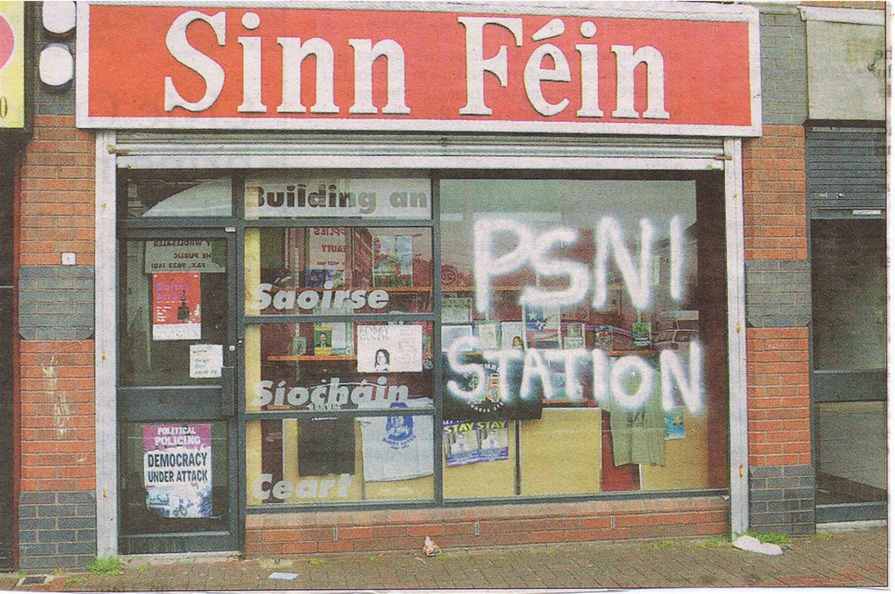
Despite what those in Leinster House would have you believe, not one Irish republican campaigned, fought or died for this corrupt Free State, never mind to end-up applying to it for 'permission' to honour the men and women that it, and its parent administration in London, executed (see the 'Offaly Sinn Féin' pic, below) -
After the British have completely left Ireland, politically and militarily, and the definite timeline from 1916 to that date is written, those reading it will then realise that the only part played in that scenario by the Stormont and Leinster House institutions was in delaying that achievement.
Irish republicans realise that, and have always done so.
ON THIS DATE (22ND MARCH) 52 YEARS AGO : 'FÜHRER FAULKNER' INSTALLED AS 'PM' OF AN OCCUPIED AREA.
"The British Ambassador called to see me at 11am this morning. He told me in strict confidence that he had received a message from the British representative in Belfast, Mr Ronnie Burroughs , who indicated that he had been informed by Mr Brian Faulkner that the latter is confident of securing the nomination to be the next Prime Minister of Northern Ireland (sic).
Mr Faulkner expects this to be approved about noon on Tuesday and that he will go to the Governor-General about 3.00pm....Mr Burroughs said that Mr Faulkner had assured him categorically that he would be prepared to implement the Downing Street Declaration and that there would be no going back on the policies relating to the B Specials, the RUC and reform.
He also indicated that he would not have anyone in his Cabinet who would not support his policies...in the course of the discussion which followed the Ambassador and I touched on the doubts held by the minority in the North on the sincerity of Mr Faulkner in relation to reforms...Mr Faulkner's earlier right-wing tendencies did not inspire confidence..." (from this Free State document, dated 23rd March 1971, and marked 'Secret'.)
Brian Faulkner was born in Helen's Bay, in County Down, and was elected to Stormont as a Unionist MP for East Down in the 1949 election. He became 'Prime Minister of Northern Ireland' (sic) on the 22nd March 1971 - 52 years ago on this date - and chaired the first ever inter-party meeting held at Stormont.
However, nationalists were alienated by internment and Faulkner was ordered to hand over complete security control to London in 1972. He became Chief Executive of the new power-sharing executive in 1974, but resigned as party leader when the UUP rejected the proposed 'all-Ireland council' settlement by a majority of eighty votes. The executive came to an end as a result of a strike by the Ulster Workers Council (UWC), and Faulkner retired from active politics in 1976.
He died on the 3rd March 1977 at the age of 56 following a riding accident whilst hunting with the County Down Staghounds near Saintfield, County Down. He had been riding at full gallop along a narrow country road when his horse slipped - he was thrown off and killed instantly.
It was during his 'Premiership' that internment without trial was introduced, under the '1922 Special Powers Act', on Monday, 9th August 1971, because, according to Faulkner - "Every means has been tried to make terrorists amenable to the law. But the terrorist campaign continues at an unacceptable level. And I have had to conclude that the ordinary law cannot deal quickly or comprehensively enough with such viciousness...".
The British forces that enforced that 'edict' had a list of 450 people to be rounded-up, but managed to grab only 342 of them, all from the nationalist community, only two of whom were republican activists. No loyalists were 'arrested'. Over the next four days, 24 people were killed in rioting and gun battles across the Six Counties and about 7,000 people had to flee from their homes.
Mr. Faulkner was said to be 'distressed' when it was brought to his attention that he had been referenced in a song which lauded a prison break which took place on the 17th November 1971, when he would have been only beginning to build his political career in Stormont - nine IRA prisoners escaped from Crumlin Road Prison in Belfast (which, between it and Long Kesh, housed more than 700 IRA prisoners at the time) with the use of rope-ladders!
The nine were Thomas Kane, Seamus Storey, Bernard Elliman, Danny Mullan, Thomas Fox, Tom Maguire, Peter Rogers, Christy Keenan and Terrence 'Cleaky' Clarke and all of them escaped in two cars which were waiting for them on the near-by Antrim Road :
OVER THE WALL.
In Crumlin Road Jail all the prisoners one day
took out a football and started to play,
and while all the warders were watching the ball
nine of the prisoners jumped over the wall!
Over the wall, over the wall,
who would believe they jumped over the wall?
over the wall, over the wall,
It's hard to believe they jumped over the wall!
Now the warders looked on with the greatest surprise
and the sight that they saw brought tears to their eyes,
for one of the teams was not there at all
they all got transferred and jumped over the wall!
Now the governor came down with his face in a twist
and said "Line up those lads while I check out me list,"
but nine of the lads didn't answer at all
and the warder said "Please Sir, they're over the wall."
The 'security forces' were shook to the core
so they barred every window and bolted each door,
but all their precautions were no use at all
for another three prisoners jumped over the wall!
Then the news reached old Stormont, Brian Faulkner turned pale
when he heard that more men had escaped from his jail,
said he - "Now we'll have an enquiry to call, and we'll get Edmund Compton to whitewash the wall."
'Führer Faulkner' began his 'premiership' of an occupied area on this date - 22nd March - 52 years ago.
'THE YALTA AGREEMENTS...'
From 'The United Irishman' newspaper, April 1955.
The world and its people were sliced and stabbed at Yalta and the peoples of America, Russia and the British Empire had no voice, no power to stay the ruthless hands of the killers.
If we in Ireland have a message for the peoples of these countries it is this - beware of the power you give your leaders ; make them responsible to you for all their acts, let there be no secret agreements in time of war or in any international crisis. Our duty, whether we be Irish, American, English, Russian or Chinese, is to love one another and not to hate.
It is the desire of all men (sic) to live in peace and, if leaders do or say anything which would inspire hate for other races or peoples, away with them - they are not leaders but demagogues lusting for power.
(END of 'The Yalta Agreements' ; NEXT - 'Mutual Goodwill!', from the same source.)
ON THIS DATE (22ND MARCH) 44 YEARS AGO : IRA ASSASSINATE A BRITISH 'AMBASSADOR' IN THE NETHERLANDS.
"...we have carried out bombings and shootings in Germany over the last two years as well. Last Spring we executed Sir Richard Sykes. He was involved in intelligence gathering against our organisation but he was also a leading propagandist in the same way as Peter Jay* was in America. Sykes was also the man who conducted the investigation into our attack on the British ambassador to Dublin, Ewart Biggs. Richard Sykes was a very important person and what that attack, and others, have shown, is the IRA's capability to operate abroad and against the enemy, not the host country, and gained our struggle attention there..."
- the reply given to journalist Ed Maloney by an IRA spokesperson, on being asked why the IRA had killed 'Sir' Richard Sykes (pictured), as printed in 'Magill' magazine, September 1980, eighteen months after Sykes had been assassinated. (*More here, re Peter Jay and what the IRA thought of him...)
'The Guardian' newspaper, too, was of the opinion that the man in question (...a 'decorated war hero..') was more than just a run-of-the-mill 'career politician' - 'Sir Richard, who would have been 59 in May, was rated as one of the "high flyers" of the British foreign service, coming up through a series of posts that took him to China, Cuba and embassies that are "listening posts" for the Soviet block.
In his last posting before going to The Hague he was one of the six senior officials at the FO (Foreign Office). His division was concerned with defence, arms and security, and it can be presumed he held responsibility for day-to-day links with the intelligence services..'(from here).
The 'Ireland In History' blog had this to say about him : "The Ambassador was a noted security expert and at the time there was much initial speculation in the Netherlands and in Britain that other groups under suspicion at the time (including Palestinians and Iraqis) could have targeted him. He was appointed to the job in June 1977 after a two year posting as a Foreign and Commonwealth Office deputy under-secretary in London. He was an acknowledged expert on security affairs and had been a diplomat in Cuba, Peking and Washington. Ironically he was responsible for an internal report on the safety of British diplomats following the assassination by the IRA in 1976 of the British ambassador to Dublin, Sir Christopher Ewart-Biggs...' (from here.)
The British Government, as expected, put a 'diplomatic spin' on the death of 'Sir' Sykes and those like him - "Today we honour the memory of 18 courageous men and women whose lives tragically were cut short in service to our country and the Foreign and Commonwealth Office.
We owe them a great debt of gratitude and we pay tribute to their memory, to their important work and to their undoubted bravery...and I thank you for the contribution that you have made to the service of our country overseas..this ceremony is also a moment to take pride in the Foreign Office and all it represents..it is a great honour to lead an organisation that makes such a unique and irreplaceable contribution to the United Kingdom..etc etc.." but Richard Sykes and those like him were the 'Cairo Gang' equivalent of their time and were dealt with as such.
Mr Sykes ended his 'diplomatic' career on the 22nd March 1979 - 44 years ago on this date.
'ROUGH JUSTICE...'
From 'Magill' Annual, 2002.
These same brave people were also urging all people present at the meeting to do the very same but the response, alas, was a consenting mumble from the crowd.
'Wigmore', never adverse to a spot of bandwagon-jumping, welcomes suggestions from readers of other Irish citizens who could be marched to the nearest lock-up in such a wonderfully direct fashion.
The best suggestion will receive a fashionable police night-stick tastefully decorated with a recurring anarchist motif. Answers on a recycled postcard, please...
(END of 'Rough Justice' ; NEXT - 'Though The Heavens May Fall', from the same source.)
ON THIS DATE (22ND MARCH) 182 YEARS AGO - IRISH ABROAD ORGANISE TO LOOK AFTER EACH OTHER. SORT OF...
This piece is in relation to one particular aspect of travelling abroad that was more prevalent in previous times than it would be now (a risk reduced thanks to modern technology, I'd like to believe..)
Myself and my friends have landed in New York many times and, apart from being a wee bit merry
jet-lagged (!) we were comfortable in ourselves and in our surroundings and were always met on the ground by our friends, colleagues and comrades, but we could easily picture what it would have been like for our ancestors :
'...on arrival passengers usually made their way to the city to find boarding houses where there was a good chance the remainder of their money would be swindled. The Irish and other immigrants faced numerous abuses such as 'illusive advertisements, crooked contractors, dishonest prospectuses' and 'remittent sharpers' when they arrived in America. The 'Irish Emigrant Society' was founded in 1841 (on the 22nd March that year - 182 years ago on this date) by a group of New York Irish to combat issues such as these.
In December 1848 the Emigrant Society advised emigrants that as soon as their ship came into harbour she would be boarded by an agent of the Society, who would offer them sound and honest advice. But, they warned, the ship would also be boarded by a large number of 'runners' – conmen, who would make it their business to attract them to the boarding houses that employed them.
They should be careful not to accept help from them as their ploy was to promise good quality board at low prices, but when they came to leave the house an exorbitant fee would be demanded. They would threaten not to hand over luggage unless this fee was paid and violent scenes might often ensue.
The Society warned that many persons, some of Irish birth, had set up offices in the city where they claimed to be agents for railroad and steamboat enterprises. These crooks sold tickets which purported to entitle the holder to travel to specific destinations but which were worthless.
To protect emigrants from such frauds various measure were introduced in New York in 1848 including the construction of reception centres and the licensing of steam boats to take emigrants from the quarantine to the landing piers. Boarding houses were also required to display their prices in English, Dutch, German, Welsh and French. Immigrants who survived the ordeal of the crossing now had to decide where to settle in America...' (from here.)
'...the story of the Irish Emigrant Aid Society founded in 1841 begins in the 1830s when the volume and character of Irish immigration to the United States changed dramatically. We often think of large-scale Irish immigration to America as beginning with the Famine (sic - it was an attempted genocide, by the British 'Establishment', against the Irish) in 1845, but it was already well under way by then, with some 200,000 Irish arriving in New York in the 1830s alone.
Before 1830, the majority of Irish immigrants were Protestants from Ulster. More often than not, they arrived with some capital and, equally important, marketable occupational skills. But starting in the 1830s, as the agricultural crisis that would later 'blossom' worsened, more and more of the Irish who arrived in the U.S. in the 1830's and ’40s were poor, unskilled Catholics. Whereas only 28 percent of Irish immigrants arriving in 1826 were unskilled labourers, the number hit 60 percent in the 1830s and kept rising to more than 80 percent by 1850...
One of the most pervasive threats to immigrant well-being addressed (by the Irish Emigrant Society) were the legions of con men and crooks descending upon unsuspecting immigrants. Many of them worked for boarding houses that charged extortionate rates and saddled immigrants with hidden charges.
Others offered fraudulent money exchanges or sold bogus tickets for steamers and trains heading west. Worst were the pimps who steered unsuspecting Irish women to brothels. Sadly, as the Society's annual reports state, these men often used their ethnic credentials — a good Irish accent or, better still, the ability to speak Irish — to ensnare their fellow Hibernians. An eyewitness account by an Irish priest in the 1850s explains the typical scenario -
"The moment he landed, his luggage was pounced upon by two runners, one seizing the box of tools, the other confiscating the clothes. The future American citizen assured his obliging friends that he was quite capable of carrying his own luggage, but no, they should relieve him — the stranger, and guest of the Republic — of that trouble.
Each was in the interest of a different boarding-house, and each insisted that the young Irishman with the red head should go with him...not being able to oblige both gentlemen, he could oblige only one ; and as the tools were more valuable than the clothes, he followed in the path of the gentleman who had secured that portion of the 'plunder...'
The two gentlemen wore very pronounced green neckties, and spoke with a richness of accent that denoted special if not conscientious cultivation ; and on his (the Irishman's) arrival at the boarding-house, he was cheered with the announcement that its proprietor was from "the ould counthry," and loved every sod of it, God bless it..." (from here.)
I'm sittin' on the stile, Mary,
Where we sat side by side
On a bright May mornin' long ago,
When first you were my bride;
The corn was springin' fresh and green,
And the lark sang loud and high -
And the red was on your lip, Mary,
And the love-light in your eye.
The place is little changed, Mary,
The day is bright as then,
The lark's loud song is in my ear,
And the corn is green again;
But I miss the soft clasp of your hand,
And your breath warm on my cheek,
And I still keep list'ning for the words
You never more will speak...
On a bright May mornin' long ago,
When first you were my bride;
The corn was springin' fresh and green,
And the lark sang loud and high —
And the red was on your lip, Mary,
And the love-light in your eye.
The place is little changed, Mary,
The day is bright as then,
The lark's loud song is in my ear,
And the corn is green again;
But I miss the soft clasp of your hand,
And your breath warm on my cheek,
And I still keep list'ning for the words
You never more will speak... (from here.)
FUNDS AND FINE GAEL'S LEADER...
Michael Lowry has so far been the focus of media attention about Fine Gael fundraising.
But the party's current leader, Enda Kenny (pictured), hosted a £1,000-a-plate dinner two days before the second mobile phone licence was awarded. And other guests say that one of the bidders for that licence was in attendance.
By Mairead Carey.
From 'Magill' magazine, January 2003.
In the early 1990's, Fine Gael was on the verge of bankruptcy but, by the time it came to power in 1994, its financial position "had much improved and was manageable", according to John Bruton.
In response to questions raised by Vincent Browne about the party's remarkable financial recovery, he wrote - "When Fine Gael unexpectedly entered government in December of that year, I advised ministers to be scrupulously fair and proper in their dealings as ministers. I asked them to protect themselves and their office from anything that could be open to misrepresentation or suspicion.
In fact, I think I actually said something like "Do not ever do anything that you would not want to see on the front page of 'The Irish Times' ".
Bruton told 'Magill' that he could not recall the function in the Conrad Hotel and would therefore not comment on whether it was appropriate to have competitors for government projects at such an event. He also said that the name 'Mike Smith' meant nothing to him...
(MORE LATER.)
Thanks for the visit, and for reading,
Sharon and the team.
We won't be here next Wednesday, 29th March 2023 ; we're off again to Galway, this time for two weeks, but this time it's just meself and the Girl Gang - no children, no grandchildren, no neighbours, no work colleagues, no set routine etc, just the five of us, free to do as we want.
Imagine the havoc that we're gonna cause...!
We'll be back in April, but can't yet say on what date ; we have an open-ended arrangement with the local Garda Barracks ... eh... hotel that we're staying in so as we can extend our stay if we want to.
'Cause when the five of us get a taste of freedom, there's no stoppin' us...!
See yis all in April - slán anois!
ON WEDNESDAY, 22ND MARCH 2023, WE'LL BE....
...with a six-parter, including a piece on an explanation issued by the IRA over forty years ago as to why it had carried out a particular operation abroad in which a British "decorated war hero" was targeted.
That operation 'stung' the military and political 'Establishments' in this country and in Britain, and in the country in which it happened, and reminded the world that 'Ireland unfree would never be at peace'.
We'll have a few paragraphs on an Irishman who built a political career for himself 'in the service of the crown' but came back to earth when he came up against a horse who wouldn't play ball with him, and we quote from a 'Secret' memo compiled on the man by Free State operatives in the early 1970's.
In one of our other four pieces we'll be looking at how the Irish, among others, took crude advantage of fellow Irishmen and women, in the mid-19th century, who were attempting to make a new life for themselves in America - nothing to be proud of, but a warning, perhaps, for those being forced to emigrate from this corrupt State today...
Check back with us on Wednesday, 22nd March 2023, if ya can - meanwhile, you can keep up with my ramblings on Twitter and Facebook as well!
Thanks for reading - see ya on the 22nd!
Sharon.
ON THIS DATE (15TH MARCH) 171 YEARS AGO : IRELAND WITNESSES THE BIRTH OF 'THE RISING OF THE MOON'.
On the 9th March, 1907, a play entitled 'The Rising of the Moon', by Isabella Augusta Persse Gregory ('Lady Gregory', pictured) premiered in Dublin in the Abbey Theatre, and was also produced by that venue.
The cast included W G Fay, J M Kerrigan, J A O'Rourke and Arthur Sinclair :
'On a moonlit night at an Irish wharf by the sea, three Irish policemen in the service of the occupying English government pasted up wanted posters for a clever escaped political criminal. Convinced that the escaped rebel might creep to the water's edge to be rescued by sea, they all hoped to capture him for the hundred-pound reward and perhaps even a promotion. The Sergeant sent his two younger assistants with the only lantern to post more leaflets around town while, uneasily, he kept watch at the water's edge. A man in rags tried to slip past the Sergeant, explaining that he merely wanted to sell some songs to incoming sailors...' (from here.)
The lady author was born in Roxborough House, near Loughrea in County Galway, and was schooled at home by a nanny, Mary Sheridan, who obviously passed-on her interest in Irish history to her pupil. At 28 years young, Isabella married 'Sir' William Henry Gregory, who 'owned' a large estate at Coole Park, near Gort, in County Galway, thus conveying on her the title 'Lady' : as a 'Lady of Leisure' who now found herself in the 'Big House' she availed of the large library and, when not reading, accompanied her husband on business trips throughout the world. Her education, the library and her foreign travels sparked within her a love of the written word and she quickly became a published author.
Her husband died when she was 41 years of age but she continued to live in 'the Big House', where her interest in all things Irish was nurtured, to the point that she practically converted the house into a 'retreat' for those who, like her, were smitten by Ireland and its troubled history - Edmund John Millington Synge, William Butler Yeats (and his brother, Jack, a well-known painter) , George Bernard Shaw (who described her as "the greatest living Irishwoman") and Sean O'Casey were amongst those who visited regularly and, indeed, she was believed to have had romantic connections with the poet Wilfrid Blunt and a New York lawyer, John Quinn.
Despite her privileged lifestyle (or, indeed, perhaps due to it, as it afforded her the time to 'look within her soul') Isabella Augusta Persse Gregory, who had a regular 'audience' with the 'Upper Class' of the day, loudly declared to all and sundry that it was "..impossible to study Irish history without getting a dislike and distrust of England..".
A 'poacher-turned-gamekeeper', if you like but, unusual in our history, one who 'turned' the right way.
She died in that 'Big House' on the 22nd May 1932, at 80 years of age, and is fondly remembered by those of us who share her convictions and agree with her "impossible to study..." declaration.
The academic Mary Catherine Gunning Colum said of her -
"With all her faults and snobbery, she was a great woman, a real leader, one of those who woke up Ireland from the somnolence and lassitude it was too prone to fall into. It is very doubtful that Yeats could have produced as much work as he did without her help. It is almost certain that, but for Lady Gregory, the Irish national theatre would have remained a dream, or ended in being that failure that so many hopeful undertakings in Ireland became."
Isabella Augusta Persse Gregory : 15th March 1852 - 22nd May 1932.
'THE YALTA AGREEMENTS.'
From 'The United Irishman' newspaper, April 1955.
The one significant and important fact about the Yalta Agreeements which has not been mentioned by the American, English or Irish press is that these secret agreements were made without the knowledge or consent of the people concerned.
All three leaders concerned claimed to be champions of freedom and democracy ; Stalin represented a state claiming to be working for the acme of democratic freedom - the socialist state which would emerge from the transient communist dictatorship (according to Lenin).
Roosevelt represented the USA - a comparative new-comer to world politics, but claiming to be a practising democratic state - government of the people, by the people, for the people. Churchill, of course, represented England, the seat and centre of the British Empire and the home of the 'mother of parliaments...'
(MORE LATER.)
ON THIS DATE (15TH MARCH) 128 YEARS AGO : 'LAST WITCH' BURNED IN IRELAND.
On the 15th March 1895 - 128 years ago on this date - a lady named Bridget Cleary was done to death by her husband, Michael, who believed she was a 'changeling', left in the house by evil fairies -
'Mary Kennedy bundled up to visit her ailing, 26-year-old niece, Bridget Cleary. It was a quick, half-mile walk over the bridge and up the hill to the Cleary’s cottage in Ballyvadlea of County Tipperary, Ireland. But as Kennedy approached the house that evening, she heard shouting and, when she opened the door, saw six men holding Bridget to her bed.
"Are you [Bridget] Boland, the wife of Michael Cleary, in the name of God?", Michael yelled at his wife as five others, including three of Kennedy’s sons and Bridget’s own father, restrained her.
Michael held a saucepan filled with fresh milk and herbs, and was forcing his wife Bridget to swallow the bitter concoction. Again, he asked if she was his wife. She replied, in God’s name, that she was. But Michael was unconvinced. To him, the woman before him was not Bridget. She was an evil fairy, a changeling, that had taken his wife’s form. And within the next 24 hours, he would kill her...'
(From here.)
Bridget Cleary has been popularly described as 'the last witch burned in Ireland' ; the poor woman had been seriously ill with, it is thought, TB or pneumonia for a few days before her husband killed her, and that illness probably caused her mind and speech to ramble which, in turn, might have caused her husband Michael and his and her friends - bearing in mind the times that were in it and the superstitions that were rife in those days - to believe she had been taken by fairies and that a sickly changeling had been left in her place. God rest the poor woman.
And here we are, 128 years after that horrific event, and we're still being troubled by 'changelings'...
'ROUGH JUSTICE.'
From 'Magill' Annual, 2002.
'Wigmore' has learned that the grand lefty tradition of nonsensical direct action is by no means dead.
It appears that some 'members of the public' were so outraged by Minister Cowen's poor performance during Ireland's tenure as the President of the UN Security Council that they are ready to - quite literally - take the law into their own hands.
At a recent anti-war meeting organised by a coalition of different interest groups, it transpired that some active members of the civil society are planning to contact their local garda stations and demand citizen's arrests of Minister Cowen and of the Taoiseach for their role in committing war crimes in Afghanistan...
(MORE LATER.)
ON THIS DATE (15TH MARCH) 24 YEARS AGO : IRISH HUMAN-RIGHTS LAWYER MURDERED BY PRO-BRITISH FORCES.
On the 15th March 1999 - 24 years ago on this date - human-rights lawyer Rosemary Nelson (pictured) was murdered by a pro-British paramilitary grouping in Ireland, the 'Red Hand Defenders', who had placed a bomb under her car.
Rosemary had become a political thorn in the side of Westminster, due to her work on behalf of those who had been wronged by the British political and military establishment in Ireland.
'...a bomb had been attached to the underneath of her car, and detonated when she pressed the brakes as she reached the bottom of the road from her home as she drove to her office in Lurgan. On the night of her death, the 'Red Hand Defenders' claimed responsibility for the attack. However, it was suggested that such a group had neither the expertise nor resources to carry out such an attack on their own, and the opinion that the British security forces (sic) had been involved was echoed by many...'
(From here.)
Also, it should be remembered that Rosemary Nelson was harassed and threatened by the pro-British 'RUC police force' in this country shortly before similar elements murdered her.
RIP Rosemary.
ON THIS DATE (15TH MARCH) 101 YEARS AGO : LEINSTER HOUSE 'FORBIDS' THE IRA TO HOLD A CONVENTION!
1922, Ireland : political turmoil caused, firstly, by the British and, secondly, by their political and military proxies in the newly-minted-by-Westminster Free State 'parliament' and army/militia, was rife.
The IRA was due to discuss, in the Mansion House, in Dublin, the political and military situation in the country, at a meeting which had been organised in January 1922 and which was due to be held on the 26th March.
But, on the 15th March 1922 - 101 years ago on this date - the Staters 'banned' the meeting ; Richard Mulcahy, Eoin O'Duffy and Arthur Griffith, among others, 'banned' the Convention, because they knew that at least between 70 to 80 per cent of the IRA were against the 'Treaty of Surrender' and they hoped that, by 'forbidding' the meeting, they could prevent Irish republicans from organising against it.
The following day a 'Proclamation' was issued by the Staters stating that if any IRA Officer attended the convention he would be dismissed.
The Convention, which had been organised by 'The Republican Military Council' and signed-off on by over 50 senior officers including 4 GHQ staff, 5 divisional commanders and a number of brigade commandants, went ahead as planned ; the Staters took no action against the republicans in attendance, despite their previous innuendos to do so.
But it was a sign of things to come ; more details here.
ON THIS DATE (15TH MARCH) 101 YEARS AGO : HOSPITAL ASSASSINATIONS BY THE IRA.
On Wednesday, 15th March 1922 - 101 years ago on this date - at about 9.30pm, four masked and armed IRA men entered St Bride’s Home, a small private hospital at Ely Place, just off the Sea Road in Galway.
The man in charge there was a Dr. William A Sandys, who was a medical officer for the RIC.
The men made their way to, and entered, room 21, in which there were two men, one of whom was RIC Sergeant John Gilmartin (49) (from County Leitrim, he had joined the RIC in 1893), who was asked if he was a member of the RIC ; he replied that he was at one time, but not now. Having searched his bed and bag, he was told to say an Act of Contrition, to which he replied "Oh, God, sure you are not going to do this...?" The men then opened fire, killing him.
Dr. Sandys, two priests, some nurses and hospital staff were having supper in the dining room when they heard the shots and they rushed to room 21.
While they were examining Sergeant Gilmartin, they heard the sound of several more shots from another part of the building and four men were seen walking through the hall and out the door of the hospital. It was then discovered that the IRA men had also visited room 17, which was occupied by an RIC Sergeant named Tobias Gibbons (54) (from Devleash East, near Killawalla, in County Mayo - he had joined the RIC in 1902) and an RIC Constable named McGloin.
Mr. Gibbons was shot dead, and Mr. McGloin was seriously wounded.
Also on that same night (15th March 1922), an officer from the 'Congested Districts Board', a Mr. Patrick Cassidy, from County Mayo, was shot dead at the Galway Workhouse Hospital. Mr. Cassidy was in the hospital recovering from an earlier shooting.
It was later recorded in the 'Bureau of Military History' that RIC Sergreant John Gilmartin "...had a very bad record in the district. He protected the (British) Auxiliaries while they flogged a number of boys and disembowlled one of them with a bayonet in front of his mother. After the Truce he went into Galway Hospital for protection, but some men went into the hospital and shot him..."
People like that would have a hard time to find a hiding place.
FUNDS AND FINE GAEL'S LEADER...
Michael Lowry has so far been the focus of media attention about Fine Gael fundraising.
But the party's current leader, Enda Kenny (pictured), hosted a £1,000-a-plate dinner two days before the second mobile phone licence was awarded. And other guests say that one of the bidders for that licence was in attendance.
By Mairead Carey.
From 'Magill' magazine, January 2003.
Fine Gael agreed with all donors prior to the 1997 Electoral Act being introduced that details of their donations would be kept confidential.
The party has only broken its silence on one occasion, when it made a statement on the controversial $50,000 donation it received from the Norwegian telecommunications company, Telenor, which was part of Denis O'Brien's licence-winning Esat consortium.
The donation was made as a result of a fundraising dinner in New York in November 1995, which was also addressed by the then Taoiseach, John Bruton.
Esat declined to support the event directly but indicated that its partner, Telenor, would make a contribution by taking two corporate tables at a cost of $50,000 - this donation was made after the awarding of the licence...
ON THIS DATE (15TH MARCH) 101 YEARS AGO : NEW POLITICAL GROUP FORMED BY EAMON DE VALERA.
"If the Treaty was accepted the fight for freedom would still go on ; and the Irish people, instead of fighting foreign soldiers, would have to fight the Irish soldiers of an Irish Government (sic) set up by Irishmen. If the Treaty was not rejected, perhaps it was over the bodies of the young men he saw around him that day that the fight for Irish freedom may be fought..."
"...if they accepted the Treaty, the Volunteers would have to wade through Irish blood, through the blood of the soldiers of the Irish Government (sic) and through, perhaps, the blood of some of the members of the Government in order to get Irish freedom..."
"...if we continue on that movement which was begun when the Volunteers were started, and we suppose this Treaty is ratified by your votes, then these men, in order to achieve freedom, will have to march over the dead bodies of their own brothers. They will have to wade through Irish blood. The people had never a right to do wrong..."
The above are samples of speeches delivered by Eamon de Valera in the Free State to various-sized crowds in the days after he had formed a new republican organisation, 'Cumann na Poblachta' ('League of the Republic/Society of the Republic'), on the 15th March 1922 - 101 years ago on this date.
Fighting words, surely enough but, considering that they were uttered by a man who, four years after saying them (ie in 1926) established one of the most corrupt semi-political Free State mafias that still exist in this State today, they were only words ; he made a good living, financially, from 1926 until he died, by condemning "the fight for freedom" and executing those fighters.
'Long before that, you had slept
in ditches and dug-outs,
prayed in terror at ambushes
with others who later debated
whether de Valera was lucky or brilliant
in getting the British to remember
that he was an American...'
(From here.)
Thanks for the visit, and for reading,
Sharon and the team.
ON THIS DATE (8TH MARCH) 81 YEARS AGO : DEATH OF AN UNYIELDING OPPONENT OF THE FREE STATE.
On March 27th, 1872, a baby girl was born in London, was moved to County Cork and reared and educated there, at Queens College : that baby was Mary MacSwiney (pictured), who grew up to be an uncompromising republican and one of the most outstanding republican personalities of the 1920's and 1930's.
The young Mary MacSwiney trained as a teacher and returned to London for work until a suitable post was available in Dublin. A supporter of the suffragette movement, she joined the 'Munster Womens Franchise League' (MWFL) in 1908 and, during the following years, campaigned for the franchise to be extended to women.
She left the 'MWFL' in 1914 as a result of that organisations support for Britain in the first 'World War'.
After its formation in April 1914, Mary MacSwiney joined Cumann na mBan and was later appointed to its Executive Committee ; at the same time, she was a member of a number of other nationalist organisations, including the Gaelic League.
After the 1916 Rising, she was arrested and imprisoned, and was dismissed from her teaching post ; after her release some months later, she founded a school, 'St Ita's', modelled on Padraig Pearse's school, St Enda's. Her sister Eithne and her brother Terence were also involved in the setting-up of the school.
In 1917, Mary MacSwiney joined Sinn Féin, following the adoption by the party of a more republican separatist policy.
Following the death of her brother Terence, who died on hunger-strike in October 1920 (at the height of the Tan War) Mary MacSwiney visited America and gave evidence before the 'American Commission on Conditions in Ireland' regarding the campaign of terror being waged against all sections of the nationalist population by the British forces of occupation.
Elections to the Second Dáil were held in May 1921, and Mary MacSwiney was elected a TD for Cork ; in December that year she spoke in opposition to the Treaty of Surrender which she described as "the grossest act of betrayal that Ireland ever endured" and stated that if the Treaty was passed she would use her influence as a teacher to spread rebellion against the proposed Free State.
In the Civil War that followed, Mary MacSwiney was a formidable and unyielding opponent of the Free State and made no secret of her support for the republican side. She was imprisoned for a brief period in July 1922, following the surrender of the Four Courts garrison in Dublin.
Returning to Cork after her release, she virtually ran the republican headquarters in the city, but had to leave Cork in a hurry as the Free Staters were looking for her.
She was arrested in Dublin on November 4th that year (1922) and was imprisoned in Mountjoy Jail - she immediately went on hunger-strike for release and was eventually freed on the 25th day of her fast, due to the huge international publicity her case received.
She was elected to the Executive of Cumann na mBan in 1926 and, in October that same year, was also elected as Vice-President of Sinn Féin, at that organisations Ard Fheis, which was held six months after the split with de Valera.
Along with other prominent republicans, including Brian O'Higgins, she resigned from the party in 1934 over the decision of Sinn Féin to allow members to receive IRA pensions from the new Fianna Fail administration (there can be no doubt of how she would react to the salaries, offices, perks and holiday-homes that the PSF grouping are in receipt of, and not only from the Free State..)
Mary MacSwiney was one of the last surviving loyal members of the Second Dáil who transferred their authority to the Army Council of the IRA in December 1938, an authority which still resides in the Republican Movement.
She supported the IRA bombing campaign in England but poor health prevented her from playing her usual active part in the Movement.
Mary MacSwiney died on the 8th of March, 1942, at seventy years of age - 81 years ago, on this date - thirty-four years of which she devoted to socialism and republicanism.
The MacSwiney name will live on as part of the Irish struggle.
8TH MARCH 2023 - INTERNATIONAL WOMEN'S DAY.
'Lá Idirnáisiúnta na mBan (International Women's Day) – the struggle continues ;
We salute all those women of Cumann na mBan who fought and died to end British rule in Ireland, and the establishment of a Socialist Republic based on the Proclamation of 1916.
Many women of Cumann na mBan were involved in the planning and execution of the 1916 Rising, providing support through intelligence gathering, fundraising, and providing safe houses for members of the rebellion. Women also served as couriers, carrying messages and weapons between rebel strongholds and providing medical aid to wounded fighters.
Sinn Féin Poblachtach remembers those women of Cumann na mBan as equal participants in the 1916 Rising, and their contributions are celebrated and commemorated alongside those of their male counterparts.
Cumann na mBan’s contribution to the revolutionary struggle was not confined to the Easter Rising 1916. The organisation played a very significant part in the War of Independence, rejected the Treaty of Surrender and played a heavy price for their activities in the Civil War. They have continued to the present day to be to the fore in the struggle for Irish freedom and in particular we remember those women who paid the supreme price during the war in the Occupied Six Counties in recent years.
We will continue to celebrate the social, economic, cultural, and political achievements of women, and to raise awareness of the ongoing struggle for gender equality and for complete Irish freedom.'
(Borrowed [and slightly edited!] from colleagues of ours in Armagh, Ireland.)
'TRIBUTE TO DEAD REPUBLICAN...'
From 'The United Irishman' newspaper, April 1955.
Oration given by Tomas MacCurtain at the grave of Domhnall Mac Suibhne, Ahane, Cullen, County Cork, who was laid to rest on March 7th 1955 -
"In his name-call on the young men and women of this historic countryside to prove themselves worthy of this man who stood forth all the days of his life ; he was fearless, undaunted, uncompromising.
The day is at hand, and I promise you that it is nearer than any one of you here might think, when you will be called on to serve the Cause which Domhnall Mac Suibhne served so faithfully and so long. His voice is now silent and his pen is still, but from this grave his spirit will call to you to play your part as he played his in the struggle for the freedom of our country. When that day comes let ye not be found wanting.
Domhnall Mac Suibhne is dead, and perhaps it is only now when he is gone that those who lived around him will realise that something is gone which cannot be replaced.
Go dtugaidh Dia Solus na bFlaitheas dá anam uasal calma. Ar dhéis Dé go raibh sé."
(END of 'Tribute To Dead Republican' ; NEXT - 'The Yalta Agreements', from the same source.)
ON THIS DATE (8TH MARCH) 57 YEARS AGO : PILLAR OF SOCIETY LOOSES HIS STANDING...
In 1808, Trinity College in Dublin donated £100 towards the building of Nelsons Pillar, and Arthur Guinness and Sons gave £25. The total cost of the Pillar was £6856, 8 shillings and 3 pence (including the railings around it..) and it (and the railings!) were 'part-removed' on Tuesday, 8th March, 1966 - 57 years ago on this date - without 'permission' from Trinity College, Guinness, Leinster House or Westminster!
The structure was erected in the then Sackville Street (named after the then British 'Lord' Lieutenant of Ireland, Lionel Cranfield Sackville aka the 'Duke of Dorset') in 1808, in honour of British Admiral 'Lord' Nelson's "victories at sea".
The column was about 120 feet high and Nelson's statue (designed by Cork sculptor Thomas Kirk) stood 13 feet tall on top of it. At about 1.30am on the morning of Tuesday, 8th March 1966, an explosion blew the top part of the column asunder and what was left of Nelson landed on the ground, as did hundreds of tons of (other!) rubble.
The IRA was suspected of involvement, but quickly distanced itself from the job, declaring that they were more interested in removing actual British imperialism from Ireland rather than just the symbols of it - the 'Saor Éire' group let it be known that its activists were responsible, that the codename for the operation was 'Operation Humpty Dumpty' and that, a day or two beforehand, they had left a device on site which failed to detonate and was retrieved, repaired and left back on Monday night, the 7th March 1966.
The front page of 'The Irish Times' newspaper on the 8th March 1966 read : 'The top of Nelson Pillar, in O'Connell street, Dublin, was blown off by a tremendous explosion at 1.32 o'clock this morning and the Nelson statue and tons of rubble poured down into the roadway. By a miracle, nobody was injured, though there were a number of people in the area at the time...', which could be said to be probably the first time that Nelson's arrival in an area didn't hurt anyone...
The two-headed, one-armed and one-eyed Nelson '...understood the need to annihilate the enemy...he led the fleet into harm's way, picking out the enemy flagship as his target, leaving it a crippled hulk and the enemy fleet a leaderless mob...after that his followers could complete the task...no one ever argued that he was a paragon of matchless virtue (but) for 200 years his reputation has been besmirched with accusations of infidelity...yes, Nelson had his faults (his vanity, love of applause and vulnerability to flattery)...' (from here) was given a headache by Irish republican Seán Ó Brádaigh, and others, in the 1950's, when an attempt was made to melt the head of the statue and de Valera is said to have asked 'The Irish Press' newspaper to run with a front-page headline declaring 'British Admiral Leaves Dublin By Air' !
'Grey brick upon brick
Declamatory bronze
On somber pedestals
O'Connell, Grattan, Moore
And the brewery tugs and the swans
On the balustraded stream
And the bare bones of a fanlight
Over a hungry door
And the air soft on the cheek
And porter running from the taps
With a head of yellow cream
And Nelson on his pillar
Watching his world collapse' (from here.)
WILLIAM JEFFERSON CLINTON...
From 'Magill' Annual, 2002.
Secondly, with his faded good looks, financial problems, and uncertainty about the future, the man from Little Rock personifies the current post-Tiger Zeitgeist like no other could.
As Beckett once said - 'When you're up to your neck in shit, all you can do is sing', and what better blustering tenor to hear emanating from the Park in a few years than that of Wild Bill? Harangued by unresolved court cases, heavily in debt, at the mercy of continually prying journalists and still smiling, his essential indomitable insouciance could be a lesson to us all in these times of coming hardship.
True, Bill's side of the deal would bring him about the same level of real power as wielded by the average president of an American high school class, but a man of his wiles could easily use the country to establish a world-wide power base opposed to George Bush's America, and few would be opposed to renaming the Presidential abode something a bit more fiesty, such as 'Kandahar'.
In terms of our next President, 'Wigmore' suggests William Jefferson Clinton ; if he has taught us anything, it is that anything is possible if you can manage to bend the rules and just keep smiling.
(END of 'William Jefferson Clinton' ; NEXT - 'Rough Justice', from the same source.)
ON THIS DATE (8TH MARCH) 50 YEARS AGO : IRA ATTACK OLD BAILEY, LONDON.
On Thursday, 8th March 1973 - 50 years ago on this date - at about 3pm, a 300lb IRA car bomb exploded outside the 'Central Criminal Court of England and Wales' (the 'Old Bailey', situated on a site once occupied by the old Newgate Prison). One man, Fred Milton, 60, who worked as a caretaker in a near-by office block, Hillgate House, had suffered a heart attack before the explosion, and the poor man died about two hours after same - and at least 215 people were injured.
Two other car bombs, which were apparently timed to explode at the same time, were defused, and it later emerged that New Scotland Yard, a British Army recruiting office in Westminster and a British government building in Whitehall were all targeted by that IRA ASU, for the same reason as the Old Bailey was - the common link was that all were representative of the British state, reminiscent of earlier such actions in England by Irish republicans - for instance, in the late 1930's, installations such as electricity, water and transport infrastructure were targeted in London, Manchester and Birmingham, not to mention the Fenian dynamite campaign in Victorian Britain.
However ; back to the 1973 attack - the following is taken from 'Iris Magazine', August 1984 : 'In March 1973, seven men and three women, including Marion and Dolours Price, had been charged in London with the Old Bailey and Whitehall bombings. After being sentenced to life imprisonment, the Price sisters embarked on a hunger-strike for repatriation. Their hunger-strike was to last 206 days, during which they were force-fed in horrific conditions.
In support of the Price sisters the women in Armagh Jail started having a token 24-hour hunger-strike every Friday. Those prisoners on remand would also use the opportunity of court appearances to make speeches from the dock about their comrades on hunger-strike.
The Price sisters were finally transferred to Armagh Jail on March 18th 1975 - their transfer had been announced much sooner and the Armagh women prisoners didn't expect them on that day. As Teresa Holland put it - "We had been practising for weeks, with flags, uniforms, the lot, and they hadn't come. And then suddenly there they were! So we got out the flags and the uniforms and had another parade just for them. They were lost, they couldn't believe their eyes. Everybody felt brilliant and, for a full week, every time they went into someone's cell, the girl in that cell would make them a big feed. It actually took them a long time to settle in, with all the fuss!"
And, unfortunately, that whole scenario could yet be repeated due to the fact that Westminster continues to claim political and military jurisdictional control over six Irish counties, and enforces that 'claim' regardless of the consequences involved.
FUNDS AND FINE GAEL'S LEADER...
Michael Lowry has so far been the focus of media attention about Fine Gael fundraising.
But the party's current leader, Enda Kenny (pictured), hosted a £1,000-a-plate dinner two days before the second mobile phone licence was awarded. And other guests say that one of the bidders for that licence was in attendance.
By Mairead Carey.
From 'Magill' magazine, January 2003.
A number of bookmakers were also present at the Conrad fundraiser - Stewart Kenny represented Paddy Power, while the head of Ladbrokes gaming operations, Mike Smith, was also in attendance.
Ladbrokes owned the Hilton chain of hotels outside the US and was at that time searching for a site for the Dublin Hilton. "The size of the site depended on whether the group secured a casino licence for the hotel. We wanted to know the deal," said a company source.
Enda Kenny told the Dail (sic) in January of that year that he had an open mind on whether legislation should be introduced to allow gaming in the country (sic), but there was widespread public opposition to such licences being granted and, in June 1996, the government decided not to introduce the necessary legislation.
The late Paddy Fitzpatrick, head of the Fitzpatrick chain of hotels, was also at the fundraiser. It is not known how many fundraisers were held by either the party or individual ministers during the two-and-a-half years in which Fine Gael was in power...
(MORE LATER.)
Thanks for the visit, and for reading,
Sharon and the team.