On the 21st February, 1919, two-hundred-and-twenty workers went on strike at Fulton's Woolen Mill in Caledon, County Tyrone.
The strike was led by Irish republican activist Peadar O'Donnell and, even though the majority of the workers were unionist, they agreed that unity on the floor of the workplace was needed if they were to improve their pay and conditions.
The striking workers had joined the 'Irish Transport and General Workers Union' and held their ground for the first few weeks but, slowly, the comradeship splintered to the point that, after about one month, at least ninty of them had reluctantly returned to work, leaving about 130 still on the picket lines.
The Mill's management then hired scab workers from the 'Carsonite Ulster Workers Union' and divided the remaining strikers by offering loyalists on the picket their jobs back.
The strike collapsed in July 1919.
==========================
'SINN FÉIN NOTES...'
From 'The United Irishman' newspaper, April 1955.
Sinn Féin statement re IMRA :
"At a meeting of the National Executive of the 'Irish Monetary Reform Association' held on March 20th, 1955, Mr Liam Bolton, Vice-Chairman (sic),presiding, the following resolution was proposed by Liam Bolton and passed -
'1. That the National Executive of IMRA is prepared to accept the Constitution of Sinn Féin as issued to the Irish people.
2. We consider that on the financial issue the social and economic programme of Sinn Féin is not sufficiently specific, but we are prepared as individual members of Sinn Féin through our Cumann to work for full monetary control."
Northern Elections :
The Joint Election Committee met at Headquarters on Sunday, 6th March last, and the business of this Committee is to co-ordinate all the activities of the organisation in the election campaign...
(MORE LATER.)
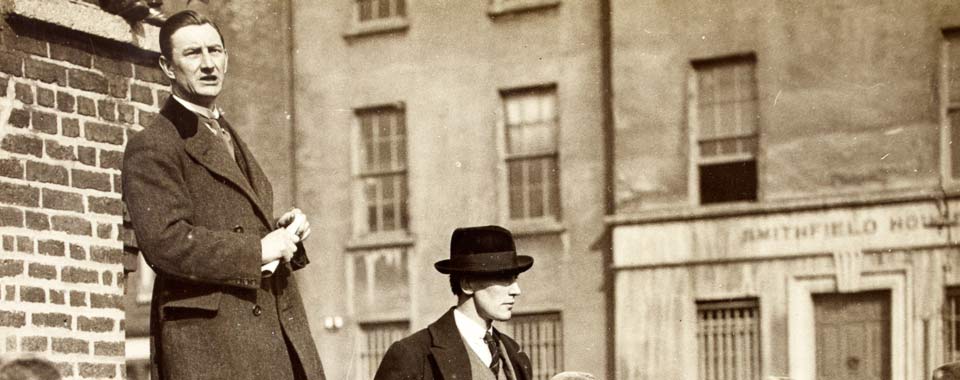
On the 20th January, 1920, a British-proxy semi-political/military grouping, the 'Dublin Metropolitan Police', raided Number 4, Oakley Road, in Ranelagh, Dublin ('Cullenswood House'), where the then IRA Chief of Staff, Richard Mulcahy (pictured, a republican-gamekeeper-turned-Free State-poacher) lived.
The raid was led by DMP Deputy Inspector William Charles Forbes Redmond (who was assassinated by the IRA just over one year later, on the 21st January 1921 ; he was the DMP 'Assistant Commissioner' at the time), believed to be acting on information from a British spy in the IRA, a man named John Charles Byrne (38), from Romford, in Essex, England.
Mr Byrne 'traded' under a fictitious name, 'John Jameson', and was shot dead by the IRA on the 7th March, 1920, on the Ballymun Road in Dublin.
Richard Mulcahy was in the house on that day in January 1920, with Mr Michael Collins, and both would have been caught had it not been for a spy of their own ; a DMP Detective, a Mr James McNamara, heard about the raid as it was being organised and tipped-off one of his IRA contacts, a Mr Tomas Cullen who, along with IRA man Frank Thornton, rushed to Number 4 and got their men off the premises with minutes to spare.
On the 21st February that year (1920), the DMP raided the house again.
Richard Mulcahy was there, but managed to escape (dressed in his pyjamas!) but the raiders got their hands on IRA documents which, they claimed, contained "complete addresses of 3,000 members of the Dublin Brigade IRA."
But, whether or not they had those details, it didn't prevent the Dublin IRA from defending itself and its people against the British forces in Dublin, and Ireland.
==========================
SO, FAREWELL THEN, CELTIC TIGER....
It had to happen, sooner or later.
Most of the pundits and economists were too busy singing the Celtic Tiger's praises to notice, but a few critical observers worried all along about the weaknesses of a boom economy that depended so much on a few companies from one place - the United States.
By Denis O'Hearn.
From 'Magill' Annual 2002.
It is time to reassess the Celtic Tiger.
Two crucial questions bear examination ; the first is whether a Celtic Tiger could have ever been sustainable, and the second - and far more important question - is what are the social consequences of Irish growth or stagnation?
At the end of the 1980's the future of the southern Irish economy did not look good ; the economy was stagnant, unemployment was higher than anywhere in the European Union except possibly Spain, and the State was one of the most indebted in the world.
Socially, things appeared to be going from bad to worse as the State compounded economic miseries with an austerity programme that shut down or cut back many facilities for the poorest sections of the population.
By 1994, however, the economic growth rate rose to six per cent.
It was so high by EU standards that an article in Morgan Stanley's 'Euroletter' asked whether Ireland was now a Celtic Tiger, after the high-growth tiger economies of East Asia...
(MORE LATER.)
On the 21st February, 1921, a six-person RIC foot patrol was making its way, in single file, through the town of Maynooth, in County Kildare, at about 10pm, when they came under fire from an IRA Unit.
RIC 'Sergeant' Joseph Hughes (34), from Rathaspick, Wolfhill, near Ballylinan, in County Laois, fell to the ground, wounded, as his fellow gunmen ran for cover, firing as they went. The gun battle lasted for about ten minutes, after which the IRA withdrew from the scene.
The IRA Volunteers, from the Kilcock and Leixlip Companies, used shotguns, rifles and revolvers in the attack, hoping to replenish their stock with RIC weapons which, unfortunately, didn't happen this time.
RIC member Hughes worked as a miner as a 15-years-young youth, and then got a job as a postman, but joined the RIC in 1909, at about 23 years of age ; the bullet wound that he received that night killed him - the round hit him in the right jaw and exited at the back of his head.
That IRA operation had been planned by Paddy Mullaney, a national schoolteacher from Leixlip, in County Kildare, who had been appointed Officer Commanding of the 1st Kildare Battalion IRA in November 1920.
The inquest into the shooting found that RIC member Hughes had been killed "by armed rebels".
==========================
On the 21st February, 1921, 'The Freeman's Journal' newspaper announced that British forces in the area had released a 'proclamation' (signed by a Colonel-Commandant PCB Skinner) stating that fairs and markets in the districts of Bagnalstown, Carlow and Castledermot would not be going ahead due to the IRA attacks on roads and bridges in those areas.
The reason for such 'proclamations' was two-fold : to limit themselves as targets on 'Fair Days' and to try and turn the people against the IRA as 'instigators of the trouble caused'.
But, as a tactic, it failed, as the Movement went from strength to strength.
==========================
On the 21st February, 1921, The IRA carried out an ambush on members of the Devonshire Regiment in Friary Street in Kilkenny City.
But the operation wasn't a success : IRA Volunteers Thomas Hennessy was shot dead and Michael Dermody died of his wounds on the 4th March (having been shot by Private Harley Turner and Lance Corporal Ernst Higgins, respectively), and a civilian, Tom Dollard, was shot dead by a British Army soldier, who claimed he thought Mr Dollard was an IRA man.
==========================
On the 21st February, 1921, 'Sir' Hamar Greenwood (pictured) delivered a speech in the British 'House of Commons' during which he stated that elections to the (British spawned) Dublin and Belfast political administrations would be held within two months, and also declared that "the 'Government of Ireland Act' (which partitioned Ireland) provides for the political unity of Ireland..." (!).
Mr Greenwood's colleagues, who disagreed with any type of 'United Ireland' sentiment from anyone, soon made their 'esteemed friend' aware of what they thought of his utterances : eight Conservative British Government Coalition MP's 'crossed the floor' (ie refused to support the 'Government of Ireland Act'), seven Liberal British Government MP's voted against their own administration, and eighty-eight of them showed their annoyance by abstaining from voting.
Poor Hamar was hammered!
==========================
A shop owner in Rosslea, in County Fermanagh, a Mr George Lester, was well known locally as a 'bully boy', a loud mouth, and carried that attitude with him as he put on his 'Ulster Special Constabulary' ('USC') uniform to 'safeguard the Union' ; he was known to actually issue threats to Catholic children and adults, using his 'USC' membership and uniform as a 'shield'.
His constant attempted terrorising of local Catholic children and adults brought him to the attention of the local IRA Unit who, in a letter to him, advised him to calm down, but it didn't work - he continued treating the same demographic in the same manner.
On the 21st February, 1921, as he was opening up his shop for business, the IRA shot him, only wounding him - a warning to stop his bullying behaviour.
It was because of his hatred for Catholics that he was popular with his 'USC' colleagues and a gang of them assembled that same evening to 'avenge' the shooting of their friend ; the 'Specials' and their UVF colleagues drove into the village of Roslea, attacked and looted the priest's house, and burned down at least ten houses in which Catholics lived.
During their attack on the village, a 'USC' member, Samuel Finnegan, used the butt of his rifle to break open a house door but the weapon discharged, killing him instantly.
A few weeks later, in a single night, the IRA targeted about 16 houses where 'Specials' lived and killed three of them.
==========================
In February, 1921, acting on information supplied to them, the British Crown Forces dismantled an IRA arms dump in Cork and removed the weapons that were stored in it.
An investigation by the IRA concluded that a Mr John Sheehan, from Kanturk, in County Cork, had given the location of the arms dump to the British and further inquiries revealed that he had briefed his mother not to open the door as it could be "the Sinn Feiners come for me...".
On the night of the 21st February 1921/early morning of the 22nd, the IRA took him in for questioning and he was shot dead by them in early March. His body was discovered on the 21st March (1921) with a notice beside it - "Spies, Traitors, Informers ; associate with the Military, Police and Black and Tans in Kanturk, you will be listed. Beware. IRA".
The IRA issued a statement saying - "During March 1921 a spy was found guilty of giving information to the enemy and was executed by members of the Kanturk Battalion".
==========================
On the 21st February, 1921, The 'Judge Advocate General' of the British Army, a Mr Felix Cassel, wrote to the British Secretary of State for War*, a Mr Laming Worthington-Evans, voicing concern about the death sentence that was pronounced on an Irish rebel, Seán Allen (pictured), the previous month (January 1921).
Seán, from Bank Place in Tipperary, was a member of the Tipperary No.3 Brigade IRA and was convicted of possession of a revolver on the 19th January, 1921. Five of his comrades (Timothy McCarthy, Thomas O'Brien, Daniel O'Callaghan, John Lyons and Patrick O'Mahony), who were captured after the Dripsey ambush, were also sentenced to death by the British.
The 'Execute' ruling had been referred to the British 'High Court' to determine its legality, but that 'court' washed its hands of any responsibility in declaring that it had "...no power to interfere with the findings of a military court while war* was being waged..".
On the 28th February, 1921, all six Irish rebels were executed in the 'Military Detention Barracks' in Cork City by the British.
The IRA instructed its Volunteers to shoot any British Army soldiers that they came across in Cork, and twelve British Army men (some in plain clothes) were shot, of whom six died from their wounds.
(* - when it suited Westminster, it was a "war" it was fighting against the IRA, and when it suited them, it wasn't : it was 'a skirmish against terrorists...')
==========================
BEIR BUA...
The Thread of the Irish Republican Movement from The United Irishmen through to today.
Republicanism in history and today.
Published by the James Connolly/Tommy O'Neill Cumann, Republican Sinn Féin, The Liberties, Dublin.
August 1998.
('1169' comment - 'Beir Bua' translates as 'Grasp Victory' in the English language.)
'WHY WE WANT RECRUITS'.
(Padraic H. Pearse, May 1915.)
"We do not anticipate such a moment in the very near future, but we live at a time when it may come swiftly and terribly.
What if Conscription be forced upon Ireland?
What if a Unionist or a Coalition British Ministry repudiate the Home Rule Act?
What if it be determined to dismember Ireland?
What if it be attempted to disarm Ireland?
The future is big with these and other possibilities.
And these are among the reasons why we want recruits."
ROBERT EMMET AND THE IRELAND OF TODAY.
(Padraic H. Pearse ; an address delivered at the Emmet Commemoration in the Aeolian Hall, New York, March 9th, 1914.)
"We who speak here to-night are the voice of one of the ancient indestructible things of the world. We are the voice of an idea which is older than any empire and will outlast every empire.
We and ours, the inheritors of that idea, have been at age-long war with one of the most powerful empires that have ever been built up upon the earth ; and that empire will pass before we pass. We are older than England and we are stronger than England. In every generation we have renewed the struggle, and so it shall be unto the end.
When England thinks she has trampled out our battle in blood, some brave man rises and rallies us again ; when England thinks she has purchased us with a bribe, some good man redeems us by a sacrifice.
Wherever England goes on her mission of empire we meet her and we strike at her : yesterday it was on the South African veldt, today it is in the Senate House at Washington, tomorrow it may be in the streets of Dublin.
We pursue her like a sleuth-hound ; we lie in wait for her and come upon her like a thief in the night : and some day we will overwhelm her with the wrath of God..."
(MORE LATER.)
The 1922 Ard Fheis of the Sinn Féin organisation was a somewhat testy affair, understandably, as some of the roughly 2,500 delegates present had already decided to accept the 'Treaty of Surrender' and were about to side with the British in fighting against the IRA and Irish Republicanism.
In the hope of remaining civil to each other at the Ard Fheis, both sides present agreed to abide by three rules -
'1. That no election would be held in next three months.
2. That that the Dáil (elected as a 32-County body) would continue to function as before the Treaty.
3. That a new Constitution would be put to the people at same time as they would be asked to vote on the Treaty.'
One of the pro-Treaty delegates, a Mr Denis McCullough, spoke about "their people in the North (who) were being murdered day by day" which, if anything, the Treaty he supported was going to prolong!
There were about 300 delegates present from Ulster, and they implored the Ard Fheis to "maintain unity", with the majority of those present assuming that the new Constitution would be republican in character (which it wasn't), if not in spirit (which, again, it wasn't).
In relation to 'Number 1', above, the author Diarmaid Ferriter was later to wisely opine that "...three months was a long time to allow events to drift.."
And, unfortunately, things have "drifted" ever since, for all, except traditional Irish republicans.
(More about the 1922 Sinn Féin Ard Fheis can be read here.)
==========================
On the 21st February, 1922, the 'Irish Labour Party' held a conference at which it's secretary, Tom Johnson (pictured) welcomed the 'Treaty of Surrender' but condemned the pro and anti-Treaty sides in Sinn Féin, which is not really surprising as what passes for a 'Labour Party' here has not only never been a republican organisation but has, and is, a pro-State, pro-capitalism, anti-republican collection of individuals wanting to feather their own nests.
Well-suited for 'careers' in Leinster House, in other words.
==========================
In late January 1922, the Free Staters began to change Irish society to suit their new 'respectable' image and, among other dispositions, the IRA Police were disbanded and a new (26 County) 'Civic Guard' was established.
The first commissioner of the new 'police force' was Michael Staines, from County Mayo, the first recruit was Patrick Joseph Kerrigan, also from Mayo, and the first serving member was Patrick McAvinia, from County Cavan. We've no idea on whose shoulders the first republican head they cracked rested.
And it has been all down hill since then...
==========================
On the 21st February, 1922, the British Army barracks in Ennis, County Clare, was vacated by the foreign soldiers, as was the RIC Barracks in Ennis (on the 25th February), and both buildings were taken over by the IRA.
The vacated 'Ordnance Survey Building' in Ennis was abandoned by British civil servants and Free Staters, under the command of Michael Brennan (a republican-gamekeeper-turned-Free Stater) took it over.
In July that year (1922), the IRA were forced by the Staters to abandon both buildings, but torched them on exiting and, with both buildings no longer serviceable, the Staters had to rough-up a headquarters for themselves in the Corofin Workhouse (pictured)!
==========================
On the 21st February, 1922, the IRA raided the house of former British Army officer, Leslie Huddlestone, at the Cairn, Ramelton, in County Donegal, looking for arms and ammunition.
2nd Lieutenant Joseph Duffy (from Milford, in County Donegal), D Company, 3rd Battalion, 1st Northern Division of the IRA was in charge of the operation and, while attempting to gain entry to the house, the hall door was opened from the inside and one shot was fired - the bullet hit Lieutenant Duffy in the heart, killing him instantly.
The IRA later released a statement confirming that 2nd Lieutenant Joseph Duffy "...was engaged in an official raid for arms when he was shot and killed.."
==========================
On the 21st February, 1922, British Army General Nevil Macready wrote a letter to 'Sir' Laming Worthington-Evans (pictured), the British Secretary of State for War, in which 'the Irish situation' was mentioned.
Mr Macready stated to Mr Worthington-Evans that it was his belief that "...it is quite possible that (Michael) Collins and company will have to fight for their lives, not only with the ballot boxes, but also with automatics and rifles.."
And sure no doubt he would have supplied Collins' Crew with more weapons with which to do so again...
==========================
ON THIS DATE (21ST FEBRUARY) 48 YEARS AGO : IRISH REPUBLICAN 'BURIED' BY FREE STATERS UNDER SIX FEET OF CONCRETE.
'Exhumed in glory a November moon was drifting
And freedom's light aglow
When some IRA had gathered in a graveyard in Mayo.
Those brave Irish Freedom fighters
Who came together in the West
Had come to fill the promise to lay Frank Stagg at rest.'
'Frank Stagg was the seventh child in a family of thirteen children, born at Hollymount near Ballinrobe, Co Mayo, in 1942. Stagg was educated to primary level at Newbrooke Primary School and at CBS Ballinrobe to secondary level. After finishing his education, he worked as an assistant gamekeeper with his uncle prior to emigrating from Ireland to England in search of work. In England, Frank was employed as a bus conductor and later qualified as a bus driver. In 1970 he married Bridie Armstrong from Carnicon, Co Mayo.
He joined Sinn Féin in Luton in 1972 and shortly afterwards joined the IRA. Frank remained in touch with home and spent his annual holidays in Hollymount up to the year of his arrest and imprisonment in 1973.
In the words of his mother, "he never forgot he was Irish..." ' (From here.)
Frank Stagg had begun his fourth (and final) hunger strike in late 1975 - having been convicted under the notorious 'British Conspiracy Laws' - as it was the only 'weapon' he had at his disposal with which to impress on his British captors his desire to be repatriated to Ireland.
He died, blind and weighing just four stone, in Wakefield Prison on 12th February 1976, after 62 days on hunger strike.
His remains were hijacked by suited, uniformed and armed members of the State, acting under orders from FS Taoiseach Liam Cosgrave and his 'Justice' Minister, Paddy Cooney - the airplane carrying his coffin was diverted from Dublin to Shannon and, when it landed, the Special Branch surrounded it and forcibly removed the coffin and buried it, supported by an armed escort, under six feet of concrete in Leigue Cemetery in Ballina, County Mayo, in a grave purchased by the Free Staters and which was located about 70 meters from the Republican Plot in that cemetery ; on that day - Saturday, 21st February, 1976, 48 years ago on this date - the Requiem Mass was boycotted by almost all his relatives.

We're putting the finishing touches to a 20-part post for Wednesday, 21st February 2024, in which we'll be mentioning loads of interesting stuff (!), including the following...
From 1922 - two high-ranking British politicians holding a discussion in which 'the Irish problem' is mentioned : one of them voices fear for Michael Collins and his administration in the Free State, declaring that "the ballot box" may not be enough to defeat the Irish rebels...
This Sinn Féin Ard Fheis in the 1920's proved, as expected, to be a somewhat lively affair, so 'rules of engagement' were agreed by the two different sides present. No blood was actually spilt, but it was a 'loud' meeting...
Westminster remains adamant to this day that there never was a "war situation" in Ireland in relation to their military and political 'presence' (!) here- rather it was, according to themselves, a "peace-keeping" exercise/mission against "terrorists". But this 1921 letter between their 'War Cabinet' declares otherwise...
A house raid in Dublin by pro-British forces in 1920 which was set-up by a British spy within the IRA and foiled by an IRA spy in the British camp...!
...so don't have us doing all this work and putting the effort in, and then not botherin' yer barney to check back with us. 'Cause if ya don't show up here on Wednesday, 21st February 2024, we'll send the boys around, righ'...?!!
Thanks for the visit, and for reading : see yis all on the 21st (...or else..)!
Sharon and the team.
On the 14th February, 1919, word began to circulate in Maddenstown, the Curragh, County Kildare, and surrounding districts, of a shooting that had happened the previous day.
It wasn't long before bad news was confirmed : a local man, in his 40's, a Mr Patrick Gavin, who worked for about 15 years as a farmhand for a Mr Moore, from the townland of Tully, was driving a bullock to a market at the Newbridge Fair when he was shot dead by a British soldier.
The British Army soldier, a Private Arthur Gay from the 'Duke of Wellington Regiment', was one of three soldiers on sentry duty when, he claimed, he was attacked by Mr Gavin, who was carring a stick. His two armed colleagues were elsewhere (!) when Private Gay "was attacked by Patrick Gavin" and, when the two of them arrived at the scene (!), they said, Mr Gavin was dead from a gunshot wound.
At the 'inquest', the jury (!) stated that perhaps only more experienced soldiers should be placed on sentry duty, and then discharged Private Arthur Gay from the 'court'.
Case closed.
==========================
'SINN FÉIN NOTES...'
From 'The United Irishman' newspaper, April 1955.
GLASGOW...
Weekly concerts and dancing competitions are held at various centres, and a commemoration will be held at the grave of Thomas Brady, former chairman (sic) of the Cumann, on Easter Sunday and, that same night, a concert will be held in aid of An Cumann Cabhrach.
NEW CUMANN.
New Cumann have been formed during the past month in Carrickmacross, in County Monaghan, in Galway City, Carlow, and Hilltown, in County Down.
'IRISH MONETARY REFORM ASSOCIATION' JOINS SINN FÉIN.
We are very glad and proud to welcome into our organisation the members of the 'Irish Monetary Reform Association'. The following statement has been released to the press for publication...
(MORE LATER.)
On the 14th February, 1920, at least 120 armed IRA Volunteers, led by Eoin O'Duffy (pictured - a republican gamekeeper-turned Free State poacher) armed with a dozen rifles, twenty revolvers and about thirty shotguns, made their move to capture their first RIC barracks in Ulster at Ballytrain, County Monaghan.
The barracks housed between about six and ten armed RIC members and those inside were ordered by the IRA to surrender - they refused the offer - but accepted same soon after when an explosion caused a large hole to appear in the gable wall of the building (...courtesy of some gelignite liberated from Monaghan County Council builders yard!).
Any weapons and ammunition on the premises were taken by the IRA and the RIC members were released.
It has been recorded that, among the IRA Volunteers who took part in that attack were Ernie O'Malley, Dan Hogan, Seamus McKenna, Terry Magee, James Flynn, Phil Marron, P J Daly, John Donnolly, Thomas Donnelly, Patrick McDonnell, Charles Walton, Barney Marron and Patrick McCabe, and first aid was given to any of the RIC members who were injured in the explosion.
However, within about one month of that raid for arms, most of those who took part were 'arrested' by British forces but, by then, the liberated weapons had been dispersed to other IRA Units.
==========================
The funeral of IRA Commandant Diarmuid Hurley.
On the 14th February, 1920, an IRA Unit under the instruction of Commandant Diarmuid Hurley captured an RIC Barracks at Castlemartyr, in County Cork.
Commandant Hurley was killed by enemy forces on the 28th May, 1921 (funeral pic, more information here) -
'In the month of September, so charming,
It is well I remember the day,
Five thousand, in order, were marching,
How sadly our bands did play.
After Diarmuid's remains,
Whose blood flowed in streams,
When he fought for old Ireland and you,
In that dear sainted plot, he will ne'er be forgot,
Where he sleeps with his comrades so true...'
==========================
On the 14th February, 1920, Mr Michael Ensko, a 26-year-old shoemaker by trade, from Drumbiggle in County Clare, died after being hit by a British Army lorry. He left behind a wife, Bridget, and two daughters, Bridget and Teresa.
RIP.
==========================
On the 14th February, 1920, the 'Buttevant Soldiers Home' in Buttevant, County Cork, which was attached to Buttevant British Army Military Barracks, went on fire, and the Attendant of the premises, who slept there, a lady named Ella Constance Wood, died in the fire.
The British military and political leadership held an 'inquest' on the same day (14th), an unusual development, and agreed on the wording for the 'Certificate of the Fact of Death' - "shock caused by burning".
If the fire had been considered to be other than accidental (ie arson) the inquest would not have been held so quickly, I presume?
==========================
On the 14th February, 1920 (...this shooting has also been stated to have occurred on the 17th and the 25th, but our sources continue to list it as having happened on the 14th), a Mrs Ellen Morris (aged 61 and a mother of 15 children), who lived in Ballagh, near Gorey, in County Wexford, was disturbed in her house by six armed men.
The men were looking for any weapons that might have been in the house, as one of her sons was in the British 'Royal Army Service Corps' and, for his own safety and that of his family, would probably have kept a firearm, or firearms, in the house.
The woman of the house got to her feet, grabbed a spade and went for one of the men with it ; he shot her dead.
One of the residents in the house wanted to leave to get a priest, but was told to stay put. When they had finished their business, the IRA told the residents not to leave the house for two hours - the six men then left.
Later that year (1920) thirteen men were brought to 'trial' over the shooting and one of them, John Lacy (18), admitted firing the shot but said that it was not intentional.
An RIC man, who was 'working the case', had collected statements but he was shot dead before he could present his 'evidence'. John Lacy pleaded guilty to manslaughter and received 18 months in prison with hard labour.
==========================
SO, FAREWELL THEN, CELTIC TIGER.
It had to happen, sooner or later.
Most of the pundits and economists were too busy singing the Celtic Tiger's praises to notice, but a few critical observers worried all along about the weaknesses of a boom economy that depended so much on a few companies from one place - the United States.
By Denis O'Hearn.
From 'Magill' Annual 2002.
As long as the historic US economic boom continued, the Irish economy could grow on its back.
But once the boom ended - and it went on much longer than anyone could have imagined a decade ago - the possible consequences for Ireland should have been obvious.
Now the boom is over, and the US is heading into a recession that will undoubtedly be deepened by the fallout from September 11th. North Americans, they say, will stop travelling and stop buying.
The southern Irish economy, which was humming along at ten per cent growth, already seemed headed for two straight quarters of zero growth, even before the attacks. That is some people's definition of a recession.
Only last year top economists were predicting rapid economic growth for at least another five years. Now people are beginning to ask what happened - and what will happen...
(MORE LATER.)
On the 1st February, 1921, an informer named Thomas Bradfield (56), from Knockmacool, Willsgrove, in County Cork, was shot dead by the IRA.
On the 14th February, 1921, at about 2am, two men from the 'Anti-Sinn Féin Society' broke into the Coffey family home in Breaghna, Desertserges, in County Cork, and quickly opened the locked front door, where about ten 'off duty' British Army soldiers (from the 'Essex Regiment') and various Black and Tans were waiting.
Two young men in the house, James (24) and Timothy Coffey (23), who both lived in Breaghna, County Cork, both IRA Volunteers ('Numbers 66 and 67' on a 'hit list' of 168 names compiled by the British, from information supplied to them by informers) were dragged from their beds, taken outside, and marched away.
They were forced into a near-by field (farmed by a neighbour, a Mr O'Donoghue) where they were beaten and interrogated about the shooting dead of the informer Bradfield.
The two brothers, Jim and Tim Coffey, were then shot dead.
The two men who had broken into the house were tracked down and the West Cork IRA later released a statement - "Two members of the ('Anti-Sinn Féin Society') gang were arrested, court-martialed and shot without delay".
==========================
In February, 1921, RIC member John Carroll arrived in the village of Ballywilliam, County Wexford, to visit his father.
After his visit, he disappeared.
On the 14th February, his blindfolded body was found in a field near Nenagh, in County Tipperary ; he had been shot in the head by IRA Volunteers under the command of Michael McCormack (an IRA GHQ organiser).
His family were told by the IRA that they would pay a visit to the man of the house and his three other sons if there were any reprisals but, soon after, a Mr Denis Hayes (a cousin of the Carrolls) had his house burned down ; rumour had it that Mr Hayes had tipped-off the IRA that RIC member John Carroll would be in Ballywilliam, visiting his family.
But, codladh an ghioria, on the 12th June the following year (1922), the Carroll house was burned down, and a Mr Patrick Carroll was shot dead.
==========================
On the 14th February, 1921, the 'General Officer Commanding' of the 5th Division of the British Army, 'Sir' Major-General Hugh Sandham Jeudwine (pictured), wrote to the 'General Officer Commanding' of the British Army in Ireland, General Nevil Macready (the last in a long line of 'Commanders of the British Army' in Ireland) and opined that martial law should be imposed on the whole country as this "...would substitute for the present divided control by military and police (and) under martial law, the extreme penalty should be relentlessly enforced for levying war, or carrying or using guns.."
Mr Jeudwine was an effective military operative but is said to have 'earned a reputation for unpopularity'. He died on the 2nd December, 1942, aged 80, in Surrey, in martial law-free England.
==========================
John O'Leary (33), an ex-British Army soldier, was shot dead by members of the 2nd Battalion, Cork Number 1 Brigade, IRA, near his home at 30 Gerald Griffin Avenue in Cork City, on the 14th February, 1921 (NOTE - other dates given for this shooting are the 12th and 15th February).
His active military 'career' was brought to an end after he lost a leg in 'World War 1', and he then took up a position with British Army Captain Campbell Joseph O’Connor Kelly ('OBE, MC, MM'!) in the 'Intelligence (6th) Division' in the British Army's Victoria Barracks in Cork.
Four IRA Volunteers, dressed in plainclothes, stopped him about a hundred yards from his house and asked to see his documents, and he showed them his barracks pass. After having confirmed his identity, he was shot three times and died of his wounds three days later in the North Infirmary Hospital, in Cork.
Michael Murphy, Commander of the Second Battalion of the Cork No. 1 Brigade, IRA, later recalled the liquidation of British Army Captain Kelly's associates : "Captain Kelly was in charge of the British intelligence system here. He had six intelligence officers on his staff. Each of them was wiped out one after the other..."
==========================
On the 14th February, 1921, James Charles Beale (an Englishman married to a Sarah Blemens) was shot dead by the IRA in the Wilton area of Cork.
Sarah Blemens father and brother (James and Frederick) had been kidnapped and shot in November 1920 by the IRA, who stated that they were members of an anti-Sinn Féin organisation with connections to the Cork YMCA and Cork Freemasons.
Mr Beale worked as a manager at the Woodford and Bourne Company in Patrick's Street in Cork, a grocers and wine merchants and, as he left work on the 14th at about 6pm and made his way home, he was intercepted by Jeremiah Keating and John Horgan from 'G Company', 2nd Battalion, Cork Number 1 Brigade IRA, and driven to the Wilton area of the city and shot dead.
A placard stating - 'Convicted Spy. The penalty for all those who associate with the Auxiliary Cadets, the Black and Tans, and the RIC. IRA. P.S. Beware' was attached to his body.
It is thought that the IRA had acquired information on those three men through details which they came across from mail bag grabs, which they had in their possession.
The IRA stated that they were watching "...the approaches to College Road. We spotted Beale as he was crossing Southgate Bridge en route to his home. We got revolvers, picked up Beale and brought him by car to the Wilton district, where he was shot...we found in his possession papers giving valuable information relating to the spy organisation with which he was connected.
In our opinion the shooting of Beale broke the back of the anti-IRA-Sinn Féin organisation in Cork City. As a result of disclosures which came to light in the papers found on Beale, members of his organisations were picked up by other IRA Companies in the city and suitably dealt with. This had a discouraging effect on the Anti-Sinn Fein League which faded out, thus removing a serious threat to the Cork IRA..."
James Charles Beale's name appears in the 'Compensation Commission Register' (dated 14th February 1921) with the notation - 'Agreed 50/50' split on liability between British and Irish. Compensation of £900 was awarded. His widow Sarah Beale was awarded compensation of £3,250, and his children Matilda and Ross of Southsea in Portsmouth in England were granted compensation of £900..'
==========================
Between the 13th and the 14th of February, 1921, the IRA trenched roads in South Kildare, Booleigh and Kilmeade, felled trees across roads at Mullaghmast and between Bolton Hill and Castledermot and from Kilkea to Castledermot, to slow down enemy movement.
==========================
BEIR BUA...
The Thread of the Irish Republican Movement from The United Irishmen through to today.
Republicanism in history and today.
Published by the James Connolly/Tommy O'Neill Cumann, Republican Sinn Féin, The Liberties, Dublin.
August 1998.
('1169' comment - 'Beir Bua' translates as 'Grasp Victory' in the English language.)
'WHY WE WANT RECRUITS'.
(Padraic H. Pearse, May 1915.)
"We want recruits because we have work for them to do. We do not propose to keep our men idle. We propose to give them work — hard work, plenty of work. We would band together all men capable of working for Ireland and give them men’s work.
We want recruits because we are able to train them. The great majority of our officers are now fully competent to undertake the training of Irish Volunteers for active service under the conditions imposed by the natural and military facts of the map of Ireland. Those officers who are not so competent will be made competent in our training camps during the next few months.
We want recruits because we are able to arm them. In a rough way of speaking, we have succeeded already in placing a gun and ammunition therefor in the hands of every Irish Volunteer that has undertaken to endeavour to pay for them. We are in a position to do as much for every man that joins us.
We may not always have the popular pattern of gun, but we undertake to produce a gun of some sort for every genuine Irish Volunteer ; with some ammunition to boot.
Finally :
We want recruits because we are absolutely determined to take action the moment action becomes a duty. If a moment comes — as a moment seemed on the point of coming at least twice during the past eighteen months – when the Irish Volunteers will be justified to their consciences in taking definite military action, such action will be taken..."
(MORE LATER.)
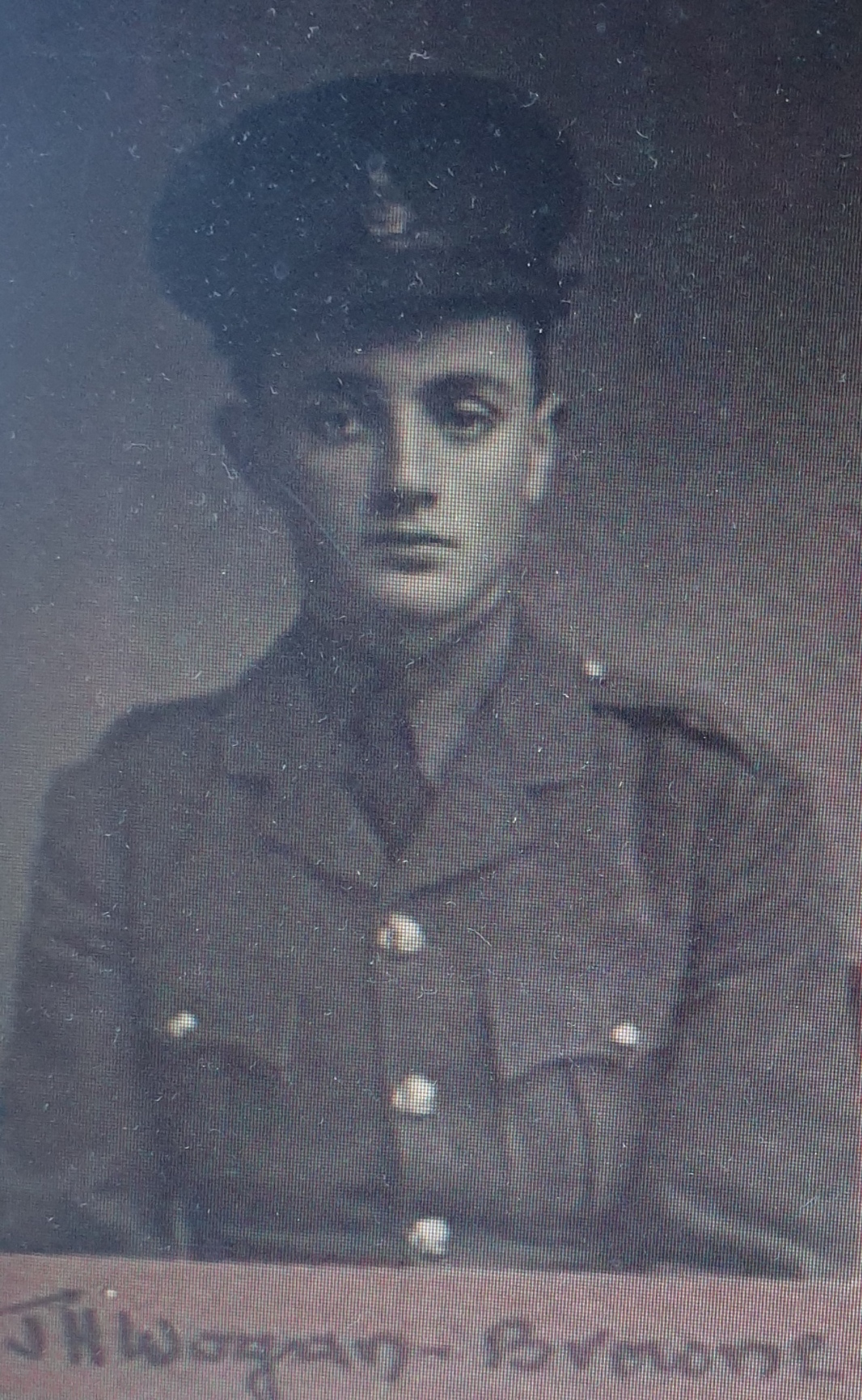
On the 14th February, 1922, a British Army Lieutenant, John Hubert Wogan-Browne (pictured), was buried in Naas, in County Kildare.
He had been shot in the head on the 10th February during an IRA fund-raising operation in Kildare Town, when a British Army regimental payroll was targeted outside 'The National Bank'.
The money was being carried by the British Army man ; the IRA knew there would be between £135 and £500 in cash in his possession, but he fought with the Volunteers to hold on to the money.
Michael Collins was, at that time, in command of the newly-spawned Free State Army and, on hearing of the shooting, he contacted Mr Winston Churchill
and assured him that he would do all in his power to bring those IRA Volunteers to justice, as any good servant would do, and told him that his men would assist the RIC and the British Army in finding those who had carried out the robbery and the shooting.
Then, on the 13th February, Mr Collins telegrammed Mr Churchill to inform him that three IRA Volunteers had been 'arrested for the crime' - "Have just been informed by telephone that we have captured three of those responsible for the attack on Lieutenant Wogan-Browne. Everyone, civilian and soldier, has co-operated in tracking those responsible for abominable action. You may rely on it that those whom we can prove guilty will be suitably dealt with..."
Mr Collins had somewhat placated his political and military mentors in Westminster with his 'we will pursue them' statement and, later, done the same in his own country - no trial was ever held, no-one was imprisoned for the robbery or the shooting. Disgraceful that he had ever placed himself in the position where he had to turn on his own countrymen and women to please the British.
==========================
On the 14th February, 1922, British Army Field-Marshall 'Sir' Henry Wilson (pictured), who was on the verge of retiring from his position as 'Chief of the Imperial Staff' (!) suggested to Winston Churchill and his 'British Cabinet Committee on Ireland' that "nothing could solve the Irish problem (sic) except re-conquest..."
And poor Mr Churchill and his Cabinet had their hands full - they were also dealing with a suggestion from Mr James Craig, the '1st Viscount Craigavon', that 5,000 'Special Constabulary' (pictured) should be mobilised to invade the Free State!
Mr Churchill 'compromised' with both men and their 'suggestions' - he sent three (more) battalions of British soldiers to patrol and secure their imposed border in Ireland!
==========================
ON THIS DATE (14TH FEBRUARY) 103 YEARS AGO : IRA MAN WHO REFUSED THE OPPORTUNITY TO ESCAPE WAS DECLARED 'GUILTY' BY HIS BRITISH CAPTORS AND THEN EXECUTED.
IRA Volunteer Patrick Moran (pictured): "I don't want to let down the witnesses who gave evidence for me..." - the words of Patrick Moran, Adjutant of D Company Irish Volunteers, 2nd Battalion (Dublin), to his comrades Ernie O'Malley (who had passed himself off to the British as 'Bernard Stewart') and Frank Teeling as they were about to walk to freedom through a gate in Kilmainham Jail in Dublin, which they had forced open, on the 14th of February 1921 - 103 years ago on this date.
Patrick Moran believed he would be found innocent at his 'trial' and saw no reason why he should take the opportunity to escape.
He was a 'dangerous man', as far as Westminster was concerned, and had been imprisoned in Dublin Castle on the 7th of January 1921 and charged with the 'murder' of two British Army/paramilitary gang members, Ames and Bennett, after been mistakenly identified as having been involved in the shooting dead of both men - Lieutenant Peter Ashmun Ames and British Army Lieutenant George Bennett (both of whom were in command of 'The Cairo Gang') on the 21st of November 1920 at 38 Upper Mount Street in Dublin.
Patrick Moran stayed behind on the night of the prison break ,refusing to take part in same, having encouraged Simon Donnelly to go in his place, a decision which was was to cost Patrick Moran his life.
On the 15th of February 1921, he was put on 'trial' (during which sixteen people and an RIC man verified he was elsewhere!) but was, as expected, found 'guilty' and, three days later - on the 18th of February 1921 - he was transferred to Mountjoy Jail, Dublin.
On Wednesday, 9th of March 1921, Patrick Moran was sentenced to death and he was executed by hanging five days later, on Monday, the 14th of March.
He had defended the integrity of his country in Jacob's Factory Garrison during Easter week in 1916, where he served under Thomas MacDonagh, and had been imprisoned at Knutsford and Woorwood Scrubs in England, and in Frongoch Internment Camp in Wales.
He was one of 'The Forgotten Ten' in that he, and his nine comrades, were 'forgotten' by the State but have always been remembered by the Republican Movement.
Finally, the planning and execution of the escape itself is worthy of a few paragraphs : On the 11th February 1921, Frank Teeling and Ernie O'Malley were joined in Kilmainham Jail by Simon Donnelly, who was taken into their confidence and told of the up-coming plan of escape. The peep-holes in the cell doors were three inches in diameter and, if one of the men could get his arm through it, it would be possible to open the door from the outside.
The plan then was to make their way to the yard, as the men had noticed that the door leading from the prison to the yard was usually left closed-over, but not locked, and then cross the yard to a large iron gate on the west side of the jail, cut the bolt on it and escape.
A 'Plan B' had been made in case the bolt cutter should fail - IRA Volunteers from 'F' Company, Fourth Battalion, Dublin Brigade, would take up positions outside the prison wall with a rope ladder and, awaiting an agreed signal, throw in the rope attached to the ladder, so that the prisoners could haul the ladder over to their side of the wall.
Oscar Traynor (on the left, in this photograph), IRA Dublin Brigade O/C, had secured a bolt cutter and that, along with two revolvers, were packaged and smuggled into the prison by a friendly British soldier. The prisoners were not sure that the bolt cutter would be up to the job but were determined to carry out the escape plan, as Frank Teeling was in line for execution ; on the night of February 13th, 1921, the three men made their way to the outer prison gate but, as the handles of the bolt cutter were incorrectly fitted, they were unable to cut the bolt.
They went to 'Plan B', and gave the signal for their comrades on the other side of the prison wall to throw in the rope attached to the ladder - the rope jammed on top of the wall and snapped when the men outside attempted to pull it back to them. The three prisoners had no alternative but to return to their cells.
The following day, the 14th February, 1921, the British soldier who was in on the plan repaired/adjusted the handles on the bolt cutter and, that night, at 6.30pm, the three prisoners decided to make another escape attempt.
The three Irish republican prisoners again made their way down to the gate and, this time, the bolt cutter worked. They used butter and grease, which they saved from their meals, to help ease the remaining portion of the corroded bolt out from its latch and two of the men got their revolvers at the ready as the third man pulled on the heavy door which creaked open sluggishly on its rusty hinges and the three men walked out!
Simon Donnelly had tried to persuade Patrick Moran to join them, but Moran - who was not involved in shooting Ames or Bennett, and had what he considered the perfect alibi for that night - refused to leave the prison except by the front gate as a free man.
Patrick Moran paid with his life for relying on British justice : as stated above, on Wednesday, 9th of March 1921, Patrick Moran was sentenced to death and he was executed by hanging five days later, on Monday, the 14th of March.
Not the first innocent man to be put to death by the British, and not the last Irish person to be punished by them in revenge.
Thanks for the visit, and for reading.
Sharon and the team.
From 1921 - three members of this extended family were shot by the IRA for their anti-republican activity, which led to some public unease in the areas where they lived.
Then paperwork came to light which exposed the actions of the three men and pinpointed their political allegiance, and named others who felt as they did...
From 1922 - Michael Collins confirmed to Churchill in Westminster that he would capture the IRA Volunteers that had killed a British Army Lieutenant in Ireland and bring them to justice, but...
...and speaking of Mr Churchill, the poor man had other Irish-related issues on his plate : his own people wanted him to militarily invade the Free State!
This imprisoned IRA man had the opportunity to escape from British custody, and had the means to do so, but decided to stay where he was. It was a bad call - he barely lived long enough to regret it...
It being St Valentine's Day on Wednesday, 14th February 2024 (...yeah, that's right, lads - forget it at your peril..!) we're putting together 18 pieces about Irish men and women that had real desire, attraction and love...for their country, that is, and we write about how they expressed those emotions.
So there ya have it - breakfast in bed, and a fair bit of reading (four sample pieces above) to be gettin' on with, on Wednesday, 14th February 2024. Just make sure you don't get yer toast crumbs on the page.
Or else...!
Thanks for reading - see yis on Wednesday 14th!
Sharon and the team.