ON THIS DATE (26TH JUNE) 102 YEARS AGO : FREE STATE GENERAL KIDNAPPED ON THE EVE OF CIVIL WAR.
On the 26th June, 1922, Leo Henderson and a group of 'Irregulars/Dissidents' left the then republican-occupied Four Courts (which had been taken over on the 14th of April by anti-treaty forces) and arrived at Ferguson's garage on Dublin's Baggot Street, accusing them of doing business with Belfast ; this was, they said, in violation of the boycott the IRA had placed on the city due to violence against nationalists/republicans there.
Leo Henderson seized a number of cars at gunpoint, and was on the point of driving back to the IRA stronghold of the Four Courts when he was 'arrested' by Free State troops.
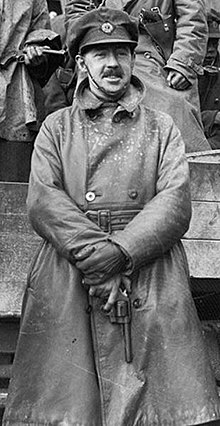
Volunteer Henderson's comrades in the Four Courts in response arrested a Free State Army General, Jeremiah Joseph ('JJ') 'Ginger' O'Connell (pictured) and, within 24 hours, Free State artillery ('borrowed' from Westminster) was battering at the walls of the Four Courts in central Dublin.
The first shots of the Irish Civil War were caused by a row over selling cars to Belfast...
..not altogether the full story, although the 'bones' of what actually happened are there.
Harry Ferguson's garage was a well-known Belfast automobile company, with a branch on Baggot Street, in Dublin. It was known to be unsympathetic to the 'Irregulars' and had blatantly ignored an overall directive from the IRA that for-profit business dealings with Belfast should cease until business bosses in that city took steps to ensure the safety of their nationalist workforce.
Leo Henderson and his men commandeered about 15 cars which had been sent, for sale, to Dublin from Belfast - the IRA's intention, as well as to be seen enforcing the 'Belfast Trade Boycott', was to use the vehicles, as part of the war effort, against the continuing British political and military presence in the Six Occupied Counties and in their campaign to overthrow the then-fledging Free State political administration.
Leo Henderson was captured by the Staters, with ex-IRA man Frank Thornton in command of them and, when the IRA leadership heard that Henderson had been 'arrested', they discussed abducting Collins himself or Richard Mulcahy in retaliation, but decided instead to seize Free State General Jeremiah Joseph (JJ) 'Ginger' O'Connell, who was Richard Mulcahy's Deputy Chief-of-Staff.
At 11.15pm on the night of Tuesday, 27th June, 1922, 'Ginger' was arrested in Dublin by the IRA after an evening out with his girlfriend - the couple had gone to the theatre and, after the girlfriend was dropped home, 'Ginger' went to McGilligan's Pub in Leeson Street for a few pints.
As he left the pub, the IRA seized him and held him in the republican-occupied Four Courts ; Ernie O'Malley actually telephoned Free State General Eoin O'Duffy, who was in Portobello Barracks, and told him that 'Ginger' will be returned to the Staters in exchange for Leo Henderson.
The republicans knew that 'Ginger' was valued by Collins and his renegades - he was one of the few that eagerly conveyed the 'cancel-the-Rising'-order
from Eoin MacNeill in 1916 and both Collins and Mulcahy regarded him as a safe pair of hands.
Collins's political and military bosses in London were notified about 'JJ Ginger' being held in republican custody and made it clear to Collins that if he and his Free State colleagues didn't take steps to remove the republicans from the Four Courts, they would - the Staters had already decided to attack their former comrades in the Four Courts and had already accepted the offer from Westminster of equipment with which to carry-out the task ; British artillery, aircraft, armoured cars, machine guns, small arms and ammunition were by then in the possession of Collins and his team, who then used the 'JJ kidnap'-incident to press ahead with the assault.
At 3.40am, on Wednesday, 28th June 1922, the republican forces inside the Four Courts were given an ultimatum by Collins - 'surrender before 4am and leave the building'.
The republicans ignored the threat and held their ground and, less than half-an-hour later - at about 4.30am - the Staters opened fire on the republicans with British-supplied 18-pounder guns and practically destroyed the building (pictured), an act which was recently described as "..a major national calamity..an assault on the collective memory of the nation..such actions are considered as war crimes..a cultural atrocity.."
The IRA held out for two days before leaving the building, but fought-on elsewhere in Dublin until early July, 1922, with Oscar Traynor (who later joined the Fianna Fáil party) in command.
'JJ Ginger' was rescued by his Stater colleagues on Friday, 30th June 1922 when they finally managed to enter the then shell of a building where the Four Courts once stood and, within months, was demoted from a Lieutenant-General to a Major-General and then to a Colonel, a position he was to remain in.
He got married in 1922 and, between 1924 and 1944 (he died in the Richmond Hospital in Dublin from a heart attack on the 19th February of that year), he was shifted around like a pawn on a chess board : chief lecturer in the FS Army school of instruction, director of Number 2 (Intelligence) Bureau, OC equitation school, quartermaster-general and director of the military archives.
We wonder did he consider himself to be the man who started a Civil War...?
On the 26th June, 1919, two British military gentlemen, a Brigadier General Francis Waldron CB and a Major Thackeray RM presided over a meeting in the Courthouse, in Kildare, to discuss their intentions to establish a branch of the 'Comrades of the War Association' in Kildare, to service like-minded individuals in that and surrounding districts.
The grouping had as its objective "..to represent the rights of ex (British)-servicemen who had served during 'The Great War 1914-1918' (and to) provide financial, social and emotional care and support to all members of the British Armed Forces - past and present, and their families..."
The 'Comrades of the War Association' grouping later merged with other ex (British)-servicemen's organisations to form the 'British Legion'.
I believe my membership card is in the post...
==========================
On the 26th June, 1919, the subject of the farm workers strike in Celbridge, County Kildare, was raised at a meeting of the 'County Kildare Farmer's Union' in Athy, in that county.
The Athy farmers put it to a vote whether or not they should join their colleagues in the Celbridge district and sack their farm employees who were members of the then ITGWU trade union, but the proposal to do so was defeated by about 40 votes.
The next day (27th June), the ITGWU was notified by the 'County Kildare Farmer's Union' that, unless the striking workers in the Celbridge area were back at work by the 2nd of July (1919) the County Executive of the 'County Kildare Farmer's Union' would impose an enforced 'lockout' of all members of the ITGWU.
You can read more about that employee bullying here...
==========================
On Monday, 23rd June 1919, as an RIC 'District Inspector', a Mr Michael Hunt (50), was making his way across the Market Square in Thurles, County Tipperary, three shots were fired at him by three IRA Volunteers, 'Big Jim' Stapleton, Tommy Stapleton and Jim Murphy.
Two of the bullets hit him - one went through his right shoulder and the second entered his body just under the left lung. He died within 10 minutes.
The third bullet hit a 12 year old boy, Danny Maher, in the left kneecap.
The young lad was taken to see a local doctor, who couldn't retrieve the bullet and, as there was no point in him staying there, he thought (!), Master Maher walked the eight miles back home (...the next day he got the train to the Mater hospital in Dublin to get x-rayed and proper medical attention. Danny Maher lived well into his 80's!).
Mr Hunt's involvement with the RIC wasn't just a job for him - it was a passion, and he had stepped on many republican toes throughout his 'career', to the extent that he went out of his way to tear Tricolour flags down from lamp posts etc, without a care in the world. He was from County Sligo, and was married with three children, and 'served' the Crown in various parts of the country, including as 'Head Constable' in Carrick-on-Suir, County Tipperary.
On Thursday, 26th June 1919, his execution was raised in the Westminster Parliament, in London : 'Lord' John French, the '1st Earl of Ypres' and the British-appointed 'Lord Lieutenant of Ireland', called for the Sinn Féin organisation to be proclaimed an illegal group, but some of his own parliamentarians argued against him, stating that they couldn't do that as Sinn Féin.. "...was a very composite movement (which) included many members holding ordinary Nationalist views.." and put it to Mr French that.. "...he made no distinction between different elements of the separatist movement.."
It was sometime after that exchange that they started calling us 'terrorists' instead...!
==========================
'THE STORMONT CORONERS AMENDMENT BILL.'
From 'The United Irishman' newspaper, April 1955.
On the 15th March 1955, we notice that the Stormont Coroners Amendment Bill has been published.
The aim of the new Bill is to enable coroners in certain circumstances to hold an inquest without a jury.
If this is one of the signs of coming events, then it is easy to predict that in any future shootings by B Specials or their colleagues, they will be caused no undue anxiety as to the type of verdict which may be brought in.
It is surely questionable whether such a Bill is at all moral under present-day circumstances...
(MORE LATER.)
On the 26th June, 1920, an IRA Unit from the North Cork Number 2 Brigade, led by Liam Lynch, George Power, Sean Moylan (Officer Commanding Newmarket Battalion) and Patrick Clancy (Officer Commanding Kanturk Battalion) captured British Army Brigadier General Cuthbert Lucas (pictured), the Commander of the 16th Brigade of the British Army in Ireland.
Two other British Army officers, a Colonel Danford and a Colonel Tyrell, were also captured.
The three British Army Officers had taken a break from marauding on that day, and were resting in a cottage in Kilbarry, County Waterford, preparing to go salmon fishing on the banks of the Blackwater River, just as the IRA Intelligence Department had told the IRA North Cork Number 2 Brigade they would be!
As they were outnumbered and outgunned, the three British operatives offered no resistance as they were put into the touring car belonging to Mr Lucas but, as they were leaving the site, Mr Danford and Mr Tyrell began talking to each other in Arabic and then suddenly tried to overpower Volunteers Lynch and Clancy in an escape attempt.
The IRA men got the better of them and, in the struggle, Mr Danford was seriously wounded ; himself and Mr Tyrell were removed from the car and made as comfortable as possible on the side of the road, and were told to stay where they were as a doctor would be sent from the next village to tend to them.
The Volunteers travelled to East Clare with their prisoner, Mr Lucas, from where they contacted the British Army leadership with the intention of exchanging their prisoner for IRA captives (Mick Fitzgerald and other Volunteers) held by them but, over the next few days, it became obvious to them that the British had no interest in, or intention of, taking part in such an exchange.
The IRA never intended to shoot Mr Lucas in cold blood, but he was now of no use or value to them ; on the 30th of July (1920) he 'escaped', according to himself, and was safely collected by his own people.
However, while being taken out of the area in a small convoy of British Army vehicles, travelling through Oola in East Limerick (on the border with Tipperary) they were attacked by a Unit from the IRA 3rd Tipperary Brigade (with Dan Breen and Seán Treacy in command) and Mr Lucas was grazed in the head by a bullet - he was lucky, but five of his 'rescuers' weren't ; two of them were killed and three were wounded, before the IRA withdrew, as British Army reinforcements were moving towards their position.
Later that day, Mr Lucas and his remaining convoy arrived in Fermoy, County Cork, with n'er a salmon between them...
==========================
On the 26th June, 1920, under the command of Brigade Officer Commander Frank McGrath, the Number 1 North Tipperary Brigade IRA attacked the RIC in their barracks in the town of Borrisokane, in County Tipperary.
During the operation, two IRA Volunteers were wounded (by their own side) and one of them, Michael Kennedy, died from his wounds in early July.
It is recorded that, despite the self-inflicted injuries, victory was almost imminent, but Brigade O/C McGrath ordered the withdrawal of the Volunteers, despite protestations from his Adjutant, Seán Gaynor.
Adjutant Gaynor, who had joined the Volunteers in 1917 and had served terms of imprisonment in Limerick and Belfast, was immersed in the IRA military campaign and subsequently replaced Volunteer McGrath as the Officer Commanding of the Brigade.
==========================
In February, 1920, the Officer Commanding of the Sligo Brigade IRA, Frank Carty (pictured, a republican-gamekeeper-turned-Free State-poacher) , who joined the 'Irish Volunteers' in 1914 and then joined the 'Irish Republican Brotherhood' the following year, was 'arrested' by the British and incarcerated in Sligo Jail.
In June (1920), IRA Volunteers Liam Pilkington and Seamus Devins were put in charge of an escape committee to rescue their comrade from the jail and, on the 26th of that month, they put the plan into action.
Dozens of Sligo Volunteers were involved in the operation, before which they placed an armed defensive cordon on all roads leading to and from the jail (including a blockade of sorts - a pair of old, heavy iron gates were placed across one of the access roads).
Thirteen Volunteers used a ladder to scale the jail wall, in near full darkness, and lowered themselves to the ground inside with a rope ladder, overpowered the guard on security duty and successfully gained entrance to the Governor's house.
They tied the Governor up and got his set of keys, which were used to open Frank Carty's cell door and, when he was out, the group made their way to the rope ladder but it was decided that that would be too slow of a method for so many people.
'Plan B' was put into action ; several men with sledgehammers and pickaxes splintered the wicket gate (a small entrance/exit gate in the main gates), which took only a few minutes, and all involved got out and away into the hills and freedom.
It is said that there was a reluctance on the part of the Sligo town RIC and British Army to be first on the scene of all the commotion, a reluctance which helped to ensure the success of the operation.
The only injuries reported that night, on both sides, was caused by the heavy iron gates on the road when a British Army truck, in the darkness, drove into them and a few of its passengers got thrown around a bit!
==========================
ON THIS DATE (26TH JUNE) 33 YEARS AGO : 'MAGUIRE SEVEN' CONVICTIONS QUASHED.
'Two brothers who were falsely imprisoned as teenagers for the Guildford pub bombings have spoken of the experience 40 years on. Patrick and Vincent Maguire were part of the 'Maguire Seven' group who were - together with the Guildford Four - wrongly convicted for the 1974 bombings ; "I remember the day I came home from school. It was a Thursday.. youth club night... a normal day," Patrick - who was 13 at the time of his arrest - told RTE Radio 1's Sunday with Miriam this morning.
"We [himself and his brother John] were eager to get and go there... [Afterwards] we saw a lot of police and unmarked car outside our home. I ran up to the house, knocked on the door. The door opened... I said 'I live here' and I was dragged inside. They said, 'here's another one'. That was the day my childhood ended," he said.
The 'Maguire Seven', who were convicted of handling explosives allegedly passed to the IRA to make bombs, were made up of Anne and Patrick Maguire, Anne's brother Sean, Anne's brother-in-law Patrick Conlon, family friend Patrick O'Neill, and Anne's two sons Patrick and Vincent...' (from here.)
'On the day after the 'Guildford Four' had walked out of the Old Bailey, the British Government had appointed Sir John May to lead a public inquiry into the convictions of the eleven people charged with the Guildford and Woolwich pub bombings.
Sir John bared his teeth in July 1990 when he forwarded to the government his 'Interim Report on the Maguire Case' ; in this report
he criticised the trial judge Sir John Donaldson's handling of the 'Maguire Seven' case and questioned the credibility of the forensic evidence that had been presented to the court. What is more, he recommended that the 'Maguire Seven' case should go back to the court of appeal. When this occurred, the court of appeal quashed the convictions of the 'Maguire Seven', on the 26th June, 1991...' (from here.)
Could never happen again, could it - innocent people imprisoned to satisfy the requirements of an unjust political regime...?
On the 26th June, 1921, Westminster's 'Sir' Joseph Austen Chamberlain, the then Conservative (Tory) Party leader (the older half-brother of British Prime Minister Neville Chamberlain)wrote a letter to his sister, Hilda, in which he mentioned 'work'...!
Mr Chamberlain's job (!) at that particular time was in connection with mostly 'behind-the-scenes' wheelin' and dealin' with Michael Collins and others about a truce and treaty between the warring sides ie Westminster and Dáil Éireann/the British Armed forces and the IRA.
In his letter, Mr Chamberlain opined that his government's change of policy towards those damned Irish rebels/terrorists/dissidents (!) was "...a last attempt at peace before we go the full length of martial law.."
The wheelin' and dealin' started, officially, in London, on the 11th October, 1921, and culminated in the signature, by British and Irish negotiators of 'Articles of Agreement' ('the Treaty of Surrender', as Irish republicans call it) in the early morning of the 6th December, 1921, leading directly to the creation of the Irish Free State on the 6th December, 1922, consisting of 26 of our 32 counties.
And, today - 2024 - we remain six counties short of our objective.
==========================
In August, 1920, the British Army leadership in Ireland issued an order to all its gunmen-in-uniform stating that, for fear of retaliation in kind, they should send their wives and children back home to England, for their own safety.
Ten months later, some of those who 'bravely' ignored that order were to pay the price for their own savagery :
In June, 1921, British operatives Mr William Frederick Hunt (a 'District Inspector' with 'R Company', RIC 72296/ADRIC 104) , who had a reputation for being an agressive person, and Mr Enfield White, who had obtained lodgings in the Mayfair Hotel on 30 Lower Baggot Street, in Dublin, were in the private dining room of that establishment, enjoying an early evening tea.
Mr Hunt was accompanied by his wife, Alice, and their ten-year-old daughter, Doris, and Mr White was accompanied by his wife, Annie.
The group were relaxed in their private room, supping tea, when a knock came to the door, which was then opened by Mr Hunt.
Four IRA Volunteers entered the room and shot Mr Hunt three times, and he fell to the floor, dead. Mr White survived the wounds inflicted on him.
The hotel was owned at the time by a British Army Captain, Walter Aloysius Doyle-Kelly, who 'served the Empire' in '6th Jats' in France in 1915, and was wounded in Mesopotamia on the 7th January, 1916.
The IRA Unit which carried out the operation consisted of Volunteers from 'Number 4 Section ASU' of the Dublin Brigade, IRA, which was led by Pádraig Ó Conchubhair (Paddy O'Connor) and included Volunteers Michael Stack, Peter Larkin, Jim Stapleon, James Murphy, Jack Hanlon, Jim O'Neill, James Tully and Alec O'Toole.
==========================
On the 1st April, 1921, an ex-British Army soldier living in Cork, Thomas Goulding, had to jump into the River Lee (pictured) to escape an IRA ASU who were closing-in on him. He swam to the other side of the river and escaped certain death.
On the 26th June that year, another attempt was made to shoot him, but he survived that, too.
We presume Mr Goulding got the message, and moved to a different location...
==========================
In around December, 1920, a 25-years-young Scottish man, Alex McDonald, from the town of Caithness, no doubt looking for 'adventure', decided to move to Ireland and join the RIC ('Service Number 59921'). On the 26th June, 1921, he 'went missing' and has never been heard of since.
Thomas Shanley, a then 20-years-young farmer, in 1911, in the area where he was born, County Leitrim, no doubt looking for 'adventure', too, decided to join the RIC ('Service Number 65937/LDS 2092/094') and, for five years, was moved around to different parts of Ireland 'to keep the peace'.
In 1916, at 25 years of age, he was permanently stationed in Kildorrery, in County Cork, and was said to have been in close proximity when Lord Mayor Tomás MacCurtain was assassinated in his house by the RIC in March, 1920.
On the 26th June, 1921, as he was leaving Mass in Kildorrery Church, the IRA shot him four times, killing him instantly.
==========================
A group of British Army soldiers from the 'Rifle Regiment' were on patrol in the Donegal area on the 26th June, 1921, when they came upon a civilian, a local man, a Mr Manus O'Donnell.
The British claimed they called on him to halt and, when he didn't, they shot him. Mr O'Donnell died two days later in the Infirmary in Lifford, County Donegal.
==========================
On Friday, 24th June, 1921, IRA Volunteer John (Seán) Twomey (23), from North Main Street in the city, the Officer Commanding of the Cork City ASU, was out and about his business on the Grand Parade in Cork when he was jumped-on by British soldiers from the 'Manchester Regiment' and 'arrested' by them.
On Sunday, 26th June, at about 8pm, he was being moved from one holding centre to another and, as the British Army armoured car pulled up, Volunteer Twomey made a break for freedom.
He ran towards Kyle Street and was called-on by his ex-captors to stop, but he kept running ; one of the British soldiers later said - "(One of us) fired with his revolver...(he) fired six shots...(our) driver fired two shots, and one of the RIC also fired, but I don't know how many shots..."
Volunteer Twomey ran into Mrs Bradley's Public House on Kyle Street as the shots rang out and, as he was running in, a woman in the doorway collapsed.
When the British soldiers got to the pub, they found a woman, Mrs Mary Parnell (32), a widow with two children, who lived in Number 11 Kyrl's Quay, Cork City, dead in the doorway with "...most of her face and the top of her head having been shot away.."
The 'inquest jury' determined that 'Mary Parnell had been killed by crown forces in the execution of their duty..'
Volunteer Twomey had been wounded in the escape attempt and was unfortunately recaptured that same night.
==========================
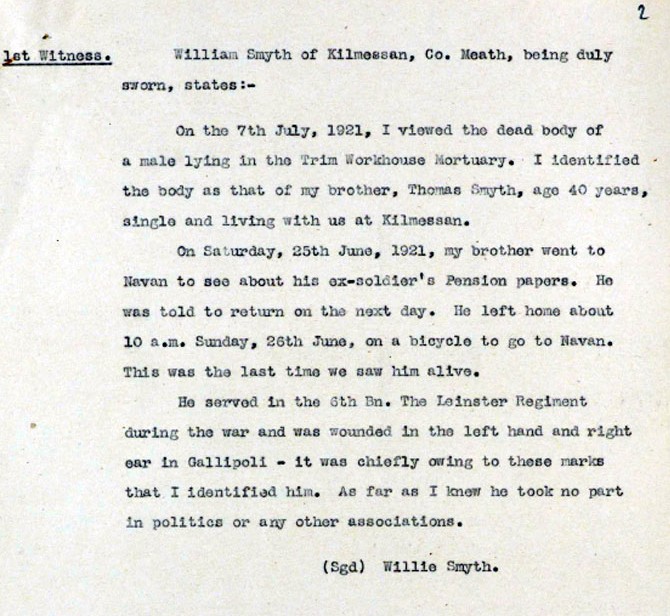
On Saturday, 25th June 1921, ex-British soldier Thomas Smith (38) left his home in Kilmessan, in County Meath, to travel on his bicycle the 13km to the town of Navan, to inquire about his military pension - Mr Smith had 'served the Crown' in Gallipoli in the 6th Brigade of the 'Leinster Regiment' and was wounded in the left hand and right ear, and was due a few bob.
In Navan, the BA pensions people took his details and asked him to call in to them the next day.
On Sunday, 26th June (1921), Mr Smith left his house at about 10am and disappeared.
In early July, a body was discovered in the River Boyne, with its hands, arms and feet tied, and iron weights fixed to it. On the 7th July, a Mr William Smith identified the body as that of his brother, Thomas.
There was no claim of responsibility, nor was there any witnesses to what had happened.
==========================
SO, FAREWELL THEN, CELTIC TIGER....
It had to happen, sooner or later.
Most of the pundits and economists were too busy singing the Celtic Tiger's praises to notice, but a few critical observers worried all along about the weaknesses of a boom economy that depended so much on a few companies from one place - the United States.
By Denis O'Hearn.
From 'Magill' Annual 2002.
Inequality has increased and governments have been unable or unwilling to use their tremendous resources to the benefit of the Irish people*.
One reason inequality increased is because growth is so heavily concentrated in profits ; US companies came to Ireland to make lots of profits and to avoid taxation.
They succeeded very well.
In the 1980's, US companies' profit rates in Ireland were two-and-a-half-times higher than elsewhere in the world ; now they are five times higher, a fact that makes US tax authorities very suspicious of their accounting procedures.
Apart from foreign companies, the 'Celtic Tiger' also created a large rise in unearned incomes and professional fees for the richest segments of Irish society... ( *...the more things change..)
(MORE LATER.)
On the 26th June, 1922, British Army Colonel John Gretton, of the 6th Battalion of the Staffordshire Regiment, wrote to his boss, Winston Churchill, with some alarming information...!
Mr Gretton told Mr Churchill that a concerted IRA attack was imminent on the good loyalist people of the Six Counties any hour now if, indeed, it wasn't actually taking place as he wrote!
He told Mr Churchill that he knew this because the Roman Catholic Franciscan Order was holding a religious pilgrimage in Multyfarnham Abbey in County Meath and the last time they met there it was to "plan a Protestant massacre".
We don't know how Mr Churchill reacted when he discovered that the last time the Franciscans met there was in 1641...
==========================
On the 26th June, 1922, a 'Special Constable', a Mr William Leggett, was a passenger in a Crown Force Crossley Tender (pictured) when the vehicle suffered a burst tyre, overturning as a result, and Mr Leggett died in the crash.
==========================
On the 22nd June, 1922, British Army Field Marshal Sir Henry Wilson, MP (pictured), and the chief military advisor to the Stormont political and military administration in Ireland, was assassinated in London, outside his house at 36 Eaton Place, by the IRA.
There was, as would be expected, much disgust in Westminster over his execution and, on the 26th June, within hours of Mr Wilson's State funeral in Saint Paul's Cathedral in London, Mr Lloyd George and Mr Winston Churchill came under verbal attack from Mr Bonar Law and others about his death.
Mr Lloyd declared that he regretted that the Free Staters in Ireland had not done more to protect life and property, overall, questioning whether they were capable at all of doing that, while Mr Churchill went further.
He made a speech in which he linked Mr Wilson's assassination with the anti-Treaty IRA men occupying the Four Courts in Dublin and demanded that the Free Staters clear out this "nest of anarchy and treason", stating that if they didn't do so, the British would do it for them -
"This sort of thing must come to an end (or) His Majesty's Government shall deem the Treaty to be formally violated and resume full liberty of action in any direction that may seem proper..."
But of course "the proper sort of thing" was not done - that of a complete British military and political withdrawal from Ireland.
==========================
Between 31st January and 26th June 1922, the British Government supplied Michael Collins and his Free State military with 11,900 rifles, 79 Lewis Machine Guns, 4,200 revolvers, 3,504 grenades, 1.7 million rounds of ammunition, six armoured cars and a large number of trucks, with which to defeat Irish resistance to British interference in Ireland.
Free State forces amounted to approximately 8,000 armed men while a Leinster House source estimated that the IRA had 12,900 men and 6,780 rifles.
So, while the IRA actually outnumbered the Staters (and had more experienced fighters), the Staters were much better equipped.
The Brits did, sometimes, look after their own...
==========================
BEIR BUA...
The Thread of the Irish Republican Movement from The United Irishmen through to today.
Republicanism in history and today.
Published by the James Connolly/Tommy O'Neill Cumann, Republican Sinn Féin, The Liberties, Dublin.
August 1998.
('1169' comment - 'Beir Bua' translates as 'Grasp Victory' in the English language.)
REPUBLICANS AND THE STATE :
The First Dáil Éireann was 'illegal', but whose 'law' was being quoted?
The Irish people had overwhelmingly backed Sinn Féin who had openly announced their intentions before the elections.
Throughout this time the Dáil operated unevenly ; it enjoyed success in the Republican Courts which, in areas, were able to gain the confidence of the people and drew support away from the judicial pillar of the British State.
It was also successful in establishing a Republican Police Force and establishing a local government structure.
Of course it was difficult to operate at this time as the two parallel States - Republican and British - competed for support and the armies of the two States were at war...
(MORE LATER.)
On the 26th June, 1924, a Mr Richard Mulcahy (pictured, a republican-gamekeeper-turned-Free State poacher) introduced a 'Censure Motion/Motion Of Censure' in the Leinster House assembly stating that "it was contrary to the best interests of the State, and ill-considered of the Executive, to have removed the (IRA) Army Council..."
Mr Mulcahy no doubt wanted to keep his friends close and his enemies closer, but the 'Labour Party' (becoming accustomed to 'perks and pensions') abstained from the vote and the motion was defeated.
The Staters hadn't learned then, and still haven't learned to this day, that they have no business in republican business.
==========================
Thanks for the visit, and for reading!
Sharon and the team.
Ah sure, look it...
...we're not anymore bigheaded now than we were before we clocked-up over 1,500,000 hits.
YA WHA'???
You hadn't noticed, you say... "so what?", ya declare, with a shrug of your shoulders...
"Big deal...", you retort, throwing your eyes up to Heaven...
Well feck off then, and don't check back with us on Wednesday, 26th June 2024, when we'll be posting a blog with 1,500,000...eh...23...parts in it, covering the following four stories and nineteen others -
Between January and June in this particular year in the 1920's, the IRA had time-and-a-half the number of 'men and women in uniform' that the Staters had, but the latter had one advantage that the former didn't have - Westminster...
1920's, Ireland - Michael Collins told directly by Westminster to 'sort out' an on-going incident between his people and the IRA or else they would do what they deemed necessary to bring the incident to a close in their favour...
1919, Ireland - 'Legion'-aires (!) disease outbreak (a rose by any other name..!) in a county near Dublin soon morphed into its true colours...
1919, Ireland ; for this RIC man, his 'job' wasn't - it was a passion, his 'mission in life'. His forced absence (!) was even noted in Westminster, who praised him and called for political ramifications to be enacted in Ireland...
So...do US a favour : add another score to our hit counter, won't ya not, as we're trying to get to two million.
Not greedy or anything...!
Thanks for the visit, and for reading : see yis on Wednesday, 26th June 2024!
Sharon and the team.
Go Raibh Maith Agat/Thank You!
A couple of days ago, we 'aged' - to over 1,500,000 hits on this blog - and counting...!
We espouse, support and believe in traditional Irish Republicanism on this weblog and, while we have always been aware that there is support 'out there' for our political, societal and historical values, the three of us continue to be grateful to all our readers, and surprised by where they come from.
We have been repeatedly 'hit on' by regular customers (!) from America (big 'Hi!' to our readers in the White House, all our colleagues in New York, Florida, Boston etc), Canada, Russia, England (...including our viewers in the 'House of Lords' and elsewhere in Westminster - yes, we see you...!) and our tens of thousands of readers in France, Germany, Switzerland and about 170 other countries!
The three of us try our best to remember lesser-known figures and occurrences from Irish history and politics, and keep them 'alive' for those with a similar interest, as well as the better-known occurrences.
It's a formula which works for us, and one that we love and enjoy, and our intention is to keep doing it until we have exhausted all our many resources.
Mór againn do chuidiú.
Is mise le meas, agus le gach dea-ghuí!
Thanks for the visit, and for reading!
Sharon and the team.
'AN OLD AND UNFAIR CRITICISM...'
From 'The United Irishman' newspaper, April 1955.
At the inaugural meeting of Fianna Fáil in May 1926, Mr de Valera said he had been planning a policy since 1921.
As Sceilg points out, why did he not then indicate what it was, when the Rathmines motion came before the Ard Fheis in 1925?
Why did he let a sub-committee of men, who certainly knew Ireland and her needs as well as he did, work for months on a National Policy, when he studiously ignored it?
Now Sceilg is always, without question, most accurate, and this may be old news to some but, to others, I feel lengthy contradiction of such an affair comment is necessary, to clearly indicate that Sinn Féin has always been ready to provide solutions to national problems and indeed to anticipate them by fostering the creative spirit of the race.
(END of 'An Old And Unfair Criticism' : NEXT - 'The Stormont Coroners Amendment Bill', from the same source.)
On the 12th June, 1920, two RIC members - a Mr John Carroll and a Mr Norman Cruise - were in 'The Railway Hotel' (pictured), in Limerick, having a few drinks when a gunshot was discharged and Mr Carroll fell to the floor, dead.
Mr Cruise jumped up and ran.
The gunman, IRA Volunteer Paddy Naughton, ran after him, but the RIC member managed to get away, but recognised the IRA man.
Volunteer Naughton went 'on the run', as he was experienced enough to know that he was a dead man if he remained in that area.
Volunteer Paddy Naughton was born on the 22nd January, 1898, in Limerick City, and joined the Volunteers there when he was 19 years of age.
He was an active Volunteer in 'F Company', 2nd Battalion, Mid-Limerick Brigade and, in early 1920, the British and their colleagues in the RIC devoted great resources in trying to capture or kill him, so the Brigade leadership made arrangements to transfer him to the West Limerick Brigade, where he would be safer.
He quickly became a valued member of the 'Active Service Unit' in his new area and was active right up until the 'Truce' on the 11th July, 1921.
When some left the Movement to support the 'Treaty of Surrender', to assist Westminster in Ireland, Volunteer Naughton and almost all of his comrades stayed true to their republican beliefs ; indeed, so weak were the Free Staters in Limerick that they requested Westminster to ensure that the British Army stayed on the ground and assist them in gaining control of the area!
Volunteer Captain Naughton, 24 years of age, was killed in action in Roches Street, Limerick, on the 20th June, 1922 ; he died as he had lived all his adult life - fighting for the Irish Republic.
RIP IRA Captain Paddy Naughton ; 22nd January 1898 - 20th June 1922.
==========================
A Mr Thomas King (26), from Roundstone in County Galway, a boiler-stoker in the British 'Royal' Navy, decided, in about November 1919, to earn an easier few shillings by joining the 'Temporary Police' - the 'Black and Tans' - in Ireland, was sent here for 'training' and, in March 1920, he was stationed in the West Cork area, between the townlands of Bantry and Glengarriff.
It was in that area, too, that the Vice-Officer Commanding of the 3rd (West) Cork Brigade of the IRA, Ted O'Sullivan, and his Unit, operated from and, on the 12th June, 1920, they had established an ambush point, hoping to meet an RIC patrol which they knew was due.
The Volunteer IRA Unit watched as one man on a bicycle, whom they recognised, leisurely cycled past the ambush point, but the rebels, believing that an RIC patrol was on the way, didn't react to his presence : they recognised that cyclist as Thomas King, who was in plain clothes on that day, and he was an enemy agent that they especially wanted to interview, as he was said to have been involved in the execution of IRA Volunteer Thomas O'Dwyer.
The IRA Volunteers were then made aware that the RIC patrol had taken a different route and they called off the ambush, agreeing that five of their number - Dan O'Mahoney, John J. O'Sullivan, John Wrynne, Michael Driscoll and Denis O'Sullivan - should go across fields to Snave Bridge, where Mr King was headed, on his way to the enemy barracks in Glengarriff.
The Volunteers arrived at their destination ahead of Mr King and shot him dead when he arrived at the bridge.
The inquest into the killing collapsed when jurors failed to show for the 'court' case, prompting the Court Coroner to declare that he had never seen that happen before, to which an RIC 'District Inspector', a Mr Oates, replied -
"It shows the state to which society has been reduced..."
Mr Oates, and those like him, had actually 'reduced (Irish) society' to a state that even they themselves didn't think was acceptable.
==========================
SO, FAREWELL THEN, CELTIC TIGER....
It had to happen, sooner or later.
Most of the pundits and economists were too busy singing the Celtic Tiger's praises to notice, but a few critical observers worried all along about the weaknesses of a boom economy that depended so much on a few companies from one place - the United States.
By Denis O'Hearn.
From 'Magill' Annual 2002.
Alain de Janvry asked if economic growth is dominated by a few export sectors that have little connection (articulation) with other parts of the economy, then what chance is there that economic growth will connect to social well-being for the majority of people?
The more likely outcome, he argued, is that such economic growth will favour the wealthy, who will use their power to increase social inequality rather than to achieve social justice.
If the system goes into crisis and growth slows, the wealthy will hold onto resources even tighter and the poorest sections of the population will suffer the most.
Unfortunately, this pessimistic analysis appears to fit the 'Celtic Tiger' like a glove ; the main beneficiaries of economic growth and of social policy under the 'Celtic Tiger' have been the wealthier sections of society...
(MORE LATER.)
On the 12th June, 1921, the IRA, in pursuit of its policy of ensuring that the 'Big Houses' in the country were rendered unusable to Crown Forces,
raided one such mini-mansion in Brackley, County Cavan, which was owned by the Reverend John Finlay, an Anglican Priest.
Mr Finlay (pictured) 78 years of age, was removed from the house with his wife, Isabella, and the house staff and, somewhat disoriented, understandably, were placed in a nearby barn.
When Mrs Finlay returned to the burned-out house the following morning, she found the body of her husband lying on the lawn ; he had a puncture wound at the base of his skull, which had been inflicted with a blunt instrument.
The killing was raised in Westminster -
"About 2am on the morning of June 12 of last year, Dean Finlay was murdered on the lawn outside his house. More than one witness testified at the Military inquiry that about forty men broke into the house, which they set on fire.
Afterwards, the Dean was found on the lawn. He was dead.
A few days later nine men were arrested on suspicion and were identified by different witnesses as strangers who had been present on that occasion, and some of them were stated to have carried short iron bars, with which Dean Finlay might have been struck down.
No witness came forward who was able to say that he saw the blow delivered. These nine men were in custody awaiting trial at the time of the General Amnesty which followed the signing of the Treaty. They were never brought to trial, and were released from custody in pursuance of the Amnesty extended to persons convicted of, or suspected of having committed, offences from political motives in Ireland..."
Mr Finlay's death was said to be as the result of an accident during a struggle or "an unpremeditated act of ill-discipline.."
==========================
This diagram was produced in the 1930's as part of the IRA Brigade activity reports by veterans of the IRA's Offaly No. 1 Brigade.
On the morning of Sunday, 12th June, 1921, RIC 'Head Constable' James McElhill (53) was 'on duty' in the barracks in Kilbeggan, in County Westmeath, and told his colleagues he was taking time off to go to Mass in the nearby church.
As Mr McElhill, a single man who was born in County Tyrone, reached the church a number of gunshots were fired at him and he fell to the ground, badly wounded. He was rushed to the hospital in Mullingar, where he died.
Five IRA Volunteers led by Offaly No. 1 Brigade officer (and Kilbeggan man) Seán McGuinness were involved in the attack.
==========================
On the 12th June, 1921, British Army soldiers attached to the 'Leicestershire Regiment' fired on a group of IRA Volunteers who were drilling at Lisacul Crossroads, between Castlerea and Ballaghdereen, in County Roscommon, and succeeded in shooting dead an uninvolved civilian who was in the area, a Mr Thomas Joseph Rush (29).
Martin and Bridget Rush, the brother and sister respectively of Thomas, later discovered that, when the British Army were closing-in on the Crossroads, Thomas ran for about 500 yards and hid behind a fence.
A British Officer named Chudley and two of his soldiers found him, shot him at close range, and then smashed his skull in with rifle butts.
They then looted the body, taking his gold watch and chain and his money.
Mr Rush was born in Ballaghadereen, in County Roscommon, in 1892, and emigrated to America when he was 21.
He became a 'naturalised US citizen' in Februay 1920 and, that same month, applied for a US Passport as he was thinking of going home for a visit to see his brother, which he did, in June 1921 where, on the 12th of that month - 103 years ago on this date - British soldiers cold-bloodedly shot him dead.
==========================
On Friday, 10th June 1921, RIC member James Glover ('Service Number 64889') was shot dead in Belfast, in the Falls Road area, and two of his RIC colleagues - a Mr Sullivan and a Mr Sharky - were wounded.
The three of them had been returning to their barracks on the Springfield Road and, as they neared the Diamond Picture House on the corner of Cupar Street and the Falls Road, six IRA Volunteers emerged from the foyer and opened fire on them with pistols. A total of 30 rounds were fired at them and all three RIC men were hit numerous times.
Mr Glover was hit four times and was specifically targeted due to his 'nixers' with 'Nixon's Murder Gang' (see below link).
He was 31 years old and single when he died ; a native of County Antrim, he had joined the RIC in about 1910 (having previously worked as a gardener) and was one of the first 200 RIC members to enlist at the outbreak of war, 'serving' as a machine gunner in the 'Irish Guards' in France, from where he was invalided out of the British Army in 1917, after sustaining a gunshot wound to his back on the 31st July 1917.
On the 21st February, 1919, he rejoined the RIC and was posted back to his old barracks in Springfield Road, in Belfast.
His family had a history of colonisation - he was one of seven brothers, 3 of whom had served in the British Army : Samuel served with the 'Royal Army Medical Corps', David (the eldest) was killed with the 12th Battalion, 'Royal Irish Rifles' at Cambrai in 1917, and 3 of his other brothers (Matthew, Thomas and Robert) were in the US Army.
Anyway : after he was executed by the IRA, his Crown Forces pals were looking for revenge and, in the early hours of Sunday, 12th June, two or three motor cars full of armed RIC men knocked on the doors of several houses in Belfast and asked for the man of the house by name.
Using this method, they 'arrested' three men - Alexander McBride (30), from Ballycastle, County Antrim, Malachy Halfpenny (22), from Herbert Street (he was one of six brothers who served in the British Army, one of whom was killed and all of whom were wounded) and William Kerr (26), from Old Lodge Road, none of whom were IRA Volunteers - and told they were being taken to the nearest barracks.
Instead, all three were driven to a field in the north of the city and their bodies were later discovered riddled with bullets.
Of the three men, Mr McBride, a local married businessman and father, was a sometime republican supporter but Mr Halfpenny, a postman (an ex-British Army soldier) and Mr Kerr (a married hairdresser and father) had no connection to the Republican Movement.
Mr McBride's body was found on the Ballysillan Road, Mr Kerr's body was found on the Springfield Road and Mr Halfpenny's body was found on the Ligoniel Road.
Mr Kerr's sister, Alice, identified RIC 'District Inspector' John William Nixon, a Cavan man, as one of the RIC men who called to their house on the 12th June, which would be in keeping with his modus operandi and that of the grouping he worked with and for...
==========================
On the 12th June, 1921, RIC 'Special Constable' Thomas Sturdy was sitting in an armoured lorry at the corner of Dock Street and North Thomas Street in Belfast, when an IRA sniper shot him dead.
Mr Sturdy's colleagues headed out later that day looking for revenge, and forced their way into a house in Dock Street, took the man of the house - a Mr Patrick Milligan (24, a father of one) - out to the back yard of the house and shot him dead.
They then drove to Coates Street and entered the home of a Mr Joseph Millar (25, a father of one), took him out to the front of his house and shot him : Mr Millar died from his wounds at 2.15am the next day.
On that same date, a Mr Hugh Jenkins (19) was shot dead on the Kashmir Road, Belfast, and 51-year-old Thomas Mallon was shot dead by a bullet fired through the window of his house in North Thomas Street, in Belfast.
==========================
On the 12th June, 1921, two RIC members - Mr Michael Brannan (26) and Mr John Frederick Smith (25) were in civilian clothes and enjoying a few pints in Ryan's Pub, in British-occupied Dublin.
IRA Volunteers from 'C Company', 4th Battalion of the Dublin Brigade, with Volunteer Joseph Byrne in command, entered the pub, ordered the two RIC men to vacate the premises, brought them outside and across the River Liffey to Rainsfort Street (beside Guinness's Brewery) and shot them dead.
Mr Brannan was from Durham, in England, and Mr Smith was from Middlesex in England.
==========================
On the 12th June, 1921, Dan Breen (a republican-gamekeeper-turned-Free State-poacher) married Brigid Malone, from Grantham Street, in Dublin, a Dublin Cumann na mBan woman and sister of Lieutenant Michael Malone, who was killed in action at the Battle of Mount Street Bridge during the 1916 Rising.
The couple got married in Purcell's, 'Glenagat House', New Inn, Cahir, in County Tipperary (between Cashel and Clonmel) with Sean Hogan as best man and Aine Malone as bridesmaid.
Dinny Lacey and most of the leadership of the Third Tipperary Brigade were in attendance.
In January 1927, he became the first anti-Treaty TD to take the 'Oath of Allegiance' and sit in Leinster House after the establishment of the Free State.
==========================
BEIR BUA...
The Thread of the Irish Republican Movement from The United Irishmen through to today.
Republicanism in history and today.
Published by the James Connolly/Tommy O'Neill Cumann, Republican Sinn Féin, The Liberties, Dublin.
August 1998.
('1169' comment - 'Beir Bua' translates as 'Grasp Victory' in the English language.)
REPUBLICANS AND THE STATE :
Republicans do not recognise the legitimacy of the six or twenty-six-County States.
In 1918 the British called a General Election ; the whole of Ireland was at that time still a part of the 'United Kingdom'.
Sinn Féin stood in that election on the basis that, if elected, they would not send their representatives to a British parliament, but would establish an independent parliament in Ireland.
Winning the support of a majority of the Irish people, the Sinn Féin TD's met in Dublin and established the First Dáil.
It should be noted that the actual number of votes for Sinn Féin in the general election belied the full support enjoyed by the republicans, since in one-quarter of the constituencies Sinn Féin candidates were not opposed by other parties, because of the futility of denying the massive support Sinn Féin enjoyed and were awarded the seats without a vote...
(MORE LATER.)
On the 27th April, 1922, a notice was delivered by an IRA Officer to a Mr FW Gore Hickman, a member of the gentry (!) and a 'landed estate owner', who lived in Kilmore House in the townland of Kilmore, just one mile from the village of Knock, in the parish of Kilmurry McMahon, County Clare : the Hickmans had connections with, and in, the Crown Forces.
The notice was from the IRA, and was headed 'Oglaigh na hEireann, HQ 1st Western Division', and it gave Mr Hickman notice to vacate the house and lands (consisting of over 18 townlands and amounting to about 4,800 Irish acres, in the late 1850's) as it was required for men and women who were being driven out of Northern towns by Orange-men.
The IRA notice caused consternation in some circles, which prompted Volunteer Simon McInerney, the Officer Commanding of the West Clare Brigade to state, in 'The Clare Champion' newspaper, on the 12th June, 1922, that "the confiscation of the property, effects and stock of Mr F W Gore Hickman of Kilmore House was carried out as a reprisal for the extermination of the Roman Catholic population of Ulster...".
The mansion was demolished by the IRA on the 30th July that year, and materials from it were used to construct several houses within the area.
==========================
On the 12th June, 1922, the managing director of Hughes Bakery in West Belfast, a Mr Edward Devine, was shot dead during a robbery of the shop, a Mr Patrick Ward was shot by a loyalist sniper in Great Patrick Street, Belfast (Mr Ward died two weeks later) and it was on or around this date that a Mr William Smyth (50) was shot in North Queen Street, Belfast, in the middle of the afternoon.
==========================
In February, 1921 (1921), RIC member John Carroll arrived in the village of Ballywilliam, County Wexford, to visit his father.
After his visit, he disappeared.
On the 14th February that year, 1921, his blindfolded body was found in a field near Nenagh, in County Tipperary ; he had been shot in the head by IRA Volunteers under the command of Michael McCormack (an IRA GHQ organiser).
His family were told by the IRA that they would pay a visit to the man of the house and his three other sons if there were any reprisals but, soon after, a Mr Denis Hayes (a cousin of the Carrolls) had his house burned down ; rumour had it that Mr Hayes had tipped-off the IRA that RIC member John Carroll would be in Ballywilliam, visiting his family.
But, codladh an ghioria, on the 12th June in 1922 the Carroll house was burned down, and a Mr Patrick Carroll was shot dead.
Also, on that same date, in Carrigatogher, near Nenagh, in County Tipperary, two members of the Gleeson family were shot and a Mr Adam O'Brien was shot in Cloughjordan, County Tipperary.
==========================
As per the terms of the 'Treaty of Surrender', Westminster began to disband its publicly-displayed military apparatus in the newly-spawned Irish Free State and, on the 12th June, 1922, the 'Lords and Masters' of six 'Irish Regiments' of the British Army were summounded to Windsor Castle, in Berkshire, England, for an audience (!) before their 'King', George V.
The British Army regiments that were officially leaving the killing fields of Ireland were the 'Royal' Irish Regiment, the Connaught Rangers, the South Irish Horse, the Prince of Wales's Leinster Regiment (Royal Canadians), the 'Royal' Munster Fusiliers and the 'Royal' Dublin Fusiliers.
Their boss, Mr George V (!), through a teary eye (probably!) stated -
"No regiment parts with its colours without feelings of sorrow. A knight in days gone by bore on his shield his coat-of-arms and tokens of valour and worth. Only to death did he surrender them.
Your colours are the record of valorous deeds in war, and of the glorious traditions thereby created. By you and your predecessors these colours have been reverenced and guarded as a sacred trust, which trust you now confide to me.
As your king, I am proud to accept this trust, but I fully realise with what grief you relinquish these dearly-prized emblems, and pledge my word that within these ancient and historic walls your colours will be treasured, honoured, and protected as hallowed memorials of the glorious deeds of brave and loyal regiments."
There is another British 'king' in situ over there now, so here's hoping he'll call the rest of his military (and political) squads home, from the six Irish counties they occupy, as well...
==========================
In 1923, the politicians in Leinster House decided that they (and the British) 'had won the war against republicanism' and gave second thoughts to their standing army in the bastard State they had (both) given birth to.
Their military outfit was never a terribly well-disciplined force comprised, as it was, of various anti-republican elements ranging from those who believed, politically, that Ireland consisted of just twenty-six counties, those who once thought otherwise but were prepared to compromise with themselves if a financial reward for doing so was offered, those who were thinking of joining the British Army for 'adventure' to those who were in the Crown Forces (BA, RIC, RUC etc) but resigned to join the new anti-republican armed grouping.
The politicians were quite openly talking about 'thinning the ranks' ie demobilisation of their military force which, naturally, didn't sit well with their rank and file.
The soldiers were armed, trained to a certain degree and, they figured, had practically nothing to loose, so 'nixers' became the order of the day - use what you have, while you still have it, to 'acquire' an extra few shillings and pounds, and that's what happened - there was a glut of bank robberies by State soldiers who were looking for paydays before being made unemployed.
On the 12th June, 1923, a Private Henderson was arrested by the State 'Criminal Investigation Department' (CID) for having carried out an armed robbery on a bank in Capel Street, in Dublin (pictured).
We don't know how much he robbed or what happened to him, but we would have hoped that more thiefs like Mr Henderson would have carried out enough robberies to financially break the State.
But no such luck...!
==========================
Thanks for the visit, and for reading!
Sharon and the team.
We won't be here next Wednesday, the 19th June 2024, as we're helping to organise a family celebration and, when there's close on about 200 people to cater for, we're gonna need as much time as we can get!
But we'll be back on Wednesday, 26th June 2024 with, among other bits and pieces, a high-profile kidnapping in the Free State.
And sure if I've anything to say between this and then, you can catch me on 'X' and 'Facebook' if ya wanna!
Ireland, 1921 - this US citizen was in Ireland to visit his brother. A Crown Force patrol was heading his way but he had the sense to make himself scarce, as he knew what they were capable of, as did other people in the area. But they found him - he never made it back to America alive...
1921, Belfast - three men were taken away by 'renegade' British forces and their bodies were found the next day. A well-known and feared RIC man, with a 'gung-ho' family history, was found to be involved, and he in turn was linked to a better-known uniformed thug. His 'nixers' came back to haunt him...
Mr de Valera was, he said, thinking of this particular policy since 1921, it was raised by others in 1925 but he said nothing. Then, in 1926, he tried to introduce it as his own policy...
Ireland, 1921 - these fighters left the IRA to join the Free State Army but quickly realised they were in the minority and couldn't actually contain their former comrades, who were still striking against the British military presence. So those former republicans turned to the British Army and asked them for help to control the IRA...
In 1919, this Galway man left his job in the British Navy and moved 'inland', for the same employer. He hunted down the IRA for Westminster and, by chance, cycled into an IRA ambush position one day and was recognised for what he was. 'Plan A' didn't work out for the Volunteers, so the ex-Navy man became 'Plan B'...
...the above pieces are snapshots of just five of the 23 articles we'll be writing about on the blog on Wednesday, 12th June 2024, with 'ner a mention of the elections, which are (rightly) dominating the airwaves here.
...and speaking of elections (!), t'was on the 12th June in the year 1741 that a by-election was held here, following the death of 'Sir' Walter Dixon Borrowes.
It was won by a 'Lord' Ophaly (later '1st Duke of Leinster'), but that was really secondary - the real action took place on the (political) duelling field, between a Mr William Paul Warren and a Mr Jack Hardy, which led to Mr Hardy's right hand and arm being shattered ; the 'vote' in favour of amputation was strong...!
Anyway - give us a shout back here on Wednesday, 12th June 2024 ; find out about the amputation job yourself, if ya want, and we'll tell ya about the other 23...
Thanks for the visit, and for reading ; see y'all on Wednesday, 12th!
Sharon and the team.
==========================