Wednesday, August 06, 2014

STORMONT MINISTER ISSUES DECREE THAT HE SHOULD LIVE FOREVER AND WALK ON WATER. PRACTICALLY !

By Peadar O'Donnell ; first published in January 1963.

The 'Red Scare' of 1931 was nonsense, in relation to Irish life, but it was necessary to make a climate for new 'terrorist' legislation, and it was easy to make such a climate, for there was a scare abroad and even robust intelligence is not always a safeguard against a scare. The Free State government raised a great din, and press and pulpit formed a jazz band that bare throats could not cut through to reach the people. Leinster House had a considerable measure of success, mainly because the IRA having first cut itself off from de Valera and later estranged itself from Sinn Féin, did seem a bit 'new' , especially since it had not found a way to fulfil the purpose, which alone would have justified it in striking out on its own, to associate itself with people on concrete social struggles and so interpret its politics to them.

I had the unique experience of seeing the 'Red Scare' develop on two fronts at the same time - is human hysteria a virus which crosses national frontiers as easily as influenza? I sneaked in and out of Ireland to attend executive meetings of the European Small-Farmer Movement in Berlin : I even chanced to be on the spot when a Nazi mob wrecked a cinema which was showing a 'defeatist' film called 'All Quiet on the Western Front'.

Count Michael Károlyi, who was one of my associates on the European committee, lived in Berlin at that time and he was an experienced observer. I also had the enlightened guidance of two grand people, the Grabisches, who fled Germany in the end, to the very great joy of their many Irish friends - my wife and I spent the Christmas of 1931 with them. (MORE LATER).


THE ANATOMY OF AN AFTERNOON : THE STORY OF THE GIBRALTAR KILLINGS........

By Michael O'Higgins and John Waters. From 'Magill Magazine' , October 1988.

The success of the Crown strategy can, as much as in the jury's verdict, be measured in the number of inquest hours spent in hearing experts from both sides argue the toss about the feasibility of setting off a bomb located in the assembly area by remote control from the places the killings occurred. There was, as Paddy McGrory himself said, an air of unreality about it - it was occasionally necessary to pinch and remind oneself there was no bomb in the assembly area and none of the three had a detonating device. It could be argued that since the Crown chose to throw the balls, McGrory had to play them by fielding his own experts. But equally, by getting sucked into their game of self-contained logic, McGrory may have allowed the Crown to dictate the nature and pace of the inquest, leaving a lot of damning evidence about what actually happened on the day insufficiently underlined in the minds of the jury.

It all comes down in the end to the twenty-odd shots, fired by three men, over an aggregate if not an actual period of ten seconds, which left three people dead. When the clouds of confusion, created by the talk of plots and counter plots, traps, bombs, Rules of Engagement , warnings, threatening looks and 'things uppermost in people's minds' are cleared away, that is what you are left with. That and the forensic evidence which, for all the sloppiness of the preservation-of-scene operation, is remarkably telling.

With Seán Savage, as the coroner himself remarked, it is probably impossible to establish with any certainty what actually happened - the story told by Soldiers 'C' and 'D' about him "corkscrewing to the ground" while they were firing at him, while stretching credulity, might just possibly be true. Even so, there are a number of puzzling things about the evidence relating to Savage's shooting. The soldiers say they fired a total of fifteen shots at him - Soldier 'C' six rounds and Soldier 'D' nine. There was a total of fifteen bullet cases found in the vicinity, which seems to tie in. But another spent shell was found in Seán Savage's left-hand trouser pocket, something which seems to have been overlooked by both the coroner and Mr. McGrory. If it did not relate to the shots fired, the possibility arises that it was some kind of bizarre 'memento' planted by one of the soldiers. It is difficult to say which of the two scenarios is the most ominous. (MORE LATER).


MICHEÁL MARTIN TAKES THE (WRONG) BOUNDARY COMMISSION TO TASK.

"Gerrymandering" , Mr. Martin called it : "It is the biggest attempt to manipulate election boundaries in the 35 years since Fianna Fail introduced independent Boundary Commissions...." (from here) , adding "....we saw that straight away when the terms of reference were published,that skewing was going on....".

However, a more important 'skewing' by a Boundary Commission has been ignored by Mr. Martin and his party and, indeed, by the administration and the so-called 'opposition' in Leinster House-the 'Boundary Commission' established under 'Article 12'of the 1921 'Treaty of Surrender',which was tasked with 'determining the boundaries between the newly-partitioned 6 and 26-county 'states' ' ,the deliberations of which caused a mutiny within British forces in Ireland!(PART 15)

'Sir' Richard Dawson Bates, the Stormont 'Minister for Home Affairs', put together his RIC raiding-party and stormed the Offices of Fermanagh County Council ; the building was seized, the Council Officials were expelled and the institution itself was dissolved! In the following four months (ie up to April 1922) , 'Sir' Bates and his RIC raiding-party were kept busy ; Armagh, Keady and Newry Urban Councils, Downpatrick Town Commissioners, Cookstown, Downpatrick, Kilkeel, Lisnaskea, Strabane, Magherafelt and Newry No. 1 and No. 2 Rural Councils and a number of Boards of Poor Law Guardians had all been dissolved and (pro-Stormont) 'Commissioners' appointed to carry out their functions!

The people of those areas (ie the voters !) were not asked their opinion on whether their Council should be closed down or not, nor were they asked if they agreed with the 'appointment' of a new 'Commissioner' ; in all cases , the new 'boss' understood what his 'job' was - to do as instructed by 'Sir' Bates and his bigoted colleagues in Stormont. In actual fact, the new 'Commissioner' for Armagh and Keady Councils , for instance, was a Colonel Waring, who later 'progressed' through the ranks to become a County Commandant of the 'B' Specials!

'Sir' Bates must have considered himself an all-powerful 'God' by this stage, because he then gave himself the 'legal authority' to ".... outlaw organisations, to detain or intern people indefinitely without charge or trial, to make it an offence to refuse to answer questions put by a policeman, Special Constable or soldier, to impose curfews, make exclusion orders, to examine bank accounts and seize same if required, to block roads and bridges, and to evacuate or destroy houses and buildings...." The man was only short of issuing a decree that he should live forever and walk on water if he wanted to...! That 'law' was introduced in Ireland in the early 1920's ; some forty years later, a certain South African Minister for 'Justice' was to make reference to it.... (MORE LATER).


DANIEL O'CONNELL : BORN ON THIS DATE (6TH AUGUST) 239 YEARS AGO.


Working within British 'law' with a vow NOT to use force against the British....

Ireland 1843 - 45 years after the 'United Irishmen' Rising, 5 years before the 'Young Irelanders' were to rise up in arms against British mis-rule, and 15 years before the Irish Republican Brotherhood was founded (on Saint Patricks Day, 1858). The population of Ireland was in decline - 'famine' struck again and approximately 2 million people were to leave the island ; one million people emigrated and the same number died. A Mr. Stephen de Vere was an eye-witness on one of the emigrant ships - "Before the emigrant has been a week at sea, he is an altered man. How can it be otherwise? Hundreds of poor people, men, women and children, of all ages, from the drivelling idiot of ninty to the babe just born, huddled together, without light, without air, wallowing in filth and breathing a foetid atmosphere, sick in body, dispirited in heart. The fevered patients lying between the sound in sleeping places so narrow as almost to deny them a change of position....by their agonised ravings disturbing those around them. Living without food or medicine except as administered by the hand of casual charity, dying without spiritual consolation and buried in the deep without the rites of the Church..." Thus did one million Irish people 'live' on board the emigrant ships.

It was around this time that a Mr. Nicholas Cummins, a Cork Magistrate, found himself in the village of Skibbereen , in Cork. The account of what he witnessed was published in 'The Times' newspaper - "I shall state simply what what I saw there: on reaching the spot I was surprised to find the wretched hamlet apparently deserted. I entered some of the hovels to ascertain the cause, and the scenes which presented themselves were such as no tongue or pen can convey the slightest idea of. In the first hovel, six famished and ghastly skeletons, to all appearances dead, were huddled in a corner on some filthy straw, their sole covering which seemed a ragged horsecloth, their wretched legs hanging about, naked above the knees. I approached with horror, and found by a low moaning they were alive - they were in fever, four children, a woman and what had once been a man. It is impossible to go through the detail : suffice it to say that, in a few minutes, I was surrounded by at least 200 such phantoms, such frightful spectres as no words can describe, either from famine or from fever. Their demoniac yells are still ringing in my ears, and their horrible images are fixed upon my brain. My heart sickens at the recital, but I must go on.

The same morning the police opened a house on the adjoining lands, which was observed shut for many days, and two dead corpses were found, lying upon the mud floor, half devoured by rats. A mother, herself in a fever, was seen the same day to drag the corpse of her child , a girl about twelve, perfectly naked, and leave it half covered with stones. In another house, within five hundred yards of the cavalry station at Skibbereen, the dispensary doctor found seven wretches lying unable to move, under the same cloak. One had been dead for many hours, but the others were unable to move either themselves or the corpse....."

But even still , some tried to fight back. The 'Repeal Association', led by Daniel O'Connell in the early 1840's, was one of the largest mass movements in Europe at the time ; it had its 'roots' in the 'Catholic Association' which, between 1823 and 1829, led by O'Connell, and supported by the Catholic Hierarchy, organised the vast majority of the population into a political body seeking emancipation - for at least six years (1823-1829) the campaign was relentless, giving rise to civil unrest in Ireland and prolonged agitation in England itself concerning the issue. The British Prime Minster, 'Sir' Robert Peel, relented in 1829, and Catholic Emancipation was passed at Westminster. Daniel O 'Connell was a 'God' ; to the Irish, he could do no wrong, and he continued to press the British for more 'reforms' of the system. But, to the British, O'Connell was becoming more of a troublesome 'thorn in the side'.

On April 15th, 1840, Daniel O'Connell launched the 'Loyal National Repeal Association' (as it called itself from 1841 onwards - at its inception it was simply known as 'The Repeal Association' : O'Connell was back-tracking with the name-change, all but apologising to the British for asking them to 'tweak' the system a little more in favour of the Irish) but he made it clear that it was his desire that Ireland should remain under the British 'Monarchy' - saying, if you like - '...stay if you want , just treat us better.' The only force to be used, he stated , was "moral force" ; but even this was too much of a demand for Westminster - 'Sir' Robert Peel (the British PM) replied that to 'grant' O'Connell his way "would not merely mean the repeal of an Act of (British) Parliament, but dismemberment of a great Empire. Deprecating as I do all war but above all, civil war, yet there is no alternative which I do not think preferable to the dismemberment of Empire." A group within the 'Repeal Association' (or 'The Loyal National Repeal Association', as O'Connell insisted it be known as) supported Daniel O'Connell in his endeavours but were not convinced that "moral force" alone would win the day ; they were the 'Young Irelanders', and they viewed their leader "with a mixture of affection and impatience." In 1842, 'The Young Irelanders' established a newspaper called 'The Nation' , in which they supported the objectives of the 'Repeal' Movement. The newspaper, under the control of 26 years-young Charles Gavan Duffy, supported Daniel O'Connell in his quest to publicise the 'Repeal' Movement, and helped to organise and promote outdoor meetings (known as 'Monster Meetings') at which the objectives of the 'Repeal' Movement could be advanced. The year 1843 was promoted as 'The Year of Repeal', and Daniel O'Connell took his message to the people ; in Mullingar, County Westmeath, for instance, he addressed a crowd of approximately 150,000 people. The British 'authorities' were watching these developments with interest and, while no doubt regarding the 'Loyal' Daniel O'Connell as no more than a 'rebel pet', were presumably more worried by the fact that the huge crowds he drew would be susceptible to the less 'loyal' message coming from 'The Young Irelanders'. After the Mullingar 'Monster Meeting ' , which was viewed as a tremendous success by the organisers, 'The Nation' newspaper helped to publicise another such meeting - this time in Mallow, County Cork : 400,000 people turned up - the British were uneasy.

A third 'Monster Meeting' was held in Lismore, County Waterford - again, a crowd estimated at 400,000 people attended. At each meeting, the 'Young Irelanders' were recruiting, having made their position clear in the pages of their newspaper, 'The Nation', in leaflets, and by word of mouth - ie 'we get back whatever we can by O'Connell's methods, but will not confine ourselves to those methods alone...' The British were perplexed at what to do regarding the 'Monster Meetings' - were they a 'safety valve' at which the 'agitators/rebels' could let off steam in a more-or-less harmless fashion, or were they a possible recruiting exercise at which the more militant element could 'plot and plan'? However, after the 15th August 1843, the British decided to take action ; for it was on that date that between 800,000 and one million people gathered on the Hill of Tara in County Meath for a 'Monster Meeting'. The 'Young Irelanders' newspaper, 'The Nation', put the figure for those in attendance at the Hill of Tara 'Monster Meeting' at three-quarters of a million people "without fear of exaggeration" ; Daniel O'Connell himself claimed it was at least one-and-a-half million people, while another newspaper of the day ('The Times'?) reported - "The whole district was covered with men. The population within a days march began to arrive on foot shortly after daybreak and continued to arrive, on all sides and by every available approach, 'till noon. It was impossible from any one point to see the entire meeting. The number is supposed to have reached between 500,000 and 700,000 persons....". Other reports stated that O'Connell's marshals were on horseback, that the crowds arrived on foot and in carriages, banners were present, as were bands and groups in "historic fancy dress". Indeed, archaeologists have found human bones on the site, some of which are said to be 4000 years old, and traces of wooden platforms, bits of clay pipes and, of course (!) , whiskey bottles, dating back to the mid-19th Century. On that day in Irish history, Daniel O'Connell addressed a sea of people -

"We are at Tara of the Kings - the spot from which emanated the social power, the legal authority, the right to dominion over the furthest extremes of the land....the strength and majority of the National Movement was never exhibited so imposingly as at this great meeting. The numbers exceed any that ever before congregated in Ireland in peace or war. It is a sight not grand alone but appalling - not exciting merely pride, but fear. Step by step, we are approaching the great goal of Repeal of the Union, but it is at length with the strides of a giant..." Again, it must be stressed that Daniel O'Connell would use only "moral force" to achieve what he termed 'repeal of the Union' and, even then, favoured the island of Ireland remaining as a unit governed by the British 'Monarchy' - a 'new' coat of varnish on rotten timber. O'Connell could 'talk the talk' but the British were fearful that he was encouraging others to 'walk the walk'.The 'Monster Meetings' were a great success - despite all the "misfortunes" (as the British would have it) that the Irish people were suffering in their daily lives ; the desire, the demand, for a British withdrawal had not gone away. And, as stated here a few paragraphs back, after the Tara 'Monster Meeting' (15th August 1843) the British decided it just wasn't cricket : enough was enough. A 'Monster Meeting' planned for Clontarf, in Dublin, which was to take place on Sunday, 8th October, 1843, was banned by the British authorities on Saturday, 7th October 1843 - the day before the event was due to take place ; Daniel O'Connell and others in the leadership of 'The Loyal National Repeal Association' quickly lodged a complaint. Daniel O'Connell protested at the banning, as did his colleagues in the leadership of the 'Loyal National Repeal Association' - they were later to be arrested by the British and sentenced to a year in prison for 'conspiracy', but this judgement was then reversed in the British House of Lords. When, on that Saturday, the 7th of October 1843, O'Connell noticed that posters were being put-up in Dublin by the British 'authorities' stating that the following days meeting had been banned, he backed down ; in this scribblers opinion he should have 'stuck to his guns' and ignored the British 'writ' - he should have went ahead with the Clontarf 'Monster Meeting' therby 'putting it up' to the British but..."moral force only" won the day ; O'Connell issued his own poster that same day (ie Saturday 7th October 1843) as well as spreading the word through the 'grapevine' that the meeting was cancelled. That poster makes for interesting reading -

NOTICE

WHEREAS there has appeared, under the Signatures of "E.B. SUGDEN, C DONOUGHMORE, ELIOT F BLACKBURN, E. BLAKENEY, FRED SHAW, T.B.C. SMITH, a paper being, or purporting to be, a PROCLAMATION, drawn up in very loose and inaccurate terms, and manifestly misrepresenting known facts ; the objects of which appear to be, to prevent the PUBLIC MEETING, intended to be held TO-MORROW, the 8th instant, at CLONTARF, TO PETITION PARLIAMENT for the REPEAL of the baleful and destructive measure of the LEGISLATIVE UNION.

AND WHEREAS, such Proclamation has not appeared until LATE IN THE AFTERNOON OF THIS SATURDAY, THE 7th, so that it is utterly impossible that the knowledge of its existence could be communicated in the usual Official Channels, or by the Post, in time to have its contents known to the Persons intending to meet at CLONTARF, for the purpose of Petitioning , as aforesaid, whereby ill-disposed Persons may have an opportunity, under cover of said Proclamation, to provoke Breaches of the Peace, or to commit Violence on Persons intending to proceed peaceably and legally to the said Meeting . WE, therefore, the COMMITTEE of the LOYAL NATIONAL REPEAL ASSOCIATION, do most earnestly request and entreat, that all well-disposed persons will, IMMEDIATELY on receiving this intimation, repair to their own dwellings, and not place themselves in peril of any collision, or of receiving any ill-treatment whatsoever. And we do further inform all such persons, that without yielding in any thing to the unfounded allegations in said alleged Proclamation, we deem it prudent and wise, and above all things humane, to declare that said MEETING IS ABANDONED, AND IS NOT TO BE HELD.

SIGNED BY ORDER,

DANIEL O'CONNELL,

CHAIRMAN OF THE COMMITTEE.

T. M. RAY, Secretary.

SATURDAY , 7 th OCTOBER, 1843. 3 O 'CLOCK P.M.

RESOLVED - That the above Cautionary Notice be immediately transmitted by Express to the Very Reverend and Reverend Gentlemen who signed the Requisition for the CLONTARF MEETING, and to all adjacent Districts, SO AS TO PREVENT the influx of Persons coming to the intended Meeting.

GOD SAVE THE QUEEN.

Browne,Printer, 36 Nassau Street.


The British had put pressure on their 'rebel pet', O'Connell, to enforce their ban, and had ordered a number of gunboats and land-based artillery pieces to train their weapons on the Clontarf area. Daniel O'Connell was aware that thousands of people would already be on their way to the Clontarf meeting (some having left their homes on the Friday, or earlier, for the walk to Dublin) so he sent his marshals out from Dublin on horseback, urging the crowds to return home : it was that or challenge Westminster, but that wasn't an option, as far as he was concerned. O'Connell and his 'Loyal Association' had painted themselves into a corner ; they fell into a trap of their own making . He had publicly and repeatedly vowed to work within "the law" (ie British 'law') which could have at any time been used, as it eventually was, to ban his agitation and he had vehemently ruled out the use of force in any circumstances in challenging the British. One of the results of the decision by Daniel O'Connell to cancel the Clontarf 'Monster Meeting' was that the public lost faith in him and in the 'Loyal National Repeal Association' ; when he realised that he had lost that support, he expressed the view that "repeal of the Union" could not be won. The 'Young Irelanders' denounced him and began preparations for a military rising - but the people were, for the most part , dispirited, and the 'Great Hunger' (so-called 'Famine') was taking its toll.

Hundreds of thousands of potential Irish rebels died of hunger or related diseases between the years 1845 and 1849 . The then Catholic Archbishop of Dublin, Dr. Murray, prayed "that God in His mercy would vouchsafe to avert the calamity which seems impending over us ....." and Westminster stated that it could not give people food because, in doing so, it would undermine market prices! The people, weak and dying from want of food, had nothing to lose - those that were strong enough to do so took matters into their own hands. 'The Freemans Journal' newspaper wrote on 15th April 1846 : "There have been attacks on flour mills in Clonmel by people whose bones protruded through the skin which covered them ; staring through hollow eyes as if they had just risen from their shrouds, crying out that they could no longer endure the extremity of their distress and that they must take that food which they could not procure. As we pass into summer, we pass into suffering. Every week develops the growing intensity of the national calamity ..." It should be noted that every sort of food except the potato was available because the harvest in every other crop but the potato was excellent ; food was leaving the country for export in vast quantities, and even more was coming in! Apart from the Indian corn, nearly four times as much wheat was being imported into Ireland as exported : but that food was not for the hungry.

As if man-made 'Famine' wasn't enough for the Irish people to contend with, the British made life even more miserable for the dying ; a report in 'The Freemans Journal' newspaper (Summer 1846) gave the following description of an eviction in County Galway - "It was the most appalling sight I ever witnessed : women, young and old, running wildly to and fro with small portions of their property to save it from the wreck. The screaming of the children, and wild wailings of the mothers driven from home and shelter....in the first instance the roofs and portions of the wall only were thrown down. But that Friday night the wretched creatures pitched a few poles slant-wise against the walls covering them with thatch in order to procure shelter for the night. When this was perceived the next day the bailiffs were dispatched with orders to pull down all the walls and root-up the foundations in order to prevent the poor people from daring to take shelter amid the ruins..." Meanwhile, as the Irish people were suffering - unnecessarily, for the most part - a different government came to power in England ; a new Prime Minister, 'Lord' John Russell , replaced 'Sir' Robert Peel at the end of June 1846. The situation was to change for the Irish - but not for the better - the new political power in London, in this case represented by Charles Trevelyan, Permanent Head of the British Treasury and a well-known 'bible-thumper', even though he was only in his mid-thirties, was anxious to 'make his mark' and turned his attention to the Irish. Trevelyan contacted the cargo-ship 'Sorciere' which was then on its way to Ireland with a hold full of Indian corn ; he ordered the Captain of the 'Sorciere' to abandon his mission - "The cargo of the Sorciere is not wanted. Her owners must dispose of it as they think proper." The Brits justified that decision, and others like it, by stating (again , it was Charles Trevelyan who spoke) - "The only way to prevent people from becoming habitually dependent on (the British) government is to bring operations to a close. The uncertainty about the new crop (of wheat in Ireland) only makes it more necessary. Whatever may be done hereafter, these things (ie relief missions) should be stopped now, or you run the risk of paralysing all private enterprise and having this country (Ireland) on you for an indefinite number of years." In short - 'The Irish might as well die now as later ...'. A callous bastard.

A report from that period (possibly in 'The Freemans Journal' newspaper, around October 1846) stated that '...several hundred men, often carrying shovels, were marching into towns and on to landlords estates pleading for work. When several thousand called on the Marquis of Sligo at his house in Westport they were careful not to tread on his grass, and even though he had no work for them they were rewarded by being told he would not harass them for their rents.' A generous landlord, to be sure...

A British 'Justice of the Peace' (no name given) wrote from County Mayo - "The heart sickens at the sight of so many creatures all but dead ; many, many, many are not able to work, they are so debilitated from want of food. I see hundreds of women and children going through the stubble fields striving to get an old stalk of potato..." It was these same "debilitated creatures" that had put their faith in Daniel O'Connell to speak up for them, but the great 'Liberator', who lived in a stand-alone mansion overlooking Kenmare Bay in County Kerry, 'Derrynane House' (where his uncle, Maurice O'Connell, used to live) failed them by his own hand. By giving a vow to work within British 'law' and to use "moral force" only, he could only 'achieve' as much freedom as the British were willing to give him. Today, 167 years after the death of Daniel O'Connell, like-minded constitutionalists in Leinster House have made that same mistake in regards to their belief in the British sense of 'fair play' - they, too, will be 'slapped down' by the British, who will allow them to go so far but no further. They will receive as little 'freedom' as Westminster decides to give them. In the words of a celebrated Irish man, born in Dublin in 1854, one Oscar Fingal O'Flahertie Wills Wilde - "Experience was of no ethical value. It was merely the name men gave to their mistakes." Not to admit the mistake is bad enough, but to repeat it is worse....


THE NEW 'MARK OF THE DEVIL' : 666 /729/871/529.

Not forgetting about our own on-going injustices with Westminster, but as Irish republicans we are practically duty-bound to show support to other peoples that are also suffering from imperialism.

If you can attend street protests, pickets and/or demonstrations, well and good but, if for whatever reason you are unable to show your support in that fashion, then here's something you can do : hit those aggressors in their pockets. This list, although by no means 100% complete (ie visually check the label of each item in your shopping basket) will give you some idea of the range of products that help to keep the Israeli economy afloat. And while you're at it, you might like to be able to put a British-made product back on the shelf, too - useful list here re same!

And, by the way - with the date that's in it - let's not forget that Israel is a nuclear power and has shown that, as a State, its political and military leaders are capable of any atrocity which they believe would further their own interests. Just like their political and military backers and mentors. Ill-disposed people of that nature should not be allowed near a panic button, never mind a nuclear button.


KILKENNY TO WIN/LOSE ONCE/TWICE, CABHAIR TO BE VICTORIOUS!

And another 'Second Sunday Raffle' awaits us this coming weekend, as out usual sports hotel venue prepares itself for a busy Sunday : the manager has been on to us to let us know it's standing-room only as the Wolves intend to do a bit of shopping in Norwich and some team from some other City will be Arsenal-ing around on a soccer pitch hoping to Shield themselves from defeat, a job that Kilkenny , apparently, will have to do twice on that same Sunday, as different teams from that city will be playing against teams from Waterford and Limerick. CABHAIR, on the other hand, by virtue of the fact that those matches are being held and the sports hotel is specially geared-up to suit such occasions, will leave 'at the end of play', having handed out €440 in prize money, a clear winner! We will, as usual, post the results here if not on the day itself then asap after we sober up recover....!

Thanks for reading, Sharon.


Wednesday, July 30, 2014

BRITISH 'ROYAL' AND ARMED GUARD TO RESTRICT ACCESS TO GLASNEVIN CEMETERY IN DUBLIN ON 31ST JULY 2014.

By Peadar O'Donnell ; first published in January 1963.

There was a force of uniformed gardaí at Sallins to deal with any attempt by a small group to make a token demonstration. It became their task, instead, to offer merely token resistance to what must have appeared to them as an uprising - IRA relations with uniformed gardaí were always surprisingly good, and when the procession moved out from the assembly field at Sallins, with the Dublin Brigade IRA leading, the boom of uniformed gardaí across their path gave way at a touch. Meanwhile, hundreds of 'spectators' gathered by the graveyard wall, and moved closer and closer, in friendliness, to the puzzled Free State soldiers. The critical moment came as the head of the parade appeared, and the 'spectators' crept even closer. The Free State army officer in charge, seeing a hosting of republicans moving down on him, eased the strap on his helmet and smiled. By now, in any case, his men were mud-packed in the middle of the 'spectators'.

I deputised for Seán Russell and delivered the oration and I remember, as I talked, that I saw de Valera with his leading colleagues in a group among a great throng of people outside the graveyard wall - waiting in the wings. Bodenstown was a challenge, both to republican leaders and to the Dublin government : it was clear to IRA leaders that they had a backing which, expressed in political terms, put them so close on de Valera's heels that any kind of teamwork with him would give the republicans the majority at a general election. Had they been able to announce, at that moment, that they would use this means to chase the Cosgrave government out of office, republican Ireland would have cheered them.

Armed conflict with the IRA offered the Free State government its one chance of survival. The government had the loud speakers to enable it move into this conflict chanting high moral and democratic slogans , but Fianna Fáil would tear itself apart * in the stress of loyalties which such a conflict would set up. De Valera himself would have no choice but to stand aside, and with him would go the hierarchy of the Fianna Fáil organisation. The government chose its battleground with skill - it was no longer at war with republicans, but with "communists". (* - 1169 Comment: perhaps at that time - the 1930's - some or most of the Fianna Fáil leadership and membership would have been politically concerned enough about the Six County issue to distance themselves from acts of collaboration with Westminster re same, but not so now and, indeed, not so since the late 1960's/early 1970's. Apart from occasional verbalising now and then, as far as those in Leinster House are concerned, the Six County issue has been 'settled'.) (MORE LATER).


THE ANATOMY OF AN AFTERNOON : THE STORY OF THE GIBRALTAR KILLINGS........

By Michael O'Higgins and John Waters. From 'Magill Magazine' , October 1988.

Initially, remember, when news of the shootings first came through, accompanied by misinformation about the guns and explosives the trio had brought into Gibraltar, the popular consenus was that major carnage had been averted by the prompt action of the authorities. Then the rather awkward information became available that, in fact , there were neither guns nor explosives in Gibraltar that day. Explosives were subsequently found in Marbella and the IRA obligingly confirmed that the three IRA operatives had in fact been an active service unit on a mission with a quantity of explosives. The initial satisfaction felt by the 'Great British Public' , temporarily unsettled by the news about the absence of guns and explosives, returned as it foreshortened in its mind the circumstantial gap between the incident itself and the discovery of explosives.

The task for the authorities was to present a scenario which would allow a Gibraltarian jury to make the same mental somersault, a scenario which would provide a rationalisation for what happened and similtaneously keep to the forefront of the jurors' minds - and obtain the maximum emotive value from - the fact that, even if the deceased had not yet succeeded in planting a bomb in Gibraltar, this was their intention. Hence the carefully constructed inverted pyramid, which Paddy McGrory referred to in his final address to the coroner, starting with the false assumptions made by British intelligence, incarnate at the inquest in the curtained body of 'Officer O' , and sustained through the events of the weekend and afternoon of March 6th, right up to their fossilised form in the thoughts of Soldiers 'A' , 'B' , 'C' and 'D' at the moments they pulled their triggers.

This scenario allowed the Crown to build also a substructure of self-contained logic which led to the almost inevitable justification of the killings, if not indeed their very inevitability. The 'Rules of Engagement' , that most accomodating of documents, allowed the British soldiers - once they had formed, by whatever means, the view that the IRA members were intent on setting off a bomb - power to use firearms effectively without warning, and to use them in the most lethal way possible, so long as they really believed what they told us they really believed . (MORE LATER).


MICHEÁL MARTIN TAKES THE (WRONG) BOUNDARY COMMISSION TO TASK.

"Gerrymandering" , Mr. Martin called it : "It is the biggest attempt to manipulate election boundaries in the 35 years since Fianna Fail introduced independent Boundary Commissions...." (from here) , adding "....we saw that straight away when the terms of reference were published,that skewing was going on....".

However, a more important 'skewing' by a Boundary Commission has been ignored by Mr. Martin and his party and, indeed, by the administration and the so-called 'opposition' in Leinster House-the 'Boundary Commission' established under 'Article 12'of the 1921 'Treaty of Surrender',which was tasked with 'determining the boundaries between the newly-partitioned 6 and 26-county 'states' ' ,the deliberations of which caused a mutiny within British forces in Ireland!(PART 14)

When the 'A' and 'C' Special Constabulary realised that they were to lose their jobs , on the mouth of Christmas (10th December 1925) and with unemployment running at over 20 per cent, whereas the 'B' Specials were to be kept on, discontent in the ranks grew. The 'A' and 'C' Specials held meetings between themselves and, on 14th December 1925 , they mutinied! 'A' and 'C' members in Derry 'arrested' their own Officers (!) , as they did in Ballycastle - two days later (ie on 16th December 1925) a demand from the 'A' and 'C' 'rebels' (!) was handed over to 'Sir' Richard Dawson Bates, the Stormont 'Minister for Home Affairs', a solicitor by trade, who was also Secretary of the 'Ulster Unionist Council', a position he had held since 1905. Bates 'made his name' in 1921 when, at 44 years of age, he ordered the RIC to close down the Offices of Tyrone County Council - 'Sir' Bates didn't like the way they were doing their business.

'Sir' Richard Dawson Bates 'made his name' (or reinforced it!) in 1921, when he ordered the RIC to close down the Offices of Tyrone County Council as said institution had declared its allegiance to the rebel Dail Eireann (32 County body)! On 6th December that year (ie 1921) , 'Sir' Bates seen to it that a 'Local Government (Emergency Powers) Bill' was passed into 'law' ; this new 'law' stated - "The Ministry, in the event of any of the local authorities refusing to function or refusing to carry out the duties imposed on them under the Local Government Acts, can dissolve such authority and in its place appoint a Commission to carry on the duties of such authority." However, 15 days later (ie on the 21st December 1921) Fermanagh County Council followed the lead set by its counterpart in Tyrone : the following statement was issued by Fermanagh Officials - "We , the County Council of Fermanagh , in view of the expressed desire of a large majority of people in this county, do not recognise the partition parliament in Belfast and do hereby direct our Secretary to hold no further communications with either Belfast or British Local Government Departments, and we pledge our allegiance to Dail Eireann."

Short, sharp, and to the point. And it was (rightly) seen by 'Sir' Richard Dawson Bates as a direct challenge to his 'authority' ; 'Sir' Bates ordered the RIC to ready themselves immediately..... (MORE LATER).


"SHOT WHILE ATTEMPTING TO ESCAPE...." : 92 YEARS AGO ON THIS DATE :

Eamon de Valera (right) with Michael Collins (centre) and Harry Boland (left) pictured together in 1921, before the Treaty of Surrender.

Between June 1922 and May 1923, the Leinster House/Free State regime 'officially' executed 77 Irish republican prisoners of war but are estimated to have taken the lives of at least 100 other 'dissidents' by passing information on those targets to their State army and to the 'special branch'/CID, who were then based in Oriel House, in Dublin.

It is generally considered that Harry Boland was the first man to be 'unofficially executed' by a Michael Collins-controlled Free State death squad on the evening of Sunday 30th July/early Monday morning 31st July 1922 and, following that shooting, in the Grand Hotel in Skerries, Dublin, the State gunmen issued this statement (on Monday 31st July 1922) - "Early this morning a small party of troops entered the Grand Hotel to place Mr. H.Boland T.D., under arrest. Mr. Boland had been actively engaged in the irregular campaign. When accosted in his bedroom he made an unsuccessful attempt to seize a gun from one of the troops and then rushed out to the door. After firing two shots at random and calling on Mr. Boland to halt, it was found necessary to fire a third shot to prevent an escape. Mr. Boland was wounded and removed to hospital. A man giving his name as John J.Murphy with residence at 3 Castlewood Avenue, Ranelagh,Dublin, who was found with Mr. Boland, was taken prisoner. Subsequently he was identified as Joseph Griffin*, an active irregular, belonging to Dublin." (*'1169' Comment - Joe Griffin was an IRA operative within the Movement's Intelligence Department.)

Although unarmed at that moment, as admitted by his executioners, caught by surprise and outnumbered (a "small party" of Free State troops were in the room at the time) the Staters attempted to present the execution of Harry Boland as 'a killing in self-defence' ie 'he attempted to jump us and then tried to flee...'. They had learned well from their British colleagues. However ; Harry Boland died from his wounds on the 2nd August 1922, in St. Vincents Hospital, Dublin and, as he lay waiting for death, he told family members that the Stater who shot him had been imprisoned with him in Lewes Prison, in England, but he refused to put a name to him. The funeral expenses were taken care of by the Cumann na Poblachta organisation, and more information on the life and death of Harry Boland can be found here.


TOO LONG A SACRIFICE.....

...CAN MAKE A STONE OF THE HEART...

...O when may it suffice?

That is Heaven's part, our part

To murmur name upon name,

As a mother names her child

When sleep at last has come

On limbs that had run wild.....


A member of the British 'royal' family, accompanied by members of the British armed forces, will be responsible (along with establishment representatives from this Free State) for causing severe restrictions at Glasnevin Cemetery in Dublin on Thursday 31st July 2014, as a so-called 'Cross of Sacrifice' ceremony will be taking place. This effort in attempting to 'normalise the relationship' between the British 'empire' and a country in which that same 'empire' still claims to have part-jurisdictional control over - a claim which is enforced politically and militarily - is an effort involving a body called the 'Commonwealth War Graves Commission' and is guaranteed favourable coverage in what passes for 'the media' in this bent State. The hypocrisy involved in this sickening escapade will be ignored as the politicians and business-people shoulder each other out of the frame in order to be photographed with a 'royal' as they verbally and/or mentally hip hip hooray themselves with a toast to how 'grown up and mature' we Irish have become.

But the sacrifices of our republican dead and the present sacrifices of our 'family' members , some of whom are incarcerated to this day, guarantees (and rightly so) that we have 'hearts of stone' when it comes to this 'forgive and forget' nonsense. When this injustice is finally and properly resolved then a fresh look can be taken, from that new perspective. But this, unfortunately, is not that time. What it is , however, is an opportunity for republicans to prove to the on-lookers that not all Irish people have been 'bought' nor are we all 'enthralled' to be in the presence of English 'royalty' and/or fellow Irish people who consider themselves to be on an equal footing with 'Prince' Edward and his type and, to this end, Republican Sinn Féin will be holding a picket on the day - Thursday 31st July 2014 - at 11.30am at the main gates of Glasnevin Cemetery. All genuine republicans welcome!


BOGUS RECEIPTS -

- IVOR DOESN'T DO IT BETTER....

....better, that is, than his 166 colleagues in Leinster House! And he doesn't do house painting or 'skippering' any better, either, and probably isn't as good as his wife at perming hair!

But, to be fair to the man, he is one of many who seen an opening to feather his own nest (and that of those close to him) in a corrupt institution which purports to 'govern' over a bent State and didn't think it fair that he should have to scratch a living on €1354 a week. If he's guilty of anything, it is surely only that he licked and sleveened his way on to the wrong rung of that greasy ladder - he should have aimed for a position within the ranks of the 'permanent government' as that would have afforded him the time to 'brush up' on his decorating skills, become the captain of his own destiny and keep his hair on!

Thanks for reading, Sharon.


Wednesday, July 23, 2014

WESTMINSTER OFFERED £1,200,000 IF THAT PARAMILITARY FORCE WOULD DISBAND. OFFER REFUSED, HOSTAGES TAKEN....

By Peadar O'Donnell ; first published in January 1963.

Stalking through this period of mass unrest came the great figure of de Valera, with his tame chorus on his heels. Fianna Fáil had everything to gain from the conflict and confusion on the rural front and around the IRA , provided they could not be accused of promoting it, for the people's reaction to it all was to see in de Valera and his party the only promise for peace - "There will be no peace in the country until de Valera gets power."

The Free State Government could not but be aware of the scale of the IRA preparations for the day of pilgrimage to Wolfe Tone's grave at Bodenstown, June, 1931, for every unit throughout the country openly made its arrangements for buses, trains, cars, lorries and cycling parties. On the eve of the hosting an announcement was made, over the wireless, that the government had banned the procession to Bodenstown, stationed armed soldiers in the graveyard and cancelled all trains and buses. A swoop was made on IRA leaders during the night, but they had already gone underground. By sheer bad luck, Seán Russell, who was to deliver the oration next day, and Mick Price, whose organising genius would have been valuable in Dublin in the confusion of the Sunday morning, were arrested. But, in fact, little organising was called for.

Dublin Brigade IRA mobilised at Parnell Square and marched to Kingsbridge Station and the milling city followed. Buses were 'directed' to the station where they were packed with people and set out for Sallins in the greatest convoy of buses ever to go out from Dublin and the reaction from all over the country was equally aggressive - the Leinster House ban was seen as a challenge and accepted as such. The road transport that was to augment the train service took on a new importance and every vehicle that could move, taxed or untaxed, was put on the road. Surprisingly enough it was only here and there that buses at local depots were used. Cyclists poured out from boreens everywhere following on the radio announcement of the night before and the roads were loud with shouts and song all night. (MORE LATER).


THE ANATOMY OF AN AFTERNOON : THE STORY OF THE GIBRALTAR KILLINGS........

By Michael O'Higgins and John Waters. From 'Magill Magazine' , October 1988.

The Gibraltar inquest, as with all such hearings to a greater or lesser degree, was a highly complex game played out before eleven varyingly interested spectators with the truth functioning as the ball. The authorities gained possession early on, constructing a self-contained scenario in defence of their actions which seemed well-nigh impenetrable. Much of the time thereafter was absorbed with Paddy McGrory bouncing his logic and common sense off a ring of steel fashioned from hypothesis, military rationale and a fairly basic understanding of everyday Gibraltarian psychology.

At times McGrory's tactics seemed puzzling - he seemed, for example, to be bending over backwards to exonerate the Gibraltar police from any involvement in the alleged shoot-to-kill policy when there was ample evidence that the Police Commissioner was very much part of the Crown's four-square frontline of defence. At times like this it seemed as though the whole truth was an inevitable casualty of the ever-present imperative that the jury's temper not be prodded with any insinuation that one of there own might be involved in any conspiracy. The Crown's case was obviously constructed with such considerations very much to the fore. In essence their defence began and ended with 'The Bomb That Threatened The Gibraltarian People' , only there was no such bomb, if the situation was as Paddy McGrory was alleging - that there had been a conspiracy to kill and that, regardless of whether there was a bomb or not, the SAS were going to kill the IRA active service unit anyway. It is difficult to imagine how the Crown might have put together a more watertight defence. (MORE LATER).


MICHEÁL MARTIN TAKES THE (WRONG) BOUNDARY COMMISSION TO TASK.

"Gerrymandering" , Mr. Martin called it : "It is the biggest attempt to manipulate election boundaries in the 35 years since Fianna Fail introduced independent Boundary Commissions...." (from here) , adding "....we saw that straight away when the terms of reference were published,that skewing was going on....".

However, a more important 'skewing' by a Boundary Commission has been ignored by Mr. Martin and his party and, indeed, by the administration and the so-called 'opposition' in Leinster House-the 'Boundary Commission' established under 'Article 12'of the 1921 'Treaty of Surrender',which was tasked with 'determining the boundaries between the newly-partitioned 6 and 26-county 'states' ' ,the deliberations of which caused a mutiny within British forces in Ireland!(PART 13)

Colonel 'Sir' Charles Wickham, Divisional Commissioner of the RIC in the Six Counties, had an interesting background - a Brit through and through : he spent 23 years as the man in charge of the 'B' Specials , and was also Head of the RUC for a period. He was born in 1879, in England , and was educated at Harrow and Sandhurst, where he no doubt picked-up his 'stiff upper lip'. At 20 years young he joined the British Army and served in the Boer War and in the 'First World War'. Between the years 1918 and 1920 he served as a Lieutenant-Colonel with the British military 'mission' in the Russian Civil War , following which (at 41 years young) he was the 'Divisional Commissioner for Ulster' in the RIC, from 1920 to 1922. It was at that time in his 'career' - when he was recognised as a 'good all-rounder' by Westminster - that he helped to establish the Ulster Special Constabulary. At 43 years young he was appointed as the Inspector-General of the RUC, a position he held until 1945 when, at 66 years of age , his paymasters in Westminster formed the opinion that the 'johnnies' in the 'colonies' would benefit from a spot of ' Wickham-ism '. In 1945 , British Lieutenant-Colonel 'Sir' Charles Wickham was 66 years of age ; but no rest for the wicked! He was sent to Greece to serve as the 'Head of British Police and Prisons Mission', where he 'crossed swords' with the ELAS guerrilla group. He remained in that position until 1952 (when he was 73 years of age). The man died in 1972 , at the grand age of 93.

However - on the 7th October 1924, British 'Sir' James Craig (Stormont 'Prime Minister') practically threatened Westminster that he would be prepared to lead 40,000 armed men against said institution if same recommended changes to the Six County area (re the 'Boundary Commission' report) . Craig was referring to the 'Special Constabulary' - the Ulster (sic) Special Constabulary Association , a powerful group in its day. It was estimated that, at the peak of its power, one in every five of the adult male Protestant population was a member! Following the final report of the Boundary Commission it became clear that the Free Staters were no longer prepared (if , indeed , they ever were) to push for changes regarding the 'border', and the British realised that they had no further use for the Special Constabulary , so they set-about disbanding them ; money was put on the table.

Westminster offered the approximately 40,000-strong 'Special Constabulary' organisation a few bob to 'go away' (!) - £1,200,000 was put on the table, provided most of them agreed to disband. 'Sir' James Craig, up to then a great friend and supporter of the 'Specials', stated that they would have to go : on 10th December 1925, Craig told the 'A' and 'C' Specials that they were out of work and offered each man two months pay. End of announcement, no discussions were to be held! The 'B' Specials were to be kept - indeed, it was only in 1969 that that gang of thugs 'disbanded' (ie changed uniform into that of the 'Ulster Defence Regiment' [UDR] and carried-on with their mis-deeds) . It was actually in September 1969 that the (British) 'Cameron Commission' described the 'B' Specials as "a partisan and paramilitary force..." , while the October 1969 'Hunt Report' recommended that the 'B' Specials be disbanded. However - the 'A' and 'C' Specials were not happy with the "disband now" order from their old friend , 'Sir' James Craig....... (MORE LATER).


THE BRITISH ESTABLISHMENT.....

....UP TO THEIR NECKS IN IT.

"I was asked to find underage boys for sex at drink and drug-fuelled Tory party conferences....." (from here) , and more of the same here , and that's without mentioning this pair of British-establishment favourites. Nothing new in any of that, apparently, as Westminster and Buckingham Palace have been safe havens for such sick people for a long time now, covered-up and glossed over by their employees in the media and the various political 'secret services' whose function it is to protect and preserve the silence and the status quo.

Indeed, it has been said that the only reason that the 'Lady Mountbatten' affair became public was to distract public attention away from the 'greater sins' of her husband, which we wrote about in an article we covered on this blog nine years ago, and re-publish now:

HOW THE GAY LIFE KILLED MOUNTBATTEN.

Encounters with youths exposed him to IRA.


BY FRANK DOHERTY.

First published in 'NOW' magazine, Volume 1, No.4, October 1989, page 37.

'Royal' uncle 'Lord' Louis Mountbatten was killed because of his homosexuality, according to Irish Republican sources ; 'Lord' Mountbatten died in August 1979 when his boat was blown up at Mullaghamore, County Sligo, by the Provisional IRA. A book to be published in Britain next month (ie meaning October 1989) by a former British Intelligence Officer will give details of 'Lord' Mountbatten's gay life and claim that he was a risk to British State security ; but, ironically, 'Lord' Mountbatten proved to be a bigger threat to his own security. It was his liaisons with three young Irish boys which led to his assassination - it was information obtained indirectly from one of the boys which drew the attention of the IRA to 'Lord' Mountbatten's presence in Ireland. The same source provided details about his movements.

'Lord' Mountbatten regularly slipped away from his Irish Special Branch guards for homosexual encounters. The IRA had expected his cabin cruiser to be used for such a meeting with a teenage boy on the day he died. They planted a radio-controlled bomb in the engine compartment on the boat, killing Mountbatten and three others, including a 15-year-old Enniskillen boy ; the bombing brought widespread condemnation and an immediate crack-down on the IRA on both sides of the Border. It came on the same day as 18 British Paratroopers were killed at Narrow Water, near Warrenpoint, County Down, in an IRA double ambush. The new book , 'The Greatest Treason' by Richard Deacon, claims that Mountbatten passed secret information to the Russians ; Deacon, whose real name is Donal McCormick, is an ex-intelligence Officer who was a close friend of the former head of the British Secret Service, 'Sir' Maurice Oldfield. Author 'Richard Deacon'(/Donal McCormick) quotes an unnamed former CIA Officer as saying - "What we could never understand was how Mountbatten, a known homosexual and therefore a security risk, managed to achieve the kind of promotion and jobs he got...." 'Deacon' says - "It was known inside the (British) Navy long before World War Two that he was a homosexual, sometimes even risking such conduct in his cabin when at sea...." The author describes 'Lord' Mountbatten as "... devious and egotistical.."

The IRA bomb was detonated from a car parked on the shore as 'Lord' Mountbatten sailed past a couple of hundred feet away : a pulse-coded transmitter of a type not used before was brought in from South Armagh because the IRA believed that British security officers may have fitted ECM (Electronic Counter-Measure) equipment in Classiebawn Castle which would have prematurely detonated any radio-bomb they attempted to plant. The IRA spent nearly two months setting-up the assassination, relying on information from 'Lord' Mountbatten's homosexual contacts to track his movements. Mountbatten was an uncle of both (British) 'Queen' Elizabeth and her husband, 'Prince' Phillip, and was interested in what homosexuals call 'the rough trade' and liked to have 'contacts' with 'working-class' youths. He was particularly attracted to boys in their early teens and it was this characteristic which made him especially vulnerable to the IRA, because he needed to slip away from his personal bodyguards to keep dates with such boys, some of whom came in contact with IRA men. His vice habit was similar to that of the former British Secret Service Chief, 'Sir' Maurice Oldfield, who was appointed 'Ulster (sic) Security Co-Ordinator' by Margaret Thatcher in the wake of the Mountbatten assassination. 'Sir' Maurice also slipped away from his 'personal protection detail' - a team of handpicked, plain-clothes British 'Royal' Military Policemen - on various occasions while he was living in Stormont House, beside Stormont Castle in Belfast. But a plan by the IRA to kill him during one such expedition into County Down failed when he was unexpectedly moved back to London.

END.

The British establishment have been protecting their own for hundreds of years, regardless of the sins involved, as they realise their privileges are built on a foundation of sand - even if one 'pillar' falls, they are wealthy and well-placed enough to withstand the limited exposure such a collapse entails. Foreign lands are not the only rape victim in their cursed 'empire'.


IRISH FRIENDS OF ISRAEL (OR WHOEVER PAYS THEIR WAGE).

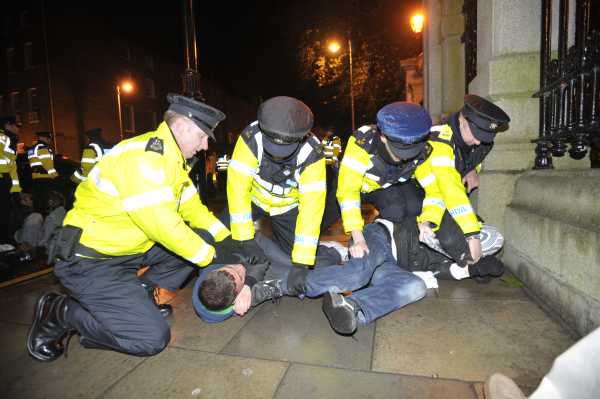
This was the scene in Dublin on Saturday 19th July last as Free State Gardaí made a move to prevent pro-justice demonstrators from assembling outside the Israeli Embassy. Their by-now familiar method of 'keeping the peace' comes as no surprise to those of us who have had unwanted (and, on their part, unnecessary) 'interaction' with them on what were otherwise peaceful pickets and demonstrations over many years, as they are paid, maintained and supported by an anti-working-class elite in Leinster House and, as such, can be relied on to do their masters bidding.

More photographs of the above-pictured assault can be viewed here and here, and the following pictures will give readers who might not be aware of how that 'police force' operates a flavour of what can be expected should you dare to challenge that which they deem 'sacred' ie whatever they, the Free State Gardaí, are instructed to oppose/disrupt by their political paymasters in Kildare Street - these images are from various demonstrations in this State which were held to highlight injustices ranging from opposition to the on-going Shell infringements to issues dealing with the fact that the national issue is not yet settled :


And not only will that 'police force' physically abuse you, whether they are being filmed or not, but they will attempt to mentally abuse and torture you, too, as can be verified here. As with the State and its institutions which give succour to such a 'police force' (a section of which carry firearms) , it is not enough to 'tweak' said bodies because the very character and history of them strongly suggests that they are irreformable. They need to be replaced with systems which operate using justice as a template.

Thanks for reading , Sharon.


Wednesday, July 16, 2014

"WE SHOULD OBTAIN THE SERVICES OF THESE LOYALIST PARAMILITARY ORGANISATIONS" - WESTMINSTER.

By Peadar O'Donnell ; first published in January 1963.

The only body of opinion in Ireland that moved on the level of the pronouncement by His Holiness was the Orange Order, which influenced a body of Orangemen to go to the aid of Captain Boycott, who was hard beset in Connaught : the Orangemen didn't bless the Pope on their travels but they were responsive to the same landlord and imperial influence as His Holiness. The Irish bishops, who knew that Leo X111's pronouncement did not contemplate the reality of the Irish political scene, sabotaged it.

From Leo X111 to his Lordship, Dr. Cohalan, Bishop of Cork - his Lordship of Cork, whether through tantrums or from political bias, declared the IRA unworthy of the sacraments in 1920 but the only response, in Cork, on the level of his pronouncement , came from the Black and Tans who promptly burned part of the city. The priests of Cork disowned their bishop in conversation and ignored him in the Confessional.

There is more excuse for their Lordship's bewilderment in 1931 than in 1922 - they were the victims of a scare in 1931 but in 1922 they went to battle in full possession of their wits, political partisans of the Irish middle class. The Republic never meant anything to them. Their pastorals should be put into the same course of study as the newspaper editorials of that day to form, with those editorials, the literature of reaction in a period in Irish history , one deriving from religion as little as the other. (MORE LATER).


THE ANATOMY OF AN AFTERNOON : THE STORY OF THE GIBRALTAR KILLINGS........

By Michael O'Higgins and John Waters. From 'Magill Magazine' , October 1988.

Taken on those terms, the majority verdict of the jury can only be seen as a resounding victory for Paddy McGrory, the lawyer for the next of kin whose eloquent and searching performance was one of the few uplifting things about this inquest, even if his tactics on occasion seemed a bit puzzling. Given the hugely British ethos which permeates Gibraltar and the massive emotive value of the fact that the IRA seemingly intended to place a massive 140lb car bomb adjacent to a school housing all of Gibraltar's children between the ages of four and nine, persuading eighteen per cent of a Gibraltarian jury that Mairead Farrell, Daniel McCann and Séan Savage were not lawfully killed is no mean achievement.

The other resounding thing about the inquest was the coroner himself, Felix Pizzarello who, however sticky the wicket sometimes appeared, seemed intent above all on upholding the integrity of Gibraltarian justice in the eyes of the world. From early on he showed himself to be no pushover, maintaining throughout that his inquest would be meaningless if, as was widely circulating, the SAS soldiers involved would not appear. Even if they did appear, he intimated at a pre-inquest hearing, the limitations his court would have to labour under might make it impossible for the truth to emerge.

In enpanelling the jury, Mr. Pizzarello appeared to be doing his utmost to balance the odds ; he could, according to the rules, have chosen any number of jurors between seven and eleven, but by opting for the maximum number he increased the possibility of a majority as opposed to a unanimous verdict. From time to time there appeared the semblance of what could be taken for a rapport between Pizzarello and McGrory - he seemed to have a genuine sympathy for the predicament McGrory frequently found himself in with the Crown's 'Public Interest Immunity' certificates, and more often than not liberally interpreted the spirit rather than the letter of the law. Occasionally, too, in the stickiness of the courtroom, he permitted himself a dry laugh at Paddy McGrory's wry humour. On a couple of occasions Mr. Pizzarello made what just might have been Freudian slips with regard to his personal views of the case, on one occasion causing a perturbed Michael Hucker, representing Soldiers 'A' to 'G' , to rise and complain that he was "a bit concerned by Your Honour's use of the term 'scene of the crime'....". (MORE LATER).


MICHEÁL MARTIN TAKES THE (WRONG) BOUNDARY COMMISSION TO TASK.

"Gerrymandering" , Mr. Martin called it : "It is the biggest attempt to manipulate election boundaries in the 35 years since Fianna Fail introduced independent Boundary Commissions...." (from here) , adding "....we saw that straight away when the terms of reference were published,that skewing was going on....".

However, a more important 'skewing' by a Boundary Commission has been ignored by Mr. Martin and his party and, indeed, by the administration and the so-called 'opposition' in Leinster House-the 'Boundary Commission' established under 'Article 12'of the 1921 'Treaty of Surrender',which was tasked with 'determining the boundaries between the newly-partitioned 6 and 26-county 'states' ' ,the deliberations of which caused a mutiny within British forces in Ireland!(PART 12)

Rather than be alarmed at the 20,000-strong UVF organisation , the British were considering using it for their own advantage - the RIC was in favour of such a move by Westminster ; on the 9th November 1921 , the Divisional Commissioner of the RIC in the Six Counties , a Colonel 'Sir' Charles Wickham , stated , in a 'secret' circular which he sent to other RIC bosses in the Six Counties - "Owing to the number of reports which have been received as to the growth of unauthorised Loyalist defence forces , the (British) Government have under consideration the desirability of obtaining the services of the best elements of these organisations. They have decided that the scheme most likely to meet the situation would be to enrol all who volunteer and are considered suitable into Class 'C' (of the 'Special Constabulary') and to form them into regular military units. There is no necessity to produce the maximum possible number of units ; what is required is to ensure that every unit recommended for formation can be constituted from a reliable section of the population." ('1169...' Comment : for "reliable" , read 'Unionist' .)

Note how the supposed 'neutral' RIC described the UVF paramilitary organisation as a "... loyalist defence force ... a reliable section of the population .." - the British were then, and still are today, 'in charge' of said Loyalist paramilitary organisations, and use them to carry-out 'jobs' which Westminster wants done, but not 'officially'. Also , about two weeks after 'Sir' Wickham wrote and dispatched his 'secret' circular, a copy of it found its way into the hands of Michael Collins who, on 23rd November 1921, whilst attending Treaty negotiations with the British in London , produced it to the startled British and told them it may very well signal the end of the 'negotiations'.

Westminster called in its top man in the Six Counties - 'Sir' James Craig, the Stormont 'Prime Minister' - and told him that the 'secret' circular would have to be withdrawn ; Craig then instructed his 'Minister for Home Affairs' , a Mr. Richard Dawson Bates (a UVF man himself) to withdraw the circular. However, by way of a 'two-fingered salute' to his political masters in Westminster, when he returned to Belfast, Craig increased the number of 'A Specials' by 700 men and the 'B Specials' by 5,000 men! If they could'nt 'hire' "... from a reliable section of the population ..." in one way, then they'd find another way to do it! Colonel 'Sir' Charles Wickham, Divisional Commissioner of the RIC in the Six Counties, had an interesting background - a Brit through and through ....... (MORE LATER).


PAT CANNON COMMEMORATION , DUBLIN (38TH ANNIVERSARY): 7PM, THURSDAY 17TH JULY 2014.

Pat Cannon (left),Dublin, and Peter McElchar ,Donegal.

In 1955 , the year in which Pat Cannon was born , splits were occurring in the IRA, as several small groups, impatient for action, launched their own attacks in the Occupied Six Counties. One such activist, Brendan O'Boyle, blew himself up with his own bomb in the summer of that year. Another, Liam Kelly, founded a breakaway group 'Saor Uladh' ('Free Ulster') and in November 1955, attacked a Royal Ulster Constabulary (RUC) barracks at Roslea in County Fermanagh. One RUC man was badly injured and a Republican fighter was killed in the incident. In August of the following year, Kelly and another ex-IRA man , Joe Christle, burned down some customs posts on the border.

In the UK general election of 1955, Sinn Féin candidates were elected MPs for the Mid-Ulster and Fermanagh and South Tyrone constituencies in the Occupied Six Counties, with a total of 152,310 votes. The following is the Election Manifesto that the then Sinn Féin organisation put to the people :

Sinn Féin election manifesto, Westminster Elections - 1955.

The following document was published by Sinn Féin in 1955:

SINN FÉIN ELECTION MANIFESTO WESTMINSTER ELECTIONS, 1955.

In the Election of 1918 the Irish People, by an overwhelming majority repudiated the claims of England and her parliament to rule them and they established the Irish Republic which was proclaimed in arms in 1916. The Republican Government and State then established were later overthrown by England and the nation was partitioned into two statelets. The cardinal objective of the Irish People is the restoration of the Republic thus unlawfully subverted.

The resurgent confidence of Irish men and women in their own strength and ability to achieve the full freedom of their country and the right of its citizens to live in peace, prosperity and happiness has enabled Sinn Féin to contest all 12 seats in this Election and give an opportunity to our people in the Six Counties to vote for Ireland, separate and free.Sinn Féin candidates are pledged to sit only in a republican Parliament for all Ireland. Apart altogether from the futility of the procedure, sending representatives to an alien legislature is in effect attempting to give it semblance of authority to legislate for and govern the people of North-East Ulster. Sinn Féin candidates seek the votes of the electorate and the support of the Irish people as the representatives of the Republican Movement now on the onward march towards achievement of the National ideal -- the enthronement of the Sovereign Irish Republic.

The winning of seats in these elections will not be regarded by Sinn Féin as an end in itself, nor will the results, whatever they be, effect in any way the determination of Republicans to forge ahead towards their objective. Neither will the number of votes recorded for the Republican candidates be looked upon as something in the nature of a plebiscite affecting in any way the right of Ireland to full and complete freedom. That right is inalienable and non-judicable and must never be put in issue through referendum of a section of population nor of the people of the country at large. Through the medium of the election machinery, Sinn Féin aims at providing an opportunity for the electorate, in all constituencies, and for the people of the country to renew their allegiance to Ireland, and by their support of the Republican candidates demonstrate to England and to the world the right of an ancient and historic nation to its complete and absolute freedom and independence.

Sinn Féin has been charged with disruptionist tactics. The aim of Sinn Féin today as always is to secure unity of thought, purpose and deed in the achievement of separate nationhood. Bigotry, persecution and sectarianism have no place in the Sinn Féin programme. Republican policy has ever been to secure civil and religious freedom for the Irish Nation and the individual citizens.Ireland and all its resources belongs to the Irish people. Sinn Féin will, with the consent of the Irish people, organise and develop the resources of the nation for the benefit of its citizens irrespective of class or creed. The continued occupation of Ireland by England makes such development impossible, since England has succeeded in making effective in Ireland the Imperial dictum of "Divide and Conquer" thereby impoverishing not only the Irish people but the material resources of the country as well.

Sinn Féin appeals to all Irishmen to forget all past dissension's and to demonstrate by their support of the Sinn Féin candidates their opposition to English occupation and their determination to achieve National Independence.

Published by Sinn Féin Northern Election Committee, Divis Street, Belfast and printed by the Cromac Printery, Belfast.

The big news of that 1955 election was Sinn Fein’s two seats and its 23.6% of the vote. Sinn Fein’s two successful candidates in Mid-Ulster and Fermanagh & South Tyrone had been imprisoned for their part in the raid on Omagh. Philip Clarke and Thomas Mitchell were the successful Sinn Fein candidates for Fermanagh & South Tyrone and Mid Ulster respectively. However as they were serving prison sentences they were deemed ineligible to serve in the House of Commons. In that same year - 1955 - a child was born in Dublin on November 28th : he was one of a family of seven (three girls and four boys) and his name was Pat Cannon. He and his family lived in Edenmore, on the northside of Dublin city and he became a fitter/welder by trade. He joined the IRA whilst still a teenager and soon became a trusted member of that organisation.

On Saturday , 17th July 1976 , Pat Cannon , 5 months shy of his 21st birthday, and his comrade , Peter McElchar from Donegal ,set out in a car in which they were transporting an explosive device. They crossed the border from Donegal into Tyrone and were approaching the town of Castlederg at about 2.15pm when the device exploded prematurely. Peter McElchar was killed instantly. Patrick Cannon was gravely injured and was taken to Tyrone County Hospital in Omagh. He was being transferred to hospital in Belfast when he died.

The Annual Pat Cannon Commemoration will be held on Thursday 17th July (2014) - those attending are asked to assemble at 7pm at the gates of the old cemetery in Balgriffin , Dublin. All genuine Republicans welcome!


HOWTH GUN-RUNNING AND BACHELORS WALK MASSACRE COMMEMORATION, DUBLIN , 26TH JULY 2014.

On Saturday, 26th of July, 2014, to mark the centenary of the Howth gun-running and Bachelors Walk Massacre which happened on the same day in 1914, the Sean Healy slua of na Fianna Éireann, Dublin, are holding commemoration gatherings both at Howth and Bachelors Walk. These events will begin at 12.45pm at Howth Pier where a short oration will be given by a Dublin member of Na Fianna Éireann, following which those present will parade into Dublin city centre and assemble, at 2.30pm, on Bachelors Walk, to remember the massacre that took place on that spot on the 26th of July in 1914. All genuine Irish republicans welcome!

In the early afternoon of Sunday, 26th July, 1914, a consignment of over one-thousand rifles and ammunition for same was landed at Howth harbour, in Dublin, and unloaded by the newly-formed 'Irish Volunteers', assisted by members of Na Fianna Éireann. On its way in to Dublin city, the republican convoy was halted by a force of about fifty British RIC 'policemen' and over one-hundred British soldiers from the 'Kings Own Scottish Borderers' , known as the 'Kosbies'. A large crowd of civilians gathered to watch the confrontation ; the Assistant British RIC Commissioner, William Harrell, approached the Republicans and demanded that their weapons be handed over. Two of the Rebel leaders, Thomas MacDonagh and Darrell Figgis, left the main body of armed republicans and marched over to Harrell and told him it was their understanding that he (Harrell) had no legal authority to issue such a demand!

While RIC Chief Harrell issued chapter and verse of how, and from whom, he derived his 'authority', the two Irish republicans were quoting him chapter and verse of why it was that his 'authority' was not valid in Ireland ; Harrell's RIC colleagues were lined-up on the road about ten feet behind him and the British 'KOSBIES' were, in turn, lined-up behind the RIC men- both groups were concentrating on the verbal sparring-match between Harrell, MacDonagh and Figgis. But the group of Irish republicans, standing in military formation behind MacDonagh and Figgis, had directed their concentration elsewhere : as the verbal disagreement continued, republicans at the very back of the gathering simply walked away in the opposite direction with their weapons under their coats and other men in the republican contingent handed their weapons to known members of the public who, again , walked off with the equipment under their coats!

Meanwhile, after about half-an-hour of trying to get the better of MacDonagh and Figgis, RIC Chief Harrell gave up and ordered his men, and the British military, to move-in and seize the guns - they got 19 of the 1000 rifles, the rest having been spirited away. The British were not amused, but the crowd that had gathered to watch the confrontation cheered, clapped and laughed at the RIC and the British KOSBIES, as the two British gangs formed-up for the march back into the city centre. Word of the incident had spread at this stage and a large number of the public decided to walk alongside the British, laughing and jeering at them. When the procession was about three miles from Dublin city centre, they were joined by about fifty more members of the KOSBIES who fell in behind their colleagues. Likewise, dozens of men, women and children - out for a Sunday walk - had heard about the 'disappearing rifles' and joined with their neighbours in walking beside the British, poking fun at them. It being a Sunday afternoon, families were out in force in the city and were lined-up along the Quays, having heard that the British military detachment was headed that way : people spilled-out from the old tram terminus on Bachelors Walk to view the spectacle.

The British were by now near breaking-point ; they were more accustomed to being feared or, at best , ignored, by the public, and were seething with rage now that they were being laughed at by them. An Officer in charge felt the same,and ordered one line of his men (approximately twenty soldiers) to halt and turn to face the jeering crowd ; when the soldiers had done as commanded, he instructed them to "ready weapons" and fire on the crowd, if he so ordered. It is not clear whether the order to "fire" was given or not but, regardless , the British did open fire. The people on the footpaths - men, women and children - were easy targets. Forty-one people were hit : a man in his mid-forties died on the spot, as did a woman in her early fifties, and a teenage boy. Of the other thirty-eight people, one died later. Such was the outcry from Ireland and abroad, the British Government decided to hold a so-called 'Commission of Inquiry' into the shooting and,in August that year (1914), that body announced its conclusion and, as expected, the 'Commission of Inquiry' was nothing of the sort. It amounted to a mere 'slap-on-the-wrist' for those who pulled the triggers. The 'Commission' simply stated that the actions of their gunmen on that day, Sunday, 26th July, 1914, was "....questionable and tainted with illegality.." and scolded their soldiers for "...a lack of control and discipline.." The British Army soldiers responsible for the massacre, the 'Kings Own Scottish Borderers', within hours following the shootings, found themselves even more reviled by the Irish than they had been - their very presence on the street now guaranteed trouble. They were shipped out of Ireland only days after the incident, to the Western Front. The Irish, meanwhile, had buried their dead : on 29th July, 1914, literally thousands of Irish people followed the coffins of those shot dead three days earlier and Dublin city came to a standstill as thousands upon thousands of people filled the footpaths along the funeral route, from the Pro-Cathedral to Glasnevin Cemetery. An armed Company of Irish Volunteers, with weapons reversed, led the mourners to the gravesides.

While the British political and military administrations claim jurisdiction over any part of Ireland, the incident outlined above can happen again. That British claim must be dropped and the armed thugs enforcing same must be re-called to their own country. Any other 'solution' only postpones a proper peace. See you on July 26th next!


GERMANTINA! LUKE SCORES TWICE , WICKLOW FIRST AND LAST....

Just as well it wasn't a game of ice hockey they were playing....!

The last fund-raising raffle I worked on for the Movement (8th June last) was busy enough - as they all are! - but I didn't mind, as myself and four friends were flying out to New York for a three-week holiday after it, so come what may I was on a 'winner'. On Sunday just gone - 13th July - we were back in the usual raffle venue for the July raffle and, despite having being 'warned' regarding the expected crowd due to it being 'World Cup Final' day (the last two teams that hadn't been knocked out of the tournament were playing against each other, apparently!) we were surprised to find a huge crowd inside the venue and a queue forming outside, even at 4pm! I could joke about our 'raffle table' being covered in towels but only Spanish holiday-makers might get it....

And now to the above-mentioned 'score' : newcomer (sub?!!) Luke, from Meath -his first time in the hotel- won our 3rd prize , worth €40 (stub 273) and the 6th prize , €20 (stub 279), and found it hard to believe that not only had he won the 3rd prize ("Swear to God, girls, if it wasn't for bad luck I'd have no luck at all...."!) but was struck silent (and that's saying something for a Meath man!) when he heard his name being called out for the second time. He apparently thought we were winding him up, so Jean from our table was dispatched to locate him , with his other prize envelope, and as it turned our she was right to head straight for the bar, where he was located, regaling anyone that would listen to him about his '40-nil' victory : no extra time needed for him to accept the correction to his 'score'!

Our 1st prize, €200, was won by Paul Dempsey on stub 241, a Wicklow man who just happened to be at the same table as another Wicklow person, Clare Tierney, who won our last prize (€20) on stub 258 , and were last seen comparing envelopes up at the bar, with Paul acting the gentleman by insisting that it was his round. It turned out that he didn't actually know Clare before they both found themselves up at the ref's table (!) but, once introduced, both seemed keen to discuss 'transfers'. The raffle crew, of course, got off-side immediately! A true reflection of just how successful this particular raffle has become was shown by the two friends that could only manage to get the one ticket between them, as our tickets proved harder to get than tickets for the final : the two lads, Paul and John, bought the last available ticket from our bus driver, Anthony, and it proved , for them, to be a raffle of two halves - their ticket, number 060, won them €100, our second prize , netting (!) each lad a handy €50!

Our 7th prize, €20, was won by Séan Madigan, from County Clare, on stub 411, Jack Morris, a Dublin man, also pocketed €20 when he won the 5th prize on stub 617 and A Mr. Vincent Duffy also won €20 on stub 468 when he won our 4th prize. Myself and the other members of the raffle team stayed on in the hotel for a meal and a few drinks, but we sent ourselves off (!) at about 7pm, as we didn't want to score an own-goal (groan!) by waiting around until the 'stadium' emptied. Besides, by then, we were the real 'winners' of the monthly match we had just played, during which we handed-out envelopes as opposed to yellow or red cards. And as well as that, some panel or other were (boringly!) discussing the match , on television, that was about to start and, following said discussion (which seemed to be not only pointless but never-ending!) , two hours (or more?) of soccer was going to be screened. All balls, balls and more balls!

Thanks for reading , Sharon.