PROSE AND CONS.
By prisoners from E1 Landing, Portlaoise Prison, 1999.
ACKNOWLEDGMENTS :
Grateful thanks to the following for their help, support, assistance and encouragement, and all those who helped with the typing and word processing over the past few months. Many thanks to Cian Sharkhin, the editor of the book, Mr Bill Donoghue, Governor, Portlaoise, Mr Seán Wynne, supervising teacher, the education unit in Portlaoise Prison and the education staff, especially Zack, Helena and Jane. Education officers Bill Carroll and Dave McDonald, Rita Kelly, writer, print unit, Arbour Hill.
First Print : November 1999, reprinted March 2000, illustrations by D O'Hare, Zack and Natasha. Photograph selection : Eamonn Kelly and Harry Melia.
DEMONS IN THE DUNGEON.
Torturous thoughts travel through my dungeon
cobwebs cling to each and every wall
spiders climb each web slowly.
Torturing the nerve channels superbly.
Bitter thoughts engrave my dungeon
leaving a mark for potential torture.
I fight to control my cells
most of the time I succeed
though the odd spider conquers my brain,
to the delight of the demons.
I hear their laughter and contemplate revenge
knowing it is I who will prevail.
Paul Dillon. (Next : 'I Should Have Known Better', by Paul Dillon.)
IS PEACE SAFE WITH ANDREWS....?
Where politics once stagnated, events in Northern Ireland now chase each other helter-skelter. As 'Magill' went to press, a new joint government document turned recent perceptions head over heels. Fionnuala O'Connor charts the doubts behind the instant reactions. From 'Magill' magazine, February 1998.
Republicans fear that the central premise on which they came to the table has been torn up, unionists are torn between hoping that that is so and fears that the governments are once more dithering. Their decision to oust the UDP may have come too late to re-establish authority and the document of Tuesday January 27th last might have redressed the balance and eased nationalist discontent but there is a real and general concern that Dublin and London have been blown this way and that, showing dangerous weakness.
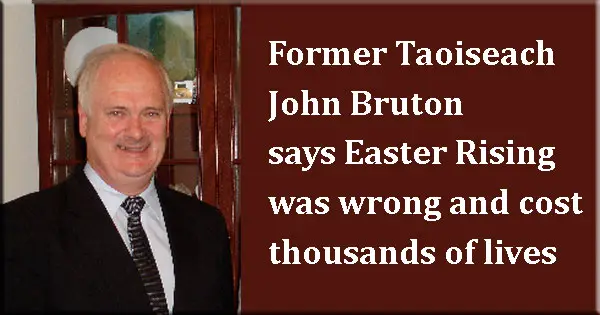
The first IRA cease-fire broke down when Sinn Féin's admission to talks was repeatedly postponed, and those talks themselves got bogged down as unionists stalled on format and rules. Dublin's input has been vital at several points, fundamentally in drawing up the joint framework document of February 1995. John Bruton as taoiseach caused frequent anxious moments to those most involved in creating and maintaining movement towards negotiation, principally SDLP leader John Hume and the Sinn Féin leadership under Gerry Adams. In their eyes, Bruton's mistaken conviction that he could bring unionists on board and his distaste for Sinn Féin distracted him from what all concerned saw as the Irish government's chief role - to speak for the limited but defined nationalist consensus in dealings with the British government.
Irish officials were largely responsible for the framework document's scope and nuance - theirs , not John Bruton's, was the passion for the underlying principles and, in detailing how 'Northern Ireland' could be reconstructed along lines of equality for two competing political identities and in describing the possible reach of North-South bodies, the framework gave republicans hope, and a fig-leaf - a chance to argue that they could achieve arrangements that at least allowed for gradual transition to a united Ireland. They decided it could be a basis for negotiation... (MORE LATER).
CONDITIONS IN ENGLISH JAILS.
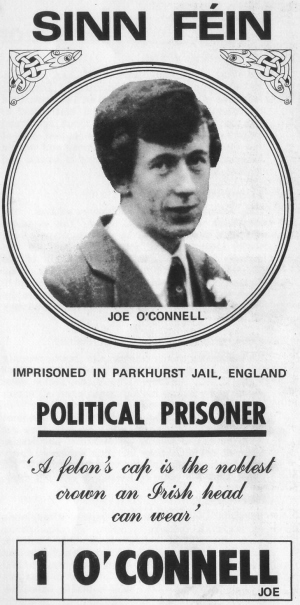
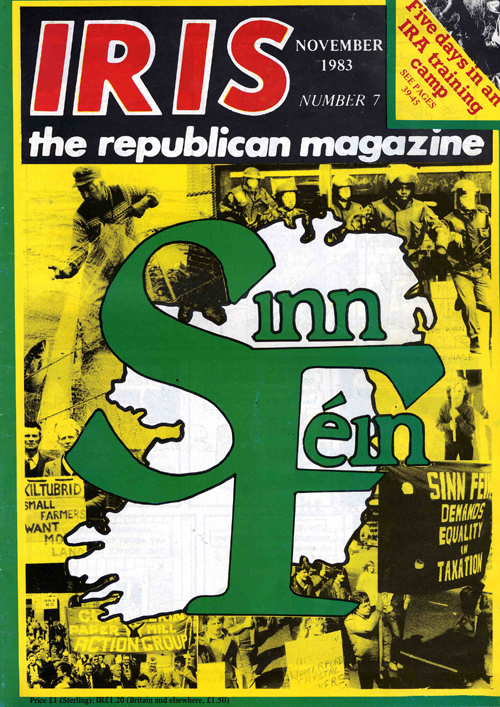
Like their comrades in the H-Blocks and Armagh, the Irish POW's in England have resisted criminalisation against all the odds, with the same conviction articulated by Joe O'Connell, speaking from the dock at the Old Bailey during the 1977 'Balcombe Street' trial - "We admit to no crimes. The real crimes and guilt are those British imperialism has committed against our people." From 'Iris' magazine, July/August 1982.
There are currently 67 Irish political prisoners in jail in England, 53 of them republicans and at least 14 of them totally innocent victims of political trials. Five of the POW's are women, held in Durham Jail, and there is one remand prisoner, John McComb from Belfast (the "terrorist" mentioned here) , who has been in Brixton for several months now.
Over half the prisoners are from the North, the rest are from the twenty-six counties ; thirty-two of them are originally from Belfast. There are supposed to be no political prisoners in England, no political trials, but in reality the arrests, trials and prison conditions of the POW's are all highly political. Most of the trials took place in an anti-Irish, highly prejudicial atmosphere, the circumstances of the arrests were often indiscriminate, and many cases involved paid agent provocateurs and police set-ups.
The nature of the evidence was usually flimsy, and 80% of cases have been under the notorious catch-all conspiracy laws, where the onus of proving innocence is on the defendant. The length of sentence has invariably been savage, as in the North. The vast majority of the POW's are classified as top-security category 'A'... (MORE LATER).
ON THIS DATE (28TH OCTOBER) 39 YEARS AGO : IRISH REPUBLICAN LEADER ASSASSINATED BY PRO-BRITISH DEATH SQUAD.
"We must take no steps backward, our steps must be onward, for if we don't, the martyrs that died for you, for me, for this country, will haunt us forever" - Máire Drumm, pictured, left.
On the 28th October 1976, the then Sinn Féin Vice President, Máire Drumm, was shot dead in her hospital bed by a pro-British loyalist death squad. She was born in the townland of Killeen, South Armagh, on the 22nd October 1919 to a staunchly republican family (the McAteer's) and her mother had been active in the Tan War and the Civil War.
In 1940, Máire joined Sinn Féin in Dublin but, in 1942, she moved to Belfast, which became her adopted city, and she continued her republican activities. Every weekend, she would carry food parcels to the republican prisoners in Crumlin Road Jail and it was here that she met Jimmy Drumm, who she married in 1946. When the IRA renewed the armed struggle in the late 1950s, Jimmy was again interned without trial from 1957 to 1961, and Máire became more actively involved in the civil rights movements of the 1960s. She worked tirelessly to rehouse the thousands of nationalists forced from their homes by unionist/loyalist pogroms.
During her work as a civil rights activist, Máire emerged as one of the republican movement's most gifted leaders and organisers and was the first to warn that the British troops sent in as 'peace keepers' were a force of occupation. Máire was a dynamic and inspirational speaker - once, when addressing a rally in Derry after the shooting of two men from the city, Máire said - "The people of Derry are up off their bended knees. For Christ sake stay up. People should not shout up the IRA, they should join the IRA..." In 1972, she became Vice President of the then Sinn Féin organisation and, due to her dedication and the dedication of her family to the republican struggle, they were continuously harassed by the RUC, British Army and by loyalist paramilitaries. The British Army even constructed an observation post facing their home in Andersonstown and, at one point, her husband and son were interned at the same time. Her husband, Jimmy, became known as the most jailed republican in the Six Counties and Máire herself was also jailed twice for 'seditious' speeches, once along with her daughter. In 1976, at only 57 years of age, her eyesight began to fail and she was admitted for a cataract operation to the Mater Hospital, Belfast. On the 28th October 1976, as Máire lay in her hospital bed, loyalist killers wearing doctors white coats walked into her room and shot her dead. Máire Drumm, freedom fighter and voice of the people, was buried in Milltown Cemetery.
ON THIS DATE (28TH OCTOBER) 164 YEARS AGO : 'REBEL' MP AND BARRISTER (AND PLEDGE-BREAKER) EXPOSED.
It's practically impossible to write about William Keogh (pictured, left) without mentioning his pledge-breaking colleague and fellow charlatan, John Sadleir. Both men were born into difficult times, but so were many others and not all of them resorted to being 'snake oil' sales people, the path chosen by Keogh and Sadleir. Their 19th century Ireland was one in which approximately six-and-a-half million people 'lived' in, which was a rise in population of about three-and-a-quarter million since the introduction of the potato into the country in the middle of the 18th Century (ie 1760, population of approximately three-and-a-quarter million ; 1815 - population of approximately six-and-a-half million).
With the potato being in itself highly nutritional and a good basis for an adequate diet, as well as being a prolific crop, the poor were able to get better use from what little land they had and use their land to support more people, which led to an increase in the population. Also, the potato needed less land than, for instance, grain, and allowed the farmer to grow other crop elsewhere which he could then sell. Unfortunately for the Irish 'peasant' farmer (as the British described us) , this 'good fortune' was noticed by the British 'landlords' and rents were increased at the same period that land was scarce (due to the population increase) - the 'rent' for a 'holding' quadrupled between 1760 and 1815, so the 'holding' (ie small farm) was sub-let, usually to the farmers sons, so that the 'rent owed' for that patch of soil could be shared by the family.
However, the Irish spirit was strong, and the British 'landlords' and their agents did not have it all their own way. The so-called 'lower-ranks', the 'wretched people', those who wore 'the mark of slavery', had organised themselves as best they could ; secret, underground oath-bound societies fought back - the Whiteboys, Oakboys, Moonlighters, the Defenders and the Steelboys : fences belonging to British 'landlords' were ripped-up, the 'masters' cattle were taken, his haystacks and crop removed, his 'Big House' attacked and, when possible, levelled and burnt, and he himself, and his minions, put to death when the opportunity presented itself to do so. It was into this 'melting-pot of madness' that a child was born in County Tipperary in 1815 - John Sadleir.
At the time that John Sadleir was growing-up, a man named George Henry Moore (who was connected to, and supported by, the Catholic Church Hierarchy) was organising a 'pressure-group' which was to be called the 'Irish Brigade' to lobby Westminster on behalf of the Catholic Church, its members, and its 'flock' - John Sadleir joined the 'Irish Brigade' lobby-group and became a prominent member of it, as did about twenty liberal-minded British MP's, including William Keogh. When John Sadleir was 36 years of age (in 1851) the British administration introduced the 'Ecclesiastical Titles Bill' (on 6th February 1851) making it 'illegal' for any Catholic prelate (ie priest, arch-bishop, bishop etc) to be that which the Vatican claimed him to be - that is, under the 'Ecclesiastical Titles Bill', it was deemed to be 'a crime' to be described as the 'parish priest of XXX', 'arch-bishop of XXX', 'bishop of XXX' etc - in short, the assumption of titles by Roman catholic priests was outlawed by Westminster : the British wanted to curb the activities and influence of the catholic church, but this 'law' was not always followed-up (ie enforced) on the ground (what we in Ireland would call 'an Irish solution to an Irish problem').
However, enforced or not, the 'Titles Bill' was vehemently opposed by John Sadleir and William Keogh and 'The Irish Brigade' (who were by now known by the nick-name of 'The Popes Brass Band', such was their support for the catholic hierarchy) and others, too, were opposed to the 'Bill' - a group known as the 'Tenant Right League', which had been founded in 1850 by 'Young Ireland' Movement leaders Charles Gavan Duffy and Frederick Lucas (to secure better conditions for those that worked the land) also campaigned against 'The Ecclesiastical Titles Bill' : the 'Tenant Right League' was formed in City Assembly House in William Street in Dublin in August 1850, after a four-day conference which was attended by a right mix of people - magistrates, 'landlords', tenants themselves, priests (of both Catholic and Presbyterian persuasion) and newspaper journalists and editors. In his own constituency, where he was entertained to a public banquet on the 28th October, 1851 - 164 years ago on this date - William Keogh declared, in the presence of Archbishop McHale : "I will not support any party which does not make it the first ingredient of their political existence to repeal the Ecclesiastical Titles Act..." and again, in Cork, on the 8th March, 1852, he declared : "So help me God, no matter who the Minister may be, no matter who the party in power may be, I will support neither that minister nor that party unless he comes into power prepared to carry the measures which universal popular Ireland demands..." As the British themselves are fond of saying - 'Fine words butter no parsnips'.
In 1852, 'The Irish Brigade' and 'The Tenant Right League' joined forces to get the 'Ecclesiastical Titles Bill' revoked and, in July that year (1852) the new grouping came together as 'The Independent Irish Party', which declared that "legislative independence is the clear, eternal and inalienable right of this country, and that no settlement of the affairs of Ireland can be permanent until that right is recognised and established...(we will) take the most prompt and effective measures for the protection of the lives and interests of the Irish people, and the attainment of their natural rights..." John Sadleir and William Keogh, two of the more prominent MP's in 'The Independent Irish Party' (of which there were about forty, as the new 'IIP' was joined by Irish MP's in Westminster) , like all the other 'IIP' representatives, took a pledge not to accept any Office in a Westminster administration or to co-operate with same until, among other things, the 'Ecclesiastical Titles Bill' was done away with ; however, the British had seen developments like this elsewhere in their 'empire' and were preparing to manoeuvre things in their own favour.
The new 'Independent Irish Party' was flexing its muscle ; as William Keogh (a barrister and MP for Athlone) put it - "I will not support any party which does not make it the first ingredient of their political existence to repeal the Ecclesiastical Titles Bill. So help me God ..." By this stage, Charles Gavan Duffy had been elected as an 'Independent Irish Party' MP to Westminster, representing the New Ross area of Wexford. The 'IIP', with forty members elected to Westminster, did actually hold the balance of power in 'Lord' Derby's Tory-led government in Westminster and so pressed their claims with that administration regarding the 'Titles Bill' and other matters pertaining to Ireland - but they got no satisfaction from 'Lord' Derby or any of his Ministers, so the 'IIP' 'pulled the plug' and the British government of the day collapsed. The main opposition party in Westminster, the 'Whigs', led by 'Lord' Aberdeen, apparently promised John Sadleir IIP MP and William Keogh IIP MP that the 'Whigs' would be sympathetic to the interests of the 'Independent Irish Party' and the two Irish MP's, in turn, passed this information on to the ruling body of their own party and it was agreed to support the 'Whigs' in their bid for power which, with 'IIP' support, they got. But no sooner had 'Lord' Aberdeen climbed into the prime ministerial chair when his political promises to Sadleir and Keogh were cast aside ; he was, it seems, prepared to 'honour' part of the agreement he made with the 'Independent Irish Party' representatives and party, but not enough to satisfy them, and certainly not enough when compared with what he said he would do. This led to rows and bickering within the 'IIP', a signal which 'Lord' Aberdeen picked-up on and used to his own advantage , in true British 'divide-and-conquer'-style.
'Lord' Aberdeen offered John Sadleir IIP MP the position of 'Lord of The Treasury' in the new British administration, and also 'threw a bone' to the other dog, William Keogh IIP MP - that of the Office of British Solicitor-General for Ireland and, despite already having their parsnips well buttered, both men took the offer, and the Catholic Church, subservient as ever to the British, when push came to shove, supported them for doing so! This tore not only the 'Independent Irish Party' asunder (although it did manage to 'hobble' on for another few years, disintegrating along the way) until finally it disbanded in 1858, but it also disappointed Charles Gavan Duffy IIP MP, one of the more prominent members of the party, so much so that, in October 1855, he emigrated to Australia in despair. As 'Lord of The (British) Treasury', John Sadleir aspired to a lifestyle which he no doubt considered to be his of right - he was, after all, a British Minister and he also owned, by now, a community-type bank/financial house, in Ireland - the 'Tipperary Joint-Stock Bank' : however, such was his taste for the fine life and his desire to 'keep in' with his new 'friends', when his bank was found to be shy by over one million pounds the shame was too much and he killed himself in 1856. However, his old buddy, the British Solicitor-General for Ireland, William Keogh, somehow managed to 'soldier-on' and was asked to perform another task for his British pay-masters and he became a British Judge, in Ireland, during the infamous Fenian Trials of 1865-1867, where he verbally cracked many an Irish rebel skull, saving his employers from getting their hands even more bloodier. His conscience must have eventually got the better of him because, in 1878, he, too, killed himself. It could only make you wonder that, had he a bank to embezzle, would he have lived longer?
Despite success at the polls, and having the 'ear' of the political bosses and the 'respect' of the British 'establishment' and good, favourable media coverage, being well-dressed, well-spoken and well-paid, if you lose your political principles, you're finished - draw your own conclusions....
Thanks for reading, Sharon.
PROSE AND CONS.
By prisoners from E1 Landing, Portlaoise Prison, 1999.
ACKNOWLEDGMENTS :
Grateful thanks to the following for their help, support, assistance and encouragement, and all those who helped with the typing and word processing over the past few months. Many thanks to Cian Sharkhin, the editor of the book, Mr Bill Donoghue, Governor, Portlaoise, Mr Seán Wynne, supervising teacher, the education unit in Portlaoise Prison and the education staff, especially Zack, Helena and Jane. Education officers Bill Carroll and Dave McDonald, Rita Kelly, writer, print unit, Arbour Hill.
First Print : November 1999, reprinted March 2000, illustrations by D O'Hare, Zack and Natasha. Photograph selection : Eamonn Kelly and Harry Melia.
MY FEATHERED FRIEND.
My feathered little friend
I see you have returned
Your sudden departure
Had left me empty
I searched the sky for a glimpse
of your tiny body
Clouds covered my mind
as well as the woollen roof.
Now how your appearance
has touched my very soul
the happiness you bring me
makes waves look like raindrops
There were times I thought you were hurt
I prayed for your safety
my prayers have been answered
my feathered friend.
Paul Dillon.
(Next : 'Demons in The Dungeon', by Paul Dillon.)
SUNDAY 25TH OCTOBER 2015, DUBLIN : INTERNATIONAL DAY OF SUPPORT FOR IRISH POW'S.
E-mail: supportthepows AT irish-solidarity.net
Web: http://supportthepows.irish-solidarity.net
The 5th Annual International Day in Support of the Irish Prisoners of War held in Maghaberry, Portlaoise, and Hydebank jails will be held on the 24th, 25th and 26th of October 2015 ; this event, since 2011, has been held annually on the last weekend of October and, as in previous years, it is organised by the "International Committee to Support the Irish Prisoners of War". The committee is supportive of all Irish Republican prisoners held in Irish and British jails.
The last weekend of October is a historical date for Irish Republicans ; on October 25th, 1917, the Ard-Fheis of Sinn Féin adopted a Republican Constitution and, three years later, Sinn Féin’s Lord Mayor of Cork, Terence MacSwiney, died after 74 days on hunger strike. Furthermore, Joseph Murphy died on hunger strike in Cork prison on that day. On October 27th 1980, the first H-Block hunger strike began and on October 26th 1976, Máire Drumm, Vice-President of Sinn Féin, was murdered in the Mater Hospital, Belfast, by a loyalist death squad. Finally, on the last day of October 1973, the helicopter escape from Mountjoy jail took place.

I used to think that happiness hadn't been invented
But that was in the bad old days before I met you
When I let you walk into my heart...'
...and here he is again, with a previous T-shirt which, like the other one he sports in this post, was designed in London for him. Word is he will be sporting a new designer garb for Easter 2016 - Butchers Apron on the front, orange on the back, but won't be distributing them to members of the British Army, as he has special awards for them. And here's one of Mitchel's party colleagues, Councillor Mickey Larkin from Slieve Gullion, in Armagh, taking the mickey out of Irish republicans by having a regular 'coffee with a cop', and imploring others to do the same (topped, at 9 minutes 21 seconds in, in this RTE podcast, by Gerry Adams admitting that he regularly passes on information about republicans to the Free State RUC/PSNI, who claim to be 'Ireland's National Police Service'!) -
"This is a welcome community engagement...in getting to know and get help from their (surely you mean 'our', Councillor?) local officers...in the new dispensation. It's a relaxing atmosphere...have a chat, have a coffee...",he said earnestly to those of his constituents that weren't gagging at the very thought of voluntarily getting that close to a member of that pro-British militia. Which wins Mickey this award...
...and, finally , if you want to give yourself or a loved one a proper 'award' (or 'reward'), as opposed to having 'coffee with a cop', then these two Irish republican items are new to the market and are now available from either 223 Parnell Street in Dublin 1 (00353-1-8729747) or 229 Falls Road in Belfast (0044-4890-319004 / 0044-2890-319004), with the jersey selling for €50/£35 and the '2016 Lily Badge' priced at a fiver (Euro or Sterling) :
When it comes to 1916-2016 or, indeed, anything to do with Irish republicanism, don't let the Provos and other pretenders take the mickey - buy genuine republican items only!
Thanks for reading, Sharon.
...and Dublin, Sunday 25th October 2015 - from the Half'penny Bridge to Australia, and beyond...these Irish republican ladies established a group to assist an existing male-dominated group but were not made feel welcome for having done so...a link (of sorts) between Frank Driver, Kevin Barry, James Daly, IRA Volunteers Paul Smith, George Keegan and Paddy Parle (not forgetting Michael Watters)....and cringe as you read how an Irish 'republican' congratulated the Commander-in- Chief of the British Parachute Regiment on a job well done!
CHECK BACK ON WEDNESDAY 21ST OCTOBER 2015.
Thanks for visiting, Sharon.
PROSE AND CONS.
By prisoners from E1 Landing, Portlaoise Prison, 1999.
ACKNOWLEDGMENTS :
Grateful thanks to the following for their help, support, assistance and encouragement, and all those who helped with the typing and word processing over the past few months. Many thanks to Cian Sharkhin, the editor of the book, Mr Bill Donoghue, Governor, Portlaoise, Mr Seán Wynne, supervising teacher, the education unit in Portlaoise Prison and the education staff, especially Zack, Helena and Jane. Education officers Bill Carroll and Dave McDonald, Rita Kelly, writer, print unit, Arbour Hill. First Print : November 1999, reprinted March 2000, illustrations by D O'Hare, Zack and Natasha. Photograph selection : Eamonn Kelly and Harry Melia.
TIME.
"What time is it"
trying to catch my mother's attention,
And she looking at the old carriage clock
as it lay on the timber mantle piece
above the black range fireplace,
where she would cook the food
we got on a good day
"Time you were in bed," she replied
with the hint of humour
she usually gave
though she tried to be serious,
I stayed on in bed that morning
and missed school with some excuse
she threatened me with the wrath of my father
now she still tried this
though she knew it was no good,
she wasn't a stern woman
yet at times I avoided her
"Time for bed for you
I won't tell your father this time
but believe me I will the next,
on now and off to bed!"
Paul Dillon.
(Next : 'My Feathered Friend', by Paul Dillon.)
GPO PICKET AND STALL, SATURDAY 10TH OCTOBER 2015.
A POW-support picket and an information stall, including a petition, will be seeking your support on Saturday, 10th October 2015, at the GPO in O'Connell Street, Dublin, between 12.45pm and 1.45pm. The objective is to further publicise the 'August 2010 Agreement' and to demand that it be implemented, as agreed :
'Maghaberry, 12 August 2010 :
A. Agreement Reached on Dispute at Roe House in Maghaberry Prison -
Following a protest by Republican prisoners in Roe House, the Northern Ireland Prison Service (NIPS) and the prisoners agreed to engage in a facilitation process. A Joint Facilitation Group (Irish Congress of Trade
Unions, Creggan Enterprises and Dialogue Advisory Group) met both parties on a number of occasions over the past several weeks. The discussions were underpinned at all times by the following principles:
B. Fundamental Principles ;
1. Arrangements are predicated on mutual respect;
2. Prisoner and staff safety must not be put at risk;
3. Arrangements should comply with human rights and equality requirements;
4. Revised arrangements and procedures should be achievable and sustainable;
5. Staff should be able to carry out their work professionally, free from harm, intimidation or threat;
6. The security of the establishment should not be diluted; and 7- The arrangements must strengthen public confidence in NIPS.
C. Prisoner Forum :
An effective Prisoners’ Forum will be established, in addition to existing processes for complaints and requests. This should provide a meaningful mechanism to address issues of mutual concern and is designed to build trust.
D. Full body searching ;
1. No random full body searching will take place on the way to domestic and legal visits and the videolink or from the SSU.
2. No "rubdown" searching internally, within Roe 3 and 4.
3. NIPS will introduce a new search facility and revised search policy for separated prisoners. The new facility will be located within the Bush and Roe complex and subject to CCTV and audio coverage. It will incorporate a combination of the latest technologies which will remove the requirement for routine full-body searching of separated prisoners within the prison. The search process for all separated prisoners entering the separated complex will be:
• outer clothing, metal objects, belts and shoes removed and passed through scanner;
• all prisoners undergo scanning by hand held metal detector;
• all prisoners undergo thorough rub-down search; and • prisoners required to sit on BOSS chair (where outer clothing contains metal, prisoners may be required to remove this).....'[more here.]
Your presence and/or support and/or signature on the day - Saturday 10th October 2015, GPO Dublin between 12.45pm and 1.45pm - would be greatly appreciated by those present and by our prisoners. All genuine republicans welcome!
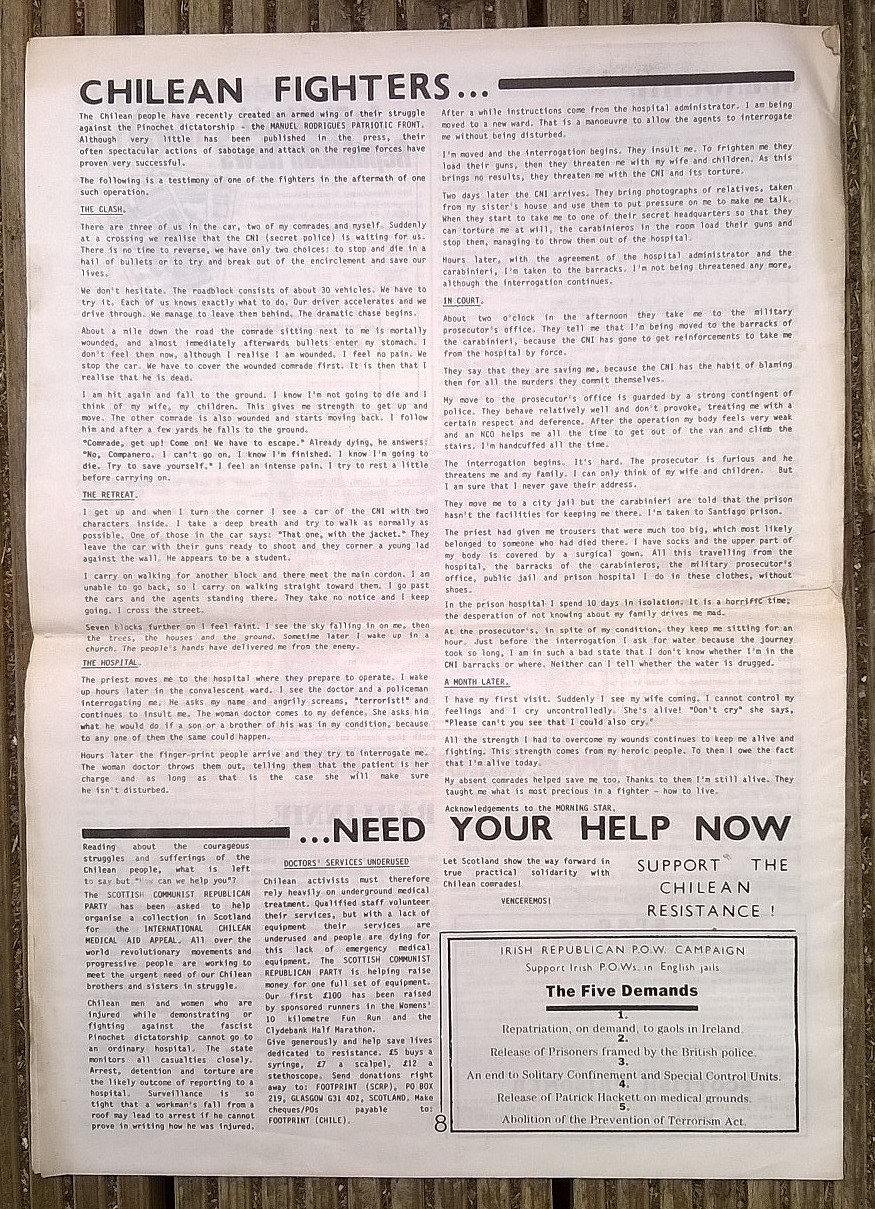
CHILEAN FIGHTERS NEED YOUR HELP NOW....
The following piece was published in the 'Socialist Republic!' newspaper in September 1986.
The Chilean people have recently created an armed wing of their struggle against the Pinochet dictatorship - the 'Manuel Rodrigues Patriotic Front'. Although very little has been published in the press, their often spectacular actions of sabotage and attack on the regime forces have proven very successful. The following is a testimony of one of the fighters in the aftermath of one such operation.
IN COURT.
"About two o'clock in the afternoon they take me to the military prosecutor's office and tell me that I'm being moved to the barracks of the carabinieri because the CNI has gone to get reinforcements to take me from the hospital by force. They say that they are saving me, because the CNI has the habit of blaming them for all the murders they commit themselves.
My move to the prosecutor's office is guarded by a strong contingent of police. They behave relatively well and don't provoke, treating me with a certain respect and deference. After the operation my body feels very weak and an NCO helps me all the time to get out of the van and climb the stairs. I'm handcuffed all the time. Then the interrogation begins. It's hard. The prosecutor is furious and he threatens me and my family. I can only think of my wife and children but I am sure that I never gave their address. Then they move me to a city jail but the carabinieri are told that the prison hasn't the facilities for keeping me there and I'm taken to Santiago prison.
The priest had given me trousers that were much to big, and most likely belonged to someone who had died there. I have socks and the upper part of my body is covered by a surgical gown. All this travelling from the hospital, the barracks of the carabinieros, the military prosecutor's office, public jail and prison hospital I do in these clothes, without shoes. In the prison hospital I spend 10 days in isolation. It is a horrific time ; the desperation of not knowing about my family drives me mad. At the prosecutor's, in spite of my condition, they keep me sitting for an hour. Just before the interrogation I ask for water because the journey took so long. I am in such a bad state that I don't know whether I'm in the CNI barracks or where. Neither can I tell whether the water is drugged." (MORE LATER).
STUNNING SILENCE....
The British publishing group 'Macmillan' must have been sorely disappointed by the media's reaction, or lack of it, to the launch last month of Paul Foot's book 'Who Framed Colin Wallace?' By Eamonn McCann, from 'Magill' magazine, June 1989.
However, a read through the book reveals one reason why a large number of journalists might have wanted as little weight as possible given to it. By and large, and with the usual stipulation about honourable exceptions, journalists don't come well out of the Colin Wallace story.
The early chapter describe how Wallace was able to plant phoney stories in the media, even in the 'quality' newspapers and 'serious' programmes, in the early 1970's. Later chapters explain how journalists - in some cases the same journalists - were duped in the 1980's into carrying phoney stories designed to discredit Wallace. Journalists who lapped up Wallace's lies later lapped up lies against him and what Paul Foot shows is that at each stage these were lies which suited the establishment line at the time. This may well be the main reason so many journalists reacted with silent hostility, and a good reason the rest of us should make sure to read it.
[END of 'Stunning Silence' ; next - 'Conditions In English Jails', from 1982.]
ON THIS DATE (7TH OCTOBER) 37 YEARS AGO : 'THE MONSTER RETREATS...'
"...don't let them beat you. I need to hear those voices. They anger the monster. It retreats. The voices scare the devils. Sometimes I really long to hear those voices. I know if they shout louder they will scare the monster away and my suffering will be ended. I remember, and I shall never forget, how this monster took the lives of Tom Ashe, Terence MacSwiney, Michael Gaughan, Frank Stagg and Hugh Coney, and I wonder each night what the monster and his black devils will do to me tomorrow. They always have something new. Will I overcome it ? I must. Yes, I must..."
On this date - 7th October, in 1978 - an article by Bobby Sands entitled 'I Fought a Monster Today' was first published :
I fought a monster today and once more I defeated the monster's army. Although I did not escape, I survived to fight another day. It was hard. Harder today than ever before, and it gets worse every day. You see I am trapped and all I can do is resist. I know some day I will defeat this monster, but I weary at times. I think and feel that it may kill me first.
The monster is shrewd. It plays with me; it humiliates me, and tortures me. I'm like a mouse in comparison to this giant, but when I repel the torture it inflicts upon me I feel ten feet tall for I know I am right. I know that I am what I am, no matter what may be inflicted upon me, and it will never change that fact. When I resist it doesn’t understand. You see it doesn’t even try to comprehend why I resist. Why don’t you give in to me, it says. Give in, give in to us, the monsters army jibes. My body wants to say yes, yes, do what you want with me, I am beaten, you have beaten me, but my spirit prevails.
My spirit says no, no, you cannot do what you want with me. I am not beaten, you cannot do what you want with me. I refuse to be beaten. This angers the monster. It goes mad, it brutalises me to the point of death, but it does not kill me. I often wonder why not, but each time I face it, death materialised before me. The monster keeps me naked, it feeds me, but it didn’t feed me today, because it had tried so hard to defeat me and failed, this angered it once more. You see I know why it won’t kill me. It wants me to bow before it, to admit defeat.
If you don’t do as I say, I will never release you. I refuse.
My body is broken and cold. I'm lonely and I need comfort. From somewhere afar I hear those familiar voices which keep me going: we are with you, son. We are with you. Don’t let them beat you. I need to hear those voices. They anger the monster. It retreats. The voices scare the devils. Sometimes I really long to hear those voices. I know if they shout louder they will scare the monster away and my suffering will be ended. I remember, and I shall never forget, how this monster took the lives of Tom Ashe, Terence MacSwiney, Michael Gaughan, Frank Stagg, and Hugh Coney, and I wonder each night what the monster and his black devils will do to me tomorrow.
They always have something new. Will I overcome it? I must. Yes, I must. Tomorrow will be my seven hundred and fortieth day of torture - an eternity. Yes, tomorrow I’ll rise in the H-Blocks of Long Kesh. Yes, tomorrow I’ll fight the monster and his devils again!"
The sectarian realities of ghetto life materialised early in Bobby's life when at the age of ten his family were forced to move home owing to loyalist intimidation even as early as 1962. Bobby recalled his mother speaking of the troubled times which occurred during her childhood ; "Although I never really understood what internment was or who the 'Specials' were, I grew to regard them as symbols of evil". Of this time Bobby himself later wrote: "I was only a working-class boy from a Nationalist ghetto, but it is repression that creates the revolutionary spirit of freedom. I shall not settle until I achieve liberation of my country, until Ireland becomes a sovereign, independent socialist republic..."(..from here.)
The fight for the same Cause that Bobby Sands died for in 1981 is on-going today, as six Irish counties remain under the jurisdictional control of Westminster, which enforces that control with political and military occupation.
ON THIS DATE (7TH OCTOBER) 91 YEARS AGO : STORMONT 'PRIME MINISTER' THREATENS WESTMINSTER WITH 40,000 ARMED MEN.
1924, Ireland : 'Sir' James Craig (pictured, right) , the British-appointed 'Prime Minster' of the Stormont 'government' in the occupied Six Counties, was in a foul mood, as usual and, as usual, his temper tantrums could be traced back to a certain clause in the then three-year-old 'Treaty of Surrender' - the clause ('Article 12' of that treaty) which established a boundary commission re the imposed artificial border between 26 Irish counties and six other Irish counties, and which was agreed to by the British reluctantly (under protest, if you like). The agreed terms of reference for that commission was 'to determine in accordance with the wishes of the inhabitants so far as may be compatible with economic and geographic conditions, the boundaries between Northern Ireland (sic) and the rest of Ireland..'
That body consisted of three members, one from each political administration - Dublin, Stormont (the representative for which, Joseph R. Fisher, was put in place by Westminster!) and Westminster, and was 'Chaired' by Justice Richard Feetham, a South African Judge (and a good friend of the British 'Establishment'). The British (in the guise of 'Sir' James Craig) were determined that the 'Boundary Commission' "...would deal only with minor rectifications of the boundary.." while Michael Collins claimed that the Free Staters would be offered "...almost half of Northern Ireland (sic) including the counties of Fermanagh and Tyrone, large parts of Antrim and Down, Derry City, Enniskillen and Newry..." , to which the then British 'Colonial Secretary to Ireland', Winston Churchill, replied, stating that the possibility of the 'Boundary Commission' ".. reducing Northern Ireland (sic) to its preponderatingly Orange (ie Unionist) areas (is) an extreme and absurd supposition, far beyond what those who signed the [1921] Treaty meant..."
Eoin MacNeill, the Free State representative on the commission, stated that the majority of the inhabitants of Tyrone and Fermanagh, and possibly Derry, South Down and South Armagh would prefer their areas to be incorporated into the Free State rather than remain as they were ie 'on the other side of the border', under British jurisdiction, but the other two (Westminster-appointed) members of the commission, Fisher and Chairperson Feetham, then disputed with MacNeill what the term 'in accordance with the wishes of the inhabitants' actually meant. When MacNeill reported back to his Free State colleagues and voiced concern over the way the 'Boundary Commission' was doing its business, he was more-or-less told to just do his best - his colleagues were 'comfortable' by then ; they had status, careers and a bright (personal) future ahead of them. The 1916 Rising had taken place eight years ago, the Treaty of Surrender had been signed three years ago and now the Stormont 'Prime Minister', 'Sir' James Craig, was threatening 'to cause more trouble' if the Boundary Commission recommended change. The Staters thought it best just to be seen going through the motions, regardless of whether anything changed or not, especially when they considered the threat from the Stormont 'Minister for Education', 'Lord' Londonderry - "If by its findings any part of the territory transferred to us under the Act of 1920 is placed under the Free State, we may have to consider very carefully and very anxiously the measures which we shall have to adopt, as a government, for the purpose of assisting loyalists whom your commission may propose to transfer to the Free State but who may wish to remain with us, with Great Britain and the Empire."
Then, on the 7th October 1924 - 91 years ago on this date - 'Sir' James Craig (the Stormont 'Prime Minister') took to the floor in Stormont and made a speech directed at Westminster - Craig knew his British 'friends' well enough to know that they would not hesitate to 'cross' him : he stated in his speech that an "unfavourable" decision by the commission would see him resign as Stormont 'Prime Minister' and take charge of at least 40,000 armed men who were of similar mind with him , and that they would not rule out any steps necessary "to defend their territory".
Eoin MacNeill had his 'concerns' further added to when the 'Boundary Commission' stated that, in actual fact, the Free State should transfer some of its territory to the Six County 'State'! He finally resigned in disgust on the 21st November 1925 and, in a parting shot, the British claimed that, before he resigned, he had agreed that the Free State should cede some territory to the 'Northern Ireland State', a claim which may or may not have prompted him to also resign (on the 24th November 1925) from the Free State administration. Within days (that is, on the 3rd December 1925) , all those that were still involved with the 'Boundary Commission' farce agreed that the 'border', as fixed 5 years earlier in the '1920 Government of Ireland Act' and as stated in the 1921 'Treaty of Surrender', would so remain, and an agreement was signed to that effect by all concerned. Those representatives also agreed that the 'findings' of that body should be kept hidden and, indeed, that paperwork was only published for the first time 44 years later, in 1969!
The Free Staters in Leinster House could (and should) have taken a legal case stating that the Boundary Commission was not properly constituted, as per the agreed 1921 Treaty, thereby highlighting, on an international stage, British duplicity - but that would have required 'balls', excuse the language, and the Free Staters, then, as now, have none.
ON THIS DATE (7TH OCTOBER) 93 YEARS AGO : BODIES OF THREE MURDERED NFÉ YOUTHS FOUND IN DUBLIN.
Na Fianna Éireann members (pictured, left), three of whose Dublin members, all under 18 years of age, were executed by Free State forces in 1922.
On the evening of Friday October 6th 1922, a young Dublin lady, Jennie O'Toole - a member of Cumann na mBan - was pasting republican leaflets on lamp posts on the Clonliffe Road in Drumcondra, Dublin and, when she got near the Distillery Road junction, she was shouted at repeatedly and verbally abused by a local man when he saw the nature of the material involved. That loudmouth was, according to information distributed in Irish republican circles at the time, Free State Army Captain Pat Moynihan, who lived on that same road. Moynihan, an Irish republican 'poacher-turned-gamekeeper', could very well have been watching that street as two of his nieces were expected home on that route from a date to a theatre which they had been on with two anti-republican State operatives, Nicholas Tobin and Charlie Dalton, who both worked for the Free State Army Intelligence Section at Wellington Barracks.
When Charlie Dalton was the same age as one of the NFÉ youths mentioned in this piece - Joseph Rogers (16) - he was recruited by Michael Collins and joined the squad that Collins was then assembling : this IRA unit was permanently housed in Abbey St, Dublin, in a 'front' premises in which a 'legitimate' business operated from - 'George Moreland, Cabinet Maker'- and squad members were paid £4 10s a week to carry out assassinations on a full-time basis. Shortly after his 17th birthday, as a member of that Squad, Charlie Dalton took part in the executions of British Army Major C M Dowling and British Army Captain Leonard Price in their bedrooms in Baggot Street.
The distressed young lady, Jennie, encountered three young lads, members of Na Fianna Éireann, who offered to take over the work : Edwin Hughes (17), who lived at 107 Clonliffe Road, Drumcomdra, Brendan Holohan (17), 49 St.Patrick’s Road, Drumcondra and Joseph Rogers (16), 2 Upper St.Patrick’s Road, Drumcondra. It appears to be the case that Free State Captain Moynihan met Nick Tobin and Charlie Dalton and told them that republicans were in the area, pasting leaflets, and that Tobin and Dalton contacted a near-by Free State Army barracks for a search party and arranged to meet them in the area. Dalton could very well have known who he was hunting, as young Brendan Holohan and Joseph Rogers were near-neighbours of his and the nature of his job would have dictated that he familarise himself with local Republican activists.
The three young boys were still pasting leaflets on poles on that route which took them in the vicinity of Free State Captain Pat Moynihan's house when, shortly after 10.30pm on that Friday night, the 6th of October 1922, a Free State Army truck screeched to a halt beside them and they were violently thrown in to the back of it and taken to Wellington Barracks, where they were interrogated and released. Their Free State captors included Charlie Dalton and Nick Tobin. The next day - Saturday 7th October 1922, 93 years ago to date - the three young lads were lifted again by the Free Staters and soon found themselves standing in waste ground just off the Naas Road in an area known then as 'The Quarries', in Clondalkin, Dublin (near to the Naas Road/Monastery Road junction, not far from what is now the 'Red Cow Roundabout') : each of them was riddled with bullets and had a coup de grâce delivered to 'finish the job' - a shot to the head. The youngest of the three lads, 16-years-old Joseph Rogers, was the son of well know Dublin Bookmaker Mr. Thomas Rodgers and had served two years of his apprenticeship as a mechanical engineer - his body was identified by his older brother, Michael. The remains of Edwin Hughes (17) was identified by his older brother, Gerald, and 17-year-old Brendan Holohan's body was identified by his father Michael. Their bodies were taken to Tallaght Aerodrome on the Belgard Road in Tallaght, Dublin, and the inquest into their deaths was later held in Clondalkin Library.
At the inquest, Dr Frederick Ryan, who performed the post mortem, described the wounds that killed them ; "Joseph Rogers' overcoat was saturated with blood. He had 16 wounds altogether. There was an entrance wound in the back of the skull, about an inch and a half from the ear. There was no exit wound. It was possible for a man to inflict this wound while both were standing. There was no singeing. In the left upper jaw there was an entrance wound, but no corresponding exit wound. There were superficial wounds on the left side of the body corresponding to the nipple, on the left side of the abdomen, a punctured wound on the left side of the nose, an entrance and exit wound at the base of the left index finger, superficial wounds on the left arm, an entrance and exit wound in the middle of the left thigh, a large contused wound on the left shin bone, and an incised wound on the left knee, probably caused after death. Regarding Brendan Holohan there was a bullet hole through the peak of his cap, but no mark on his head. The coat was torn on the right elbow, and there was a wound through the flesh of the arm, corresponding with the perforation in the sleeve. There were two entrance wounds, four inches from each other, in the right chest...(but no exit wounds). They were clean cut, such as might be made by an instrument of the same diameter as a pencil. The clothing was perforated at the place corresponding with these wounds. There was a wound over the right shoulder blade, which was an old one. There was an entrance wound in the lower portion of the abdomen, and a bullet lodged in the surface over the left hip bone and the shin. There was a wound in the back of the skull in the occipital protuberance, which took a downward direction into the neck and severed the spinal cord. This was sufficient to cause death immediately. If a man was standing on top of a ditch he could have been shot in the head, otherwise he must have been lying down."
In the case of Edwin Hughes (17), he said "The first wound, on the right-hand side corresponding to the second rib, took a horizontal direction and pierced the great vessels of the heart. There was no exit wound to it. There was no singeing. Another bullet pierced the overcoat on the right side, but there was no mark on the inner coat or vest. There were wounds in the abdomen and on the left thigh. On the right knee and right arm there were superficial wounds, such as might be caused by grazing bullets. The clothes were cut as if by barbed wire. The abdomen wound might possibly be caused by a prod of some instrument, but that was not probable."
But this crime did not go unnoticed - Dermot MacGiolla Phadraig, a Na Fianna Éireann training officer, was passing by the area at the time on Saturday 7th October 1922 and witnessed the executions and a Charles Byrne, an undercover man for the IRA in Oriel House, was also passing by and actually spoke to one of the Free State gunmen, Charlie Dalton and, in November 1922, an inquest was held at which the prosecution demanded that a verdict of murder be brought against Charlie Dalton but, apparently, the jury were 'reminded' by the State that they were living in 'exceptional times' and, following that and possibly other 'reminders', the jury declined to entertain the prosecution. In an effort to suggest that 'justice will be done', Dalton was then 'arrested' by his colleagues in the CID but was never charged with an offence related to the 'Quarrie Killings'. Incidentally, Nick Tobin, one of the Free State 'Quarrie Gunmen', was in charge of a Free State raiding party later on that same month (October 1922) when they went to kill more Republicans who, they were told, were operating an IRA bomb-making factory from house number 8 in Gardiner Place, in Dublin city centre: Nick never made it back to his Free State base that day, having been shot dead by 'accident' by his own colleagues.
The Na Fianna Éireann organisation is still active to this day and, as in 1922, continues to support the republican position : Na Fianna Éireann (literally 'Warriors of Ireland') has had several subtitles in its history ; Irish National Youth Movement, Irish Republican Youth Movement, Irish Republican Scouts etc but its central ethos has never changed. It has always had the object of educating the youth of Ireland in national ideas and re-establishing the independence of the nation. The goal of the organisation on its foundation in 1909 was "...to re-establish the independence of Ireland by means of training the youth of Ireland to fight Ireland’s fight when they are older and the day comes...". Members are trained in scouting skills and parade drill and receive education regarding republicanism and Irish history and heritage. In short, the NFÉ organisation instills a sense of pride, worth and value into those who join - worthy character traits which they carry with them into adulthood, and they will continue to do so, regardless of how many 'Charlie Dalton'-types try to 'persuade' them otherwise.
ON THIS DATE (7TH OCTOBER) 172 YEARS AGO - THE 'DOC' BACKS DOWN.
The 'Monster Meetings' (pictured, left) held by Daniel O'Connell were a great success, despite all the 'misfortunes' (as the British would have it) that the Irish people were suffering in their daily lives ; the desire, the demand, for a British withdrawal had not gone away. But, after the Tara 'Monster Meeting' (held on the 15th August 1843) the British decided such meetings were not to the benefit of the 'Union' and were not to be allowed. A 'Monster Meeting' planned for Clontarf, in Dublin, which was to take place on Sunday, 8th October, 1843, was, on Saturday 7th October - 172 years ago on this date - banned by the British authorities ; the day before the event was due to take place.
Daniel O'Connell and others in the leadership of 'The Loyal National Repeal Association' quickly lodged a complaint. They protested at the banning and were arrested by the British and sentenced to a year in prison for 'conspiracy', but this judgement was then reversed in the 'British House of Lords'. When, on that Saturday, the 7th of October 1843, O'Connell noticed that posters were being put up in Dublin by the British 'authorities' stating that the following days meeting had been banned (those posters were issued from Dublin Castle and were written by the 'Prime Minister of Britain and Ireland', Sir Robert Peel, who called the proposed meeting [for the restoration of the Irish Parliament, abolished in 1801] "an attempt to overthrow the constitution of the British Empire as by law established") and O'Connell backed down ; in this scribblers opinion he should have 'stuck to his guns' and ignored the British 'writ' - he should have went ahead with the Clontarf 'Monster Meeting' thereby 'putting it up' to the British but 'moral force only' won the day ; O'Connell issued his own poster that same day (ie Saturday 7th October 1843) as well as spreading the word through the 'grapevine' that the meeting was cancelled. That poster makes for interesting reading -
NOTICE
WHEREAS there has appeared, under the signatures of E.B. SUGDEN, C DONOUGHMORE, ELIOT F BLACKBURN, E. BLAKENEY, FRED SHAW, T.B.C. SMITH, a paper being, or purporting to be, a PROCLAMATION, drawn up in very loose and inaccurate terms, and manifestly misrepresenting known facts ; the objects of which appear to be, to prevent the PUBLIC MEETING, intended to be held TO-MORROW, the 8th instant, at CLONTARF, TO PETITION PARLIAMENT for the REPEAL of the baleful and destructive measure of the LEGISLATIVE UNION.
AND WHEREAS, such Proclamation has not appeared until LATE IN THE AFTERNOON OF THIS SATURDAY, THE 7th, so that it is utterly impossible that the knowledge of its existence could be communicated in the usual official channels, or by the post, in time to have its contents known to the persons intending to meet at CLONTARF, for the purpose of petitioning , as aforesaid, whereby ill-disposed persons may have an opportunity, under cover of said proclamation, to provoke breaches of the peace, or to commit violence on persons intending to proceed peaceably and legally to the said meeting. WE, therefore, the COMMITTEE of the LOYAL NATIONAL REPEAL ASSOCIATION, do most earnestly request and entreat, that all well-disposed persons will, IMMEDIATELY on receiving this intimation, repair to their own dwellings, and not place themselves in peril of any collision, or of receiving any ill-treatment whatsoever. And we do further inform all such persons, that without yielding in any thing to the unfounded allegations in said alleged proclamation, we deem it prudent and wise, and above all things humane, to declare that said MEETING IS ABANDONED, AND IS NOT TO BE HELD.
SIGNED BY ORDER,
DANIEL O'CONNELL,
CHAIRMAN OF THE COMMITTEE. T. M. RAY, Secretary.
SATURDAY, 7th OCTOBER, 1843. 3 O 'CLOCK P.M.
RESOLVED - That the above cautionary notice be immediately transmitted by express to the Very Reverend and Reverend Gentlemen who signed the requisition for the CLONTARF MEETING, and to all adjacent districts, SO AS TO PREVENT the influx of persons coming to the intended meeting.
GOD SAVE THE QUEEN.
The British had put pressure on their 'rebel pet', O'Connell, to enforce their ban, and had ordered a number of gunboats and land-based artillery pieces to train their weapons on the Clontarf area ; two British warships, the Rhathemus and the Dee, were already in Dublin Harbour, carrying around 3,000 British troops from the 24th and 34th regiments to ensure the mass rally in favour of repeal of the 'Union' did not take place. The nationalist newspaper, the 'Freeman’s Journal', stated that the troops had been summoned to "cut the people down (and) run riot in the blood of the innocent". Daniel O'Connell was aware that thousands of people would already be on their way to the Clontarf meeting (some having left their homes on the Friday, or earlier, for the walk to Dublin) so he sent his marshals out from Dublin on horseback, urging the crowds to return home : it was that or challenge Westminster, but that wasn't an option, as far as he was concerned.
O'Connell and his 'Loyal Association' had painted themselves into a corner ; they fell into a trap of their own making. He had publicly and repeatedly vowed to work "within the law" (ie British 'law') which could have at any time been used, as it eventually was, to ban his agitation and he had vehemently ruled out the use of force in any circumstances in challenging the British. One of the results of the decision by Daniel O'Connell to cancel the Clontarf 'Monster Meeting' was that the public lost faith in him and in the 'Loyal National Repeal Association' ; when he realised that he had lost that support, he expressed the view that "repeal of the Union" could not be won. The 'Young Irelanders' denounced him and the manner in which he had directed the 'Repeal' campaign, and stated that his leadership had failed to address the threat "of the decay of Irish culture, language and custom" under British influence and interference. One of the many who left O'Connell's side to lead the 'Young Ireland' Movement, John Mitchel, the son of a Northern Presbyterian Minister, called on the Irish people to strike back against the British - "England! All England, operating through her government : through all her organised and effectual public opinion, press, platform, parliament has done, is doing, and means to do grievous wrongs to Ireland. She must be punished - that punishment will , as I believe, come upon her by and through Ireland ; and so Ireland will be avenged..."
The 'Loyal National Repeal Association' managed to limp along for a further four years but when O'Connell died in 1847 it fell into disarray and dissolved itself in 1848 proving, not for the first time in our history, that 'moral force' alone , when dealing with a tyrant, will not win the day.
ON THIS DAY NEXT WEEK (WEDNESDAY 14TH OCTOBER 2015).....
...we won't be posting our usual contribution, and probably won't be in a position to post anything at all ; this coming weekend (Saturday/Sunday 10th/11th October) is spoke for already with a 650-ticket raffle to be run for the Cabhair organisation in a venue on the Dublin/Kildare border (work on which begins on the Tuesday before the actual raffle) and the 'autopsy' into same which will take place on Monday evening 12th October in RSF Head Office on Parnell Street and then it's straight back to the preparations for the RSF Ard Fheis, which will be held in November, in a Dublin venue. And that's the position - between the three of us we're booked up solid with our 'pay-the-bills/day-job' work and the raffle and the Ard Fheis work and can't see ourselves being able to get back to posting here until Wednesday 21st October next. And then it'll be time to finalise work on the Cabhair Christmas Swim and loads of other stuff which one committee or another will no doubt be looking to have done! But it's all for a good Cause and we don't mind helping out!
Thanks for reading, Sharon.