EASTER MONDAY COMMEMORATION, DUBLIN, 17TH APRIL 2017.
RSF President Des Dalton, speaking at the RSF Easter Monday Commemoration (17th April 2017) in O'Connell Street, Dublin.
The main RSF Easter Commemoration in Dublin this year was held on Easter Monday (17th April) at the GPO in O'Connell Street - the organisers had to set-up their equipment and hold the event on the traffic isle facing the post office due to the amount of barricades and Luas-related building work that was taking place in the area that weekend but the event, despite the terrain(!), was a noted success. All-in-all, about 300 people stayed with us for the hour-and-a-half that we were in O'Connell street, albeit in three different places : a good crowd stood their ground around the six columns at the GPO, some joined us on the traffic isle and more lined the footpath on the other side of O'Connell Street.
The commemoration was chaired by one of the RSF Treasurers, Anthony Donohue, the main speaker was Líta Ní Chathmhaoil and, between them, Róisín Hayden and Pádraig Ennis read the Easter Statement and the 1916 Proclamation. RSF President Des Dalton gave a rousing speech from the stage in which he referenced the hypocrisy of State representatives seeking to 'honour' the men and women of 1916, as those same Free Staters can trace their political lineage back to those that fought against the 1916 fighters, and he was loudly applauded by the crowds present for making that comparison, and rightly so.
All of the 300 leaflet packs were distributed and, indeed, had we got half-as-much again we would have handed those out as well, such was the demand. We publish a few pics with this post, and a more detailed report will be published in the May 2017 issue of 'Saoirse' , which goes to print on Wednesday, 10th May next :
Anthony Donohue officiating at the Easter Monday Commemoration in Dublin.
The RSF Colour Party, Cumann na mBan and Na Fianna Éireann representatives at the Dublin Commemoration.
Líta Ní Chathmhaoil delivering the main oration on Easter Monday at the Commemoration.
RSF are to be congratulated for presenting themselves in such a fine manner at this event, and should continue to feel proud of themselves for upholding the political objectives and principles of those they commemorated on the day. Maith thú, a chairde!
ON THIS DATE (19TH APRIL) 77 YEARS AGO : IRA DIRECTOR OF PUBLICITY DIES ON HUNGER-STRIKE.
IRA man Jack 'Seán' McNeela (pictured) was born in Ballycroy, Co. Mayo, in 1912 and, although only 27 years of age at the time, was an experienced IRA Volunteer when, in 1939, the Leinster House (Free State) political administration introduced an 'Offences Against the State Act', incorporating a 'Special Criminal Court', which effectively re-classified republican prisoners as 'special criminals' rather than that which they were (and are), political prisoners.
IRA prisoners in Mountjoy Jail vehemently objected to that policy change and the following story of that particular period in our history, as recorded by Michael Traynor, was given to Republican Sinn Féin by Carmel McNeela, widow of Paddy McNeela and sister-in-law of Jack 'Seán' Mc Neela - but a bit of background, first : Tony Darcy (a Galway IRA man and Officer Commanding of the IRA Western Command at the time, who began his hunger strike on 25th February 1940 and died on 16th April, in St Bricins [Free State] military hospital in Dublin, after 52 days on hunger strike) was sentenced to three months imprisonment for refusing to account for his movements or give his name and address when arrested by Free Staters at an IRA meeting in Dublin. The POW's went on hunger strike after Meath IRA man, Nick Doherty, was imprisoned on the criminal wing in Mountjoy Jail and a request to transfer him to join his political comrades in Arbour Hill Jail was refused by the Staters. One week into the protest, the prison authorities made a move to take the IRA OC of the prisoners, Jack 'Seán' McNeela, for 'trial' before the 'Special Criminal Court' but he refused to go with them. Barricades were built and D-Wing was secured as best as possible by the IRA prisoners and they were soon attacked by armed Special Branch men, backed-up by the Dublin Metropolitan Police. Among the casualties were McNeela and Darcy, both of whom were beaten unconscious and suffered wounds that were never allowed to heal.
This is the account of that period, by Michael Traynor : "When Seán Russell became CS (Chief of Staff) of the IRA in 1938 he immediately appointed Jack McNeela OC (Officer Commanding) Great Britain with the particular task of putting the organisation there on a war footing and amassing explosives and preparing for the forthcoming
bombing campaign. After a few months of tense activity Jack was arrested and sentenced to nine months imprisonment. He returned to Ireland in 1939 and was appointed Director of Publicity. Jack was very disappointed with this appointment. He said he knew nothing about publicity and would have preferred some task, no matter how humble, which would have kept him in contact with the rank and file Volunteers. However Publicity had to be organised and Jack threw himself to the job with zeal and energy.
After two months, out of nothing, Jack had his Publicity Department functioning perfectly. Writers were instructed and put to work, office staff organised, radio technicians got into harness. Another big disappointment at this time for Jack was the instructions he received about the raid on the Magazine Fort. He nearly blew up when he was told that he could not take part in the operation, that HQ staff could not afford to lose more (Volunteers) if the operation failed. He was a man of action and wanted to be with his comrades in time of danger. He repeatedly requested permission to take part in the operation but without success. But Jack was there, orders or no orders, and he did about ten men's work in the taking of the fort and the loading of the ammunition. He was a very pleased man that night, for he, like all the rest of the members of GHQ, knew that this ammunition was necessary to the success of the Army's attack on the Border, which was planned to take place in the following spring.
He was arrested about three weeks later with members of the Radio Broadcast Staff and lodged in Mountjoy jail. He was OC of the prisoners when I arrived in the middle of February 1940. Tomás Mac Curtáin was there, and Tony Darcy, who was a very great personal friend of Jack's, so was Jack Plunkett and Tommy Grogan. I was about a
week in jail, life was comparatively quiet, great speculation was going on as to what would happen to the men arrested in connection with the raid on the Magazine Fort. The crisis developed when Nicky Doherty, of Julianstown, Co Meath, was sentenced to five years penal servitude. Instead of being transferred to Arbour Hill (where other
republican prisoners had political status), Nicky was lodged in the criminal section of Mountjoy Jail. Jack, being OC of the republican prisoners, interviewed the governor of the jail and requested that Nicky be transferred to Arbour Hill on the grounds that he was a political prisoner and that it was unjust and unchristian to attempt to degrade and classify as criminal a republican soldier. The request was ignored. Jack and his prison council met to consider the situation : it was decided that a demand was necessary and with the demand for justice went the ultimatum that if he refused a number of prisoners (who were still untried) would go on hunger strike until the demand was accepted. A short time limit was set, but the demand was also ignored.
Jack, I remember well, was very insistent that the issue should be kept clear and simple. The hunger strike was a protest against the attempted degradation of republican soldiers. There was no other question or issue involved. A simple demand for justice and decency. Seven men volunteered to go on hunger strike and when the time limit [February 25, 1940] of the ultimatum expired they refused to eat any food, although tempting parcels of food kept arriving every day from their relatives and friends. It was felt by the men on hunger strike that the struggle would be either a speedy victory or a long, long battle, with victory or death at the end. It was victory and death for Jack McNeela and Tony Darcy."


EASTER IN THE 6, THE 26, AND NEW YORK, FOR 2017.
The main RSF Easter Commemoration in Dublin will be held on Easter Monday, 17th April 2017 - details here - but, if you can't get to that one, then click to enlarge the pic (left) to get the details of other RSF-organised Easter commemorations, from Donegal to Cork to New York.
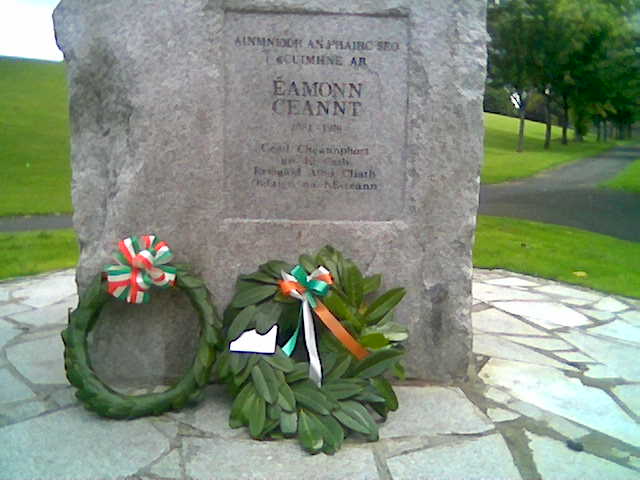
On Easter Sunday in Dublin, a wreath will be laid and the 1916 Proclamation will be read at the Éamonn Ceannt monument in the public park named in his honour in Crumlin (Dublin) at 12 noon and a commemoration will be held in Deansgrange Cemetery (which was established in 1861 and had its first burial in 1865) that same day at the republican plot, at 1pm.
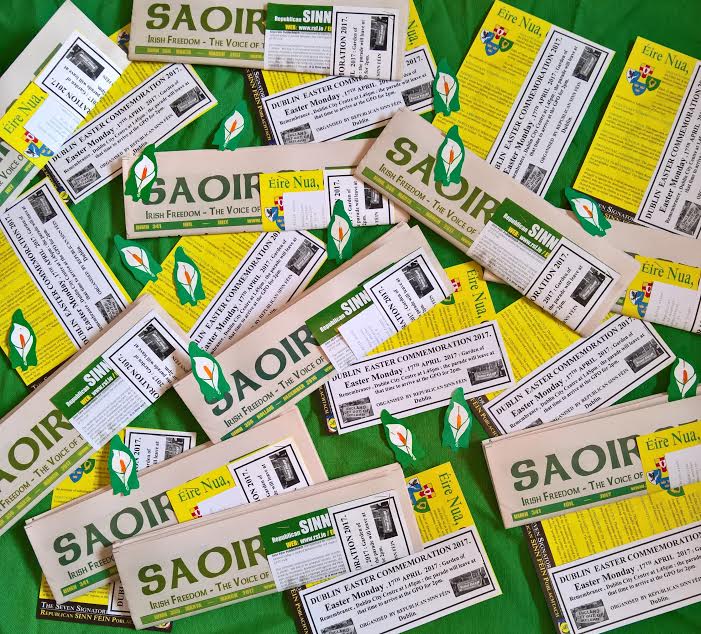
300 'leaflet packs' (pictured, left) comprised of, in total, 1,200 printed items of an Irish republican nature, will be distributed free of charge in Dublin city centre on Easter Monday at the above-mentioned commemoration at, and in, the vicinity of the GPO in O'Connell Street, on a 'first up best dressed' basis.
This blog will have a rep at each of the three events but, unfortunately, the '1169' Finance Director (!) refused my request for time off (and funds!) to cover the New York commemoration, so excuse me if you come across a rather cranky female 'leaflet-pack'-distributor in Dublin on Easter Monday...!
Thanks for reading, Sharon.
GPO (DUBLIN) PICKET IN SUPPORT OF REPUBLICAN POW GABRIEL MACKLE.
This statement was issued almost one year ago by the POW Department of Republican Sinn Féin - 'POW assaulted in Maghaberry : on Tuesday, April 12, 2016, Republican Sinn Féin learned that republican prisoner Gabriel Mackle was assaulted and dragged off Roe House, Maghaberry jail, Co Antrim, by the riot team, because he refused to turn off his music. The screw hit the alarm and the riot squad arrived and subsequently Gabriel was handcuffed, taken off the landing and the landing was locked down. We have no further details on Gabriel's whereabouts. This is yet another incident in a long line of attacks against republican prisoners and specifically Gabriel Mackle who is singled out time and time again because he refuses to be criminalised.
Recently the jail administration refused Gabriel the right to engage with his religious beliefs and celebrate his son's Confirmation. Later that same week he was mysteriously turned down for legal aid to pursue the case on a judicial review, which is beyond bizarre as it rarely occurs.
Clearly the petty vindictive attitude remains a part of the screw psyche, where the denial of political status and the general freedom to conduct their own affairs continues. Aggression will be met with resistance and thus the conflict continues, and the wishes of the POWs for a conflict free environment denied...' (from here).
This same man is being victimised again, but by a different prison source : 'Disturbing news came out to Sinn Féin Poblachtach today of dissent and conflict within Maghaberry prison. An attempt was made to remove a Cabhair POW from Roe house. Gabriel Mackle had only returned from a few days release to celebrate a family occasion when he was approached by some representatives of the IRPWA POWs...' (more here) and this - 'Statement by the President of Republican Sinn Féin Des Dalton -
Republican Sinn Féin salutes Gabriel Mackle on his courageous defence of his distinct identity and autonomy as an Irish republican POW within the Maghaberry prison. Irish republican POWs have historically had to run the gauntlet of British and 26-County state attempts to criminalise them and deny them their identity, shamefully on this occasion this latest injustice comes at the hands of those purporting to be fellow Irish republicans...' (from here).
ON SATURDAY, 8TH APRIL 2017, at 11.30am, a picket will be held at the GPO in Dublin in support of Irish republican POW Gabriel Mackle. Please show your support.
GALWAY IS WHERE I WANT TO BE*...
..This City is song enough for me
To sit in old Eyre Square, holding hands with you, love, there -
There's nowhere else on earth I'd rather be*... (*ehh...!)
Serene. A place where you can take stock of yourself, catch your breath, and enjoy having nothing to do and all day to do it. Peaceful, restful and calm. The five of us spent a week-and-a-bit in Ballyconneely, in Galway, and feel the better for it. The scenery was of a picture-postcard quality, a walk through the woods, crossing little boreens and strolling through fields to get to the shops, and meandering back to base by the footpath-less small road, until it slowly veered off course, making us jump a wee stream and carry-on across a field or two in order to reach our bungalow. Bliss!
The locals are lovely people and we had the craic with them, and we were treated as long lost cousins by the shopkeepers and innkeepers etc that we had the pleasure to mix with, the weather held up for us, we had no kids or grandkids with us to 'entertain' (!) and we weren't expected to meet anyone at any location at any particular time. Time was our own, in other words, and was worth twice as much for being so! But the goo was on all five of us for a bit of sweaty grit, and noise, and hot air carrying some quare smells to your nostrils and having to dodge (sometimes) grumpy people and drivers as you're out and about and the sheer choice of what to see and where to see it and...never mind. Only annoying myself here.
If you need a relaxing break, then Ballyconneely is made for it. But if you want an experience of a different type...!
EASTER MONDAY 2017 (17TH APRIL) : RSF DUBLIN COMMEMORATION.
On Easter Monday this year (17th April 2017), RSF in Dublin will hold its annual Easter Commemoration : those attending are asked to assemble at the Garden of Remembrance in Parnell Square, from where, at 1.45pm, the parade will leave for the GPO, arriving at that venue at 2pm. Our pic shows the RSF Easter Commemoration from last year (2016).
REPUBLICAN MEMORIAL DEFACED...
Before being defaced.....and after the act.
'In Memory Of All Those Who Fought For Irish Freedom' - the words etched into a marble plaque which is affixed to a memorial plinth on Meagher Quay, in Waterford, opposite the Granville Hotel ; that hotel, and the Quay it's located on, are connected to Thomas Francis Meagher, who fought against the British presence in Ireland. A political dimwit considered it appropriate, for a reason best known to him/herself, to tape a poster of Martin McGuinness to the plinth, apparently in the mistaken belief that the latter, too, had 'fought for Irish freedom'.
But that's not the case, as any Irish republican will tell you - Martin McGuinness was active, militarily, to obtain that which he later achieved, politically - 'civil rights' for nationalists, from Westminster, as opposed to that which Meagher and other republicans were, and are, fighting for - a complete British military and political withdrawal from Ireland, not simply 'to be treated better by the British'. It would be equally as politically absurd, insulting, inappropriate and wrong to tape a 'tribute' poster of, for example, Daniel O'Connell, to a memorial for Bobby Sands, and I hope a reader can bring this post to the attention of the perpetrator before s/he ruins any more republican memorials.
PROSE AND CONS.
By prisoners from E1 Landing, Portlaoise Prison, 1999.
ACKNOWLEDGMENTS :
Grateful thanks to the following for their help, support, assistance and encouragement, and all those who helped with the typing and word processing over the past few months. Many thanks to Cian Sharkhin, the editor of the book, Mr Bill Donoghue, Governor, Portlaoise, Mr Seán Wynne, supervising teacher, the education unit in Portlaoise Prison and the education staff, especially Zack, Helena and Jane. Education officers Bill Carroll and Dave McDonald, Rita Kelly, writer, print unit, Arbour Hill.
First Print : November 1999, reprinted March 2000, illustrations by D O'Hare, Zack and Natasha. Photograph selection : Eamonn Kelly and Harry Melia.
YOUNG LADY FROM WOOSTER. (By D O'H, from an Indian Guru.)
There was a young lady from Wooster,
Our pic shows the RSF Easter Commemoration from last year (2016).
REPUBLICAN MEMORIAL DEFACED...
Before being defaced.....and after the act.
'In Memory Of All Those Who Fought For Irish Freedom' - the words etched into a marble plaque which is affixed to a memorial plinth on Meagher Quay, in Waterford, opposite the Granville Hotel ; that hotel, and the Quay it's located on, are connected to Thomas Francis Meagher, who fought against the British presence in Ireland. A political dimwit considered it appropriate, for a reason best known to him/herself, to tape a poster of Martin McGuinness to the plinth, apparently in the mistaken belief that the latter, too, had 'fought for Irish freedom'.
But that's not the case, as any Irish republican will tell you - Martin McGuinness was active, militarily, to obtain that which he later achieved, politically - 'civil rights' for nationalists, from Westminster, as opposed to that which Meagher and other republicans were, and are, fighting for - a complete British military and political withdrawal from Ireland, not simply 'to be treated better by the British'. It would be equally as politically absurd, insulting, inappropriate and wrong to tape a 'tribute' poster of, for example, Daniel O'Connell, to a memorial for Bobby Sands, and I hope a reader can bring this post to the attention of the perpetrator before s/he ruins any more republican memorials.
PROSE AND CONS.
By prisoners from E1 Landing, Portlaoise Prison, 1999.
ACKNOWLEDGMENTS :
Grateful thanks to the following for their help, support, assistance and encouragement, and all those who helped with the typing and word processing over the past few months. Many thanks to Cian Sharkhin, the editor of the book, Mr Bill Donoghue, Governor, Portlaoise, Mr Seán Wynne, supervising teacher, the education unit in Portlaoise Prison and the education staff, especially Zack, Helena and Jane. Education officers Bill Carroll and Dave McDonald, Rita Kelly, writer, print unit, Arbour Hill.
First Print : November 1999, reprinted March 2000, illustrations by D O'Hare, Zack and Natasha. Photograph selection : Eamonn Kelly and Harry Melia.
YOUNG LADY FROM WOOSTER. (By D O'H, from an Indian Guru.)
There was a young lady from Wooster,
who dreamt a rooster seduced her,
she woke with a scream
but 'twas only a dream -
A bump in the mattress had goosed her.
(Next - 'Dumbo the Elephant', by Cian Sharkhin.)
ON THIS DATE (5TH APRIL) 79 YEARS AGO : SKILLED €1000-A-DAY CHAIR IS BORN...
Trade unionism and politics have a lot in common, including the fact that, if operated for the greater good, both can be beneficial to society and to the individual. Take, for instance, sports-mad Bill Attley (pictured, left), who was born in Dublin on this date - 5th April - in 1938 : he studied at the National College of Industrial Relations (formerly known as the 'Catholic Workers College' and the 'College of Industrial Relations', now known as the 'National College of Ireland') and was an active member of the 'Workers' Union of Ireland', where he was elected as branch secretary at just 30 years of age.Nine years later he became the deputy general secretary of that union and five years after that he was elected as the general secretary. In that same year (1982) he was appointed as a 'UEFA Referee Observer', a post he held for 28 years - indeed, in his second year in that position, he was elected as the 'Chief Referee Assessor' of the FAI. Not bad going, considering he got his first major 'outing' as an assistant ref in 1975, in a semi final, and then in a European cup final progressing, within a year, to the position of ref in an FAI cup final.
At 52 years of age, Bill assisted in merging the WUI with the ITGWU and a new trade union organisation, SIPTU, was formed and, on a personal note, I'll say again that it was a bad move for the members of both of the pre-merged unions - the new entity lost its 'bottle' and became more 'middle class' than 'working class', and I know of many SIPTU members who, like me, are disappointed that, unlike the 'old' ITGWU, the SIPTU model constantly gives a very good impression of a union which is only really in your corner if you're an air traffic controller or some such. Anyway : the then new trade union needed, among other such suits, a 'joint general president' and our Bill filled that position for the first four years of its existence (1990-1994) following which he officered as general secretary until he retired in 1998, at 60 years of age. Also, throughout his trade union 'career' he also affiliated himself with the State Labour Party, and it was to the chagrin of both of those groups that his name became associated with the 'SIPTU Slush Fund Scandal' (which wasn't his first foray of that type...) -
'The fund, which spent more than €3 million over a decade of operation, has been heavily criticised following an audit that uncovered a catalogue of waste of taxpayers’ money and serious breaches of corporate governance...it has emerged that over €3m of state funds were paid into a bank account known as the SIPTU national health and local authority levy fund...the account was not one officially sanctioned by the union but under the control of two SIPTU officials...among those due to attend the hearing is CEO of the HSE, Cathal Magee, the secretary general of the Department of Health, Michael Scanlan and former general secretary of SIPTU, Bill Attley, who was head of the SKILL steering group...' (from here) and this : '..also on the tab were laptops for union members (€30,000), a DVD (€30,526!), personal mobile phone costs and numerous taxi rides, including an amazing round-trip from Dublin to Tullamore via Louth (€544)! On the larger side there were "consultancy services" which were not put out to tender to the value of €526,444. This seems to have been for "Partnership training for SIPTU shop stewards and general operatives", whatever that might mean. To the lucky member of the Skills steering group who was hired to provide the service it meant a tidy €73,000...(and some of the money) was used to top up someone's pension. Neither the amount nor the individual involved have been disclosed...' (from here).
The name 'Attley' apparently '..portrays partnership, the coming together of like minds and ideals (and) although it is flexible and patient, it is unnoticed and operates from the shadows...' ; indeed - actions such as those outlined above cast a big dark spot and leave those not prepared 'to operate from the shadows' in the shade.
RICOCHETS OF HISTORY...
At the end of a year in which *IRA decommissioning has been met with widespread euphoria, Phil Mac Giolla Bháin takes a stubborn look at the facts and concludes that the celebration party may be a little premature. From the 'Magill Annual 2002' (*PIRA).
The transformation process that the Adams/McGuinness leadership has embarked upon since the hunger strikes of 1981, up until the recent supervised destruction of (P)IRA weaponry, has been the latest episode in the unresolved party/army debate - it is unresolved for republicans because it has been set by outside events ('1169' comment - actually, it was then, and remains, "unresolved for republicans" because it was an agenda promoted, internally, by nationalists [as opposed to republicans] who had unfortunately obtained leadership positions in the Movement).
The tidy ideological arguments of the Dublin-based leadership of the IRA under Cathal Goulding were not adhered to by Gusty Spence and the B-Specials ; the pogrom of northern nationalists made the unfashionable militarists come out of retirement. At the time, even the government of the Republic (sic - the author was referring to the 26-county Free State administration) - or at least a section of it - saw the need for guns. Specifically, guns in the hands of a threatened Irish citizenry. The objective of getting 500 Hungarian 9mm pistols and the appropriate amount of ammo into the North arose for the same reason that the British government parachuted 'shorts' (handguns) into occupied France in 'World War II'.
The British even made a simple one-shot .45mm 'saturday-night-special' handgun for the purpose, complete with simple instructions in French, and it was hoped that patriotic French 'terrorists' would find it and use it to eliminate a German soldier or, perhaps, even better, a member of the Vichy administration. Vichy France was not a normal or stable society ('1169' comment - but what society under military and political occupation could expect to be "normal or stable", despite even when certain members of that society decide to cooperate with the occupiers...?) - hence the guns in the hands of the citizenry. It would be bizarre to parachute handy 'murder kits' to civilians today. Context, historical context, is everything...(MORE LATER).
GROWING UP IN LONG KESH...
SIN SCÉAL EILE.
By Jim McCann (Jean's son). For Alex Crowe, RIP - "No Probablum". Glandore Publishing, 1999.
Biographical Note : Jim McCann is a community worker from the Upper Springfield area in West Belfast. Although born in the Short Strand, he was reared in the Loney area of the Falls Road. He comes from a large family (average weight about 22 stone!). He works with Tús Nua (a support group for republican ex-prisoners in the Upper Springfield), part of the Upper Springfield Development Trust. He is also a committee member of the 'Frank Cahill Resource Centre', one of the founders of 'Bunscoil an tSléibhe Dhuibh', the local Irish language primary school and Naiscoil Bharr A'Chluanaí, one of the local Irish language nursery schools.
His first publication last year by Glandore was 'And the Gates Flew Open : the Burning of Long Kesh'. He hopes to retire on the profits of his books. Fat chance!
BÁS DON BÉARLA.
'Thonging' is the strips of plastic that hold Long Kesh purses and bags together - holes are punched through the leather around the edges and the thonging is interlaced through them. In early 1974 the thonging was used to connect the cages of Long Kesh so as to provide supply lines from cage to cage. Loaves of bread were transported around Long Kesh by this method - it was a fantastic piece of resourcefulness, as demonstrated by republican POW's.
The signing of 'The Sunningdale Agreement' of 1973 and the subsequent UWC Strike had far-reaching effects on the people of the North of Ireland and on the prisoners of Long Kesh. At that time I was on remand in Cage 10, and we were denied everything - no sports of any description ; we had a table-tennis table but couldn't get bats or ping-pong balls. The Kesh was in a constant state of flux. We had no parcels, heating or visits and the food the screws sent up was nothing more than slops, so we threw it over the wire of the cage, usually at the Principal Officer's bunk (a wooden hut that sat outside the cage). The idea was to try and hit the screws with the 'food' as they darted from place to place.
The only proper food we had was bread and margarine - we had no cigarettes, letters, electricity or heating, so we burned anything non-essential to heat water to make tea and when the tea-leaves were brewed to death we dried them and then smoked them. Not advisable, especially if the tea is Nambarrie's... (MORE LATER).
(T)HERE WE GO AGAIN...
..but this time it's 'work', not pleasure! We're not going to be able to post our usual contribution here next Wednesday, 12th April 2017, even though we will be here, in Dublin (and not in Galway [or further afield]!). We'll be assisting the Cabhair organisation to run a 650-ticket raffle on Sunday 9th April (work on which began on Tuesday 4th) and, as usual, we'll be attending the 'autopsy' on Monday evening (10th) into how it went. The gig itself is held in a hotel on the Dublin/Kildare border and the Monday evening end of it takes place in Dublin city centre, but the effort behind the scenes is what makes or breaks it, and it's almost a full-time job from the Tuesday before the gig until, usually, the Tuesday after it, to ensure that all goes well. But it's well worth it, as it brings in a decent few quid, brings us into contact with new people and helps us to keep in touch with existing colleagues. We'll be back here on Wednesday, 19th April 2017 with, among other bits and pieces, a few paragraphs about an Irish republican radio operator who was battered and imprisoned by the Free State administration, acting under instruction from a former Irish republican gunman...
Thanks for reading, Sharon.
VANDALISED BY A POLITICALLY IGNORANT NATIONALIST...
A reader in the South-East of Ireland has contacted us to ask if we could highlight a recent incident of vandalism concerning an Irish republican monument which she, respectfully, walks past twice each day. She told us of how angry she is to realise that someone could think so little of a monument erected to those that fought for the limited freedom we have today to the point that they could besmirch that memory in the manner they did, and described the damage done as having been perhaps carried out more from the perpetrator being politically ignorant than being intentionally destructive but, never the less, she considers the deed to have been one of vandalism. And we wholeheartedly agree.
We will publish a 'before' and 'after' pic here on Wednesday, 5th April, and you can make your own mind up...
Thanks for the visit - see you on the 5th. Sharon.
ON THIS DATE (22ND MARCH) 46 YEARS AGO : 'FÜHRER FAULKNER' INSTALLED AS 'PM' OF AN OCCUPIED AREA.
"The British Ambassador called to see me at 11am this morning. He told me in strict confidence that he had received a message from the British representative in Belfast, Mr. Ronnie Burroughs , who indicated that he had been informed by Mr. Brian Faulkner that the latter is confident of securing the nomination to be the next Prime Minister of Northern Ireland (sic). Mr. Faulkner expects this to be approved about noon on Tuesday and that he will go to the Governor-General about 3.00pm....Mr. Burroughs said that Mr. Faulkner had assured him categorically that he would be prepared to implement the Downing Street Declaration and that there would be no going back on the policies relating to the B Specials, the RUC and reform. He also indicated that he would not have anyone in his Cabinet who would not support his policies...in the course of the discussion which followed the Ambassador and I touched on the doubts held by the minority in the North on the sincerity of Mr. Faulkner in relation to reforms...Mr.Faulkner's earlier right-wing tendencies did not inspire confidence..." (from this Free State document, dated 23rd March 1971, and marked 'Secret'.)
Brian Faulkner was born in Helen's Bay, in County Down, and was elected to Stormont as a Unionist MP for East Down in the 1949 election. He became 'Prime Minister of Northern Ireland' (sic) on the 22nd March 1971 - 46 years ago on this date - and chaired the first ever inter-party meeting held at Stormont. However, nationalists were alienated by internment and Faulkner was ordered to hand over complete security control to London in 1972. He became Chief Executive of the new power-sharing executive in 1974, but resigned as party leader when the UUP rejected the proposed 'all-Ireland council' settlement by a majority of eighty votes. The executive came to an end as a result of a strike by the Ulster Workers Council (UWC), and Faulkner retired from active politics in 1976. He died on the 3rd March 1977 at the age of 56 following a riding accident whilst hunting with the County Down Staghounds near Saintfield, County Down. He had been riding at full gallop along a narrow country road when his horse slipped - he was thrown off and killed instantly.
It was during his 'Premiership' that internment without trial was introduced, under the '1922 Special Powers Act', on Monday, 9th August 1971, because, according to Faulkner - "Every means has been tried to make terrorists amenable to the law. But the terrorist campaign continues at an unacceptable level. And I have had to conclude that the ordinary law cannot deal quickly or comprehensively enough with such viciousness...". The British forces that enforced that 'edict' had a list of 450 people to be rounded-up, but managed to grab only 342 of them, all from the nationalist community, only two of whom were republican activists. No loyalists were 'arrested'. Over the next four days, 24 people were killed in rioting and gun battles across the Six Counties and about 7,000 people had to flee from their homes.
Mr. Faulkner was said to be 'distressed' when it was brought to his attention that he had been referenced in a song which lauded a prison break which took place on the 17th November 1971, when he would have been only beginning to build his political career in Stormont - nine IRA prisoners escaped from Crumlin Road Prison in Belfast (which, between it and Long Kesh, housed more than 700 IRA prisoners at the time) with the use of rope-ladders! The nine were Thomas Kane, Seamus Storey, Bernard Elliman, Danny Mullan, Thomas Fox, Tom Maguire, Peter Rogers, Christy Keenan and Terrence 'Cleaky' Clarke and all of them escaped in two cars which were waiting for them on the near-by Antrim Road :
OVER THE WALL.
In Crumlin Road Jail all the prisoners one day
took out a football and started to play,
and while all the warders were watching the ball
nine of the prisoners jumped over the wall!
Over the wall, over the wall,
who would believe they jumped over the wall?
over the wall, over the wall,
It's hard to believe they jumped over the wall!
Now the warders looked on with the greatest surprise
and the sight that they saw brought tears to their eyes,
for one of the teams was not there at all
they all got transferred and jumped over the wall!
Now the governor came down with his face in a twist
and said "Line up those lads while I check out me list,"
but nine of the lads didn't answer at all
and the warder said "Please Sir, they're over the wall."
The 'security forces' were shook to the core
so they barred every window and bolted each door,
but all their precautions were no use at all
for another three prisoners jumped over the wall!
Then the news reached old Stormont, Brian Faulkner turned pale
when he heard that more men had escaped from his jail,
said he - "Now we'll have an enquiry to call, and we'll get Edmund Compton to whitewash the wall."
'Führer Faulkner' began his 'premiership' of an occupied area on this date - 22nd March - 46 years ago.
PROSE AND CONS.
By prisoners from E1 Landing, Portlaoise Prison, 1999.
ACKNOWLEDGMENTS :
Grateful thanks to the following for their help, support, assistance and encouragement, and all those who helped with the typing and word processing over the past few months. Many thanks to Cian Sharkhin, the editor of the book, Mr Bill Donoghue, Governor, Portlaoise, Mr Seán Wynne, supervising teacher, the education unit in Portlaoise Prison and the education staff, especially Zack, Helena and Jane. Education officers Bill Carroll and Dave McDonald, Rita Kelly, writer, print unit, Arbour Hill.
First Print : November 1999, reprinted March 2000, illustrations by D O'Hare, Zack and Natasha. Photograph selection : Eamonn Kelly and Harry Melia.
IN MEMORY OF DADDY. (By D O'H.)
Oh! Breathe not his name,
let it sleep in the shade
where cold and unhonour'd
his relics are laid!
Sad, silent and dark
be the tears that we shed,
as the night dew that falls
on the grass o'er his head.
But the night dew that falls,
tho' in silence it weeps,
shall brighten with verdure
the grave where he sleeps.
And the tears that we shed,
tho' in secret it rolls,
shall long keep his memory
green in our souls. (By Thomas Moore - 'Oh breathe not his name')
(Next - 'Young Lady From Wooster', by D O'H.)
ON THIS DATE (22ND MARCH) 38 YEARS AGO : IRA ASSASSINATE A BRITISH 'AMBASSADOR' IN THE NETHERLANDS.
"...we have carried out bombings and shootings in Germany over the last two years as well. Last Spring we executed Sir Richard Sykes. He was involved in intelligence gathering against our organisation but he was also a leading propagandist in the same way as Peter Jay* was in America. Sykes was also the man who conducted the investigation into our attack on the British ambassador to Dublin, Ewart Biggs. Richard Sykes was a very important person and what that attack, and others, have shown, is the IRA's capability to operate abroad and against the enemy, not the host country, and gained our struggle attention there..." - the reply given to journalist Ed Maloney by an IRA spokesperson, on being asked why the IRA had killed 'Sir' Richard Sykes (pictured, left), as printed in 'Magill' magazine, September 1980, eighteen months after Sykes had been assassinated. (*More here, re Peter Jay and what the IRA thought of him...)
'The Guardian' newspaper, too, was of the opinion that the man in question (...a 'decorated war hero..') was more than just a run-of-the-mill 'career politician' - 'Sir Richard, who would have been 59 in May, was rated as one of the "high flyers" of the British foreign service, coming up through a series of posts that took him to China, Cuba and embassies that are "listening posts" for the Soviet block. In his last posting before going to The Hague he was one of the six senior officials at the FO (Foreign Office). His division was concerned with defence, arms and security, and it can be presumed he held responsibility for day-to-day links with the intelligence services..'(from here) and the 'Ireland In History' blog had this to say about him : "The Ambassador was a noted security expert and at the time there was much initial speculation in the Netherlands and in Britain that other groups under suspicion at the time (including Palestinians and Iraqis) could have targeted him. He was appointed to the job in June 1977 after a two year posting as a Foreign and Commonwealth Office deputy under-secretary in London. He was an acknowledged expert on security affairs and had been a diplomat in Cuba, Peking and Washington. Ironically he was responsible for an internal report on the safety of British diplomats following the assassination by the IRA in 1976 of the British ambassador to Dublin, Sir Christopher Ewart-Biggs...' (from here.)
The British Government, as expected, put a 'diplomatic spin' on the death of 'Sir' Sykes and those like him - "Today we honour the memory of 18 courageous men and women whose lives tragically were cut short in service to our country and the Foreign and Commonwealth Office. We owe them a great debt of gratitude and we pay tribute to their memory, to their important work and to their undoubted bravery...and I thank you for the contribution that you have made to the service of our country overseas..this ceremony is also a moment to take pride in the Foreign Office and all it represents..it is a great honour to lead an organisation that makes such a unique and irreplaceable contribution to the United Kingdom..etc etc.." but Richard Sykes and those like him were the 'Cairo Gang' equivalent of their time and were dealt with as such.
RICOCHETS OF HISTORY...
At the end of a year in which *IRA decommissioning has been met with widespread euphoria, Phil Mac Giolla Bháin takes a stubborn look at the facts and concludes that the celebration party may be a little premature. From the 'Magill Annual 2002' (*PIRA).
The border campaign, or 'Operation Harvest' as it was known inside the IRA at the time, was an attempt to bring Tom Barry's West Cork war of 1920 to Fermanagh and Tyrone - it was pure republican militarism, and not very good militarism at that. Like most military failures, it failed to look at the technological improvements the enemy had acquired since the last engagement. Attempts to take 'the Tan War' to Tyrone failed.
To adapt Lenin's dictum, a guerrilla army in the wake of military failure is ripe for revisionism. The debate within the republican movement from the order to dump arms in 1962 to the walk-out at the Intercontinental Hotel in Ballsbridge during the 1970 Sinn Féin Ard Fheis could be reduced to a one-word question - "Guns?" Differing republican attitudes to the guns reflected whether they believed that the party or the army should have primacy. In the early years after independence (sic), attitudes to IRA guns reflected attitudes to Free State guns.
German sociologist Max Weber concluded that, at its core, a state was "the sole claimant to the wielding of legitimate force within a given territory". If you have two claimants, then there will be civil war. The existence of IRA guns since the civil war has signalled that the partition settlement (a 'settlement' under a threat from the British of "immediate and terrible war" if that treaty wasn't accepted!) copper-fastened by borrowed English artillery was not accepted by everyone. The need for IRA guns in Belfast in 1969 meant that Michael Collins's fears for Northern Ireland (sic) had become a deadly reality. The pogrom against the people of the Clonard came at a time when the IRA had obligingly put its weapons verifiably beyond use. They had given them to the Free Wales Army. (MORE LATER).
ON THIS DATE (22ND MARCH) 176 YEARS AGO - IRISH ABROAD ORGANISE TO LOOK AFTER EACH OTHER. SORT OF...
This piece is in relation to one particular aspect of travelling abroad that was more prevalent in previous times than it would be now (a risk reduced thanks to modern technology, I'd like to believe..)
Myself and my friends have landed in New York many times and, apart from being a wee bit merry
jet-lagged (!) we were comfortable in ourselves and in our surroundings and were always met on the ground by our friends, colleagues and comrades, but we could easily picture what it would have been like for our ancestors :
'...on arrival passengers usually made their way to the city to find boarding houses where there was a good chance the remainder of their money would be swindled. The Irish and other immigrants faced numerous abuses such as 'illusive advertisements, crooked contractors, dishonest prospectuses' and 'remittent sharpers' when they arrived in America. The 'Irish Emigrant Society' was founded in 1841 (on the 22nd March that year - 176 years ago on this date) by a group of New York Irish to combat issues such as these.
In December 1848 the Emigrant Society advised emigrants that as soon as their ship came into harbour she would be boarded by an agent of the Society, who would offer them sound and honest advice. But, they warned, the ship would also be boarded by a large number of 'runners' – conmen, who would make it their business to attract them to the boarding houses that employed them. They should be careful not to accept help from them as their ploy was to promise good quality board at low prices, but when they came to leave the house an exorbitant fee would be demanded. They would threaten not to hand over luggage unless this fee was paid and violent scenes might often ensue.
The Society warned that many persons, some of Irish birth, had set up offices in the city where they claimed to be agents for railroad and steamboat enterprises. These crooks sold tickets which purported to entitle the holder to travel to specific destinations but which were worthless. To protect emigrants from such frauds various measure were introduced in New York in 1848 including the construction of reception centres and the licensing of steam boats to take emigrants from the quarantine to the landing piers. Boarding houses were also required to display their prices in English, Dutch, German, Welsh and French. Immigrants who survived the ordeal of the crossing now had to decide where to settle in America...' (from here.)
'...the story of the Irish Emigrant Aid Society founded in 1841 begins in the 1830s when the volume and character of Irish immigration to the United States changed dramatically. We often think of large-scale Irish immigration to America as beginning with the Famine (sic - An Gorta Mór/the Great Hunger') in 1845, but it was already well under way by then, with some 200,000 Irish arriving in New York in the 1830s alone. Before 1830, the majority of Irish immigrants were Protestants from Ulster. More often than not, they arrived with some capital and, equally important, marketable occupational skills. But starting in the 1830s, as the agricultural crisis that would later 'blossom' worsened, more and more of the Irish who arrived in the U.S. in the 1830's and ’40s were poor, unskilled Catholics. Whereas only 28 percent of Irish immigrants arriving in 1826 were unskilled labourers, the number hit 60 percent in the 1830s and kept rising to more than 80 percent by 1850...
One of the most pervasive threats to immigrant well-being addressed (by the Irish Emigrant Society) were the legions of con men and crooks descending upon unsuspecting immigrants. Many of them worked for boarding houses that charged extortionate rates and saddled immigrants with hidden charges. Others offered fraudulent money exchanges or sold bogus tickets for steamers and trains heading west. Worst were the pimps who steered unsuspecting Irish women to brothels. Sadly, as the Society's annual reports state, these men often used their ethnic credentials — a good Irish accent or, better still, the ability to speak Irish — to ensnare their fellow Hibernians. An eyewitness account by an Irish priest in the 1850s explains the typical scenario -
"The moment he landed, his luggage was pounced upon by two runners, one seizing the box of tools, the other confiscating the clothes. The future American citizen assured his obliging friends that he was quite capable of carrying his own luggage, but no, they should relieve him — the stranger, and guest of the Republic — of that trouble. Each was in the interest of a different boarding-house, and each insisted that the young Irishman with the red head should go with him...not being able to oblige both gentlemen, he could oblige only one; and as the tools were more valuable than the clothes, he followed in the path of the gentleman who had secured that portion of the 'plunder'..the two gentlemen wore very pronounced green neckties, and spoke with a richness of accent that denoted special if not conscientious cultivation; and on his (the Irishman's) arrival at the boarding-house, he was cheered with the announcement that its proprietor was from "the ould counthry," and loved every sod of it, God bless it..." (from here.)
I'm sittin' on the stile, Mary,
Where we sat side by side
On a bright May mornin' long ago,
When first you were my bride;
The corn was springin' fresh and green,
And the lark sang loud and high -
And the red was on your lip, Mary,
And the love-light in your eye.
The place is little changed, Mary,
The day is bright as then,
The lark's loud song is in my ear,
And the corn is green again;
But I miss the soft clasp of your hand,
And your breath warm on my cheek,
And I still keep list'ning for the words
You never more will speak...
On a bright May mornin' long ago,
When first you were my bride;
The corn was springin' fresh and green,
And the lark sang loud and high —
And the red was on your lip, Mary,
And the love-light in your eye.
The place is little changed, Mary,
The day is bright as then,
The lark's loud song is in my ear,
And the corn is green again;
But I miss the soft clasp of your hand,
And your breath warm on my cheek,
And I still keep list'ning for the words
You never more will speak... (from here.)
GROWING UP IN LONG KESH...
SIN SCÉAL EILE.
By Jim McCann (Jean's son). For Alex Crowe, RIP - "No Probablum". Glandore Publishing, 1999.
Biographical Note : Jim McCann is a community worker from the Upper Springfield area in West Belfast. Although born in the Short Strand, he was reared in the Loney area of the Falls Road. He comes from a large family (average weight about 22 stone!). He works with Tús Nua (a support group for republican ex-prisoners in the Upper Springfield), part of the Upper Springfield Development Trust. He is also a committee member of the 'Frank Cahill Resource Centre', one of the founders of 'Bunscoil an tSléibhe Dhuibh', the local Irish language primary school and Naiscoil Bharr A'Chluanaí, one of the local Irish language nursery schools.
His first publication last year by Glandore was 'And the Gates Flew Open : the Burning of Long Kesh'. He hopes to retire on the profits of his books. Fat chance!
PSYCHOLOGICAL WARFARE (does my head in...)
The British soldier had a sort of sick grin on his face and was shouting all sorts of abuse at us as he started disappearing into the crowds of soldiers. Within about thirty seconds he was gone. "Where did he go?", asked Norman. "I think he's away to join the air force", answered Jack the Giant. "How do you know?", someone asked him. "Because he's only after flying down that road", said Jack. Even the other Brits were laughing. Just as Norman was about to point our next target, all the Brits at the front turned their backs on him and us.
We stood at that gate for about an hour while the Sentenced Prisoners' OC and the screws met to discuss the reason for the confrontation. I have never found out what it was about but that's not important anyway. I was told that we won, so that'll do me. As we stood at the gate facing the Brits the word started filtering through to us in Irish that it was over and that the Brits would be going. "Right lads, we're not waiting any longer, we're going to attack!", shouted the Training Officer. "Right, boys, here we go. Get into the bastards!!" We started pretending to open the gate ; the Brits couldn't believe it. Of course they hadn't been told what we already knew.
The Brit officers were running about screaming at their men, shouting for order in the ranks, and informing them that the issue was settled and that they wouldn't be going into the cages. The Brit soldiers were absolutely fuming with rage. "You lucky bastards", Norman Stanley Bowler shouted at them, "we would have slaughtered the lot of ye..."
Some of the Brits were actually crying with rage because they couldn't get at us - I'm constantly amazed at the things that some people do for money but joining the British Army must be the lowest of the low, ranking only with being an RUC man or a prison screw. (MORE LATER).
GIVE ('cause I'm taking anyway...!)
We won't be here next Wednesday, 29th March 2017, and won't be back on the blog until the following Wednesday, 5th April - I got the chance of a shortish break in Galway and decided to go for it, as myself and the girlfriends are not going to New York this year and we're all feeling sorry for ourselves :- ( so the usual NYC gang are gonna be drownin' our sorrows in the City of Tribes, when really we would all much rather be with the Warriors in that other city but...not to be, not this year, anyway.
This is Galway, the bidding city the forbidding city.
City of thieves or is it scribes or is it tribes?
The jury are coming this July, the word is out they'll rule on the bid, for Capital of Culture twenty twenty give the horse plenty.
We have a great little city here, a pity little city, a shitty little city... Back on Wednesday, 5th April 2017. See ye then!
Thanks for reading, Sharon.