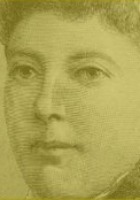
ON THIS DATE (1ST JULY) 153 YEARS AGO - DEATH OF 'MEAGHER OF THE SWORD'."Abhor the sword - stigmatize the sword? No, for in the passes of the Tyrol it cut to pieces the banner of the Bavarian, and, through those cragged passes, struck a path to fame for the peasant insurrections of Innsbruck! Abhor the sword - stigmatize the sword? No, for at its blow a giant nation started from the waters of the Atlantic, and by its redeeming magic, and in the quiverings of its crimsoned light, the crippled colony sprang into the attitude of a proud Republic - prosperous, limitless, and invincible! Abhor the sword - stigmatize the sword? No, for it swept the Dutch marauders out of the fine old towns of Belgium - scourged them back to their own phlegmatic swamps - and knocked their flag and sceptre, their laws and bayonets, into the sluggish water of the Scheldt.." - Thomas Francis Meagher, pictured.
Born on the 3rd August 1823, died (in mysterious circumstances) on the 1st July, 1867 - 153 years ago, on this date - 'Does the world even have heroes like Ireland's Thomas Francis Meagher anymore? After fighting for Irish independence ("I know of no country that has won its independence by accident") ,then condemned to death, pardoned and exiled, Thomas Francis Meagher escaped to America, where he became a leader of the Irish community and commanded the Irish Brigade during the Civil War. General Meagher's men fought valiantly at some of the most famous battles of the Civil War, including Antietam, Fredericksburg and Chancellorsville. After the war, Meagher served as Acting Governor of the Montana Territory. In 1867, Meagher disappeared on the Missouri River ; his body was never found..' (from here.)
Thomas Francis Meagher was born in Waterford City (near the Commins/Granville Hotel) on August 3rd, 1823, into a financially-comfortable family ; his father was a wealthy merchant who, having made his money, entered politics, a route which the young Thomas was to follow. At 20 years young, he decided to challenge British misrule in Ireland and, at 23 years of age (in 1846), he became one of the leaders of the 'Young Ireland' Movement. He was only 25 years of age when he sat down with the Government of the Second French Republic to seek support for an uprising in Ireland. At 29 years of age, he wrote what is perhaps his best known work - 'Speeches on the Legislative Independence of Ireland', of which six editions were published.
He unveiled an Irish flag, which was based on the French Tricolour, in his native city, Waterford, on the 7th March 1848, outside the Wolfe Tone Confederate Club. The French Minister for Foreign Affairs, Alphonse de Lamartine, and a group of French women who supported the Irish cause, gave Meagher the new 'Flag of Ireland', a tricolour of green, white and orange - the difference between the 1848 flag and the present flag is that the orange was placed next to the staff and the red hand of Ulster adorned the white field on the original. On the 15th April that same year, on Abbey Street, in Dublin, he presented the flag to Irish citizens on behalf of himself and the 'Young Ireland' movement, with the following words : "I trust that the old country will not refuse this symbol of a new life from one of her youngest children. I need not explain its meaning. The quick and passionate intellect of the generation now springing into arms will catch it at a glance. The white in the centre signifies a lasting truce between the 'orange' and the 'green' and I trust that beneath its folds, the hands of the Irish protestant and the Irish catholic may be clasped in generous and heroic brotherhood.."
He was arrested by the British for his part in the 1848 Rising, accused of 'high treason' and sentenced to death ("to be hanged, drawn and disemboweled..") but, while he was awaiting execution in Richmond Jail, this was changed by 'Royal Command' to transportation for life. Before he was deported, he spoke in Slievenamon, Tipperary, to a crowd estimated at 50,000 strong, about the country and the flag he was leaving behind - "Daniel O'Connell preached a cause that we are bound to see out. He used to say 'I may not see what I have laboured for, I am an old man ,my arm is withered, no epitaph of victory may mark my grave, but I see a young generation with redder blood in their veins, and they will do the work.' Therefore it is that I ambition to decorate these hills with the flag of my country.."
In July 1849, at only 26 years of age, he was transported from Dun Laoghaire on the SS.Swift to Tasmania, where he was considered, and rightly so, to be a political prisoner (a 'Ticket of Leave' inmate) which meant he could build his own 'cell' on a designated piece of land that he could farm provided he donated an agreed number of hours each week for State use. In early 1852, Thomas Francis Meagher escaped and made his way to New Haven, in Connecticut, America, and travelled from there to a hero's welcome in New York. This fine orator, newspaper writer, lawyer, revolutionary, Irish POW, soldier in the American civil war and acting Governor of Montana died (in mysterious circumstances - he drowned after 'falling off' a Missouri River steamboat) on the 1st of July 1867 at 44 years of age. Once, when asked about his 'crimes', he replied - "Judged by the law of England, I know this 'crime' entails upon me the penalty of death ; but the history of Ireland explains that 'crime' and justifies it."
This brave man dedicated twenty-four of his forty-four years on this earth to challenging British misrule in Ireland and, while it can be said without doubt that Thomas Francis Meagher did his best, a 'crime' does remain to be resolved.
'THE CULT OF THE FALSE PROPHETS...'
From 'The United Irishman' newspaper, June, 1955.
The oldest of these newspapers, 'The Irish Press', still presents an appearance of representing republican ideals, but 'The Sunday Press' newspaper dilutes these with a big splash of the worst elements in Anglo-American culture.
'The Evening Press' newspaper, its latest publication, seems to say that republicanism and nationality are dead, and that Fianna Fail itself is in danger of death, and to avert the latter 'calamity' there is sought the votes of the degenerate, the method being to degenerate them still further, with disc-jockey and dance-hall 'culture'.
'The Irish Times' newspaper, to give it its due, stands for some kind of conception of Irish nationality. 'The Evening Press' falls short of the standards of the ex-unionist newspaper. Those three newspapers were founded at different periods in the life of Fianna Fail, with the earliest still retaining something of the true Republican Movement from which Fianna Fail seceded, but the latter illustrating the decline and fall of a movement which has severed its connection with the source of its strength... (MORE LATER.)
ON THIS DATE (1ST JULY) 123 YEARS AGO : IRISH GUERRILLA LEADER BORN.
"On an extremely cold, wet night, the men began moving to Kilmichael to take on the dreaded Auxiliaries. All IRA positions were occupied at 9am. The hours passed slowly. Towards evening the gloom deepened over the bleak Kilmichael countryside. At 4.05 pm. an IRA scout signaled the enemy's approach.
The first lorry came round the bend into the ambush position. Tom Barry, dressed in military style uniform stepped onto the road with his hand up. The driver gradually slowed down. When it was 35 yards from the Volunteers command post a Mills’ bomb was thrown by Barry and simultaneously a whistle blew signalling the beginning of the ambush. The bomb landed in the driver’s seat of the uncovered lorry. As it exploded, rifle shots rang out. The lorry, its driver dead, moved forward until it stopped a few yards from the small stone wall in front of the command post. While some of the Auxiliaries were firing from the lorry, others were on the road and the fighting was hand-to-hand. Revolvers were used at point blank range, and at times, rifle butts replaced rifle shots. The Auxiliaries were cursing and yelling as they fought, but the IRA coldly outfought them. In less than five minutes nine Auxiliaries were dead or dying. Barry and the three men beside him at the Command Post, moved towards the second lorry..." (from here.)
"Many statements have been made by Ministers and Generals in various countries on the necessity for long periods of training before even an infantry soldier is ready for action. This is utter nonsense when applied to volunteers for guerilla warfare. After only one week of collective training, his Flying Column of intelligent and courageous fighters was fit to meet an equal number of soldiers from any regular army in the world, and hold its own in battle, if not in barrack-yard ceremonials". - Tom Barry, 'Guerilla Days in Ireland'.
"They said I was ruthless, daring, savage, blood thirsty, even heartless. The clergy called me and my comrades murderers ; but the British were met with their own weapons. They had gone in the mire to destroy us and our nation and down after them we had to go" - Tom Barry.
And, four months later, Tom Barry (pictured, in 1921) was again active in an equally successful engagement with British forces - in the early hours of Saturday, 19th March 1921, under the command of Tom Barry (the son of an RIC officer who had retired to become a shopkeeper) and Liam Deasy (who, within less than two years afterwards, signed a Free State 'pledge' in exchange for his life), the West Cork Flying Column of the IRA turned the tables on a British Army and RIC column at Crossbarry, situated about twelve miles south-west of Cork city, despite being outnumbered ten-to-one.
During the hour-long firefight, in which 104 IRA Volunteers (each carrying approximately 40 rounds of ammunition) successfully fought their way out of a 'pincer'-type movement by about 1,200 enemy troops, consisting of British soldiers from the Hampshire and Essex Regiments, Black and Tans and RIC men, three IRA men were killed in action (Peter Monahan, Jeremiah O'Leary and Con Daly) and three others were wounded. Reports varied in relation to British casualties but it seems certain that at least ten of their soldiers were killed and three wounded (more here).
In an interview he gave a number of years later, Tom Barry recalled how "..about two hours had elapsed since the opening of the fight. We were in possession of the countryside, no British were visible and our task was completed. The whole Column was drawn up in line of sections and told they had done well.." - and they had indeed 'done well', only to witness, within months, their efforts (ab)used by those who yearned for a political career, which they were given by Westminster in return for their surrender. But, thankfully, although still outnumbered, a republican force still exists to this day.
Tom Barry was born on this date (1st July, 1897) - 123 years ago. He died, at 83 years of age, on the 2nd July, 1980.
'FREEDOM OF INFORMATION OR FUMBLING OF INFORMATION?'
By Paul O'Brien.
From 'The Magill Annual', 2002.
('1169' comment - Interesting article, considering the recent changes to this particular piece of State legislation.)
An FOI ('Freedom Of Information') request, forwarded to each of the 15 government departments earlier this year, was simple - 'Magill wishes to apply, under the FOI Act 1997, for information relating to the following : statistics concerning sexual harassment and/or sexual discrimination claims by members of the department since the FOI Act came into effect.' The request asked for a break-down of complaints by gender, details of what (if any) investigations were undertaken and details of what (if any) disciplinary action was taken. It was done in the expectation that there is coherency in the Civil Service's approach to FOI requests.
But the responses to the FOI request were very different ; a number of departments responded simply by saying there were no such recorded cases since the FOI Act came into effect in 1997. One department said it would release the records considered appropriate, provided 'Magill' paid a fee of £33 for research and retrieval of records, but another department indicated it was only likely to charge if the fee exceeded £40! Then there were departments that refused information on existing cases for a number of reasons, including that - '...disclosure would prejudice the effectiveness of investigations or inquiries conducted by or on behalf of the department..'
'Magill' was also told that - '..disclosure would have a significant adverse effect on the performance of the department of its functions relating to management..' and - '..such information is confidential..', '..such information is personal information..'.
In contrast, other departments released details on the number of cases and brief outlines of them. One department, for example, said there had been two cases, that it had carried out formal investigations into both, that in one the complaint was upheld and in the other it was considered vexatious, that action was taken in both and that further legal action was anticipated... (MORE LATER.)
POLITICAL 'WINNERS' ARE/AND 'LOSERS' IN A CORRUPT STATE.
On Saturday last, the 27th June 2020, a 'new' political administration for this State took up Office in Leinster House, comprising the Fianna Fáil, Fine Gael and Green parties. The Republican Movement issued the following statement in relation to same -
'NEW 26-COUNTY CABINET UNDERLINES MARGINALISATION OF WESTERN AND RURAL IRELAND :
The composition of the new 26-County cabinet underlines the highly centralised nature of the 26-County state and the ongoing marginalisation of western and rural Ireland. A whole swathe of the western seaboard from Donegal to Limerick will be without representation at the cabinet table, while six of the 15 ministers are Dublin based. Also in keeping with the long standing 26-County neglect of the Gaeltacht and failure to promote and develop the Irish language, ministerial responsibility for the Gaeltacht has been relegated to one of six areas of responsibility given to Green minister Catherine Martin.
All of this is in stark contrast to the very real democratic decentralisation of power and decision making that is set out in SInn Féin Poblachtach’s Éire Nua programme. Under Éire Nua’s proposals for a Federal Ireland each province would have its own administration with real power and responsibility for economic and social development, employment, health and education within the province. This would ensure two things. Firstly, that those making the decisions are directly accountable to the people affected by them and are based in the regions affected. Secondly, that ensures that those making the decisions are in tune with the needs of their particular province, region and community.
Currently rural Ireland is in fear and trepidation that largely urban based Green ministers with no feeling for, or understanding of rural Ireland are set to further compound the ongoing neglect of rural Ireland. For instance, under Éire Nua the people of rural Ireland including the Gaeltacht regions and the islands would be fully represented and involved in the making of, and implementation of the decisions that affect them. Likewise, urban areas affected by high unemployment, social exclusion and drug abuse would be involved directly in the rejuvenation and administration of their communities.
Unlike the present partitionist setup, Éire Nua is about real participatory democracy and not merely paying lip service to the needs and demands of the people every five years. A New Ireland would not be simply about jobs for the boys or girls, the dispensing of political favours by the local TD or minister like some feudal lord of old. Real democracy involves all the people including those currently marginalised from the centre of the economy and society both urban and rural. The incoming 26-County administration is simply the same stale old wine in new bottles. The type of radical, creative and innovative thinking and action that is required will never come from parties that are wedded to the status quo. The Ireland envisaged in the 1916 Proclamation and the Democratic Programme of the First Dáil will never emerge from Leinster House. Sinn Féin Poblachtach is proud to put Éire Nua forward as a credible alternative to a system that has delivered nothing but failure and betrayal to the Irish people for 100 years.'
Incidentally, the 8th February 2020 election was to elect members to the 31st Leinster House assembly and not, as declared by all and sundry, to "the 33rd Dáil Éireann". That latter term is a spoof, a spin, ignorant of the true position, deliberate misdirection and smoke and mirrors, like the outcome of the election itself, apparently - Mary Lou McDonald declared after the results were known that "Sinn Fein (sic) has won the election..." (from here) and "It's official. Sinn Fein (sic) won the election.." (from here).
Yet, as 'winners', they are unable to form an administration without the help of the 'losers'!
'UNION JACK TORN DOWN'.
From 'The United Irishman' newspaper, November 1954.
During the 'World Ploughing Championship' at Killarney, the 'Esso Petrol Company' had the flags of the competing nations flying on separate poles at the Lake Hotel, including the 'Union Jack'. They were under strong CID protection day and night but, at 5.30pm on Sunday evening, October 10th, the 'Union Jack' was torn from its post just before a big dinner in honour of the ploughing teams. This incident was not published in any of the daily newspapers or the local press.
During August week the 'Union Jack' was flying from the Russell Court Hotel in Dublin, under police protection. At the Horse Show the same flag was carried in parade by a member of the Free State Army and - during the same week - cyclists taking part in a 'Round Ireland' race were stopped at the border and compelled by the RUC to remove small Tricolour pennants on their bikes! (END of 'Union Jack Torn Down'. NEXT - 'For Peace', from the same source. )
Thanks for reading - Sharon and the '1169' team. Stay safe, and 'play' safe ; even if that means keeping a sensible distance from yourself...!
IN THIS MONTH (JUNE) 143 YEARS AGO : "YOU'LL NEVER SEE THE LIKES OF THEM AGAIN.."
The graphic shows alleged members of the 'Molly Maguires' being led to their death.
'On 21st June 1877, in the anthracite-mining county of Schuylkill, Pennsylvania, ten Irish immigrant men alleged to have been members of an oath-bound secret sect of vigilantes called the 'Molly Maguires' were hanged in what came to be known as 'The Day of the Rope'. Twenty members of the group in all would be executed, following a kangaroo court that American historian John Elliot called "one of the most disgraceful episodes in the history of the bench and bar in the United States." Oppression, exploitation, racial and ethnic bigotry, strikes and union-busting are common enough themes in the American labour movement, but the story of the 'Molly Maguires' and the ruling class's attempts to destroy these Irish workers is so especially contemptible it has achieved legendary status..' (from here.)
On what became known as 'Black Thursday' (21st June, 1877), ten coal miners were hanged until dead in eastern Pennsylvania ; all ten had been born in Ireland but were forced to leave because of the attempted genocide known as 'An Gorta Mór'. It was claimed that they, and others, were involved in 'organised retributions' against corrupt and unfair employers and other members of the establishment, and operated as such under the name 'Molly Maguires' ('Molly Maguire' had become famous in Ireland [or 'infamous', as the 'landlord' class described her] for refusing to bow down or bend the knee to the monied 'gentry').
The workers had been arrested for their alleged part in several killings and, despite much doubt cast over the 'evidence' used against them, they were convicted and sentenced to death. The court case was widely seen as employers drawing 'a line in the sand' in regards to what they considered to be 'uppity' workers looking for better wages and conditions, and an excuse for the establishment to vent its anti-labour and anti-Irish prejudice - the first trials began in January 1876. They involved 10 men accused of murder and were held in 'Mauch Chunk' (an Indian name meaning 'Bear Mountain') and Pottsville.
A vast army of media descended on the small towns where they wrote dispatches that were uniformly pro-prosecution. The key witness for the prosecution was yet another Irishman, James McParlan : back in the early 1870's, when bosses had hired the Pinkerton Detective Agency to spy on workers, McParlan had gone under cover to infiltrate the 'Mollies' and gather evidence. And gather he did — or at least he claimed he did during the trials. On the stand he painted a vivid picture of 'Molly Maguire' secrecy, conspiracy and murder. With Irish Catholics and miners excluded from the juries, the verdicts were a foregone conclusion.
All 10 were convicted and sentenced to hang. No doubt seeking to send the most powerful message to the region's mining communities, authorities arranged to stage the executions on the same day — June 21st, 1877 – in two locations. Alexander Campbell, Michael Doyle, Edward Kelly, and John Donahue were hanged in 'Mauch Chuck' (where the four men "all swung together"), while James Boyle, Hugh McGehan, James Carroll, James Roarity, Thomas Duffy, and Thomas Munley met a similar fate in Pottsville (where all six "swung two-by-two"). Although the hangings took place behind prison walls, they were nonetheless major spectacles that drew huge crowds and generated international news coverage. It was reported that there was "..screams and sobbing as husbands and fathers were bid goodbye.." and that "..James Boyle carried a blood-red rose and Hugh McGehan wore two roses in his lapel (as) James Carroll and James Roarity declared their innocence from the scaffold.."
Over the following two years, ten more alleged members of the 'Molly Maguires' were hanged, including Thomas P. Fisher (on the 28th March 1878) and James McDonnell and Charlie Sharp (on the 14th January 1879). In 1979 - 101 years after the cruel deed - the state of Pennsylvania pardoned one of the men, John 'Black Jack' Kehoe, after an investigation by its 'Board of Pardons' at the behest of one of his descendants. John Kehoe was led to the gallows on the 18th December, 1878 - 141 years ago on this date (incidentally, Seán Connery played the part of John Kehoe in the film 'The Molly Maguires') ; on the 5th December 2005, the Pennsylvania State House of Representatives passed a resolution recognising the lack of due process for several of the men :
'The basic facts of the case are clear. As the 'Death Warrant' indicates, Governor John F. Hartranft ordered the execution of John Kehoe. In l877, he had been tried by the 'Court of Oyer and Terminer', a 'court of criminal jurisdiction', and was found guilty of the murder of Frank W.S. Langdon, a mine foreman, fifteen years earlier. He was sentenced to death by hanging. Kehoe's attorney appealed the decision to the State Supreme Court, which supported the lower court. Governor Hartranft signed Kehoe's death warrant in February 1878. As a last resort Kehoe's attorney issued three pleas for clemency to the Pardon Board, which also denied his appeals. The Governor eventually signed a second death warrant on November 18, 1878. Kehoe was executed before a large crowd in Pottsville on December l8, l878..' (from here.)
Make way for the Molly Maguires,
They're drinkers, they're liars but they're men.
Make way for the Molly Maguires,
You'll never see the likes of them again.
Down the mines no sunlight shines,
Those pits they're black as hell,
In modest style they do their time,
It's Paddy's prison cell.
And they curse the day they've travelled far,
Then drown their tears with a jar.
Backs will break and muscles ache,
Down there there's no time to dream
of fields and farms, of woman's arms,
"Just dig that bloody seam".
Though they drain their bodies underground,
Who'll dare to push them around.
So make way for the Molly Maguires,
They're drinkers, they're liars but they're men ;
Make way for the Molly Maguires -
You'll never see the likes of them again.
The 'Molly Maguires' were an organised labour group that had allegedly been responsible for some incidences of vigilante justice in the coalfields of eastern Pennsylvania, defending their actions as attempts to protect exploited Irish-American workers. We badly need the 'likes of them' again.
'THE CULT OF THE FALSE PROPHETS...'
From 'The United Irishman' newspaper, June, 1955.
The 'Gaelic League' and early Sinn Féin were autogenous movements which not only drew strength from the force of Irish tradition, but added to it. The ensuing military movement, being built upon solid foundations, enjoyed a partial success, but a complete success might have been achieved had our people, in 1921, known their full strength, which was moral as well as military, passive as well as active.
After 1921 we lost our unity and our self-confidence, and entered that wilderness in which we have remained to this day ; it is the duty of the Republican Movement to be to Ireland's people as Moses was to the children of Israel, and lead them to the 'Promised Land'. To start again that pilgrimage through the centuries which began before Rome and ends with the second coming of Christ. The fetters of partition ('1169' comment - such as this political institution) prevent the forward march of our nation at present.
The breaking of these is a means to the end of fulfilling our destiny, the necessary preliminary to further advances. Partition aside, there is one other factor which impedes our progress - the 'Cult of the False Prophets'. Let the 'Legion of the Rearguard' ('1169' comment - ie that which Fianna Fáil consider themselves to be!) first stand the examination of its fruits, and this by the convenient yardstick of its own publications, the 'Press' newspapers... (MORE LATER.)
KICKING AGAINST THE PRICKS...
The heavy-handed official response to a number of Irish publications and websites has drawn attention to this country's growing satirical network. Which can only be a good thing. By Noel Baker.
From 'Magill' magazine, July 2002.
'Alan' from the 'Evil Gerard' website said - "I don't think there's anything we wouldn't touch. I mean, we had an 'Abortion Referendum Special' and a 'September 11th' issue, so I don't think there's anything we wouldn't write about - not that we're fearless or anything."
But the 'Gerard' man admits, a la Portadown's 'Newt', that Irish politics' mixture of the banal and the ridiculous is a confused blessing. "There's only so many jokes you can make up about brown envelopes, or whatever, before people start going 'Oh God please stop!' he says. "Sometimes you think 'Yeah, it's about time we did another bribe story', but we don't force ourselves into doing it."
'Everything's Just Fine!' screams the most current headline on 'The Portadown News' - and thankfully for those charged with kicking against the prick's, it's not. And in case you're thinking that these cerebral, irascible/pissed-off people, who have offered assurances that they bear no resemblance to the comic-book store guy in 'The Simpsons, have lost their sense of humour and perspective while discussing satire in 'A Serious Manner', Portadown's 'Newt' makes a few pertinent points -
"Portadown News is a bad ecstasy comedown in the back of a Vauxhall Corsa. Sometimes I think I've created something really cool, at other times I think I'm the biggest teenager this side of Newry. And journalists who write about journalism are like big stadium rock bands who sing about the loneliness of touring."
(END of 'Kicking Against The Pricks'. NEXT - 'Freedom of Information Or Fumbling Of Information?', from the 'Magill Annual', 2002.)
'IN MEMORIAM' AND 'BARNES AND McCORMACK MEMORIAL'.
From 'The United Irishman' newspaper, November 1954.
'IN MEMORIAM' -
Maurice O'Neill (Kerry), executed in Mountjoy Jail, 12-11-1942..
Jack Gaffney (Belfast), died on the prison ship 'Al Rawdah', 18-11-1940. John J. Kelly (Donegal), John J. Reynolds (Leitrim), Charles McCafferty (Tyrone), killed in accidental bomb explosion 28-11-1938.
'BARNES AND McCORMACK MEMORIAL' -
The Offaly County Executive Committee, Chaired by Tom Kenna, met at Tullamore on Sunday, 24th October last. Every town and village are getting organised to help the Memorial Fund. Mr. P. McLogan attended from Portlaoighse and received a warm reception and assured the committee of all the help possible from the Republican Movement.
A ceili has been arranged for the County Ballroom, Tullamore, on Wednesday 8th December next ; the 'Gallowglass Ceili Band' will attend and it is expected that the function will be a great success.
(END of 'In Memoriam' and 'Barnes and McCormack Memorial'. NEXT - 'UNION JACK TORN DOWN', from the same source. )
Thanks for reading - Sharon and the '1169' team. Stay safe, and 'play' safe.
ON THIS DATE (17TH JUNE) 46 YEARS AGO : IRA BOMB WESTMINSTER.
On Monday, 17th June 1974, the then IRA decided to make it's presence felt, once again, in 'the Belly of the Beast' - a 20lb device exploded at the British Parliament, causing widespread damage and injuring 11 people. Six months before that attack, the IRA had exploded two bombs in London - one at Madame Tussauds and one at a boat show which was taking place at Earls Court Exhibition Centre and, one month after the 17th June attack, two bombs also exploded in London - British government buildings in Balham, South London, were damaged in the first explosion that day and the Tower of London was the target for the second bomb. This is a BBC report of the 17th June 1974 IRA attack -
'A bomb has exploded at the Houses of Parliament, causing extensive damage and injuring 11 people.
The IRA said it planted the 20lb (9.1 kg) device which exploded at about 0828 BST in a corner of Westminster Hall.
The explosion is suspected to have fractured a gas main and a fierce fire spread quickly through the centuries-old hall in one of Britain's most closely-guarded buildings. Scotland Yard detectives have said they fear this attack could herald the start of a new summer offensive by the dissident Irish group on government buildings. No one expected in those days the House of Commons would be a target - security was extremely casual.'
Former Labour MP Tam Dalyell ('Sir Thomas Dalyell of the Binns, 11th Baronet) gave this account - "A man with an Irish accent telephoned the Press Association with a warning only six minutes before the explosion. Police said a recognised IRA codeword was given. Although officers were not able to completely clear the palace before the bomb went off, most of the injured were only slightly hurt" and Edward Short, the Leader of the British 'Commons', announced that a review of security procedures would begin immediately, but he said the attack would not disrupt parliamentary business or intimidate MPs. Liberal Chief Whip David Steel was in the building when the device detonated and told the BBC the damage looked considerable - "I looked through Westminster Hall and the whole hall was filled with dust. A few minutes later it was possible to see flames shooting up through the windows..."
Today, the group that carried out that attack are only a short step away from again entering that bastion of British misrule but, this time, to assist their new objective of administering the British writ in Ireland. Shame on them.
'THE CULT OF THE FALSE PROPHETS.'
From 'The United Irishman' newspaper, June, 1955.
That Ireland was once the cultural centre of Europe is general knowledge, as also the fact that she retained her nationality throughout centuries of oppression. The latter implies the survival of learning, literacy and language ; the survival of those forces which, with organised religion, are the marks of a civilised nation.
It was the wonder of Elizabeth's conquistadores, themselves with but a generation of renaissance learning behind them, to observe that Ireland had retained also something of the long-forgotten legacy of classical Europe ; but the Elizabethans and their successors were more adept masters in the perverted art of applying fruits of knowledge to the business of conquest. They appreciated the power of the pen and they formulated the dual policy of exterminating Ireland's culture along with her people.
This fear, on the enemy's part, of language, literacy and learning, served to enhance their value for Ireland's people. Though the latter many times surrendered their swords, they never completely surrendered their native culture. Many apostatised during the 19th century, but the perfidy of some was a stimulus to others to provide the cultural reaction and national revival necessary for successful revolution... (MORE LATER.)
ON THIS DATE (17TH JUNE) 175 YEARS AGO : BIRTH OF A GREEN-HEARTED LOYALIST.
Emily Lawless, pictured, left (aka 'Emily Lytton'), the writer and poet, was born on the 17th of June, 1845, in Ardclough, County Kildare and was educated privately.
War battered dogs are we
Fighters in every clime;
Fillers of trench and of grave,
Mockers bemocked by time.
War dogs hungry and grey,
Gnawing a naked bone,
Fighters in every clime -
Every cause but our own.
- Emily Lawless, 1902 ; "With the Wild Geese".
She was born into a politically mixed background, the eldest daughter and one of eight children ('Sir' Horace Plunkett was her cousin) . Her father was 'Titled' by Westminster (he was a 'Baron') even though his father (Emily's grandfather) was a member of the 'United Irishmen'. Her brother, Edward, seems to have taken his direction from his father rather than his grandfather - he held and voiced strong unionist opinions, wouldn't have a Catholic about the place and was in a leadership position within the (anti-Irish) so-called 'Property Defence Association'. Perhaps this 'in-house' political confusion (mixed between stauch unionism and unionism with sympathies for Irish nationalism/republicanism, coupled with the 'whisperings of shame' that Emily was a lesbian and was having an affair with one of the 'titled' Spencer women) was the reason why her father and two of his daughters committed suicide.
She considered herself to be a Unionist although, unlike her brother, she appreciated and acknowledged Irish culture (...or, in her own words - "I am not anti-Gaelic at all, as long as it is only Gaelic enthuse and does not include politics...") and, despite being 'entitled' to call herself 'The Honourable Emily Lawless', it was a 'title' she only used occasionally. She spent a lot of her younger days in Galway, with her mother's family, but it is thought that family tragedies drove her to live in England, where she died, on the 19th of October 1913, at the age of 68, having become addicted to heroin. She was buried in Surrey. She wrote a full range of books, from fiction to history to poetry, and is best remembered for her 'Wild Geese' works, although some of her writings were criticised by journalists for its 'grossly exaggerated violence, its embarrassing dialect and staid characters...'.
'The Nation' newspaper stated that 'she looked down on peasantry from the pinnacle of her three-generation nobility...' and none other than William Butler Yeats declared that she had "an imperfect sympathy with the Celtic nature..." and that she favoured "theory invented by political journalists and forensic historians." But she had a great talent :
After Aughrim
She said, "They gave me of their best,
They lived, they gave their lives for me ;
I tossed them to the howling waste
And flung them to the foaming sea."
She said, "I never gave them aught,
Not mine the power, if mine the will ;
I let them starve, I let them bleed,
they bled and starved, and loved me still."
She said, "Ten times they fought for me,
Ten times they strove with might and main,
Ten times I saw them beaten down,
Ten times they rose, and fought again."
She said, "I stayed alone at home,
A dreary woman, grey and cold ;
I never asked them how they fared,
Yet still they loved me as of old."
She said, "I never called them sons,
I almost ceased to breathe their name,
then caught it echoing down the wind
blown backwards, from the lips of fame."
She said, "Not mine, not mine that fame ;
Far over sea, far over land,
cast forth like rubbish from my shores
they won it yonder, sword in hand."
She said, "God knows they owe me nought,
I tossed them to the foaming sea,
I tossed them to the howling waste,
Yet still their love comes home to me."
Emily Lawless, 1845-1913.
KICKING AGAINST THE PRICKS...
The heavy-handed official response to a number of Irish publications and websites has drawn attention to this country's growing satirical network. Which can only be a good thing. By Noel Baker.
From 'Magill' magazine, July 2002.
'Alan' of the 'Evil Gerard' website opines - "With a newspaper, you print it, it's bought, it's read, it's thrown out and then two days later you're asking 'Oh, has anyone seen that paper?' It would seem that these things should be printed, but then you might end up over-stretching yourself and it gets a bit tired. 'The Slate' is great," he continues, adding that it would be harder for a website to transfer itself to print than vice-versa.
"Their features are very funny, such as 'Blacks in the Jacks' - I just think it shows that asylum seekers should be allowed work instead of being put in this horrible situation." As for the suggestion that a country of cronies such as ours deserves a 'Private Eye'-like publication, 'Alan' demurs. "I think then it could be a case of too many cooks spoiling the broth. You could have people saying 'write about this' and that would be a problem. I don't think simply having a bigger audience would make it any better than it is." Yet it says much that the most recognisable champions of satire in this country at present are the 'Apres Match' team - and they don't make the screen unless a football match is on.
And with other websites such as the excellent 'Salon.Com' charging for laughs, it could be argued that Irish websites such as 'Evil Gerard' and 'Waffle-Iron' (this month's headline - '02 planning to flood country. And they mean literally') are part of a shrinking majority. But as 'Alan' maintains - "People say we're copying 'The Onion.Com', which we are, but with a different style, and they were copying someone else anyway." And 'The Onion', the seminal site which is required reading for sub-editors everywhere, is still a free service... (MORE LATER.)
'LEINSTER HOUSE DEBATE : A TERRIBLE MESSAGE FOR THE NORTH..'
From 'The United Irishman' newspaper, November 1954.
Recognising the 800-year-old historical fact of British occupation, republicans are facing the task in the only way that it can be faced and anyone who ignores the fact of the British occupation by throwing the onus on to either majority or minority groups is either ignorant of the true position or deliberately falsifying the facts.
The denunciation of force, based on the misrepresentation of the republican activity, as being directed against the minority group rather than against the army of occupation, was most effectively answered by one voice in Leinster House, that of ex-Fianna Fail deputy M. Maguire, when he said - "This is a terrible message for the people of the North."
(END of 'Leinster House Debate : A Terrible Message For The North' ; NEXT - 'In Memoriam' and 'Barnes and McCormack Memorial'.)
Thanks for reading - Sharon and the '1169' team. Stay safe, and 'play' safe!
'SAOIRSE IRISH FREEDOM' NEWSPAPER JUNE 2020...
'Saoirse – Irish Freedom is the voice of the Irish Republican Movement. The monthly newspaper of Republican Sinn Féin, it takes its name from Irish Freedom – Saoirse, a Fenian paper which first appeared in November 1910 and continued as a monthly publication until December 1914 when it was suppressed by the British authorities. Among the contributors to that paper were Bulmer Hobson, PS Hegerty, Terence McSwiney, Pádraig Pearse, Ernest Blythe, Piaras Beaslaí, Pat Devlin, Fred Cogley, JW Good and Roger Casement.
Irish Republicans have always attempted to produce a newspaper, as a means of speaking to the people. As revolutionaries we have had to rely on our own resources to counter-act the status quo message promoted by the Establishment media...' (from here.)
The June 2020 issue of this Irish republican newspaper can be downloaded here for €1.50 - the newspaper, and the organisation which produces it, are (obviously!) not State-funded and your custom would be greatly appreciated. Thank You - GRMA!
ON THIS DATE (10TH JUNE) 166 YEARS AGO : BIRTH OF A 'SUFFRAGE SOCIETY' LEADER.
"Our opinion of people depends less upon what we see in them than upon what they make us see in ourselves..." - Elizabeth Bellenden Clarke (aka 'Sarah Grand', pictured), who was born in County Down, Ireland, on this date, in 1854 ;
'Sarah Grand was born Frances Elizabeth Bellenden Clarke in Donaghadee, County Down, on this day in 1854. She was a feminist writer and a major character in the 'New Woman' movement in the late 19th century, when women were beginning to have careers that could offer them financial independence from a man. Sarah Grand was the pen-name she adopted for her work. In 1868 she was expelled from her school for actively protesting against the Contagious Diseases Act, which solely blamed prostitutes for the spread of sexually transmitted diseases.
She married an army surgeon and through his work she gained an extensive understanding of the anatomy (and), drawing on her own experiences in that work, became a leading female writer. She separated from her husband after they became estranged. She trusted her writing to support her and moved to London (where) her most notable works were 'The Heavenly Twins' and 'Babs the Impossible'. She wasn’t always praised for her work, but she did have a following, and her publications always attracted attention and created debate. One of her most noted fans was fellow Irish writer George Bernard Shaw...' (from here.)
'Sarah' entered formal education at 14 years young when the family moved to Yorkshire, in England, and she attended 'finishing school' in Holland Park. Her (unhappy) marriage to an army surgeon ended in 1890 when she left him and their son to pursue a writing career in London and anonymously published 'Ideala: a Study from Life' at her own expense but it wasn't until she wrote 'The Heavenly Twins' that she found success.
Influenced by Josephine Butler's campaign against the 'Contagious Diseases Act', the novel explored men passing on syphilis to their families and the restricted lives of women. Published under the pseudonym 'Sarah Grand', it became a best seller ; she published and lectured on women's suffrage and became president of the 'Union of Women's Suffrage Societies' in Tunbridge Wells, in Kent, England.
Frances Elizabeth Bellenden Clarke ('Sarah Grand') died at 89 years of age on the 12th May, 1943, in Wiltshire, in England.
'AMERICAN ITEMS OF INTEREST...'
From 'The United Irishman' newspaper, June, 1955.
Death of Mrs. Nellie Hoyne Murray...
Upon Nellie's release from Kilmainham Jail in 1923, her health became impaired, hence her journey to California. She was the wife of George Murray, and for 20 years she was the Secretary of the 'Irish Republican Club' ; she leaves her husband and a daughter, Mrs Chris Flanagan. Requiem High Mass was offered by Father John Acton and the pastor, Msgr. Martin McNicholas, preached the sermon.
The flag bearers were Richard Phelan and Thomas Ward for the American and Irish flags, and the pallbearers were Bill Sullivan, Dr. J.O. Murrin, Tommy White, Tom Dwyer, John J. O'Reilly and Denis Shea. The casket was draped in the Tricolour and, at the graveside, in Calvary Cemetery, Thomas White, President of the 'Peter Murray Irish Republican Club', gave a tribute on behalf of the members of that organisation.
Bill Hayden of Kilkenny Dies in New York ;
We regret to announce the death in New York on May 7th of Bill Hayden, an uncompromising Irish republican who served two terms in Kilkenny Jail under the Black and Tans and Free State forces.
His untimely passing occurred following a car accident and he is mourned by many Irish in this city including his friends and comrades of the GAA and the Clan na Gael. Patrick O'Mahoney of the Clan na Gael and John ('Kerry') O'Donnell, President, New York GAA, paid last tributes to the dead Irish republican. Mr. O'Mahoney said - "Your comrades in Ireland's struggle will remember you all their lives as well as your friends who play the games of the Gael.
I regret you cannot sleep in your native soil in some quiet churchyard, but such is denied you, Bill, because native traitor and foreign tyrant have, through all the years, made sure the youth of Ireland should seek the emigrant ship and eventually fill a grave far from home."
(END of 'American Items Of Interest'. NEXT - 'The Cult Of The False Prophets', from the same source.)
KICKING AGAINST THE PRICKS...
The heavy-handed official response to a number of Irish publications and websites has drawn attention to this country's growing satirical network. Which can only be a good thing. By Noel Baker.
From 'Magill' magazine, July 2002.
With the ongoing situation in the North there is fertile ground for satire, but 'Newt' has no truck with taking a middle ground or ostensibly 'objective' position just for the sake of it ; "The real problem is balance",,
he says, "the idea that for every poke at 'them' you need to take a poke at 'us', with the writer assumed 'neutral'. I made it clear from day one that I wouldn't do this - I declared myself a unionist, and I just call it like I see it. Eight years into the ceasefire it shouldn't still be considered 'biased' to take a mainstream political position - that's what neutralises satire, and it's also an attitude that still keeps most people away from politics in general."
He adds - "Pure negativity would just make me another part of the problem. I know that even in the case of preaching to the converted, a lot of the 'Portadown News' readers never realised there were other people about who shared their attitude, so even that's a good thing."
Those behind the monthly 'Evil Gerald' website (sample headlines - 'Regularities Discovered in Fianna Fail Accounts' and, during the foot-and-mouth crisis, 'Last Remaining Irish Cow Located And Slaughtered') are in accord, and don't believe that a push towards a more obviously mainstream publication would benefit them.
First established in UCD ('Ireland's Worst College', according to 'The Slate'), 'Evil Gerald' was launched on the web some 18 months ago. Up to 15 people are now involved, with a nucleus of six or seven writers at the helm and, according to those who run it, between the months of November and March last it received 1.5 million hits - half of those from America. "The beauty of a website is that it's there, and it's always there," opines 'Alan' (no second names here, either) of 'Evil Gerald'... (MORE LATER.)
'LEINSTER HOUSE DEBATE : A TERRIBLE MESSAGE FOR THE NORTH..'
From 'The United Irishman' newspaper, November 1954.
Seán McBride took the same political line as Costello and de Valera - ignored the fact that there is a British Army of Occupation enforcing the division conquest of our country, scathingly referring to the recent republican actions in the North as "intrusions on partition" !
For refusing to fall into line with the Leinster House policy of ignoring the facts, Mr Liam Kelly calls the republican methods "illogical and unreasonable." Little wonder that 'The Dublin Evening Mail' newspaper summed-up all their attitudes as "an historic fusion", for this indeed is what it was. The shadowy differences between the political parties, north and south, are now seen to fade away in the light of realities.
So much so that they would now appear to have formed an alliance to preserve the status quo and the basis of this alliance is misrepresentation. They all, as one, have misrepresented the republican policy by trying to insinuate that republicans wish to start a civil war rather than the obvious simple purpose - to get the English invader out! (MORE LATER.)
Thanks for reading - Sharon and the '1169' team. Stay safe, and 'play' safe. Or at least don't be as reckless as the old you. Or, if you must be, don't get caught. But if you do get caught, leave our name out of it (especially if we were out partying with ya, but done a bunk out the side door before the Covid Cops arrived)...! And if you are 'persuaded' (!) to mention our name, don't do it as a bail reference, 'cause the Judge'll increase yer sentence for givin' him bogey info...and then, when ya eventually get out, you'll be 'judged' again - for rattin' on us...
ON THIS DATE (3RD JUNE) 46 YEARS AGO : FORCE-FED IRISH HUNGER-STRIKER DIES.
Michael Gaughan (pictured), the eleventh Irish republican to die on hunger strike, was four months away from celebrating his 25th birthday.
Immortalised in song by Seamus Robinson, Michael Gaughan was an IRA activist in England and, in December 1971, he found himself in front of a British judge in the Old Bailey, where he was sentenced to seven years in Wormwood Scrubs for taking part in a (republican fund-raising) bank raid in north London.
Two years later, he was transferred to Albany Prison on the Isle of Wight and demanded that he be treated as a political prisoner. This was refused and he was placed in solitary confinement before being moved to Parkhurst Prison, also on the Isle of Wight. On the 31st of March, 1974, Michael Gaughan joined an on-going hunger-strike protest and, after 23 days, he was force-fed : the tube that was forced down his throat punctured his lung, killing him, in Parkhurst Prison, on the 3rd of June, 1974 - 46 years ago on this date. His body was removed from London and on Friday and Saturday, 7th and 8th June 1974, thousands of mourners lined the streets of Kilburn and marched behind his coffin, which was flanked by an IRA guard of honour, to a requiem mass held in the 'Church of the Sacred Heart of Jesus' in Kilburn.
On that Saturday (8th June 1974), his body was transported to Dublin where, again, it was met by mourners and another IRA guard of honour (pictured) who brought it to the Adam and Eve's Franciscan church on Merchant's Quay, where thousands filed past as the body lay in state. The following day, his body was removed to Ballina, County Mayo. The funeral mass took place on the 9th June, at St. Muredach's Cathedral, Ballina, and the procession then went to Leigue Cemetery, Ballina.
Michael Gaughan was given a full republican burial and was laid to rest in the republican plot. Mayo republican Jackie Clarke (Seán Ó Clérigh, whose family later had political disagreements with the Provisional Sinn Féin party) presided at the last obsequies, and the oration at his graveside was given by Dáithí Ó Conaill, who stated that Gaughan "..had been tortured in prison by the vampires of a discredited empire who were joined by decrepit politicians who were a disgrace to the name of Irishmen...". His coffin was draped in the same Tricolour that was used for Terence McSwiney's funeral 54 years earlier. He left a final message in which he stated - "I die proudly for my country and in the hope that my death will be sufficient to obtain the demands of my comrades. Let there be no bitterness on my behalf, but a determination to achieve the new Ireland for which I gladly die. My loyalty and confidence is to the IRA and let those of you who are left carry on the work and finish the fight."
And today, 46 years after Michael Gaughan was buried, republicans are still working towards that same objective.
'AMERICAN ITEMS OF INTEREST...'
From 'The United Irishman' newspaper, June, 1955.
The Labour sub-committee will consist of many AFL business agents and CIO officials and will help to get the prisoners' side of the story known at union meetings etc. Already many who are not Irish or even of Irish extraction have given a dollar or half-dollar to the Fund when informed by their fellow workers what the men in jail represented and why Ireland was still not free. Much more work along these lines is needed.
Greater circulation for 'The United Irishman' newspaper is assured in New York now that the paper has increased in size to eight pages and has improved its appearance to make for livelier and more reading matter. Comment on the March issue was highly favourable and the task now is to get it into the hands of as many Irish here as possible and, towards this end, the new Sinn Féin Committee members are dedicating themselves.
Death of Mrs. Nellie Hoyne Murray :
Mrs. Nellie Hoyne Murray ('Record 14046' here), whose funeral was held on Monday, May 2nd, from St. John the Evangelist Church in Los Angeles, was a tireless worker in the Irish Republican Movement ever since coming to Los Angeles nearly 25 years ago. As a girl in Kilkenny, her native city, she became an active participant in the struggle against the Black-and-Tans and, as a result, she was sentenced to a year in Kilmainham Jail in Dublin... (MORE LATER.)
ON THIS DATE (3RD JUNE) 54 YEARS AGO : DEATH OF A POLITICAL WANDERER - FROM THE IRB TO FINE GAEL!
Fionán Lynch (pictured, campaigning for votes in the 1920's) died on the 3rd June, 1966, just weeks after celebrating the 50th Anniversary of the 1916 Rising. He was active during the fight and was said to be a personal friend of Michael Collins, was sentenced to 10 years in prison but was released in 1917 in the general amnesty. He spent the rest of his 'political career' in politics and served as an abstentionist Leinster House member for Sinn Féin, before absconding into Free State politics with the Blueshirts (Cumann na nGaedheal/Fine Gael)!
'Fionán Lynch (Irish: Fionán Ó Loingsigh; 17 March 1889 – 3 June 1966) was an Irish revolutionary, barrister, politician and judge...(he) was born in Cahersiveen, County Kerry in 1889 and educated in Rockwell College and Blackrock College. He qualified as a national school teacher in 1912 and joined the Gaelic League the same year (and) was a founder member of the Irish Volunteers in 1913 and was sworn into the Irish Republican Brotherhood (IRB) that same year..(he) fought in the Easter Rising in Dublin in 1916 in the Four Courts garrison with Commandent Edward Daly in North King Street. Daly was executed and Captain Fionán Lynch was sentenced to death but commuted to 10 years Penal Servitude. He was imprisoned in Kilmainham Gaol and later in Mountjoy. He was one of the last Irish men to speak with Thomas Ashe before he died. He was later interned in prison in England and Wales until the general amnesty in late 1917.
Upon his release Lynch resumed his paramilitary activities and was elected as an abstentionist Sinn Féin Member of Parliament for Kerry South at the 1918 Westminster Election, becoming a Member of the 1st Dáil. At this time one of the safe houses frequently used by Lynch and Collins was at 44 Mounjoy Square, Dublin, the house of Lynch’s aunt Miss Myna McCarthy. As Teachta Dála for Kerry South he spent much time in the county on parliamentary and paramilitary activities. Many meeting were held in Tralee, in the premises of Mr.Thomas Slattery who figured prominently in the National Movement. Here he met Miss Bridget Slattery and they were married in November 1919. They lived in Dublin and awaited the sound of the army Crossley tender which brought the threat of summary arrest under the terms of the amnesty.
He was automatically elected as an abstenionist member of the House of Commons of Southern Ireland and a Member of the 2nd Dáil as a Sinn Féin Teachta Dála for Kerry–Limerick West at the 1921 elections. *He supported the Anglo-Irish Treaty like almost all IRB members and during the Dáil Debates criticised some Anti-Treaty TDs. During the Civil War he fought with the Irish Free State Army and rose to the rank of Brigadier. He left the Army in 1923 to concentrate on his political career.
He was elected to the 3rd Dáil (sic) at the 1922 general election as a Pro-Treaty Sinn Féin TD and at each subsequent general election as a Cumann na nGaedhael and later Fine Gael deputy for the constituencies of Kerry from 1923 to 1937 and Kerry South from 1937 until 1944.
Lynch served as Minister for Education from April to August 1922, as Minister for Fisheries from 1922–1930, and as Minister for Lands and Fisheries from 1930–32...in 1937 he was appointed Leas Ceann Comhairle (deputy speaker) of Dail Eireann (sic)but suffered serious ill health and relinquished the post in 1938...he qualified as a barrister after 1932 and remained a TD (sic-Leinster House member) until his appointment as a Circuit court judge in 1944 to the Irish Speaking Sligo and Donegal Circuit...' (from here.)
*In speaking in support of 'The Treaty of Surrender', Mr. Lynch stated - "I stand for this Treaty on four grounds, and the one I mention last is the one that will mean the most to me. I stand for it because it gives us an army, because it gives us evacuation, because it gives us control over the finances of the country, and lastly, and greatest of all to me, because it gives us control over our education..."
1) That (Free State) "army" allied itself, from inception, with Westminster (who helped establish it) and has never since opposed the continuing occupation of six of our counties by that institution.
2) "Evacuation" - only partially so, which was never the objective for republicans.
3) "Country finances" - what type of person would consider the 26 County State to be a "country"?
4) That "control over education" was given, by Leinster House, to the Clergy. A disastrous decision, nothing to be proud of there.
From the IRB to Fine Gael ; a confused political line, to say the least and, again - nothing to be proud of.
KICKING AGAINST THE PRICKS...
The heavy-handed official response to a number of Irish publications and websites has drawn attention to this country's growing satirical network. Which can only be a good thing. By Noel Baker.
From 'Magill' magazine, July 2002.
Describing 'The Portadown News' as being written "from a pissed-off pro-Agreement perspective.." ,Portadown native 'Newt' began the website in March 2001, adding that "it seemed like a good idea at the time." Since its inception, the site has now reached the stage where it clocks up more than 1,000 hits a day.
Considering that other Irish satirical websites such as 'The Evil Gerald' and 'Waffle-Iron.Com'attract similarly high numbers of mouse merchants, it seems that those in the business of lampooning officialdom can work on the margins and still attract readers. In fact, for the people behind websites like 'The Portadown News' and 'Evil Gerald', the real problem is staying one step ahead of reality.
A clearly incredulous 'Newt' offers the following example ; "When one of our local councillors complained that green cycle paths made the roads look like tricolours, I couldn't think of any way to make the story more stupid than it already was. It's a constant battle with reality..."
(MORE LATER.)
'LEINSTER HOUSE DEBATE : A TERRIBLE MESSAGE FOR THE NORTH.'
From 'The United Irishman' newspaper, November 1954.
Even in the face of Basil Brooke's declaration that there would be no unity at any price, the Leinster House politicians appear to be determined to continue their futile policy of wooing the Stormont junta. As if that were not enough they accompany their plamás and soft talk for the anti-Irish elements in the country by deliberately misrepresenting the attitude and policy of the Republican Movement.
Construing the two recent actions of the IRA as attacks on the people of the North instead of what they actually were - attacks on the British occupation forces - they then proceeded to condemn the use of force. Mr. (John Aloysius) Costello, Fine Gael, referred to the use of force as "immoral, unchristian and likely to endanger the vital interests of the Nation.." and, as a means of solving partition, he said, "..you are certainly not going to do it by force of arms."
Mr. de Valera followed on the same line as that primed by Mr. Costello, namely by completely omitting all reference to the British Army of occupation and substituting what he chose to term "..the minority groups in this country..." as being responsible for partition. He condemned the IRA actions on that false premise, saying "..there is no easy line of conduct to follow which could guarantee to bring about a solution. This is made an excuse by the people referred to (the IRA) to pretend that it can be done by force.." Seán McBride took the same line... (MORE LATER.)
Thanks for reading - Sharon and the '1169' team. Stay safe, and 'play' safe. Or at least don't be as reckless as the old you. Or, if you must be, don't get caught. But if you do get caught, leave our name out of it (especially if we were out partying with ya, but done a bunk out the side door before the Covid Cops arrived)...! And if you are 'persuaded' (!) to mention our name, don't do it as a bail reference, 'cause the Judge'll increase yer sentence for givin' him bogey info...