ON THIS DATE (8TH SEPTEMBER) 209 YEARS AGO : AN IRISH THORN IN THE BRITISH IMPERIAL SYSTEM IS BORN.
John Martin, Irish revolutionary, transportee and politician, was born at Loughborne, near Newry, in County Down, on the 8th September, 1812 - 209 years ago on this date - and he grew up to become a prominent member of the 'Young Ireland' movement, a journalist and a politician ; the mark he left on Irish history is perhaps not as well remembered as it should be.
The son of a Presbyterian cleric, John Martin was educated in Dr. Hendersons school in Newry, where he 'learned his lessons' with, and from, the young Fenian John Mitchel ; the two young men were of similar mind in relation to the British presence in their country, and formed a friendship that was to last to the end of their days.
John Martin joined Daniel O'Connell's 'Repeal Association' in the early 1840's , and listened as that organisation and its leadership repeatedly condemned the 'Young Ireland' group, stopping short of labelling them as a 'terrorist' body ; John Martin and John Mitchel left the 'Repeal Association' and assisted William Smith O'Brien to found the 'Irish Confederation' movement.
Also, at this time, the well-known Fenian James Fintan Lalor was agitating on the land issue in Ireland and John Martin wrote articles in support of Lalor's position and had same published in John Mitchel's newspaper, 'The United Irishman'.
Mitchel was arrested in 1848 , and his newspaper was shut down ; almost immediately, John Martin founded his own newspaper, which he called 'The Irish Felon', and continued on where Mitchel's 'paper had been forced to leave off - on the 24th June, 1848, he wrote in his first issue : "I regard the Act of Union as a usurpation and refuse to acknowledge the authority of the London parliament. So long as such a 'government' presumes to injure and insult me, and those in whose prosperity I am involved, I must offer to it all the resistance in my power. I hope to witness the overthrow, and assist in the overthrow, of the most abominable tyranny the world now groans under - the British imperial system."
John Martin quickly published a second issue of 'The Irish Felon', again condemning the British Government and its agents in Ireland, and was arrested, charged with treason and sentenced to ten years in Van Diemens Land (Tasmania) ; he was released six years later (1854) on condition that he stayed out of Ireland, which he did.
In January 1856, that proviso was lifted and John Martin returned to his native County Down and again involved himself in the struggle - he was an outspoken supporter of the tenants rights movement and, in May 1870, at the age of 58, he helped to found the 'Home Government Association of Ireland'.
In 1871, to the disgust of the British, he was elected MP for Meath. His good friend and fellow rebel John Mitchel died in March 1875 and, within a fortnight, John Martin died, aged 63 ; he had lived his life as a thorn in the side of "the most abominable tyranny ; the British imperial system".
And he helped sow the seeds for more such thorns.
'A TONIC...'
From 'The United Irishman' newspaper, July, 1954.
Even Irishmen who themselves had served in the British Army agree that it has no right here and that it must be got out.
This is what gave rise to the feeling of delight at Armagh - not to capture some guns, though that is important, not to make the British Army look foolish, not merely a spectacular operation, but to emphasise the fact that the British Army of occupation is still in Ireland, that it holds Irish territory by force of arms and that it must be cleared out!
It is a return to fundamentals. The devilish cunning which conceived the 'Government of Ireland Act 1920', which set up two statelets in Ireland and which committed these two puppets to hold Ireland for England "with an economy of English lives", this diabolical scheme has seen for over 30 years the forces of the Southern State, and the RUC, B Specials and Territorials of the Northern State act as first line of defence as protectors and upholders of the continued grip of England on Ireland.
For over thirty years they have been united on this issue, they have been consistently and deliberately anti-republican. They have played England's game for her, according to the rules laid down, while the English politicians in the background have been sneeringly contemptuous of their Irish dupes... (MORE LATER.)
ON THIS DATE (8TH SEPTEMBER) 99 YEARS AGO : REPUBLICAN SOLDIER ABDUCTED AND BUTCHERED IN THE STREET.
On the 8th September 1922 - 99 years ago on this date - a Captain in the Cork No. 1 Brigade, IRA, Tadhg Kennefick (pictured) (aka Tim Kenefick), was on his way to his mothers funeral when he was jumped-on by several Free State soldiers.
They dragged him behind the back of their truck, tied his hands together and then pummeled him to the ground with their rifle butts, knocking out some of his teeth. When, eventually, he was found - dumped behind a wall outside Coachford Village, Cork - his lifeless body showed two gunshot wounds to the head.
An inquest into his death was held in Coachford on the 11th September, at which Coroner John Joseph Horgan presided, after which the verdict was announced : 'Wilful murder of Timothy Kenefich by National troops at Nadrid, Coachford, Co. Cork, on 8th September, 1922..'
When this was put to Free State Army General Richard James Mulcahy he became defensive and declared that the inquest had been held under the auspices of the "irregulars.. (ie the anti-treaty IRA) ..who were armed to the teeth."
He ended his input by stating that..."under the circumstances, no action had been taken to bring the so-called guilty troops to justice." One of Mulcahy's State Army comrades, Emmet Dalton (who, like Mulcahy, was an IRA-poacher-turned-Free State-gamekeeper) is said to have told Mulcahy that Collins' Squad were responsible for the death of IRA Captain Kenefick, and that he - Dalton - supported such actions.
Just one of the hundreds of such actions perpetrated on their own people by those left in charge of the 'new Free State' by Westminster.
'By a Traitors Hand
Was His Life Blood Shed
As Crimson He Dyed The Sod
May The Angels Watch Over This Martyrs Bed
And His Soul Find Peace With God.'
'WHAT IS TO BE DONE? THE STRUGGLE IN THE 26 COUNTIES...'
The following article was solicited by 'IRIS' from a political observer in the 26 Counties. The article - whose author, John Ward, is not a member of the Republican Movement - is aimed at provoking discussion within (P)Sinn Féin. From 'IRIS' magazine, October 1987.
('1169' comment - please note that 'IRIS' magazine had, at that time, recently morphed from a republican-minded publication into a Trot-type mouthpiece for a Leinster House-registered political party.)
Things were flagging badly by 1980 until the hunger-strikes sparked off a new wave of support on an emotional Northern issue.
But towards the end of the hunger-strikes, republicans had realised that only action by the South could save the remaining prisoners and yet public interest was fading in the South. The poor of Kilbarrack, Finglas, Coolock, Ballymun or Gurranebraher in Cork, or Southhill in Limerick, who had come out on H-Block marches, were so burdened down with the daily struggle to survive that they could not keep their attention focused on a seemingly remote issue like the North for any length of time.
And Sinn Féin had virtually nothing to say* to them about their own day-to-day problems or how they were connected with the struggle against imperialism in the North. The hunger-strikes were the start of a whole republican renaissance in the North, but there the national question was in the forefront of everyone's mind - though even in the North republicans had to (and wanted to) develop policies on housing, unemployment, health, public services etc.
In the South there was still that enormous gap between a movement whose entire pre-occupation appeared to be the national question** and the North, and the working-class whom they wanted to reach but who had more urgent preoccupations of their own...
('1169' comment* ; a completely false and deliberately misleading claim by this anti-republican 'nationalist/trot' - in the mid-1980's, the then Sinn Féin organisation had publicly-accessible policies, in leaflet and pamphlet etc format, on unemployment, agriculture, fisheries, culture etc and these were distributed at public meetings, door-to-door, pub-to-pub etc, and edited versions of same were included in election manifestos during the 1980's. But a 'nationalist/trot' will never let the truth deflect him/her from their anti-republican agenda.)
(**'1169' comment** ; it "appeared" that way to those who made it their preferred business not to look for social polices within the then Sinn Féin organisation in order that they could then dismiss/label the organisation as a one-trick pony.) (MORE LATER.)
ON THIS DATE (8TH SEPTEMBER) 113 YEARS AGO : NEW SCHOOL OPENS, HIGHLIGHTING OUR GAELIC PAST.
On the 8th September 1908 - 113 years ago on this date - Padraig Pearse and Thomas McDonagh, both poets, educators and then soon-to-be leaders in a Rising against British misrule in Ireland, founded and opened a new type of school, one which focussed on the connection between European issues and Irish history.
The premises was located at Cullenswood House, Oakley Road, in Ranelagh, in Dublin, and offered a curriculum of freedom for each student to choose which subjects suited them better and allowed for and, indeed, encouraged, personal development among the students ;
'Pearse was also influenced by the most modern educational theories of his time, such as those of Maria Montessori and in particular the ‘Direct Method’ of language teaching which he had seen being practised in the bilingual schools of Belgium. Classes were to be taught in both Irish and English, with Irish as the everyday language of the school. At St Enda’s, education was to be an adventure in which the pupils’ imaginations would be stimulated and their individual talents developed..' (from here.)
The name for the new school was almost settled on as 'St Lorcans' but it was felt that 'St Enda's' would better reflect the ethos of what Pearse and McDonagh hoped to achieve ; 'The mouth of the just shall mediate wisdom, and his tongue shall speak judgement, the law of his God is in his heart...' (from here) as St Enda had left behind him the life of a soldier to become a scholar.
In its first year in operation about forty boys were enrolled and in year two this number had increased to about 130, comprising approximately 30 boarders, 70 day-pupils and 30 in preparatory classes. Such was the demand for places, the school moved location to a building in Rathfarnham, in Dublin, known as 'The Hermitage', in 1910, and all the Pearse family came on board to play their part in the day-to-day running of the school.
The 1916 Rising intervened in this useful and successful enterprise and the school was closed down - but not for long. Before the end of that same year it had re-opened back in Cullenswood House in Ranelagh and, having re-established itself there, was in a position to move back, again, to The Hermitage, in 1919, which it did.
It suffered the loss of Padraig Pearse and, try as it might, was unable to overcome the absence of his organisational skills, but managed to persevere until 1935, when it closed its gates for good, leaving the way open for the Free State 'Murder Machine'.
We need people like Padraig Pearse today, and we need his ideals.
'STUDENTS ON THE MARCH.'
From 'The United Irishman' newspaper, March, 1955.
The biggest republican demonstration seen in Galway for many years took place on February 5th last when the students of the city marched in support of the Omagh prisoners.
Despite opposition from the authorities, a group of students within University College Galway succeeded in organising a magnificent turn out for the Rally and the meeting which followed in Eyre Square held the attention of a big crowd - more than a thousand copies of 'The United Irishman' newspaper were sold at the meeting - which the daily papers reported as being only 300 strong!
Mr McNamara, Galway, chaired the meeting and speakers who travelled from Dublin held the huge crowd for more than two hours.
Appealing to the students to step into the ranks of the ever-growing Republican Movement, Seámus Sorahan BL said that their fellow-student Philip Clarke and indeed all the prisoners were a monument to a rising generation and they looked to the people to fill their places in preparation for the bitter fight ahead... (MORE LATER.)
ON THIS DATE (8TH SEPTEMBER) 88 YEARS AGO : FASCISM RISES IN IRELAND.
'Fine Gael's roots begin in post-revolution Ireland of the 1930s. From 1918 to 1922 there was a huge swell of popular mobilisation involving strikes, boycotts, workers' occupations and land seizures, as well as an armed struggle between the British forces and the IRA.
Hundreds of thousands were directly involved in the various elements of the revolution ; fighting for national liberation as well as a range of social aspirations, which were ultimately defeated.
After the defeat, a counter-revolution ensued in Irish society, crystallised in the Anglo-Irish Treaty and the subsequent Civil War that enforced it. The counter-revolution was led by right-wing groups and individuals trying to quash the social demands of the revolution. It is from amongst these forces of the counter-revolution that Fine Gael (pictured) would eventually emerge...' (from here.)
The 'Fine Gael' paramilitary/political party was spawned on the 8th September 1933 - 88 years ago on this date - by W.T. Cosgrave, Eoin O'Duffy, James Dillon and Frank MacDermot, who thought (wrongly, obviously, as it transpired) that it would be a good idea to amalgamate their various political/paramilitary outfits into one grouping.
And so it was that Cumann na nGaedheal (which considered itself to be the 'Party of the Irish'!), the National Centre Party (aka 'The Farmers Party') and the 'Army Comrades Association/National Guard', who were better known by their other name - the 'Blueshirts' - melted together into one bigger shit-show organisation, which they labelled 'Fine Gael' ('Irish Race'), a grouping which represented the supporters of the Treaty of Surrender (the 'Anglo-Irish Treaty').
Indeed, the Fine Gael party are so ashamed of their own history that they never talk about or promote it, and their colleagues in the establishment media in this State never seek to discuss it with them as most of them are establishment supporters themselves and don't want to upset or expose their political colleagues in their Head Office.
We went on to the main Fine Gael website and searched it for 'Party History' ; this is what we found -'History of Fine Gael ; Fine Gael has long been the major vehicle of innovative reform and new thinking in the Irish state, with a proud record of achievement, and with 30,000+ members is the largest political party in Ireland (sic) today.'
And that's it. That's all they have to say about their own party history. And if any party that I supported had a history like Fine Gael has, I'd keep quiet about it, too.
The then new paramilitary/political party, 'Fine Gael', in 1933, believed that it and its supporters were the continuation of the departing British aristocracy and were entitled to the 'spoils of war' just like that aristocracy and, today, that is still how they view themselves.
They enhanced their value among their own type by attempting to tax childrens shoes - they consider the poor and the unemployed to be 'a burden' (see Mr Cosgrave's comments, pictured) - and by making dodgy political appointments and, indeed, by attempting any other nefarious deeds that would continue to enhance their political/financial/moral standing with their own supporters.
Without the (neo-Nazi) Blueshirts there would have been no Fine Gael, but don't just take my word for it.
That's it, readers. Can't handle any more of that, but there's more here, if you can stomach it.
I need a shower now...
Thanks for the visit, and for reading,
Sharon.
POLITICAL POISON AMALGAMATES IN IRELAND.
On Wednesday, 8th September next, we'll be posting a seven-part blog post which will include a few paragraphs on fascism in Ireland, from the 1930's to this year.
Due to the savage manner of how this corrupt State was spawned in 1922, right-wing political opportunists took advantage of the turmoil created by the British and by the new Free State regime to attempt to establish and promote themselves as 'leaders-in-waiting' but, before they either 'burned out', collapsed or were put out of business, they seen the writing on the wall and came to an agreement between themselves, the ramifications of which are still being felt in this State today.
Indeed, one such right-wing grouping is so aware that its political history would be detrimental to its future prospects that it actually refuses to disclose same to its own members and supporters, never mind to the general public!
All this (and more!! - six other items, to be precise..) will be posted here on Wednesday, 8th September 2021.
If you're interested in where and when it all started to go wrong for this gombeen State, then check us out on Wednesday coming. Unlike with most things in politics, you won't be disappointed.
Hopefully..!
Thanks for the visit, and for reading,
Sharon.
ON THIS DATE (1ST SEPTEMBER) 218 YEARS AGO : TWO 'DISSIDENTS' EXECUTED BY THE BRITISH.
On the 1st of September, 1803 - 218 years ago, on this date - two Irishmen were executed by the British for the part they played in supporting Robert Emmet in his quest to remove the British presence from this country.
It was not only college-educated men and women like Robert Emmet (ie those who might be perceived as being 'upper class') who decided to challenge Westminster's interference in Irish affairs in 1803 : so-called 'working class' men and women also paid the ultimate price for daring to challenge that unwanted presence.
On the 1st September, 1803, two such men were executed by the British ; Edward Kearney, a carpenter, was hanged in Thomas Street, in Dublin, as was Owen Kirwan, a tailor -
'Owen Kirwan afterwards to wit on the twenty-third day of July in the said forty-third year of the reign of our said lord the king with force and arms at Plunket-street aforesaid in the city and county of the city of Dublin aforesaid with a great multitude of persons whose names are to the said jurors unknown to a great number to wit to the number of one hundred persons and upwards armed and arrayed in a warlike manner to wit with swords guns and pikes being then and there unlawfully maliciously and traitorously assembled and gathered together against our said lord the now king most wickedly maliciously and traitorously did ordain prepare levy and make public war against our said lord the king his supreme and undoubted lord contrary to the duty of the allegiance of him the said Owen Kirwan against the peace of our said lord the king his crown and dignity and contrary to the form of the statute in such case made and provided...' (from here.)
'After he (Edward Kearney) was hanged, his head was cut off by the executioner, who held it up in his hand to the spectators, according to the law against his crime, saying, "Behold the head of a traitor." His remains were brought back in a cart to the prison, and afterwards interred in the yard of Newgate...' (from here.)
"A man in my situation, my lords, has not only to encounter the difficulties of fortune and the force of power over minds which it has corrupted or subjugated, but the difficulties of established prejudice : the man dies, but his memory lives..." - Robert Emmet.
And their memories will live on, even after the conflict in this country has been fully and finally settled. We may eventually forgive, but we'll never forget.
'A TONIC'.
From 'The United Irishman' newspaper, July, 1954.
The brilliantly sucessful raid on Armagh military barracks has been a wonderful tonic to every Irishman (sic)with even the smallest spark of national feeling in him (sic).
When the news was flashed in great headlines across the newspapers, when it was repeated on the radio, Irish shoulders straightened, Irish heads lifted higher and there was a feeling of delight everywhere. In the public streets, in factories and workshops, in the theatres and dance halls, the mention of Armagh brought rounds of applause.
Men (sic) who were active republicans but who have since grown tired, those who have been Free State supporters since 1922, and those who "never took any part in politics" all echoed their praise of the courage and daring of those who carried it out.
For all are agreed on this one point - the British Army has no right in Ireland*. It is the army of the aggressor, of the robber Empire, and its only right in Ireland is the 'right' of conquest, of naked force...
('1169' comment* : Politically, as well as militarily, the British have no right in Ireland.) (MORE LATER.)
ON THIS DATE (1ST SEPTEMBER) 165 YEARS AGO : BIRTH OF A COLLABORATOR.
'Irish Volunteers split over Redmond’s recruitment plea. Founders of movement call for the establishment of a 'National Government' in Dublin.
Tensions within the Irish Volunteers have flared into open view with the announcement that all John Redmond’s nominees have been removed from the ruling committee. The announcement came in a statement by twenty members of the governing committee that is highly critical of John Redmond. Issued by the founder of the Irish Volunteers, Prof. Eoin MacNeill, the statement condemns Mr. Redmond for his call on Irish Volunteers to join the British army. It reads:
'Mr. Redmond, addressing a body of Irish Volunteers on last Sunday, has now announced for the Irish Volunteers a policy and programme fundamentally at variance with their own published and accepted aims and pledges. He has declared it to be the duty of the Irish Volunteers to take foreign service under a government which is not Irish. He has made this announcement without consulting the Provisional Committee, the Volunteers themselves, or the people of Ireland, to whose service alone they are devoted...'
(The statement was laced with bitterness at the manner in which Mr. Redmond had assumed control over the Volunteers three months ago when it was a proven success, having initially opposed its establishment and operations...) (from here.)
John Redmond (pictured) was born on the 1st September, 1856, in Dublin and, from a position of power within nationalism in Ireland, he encouraged Irish people to join the British Army to "..account yourselves as men not only in Ireland itself, but wherever the firing line extends.." by which he meant that Irish people should shoulder weapons for British objectives in the hope that Westminster would look favourably on the Irish for doing so!
At the time that Mr Redmond made his 'Join the British Army' call, the organisation that he was in the leadership of, the 'Irish Volunteers', was approximately 180,000 strong ; at least half of the 'IV' leadership were Redmond's people and, as he was also in the leadership of the 'Irish Parliamentary Party', his words carried weight within the political and media circles of the day.
However, thankfully, not everyone was smitten by the man ; the 'Irish Volunteers' split, with the majority unfortunately siding with Redmond, and calling themselves the'National Volunteers', but approximately 11,000 of the membership refused to join with him in his new organisation and, within a few short years, as the actual raison d'être of the new organisation became even more unclear, it's power waned as, indeed, did Redmond himself - in early March, 1918, he underwent an operation to remove an intestinal blockage.
The operation was, at first, considered successful but directly or indirectly caused the man to suffer a heart attack, from which he died on the 6th March, 1918. No doubt the British missed his input and support.
'WHAT IS TO BE DONE? THE STRUGGLE IN THE 26 COUNTIES...'
The following article was solicited by 'IRIS' from a political observer in the 26 Counties. The article - whose author, John Ward, is not a member of the Republican Movement - is aimed at provoking discussion within (P)Sinn Féin. From 'IRIS' magazine, October 1987.
('1169' comment - please note that 'IRIS' magazine had, at that time, recently morphed from a republican-minded publication into a Trot-type mouthpiece for a Leinster House-registered political party.)
Sinn Féin in the 26 Counties became little more than a support group for the IRA in the North. In so far as it had any policies of its own, they were the *tired old ones of abstentionism, the Second Dáil, federalism, and a vague sort of liberal co-operativism that would not scare away small business people but would not do anything for the working class either.
For years that did not seem to matter. Emotional support for the Northern nationalists was at a peak and all Sinn Féin had to do was channel it. Other issues seemed secondary at the time. And even when that support began to wane in the mid-1970's and Southern governments stepped up their attacks on republicans with the 'Criminal Law Jurisdiction Act', seven-day detention, the 'Heavy Gang' etc, nobody paid too much attention to Sinn Féin's policies, or lack of them, on day-to-day issues.
The task of the Movement was to fight repression and it took up all the time and attention of the activists and supporters...**
('1169' comment* - the then Sinn Féin organisation had indeed got policies in regards to those issues, among many other issues, as those issues relate to republicanism and the republican position, politically, as should be expected from an Irish republican organisation! To attempt to dismiss those issues as 'tired old policies' is a strong indication that the person doing so does not understand the nexus or, indeed, the basics of Irish republicanism, and has little or no interest in same.)
('1169' comment** - in other words, if republican activists were not so determined to support and promote republican objectives and campaign and fight against State attacks on those objectives, those activists would have had more time to spend in support of [far-away] campaigns and fights against injustice in other countries!)
(MORE LATER.)
ON THIS DATE (1ST SEPTEMBER) 157 YEARS AGO : IRISH PATRIOT BORN IN DUBLIN.
Pictured, left - Roger Casement's body being re-interred (on Monday, 1st March 1965) in the Republican Plot in Glasnevin Cemetery, Dublin, having been released by the British from Pentonville Prison in Islington, North London.
Ruairí Dáithí Mac Easmainn (Roger Casement) was born on the 1st September, 1864 - 157 years ago, on this date - in Sandycove, County Dublin, the son of Captain Roger Casement of the 3rd Dragoon Guards of the British Army and Anne Jephson from Mallow, County Cork.
His mother had him secretly baptised in her own religion, Roman Catholic, but he was raised in the Protestant faith of his father. As both his parents died young, Roger was taken in by an uncle, near Ballycastle, County Antrim, and educated as a boarder at the diocesan school in Ballymena.
From 1895 onwards he held consular appointments at various locations in Africa, including Boma in the Congo (1904) where, for the British Foreign Office, he investigated Belgian human rights abuses of the indigenous people. Later, in Peru, he was commissioned to undertake a report on the reported abuse of workers in the rubber industry in the Putumayo basin, which earned him a knighthood after his findings were published as a parliamentary paper (1911).
He had been a member of the Gaelic League and became increasingly radicalised by the opposition of the Ulster unionists to Home Rule from 1912 onwards and wrote nationalist articles under the pseudonym 'Seán Bhean Bhocht'.
He rarely receives a mention when it comes to the writers and poets of 1916 ("Of unmatched skill to lead by pathways rife/With danger and dark doubt, where slander's knife/Gleamed ever bare to wound, yet over all/He pressed triumphant on-lo, thus to fall" - 'Parnell', by Roger Casement) yet his reports from the Putumayo and from the Congo show a writer of great talent.
His descriptions of the horrendous brutality inflicted on innocent and perfectly peaceful native inhabitants was enough to force a change of policy with regard to the treatment of workers and slaves on the rubber plantations. Casement wrote in 1911 that "..the robbery of Ireland since the Union has been so colossal, carried out on such a scale, that if the true account current between the two countries were ever submitted to any impartial tribunal, England would be clapped in jail..".
For his part in trying to stop that robbery he was convicted of treason by the British and sentenced to death after a three-day 'trial' (held at the Old Bailey in London between the 26th and the 29th of June 1916, where he was prosecuted by 'Sir' Edward Carson, the Orange Order bigot).
His speech from the dock is not as appreciated as it should be -
"With all respect I assert this Court is to me, an Irishman, not a jury of my peers to try me in this vital issue for it is patent to every man of conscience that I have a right, an indefeasible right, if tried at all, under this Statute of high treason, to be tried in Ireland, before an Irish Court and by an Irish jury.
This Court, this jury, the public opinion of this country, England, cannot but be prejudiced in varying degree against me, most of all in time of war. I did not land in England ; I landed in Ireland. It was to Ireland I came ; to Ireland I wanted to come ; and the last place I desired to land in was England. But for the Attorney General of England there is only 'England' — there is no Ireland, there is only the law of England — no right of Ireland ; the liberty of Ireland and of the Irish is to be judged by the power of England.
Yet for me, the Irish outlaw, there is a land of Ireland, a right of Ireland, and a charter for all Irishmen to appeal to, in the last resort, a charter that even the very statutes of England itself cannot deprive us of — nay, more, a charter that Englishmen themselves assert as the fundamental bond of law that connects the two kingdoms.." (..more here).
I say that Roger Casement
did what he had to do.
He died upon the gallows,
but that is nothing new.
Afraid they might be beaten
before the bench of Time,
they turned a trick by forgery
and blackened his good name.
A perjurer stood ready
to prove their forgery true ;
they gave it out to all the world,
and that is something new.
For Spring Rice had to whisper it,
being their Ambassador,
and then the speakers got it
and writers by the score.
Come Tom and Dick, come all the troop
that cried it far and wide,
come from the forger and his desk,
desert the perjurer's side.
Come speak your bit in public
that some amends be made
to this most gallant gentleman
that is in quicklime laid. (From here.)
Roger Casement was sentenced to "death by rope" on the 29th June 1916 and was executed by the British on the 3rd of August that year in London, England.
God's curse on you, England...
ON THIS DATE (1ST SEPTEMBER) IN...
.. 1920 -
On Wednesday, 1st September 1920, the IRA ambushed an RIC cycle patrol at Ratra Crossroads, County Roscommon ; five RIC men on bicycles were attacked at Rathmacross (or Ratra Crossroads) in County Roscommon (located between Ballaghdereen and Frenchpark) resulting in the deaths of two RIC operatives ( Edward Murphy and Martin McCarthy) and one IRA man, Captain Tom McDonagh from the South Sligo Brigade.
The IRA ambush party of about 25 men were under the command of Jim Hunt and Michael Marren from the East Mayo Brigade. Captain McDonagh's body was dragged by British Crown Forces through the streets of Ballaghdereen and put on public display, and a number of buildings and businesses were burnt or blown up in Ballaghdereen that night, by the RIC, in reprisal.
Thomas J McDonagh was a leading member of C Company, 4th Battalion, Sligo Brigade, IRA. He was 20 years old and was born in the USA, moved to Ireland after his parents died when he was five years old and grew up with his grandmother and uncle on their small farm. He trained as a stereotyper in the offices of the Herald Works but, due to illness in the family, he returned to working on the family farm.
Also, on that same date (1st September 1920) the following actions took place :
The 6th Battalion of Cork Number 1 Brigade, IRA, ambushed British forces at Inniscarra, in the barony of Muskerry East, County Cork ; the enemy forces escaped, and there was no casualties reported by either side.
IRA Volunteer Patrick McKenna, 24, from Church Street in Castleblaney, in County Monaghan, a member of the Castleblayney Company, 4th Battalion, 2nd Monaghan Brigade IRA, was shot dead during an IRA-authorised arms raid in his home town.
The perpetrators, William and Robert Fleming, a father and son team who were, apparently, members/supporters and/or involved with the 'Ulster Special Constabulary', a paramilitary reserve pro-British 'special constable police force' in the Occupied Six Counties, were later executed by the IRA (our photograph shows the British trappings on display at their funeral).
Lieutenant Bernard Marron IRA died as a result of gunshot wounds received while raiding for arms at Corcreagh, County Monaghan. He was a carpenter by trade and was from Monaghan, and was about 29 years old. He was found in a field at Corcreagh about one mile from Shercock (on the morning of Wednesday, 1st of September 1920), badly wounded to the head with a gunshot wound and was taken into the house of Mr. Thomas McKenna. He survived for several hours before his wound got the better of him.
Volunteer John ('Jack') O'Brien, 1st Battalion, 3rd Northern Division, IRA, was killed at Carrick Hill, Belfast while engaged in picket duty. He was shot at the corner of Park Street and Kildare Street, on the 1st September, 1920, and was taken to the Royal Hospital, where he died, two days later. His funeral service was held in St Patrick's chapel in Donegal. He was 49 years of age, and left behind his wife, Sarah, and children Sarah, Margaret and John.
'AN EMPTY FORMULA...'
From 'The United Irishman' newspaper, March, 1955.
The great majority of men and women who are products of the secondary schools and colleges bow to the conqueror and the spirit of slavery prevails.
Britain is well aided and abetted by 'the government of the Republic of Ireland', and here is one instance - if a teacher who was trained in a Belfast training college is appointed to a job in the 26-counties, the State Department of Education will not sanction the appointment - however great the need for the teacher or however anxious the manager is to have him or her. And it is not a question of language, as the rule would apply to a native speaker.
The teacher is an 'alien', educated in Belfast. So that is that!
(END of 'An Empty Formula' ; NEXT - 'Students On The March', from the same source.)
Thanks for the visit, and for reading,
Sharon.
ON THIS DATE (25TH AUGUST) 82 YEARS AGO : EXPLOSIONS FOLLOW ULTIMATUM.
'I have the honour to inform you that the Government of the Irish Republic [32 counties], having as its first duty towards its people the establishment and maintenance of peace and order here, demand the withdrawal of all British armed forces stationed in Ireland.
The occupation of our territory by troops of another nation and the persistent subvention here of activities directly against the expressed national will and in the interests of a foreign power, prevent the expansion and development of our institution in consonance with our social needs and purposes, and must cease.
The Government of the Irish Republic believe that a period of four days is sufficient notice for your Government to signify its intentions in the matter of the military evacuation and for the issue of your Declaration of Abdication in respect of our country. Our Government reserves the right of appropriate action without further notice if upon the expiration of this period of grace, these conditions remain unfulfilled...' - IRA ultimatum to the British Foreign Secretary, Lord Halifax, 12th January, 1939.
Westminster ignored the Irish republican ultimatum, thus setting in motion "appropriate action" by republican forces in England. Over the next few months, at least 300 bombing incidents took place in different British cities, targeting infrastructure such as electricity stations, post offices, gas stations and government buildings.
The last known attack took place in London on the 18th of March, 1940 - indeed, following the Coventry 'own goal' by the IRA, there were a further 42 such incidents attributed to Irish republicans, culminating in the London explosion, mentioned above.
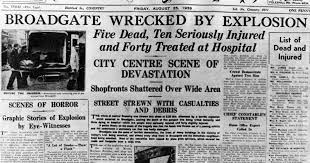
It was on Friday, the 25th August, 1939 (a few days before Hitler's German army invaded Poland), that an IRA man from Cork, Joby O' Sullivan, strolled through Broadgate, in Coventry, wheeling a push bike (a 'Halford Karriwell' model, purchased from the 'Halford Cycle Company' in Smithford Street, in Coventry), heading for the police station.
The bike apparently, repeatedly, got stuck in tram tracks on the road and, frustrated, he removed it from the road and propped it up against a wall. The bike had an armed bomb in the basket that was fixed to the handlebars, which had been wired up to an alarm clock timer, which was set for about 2.30pm. He left it there, and walked away, claiming afterwards that he was frustrated with the problem caused by the tram tracks. The five-pound bomb exploded prematurely, killing five people and injuring dozens more.
Joby O'Sullivan said later that he wasn't caught because the British police were expecting Irish suspects to get a ferry at Holyhead back to Ireland, but instead he got a train to London and stayed there "until everything died down."
Shortly after the Coventry explosion, Peter Barnes (pictured, who was in London on the day of the explosion) was arrested at the lodgings he was staying in and, three days after that, James McCormack (aka 'James Richards') was pulled-in along with the other tenants of the house he was staying in. The 'trial' began in December (1939) and both men were convicted and sentenced to death by hanging. Throughout the court case, James McCormack remained silent until he told the court – "As a soldier of the Irish Republican Army, I am not afraid to die, for I am dying in a just cause."
Peter Barnes stated to the court – "I would like to say as I am going before my God, as I am condemned to death, I am innocent, and later I am sure it will all come out that I had neither hand, act or part in it. That is all I have to say." In his last letter (to his brother) he wrote – "If some news does not come in the next few hours all is over. The priest is not long gone out, so I am reconciled to what God knows best. There will be a Mass said for us in the morning before we go to our death. Thank God I have nothing to be afraid of. I am an innocent man and, as I have said before, it will be known yet that I am."
In the last letter he ever wrote, James McCormack, pictured, said – "This is my farewell letter, as I have been just told I have to die in the morning. As I know I am dying for a just cause, I shall walk out tomorrow smiling, as I shall be thinking of God and of the good men who went before me for the same cause." (That letter was addressed to his sister, as both of his parents were dead.)
In Winson Green Prison, Birmingham, at 8.50am on Wednesday, 7th February 1940, the two men received a final blessing. Minutes later they walked together to the scaffold and were hanged by four executioners.
May all involved Rest in Peace.
'THE BREAK OF ARMAGH : A SUGGESTION BY A WORLD-FAMOUS POET...'
From 'The United Irishman' newspaper, July, 1954.
I haven't too much money to spare, but for promotion of this idea I am heartily willing to squeeze out ten guineas as the start of a fund for a grand 'Armagh Commemoration Day'.
Signed - Seumas MacManus.
'UI' Editors Note ; Seumas MacManus is a well-known poet who has spent many years in the USA, where much of his work was published.
He is now back home in his native Donegal. The above letter was refused publication by 'The Irish Press' newspaper and by 'The Irish Independent' newspaper.)
(END of 'The Break Of Armagh : A Suggestion By A World-Famous Poet' - NEXT : 'A Tonic', from the same source.)
ON THIS DATE (25TH AUGUST) 218 YEARS AGO : ROBERT EMMET CAPTURED BY THE BRITISH.
'Beside a block of two houses in Harold’s Cross, Dublin 6, is a small plaque remembering rebel leader Robert Emmet. While his grand statue in St Stephen's Green is a well-known landmark, this plaque is much easier to pass by without a second glance. But it holds quite an interesting story, as marking the site of the house where Emmet hid before his eventual capture and execution.
After his failed rising against British rule in July 1803, Emmet fled into hiding and eventually ended up in a house in Harold’s Cross under the assumed name of a lodger called Hewitt..' (from here.)
It was during his stay in the Harold's Cross 'safe house' that he met-up with his mother and Sarah Curran but, on Thursday August 25th, 1803 - 218 years ago on this date - he was finally 'arrested' by the British. It has been stated by others that a £1000 reward was paid by Dublin Castle to an informer, for supplying the information which led to his capture.
Robert Emmet's misfortunes did not stop on his arrest : he had the misfortune to be defended by one Leonard McNally (pictured) who was trusted by the United Irishmen.
However, after McNally's death in 1820, it transpired that he was a highly paid government agent and, in his role as an informer, that he had encouraged young men to join the rebels, betrayed them to Dublin Castle and would then collect fees from the United Irishmen to 'defend' those same rebels in court!
Emmet was tried before a 'Special Commission' in Green Street Court House in Dublin (..some political groupings today will swear their allegiance to Emmet and that which he represents while at the same time refusing to make a stand against such 'Special Commissions'!) on September 19th, 1803.
The 'trial' lasted all day and by 9.30pm he was pronounced guilty ; asked for his reaction, he delivered a speech which still inspires today. He closed by saying that he cared not for the opinion of the court but for the opinion of the future - "..when other times and other men can do justice to my character.." Robert Emmet, 25 years young, was publicly executed on Tuesday September 20th outside St Catherine's Church in Dublin's Thomas Street ; he was hanged and his body was then beheaded.
The final comment on the value of Robert Emmet's Rising must go to Seán Ó Brádaigh, who states that to speak of Emmet in terms of failure alone is to do him a grave injustice.
He and the men and women of 1798 and 1803 and, indeed, those that went before them, set a course for the Irish nation, with their appeal to Protestant, Catholic and Dissenter under the common name of 'Irishman', which profoundly affected Irish life for more than two centuries and which will, we trust, eventually bear abundant fruit, regardless of the amount of 'poison fruit' - like McNally - that constantly try to hinder progress in that direction.
'WHAT IS TO BE DONE? THE STRUGGLE IN THE 26 COUNTIES...'
The following article was solicited by 'IRIS' from a political observer in the 26 Counties. The article - whose author, John Ward, is not a member of the Republican Movement - is aimed at provoking discussion within (P)Sinn Féin. From 'IRIS' magazine, October 1987.
('1169' comment - please note that 'IRIS' magazine had, at that time, recently morphed from a republican-minded publication into a Trot-type mouthpiece for a Leinster House-registered political party.)
For various reasons, the IRA reverted back to a purely military policy and by the 1940's both (P)Sinn Féin and the IRA were seen as solely concerned with military campaigns in the North and Britain, uninterested in social and economic issues, and obsessed with weird and esoteric arguments about the legitimacy of Leinster House, which the bulk of the population had long since settled down to accepting as fact.*
(P)Sinn Féin's fortunes picked up briefly with the initial success of the 1950's border campaign, but basically by 1962 its image was the same as in the 1940's and the whole Movement's attitude was summed up in the statement ending that campaign, which blamed the Irish people for not supporting it,** their liberators - dissolving the people again!
There were attempts to change things in the 1960's with the increasing involvement in social issues through groups like the 'Dublin Housing Action Committee' and they seemed to be having a fair degree of success. But the split in 1970 cut short that development ; the Stickies sold out on the struggle in the North but because Sinn Féin in the South focused at that time on abstentionism and attacks on the Marxist policies of the Stickies, many of the activists on social and economic issues went with Gardiner Place (the Stickies) only to become disillusioned later and go up the blind alley of the IRSP...
('1169' comment -* "...weird and esoteric arguments about the legitimacy of Leinster House.."! And that nicely sums up just how a confused nationalist/trot views a political subject which is alien to them - republican history. The further away a conflict is, the louder they shout their support for it, but a political conflict on their own doorstep will be dismissed by them as a "weird obsession" as they elbow you out of the way in their rush to cheerlead for a far-away conflict!)
('1169' comment -**Not so : in late February 1962, the IRA Army Council issued a press release in which they announced the ending of the 'Border Campaign' due to various factors, including 'the attitude of the deliberately distracted general public'. That anti-republicans and trots/far-away cheerleaders should seek to misrepresent and 'spin' that Army Council statement is par for the course with that type as that's how their confused mindset works - they don't understand the nuances in republicanism which is to be expected, as they don't understand republicanism itself!)
(MORE LATER.)
ON THIS DATE (25TH AUGUST) IN...
..1764 - 'James (Jemmy) Hope was born in County Antrim in 1764.
Heavily influenced by his Presbyterian faith and by the ideas of the American Revolution, in 1782 he joined the Irish Volunteer movement, which was initially raised to protect Ireland, but which progressively became more radical in its outlook and demands. In 1789 he marched with them to celebrate the taking of the Bastille and the start of the French Revolution.
When the Volunteers waned, James joined the newly formed United Irishmen, which sought the end of British rule and an independent Ireland. The authorities watched the growth of the United Irishmen with concern. On war being declared against France in 1793, they were declared illegal and they went underground...' (from here.)
..1919 - IRA members took an oath to the Cause of Irish republicanism and began using the name 'Irish Republican Army' ; five days before that event took place, the [32-County] Dáil Éireann passed a Motion that that Oath of Allegiance to the [32-County] Irish Republic should be taken by all members of the 'Irish Volunteers' and by the members and staff of the Dáil, and it was on the 25th August that that process began.
..1920 - An RIC 'Constable', Matthew Haugh, was shot dead in Bantry, County Cork, by the IRA. He was a 25-years-young native of Ennis, in County Clare, and was shot and killed when his 'police patrol' was ambushed at Chapel Street in Bantry, Co Cork. The other three of his paramilitary colleagues that were with him at the time were injured, but fled the scene.
..1922 - A Free State CID Motor Driver was fatally wounded in an IRA attack at Deansgrange, in Dublin and, on that same date (25th August 1922) a Free State soldier was shot dead and a barracks burned at Shortcourse, in Waterford and, also on that date, a 17-years-young Free State soldier, Michael Bannon, from Fardrum, in Athlone, County Westmeath, was shot dead by the IRA in Tubbercurry, in County Sligo.
Dying at such a young age, fighting to defend the undefendable.
'AN EMPTY FORMULA...'
From 'The United Irishman' newspaper, March, 1955.
Supposing - and it would take a great stretch of imagination - but supposing Pearse or Connolly had done that, would it have been any more justifiable, any less despicable?
We believe in the sacredness of an oath, and for that reason the Republican Movement cannot admit into its ranks any who are bound by an oath of allegiance to England. The taking of this oath of allegiance is a condition of employment for all teachers in the Six Counties, for all nurses in hospitals over which Stormont has any control and for all civil servants. In fact, for every worker who gets a payment from the government.
This means that a great number of splendid men and women may not become affiliated to the Republican Movement because they are bound by oath "to render true and faithful allegiance to 'Her Majesty' ". Many of these, especially a great body of schoolteachers, work very hard for the language, and for the national games and dances, and turn out of the schools the makings of grand republican soldiers, although they own that they themselves have had to swallow the bitter pill.
There are, however, a great crowd who take this oath and make the excuse of Mr de Valera which has now become so familiar that we are sometimes at a loss to know which is the right definition of an oath - is it the one we learned in the catechism or is it "an empty formula.."? (MORE LATER.)
AND FINALLY...
The Annual Bundoran Hunger Strike Commemoration will be held on SATURDAY 28th of AUGUST, 2021, meeting up at the East End of Bundoran, at 3pm. This year is the 40th anniversary of the H-Block Hunger-Strike.
Regardless of where you were or who you were with 40 years ago, we hope you'll be in Bundoran, with us, this year. See ye there!
Thanks for the visit, and for reading,
Sharon.
BACK FROM STAYCATION (AND SAVING FOR A REAL HOLIDAY!).
We survived it!
By hook and by crook, by pure good fortune, quick thinking, the gift of the gab, and by being quick on our feet, we survived it.
But we really shouldn't be trusted to be let out on our own, with no responsibilities (except to each other), not having to clock-watch, no (adult-ish!) children or grandchildren to keep an eye on - or them, on us! - come and go as we please, not confined to set times for breakfast or supper or meals in between, and not answerable to any authority only our own.
A surefire receipe for disaster. And it was delicious...!
We had the use of two mobile homes, one in Waterford, the other in Kilkenny, and we had two cars between the five of us so, all-in-all, everything more-or-less (!) worked out well for us ; the designated drivers were picked by the short straw method, a system which worked for us, and which also ensured that at least two of our number had their full wits about them on all of our trips to various big and small towns.
And there were many such trips to the different towns we visited, both in and around Waterford and Kilkenny, even though all venues we were in were on semi-lockdown, due to Covid. But, using our local knowledge and contacts, a knock on a side window can open many a door, so to speak!
We have always found staycations like this to be expensive, and this one was no exception : in our shared opinion, most of the venues we visited had increased their prices, some substantially, to make-up for their loss of trading abilities over the last eighteen months or so. The price increases were noticeable and, before we declined the service on offer, we made sure that our objections to same were equally as noticeable!
The weather was mostly good to us - we were, after all, in 'the sunny south-east' - and, overall, it kept true to its moniker, allowing us on more than one occasion to spend most of a day on a beach (excuse the fuzzy pic, top of article - must have been the mad heat that affected the camera lens...!), watching the world go by, and plotting our night-time assault on that same world! But our planned assaults had to be tempered by the fact that we were in either Waterford or Kilkenny, not in New York, so we toned things down a bit. Sort of..!
Anyway ; we're all back now, unmolested by any Covid (or other!) restrictions or State laws and 'normal' business will be resuming soon, both here - on the blog - and in what some consider to be 'real life' ie bills, work, timelines, babysitting/child-minding, dinners, teas, food shopping and etc etc and we need another break already..!
See ye all on Wednesday, 25th August 2021 when, among other pieces, we'll be writing about an IRA ultimatum to Westminster and an Irish republican operation in England that went horribly wrong...
1917 - 1981 : TWENTY-TWO IRISH REPUBLICANS DIED ON HUNGER-STRIKE.

Terence McSwiney, Cork, 74 days, 25th October 1920.
Michael Fitzgerald, Cork, 67 days, 17th October 1920.
Joseph Murphy, Cork, 76 days, 25th October 1920.
Joe Witty, Wexford, 2nd September 1923.
Dennis Barry, Cork, 34 days, 20th November 1923.
Andy O Sullivan, Cork, 40 days, 22nd November 1923.
Tony Darcy, Galway, 52 days, 16th April 1940.
Jack ‘Sean’ McNeela, Mayo, 55 days, 19th April 1940.
Sean McCaughey, Tyrone, 22 days, 11th May 1946 (hunger and thirst Strike).
Michael Gaughan, Mayo, 64 days, 3rd June 1974.
Frank Stagg, Mayo, 62 days, 12th February 1976.
Bobby Sands, Belfast, 66 days, 5th May 1981.
Frank Hughes, Bellaghy (Derry), 59 days, 12th May 1981.
Raymond McCreesh, South Armagh, 61 days, 21st May 1981.
Patsy O Hara, Derry, 61 days, 21st May 1981.
Joe McDonnell, Belfast, 61 days, 8th July 1981.
Martin Hurson, Tyrone, 46 days, 13th July 1981.
Kevin Lynch, Dungiven (Derry), 71 days, 1st August 1981.
Kieran Doherty, Belfast, 73 days, 2nd August 1981.
Tom McIlwee, Bellaghy (Derry), 62 days, 8th August 1981.
Micky Devine, Derry, 60 days, 20th August 1981.