On the 21st January, 1847, an 'Irish Constabulary/Constabulary of Ireland' officer, a Mr James Crowley (26), was on duty as a 'payroll escort' in Tipperary, Ireland.
He was accompanying a Board of Works wages clerk who was on his rounds to distribute wages for hundreds/thousands of labourers employed on so-called 'famine relief projects' and the clerk would have been carrying a significant amount of cash.
Local men, aware of the timing of the wages delivery and the route used, set up an ambush position and when the 'wages party' appeared, they waylaid them.
'Constable' Crowley attempted to stop them and was shot dead.
We have no more information on this incident.
==========================
ON THIS DATE (21ST JANUARY) IN IRISH HISTORY 107 YEARS AGO...
...an Chéad Dáil Éireann (the First Dáil) convened in Dublin's Mansion House.
Cathal Brugha was elected as 'Acting President' in place of Eamonn de Valera, who was at that time still in a British jail - he had contested a seat in the 14th December 1918 election for the Falls constituency of Belfast but lost to local 'United Irish League' leader, Joe Devlin, by 8,488 votes to 3,245.
All those elected in Ireland in that 1918 election were invited to the Mansion House for that first meeting but the Unionist MP's refused, as did those elected under the banner of a so-called 'United Irish League'(UIL) - the parliamentary nationalists (ie John Redmond's men).
In the Mansion House that day, 37 of the 73 Sinn Fein TD's (referred to as 'MP's' in Westminster) made a 'Declaration of Independence' (the remaining 36 Sinn Fein TD's were still in British jails) -
"We, the elected representatives of the ancient Irish people in National Parliament assembled, do, in the name of the Irish nation, ratify the establishment of the Irish Republic and pledge ourselves and our people to make this declaration effective by every means at our command.
We ordain that the elected representatives of the Irish people alone have power to make laws binding on the people of Ireland and that the Irish Parliament is the only parliament to which that people will give its allegiance.
We solemnly declare foreign government in Ireland to be an invasion of our national right which we will never tolerate and we demand the evacuation of our country by the English garrison..."
On that same day (21st January 1919) , two RIC men were shot dead in Soloheadbeg in County Tipperary by the IRA ; the cartload of gelignite they were guarding was the target, but they wouldn't hand it over without a fight. They lost.
That IRA unit was led by Dan Breen and Seán Treacy, who had acted without approval from Michael Collins (military) or Eamonn de Valera (political).
Dan Breen was called on to account for his IRA Unit's actions on that day by his own leadership, and said that he explained to them that the target that day was the cartload of gelignite, not the RIC men who were guarding it. He later told his comrades -
"If we were to have waited for orders from Headquarters or Dáil Éireann, nothing would ever have happened. We had had enough of being pushed around and getting our men imprisoned while we remained inactive. It was high time that we did a bit of the pushing. We considered that this business of getting in and out of jail was leading us nowhere."
The response to the shooting of the two RIC men was mixed ; Michael Collins stated -
"The sooner fighting is forced and a general state of disorder created throughout the country, the better it will be for the country. Ireland is likely to get more out of a general state of disorder than from a continuance of the situation as it now stands."

Dan Breen himself wrote -
"The clergy, the public and the press had unanimously condemned our action. At this time, scarce a word would be heard in our defence. Our former friends shunned us. Even from the Irish Volunteers, who were now known as the Irish Republican Army, we got no support.
We took the action deliberately, having thought over the matter and talked it over between us.
Treacy had stated to me that the only way of starting a war was to kill someone, and we wanted to start a war, so we intended to kill some of the police whom we looked upon as the foremost and most important branch of the enemy forces.
The only regret that we had following the ambush was that there were only two policemen in it, instead of the six we had expected..."
The only query any Irish republican could have with the above comment would be a correction regarding who 'started the war' - not the men and women in the Mansion House, or Dan Breen or Seán Treacy (pictured, above), but those in Westminster and Whitehall in London who to this day - 107 years after the above-mentioned events - persist in interfering in Irish affairs.
(...few more words below re an Chéad Dáil Éireann.)
ON THIS DATE (21ST JANUARY) 105 YEARS AGO : NEWS BREAKS THAT THE IRA IN CLARE HAD AMBUSHED BRITISH FORCES.

On the 20th January 1921, over thirty men of the East Clare Brigade of the IRA ambushed an RIC patrol at Glenwood near Sixmilebridge, County Clare, killing six of their number.
The well organised rebels suffered zero casualties and captured a significant amount of guns and ammunition.
Numerous houses in the general area were burned by the RIC that evening in reprisal for the attack.
'In mid January 1921, orders were sent to all six battalions of the East Clare Brigade asking all available IRA Volunteers to assemble at Parker’s house, Castlelake on the morning of the 20th of January.
The officers of the Brigade had decided to attempt to ambush the regular RIC patrol travelling from Sixmilebridge to Broadford.
On the appointed day, thirty seven I.R.A Volunteers reported for duty.
Half of them carried rifles while the remainder were armed with shotguns and revolvers.
A number of the republicans who had arrived unarmed volunteered as scouts.
Volunteer Joseph Clancy of Kilkishen, a local and a former soldier in the British Army, suggested a suitable location for the attack at the rear entrance to Glenwood House, Michael Brennan accepted his advice and divided up the men into different sections and explained the plan of attack.
At Glenwood, the republican scouts were posted along the road a short distance in both directions from the IRA's new position and the thirty or so remaining IRA Volunteers were divided into three sections, under the command of Michael Brennan, his brother Austin Brennan of Meelick and Tom McGrath of O'Callaghan’s Mills.
The men in Michael Brennan’s section were all armed with rifles and positioned along a high stone wall just north of the gate to Glenwood house ; the stone wall would give them a good cover from enemy fire and a direct line of fire for about fifty or sixty yards.
'Michael Brennan himself was armed with a revolver and stood a few yards behind the men in his group positioned along this wall, Joseph Clancy was hidden behind a large holly bush on top of the wall keeping watch along the road as the other Volunteers remained hidden, and Austin Brennan's group of Volunteers equipped with rifles and shotguns, was placed fifty yards further north behind another stone wall.
The remaining men under Tom Mc Grath's command were located along the edge of a field a hundred yards to the south of the gate armed with revolvers.
The ambushers were to hold their fire, until riflemen under Michael Brennan’s command attacked the lorry.
At about 4pm, a motorised patrol of ten armed Royal Irish Constabulary (RIC) and Black and Tan members, travelling from Sixmilebridge to Broadford, approached the back gate of Glenwood house.
Waiting for them, concealed behind the walls of the Glenwood estate, was a group of approximately 37 armed IRA volunteers from the East Clare Brigade of the IRA, led by Michael Brennan of Meelick. As the British patrol passed by the gates, a fusillade of gunshot, fired by the waiting group, struck them.
Six RIC and Black and Tans were killed, two were injured and two escaped unhurt, and one IRA volunteer was injured.
The ambush party withdrew in good order through the forest and mountains to the East of Glenwood, towards Oatfield. The surviving members of the British patrol made their way back to Sixmilebridge.
The local people, on hearing of the news of the ambush, braced themselves for the inevitable retribution which would follow. In an orgy of violence on that evening and in the following days, Black and Tans and Auxiliaries burned houses, destroyed property and terrorised and assaulted local people...' (from here.)
The destructive and vindictive nature of the British forces that remain in Ireland today are felt by republicans in the Occupied Six Counties and, even though those forces wear a different uniform to that displayed by the Black and Tans and the Auxiliaries, their methods and their objective is the same.
And the resolve of Irish republicans, too, is the same.

21st January 1919 - action taken politically and militarily :
On that date in 1919, Sinn Féin Teachtaí Dála ('TD's', elected representatives) held their first meeting of Dáil Éireann (Irish Assembly/ Parliament) in the 'Round Room' of the Mansion House in Dublin.
Of the 69 Sinn Féin TD's elected, only 27 were present ; 36 of them were recorded as "fé ghlas ag Gallaibh" ("imprisoned by foreigners") and another 4 were recorded as "ar díbirt ag Gallaibh" ("deported by the foreign enemy").
Mr Cathal Brugha was elected 'Acting President of the Ministry' ('Pro Tempore') and Mr Sean T. O'Kelly was elected as 'Ceann Comhairle' ('Speaker of the House').
A 'Provisional Constitution of Dáil Éireann' was unanimously adopted, they agreed (again) to 'The Declaration of the Republic', the 'Democratic Programme' (discussion/proposed changes to the existing education system, reform of the 'Poor Law Act' and other social reforms) was accepted and a 'Message to the Free Nations of the World' was issued.
As that political business was being discussed in Dublin, Volunteers attached to the South Tipperary Brigade of the rebel Movement ambushed an enemy munitions convoy carrying gelignite for a quarry in the Soloheadbeg area (about four miles from Tipperary Town and about one mile from Limerick Junction), during which two RIC members - a Mr James McDonnell (56), from Belmullet, in County Mayo (a widower, with six children) and a Mr Patrick O'Connell (36), unmarried, a native of Coachford, in County Cork - were shot dead.
The driver of the vehicle, a Mr James Godfrey, and a County Council employee, a Mr Patrick Flynn, were unhurt (the Volunteers got the gelignite but missed the detonators which were in Mr Flynn's coat pocket).
More detail about that operation can be read here.

As the Dáil in Dublin was discussing its options and the Volunteers in Tipperary were limiting the options of their enemies, four Volunteers in Usk Prison in Wales were expanding their options.
On day one, the rebel POW's handed their prison-issue clothes/uniform back to the prison governor, a Mr Young, and informed him that not alone would they not be needing or wearing his uniforms, but they would be staying dressed in their own clothes, would be associating freely with each other, would be receiving and sending letters as they seen fit and would be smoking cigarettes in their cells when the mood to do so took them.
Mr Young contacted his boss in the British Home Office in London and was instructed to allow them those 'privileges'!
The republican rebels - Joseph McGrath (TD), Barney Mellows, Frank Shouldice and George Geraghty - used a smuggled key made from a copy of a warder's key, a sympathetic guard and clever coded messages to facilitate their breakout and subsequent escape, on the 21st January 1919, by car and train (Pontypool Railway Station and Pilemile, Newport, Shrewsbury and Liverpool Stations).
In Liverpool Station, they made contact with Volunteers Thomas O'Loughlin and Stephen Lanigan who secured safe passage to Dublin for the four rebels, who reported back for duty after being de-briefed.
==========================
GAS LADS...

The massive finds of oil and gas on our western seaboard could ensure Ireland's financial security for generations.
Wealth approximating that of the Arab countries is within our grasp, but the Irish government seems content to sell off our birthright for a handful of votes and a few dollars.
In a special 'Magill' report, Sandra Mara investigates just what we are giving away, and why.
From 'Magill' magazine, March 2002.
In the run-up to the election, the taxpayers of Ireland should be demanding answers to the enigma of the Corrib gas deal.
It was a deal described on 21st June last in Leinster House by Joe Higgins "as an outrageous robbery of an extremely valuable asset that properly belongs to the people.." which, he said, "..has been handed over to Enterprise Oil.
The commercial and economic benefit from it has been handed lock, stock and barrel by a Fianna Fail-dominated government to yet another multinational corporation on foot of a deal which they cannot possibly believe is so favourable to them, with no royalties, and with a corporation tax rate which they can write off against expenses not only incurred in Ireland but elsewhere.
Incredibly, when the Minister for the Marine and Natural Resources, Frank Fahey, stood up in Leinster House and asked how much value should be placed on the one trillion cubic feet of gas estimated to be in the Corrib field, the minister, on behalf of the government, admitted that he had no idea how much this resource was worth..."
(MORE LATER.)
ON THIS DATE (21ST JANUARY) 124 YEARS AGO - BIRTH OF KEVIN GERARD BARRY ANNOUNCED.

On the 20th January, 1902, a baby boy was born in Dublin who was to capture world support and sympathy while still in his teens : the child's name was Kevin Gerard Barry (pictured), and he was born into a strong Irish republican family which could trace members of its clan as having been active in 1798 with Wolfe Tone.
Kevin Barry, 18 years young, was executed on the 1st November 1920 in Mountjoy Jail, Dublin, and was the first Irish republican to be 'officially' executed by the British since 1916.
At the time of his death his eldest brother, Mick, was OC of the Volunteers in an area known as 'Tom Beithe' (Tombeagh), a townland in Hacketstown Civil Parish, in Barony, County Carlow, and his sister, Sheila, was in Cumann na mBan.
He was captured while on active service outside the entrance of Monk's bakery in Dublin.
Although, as stated, born in Dublin, he spent much of his life at the family home in Tombeigh, and both sides of his family - the Barry's and the Dowling's - came from the Carlow area, and some of his ancestors had fought in 1798.
He attended national school in Rathvilly, Carlow, for a few years, before going to Belvedere College in Dublin where he was a medical student.
Kevin Barry's body was not returned to his family for burial ; he was interred within the prison confines of Mountjoy Jail and was the first of what was to become know as 'the Forgotten Ten'.
Because Munster and a small part of Leinster was under martial law those executed there were shot as soldiers but, as Dublin was under civilian law, those executed in Mountjoy were hanged.
In his 'Sworn Statement' ('written testimony'), Kevin Barry wrote -
"I, Kevin Barry, of 58, South Circular Road, in the County of Dublin, Medical Student, aged 18 years and upwards, solemnly and sincerely declare as follows : On the 20th of September, 1920, I was arrested in Upper Church Street by a Sergeant of the 2nd Duke of Wellington's Regiment and was brought under escort to the North Dublin Union, now occupied by military.
I was brought into the guard room and searched.
I was then moved to the defaulter's room by an escort with a Sergeant-Major, who all belonged to 1st Lancashire Fusiliers, and I was then handcuffed.
About 15 minutes after I was put into the defaulter's room, two Commissioned Officers of the 1st Lancashire Fusiliers came in, accompanied by 3 Sergeants of the same unit. A military policeman who had been in the room since I entered it remained.
One of the officers asked me my name, which I gave, and he then asked me for the names of my companions in the raid. I refused to give them.
He tried to persuade me to give the names and I persisted in refusing. He then sent a Sergeant for a bayonet. When it was brought in the Sergeant was ordered by this officer to point the bayonet at my stomach.
The same questions as to the names and addresses of my companions were repeated with the same results. The Sergeant was then ordered to turn my face to the wall and point the bayonet to my back. The Sergeant then said he would run the bayonet into me if I did not tell. The bayonet was then removed and I was turned round again.
This officer then said that if I still persisted in this attitude he would turn me out to the men in the barrack square and he supposed I knew what that meant with the men in their present temper. I said nothing.
He ordered the Sergeants to put me face down on the floor and twist my arm. I was pushed down onto the floor after my handcuffs were removed.
When I lay on the floor one of the Sergeants knelt on the small of my back, the other two placed one foot each on my back and left shoulder and the man who knelt on me twisted my right arm, holding it by the wrist with one hand while he held my hair with the other to pull back my head. The arm was twisted from the elbow joint. This continued to the best of my knowledge for 5 minutes. It was very painful.
The first officer was standing near my feet and the officer who accompanied him was still present. During the twisting of my arm the first officer continued to question me for the names and addresses of my companions and the names of my Company Commander or any other (IRA) officer I knew. As I still refused to answer these questions I was let up and handcuffed.
A civilian came in and he repeated the same questions with the same results. He informed me that if I gave all the information I knew, I could get off.
I was then left in the company of the military policeman. The two officers, three sergeants and civilian all left together.
I could certainly identify the officer who directed the proceedings and put the questions. I am not sure of the others except the Sergeant with the bayonet.
My arm was medically treated by an officer of the Royal Army Medical Corps attached to the North Dublin Union the following morning and by the prison hospital orderly afterwards for 4 or 5 days.
I was visited by the Court Martial Officer last night and he read the confirmation of sentence of death by hanging to be executed on Monday next.
I make this solemn declaration conscientiously believing same to be true and by virtue of the Statutory Declarations Act, 1835.
Declared and subscribed before me at Mountjoy Prison in the County of the City of Dublin, 28th October, 1920.
(Signed) MYLES KEOGH, a justice of the peace for said County.
KEVIN GERARD BARRY."
Canon John Waters, the prison chaplain, wrote to Kevin Barry's mother with a description of his final moments :
"His courage was superhuman and rested I am sure, on his simple goodness and innocence of conscience. You are the mother, my dear Mrs Barry, of one of the bravest and best boys I have ever known, he went to the scaffold with the most perfect bravery, without the slightest faltering, 'til the very last moment of his life..."
Incidentally, while speaking to Mrs Barry, Canon Waters opined that young Kevin "...does not seem to realise he is going to die in the morning.." to which she asked what was meant by that comment : the priest replied that Kevin "...is so gay* and light-hearted all the time (but) if he fully realised it he would be overwhelmed..."
Mrs Barry took offence at those words and replied - "Canon Waters, I know you are not a republican. But is it impossible for you to understand that my son is actually proud to die for the Republic?"
The wise Canon didn't argue back.
It was on this date - 21st January - 106 years ago, that Kevin Barry's death was announced.
(*'Gay' - 'happy', not as it would be interpreted today.)
ON THIS DATE (21ST JANUARY) 54 YEARS AGO : DEATH OF A GAMEKEEPER-TURNED-POACHER REPORTED TO BE IMMINENT.

"Garda Special Branch - Britain’s lackeys : Gombeen men lured down from the mountains of Kerry by the smell of fresh meat.." - so summarised Brendan Behan the men of Special Branch over 50 years ago. Some things have changed since then, they now have the odd female detective and on rare occasions you may even hear a Dublin accent from the men in the (Ford) Mondeo. To republican activists they are synonymous with harassment and thuggery..." (from here.)
'Col. Eamon Broy, who died on Saturday at his home, Oaklands Drive, Rathgar, Dublin, aged 85, was a former Commissioner of the Garda Siochana.
During the War of Independence he was one of Michael Collins’s three 'contacts' among the detective force in Dublin Castle and played a leading part in breaking the secret information system there.
A native of Rathangan, Co. Kildare, he joined the old D.M.P. in his youth and was attached to G Division – the secret service arm of the British administration in Ireland and, during this period, he and his police colleague, David Neligan*, formed the heart of Collins’s intelligence service.
Between 1917 and 1921 they fed him with vast amounts of highly classified information and warnings.
Col. Broy was arrested by the British in February, 1921, and imprisoned in Arbour Hill until the Truce.
He was subsequently secretary of the then (Free State) Department of Civil Aviation and later adjutant of the first Irish Air Corps, with the rank of commandant. On his promotion to colonel he was made OC of the ground organisation of the corps.
In 1922 he became secretary to the D.M.P. and on the formation of the Dublin Metropolitan Garda in 1925 he was appointed chief superintendent and, in 1929, he was transferred to the Depot, Phoenix Park, as commandant.
In February, 1933, he became chief of the Detective Division in succession to Col. David Neligan and inside a month was appointed Commissioner of the Garda Siochana to replace General Eoin O’Duffy who had been dismissed by the Government.
In the same year Col. Broy established a new force attached to the Special Branch, to deal with the situation arising from the refusal of some farmers to pay rates during the period of the Blueshirt movement.
The members were drafted to parts of the country (sic) where the no-rates campaign was in progress, and they escorted bailiffs on cattle seizures and were involved in many violent incidents...he retired in 1938...and died on the 22nd January, 1972, aged 85...'
(*David Neligan was another gamekeeper-turned-poacher ; he was a particularly vicious Free State operative who 'made his name' in the fight against republicans in Kerry during the Civil War. His overall intention was to wreak havoc on the Republican Movement and he had no hesitation in turning his weapon on those he had once fought alongside.)
We have written about those 'gamekeepers-turned-poachers' before - here, and here, for instance - and, in time, there will be many other opportunities (and requirements) for other writers to do the same.


In early January, 1920, an 'RIC District Inspector' in Belfast, a Mr William Charles Forbes Redmond (46, pictured), a married man from the town of Newry, in County Down, was promoted to the position of 'Second Assistant Commissioner of the DMP' and, with much less fanfare, he was - internally - also welcomed in as the 'Head of DMP's 'G' Intelligence Division', where he was in charge of about ten 'detectives'.
He was tasked by Westminster "to take care of political crime", as the British called it, and to do so urgently - three of his fellow 'G Men' had been executed by the IRA in the previous six months and he prepared himself for a visit to Dublin to evaluate the situation for himself.
And the IRA in Dublin knew he was coming...
Volunteer Frank Thornton had been sent by IRA Intelligence to Belfast to collect a file on Mr Redmond from one of its operatives, an RIC Sergeant, a Mr Matt McCarthy (a Kerry man), who was stationed in Chichester Street RIC Barracks in Belfast.
The RIC operative wasn't working alone - Mr Redmond's secretary, an RIC detective, Mr Jim McNamara, was also working for the IRA and, between the both of them, they got Volunteer Thornton into the barracks and gave him a photograph of Mr Redmond and other details, including his travel itinerary, which showed that he was to travel to Dublin on the 21st January (1920).
That information was brought back to Dublin and a plan to execute Mr Redmond was put in place.
"If we don’t get that man, he'll get us, and soon..."
- part of the briefing given to the five IRA ASU's assembled to deal with Mr Redmond in Dublin.
On Wednesday, 21st January (1920), at about 5.45pm, Mr Redmond left his office in Dublin Castle to walk home, a route which took him into Grafton Street/Harcourt Street in Dublin City Centre.
One of the five IRA ASU's (consisting of Volunteers Thomas Keogh, Joseph Dolan and Patrick ['O] Daly*) spotted Mr Redmond on Harcourt Street at about 6pm and walked up to him outside the old 'Standard Hotel' and Volunteer [O'] Daly shot him once in the head.
Mr Redmond died a few minutes later from the wound.
(* Within less than a year, Volunteer ['O] Daly would morph from a republican gamekeeper into a Free State poacher and turn on his IRA ASU comrades.)

As part of its political work, the (republican) Dáil established a 'Commission of Inquiry into the Industry and Resources of Ireland' to survey Irish resources, with a Mr John O'Neill as Chairperson and a Mr Darrell Figgis as Secretary (...both of whom were republican-gamekeepers-turned-Free State poachers.)
This was part of the Dáil's broader economic efforts, alongside establishing courts and managing finances etc, and Irish republicans, unionists and non-aligned business-people and workers were requested to contribute to the group with ideas to develop the Irish economy and to promote and encourage industrial development.
Westminster, however, viewed the group as a threat, banned publication of its activities and used its troops in Ireland to stop its public hearings.
But the Commission carried on, as best it could under those enforced conditions and, in mid-January 1920, announced that it had booked Cork City Hall for a public meeting to be held over three days - the 21st, 22nd and the 23rd.
British Army soldiers moved in in force and stopped the Cork City Hall meetings, which went 'underground' and were held in different venues ; indeed, at one such 'underground' meeting, a British Army Sergeant carrying a hangman's rope approached Mr Darrell Figgis 'to make an example of him' but was physically stopped in his tracks by a Mr Maurice George Moore, a member of the Commission and an ex-Colonel in the British Army's Connaught Rangers Regiment!
The Commission later decided, for reasons of public safety, to restrict its work to private consultations with interested parties including County Councils and business groups, working around British-imposed and enforced restrictions as best it could, concluded its proceedings and published its final reports in early 1922.
==========================

THE MONTH UNSPUN...
The stories that hit the headlines.
From Magill magazine, August 2002.
'The Sunday Times' believed that Ansbacher is "just the tip of the iceberg", as the State High Court inspectors "did not have the power to investigate other companies they suspected of facilitating tax evasion."
'The Observer' quoted the government as saying that there was little chance of the individuals and corporations named in the report facing criminal prosecution.
But Mary Harney, in the same newspaper, said the report "is a damning insight into a world of conspiracy, fraud and tax evasion over a long number of years..".
Ben Dunne, meanwhile, speaking in 'The Sunday Independent' newspaper, came up with the quote of the day when he said he "couldn't care less about Mary Harney and Ansbacher", while 'The Sunday Business Post' newspaper explained that some Ansbacher account-holders were turning on their advisors and claiming they were unaware that they were taking part in a tax evasions scheme...
(MORE LATER.)
ON THIS DATE (21ST JANUARY) 103 YEARS AGO : CONFIRMED - 11 IRA PRISONERS HAD BEEN PULLED FROM THEIR CELLS AND EXECUTED BY FREE STATERS.

On the 20th January in 1923, Free State forces removed 11 of the IRA prisoners ('Irregulars') they were holding and executed each one of them.
Sixteen months previous to executing those men, Leinster House politicians had signalled their intent to do so in order to secure their own positions in the new Free State, declaring that those IRA men were fighting against what they described as 'a legitimate Irish authority..'
About one year before that awful day, those Free State executioners would have fought on the same side, in the fight against Westminster, as those they executed on that Saturday, 20th January 1923.
Five IRA men were executed by firing squad at about 8am that day, in Custume Barracks, Athlone, County Westmeath :
Thomas Hughes, from Bogginfin, Athlone, who was Lieutenant Commandant, 'Officer Commanding Munitions', Western Division I.R.A. He had served as Captain with the 3rd Engineers Dublin Brigade and was also 'Officer Commanding Munitions' in Athlone.
Michael Walsh, born in Derrymore, County Galway ; he was Vice-Commandant, 2nd Battalion No. 1 Brigade, Western Division.
Herbert Collins, a native of Kickeen, Headford, County Galway, who was captured at Currahan and charged with being in possession of arms and ammunition.
Stephen Joyce, a native of Derrymore, Caherlistrane, County Galway and Martin Burke, a native of Caherlistrane, County Galway - he was Officer Commanding, Active Service Unit Number 3 Brigade, Western Division.
Four of the IRA men - Michael Brosnan of Rathenny, Tralee, County Kerry, John Clifford of Mountlake Caherciveen, County Kerry, James Daly from Knock, Killarney, County Kerry and James Hanlon of Causeway, Tralee, County Kerry - were executed at Ballymullen Barracks, Tralee, Kerry : they were 'found guilty' of being in possession of arms and ammunition under the 'Emergency Powers Act' but local opinion was that the four men were put to death because of on-going attacks on the railway system in the Kerry area.
Two IRA men were executed at Limerick Jail : Commandant Cornelius 'Con' McMahon, Limerick, and fellow Limerick man Volunteer Patrick Hennessy.
Both men were charged with the destruction of Ardsollus railway station in County Clare on the 14th of January 1923 and were 'found guilty' of same and of being in possession of guns and ammunition.
Patrick Hennessy was secretary of Clare County Gaelic Athletic Association and a member of the county team, and Con McMahon had served a term in prison in Limerick Jail in 1920.
Also, for the record, between 17th November 1922 and 2nd May 1923, seventy-seven Irish republican prisoners were removed from their prison cells and shot dead by order of the Free State administration. In this post we name those 77 men and list where each man was executed and the date of same. We do so in the hope that these men will never be forgotten :
1922-
James Fisher, Dublin, November 17th.
Peter Cassidy, Dublin, November 17th.
Richard Twohig, Dublin , November 17th.
John Gaffney, Dublin, November 17th.
Erskine Childers, Dublin, November 24th.
Joseph Spooner, Dublin, November 30th.
Patrick Farrelly, Dublin, November 30th.
John Murphy, Dublin, November 30th.
Rory O Connor, Dublin, December 8th.
Liam Mellows, Dublin, December 8th.
Joseph McKelvey, Dublin, December 8th.
Richard Barrett, Dublin, December 8th.
Stephen White, Dublin, December 19th.
Joseph Johnston, Dublin, December 19th.
Patrick Mangan, Dublin, December 19th.
Patrick Nolan, Dublin, December 19th.
Brian Moore, Dublin, December 19th.
James O'Connor, Dublin, December 19th.
Patrick Bagnel, Dublin, December 19th.
John Phelan, Kilkenny, December 29th.
John Murphy, Kilkenny, December 29th.
1923-
Leo Dowling, Dublin, January 8th.
Sylvester Heaney, Dublin, January 8th.
Laurence Sheeky, Dublin, January 8th.
Anthony O'Reilly, Dublin, January 8th.
Terence Brady, Dublin, January 8th.
Thomas McKeown, Louth, January 13th.
John McNulty, Louth, January 13th.
Thomas Murray, Louth, January 13th.
Frederick Burke, Tipperary, January 15th.
Patrick Russell, Tipperary, January 15th.
Martin O'Shea, Tipperary, January 15th.
Patrick McNamara, Tipperary, January 15th.
James Lillis, Carlow, January 15th.
James Daly, Kerry, January 20th.
John Clifford, Kerry, January 20th.
Michael Brosnan, Kerry, January 20th.
James Hanlon, Kerry, January 20th.
Cornelius McMahon, Limerick, January 20th.
Patrick Hennesy, Limerick, January 20th.
Thomas Hughes, Westmeath, January 20th.
Michael Walsh, Westmeath, January 20th.
Herbert Collins, Westmeath, January 20th.
Stephen Joyce, Westmeath, January 20th.
Martin Bourke, Westmeath, January 20th.
James Melia, Louth, January 22nd.
Thomas Lennon, Louth, January 22nd.
Joseph Ferguson, Louth, January 22nd.
Michael Fitzgerald, Waterford, January 25th.
Patrick O'Reilly, Offaly, January 26th.
Patrick Cunningham, Offaly, January 26th.
Willie Conroy, Offaly, January 26th.
Colum Kelly, Offaly, January 26th.
Patrick Geraghty, Laoise, January 27th.
Joseph Byrne, Laoise, January 27th.
Thomas Gibson, Laoise, February 26th.
James O'Rourke, Dublin, March 13th.
William Healy, Cork, March 13th.
James Parle, Wexford, March 13th.
Patrick Hogan, Wexford, March 13th.
John Creane, Wexford, March 13th.
Séan Larkin, Donegal, March 14th.
Tim O'Sullivan, Donegal, March 14th.
Daniel Enright, Donegal, March 14th.
Charles Daly, Donegal, March 14th.
James O'Malley, Galway, April 11th.
Francis Cunnane, Galway, April 11th.
Michael Monaghan, Galway, April 11th.
John Newell, Galway, April 11th.
John McGuire, Galway, April 11th.
Martin Moylan, Galway, April 11th.
Richard Hatheway, Kerry, April 25th.
James McEnery, Kerry, April 25th.
Edward Greaney, Kerry, April 25th.
Patrick Mahoney, Clare, April 26th.
Christopher Quinn, Clare, May 02nd.
William Shaughnessy, Clare, May 02nd.
Those 77 men did not take up arms in the belief that they were fighting for the establishment of a morally corrupt so-called 'half-way-house' institution, nor did they do so to assist the British in the 'governance' of one of their 'part' colonies or to turn the country into a dustbin for foreign vagrants to nest in.
That which those brave men and many other men and women fought for remains to be achieved.


On the night of the 20th January, 1921, and the early hours of the 21st, a mixed gang of RIC, Black and Tans and British Army 'Royal Scots Fusiliers', travelling from Gormanstown in County Meath to the south of Ireland, were having a drinking session in the town of Portlaoise, County Laois, in Ireland.
When the bar closed, four of them decided to go back to the small hotel they were staying in (Kelly's Hotel) in the belief that they could continue drinking there.
Their drunken ramble back to the hotel took them noisily down Lyster's Lane and it was there that one of them, a Mr William John Wilton, an RIC member, realised that one of his 'old pals', a Mr Thomas Lawless (47), an ex-British Army soldier, lived in one of the houses in that Lane.
The RIC member unholstered his revolver and repeatedly banged and kicked that house door, demanding that he and his drunken mates be allowed in or that 'Tommy' should come out drinking with them.
Mr Lawless shouted through the door for them to go away, and the RIC member fired a shot through the door, killing him.
The RIC member, Mr William John Wilton, was later found guilty at a Military Court of manslaughter and, on the 27th May, was sentenced to ten years penal servitude but, when the shooting had been forgotten about by all but Mrs Agnes and her seven children, the RIC member was, on the 9th March 1922, remitted of his sentence and released to continue his drinking and shooting.

On the 21st January, 1921, the Eleventh Session of Dáil Éireann took place, but only twenty-two of the elected members were present.
The 'missing majority' were either 'on the run' from the Crown Forces or imprisoned, as the entire Dáil had been 'outlawed' by Westminster.
The following proposal was put to the floor, voted on, and passed -
"That this Session of the Dáil now adjourn owing to its inability to discuss adequately important questions of policy in the unavoidable absence of responsible Ministers.
Most Ministers could not attend because they had reason to fear it would be dangerous to come here, that certain Members of the Dáil would be well known and there was serious danger of their being followed and tracked..."
The Assembly adjourned and, shortly afterwards, members were contacted by the Dáil Secretariat staff and a new session was organised.

On the morning of the 21st January, 1921, two RIC members attached to Ballincollig Crown Force Barracks in County Cork - a Mr Henry Joseph Bloxham (a 'Sergeant', 40, 'Service Number 58519', a Mayo man, twenty-two years a member) and a Mr John Larkin (a 'Head Constable, Service Number 55799') changed back into their civilian clothes, retrieved two pushbikes from the barracks shed, said their goodbyes to their Crown Force colleagues and cycled off in the direction of the small town of Waterfall, about 7km (4 miles) away.
The IRA in the area were aware of their travel plans and the Ballincollig Company of the Cork Number 1 Brigade had organised for four Volunteers from the Third (Ovens) Battalion of that Brigade - Volunteers Leonard Murphy, James Murray, Daniel Donovan and Jerry O'Shea - to meet them (!) on their journey.
Local rumour had it that the two plain-clothed RIC members were carrying confidential dispatches from a spy but, whether they were or not, the IRA was still interested in them.
The two cyclists had travelled a few miles when the IRA ASU opened fire on them - with bullets whizzing around them, they cycled hell for leather to get past the ambush position but to no avail.
Mr Bloxham was hit three times and fell to the ground, dead, and his companion, Mr Larkin, was wounded, but kept going.
It is presumed that the IRA searched Mr Bloxham's body because, when he was discovered on the road later that day by his Crown Force colleagues, he had "...three gunshot wounds and a wound under the heart, caused by a sharp instrument.."
A knife wound, perhaps, inflicted by one of the Volunteers as a warning to other Irishmen carrying information and/or working for and with the Crown Forces?
Incidentally, Mr Bloxham's father, John, also worked for the Crown Forces but his sister, Elizabeth (Bessie), a domestic science teacher, wrote articles for 'The Irish Review', 'The United Irishman' and 'The Irish Volunteer' periodicals, was a founder member of Cumann na mBan (and a part-time chief organiser for the organisation) and was a prominent suffragist and a member of 'The Irish Women's Franchise League'.
A woman after me own heart...!

On the same date that the Volunteers in Cork were dealing with that fine woman's brother, their Volunteer comrades in the Drumcondra area of Dublin were planning to deal with his RIC colleagues.
But it didn't go as planned.
'Section 1 of the Dublin Brigade IRA ASU', under the command of Volunteer Frank Flood, had prepared themselves to ambush an RIC patrol but had not bargained on the lorry-load of British Auxiliaries who arrived on the scene.
A gunfight ensued, which ended with the capture of six Volunteers, one of whom, Volunteer Michael Magee, died from his wounds.
On the 23rd February (1921), a British Army Lieutenant Colonel, a Mr Powell, presided over a two-day court martial for the five surviving Volunteers at which they were found 'guilty of High Treason', an offence punishable by the death penalty (the specific form of 'High Treason' they were charged with was 'Levying War against the King in his Realm...').
However, one of the Volunteers, Dermot O'Sullivan (17), had his sentence commuted to penal service for life because of his age.
The four Volunteers to be executed were -
Frank Flood (19 years old, from 30 Summerhill Parade, Dublin, a third year engineering student, single, a lieutenant in H Company, 1st Battalion, Dublin Brigade IRA);
Patrick Doyle (29 years old from 1 Saint Mary's Place, Dublin, a carpenter, married with one child and wife pregnant with twins, a member of F Company, 1st Battalion, Dublin Brigade, IRA);
Thomas Bryan (22 years old from 14 Henrietta Street, Dublin, an electrician, married with no children, a member of the No. 3 Company, 5th Battalion, Dublin Brigade, IRA.);
Bernard Ryan (20 years old from 8 Royal Canal Terrace, Dublin, apprentice tailor, member of F Company, 1st Battalion, Dublin Brigade).
On the 14th March, 1921, the British hung those four brave Irish rebels.
Incidentally, Volunteer Patrick Doyle's wife, Louise, last saw her husband (a prison visit) on the 12th March, 1921, and brought with her their three-year-old daughter and their newly born twin girls.
On their way back home, one of the twins, Louisa Patricia Doyle, died in her mother's arms.
The poor child was buried the same morning that her father was hung.
Unimaginable grief. So sad.
(It should be noted that, as no member of the Crown Forces was actually killed during or because of the failed ambush on the 21st January 1921, the 'next most serious charge' that could be brought against the participating rebels was the charge that was brought against them - 'High Treason against the King of England/Levying War against the King in his Realm...'.)
RIP Volunteers Michael Magee, Frank Flood, Patrick Doyle, Thomas Bryan and Bernard Ryan.
RIP Louisa Patricia Doyle.

On the same date that those brave Volunteers in Dublin were unknowingly taking part in their last operation, a young British Army soldier in Tipperary Military Barracks - a Mr William Arthur George ('Reference Number 5095164') was involved in a lorry accident which killed him.
He was attached to the '1st Royal Warwickshire Regiment' of that foreign army, and is buried in his own country, in Birmingham and, about 200 miles (340km) up the road, in Belfast, at the same time, a civilian, a Mr Daniel Horner, died from injuries he received during earlier disturbances in Belfast which were caused by the presence of other British Army soldiers.

"Sometime about the 20th (January 1921) we were going to a place called Castletownkenneigh and in the early hours of the morning we held up a spy on the road.
We took him along with us and the following morning he was tried by court-martial and shot and left on the road, labelled..."
- an IRA witness statement, 1921.
"Another spy, Lynch, was noticed going around, and we noticed that the people he talked to were bitter and, we suspected, active enemies of ours in Bandon.
One day he came to a lad and he said he had heard there was to be a raid that night and not to sleep at home.
The lad passed on the word, but the other fellows mentioned in Bandon did not change their houses that night and were captured in the raids.
This young lad did not sleep at home and so escaped.
That was enough for us.
The spy was court-martialled and was shot.
Why did he pass on the word (about the raids)?
Maybe to make friends with this young lad, for he (Daniel Lynch) had been going around with younger Volunteers and had promised them revolvers, and he had been anxious to make contacts with young Volunteers..."
- Volunteer Flor Begley to Volunteer Ernie O'Malley.
Some of the Volunteers of the Timoleague Company of the First Battalion 3rd (West) Cork Brigade IRA had been watching Mr Daniel Lynch since at least late August, 1920, when they lost one of their Army comrades, Volunteer Timothy Fitzgerald, who was attached to the Mount Pleasant IRA Company (he was from the townland of Gaggan, near the town of Bandon).
As stated above, the IRA took Mr Lynch into custody on the 20th and court-martialed and executed him on the 21st near the village of Timoleague, and his body was buried beside a quarry in the locality of Killeady, near Blarney, in Cork.

'The lorry was going at a good speed when suddenly it was met by a hurricane of lead from about 50 men concealed behind the trees.
District Inspector Clarke fell wounded from the first volley. The steering column was broken in the hand of the driver, Constable Seabright. The tank and car were riddled and the lorry ran against the bank, turning over on its side and throwing the occupants, still under a withering fire, onto the road. The district inspector, the sergeant and two of the constables never rose, but the others replied as vigorously as they could...'
- a report from 'The Saturday Record and Clare Journal Newspaper' on the 21st January, 1921, on an IRA ambush which had taken place the previous day -
"That affray was the fourth ambush which I have experienced in three days.
The car, containing ten men, was nearing Glenwood when, on rounding a bend in the road, about 100 men suddenly appeared from behind a hedge.
A volley of shots was heard, and bullets hit the car from all directions. D.I. Clarke was the first man to be hit.
He was sitting by my side when a bullet entered his left shoulder. He shouted 'Drive on, Sievwright, I am hit'.
A terrific and uninterrupted rain of rifle bullets followed. I opened the throttle, and tried to race through, but just as I reached mid-way between the fire the car stopped, and a bullet grazed my hands at the wheel.
D.I. Clarke fell out of the car on to the road and crawled by the roadside for several yards. The men behind the hedge turned their attention to him, and made him the target for the whole of their fire.
He was riddled with bullets and killed outright..."
- Mr George FS. Sievwright, the driver of the RIC lorry, which he was driving from Sixmilebridge to Broadford.
That IRA ambush took place on the 20th January 1921 near the village of Glenwood, in County Clare, and made the headlines for the media on the 21st.
Three Black and Tan terrorists - Mr Michael Moran (from Castlebar in County Mayo), Mr Frank Morris (from London, England) and a Mr William Smith (from Kent, England) - were killed in the ambush, as were three RIC members - a Mr Mulloy (from County Mayo), a Mr John Doogue (from County Laois) and Mr William Clarke (28, from County Armagh).

Mr Clarke (pictured) had previously 'served' as a Lieutenant in the 15th 'Royal Irish Rifles Ulster (sic) Division' and as a Sergeant in the 'Canadian Mounted Infantry'.
It seems they weren't the only ones who always 'got their man...'.
As Mr Clarke and his colleagues were coming under fire in County Clare, about 85 miles (135km) down the road in County Cork, a British Army Officers 'servant', a Mr Herbert Eagling, was being rushed to the Central Military Hospital in Cork.
Mr Eagling had been accidentally (!) shot by a fellow British soldier in the abdomen at Ballyvonare Military Camp, Buttevant, in County Cork ; it was recorded 'that a fellow servant was cleaning his Officer's pistol when it 'went off' '.
His wound became infected and he died that day from peritonitis ('inflammation of the peritoneum, typically caused by bacterial infection either via the blood or after rupture of an abdominal organ') and he died in that hospital.
Mr Eagling ('Service Number 7810783') was 23 years of age, he was born in Norfolk, in England, and was hoping to work his way up the ranks in the British Army Machine Gun Corps (Infantry).
He is buried in Hingham Cemetery in Norfolk.
==========================
DEATH IN THE MEDITERRANEAN...

Desmond Boomer, a Belfast engineer working in the Libyan oil-fields, disappeared seven years ago.
Officially, the plane on which he was a passenger crashed as a result of mechanical failure and pilot error.
But is that the real story?
Or were the Irishman and his fellow passengers unwitting victims of the shady war between Islamic fundamentalism and Mossad, Israel's intelligence network?
A special 'Magill' investigation by Don Mullan, author of 'Eyewitness Bloody Sunday'.
From 'Magill' magazine, January 2003.
The families fear a conspiracy of silence between Malta and Tunisia, and they believe that this is shown by the failure of both governments to properly investigate the alleged accident in a coherent, transparent and sensitive manner, particularly given the international dimensions of their tragic loss.
Amongst several anomalies, they point to the delay and eventual failure of the Tunisian government to hand over the alleged original recording of Captain Bartolo's last flight for forensic analysis, the failure to identify or properly question the fishermen who allegedly found the wreckage, and the failure to have the wreckage sent for forensic examination at an independent and properly equipped laboratory to establish how long the plane lay on the seabed and whether any traces of human tissue could be found in the wreckage.
The Boomer, Williams and Aquilina families believe their loved ones may have been unwittingly caught in the crossfire of the murky Arab-Israeli conflict ; specifically, they point to a dramatic killing that occurred on the island of Malta five weeks earlier...
(MORE LATER.)


On the 21st January, 1922, 'Sir' James Craig, the 'Prime Minister of Northern Ireland (sic)', contacted Mr Michael Collins, the 'Chairman of the Provisional Government of the Irish Free State' (and the 'Minister for Finance' in that recently-spawned institution) and told him that he would see to it that the attacks on Catholics in 'Ulster' (sic) would stop and Catholic workers in Belfast shipyards would be properly protected if he, Collins, would see to it that the 'Belfast Boycott' would end.
And lo and behold but didn't that boycott come to an end that same month, but the (unofficially Stormont-sanctioned) attacks on Catholics didn't and still haven't to this day.
It should be noted that that meeting came about because Mr Winston Churchill had 'leaned on' Mr Craig to bring it about - indeed, Mr Churchill gave the two men a loan of his London office to meet in!
Incidentally, during their discussions, both men agreed to accept the findings of the 'Boundary Commission', but both men altered their positions later - they both practiced the political art (!) of saying whatever it takes to get the ball over the line, then cry 'FOUL!!' later...

On the same day that Mick and Jim were coddin' themselves in Winnies office in London, a group of concerned Irish and other nationalities assembled in Paris, France, for the 'Convention of the Irish Race'.
"There is a country more ready than any other to lift painting into its rightful place, and that is Ireland, this land of ours. Painting is the freest of the Arts. The artist must himself be free and his country must be free.
The Irish blood is full of freedom..."
-Jack B. Yeats's speech at the Convention in Paris.
This was a world-wide gathering of Ireland's sons and daughters, held from the 21st January (1922 - a date chosen to commemorate the first sitting of the Dáil in 1919) to the 28th January, and was attended by over a hundred delegates from 22 countries.
Representatives from the newly-engineered Irish Free State showed up (with a Mr Eoin MacNeill in charge of them), as expected and, also as expected, used the occasion to promote the Treaty of Surrender, which led to verbal disputes with Irish republicans who were present including - unfortunately - a Mr Éamon de Valera, who argued against that Treaty which he was later to support!
An 'association(/party)' was formed at the Convention* (*which, on a vote, agreed to support the Treaty) called 'Fine Ghaedheal' which helped to promote the Irish republican Cause but, such was the political clout of the 'Establishment' figures ranged against it, it effectively collapsed in around June that same year.
My people, the indigenous Irish, could do with another such Convention ; six of our counties are still under the British jurisdictional writ, the Free Staters in Leinster House have long since abandoned accountability to anyone except themselves, the EU, WEF and the WHO and, on top of that, we have new intruders coming in daily...

On the 21st January, 1922, the IRB 'District Centre' in Cork passed a resolution condemning its own Supreme Council's previous statements (12th December 1921 and 12th January 1922) in which the Treaty of Surrender was supported.
The resolution also called for their Council to resign and, on hearing this, other Centres do likewise and cease to function in disgust.
A Mr Michael Collins was a high-ranking member of the Supreme Council and guided it in support of the Treaty and, in that same month, he was also busy elsewhere - establishing the new Free State Army.
On the 1st October, 1924, the FSA morphed itself into 'Óglaigh na hÉireann' (sic) and, by coincidence (!), it was around that time that the IRB ceased to exist...

The day before the IRB in Cork passed that resolution, about 100 km (60 miles) up and across the country, rebel Volunteers came across an RIC/Black and Tan lorry in for repairs in a garage in Edward Street, in Tralee, in County Kerry.
When they made a move to commandeer it, enemy troops opened fire on them, and a gunfight ensued, but the rebels returned safely to base.
The next day (21st), the RIC found the rebels and, again, shots were exchanged (in what the Staters called "an unauthorised action").
One of the rebels - Volunteer Patrick (Percy) Hannafin (21, pictured) - was hit, as was an RIC member.
Volunteer Hannafin was a member of the Tralee Fianna (Na Fianna Éireann), and obtained the rank of adjutant for that Sluagh ('unit') NFE, and was active with the 1st and 9th Battalions of the Kerry No. 1 Brigade IRA.
That brave young man died from his wounds on the 27th January 1922, and is buried in the family plot in the Old Rath Cemetery, Tralee, County Kerry.
RIP Volunteer Patrick (Percy) Hannafin.

As the RIC and the IRA clashed on that street in Tralee, about 300km (185 miles) up and across the country, the manufactured political leadership of the spawned Free State were having a chat in an office in Dublin.
They decided to establish a 'new police force' - the 'Civic Guard' - unarmed, and with a Mr Michael Staines (a republican-gamekeeper-turned-Free State-poacher) as its commissioner.
On the 9th February (1922), the 'Civic Guard' began to take over 'policing duties' from the RIC and the grouping was renamed 'An Garda Síochána na hÉireann' ('Guardians of the Peace in Ireland'! - sic) under the 'Garda Síochána (Temporary Provisions) Act' on the 8th August, 1923.
The uniform changed many times over the years, but the 'do-my-masters-bidding'-regardless'-attitude and corruption remained as, indeed, it does to this day.
==========================
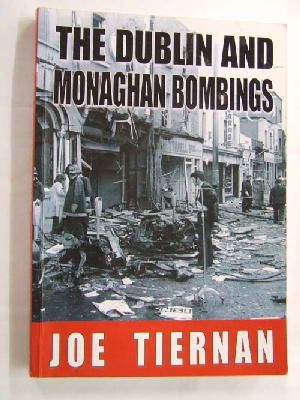
ON THIS DATE (21ST JANUARY) 53 YEARS AGO : MEDIA REPORTS THAT SACKVILLE PLACE IN DUBLIN HAD BEEN BOMBED BY LOYALISTS.
FOR THE SECOND TIME IN SEVEN WEEKS.

A photograph from the scene of the loyalist bombing in Dublin on Saturday 20th January 1973, in which one man died (29-year-old Scottish born Thomas Douglas, a bus conductor) and 13 people were injured.
'On Saturday 20 January 1973, seven weeks after the December 1972 bombings, a further bomb exploded in Dublin city centre killing one man...unbelievably, the location was once again Sackville Place and the bombers were now beginning to thumb their noses at the security forces...by choosing to bomb the same location twice within seven weeks...the bombing was never claimed by the organisation which carried it out, but no one was in any doubt that loyalists were involved...the bomb, which contained 20 pounds of explosives, was planted in a red Vauxhall Viva car, registration number EOI 1129, which was hijacked in Agnes Street off the Shankill Road in Belfast that morning...' (from here).
Regardless of how active their campaign is in Dublin (or elsewhere in Ireland) or whether they claim responsibility for their actions or not, the fact remains that as long as Westminster continues to maintain a political and military presence in Ireland the loyalists can be 'activated' anytime the British administration feels it would be advantageous to do so. The loyalists and other pro-British elements can only be neutralised when Westminster stops interfering in this country.


"The policy of militant action by the anti-Treaty army is slowly changing to one of sheer destructiveness and obstruction of Civil Government..."
- A report issued by the Free State Army to their political enablers in Leinster House, on the 21st January, 1923.
Yet it was the Free State Army that brought about significant and brutal destruction while solidifying its control within the State, during the final months of the Civil War, primarily focusing on eliminating the remaining IRA forces and their infrastructure, through aggressive military operations, 'official' executions, and reprisals.
The most notorious actions occurred in March 1923, particularly in County Kerry ; in revenge for the deaths of five FSA soldiers at Knocknagoshel, the Stater troops (under Paddy [O]'Daly, a republican-gamekeeper-turned-Free State poacher) used landmines to blow up 17 IRA POW's at Ballyseedy, Countess Bridge, and Bahaghs, often leaving only one survivor to escape, to spread fear among the rebel ranks.
The Staters 'formally executed' 81 (some sources put the number at 83) Irish republicans during the Civil War, with a significant number occurring in 1923, including 34 in January 1923 alone.
As well as their 'formal executions', many "unauthorised" or extrajudicial killings of IRA POW's occurred.
Instances of assault, sexual violence, and property destruction (such as the burning of Bessborough House in Kilkenny in March 1923 to prevent its use by the rebels) against civilians suspected of aiding republicans were also reported.
The Free State exchequer estimated that the war against its own brothers and sisters...'largely due to the (Free State) army's operations to combat the guerrilla campaign, reached approximately £17 million by September 1923...'
The Staters paid, financially, at least £17 million in the early 1920's to uphold the British writ in Ireland, but paid much more than that, morally, in doing so.
Incidentally, by May 1923 the Free State Army had grown to over 50,000 men and now that the Stater politicians didn't need such expensive cannon-fodder, they talked about letting more than half of them go.
In the autumn of 1923 it was decided to reduce the strength of their army and "to reorganise it for peacetime", which entailed a reduction of 30,000 personnel.
A small group of Stater officers (led mainly by former members of Collins’ Intelligence Unit - oh the delicious, callous irony!) attempted to resist the efforts to demobilise officers (feck the ordinary foot soldier!), and that evolved into what has been called the 'Army Mutiny' of March 1924.
What a shame they didn't turn on each other as viciously as they had turned on their brothers and sisters in the rebel army...
==========================
Thanks for the visit, and for reading - appreciated!
Sharon and the team.
(We'll be back on Wednesday, 4th February 2026.)