

'The Fenians challenged the police in the 'Name of the Irish Republic' to surrender and give up their arms.
Tim Daly reached for Sub-Constable O’Donnell's gun and as the two men struggled over the gun, a shot rang out and Sub-Constable Patrick Sheedy fell, mortally wounded.
Next, Constable O’Donnell was shot in the head but only lightly wounded.
The other two constables fled, in opposite directions, as a fusillade rang out...'
(From here.)
On the 4th March, 1867, 'Sub-Constable' Mr Patrick Sheedy (42) was one of at least four 'police constables' who would have been 'detailed to duty' for the following day - 'Skellig Night', an Irish carnival/festival of sorts (!) in the Munster area of Ireland, when Fenians decided to flex their muscles in support of the Rising that had been planned for that date.
Mr Sheedy and his colleagues didn't have a good time at it...
==========================
ON THIS DATE (4TH MARCH) 138 YEARS AGO : "GRACE UNKNOWN...."

Grace Gifford Plunkett (pictured) was born on this date (4th March) in 1888, in Dublin.
She attended art school here and in London and, in 1915, at the age of 27, she 'stepped out' with the then editor of 'The Irish Review' magazine, a Mr Joseph Plunkett, one of the founders of the 'Irish Volunteer' organisation.
He was imprisoned in Kilmainham Jail in Dublin for his part in the 1916 Easter Rising and was condemned to death by firing squad : he asked Grace to marry him and, on the 3rd of May 1916, at 6pm, in Kilmainham Jail, Grace Gifford and Joseph Plunkett were married, with two prison officers as witnesses and fifteen British soldiers 'keeping guard' in the same cell.
The couple were allowed ten minutes together, before Grace was removed from her husband ; he was executed by the British hours later, on the 4th May, 1916.
Grace Gifford Plunkett was at that time on the Executive of the then Sinn Féin organisation, and spoke out against the Treaty of Surrender.
Like all anti-treaty activists (then as now) she was constantly harassed by Free State forces and was no stranger to the inside of prison cells, and was on a 'watch list' by the Leinster House administration.
She had no home, little money and was despised by the State 'authorities' - selling her drawings and illustrations gave her a small irregular income, as she moved from rented flat to rented flat and ate in the cheapest restaurants she could find.
She died suddenly, and alone, on the 13th of December 1955, aged 67, in a flat in South Richmond Street in Portobello, Dublin, and is buried in Glasnevin Cemetery, Dublin.
'Rougher than Death the road I choose
Yet shall my feet not walk astray,
Though dark, my way I shall not lose
For this way is the darkest way.
Now I have chosen in the dark
The desolate way to walk alone
Yet strive to keep alive one spark
Of your known grace and grace unknown...'
(from here.)
THE GREAT OIL AND GAS ROBBERY...
From 'Magill' Magazine, October 2005.
"I spent an hour with Micheál Ó Seighin (pictured), one of the Rossport Five.
Micheál received us very graciously in the small visiting box. He is a small, quietly-spoken man in his late 60s.
"Tá sibhse ag dhéanamh obair go hiontach. Congratulations. Bhí an scéal Dé Luan go han, han mhaith. Ceim mhór", he said..."

Micheál Ó Seighin.

Michael McDowell.

Pat Rabbitte.
On Friday 23rd September, a senior political delegation met with the Taoiseach, the Minister for Foreign Affairs and the Minister for Justice to discuss the evolving peace process. All in attendance agreed privately, and later publicly, that it was a good and positive engagement.
And so it was.
When it was over I took Michael McDowell to one side and shook hands.
"Am I still barred from visiting the Rossport Five?", I asked him.
"Yes", he said.
"Why?", I asked.
"Because that's my decision", he said.
On Wednesday 28 September I did get a visit to Cloverhill, but it wasn't with the Minister's permission. The Ó Seighin family gave up one of their visits so that I could spend an hour with Micheál Ó Seighin, one of the Rossport Five.
Micheál received us very graciously in the small visiting box ; he is a small, quietly-spoken man in his late 60s.
"Tá sibhse ag dhéanamh obair go hiontach. Congratulations. Bhí an scéal Dé Luan go han, han mhaith. Ceim mhór"?, he said.
"Tá a lán le dhéanamh go foill", I said. "Cad é mar atá rudaí anseo?"
"Tá muid maith go leor. We are getting a huge amount of support. Up to 140 cards a day so that helps and I had my mind made on this for a long time. We had really no choice and the other lads are very strong."
"It's a long time to be here. How are your families?", I asked.
"The entire community is with us and all of our families are totally committed. We're very well organised over the last number of years..."
(The third [ie last] pic above shows a Mr Patrick Rabbitte, ex-State Labour Party leader and ex-'State Minister for Communications, Energy and Natural Resources' ; Mr Rabbittee retired as State Labour Party leader in 2007, and from political life altogether in 2016, on a combined pension package worth over €2 million to him!)
(MORE LATER.)


A worrying development for the British, or so it might have seemed at the time, but Westminster's insistence to US President Woodrow Wilson that the Irish situation was 'a domestic/internal issue' won out in the end.
T'was on the 4th March in 1919 that the 'United States House of Representatives' voted overwhelmingly that the Paris Peace Conference should favourably consider Ireland’s claim to self-determination (the vote was 261 for, 41 against, and the US Senate did the same on the 6th of June that same year).
An Irish-American delegation had met with Mr Woodrow Wilson in New York earlier on that same day and, even though Mr Wilson didn't actually commit himself to outrightly supporting Irish aspirations for self-determination, he let it be known to the delegation that it wasn't something he was opposed to, and suggested that their case might be better heard at the 'League of Nations' - the delegation 'read between the lines' and the meeting got a bit heated.
But Mr Wilson and his team stayed 'on the fence', carefully, not majorly offending either camp ; that's politics for ya - and a lost opportunity...
==========================

THE MONTH UNSPUN...
The stories that hit the headlines.
From Magill magazine, August 2002.
'The Irish Independent' newspaper reported on 4th July that Elan chief executive Donal Geaney had the full confidence of his board.
Six days later he had resigned and been replaced by a five-member executive committee.
'The Irish Times' quoted newly-appointed Elan chairman Dr Garo Armen -
"The board decided to change top management because it deemed that it was necessary for the company to strengthen its cash position, restructure itself and reduce its cost base substantially."
'The Financial Times' newspaper reckoned that Wall Street's love affair with Ireland was now over and that.. "...not many doors will be opening for Elan for some time to come."
Elan's suspect accounting practices have come in the wake of similar revelations from Enron and Worldcom, and have started Wall Street thinking that loose accounting standards are a major problem in more than one company...
(MORE LATER.)

"As a protest against the present regime of coercion and the imprisonment of Irishmen for holding political opinions not approved of by the military governors of this county, we wish to inform you that the military point-to-point advertised for Boston will not be allowed to be held..."
- a statement issued on the 4th March, 1920, by Irish republicans and other concerned locals, and sent to 'The Secretary, Boston Point-to-Point, Rathangan, County Kildare' (the "regime of coercion" refers to the imposition of martial law and the use of the 'Defence of the Realm Act' (DORA) to 'arrest' Sinn Féin members and Irish Volunteers).
'Boston' is a townland in the Red Hills area, near the village of Rathangan, in County Kildare, and the "military point-to-point" mentioned in the statement is a reference to a steeplechase horse race which had been organised by British Army officers, stationed in Ireland, affiliated to the '12th Lancers' and the '6th Dragoon Guards Carabiniers'.
The 'festivities' (?!) were to be held on Wednesday, 17th March 1920 (Saint Patrick's Day) and were intended to be 'a jolly day out' for British Army and political 'Toffs', their wives, husbands, girlfriends, mistresses and supporters.
There was frequent targeting of these 'social and sporting events' as a form of protest and disruption against British rule in Ireland and, while some of the horse races were actually, physically disrupted and interfered with, the mere threat of disruption could often be enough to result in the event being cancelled or postponed - psychological warfare.
As it transpired, the Paddy's Day outing didn't go ahead on the announced day, but a scaled-down version took place six days later (on the 23rd), in a less-relaxed atmosphere...

At the same time as the 'Call It Off'-statement was delivered to the Toffs in Kildare, about 130 km(80 miles) across the country and down a fair bit, in the village of An Bhuaile Dhubh (Bouladuff, aka 'The Ragg'), 5 miles outside of Thurles and 3 miles from Borrisoleigh, in the county of Tipperary, three armed Volunteers (James Stapleton, Patrick O'Brien and James Larkin) attached to the Mid Tipperary Brigade (No.2) of the IRA were having a meeting in Fanning's Pub (/grocer shop) when two armed and uniformed RIC members walked in.
The IRA men pulled out their revolvers and told the RIC members to surrender but, instead, they went to draw their guns and were fired on - one of them, a Mr John Martin Heanue (24, from Galway), was badly wounded and died the following day.
The IRA men then left the area.
In a later-to-be-discovered related incident, on the night of the 28th March/morning of the 29th, six masked men called to the nearby home of Volunteer Thomas Dwyer (21) and shot him dead, as his younger sister looked on.
But 'long lie the fox' -
...on the 7th July 1921 (16 months after Volunteer Thomas Dwyer was shot dead and was buried in Drom Cemetery, County Tipperary), the body of a man was discovered at a quiet crossroads near the village of Bonniconlon, a village in the barony of Gallen, in north County Mayo.
The body was that of a 'retired' RIC Sergeant, a Mr Anthony Foody.
Tied around his neck was a sign -
'Remember Dwyer and The Ragg.'
RIP Volunteer Thomas Dwyer.
As that gunplay in the pub was taking place in Tipperary, about 135km (82 miles) up the country and over a bit to the left (!), a farmer from the village of Ardskamore (aka 'Ardkillmore'), near the town of Corofin in County Galway - a Mr Martin Cullinane (/Cullinan) - was visiting a neighbour, a Mr John Lardner, when a group of armed men approached the house.
A bullet was fired through a window in the house, striking Mr Cullinane and killing him.
IRA or British forces?
No claim of responsibility was made.
==========================
DEATH IN THE MEDITERRANEAN...

Desmond Boomer, a Belfast engineer working in the Libyan oil-fields, disappeared seven years ago.
Officially, the plane on which he was a passenger crashed as a result of mechanical failure and pilot error.
But is that the real story?
Or were the Irishman and his fellow passengers unwitting victims of the shady war between Islamic fundamentalism and Mossad, Israel's intelligence network?
A special 'Magill' investigation by Don Mullan, author of 'Eyewitness Bloody Sunday'.
From 'Magill' magazine, January 2003.
Shqaqi, surprised that his real identity was known, looked around and was immediately shot six times by the pillion passenger on the motorbike.
The 'Soldier Of Fortune' article claims the hit men were taken to Tigne where they boarded a speedboat once again and, in 30 minutes, they were back in Sicily together with their commander.
From there, it is alleged they boarded a private jet that took them back to Tel Aviv.
On the 5th November, 1995 - a month before the mysterious disappearance of Desmond Boomer and his travelling companions - a local Maltese newspaper, 'The KullHadd', implicated an unnamed pilot as a possible accomplice in the assassination of Shqaqi...
(MORE LATER.)


On the 4th March, 1921, IRA Units in Kildare destroyed/disabled bridges and roads in Castledermot, Monasterevin, Kilcrow and Burtown and, as that infrastructure was hit, the Crown Forces in Dublin were 'building up' the infrastructure they had imposed on the city in mid-January that year.
That infrastructure took the form of a curfew which was centered on, but not confined to, the North King Street, Capel Street, and Church Street areas of Dublin city centre, between the hours of 10pm and 5am, with '40-hour lockdowns' implemented without notice.
On the 4th March (1921), the curfew area was extended to a massive area of 36 square miles, spanning from Chapelizod to Ballybrack and Glasnevin to Terenure, with public travel now 'forbidden'/strictly limited between the hours of 9pm to 5am.
However, republican Volunteers continued to impose their own 'curfew' on those imposers and imposters...

In late February 1921, IRA Intelligence in the town of Cashel, in County Tipperary, mapped the movements of an RIC member, a Mr James R Beasant (25), from Wiltshire, in England, who had joined that grouping in December 1920.
After 'work' on a Friday evening, Mr Beasant was a regular in Cantwell's Pub (pictured) on the corner of Main Street and John Street, in Cashel, where he had a few pints before heading to his house.
That information was passed to the 3rd Tipperary Brigade of the IRA and, towards the last days of February (1921) an IRA meeting to discuss the issue was held in M/s Anastasia ('Stasia') Nevin's house, which was only a few doors away from that pub.
Four Volunteers - Patrick Hogan (aka 'Seán Hogan'), Patrick Keane, Thomas Nagle (aka 'Jack Nagle') and William O'Donnell - and Stasia herself, were tasked with the operation to pay Mr Beasant a visit and a plan of action was put together.
On Friday, the 4th March, having confirmed that Mr Beasant was, as usual, in the pub, the four Volunteers called into Stasia.
Volunteer Hogan gave Stasia a small revolver, which she put in her handbag and, as per the plan, she left the house to stand down the road, on lookout duty.
On a 'coast clear' signal from Stasia, the four Volunteers left the house and walked the few doors down the road to the pub entrance.
Volunteer O'Donnell (the then 0fficer Commanding 'A' Company, 2nd Battalion IRA) later reported on the operation -
"All four of us carried revolvers.
Volunteers Keane and Nagle stayed in Miss Nevin's in John Street and Volunteer Hogan and I stayed in SD Ryan's of Friar Street.
Local Volunteers, who acted as scouts, kept us informed of the movements of the RIC.
At about 7 pm on the night of the 4th March, 1921, a scout reported that two RIC men were drinking in Cantwell's public house at the corner of John Street and Main Street and they were separate, one was drinking in the kitchen and the other was in the shop.
Volunteer Hogan then decided that Volunteer Nagle and himself would enter Cantwell's by the side door, Volunteer Nagle to go into the kitchen to deal with the RIC man there, while he himself would attack the RIC man in the shop.
Volunteer Keane and I were to stand on the footpath just outside Cantwell's shop to deal, if necessary, with an RIC patrol which might be expected in the vicinity around that time.
During the time which elapsed from the scout seeing the RIC men until our arrival at Cantwell's, the two RIC men had left and another one - Beasant - had entered the shop and the RIC patrol, too, had arrived in the vicinity and were standing at the railings of Corcoran's Hotel, about 50 yards away down the street.
Volunteer Hogan was unaware of the patrol's presence when he entered Cantwell's, but Volunteer Keane and I saw them as they stood chatting to each other when we took up our position.
Volunteer Hogan fired point blank at Beasant, who was sitting in the shop, but it had no effect.
He fired four more shots at him but, except for a slight scratch wound, the shots had no effect and Beasant then closed with Volunteer Hogan and gasped his right arm ; Volunteer Hogan changed the gun to his left hand and fired again, but still without effect.
Meanwhile, Volunteer Nagle, seeing no RIC man in the kitchen, came back out to the shop, where he saw Volunteer Hogan and Beasant struggling with each other.
Volunteer Nagle fired, hitting Beasant in the head, and the latter then fell dead.
Volunteer Keane and I had not expected to hear more than two shots or three at the most and, after hearing the fifth shot, he remarked to me that the boys must be in trouble inside and suggested that we should go in.
I told him that we had better watch the RIC patrol who, by the way, if they heard the muffled sound of the shots, did not take any notice, but remained where they were.
After the pause and hearing Volunteer Nagle's shot, we did go to the door to see what was happening and, to our relief, met Volunteers Hogan and Nagle coming out.
We got out of the town immediately and, taking to the fields, reached Woodenstown early next morning, where we rested in a farmer's house.
Here we met Volunteer Seumas Robinson, the Brigade 0fficer Commanding, who remarked that he had just heard that a Black and Tan had been shot in Cashel the night before.
He added that he also heard that a girl had been wounded in the shooting - that was the first intimation we got that Miss Julia Cantwell, who had been hiding behind the counter at the end of the shop, had been wounded..."
As the Volunteers were leaving the pub, Stasia walked in the opposite direction, down Main Street, and went to the cinema which was filled with British soldiers and she made sure that she was noticed by the officers, knowing that an alibi as to her whereabouts at the time of the shooting would be necessary.
Indeed, there was such a crowd of soldiers at the cinema, that a gallant British Army officer escorted her home afterwards, making sure that herself and her little handgun in her handbag got home safely..!


On the same day that Mr Beasant drank his last pint, about 140km (85 miles) down the road, a female resident of the Kilcatherine Parish in the Eyeries district of West Cork - a M/s Bridget Noble (née Neill) - was on her way to Castletownbere (/Castletown Berehaven) in Cork, when she was arrested by the IRA between Ardgroom and her destination.
Having searched her house in her absence on the 4th (by order of the Captain of the Ardgroom Volunteer Company), acting on information, the rebels found a letter to her from the RIC 'Head Constable' asking her to meet him in Castletownbere and they caught up with her just past the village of Ardgroom, on the Beara Peninsula, on her way to that meeting (the search party also found five half-torn letters from other RIC members and two photographs of RIC men).
Her constant contact with the RIC had been noticed by Volunteers from 'C Company' of the Castletownbere Battalion, as had her 'friendship' with the local RIC sergeant, whom she met up with more than once in a private house.
M/s Noble had previously had her hair forcibly shorn by the IRA as a warning to stop associating with enemy forces, but still she persisted ; indeed, she reported that IRA action to her friends in the RIC, and gave them the names of seven Volunteers whom she claimed were responsible for the punishment action.
Having been arrested by the rebels on the 4th March (1921), she was questioned and put on trial on the 13th, found guilty, and executed on the 15th.
A report on the case was prepared by the Cork No. 5 Brigade HQ and sent to their Dublin GHQ in October that year, as her execution caused some unease within the ranks of the rebel Movement who, generally, were not in favour of shooting women, as was stated in 'IRA General Orders'.
Incidentally - M/s Bridget Noble was one of three women executed by the IRA as informers during that period of our on-going struggle ; the other two were Maria Georgina (Mary) Lindsay and Kate (Kitty) Carroll.
M/s Noble's husband received £1,500 in compensation from the British government.
==========================
ON THIS DATE (4TH MARCH) 16 YEARS AGO : GREEN ISLE FOODS ISSUE COVERED BY MEDIA.

Statement released on Wednesday, 3rd March 2010, by SIPTU (...and carried by the media on the 4th and afterwards).
'History of Green Isle Foods dispute ; Workers in Green Isle Foods have embarked on a course of action not seen in Ireland for many years. Members of the Technical Engineering and Electrical Union (TEEU) have been left on the picket line for six months by their employer and the parent company, Northern Foods in Britain.
The basic facts ; in December 2008, a TEEU member opened a new icon on his computer entitled 'Boardroom'.
He assumed it was an information bulletin.
In fact it had been sent to him by mistake instead of to a senior member of management with a similar name.
He did not pay much attention to the contents until a file appeared on the site in March 2009 containing restructuring proposals that involved making six TEEU members redundant.
The engineer showed his manager the file and shared the information with a number of fellow employees.
When the company realised its error it insisted that all employees who may have accessed the 'Boardroom' folder sign a document confirming that they had done so and accepting it was a serious disciplinary offence for which they faced dismissal.
The members asked their union for advice.
When the TEEU sought to represent them the company refused to entertain the union.
The men were suspended on full pay, while Green Isle Foods applied to the High Court for an order seeking full disclosure from the employees along with exemplary damages for breach of contract, confidentiality, interfering with the company's business and all legal costs - including interest.
The TEEU represented the men in court and after hearing the evidence Judge Mary Laffoy recommended that the parties agree a mutually acceptable process for resolving the problem.
An agreement was reached by which all suspensions were lifted, the men returned to work and they agreed to co-operate with the company investigation, which dragged on from early April until mid June 2009.
Eamon Devoy, General Secretary Designate of the TEEU, eventually wrote to the company on June 17th, asking that the inquiry into 'Boardroom' be wound up because of the stress it was causing employees.
Instead, the company said it had begun what it claimed was a second investigation, wholly unrelated to the first, on the previous day, June 16th, into the storage of inappropriate emails on PCs.
On June 18th it also issued the findings of its first investigation.
This found the company IT systems were not secure or properly monitored, and there was no evidence to suggest information from the 'Boardroom' folder had been given to anyone outside the company.
Meanwhile, the company pursued its second investigation without any involvement from the TEEU, whose members refused to engage in the new process without union representation.
The same individuals were investigated as in the 'Boardroom' inquiry and, while it remains unclear if this investigation was ever concluded, the men were dismissed at the end of what had proven a very secretive process, on July 10th, 2009.
Their appeals were rejected on July 31st, and the company rejected an offer by the Labour Relations Commission to intervene.
Having failed to find some means of resolving the dispute through negotiation, mediation and dialogue, the TEEU served strike notice on Green Isle Foods.
The response of the company was to bring in strike breakers, who were in place even before pickets were mounted at the end of August 2009.
Meanwhile, the other TEEU members, whose positions had been identified as redundant in the 'Boardroom' file, received satisfactory redundancy settlements ; the crucial difference was that they were employees of ESS, a subcontractor on the Green Isle Foods site which recognises unions.
Green Isle Foods has sought to portray the dispute as one involving the downloading of pornographic (material) from the internet, but in fact the Green Isle Foods system does not allow employees access to the internet, let alone the ability to download material.
In the case of two TEEU members who were dismissed, they opened unsolicited emails which had nothing to suggest the material was inappropriate and, in one case, the man was dismissed for failing to delete the email subsequently from his in-box although he did not show it to anyone else.
The source of the unsolicited emails has never been identified by the company.
The third employee was dismissed because he brought a memory stick to work with film and video game material on it which was not pornographic images, but which the company claimed could breach copyright law if used on its equipment.
After being on the picket line for over four months the TEEU referred the dispute to the Labour Court, which heard the case on December 4th, 2009.
The company refused to attend, saying it did not recognise unions and therefore the Labour Court was an inappropriate forum to resolve the dispute but, nevertheless, it was represented at the hearing by IBEC.
The Court issued a recommendation on December 8th, 2009, stating it was satisfied the dismissals were unjustified, that there should be an immediate return to work, full reinstatement of the men and compensation for loss of earnings.
In the event that this was not acceptable to the two sides the Court recommended that they should agree, through a third party if necessary, on a compensation package for the men.
When the company rejected this proposal the Court recommended, on January 5th, 2010, that the sacked men receive €40,000, €60,000 and €80,000 respectively, reflecting their lengths of service (seven, 10 and 16 years), if they were not reinstated as previously recommended.
When the company continued to ignore the Labour Court recommendations, the shop stewards, Jim Wyse and Declan Shannon, requested meetings with the company locally to resolve the dispute through direct talks, and even offered to negotiate on the Labour Court terms.
Management met them briefly for a few minutes on three occasions over four weeks but did not even bother to make a note of the men's proposals before rejecting them.
It was after this final rebuff that the workers decided to adopt a hunger strike strategy ; they had spent six months on the picket line during the worst winter weather for 40 years and their families were experiencing extreme economic hardship.
They felt it was the last means available to bring pressure to bear on a company that was impervious to all the normal rules of industrial relations or common decency.
Jim Wyse became the first hunger striker on February 17th - he volunteered to go first because it was his suggestion, John Guinan joined him on February 24th and John Recto joined the Green Isle Foods hunger strike on March 3rd, 2010.
Some hours before he joined Jim Wyse and John Guinan on hunger strike, John Recto was asked to call into Naas Garda Station, where he was informed that his work visa has been revoked.
He was told he has until March 8th to leave the country.
He is from the Philippines and has been working at Green Isle Foods for the past three years, and his wife and three children, aged six, seven and one year old, are living with him in Naas ; his youngest child was born in Ireland.
End of SIPTU statement.'
To a certain extent, this is the fault of those that work for a wage/salary and the overall Trade Union movement.
The three of us involved with this blog work outside (and inside) the home, for a wage/salary, and are union members.
We are, in our separate places of employment, in senior management positions and are therefore, thankfully, able to sort any disputes that arise in-house, in a fair-to-all manner, without calling in TU reps who, anyway, are busy campaigning for foreign vagrants and/or decorating their offices with queer/rainbow flags and bunting.
It is as much the fault of the Trade Union movement because they have become 'soft' and over-friendly with politicians and company bosses : in truth, the Trade Union leadership have more in common - and not only in relation to the money they 'earn' - with those two groups, in that they lack the moral courage to stand by their (stated) convictions and alleged intention - to protect that what we already have, in the workplace, and to seek to improve conditions for the working class.
We, the tax-paying working class, have been sold out four times over - by ourselves, for not only not whole-heartedly fighting back but for not actually leaving blood on the streets in our attempt to do so, by the self-serving and (pension-)time-serving millionaire politicians in this State, by the business owners, bosses and management and, finally, by 'our' trade union movement, who have shown that, once bought, they stay bought.
We should be thoroughly ashamed of ourselves.
('1169' comment ; after 15 days on hunger-strike, the issue was settled. Some details here.)


On the night of the 4th March/morning of the 5th, 1922, the hall door of a house in Swinford, County Mayo, came crashing in and an armed man wearing a disguise walked in.
The man of the house, a Mr John O'Dowd, a 'retired' RIC Sergeant, was sitting at the fireside with his wife.
The wife grabbed a chair, jumped up and placed herself between her husband and the Volunteer, just as the Volunteer fired a shot, which went through the chair and hit the wife, piercing a lung.
He fired at least two more shots, and hit Mr O'Dowd twice, then left the scene.
Mr O'Dowd was seriously injured, but recovered.
His wife didn't.
RIP Mrs O'Dowd.
==========================
ON THIS DATE (4TH MARCH) 222 YEARS AGO - 'CONVICTS' REVOLT : 'VINEGAR HILL' NSW UPRISING.

On this date in 1804, an uprising was held by the 'Castle Hill Convicts' in New South Wales, Australia, led by Irish rebel Phillip Cunningham, a Kerryman, born at Glenn Liath ('Grey Glen'), Moyvane.
Although not a lot is known about this Irish hero, it is recorded that he moved to Clonmel, Tipperary, in the 1790's, and worked as a stonemason, supplementing his income from same by opening up a small pub.
Peter Cunningham and about two hundred other 'convicts' turned on the Redcoat soldiers who had imprisoned them, locked them up and broke into a weapons hut.
Martial law was declared as a result, in the Sydney area, and residents in the town of Parramatta were advised to assemble at the docks, ready to flee the area if needed.
The rebels had by now based themselves on a hilltop and declared it to be their 'Vinegar Hill'.
A Major George Johnson and his men from the New South Wales Corps and a detachment of fifty mercenaries from the 'Loyal Association' marched through the night and a short battle commenced in and around 'Vinegar Hill', ending the rebellion. Peter Cunningham was later executed without trial.
'The Sydney Gazette' newspaper covered(/coloured) the event, in its edition of the 11th March 1804, in the following manner -
'REBELLION AT CASTLE HILL.
Major Johnston on arriving at Toongabbee, received information that a considerable Body were on their way to the Hawkesbury.
Notwithstanding the fatigue of his small Detachment in marching up from Sydney and the distance they had gone since, they immediately ran in good Order, with their followers, and after a pursuit of Seven Miles farther, Major Johnston and a Trooper, who had preceded the Detachment, came up with the rear of the Insurgents at 11 o'clock, whose number have since been ascertained to be 233 men, armed with Musquets, Pistols, Swords etc., and a number of followers which they had taken from the Settlers.
After calling to them repeatedly they halted, and formed on the rise of a Hill: The Major and Trooper advanced within pistol shot, and endeavoured to persuade them to submit to the Mercy that was offered them by the Proclamation, which they refused.
The Major required to see their Chiefs, who after some deliberation met them half way, between the Detachment and Insurgents, when by a great presence of mind and address the Major presented his pistol at the head of the Principal leader (Phillip Cunningham), and the Trooper following his motions, presented his Pistol also to the other leader's head (William Johnston) and drove them into the Detachment without the least opposition from the body of the Insurgents..'
That rebellion may very well have been shortlived and its leader, Peter Cunningham, almost forgotten in our history, but it, and he, live on in the memory of every Irish republican to this day.
As it should be.


"Convicted Spy.
Tried And Executed By The IRA."
- a note pinned to a body found by Free State Army soldiers on the 4th March, 1923, near the village of Clerihan (/Ballyclerahan), Clonmel, County Tipperary.
The remains were those of a Mr Thomas McGrath, a British Army soldier who had joined the then new Free State Army.
He had been executed on the 2nd March.
==========================
BORN ON THIS DATE (4TH MARCH) THE SAME DATE THAT HE DIED, AND NAMED AFTER AN IRISH HERO WHO WAS BORN ON THAT SAME DATE 120 YEARS BEFORE HIM!
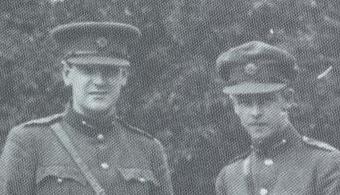
Emmet Dalton (pictured, on the right, with Michael Collins), Irish rebel-turned-Free Stater, was born in America on March 4th 1898 and died in Dublin on March 4th 1978 - his 80th birthday, and also the bicentenary of the birth of the man he was named after, and whose Cause he belittled - *Robert Emmet.
Mr Dalton was educated at the O'Connell School in Drumcondra, Dublin and, as a young adult, became interested in the political teachings of a Mr John Redmond, so much so that he joined the British Army, serving as a 2nd Lieutenant with the 7th Battalion of the Dublin Fusiliers.
He would have been present at the Somme in September 1916 when over 4,000 Irish soldiers died (including his friend, Tom Kettle) and, indeed, won a 'Military Cross' for '..leading forward to their final objective companies which had lost their officers. Later, whilst consolidating his position, he found himself with one sergeant, confronted by 21 of the enemy, including an officer, who surrendered when he attacked them..'.
He further served the British 'war effort' in Palestine, where he trained a sniper patrol and also served as a British Army staff officer in France.
He was demobilised, in Germany, in 1919, at the age of 21, and returned to Dublin, becoming the 'Director of Training' for the Irish Republican Army, but he sold out in favour of the 'Treaty of Surrender' in 1921 and made a (Free State) name for himself by attacking republican positions from the sea, actions that his British paymasters considered as having 'turned the tide' against the Irish republican resistance, and also led the Free State attack on the Four Courts in Dublin on the 28th June 1922.
He was with Michael Collins on the 22nd of August 1922 when the latter was shot dead by republican forces in West Cork (Béal na mBláth) and is said to have propped up a dying Collins to place dressings on his wound.
He resigned from the Free State Army shortly after Collins was killed (his brother, Charlie, stayed on and made an equally bad name for himself), and was appointed as the clerk of the Free State Senate, but resigned from that, too, three years later, and opened a film production company, Ardmore Studios, near Bray, in Wicklow.
He died, aged 80, on the 4th of March 1978, the same date and month that he had been born on, and was buried in Glasnevin Cemetery in Dublin.
Rumours persist that Mr Dalton himself shot Collins dead, as per instructions from Westminster...?
(*...few words [!] elsewhere in this post about the brave Irish rebel.)


"The Ulster Protestants are the spoiled children of politics who are incapable of making concessions..."
-Mr William Thomas Cosgrave (pictured), the then 'President of the Executive Council of the Irish Free State, leader of the Cumann na nGaedheal political party and the Leinster House member for the Carlow–Kilkenny constituency' (and, as if that wasn't pensions enough for him, he was, when he spoke those words, only about three weeks away from also taking on the position of Free State Minister for Defence!).
Or at least that's what a Mr Norman George Loughnane claimed Mr Cosgrave said, at a meeting with his boss, a Mr Lionel Curtis.
Mr Loughnane was a British government official (a 'Principal Officer' in the British Treasury), a former administrator in Dublin Castle, and was also associated with the British 'Ministry of Pensions' in Westminster, and Mr Curtis once 'served' as the 'Colonial Office Adviser on Irish Affairs' for the Brits.
Mr Cosgrave and Mr Loughnane were themselves like "spoiled children" with all their salaried positions, and poor Mr Curtis was like the child who was last in getting to the sweet jar/piggy bank...
==========================
ON THIS DATE (4TH MARCH) 248 YEARS AGO : 'DARLING OF ERIN' BORN.

Robert Emmet was born on the 4th March, 1778, a son of Dr Robert Emmet and Elizabeth Mason.
His father served as state physician to the vice-regal household but was a social reformer who believed that in order to achieve the emancipation of the Irish people it was first necessary to break the link with England.
Robert Emmet (Jnr) was baptised on March 10th in St Peter's Church of Ireland in Aungier Street, Dublin, and attended Oswald's School in Dropping Court, off Golden Lane, in Dublin and, from there, he went to Samuel Whytes School in Grafton Street, quite near his home, and later to the school of the Reverend Mr Lewis in Camden Street.
He entered Trinity College, Dublin, in October 1793 at the age of fifteen and a half where he practiced his oratorical skills in the Historical and Debating Societies and one of his friends there was the poet Thomas Moore.
There were four branches of the 'United Irishmen' in TCD and Robert Emmet was secretary of one of them but, after an inquisition, presided over by Lord Chancellor Fitzgibbon, Emmet became one of nineteen students who were expelled for United Irishmen activity.
Although not active in the 1798 Rising, Robert Emmet was well known to the British authorities and by April 1799, when Habeas Corpus had been suspended, there was a warrant issued for his arrest, which he managed to evade and, early in 1801, accompanied by a Mr Malachy Delany of Cork, he travelled throughout Europe, and made Paris his headquarters - it was there that he replaced Edward Lewis as the liaison officer between Irish and French republicans.
While in Paris, he learned about rockets and weapons, and studied a two-volume treatise by a Colonel Tempelhoff which can be examined in the Royal Irish Academy, with the marginal notes given the reader some insight into Emmet's thinking.
Following the signing of the 'Peace of Amiens' by France and England in March 1802, the United Irishmen that were being held as prisoners in Fort George were released and many such as Thomas Russell and Thomas Addis Emmet made there way to Paris.
Emmet returned to Ireland in October 1802 and began to plan for a rising and, in March 1803, at a meeting in Corbet's Hotel, 105 Capel Street, Dublin, Emmet briefed his key organisers.
In April 1803 Emmet rented an isolated house in Butterfield Lane in Rathfarnham as a new base of operations and Michael Dwyer, a 1798 veteran, suggested his young niece as a suitable candidate to play the role of the 'housekeeper'.
Born in or around the year 1778, Ann Devlin soon became Robert Emmet's trusted helper and served him loyally in the months ahead.
Shortly afterwards he leased a premises at Marshalsea Lane, off Thomas Street, Dublin, and set up an arms depot there, for the manufacture and storage of weapons for the incipient rising.
Former soldiers mixed their practical skills with the scientific knowledge that Robert Emmet had acquired on the continent, and an innovative rocket device was produced.
Elaborate plans were drawn up to take the city and in particular Dublin Castle : supporters from the surrounding counties of Kildare, Wicklow and even Wexford were pledged to assist.
Emmet bided his time, waiting for an opportune moment when English troops would be withdrawn to serve in the renewed war in France, but his hand was forced when a premature explosion on the evening of July 16, 1803, at the Patrick Street depot, caused the death of John Keenan and, even though there was no obvious wide scale search or arrest operation by the British following the explosion, the leadership of the movement decided to set July 23, 1803 (the following Saturday) as the date for the rising.
Emmet hoped that success in Dublin would inspire other counties to follow suit.
Patrick M. Geoghegan, in a recent publication, says that "..the plan for taking Dublin was breathtaking in its precision and audacity. It was nothing less that a blueprint for a dramatic coup d'état. Indeed, over a century later, Pearse and Clarke would also refer to the plan for their own rising.."

Emmet's plan depended on two factors - arms and men and, as Geoghegan states, when the time came, Robert Emmet had not enough of either - events went dramatically wrong for him.
On the appointed day his plans began to unravel ; Michael Dwyer and his promised 300 men did not get the word until Sunday July 24th and, the previous day, an excess of men had moved in to Dublin from Kildare and could not be concealed in the existing depots so they spread out around the city pubs and some started drinking. Others, after inspecting the existing arsenal and finding many pikes but few muskets or blunderbusses, went home unimpressed.
Because he had alerted other countries and still had the element of surprise, Emmet decided not to postpone the Rising thus, shortly after seven o' clock on Saturday July 23rd, 1803, Robert Emmet in his green and gold uniform stood in the Thomas Street, Dublin, depot and, to the assembled rebels, read out his proclamation, declaring that the Irish nation was about to assert itself in arms against foreign rule.
But again events conspired to thwart the rebels - coaches commissioned for the attack on Dublin Castle were lost and erroneous information supplied that encouraged pre-emptive strikes, meant that confusion reigned.
Also, the novel rocket signals failed to detonate.
Emmet's own forces, who were to have taken the Castle, dwindled away and, throughout the remainder of that evening, there were skirmishes at Thomas Street and the Coombe Barracks but he decided to terminate operations and leave the city.
For the English Army, which included Daniel O' Connell, it was then merely a mopping-up operation : in the aftermath, the English arrested and tortured Anne Devlin, even offering her the enormous sum of £500 to betray Robert Emmet - she refused.
Emmet himself took refuge in the Harold's Cross area of Dublin, during which he met with his mother and Sarah Curran but, on Thursday August 25th, 1803, he was finally arrested.
It has been stated by others that a £1000 reward was paid by Dublin Castle to an informer, for supplying the information which led to his capture.
Robert Emmet's misfortunes did not stop on his arrest : he had the misfortune to be defended by one Leonard McNally who was trusted by the United Irishmen but, after McNally's death in 1820, it transpired that he was a highly paid government agent and, in his role as an informer, that he had encouraged young men to join the rebels, betrayed them to Dublin Castle and would then collect fees from the United Irishmen to 'defend' those same rebels in court!
Emmet was tried before a 'Special Commission' in Green Street Court House in Dublin on September 19th, 1803 ; the 'trial' lasted all day and by 9.30pm he was pronounced guilty.
Asked for his reaction, he delivered a speech which still inspires today, closing by saying that he cared not for the opinion of the court but for the opinion of the future -
"..when other times and other men can do justice to my character.."
Robert Emmet was publicly executed on Tuesday September 20th outside St Catherine's Church in Dublin's Thomas Street.
The final comment on the value of Robert Emmet's Rising must go to Séan Ó Brádaigh, who states that to speak of Emmet in terms of failure alone is to do him a grave injustice - he and the men and women of 1798 and 1803 and, indeed, those that went before them, set a course for the Irish nation, with their appeal to Protestant, Catholic and Dissenter, under the common name of 'Irishman', which profoundly affected Irish life for more than two centuries and which will, we trust, eventually bear abundant fruit.
Finally, it was not only college-educated men and women like Robert Emmet (ie those who might be perceived as being 'upper class') who decided to challenge Westminster's interference in Irish affairs in 1803 : so-called 'working class' men and women also acknowledged the need for such resistance - Edward Kearney, carpenter, hanged, Thomas St / Owen Kirwin, tailor, hanged, Thomas St, September 1st 1803 / Maxwell Roche, slator, hanged, Thomas St, September 2nd 1803 / Denis Lambert Redmond, coal facer, hanged, Coalquay (Woodquay) Dublin, / John Killeen, carpenter, hanged, Thomas St, September 10th 1803 / John McCann, shoemaker, hanged at his own doorstep, Thomas St, September 10th 1803 / Felix Rourke, farm labourer, hanged, Rathcoole, Dublin, September 10th 1803 / Thomas Keenan, carpenter, hanged, Thomas St, September 11th 1803 / John Hayes, carpenter, hanged, Thomas St, September 17th 1803 / Michael Kelly, carpenter, hanged, Thomas St, September 17th 1803 / James Byrne, baker, hanged, Townsend St, Dublin, September 17th 1803 / John Begg, tailor, hanged, Palmerstown, Dublin, September 17th 1803 / Nicholas Tyrrell, factory worker, hanged, Palmerstown, Dublin, September 17th 1803 / Henry Howley, carpenter, hanged, Kilmainham Jail, Dublin, September 20th 1803 / John McIntoch, carpenter, hanged, Patrick St, Dublin, October 3rd 1803 - there are dozens more we could list here, but suffice to say that 'class' alone was not then, nor is it now, a deciding factor in challenging British military and political interference in this country.
'Justice' is the deciding factor in that equation.
Thanks for the visit, and for reading - appreciated!
Sharon and the team.
(We'll be back on Wednesday, 18th March 2026 - and we'll be making a 'lil holiday announcement then ; we're taking a couple of weeks off, 'cause me and the Girl Gang are off soon on our rambles abroad, starting in the Canary Islands, so the two lads here will take a break, as well. And, as we say here - (MORE LATER - on the 18th!)...)

