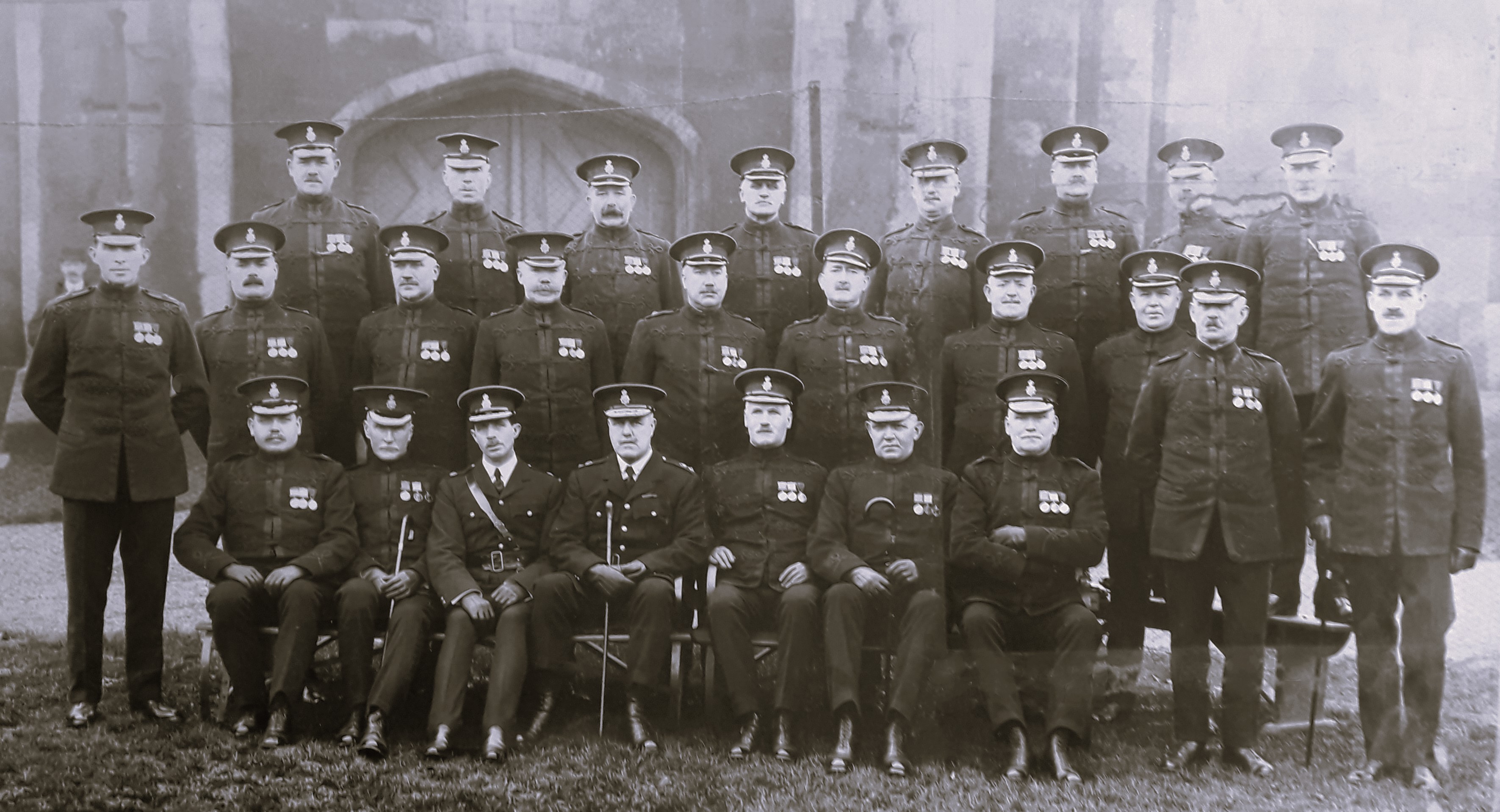
On the 29th June, 1919, a deaf man, a Mr Patrick Studdert (56), from an area known as 'the Blocks' (McSweeney Terrace') in the village of Kilkee, in the county of Clare, who was not a member of the Republican Movement and who worked as a farmer/fisherman to provide for his wife, Kate, and their nine children, was crossing a field he owned to move some of his cows away from a fence erected, and guarded, by the British Army.
A British Army Sergeant, a Mr Wolseley (/Wolsley/Wolsey), attached to the 'Scottish Horse Regiment', was on sentry duty and shouted at Mr Studdert to 'halt' but, being a deaf man, the shout went unheard and, therefore, obviously, unheeded.
Mr Wolseley, a veteran of the trenches of Europe and the British 'military campaigns' in the Middle East, raised his rifle, took aim, and shot the poor man in the back of his head.
Mr Patrick Studdert died from that head wound on the 1st July 1919.
Because the British Army murderer, Mr Wolseley, "was acting in an official capacity as a British soldier during an active combat deployment", his individual service record is kept under lock by the 'British National Archives' rather than being made public and his personal background, first name, and hometown are kept out of the public press.
Mr Studdert's widow, Kate, eventually secured £400 in compensation payment from Westminster.
RIP Mr Patrick Studdert.
==========================

At the same time that the British Army murderer, Mr Wolseley, was 'doing his duty', about 170 miles (275 km) away, across the country and up a bit, his comrades in the 'DMP' were raiding a premises on Lower Stephen Street, in Dublin City Centre, acting on a tip off from an informer.
The building that was raided was beside Mercer's Hospital, just blocks away from Dublin Castle (the HQ of British interference in Ireland), which made that particular arms dump a highly dangerous, yet high-value logistical hub for the rebels, for moving and storing weapons through, and in, the city center.
But every cloud...
...the loss of the Lower Stephen Street arms dump caused immediate panic within the rebel leadership, as it threatened to expose the Dublin Brigade's entire officer corps and dismantle their operations.
Frustrated by that and other losses, Michael Collins (still a rebel at that time) approached Volunteer Dick McKee (who often operated under the nom de guerre 'Fergus', Commander of the Dublin Brigade and a rebel until he died) immediately after that raid and the two Volunteers assembled a full-time unit tasked specifically with assassinating British intelligence agents and detective 'G-men'.
Within weeks, the active service unit known as 'The Squad'/Twelve Apostles' was formed and proved very effective at that which it was formed for!
Incidentally, three days after the DMP raid on that arms dump, the British 'officially' declared that Sinn Féin, the Irish Volunteers, Cumann na mBán, and the Gaelic League were deemed to be 'illegal organisations' but the Republican Movement just carried-on as it did before that cheeky declaration!
==========================
THE GREAT OIL AND GAS ROBBERY...
From 'Magill' Magazine, October 2005.
"I spent an hour with Micheál Ó Seighin (pictured), one of the Rossport Five.
Micheál received us very graciously in the small visiting box. He is a small, quietly-spoken man in his late 60s.
"Tá sibhse ag dhéanamh obair go hiontach. Congratulations. Bhí an scéal Dé Luan go han, han mhaith. Ceim mhór", he said..."

Micheál Ó Seighin.

Michael McDowell.

Pat Rabbitte.
As we made our way out of Cloverhill through the security, past the other visitors, mostly women, many of them with young children, and obviously urban working class, I reflected on how people end up in prison.
I thought of the small, quietly-spoken, scholarly gaelgeoir from Mayo.
I thought of Michaél and his comrades learning about the urban working class poor and worrying about the problems of drug abuse while standing up for the rights of a small rural community.
It could be unless the government intervenes in a positive and decisive way to resolve the issues which are the cause of this dispute, that there will be many more people from west Mayo incarcerated at the whim of a multi-national.
Last week public pressure moved the Government and Shell, and the Rossport Five were released.
But the campaign continues.
There are big issues involved here...
(The third [ie last] pic above shows a Mr Patrick Rabbitte, ex-State Labour Party leader and ex-'State Minister for Communications, Energy and Natural Resources' ; Mr Rabbittee retired as State Labour Party leader in 2007, and from political life altogether in 2016, on a combined pension package worth over €2 million to him!)
(MORE LATER.)


On the 1st July, 1920, about 30 Volunteers from the Skibbereen Battalion of the Cork No. 3 Brigade ambushed an RIC patrol which was traveling between Leap and Skibbereen.
Armed primarily with (poor quality) shotguns(and equally poor-quality cartridges), the IRA unit ultimately retreated, returning to base, and there were no casualties on either side.
The ambush took place in the vicinity of the townland of Brade, in West Cork, about one mile west of the village of Leap, and it was led by Battalion Officer Commanding Volunteer Samuel Kingston, Vice Commanding Officer Volunteer Neilus Connolly and Cork No. 3 Brigade Quartermaster Volunteer Pat Harte.
They were to have better luck in the future...!
==========================
A Mr John Tangney, a Kerry man, took a (reluctant?) notion in 1918 to join the RIC, which he did and, in return, they gave him a pay packet and the 'service number' 69544.
He was stationed at the rural village barracks of Ballylooby, in County Tipperary, where he became pals with another new recruit, a Mr Daniel Francis Crowley.
Both men were not as inclined to use their uniforms to 'put manners' on the locals and, indeed, were somewhat uneasy about how quickly and how often their RIC bosses were in overlooking such transgressions.
In 1920, Mr Tangney and his colleague, Mr Crowley, were transferred (for not being 'hard enough', maybe?) from Ballylooby to the larger Clogheen Barracks, in Tipperary, and it was here that they witnessed a massive shift in how the British administration intended to 'police' the rebellion which was gathering pace all around them.
Both men complained to their colleagues and to their 'police' bosses about the gradual (!) phasing-in of regulations permitting the use of weapons for acts of aggression but nothing changed - the RIC continued to throw their weight around so, on the 1st July, 1920, both of them officially resigned from that grouping, in direct protest against the "brutality and lawlessness" of the British administration, particularly following the deployment of the paramilitary Black and Tans.
He publicly stated that he could no longer take part in the aggressive actions and methods being implemented by his superiors against Irish citizens, whether those citizens were involved in the rebel movement or not.
Local newspapers covered the resignations, as did the Republican Movement, and it was brought to the attention of journalists and politicians in Washington, United States who, acting as an unofficial body called 'The American Committee of One-Hundred on Ireland', were in the process of setting-up a high-profile group ('The American Commission on Conditions in Ireland') to inquire into British misrule in Ireland.
On the 10th December, 1920, Mr Tangney and Mr Crowley gave sworn testimony in Washington, before 'The American Commission on Conditions in Ireland', testimony which provided rare, insider evidence that heavily damaged British international prestige.
The two ex-RIC men detailed RIC brutality, British military and political misconduct, outlining how the RIC gradually (!) phased in new regulations that explicitly permitted and encouraged the use of weapons for unprovoked acts of aggression against Irish civilians.
They exposed a British military and political leadership in Ireland that was drunk on whiskey and power, and gave special praise (!) to a Mr Thomas William Lowndes (who was stationed in County Clare and sometimes operated from the Phoenix Park Depot in Dublin, and was considered as 'stiff-upper-lip royalty' in pro-British political and military circles, due to his family's involvement in 'peace-keeping' in Ireland), describing him as representing 'a complete breakdown of discipline and command' in the para-military grouping he was a 'County Inspector' in.
When Collins and other Staters were handed 26 Irish counties by the British to look after for them, Mr Thomas William Lowndes and his ilk legged it to England for safety, as they knew the IRA was still interested in them.
Mr Thomas William Lowndes died of natural causes after a peaceful retirement, passing away quietly in England from natural causes associated with old age.
Which, incidentally, is nothing that a few ounces of lead wouldn't have fixed.
==========================

On the same date that two RIC men resigned from that grouping, about 50 miles (80 km) down the country, in Cork, a building on the then 'King Street' (now MacCurtain Street) blew up.
Volunteer Michael Murphy, Commandant of the 2nd Battalion IRA, explained what happened (!) -
"To my mind, the best way to do the job was to explode a land mine (containing 10 lbs of gelignite) from the adjoining house.
I fixed the time for the explosion at about 5pm when I knew that the garrison would be inside at tea and, at about 4.30pm, a few of us entered the dwelling house adjoining and, having removed the occupants elsewhere, placed a large mine at the dividing wall between the house and the barracks day room.
The mine was exploded and blew a large breech in the dividing wall, hurling debris into the dayroom of the barracks.
This being done, I signalled to the Volunteers to withdraw, as we could not possibly hope to engage the garrison with any chance of success..."
The enemy barracks was heavily damaged in that attack (which was under the overall command of the Cork No. 1 Brigade), forcing the Crown Forces to evacuate and thus surrender control of the streets to the rebels.
That barracks was one of the main enemy stations within Cork City and was connected to the murder of former Lord Mayor Tomás MacCurtain on the 20th March (1920), in that some of the roughly two dozen RIC members and a few of the Black and Tans that were stationed there were known to be involved in the murder of Volunteer MacCurtain ; at the time of the explosion, at least ten of those operatives were in the day room.
Seconds before the landmine was triggered, IRA Volunteers on the street outside the barracks fired gunshots into the air to clear the street of pedestrians, and other Volunteers were controlling access to the Union Quay and Blackrock Road areas of the immediate vicinity.
Incidentally, by the end of 1920, a total of 553 barracks had been destroyed in the country.
==========================

On the same date that the Cork lads were demonstrating the 'Safe Cross Code', their comrades about 420 km (260 miles) up the road in the town of Pettigo, in County Donegal, having already forced the removal of the RIC from their barracks, paid the building another visit.
Volunteers attached to the South (No. 4) Donegal Brigade of the IRA burned it down.
The family of the previous RIC 'sergeant' in charge of the barracks, a Mr Andrews, were still living in the barracks at the time, so the Volunteers moved them and their belongings out of the building before torching it.
But their decency was deliberately misrepresented by Mr Andrews who, in his application for financial compensation to the County Court, claimed that his family was mistreated by the rebels during their evacuation, prompting Volunteer Liam O'Duffy, the Adjutant of the South Donegal Brigade IRA, to issue a statement to 'The Donegal Vindicator' newspaper correcting the situation.
A few days after that statement was published, the Crown Forces raided the newspaper offices and put them (temporarily) out of business and, later that same year, they raided again, 'arrested' two members of staff - Eily and Kathleen McAdam - and 'seized' paperwork and files.
The foreign raiders refused to return the material, but the two girls were eventually released without charge.
==========================

While the Cork and Donegal Volunteers were dealing with the Crown Forces in their own way, so, too, was British Army Field Marshal 'Sir' Henry Hughes Wilson, a '1st Baronet', and 'Chief of the Imperial Staff'.
His diary for the 1st July 1920 notes that his political and military boss, a Mr David Lloyd George, who had a longer moniker than Mr Wilson - that of '1st Earl Lloyd-George of Dwyfor' - "...is under the ridiculous belief that Tudor has organised a counter-murder society.." in Ireland.
The 'Tudor' he referenced was British Army Major-General Hugh Tudor (pictured, the 'Police Advisor to the Irish Administration').
In his diary a few days later, Mr Wilson wrote that Mr Lloyd George had... "..reverted to his amazing theory that Tudor, or someone, was murdering two Sinn Féiners to every loyalist the Sinn Féiners murder. He seemed to be satisfied that a counter-murder association was the best answer to the Sinn Féiner murders..."
Then on the 10th July (1920), Mr Wilson recorded his opinion that, when Mr Lloyd George was pressed about the 'counter-murder association' by a Mr Edward Stanley (who, incidentally, had a much bigger and better moniker that the other two put together - '17th Earl of Derby, CB, Privy Council member, KCVO, GCVO, GCB and Knight of the Garter'!), Mr Lloyd George replied -
"You must not ask me any questions but the thing is in operation already..."
There was, indeed, an 'official' so-called 'Counter-Murder Association' to, as the British seen it, 'retaliate against republicans', which in our opinion, shows the political and military panic in London at the time regarding the escalating successes of the republican fighters.
==========================

As Mr Wilson was writing his 'ridiculous' diary note in Westminster, about 445 miles(715km) to the West and down the country a bit, in Ballyarigan in the Kilcatherine parish near Castletownbere, in the county of Cork, in Ireland, a British Army 'Royal Marine Light Infantry' ('8th Battalion') soldier was in the BA barracks, doing God knows what, as it was never divulged.
He was a Mr William Entwistle (23), from 213 Douglas Road in Sheffield, England.
A gunshot was heard, Mr Entwistle fell down wounded and was rushed to hospital, where he died two hours later from cardiac failure.
Official British military and civil registries list his cause of death as "unexplained gunshot wounds that led to cardiac failure within two hours", and 'Royal Marine' records state that "he died by means other than disease, accident or enemy action...".
He is buried in Saint Finian's Cemetery ('Foildarrig Cemetery'), in Castletownbere, on the Beara Peninsula in West County Cork.
==========================
As Mr Entwistle was wondering where the shot came from (or maybe not...?), about 70 miles (110 km) to the West, in Tralee in County Kerry, a 17-year-old (unnamed) girl was dragged from her house by IRA Volunteers, her hair was shorn off and (cold) tar was poured over her head.
Two of her brothers were members of the RIC.
Many women and their families chose not to report their names to newspapers or historians due to the social stigma which was attached to those who associated with enemy forces, a trait we could do with today, in our opinion...
==========================

THE MONTH UNSPUN...
The stories that hit the headlines.
From Magill magazine, August 2002.
'Operation Hyphen'.
Refugee and immigrant groups were unhappy with the way the raids were carried out ; they created an "ethos of fear", according to one group quoted in 'The Irish Times' newspaper.
The groups (GONGO agencies) also questioned whether civil rights* had been impinged on in some cases, and said that the operation raised "serious" concerns about the implementation of government policy.
'The Irish Independent' newspaper gave the reason for there being so many outstanding deportation orders -
"As soon as (illegal immigrants) realise that they have exhausted all of the appeals procedures as laid down by the UN, they go on the run, either constantly changing address, disappearing into the black economy or else moving back to Britain or mainland Europe..."**
(*'1169' Comment - the civil rights of the indigenous Irish people have been sacrificed by Leinster House, County Council politicians and the rest of the State 'Establishment' [judiciary, media, cops, business owners, legal profession etc] in favour of hundreds of thousands of foreign vagrants, employed and unemployed, who are being promoted as the new customer and voting base for that State 'Establishment'. The Irish - our culture, traditions and our way of life - are disappearing.)
(**'1169 Comment - and here we are, 24 years later, and that's still happening except now, 2026, those vagrants have support from the State [politicians, GONGO agencies, media, judiciary etc] and are encouraged and assisted to launch free-to-them appeal after appeal, during which time they stay in the State, on welfare. Your 'passport' to, and in, this State, is your skin colour.)
(MORE LATER.)


On the 1st July, 1921, it was revealed that there were 3,414 'A' Specials in the six north-eastern counties of Ireland, 15,902 'B' Specials and 1,310 'C' Specials.
Their colleagues in the RIC numbered 2,109, consisting of 50 armed 'officers' and 2,059 armed operatives listed as 'other ranks'.
At that same time, the IRA had an estimated nominal paper strength of roughly 115,000 members throughout the country but, due to severe weapon shortages and the nature of guerrilla warfare, only about 15,000 were actively engaged, with 3,000 on continuous full-time active service at any given time.
We badly need those thousands of fighting men and women now, for the new threat we face...
==========================

On the 1st July, 1921, armed Volunteers attached to the ASU of the 1st (Fermoy) Battalion, Cork No. 2 Brigade IRA held their final meeting to confirm their intentions for the operation the following day and, on the appointed day, as planned, they took up an ambush position near the village of Tallow, in County Waterford ; they were armed with rifles and a machine gun.
A ten-member RIC patrol, on its daily route, varied its direction slightly on that day but not enough to save them from the brunt of the rebel attack.
When the RIC entered the 'pinch point', the IRA opened fire on them and fire was returned by some of them, their colleagues having legged it to the relative safety of near-by houses.
The gun battle lasted for about ten minutes, before the rebels withdrew to the area of Boultha, a village in the barony of Kinnatalloon, in County Cork, where they rested, before moving out in the direction of the town of Castlelyons.
One RIC member, a Mr Francis (Frank) Creedon (41, with nineteen years 'service'), was dead, and two of his pals were wounded.
==========================

A 'Big House' in the county of Monaghan, 'Shantonagh House' (pictured), situated in the townland of Tooa (also spelled Tuath/Doora/Doori), in the civil parish of Aghnamullen and the 'barony of Cremorne', which was 'owned' by the Fitzherbert family, was attacked and burned down by the IRA, because of military objectives and local agrarian disputes.
==========================
As that probable British Army asset was being put out of commission, about 135 miles (215 km) down the road, in the county of Carlow, the '5th Division of the British Army' were raiding houses, villages and towns, 'arresting' republicans - they later claimed... "..18 out of the 20 known members of a local IRA company were taken, owing to the gradual improvement in the military intelligence service as a supplement to the local police..."
At least they hadn't got a 'Big House' to imprison the men in.
==========================
In mid-1920, an English man in London, a Mr Joseph Shelsher (22), took a notion to implement British 'law and order' in Ireland, so he came over here and joined the RIC.
In return, he got a weekly paypacket, the number '70853', and was stationed in the village of Bansha, between Tipperary Town and the village of Cahir, in the county of Tipperary.
On the 1st July, 1921, after 'keeping the peace' in Ireland for about one year, he decided "to go out for a walk" (?!) towards the townland of Barnlough, which is where his body was found the next day.
Mr Shelsher had been shot in the head.
==========================
At the same time that Mr Shelsher was strolling around the townland of Barnlough in Tipperary, about 160 miles (255 km) up the country and over on yer left a bit, in Sligo, in the townland of Culleens in the parish of Kilglass ('Barony of Tireragh'), an armed seven-man patrol of RIC members was ambushed by IRA Volunteers who were attached to an ASU from the North Mayo Brigade and to the Sligo Brigade.
Two RIC members, a Mr Thomas Higgins (37, a Galway man) and a Mr John King (36, also from Galway) were taken prisoner and were being led away from the scene when the Volunteers came under attack from a Crown Force detachment.
The rebels, defending themselves as best they could, headed in the direction of Sliabh Gamh (the Ox Mountains, in County Sligo, stretching southwest to form part of the border with County Mayo) and this is where two conflicting accounts surfaced ; the two RIC members were killed, but how...?
One version has it that, being on the run from enemy forces, the Volunteers were being slowed down by their prisoners and, after debating it between themselves, the rebels "decided to give them a few short seconds in which to say their prayers..." before shooting them, while the second version, supported by 'The Irish Bulletin', which was the daily newspaper and gazette of the Irish Republic, stated that the two RIC members were shot in a running gun fight between the IRA and Crown Forces.
Hobson's Choice for those two...
==========================
As Hobson was or wasn't making up its mind, about 205 miles (330 km) down the country, in the village of Rosscarbery, in the county of Cork, two armed men removed a Mr Francis Sullivan from his house, brought him off with them, and shot him dead.
West Cork Brigade Column veteran Volunteer James ('Spud') Murphy stated -
"After a cross-examination (he admitted that)...he had informed the enemy of the whereabouts of Volunteer Jim Lane and myself. We procured a priest to hear his confession and then executed him..."
The Sullivan family had connections with the Crown Forces, as the executed man's father, John, served as a Commissioned Boatman with 'Her Majesty’s Coastguard', then continued his 'service' as an adjunct of the Royal Navy, under the control of the British Admiralty.
The late Mr Francis Sullivan's name appeared in the 'British Compensation Commission Register', dated the 1st July 1921, with the notation that British liability was accepted, and with a note that £600 was awarded to his family.
A label attached to the body stated that anyone giving information to the Auxiliaries or the RIC would meet the same fate...
==========================
DEATH IN THE MEDITERRANEAN...

Desmond Boomer, a Belfast engineer working in the Libyan oil-fields, disappeared seven years ago.
Officially, the plane on which he was a passenger crashed as a result of mechanical failure and pilot error.
But is that the real story?
Or were the Irishman and his fellow passengers unwitting victims of the shady war between Islamic fundamentalism and Mossad, Israel's intelligence network?
A special 'Magill' investigation by Don Mullan, author of 'Eyewitness Bloody Sunday'.
From 'Magill' magazine, January 2003.
Writing in 'KullHadd' on the 24th October 1999, Joe Mifsud, then researching a book on the Shqaqi assassination, wrote -
"The military section of Jihad wanted to effect attacks in Malta as retaliation for the killing of their leader, Fathi Shqaqi, (and) the new leader, Ramadan Shallah, had a hard time to stop these attacks."
A cabinet meeting of the Maltese government was called to discuss the crisis on the evening of the 3rd November, 1995 ; Malta had three immediate and grave concerns - its own internal security, the security of its diplomatic staff abroad and its trade relations with the Arab world, particularly Libya.
The incident created all manner of dangers, principally because it gave renewed and potent proof that the murderous Arab-Israeli conflict could manifest itself on the island, which had already been linked to the 1988 Lockerbie bombing - there were suspicions that the bomb that destroyed the Pan Am 103 Jumbo Jet, killing 270 people, originated in Malta...
(MORE LATER.)
"AT THE PRESENT MOMENT, THERE WILL BE NO PEACE (IN IRELAND)..." - BRITISH SPY, 1921.

"There will be no peace settlement.
Of that you can be quite sure.
At the present moment, there will be no peace.
And that is all there is to it..."
- the words of British Army Brigadier-General 'Sir' Ormonde de l'Épée Winter ('KBE, CB, CMG, DSO ETC ETC', pictured, who nixered (!) for the Brits as Chief of the British Army Intelligence Branch), in a letter he wrote to a Mr Hubert Sidney Jenner Lamond Hemming (!), a Colonel in the British Army, on the 1st July, 1921.
Mr Winter was the then 'Deputy Director of Police', for Westminster, in Ireland but - and he obviously didn't see this coming! - a truce between the IRA and the British crown forces came into effect at noon on Monday, 11th July 1921 and, on the 6th December, 1921 (as not predicted by him!), a so-called 'peace settlement' was signed!
As part of the 'Truce', on the 16th July (1921), liaison officers were set up between the British Army/RIC and IRA to sort out details and resolve any disputes at local level.
Volunteer Eoin O'Duffy was appointed Truce Liaison Officer (TLO) for Belfast, and established a presence in St Mary's Hall in that city and announced that all IRA activity, except self-defence, would cease, Volunteer Patrick Shiels was 'TLO' for Derry and Donegal (but was later replaced in that position by Volunteer Patrick Lynch, from Magera), Volunteer George Lennon was the 'TLO' for Waterford (with Volunteer Paddy Paul as his deputy).
A British Army Officer, a Mr William Stack, was the 'TLO' for the British Army's 14th Infantry Brigade area in their 5th Division, a Mr Finton Murphy was 'TLO' for the BA 15th Infantry Brigade and Volunteer Michael Staines was the 'TLO' for the Galway Brigade area.
The 'TLO's' for the British Army apparently thought that their rank would carry some sway with the IRA 'TLO's', but not so -
"The class of individual selected for these liaison duties left much to be desired...", wrote their TLO staff, "..the liaison arrangements were in fact little more than a farce. The men originally selected by Sinn Féin were in many cases leading extremists, whose complicity in outrages and murder was well known to the British officers who were required to deal with them..."
Yes, yes, yes...sure that's just not cricket, sure it's not, Mr Winter : you couldn't beat the IRA militarily and, politically, you couldn't best them, either.
Incidentally, talking about British Army Brigadier-General 'Sir' Ormonde de l'Épée Winter, he was known as 'O' and also as "The Holy Terror" within the spy network he helped develop and worked within, in Ireland.
A fellow officer of his gave the following opinion of the spy 'O' -
"O is a marvel!
He looks like a wicked white snake and can do everything.
He is an Artillery Colonel and commanded a Division of Artillery in France, and in India they say he was tried for murder for a little escapade while doing secret service work.
He started a race course near Calcutta and made a pot of money!
He is as clever as paint, probably entirely non-moral, a first class horseman, a card genius, knows several languages, is a super sleuth, and a most amazing original.
When a soldier who knew him in India heard that he was coming to Ireland he said 'God help Sinn Fein, they don't know what they are up against...' "
A non-moral snake, a murderer and a gambler - yes, I think Irish republicans knew what to expect even before he got here.
Included in his 'snakeisness' was his purchases of Irish republican newspapers in shops and on street stalls and the near-facsimile copying of them, in bulk, for distribution, in the same colours and design but with altered text, to sow confusion among Sinn Féin and the IRA!
This forging snake was driving out of his Dublin Castle lair in June, 1921, when the IRA ambushed him and his guard ; he was only wounded (in the hand) but it must have given him food for thought, as he retired from active service against the Irish in early 1924.
He shed his final skin on this Earth on the 13th February, 1962.


Not strictly to do with the 1st July, 1922 only, but encompassing that particular date.
The 'Battle for Dublin' took place from the 28th June to the 5th July (1922) and those week-long street battles marked the beginning of the 'Cogadh na gCarad' ('War of Friends/Civil War').
'...the fighting began with an assault by the newly formed Free State Army on the Four Courts building in central Dublin, which was occupied by Volunteers of the Irish Republican Army (who) vacated the building on the 30th June after a two-day bombardment by the Free Staters, who used borrowed British guns against those who, only months earlier, they had been fighting with, against the British occupiers...but the rebel army fought-on elsewhere in Dublin until early July with Oscar Traynor in command...'
More about that sad episode in our history, when the Irish Republic was betrayed by our own people, can be read here.
==========================

In late June, 1922, the newly-spawned Free State Army moved a force of armed men into the Workhouse building in Boyle, County Roscommon (pictured), under the command of FSA Brigadier Michael Dockery (29, from Lisadurn, Elphin, in Roscommon, a republican-gamekeeper-turned-Free State-poacher).
On the 1st July, an IRA party moved on the building, and a three-day gunbattle began, during which Mr Dockery was shot dead.
On the third day of the gunfight, reinforcements from the Stater Army (under the command of a Mr Sean MacEoin [John Joseph McKeon, 'the Blacksmith of Ballinalee'], another republican-gamekeeper-turned-Free State-poacher) had arrived on the scene with an 18-pounder gun, borrowed from the British Army, meaning that the IRA had to withdraw.
The rebels retreated to the Arigna Mountain Range, north of County Roscommon (near Lough Allen and the River Shannon) and, on their way there, they encountered an FSA patrol near the village of Ardcarne, outside the town of Carrick-on-Shannon, and had at them - one FSA soldier was killed in the engagement, and the rebels proceeded to the mountains.
At that same time, IRA leader Ernie O'Malley and about 40 other Volunteers were meeting-up in Blessington, West Wicklow, with a 110-strong column of Volunteers from Tipperary, commanded by Volunteer Michael Sheehan, to plan future actions.
As the Wicklow meeting was taking place, IRA Volunteers about 250km/160 miles away, up the road and across the other side of the country (with Volunteers Frank Carty and Tom Carney in command) were taking over the Workhouse in Colloney, in County Sligo.
From that base, the rebels launched attacks on the Stater Army in nearby Markree Castle and it was during one of those attacks (on the 4th [July 1922]) that a republican-gamekeeper-turned-Free State poacher, a Lieutenant Patrick Joseph McDermott (29, from Knockadoo, in Sligo) was shot dead.
==========================
In late June, 1922, there were only two military outposts (Listowel in Kerry and Skibbereen in Cork) left in the province of Munster, in Ireland (which comprises six counties - Clare, Cork, Kerry, Limerick, Tipperary and Waterford) which were held by the Free State Army.
In late June those two structures were attacked by the IRA and, on the 1st July, the Listowel Barracks surrendered and the Staters in the Listowel Barracks threw in the...towel...on the 4th July.
'Independence Day' for Kerry...!
==========================

On the 28th/29th June, 1922, a gunbattle took place in Drogheda, in the county of Louth, between the IRA and the Stater Army, during which each side suffered one loss - Volunteer Liam Leech (17), attached to the First Battallion of the 9th Brigade of the IRA and a Section Commander in the rebel garrison in Millmount, was shot dead at Pitcher Hill by a Stater sniper.
His body was brought to the IRA stronghold at Millmount Tower, where his comrades kept a guard of honour.
On Saturday, the 1st July, his funeral procession moved through Drogheda to the Republican Plot at Saint Peter's Cemetery and, despite the high tensions and ongoing sniper fire in parts of the town, thousands of local citizens lined the streets to pay their respects to the local IRA Commander.
The Stater soldier, Mr John Lynch, a Meath man, was removed from the Cottage Hospital and buried in that county on the 1st July.
==========================

As Volunteer Leech was being buried with full IRA Honours in County Louth, about 65 km (40 miles) up the road, in the town of Newtownhamilton in the county of Armagh, a Mr William John Frazer, a publican and a stout (!) Orangeman, was on his way to the town of Newry on the night of the 30th June/morning of the 1st July (1922) when he was 'abducted' by three armed men.
His body was only found in 1924 in a bog in the townland of Ballard, on the upper slopes of Slieve Gullion, the highest peak in County Armagh.
==========================

On the 1st July, 1922, the IRA vacated the RIC barracks in Ennis, County Clare, setting fire to it on their way out, and also destroyed another such building in Clare Castle, having done the same in the towns and villages of Lisdoonvarna, Ennistymon, Kildysart and Liscannor.
The rebels then set up a new base in the Corofin Workhouse, in the townland of Kilvoydan, in the county of Clare, pictured, below.

==========================

On the 1st July, 1922, a Mr Alfred 'Andy' Cope (pictured), the 'Assistant Under-Secretary for Ireland' and'Clerk of the Irish Privy Council' in Dublin Castle, wrote to his colleague, a Mr Lionel George Curtis, bringing it to his attention that Mr Collins and the political and military pack he then ran with in Leinster House had contacted him asking for the Royal Navy to be deployed on the south and west coasts of the Free State to prevent arms being smuggled into the country by the IRA.
It was later recorded that "...the Royal Navy deployed a substantial number of boats and made many searches of vessels in the summer of 1922..".
Borrowing British guns and borrowing the 'Royal Navy' : sure ya might as well, Mick - didn't ya borrow 26 Counties from them...?
==========================
On the same date that Fred was chit-chatting to Lionel about Mick, the bould Mr Collins and his sidekick, a Mr William Thomas Cosgrave, were meeting a concerned/uneasy delegation of citizens who had expressed reservations about the conduct of the Staters, especially in relation to their bombing of the Four Courts.
Included in that delegation was M/s Louisa ('Louie') Bennett, representing (with other women) 'The Irish Women Workers Council', and their concerns were just about listened to by the two Staters, following which Mr Collins told them that any cessation of hostilities against the republicans at that stage would endanger the lives of members of his government, and Mr Cosgrave told them that the only terms that he would accept from the IRA was unconditional surrender. The women left the meeting more concerned than when they had entered.
Another Stater, a Mr Ernest Blyth, who 'served' the Free State as, concurrently, Minister for Trade and Commerce, Minister for Economic Affairs and Acting Minister for Home Affairs (!), then reported that he, too, had received a delegation from concerned citizens, including a Mr Laurence O'Neill (the Lord Mayor of Dublin), the Archbishop of Dublin and a Mr Cathal O’Shannon from the Labour Party.
They proposed a ceasefire between the Staters and the IRA, but the Staters in Leinster House rejected the idea.
And why wouldn't they, when they had the 'Royal Navy' backing them...
==========================
ON THIS DATE (1ST JULY) 129 YEARS AGO : IRISH GUERRILLA LEADER BORN.

"On an extremely cold, wet night, the men began moving to Kilmichael to take on the dreaded Auxiliaries. All IRA positions were occupied at 9am. The hours passed slowly. Towards evening the gloom deepened over the bleak Kilmichael countryside. At 4.05 pm. an IRA scout signaled the enemy's approach.
The first lorry came round the bend into the ambush position. Tom Barry, dressed in military style uniform stepped onto the road with his hand up. The driver gradually slowed down. When it was 35 yards from the Volunteers command post a Mills’ bomb was thrown by Barry and simultaneously a whistle blew signalling the beginning of the ambush. The bomb landed in the driver’s seat of the uncovered lorry.
As it exploded, rifle shots rang out. The lorry, its driver dead, moved forward until it stopped a few yards from the small stone wall in front of the command post. While some of the Auxiliaries were firing from the lorry, others were on the road and the fighting was hand-to-hand.
Revolvers were used at point blank range, and at times, rifle butts replaced rifle shots.
The Auxiliaries were cursing and yelling as they fought, but the IRA coldly outfought them. In less than five minutes nine Auxiliaries were dead or dying. Barry and the three men beside him at the Command Post, moved towards the second lorry..." (from here.)
"Many statements have been made by Ministers and Generals in various countries on the necessity for long periods of training before even an infantry soldier is ready for action. This is utter nonsense when applied to volunteers for guerilla warfare.
After only one week of collective training, his Flying Column of intelligent and courageous fighters was fit to meet an equal number of soldiers from any regular army in the world, and hold its own in battle, if not in barrack-yard ceremonials". - Tom Barry, 'Guerilla Days in Ireland'.
"They said I was ruthless, daring, savage, blood thirsty, even heartless.
The clergy called me and my comrades murderers ; but the British were met with their own weapons.
They had gone in the mire to destroy us and our nation and down after them we had to go" - Tom Barry.

And, four months later, Tom Barry (pictured, in 1921) was again active in an equally successful engagement with British forces - in the early hours of Saturday, 19th March 1921, under the command of Tom Barry (the son of an RIC officer who had retired to become a shopkeeper) and Liam Deasy (who, within less than two years afterwards, signed a Free State 'pledge' in exchange for his life), the West Cork Flying Column of the IRA turned the tables on a British Army and RIC column at Crossbarry, situated about twelve miles south-west of Cork city, despite being outnumbered ten-to-one.
During the hour-long firefight, in which 104 IRA Volunteers (each carrying approximately 40 rounds of ammunition) successfully fought their way out of a 'pincer'-type movement by about 1,200 enemy troops, consisting of British soldiers from the Hampshire and Essex Regiments, Black and Tans and RIC men, three IRA men were killed in action (Peter Monahan, Jeremiah O'Leary and Con Daly) and three others were wounded. Reports varied in relation to British casualties but it seems certain that at least ten of their soldiers were killed and three wounded (more here).
In an interview he gave a number of years later, Tom Barry recalled how "..about two hours had elapsed since the opening of the fight. We were in possession of the countryside, no British were visible and our task was completed. The whole Column was drawn up in line of sections and told they had done well.." - and they had indeed 'done well', only to witness, within months, their efforts (ab)used by those who yearned for a political career, which they were given by Westminster in return for their surrender.
But, thankfully, although still outnumbered, traditional Irish republicans still exist to this day.
Tom Barry was born on this date (1st July, 1897, in Killorglin, County Kerry) - 129 years ago.
He died (in Cork), at 83 years of age, on the 2nd July, 1980.
RIP Volunteer Thomas Bernardine Barry.


On the 1st July, 1923, near the end of their days 'work', the Staters in the Leinster House assembly agreed between themselves that their 'Public Safety (Emergency Powers) Act 1923' should be extended for a six-month period and expressed their desire to vote for such an extension the following day.
And, on the 2nd July, those 'politicians' voted to do just that.
This political 'Act', first enacted and enforced in June 1923 by the Staters, gave Leinster House the "authority to intern and seize land and stock..." and was wide open for corruption and for the settling of grudges.
One of the pretences used in an attempt to retrospectively justify that outrage was a report from the pro-British 'Dublin Metropolitan Police' (DMP), which stated that, for the period between the 1st July 1923 and the 31st of that month, there were 260 armed robberies and 119 armed raids throughout the State.
And seizing land and livestock would stop that, apparently...
==========================

As they were finishing their labours (!) on the above day, the Staters estimated that they were holding 11,316 IRA rebels in their custody, claiming that, overall, the Movement consisted of approximately between 12,000 and 15,000 members.
They claimed that, a year earlier (ie July 1922), the IRA had a theoretical ('paper') strength of about 70,000 to 84,000 Volunteers, estimating that around 12,000 of them were active participants.
In around July 1922, Leinster House had an army of between 7,000 to 8,000 soldiers to militarily secure their Free State which, by July 1923, had grown to about 55,000 soldiers and 3,500 officers.
Today (2026), the total strength of what the Staters call the 'Irish Permanent Defence Force' ('IPDF') stands at 7,741 'active-duty personnel', with the State Army accounting for approximately 4,800 of that force (a figure which remains significantly short of the Leinster Houses 'authorised establishment target' of 9,739 'active-duty personnel').
And again, today (2026), there are tens of thousands of 'asylum seekers/migrants/refugees/vagrants' in this State, who have organised themselves to take as much as they can, financially, from State taxpayers (with assistance in doing so from the State 'Establishment') but what way will they organise themselves when they decide they should be entitled to even more...?
==========================
"ABHOR THE SWORD? STIGMATISE THE SWORD? NO!"

"Abhor the sword - stigmatise the sword? No, for in the passes of the Tyrol it cut to pieces the banner of the Bavarian, and, through those cragged passes, struck a path to fame for the peasant insurrections of Innsbruck!
Abhor the sword - stigmatise the sword? No, for at its blow a giant nation started from the waters of the Atlantic, and by its redeeming magic, and in the quiverings of its crimsoned light, the crippled colony sprang into the attitude of a proud Republic - prosperous, limitless, and invincible!
Abhor the sword - stigmatise the sword? No, for it swept the Dutch marauders out of the fine old towns of Belgium - scourged them back to their own phlegmatic swamps - and knocked their flag and sceptre, their laws and bayonets, into the sluggish water of the Scheldt.." - Thomas Francis Meagher, pictured.
Born on the 3rd August 1823, died (in mysterious circumstances) on the 1st July, 1867 -
'Does the world even have heroes like Ireland's Thomas Francis Meagher anymore? After fighting for Irish independence ("I know of no country that has won its independence by accident") ,then condemned to death, pardoned and exiled, Thomas Francis Meagher escaped to America, where he became a leader of the Irish community and commanded the Irish Brigade during the Civil War.
General Meagher's men fought valiantly at some of the most famous battles of the Civil War, including Antietam, Fredericksburg and Chancellorsville. After the war, Meagher served as Acting Governor of the Montana Territory. In 1867, Meagher disappeared on the Missouri River ; his body was never found..' (from here.)
Thomas Francis Meagher was born in Waterford City (near the Commins/Granville Hotel) on August 3rd, 1823, into a financially-comfortable family ; his father was a wealthy merchant who, having made his money, entered politics, a route which the young Thomas was to follow.
At 20 years young, he decided to challenge British misrule in Ireland and, at 23 years of age (in 1846), he became one of the leaders of the 'Young Ireland' Movement.
He was only 25 years of age when he sat down with the Government of the Second French Republic to seek support for an uprising in Ireland. At 29 years of age, he wrote what is perhaps his best known work - 'Speeches on the Legislative Independence of Ireland', of which six editions were published.

He unveiled an Irish flag, which was based on the French Tricolour, in his native city, Waterford, on the 7th March 1848, outside the Wolfe Tone Confederate Club. The French Minister for Foreign Affairs, Alphonse de Lamartine, and a group of French women who supported the Irish cause, gave Meagher the new 'Flag of Ireland', a tricolour of green, white and orange - the difference between the 1848 flag and the present flag is that the orange was placed next to the staff and the red hand of Ulster adorned the white field on the original.
On the 15th April that same year, on Abbey Street, in Dublin, he presented the flag to Irish citizens on behalf of himself and the 'Young Ireland' movement, with the following words :
"I trust that the old country will not refuse this symbol of a new life from one of her youngest children. I need not explain its meaning. The quick and passionate intellect of the generation now springing into arms will catch it at a glance. The white in the centre signifies a lasting truce between the 'orange' and the 'green' and I trust that beneath its folds, the hands of the Irish protestant and the Irish catholic may be clasped in generous and heroic brotherhood.."
He was arrested by the British for his part in the 1848 Rising, accused of 'high treason' and sentenced to death ("to be hanged, drawn and disemboweled..") but, while he was awaiting execution in Richmond Jail, this was changed by 'Royal Command' to transportation for life.
Before he was deported, he spoke in Slievenamon, Tipperary, to a crowd estimated at 50,000 strong, about the country and the flag he was leaving behind -
"Daniel O'Connell preached a cause that we are bound to see out. He used to say 'I may not see what I have laboured for, I am an old man ,my arm is withered, no epitaph of victory may mark my grave, but I see a young generation with redder blood in their veins, and they will do the work.' Therefore it is that I ambition to decorate these hills with the flag of my country.."

In July 1849, at only 26 years of age, he was transported from Dun Laoghaire on the SS.Swift to Tasmania, where he was considered, and rightly so, to be a political prisoner (a 'Ticket of Leave' inmate) which meant he could build his own 'cell' on a designated piece of land that he could farm, provided he donated an agreed number of hours each week for State use.
In early 1852, Thomas Francis Meagher escaped and made his way to New Haven, in Connecticut, America, and travelled from there to a hero's welcome in New York.
This fine orator, newspaper writer, lawyer, revolutionary, Irish POW, soldier in the American civil war and acting Governor of Montana died (in mysterious circumstances - he drowned after 'falling off' a Missouri River steamboat) on the 1st of July 1867 at 44 years of age.
Once, when asked about his 'crimes', he replied -
"Judged by the law of England, I know this 'crime' entails upon me the penalty of death ; but the history of Ireland explains that 'crime' and justifies it."
This brave man dedicated twenty-four of his forty-four years on this earth to challenging British misrule in Ireland and, while it can be said without doubt that Thomas Francis Meagher did his best, a 'crime' does remain to be resolved...
Thanks for the visit, and for reading - much appreciated!
Sharon and the team.
We'll be back with some more comments and bits and pieces on Wednesday, 15th July 2026, and I've been known to say a few words on 'X' and Facebook as well, if ya wanna pop-on and have a gander!