
On the 4th November, 1919, at a private meeting, Westminster's 'Irish Committee' presented its first report to its political bosses in the British Cabinet.
That committee was Chaired by a Mr Walter Hume Long (pictured, '1st Viscount Long, PC, JP, FRS, ETC ETC!) a British pro-Unionist politician, who also held positions as President of the Board of Agriculture, President of the Local Government Board, Chief Secretary for Ireland, Secretary of State for the Colonies and First Lord of the Admiralty ; a well-got jobsworth!
That first report formally recommended/proposed a policy of setting up two 'Home Rule parliaments', one in Dublin and one in Belfast, with a 'Council of Ireland' (composed of an equal number of members from North and South) which, it was claimed, would enable both 'parliaments' to deal with matters of common concern and eventually could - 'could', not would - provide a framework for possible unity (which, it was opined, would enable "Ireland to work out her own salvation" : the irony of Westminster offering to assist the Irish to decide our own future!).
However - because this was an internal government committee, these details were not yet introduced as a bill to the public so-called 'House of Commons' and, besides, the extent of territory which was to be 'under the jurisdictional control of the Belfast parliament' was left open ie 3 counties, 6 counties or the whole 9 counties of Ulster?
The Westminster-inspired 'Irish Committee' later admitted that its reason for advising that a 'Belfast Parliament' be established, rather than 'leaving the (snatched) territory under the Belfast Parliament as a fully integrated part of the UK'(sic) was because, they said, otherwise it would be impossible to "convince Irishmen themselves or Dominion or American opinion that Great Britain was sincere in its policy of Home Rule unless it withdraws its control from the domestic affairs of Ireland altogether..."
This blog favours the latter option.
Anyway ; on the 11th November (1919), the British Government accepted the 'two Home Rule' proposals and officially began discussing the size of the Irish terrority required to make it feasible (!) and just how much power and authority to 'grant' to this new pro-British administration in Ireland but, cute hoor politicians that they were, they threw that particular poisoned chalice back to their 'Irish Committee' (...incidentally, the 'IC' Chairman, Mr Walter Hume Long, was not a happy camper with doing that, as he favoured knocking the Irish - Catholic, Protestant or Dissenter - out of the equation altogether)!
An 'Irish Committee' member, a Mr 'The Right Honourable' (!) Herbert Albert Laurens Fisher ('President of the [British] Board of Education, Member of Parliament [MP] for the Combined English Universities and member of the [British] Privy Council') had a meeting with a Mr 'Sir' James Craig (the 'Parliamentary Secretary to the Ministry of Pensions') at which Mr Craig stated that he and his Unionist colleagues wanted (!) only six of the nine counties of Ulster - they weren't fully sure that they could 'hold' Donegal, Cavan and Monaghan for the Crown.
Mr Craig stated -
"The six remaining Ulster counties were the largest area with a decisive Protestant majority in which Unionist power could be guaranteed in perpetuity..."
"Perpetuity" - the political word for 'until further notice' : nothing screams 'forever' quite like a legal clause waiting to be bought out!
The suits in Westminster mulled over the position they were now at for about two weeks or so and, acknowledging to themselves that they should appear to be neutral(ish) in how they presented themselves to the Irish, to the Americans and to other interested parties worldwide, issued a statement on the 3rd December (1919) that, after discussions at Cabinet level, it was agreed that "the ultimate aim of the Government's policy in Ireland was a united Ireland with a separate parliament of its own, bound by the closest ties to Great Britain, without offending the Protestants of Ulster..." - weasel words which, they believed/hoped, would appease all involved.
On the 15th December (1919), the British Cabinet announced that the 'Ulster Unionist' movement and supporters in the Six Counties were in agreement with them that Counties Donegal, Cavan and Monaghan 'should not fall under the writ' of the new 'Ulster' (sic) Parliament, to be based in Stormont and, on the 22nd December (1919), the 'Better Government of Ireland Bill' was introduced into the British 'House of Commons', proposing two parliaments, one for the six counties of north-east Ireland and one for the other twenty-six counties.
Also recommended was a 'Council of Ireland', consisting of twenty members of each administration with initially few powers but with the hope - the belief - that it would evolve into an all-Ireland Parliament ie a 'sweetner' to help 'sell' the notion to the Irish.
It's not referenced as much as it should be, in our opinion, but at that same 22nd December (1919) 'House of Commons' announcement, Mr David Lloyd George, the British Prime Minister (and the then 'First Lord of the Treasury' and Member of Parliament (MP) for Caernarvon Boroughs) stated :
"Any attempt at secession [by Ireland] will be fought with the same determination, with the same resources, with the same resolve as the Northern States of America put into the fight against the Southern States. It is important that that should be known, not merely throughout the world, but in Ireland itself..." - a counter-balance for the benefit of the pro-British in Ireland to help neutralise the above-mentioned 'sweetner'!
Don't know about ye lot out there, but we're getting motion sickness trying to keep up with those slíbhíns (sleeveens) - we just love how their political convictions completely depend on who is holding the microphone...


On the 4th November, 1920, at least four Volunteers (including Volunteers Ned O'Leary and Joseph Starr ; we have been asked not to name the other ASU members) attached to the Active Service Unit of the North Tipperary Brigade IRA established an ambush position at Casey's Cross, near the town of Nenagh, in the county of Tipperary.
They were acting on information that a British Army Intelligence Officer for the Northamptonshire Regiment (1st Battalion), a Lieutenant Henry James Hambleton (26, pictured) would be travelling through the crossroads on his motorbike.
When Mr Hambleton arrived at the crossroads the Volunteers shot him dead.
That night, dozens of young men and women temporarily left the town of Nenagh and surrounding areas and stayed for a few days in the countryside, living rough - they knew what was coming.
That same night and on the 5th, houses in the area were firebombed by British soldiers and their RIC colleagues, and Nenagh Creamery was set on fire.
But worse was to follow on the 5th - two IRA Volunteers, 21-year-old John O'Brien (who worked in his father's pub) and his 24-year-old cousin and close friend, Thomas O'Brien (24, a carpenter), who had both cycled ten miles to the town of Puckaun to avoid the revenge attacks by the British Army and RIC, were in the house of a Mr Rody Cleary, a Sinn Féin councillor, when it was raided by those enemy forces and the two young men were butchered by bayonet by them.
On the 24th November (1920), a Mr 'Sir' Hamar Greenwood, the British 'Chief Secretary for Ireland', when asked about the 'incidents', replied -
"As an example of the provocation to the Commanders of British officers, soldiers and police, I may instance the circumstances attending the murder (sic) of Lieutenant Hambleton.
This is only one instance out of many of the struggle of British officers in keeping discipline in the face of inhuman provocation..."
Such a shame they are slow learners in learning about "the struggle of British officers in keeping discipline" in our country, Ireland.
Anyway - Mr Hambleton was born in Ferozepore (/Ferosepore), in the Indian Subcontinent, and is buried in Saint Martin's Churchyard in Exminster, near Exeter, in England, the country he fought and died for.
RIP Volunteer John O'Brien and Volunteer Thomas O'Brien.
==========================

On the 4th November, 1920, the then 'Inspector General of the RIC', a Mr 'Sir' Thomas James Smith (a hardline RIC supporter, who was double-jobbing - he had 'served' since 1909 as the 'Belfast City Commissioner', and still at that time held that position) 'retired' (!) and, 'officially', the position remained vacant.
But, 'unofficially', the 'Police Adviser' (later 'Chief of Police') a Mr ('Major General') Henry Hugh Tudor (pictured, known here in Ireland as 'the English General behind the Black and Tans') took over in that role (although not 'officially' confirmed until March 1920, even though he had de facto been in charge, 'behind the scenes', since late 1919!)
Mr Tudor's 'Irish assignment(s!)' ended in June 1922 as he was sent to Palestine as 'General Officer Commanding the Forces (GOCF)'/Inspector-General of Police and Prisons and Temporary Air Vice-Marshal.
Great to see that he improved on his double-jobbing skills!
In 1923, Mr Tudor was appointed as a 'Knight Commander of the Most Honourable Order of the Bath (KCB)' by his military and political superiors in Westminster and, at 54 years of age, retired (to 19 Churchill Square Apartments, Saint John's, Newfoundland) and, at 94 years of age, he died in Saint John's General Hospital in Saint John's, Newfoundland, in Canada.
Despite decades of living in hiding out of fear of assassination by the IRA for his role with the Black and Tans, he ultimately passed away peacefully, a grace denied to the estimated 300 to 500 Irish people killed by the Tans.
==========================

On the same day that Mr TJ Smith handed in his retirement notification, a Mr 'Sir' Mark Sturgis (pictured) was doing his own paperwork in Dublin.
An entry in his diary for the 4th November, 1920, read -
"The RIC are getting a bit of their own back and morale is improving..."
In the weeks just before he wrote those words, the RIC had suffered about 24 losses but had killed an estimated 30 to 40 people themselves.
At the time, Mr Sturgis was a senior British civil servant, working from Dublin Castle, and operated as the effective 'Joint/Principal Assistant' to the British 'Joint Under-Secretary for Ireland', a Mr 'Sir' John Anderson.
In this position, Mr Sturgis was at the heart of the British administrative hierarchy who were attempting to manage British misrule in Ireland and, as such, should have known the difference between keeping a diary and a chat down the pub with the mates...
==========================

As Mr Sturgis was recording his own bigotry in his diary, a Mr Joseph Devlin was asking questions in the British 'House of Commons' about RIC shootings in Ireland on the 26th September (1920).
On that date, an organised RIC hit squad led by RIC members 'County Inspector' Richard Dale Winnett Harrison and a 'Head Constable', a Mr Giff, who has remained as faceless as he was sinister, went out seeking revenge for the IRA shooting of one of their colleagues, a Mr Thomas Leonard.
Their first victim was Volunteer Edward Trodden, a barber, who owned his shop on the Falls Road (No. 58), in Belfast.
Volunteer Trodden had joined the IRB as a younger man and had followed his political convictions through into the 'Irish Volunteers' and the IRA.
He was asleep when Mr 'County Inspector' Richard Dale Winnett Harrison and his crew broke in, ran upstairs, dragged him downstairs by the hair, took him out to his yard and shot him dead.
Meanwhile, Mr 'Head Constable' Giff and his crew, unhindered by 'the forces of law and order', had made their way to house No. 236 on the Springfield Road, a distance of about 1.5 miles (2.60km), where the Gaynor family lived.
Two of the Gaynor's, Liam and Seán, were active Volunteers ; Seán had joined 'B' Company, 1st Battalion, Belfast Brigade in 1918, and was unfortunately in the house when the door was kicked in - his brother, Liam, had gone to Dublin on IRA business.
Mr Giff and his crew ran upstairs, found Seán in his bedroom and shot him but, before leaving the bedroom, Mr Giff ran the badly wounded Volunteer through with a bayonet.
Every room in the house was then shot up and, before leaving, the invaders threatened Mrs Gaynor with a rifle butt for refusing to disclose the whereabouts of her elder son, Liam.
On that same date (26th September 1920), the door of house number 54 on the Springfield Road was also kicked in and Volunteer Seán (John) McFadden (IRA Intelligence Department) was shot dead.
Mr Devlin's questions in the British 'House of Commons' were answered by a 'Member of Parliament' (MP) for Belfast East, a Mr Thompson Donald, who told him that there would be retaliation on Sinn Féin members if further Crown Force personnel were killed.
The anti-Irish newspaper (!), 'The Daily Express', supported Mr Donald in his comments.
But Irish republicans paid no heed to Mr Donald and didn't read those types of 'newspapers'...
==========================
A Mr John McLean died in Belfast on the 4th November, 1920, "from injuries that he had received earlier..."
We couldn't find any more information on this incident.
==========================
FAILING THE CHILDREN...

In every county in Ireland, children must put up with woefully inadequate school buildings.
The government says it is doing its best to improve the situation, but parents and teachers complain that the State's attitude is bureaucratic, secretive and uncaring.
Niall Stanage investigates.
From 'Magill Magazine', March 2002.
Ardkeeran National School principal Jim Higgins teaches 17 senior pupils in a room barely five metres from front to back.
He cannot use his desk because there is not enough room for him to squeeze behind it, and the children cannot write on the blackboard because so many things are stored in front of it.
Every inch of space is utilised ; books are stuffed into high cupboards and a globe rests precariously on a windowsill. There is no storeroom, no principal's office and no kitchen, and the school's fridge stands just outside the fetid toilets.
All the sports gear and cleaning equipment is stored in the room which Aisling Moroney uses to teach 35 third and fourth class pupils...
(MORE LATER.)
ON THIS DATE (4TH NOVEMBER) 52 YEARS AGO : JUDITH THERESA WARD WAS 'CONVICTED ON ALL COUNTS' IN AN 'UNPROFESSIONAL TRIAL'.

Judith Ward (pictured), an 'IRA activist', was arraigned on the 3rd October 1974 at Wakefield Crown Court, West Yorkshire, England, on an indictment containing 15 counts : Count 1: causing an explosion likely to endanger life or property on the 10th September 1973, at Euston Station, Count 2: a similar count relating to the explosion on the motorcoach on the M62 on the 4th February 1974, Counts 3-14: twelve counts of murder relating to each of the persons killed in the explosion on the motorcoach and Count 15: causing an explosion as before on February 12, 1974, at the National Defence College at Latimer.
She pleaded "not guilty" to all counts but, on the 4th November 1974 - 52 years ago on this date - she was convicted on all counts, by a majority of 10 to two on Count 1 and unanimously on all the others.
She was sentenced to five years' imprisonment on Count 1, 20 years' imprisonment concurrently on Count 2, life imprisonment for the murder Counts 3-14 and to 10 years on Count 15, to be served consecutively to the 20 years on Count 2, making a determinate sentence of 30 years.
It took eighteen years of campaigning to have her conviction quashed, which it was on the 11th May 1992, and it transpired that she had changed her 'confession' several times and that the police and the prosecution selected various parts of each 'confession' to assemble a version which they felt comfortable with!
One of the main pieces of forensic evidence against her was the alleged presence of traces of nitroglycerine on her hands, in her caravan and in her bag. Thin layer chromatography and the Griess test were used to establish the presence of nitroglycerine but later evidence showed that positive results using these methods could be obtained with materials innocently picked up from, for instance, shoe polish, and that several of the forensic scientists involved had either withheld evidence or exaggerated its importance.
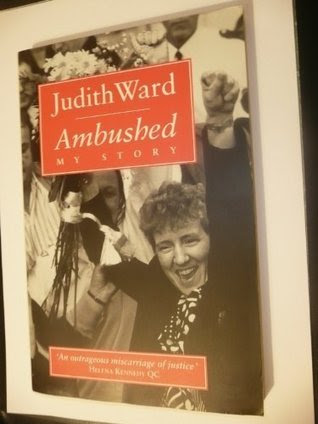
Her book, 'Ambushed - My Story' makes for interesting reading and allows the reader to draw comparisons with the injustices suffered by the Maguire Seven, the Birmingham Six and the Guildford Four ; a total of 18 innocent people, including Judith Ward (13 men, 3 women and two children) who, between them, spent a total of 216 years in prison. Anne Maguire, a mother of 5 children, was menstruating heavily and denied all toiletries for a week, and was beaten senseless and Carol Richardson, who didn't even know she was pregnant, miscarried in Brixton Prison days after her arrest.
Pat O'Neill, who had minutes before entered the Maguires house to arrange for a baby-sitter when the police arrived, was told by a cop to swear that he saw a big cardboard box on Maguires table or else he would be done, but he refused to lie - he served eleven years.
On his release, he found his marriage was broken beyond repair and that his six children had left the family home.
How many more Irish children will have to 'leave the family home' before the British eventually give a date for their political and military withdrawal from Ireland, because the situation as it now (and still) exists here is that their very presence continues to be objected to by Irish republicans and continues to give rise to unrest.
And, if our history is to be used as a yardstick, that will always be the case.


On the 4th November, 1921, during the 'Treaty of Surrender' negotiations (!?), one of the Irish plenipotentiaries (there were five altogether - Messrs. Robert Barton [pictured], Edmund Duggan, George Gavan Duffy, Arthur Griffith and Michael Collins), Mr Robert Barton, and a Mr Erskine Childers (the 'Principal Secretary to the Irish Delegation'), asked one of the other five 'negotiators' (?!), a Mr Seoirse Ghabháin Uí Dhubhthaigh (George Gavan Duffy) to go Dublin to lodge a complaint with a Mr Éamon de Valera, the President of Dáil Éireann.
The complaint was that Mr Griffith and Mr Collins were negotiating with the British on their own, behind closed doors - Mr Duffy lodged the complaint with Mr de Valera, who listened to the complaint but firmly declined to intervene.
And because he took no action to halt the so-called 'sub-conferences', Mr Griffith and Mr Collins continued to meet privately with British leaders, which fractured the Irish delegation's internal trust, culminating in the dramatic and divided final hours before the 'Treaty of Surrender' was signed on the 6th December 1921.
Mr Duffy was the last man to sign the 'Treaty', and done so reluctantly (as did Mr Barton, who later regretted it to the point that he campaigned and fought against it) ; he (Mr Duffy) attempted to explain/excuse himself on the 21st of December that year (1921) -
"I do not love this Treaty now any more than I loved it when I signed it, but I do not think that that is an adequate motive for rejection to point out that some of us signed the Treaty under duress, nor to say that this Treaty will not lead to permanent peace.
It is necessary before you reject the Treaty to go further than that and to produce to the people of Ireland a rational alternative.
My heart is with those who are against the Treaty, but my reason is against them, because I can see no rational alternative..."
The "rational alternative" to accepting a highly damaging arrangement, which 'legitimised' an unfair solution (!) which carried a higher long-term cost than rejecting it, was to maintain the guerrilla activity as best as possible, coupled with civil non-cooperation and to highlight British agression in Ireland as being an internationally unpopular bloody war against a democratic population.
Anyway - Mr Duffy was later to be appointed as the (3rd) 'President of the (Free State) High Court'.
In our opinion, Mr Duffy should have gone with his heart...
==========================
ON THIS DATE (4TH NOVEMBER) 25 YEARS AGO : BRITISH PARAMILITARIES CHANGE NAME AND UNIFORM.

On the 10th October, 1969, 'The Hunt Report' recommended that the RUC (which had been formed on the 5th April 1922) should be changed into an unarmed force, that the 'B Specials' (the 'Ulster Special Constabulary') should be disbanded and a new reserve force be established, to be known as the 'Ulster Defence Regiment'.
The RUC name was given to the then-existing RIC force on the 1st June 1922 in an attempted sleight-of-hand manoeuvre to present an existing pro-British paramilitary force as a 'new entity' and that 'new entity' - the RUC - was, in turn, amalgamated into the 'new' PSNI on the 4th November 2001 - 25 years ago on this date.
This was another tweaking of the name and uniform of a paramilitary outfit (and they've done it again!), as the 'police force' in that part of Ireland are still administered by Westminster and are as anti-republican as they were when they bore the 'RIC' name, and maintain the same structure and objective as when they were known by that latter name.
The more gullible in Leinster House and elsewhere among us (although they are well salaried to be so or, at least, to give the impression that they are that gullible) profess themselves convinced that a new day has dawned, ignoring the fact that the shadow in the room is caused by an elephant that they themselves have welcomed in.

THE MONTH UNSPUN...
The stories that hit the headlines.
From Magill magazine, August 2002.
Kildare county secretary Richie Whelan was asked by 'The Irish Independent' if Kildare would take the case to the GAC, and replied -
"We will probably discuss it here all right but there doesn't seem to be much point in asking for a clarification of rules when different rules obviously apply to different counties," he said.
So he's obviously still quite annoyed, then.
Assuming that at some point in the future another team will accidentally or otherwise repeat the mistake that Cork and Kildare made, it will be interesting to see what the ruling is.
Perhaps everything will be cleared up before then - although, knowing the GAA, perhaps not.
(END of 'The Month Unspun' : NEXT - 'ATTITUDES', from the same source.)
4TH NOVEMBER 1922 : IRISH REBEL CAPTURED BY THE STATERS.

Ernie O'Malley, pictured during his arrest in Dublin Castle in 1921 . He was using the alias 'Bernard Stewart' .
Then, as now, Irish republican prisoners fought against criminalisation and for prisoner-of-war status : Ernie O' Malley wrote -
"Free men cannot be kept in jail , for their spirits are free. In our code, it is the duty of prisoners to prove that they cannot be influenced by their surroundings. Make the enemy feel a jailer but be free yourself."
An appendix of prison letters records that spirit of defiance ; not surprisingly, Volunteer O'Malley was the last republican leader to be released from the Curragh Internment Camp in July 1924, although he had been confined to bed with his many wounds for most of his imprisonment.
Despite medical operations, he carried in his body five bullets to the grave.
When 'The Singing Flame' was published in 1978, twenty-one years after his death, the chief political book reviewer of 'The Irish Times' newspaper saw Ernie O' Malley as "...the unrepentant Fenian and perhaps even as the very first Provisional.." ('1169...' Comment : we disagree - O'Malley fought against Westminster, he didn't administer political or military 'control' on their behalf.)
Ernie O'Malley was one of the bravest, most idealistic, most dedicated and determined of republican fighters, ruthless against imperialism, but chivalrous in war.
On 30th June 1922, Volunteer O'Malley, as Officer Commanding of his IRA Garrison, most unwillingly surrendered the destroyed Four Courts in Dublin : when Free State officers accused him of deliberately causing the fire and the great explosion that had wrecked the building, he denied that republicans had set off a mine -
"It was the spirit of freedom lighting a torch. I'm glad she played her part."
Two years before he died he wrote -
"The spirit of freedom is immeasurable and its strength can suddenly increase in unexpected ways..."
On the 4th November, 1922, Volunteer O'Malley was staying with the Humphrys family at 36 Ailesbury Road, Donnybrook, Dublin (the house was constructed in 1920 by M/s Nell Humphreys, sister of Michael Joseph 'The O'Rahilly', who died in the 1916 Easter Rising), when the Staters raided the house and went straight to the secret room (which had been built for Volunteer O'Malley by a builder and republican activist, a Mr Batt O'Connor) where he was staying ; the Volunteer opened fire and, for the next hour or so, gunfire was exchanged between the rebel and the Staters.
Volunteer O'Malley sustained severe bullet wounds before being subdued by the Staters and taken into 'custody' by them.
He lived to fight another day but, on the 25th March, 1957, at 59 years of age, at 9.20am, in the home in Howth, Dublin, of his sister, Kathleen(/Kaye), his heart gave out on him ; he had had a long history of illness and heart conditions related to injuries from his revolutionary days and his body couldn't take any more.
But his mind was said to be as sharp as ever...
RIP Volunteer Ernie O'Malley.

On the 4th November, 1922, a Free State Army patrol was ambushed by the IRA in the townland of Carraig an Mharascalaigh ('Rockmarshall'), on the Cooley Peninsula in the county of Louth.
Two Staters - a 'Captain' James Boyle (24) and a 'Sergeant' Peter Treanor(/Trainor, mid-30's) were killed during the gunfight.
Mr Boyle was from Muchgrange, in Greenore, in the county of Louth and, before joining the Stater Army ('5th Northern Division'), he worked as a bookkeeper for the Greenore Railway Company.
He is buried in Cill Mhuire (Kilwirra) Cemetery in County Louth.
Mr Treanor(/Trainor), a widower (his wife, Margaret, died in January 1921 - they had three daughters [Mary Alice, Ellen, and Margaret] who were raised by his brother, Francis) had a prior 'military service history' that included a British Army pension.
The Volunteers returned safely to base.
==========================
At the same time as the Staters were under gunfire in Carraig an Mharascalaigh, their colleagues in Ballineen, in the county of Cork (about 260 miles/420 km down the country) were also duckin' and divin'!
An IRA Unit, consisting of around 200 armed fighters and with Volunteer Tom Barry in command, opened fire on a Free State Army patrol, wounding some of them during the five/six hours that the attack lasted for.
A Stater medic, a Mr Thomas Gallagher (18), ran into the line of fire to rescue one of his colleagues, an FSA soldier named Fox, but was hit himself.
The wounded young man was brought to the near-by home of a Mrs Sullivan, where he died.
Volunteer Tadhg O'Leary, 26, from Macroom in Cork, an IRA Section Commander, was killed in that fight, as was Volunteer Jack Howell, 31, from Doneraile in Cork.
RIP Volunteer Tadhg O'Leary and Volunteer Jack Howell.
==========================
AND...as those Staters in Cork were under fire from the rebels, so, too, were their colleagues about 80km (50 miles, as the crow flies) across the country in the county of Kerry.
Three Stater soldiers were guarding the drawbridge at Blennerville, in the county of Kerry, when they came under attack from the IRA.
One of them, a Mr Patrick Conroy (23) who, before expressing loyalty to the half-crown, worked as a labourer for Clonmel Corporation in the county of Tipperary, was severly wounded and died from those injuries shortly afterwards.
==========================
'THE TUAM HERALD', 4TH NOVEMBER 1922 : RIC 'SERGEANT RODDY'.

'November 4th, 1922.
The Civic Guards arrived in town last Friday and took possession of the old R.I.C. Barracks, now in a dilapidated condition.
Certain elements in our midst not actually criminals, will be none the worse for the restraining influence of the policeman.
The street brawler needs to be more careful, Saturday evening's pitch and toss school under the Cross in the Square will have to seek a more secluded venue and the all night pubs may be tempted to close a little earlier for their own sake if not for the customers'.
One member of the force was heartily welcomed. He was Sergeant Roddy.
One can't forget his action in July 1920 when as a member of the R.I.C. he refused to take part in the burning of the town.
He then resigned the force and was appointed Cramer* by the Commissioners, a position he held for a short time.
He was visited one night at his residence and beaten up by masked men** who threatened his life if he did not leave the town which he had to do for the sake of his family.
Now he is back in charge of the new force.'
(NOTE - * 'Cramer' : a typo - should read 'craner', an early 20th century job description, sometimes spelled 'crayner', an 'official civic position' ie weighbridge operator, appointed directly by the Town Commissioners [the local municipal government body]. It was a recognised position, operating and collecting tolls at a weighing crane used for goods brought to market.
** - that would have been his own [ex-] RIC colleagues who beat him up and evicted him from the town, for being 'sympathetic to the rabble'.)
A pity Mr Roddy only changed uniforms...
DEATH IN THE MEDITERRANEAN...

Desmond Boomer, a Belfast engineer working in the Libyan oil-fields, disappeared seven years ago.
Officially, the plane on which he was a passenger crashed as a result of mechanical failure and pilot error.
But is that the real story?
Or were the Irishman and his fellow passengers unwitting victims of the shady war between Islamic fundamentalism and Mossad, Israel's intelligence network?
A special 'Magill' investigation by Don Mullan, author of 'Eyewitness Bloody Sunday'.
From 'Magill' magazine, January 2003.
The Boomer family have made ten visits to Malta to attend various sittings of the Board of Inquiry :
"If the Irish government supports us," Cormac Boomer said, "we would gladly challenge Malta's handling of our son's disappearance in the Maltese courts."
He also feels a sense of profound disappointment towards former political colleagues in the North ; he was involved with the SDLP for 20 years, 16 of which he spent as a Belfast City councillor.
Despite this, he has received absolutely no assistance from any northern politicians.
"I have written to MEP's and MP's," he says, "and sent them documentation and information files. To date, only Gerry Adams MP and Jim Nicholson MEP did me the courtesy of a reply...
(MORE LATER.)
4TH NOVEMBER ; 1650, 1779, 1843 AND 1920.

SNIPPETS...
• 1650 - 'The Cromwellian Squeeze' ; English 'King' William III ('William of Orange') was born in the Hague ('Dutch Republic')on the 4th November that year ('old style calendar', or 14th November, 'new style calendar'), and the Cromwellian 'authorities' in Ireland issued strict, sweeping orders, in Dublin, enforcing the exclusion of the native Irish from within the city walls, part of the systematic clearance and urbanisation control that defined the 'Commonwealth' era.
His birthday later evolved into one of the most prominent and intensely controversial 'civic celebrations' (!) in Dublin's history, becoming a major public holiday in Dublin for the Protestant ruling class.
Every year, the city's authorities and militias would parade in uniform around the city...
• 1779 - 'The Volunteers and Free Trade' ; On the 4th November, 1779, a massive and heavily armed parade of the 'Irish Volunteers' took place at College Green in Dublin, where they famously draped 'King' William III's statue with banners reading "Free Trade or This!", forcing the British government to back down on crippling commercial restrictions on Ireland.
On that date in that year, roughly 1,000 members of the 'Irish Volunteers' assembled on College Green in Dublin to celebrate the 129th birthday of 'King' William III - armed Volunteer troops formed-up and fired muskets around Grinling Gibbons's bronze statue of 'the king' to demonstrate political strength and to pressure the British government for legislative independence and free trade for the Irish Parliament...
• 1843 - 'The Silencing of O'Connell' ; In the fallout of the banned 'Monster Meeting' at Clontarf, Daniel O'Connell and his associates were formally processed through the Crown Courts on charges of "conspiracy to alter the constitution by illegal means," showcasing the 19th-century legal machinery used to halt mass mobilisation, and the (ab)use of the then media to do so.
On the 4th November in 1843, the British 'satirical' magazine, 'Punch', published a famous and hostile cartoon titled 'The Irish Frankenstein', which depicted Mr O'Connell conjuring up a giant, menacing monster, representing the Repeal movement as a massive brute he had created which he could no longer control after backing down at Clontarf.
Also, on that same date, 'The Nation' newspaper, the official newspaper of the 'Young Ireland' wing of the movement, published an extensive, historically significant issue in which writers like Thomas Davis debated the future of the Repeal Association, deeply analysing what Mr O'Connell's capitulation at Clontarf meant for the movement and how they should pivot toward a more aggressive strategy...
• 1920 - 'The Kevin Barry Aftermath' ; Just days after 18-year-old Volunteer Kevin Barry was hanged at Mountjoy (1st November), the 4th November 1920 saw an intense escalation in the intelligence war, with the IRA executing several British intelligence agents and the Crown Forces intensifying localised curfews and raids across Dublin and Belfast.
The political and military crisis in Ireland intensified sharply.
Parliamentary debates in Westminster and the 'House of Commons' took place during which the escalating "policy of frightfulness" and 'police/military reprisals' in Ireland were raised, specifically addressing allegations that Volunteer Kevin Barry had been subjected to torture while in custody before his trial...
Thanks for the visit, and for reading the few words we write - appreciated, and don't forget to mention our presence to yer pals!
We'll be back on Wednesday, 18th November 2026 and, between this and then, I'll still be voicing me opinion on 'X' and 'Facebook' as well, if yer missing me that much!
Sharon and the team.
Slán go fóill anois!

