ON THIS DATE (26TH APRIL) 42 YEARS AGO : "TWENTY THOUSAND MARCHERS..."
Mrs. Rosaleen Sands (RIP).
Dear Mum
Dear Mum, I know you’re always there
To help and guide me with all your care,
You nursed and fed me and made me strong
To face the world and all its wrong.
What can I write to you this day
For a line or two would never pay
For care and time you gave to me
Through long hard years unceasingly.
How you found strength I do not know
How you managed I’ll never know,
Struggling and striving without a break
Always there and never late.
You prayed for me and loved me more
How could I ask for anymore
And reared me up to be like you
But I haven’t a heart as kind as you.
A guide to me in times of plight
A princess like a star so bright
For life would never have been the same
If I hadn’t of learned what small things came.
So forgive me Mum just a little more
For not loving you so much before,
For life and love you gave to me
I give my thanks for eternity.
 Bobby Sands (RIP).
'MUTUAL GOODWILL...!'
From 'The United Irishman' newspaper, April 1955.
We are so familiar with the English code of honour (!) that it is no surprise to read that in later years, when Disraeli had become Prime Minister, he wrote the following to the 'Viceroy' of Ireland -
"A portion of the population is attempting to sever the constitutional tie which unites it to Great Britain in the bond which has favoured the power and prosperity of both. It is to be hoped that all men of light and leading will resist this destructive doctrine..."
'Lord' Derby, in October 1881, writing of the Fenian movement, said -
"A few desperate men (sic), applauded by the whole body of the Irish people for their daring, showed England what Irish feeling really was ; made plain to us the depth of a discontent whose existence we had scarcely suspected. It is regrettable that, for the third time in less than a century, agitaetion accompanied by violence should have been shown to be the most effective instrument for redressing whatever Irishmen (sic) may be pleased to consider their wrongs."
Not even the pseudo-freedom we have today was gifted to us by England, or obtained by negotiation and "mutual good will" ; such 'freedom' as we have was wrested from England by force of arms...
(MORE LATER.)
ON THIS DATE (26TH APRIL) 107 YEARS AGO : IRISH PACIFIST EXECUTED BY THE BRITISH.
Francis Sheehy-Skeffington was born on the 23rd December 1878 in Bailieborough, Co Cavan, and was 37 years of age in 1916 when some of those who shared mostly the same social interests as he did and frequented the same venues (Thomas MacDonagh, James Connolly, Countess Markievicz and Joseph Plunkett, for example) organised and took part in an armed uprising against the British. Sheehy-Skeffington would have been sympathetic to their objective but not to their method.
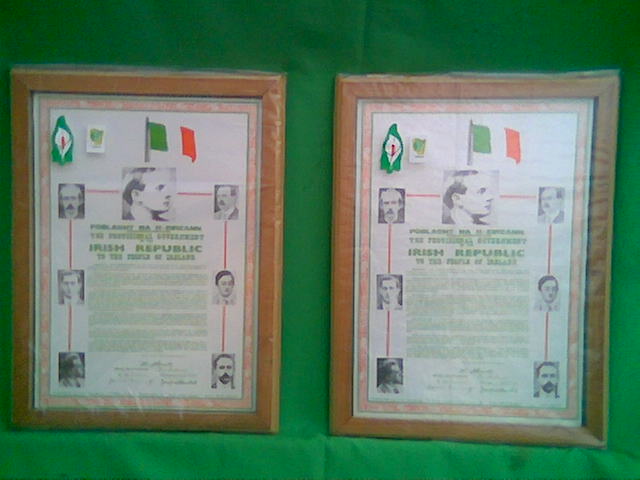
On Easter Monday, 24th April 1916, the Irish republican Proclamation was circulated in Dublin and, in reply, on Tuesday 25th, the British circulated their own 'Proclamation' in Dublin -
' A PROCLAMATION -
Bobby Sands (RIP).
'MUTUAL GOODWILL...!'
From 'The United Irishman' newspaper, April 1955.
We are so familiar with the English code of honour (!) that it is no surprise to read that in later years, when Disraeli had become Prime Minister, he wrote the following to the 'Viceroy' of Ireland -
"A portion of the population is attempting to sever the constitutional tie which unites it to Great Britain in the bond which has favoured the power and prosperity of both. It is to be hoped that all men of light and leading will resist this destructive doctrine..."
'Lord' Derby, in October 1881, writing of the Fenian movement, said -
"A few desperate men (sic), applauded by the whole body of the Irish people for their daring, showed England what Irish feeling really was ; made plain to us the depth of a discontent whose existence we had scarcely suspected. It is regrettable that, for the third time in less than a century, agitaetion accompanied by violence should have been shown to be the most effective instrument for redressing whatever Irishmen (sic) may be pleased to consider their wrongs."
Not even the pseudo-freedom we have today was gifted to us by England, or obtained by negotiation and "mutual good will" ; such 'freedom' as we have was wrested from England by force of arms...
(MORE LATER.)
ON THIS DATE (26TH APRIL) 107 YEARS AGO : IRISH PACIFIST EXECUTED BY THE BRITISH.
Francis Sheehy-Skeffington was born on the 23rd December 1878 in Bailieborough, Co Cavan, and was 37 years of age in 1916 when some of those who shared mostly the same social interests as he did and frequented the same venues (Thomas MacDonagh, James Connolly, Countess Markievicz and Joseph Plunkett, for example) organised and took part in an armed uprising against the British. Sheehy-Skeffington would have been sympathetic to their objective but not to their method.
On Easter Monday, 24th April 1916, the Irish republican Proclamation was circulated in Dublin and, in reply, on Tuesday 25th, the British circulated their own 'Proclamation' in Dublin -
' A PROCLAMATION -
WHEREAS, in the City of Dublin and County of Dublin, certain evil disposed persons and Associations, with the intention of subverting the supremacy of the Crown in Ireland, have committed diverse acts of violence, and have with deadly weapons attacked the forces of the Crown, and have resisted by armed force the lawful authority of His Majesty's Police and Military forces ; and WHEREAS by reason thereof several of His Majesty's liege subjects have been killed and many others severely injured, and much damage to property has been caused ; and WHEREAS such armed resistance to His Majesty's Authority still continues :
NOW WE, Ivor Churchill Baron Wimborne, Lord Lieutenant-General and General Governor of Ireland, by virture of all the powers thereunto enabling us, do hereby proclaim that from and after the date of this Proclamation, and for the period of one month thereafter, unless otherwise ordered, the City of Dublin and County of Dublin are under and subject to Martial Law ; and WE do hereby call on all loyal and well-affected subjects of the Crown to aid in upholding and maintaining the peace of the Realm and the supremacy, and authority of the Crown ; and WE warn all peaceable and law-abiding subjects within such area of the danger of frequenting or being in any place in or in the vicinity of which His Majesty's forces are engaged in the suppression of disorder :
AND WE do hereby enjoin upon such subjects the duty and necessity, so far as practicable, of remaining within their own homes so long as these dangerous conditions prevail ; and WE do hereby proclaim that all persons found carrying arms without lawful authority are liable to be dealt with by virture of this Proclamation.
Given at Dublin,
This 25th day of April, 1916.
WIMBORNE.
GOD SAVE THE KING.'
That British 'Proclamation' was only in circulation for a day when three men were 'arrested' by British forces : Francis Sheehy-Skeffington, Patrick McIntyre and Thomas Dickson.
It was earlier on that same day, Wednesday 26th April 1916, that 1,600 British soldiers from the 'Third Cavalry Brigade', artillery from Athlone and the 176th and 178th Infantry Brigades of the 59th North Midland Division of the British Army were preparing themselves for the march from 'Kingstown' Harbour (Dun Laoighaire) to Dublin city centre.
Tension was high in the city ; Francis Sheehy-Skeffington, a leading writer and well-known pacifist, was in Dublin city centre, on his way home to Rathmines when he tried to help stop looters who were out in force, taking advantage of the disorganised situation in the capital, but he was 'arrested' by British troops from Portobello Barracks, as were two other civilians - Dublin journalists Patrick McIntyre, then editor of the 'Labour' newspaper, 'Searchlight', and Thomas Dickson, then editor of a pro-republican weekly newspaper, 'The Eye-Opener'.
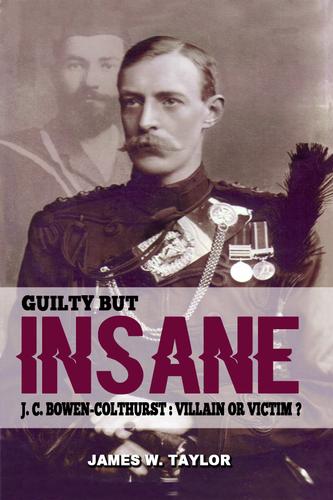
Word circulated on Thursday morning, April 27th, 1916, that the three men had been shot dead in the barrack square by a British Army firing squad, without any 'formal' charges having been brought against any of them. Later , the British Army Captain in charge of the firing squad, a Bowen Colthurst, a member of the 'Royal Irish Rifles', from Dripsey in County Cork, who was a decorated officer who had fought in the Boer War and afterwards served in India, including the 1904 British military incursion into Tibet.
He had been injured while leading a disastrous attack against a German position on the western front in September 1914 and was sent back to Ireland. He was attached to the 3rd Battalion stationed at Portobello Barracks when the 1916 Easter Rising took place. Colthurst was later 'tried' by court-martial regarding the order he issued to the firing squad and was found 'guilty but insane', but a different account re the shooting of the three men was beginning to emerge.
It was during the court-martial of Bowen Colthurst that a different version of the events surrounding the executions of Francis Sheehy Skeffington, Patrick mcIntyre and Thomas Dickson was spoke of - a British Army Officer in Portobello Barracks stated that he heard a number of shots on the Wednesday (April 26th, 1916 - 107 years ago on this date) and went to investigate ; he claimed to have seen three stretchers being carried out of the porch of the guardroom on which were three dead bodies - one of those bodies had a blanket thrown over it and a bowler hat placed across the face and, from either side of the stretcher, an arm hung down, dripping blood.
This (unnamed) British Army Officer claimed that the body with the bowler hat on the face was that of Francis Sheehy Skeffington - the 'witness' stated, apparently in a jovial manner, that the firing party had done its work so badly that a second one had had to be summoned to finish Skeffington off. Were the three men shot dead in the guardroom on the Wednesday night (26th April 1916) by a vengeful British enemy and then, in order to cover-up the deed, were their corpses 'wheeled out' the following day for an 'official' British Army 'execution'..?
The following letter makes for interesting reading in relation to the circumstances surrounding this particular event -
From Henry Lemass
To : Herbert Henry Asquith
13 June 1916
31 PARLIAMENT STREET, DUBLIN,
SIR
As solicitor for Mrs. Sheehy Skeffington - for whose husband's murder, on 26th April, Captain Bowen Colthurst has been adjudged guilty - I have the honour to inquire when the promised Public Inquiry will be held? My client is profoundly dissatisfied with the limited information afforded at the Courtmartial, when the insanity of the accused was suggested. While she abhors the idea that fresh blood should be spilt, my client is equally resolute that the truth should be known, so that the people of the three Kingdoms may determine whether the same measure of justice has been meted out to all parties affected by the rebellion.
That there were circumstances giving rise to anxiety connected with the recent trial will be evident from the following facts : Lieutenant Wylie, K.C. who had prosecuted to conviction other men recently executed, was released from this Courtmartial and an English Counsel, not fully acquainted with the facts or imperfectly instructed, was appointed. Although no plea of inability to plead was entered for the accused, the question of his sanity was raised from the outset.
Yet the manner in which he effected the arrest of the other murdered men (Messrs Dickson and McIntyre) was not proved, nor the process by which he selected them for execution from amongst eight prisoners. Nevertheless, it was within the knowledge of the Military Authorities that Messrs Dickson and McIntyre were taken into custody on the premises of Alderman James Kelly, ex-High Sheriff, by the accused, under the idea that the shop belonged to Alderman Thomas Kelly, a person of wholly different politics.
They also knew that Colthurst threw a bomb into the premises and subsequently "planted" Mr. Dickson's trunk therein to give rise to the suspicion that Mr. Dickson had been harboured by Alderman James Kelly who was also lodged in Portobello Barracks.
Nor was the Court informed that two sisters of Mrs. Skeffington, viz: Mrs Kettle (wife of Lieutenant Kettle), and Mrs, Culhane (widow of a public official lately deceased) called at Portobello Barracks on Friday, 28th April, after the murders, and, on inquiring for their brother, Lieutenant Sheehy, were put under arrest and brought before Captain Colthurst, and that he denied all knowledge of Mr. Skeffington and was perfectly calm and collected in his demeanour and falsehoods.
Similarly, the tribunal was not made aware that on the evening after his examination of these ladies, Captain Colthurst ordered a search of Mrs.Skeffington's house ; that his soldiers first fired into her dwelling, and then, producing a key taken from the body of the murdered man, opened his locked room and removed documents to try to furnish the accused with ex post facto justification for his crime.
The second raid on the widow's house by Colthurst's orders on the following Monday, as well as the fact that one of the soldiers who took part in it was the Sergeant left in charge of Dickson's trunk at Alderman James Kelly's, was also left unmentioned. There was an equally significant silence as to the protests of the murdered men on the morning of their execution, and as to the accused's refusal of spiritual solace to them in their last moments.
The Courtmartial were likewise unaware that Captain Colthurst was allowed to remain at large by his superiors until the 6th May - nearly a fortnight after the murders - while the non-production of Major Sir Francis Vane, his Senior Officer, disabled it from learning that on the 1st may (a week after the murders) the accused was promoted to the charge of the Defence of Portobello Barracks.
His conduct on shooting the lad, Coade, on Rathmines Road previous to the three murders, was not introduced, although Coade's father immediately lodged information at the Barracks.
None of the soldiers who formed the firing party was called to speak as to the nature of the accuseds commands and demeanour, or explain how Mr. Skeffington came to be taken from a locked cell without authority. The added tragedy which led to a second squad of soldiers being called out to fire at the prostrate body of Mr. Skeffington would not have become known (although proved at the private preliminary inquiry) but for the candour of the noble President of the tribunal, Lord Cheylesmore.
As for the attempt to fasten complicity with the rebellion on Mr. Skeffington by the production of a document published previously by Alderman Thomas Kelly (which deceased, as a journalist, kept in his house) - it stands in strange contrast with the silence preserved concerning the innocence of the other slaughtered men and the Court was not even told who or what they were. The admission of this document after Adjutant Morgan, who produced it, had sworn that it was not found on Mr. Skeffington, may have been due to inadvertenance, but the cunning of the untruthful endorsement on it by the accused to the effect that it was found on the body, seemed to call for observation on the issue of sanity, as corroboration of the fact that Captain Colthurst from the date when he knew the murders were discovered, was engaged in the manufacture of evidence to palliate his guilt.
I therefore have to ask that in view of the promised Inquiry you will make arrangements with the Military Authorities to have in attendance thereat, in addition to the witnesses called on behalf of the prosecution at the late Courtmartial, the following persons : 1 — The soldiers under command of Lieutenant Wilson when Mr. Skeffington was marched out of his cell into the street to serve as a hostage. 2 — The soldiers who composed the first and second firing parties. 3 — Lieutenant Colonel McCammond who was in command of the Royal Irish Rifles. 4 — Major Sir Francis Vane, 2nd in Command. 5 — Lieutenant Tooley and Lieutenant Gibbon. 6 — The officers and soldiers who were sent after the murder to search Mrs. Skeffington's residence on two occasions - especially Sergeant Claxton.
Of course, the names, regiment and regimental number of all the proposed witnesses should be supplied to me some days before the Inquiry, unless the Government undertake to call them for examination. I should also be furnished the Notes of the preliminary Inquiry which the Courtmartial were supplied with. In addition I request that all documents, etc., taken from the person of Mr. Skeffington, or seized at his residence, should be returned, and if this is refused that copies should be supplied to me.
I should likewise be afforded an opportunity of examining and taking copies of any reports or entries dealing with the circumstances attending the arrest or execution of Mr. Skeffington, or the searches at his residence. I shall feel obliged by an intimation of an early decision.
I have the honour to be, Sir,
Your obedient Servant
HENRY LEMASS.
To THE RIGHT HON. H. H. ASQUITH, K.C., M.P.,
Prime Minister,
10 Downing Street, London, S.W.'
Francis Sheehy Skeffington : Born 23rd December 1878, Bailieborough, County Cavan ; Died 26th April 1916, 107 years ago on this date, Portobello Barracks, Dublin, aged 37.
ON THIS DATE (26TH APRIL) 278 YEARS AGO : 'LORD' KILLED BY A DRAGO(O)N'S 'STING'.
'Positive and overbearing,
Changeful still and still adhering,
Spiteful, peevish, rude, untoward,
Fierce in tongue, in heart a coward.
Judgement weak and passion strong,
Always various, always wrong.'
"On this date (26th April 1745 - 278 years ago today), John Allen (3rd Viscount Allen), former MP for Carysfort, kills a dragoon in a street brawl : 'His Lordship was at a house in Eustace Street. At twelve in the night, three dragoons making a noise in the street, he threw up the window and threatening them, adding as is not unusual with him a great deal of bad language.
The dragoons returned it. He went out to them loaded with a pistol. At the first snapping of it, it did not fire. This irritated the dragoon who cut his (ie Allen's) fingers with his sword, upon which Lord Allen shot him.' The wound occasions a fever which causes Lord Allen’s death on 25 May..."
Or maybe, perhaps, the '3rd Viscount' did not invite such misfortune onto himself - '..he seems to have been mugged in the centre of Dublin one night in 1745, and although he fought off his attackers - and killed one of them - he received a wound in his hand which became infected and caused his death a month later...he died on 25 May 1745 from an infected wound in the hand received when he was 'insulted in the public streets by some disorderly dragoons' - one of whom he killed - on 26 April 1745..' (from here.)
And this, sourced from 'Google Books' - 'This nobleman being insulted in the public streets by some disorderly dragoons 26 April 1745, received a wound in the hand which occasioned a fever, and caused his death 25 May...'
But, really, whatever about John Allen (the'nobleman') inviting trouble by being verbally aggressive to three 'loud' soldiers (karma that all four participants were birds of a feather!) or whether the three soldiers momentarily forgot they were on home ground and simply behaved as if they were 'on duty' elsewhere in their 'empire', the parties involved caused trouble only too and for themselves, unlike another 'John Allen', featured here, who would attempt to convince you (having himself obviously being convinced by his 'betters') that the 'empire' he served is some sort of benevolent and charitable organisation, rather than the thieving and toxic entity it is.
That last link will permit you to 'View More Comments', and you should - "And I'm sure that many members of the Red Army were "fully dedicated to the well-being and advancement of the people they served" and had a "sense of mission" too..the problem is that ruling over people without their consent (which is what colonialism is a subset of) is wrong. It doesn't matter if you do it for purely "greater good" or paternalistic reasons, it's still wrong...it would be much better for us as a society to really stop lying to ourselves and face the reality of the British Empire.
It committed genocide across the world, stole the natural resources from the countries we claimed as ours, destroyed and laid waste to the cultures of millions of people, raped, pillaged and then in the dog days of empire we pretend we were their (sic) to protect the people from terrorists.."
At least this'John Allen', the 'Funnyman', admits to being a comedian, unlike the other two, and acknowledges that 'his house is a mess' - the other two John Allen's, by virture of their professions, preferred to 'mess up' everybody else's 'house'...
'THOUGH THE HEAVENS MAY FALL...'
From 'Magill' Annual, 2002.
Dr Moira Woods (pictured).
In March 1992, a complaint alleging professional misconduct against Dr Woods was lodged with the Medical Council, the governing body of the medical profession in Ireland (sic).
The complaint made little progress during the lifetime of the then council, and it was not until a new council took office in 1995 that an inquiry was mooted. In January 1996, the families were informed by the Medical Council that there was sufficient prima facie evidence to warrant an inquiry.
In December 1996, the Medical Council's 'Fitness to Practice Committee' met to consider whether the inquiry should be held in public or in private and a majority of the Committee concluded that, with the exception of matters relating to one family, it would be appropriate to proceed by means of a public inquiry.
The names of children and families were to be removed from all documents, and it was ruled that references to them in the course of the inquiry should not allow them to be identified...
(MORE LATER.)
FUNDS AND FINE GAEL'S LEADER...
Michael Lowry has so far been the focus of media attention about Fine Gael fundraising.
But the party's current leader, Enda Kenny (pictured), hosted a £1,000-a-plate dinner two days before the second mobile phone licence was awarded. And other guests say that one of the bidders for that licence was in attendance.
By Mairead Carey.
From 'Magill' magazine, January 2003.
Enda Kenny made it clear from the outset of the latest leadership campaign that he did not support Michael Noonan's view on corporate donations - and overturned the (Fine Gae) ban within months of taking the helm.
Since 1997, the party has had to disclose the identity of donors, which has led to a falling-off in revenue. Fine Gael received no corporate donations last year (2002) as a result of Noonan's ban and received just over €60,000 in 2000 and just over €18,000 in 1999. Because it lost over 20 TD's (sic) in the last election, the party is down some €600,000 in State funding given to the main political parties.
Enda Kenny's own fundraising has never reached the heights it scaled when he was in office...
(MORE LATER.)
Thanks for the visit, and for reading,
Sharon and the team.
ON THIS DATE (19TH APRIL) 83 YEARS AGO : IRA DIRECTOR OF PUBLICITY DIES ON HUNGER-STRIKE.
IRA man Jack 'Seán' McNeela (pictured) was born in Ballycroy, Co. Mayo, in 1912 and, although only 27 years of age in 1939, was an experienced IRA Volunteer when the Leinster House (Free State) political administration introduced an 'Offences Against the State Act', incorporating a 'Special Criminal Court', which effectively re-classified republican prisoners as 'special criminals' rather than that which they were (and are), political prisoners.
IRA prisoners in Mountjoy Jail vehemently objected to that policy change and the following story of that particular period in our history, as recorded by Michael Traynor, was given to Republican Sinn Féin by Carmel McNeela, widow of Paddy McNeela and sister-in-law of Jack 'Seán' Mc Neela - but a bit of background, first :
Tony Darcy, a Galway IRA man and Officer Commanding of the IRA Western Command at the time, who began his hunger strike on 25th February 1940 and died on 16th April, in St Bricins (Free State) military hospital in Dublin, after 52 days on hunger strike, was sentenced to three months imprisonment for refusing to account for his movements or give his name and address when arrested by Free Staters at an IRA meeting in Dublin.
The POW's went on hunger strike after Meath IRA man, Nick Doherty, was imprisoned on the criminal wing in Mountjoy Jail and a request to transfer him to join his political comrades in Arbour Hill Jail was refused by the Staters. One week into the protest, the prison authorities made a move to take the IRA OC of the prisoners, Jack 'Seán' McNeela, for 'trial' before the 'Special Criminal Court' but he refused to go with them.
Barricades were built and D-Wing was secured as best as possible by the IRA prisoners and they were soon attacked by armed Special Branch men, backed-up by the Dublin Metropolitan Police. Among the casualties were McNeela and Darcy, both of whom were beaten unconscious and suffered wounds that were never allowed to heal.
This is the account of that period, by Michael Traynor :
"When Seán Russell became CS (Chief of Staff) of the IRA in 1938 he immediately appointed Jack McNeela as 'OC (Officer Commanding) Great Britain' with the particular task of putting the organisation there on a war footing and amassing explosives and preparing for the forthcoming bombing campaign.
After a few months of tense activity Jack was arrested and sentenced to nine months imprisonment. He returned to Ireland in 1939 and was appointed Director of Publicity. Jack was very disappointed with this appointment. He said he knew nothing about publicity and would have preferred some task, no matter how humble, which would have kept him in contact with the rank and file Volunteers. However 'Publicity' had to be organised and Jack threw himself to the job with zeal and energy.
After two months, out of nothing, Jack had his Publicity Department functioning perfectly. Writers were instructed and put to work, office staff organised, radio technicians got into harness.
Another big disappointment at this time for Jack was the instructions he received about the raid on the Magazine Fort. He nearly blew up when he was told that he could not take part in the operation, that HQ staff could not afford to lose more (Volunteers) if the operation failed. He was a man of action and wanted to be with his comrades in time of danger. He repeatedly requested permission to take part in the operation but without success.
But Jack was there, orders or no orders, and he did about ten men's work in the taking of the fort and the loading of the ammunition. He was a very pleased man that night, for he, like all the rest of the members of GHQ, knew that this ammunition was necessary to the success of the Army's attack on the Border, which was planned to take place in the following spring.
He was arrested about three weeks later with members of the Radio Broadcast Staff and lodged in Mountjoy jail. He was OC of the prisoners when I arrived in the middle of February 1940. Tomás Mac Curtáin was there, and Tony Darcy, who was a very great personal friend of Jack's, so was Jack Plunkett and Tommy Grogan.
I was about a week in jail, life was comparatively quiet, great speculation was going on as to what would happen to the men arrested in connection with the raid on the Magazine Fort. The crisis developed when Nicky Doherty, of Julianstown, Co Meath, was sentenced to five years penal servitude. Instead of being transferred to Arbour Hill, where other republican prisoners had political status, Nicky was lodged in the criminal section of Mountjoy Jail.
Jack, being OC of the republican prisoners, interviewed the governor of the jail and requested that Nicky be transferred to Arbour Hill on the grounds that he was a political prisoner and that it was unjust and unchristian to attempt to degrade and classify as criminal a republican soldier. The request was ignored. Jack and his prison council met to consider the situation : it was decided that a demand was necessary and with the demand for justice went the ultimatum that if he refused a number of prisoners (who were still untried) would go on hunger strike until the demand was accepted. A short time limit was set, but that demand was also ignored.
Jack, I remember well, was very insistent that the issue should be kept clear and simple. The hunger strike was a protest against the attempted degradation of republican soldiers. There was no other question or issue involved. A simple demand for justice and decency. Seven men volunteered to go on hunger strike and when the time limit [February 25, 1940] of the ultimatum expired they refused to eat any food, although tempting parcels of food kept arriving every day from their relatives and friends.
It was felt by the men on hunger strike that the struggle would be either a speedy victory or a long, long battle, with victory or death at the end. It was victory and death for Jack McNeela and Tony Darcy."
"Seven days after the commencement of the hunger strike, Special Branch policemen came to take Jack to Collins Barracks for trial before the 'Special Criminal (or was it the Military) Court'. Jack refused to go with them. They told him they'd take him by force. They went away for reinforcements. A hasty meeting of the Prisoners' Council was held. They felt it was unjust to take Jack for trial while he was on hunger strike, and that everything possible should be done to prevent the hunger strikers from being separated.
Barricades were hastily erected in the D-Wing of the jail. Beds, tables and mattresses were piled on top of each other ; all the food was collected and put into a common store and general preparations made to resist removal of Jack, their OC. A large contingent of the DMP arrived together with the Special Branch at full strength. The DMP men charged the barricades with batons ; the Special Branch men kept to the rear and looked on while the DMP men were forced to retire by prisoners with legs of chairs. Several charges were made but without success. Some warders and a few policemen suffered minor injuries. The governor of the jail came down to the barricade and asked the prisoners to surrender. They greeted him with jeers and booing.
After some time the DMP men returned, armed with shovel shafts about six feet long, hoping with their superior weapons to subdue the prisoners. After several charges and some tough hand-to-hand fighting the DMP again retired. The most effective weapon possessed by the prisoners was a quantity of lime, liquefied by some Mayo men, and flung in the faces of the charging DMP men.
It was reminiscent off the Land League days and the evictions. Finally the fire hydrants were brought into use and the force of the water from these hoses broke down everything before them. The barricade was toppled over and the prisoners, drenched to the skin, could not resist the powers of water at pressure ; they were forced to take cover in the cells.
I got into a cell with Tony Darcy and Jack McNeela. We closed the door. After a few minutes the door was burst open and in rushed about five huge DMP men swinging their batons in all directions. Tony, standing under the window facing the door, put up his hand but he was silenced by a blow of a baton across the face that felled him senseless. Jack was pummelled across the cell by blow after blow. Blood teemed from his face and head.
These wounds on Jack and Tony never healed until they died."
"It lasted only a few brief minutes, this orgy of sadistic vengeance, and then we were carried and flung into solitary confinement. Jack was taken away that evening and tried and sentenced by the Special Court. The next time I saw Tony and Jack was in the sick bay in Arbour Hill. Jack Plunkett was also there with them. We exchanged experiences after the row in the 'Joy'.
Day followed day, I cannot remember any particular incident, except that regularly three times a day an orderly arrived with our food, which we of course refused to take. We were by now nursing our strength, realising that this was a grim struggle, a struggle to the death.
We jokingly made forecasts of who would be the first to die. Jack was almost fanatic about speaking Gaelic. Most of our conversation while in the Hill was in Gaelic. Tony used to laugh at my funny accent. While he couldn't speak Gaelic he understood perfectly well all that was said and sometimes threw in a remark to the conversation. When conversation was general, English was the medium.
Jack Plunkett didn't know any Gaelic at all. We were in the best of spirits. Rumours filtered through to us, I don't know how, because we were very strictly isolated from the rest of the republican prisoners in the Hill. We heard that one of our comrades had broken the hunger strike at the Joy ; we didn't hear the name for a few days. The report was confirmed. We were inclined to be annoyed, but we agreed that it was better for the break to come early than late. It had no demoralising effect.
After Jack was arrested all the books he had bought (mostly Gaelic) were sent into the Joy. He intended to make good use of his spell of imprisonment. He kept requesting the Governor of the Hill to have them sent to him. After about three weeks a few tattered and water-sodden books were brought to him, all that remained of his little library, the others had been trampled and destroyed by the DMP in Mountjoy. Jack was vexed. He hadn't smoked, nor taken drink, and every penny he had went to the purchase of these books that he loved.
We were, during all this time, as happy as men could be. In spite of imprisonment and all that it means we were not all despondent nor feeling like martyrs. Everyday, we reviewed our position ; what we had done, our present state of health, the prospect of success. The conclusion we came to was that de Valera, Boland and Co had decided to gamble with us – to wear us out in the hope that we would break and therefore demoralise all our comrades and if we didn't break, to give political treatment to all IRA prisoners when we were in the jaws of death. The issue, as we saw it, was of vital importance to us, but of practically no consequence to the Fianna Fáil regime. We knew of course that de Valera and the Fianna Fáil party hated the IRA, because we were a reminder of their broken pledge to the people.
On the eve of St Patrick's Day we were removed to St Bricin's military hospital (pictured). A few days later Tomás Mac Curtáin and Tommy Grogan joined us. We were terribly disappointed with their report from the 'Joy'. The men who had been sentenced were accepting criminal status instead of refusing to work as they had been instructed to do ; that is another story, although it led directly to the death of Seán McCaughey six years later in Portlaoise jail.
We were in a small hospital ward. Three beds on each side, occupied by six hungry men and every day was a hungry day. Every evening each of us would give the description of the meal he would like most, or the meal he had enjoyed most. Salmon and boxty loomed large in Jack's menu. About this time we began to count the days that we could possibly live.
The doctors who examined us, sometimes three times a day, told us that we had used up all our reserves and were living on our nerves ; they tried to frighten us, assuring us that if we didn't come off the hunger strike our health would be ruined. We all agreed among ourselves that the doctors were actuated by purely humane motives, although their advice if acted on by us would have been very satisfactory to their employers. After 50 days on hunger strike we were unable to get out of bed, or rather the strain of getting up was too great an expenditure of energy, which we were determined to husband carefully.
We did not see any change on each other. The change came so imperceptibly day after day. Jack, lying in the next bed to me, seemed to be the same big robust man that I had known before we were arrested, yet we each were failing away. The doctors and nurses were very kind. We were rubbed with spirit and olive oil to prevent bedsores ; all our joints and bony places were padded with cotton wool, for by now the rubbing of one finger against another was painful. None of us could read anymore, our sight had lost focus and concentration on material objects had become difficult. We were face to face with death, but no one flinched or if he did he prayed to God for strength and courage.
On the 54th night of the strike, about midnight, Tony cried out (we were all awake): 'Jack, I'm dying.' We all knew that it was so. Jack replied, 'I’m coming, Tony’. I felt, and I'm sure Jack and the others felt also that getting out of bed and walking across the room to Tony would mean death to Jack also. As well as I remember Mac Curtáin, Plunkett, Grogan and myself appealed to Jack not to get out of bed. But Tony's cry pierced Jack's heart deeper than ours so he got up and staggered across the room to his friend and comrade. Later that night Tony was taken out to a private ward. We never saw him again. He died the following night. A great and staunch and unflinching soldier and comrade ; oh that Ireland had twenty thousand as honourable and fearless as he.
The day following Tony's removal from the ward, Jack's uncle, Mick Kilroy, late Fianna Fáil TD, came to see Jack. Alas, he didn't come to give a kinsman's help, but attacked Jack for "daring to embarrass de Valera" the "heaven-sent leader" by such action and demanded that Jack give up his hunger strike at once.
Jack's temper rose and had he been capable of rising would have thrown him out. He ordered him out of the room, so did we all. It was the first time in 56 days that we felt enraged at anything. The brutal treatment of the DMP after seven days’ hunger strike was trivial in comparison to this outrage. The next day Jack was taken out of the ward. We never saw him again. A few hours after his removal we received a communication from the Chief of Staff IRA. The following is an extract :
'April 19, 1940. To the men on hunger strike in St Bricin's Hospital : The Army Council and the Nation impressed with the magnitude of your self-sacrifice wish to convey to you the desire that if at all consistent with your honour as soldiers of the Republic you would be spared to resume your great work in another form. We are given to understand that the cause you went on strike has been won and that your jailers are now willing to concede treatment becoming soldiers of the Republic. In these circumstances if you are satisfied with the assurances given you – you will earn still more fully the gratitude of the people – relinquishing the weapon which has already caused so much suffering and has resulted in the death of a gallant comrade.'
Jack had requested confirmation from HQ of the assurances given to us by Fr O'Hare, a Carmelite Father from Whitefriars Street, Dublin. Fr O'Hare had interviewed Mr Boland, the Minister for Justice in the Free State government, and received his assurances that all republican prisoners would get political treatment. Naturally we did not want to die, but we could not accept any verbal assurance so we felt that written confirmation by our Chief of Staff was necessary.
When the confirmation arrived Jack was out in the private ward. I was acting OC. We were reluctant, the four of us who remained, to come off the hunger strike, with Tony dead and Jack at death's door. Yet we had the instruction from HQ that our demands were satisfied. The doctors assured us that if the strike ended Jack had a 50-50 chance of living so I gave the order that ended the strike.
I believe the doctors worked feverishly to save Jack's life, but in vain. Jack McNeela, our OC and comrade, died that night and joined the host of the elected who died that Ireland and all her sons and daughters would be free from the chains of British Imperialism and happy in the working out of their own destiny."
On the 19th April 1940 - 83 years ago on this date - Jack 'Seán' McNeela, a 28 year old IRA Volunteer from Ballycroy in County Mayo, died in Arbour Hill Military Detention Barracks in Dublin, after 55 days on hunger strike, fighting against the Free Staters for political status.
Incidentally, a radio programme produced by 'Midwest Radio' highlighting the abuse meted out by those same Staters at McNeela's funeral was the subject of a complaint to the 'Broadcasting Complaints Commission' in that, according to the complainant, the programme lacked '...balance (and) impartiality (and) distorted the facts and (the) historical perspective..'.
The complaint was rejected. The complainant was a retired garda. More here...
'MUTUAL GOODWILL!'
From 'The United Irishman' newspaper, April 1955.
It is a strange anomaly that what has often been regarded as the clearest exposition of the 'Irish Question' in the middle nineteenth century was by an Englishman, Disraeli (pictured), who said -
"I want to see a public man come forward and say what the 'Irish Question' is. One says it is a physical question, another says spiritual.
Now it is the absence of the aristocracy, now the absence of railways. It is the Pope one day and potatoes the next. A dense population in extreme distress inhabit an island where there is an established church which is not their church, and a territorial aristocracy, the richest of whom live in a distant capital. Thus they have a starving population, an alien church and, in addition, the weakest executive in the world.
Well, what then would honourable gentlemen say if they were reading of a country in that position? They would say at once, 'the remedy is a revolution.' But the Irish could not have a revolution and why?
Because Ireland is connected with another and more powerful country.
Then what is the consequence? The connection with England became the cause of the present state of Ireland.
If the connection with England prevented a revolution and a revolution was the only remedy, England logically is in the odious position of being the cause of all the misery of Ireland. What then is the duty of an English minister? To effect by his policy all those changes which a revolution would effect by force.
That is the Irish question in its integrity..."
(MORE LATER.)
'THOUGH THE HEAVENS MAY FALL.'
From 'Magill' Annual, 2002.
Dr Moira Woods (pictured).
Just short of a decade ago, a number of Irish families who had been subjected to interventions by two health boards, in matters concerning the suitability of the parents concerned to rear their own children, began a process of seeking an investigation into the behaviour of the doctor who had provided expert evidence against them.
The doctor in question was Dr Kathleen Cecilia Moira Woods, then attached to the Rotunda Hospital's 'Sexual Assault Treatment Unit' in Dublin, who had found comprehensively against the parents concerned, having purported to substantiate a number of very serious allegations against the families in question in the course of her practice as a medical specialist in the area of diagnosis and treatment of child sexual abuse.
Dissatisfied with her findings, and critical of her methodology, the families sought to obtain redress in whatever way might be open to them...
(MORE LATER.)
ON THIS DATE (19TH APRIL) 81 YEARS AGO : 'COOPERATING WITH THE OCCUPIERS'.
A lesson here for our home-grown 'cooperators' : '19th April 1942 - France Vichy Government : the New Vichy Government, headed by Pierre Laval at the bidding of his German masters, in an attempt to bring the insurgent French people back into line with Nazi ruling...promised to protect the people from the Nazi Regime by gaining concessions...'
'The Vichy Government was born of defeat at the hands of the Germans in June of 1940. Military weakness and political divisiveness had combined to ensure a French defeat in only six weeks of fighting...France turned to the aged hero of Verdun, Henri Petain, to save France in this dark hour.
Petain took over and negotiated with the Germans to leave part of France unoccupied. The unoccupied part of France was ruled from the city of Vichy (famous for its 'Vichy water'). The new government had a much stronger president and brought more stability to the French political system. Petain was viewed as a veritable national savior. He promised to get peace with honor - or as much honor as could be gained in such circumstances...the Vichy Government was much more authoritarian than the Third Republic.
A secret police force, more restricted civil rights and less power for the legislative branch were characteristic. Vichy also cooperated ('collaborated') with the Nazis partly out of sympathy, but mostly out of intimidation (as) Vichy ruled, after all, purely at the pleasure of the masters in Berlin (and) as Nazi pressure increased, Vichy began to cooperate even more...'
'Pétain's Vichy Government was not a fascist regime and Pétain was not a puppet of the Nazis, at least he liked to think so – but the anti-Semitic laws were his own. Right from the start the Vichy Government set out its stall, actively doing the Nazi's dirty work with little interference: conducting a vicious civil war against the French resistance, implementing numerous anti-Jewish laws, and sending tens of thousands of Jews to the death camps.
Within six months, 60,000 non-French citizens had been interned in thirty concentration camps that had sprung up in France with alarming speed and efficiency...'
On the 2nd June 1944, General de Gaulle proclaimed a provisional French government - it was on that date that the Vichy regime came to an end. In August 1944, Pétain, Laval (later to be convicted of 'treason') and several others were taken away by the Germans in their general retreat from France back to Germany.
In France, during the summer of 1945, collaborators were hunted down and some were executed without trial. Pétain, who had returned to France, was condemned to death but this sentence was commuted to life imprisonment. Laval, along with other collaborators, was executed : 'Pierre Laval was shot today at 12.32pm after a vain attempt to poison himself had delayed his execution...when his advocates told him last night that General de Gaulle would not commute the sentence or the Minister of Justice order a retrial, Laval had been composed and cheerful.'
When this morning at 8.45am, Mornet, the Procurator General, came to him to inform him that he was to be executed at 9.30am, Laval was lying in bed. Without replying, he put his head under the blankets. His advocates thought that he had had a moment of weakness and one of them raised the blanket to ask him to master himself, but saw at once from Laval's appearance that he must have taken poison.
He was already losing consciousness. He had in fact drunk from a bottle of cyanide of potassium which he still held, but in his hurry he had not drained the bottle and had not shaken it before drinking. Immediate medical attention prevented his attempted suicide, and half an hour later Laval was again conscious...'
On October 15th 1945, Laval was shot in the courtyard of Fresnes Prison and Henri Philippe Benoni Omer Joseph Pétain, generally known as 'Philippe Pétain' or 'Marshal Pétain', died on the 23rd July 1951, aged 95, in Île d'Yeu, in France - he had been exhibiting signs of mental illness and would occasionally lose control over his bodily functions, and suffered from hallucinations.
He succumbed to senility two years before he died, and had heart problems and was unable to move without assistance - indeed, the second 'broken entity' he was to be associated with.
Had he practised his 'political art' in this State, he would have been labelled by those in Leinster House as 'a hero' and the 23rd July would by now be an 'official holiday', such is the level of 'vichism' we suffer from here.
FUNDS AND FINE GAEL'S LEADER...
Michael Lowry has so far been the focus of media attention about Fine Gael fundraising.
But the party's current leader, Enda Kenny (pictured), hosted a £1,000-a-plate dinner two days before the second mobile phone licence was awarded. And other guests say that one of the bidders for that licence was in attendance.
By Mairead Carey.
From 'Magill' magazine, January 2003.
John Bruton said - "I would have attended numerous fundraisers sponsored by units of the party. I would not have been involved in the selection of guests, nor would I have had any knowledge of the people who attended. I don't know where the money went."
Asked if it was common for ministers to hold fundraisers, he replied -"It has happened. The current Taoiseach has had numerous functions for his own constituency. I didn't have any such functions myself. I never had anything that would be personal to me."
When Michael Noonan was elected leader of the Fine Gael party in February 2001, he immediately banned all corporate donations. In a speech to the party's national (sic) conference, he said -
"Nothing has destroyed the integrity of politics more than the widespread belief and perception that those businesses who contribute to political parties enjoy an inner-circle status, an influence over policy denied to the majority of citizens which often works against their interest.
That perception is now so widespread that it is no longer possible to distinguish between contributions from those genuinely interested in democracy and those seeking to influence policy through their contributions. It is time we shouted stop..."
(MORE LATER.)
And sure yis might have gathered by now that we're back from Galway, where we had a couple of weeks of rest...of change of venue (!) ie a different place for five wild (ish) Dublin young wans to cause HAVOC in! But, while we didn't completely wreck the gaff, we did manage to announce our presense and leave our mark...!
And aren't the Galway lads terribly shy altogether? The womenfolk in their clans must be the ones that wear the pants, so to speak, as they were a bit wary of us, more so than the Dublin lads would be, and any hopes we had of meeting a rich farmer were dashed.
But we had the craic anyway, as we always seem to do (!), and we consider it to be good practice for when we finally manage to get back to New York and see our pals in Harlem and the Bronx and elsewhere ; now them lads know how to Party...!
Thanks for the visit, and for reading,
Sharon and the team.
ON THIS DATE (22ND APRIL) 115 YEARS AGO : DEATH OF A POLITICAL OPPORTUNIST.
'William Henry O’Shea [pictured] (pronounced “O’Shee”, a fact that gave rise to much worthless humour in the clubs and music halls at the time of the divorce decree) was born in 1840, the son of a Catholic Limerick solicitor. He was educated in England. He travelled at his father’s expense before his father purchased a commission (for him) in the 18th Hussars...
He married Katharine Wood in 1867. Profligate and commercially unsuccessful (he was made bankrupt in 1869, and would be again), he and Katharine were increasingly dependent on the generosity of her extremely wealthy aunt..he was a member of parliament for Clare 1880-5 and was imposed by Parnell on Galway in 1886. He abstained on the Home Rule Bill and resigned. He gave evidence against Parnell at the special commission and in late 1889 instituted proceedings for divorce. His divorce broke Parnell’s leadership of the Irish Party. O’Shea descended into the obscurity in which he died (on the 22nd April) at Hove in 1905. As one re-approaches Capt O’Shea one might think perhaps that he had been stereotypically cast as a knave...(but he was)..a villain of resilience. His caricatural aspects work in an almost Dickensian way to mitigate his profound unpleasantness of character...' (from here.)
And there's more here about this unsavoury political character, but...as our readers in America would say - "Enough Already..!
God knows that there are more than enough 'unsavoury political characters' out there to write about, especially so during this Covid 19 period, which has brought even more rogue characters of that type - from Leinster House to the White House, and other political institutions in between - into the public eye.
Instead, a few paragraphs on the innocent bystander (!) in Mr. O'Shea's life (he died, by the way, on the 22nd April, 1905 ; 115 years ago on this date) : Katharine Wood -
Born in 1846, on the 30th January, Katharine Wood (pictured) matured into an unwitting femme fatale, said to be practically solely responsible for 'the most notorious scandal of the late Victorian Age' - the downfall of Charles Stewart Parnell and the split which followed in the 'Home Rule Movement'.
'Kitty' was a name she would have hated, as it was slang for a woman of loose morals. In fact, she only loved two men in her life and married both of them, though the marriage to Parnell was to prove tragically short-lived as he died in her arms after a few brief months of happiness. She was born Katharine Wood and was known as Kate to her family. Her father was a baronet, a member of the British aristocracy and her brother a Field Marshall, although their grandfather had started life as an apprentice and was a self-made man.
The Woods were closely linked with the Gladstone family and Katharine often acted as a go-between with William Gladstone when Parnell was trying to persuade the British government to grant Ireland independence. She had married William O'Shea at the age of twenty-one, not long after the death of her father, and the marriage had produced a son and two daughters. O'Shea neglected his wife and pursued his own pleasures while she was often left to bring up the children alone, while also looking after her elderly aunt. She played the part of a dutiful wife, however, and hosted dinner parties to help her husband's career. Parnell, an important figure in Irish politics, was always invited, always accepted and yet never showed up.
Annoyed and perplexed by these apparent snubs she went to confront him in person at his office in Westminster in July 1880. The effect was immediate ; "This man is wonderful and different," she was to write later. Parnell was a bachelor who had once loved and been rejected, and never took an interest in women again until he met Katharine. It was a suicidal love as she was married to a fellow Irish MP and was a respectable wife and mother. The power of the attraction between the two, however, was impossible to resist and before long they were living together in her home in Eltham in the suburbs of London.
They had an illicit 'honeymoon' in Brighton and Katharine was to bear three children to Parnell while still married to O'Shea, the first of whom died soon after being born. It is even thought that she bore Parnell a son who could take his name after they finally married, although this child was stillborn. O'Shea knew of the relationship but turned a blind eye to it. Then the Aunt died and left Katharine a large inheritance and he decided to divorce his wife and shame Parnell publicly. The ensuing scandal ruined Parnell's career and his health.
His traditional supporters in Catholic Ireland turned away from him when they learned he had been living with a married woman even though he and his beloved Katharine became man and wife after they married at Steyning register office in Sussex, the county where they made their home. In an attempt to revive his flagging fortunes, Parnell went to Ireland and spoke at a public meeting in County Galway. He was caught in a thunderstorm and developed a chill from which he never recovered. Seriously ill, he returned to be with Katharine and died soon afterwards.
They had been married for only four months. It is estimated that half a million people lined the streets of Dublin to pay their respects to Parnell as his coffin was taken to Glasnevin cemetery to be buried near Daniel O'Connell. Later Eamon de Valera and Michael Collins were also laid to rest nearby. On the granite stone above his grave lies just one word – 'Parnell', enough to identify Ireland’s flawed hero whose dream of a free and united country at peace with Britain was destroyed by his love for a married woman.
And what happened to Kitty, as the world now knew her? It was all too much for her and she lived out her days quietly in Sussex. She never married or fell in love again but looked after her children and died at the age of seventy-five. When she was buried, only her immediate family came to the funeral and on her grave monument were the names of both her husbands with that of Parnell, the great love of her life, above that of O'Shea who gave her the name she is known by. There is no sign of 'Kitty', however. By the gravestone is a plaque placed by the Parnell Society with Parnell's promise to her: "I will give my life to Ireland, but to you I give my love.." Katharine Wood died on the 5th February 1921, at 75 years of age, in Littlehampton in Sussex, England, and is buried there. (from here.)
And there you have it - O'Shea and Parnell were both bounders who attempted to take advantage of an innocent woman. That's my take on it, and I'm stickin' to it, regardless of what the other team members of this blog think about it..!
'SINN FÉIN VICTORY.'
From 'The United Irishman' newspaper, June, 1955.
Two Prisoner Candidates Elected To Thirty-Two County Parliament!
Northern republicans on road to freedom : Thursday, May 26th 1955, is a landmark in Irish history. A new chapter has been opened. The total vote cast for Sinn Féin candidates, great though it was, is of secondary importance to the new spirit of co-operation and voluntary service to Ireland that has spread throughout the country.
We are proud of the response made by the republicans in the North to Ireland's call for freedom and unity ; after years of betrayal and confusion - in spite of enemy tactics to disrupt and 'friendly' efforts to discourage - the republicans of the North have proved that the courage and idealism of the O'Neills and the O'Donnells lives on. The election is a phase in the Sinn Féin campaign to organise all Irishmen into one united people to end forever British occupation and influence in Ireland, to restore to the Irish people their fundamental right to govern themselves and to develop the resources of Ireland for the happiness and prosperity of the Irish people.
It is now the task and duty of all Irishmen to rally to the support of Northern republicans in their demand for a 32-County Parliament. Sinn Féin has the plans, you have the power - join Sinn Féin and unite the Nation!
(END of 'Sinn Féin Victory'. NEXT - 'Disruption Tactics Fail', 'National Unity' and 'Democracy!', from the same source
.)
ON THIS DATE (22ND APRIL) 145 YEARS AGO : BIRTH OF A 1916 EASTER RISING LEADER.
On the 22nd April, 1875, Michael Joseph O'Rahilly ('The O'Rahilly') was born in Ballylongford, in County Kerry. He had a busy, well-travelled and interesting life and took part in the 1916 Easter Rising in Ireland, during which he was killed in the fighting.
"Friday April, 29 1916. The General Post Office in Dublin, occupied on the Monday as the headquarters of republican insurrection, was burning fiercely. The insurgents inside had decided they had to make their escape across Henry Street to the network of small houses and shops on Moore Street.
A small party of twenty armed men dashed across the open street to establish a toehold there and to clear out a British barricade. At their head was a distinguished looking gentleman in green uniform, complete with Victorian moustache and sword.
The charging party was hit by volleys of British bullets from the barricades on both sides. Four Volunteers were killed outright. Their leader, the moustached gentleman, fell wounded in the face. He managed to drag himself out of the line of fire to Sackville Lane, where he lay, bleeding, grievously injured. His name was Michael O'Rahilly..." (from here.)
More information re 'The O'Rahilly' himself - 'His interest in Irish history led him slowly and inexorably towards nationalism. The first indication of nationalism is in a letters controversy in 1899 in the European edition of the New York Herald, following celebrations of Queen Victoria's 80th birthday. Rahilly criticised the celebrations, pointing out the miseries her reign had inflicted on Ireland. Some of his criticism was censored by the paper as too offensive..' - can be read here, and his family history can be read here.
'SING of The O'Rahilly,
Do not deny his right;
Sing a "The" before his name;
Allow that he, despite
All those learned historians,
Established it for good;
He wrote out that word himself,
He christened himself with blood.
How goes the weather?
Sing of The O'Rahilly
That had such little sense
He told Pearse and Connolly
He'd gone to great expense
Keeping all the Kerry men
Out of that crazy fight;
That he might be there himself
Had travelled half the night.
How goes the weather?
"Am I such a craven that
I should not get the word
But for what some travelling man
Had heard I had not heard?"
Then on Pearse and Connolly
He fixed a bitter look:
"Because I helped to wind the clock
I come to hear it strike."
How goes the weather?
What remains to sing about
But of the death he met
Stretched under a doorway
Somewhere off Henry Street;
They that found him found upon
The door above his head
"Here died The O'Rahilly.
R.I.P." writ in blood.
How goes the weather? (By William Butler Yeats.)
('The O'Rahilly's' grandson, Ronan, 79 years of age, died on Monday last, 20th April. The poor man was diagnosed with vascular dementia in 2013 and had been resident in a nursing home in Carlingford in County Louth for the last years of his life. "How goes the weather", Ronan? Ar dheis Dé go raibh a anam.)
FIT TO PRACTISE?
As social work in Ireland reaches a landmark, Phil MacGiolla Bháin argues that the profession is flawed beyond salvation. From 'Magill' magazine, July 2002.
This is a landmark year for social work in Ireland, with the 'Irish Association of Social Workers' celebrating 30 years of existence ; as good a time as any to evaluate what social work has become over its relatively short lifespan.
There is no social work equivalent of the 'Irish Medical Council' which, last year, found against Dr. Moira Woods in relation to her investigation into child sex abuse at the Rotunda Hospital more than a decade before. Social workers, rather than being practising professionals, are employees of health boards. There is no 'Fitness to Practise Committee' for social work, and so there is little formal sense of what is good or bad social work practice.
Perhaps the most telling piece of evidence about what social work actually is right now was contained in an article in the summer/autumn 2001 edition of 'Irish Social Worker' on "Evidence Based Social Work", the newest fad in social work. All social work practice must now be 'evidence based', it told us, which might lead the reasonable person to ask - 'If you are now basing what you do on evidence, what did you base it on before you were relying on evidence...?' (MORE LATER.)
ON THIS DATE (22ND APRIL) 97 YEARS AGO : IRA 'POACHER-TURNED-GAMEKEEPER' ESCAPES FROM IRA SAFE HOUSE.
"Seán Quinn was a high ranking officer in the Fourth Northern Division of the Irish Republican Army and staunchly anti-treaty. He was ultimately killed by his own countrymen, Irish Free State troops...according to the sources, Seán was at safe house in Castlebellingham in County Louth on April 22, 1923 with his brothers Padraig and Malachi, and other anti-treaty IRA leaders. A Catholic priest who said Sunday Mass betrayed them and soon a large force of Free State troops surrounded their safe house when Seán decided they had to shoot their way out. Both Seán and Padraig were shot and captured. The others escaped. A week later, the civil war ended. Seán died from his injuries a month later on May 22, 1923 in St. Bricin’s Hospital in Dublin...(he) ultimately died for a cause he believed in – total Irish independence from Britain with no strings attached..." (from here.)
On Sunday, 22nd April 1923 - 97 years ago on this date - Seán Francis Quinn (Seán Proinsias Ó Cuinn), an Adjutant General in the Fourth Northern Division of the Anti-Treaty IRA, was in a safe house in Castlebellingham in County Louth, temporarily keeping a low profile with his two brothers, Padraig (Quartermaster General) and Malachi. IRA Volunteer Ned Fitzpatrick was there as well, as was their Officer Commanding, Frank Aiken. In the confusion caused by the shoot-out, after they were surrounded by the Staters, Frank Aiken escaped (Malachi and Ned escaped capture by hiding in the attic) and, just over a month later (on the 24th May, 1923 - two days after Seán died) Frank Aiken issued a 'Ceasefire' order and instructed 'all Units to dump arms'.
Mr. Aiken went on to make a political career for himself in the same political institution he had fought against - the Leinster House administration. He
campaigned for, and won, a seat in Leinster House that same year (1923) and, in 1926, assisted other turncoats to establish the Fianna Fáil party. He served the Free State faithfully until he died in 1983, at 85 years of age ; he was second-in-command ('Tánaiste') of the political apparatus in the Free State from 1965 to 1969, 'Minister for External Affairs' twice, State Minister' for Finance, and for the 'Co-Ordination of Defensive Measures', and for Defence, and for Lands and Fisheries. A very busy man, then, who spent his time shoring-up that which he once fought to tear down.
He died from 'natural causes', at 85 years of age, on the 18th May, 1983, and was buried with full Free State 'honours' in Camlough, County Armagh - one of our six counties which remain under British jurisdictional control. For now, anyway...
'PUPPETS'.
From 'The United Irishman' newspaper, November 1954.
We have been asked what do we think of the "wonderful" replies that Mr. de Valera has being giving to Basil Brooke and the verbal thrust and parry they have been carrying on during the last two weeks or so. These queries are usually accompanied by remarks like "Dev shook him that time" or "Dev didn't leave him a leg to stand on."
Quite frankly, we are thoroughly sick of this 'Punch and Judy' show - the type of nonsense which has been carried on between the Leinster House and Stormont puppets since 1922. It has got us nowhere and it will get us nowhere. That is the fact and we must face it ; Stormont is a puppet operating under the protection of the British armed forces of aggression and Leinster House is also a puppet, born out of the surrender of 1922, and operating "by the leave" of the British invader and ever watchful not to do anything which would discommode him or cause him to make effective his threat of "immediate and terrible war".
But we will be told that Mr. de Valera did not accept the surrender in 1922. No, maybe not, though recent speeches make even that doubtful. What is fact is that he has worked the Free State according to the rules laid down by the British, for many more years than anyone else. The very fact that some people still imagine him to be a republican make him a much more effective instrument for carrying out British policy in Ireland than any of the first Free Staters. (END of 'Puppets' ; NEXT - 'Republican Aid Committee' and 'Fr. Liam Pilkington Departs For Ireland', from the same source.)
('1169' comment - that last paragraph can be best summarised by the old adage 'if you get a name as an early riser you can stay in bed all day'. There are still those today in Leinster House 'that some people still imagine to be republicans' and are therefore 'more effective instruments' at implementing Free State and British fiscal etc policy in this State than either Fianna Fáil or Fine Gael are ; the supporters of those 'republicans' will tell you [as they themselves have been told by their political leadership] that it's "all part of the bigger picture...the leadership have a plan, they know what they are doing..". They forget, or don't want to acknowledge - because it doesn't suit their narrative - that throughout our history there are very well recorded instances of 'republicans' going into Free State and/or British-imposed 'parliaments' to "change the system...bring it down from the inside.." only for them to become part of that system. They become politically contaminated and the coin in their pocket becomes their endgame.)
Thanks for reading - Sharon and the '1169' team. Stay safe - watch what you do, and where you do it!


 Bobby Sands (RIP).