ON THIS DATE (28TH OCTOBER) 44 YEARS AGO : IRISH REPUBLICAN LEADER ASSASSINATED BY PRO-BRITISH DEATH SQUAD.
"We must take no steps backward, our steps must be onward, for if we don't, the martyrs that died for you, for me, for this country, will haunt us forever" - Máire Drumm, (pictured).
On the 28th October 1976 - 44 years ago on this date - the then Sinn Féin Vice President, Máire Drumm, was shot dead in her hospital bed by a pro-British loyalist death squad. She was born in the townland of Killeen, South Armagh, on the 22nd October 1919 to a staunchly republican family (the McAteer's) and her mother had been active in the Tan War and the Civil War.
In 1940, Máire joined Sinn Féin in Dublin but, in 1942, she moved to Belfast, which became her adopted city, and she continued her republican activities. Every weekend, she would carry food parcels to the republican prisoners in Crumlin Road Jail and it was here that she met Jimmy Drumm, who she married in 1946. When the IRA renewed the armed struggle in the late 1950s, Jimmy was again interned without trial from 1957 to 1961, and Máire became more actively involved in the civil rights movements of the 1960s. She worked tirelessly to rehouse the thousands of nationalists forced from their homes by unionist/loyalist pogroms.

In 1972, she became Vice President of the then Sinn Féin organisation and, due to her dedication and the dedication of her family to the republican struggle, they were continuously harassed by the RUC, British Army and by loyalist paramilitaries.
The British Army even constructed an observation post facing their home in Andersonstown and, at one point, her husband and son were interned at the same time. Her husband, Jimmy, became known as the most jailed republican in the Six Counties and Máire herself was also jailed twice for 'seditious' speeches, once along with her daughter.
In 1976, at only 57 years of age, her eyesight began to fail and she was admitted for a cataract operation to the Mater Hospital, Belfast. On the 28th October 1976, as Máire lay in her hospital bed, loyalist killers wearing doctors white coats walked into her room and shot her dead. Máire Drumm, freedom fighter and voice of the people, was buried in Milltown Cemetery.
'BRITISH OCCUPATION CHALLENGED'.
From 'The United Irishman' newspaper, June, 1955.
In spite of attempts by the unionists, the 'nationalists' and the so-called 'national press' to misrepresent the policy of Sinn Féin, the republicans and the separatists in the north rallied to the cause of Irish freedom and unity and elected two representatives to the republican parliament of the 32 Counties. The results are a striking vindication of Pearse's dictum that "the great, silent suffering mass of the Irish people are always ready to assert their right to freedom. The people have never failed Ireland. Always it has been the leaders who have failed the people."
On nomination day, the unionists tried to stampede the electors by declaring that votes cast for Mitchell and Clarke would be thrown away - that they would be completely discounted and the unionist candidate elected, but the republican electors were not deceived nor intimidated by the unionist tactics. Now that the smoke and fire of battle has cleared away, the unionists are regretting their rash threat and cannot decide what to do.
The legal position was made quite clear by the lobby correspondent of the London 'Observer' newspaper on Sunday 29th May, 1955, three days after the election : "Several Sinn Féin candidates were elected in 1918 although they were in prison, but no attempt was made to unseat them, and there has been no change in the law since then..."
(MORE LATER.)
ON THIS DATE (28TH OCTOBER) 169 YEARS AGO : 'REBEL' MP AND BARRISTER (AND PLEDGE-BREAKER) EXPOSED.
It's practically impossible to write about William Keogh (pictured) without mentioning his pledge-breaking colleague and fellow charlatan, John Sadleir. Both men were born into difficult times, but so were many others and not all of them resorted to being 'snake oil' sales people, the path chosen by Keogh and Sadleir.
Their 19th century Ireland was one in which approximately six-and-a-half million people 'lived' in, which was a rise in population of about three-and-a-quarter million since the introduction of the potato into the country in the middle of the 18th Century (ie 1760, population of approximately three-and-a-quarter million ; 1815 - population of approximately six-and-a-half million).
With the potato being in itself highly nutritional and a good basis for an adequate diet, as well as being a prolific crop, the poor were able to get better use from what little land they had and use their land to support more people, which led to an increase in the population. Also, the potato needed less land than, for instance, grain, and allowed the farmer to grow other crop elsewhere which he could then sell. Unfortunately for the Irish 'peasant' farmer (as the British described us) , this 'good fortune' was noticed by the British 'landlords' and rents were increased at the same period that land was scarce (due to the population increase) - the 'rent' for a 'holding' quadrupled between 1760 and 1815, so the 'holding' (ie small farm) was sub-let, usually to the farmers sons, so that the 'rent owed' for that patch of soil could be shared by the family.
However, the Irish spirit was strong, and the British 'landlords' and their agents did not have it all their own way. The so-called 'lower-ranks', the 'wretched people', those who wore 'the mark of slavery', had organised themselves as best they could ; secret, underground oath-bound societies fought back - the Whiteboys, Oakboys, Moonlighters, the Defenders and the Steelboys : fences belonging to British 'landlords' were ripped-up, the 'masters' cattle were taken, his haystacks and crop removed, his 'Big House' attacked and, when possible, levelled and burnt, and he himself, and his minions, put to death when the opportunity presented itself to do so. It was into this 'melting-pot of madness' that a child was born in County Tipperary in 1815 - John Sadleir.
At the time that John Sadleir (pictured) was growing-up, a man named George Henry Moore (who was connected to, and supported by, the Catholic Church Hierarchy) was organising a 'pressure-group' which was to be called the 'Irish Brigade' to lobby Westminster on behalf of the Catholic Church, its members, and its 'flock' - John Sadleir joined the 'Irish Brigade' lobby-group and became a prominent member of it, as did about twenty liberal-minded British MP's, including William Keogh. When John Sadleir was 36 years of age (in 1851) the British administration introduced the 'Ecclesiastical Titles Bill' (on 6th February 1851) making it 'illegal' for any Catholic prelate (ie priest, arch-bishop, bishop etc) to be that which the Vatican claimed him to be - that is, under the 'Ecclesiastical Titles Bill', it was deemed to be 'a crime' to be described as the 'parish priest of XXX', 'arch-bishop of XXX', 'bishop of XXX' etc - in short, the assumption of titles by Roman catholic priests was outlawed by Westminster : the British wanted to curb the activities and influence of the catholic church, but this 'law' was not always followed-up (ie enforced) on the ground (what we in Ireland would call 'an Irish solution to an Irish problem').
However, enforced or not, the 'Titles Bill' was vehemently opposed by John Sadleir and William Keogh and 'The Irish Brigade' (who were by now known by the nick-name of 'The Popes Brass Band', such was their support for the catholic hierarchy) and others, too, were opposed to the 'Bill' - a group known as the 'Tenant Right League', which had been founded in 1850 by 'Young Ireland' Movement leaders Charles Gavan Duffy and Frederick Lucas (to secure better conditions for those that worked the land) also campaigned against 'The Ecclesiastical Titles Bill' : the 'Tenant Right League' was formed in City Assembly House in William Street in Dublin in August 1850, after a four-day conference which was attended by a right mix of people - magistrates, 'landlords', tenants themselves, priests (of both Catholic and Presbyterian persuasion) and newspaper journalists and editors. In his own constituency, where he was entertained to a public banquet on the 28th October, 1851 - 169 years ago on this date - William Keogh declared, in the presence of Archbishop McHale : "I will not support any party which does not make it the first ingredient of their political existence to repeal the Ecclesiastical Titles Act..." and again, in Cork, on the 8th March, 1852, he declared : "So help me God, no matter who the Minister may be, no matter who the party in power may be, I will support neither that minister nor that party unless he comes into power prepared to carry the measures which universal popular Ireland demands..." As the British themselves are fond of saying - 'Fine words butter no parsnips'.
In 1852, 'The Irish Brigade' and 'The Tenant Right League' joined forces to get the 'Ecclesiastical Titles Bill' revoked and, in July that year (1852) the new grouping came together as 'The Independent Irish Party', which declared that "legislative independence is the clear, eternal and inalienable right of this country, and that no settlement of the affairs of Ireland can be permanent until that right is recognised and established...(we will) take the most prompt and effective measures for the protection of the lives and interests of the Irish people, and the attainment of their natural rights..." John Sadleir and William Keogh, two of the more prominent MP's in 'The Independent Irish Party' (of which there were about forty, as the new 'IIP' was joined by Irish MP's in Westminster) , like all the other 'IIP' representatives, took a pledge not to accept any Office in a Westminster administration or to co-operate with same until, among other things, the 'Ecclesiastical Titles Bill' was done away with ; however, the British had seen developments like this elsewhere in their 'empire' and were preparing to manoeuvre things in their own favour.
The new 'Independent Irish Party' was flexing its muscle ; as William Keogh (a barrister and MP for Athlone) put it - "I will not support any party which does not make it the first ingredient of their political existence to repeal the Ecclesiastical Titles Bill. So help me God ..." By this stage, Charles Gavan Duffy had been elected as an 'Independent Irish Party' MP to Westminster, representing the New Ross area of Wexford. The 'IIP', with forty members elected to Westminster, did actually hold the balance of power in 'Lord' Derby's Tory-led government in Westminster and so pressed their claims with that administration regarding the 'Titles Bill' and other matters pertaining to Ireland - but they got no satisfaction from 'Lord' Derby or any of his Ministers, so the 'IIP' 'pulled the plug' and the British government of the day collapsed.

'Lord' Aberdeen offered John Sadleir IIP MP the position of 'Lord of The Treasury' in the new British administration, and also 'threw a bone' to the other dog, William Keogh IIP MP - that of the Office of British Solicitor-General for Ireland and, despite already having their parsnips well buttered, both men took the offer, and the Catholic Church, subservient as ever to the British, when push came to shove, supported them for doing so! This tore not only the 'Independent Irish Party' asunder (although it did manage to 'hobble' on for another few years, disintegrating along the way) until finally it disbanded in 1858, but it also disappointed Charles Gavan Duffy IIP MP, one of the more prominent members of the party, so much so that, in October 1855, he emigrated to Australia in despair.

Despite success at the polls, and having the 'ear' of the political bosses and the 'respect' of the British 'establishment' and good, favourable media coverage, being well-dressed, well-spoken and well-paid, if you lose your political principles, you're finished - draw your own conclusions....
'IS IT TIME TO ASK QUESTIONS OF THE LEGAL PROFESSION...?'
By John Drennan.
From 'The Magill Annual', 2002.
The law exists to protect us but, as with the moral law of the Church, those who devote their lives to it should be under its closest scrutiny, precisely because they are more empowered by it than anyone else in our society.
It is time that journalism and politics started asking difficult questions of the legal profession. For starters, we can look into the scandal of the family courts, and then go on to ask who benefits the most from our relatively new-found public tribunal culture. Only then will we even begin to redress the balance of power between the people and the courts.
(END of 'Is It Time To Ask Questions Of The Legal Profession?' ; NEXT - 'In The Name Of The Law', from the same source.)
'THE REPUBLICAN POSITION ; STATEMENT ISSUED BY ÓGLAIGH NA H-ÉIREANN AND SINN FÉIN...'
From 'The United Irishman' newspaper, November 1954.
"A Chara,
The following statement has been released for publication. Please publish it in full or not at all...
Those who think in terms of a compromise with the leadership of Fianna Uladh must also realise that when they seek to get an alignment with the latest arrival of the splinter parties they are seeking that which is tantamount to an alignment with either Clann na Poblachta or Fianna Fail, both of which, for their own separate ends, foster and promote the growth of Fianna Uladh, whose advent can only distract our people further.
Its continued existence can but serve to create further dissensions and its leaders appear to do all in their power to retard and obstruct the advance of the Republican Movement.
Issued by the Army Council, Óglaigh na hÉireann, and the Standing Committee, Sinn Féin."
(END of 'The Republican Position ; Statement Issued By Óglaigh na hÉireann and Sinn Féin'. NEXT - 'Return To Sinn Féin', from the same source.)
Thanks for reading - Sharon and the '1169' team. Are you still with us, out there? Hard to know just where we are, in this State, in relation to the health and safety of the citizens of this State, as 'regulated' by Leinster House, that is : we think, as it's a Wednesday, we're somewhere between level 3.5 and level 5 of the 'lockdown'. Not sure. And it could change tomorrow. Or maybe not. Sure we'll see how it goes...
ON THIS DATE (23RD SEPTEMBER) 209 YEARS AGO : BIRTH OF A REBEL'S BRIDE.
Lucy Caroline O'Brien (nee Gabbett) (pictured) was born on the 23rd of September, 1811 - 209 years ago on this date - in Limerick, to Joseph Gabbett and Lucy Maunsell. At 21 years young she married William Smith O'Brien, who was then 29 years of age, and they had seven children (five boys and two girls).
Most of the information that we could find in relation to Lucy was based on her marriage to William Smith O'Brien, a man we had mentioned before in regards to his endeavours in fighting against the British military and political presence in Ireland.
But there was another side to him as well, which would have added to the pressures on his poor wife : "..admittedly, he had earlier entertained so passionate an affection for a young woman in London that he had got her pregnant. Because she was not considered suitable for marriage to the son of a substantial Anglo-Irish landowner, the girl was bought off with an annuity of £50 a year by his older brother and their father...by the time he became one of the leaders of Young Ireland, in the middle of the 19th century, William Smith O’Brien was married to Lucy and had fathered several children.." (from here.)
He was held in captivity in Van Diemen's Land for five years and this 'garden seat incident' with a young girl was recorded, in writing, by his British captors who, it must be borne in mind, had (and still have) 'form' in inventing 'private lives' for those they wish to belittle. However, it does seem that Lucy's husband might have been prone to putting his own hand out to be slapped -
"Mary Ann Wilton bore, in 1830, a son William by him. The boy was baptised in fashionable St Margaret’s, Westminster, London, on 6 January 1832. The child’s sister, Mary Wilton O’Brien, born 1831, was baptised at the same ceremony. Note that Wilton, her mother’s family name, was given as her Christian name. The birth certificate records Mary Ann Wilton as their mother and William Smith O’Brien as their father. Nine months later, the latter married Lucy Caroline Gabbett..." (from here.)
Lucy Caroline O'Brien died on the 13th June, 1861, in Limerick, Ireland, only 41 years of age, and he himself passed away three years later, in his 61st year, in Bangor, Wales, and is buried in Rathronan Churchyard in Limerick. The inscription on the family mausoleum reads - 'Lucy Caroline O'Brien, Born 1811, Died 18 June 1861 ; William Smith O'Brien, Born 17 October 1803, Died 18 June 1861 and Here Lies Edward William, Eldest Son of William Smith O'Brien, A Just Man, Lover of His People. Born 24 Jan 1837, Died 21 Jan 1909.'
'William Smith O’Brien married Lucy Caroline Gabbett, daughter of Mayor William Gabbett, in 1832. She was born in 1811 and died on the 13 June 1861.(from here.)
Trying to make ends meet and raise seven children is a full-time job in itself. Attempting to do that and have to worry about an absent husband gives an indication of the strength of the woman.
'ULSTER LETTER'.
From 'The United Irishman' newspaper, June, 1955.
With the advent of each successive generation of party politicians it becomes ever more important for republicans to set out clearly the principles of their Movement. The fundamental principle of republicanism is 'Freedom' and Wolfe Tone, the founder of Irish republicanism, has spoken clearly on its objective - "To break the connection with England."
Ireland is denied her freedom by England and by England's minions, hence it is that today Irish republicans reiterate the words of their founder - "break the connection with England." Wolfe Tone found it necessary 150 years ago to clarify the issues at stake in Ireland in his day, so also do we find it incumbent upon us to remove any doubts as to what are the issues at stake in our day.
This clarification is necessary in Ulster, which is predominantly Protestant, and in the other three Provinces, which are predominantly Catholic ; this letter is for Ulstermen. It has always been an extraordinary feature of the Irish Republican Movement that it was and is attacked with equal harshness by Protestants and Catholics, or rather by politicians of both religious denominations. Unfortunately the people, following the example of their various party political leaders, criticise the Republican Movement and, in doing so, they put forward criticisms which of themselves are contradictory... (MORE LATER.)
ON THIS DATE (23RD SEPTEMBER) 44 YEARS AGO : "A THUNDERING DISGRACE".
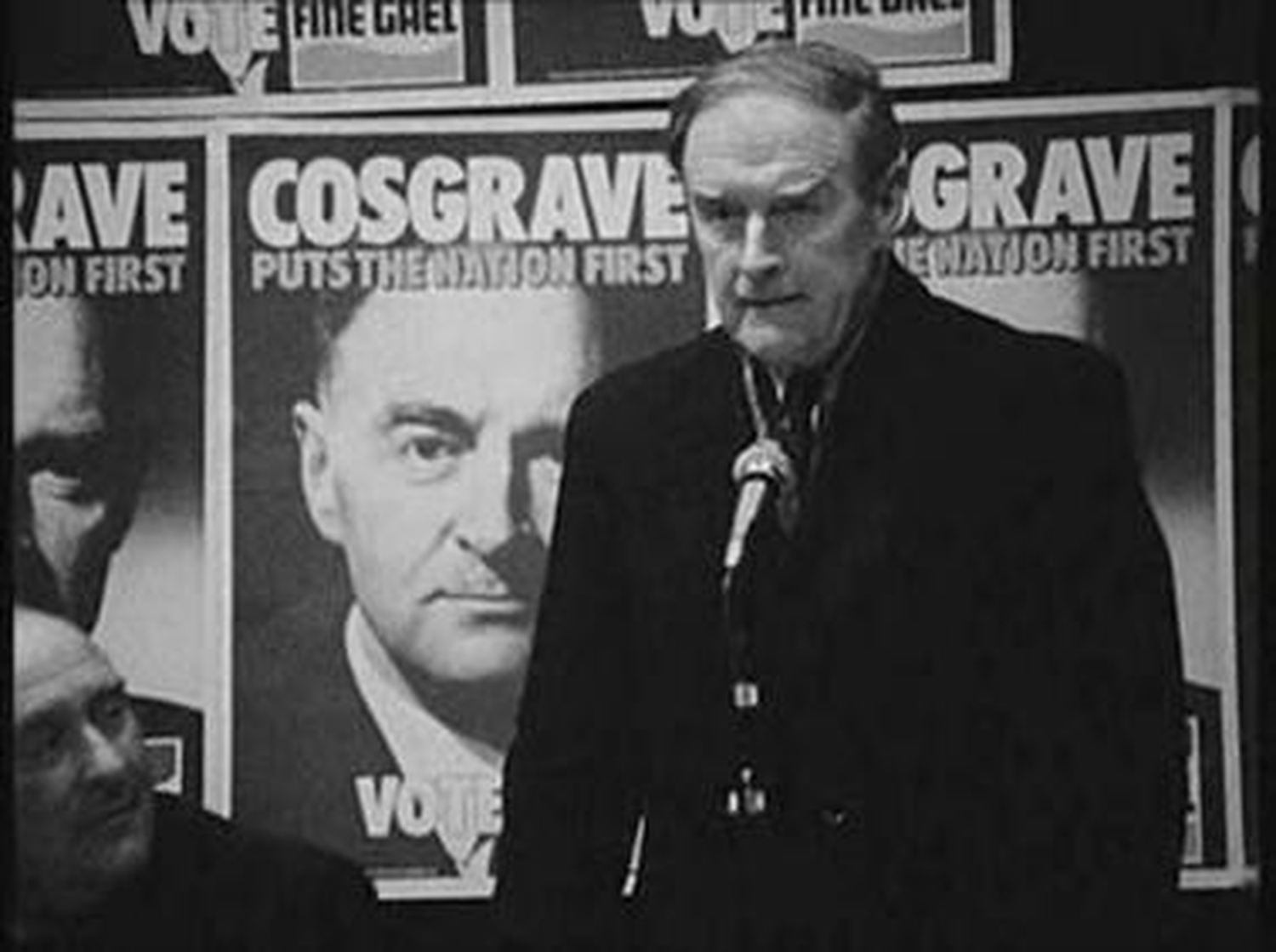
Ireland, 1970's : turmoil in the country, due to the then-as-now unwanted political and military interference here by Westminster. The Leinster House administration was headed-up at the time by Fine Gael's Liam Cosgrave (pictured), and among the many harsh laws introduced, enforced and 'improved on' by the Blueshirts was a censorship act, 'Section 31'.
The then Free State President was a Fianna Fail man, Cearbhall Ó Dálaigh , said to be a compromise candidate by the powers-that-be at the time, as he fitted the requirements dictated by the 'establishment' (ie 'a safe pair of hands') - he was previously the Free State Attorney General and Chief Justice of the FS Supreme Court, and was given the Office, unopposed, in 1974, following the death of Erskine Hamilton Childers.
But it was that legal training which raised a red flag with him in relation to a piece of legislation which the Blueshirt Leinster House administration wanted him to 'rubber stamp' - the 'Emergency Powers Act', and the fact that Ó Dálaigh and Cosgrave didn't agree with each other, socially or politically, came into play : Ó Dálaigh refused to simply 'sign off' on the 'EPA' without first testing its constitutionally.
On the 23rd of September, 1976 - 44 years ago on this date - Ó Dálaigh (pictured) spent four hours consulting with a bunch of posh suits known as the Free State 'Council of State' on whether or not it would be best practice to refer the legislation to the Free State Supreme Court to test its constitutionality before he could declare it to be 'the law' and it was decided that that would be the best thing to do, a decision which annoyed the Blueshirt administration.
Just over three weeks later (ie on the 15th October 1976) the FS Supreme Court declared that the 'EPA' was a legitimate piece of legislation and it was only then that Ó Dálaigh deemed it necessary to sign-off on it, which he did, reluctantly (or so it was alluded at the time) but that 'victory' wasn't enough for Cosgrave and his people - they considered themselves to have been disrespected by the actions of Ó Dálaigh and, three days later (ie on the 18th October 1976) , they could contain themselves no longer : it was on that date that the Free State Minister of Defence, Paddy Donegan, was opening a new Free State army barracks in Mullingar, County Westmeath (having, seemingly, forgot that Ó Dálaigh was the Commander-In-Chief of said army!) that he made a remark (he was concussed at the time, he later claimed!) which was to haunt him for the rest of his life.
He 'kicked himself up the transom' , if you like, which wouldn't have caused as much damage as firing a shotgun over dwellings in which people lived - more about that 'eccentric' (!) Free State politician can be read here...
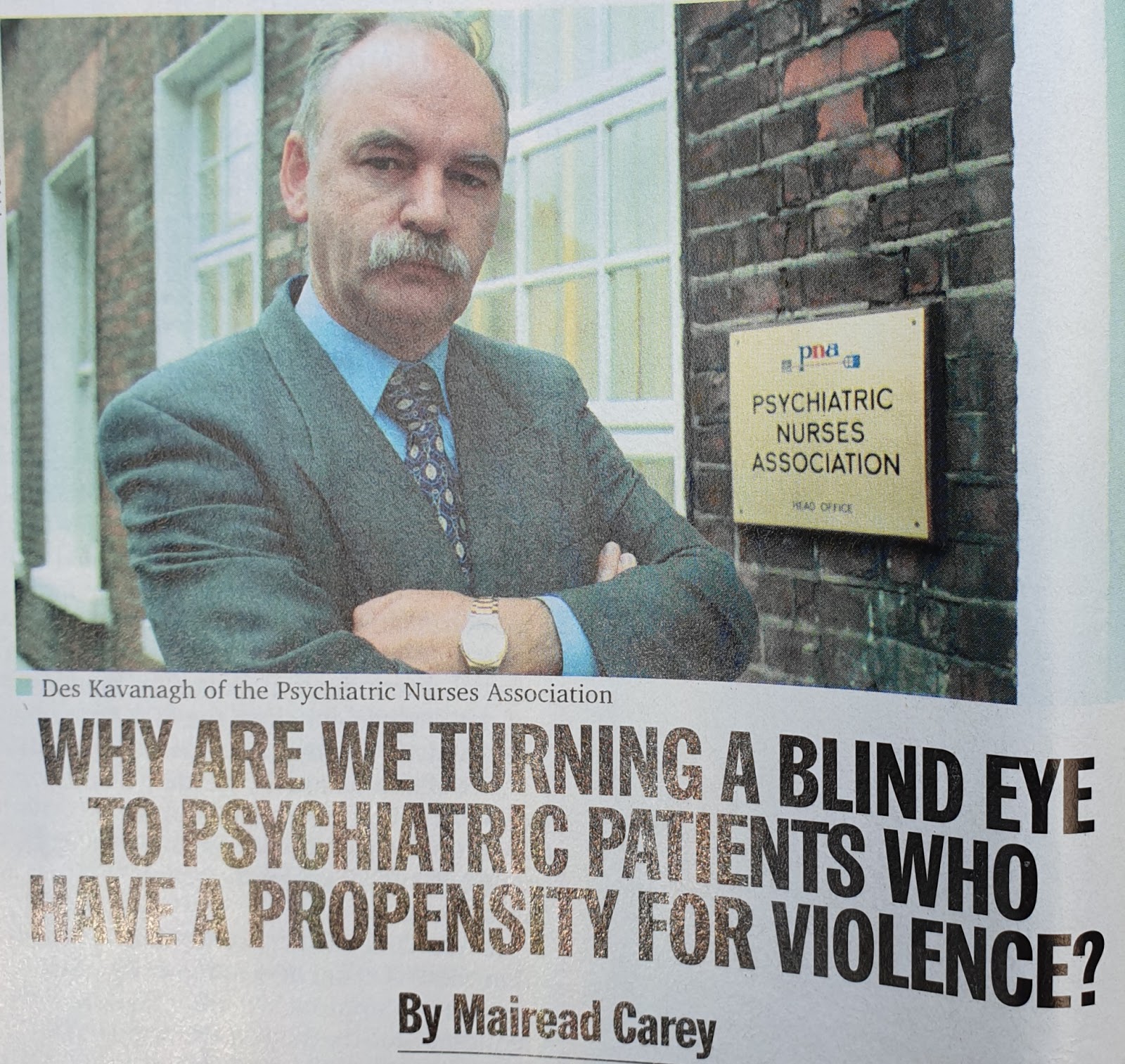
'WHY ARE WE TURNING A BLIND EYE TO PSYCHIATRIC PATIENTS WHO HAVE A PROPENSITY FOR VIOLENCE...?'
By Mairead Carey. From 'The Magill Annual', 2002.
Meanwhile, patients with acute psychiatric problems and violent tendencies are being betrayed by a system which doggedly and deliberately fails to recognise their needs. Psychiatric care in Ireland is stumbling from crisis to crisis.
Unless this unglamorous aspect of healthcare is given a significantly higher status when the government meets to attribute the 'new and improved' health budget, we can confidently expect another tragedy of the magnitude of the Riney case. Or perhaps even worse.
(END of 'Why Are We Turning A Blind Eye To Psychiatric Patients Who Have A Propensity For Violence?' ; NEXT - 'Is It Time To Ask Questions Of The Legal Profession?', from the same source.)
ON THIS DATE (23RD SEPTEMBER) 100 YEARS AGO : MURDER OF A SINN FÉIN COUNCILLOR.
'At 1.15 am Captain Geoffrey Thomas Baggallay, a one-legged courts-martial officer, had phoned Dublin Castle telling of John Lynch’s presence at the Exchange Hotel. A group of 12 British soldiers entered the Exchange Hotel, wearing military caps and long black Burberry coats. They held the hotel porter, William Barrett, at gunpoint. After consulting the register they went to the bedroom of John Lynch (pictured). It was number 6 on the third floor, where John Lynch had been staying since 12 Sept.
They shot him and the soldiers left ; the British soldiers claimed Lynch had fired a shot at them when they attempted to arrest him. The military reported a death at the hotel at 2.15 am. The RIC arrived after the military reported the death to them. The coroners verdict was that Lynch was shot by a soldier in self-defence. No evidence was given by any soldiers at the inquiry.
The IRA believed that the actual murder was carried out by Henry James Angliss and Charles Ratsch Peel working undercover. The group of khaki-clad men who shot Lynch numbered about 12, and the IRA certainly believed that Angliss and Peel were among them from the inside information that they received from “Lt G” at Dublin castle. Lt G is believed to be Lily Mernin who worked as a typist at army headquarters. Michael Collins believed that many of the British officers that were later killed on ‘Bloody Sunday’ shot John Lynch in the Exchange Hotel. Lynch was the local Sinn Féin organiser of a loan and was in Dublin to hand over £23,000 in subscriptions to Collins. Altogether £370,163 was raised in the loan effort in Ireland by September 1920 when it closed down.
It is not possible to know who the 12 men on the raiding party were who shot Lynch, however, apparently Lt. Angliss, under the influence of drink, divulged his participation in the shooting to a girl who passed this information on to an IIS (the republican intelligence department) informant. Peel escaped death on ‘Bloody Sunday’ by barracading himself in his room. George Osbert Smyth (on attachment to avenge his brother (Gerald’s death, shot by the IRA after a speech he gave in Listowel, Co Kerry) is understood to have been part of the raiding party, from information given to his family on a visit home. Osbert Smyth was shot dead in October 1920 while trying to arrest IRA suspects Dan Breen and Sean Treacy at a house in Drumcondra...' (from here.)
Like Liam Lynch, John Lynch had made his preference known in relation to how to deal with the unwanted British presence in Ireland - he was for a military solution ie to 'fight fire with fire'. This was known to the enemy in Westminster, so much so that they instructed their 'Cairo Gang' mercenaries to concentrate on admired soldiers like (Liam) Lynch and, in their rush to do so, the Sinn Féin councillor, John Lynch, was shot dead by 'Cairo' member Lieutenant Angliss (aka 'McMahon'- he had been recalled from spy work in Russia for the 'Cairo Gang' job in Dublin).
The British assassin is said to have believed that John Lynch was Liam Lynch, or related to him, but expressed no remorse when his mistake was pointed out to him. The Ciaro man was playing billiard's in Dublin after he killed John Lynch when the IRA shot him, but he was only wounded. He wanted revenge - and his position in the 'Cairo Gang' gave him that opportunity, or so he thought. But, in November, 1920, he was in lodgings at 22 Lower Mount Street in Dublin when two of the 'Twelve Apostles' entered his room. He reached for his revolver but was shot dead before he could get to it.
Sinn Féin County Councillor John Aloysius Lynch of Kilmallock, County Limerick was murdered at the Exchange Hotel in Dublin by a British agent on September 23rd, 1920 - 100 years ago on this date. The British mercenary who murdered him has been named over the years as a Captain John Fitzgerald (a native of Cappawhite, County Tipperary, who was later assassinated by the IRA), and Henry James Angliss and Charles Ratsch Peel were also named as the murderer. Whatever the case, justice was served afterwards.
'THE REPUBLICAN POSITION ; STATEMENT ISSUED BY ÓGLAIGH NA H-ÉIREANN AND SINN FÉIN...'
From 'The United Irishman' newspaper, November 1954.
"A Chara,
The following statement has been released for publication. Please publish it in full or not at all...
This official reiteration is now released for publication on behalf of Óglaigh na h-Éireann and on behalf of Sinn Féin. Its release at this juncture is considered necessary for the reasons stated above, and because of a recent approach made to ascertain if some kind of compromise agreement or understanding could be reached between the Republican Movement and Fianna Uladh, the most recent splinter party to enter the arena of party politics ('1169' Comment - "We in Fianna Uladh recognise the Constitution of the Republic of Ireland under which this State operates and we are prepared to work within its framework to extend its operation to the whole of Ireland..." - from here.).
The Republican Movement accepts and endorses the axiom that, to complete the task of freeing Ireland, the greatest possible measure of unity amongst our people is essential. Achievement of such measure of unity as a means to an end is a main aim of, and a principal plank in, the platform of the Movement. Republicans go further by fostering and endorsing the fundamental principle that the basis upon which unity rests is of greater national importance than mere achievement of a facade of unity behind which the politicians would manoeuvre for tactical positions in a game of political party stunting.
No useful purpose would be served through alignment of the Republican Movement with political splinter parties, whose national outlook is coloured by party interests and whose national endeavour is circumscribed by the personal ambitions of party leaders. Such alignment would at once bring the Republican Movement within the ambit of party politics, deprive it of any claim to national status, and reduce it to a level of yet another political party..."
(MORE LATER.)
Thanks for reading - Sharon and the '1169' team.