Joseph Whitty came from Connolly Street in Wexford town. He was a volunteer in the IRA's South Wexford Brigade and was arrested and imprisoned in late 1922, after the counter-revolution had begun. Prior to his imprisonment, he was among the many Republicans in County Wexford to suffer at the hands of Britain's occupation forces and later at the hands of the Free State traitors.
In February 1923, members of Cumann na mBan had gone on hunger strike in protest against ongoing internment and successfully secured their release. By May the Civil War had officially ended, but thousands of republicans remained imprisoned, often in very poor conditions. This resulted in further hunger strikes during 1923. The Free State government had since passed a motion outlawing the release of prisoners on hunger strike, and this was to have dire consequences for Joseph Whitty and others. He died in Newbridge Internment Camp, on September 2nd, 1923, at the age of 19. He was the fifth Republican to die on hunger strike since 1917, and was laid to rest in Ballymore Cemetery, Killinick with full military honours.
'At a public meeting held in New Ross on Sunday July 22nd 1923, Miss Dorothy MacArdle read a letter from Newbridge prison camp. She did not think it had passed through the hands of the censor. The letter referred to the condition of 19 year old Óglach Joseph Whitty, William Street, Wexford. She asserted that he was not in the organisation at all and that he was being punished as revenge for the activities of his brothers. He signed the undertaking reluctantly on the advice of a friend but despite the boasting of the government that signing meant release, he was still in gaol and dying.

The meeting should demand that he be released before he died, said Miss MacArdle. Professor Caffery proposed a resolution demanding the immediate release of Joseph Whitty and the other prisoners in Ireland and Britain and suggested that a telegram should be sent to the pope. Miss Nellie O'Ryan seconded the resolution which was put to the meeting. All present signified assent by raising their right hands. Unfortunately, the free state government failed to release Joseph Whitty (pictured). On Thursday September 2nd, 1923, he died in the Newbridge military hospital. He had been arrested about a year earlier. Interment took place in Ballymore the following Sunday before a large crowd. When the remains were laid to rest his comrades fired three volleys over them and recited a decade of the rosary in Irish....' (from 'Boards.ie')
Joe Whitty is one of twenty-two Irish republicans to die on hunger-strike between 1917 and 1981, all of whom are remembered each year by the Republican Movement.
'EDUCATION...'
From 'The United Irishman' newspaper, June, 1955.

Principles, Methods and Subjects -
1. Most people think that some higher education, or years of study, are necessary to understand advanced subjects such as science, music, philosophy, art etc but, as a person at the age of reason, or thereabouts, can intelligently accept the greatest of all principles - God and the Holy Trinity - then an intelligent student should be able to understand all lesser principles when broadly explained. Thus, each and every subject may be quickly brought within the students grasp so that he (sic) may realise its significance as a universal value.
2. The purpose of education in relation to God, man, nature and country, so that the student clearly understands the reason for his (sic) actions and his (sic) work.
3. The development of human attributes ; the spiritual and intellectual in union with the individual and physical aspects of man. The development of feeling, thinking and willing.
4. The development of the individual creative faculty.
5. Approach to subjects by forming immediate associations and statement of Great Principles involved. Also, where possible, to go back on one's own furrow, so to speak. (MORE LATER.)
ON THIS DATE (2ND SEPTEMBER) 217 YEARS AGO : EXECUTED BY THE BRITISH FOR BEING "FOUND IN ARMS" IN DUBLIN.

Owen Kirwan, hanged in Thomas Street, Dublin, September 1.
Maxwell Roach, hanged in Thomas Street, Dublin, September 2.
Denis Lambert Redmond, hanged at Coal Quay (now Wood Quay), Dublin, September 8.
John Killeen, hanged in Thomas Street, Dublin, September 10.
John McCann, hanged in Thomas Street, Dublin, September 10.
Felix Rourke, hanged outside his own home, Rathcoole, September 10.
Thomas Keenan, hanged in Thomas Street, Dublin, September 11.
John Hayes, hanged in Thomas Street, Dublin, September 17.
Michael Kelly, hanged in Thomas Street, Dublin, September 17.
James Byrne, hanged in Thomas Street, Dublin, September 17.
John Begg, hanged in Thomas Street, Dublin, September 17.
Thomas Donnelly, hanged at Palmerstown, Dublin, September 17.
Nicholas Tyrrell, hanged at Palmerstown, Dublin, September 17.
Robert Emmet, hanged in Thomas Street, Dublin, September 20.
Henry Howley, hanged at Kilmainham Jail, Dublin, September 28.
John McIntosh, hanged in Patrick Street, Dublin, October 3.
Thomas Russell, hanged at Downpatrick, Co. Down, October 21.
James Corry, hanged at Downpatrick, Co. Down, October 22.
James Drake, hanged at Downpatrick, Co. Down, October 22.
Andrew Hunter, hanged at Carrickfergus, Co. Antrim, October 26.
David Porter, hanged at Carrickfergus, Co. Antrim, October 26.
Tradesmen were prominent in Robert Emmet's movement in Dublin. Edward Kearney, John Killeen, Thomas Keenan, John Hayes, Michael Kelly, Henry Howley and John McIntosh were carpenters; Owen Kirwan and John Begg were tailors; Thomas Donnelly and Nicholas Tyrrell were factory workers; Maxwell Roach was a slater; Denis Lambert Redmond was a coal factor; John McCann was a shoemaker; Felix Rourke was a farm labourer and James Byrne was a baker. (Source: Bold Robert Emmet (1778-1803) by Seán Ó Brádaigh.) [from here.]
it was not only college-educated men and women like Robert Emmet (ie those who might be perceived as being 'upper class') who decided to challenge Westminster's interference in Irish affairs in 1803 : so-called 'working class' men and women also acknowledged the need for such resistance. And the same can be said for today.
'WHY ARE WE TURNING A BLIND EYE TO PSYCHIATRIC PATIENTS WHO HAVE A PROPENSITY FOR VIOLENCE...?'
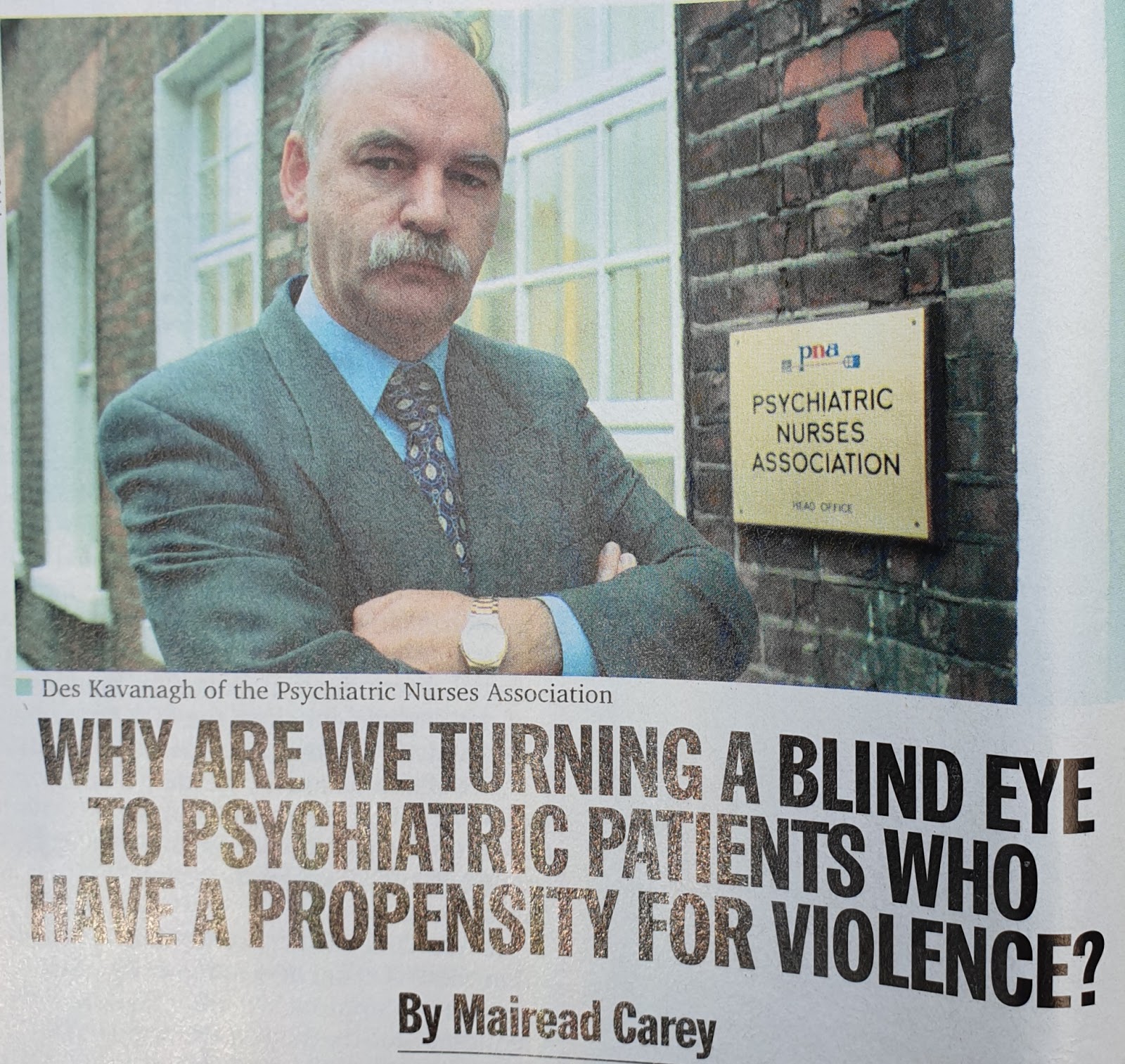
By Mairead Carey.
From 'The Magill Annual', 2002.
The real tragedy is that Gerry Connell's situation is not unique ; hundreds of parents around the country face years of "absolute hell" from children with severe psychiatric problems and a tendency to violence. For many, there is simply nowhere to go for help.
As of now, if you live in Kildare, Wicklow, South or West Dublin, there are no secure beds available for violent psychiatric patients. St. Brendan's Hospital, which caters for patients who are a danger to themselves and others, is closed to admissions and, last month, the psychiatric unit 'Vergemount', in Clonskeagh, was forced to close for the weekend because a patient became violent and there was no place to put him.
Some are familiar with the situation. The boardroom table of the 'Psychiatric Nurses Association' is covered with newspaper clippings highlighting the failures of the health system to deal with the violently disturbed : 'Schoolboy tortured and killed by psychiatric patient' is the headline on a piece about an 11-year-old from Strabane who was battered to death on the day 21-year-old Brian Doherty discharged himself from a psychiatric hospital... (MORE LATER.)
ON THIS DATE (2ND SEPTEMBER) 78 YEARS AGO : "IF FROM THE PATH YOU CHANCE TO STRAY...

..KEEP IN MEMORY OF THAT MORN, WHEN IRELAND'S CROSS WAS PROUDLY BORNE.."
 "I met the bravest of the brave this morning..."
 Tom Williams, 12th May 1924 – 2nd September 1942.
"Williams was one of six IRA volunteers sentenced to death by hanging in 1942. A group of eight, including two women, had mounted a diversionary operation to take away attention from three republican parades held in Belfast to celebrate the 1916 Easter Rising. All such parades had been banned under the Stormont regime since the partition of Ireland and the introduction of the Civil Authorities (Special Powers) Act of 1922. A police (RUC) patrol managed to capture the group but not before an exchange of shots which resulted in the death of RUC constable Patrick Murphy. Although only 18 years old, Tom Williams was in charge of the unit and in a controversial statement to the police he assumed full responsibility for the shooting. Following a remarkable international reprieve campaign, the colonial Governor of Northern Ireland commuted five of the six death sentences to terms of penal servitude. But the British had decided that Tom Williams should hang..."(from here)
'Time goes by as years roll onwards
But in my memory fresh I'll keep
Of a night in Belfast Prison
Unshamefully I saw men weep
For the time was fast approaching
A lad lay sentenced for to die
And on the second of September
He goes to meet his god on high
Now he's walking to the scaffold
Head erect he shows no fear
For on his proud and gallant shoulders
Ireland's cross he holds so dear
Now the cruel blow has fallen
For Ireland he has fought and died
And we the countrymen who bore him
Will love and honour him with pride
Brave Tom Williams we salute you
And we never will forget
Those who planned your cruel murder
We vow to make them all regret
So come all you Irish rebels
If from the path you chance to stray
Bear in memory of the morn, when Irelands cross was proudly borne
By a lad who lay within these prison walls.'
(From here)
For Tom, and all the other brave men and women.
ON THIS DATE (2ND SEPTEMBER) 100 YEARS AGO : 'SPECIAL (LOYALIST) CONSTABULARY' FIRST MOOTED.

The 'A' gang (about 3,500 of them in total) were full-time operatives who lived in the local RIC barracks and were used as re-inforcements for the RIC, and were armed and on a wage. Essentially, their presence allowed more 'police officers' free to leave their desks and assist their British colleagues in cracking nationalist skulls. The 'B' outfit (numbering 16,000 approximately) were armed but part-time and on 'expenses' only, and were usually to be found on street patrol and operating checkpoints and the 'C' grouping (about 1,000) were a reserve force with no specific duty as such but were 'on call' as an armed militia.
Nationalists knew the danger of such a move for them - the UVF/Specials were not by any means 'neutral' in the conflict. The then 'Daily News' newspaper stated, re the establishment of the 'Specials' - 'The official proposal to arm "well-disposed" citizens to "assist the authorities" in Belfast raised serious questions of the sanity of the government. It seems the most outrageous thing which they have ever done in Ireland. A citizen of Belfast who is "well-disposed" to the British government is, almost from the nature of the case, an Orangeman, or at any rate, a vehement anti-Sinn Feiner. These are the very same people who have been looting Catholic shops and driving thousands of Catholic women and children from their homes...' But all words of opposition, or even caution, were ignored.
The officer class in the 'Specials' were hired if they passed a civil service examination and were mostly upper and middle-class protestants with a moral connection to their 'mainland' (England) whereas the rank-and-file consisted of the thugs that once populated any anti-Irish paramilitary gang that would have them. The latter were not allowed 'serve' in their own county or that of a family member and were relocated on a fairly regular basis, living in the local barracks and single men were not allowed to leave same at night to socialise. 'Specials' who wanted to get married could only do so after they had been with the gang for seven years or more and even then only if their girlfriend was deemed 'suitable' by the officer class, a 'test' which included the nature of her job before and after the marriage. Any such 'Special' family were under orders not to take in lodgers, not to sell produce locally (ie eggs, vegetables etc) and the husband was not entitled to days off (no 'rest days' or annual holidays) and was not permitted to vote in elections!
After Westminster forcibly partitioned Ireland in 1921 the British wanted control over the new 'State' to be exercised by their own kind (as opposed to 'Paddies in British uniforms') and, in late 1925, they felt confident enough to declare that the 'Specials' should be wound-up and a kitty containing £1,200,000 was put on the table to secure their disbandment : their main man in that part of Ireland, 'Sir' James Craig - up to then a great friend and supporter of the Specials - was jobbed to pass on the bad news : on 10th December 1925, Craig told the 'A' and 'C' Specials that they were out of work (the 'B' gang were to be kept on) and offered each man two months pay. End of announcement - at least as far as Craig and Westminster were concerned, but the 'A' and 'C' Specials were not happy with the "disband" order and discontent in the ranks grew. The 'A' and 'C' Specials held meetings between themselves and, on 14th December 1925, they mutinied!
'A' and 'C' members in Derry 'arrested' their own Officers, as they did in Ballycastle - two days later (ie on 16th December 1925) a demand from the 'A' and 'C' 'rebels' was handed over to 'Sir' Richard Dawson Bates, the Stormont 'Minister for Home Affairs', a solicitor by trade, who was also Secretary of the 'Ulster Unionist Council', a position he had held since 1905. He was not impressed with their conduct. The 'A' and 'C' Specials were looking for more money ; they demanded a £200 tax-free 'bonus' for each member that was to be made redundant. Two days later (ie on 18th December 1925) 'Sir' Bates replied to the Special 'rebels' that not only would they not be getting the £200 'bonus' but if they didn't back down immediately they would loose whatever few bob they were entitled to for being made redundant and, on 19th December 1925, the 'rebels' all but apologised to Bates, released their hostages and signed on for the dole - the 'hard men' of the 'Specials' had been put in their place by a bigger thug than they were!
By Christmas Day, 1925, the 'A' and 'C' Sections of the 'Ulster (sic) Special Constabulary Association (the 'Specials') were disbanded. It was only in 1970 that the 'B' Special gang of thugs 'disbanded' (ie changed uniform into that of the 'Ulster Defence Regiment' (UDR) and carried-on with their mis-deeds). It was actually in September 1969 that the British 'Cameron Commission' described the 'B' Specials as "a partisan and paramilitary force..." while the October 1969 'Hunt Report' recommended that the 'B' Specials be disbanded.
Since then, the RUC, formed in 1922, have been amalgamated into the 'PSNI' but, even though the uniforms changed, the objective didn't - the preservation of British rule in Ireland.
'HE OBJECTS...'

'The Irish Press' newspaper replies to the published 'Letter To the Editor' from John Lucy, Lieut. Col. OBE, The Royal Ulster Rifles, Roynane's Court, Rochestown, Cork.
'Irish Press, 20-10-1954.
One aspect of the Omagh raid which has excited considerable comment was the fact that the most badly wounded of the British soldiers was a man from Sligo, while some of the others were also Irishmen.
The above letter represents one view of the position this creates and we publish it with the idea of clarifying the republican position on the points raised. First of all, we agree wholeheartedly that "young lads from the Twenty-Six Counties first loyalty is to their own nation." This applies equally to the young lads from the Six Counties - there is only one Irish Nation - embracing 32 Counties, and the loyalty of man and woman from within the four shores of Ireland is due to that nation and to that nation alone.
The writer goes on to imply that transferring these young Irish lads in the British Army to posts outside Ireland would meet the situation. Maybe it would, from England's point of view. Their places here would be taken by Scotchmen or Welshmen or possibly Englishmen and the Empire would be protected as before. But what of the Irish point of view? As we said, the loyalty of every Irishman is due to Ireland and Ireland only...' (MORE LATER.)
Thanks for reading - Sharon and the '1169' team.