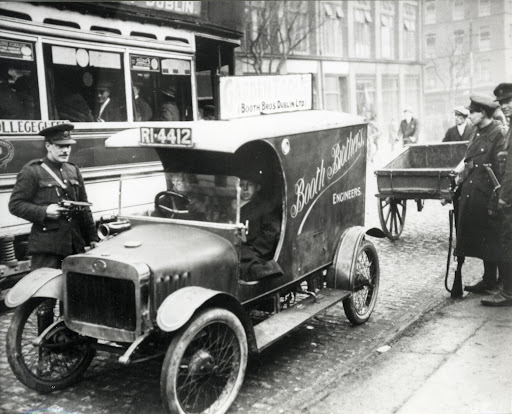
On the 10th September, 1919, the 'British Viceroy for Ireland', a Mr John French, and his political and military pal, a Mr Frederick Charles Shaw, the 'Commander of the British Army in Ireland', signed a proclamation outlawing Dáil Éireann.
Some days later, in Westminster political circles, an in-house letter came to light showing that the British 'Chief Secretary for Ireland', a Mr Ian Macpherson, and his buddy, a Mr Andrew Bonar Law, the 'Leader of the House of Commons and Lord Privy Seal', had... 'allowed (!) Dáil Éireann to assemble and sit in consultation if they wished (but when they) conspired by executive acts to overthrow the duly constituted authority (by which they meant Westminster), then we had to act...'
And, in acting in that manner, the British inadvertently showed, and proved, that politics alone wasn't going to be enough to shift them from Ireland...
==========================
On the 10th September, 1919, a Mr George Frederick Ernest Albert (aka 'King George V of England', pictured) instructed his 'Lord Privy Seal of England', a Mr Bonar Law, to attend for a meeting with him and, on the 11th, the two men were in each others company.
Mr Ernest Albert questioned Mr Law about the measures that the British government were taking to protect... "..the lives of unoffending people in Ireland, and what measures were to be brought into parliament for the government of the country (ie Ireland)..?"
The "unoffending people" in Ireland were, no doubt, those who weren't fighting against the savage hordes unleashed on them by both Mr Albert and the political savage hordes he surrounded himself with.
Anyway - the poor man wasn't in the best of health, and he died, at 70 years of age, on the 20th January, 1936, in London, from a purposely-administered drug overdose.
Whether his death was an act of euthanasia, medically assisted suicide or murder, he should have been more concerned about his own governance than that of a country foreign to him...
GAS LADS...
The massive finds of oil and gas on our western seaboard could ensure Ireland's financial security for generations.
Wealth approximating that of the Arab countries is within our grasp, but the Irish government seems content to sell off our birthright for a handful of votes and a few dollars.
In a special 'Magill' report, Sandra Mara investigates just what we are giving away, and why.
From 'Magill' magazine, March 2002.
However, things were not straightforward, and it took difficult and prolonged negotiations to reach an agreement with Enterprise Oil which resulted in some Irish rig-workers being employed.
At one point, Enterprise Oil threatened to pull out of Foynes, which was being used as a service base, and relocate to Ayr in Scotland.
This move was prevented when Emmet Stagg TD told the oil companies that they could not claim Irish tax breaks while operating out of the jurisdiction.
Following these negotiations, a number of experienced Irish rig-workers got jobs on board the Petrolia drilling rig and were there when it hit a "huge gas find, almost a blow-out", as one worker describes it.
The pressure of the gas find was so high that it caused major technical difficulties and drilling was abandoned until 1998 but, eventually, almost two years later, the 'Sedco 711', owned by Sedco Forex, was contracted to drill and Enterprise Oil agreed 34 jobs for Irish rig-workers...
(MORE LATER.)
On the 10th and 11th of September, 1920, as the Newbridge and Athgarvan Companies of the 2nd Battalion of the 7th Brigade Kildare IRA (1st Eastern Division) were carrying out a number of successful raids for arms in their areas, their republican comrades who worked on 'The Irish Bulletin' newspaper published details of a 'false flag' operation by British forces.
In November, 1919, raids by the DMP and other British forces had yielded sheets of blank Dáil notepaper on which Westminster and Dublin Castle agents were issuing false orders and instructions to IRA Units countrywide in the hope of disrupting the Movement.
The republican newspaper had in its possession false orders and instructions issued on Dáil paper by Dublin Castle agents in January and April and it also published an intelligence report written by a British Army Captain, a Mr Frederick Harper-Shove, who was attached to the 'BA General Staff, Intelligence', and was better known in BA circles as a 'spy instructor' - he mostly operated from the 'spy school' in Hounslow, in West London, in a premises known as 'Cavalry Barracks/Silent Section'.
Mr Harper-Shove had been staying in the St Andrew's Hotel in Exchequer Street, Dublin, from where he wrote a letter to one of his spy buddies, a British Army Major, Jocelyn Lee 'Hoppy' Hardy -
"Dear Hardy,
Have been given a free hand to carry on, and everyone has been charming.
Re our little stunt, I see no prospects until I have things on a firmer basis, but still hope and believe there are possibilities..."
The "little stunt" was probably a reference to the 'false flag' orders/instructions he and his people were placing in Irish republican circles, in the hope that it would lead to IRA members executing their own people in the belief that they had been 'turned'.
When not trying to stitch good people up, Mr Harper-Shove was apparently stitching himself up - his military 'Medal Index Card' contains complaints from his superior officers that he was fond of wearing medals to which he was not entitled and, in his dealings with the 'Herbal Medicine' (!) industry, Mr Harper-Shove was known as a Lieutenant-Colonel, a rank he was never entitled to!
Despite his many enemies, he stitched-up (!) a long life for himself - he died in 1974, at 88 years of age, in Gateshead, in Tyne and Wear, North East England.
That, at least, is true about the man...
'SCAB!
This is Robert Bruce, who continued to drive (British Army) munition trains while his comrades are being dismissed (for refusing to drive them).'
- Mr Bruce was the driver of a train from Belfast to Dublin on the morning of the 10th September, 1920, and the above comment was written on a placard that was made for him...
After he stationed the train in Dublin, he had a few hours before doing the return journey so he went to a pub in nearby Talbot Street, and had a pint or two.
He finished his drinks and left the pub - immediately outside, three IRA Volunteers identified themselves to Mr Bruce, showed him their placard, moved him over to a street pole and, using a length of chain and a padlock, secured him to it and placed the placard around his neck.
He wouldn't agree, but he got away lightly...
At the same time as Mr Bruce was trying on his jewellery, 155km (about 96 miles) up the road, in County Leitrim, Volunteer Patrick Gill, a middle-aged farmer from Corlara, Kilmore, County Roscommon was walking down the street in Drumsna, County Leitrim, with his sister, Elizabeth, and one of her friends, a M/s Netley.
The three friends were on their way home after attending the wake of a colleague, a Mr Bernard O'Beirne, and were walking slowly through the village when, without warning, shots were fired from the back of a British Army lorry, and Volunteer Gill fell down, dead.
An inquest was held and a Lieutenant Wallace, from the East Yorkshire Regiment of the British Army, claimed that Volunteer Gill was shouted at three times to stop, refused to do so, and was shot dead because of the danger he presented to the armed soldiers present!
The verdict reached was that "death was caused by a shooting by persons unknown..", while a coroners jury subsequently found that Volunteer Gill "had been murdered without provocation".
RIP Volunteer Patrick Gill.
==========================
ON THIS DATE (10TH SEPTEMBER) 69 YEARS AGO - LESSONS IN HOW TO KILL PEOPLE QUICKER.
"The British wanted to understand the harm that atomic explosions caused, and it was decided to use Australians, without their full knowledge and consent, as human guinea pigs. Australians were there simply to provide the labour, the bodies needed to get the tests done, the land to explode the bombs on, and, as it was later revealed, to function as lab rats for the British scientists..."
On the 10th September 1956, the British, not content with the carnage they inflicted in Dusseldorf 14 years earlier, wanted to see if they could blow things up quicker and kill even more people with less effort, and hundreds of British nuclear 'trials' took place in South Australia, about 800 kilometres north-west of Adelaide, between 1956 and 1963, at the Maralinga site, part of the Woomera Prohibited Area.
A total of seven major nuclear tests were performed,along with hundreds of minor trials, with approximate yields ranging from 1 to 27 kilotonnes of TNT (4.2 to 113.0 TJ).
Frank Walker, the author of the above-pictured book, came across the minutes of a meeting held on the 24th May 1957 between members of the 'UK Atomic Energy Research Establishment', chaired by Professor Ernest Titterton, during which the group agreed to continue its testing programme to determine the long-term effects of nuclear explosions on Australian citizens and also agreed to continue secretly testing the bodies of dead babies, infants, children, teenagers and young adults (of which the known total examined was given as 21,830!) for radiation contamination.
This violation of the dead apparently started innocently enough (!), with testing carried out on soil samples, graduating from that to tests on dead animals and then to its final phase - tests on dead humans, to discover "...if Strontium-90 is entering the food chain and getting into humans..."
'The site was contaminated with radioactive materials and an initial cleanup was attempted in 1967. The McClelland Royal Commission, an examination of the effects of the tests, delivered its report in 1985 and found that significant radiation hazards still existed at many of the Maralinga test areas.
It recommended another cleanup, which was completed in 2000 at a cost of $108 million. Debate continued over the safety of the site and the long-term health effects on the traditional Aboriginal owners of the land and former personnel.
In 1994, the Australian Government paid compensation amounting to $13.5 million to the local Maralinga Tjarutja people...'
A 'small price' to pay, I'm sure, for such invaluable knowledge - how to kill people quicker than you had done before.
'Progress' indeed.
CASH NO EXCUSE FOR RTE PUTTING DOCUMENTARY TO DEATH...
It has been a disastrous 12 months for RTE.
£23.5 million in cutbacks, a bid to increase the licence fee rejected, an enforced postponement of digital expansion, and a predicted £20 million loss to report for 2001.
By Belinda McKeon .
From 'Magill' Annual, 2002.
What is needed is the establishment of a structured co-production scheme, involving both organisations and all Irish broadcasters - as well as BBC Northern Ireland (sic), a frequent co-financer of independent productions - which would lift Irish arts documentary out of the thankless rut into which it has declined.
As for RTE, the need to create a strong, individual identity for the station has never been greater.
Despite its shortcomings, it still has a loyal viewership, and can only bolster this loyalty by building a reputation as something different, something daring, something which taps into the interests of its audience and documents the obsessions of their imagination...
(MORE LATER.)
ON THIS DATE (10TH SEPTEMBER) 83 YEARS AGO : CIVILIANS TARGETED BY BRITISH.
"The destruction of German cities, the killing of German workers, and the disruption of civilized community life throughout Germany [is the goal]....it should be emphasized that the destruction of houses, public utilities, transport and lives ; the creation of a refugee problem on an unprecedented scale; and the breakdown of morale both at home and at the battle fronts by fear of extended and intensified bombing are accepted and intended aims of our bombing policy. They are not by-products of attempts to hit factories...."
- Air Marshal Arthur Harris, Commander in Chief, Bomber Commander, British Royal Air Force (from here).
On the 10th of September 1942, 100,000 incendiary bombs were dropped on Dusseldorf, Germany, by 476 British Royal Air Force bombers - the objective was as stated above by one of Britain's more infamous 'mad bombers', a psychopathic mass murderer who, along with the man who issued him his instructions (and agreed that the first wave of RAF bombers should drop explosives thereby opening up the infrastructure for the second wave, incendiary bombs) , Churchill, should have been tried for war crimes, along with Goebbels and Himmler, amongst others.
Yet the British continue to propagate the myth that they are 'peace keepers' and here, in Ireland, they have found a gaggle of willing fools to assist them in spreading that myth.
On the 10th September, 1922, as IRA rebels from the Kerry No. 1 Brigade were consolidating their hold on the Kerry village of Tarbert, a Free State Army convoy was ambushed by the IRA near the village of Rathmore, in County Kerry.
The Staters were under the command of a republican-gamekeeper-turned-Free State-poacher, a Mr James McGuinness, who had fought with the IRA against the British but was now fighting against his old comrades (he participated in the Stacumney Ambush in July 1921).
Mr McGuinness survived the IRA ambush, but seven other Free State Army renegades were killed before the rebels withdrew, as FSA reinforcements with an artillery piece arrived on the scene.
As the rebels were withdrawing, Mr de Valera was writing a letter to a Mr Joseph McGarrity in which he outlined how the Staters had started the Civil War in Ireland and also voiced his concern that public opinion in the country was moving in the direction of support for the Treaty of Surrender ; other supporters of that Treaty, in Westminster, were - on that same date - reading the 'Weekly Intelligence Summary' from the 'Dublin District of the British Army', in which the British military leadership in Ireland noted that "there are no signs of double dealing at present (by the Staters)..." in relation to their support for the Treaty and, by association, their willingness to suppress the 32-County Republic.
So - 103 years later - no change there, then...
==========================
DEATH IN THE MEDITERRANEAN...
Desmond Boomer, a Belfast engineer working in the Libyan oil-fields, disappeared seven years ago.
Officially, the plane on which he was a passenger crashed as a result of mechanical failure and pilot error.
But is that the real story?
Or were the Irishman and his fellow passengers unwitting victims of the shady war between Islamic fundamentalism and Mossad, Israel's intelligence network?
A special 'Magill' investigation by Don Mullan, author of 'Eyewitness Bloody Sunday'.
From 'Magill' magazine, January 2003.
In October 1996, ten months after the incident, the Maltese Board of Inquiry was officially informed by Tunisia that local fishermen had pulled wreckage from the plane to the surface.
However, the Tunisian government has never identified the fishermen, the name of their vessel or the exact location where the wreckage was allegedly discovered, nor were they pressed by the Maltese Board of Inquiry to do so.
On 14th November 1996, the inquiry in Malta was shown photographs of the wreckage taken by the Maltese Charge d'Affaires in Tunis, including photographs of Captain Bartolo's wallet and its contents, allegedly found amongst the wreckage, but no specific information is given regarding the actual date the wreckage was 'discovered'.
The Maltese Board of Inquiry report, published in January 2000, states that ... "..following the recovery of the wreck, a search was carried out in November 1996 in the indicated area, but the search proved unfruitful..."
(MORE LATER.)
ON THIS DATE (10TH SEPTEMBER) 102 YEARS AGO : FINAL PREP DAY FOR A LON-ANNOUNCED (AND IMAGINED) 'NEW NATION'!
A LESS-THAN-USELESS FAILED INSTITUTION.
(No, not Leinster House - that it is the above goes without saying!)
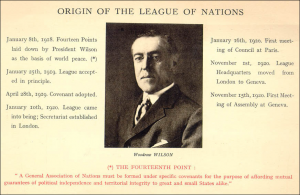
We refer to the so-called 'League of Nations' organisation which, on this date in 1923 - 10th September - was preparing to open its doors on 'Day 1' of having somehow officially announced the 'birth of a new nation' - Ireland, all 26 of its 32 Counties, that is!
The new entity (!) was, unbelievably, allowed membership of that August body (!) as "a nation".
This despite the fact that the application was endorsed by a (Free State) political administration which was in turmoil and had only just 'officially' emerged from a war with its neighbour, Britain, the effects of which were still being felt in the country as a whole and, indeed, are still being felt to this day, as the issue remains unresolved.
The 'main man' at the time, in this then war-torn State, William T. Cosgrave - a republican-poacher-turned-Free State-gamekeeper - was delighted that the Free State was 'allowed' to join the then four year-old 'League', which was considered by both the home-grown and foreign political 'Establishment' as a 'sacred circle'.
The British representative in that failed grouping, amongst others, gave what was described at the time as an "..eloquent speech...a spontaneous manifestation of good-will toward Ireland (sic) (in which) felicitations were extended...(to the new member)..."
And why wouldn't Westminster (and its 'friends' in Ireland and abroad at the time) welcome an acknowledgement by Cosgrave and his ilk that, to all intent and purpose, they agreed with Westminster that the part of Ireland handed back to 'the Irish' was indeed considered to be a 'nation', as it helped propagate the lie that the (still occupied) six north-eastern counties of Ireland were "part of the Empire".
Mr Cosgrave died 60 years ago but the political fault-line he so ably gave succor to in 1923 (and before and after that year) lives on after him.
Nothing to be proud of.
On the 10th September, 1923, the newly-spawned Irish Free State became a living oxymoron, when it was admitted to the 'League of Nations' organisation.
"We can no longer say, as we could formerly about the Irish question, that it is an internal matter..."
- the words of a Mr Antrobus, an official in the British Colonial/Dominions Office, in a letter he sent on the 19th of that month to a Mr Lionel Curtis.
Mr Antrobus opined that the Free Staters could now take a complaint against Westminster to the League because delays in appointing the Boundary Commissioner violated an 'international agreement' ie the Treaty of Surrender but, of course - as correctly judged by the British - the Free State Leinster House administration wouldn't dare bite the hand that fed them ; it would bark, but not bite.
"Our friends' heads (the Free State government) are, of course, pretty full at the moment, but this would soon change once they realised that their position in the world counted for little apart from their position in the British Commonwealth of Nations..."
- the reply to Mr Antrobus from Mr Curtis (on the 25th September) : then, and now, the Free State politicians consider(ed) themselves to be 'world players' when, in reality, they are occasional pebbles in the shoes of the real players.
==========================
ON THIS DATE (10TH SEPTEMBER) 102 YEARS AGO : AN IMPOSTER JOINS A CLUB!
"The elected Parliament and Government of the Irish Republic pledged the active support of the Irish Nation in translating into deeds the principles enunciated by the President of the U.S. at Washington's tomb on July 4th, 1918, and whole-heartedly accepted by the people of America during the war. We are eager and ready to enter a World League of Nations based on equality of rights, in which the guarantees exchanged neither recognise nor imply a difference between big nations and small, between those that are powerful and those that are weak. We are willing to accept all the duties, responsibilities, and burdens which inclusion in such a League implies..."
- the words of Michael Collins, delivered to a meeting of (the 32-County) An Chéad Dáil (the First Dáil, 1919-1921) in April 1919, in relation to the then-probable formation of a 'League of Nations' organisation (which was formed in January 1920) .
The British forcibly partitioned Ireland in December 1922 and, on the 10th September 1923, the then three-years-old 'League of Nations' organisation accepted the Free State (a 26-county entity) as a member of the club - had that grouping been called the 'League of States' rather than the 'League of Nations' then we would not be writing this piece but for any so-called 'organisation of nations' to accept a request for membership from a landmass that contains a little more than three-quarters of its own land brings to mind the Groucho Marx quote - "I refuse to join any club that would have me as a member"!
And, in a further twist of logic, 'Time' magazine stated -
"Ireland was admitted into the sacred circle of the League of Nations by unanimous vote. On all sides there were spontaneous manifestations of good-will toward Ireland. In eloquent speeches, representatives of Britain, France, China, Persia and other countries extended felicitations to the Free State representative...." again confusing the Free State as being 'Ireland', rather than part thereof.
Incidentally, this very issue caused a rift between U.S. President Woodrow Wilson and the then leader of the Clann na nGael organisation in America, Judge Daniel Cohalan - the Judge was known to be of the opinion that the 'League of Nations' was a ploy by the British to integrate themselves into American society.
It was he and the Clann organisation that financed the opposition to Wilson's 'League of Nations' proposal - indeed, of the estimated $900,000 dollar 'war fund' that the Clann had, only $115,000 dollars was spent in Ireland ; the other $785,000 dollars was spent in attacking the 'League of Nations ' or "Britains League", as Judge Daniel Cohalan and John Devoy called it.
But that's a story for another day...!
==========================
"(The Boundary Commission) will hand over to the Southern States (sic) the Catholic parishes which were anxious to join them, but which would, on the other hand, transfer to the North those Protestant parishes which are now in the Free State..."
- British Prime Minister David Lloyd George, addressing an audience in Wales, on the 10th September 1924.
One of the legal referees involved in the Boundary Commission fiasco, a Mr Kevin Matthews, stated that an award based on the wishes of the population in parishes would mean that large portions of Counties Tyrone, Fermanagh and Armagh would go to the Free State as well as Derry City, Strabane and Newry, which the British wouldn't countenance, so they loaded the dice by granting themselves two votes on the Commission - their own, and that of the Six County rep, whom they picked!
Mr Matthews repeatedly voiced concern regarding the legality of that move, arguing that Westminster did not have the unilateral authority to make such an appointment and that parliamentary legislation was required (...a point we have made numerous times on this blog), and the British 'Judicial Committee of the Privy Council' supported his argument (having ruled in June 1924 that the British government did indeed need to pass legislation to nominate the Six County representative to the commission).
However, the Commission (chaired by a Mr Richard Feetham, a friend of Westminster) rode roughshod over the ball-less Free Staters and, in its 1925 report, ultimately recommended no changes to the imposed border, a decision that proved highly controversial but went legally unchallenged by the Staters, who were quite happy to rule over (?!) the portion of Ireland that Westminster had allocated to them.
Shame on them, but it wasn't unexpected...
==========================
Thanks for the visit, and for reading - appreciated!
Sharon and the team.
(We'll be back on Wednesday, 24th September 2025.)
ON THIS DATE (1ST DECEMBER) 147 YEARS AGO : ICA CHIEF-OF-STAFF BORN IN DUBLIN.
'Commandant Michael Mallin, Chief of Staff of the Irish Citizen Army, was one of the executed. He was court-martialled on the 5th of May 1916, found guilty of treason, and executed on May 8th of 1916. There was public disquiet at the secrecy surrounding these court-martials and the speed with which the executions were taking place.
Public and legal representatives made every effort to stop the executions. They denounced the secrecy of the military courts and demanded sight of the court-martial records and of the evidence on which the sentences of executions were being carried out. The British Prime Minister, Herbert Asquith, gave a commitment in the House of Commons that he would release court-martial records.
However, after much debate and legal wrangling, the British military intervened and blocked their release. Consequently, the records of these secret court-martials were kept sealed, indefinitely, in the British archives. At one point it was believed all of the records had been destroyed...' (from here.)
Michael Mallin was born on the 1st December, 1874, in Ward's Hill in the Liberties area of Dublin ; he was the eldest of six children who survived to adulthood - five children died in childhood due to the poor living conditions in the slums where they were born.
He got some education at the local National School in Denmark Street but his uncle, James Dowling, a British Army man, convinced the then 15-years-young Michael that his future lay in military service and his advice was heeded ; in 1889, the child enlisted in the British Army as a drummer with the regimental band of the 21st Royal Scots Fusiliers and was to 'serve king and country' for 13 years and fifty-nine days , six years of which he spent in India.
His mother had an understanding of Irish republicanism but her family were involved themselves in the British war machine so the young lad was surrounded by tales of 'derring-do' and wanted to 'play his part'.
It was during those six years in India that he received the rest of his education ; having witnessed at first hand the suffering inflicted on India by Westminster, he wrote to his wife Agnes (pictured, nee Hickey), in Ireland -
"...we (the British 'empire') aught (sic) to leave the poor people alone...if I were not a soldier I would be out fighting for them...the British Army is a hell on earth. I wish I were well out of it but I did not think it was so bad until I came out here. The war (sic) is lasting a very long time, Dear, we aught (sic) to leave the poor people alone for I am sure they will never give in and they have proved brave men, God help them.
I wish it was for Erin that I was fighting and not against these poor people...I am very proud, Dear, to have a medal (for the 'Tirah Campaign') but would be far prouder if it was for Ireland I earned it. It is the likes of me that keeps mine and your country down, God help her...all the chance of being killed fighting for the robber flag that I am serving under is all over. If ever I am to die by bayonet or bullet I hope it is against it (ie against 'the robber flag') for Ireland."
For the first few years of his 'service for the empire' he was stationed in various barracks around Ireland and Britain and, as part of his training, he not only learned how to use several musical instruments but also received much of the same training as regular soldiers, a skill he was later to put to good use after he returned to Ireland - he was the 'go-to' man for drilling the Irish Citizen Army (ICA), where he was second-in-command to James Connolly.
As the Commander of the dissident Irish republican garrison at St Stephens Green in Dublin during Easter Week in 1916, he was sentenced to death by field court martial on the 5th May 1916 (the presiding British Army officer at his court martial was Colonel Ernest Maconchy) and was executed by a British Army firing squad on the 8th May.
His wife, Agnes, was pregnant on their fifth child when her husband was executed in Kilmainham Gaol and that, and the fact that he was leaving his family financially destitute, no doubt contributed greatly to his conduct at his 'trial' : he denied holding any commission in the Irish Citizens Army, said he had no prior knowledge of plans for a Rising, and stated that he was never in the confidence of James Connolly. He told the 'court' that he was a mere foot soldier in St Stephen's Green, acting under the command of Countess Markievicz during Easter Week.
His wife, Agnes, developed consumption after the execution of her husband and never completely recovered. She died in 1932 at the age of 54 from a bone disease that affected her spine and kept her bedridden for the last year of her life.
Shortly before he was executed by the British, Michael was asked by his brother if the price he was about to pay was worth it ; he replied -
"It is worth it. Ireland is a grand country, but the people in it are rotters. I am dying in the hope that we have made Ireland a better Ireland for you to live in.."
Unfortunately, it has turned out to be 'a better Ireland for the rotters to live in'.
'BRITISH ARMY MADE TO LOOK FOOLISH.'
From 'The United Irishman' newspaper, July, 1954.
Dr. Robert S. Nixon, Unionist MP for North Down, told a reporter that the British Army had been made "to look foolish" in 'Northern Ireland'.
"Ulster men and women," he said, "are shocked to have had suddenly thrown in their face another act by what must be assumed to be the Irish Republican Army. That this treasonable and revolutionary organisation exists to a greater degree than was generally accepted is a very great blow.
We have known of certain acts in England, mainly at Falstead School in Essex, in Liverpool and in Dublin."
'WORLDWIDE HEADLINES'.
The raid - flashed across the globe by the big international agencies, such as the 'Press Assassociation', 'United Press' and 'Reuter' - made frontpage headlines on the five continents.
Even on the same night it was listed among the six news headlines over AFN on their midnight bulletin. In America, it was carried by radio and television networks that same evening, while several of the leading dailies gave it prominent publicity.
(END of 'British Army Made To Look Foolish' and 'Worldwide Headlines' ; NEXT - 'The Armagh Action', from the same source.)
ON THIS DATE* (1ST DECEMBER) 120 YEARS AGO : DEATH OF AN 'IDA' FOUNDER.
"From the time I came to what have been called the years of discretion, my entire thought has been devoted to Ireland. I believed the course I pursued was right ; others may take a different view. When the proceedings of this trial go forth to the world, the people will say that the cause of Ireland is not to be despaired of, that Ireland is not yet a lost country — that as long as there are men in any country prepared to expose themselves to every difficulty and danger in its service, prepared to brave captivity, even death itself if needs be, that country cannot be lost..." - Thomas Clarke Luby (pictured) was born in Dublin on the 16th January 1822.
His mother was of a different religious persuasion from his father (a Tipperary-born Church of Ireland clergyman) and both parents were determined that their son, Thomas, should be 'successful' in life : he was educated at Trinity College, in Dublin, from where he graduated in 1840, then studied law at 'The Temple', in London.
However, he became more interested in journalism than in practising law and, as a 'toff' with a solid social conscience, he joined the 'Repeal Association' but came to the opinion that that organisation was not prepared to go far enough in defending Irish society from the ravages inflicted on it by Westminster and joined a more radical organisation, the 'Young Irelanders' and was active in the 1848 Rising.
When that rebellion was put down by the British, Luby and other 'dissidents' established a new revolutionary organisation, the 'Irish Democratic Association' ('IDA') and once again challenged British misrule in Ireland - but, once again, they failed in their endeavours.
Shortly after that failure, Luby went to France in the hope of improving his military tactics and then to Australia, where he stayed for about a year, before returning to Ireland. He made his living through journalism (mostly working for, and with, 'The Tribune' newspaper) and, in 1858, he helped establish the 'Irish Republican Brotherhood', known as the 'Fenians', with the avowed and same purpose of that of his previous efforts - to overthrow British rule in Ireland and establish an Irish Republic.
Such were the times he lived in - including the period in our history when the 'Irish National Invincibles' struck a blow for Irish freedom - Thomas Clarke Luby supported and/or was involved in every such effort. He died in Oak Street, in Jersey City, at 79 years of age, in 1901, from paralysis, on the 1st December*, 1901, and is buried, with his wife, in Bay View Cemetery in that city, under a headstone which reads - 'Thomas Clarke Luby 1822–1901. He devoted his life to love of Ireland and quest of truth.'
Unfortunately, his objective remains unfulfilled.
(*Different sources give different dates of death for Thomas Clarke Luby ; two dates are mentioned - 1st December 1901 and 29th November 1901 but, regardless, the man deserves a mention.)
THE NOT SO IRISH NEWS...
Rita Smyth examines the editorials of the Northern newspaper, 'The Irish News', for the first six months of 1987.
Her analysis shows how the paper reflects the political attitudes of the Stormont Castle Catholics (who dominate the SDLP*) and the conservative values of the Catholic Hierarchy, especially Bishop Cahal Daly.
(From 'Iris' magazine, October 1987.) ('1169' comment - *...and who now fill the ranks of other Stoop-like political parties in Stormont and Leinster House.) From 'IRIS' magazine, October 1987.
Strangely, having claimed such outstanding achievements from the Hillsborough Treaty, as we approach the 2nd anniversary of the 'deal', the 'Irish News' has not attempted to explain why it is that it still seems impossibe to get the 'Belfast Says No' banner removed from Belfast City Hall.
But even more sweeping changes are claimed : there has been a "major shift, even a reversal" of traditional British policy in regard to Ireland, and the Secretariat of Dublin civil servants at Maryfield is now an "accepted part of the government of Northern Ireland" (sic) ('The Irish News', June 5th).
And still more reform is just around the corner - for instance, the elusive "Anglo-Irish parliamentary tier (which) it may be unrealistic to expect the creation of this side of the next Westminster general election. Such a parliamentary body will further develop the unique relationship between the British and Irish people and will give TD's (sic) an opportunity to put forward their views on the need for reforms in Northern Ireland.." (sic) ('The Irish News', April 3rd)...
(MORE LATER.)
ON THIS DATE (1ST DECEMBER) 49 YEARS AGO : DUBLIN BOMBED BY BRITISH AND PRO-BRITISH AGENTS.
On the 1st December, 1972 - 49 years ago on this date - at 7.58pm and 8.15pm, two car bombs exloded in Dublin city centre killing two CIÉ workers and injuring 127 other people.
The first car bomb exploded on Eden Quay, near Liberty Hall, and the second device exploded in Sackville Place, near O'Connell Street. Two men, George Bradshaw (30) and Thomas Duff (23), both CIE bus conductors, were killed in the second explosion.
A late and short phone warning had been telephoned to the 'Belfast Newsletter' newspaper by a man with an English accent a few minutes before the first explosion and, even though no group claimed responsibility for the bombings, the blame initially fell on Irish republicans, but afterwards suspicion fell on British agents operating within the UVF.
At the time of the explosions, Leinster House politicians were debating the 'Offences Against the State (Amendment) Bill', which would have given the State much greater powers against the PIRA.
"I will believe until the day I die that the British government or British agents were involved in the death of my husband.." (Mrs Monica Duffy-Campbell ; more here.)
It should be noted that both the criminal groups mentioned above - the British Army and the UVF - are still causing trouble in Ireland.
'REDEMPTION...'
From 'The United Irishman' newspaper, March, 1955.
"Must you attempt the work in which our foe has failed,
here with impunity and your conscience unassailed?
Here would you bury the un-dead spirit of our land,
here would you shackle freedom by your unworthy hand.
Here would you undo the work which in Armagh was wrought,
here would you undo the work for which brave men have fought.
Here would you our cherished hopes bury beneath the clay,
whilst even now are suffering the men of the IRA.
Weep not, for tears this crime of yours cannot erase,
but only deeds can now redeem your dark disgrace.
Here in the name of God and of our tortured land
stand by the IRA ; give them a helping, willing hand..."
(MORE LATER.)
ON THIS DATE (1ST DECEMBER) 77 YEARS AGO : 'CHARLES HANLEY/PAT CARNEY' HANGED BY THE STATERS.
Charlie Kerins (pictured, aka 'Charlie Hanley/Pat Carney') from Tralee in County Kerry, was born on the 23rd January, 1918, in a small town called Caherina. At 17 years young he joined the local IRA and defended his political position against the Blueshirts and, at 24 years of age, he joined the GHQ staff in Dublin.
That same year - 1944 - in June, at which point he had been the IRA Chief of Staff for 20 months, he was 'arrested' by the Staters and accused before a Military Tribunal with the shooting of poacher-turned-gamekeeper Dinny O'Brien in 1942. No evidence was offered to the Tribunal by the Free State, and non was needed - the Tribunal delayed sentence until later in the day to allow Kerins to make an application to it whereby he might avoid the capital sentence ie plead for his life.
Charlie Kerins gave them his answer - "You could have adjourned for six years as far as I'm concerned, as my attitude towards this Court will always be the same". He refused to recognise the court, regarding it as a Free State junta which was not properly constituted nor in accordance with the Irish Republic that had been declared in 1916.
He was sentenced to death by hanging and made a statement to the 'court' -"All I can say is that if the Free State authorities are satisfied that I got a fair trial here, I hope their consciences are clear on that point. If this is an example of de Valera's justice, freedom and democracy, then I would like to know what dictatorship and militarism are. That is about all I have to say".
No Irish person would take the job as executioner, so de Valera hired an English hangman, Albert Pierrepoint, to hang the IRA man. Charlie Kerins climbed the scaffold at 8am on December 1st, 1944 - 77 years ago on this date - the last republican soldier to die on the gallows for Ireland, and the Staters buried him in a yard in Mountjoy Jail, in Dublin. In September 1948, the remains of Charlie Kerins were released from the prison yard and handed over to his relatives.
Escorted by an IRA guard of honour and followed by thousands of republicans, including many who had served with him in the IRA, and contingents of Fianna Éireann, Cumann na mBan, Clan na Gaedheal and Cumann na gCailini, the funeral made its way towards Dublin city centre and, from there, to Tralee, in his native County Kerry.
The oration was delivered by Tomas MacCurtain (son of the assassinated Mayor of Cork). It should be noted that, during the 1940's, the Republican Movement was in a bad way, virtually decimated, following the years of internment ; the execution and funeral of Charlie Kerins (and five other republicans) boosted the Movement and dramatically improved the organisations recruitment capabilities . A terrible price had been paid by Irish republicans but the Movement re-grouped, once again, and continued the struggle.
What, said Cathal Brugha, if our last man's on the ground,
when he hears the ringing challenge, if his enemies ring him round ;
If he'd reached his final cartridge — if he fired his final shot -
'Will you come into the empire?' He would answer, I will not.
"All I ask is that the ideals and principals for which I am about to die for will be kept alive until the Irish Republic is finally enthroned." - Charlie Kerins.
ON THIS DATE (1ST DECEMBER) IN...
...1494 ; on the 1st December, 1494 - 527 years ago on this date - 'Poynings Law' (named after Edward Poyning, Henry VII of England's 'Lord Deputy') was enacted in England in regards to Ireland ; it was thereafter deemed to be 'illegal' for any political representatives in Ireland to convene as an assembly without permission from the English 'king' and, even if he gave his 'permission', any laws or Bills that they approved would first have to be approved by their 'majesty' and his Privy Council.
It took the English 384 years to have enough faith in their planters in Ireland to scrap 'Ponyings Law', which they did in 1878.
Well...they scrapped that 'law' then, but whether they have any faith in their planters is another thing...
==============================
...1848 ; on the 1st December, 1848 - 173 years ago on this date - the paddle steamer 'The Londonderry' (pictured), which was carrying groups of poor people from the Sligo area trying to get to Liverpool to escape an attempted genocide in their own country, fell victim to a severe storm which tore the grids from its deck.
The ship, seven years old at the time, weighing 222 tons and operated by a crew of 26 sailors, took shelter in Derry Harbour and, on being examined for repairs, it was discovered that 174 people were being transported in the cargo hold, an area comprising 23 feet by 18 feet ; 72 of those poor people were dead, having suffered from both suffocation and injuries sustained from being packed and crushed into such a small area.
An 'official' investigation recommended that the crew should be charged with manslaughter but the 'incident' was overshadowed because hundreds of thousands of Irish people were dying from starvation at that same time.
==============================
...1920 ; in an attempt to tighten their grip in Ireland, following 'Bloody Sunday' and the Kilmichael Ambush, Westminster instructed their 'Chief Secretary' in Ireland, 'Sir' Hamar Greenwood, to prepare to introduce martial law (ie restricted movement and all courts and civil authorities etc to come under military control) in whatever areas he deemed fit.
British military 'middle management' in Ireland were of the opinion that all 32 Counties should be looked at in regards to being 'locked down' but 'Sir' Hamer and his boss in London, Lloyd George, thought it would serve their interests better to just enforce martial law in what they called "distant provinces" and leave Dublin open which, they reckoned, would encourage the Irish 'dissident' leadership to strike a deal with them least Dublin, too, be hampered by the new policy.
Westminster's 'Lord Lieutenant' in Ireland, 'Sir' John French, did not agree with leaving Dublin untouched but he was 'outvoted' and, nine days later, he issued a proclamation imposing martial law on Cork, Kerry, Limerick and Tipperary and, on the 30th December, that British policy was extended to Kilkenny, Clare, Wexford and Waterford. That obviously made things harder for the Republican Movement to defend itself and the country, but they persevered, nonetheless!
==============================
...1920 ; an IRA Volunteer, Patrick Clancy, from Ballylusky, Drangan, in County Tipperary, is listed as having died on this date (1st December) in 1920, but details are non-existent. We came across information showing that the Clancy family were active in the on-going struggle to remove the British military and political presence from Ireland, and that, on the 19th of November 1920, a Second Lieutenant Patrick Clancy, 3rd Tipperary Brigade IRA, 7th Battalion, Drangan, was shot and killed by British forces at Corbally/Ballylusky. We leave this information here for reference purposes.
==============================
...1920 ; Thomas Keighary, from Galway, was born in 1879 and grew-up to become a British 'policeman', a Sergeant, in the RIC, in Ireland.
On the 1st December in 1920, he was part of a check-point on a bridge over the River Boyne at Kilcarne, outside Navan, in County Meath, when he was shot dead. A British soldier later owned up, claiming that it was an accident.
==============================
...1922 ; 1st December - The Meath/North Kildare IRA column, with Paddy Mullaney, a school teacher from Balla, in County Mayo in command, is captured near Pike’s Bridge, Leixlip, on the Dublin-Kildare border after a long fight ; the column were eventually pinned down around the Ballygoran area, after they had occupied a large country house, 'Grangewilliam', the residence of Mr Cornelius Kehely. One State soldier, Private Joseph Moran, 35 years old, from Kilcock, in County Kildare, lost his life in the battle, as did one IRA man. 3 other IRA men were wounded.
22 IRA fighters were taken as prisoners, five of whom were found to have left the Free State Army to join the IRA ; they were Leo Dowling (18), Sylvester Heaney (19), Terrence Brady (18), Laurence Sheehy (21) and Anthony O'Reilly (age unknown) ; all five men were executed by a Free State Army firing squad at Portobello Barracks in Dublin on the 8th January 1923.
The IRA column was well-armed, as the Staters captured 21 rifles, 1 Lewis machine gun, 1 Thompson submachine gun, 5 revolvers, 1 'Peter the Painter' automatic pistol, 5 grenades and around 1000 rounds of ammunition.
====================================
...1922 ; Hundreds of Free State Army soldiers carry out a major operation in Dublin, setting up checkpoints at all major roads in an effort to halt the daily small-scale ambushes in the city which were being carried out by the IRA. The Staters were stopping and searching all in-coming traffic and were also frisking any male civilians they encountered for arms ; three men were found carrying weapons and were detained 'for questioning'. That same night, the Free State military barracks at Tallaght in County Dublin was attacked, and four Free State soldiers were wounded by gunfire.
====================================
...1922 ; Free State soldiers from the 'Dublin Guard' end a week of sweeps in Kerry, having raided Rathmore, Killcummin and Barraduff. They captured 39 IRA men as well as arms and equipment and, in another sweep in the Currow/Scartaglen area, they took 15 prisoners and 4 more were captured elsewhere in the county.
====================================
...1969 ; Patrick Corry (61) (pictured) died four months after being struck with batons by the RUC during an altercation with the RUC on the 2nd August 1969. He was attacked by the British 'police force' at Unity Flats, off Upper Library Street in Belfast, and he died from his injuries on the 1st December, 1969.
====================================
...1975 ; Paul Fox (20) and Laura Crawford (25), two IRA members, were killed in a car park in King Street, Belfast, when the bomb they were transporting exploded prematurely.
====================================
...1980 ; three women republican prisoners in Armagh Prison joined the existing hunger strike on the 1st December, 1980. Mairéad Nugent (21), Mary Doyle (24) and Mairéad Farrell (23) (pictured) issued a statement stating that they were "...prepared to fast to the death, if necessary, but our love for justice and our country will live forever..."
Additional volunteers were selected as 'back-ups' to take the place of the three women in the event of a death.
====================================
...1986, 1st December ; the share prices of Guinness plummeted by 40p on this day in 1986, after the British government announced they were investigating the conduct of several senior company employees. There were suspicions of insider dealing, with some employees buying shares in the company based on privileged information about a forthcoming takeover of a Scottish whiskey firm. The employees then sold the shares at a profit once the takeover was complete.
Several Guinness employees were jailed for fraud and false accounting offences, including former Chief Executive Ernest Saunders. But if that alone doesn't put ya off yer Guinness, perhaps the fact that it's a 'black protestant porter' will...!
====================================
Thanks for the visit, and for reading,
Sharon.