"OUR OWN TURF FOR OUR OWN PEOPLE."
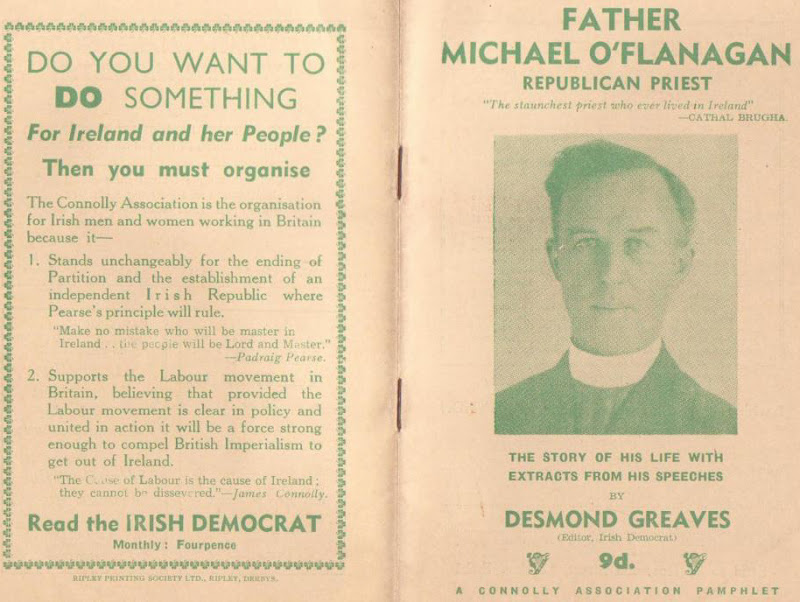
Cathal Brugha described Fr. Michael O'Flanagan as "the staunchest priest who ever lived in Ireland." This 'turbulent priest' died, aged 66, on this date (7th August) in 1942 - 82 years ago on this date.
Born to Irish speakers and into a clan of Fenians in Roscommon in 1876, Michael O'Flanagan was only 18 years young when he went to Maynooth College to study for the priesthood. He returned to his old alma mater , Summerhill College in Sligo and, at 24 years of age (in 1900), he was appointed 'Professor of Irish' in the college, from where he continued his involvement in Conradh na Gaeilge, through which he befriended Pádraig Mac Piarais and Douglas Hyde.
His church at first considered him to be a valuable asset and repeatedly sent him abroad on assignments, but less so over the years as he had a social conscience which took precedence over his church's need for him to be a 'team player' and, indeed, he embarrassed his church hierarchy when, at 37 years of age, he fully supported the Sligo dockers in their trade dispute in 1913 (even though he was working in Rome at the time, which is where he was based between 1912 and 1914) as, then as now, his religious 'betters' had more in common with the owners and bosses rather than the poorer workers.
In 1914 he was allocated to the parish of Ahamlish (North Sligo) before moving to Cliffoney, in that same county, and quickly became a true friend to the small farming community he now lived and worked with, and assisted them in their battle with the 'Congested Districts Board' who were trying to dictate the manner in which turf bogs could be used by the locals, an occasion that became known as the "Cloonerco Bog Fight".
During that 'turf war', Fr. O'Flanagan helped to organise the funeral of O'Donovan Rossa (pictured, who died on the 29th June 1915) and he spoke in Dublin City Hall when Rossa was lying in state there, which seemed to be 'the straw which broke the camel's back', as far as his Bishop (Coyne) was concerned - in October 1915, the church hierarchy attempted to transfer him to a new parish.
However, his friends and supporters in Cliffoney objected and physically prevented the new parish priest from taking up his priestly duties, a situation which lasted until Christmas Day.
Eventually, Fr. O'Flanagan was moved to Crossna, near Boyle, in County Roscommon, from where he continued to spread his own 'gospel' and that of Irish republicanism - he was vocally in favour of land reform and was strongly against Ireland taking any part in 'the First World War', 'forced' (by Westminster) or not to do so.
He worked in the background for Irish republicans during the 1916 Rising and became more politically involved in the years following same and, in October 1917, he was elected the vice-president of the then Sinn Féin organisation.
In May 1918, he condemned the English and German 'Establishments' for their encouragement to young men to join what they called "the war effort" :
"Those royal cousins who rule England and Germany will come together and clink their champagne glasses over the graves of millions of the flower of the manhood of Germany and England...", and, no sooner had he delivered those words to an appreciative audience when Bishop Coyne banned him from saying Mass in public or administering the sacraments and it would be 1938 before those duties were restored to him.
He played an active part in Sinn Féin's political victories that same year and was given the honour of opening the public session of the First Dáil Éireann in 1919 and was practically employed full-time in the 'Republican Courts' and in the development of the Dáil's land policy.
He stayed true to his political principles in 1921 and opposed the 'Treaty of Surrender', being barred from America and Australia for doing so.
He was elected president of Sinn Féin in 1933, a position which he held until 1935, but he was expelled from the organisation the following year because he breached the abstentionist policy.
He supported the Spanish Republic in its fight against Franco fascism from 1936 to 1939, which again put him at odds with his religious hierarchy, and undertook a number of speaking tours abroad in support of that fight.
Father Michael O' Flanagan, 66 years of age, died in Dublin on 7th August 1942 - 82 years ago on this date - and was buried in Glasnevin Cemetery on the 10th August. Fittingly, his graveside oration was delivered by John Joseph O'Kelly ('Sceilg') , an action that that 'turbulent priest' would have appreciated.
('1169' comment ; a headline/title like that above - 'Our Own Turf For Our Own People' - would definitely get us labelled as 'fascists/racists/far-right/ner-do-wells [!!?] etc in todays 'Woke'-infested climate and the three of us actually had a meeting about whether to change the title to 'Ireland For The Irish' instead, but sure we decided to keep the latter title for another piece later on...!)
'SINN FÉIN STATEMENT...'
From 'The United Irishman' newspaper, April 1955.
Mr McAteer assured the annual convention of the Anti-Partition League that there were happy improvements in the relationship between the "Irish Government" and the Anti-Partition League -
"We are reasonably satisfied with the new arrangements for co-operation, and we are moderately confident that it will lead to an intensification of the Anti-Partition drive, not only here but throughout the world."
At the same time, he informed the convention that the Anti-Partition League had... "..no master plan to solve partition."
It is possible that the results of the recent conference between political leaders in the twenty-six counties and representatives of the Anti-Partition League is an all-out effort to prevent Sinn Féin from succeeding where all others, on their own admission, have failed?
Issued by the Standing Committee, Sinn Féin.
(END of 'Sinn Féin Statement' and, actually, the 'end' of our 'The United Irishman' newspaper collection!
Next week [14th August 2024] we'll be re-posting articles from a 22-year-old Irish magazine [which was a great magazine once, 1980's/1990's, but went 'Woke' since then, unfortunately] and the first article is particularly timely, as it's to do with ethnicity in this State at that time which, today - 2024 - is, in our opinion, a characteristic that has changed for the worse, as far as the indigenous Irish are concerned.)
Thirty Pieces Of Silver...
On the 7th August, 1919, the British 'Chief Secretary for Ireland' (and also the '1st Baron Strathcarron'!), a Mr Ian James MacPherson, introduced a Bill in Westminster to increase the wages and improve the working conditions for their 'police force' in Ireland, the RIC.
Unemployed men were somewhat reluctant to join that semi-paramilitary grouping because the IRA were hitting back against it with some success and other Irish men and women were shunning it ; the wages were increased with fanfare to attract new recruits and to compensate for increased hardship and cost of living increases due to the fact that many shopkeepers were refusing to serve them, forcing them to obtain, usually with subterfuge, any food and other necessities from miles away.
It worked, and recruitment levels increased, as about 10,000 new members joined between January 1920 and August 1922, when the outfit was disbanded.
But their casualty rate also increased, as there were more of them presenting as targets and they were rushed into 'service' without suitable training ; between 1919 and 1922, more than 500 pro-British 'police casualties' (comprising the 'Dublin Metropolitan Police', the Auxiliaries, Black and Tans and 'Ulster Special Constabulary') were recorded ; in January 1919, the RIC claimed to have about 9,500 uniformed members and some 1,300 operational barracks in the country.
Swings and roundabouts...
==========================
SO, FAREWELL THEN, CELTIC TIGER....
It had to happen, sooner or later.
Most of the pundits and economists were too busy singing the Celtic Tiger's praises to notice, but a few critical observers worried all along about the weaknesses of a boom economy that depended so much on a few companies from one place - the United States.
By Denis O'Hearn.
From 'Magill' Annual 2002.
A populist social housing regime that provided affordable and reasonable housing to successive generations of low-income households broke down ; Irish citizens no longer have assured access to affordable housing.
In health, Ireland reduced spending as a proportion of GDP by 20 per cent between 1980 and 1996 and, even after an increase in health spending in 1998, Ireland still ranked 20th in a survey of 27 OECD countries.
Between 1970 and 1975 and 1995 and 2000, our global ranking with respect to life expectancy at birth fell by seven places - hospital waiting lists are still unacceptably long and may be on the way back up.
In education, we have performed poorly, in spite of the public image that growth is due to a highly educated population...
(MORE LATER.)
On the 7th August, 1920, IRA Volunteers attached to the Cork Number 1 Brigade were getting into position to attack a better-armed force of RIC members in their barracks in Innishannon, County Cork, when one of the rebels discharged his weapon accidentally, thus alerting the enemy ; the operation was postponed, and the Volunteers withdrew from the area.
The same IRA Brigade had, between April and July that year, rendered inoperable RIC Barracks in Blarney, Farran, Inchigeela, Clondrohid and in Cork City (MacCurtain Street).
By the end of 1920, nearly half of the 1500 RIC barracks in the country had been abandoned, and most were burned by the IRA within days of their evacuation.
Indeed, purposely, hundreds of those were rendered inoperable by the IRA on the night of the start of the fourth anniversary of the Easter Rising in 1916 - 24th April 1920!
==========================
Between thirty and forty Irish republican operatives were said to be involved in the planning etc of the overall IRA operation, but the actual ambush itself involved only about between eleven and fourteen armed IRA Volunteers from the Castletownroche Battalion, Cork Number 2 Brigade (under Tom Barry, Battalion Officer Commanding/Column Commander) and the IRA East Limerick Brigade Column (led by Donnchadh O'Hannigan and Tadhg Crowley).
The movement of a six-man RIC grouping had been monitored and an ambush position established, on the 7th August, 1920, at the townland of Scart, near
the village of Cill Dairbhre (Kildorrery, the 'Church of the Oakwood'), in North County Cork.
It was just before Noon on the 7th that the RIC members came under gunfire attack, from both sides of the road they were on, and all six were wounded.
The IRA Volunteers moved-in on the wounded forces and removed rifles, six revolvers and 250 rounds of ammunition and any other military equipment from them, taking two of them as prisoners and, once safely out of the area, released the two of them.
The other wounded RIC members were rescued by their colleagues and rushed to Fermoy Military Hospital where all but one survived - a Mr Ernest S. Watkins (29, 'Service Number 71756/LDS 2093/074B'), who was born in Monmouth, in Wales, on the 26th February 1891, and had been an RIC member for just over one month and, prior to that, worked as an engineer, leaving that trade to join the British Army and, finally, the RIC.
The next night (8th August 1920), the Crown Forces attacked the village of Kildorrery, looting houses, getting drunk and stealing from shops.
And it didn't stop there - on the 23rd November that year, a civilian - Denis O'Donnell (37), from Meadstown, near Kildorrery - was shot dead by three RIC members named Wood, Coe and Gray who were seeking to avenge the death of their colleague Mr Watkins.
Had Mr Watkins stayed in his own country, Mr O'Donnell wouldn't have died in the manner he did.
==========================
On the 7th August, 1920, the British Army re-organised itself in Ireland and established its '1st Infantry Division', consisting of two military brigades – the '15th Infantry Brigade', with its Headquarters in Belfast, covering the counties of Antrim, Armagh, Louth, Down and Monaghan, and the Derry Brigade, with its Headquarters in Derry City, and covering the counties of Donegal, Derry, Tyrone, Cavan, Fermanagh, Sligo and North Leitrim.
They sought to militarily control all 9 Counties of Ulster yet, within a few months, were professing that the province of Ulster consisted only of Six Counties...!
==========================
On the 7th August, 1920, 'The Roscommon Herald' newspaper reported that -
'...(the boycott of the RIC continues)...throughout County Leitrim the boycotting of police (sic) is carried on and there is no outside intercourse with or assistance in any way given to members of that body..'
On the 23rd April 1919, the (Republican) Dáil Éireann secretary, a Mr Diarmuid O'Hegarty, wrote out a detailed description of the policy of 'social ostracisation’ of the RIC, which had been authorised by the Dáil earlier that month. The RIC, he wrote, was to...
'...receive no social recognition from the people ; that no intercourse, except such as is absolutely necessary for business, is permitted with them ; they should not be saluted nor spoken to in the streets nor their salutes returned ; that they should not be invited to nor received in private houses as friends or guests ; that they be debarred from participation in games, sports, dances and all social functions conducted by the people, that intermarriage with them be discouraged...treated as persons, who having been adjudged guilty of treason to their country, are regarded unworthy to enjoy any of the privileges or comforts which arise from cordial relations with the public...'
And so it was!
And, actually, so it should be today, too, for the RUC/PSNI in the Occupied Six Counties and for 'An Garda Síochána' (AGS) in the Free State.
==========================
On the 6th January, 1920, IRA Volunteers held a meeting in the home of a Mr Bartholomew (Bartelmew) Walsh in the village of Glashabee, in County Cork, and the '(North) Cork Number 2 Brigade' of the IRA was formed.
The Brigade was monitored closely by GHQ Staff in Dublin and, even thought it was considered to be a successful formation, a decision was made to establish a 'Flying Column' from within its ranks and, on the 7th August that year, it was formed at a meeting held in Mourneabbey, near the town of Mallow, in County Cork (commanded by Tom Barry) attended by, among others, Patrick McCarthy, Michael O'Sullivan, Dan Browne (Newmarket Battalion), Larry Condon, John O'Mahony, Daniel Daly, Matt Flood (Fermoy Battalion), Daniel Shinnick, Jeremiah Donovan, James O'Neill, Michael O'Halloran (Castletown Roche Battalion), Patrick O'Brien, Thomas Coughlan (Charville Battalion), Daniel Vaughan (Kanturk Battalion), John Healy, Patrick Healy (Millstreet Batallion), Tadgh Byrnes, Jack Cunningham, Paddy McCarthy (from Mourneabbey), Owen Harold and Jeremiah Daly (Mallow Battalion).
When the 'Treaty of Surrender' offered a 'truce', which came into effect on the 11th July, 1921, the strength of the Cork Number 2 Brigade was 2,407 Volunteers and, overall, the IRA fielded a total 65 brigades and 297 battalions, with a strength ('on paper') of 115,550 Volunteers.
==========================
In July, 1920, courthouses in Buncrana, Carndonagh and Burnfoot, in Donegal, were burned down by the IRA to hopefully prevent any further miscarriages of 'justice' by the British political administration in Ireland.
The courthouse in Donegal Town (pictured), which was designed by local architect Michael Priestley and built in 1746, was one of only two 'Bridewells' in the county (ie it was built with basement cells), was burnt to the ground on the 7th August, 1920, following a gunbattle between the IRA and the RIC.
A Mr Harold Swan applied for compensation for the burning of the courthouse furniture, for 60 legal texts, 12,000 printed forms, and a gold mounted fountain pen.
He lodged a claim for £100 and we're not sure if he won his case, but he doesn't appear to have lodged a claim for a leather or fur coat or 60" TV...!
==========================
BEIR BUA...
The Thread of the Irish Republican Movement from The United Irishmen through to today.
Republicanism in history and today.
Published by the James Connolly/Tommy O'Neill Cumann, Republican Sinn Féin, The Liberties, Dublin.
August 1998.
('1169' comment - 'Beir Bua' translates as 'Grasp Victory' in the English language.)
REPUBLICANS AND THE STATE :
In a statement on December 8th, 1938, the surviving faithful members of the Second Dáil announced this decision...
"..confident, in delegating this sacred trust to the Army of the Republic that, in their every action towards its consummation, they will be inspired by the high ideals and the chivalry of our martyred comrades, we, as the Executive Council of Dáil Éireann, Government of the Republic, append our names.
Seán O' Ceallaigh, Ceann Comhairle,
George Count Plunkett,
Professor William Stockley,
Mary MacSwiney,
Brian Ó hUiginn,
Tom Maguire,
Cathal Ó Murchadha.
In December, 1969, following a split in the Republican Movement over the issue of the recognition of and participation in the Partition and Westminster parliaments, Thomas Maguire, as the sole surviving member of the Executive of the Second Dáil Éireann, recognised the Provisional Army Council, which remained true to the Irish Republic as the lawful Army of the Thirty-Two County Irish Republic...
(MORE LATER.)
In August, 1921, the IRA had taken over policing duties in nationalist/republican areas of Belfast and were reporting to one of their own leadership figures, a Mr Eoin O'Duffy (a republican-gamekeeper-turned-Free State-poacher).
On the 6th August, Mr O'Duffy wrote to the RIC Commissioner in Belfast, a Mr John Fitzhugh Gelston, telling him that the IRA patrols on the streets had been able to "frustrate any behaviour which might lead to serious disturbances" (ironic, considering that it was the RIC and other pro-British forces that were causing the disturbances in Ireland in the first place).
On the 7th August, the unionist/loyalist leadership in Belfast contacted Mr John Fitzhugh Gelston to object 'to the legitimacy bestowed on the IRA by the RIC (which was) resented by the unionists especially as the Truce meant a delay in the transfer of executive powers to Stormont..'
But Mr John Fitzhugh Gelston obviously survived the ticking-off (!) from his unionist/loyalist colleagues and from their political pals in Westminster because, in the 'King's Birthday Honours List' of 1923, he was 'appointed' as a 'Commander of the Order of the British Empire' (a 'CBE') in the 'Civil Division' of said 'List'.
Good on ya, Johnny - neither the IRA or the RIC could get ya, but the CBE did...!
==========================
On the 7th August, 1922, Michael Collins arrived in the Curragh, Kildare, to inspect and advise his troops stationed there, who were under the command of Commandant General John T. Prout.
He told them that "...the entire organisation and command is defective.." and placed a new Commandant-General in charge, a Mr Eamon Price.
Mr Price was the husband of Máire Nic Shiubhlaigh, an Irish actress and one-time republican activist, and was apparently not enamoured of some of his high-ranking comrades in the Free State Army - for instance, he described the FSA command staff in Kilkenny as being 'a dumping ground for cowardly, useless and otherwise buckshee officers...' ('1169' comment - WHAT?! Only the command staff...?)!
A few weeks after Mr Price's promotion (!), an FSA report on his predecessor, Mr Prout, was leaked, in which he was labelled as "..too weak as well as too guilless to handle traitorous or semi-mutinous incompetents.." - the "traitorous...semi-mutinous incompetents" was a reference to the Free State soldiers that comprised that army!
Two weeks and one day after his visit to the Curragh, Mr Collins was shot dead in Béal na Bláth, in Cork, by the IRA, but Mr Prout fared somewhat better - he was only mentally and morally wounded by being demobilised from the Free State Army in June 1924, at a time when he held the rank of Major General.
Incidentally, when Mr Collins was 'shuffling his deck' in the Curragh on the 7th August, the IRA demolished a railway bridge on the line between Kildare and Kildangan, not too far from where he was.
Sure it's just as well that he wasn't intending to get the train back to Dublin or Westminster or wherever he was going, as he might have been injured had he been on board...
==========================
Thanks for the visit, and for reading!
Sharon and the team.
Showing posts with label John T Prout. Show all posts
Wednesday, August 07, 2024
TURF, PEOPLE, LAND AND BEING "A TEAM PLAYER".
Labels:
Cathal Ó Murchadha,
Donnchadh O'Hannigan,
Ernest S Watkins.,
Harold Swan,
Jeremiah Daly,
John Fitzhugh Gelston,
John T Prout,
Máire Nic Shiubhlaigh,
Michael Priestley,
Owen Harold,
Professor William Stockley
Wednesday, July 20, 2022
1921 - BRITISH ARMY MAJOR IN IRELAND DIES BY HIS OWN HAND.
ON THIS DATE (20TH JULY) 101 YEARS AGO : BRITISH ARMY MAJOR IN IRELAND DIES BY HIS OWN HAND.
On the 20th July, 1921, a British Army Major in the hated Black and Tan/RIC 'Auxiliary' force in Ireland shot himself dead in Woodstock House in Inistioge, in County Kilkenny.
Auxiliary Cadet Major Cyrus Hunter Regnart RMLI ('Royal Marine Light Infantry'), who made a name for himself in 'foreign theatres of war', as those who cause/organise but don't actually shoulder a weapon in, call them.
Major Regnart was a linguist with a wide range of languages - German, Russian, French, Spanish, Danish - and that fact is mentioned in his reports at the end of various 'campaigns', with the implication being that he had used them to further the aims and objectives of the different 'war efforts' he involved himself in, for 'King and Country'.
On the 3rd June, 1921, he was 'released' by the RMLI and was demobilised the next day ; he joined 'ADRIC' on the 14th June, 1921 ('Service Number 2046')and was dispatched to 'A Coy' (pictured), who were then based in Woodstock House, Inistioge, in County Kilkenny where, no doubt due to the horrors he had witnessed/inflicted on his foreign jaunts, and those he witnessed/inflicted in Ireland, he killed himself on the 20th July, 1921, and was taken back to his own country to be buried (in St Helen Churchyard, in Albury, Oxfordshire, in England).
Incidentally, that 'Big House', Woodstock, was vacated by British forces in early 1922 and was then occupied by a different anti-republican element, the Free State Army. They, in turn, were withdrawn from the building on the 1st July, 1922 and, on the 2nd July, the IRA burned it down.
'CHURCHILL.'
From 'The United Irishman' newspaper, April 1955.
Mr Churchill has resigned.
His life may be summed up by saying that he was a careerist who succeeded, but it would be difficult to say that the world is a better place because he lived in it.
He certainly saved England from surrender and defeat in 1940 when he rallied a defeated and dispirited people and led them to the destruction of Germany. It cannot be said that he led them to victory, because in his lifetime the British Empire has tottered and the economy of England is as brittle as a well-baked oatcake.
Gone are the reservoirs of cheap raw materials in India, China, Malaya and all the corners of the once British Colonies... (MORE LATER.)
ON THIS DATE (20TH JULY) 99 YEARS AGO : 'BOUNDARY COMMISSION' PROBLEMS.
On the 11th July 1924, the 'Treaty of Surrender' was registered at the 'League of Nations' by the Free State authorities which, in our opinion, would have been the ideal occasion for a legal challenge to it, based on the fact that, when Michael Collins and his supporters were attempting to 'sell' it to their own side, they made a big deal of the 'Boundary Commission' clause (established under 'Article XII' of that Treaty) and in particular the part of it which stated that the 'border' could be adjusted "in accordance with the wishes of the inhabitants", which is precisely why Westminster 'took' only six of the nine Ulster counties - a built-in 'majority'.
Also, the British actually took it on themselves to amend the 1921 Treaty of Surrender to allow themselves (ie Westminster) to unilaterally appoint a representative to speak on behalf of the Stormont 'Parliament'. That Boundary Commission clause ('Article 12') was not properly adhered to by the signatories of the 1921 Treaty thereby, legally, negating the Treaty itself.
But deep pockets would be required to take such an action. And the only grouping in this State in a position to mount a challenge like that is the same (Free State) grouping which benefited then and continues to benefit today from that Clause and that which spawned it. For now they do, anyway.
On the 31st July, 1924, a 'British Judicial Committee' stated that the majority would rule on the Boundary Commission and that that Commission did not have the power to order plebiscites ; Westminster then took it upon itself to appoint a 'Northern Ireland' representative to the Boundary Commission, thus skewing the outcome of any vote taken, and it should be kept in mind that, at that stage, the Boundary Commission had not even held its first meeting - It actually only met for the first time on the 6th November 1924!
On the 20th July 1923 - 99 years ago on this date - after a meeting between Free State and British political reps in London, the Staters announced that Eoin MacNeill would be the Free State's representative on the Boundary Commission and around the same time made the formal request to the British Government to actually set up the Commission ("Please, Sir...") ; this simple request drew a hostile response from Westminster, prompting one of their own, 'Sir' James Craig, 1st Viscount Craigavon PC, PC (NI), DL etc etc to state that he and his 'government' (sic - he meant the Stormont puppet/Vichy administration in the occupied counties) would not recognise any Boundary Commission!
So, in effect, one of the main 'selling points' of the 'Treaty of Surrender' was being renegade on by the British, yet the servile Staters felt compelled to keep to their end of the 'bargain'. Typical of that mindset, which still exists in that same political institution in Kildare Street in Dublin.
'DIVIDED LOYALTIES...'
Ulster loyalism displayed its most belligerent face this year as violence at Belfast's Holy Cross School made international headlines.
But away from the spotlight, working-class Protestant communities are themselves divided, dispirited and slipping into crisis.
By Niall Stanage.
From 'Magill' magazine, Annual 2002.
Seán Mag Uidhir's words find an unexpected echo in those of prominent loyalist and Orangeman Mark Harbinson - "Nationalists have developed that side of things, and it is a credit to them," he says, "We have had this belief that the Protestant people of Ulster (sic) would always be looked after by the British government. What I am seeing now is people realising that they haven't been looked after, they have been treated like some distant colony."
Faced with a disorientating present, Protestants are prone to harking back to the pre-1969 'good old days' and, in doing so, they are reminiscing not just about a Northern Ireland (sic) whose 'Britishness' was beyond question, but about an era in which huge companies like Mackies engineering works and the Harland And Wolff shipyard employed thousands of (overwhemingly Protestant) workers.
The decimation of those industries - the shipyard once boasted a workforce of over 20,000 people, now the total is less than 2,000 and closure is regularly mooted - has been a seismic shock from which Belfast loyalism has yet to recover... (MORE LATER.)
'NYC COMMITTEE.'
From 'The United Irishman' newspaper, March, 1955.
'From Irish Republican Prisoners Dependants Fund,
Clan na Gael HQ.
To General Secretary, Dublin.
A Cara,
Since last writing you our position has greatly strengthened, the GAA President, John (Kerry) O'Donnell, has given the 'Republican Aid Committee' (RAC) his very influential support.
He has obtained for us a special field day at Croke Park, with excellent matches to be played at same with permission to have a chance sale booth for the full season in the park, making a strong appeal on behalf of the prisoners at the GAA Banquet of the Year, besides giving generous personal contributions, and pledging full support on behalf of the Prisoners' Aid. The group attached to the AOH branch Highbridge, the Bronx, who organised a very successful dance last year, are again to repeat their effort on April 16th, besides making a special subscription drive in their area.
The members of the branch have all declared their willingness and desire to help...' (MORE LATER.)
ON THIS DATE (20TH JULY) IN...
...1616 :
'The Flight of the Earls' ; on the 20th July, 1616, Hugh O'Neill (pictured), the head of the O'Neill clan of Ulster, the 2nd Earl of Tyrone, described over the decades as 'charismatic, machiavellian, a ruthless opponent, a skilled negotiator, a power seeker par excellence, an innovator...', an Irish rebel who, from 1595 to 1603 ('the Nine Years War'), led an unsuccessful Roman Catholic uprising against English rule in Ireland, died in Rome.
He hoped to restart the war by building an army of soldiers from Europe, but he never managed to gain enough military support ; the defeat of O'Neill and the conquest of the province of Ulster was the final step in the subjugation of Ireland by the English, a nightmare we're still living through.
======================================
...1798 :
During the 1798 Rebellion, a force of 3,000 'United Irishmen' were camped out in the Bog of Allen in County Kildare and used their encampment as a 'base of operations' from which to organise, and carry out, attacks on the British.
From that base, under the command of Colonel William Aylmer, they carried out attacks on British forces at Properous, Clane, Rathangan, Naas, Kilcock and Maynooth, but suffered one major setback when 200 of their number were killed on the 19th June, 1798, in what became known as 'The Battle of Ovidstown'.
On the 10th July, another rebel camp consisting of Wicklow and Wexford rebels marched from Blessington, nearly 40km away, to join them. This boosted numbers at the Bog of Allen camp to about 4,000 fighters but, the next morning, the Wicklow and Wexford group left the camp and headed north to Meath and Fingal, but they were halted on the 14th July at Drishogue Lane, Ballyboughal, where they were cut down by the British.
The British forces then headed for the Bog of Allen encampment and, on the 20th July, 1798, knowing that they were outnumbered and about to face a foe with superior weaponry, the Kildare rebels surrendered under a conditional amnesty and rebel Colonel William Aylmer sent a message to his father, an acquaintance of the 'Marquess' of Buckingham, to try and arrange surrender terms for himself, his second-in-command, Hugh Ware, and their remaining fighters.
William Aylmer was detained in Dublin Castle before being allowed to go to England, named in the 'Banishment Act' and was effectively 'evicted' from Ireland. But a section of his men had refused to surrender, breached the British encirclement and marched northwards, under Anthony Perry, to try to rise once more the rebels of Meath and Fingal.
The fight for freedom continued, and does so to this day.
======================================
...1888 :
Sarah Teresa MacMahon (Sorcha MacMahon, pictured) was born in Coas, in County Monaghan, on the 20th July, 1888, one of seven children (four boys and three girls), and was raised in an Irish-speaking household.
After her schooling, she left the family home in Monaghan and headed for Dublin where she began working as a commercial bookkeeper for Taggart's Garage, and joined Cumann na mBan, where she made her mark as a secretary and in nursing and first aid.
She was very active in the 1916 Rising and began working with Michael Collins afterwards but, in February 1922, when Cumann na mBan rejected the 'Treaty of Surrender', he instructed her to end her membership of, and association with, Cumann na mBan and - more fool her - she did.
While she then claimed that she did not support either side in the conflict between Collins' Free State and the Republican Movement, she continued to work, in a clerical position, for the Staters. She died as 'Mrs Sorcha Rogers' on the 13th December, 1970, in Sutton, County Dublin.
======================================
...1920 : On the 20th July, 1920, the RIC and their comrades in the British 'Dragoon Guards Regiment' (pictured, who were stationed in Claremorris, County Mayo) went on the rampage and provoked riots in Tuam, County Galway ; the British forces looted public houses, fired their weapons indiscriminately, burned down the Town Hall and a number of other buildings and houses.
An English reporter who was observing the destruction compared the wrecked town of Tuam to Belgian and other French towns which had been destroyed by the Germans during the First World War.
They were on a revenge mission - on the 19th, an IRA ambush in Tuam resulted in the death of two RIC men.
======================================
...1920 :
At 2am on the morning of Tuesday, 20th July 1920, the RIC Barracks in Nurney, County Kildare, was attacked by the IRA and burned down and, at 2.30am, the RIC Barracks in Castledermot (about 17 miles from Nurney), also in that same county, was attacked and burnt down, as was the courthouse and, in Athy, again in Kildare, the courthouse was made unusable.
In all three attacks, communication links were cut and the 'Weights and Measures' ledgers, and other 'official' books, were destroyed. IRA casualities were light, with only one Volunteer having received injuries.
======================================
...1920 :
On the 20th July, 1920, the West Limerick Brigade of the IRA held a meeting in Dirreen, Athea, in Limerick, and formed a 'Flying Column' of Volunteers, consisting of about 35 fighters. The Vice Commander of the Brigade, Garrett McAulieffe, was announced as the Commander of the new Column and IRA Captain Michael Colbert was promoted to the position of Vice Commander of the new Unit.
======================================
...1921 :
On the 20th July, 1921, political 'movement' took place in relation to possible 'peace talks' regarding the political and military situation Westminster had placed itself in, in relation to its interference in Ireland.
Various issues were discussed/offered/touched-on by Westminster, including that the use of the word 'treaty' was now deemed acceptable by the British cabinet, which was very decent and jolly hockeysticks etc of them.
A proposal was on the table to have 26 out of our 32 counties declared as 'a qualified Dominion Status' with 'internal control over taxation, finance and land defence', but with no navy force, and existing navy bases to be practically handed-over to the 'Royal Navy', and there would be agreed restrictions placed on the number of and actual individual membership of the new State's army.
There was to be free and open trade between the new 'Free State' and England, which would, potentially, help the new State and the Staters within it to pay the demanded 'Irish contribution to the British war debt'!
In addition, the new State must recognise "..the existing powers and privileges of the Parliament of Northern Ireland, which cannot be abrogated except by their own consent..."
A 'win-win' situation for Westminster, with gifted political careers and an easy life guaranteed for those who accepted the 'Terms and Conditions' offered/imposed by Westminster. And those acceptees are still there, in Leinster House, in Kildare Street, in Dublin.
======================================
...1922 :
On the 20th July, 1922, Free State Army Captain Ned O'Brien and about 100 State troops, using boats, attacked republican positions on the quays in Waterford and took about twelve prisoners ; they then crossed the river Suir into the city to continue their assault.
Free State General John T. Prout (pictured, a republican-gamekeeper-turned-Free State-poacher), with about 450 State troopers under his command, used an 18-pounder field gun which he stationed at the Suir Ferry bank to fire at close range into the IRA-held Post Office. Two Free State soldiers were killed in the fighting in Waterford and nineteen were wounded, and at least one IRA fighter was fatally wounded. Five civilians were killed in the three-day State onslaught.
======================================
...1922 :
On the 20th July, 1922, two Free State Army Privates, John Foran and John Martin, were killed in successive nights in attacks outside Mountjoy prison in Dublin. We have no more information on these two men.
======================================
...1933 :
On the 20th July, 1933, republican-gamekeeper-turned-Free State-fascist Eoin O'Duffy (pictured) became the leader of the 'National Guard' grouping (the 'Blueshirts', without whom there would have been no Fine Gael), an organisation which sprang from the 10,000-strong 'Army Comrades Association'.
Mr O'Duffy joined the IRA in 1917 but, when the Free State was spawned in 1921, he jumped ship to it and was the commander of the State Army between 1924 and 1925, and also 'served' as chief commissioner of the Civic Guard (the State 'police force') from 1922 to 1933.
He was removed from that position in 1933 and, true to his fascist political leanings, he helped to found the 'Fine Gael' party ; he was president of that outfit from 1933 until 1934, when he was forced to resign.
This foul creature died on the 30th November, 1944, at 54 years of age. More about him here.
======================================
...1982 :
On the 20th July, 1982, the IRA detonated two bombs in London, one in Hyde Park and the other in Regents Park, two hours later. Both were timed to coincide with British military ceremonies which were taking place in those parks.
The explosions killed 11 military personnel - four soldiers of the Blues And Royals at Hyde Park, and seven bandsmen of the Royal Green Jackets at Regents Park, and a further 51 people were injured. Seven horses also died in the attack.
According to Andrew Parker-Bowles (the ex-husband of the 'Duchess' of Cornwall), the English Queen saw the attack as one of the darkest days of her reign : "She said to me it was 'the most ghastly day of my life.'"
We here in Ireland know all about such "ghastly days".
======================================
=======================
=======================
Thanks for the visit, and for reading!
We're temporarily closing up shop here for a few weeks ; not going away, not even going on a 'staycation' and, unfortunately, definitely not going back to NYC. Yet..!
We haven't had a decent break in...eh... yonks (!) and the two lads will, I know, appreciate the free time and I've already made some arrangements with the Girl Gang for a few days/nights out, plus we'll be contacting our buddies in New York to have a chat.
We'll be back here on Wednesday, 10th August 2022 with, among other pieces, a few paragraphs about an IRA Executive meeting held in the mid-1920's, comprising over two dozen republican fighters, at which past actions were discussed and future arrangements were made.
If you're unable to do without the pleasure ofmy our company (!) until the 10th August next, then get yer fix on Facebook and/or Twitter. Or don't. See what I care ; I'm off on me holliers...!
Thanks again,
Sharon and the team.
On the 20th July, 1921, a British Army Major in the hated Black and Tan/RIC 'Auxiliary' force in Ireland shot himself dead in Woodstock House in Inistioge, in County Kilkenny.
Auxiliary Cadet Major Cyrus Hunter Regnart RMLI ('Royal Marine Light Infantry'), who made a name for himself in 'foreign theatres of war', as those who cause/organise but don't actually shoulder a weapon in, call them.
Major Regnart was a linguist with a wide range of languages - German, Russian, French, Spanish, Danish - and that fact is mentioned in his reports at the end of various 'campaigns', with the implication being that he had used them to further the aims and objectives of the different 'war efforts' he involved himself in, for 'King and Country'.
On the 3rd June, 1921, he was 'released' by the RMLI and was demobilised the next day ; he joined 'ADRIC' on the 14th June, 1921 ('Service Number 2046')and was dispatched to 'A Coy' (pictured), who were then based in Woodstock House, Inistioge, in County Kilkenny where, no doubt due to the horrors he had witnessed/inflicted on his foreign jaunts, and those he witnessed/inflicted in Ireland, he killed himself on the 20th July, 1921, and was taken back to his own country to be buried (in St Helen Churchyard, in Albury, Oxfordshire, in England).
Incidentally, that 'Big House', Woodstock, was vacated by British forces in early 1922 and was then occupied by a different anti-republican element, the Free State Army. They, in turn, were withdrawn from the building on the 1st July, 1922 and, on the 2nd July, the IRA burned it down.
'CHURCHILL.'
From 'The United Irishman' newspaper, April 1955.
Mr Churchill has resigned.
His life may be summed up by saying that he was a careerist who succeeded, but it would be difficult to say that the world is a better place because he lived in it.
He certainly saved England from surrender and defeat in 1940 when he rallied a defeated and dispirited people and led them to the destruction of Germany. It cannot be said that he led them to victory, because in his lifetime the British Empire has tottered and the economy of England is as brittle as a well-baked oatcake.
Gone are the reservoirs of cheap raw materials in India, China, Malaya and all the corners of the once British Colonies... (MORE LATER.)
ON THIS DATE (20TH JULY) 99 YEARS AGO : 'BOUNDARY COMMISSION' PROBLEMS.
On the 11th July 1924, the 'Treaty of Surrender' was registered at the 'League of Nations' by the Free State authorities which, in our opinion, would have been the ideal occasion for a legal challenge to it, based on the fact that, when Michael Collins and his supporters were attempting to 'sell' it to their own side, they made a big deal of the 'Boundary Commission' clause (established under 'Article XII' of that Treaty) and in particular the part of it which stated that the 'border' could be adjusted "in accordance with the wishes of the inhabitants", which is precisely why Westminster 'took' only six of the nine Ulster counties - a built-in 'majority'.
Also, the British actually took it on themselves to amend the 1921 Treaty of Surrender to allow themselves (ie Westminster) to unilaterally appoint a representative to speak on behalf of the Stormont 'Parliament'. That Boundary Commission clause ('Article 12') was not properly adhered to by the signatories of the 1921 Treaty thereby, legally, negating the Treaty itself.
But deep pockets would be required to take such an action. And the only grouping in this State in a position to mount a challenge like that is the same (Free State) grouping which benefited then and continues to benefit today from that Clause and that which spawned it. For now they do, anyway.
On the 31st July, 1924, a 'British Judicial Committee' stated that the majority would rule on the Boundary Commission and that that Commission did not have the power to order plebiscites ; Westminster then took it upon itself to appoint a 'Northern Ireland' representative to the Boundary Commission, thus skewing the outcome of any vote taken, and it should be kept in mind that, at that stage, the Boundary Commission had not even held its first meeting - It actually only met for the first time on the 6th November 1924!
On the 20th July 1923 - 99 years ago on this date - after a meeting between Free State and British political reps in London, the Staters announced that Eoin MacNeill would be the Free State's representative on the Boundary Commission and around the same time made the formal request to the British Government to actually set up the Commission ("Please, Sir...") ; this simple request drew a hostile response from Westminster, prompting one of their own, 'Sir' James Craig, 1st Viscount Craigavon PC, PC (NI), DL etc etc to state that he and his 'government' (sic - he meant the Stormont puppet/Vichy administration in the occupied counties) would not recognise any Boundary Commission!
So, in effect, one of the main 'selling points' of the 'Treaty of Surrender' was being renegade on by the British, yet the servile Staters felt compelled to keep to their end of the 'bargain'. Typical of that mindset, which still exists in that same political institution in Kildare Street in Dublin.
'DIVIDED LOYALTIES...'
Ulster loyalism displayed its most belligerent face this year as violence at Belfast's Holy Cross School made international headlines.
But away from the spotlight, working-class Protestant communities are themselves divided, dispirited and slipping into crisis.
By Niall Stanage.
From 'Magill' magazine, Annual 2002.
Seán Mag Uidhir's words find an unexpected echo in those of prominent loyalist and Orangeman Mark Harbinson - "Nationalists have developed that side of things, and it is a credit to them," he says, "We have had this belief that the Protestant people of Ulster (sic) would always be looked after by the British government. What I am seeing now is people realising that they haven't been looked after, they have been treated like some distant colony."
Faced with a disorientating present, Protestants are prone to harking back to the pre-1969 'good old days' and, in doing so, they are reminiscing not just about a Northern Ireland (sic) whose 'Britishness' was beyond question, but about an era in which huge companies like Mackies engineering works and the Harland And Wolff shipyard employed thousands of (overwhemingly Protestant) workers.
The decimation of those industries - the shipyard once boasted a workforce of over 20,000 people, now the total is less than 2,000 and closure is regularly mooted - has been a seismic shock from which Belfast loyalism has yet to recover... (MORE LATER.)
'NYC COMMITTEE.'
From 'The United Irishman' newspaper, March, 1955.
'From Irish Republican Prisoners Dependants Fund,
Clan na Gael HQ.
To General Secretary, Dublin.
A Cara,
Since last writing you our position has greatly strengthened, the GAA President, John (Kerry) O'Donnell, has given the 'Republican Aid Committee' (RAC) his very influential support.
He has obtained for us a special field day at Croke Park, with excellent matches to be played at same with permission to have a chance sale booth for the full season in the park, making a strong appeal on behalf of the prisoners at the GAA Banquet of the Year, besides giving generous personal contributions, and pledging full support on behalf of the Prisoners' Aid. The group attached to the AOH branch Highbridge, the Bronx, who organised a very successful dance last year, are again to repeat their effort on April 16th, besides making a special subscription drive in their area.
The members of the branch have all declared their willingness and desire to help...' (MORE LATER.)
ON THIS DATE (20TH JULY) IN...
...1616 :
'The Flight of the Earls' ; on the 20th July, 1616, Hugh O'Neill (pictured), the head of the O'Neill clan of Ulster, the 2nd Earl of Tyrone, described over the decades as 'charismatic, machiavellian, a ruthless opponent, a skilled negotiator, a power seeker par excellence, an innovator...', an Irish rebel who, from 1595 to 1603 ('the Nine Years War'), led an unsuccessful Roman Catholic uprising against English rule in Ireland, died in Rome.
He hoped to restart the war by building an army of soldiers from Europe, but he never managed to gain enough military support ; the defeat of O'Neill and the conquest of the province of Ulster was the final step in the subjugation of Ireland by the English, a nightmare we're still living through.
======================================
...1798 :
During the 1798 Rebellion, a force of 3,000 'United Irishmen' were camped out in the Bog of Allen in County Kildare and used their encampment as a 'base of operations' from which to organise, and carry out, attacks on the British.
From that base, under the command of Colonel William Aylmer, they carried out attacks on British forces at Properous, Clane, Rathangan, Naas, Kilcock and Maynooth, but suffered one major setback when 200 of their number were killed on the 19th June, 1798, in what became known as 'The Battle of Ovidstown'.
On the 10th July, another rebel camp consisting of Wicklow and Wexford rebels marched from Blessington, nearly 40km away, to join them. This boosted numbers at the Bog of Allen camp to about 4,000 fighters but, the next morning, the Wicklow and Wexford group left the camp and headed north to Meath and Fingal, but they were halted on the 14th July at Drishogue Lane, Ballyboughal, where they were cut down by the British.
The British forces then headed for the Bog of Allen encampment and, on the 20th July, 1798, knowing that they were outnumbered and about to face a foe with superior weaponry, the Kildare rebels surrendered under a conditional amnesty and rebel Colonel William Aylmer sent a message to his father, an acquaintance of the 'Marquess' of Buckingham, to try and arrange surrender terms for himself, his second-in-command, Hugh Ware, and their remaining fighters.
William Aylmer was detained in Dublin Castle before being allowed to go to England, named in the 'Banishment Act' and was effectively 'evicted' from Ireland. But a section of his men had refused to surrender, breached the British encirclement and marched northwards, under Anthony Perry, to try to rise once more the rebels of Meath and Fingal.
The fight for freedom continued, and does so to this day.
======================================
...1888 :
Sarah Teresa MacMahon (Sorcha MacMahon, pictured) was born in Coas, in County Monaghan, on the 20th July, 1888, one of seven children (four boys and three girls), and was raised in an Irish-speaking household.
After her schooling, she left the family home in Monaghan and headed for Dublin where she began working as a commercial bookkeeper for Taggart's Garage, and joined Cumann na mBan, where she made her mark as a secretary and in nursing and first aid.
She was very active in the 1916 Rising and began working with Michael Collins afterwards but, in February 1922, when Cumann na mBan rejected the 'Treaty of Surrender', he instructed her to end her membership of, and association with, Cumann na mBan and - more fool her - she did.
While she then claimed that she did not support either side in the conflict between Collins' Free State and the Republican Movement, she continued to work, in a clerical position, for the Staters. She died as 'Mrs Sorcha Rogers' on the 13th December, 1970, in Sutton, County Dublin.
======================================
...1920 : On the 20th July, 1920, the RIC and their comrades in the British 'Dragoon Guards Regiment' (pictured, who were stationed in Claremorris, County Mayo) went on the rampage and provoked riots in Tuam, County Galway ; the British forces looted public houses, fired their weapons indiscriminately, burned down the Town Hall and a number of other buildings and houses.
An English reporter who was observing the destruction compared the wrecked town of Tuam to Belgian and other French towns which had been destroyed by the Germans during the First World War.
They were on a revenge mission - on the 19th, an IRA ambush in Tuam resulted in the death of two RIC men.
======================================
...1920 :
At 2am on the morning of Tuesday, 20th July 1920, the RIC Barracks in Nurney, County Kildare, was attacked by the IRA and burned down and, at 2.30am, the RIC Barracks in Castledermot (about 17 miles from Nurney), also in that same county, was attacked and burnt down, as was the courthouse and, in Athy, again in Kildare, the courthouse was made unusable.
In all three attacks, communication links were cut and the 'Weights and Measures' ledgers, and other 'official' books, were destroyed. IRA casualities were light, with only one Volunteer having received injuries.
======================================
...1920 :
On the 20th July, 1920, the West Limerick Brigade of the IRA held a meeting in Dirreen, Athea, in Limerick, and formed a 'Flying Column' of Volunteers, consisting of about 35 fighters. The Vice Commander of the Brigade, Garrett McAulieffe, was announced as the Commander of the new Column and IRA Captain Michael Colbert was promoted to the position of Vice Commander of the new Unit.
======================================
...1921 :
On the 20th July, 1921, political 'movement' took place in relation to possible 'peace talks' regarding the political and military situation Westminster had placed itself in, in relation to its interference in Ireland.
Various issues were discussed/offered/touched-on by Westminster, including that the use of the word 'treaty' was now deemed acceptable by the British cabinet, which was very decent and jolly hockeysticks etc of them.
A proposal was on the table to have 26 out of our 32 counties declared as 'a qualified Dominion Status' with 'internal control over taxation, finance and land defence', but with no navy force, and existing navy bases to be practically handed-over to the 'Royal Navy', and there would be agreed restrictions placed on the number of and actual individual membership of the new State's army.
There was to be free and open trade between the new 'Free State' and England, which would, potentially, help the new State and the Staters within it to pay the demanded 'Irish contribution to the British war debt'!
In addition, the new State must recognise "..the existing powers and privileges of the Parliament of Northern Ireland, which cannot be abrogated except by their own consent..."
A 'win-win' situation for Westminster, with gifted political careers and an easy life guaranteed for those who accepted the 'Terms and Conditions' offered/imposed by Westminster. And those acceptees are still there, in Leinster House, in Kildare Street, in Dublin.
======================================
...1922 :
On the 20th July, 1922, Free State Army Captain Ned O'Brien and about 100 State troops, using boats, attacked republican positions on the quays in Waterford and took about twelve prisoners ; they then crossed the river Suir into the city to continue their assault.
Free State General John T. Prout (pictured, a republican-gamekeeper-turned-Free State-poacher), with about 450 State troopers under his command, used an 18-pounder field gun which he stationed at the Suir Ferry bank to fire at close range into the IRA-held Post Office. Two Free State soldiers were killed in the fighting in Waterford and nineteen were wounded, and at least one IRA fighter was fatally wounded. Five civilians were killed in the three-day State onslaught.
======================================
...1922 :
On the 20th July, 1922, two Free State Army Privates, John Foran and John Martin, were killed in successive nights in attacks outside Mountjoy prison in Dublin. We have no more information on these two men.
======================================
...1933 :
On the 20th July, 1933, republican-gamekeeper-turned-Free State-fascist Eoin O'Duffy (pictured) became the leader of the 'National Guard' grouping (the 'Blueshirts', without whom there would have been no Fine Gael), an organisation which sprang from the 10,000-strong 'Army Comrades Association'.
Mr O'Duffy joined the IRA in 1917 but, when the Free State was spawned in 1921, he jumped ship to it and was the commander of the State Army between 1924 and 1925, and also 'served' as chief commissioner of the Civic Guard (the State 'police force') from 1922 to 1933.
He was removed from that position in 1933 and, true to his fascist political leanings, he helped to found the 'Fine Gael' party ; he was president of that outfit from 1933 until 1934, when he was forced to resign.
This foul creature died on the 30th November, 1944, at 54 years of age. More about him here.
======================================
...1982 :
On the 20th July, 1982, the IRA detonated two bombs in London, one in Hyde Park and the other in Regents Park, two hours later. Both were timed to coincide with British military ceremonies which were taking place in those parks.
The explosions killed 11 military personnel - four soldiers of the Blues And Royals at Hyde Park, and seven bandsmen of the Royal Green Jackets at Regents Park, and a further 51 people were injured. Seven horses also died in the attack.
According to Andrew Parker-Bowles (the ex-husband of the 'Duchess' of Cornwall), the English Queen saw the attack as one of the darkest days of her reign : "She said to me it was 'the most ghastly day of my life.'"
We here in Ireland know all about such "ghastly days".
======================================
=======================
=======================
Thanks for the visit, and for reading!
We're temporarily closing up shop here for a few weeks ; not going away, not even going on a 'staycation' and, unfortunately, definitely not going back to NYC. Yet..!
We haven't had a decent break in...eh... yonks (!) and the two lads will, I know, appreciate the free time and I've already made some arrangements with the Girl Gang for a few days/nights out, plus we'll be contacting our buddies in New York to have a chat.
We'll be back here on Wednesday, 10th August 2022 with, among other pieces, a few paragraphs about an IRA Executive meeting held in the mid-1920's, comprising over two dozen republican fighters, at which past actions were discussed and future arrangements were made.
If you're unable to do without the pleasure of
Thanks again,
Sharon and the team.
Labels:
Cyrus Hunter Regnart,
Eoin O Duffy.,
Hugh O'Neill,
Hugh Ware,
John Foran,
John Kerry O'Donnell,
John Martin,
John T Prout,
Ned O'Brien,
Sarah Teresa MacMahon,
Sorcha MacMahon,
William Alymer
Subscribe to:
Posts (Atom)