"Reprisals are wrong.
They are bad for the discipline of the force.
They are bad for Ireland, especially if the wholly innocent suffer.
Reprisals are wrong but reprisals do not happen only by accident.
They are the result of the brutal, cowardly murder of police officers (sic) by assassins (sic), who take shelter behind the screen of terrorism (sic) and intimidation (sic) they have created.
Police (sic) murder (sic) produces reprisals. Stop murdering (sic) policemen (sic)."
- Editorial in the printed 'The Weekly Summary', 8th October 1920.
Those printed pages masqueraded as an in-house 'newspaper' for RIC members in the early 1920's in Ireland, repeatedly describing the Republican Movement as "enemies of humanity", but was a poor man's version of 'The Irish Bulletin', the Irish republican newspaper, which had a guaranteed readership outside of the Movement, and abroad.
'The Weekly Summary' was circulated among its in-house members from August 1920 until January 1922, when it folded due to a dying readership.
Literally.
Before it folded, 'The Summary' apparently lost one of its readers on the same date that it published that editorial - an RIC member, a 'Constable Dennison', in Dunamore (Dunnamore/Donamore), in County Tyrone, wouldn't surrender his revolver when ordered to do so by IRA Volunteers and, seemingly, involved himself in a scuffle with the Volunteers, during which a gun was fired, wounding him, at least.
Our sources record no mention of this event, and we couldn't find any other information on the incident.
When Mr Dennison may or may not have been involved in a situation in Tyrone, 270 miles down the road (about 430 km), in County Cork, a very definite incident was unfolding.
At least 30 IRA Volunteers, attached to the 2nd Battalion of Cork No. 1 Brigade (with Volunteer Michael Murphy in command), were in ambush position at the corner of Cove Street and Barrack Street in Cork when, at about 9am - as expected - a British Army lorry approached their position.
Seven armed BA soldiers, from the '2nd Battalion Hampshire Regiment', were in the lorry and they were quickly joined by a ticking bomb (four bombs were thrown at the vehicle altogether, one of which failed to explode) which had been lobbed into the vehicle.
One of the BA soldiers, a Mr Gordon John Squibb (17, 'Service Number 5487222'), grabbed the device with the intention of throwing it out onto the street but it exploded when he lifted it, killing him : he is buried (12th October) in the Churchyard of the Baptist Chapel in Niton, on the Isle of Wight, in England.
Three of his comrade soldiers were injured as were at least four civilians - Mr Thomas Madden, Mr Denis Buckley, M/s Kate Fitzpatrick and a Mr Jeremiah Linehan - and two Volunteers also sustained injuries - Volunteer Michael Murphy and Volunteer Tadgh O'Sullivan - when the BA gunmen fired about 20 shots in, roughly, their direction.
The civilians recovered, shaken, but in good health.

On that same date (8th October 1920), a British Army Brigadier General, 'Sir' George Kynaston Cockerill (pictured, a Conservative/Tory MP for the Reigate Constituency in Surrey, 1918-1931) had his 'Letter to The Editor' published in 'The London Times' newspaper.
In his letter, Mr Cockerill called for.. "..a meeting of plenipotentiaries from Britain and Ireland to discuss settlement, to be preceded by a truce and amnesty with the resulting agreement to be submitted to both parliaments for acceptance or rejection but not amendment..."
In (officially) July, 1921, a truce was agreed, followed by negotiations, followed by the signing of same in December 1921.
He was deeply involved in the British 'Intelligence Services' and was was 'knighted' (!) in 1926, beginning (officially!) his political career in the so-called 'House of Commons'.
He either had good intuition or knew the inside track - my money's on the latter!
As 'Sir' Cockerill was reading his own letter in 'The London Times' on the 8th, his military colleagues in Ireland were raiding a house in Meelick, in County Clare, believing they were about to 'arrest' three rebel brothers Michael, Austen and Patrick Brennan.
The armed foreigners forced their way into the dwelling only to discover that the three brothers had been notified about the raid and had gone 'on the run'.
To ease their disappointment, the British soldiers put Mrs Brennan, a widow, and her daughter, out of the house and burned it to the ground, then left the area.
Mrs Brennan and her daughter and three sons were then homeless.
We wonder did Mr Cockerill write a letter to 'The London Times' about that...?
==========================
GAS LADS...

The massive finds of oil and gas on our western seaboard could ensure Ireland's financial security for generations.
Wealth approximating that of the Arab countries is within our grasp, but the Irish government seems content to sell off our birthright for a handful of votes and a few dollars.
In a special 'Magill' report, Sandra Mara investigates just what we are giving away, and why.
From 'Magill' magazine, March 2002.
Pat Keating, spokesperson for 'Enterprise Oil', said -
"Exploration off Ireland had not been a great success, and it needed a regime to attract more exploration.
Enterprise Oil never came here because of a deal, but in the hope of making a discovery.
But the amounts of discoveries to date hasn't been great."
And on the subject of whether the terms of Irish licence agreements are more attractive than those of other countries, he said -
"I wouldn't have said so, because so many factors come into consideration in different countries.
It would be like comparing apples and oranges ; every area has its own frameworks and parameters."
Again, he stresses, that companies would come to Ireland not because the terms of licence agreements would be attractive, but rather in the hope of making a significant oil or gas find and, he says,... "Ireland has been dismally disappointing.." in that regard so far...
(MORE LATER.)

On the 8th October, 1921, Volunteer Patrick Dunne, from Greenhills, in the village of Kill, County Kildare, knocked on his own halldoor, having been imprisoned for nine months by the British, for having "seditious literature in his possession".
Our enquiries about Volunteer Dunne indicate that he shouldered a weapon for Ireland alongside the other brave men and women of the 7th Brigade, 1st Eastern Division of the Republican Army, that he had been active in the 1916 Rising and later served as Captain of the Kill Company of the Irish Volunteers.
More here...


As Volunteer Patrick Dunne was 'born again' after his nine months 'stay' (!), a British Army intelligence officer in Berlin, Germany, a 'Sir' John Arnold Wallinger, pictured, KBE, DSO, CIE, KPM ETC ETC (!), reported to his army superiors about IRA gunrunning activities in Germany.
In his (accurate) report, he provided scripture and verse on how a 'Mr Thompson' (Charles John McGuinness, aka 'Charles T. Hennessey', 'Nomad', 'Charlie', 'Night-Hawk') and another IRA Volunteer, William Beaumont (a 'Crossover' ie an ex-British Army man) had been sent to Germany by the IRA GHQ with two million German Marks to make further contact with the far-right, fascist 'Orgesch' organisation, to purchase weapons from them, which they succeeded in doing.
IRA conduits in Germany, Robert Emmet Briscoe and John T. Ryan, assisted in putting the deal together.
Mr Wallinger, somewhat exasperated, we imagine (!), also reported that the IRA Unit was also dealing with the German Communist Party to secure boats to transport the purchased weapons to Ireland!
So there ya have it - in short, in 1921, Irish republicans worked hand-in-glove with fascists and communists when the need and the opportunity to do so presented itself, for the objective of fighting for an Ireland for the Irish.
'Any port in a storm', as the saying goes, if the end result means the removal of the foreigners...
And, speaking of boats, ports and faraway lands, an event linked to the above took place on the 21st October, 1921 - German police in Hamburg raided and searched a ship called 'Anita', and found and confiscated a large amount of weapons destined for the IRA.
Volunteer Charles McGuinness was arrested by them, was eventually fined a sum of money and then released ; the ship was by all accounts rather worn but was up to the task, the weapons had been purchased by IRA GHQ from the fascist Orgesch organisation (also mentioned here) and, at his trial, the judge privately wished Volunteer McGuinness better luck next time!
...and, in yet another related incident, Volunteers Robert Briscoe and Charles McGuinness left the port of Hamburg in a small tug called 'The Frieda' on the 28th October, 1921, with a German crew supplied by the Orgesch organisation.
The tug was carrying about 300 guns and 80,000 rounds of ammunition for those weapons (some reports state 200 rifles and 10,000 rounds of ammunition), destined for the IRA.
Just before they set sail, Volunteer Briscoe sent a pre-arranged 'Thumbs Up!' telegram to Volunteer Liam Mellows, in Ireland, who was the IRA's Director of Purchases, and then Volunteer Pax Whelan, Officer Commanding of the Waterford Brigade IRA, was notified to prepare for 'The Frieda' landing on the shores of Helvick Head, in Waterford.
The tug got delayed by rough weather at sea and even worse weather made them take shelter behind a small island near Helvick Head, so Volunteer McGuinness and a few crew members decided to row a lifeboat ashore, and they then made to way to the house of a local Sinn Féin member, a Dr Vincent White (a republican-gamekeeper-turned-Free State-poacher).
Between Mr White and Volunteer Whelan, transport was arranged, the cargo was safely unloaded from 'The Frieda' and taken to Keatings of Kilrossanty in the Comeragh Mountains, on the Waterford/Tipperary border, a republican owned and operated business and, from there, the goods were distributed between the Southern and Midlands Divisions of the IRA.

That gunrunning operation was successfully completed because of cooperation between Irish republicans, fascists and communists, an unlikely combination, but one that was deemed necessary by Irish republicans to free Ireland from the foreigners.


'In January 1937, Tom Barry, then IRA Chief of Staff, traveled to Germany to meet with Nazi intelligence (the Abwehr) seeking financial and military support for a potential war with Britain, and secured a commitment subject to the IRA focusing attacks on British military installations in Northern Ireland (sic).
The trip, which was controversial and resulted in Barry's eventual resignation from the IRA leadership, laid groundwork for future IRA-Nazi contact...in January 1937, IRA leader Tom Barry travelled to Nazi Germany at the request of German Abwehr intelligence, accompanied by a German agent named Jupp Hoven, to seek financial support and ensure a commitment to a war with Britain, which the IRA would respond to by attacking British military installations in Northern Ireland (sic).
Barry secured this support, but upon his return, the IRA Army Convention rejected the "Barry Plan" in favor of Seán Russell's S-Plan to attack targets in Britain. Barry resigned as Chief of Staff but continued to have contact with German agents until at least February 1939...' (From here.)
'When it became clear that victory could not be achieved, Barry proposed that the Anti-Treaty IRA should lay down their arms, which led to frequent clashes with Liam Lynch.
Barry still continued to be a part of the IRA after the civil war and served briefly as its commander-in-chief in 1937, during which he devised a proposed plan for an IRA offensive into Northern Ireland (sic) and opened contacts with Nazi Germany. After leaving the IRA, Barry would write Guerrilla Days in Ireland, a memoir about his service in World War I and in Ireland...' (From here.)
'Barry would assert in later life that he opposed both the 1930s bombing campaign in England and IRA contacts with Nazi Germany.
In fact in January 1937 he had taken a trip to Germany seeking Nazi support, which was assured to him subject to the condition that the IRA limit its actions to British military installations once war was declared.
Financing was to be arranged through the Clann na Gael in the USA.
The Army Convention in April 1938 adopted Seán Russells S-Plan instead.
Barry resigned as chief of staff as a result, but remained in contact with German agents at least to February 1939...' (From here.)
'1937–1939: the first IRA contacts :
The Abwehr had German agents in Ireland at this point.
Joseph Hoven was an anthropology student who spent much of 1938 and 1939 in Northern Ireland and the province of Connacht.
Hoven had befriended Tom Barry, an IRA member who had fought during the Anglo-Irish War and was still active within the organisation. They met frequently with a view to fostering links between the IRA and Germany.
At this time Barry had taken up the position of IRA Chief of Staff and it was within this capacity that he visited Germany in 1937 accompanied by Hoven, with a view to developing IRA/German relations...' (From here.)
'Looking around for allies, Barry would take what would become an extremely controversial trip to Nazi Germany in January 1937, organised after contacts between German agents in Ireland and Barry.
He would later claim he made the journey at least partially to discover how much penetration the Germans had been able to manage within the IRA.
There he secured a commitment from the Abwehr, the Germany military intelligence service, for financial support in the event of a war with Britain, to be organised through republican organisations in the United States : with this, the IRA would attack British military installations in Northern Ireland (sic).
Naturally history has taken a dim view of such contacts, but at the time Barry was simply looking to become friends with those who shared his enemy.
Of course Nazi racial ideology, anti-Semitism and aggressive territorial expansion was not some secret at the time, so Barry, and others who followed the same path afterwards, should not be entirely immune from criticism either...' (From here.)
'James O’Donovan set sail for Germany and held a series of meetings in Hamburg with his new best friends in the Abwehr, discussing IRA resources, capabilities and various issues of mutual interest. The Germans also set up a means of coded communication and provided contact details for Abwehr agents.
As no money was forthcoming from Germany, Sean Russell set off on a fundraising trip to America, meeting up with Joe McGarrity, the leader of Clan na Gael. It was through McGarrity that Russell had initially made contact with German intelligence.
It was the prospect of financial and military assistance from Germany, that had earlier helped Russell secure the role of IRA Chief of Staff. Whilst Russell was in America, Stephen Hayes was appointed the new Chief of Staff.
In April 1939, O’Donovan returned to Hamburg for further discussions with the Abwehr, hoping to secure the promise of weapons and radios, but the only outcome from the trip was the setting up of a courier route.
In the middle of August 1939, two weeks before Germany invaded Poland, James O’Donovan was back in Hamburg for his third and final meeting with his Abwehr contacts. On this occasion O’Donovan stated that the IRA was seeking German support for the occupation of Northern Ireland (sic).
Whilst this was not ruled out by the Abwehr, they requested that the IRA focused for the time being on British military targets in Northern Ireland (sic) and elsewhere (sic) in the UK.
O’Donovan also requested weapons, ammunition and explosives, but these failed to materialise.
German agents did however transport money to the IRA and a radio link was established...' (From here.)
'The Orgesch (Organisation Escherich) was an anti-communist, anti-Semitic paramilitary organization in Germany during the early Weimar Republic, founded by Georg Escherich in 1920.
It was formed from the larger Citizens' Defense (Bürgerwehr) and was supported by government and army forces but was eventually disarmed and disbanded by the Allies in 1921 due to its far-right connections and private army status...' (From here.)
And it should be noted that those who were sought out then by Irish republicans to do 'business' with were real, dedicated and active far-right fascists, not the pro-Irish Mammies and Daddies (me and mine included), teenagers and old-age pensioners who are called far-right fascists by the 'Come-One-Come-All/Open Borders' people and Irish self-declared 'republican' groups for taking to the streets of Ireland today to voice opposition to even more foreign vagrants - 'asylum seekers, migrants and refugees' - being 'chaperoned' into their housing estates and nearby industrial estates, hotels, B+B's etc by State cops (AGS) and local and Leinster House politicians, as part of the people-trafficking industry that has been organised and is being run by the 'Establishment' in this corrupt State.
We can't house the world, and we can't afford - morally, societally, financially, or physically - to try and house the world, we have no "international obligations" to try to do so and, no - we're not "far-right fascist Nazis" for wanting an Ireland for the Irish!
Éire ar leathphingin, ach cá bhfuil an leathphingin?
Éire do na Gaeil.
Éire Do na hÉireannaigh.
Éire do mhuintir na hÉireann.
==========================
ON THIS DATE (8TH OCTOBER) 182 YEARS AGO - THE 'DOC' BACKS DOWN.

But, after the Tara 'Monster Meeting' (held on the 15th August 1843) the British decided such meetings were not to the benefit of the 'Union' and were not to be allowed. A 'Monster Meeting' planned for Clontarf, in Dublin, which was to take place on Sunday, 8th October, 1843, was, on Saturday 7th October - 182 years ago on this date - banned by the British authorities ; the day before the event was due to take place.
Daniel O'Connell and others in the leadership of 'The Loyal National Repeal Association' quickly lodged a complaint. They protested at the banning and were arrested by the British and sentenced to a year in prison for 'conspiracy', but this judgement was then reversed in the 'British House of Lords'.
When, on that Saturday, the 7th of October 1843, O'Connell noticed that posters were being put up in Dublin by the British 'authorities' stating that the following days meeting had been banned (those posters were issued from Dublin Castle and were written by the 'Prime Minister of Britain and Ireland', Sir Robert Peel, who called the proposed meeting [for the restoration of the Irish Parliament, abolished in 1801] "an attempt to overthrow the constitution of the British Empire as by law established") and O'Connell backed down.
In our opinion, he should have 'stuck to his guns' and ignored the British 'writ' - he should have went ahead with the Clontarf 'Monster Meeting' thereby 'putting it up' to the British but 'moral force only' won the day ; O'Connell issued his own poster that same day (ie Saturday 7th October 1843) as well as spreading the word through the 'grapevine' that the meeting was cancelled.
That poster makes for interesting reading -
'NOTICE
WHEREAS there has appeared, under the signatures of E.B. SUGDEN, C DONOUGHMORE, ELIOT F BLACKBURN, E. BLAKENEY, FRED SHAW, T.B.C. SMITH, a paper being, or purporting to be, a PROCLAMATION, drawn up in very loose and inaccurate terms, and manifestly misrepresenting known facts ; the objects of which appear to be, to prevent the PUBLIC MEETING, intended to be held TO-MORROW, the 8th instant, at CLONTARF, TO PETITION PARLIAMENT for the REPEAL of the baleful and destructive measure of the LEGISLATIVE UNION.
AND WHEREAS, such Proclamation has not appeared until LATE IN THE AFTERNOON OF THIS SATURDAY, THE 7th, so that it is utterly impossible that the knowledge of its existence could be communicated in the usual official channels, or by the post, in time to have its contents known to the persons intending to meet at CLONTARF, for the purpose of petitioning , as aforesaid, whereby ill-disposed persons may have an opportunity, under cover of said proclamation, to provoke breaches of the peace, or to commit violence on persons intending to proceed peaceably and legally to the said meeting.
WE, therefore, the COMMITTEE of the LOYAL NATIONAL REPEAL ASSOCIATION, do most earnestly request and entreat, that all well-disposed persons will, IMMEDIATELY on receiving this intimation, repair to their own dwellings, and not place themselves in peril of any collision, or of receiving any ill-treatment whatsoever.
And we do further inform all such persons, that without yielding in any thing to the unfounded allegations in said alleged proclamation, we deem it prudent and wise, and above all things humane, to declare that said MEETING IS ABANDONED, AND IS NOT TO BE HELD.
SIGNED BY ORDER,
DANIEL O'CONNELL,
CHAIRMAN OF THE COMMITTEE. T. M. RAY, Secretary.
SATURDAY, 7th OCTOBER, 1843. 3 O 'CLOCK P.M.
RESOLVED - That the above cautionary notice be immediately transmitted by express to the Very Reverend and Reverend Gentlemen who signed the requisition for the CLONTARF MEETING, and to all adjacent districts, SO AS TO PREVENT the influx of persons coming to the intended meeting.
GOD SAVE THE QUEEN.'
'God Save The Queen' indeed!
Perhaps Mr O'Connell should have contacted his 'queen' and asked her to please permit the rally to go ahead...

The nationalist newspaper, the 'Freeman’s Journal', stated that the troops had been summoned to "cut the people down (and) run riot in the blood of the innocent".
Daniel O'Connell was aware that thousands of people would already be on their way to the Clontarf meeting (some having left their homes on the Friday, or earlier, for the walk to Dublin) so he sent his marshals out from Dublin on horseback, urging the crowds to return home : it was that or challenge Westminster, but that wasn't an option, as far as he was concerned.
O'Connell and his 'Loyal Association' had painted themselves into a corner ; they fell into a trap of their own making.
He had publicly and repeatedly vowed to work "within the law" (ie British 'law') which could have at any time been used, as it eventually was, to ban his agitation and he had vehemently ruled out the use of force in any circumstances in challenging the British.
One of the results of the decision by Daniel O'Connell to cancel the Clontarf 'Monster Meeting' was that the public lost faith in him and in the 'Loyal National Repeal Association' ; when he realised that he had lost that support, he expressed the view that "repeal of the Union" could not be won.
The 'Young Irelanders' denounced him and the manner in which he had directed the 'Repeal' campaign, and stated that his leadership had failed to address the threat "of the decay of Irish culture, language and custom" under British influence and interference.
One of the many who left O'Connell's side to lead the 'Young Ireland' Movement, John Mitchel, the son of a Northern Presbyterian Minister, called on the Irish people to strike back against the British - "England! All England, operating through her government : through all her organised and effectual public opinion, press, platform, parliament has done, is doing, and means to do, grievous wrongs to Ireland. She must be punished - that punishment will, as I believe, come upon her by and through Ireland ; and so Ireland will be avenged..."
The 'Loyal National Repeal Association' managed to limp along for a further four years but when O'Connell died in 1847 it fell into disarray and dissolved itself in 1848 proving, not for the first time in our history, that 'moral force' alone, when dealing with a tyrant, will not win the day.


On the 8th October, 1922, two Kildare IRA Volunteers, Thomas Murphy (mentioned here, page 3, an IRA Quartermaster, from the townland of Landenstown) and Denis Hannon (from the townland of Baile Nua Dhún Uabhair ['Newtowndonore'], a townland in Downings Civil Parish, in Barony, County Kildare) were in the town of Coill Dubh ('Blackwood') in North Kildare when they were surrounded by Naas-based Free State Army troops and 'arrested'.
The two rebels were taken to Naas FSA Military Barracks and held in a cell similar to the one pictured.
We have no more information on what happened to these two Volunteers.
==========================
WILLIAM JEFFERSON CLINTON.

Had the electoral rules entitled him to run again for the White House in 2000, few are in any doubt that Bill Clinton would be at this present moment in time relaxing in the Oval House, toying with a fat cuban and possibly smoking a cigar...
From 'Magill' Annual, 2002.
Alas, things have been on a slide for the Teflon President ever since he swapped the White House for a modest office in Harlem (the rent being prohibitive in downtown Manhattan) where he hopes to eke out a career as a lawyer, public speaker and an international nuisance to the Bush administration.
Whereas the only decent thing for a US President to do upon leaving office is die, thus saving the taxpayer money on Secret Service wages and Presidential pensions.
Bill Clinton would appear to have a few hand-shaking, wistful decades in him yet ; not an alluring prospect for an operator weaned on the lust for power.
The solution...?
- elect him President of Ireland.
'Magill' magazine senses your reaction and begs you to persist as the argument unfolds...
(MORE LATER.)
DEATH IN THE MEDITERRANEAN...

Desmond Boomer, a Belfast engineer working in the Libyan oil-fields, disappeared seven years ago.
Officially, the plane on which he was a passenger crashed as a result of mechanical failure and pilot error.
But is that the real story?
Or were the Irishman and his fellow passengers unwitting victims of the shady war between Islamic fundamentalism and Mossad, Israel's intelligence network?
A special 'Magill' investigation by Don Mullan, author of 'Eyewitness Bloody Sunday'.
From 'Magill' magazine, January 2003.
There is no evidence that Captain Bartolo managed to have the torn alternator belt replaced on his aircraft.
The idea, therefore, that an experienced pilot would place his own life and that of his passengers in mortal danger by taking off without an alternator belt, into a raging Mediterrean storm, is scarcely conceivable.
However, this is the primary conclusion of the Maltese Board of Inquiry -
"Given the known state of the alternator belt from the passengers account on the outbound flight, the time of night, weather conditions, the time that would be needed to repair same, the pilot flew the aircraft on a sole battery with limited time.
This short duration on battery life resulted in the loss of primary flight instruments, de-icing equipment, communications, lighting and navigational instruments, making it impossible to complete the flight..."
(MORE LATER.)


On the 8th October, 1924, the 'Executive Council' of the Free State administration "decided to demand" (ie went cap-in-hand, again, to their superiors in Westminster) that a plebiscite be held in all 'Poor Law Union' areas (established by Westminster in 1838 "to provide relief through workhouses" ; ie all the villages and towns in the Occupied Six Counties in which 'workhouses' existed).
The reasoning behind such a "demand" (request) was that it was mainly Catholics/Nationalists that had to avail of the 'services offered' by those workhouses and they were the people most likely to vote for a change in political leaderhip - from Westminster rule to Dublin rule, the Staters hoped.
Leinster House made its 'demand', and waited...
..and waited some more..
...until, in order to save face, they could wait no more and, on the 1st December (1924), they issued their
The Brits said somethin' along the lines of 'Ah sure, what harm to humour them...', and told the Staters to present themselves in London on the 5th December to have a chat about the issue.

And so it was that Stater reps travelled over to their real capital city on the 5th and met with a Mr Justice Richard Feetham (pictured), one of the British reps on the failed 'Boundary Commission' junket, who bluntly told them that there wouldn't be any alteration to the imposed border because, says he, that would resonate negatively on the finances of the occupied area and, just for good measure, he told the Staters that the Treaty (of Surrender) which they signed did not delegate powers to that Boundary Commission to be abe to call for any such plebiscite - Staters snookered!
The Staters wrapped-up their packed lunches and went home, and there the matter rested - until the 22nd December, 1924.
For t'was on the 22nd that the still-limping-along Boundary Commission finished their 'fact-finding tour' (!) of the Occupied Six Counties ; they had visited political delegates in Armagh, Newry, Fermanagh and Derry and it was in Derry that Mr Feetham announced publicly that the Commission had no power to call a plebiscite to ascertain the wishes of the inhabitants, putting it up to the still-limpimg-along Staters, who didn't protest or challenge Mr Feetham's comments - don't bite that hand that feeds etc.
Finishing up for Christmas, Mr Feetham asked anyone intending to contact the Commission do so, in writing, before the end of January 1925.
And we'd bet that the Staters still sent him a Christmas Card...
==========================
ON THIS DATE (8TH OCTOBER) 203 YEARS AGO...

Richard D'Alton Williams, Irish rebel, author and doctor, is born in Dublin , 8th October 1822.
In Dublin, on the 8th October 1822, a child was born to Mary Williams, wife of a Tipperary Count, Count D'Alton ; the child, Richard D'alton Williams, was reared at Grenanstown, Nenagh, County Tipperary and educated at St. Stanislaus School, Tullabeg, in County Laois, and at St.Patricks College, County Carlow, and also studied medicine at St. Vincent's Hospital in Dublin.
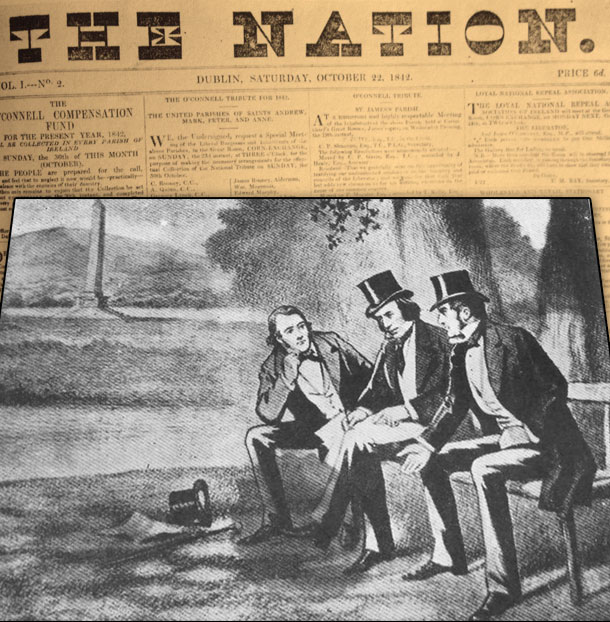
His first published poem was entitled - 'The Munster War Song' and it appeared in 'The Nation' newspaper on 7th January, 1843, under the pseudonym 'Shamrock' ; at the time of its publication, Richard D'alton Williams was in the process of moving from Carlow to Dublin, to study medicine in St Vincents Hospital.
'The Nation' newspaper received a great response to Williams' poems, and 'Shamrock' became a regular contributor, with works such as 'The Dying Gael', 'Sisters of Charity' and 'The Haunted Man', which raised the profile and readership of the newspaper.
As well as the poems, 'The Nation' published a series of humorous articles from Richard D'alton Williams, entitled 'Misadventures of a Medical Student' and described the author, 'Shamrock' (in its July 1851 issue), in the following terms -
"His intellect is robust and vigorous, his passion impetuous and noble, his perception of beauty most delicate and enthusiastic ; his sympathies take in the whole range of human affections, and his humour is irresistible. We think, indeed, that 'Shamrock' excels all his contemporaries in imagination and humour."
Richard D'alton Williams, now a member of the 'Young Ireland' Movement, put his medical training to good use during 'The Great Hunger' of 1845-1849, by helping to ease the suffering of hundreds of cholera victims ; he was by now a hardened opponent of British mis-rule in Ireland and had joined the 'Irish Confederation' group, which was founded in January 1847 by William Smith O'Brien and other 'Young Irelanders' who had disagreed with Daniel O'Connell's 'Repeal Association'.
He was quickly elected to Council level in the 'Confederation' and was the driving force behind a short-lived newspaper called 'The Irish Tribune', which he published with the assistance of 'Young Ireland' leader, Kevin Izod O'Doherty ; the first issue was published in June 1848 but only five issues of the weekly newspaper made it on to the streets before it was suppressed by the British in early July that year and gave Westminster the pretence to arrest Williams and Kevin Izod O'Doherty.

Both men were charged under the 'Treason-Felony Act' with "intent to depose the queen and levying war". A famous barrister of the time, Samuel Ferguson, defended both men in a trial which lasted five months and caused great embarrassment to the British.
Eventually, in November 1848, Williams and O'Doherty were acquitted ; Williams went back to studying medicine, and qualified as a doctor, in Edinburgh, in July 1849 and, in June 1851, emigrated to America.
Whilst in New Orleans, he met and married an Irish woman, Elizabeth Connolly, and the couple moved to a town called Thibodeaux in Louisiana, where he wrote his last poem - 'Song of the Irish-American Regiments.'
On 5th July, 1862, just shy of his fortieth birthday, Richard D'alton Williams died of consumption in Thibodeaux, Louisiana, in America.
A patriot, a poet and a publisher, Dr Richard D'alton Williams is one of the hundreds, if not thousands, of almost unknown and/or forgotten Irish men and women that played their part in the on-going struggle to remove the British presence from Ireland.
They deserve to be remembered somewhere.
Thanks for the visit, and for reading - appreciated.
Sharon and the team.
(We'll be back on Wednesday, 22nd October, 2025.)