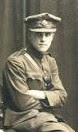
CORK, 1920 - "BACK OFF" ADVICE GIVEN, BUT APPARENTLY IGNORED...
"The pro-British sergeant at Inchigeelagh barracks, Daniel Maunsell (pictured), was considered to be the greatest threat to the local Volunteers and to the local public at large.
He was warned on several occasions by both the Company and the Battalion Irish Volunteer officers to scale down his anti-Irish activities, but to no avail.
On the 21st August 1920 he was shot dead at Creedon's Hotel in the village..." - Volunteer Patrick O'Sullivan.
A 20-year-old farmer from Tralee, in County Kerry, a Mr Daniel Maunsell, known to have pro-British tendencies, decided, in 1891, to hang-up his farmer boots and join the RIC ('Service Number 55061').
Whether he was carrying a grudge against republicanism or the 'power' of his new uniform went to his head is not known, but he quickly developed a reputation for being "hyperactive" against the Republican Movement and was, as stated above, advised to back off, which he didn't do.
The Inchigeelagh Company of Cork Number 1 Brigade of the Volunteers received information that Mr Maunsell who, by then, had been in charge of the RIC barracks, would be travelling from his home in Inchigeelagh to the town of Macroom on the 21st August, and two of their number (possibily Mick Séan Rua O'Sullivan and Ted Quinlan) were tasked to ambush him.
When Mr Maunsell got to Creedon's Hotel in the village of Inchigeelagh, at about 9.20pm, he was shot dead.
His RIC colleagues attended the scene of the shooting and, when they left same and were driving through the village of Lissardagh, they found their way blocked by a cart placed across the road by Volunteers from the Kilmurry and Crookstown companies of the Volunteers, who instructed the armed RIC members to surrender - they refused, jumped out of their truck and a gunfight ensued.
A number of RIC members were injured, one of whom - a 'Sergeant' Runane - was "seriously wounded", and Volunteer Michael Galvin, the Quartermaster of 'H' (Kilmurry) Company, was killed.
Mr Maunsell's widow and children were later awarded £4,500 in compensation.
Incidentally, it later transpired that on Saturday, 14th August (1920) - one week before he was shot dead - Mr Maunsell had taken action on the 'BACK OFF OR ELSE...' advice he was given, as he had handed in his resignation letter to his boss...
27-year-old Robert Morris, a Private in the 2nd Battalion of the 'Royal Welch Fusiliers' ('Service Number 241458'), was 'keeping the peace' in occupied Ireland in 1919 when, on the 21st August that year, he was "accidently shot dead in Limerick".
Mr Morris is buried in Leintwardine Cemetery, in Herefordshire, in the West Midlands region of England, where his father lived at the time of his son's death in Ireland.
==========================
ON THIS DATE (21ST AUGUST) 163 YEARS AGO : BIRTH OF A BRITISH PARAMILITARY 'GODFATHER'.
Colonel Frederick Hugh Crawford CBE (pictured), was born on the 21st August, 1861, in Belfast - 163 years ago on this date.
The UVF (pictured, in the early 1900's) was a politically-minded organisation when it was first formed, on the 31st January 1913 by the 'Ulster Unionist Council', with support from the 'Ulster Reform Club', but transformed itself into a drug-fuelled mini-mafia in later years.
One of the (original) UVF's better-known leadership figures (apart from 'Sir' George
Spafford Richardson, a retired British Army general) was Colonel Frederick Hugh Crawford CBE, who viewed himself as a breed apart from others who shared the planet with him - "From these settlers sprang a people, the Ulster-Scot, who have made themselves felt in the history of the British Empire and, in no small measure, in that of the United States of America.
I am ashamed to call myself an Irishman. Thank God I am not one. I am an Ulsterman, a very different breed.." (from here).
'His official title read Director of Ordnance of the HQ Staff of the UVF...he had first rate Protestant credentials for he had been one of those who signed the Ulster Covenant (pictured) in his own blood. He had travelled the world, fought for a time in South Africa and returned to throw himself tirelessly into the fight against Home Rule for Ireland...' (from here).
Colonel Frederick was born in Belfast on the 21st August 1861, and died in his 92nd year on the 5th November 1952. His father, James, was a factory owner in Belfast (manufacturing starch, which is said to be good for a stiff upper lip..) but Frederick struck out on his own, becoming an engineer with a shipping firm before taking to a military life, which brought him into the Boer War.
On the night of the 24th April, 1914, Frederick Crawford, the 'Director of Ordnance HQ Staff UVF' (who was cooperating re acquiring arms with, and for, the 'Ulster Unionist Council') and the main instigator in an operation in which over 25,000 guns were successfully smuggled into Ireland, witnessed his plans come to fruition - for at least the previous four years, he and some other members of the 'Ulster Reform Club' had been making serious inquiries about obtaining arms and ammunition to be used, as they saw it, for 'the protection of fellow Ulstermen'.
Advertisements had been placed in France, Belgium, Germany and Austrian newspapers seeking to purchase '10,000 second-hand rifles and two million rounds of ammunition..' and, indeed, between August 1913 and September 1914, it is known that Mr Crawford and his colleagues in the UVF/URC/UUC obtained at least three million rounds of .303 ammunition and 500 rifles, including Martini Enfield carbines, Lee Metford rifles, Vetterlis and BSA .22 miniature rifles, all accompanied by their respective bayonets, and six Maxim machine guns, from the Vickers Company in London, for £300 each.
The ads were placed and paid for by a 'H. Matthews, Ulster Reform Club' ; Crawford's middle name was Hugh and his mother's maiden name was Matthews, an action which some members of the Ulster Reform Club objected to, leading to Crawford resigning from that group and describing the objectors as "a hindrance".
He described that period in his life as being "so crowded with excitement and incidents that I can only remember some of them, and not always in the order in which they happened..".
Mr Crawford and his UVF/URC/UUC colleagues had ordered some munitions from a company in Hamburg, in Germany, and had paid a hefty deposit up front but, months later, as they had not heard from the company, Mr Crawford was sent there to see what the delay was and discovered that the German boss, who was in Austria while Crawford was in Germany, had informed Westminster about the order and was asked by that institution not to proceed with same - the deposit would not be returned and the deal was off, as far as the company was concerned.
Crawford tracked him down, in Austria, and called him and his company swindlers and was then told of a similar 'deal' involving that arms company regarding Mexican purchasers who also got swindled but, on that occasion, words and bullets were exchanged, the latter from gun barrels!
At 60 years of age (in 1921) he was named in the British 'Royal Honours List' as a 'CBE' ('Commander of the Order of the British Empire') and he wrote his memoirs in 1934 at 73 years of age.
He died, in his 92nd year, in 1952, and is buried in the City Cemetery in the Falls Road in Belfast. The then British PM, 'Sir' Basil Brooke, described him as "..a fearless fighter in the historic fight to keep Ulster British.." but, whatever about his 'successes on the battlefield', he was apparently less successful in his family life -
"What sort of man was my Father? As a boy and as a man he was never very intelligent. He was an unconscious bully and for that reason unloved by his children. Each in turn left the home as soon as we became adults and were able to do so.
The U.V.F rifles - I think about 15,000 - were stored and kept in good condition in a shed in the grounds of Harland and Wolff where I once saw them. For legal reasons they were in my father's name. After the retreat from Dunkirk, Britain was desperately short of arms and wanted to purchase the U.V.F rifles.
As you are now aware my father was not a very intelligent person and was a hopeless business man. My father's chartered accountant sent word to him to say that Sir Dawson Bates (pictured) wanted to meet him about something important. Accordingly, my father went to the accountant's office where his old friend Sir Dawson Bates was waiting for him - "Ah Fred, so glad you've come". The three, my Father, the accountant and Sir Dawson Bates sat down at a table.
There Sir Dawson carefully explained the desperate need Britain had for arms and asked my father, for patriotic reasons, to release the rifles – it would only be a simple matter of signing a prepared document. My father, in the presence of the accountant and Sir Dawson Bates, for patriotic reasons, signed the document without reading it.
It conveyed ownership of the rifles from my father to Sir Dawson Bates who sold them to the British Government for, I believe, £2 a barrel. But there was something equally disgusting to discover ; during the Second World War because of a failed eye operation my father became blind whereupon I was appointed his Attorney and in that capacity I had to take over his financial affairs.
I was horrified that his bank was about to foreclose which would have meant that he would have been declared a bankrupt. An unholy trio had been cheating him for years ; his estate agent who collected all revenues due to my father was keeping most of it, his chartered accountant was presenting false figures for income tax purposes and all this skulduggery was made legal by the co-operation of his trusted friend, his solicitor.." (from here).
Colonel Frederick Crawford CBE proudly worked for, and aided and abetted, British imperialism, only to be used, abused and cheated by that same system.
A lesson (which will no doubt continue to go unheeded) to be learned, even at this late stage, by those who, today, work that imperialist system in this country, north and south.
The 'modern day' UVF, meanwhile, are a self-sustaining criminal outfit, using politics as a disguise for their continued existence - 'Loads of youngsters were recruited...but the only thing these kids are good for is blocking the street. They wouldn't know the difference between Edward Carson and Frank Carson..drug dealers and housebreakers have also been recruited.
They are given the option of having their arms broken for anti-social behaviour or joining up...nearly everyone joins up.
I know of a few fellas who have been out of work and deliberately allowed to run up tabs in UVF pubs. The UVF comes to them at the end of the month and says "pay up lads". When they cannot they are given the option of a beating or signing up...' (from here.)
Colonel Frederick Hugh Crawford CBE was born on this date - 21st August - in 1861, 163 years ago and, although he's gone, the organisation he helped to establish is still with us but, as stated, it does not now operate to a political agenda.
WHY DOESN'T THE CENSUS ADDRESS ETHNICITY...?
By Niina Hepojoki.
From 'Magill' Magazine, March 2002.
It has been suggested that James Joyce was one of the first artists ever to imagine a world without foreigners.
In his essay 'Strangers in Their Own Country', Professor Declan Kiberd defines this Joycean world as... "..one possible once men and women begin to accept the foreigner in the self* and the necessarily fictive nature** of all nationalisms, which are open to endless negotiations."***
('1169' comment -* There is no "foreigner in the self" [except, perhaps, for those that are 'Woke'] as far as any indigenous people should be concerned ; we are what we are, and shouldn't seek to change our very DNA to suit anybody.
** - Nationalism is not of a "fictive nature" ; rather it is of a factual narrative and nature.
*** - "endless negotiations" ie 'those are my principles, and if you don't like them...well, I have others...' ; the very 'building blocks' of a 'Woke' structure!)
"Prove that there is racism in Cork and in this country", demanded some angry people.
Dr Eoin O'Mahony of 'Faqsresearch'* recently completed a study titled 'Racism in Ireland' - the Views of Black and Ethnic Minorities'** : this study attempted to 'prove', through validated social research, the extent of racist experiences within minority groups in Ireland ; the study consisted of a sample of 622 members of Ireland's ethnic minorities.
Based on interviews of the sample, it was concluded that 78% had experienced racism in this country, and a further breakdown of the sample noted that nine in every ten black persons felt they had been a subject of racism.
Interestingly, 70% of the overall sample also felt that white Irish people think black people are here to abuse the social welfare system...***
(* The 'Faqsresearch' company/GONGO no longer exists // ** That particular 'study' makes for heavy reading and, surprise, surprise, 'proves' that migrants here basically believe they should be entitled [!] to more // *** In our opinion, the majority of them abuse the indigenous Irish people, our hospitality, our patience and our social welfare system.)
(MORE LATER.)
"GALWAY, 1920 : "I WAS ARMED WITH A .45 REVOLVER AND HAD FIVE ROUNDS OF AMMUNITION FOR IT..."
"During the month of August, 1920, we got reports that five or six RIC men were in the habit of cycling from Oranmore to Galway on Saturday mornings.
One Friday night that month a meeting, composed mostly of officers, was held at the Forge, Brierhill.
I was present and amongst others present were Brian Molloy, my brother Mick, Thomas ('Baby') Duggan and Bernard Fallon. The meeting discussed the possibility of attacking the patrol. It was decided to attack them next morning, Saturday. Brian Molloy was the senior officer present.
We mobilised at Merlin Park wood on the Oranmore–Galway road at 10 am the following morning, Saturday. There were about fourteen or fifteen [men] present. I was armed with a .45 revolver and had five rounds of ammunition for it.
Four others had rifles and the remainder had shotguns. About twelve of the party were placed along the wall of Merlin Park at intervals of four or five yards apart, and two on the railway bridge about three hundred yards on the Oranmore side of our position. We were instructed not to fire until after the RIC had been called on to surrender, and they had refused to do so.
At about 12 o'clock noon I saw two RIC men on bikes coming under the bridge, and three others at intervals behind them. Before the leading RIC man reached the ambush position, the men on the bridge, contrary to orders, opened fire on them. We then opened fire. One of the leading RIC men fell.
We discovered afterwards that he was shot dead. The other four crawled behind a gateway on the opposite side of the road, the remaining three escaped across country.
When the firing ceased, I went on the road with three others and collected one .45 revolver and five bicycles. I kept the revolver. We dispersed, going home in twos and threes. Later the five bicycles were sent to G.H.Q. in Dublin to be exchanged for rifles.
I think that we got five rifles for them. Baby Duggan and Paddy Mullins were on the bridge. Among those in the main ambush position were my brothers, Willie and Michael Newell, Bernard Fallon, Joe Donnellan, Paddy King and Ned Broderick..." - Volunteer Thomas 'Sweeney' Newell of Castlegar, County Galway.
The Volunteers who planned and took part in the ambush were attached to the Castlegar and Oranmore IRA Companies, with Volunteer Joseph Howley and Volunteer Brian Molloy in command, and the dead RIC member was later named as a Mr Martin Foley (33, from the Castlerea district in County Roscommon), and his two wounded colleagues were named as a Mr Mulhearn and a Mr Brown.
Incidentally, the ambush was apparently not sanctioned by Seamus Murphy, the IRA Officer Commanding of the Galway Brigade, who left Galway for Dublin in September (1920), necessitating the re-organisation of the Galway Brigades.
On the 21st August, 1920, at about 11.30pm, a four-man RIC party on bicycles were in the Greenhills area of the village of Kill, in County Kildare, on their way to Naas to take up guard duty at the home of RIC 'Inspector' Kerry Supple, as the IRA had expressed an interest in having a chat with him.
The IRA had been monitoring the route and timing of the RIC members and were prepared for them that night.
IRA Commandant Tom Harris (a republican-gamekeeper-turned-Free State poacher) and his fellow Volunteers instructed the RIC members to stop and put their hands up but one of them, a 'Sergeant' Patrick Reilly ('Service Number 56526'), opened fire on the rebels.
Mr Reilly and one of his colleagues, a Mr Patrick Haverty ('Service Number 60160'), were both hit when fire was returned ; he died on site as a result, and Mr Reilly died from his wounds in Dr. Steeven's Hospital in Dublin on the 31st of that month.
The two other RIC members, a Mr Michael Flanagan and a Mr Andrew Flaherty, were approached by Volunteers Pat Brady, Jim Dunne and Jack Sullivan, who were firing warning shots into the air as they walked towards the two RIC members, and both of them were taken prisoner.
Rifles, revolvers, ammunition belts and anything else of military value were taken by the Volunteers, for distribution among their own comrades -Kildare's IRA contingent at the time was small enough, containing just two Battalions and around 100 active men, with not enough munitions for all.
The two RIC prisoners were marched to the Palmerstown Estate 300 yards away, where they were put into a wooded area and told not to report to their barracks until the next morning, and they did as they were told.
RIC 'Inspector' Kerry Supple survived the conflict and was pensioned from the RIC on the 8th October, 1921, and he moved to England, Mr Reilly was a forty-seven-year-old married man from County Offaly and had twenty-six-years 'service' in the RIC, and was just three weeks away from retirement, and Mr Haverty was thirty-nine, single, from Ballinasloe in County Galway, and had nineteen-years 'service' with the RIC.
The IRA operation, from start to finish, took about 20 minutes, and was deemed to be a success by almost all involved...
==========================
On the 21st August, 1920, an RIC 'Detective Constable', a Mr John Hanlon (33), was 'on-duty' and in the kitchen area in Walsh's Pub in Moore Street, in Kilrush, County Clare, when an IRA Volunteer from the West Clare Brigade, Liam (Bill) Haugh (a republican-gamekeeper-turned-Free State poacher), walked in and shot him dead.
Mr Hanlon, a known loyalist, had dismantled an IRA training camp in the area which was used by a local IRA Flying Column, which greatly inconvenienced the Column.
It's unclear to this day whether it was by chance that Volunteer Haugh just happened to see Mr Hanlon enter the pub, followed him in and shot him, or if it was an arranged meeting between Mr Hanlon and Volunteer Haugh to discuss the possibility of Mr Hanlon emigrating to America, for his own sake.
Crown Forces couldn't find Volunteer Haugh later, so they burned his house down, and then 'arrested' Volunteer Patrick Burke, who was carrying his revolver at the time, and beat him almost to death.
He was imprisoned for two years but, shortly after he was released, he died - his wounds and injuries were never treated in prison, where he was constantly mistreated again ; the prison Governor apparently knew he was dying and didn't want the paperwork, so he let him out.
==========================
Road and rail disruption by the IRA against the British Army and their affiliates in this country was always a worry for Westminster, as its personnel were 'sitting targets' and military equipment, correspondence and mail/parcels etc were valuable assets and intelligence information for the rebels.
So the British looked to the skies and thought - "Jolly good! Why not? We'll give it a bash..."
On the 21st August, 1920, a Bristol Fighter airplane (pictured), carrying correspondence, not personnel (apart, obviously, from the two crewmen!), left Fermoy, in County Cork, on a run to Dungarvan in Waterford, then Kilkenny and onwards to Clonmel in County Tipperary, never made it past its first drop.
The airplane developed engine difficulties not long after take off and was forced to land near Lismore, in County Waterford, where the 'landing committee' consisted of armed IRA men - they pulled the crew (injured but still alive) from the wreckage, took anything of military value, burnt the remaining carcass of the airplane, left the injured crewmen there and then returned safely to base.
"Dammit, Old Man! Back to carrier pigeons..."!
==========================
On the 21st August, 1920, as a four-man group of RIC members were walking down Jocelyn Street in Dundalk, County Louth, they were fired on by an IRA/Na Fianna Éireann unit.
One of their number, a 'Constable' Thomas Brennan (41), was killed and his three colleagues - Mr Clarke, Mr Witherden and a Mr Isdell - were all wounded ; all four of them were on their way to undertake 'crowd control duties' at a local football game.
Mr Brennan's colleagues and other pals in the Crown Forces attacked a Sinn Féin hall in Dundalk in reprisal, wrecking it, and then turned their attention to two pubs owned by local businessman Mr James McGuill, an elected County Councillor (...and Officer Commanding of the local Battalion of the IRA), and destroyed them, too.
In response, a large drapery store owned by another local businessman, a Mr Thomas Craig, a known British sympathiser, was burned down by the IRA on the 27th August (1920) - the living quarters above the premises were occupied by thirteen members of his staff, and all but three of them managed to flee the building : Elizabeth Wilson from Ballyhooley, Ballynure, in County Antrim, Georgina Rice from Ardee in County Louth and Alexander Alderdice from Drogheda all died in the fire.
Incidentally, one of the IRA/NFE Volunteers was apparently recognised by one of the wounded RIC members, but no such charge was brought against him ; the RIC member knew that there would be a price to pay for doing so.
==========================
SO, FAREWELL THEN, CELTIC TIGER....
It had to happen, sooner or later.
Most of the pundits and economists were too busy singing the Celtic Tiger's praises to notice, but a few critical observers worried all along about the weaknesses of a boom economy that depended so much on a few companies from one place - the United States.
By Denis O'Hearn.
From 'Magill' Annual 2002.
Or maybe the main Irish political parties just do not have the political will to change Irish society.
Either way, the Irish people have every reason to be very angry.
As for economic growth, despite the recent slowdown, there is still a possibility that something new will come along to spur the 'Celtic Tiger' back to life.
Ironically, the US high tech companies that have fuelled the Irish economy may get a shot in the arm from a source that many economists have invoked to predict further recession...
(MORE LATER.)
ON THIS DATE - 21ST AUGUST - 113 YEARS AGO : WOMEN GET UPPITY!
In Ireland, a few years before the Easter Rising of 1916, it would not be far-fetched at all to state that women were 'doubly oppressed' : by 'the State' (a British institution, at the time [now just a pro-British one!] ) and by, in the main, male society, although not all women accepted that that was the way it should be.
A number of social and cultural organisations had been established by women and for women, including the 'Conservative and Unionist Women's Franchise League', the 'Munster Women's Franchise League', the 'North of Ireland Women's Suffrage Committee', the 'Irish Women's Suffrage Society' and the 'Irishwomen's Suffrage and Local Government Association', most of which worked independently of each other.
Two 'troublesome' Irish women, Louie Bennett and Helen Chenevix, thought it would be to the benefit of the overall objective if those separate organisations were to be coordinated into a more effective campaigning body and, on 21st August 1911 - 113 years ago on this date - the 'Irish Women's Suffrage Federation' was formed...
"..to link together the scattered suffrage societies in Ireland in the effort to obtain the vote as it is, or may be, granted to men (and) to carry on more propaganda and education work throughout Ireland than has hitherto been possible...to form the basis of an association which will continue to exist after enfranchisement, and whose purpose will be to work, through the power of the vote, for the welfare of the country.." .
In that same year,
(1911), the 'Munster Women's Franchise League' was formed in Cork and the 'Irishwomen's Reform League' was established in Dublin.
It appears that women, then, were not only more aware of the injustices foisted on them by an unequal and oppressive society, but were more prepared than we are now to do something about it.
Time for more drastic action, perhaps, Ladies...
'The first use of the Curragh for detainees was when seventeen men from County Kildare, who were arrested during Easter Week 1916, were confined at
Hare Park Camp, the Curragh...several camps were opened in the country, including the one on the Curragh, which opened on 1st March 1921...
...the internment of republican prisoners is as old as the Irish republican struggle. Prior to 1798 most of the Irish rebellions, uprisings and wars were localised affairs, not national struggles for independence.
The 1798 rebellion was the first uprising waged to break the link with Britain. The idea was to create an Irish republic based on the ideals of France and America...
...around 12,000 people were imprisoned under the Free State governments emergency laws, which saw a harsher prison regime installed in the camps and jails than that of the British...' (from here.)
As with all prisons that the British or Staters locked Irish republican POW's in, escape attempts were mandatory and, on the 21st* August, 1921 - 103 years ago on this date - one IRA prisoner, James Staines(a brother to Michael, a republican-gamekeeper-turned-Free State poacher), hid in a lorry and was driven out of confinement!
(*'1169' comment - two dates are given by various sources for this escape - the 19th and the 21st - but it's worth writing about anyway!)
==========================
BEIR BUA...
The Thread of the Irish Republican Movement from The United Irishmen through to today.
Republicanism in history and today.
Published by the James Connolly/Tommy O'Neill Cumann, Republican Sinn Féin, The Liberties, Dublin.
August 1998.
('1169' comment - 'Beir Bua' translates as 'Grasp Victory' in the English language.)
REPUBLICANS AND THE STATE :
In a statement dated December 31st, 1969, Thomas Maguire said -
"In December, 1938, the surviving faithful members of the latest 32-County Republican parliament, the Second Dáil, elected in 1921, delegated their executive powers of government to the Army Council of the IRA.
This proclamation of 1938 was signed by Seán Ó Ceallaigh ('Sceilg'), Ceann Comhairle, Count Plunkett, Professor William Stockley, Mary Mac Swiney, Brian Ó hUiginn, Cathal Ó Murchú and myself Tomas Maguire.
The majority of the delegates at the December, 1969, IRA Convention, having passed the resolution referred to above, proceeded to elect an Executive which in turn appointed a new Army Council, committed to implement the resolution.
That convention had neither the right nor the authority to pass such a resolution.
Accordingly, I, as the sole surviving member of the Executive of Dáil Éireann, and the sole surviving signatory of the 1938 Proclamation, hereby declare that the resolution is illegal and that the alleged Executive and Army Council are illegal, and have no right to claim the allegiance of either soldiers or citizens of the Irish Republic..."
(MORE LATER.)
Thanks for the visit, and for reading!
Sharon and the team.
(We won't be here next Wednesday, 28th August 2024, as we have a family engagement down the country between now and then and, with our family, that's gonna be a four-day gig!
We'll be back on Wednesday, 4th September 2024 with, among other pieces, a few paragraphs about a political incident from over 50 years ago, in a country foreign to America, in which a Mr Donald Trump is referenced, and another few paragraphs connecting the Irish agitation for land, bayonets, 'landlords' - and the 1916 Easter Rising.
See y'all on the 4th!)
ON THIS DATE (6TH MARCH) 101 YEARS AGO : FIVE FREE STATE SOLDIERS KILLED BY IRA.
Paddy O'Daly, pictured ; IRA man-turned Free Stater.
On March 6th, 1923 (101 years ago on this date), five Free State soldiers - Captain Michael Dunne, Dublin, Captain Edward ('Joseph') Stapleton from Dublin, Lieutenant Patrick O’Connor from Castleisland, Private Laurence O’Connor from Causeway and Private Michael Galvin from Killarney - were killed in Knocknagoshel in County Kerry, by a booby trap mine placed by the IRA.
The target of the trap was a local Free Stater by the name of Paddy 'Pats' O'Connor who, according to the IRA, was a notorious torturer of republican prisoners.
Mr O'Connor had joined the Free State army because of the treatment of his father by the local IRA.
The Dublin Guards, who had been in Kerry since the previous August, were commanded by Paddy O'Daly. He was furious over the booby trap and it subsequently became clear that he was responsible for what took place following the Knocknagoshel incident ; at around 2am on March 7th, 1923, nine IRA prisoners, many of whom had been tortured, were brought to Ballyseedy Wood where they were told that they were to remove an 'irregular' (ie IRA) road block.
However, it was clear to the men what was in store for them when they had been shown 9 coffins in the barracks. Each were offered a cigarette and told it would be the last one any of them will have. They were then tied together to the mined road-block and blown up. Some of the men were still alive and were finished off by grenade and machine gun.
A memorial on Countess Bridge, Killarney, County Kerry, in memory of the IRA Volunteers butchered there by Free State forces in 1923.
Unbeknownst to the Free State troops one man was blown clear and managed to escape.
His name was Stephen Fuller (who was later to turn his back on Irish republicanism to become a FF 'TD' in 1937). Because the bodies were so badly mangled all nine coffins were filled with the remains of the eight who perished.
This was to lead to a near riot in Tralee when the coffins were handed over to the families at the gates of Ballymullen barracks. The families broke open the coffins to try and identify the remains.
Later on the same day a very similar incident took place at Countess Bridge in Killarney where five IRA prisoners where asked to remove a mined road block which was also blown up. Three of the men who lay wounded were finished off by grenade. Again, amazingly, a fifth man, Tadhg Coffey, survived and escaped.
Five days later 5 more men were killed near Bahaghs Workhouse in Cahersiveen.
In order to prevent any more escapes the men were first shot in the legs, then put over a mine and blown up.
When the details slowly emerged about what happened the Free State government was forced to call an inquiry into the executions and, in April, 1923, appointed none other than Major General Paddy O'Daly to oversee the 'court of inquiry'.
It was never going to be anything other than a whitewash.
One Free State soldier, Lieutenant McCarthy, resigned his commission after the incident and called his colleagues "a murder gang". Captain Niall Harrington (author of the 'Kerry Landings' book) of the Dublin Brigade reported that "..the mines used in the slaughter of the prisoners were constructed in Tralee under the supervision of two senior Dublin Guards officers..".
But neither he nor Free State Lieutenant McCarthy was ever called to testify, but the truth became known later.
1924 : REPUBLICAN-GAMEKEEPERS-TURNED-FS POACHERS TURN POACHERS ON THEIR NEW COMRADES...
When the IRA ordered its Volunteers to 'Dump Arms' (officially on the 24th May 1923, but the Staters knew it was about to happen), the politicians in Leinster House saw the opportunity to put more money into their own coffers by reducing their military force(s) by at least 30,000 operatives (including 2,200 officers) by the end of March 1924.
They knew that many of their newest recruits were 'unsuitable material for a full-time professional (!) army' as they were badly trained and undisciplined, and talk of enforced/compulsory/mandatory redundancies was widespread.
Charlie Dalton (top pic) and Liam Tobin (bottom pic) were two IRA Volunteers who accepted the 'Treaty of Surrender' and donned a Free State Army uniform.
They were both evidently unhappy with their personal progress in and through their Free State system as, indeed, were dozens of other ex-republican gamekeepers so, in February/early March 1924, they planned a coup against their Leinster House political and military regime which, as they knew, was about to downsize its military requirements.
On the 6th/7th of March, 1924, between 50 and 90 FSA Officers abandoned their posts, seized weaponry - ammunition, Lewis guns, grenades and revolvers - and, led by Mr Tobin and Mr Dalton, attempted to hold the Free State entity as a 'hostage' - the IRA were both bemused and amused at their antics!
The Free State/anti Free State 'mutineers' (!) delivered their 'ultimatum' to the Free State 'President of the Executive Council of the Irish Free State' (1922-1932), a Mr Liam Cosgrave -
Mar-06-1924.
'To President Liam Cosgrave.
Sir,
On behalf of the I.R.A. Organisation we have been instructed to present the following Ultimatum to the Government of Saorstát Eireann.
Briefly, our position is this :—
The I.R.A. only accepted the Treaty as a means of achieving its objects, namely, to secure and maintain a Republican form of Government in this country.
After many months of discussion with your Government it is our considered opinion that your Government has not those objects in view, and that their policy is not reconcilable with the Irish people's acceptance of the Treaty.
Furthermore, our interpretation of the Treaty was that expressed by the late Commander-in-Chief, General Michael Collins, when he stated : "I have taken an oath of allegiance to the Irish Republic and that oath I will keep, Treaty or no Treaty."
We claim Michael Collins as our leader, and again remind you that even after the Treaty was signed, that drastic action was taken against enemies of the unity and complete independence of our country. Both in oath and honour bound, it is our duty to continue his policy, and therefore present this Ultimatum to which we require a reply by 12 noon, 10th March, 1924.
We demand a conference with representatives of your Government to discuss our interpretation of the Treaty on the following conditions :—
(a) The removal of the Army Council.
(b) The immediate suspension of Army demobilisation and re-organisation.
In the event of your Government rejecting these proposals we will take such action that will make clear to the Irish people that we are not renegades or traitors to the ideals that induced them to accept the Treaty.
Our Organisation fully realises the seriousness of the action that we may be compelled to take, but we can no longer be party to the treachery that threatens to destroy the aspirations of the Nation.
LIAM TOBIN, Major-General, President of the Executive Council.
C.F. DALTON, Col., Secretary to Executive Council.'
On the 7th March, 1924, the 'Executive Council of the Free State Government' ordered the arrest of Mr Tobin and Mr Dalton but, despite searches, they eluded arrest, and the mutiny was quashed by the Free Strate 'Director of Intelligence', Michael Costello, but Richard Mulcahy and the FS Army Council were forced to resign.
Such a pity they weren't as efficient against the British...
'SINN FÉIN NOTES...'
From 'The United Irishman' newspaper, April 1955.
Arrangements have been made by the Jackie Griffith and the Austin Stack Cumann, Dublin, to hold conventions for the selection of their candidates.
Tom Keena has been selected by the Barnes and McCormack Cumann, Clara, County Offaly, as their candidate for Offaly County Council, and the Drogheda and Dundalk Urban Councils and Louth County Council are being contested also, but arrangements have not yet been made for the selection of candidates.
(END of 'Sinn Féin Notes' ; NEXT - 'Sinn Féin Replies To Mr. Hanna', from the same source.)
Betweem the 6th March 1919 and the 10th March 1919, Sinn Féin prisoners held by Westminster in English jails were released, as the severe outbreak of influenza in England worried the political leadership there to the extent that Irish political figures dying in English jails would have reflected in a bad way on the English political leadership (ie 'let them die in Ireland, not England'!)
A Sinn Féin MP, Mr Pierce McCan, had already died from the flu in British custody (he died on the 6th of March, 1919, and was buried in Dualla, Cashel, County Tipperary, on the 9th of March) and it wasn't 'a good look' on the world stage for Westminster.
Eleven of the released prisoners (among their number was Seamus O'Neill of Tipperary, Michael Fleming from Kerry, and Art O'Connor, from Celbridge, in County Kildare) were too ill from the flu to travel and had to convalesce in England until they got their strength back.
On the 4th March that year, Westminster had made the decision to remove the prisoners from their own country, to Ireland, and those released included Arthur Griffith, William T Cosgrave, Darrell Figgis and Constance Markievicz.
==========================
ON THIS DATE (6TH MARCH) 106 YEARS AGO : "IRELAND IN DEFENCE OF THE EMPIRE...".
"I have publicly promised, not only for myself, but in the name of my country, that when the rights of Ireland were admitted by the democracy of England, that Ireland would become the strongest arm in the defence of the Empire.
The test has come sooner than I, or anyone, expected.
I tell the Prime Minister that that test will be honourably met.
I say for myself, that I would feel myself personally dishonoured if I did not say to my fellow countrymen, as I say today to them here, and as I will say from the public platform when I go back to Ireland, that it is their duty, and should be their honour, to take their place in the firing line in this contest..."
- John Redmond, from here.
Mr Redmond, the leader of the 'Irish Parliamentary Party', was born into a 'Big House'-type Catholic family on the 1st September in 1856 and, after a 'proper' education (in Clongowes College in Kildare and Trinity College in Dublin) he became a political 'player' in the British so-called 'House of Commons', where he supplemented his income as a clerk.
He was only 25 years-of-age when he was first elected as an MP, having worked his way up the establishment ladder, and was elected as the leader of the 'Irish Party' on the 6th February, 1900.
John Redmond pictured - 'Irishmen, honour your history, fight for England..'
He was an Irish nationalist (small 'n') politician who, occasionally, campaigned for his followers (and anyone else that would listen to him) to join the British Army in its fight against Germany, and did so infamously, and unashamedly, in a public speech he delivered in Woodenbridge in County Wicklow on the 20th September in 1914, where he stated -
"The interests of Ireland - of the whole of Ireland - are at stake in this war. This war is undertaken in the defence of the highest principles of religion and morality and right, and it would be a disgrace for ever to our country and a reproach to her manhood and a denial of the lessons of her history if young Ireland confined their efforts to remaining at home to defend the shores of Ireland from an unlikely invasion, and to shrinking from the duty of proving on the field of battle that gallantry and courage which has distinguished our race all through its history.
I say to you, therefore, your duty is twofold.
I am glad to see such magnificent material for soldiers around me, and I say to you : 'Go on drilling and make yourself efficient for the work, and then account yourselves as men, not only for Ireland itself, but wherever the fighting line extends, in defence of right, of freedom, and religion in this war..".
And, unfortunately, in the months that followed his 'call to arms', tens of thousands of Irishmen joined his 'Cause' and fought alongside imperialism to the extent that one of his modern-day political mirror-images (..who called for Irish people to join and support the British 'police force' in Ireland!) all but called Redmond a traitor for encouraging such folly.
Other political leaders did not agree with John Redmond and, among them, was James Connolly, the Irish Trade Union leader, who was also in command of the Irish Citizen Army - he answered Redmond's call thus :
'Full steam ahead, John Redmond said,
that everything was well, chum ;
Home Rule will come when we are dead,
and buried out in Belgium'.
Also, some of John Redmond's own men disagreed with his pro-British 'call-to-arms' ; Eoin MacNeill, who was then in a leadership position within the 'Irish Volunteers', was of the opinion that the 'Irish Volunteers' should only use force against the British if* Westminster first moved against them ; a bit 'watery', definitely, but he was, however, against fighting with the British (*if having your country occupied by a foreign power cannot be considered a 'first move against us' then Mr MacNeill had a different understanding of the English language than we have!).
Just over a year after Mr Redmond had delivered his 'join imperialism'-speech in Woodenbridge, a British Army Major-General, 'Sir' Lovick Bransby Friend (..perhaps his parents never bonded with him?) the Commander-in-Chief of the British Army in Ireland, said that 1,100 recruits were needed from Ireland every week "to replace wastage" (!) of existing Irish soldiers.
The comments were made at a private conference on recruiting in Ireland that was held under the presidency of the 'Lord' Lieutenant of Ireland, Lord Wimborne, at the Viceregal Lodge in Dublin's Phoenix Park, where it was also stated that approximately 81,000 Irishmen had 'heeded Redmond's call-to-arms'.
The political mirror-image, mentioned above, had a point : if a call to assist the foe comes from 'the right quarters', it will - unfortunately - be heeded by those who should know better.
Anyway : the 'fight-for-England-for-Ireland' man died on the 6th March 1918 - 106 years ago on this date - after a medical operation that month to remove an intestinal obstruction ; the operation appeared to progress well at first, but then he suffered heart failure and died a few hours later at a London nursing home.
But his party lived on, albeit with a name change..!
In the 1920's in Ireland, the pro-British 'police force', the 'Royal Irish Constabulary' (RIC), were continuing to come under pressure from the public and their representatives in the IRA, and they were forced to abandon barracks and headquarters in, for instance, Maynooth, Leixlip, Kilcock, Carbury, Rathangan and Robertstown, in County Kildare.
This was on top of the problems they were facing from early retirements, resignations and morale issues, leaving the RIC drained of members and bereft of enthusiasm.
On the 6th March, 1920, the RIC barracks in Leixlip, in County Kildare, was abandoned/evacuated by the 'police force', the 'Sergeant' there was transferred to Maynooth and his fellow members were put into whatever other barracks that were still standing in that county - the barracks in Celbridge, for instance, received most of those rejects, as it was a heavily fortified building overlooking the River Liffey, giving it some degree of safety and, by the summer of 1920, it was the only RIC barracks remaining open in North Kildare.
Indeed, as the RIC were packing up their ill-gotten gains in Leixlip on the 6th March, their colleagues in Doon Barracks, in County Limerick, were coming under attack by the IRA.
No rest for the wicked, you might say..!
==========================
"Redouble your energies. Remember these amounts were not realised by any magic formulae, they are the results of hard work and ceaseless endeavour.
Gold is once and a half as useful to us as English paper currency. When dealing with such a country as America, gold is as valuable as it formerly was.."
- Michael Collins, 6th March, 1920, in a letter he dispatched to Sinn Féin officers for distribution to all involved in the 'Dáil Loan' campaign.
In his letter, Mr Collins stated that £98,124 had been received so far, which was short of the target, and he praised some constituencies (such as West Limerick and Mid-Cork) for their fund-raising activities.
A businessman, Mr Batt O'Connor, used his connections to acquire gold for the Fund, as did other business owners (such as Oliver St John Gogarty) and operatives (like Dáithí Ó Donnchadha [Daithi O’Donoghue] and Peter Corrigan) were tasked with keeping the financials safe from the British, which they did - the collected gold was brought to Mr O'Donoghue who put them in small tobacco tins and, when full, those tins contained either £250 or £500 worth of gold coin.
Full tins were brought by Mr O'Donoghue to Corrigan's Undertakers in Camdem Street, in Dublin, where Peter Corrigan buried them at the back of his premises. Men (and women) like Mr O'Donoghue and Mr Corrigan are the unsung heroes of that period in our history.
==========================
SO, FAREWELL THEN, CELTIC TIGER....
It had to happen, sooner or later.
Most of the pundits and economists were too busy singing the Celtic Tiger's praises to notice, but a few critical observers worried all along about the weaknesses of a boom economy that depended so much on a few companies from one place - the United States.
By Denis O'Hearn.
From 'Magill' Annual 2002.
An alternative point of view is that Irish economic growth was due to a very special set of (mostly external) circumstances.
Without them, all the macroeconomic stability or neoliberal economic policies in the world could not have achieved such results.
What were these special circumstances?
Irish economic growth was clearly dominated by the country's ability to attract a huge share of investments by transnational corporations ('TNC's') in a changing global environment ; the historic expansion of information technologies (IT) in the 1990's sent US computer firms on a global hunt for new markets and, since access to the 'Single European Market' was a major prize, these companies revived their investments in the EU to get a foot in the door.
And Ireland got more of them than its fair share ; they came to Ireland primarily because of its extremely low corporate tax rates, and also because of its cheap, educated, English-speaking labour force and its lack of bureaucratic restrictions on foreign investors...
(MORE LATER.)
An RIC member, 'Sergeant' James Maguire (49), operated as a 'Liaison Officer' for a British Army Intelligence Officer (BA Lieutenant Harold Browne) in the Limerick area, and was said to be good at his job.
His diligence brought him to the attention of the East Limerick Brigade of the IRA who were then made aware that it was Mr Maguire who had given the British information which led to the deaths of two IRA Volunteers, and the Limerick Volunteers organised themselves to address the situation.
On the 6th March, 1921, as Mr Maguire was out for a walk in the Kilmallock area of Limerick, five IRA Volunteers approached him and shot him dead.
Mr Maguire had twelve children, seven of whom emigrated to New York City and one of whom, a daughter called Mary Catherine, married an RIC member, a Mr Patrick Joseph Meade ('RIC Number 69103').
Mr Maguire should have put family first.
==========================
On the 6th March 1921 (some sources list the date as the 5th) a woman who lived in Ballylea, Tralee, in County Kerry, Bridget Walpole (57), never returned home from an outing, and her neighbours were worried about her.
She was comfortable, financially, and owned a fine house and some acres of land.
The next morning, a young boy who was out walking about 400 yards from Bridget's house, found her body - the poor woman had been shot in the back of her head, and a small notice had been tied around her neck -
'Convicted Spy, and all others beware. RIP.'
M/s Walpole was indeed known to the IRA, because she assisted them occasionally (one of the 'safe houses' in the area), as best she could, and also helped out the 'Na Fianna Éireann' organisation.
The IRA and NFE investigated the shooting and one of the IRA investigators later stated -
"A short time afterwards I came to Ballygarron, Spa, to the house of a man named Rail.
There I was informed that a woman named Mrs Walpole was found that morning shot dead on the side of the road with a label on her chest which read 'shot as a spy'.
I knew this could not be correct as I had stayed at her house several times since I first went on the run. I investigated the matter and discovered that the shooting was the result of a family row...'
But before the IRA/NFE could fully complete their investigation, the 'Treaty of Surrender' intervened and, unfortunately, the matter was not pursued, but questions were raised about a life assurance policy that M/s Walpole held, and her valuable house and lands...
==========================
The 6th March 1921 was an horrendous day for the Republican Movement in County Tipperary -
Volunteer Tom Larkin, 1st Battalion, Rosegreen, was shot dead by the British Army in Drangan, the Commandant of the 2nd Battalion, Patrick Hogan, was killed in action near the village of New Inn, the Captain of the 7th Battalion of the Moyglass Column, Richard Fleming, was shot dead by Crown Forces at Knockroe, near Drangan, Volunteer Patrick Hackett, attached to the Drangan Column, was shot dead by the British Army as was Volunteer Martin Clancy, Drangan Column.
Martin Clancy, Patrick Hackett and Richard (Dick) Fleming were attending an IRA Battalion Council meeting of Tipperary No. 3 Brigade at Knockroe, County Tipperary, when they were shot dead by a British Army raiding party.
Carelessness by the IRA sentries allowed soldiers from the Lincolnshire Regiment (under the command of BA Lieutenant M M Ormond) gain access to the meeting, at which 12 IRA officers were in attendance.
Martin Clancy was only wounded in the attack, placed 'under arrest' by the foreigners, then shot dead (his brother, Patrick, had been shot dead by the British Army on November 19th, 1920).
Patrick Hogan, who was Officer Commanding, 2nd Battalion, Tipperary No. 3 Brigade, IRA, was shot dead after Crown Forces raided the house in which he was staying at Derrycloney, New Inn, in County Tipperary.
RIP to those brave Irish men.
==========================
"The British Army never travel the same route more than once a week. Also, they travel always in convoy of more than seven lorries generally accompanied by an armoured car..."
- Tom Barry (pictured, Officer Commanding of the Cork No. 3 Brigade, IRA Flying Column), in an IRA report he wrote on the 6th March, 1921.
That British Army 'Standing Order' travel plan 'officially' came into operation on the 20th June, 1921, but was actually put into practice in early 1921, due to the losses suffered by enemy forces in IRA ambushes.
==========================
On the 6th March, 1921, the QM of the Toames Company, 7th Battalion, Cork No. 1 Brigade IRA, Cornelius Foley, was shot by British Auxiliaries who had come across about 20 men near Toames. He was brought to Macroom Castle and died there later in the day.
Before he died, he was interrogated by his captors but would only say to them - "Up de Valera. We'll kill all you bastard English before long..!"
==========================
'From November 1920 the IRA – referred to in the British and Unionist media at the time as Sinn Féiners – began a campaign of sabotage in locations across England and Wales, including arson attacks and the cutting of telegraph wires...'
On the 6th March, 1921, arson attacks were carried out by IRA in Newcastle, South Shields and Hyde in England : more here.
==========================
On the 6th March, 1921, chauffeur John O'Neill, an ex-British Army man, was driving two clients to Portmarnock Golf Club, in North County Dublin, in a 'fancy car'.
As he was driving up the Malahide Road, near Donnycarney, he was stopped by the IRA and was shot dead.
It transpired that he wasn't shot because he was ex-British Army, but because it was a case of mistaken identity by the IRA.
Mr O'Neill was working as the chauffeur for Edward McGrath (the owner of a tea merchant company) and was driving a party to Portmarnock Golf Course for a game.
Thomas Shannon, a pro golfer working at Portmarnock Golf Club, was in the front passenger seat and three other men were in the back of the car. Mr O'Neill was shot in the head and stomach and died at the scene, and one of the other men was wounded. Both were taken to the Mater Hospital.
The IRA had been monitoring the road, as it was the route taken by known British Army officers who travelled, on that day at that particular time, to the golf club, in a chauffer-driven 'fancy car'....
==========================
On the 6th March, 1921, British Army soldiers from Carlow Barracks made their way to the Church in the village of Rathanna, in County Carlow, acting on information that IRA Volunteers from the local Flying Column were due to attend Mass there.
Having surrounded the Church, they stopped, searched and harassed the men leaving Mass but one man, a Mr James Hayden, a local farmer, who was some distance away from one of the armed British soldiers and, it being a very windy day, didn't hear the instruction to stop where he was.
A British Army soldier shot him dead.
==========================
A few men were playing a game of 'Pitch and Toss' near Saxe Lane, in Sutton, Dublin, on the 6th March, 1921, when a gang of British Auxiliaries arrived on the scene.
The Auxies opened fire on the men, killing a Mr Henry Guy and wounding two of his friends.
In a statement released afterwards by Major-General Sir Gerald Farrell Boyd 'KCB CMG DSO DCM' etc, the 'General Officer Commanding' of the British Army in the Dublin District, it was simply acknowledged that shots had been fired, by his soldiers "...somewhat hastily, as it turned out that they were confronted by unarmed civilians.."
Mr Boyd died of cerebral spinal fever in 1930, which wouldn't have been a "somewhat hastily"-acquired death.
==========================
BEIR BUA...
The Thread of the Irish Republican Movement from The United Irishmen through to today.
Republicanism in history and today.
Published by the James Connolly/Tommy O'Neill Cumann, Republican Sinn Féin, The Liberties, Dublin.
August 1998.
('1169' comment - 'Beir Bua' translates as 'Grasp Victory' in the English language.)
ROBERT EMMET AND THE IRELAND OF TODAY...
"But England, we are told, offers us terms.
She holds out to us the hand of friendship.
She gives us a Parliament with an Executive responsible to it.
Within two years the Home Rule Senate meets in College Green and King George comes to Dublin to declare its sessions open. In anticipation of that happy event our leaders have proffered England our loyalty.
Mr. Redmond accepts Home Rule as a "final settlement between the two nations" ; Mr. O'Brien, in the fullness of his heart, cries "God Save the King" ; Colonel Lynch offers England his sword in case she is attacked by a foreign power.
And so this settlement is to be a final settlement.
Would Wolfe Tone have accepted it as a final settlement? Would Robert Emmet have accepted it as a final settlement?
Either we are heirs to their principles or we are not.
If we are, we can accept no settlement as final which does not "break the connection with England, the never-failing source of all our political evils" ; if we are not, how dare we go on an annual pilgrimage to Bodenstown, how dare we gather here or anywhere to commemorate the faith and sacrifice of Emmet...?"
(MORE LATER.)
Just under 500 people were killed in Belfast between July 1920 and July 1922 and about 230 of that number died between February and May 1922.
On the 6th March (listed elsewhere as the 13th and/or 15th March), 1922, IRA Volunteer Andrew Leonard (21), from Duffy Street in Belfast, was shot in the neck near Townsend Street in Belfast and died later in hospital, Catherine Lynch (51) was shot dead in her home on the Falls Road, and Thomas Heathwood and William Warder were shot dead by British military patrols in the Wall Street and Hanover Street areas respectively.
A book that was published in 1922, 'Facts and Figures of the Belfast Pogrom 1920-1922' , written from a republican/nationalist perspective, was intended to impress upon the new Free State government that the Catholic community in the city was under siege. It was written by Fr John Hassan, a Catholic priest in the city, who wrote under the pseudonym 'GB Kenna'.
Just 18 copies were published, and the rest were pulped in August 1922, just before Michael Collins's death, on the instructions of the Free State government, which feared its details would give succour to the IRA...
==========================
By the 6th March 1922, the IRA were reorganising Waterford Military Barracks (pictured) to suit themselves.
A party of about 80 IRA Volunteers (commanded by George Lennon) took over control of the building, after arguing about the legal position of doing so with the pro-British force that then occupied it - the RIC (under the command of a 'Captain' Sheehan), who was in charge of the 60-or-so RIC members who were in situ.
Meanwhile, about 30 other IRA Volunteers had taken over control of the 'Artillery Barracks' in the same town.
Local author and historian Edmund Keohan described at the time what the change of use of both barracks meant to the ordinary people of the town and the sense of impending occasion they felt -
"The occupants of the old Castle were now to be changed. The English forces were to leave ; the old premises were to fall into the possession of the Irish people alone.
This old fortress had in the olden time been washed by the waters of the Colligan, and the sentries at night could listen to the swish of the waves as they beat against its ancient walls.
In this defensive stronghold were garrisoned the troops of the English King and kept there for 750 years. It was symbolic, in every respect, of British rule in Ireland..."
The "troops of the English King" are still occupying six of our north-eastern counties ; we have won battles, but not the war.
Yet...!
==========================
'McGloin, we know you are a British Spy and Informer. Give it up at once or your days are numbered. Final Notice.'
- an IRA warning notice delived to an RIC member, Patrick McGloin, in late February/early March, 1922.
Between the 6th and the 15th March, 1922, three (ex-) RIC members and one of their civilian supporters (Patrick Cassidy) were shot in a hospital (pictured) in Galway City.
Two of them were killed outright - 'Sergeants' John Gilmartin and Tobias Gibbons - as was Mr Cassidy, who was shot four times, and a third RIC member, Patrick McGloin, was left with life-changing injuries.
RIC member Gilmartin had been observed hitting, whipping and humiliating civilians, alongside his British Auxiliaries colleagues, in the town of Moycullen, in County Galway, RIC member Gibbons received stripes from Westminster for his 'work' in Tuam, County Galway, and was actually signalled out and named in an IRA 'Intelligence Document' as a person of interest, and RIC member McGloin was, it seems, just a tad too eager to exchange his RIC outfit for that of a British soldier.
Those who carried out the shootings (said to be seven men) were never identified.
==========================
On the 6th March, 1922, Free State political and military leader Michael Collins sent a telegram to one of his managers, Winston Churchill, giving him an update on progress (!) in the British colony that both men were working together on.
In his telegram, Mr Collins informed Mr Churchill that "..the total death toll (in the Occupied Six Counties) since eleventh Feb now amounts to 48 and 198 wounded while total casualties since Orange Pogrom beginning July 1920 number 257...".
No doubt the two men blamed everyone else except themselves for those deaths and injuries...
==========================
Between the 6th and the 7th of March, 1922, the British Government agreed to break the law but to keep quiet about it.
Westminster's 'Government of Ireland Act 1920' (sic) contained stipulations which forbade it to, in effect, allocate extra funds to the Occupied Six County area which were over and above which "other areas of the UK" (sic) were allocated but, being a contested area, the O6C required different 'policing' methods.
The British Cabinet decided to give £850,000 to the Stormont administration to underwrite the cost of the Specials for the following six months but, in order to do so 'legally', they had to temporarily classify the USC/Specials as 'a military force' rather than 'a police foce', which meant they were paid for from the 'Imperial Purse' rather than exchequer/taxpayer funds and, in a further cover-up, that money was described as "assistance in a general grant of money to Ulster (sic) for unemployment and other services..."
On the 6th March, 1922, 'Sir' Otto Ernst Niemeyer GBE KCB ETC (!), the financial controller of the UK's Treasury Department, wrote in a memo that this arrangement was probably illegal and was not "within the four corners of the 1920 Act" nor was it compatible with the Treaty.
'Creative accounting and bookkeeping '...!
However...
...in July that year (on the 19th, 1922), the Stormont kitty needed to be replenished as their 'police force' were apparently almost broke (!), financially, again, and the British Chancellor of the Exchequer, a Mr Richard Horne, agreed to give £2 million to Stormont to fund the USC/Specials on the condition that "it is all that I can grant for the financial year 1922/1923", and the 'Stormont PM', a Mr James Craig (the '1st Viscount Craigavon') accepts the 'Terms and Conditions' and gets the money.
But...
...in September that year (on the 19th, 1922), Mr Craig wrote to Mr Churchill saying that he wanted a further £200,000 for 1922/1923 to fund the USC/Specials, and a commitment from Westminster to provide a further £1.35 million for 1923/1924 ; he got the extra money and a 'promise' that his requested commitment would be looked into...
...yet..
...in November that year (on the 6th, 1922), Mr Craig wrote to the 'British Colonial Secretary' looking for, among other things, "the renegotiation of outstanding financial questions" in regards to funding for the USC/Specials (in other words, a blank cheque!) and, that same month (November, 1922, on the 23rd), Mr Craig wrote to Stanley Baldwin, the new British PM, in Westminster, looking for £200,000 to fund the USC/Specials for the current financial year and, on the 28th November, added to his begging letter with a threat -
"I doubt if anyone could be found to carry on here unless they were assured that the present magnificent system of Special Constabulary was maintained at its present strength...", and then declared that his earlier £1.35 million estimate/request had now increased to £1.5m!
Mr Craig got the extra (extra, extra, extra etc!) money he was looking for, bringing his total funding for the USC/Specials (for the fiscal year 1922-1923) to £2.7m!
The abolition of the last of the USC/Specials was a central demand of the 'Northern Ireland (sic) Civil Rights Movement' in the late 1960s and, on the 30th April, 1970, that armed grouping was finally stood down, as a result of the Hunt Committee Report.
We didn't want 'em, and the Brits couldn't afford 'em...!
==========================
On the 6th March, 1923, eight Free State soldiers arrived at Bairinarig Wood, near Knocknagashel, Castleisland, in County Kerry, to search for an IRA arms dump that they believed was buried somewhere there, acting on information they had received.
The IRA had laid a trip-mine in the area, before they lured the Staters into the vicinity with a false 'arms dump' story, and one of the enemy forces detonated the device, killing himself and four of his colleagues - Lieutenant Paddy O'Connor, a local man, Captains Michael Dunne and Edward Stapleton, from Dublin, and Privates Michael Galvin, from Killarney, County Kerry, and Laurence O’Connor, from Causeway, County Kerry.
Another State soldier, Joseph O’Brien, was so badly injured that both his legs had to be amputated.
It appears that Mr O'Connor was the intended target, as the IRA had targetted him before - more here.
Also, on the 6th March, 1923, a Free State soldier ('Service Number 20034'), William Newcombe (20), from Castlemaine Street, Athlone, in County Westmeath, who was attached to the FS '5 Infantry Battalion', was shot and killed in an IRA ambush at Glasson/Three Jolly Pigeons pub, County Westmeath. He was a member of Na Fianna Éireann prior to joining the Staters, and another young FS soldier, Richard Duggan, was accidently shot in Waterford Infirmary where he was stationed. He died on March 11th.
An IRA Volunteer, John T O'Sullivan, was shot dead by the Staters at Gleesk, near Glenbeigh, in County Kerry.
==========================
On the 6th March, 1923, the IRA Chief-Of-Staff, Liam Lynch, received a letter from a high-ranking IRA Officer complaining about the dumping of arms -
"It is outrageous that about 1,200 rifles are in the 1st Southern Area of which close on 500 are dumped, yet this area will not assist other areas, where opportunities afford, for using arms.."
By early 1923, the offensive capability of the IRA had been seriously eroded and when, in February 1923, republican leader Liam Deasy was captured by Free State forces, he called on the republicans to end their campaign and reach an accommodation with the Free State.
The State's executions of IRA prisoners, 34 of whom were shot in January 1923, also took its toll on the republicans' morale and, by the beginning of 1923, the republican armed campaign was mostly over in many parts of the country but in the southwest the conflict continued for many more months, ensuring that Kerry would long be synonymous with the most bitter and violent episodes of the war...
==========================
Thanks for the visit, and for reading.
Sharon and the team.